Division II. Dicotyledons. (continued 14)
Reading edition
Distribution. Borders of streams and intervale lands, in moist fertile soil, usually growing singly or occasionally covering almost exclusively considerable areas; less commonly on dry sterile gravelly hills; western slope of the Alleghany Mountains of Pennsylvania, westward through southern Ontario and southern Michigan to southeastern Minnesota, southern Iowa, southeastern South Dakota, eastern Nebraska, eastern Kansas, and Oklahoma to the Salt Fork of the Arkansas River (near Alva, Woods County) and to creek valleys near Cache, Comanche County (G. W. Stevens), and southward to northern Alabama, Mississippi and western Florida and to the valley of the Brazos River, eastern Texas; and in the cañon of Paloduro Creek near Canyon, Randall County, northwestern Texas (E. J. Palmer); in Pennsylvania and West Virginia occasionally on the eastern slopes of the Appalachian Mountains; attaining its largest size in the valleys of small streams in southern Indiana and Illinois; now often naturalized in the region east of the Alleghany Mountains. The var. inermis, the prevailing form in Taney County, southern Missouri.
Often cultivated as an ornamental and shade tree in all countries of temperate climates.
2. Gleditsia texana Sarg. Locust.
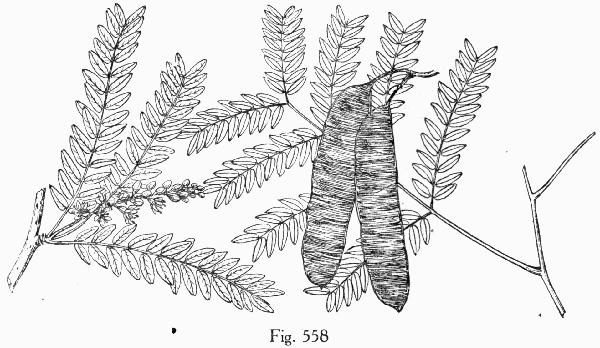
Leaves 6′—7′ long, 12—22-foliolulate, with a slender rachis at first puberulous, ultimately glabrous, or often bipinnate, usually with 6 or 7 pairs of pinnæ, the lower pairs frequently reduced to single large leaflets; leaflets oblong-ovate, often somewhat falcate, rounded or acute or apiculate at apex, obliquely rounded at base, finely crenately serrate, thick and firm in texture, dark green and lustrous above, pale below, ½′—1′ long, with a short petiolule coated while young, like the base of the slender orange-colored midrib, with soft pale hairs. Flowers appearing toward the end of April, the staminate dark orange-yellow, in slender glabrous often clustered racemes lengthening after the flowers begin to open and finally 3′—4′ in length; calyx campanulate, with acute lobes thickened on the margins, villose-pubescent and rather shorter and narrower than the puberulous petals; stamens with slender filaments villose near the base and green anthers; pistillate flowers unknown. Fruit 4′—5′ long, 1′ wide, straight, much compressed, rounded and short-pointed at apex, full and rounded at the broad base, thin-walled, dark chestnut-brown, [610] puberulous, slightly thickened on the margins, many-seeded, without pulp; seeds oval, compressed, dark chestnut-brown, very lustrous, ½′ long.
A tree, 100°—120° high, with a trunk rarely exceeding 2½° in diameter, ascending and spreading branches forming a narrow head, and comparatively slender more or less zigzag branchlets roughened by numerous small round lenticels, light orange-brown when they first appear, gray or orange-brown during their first year, ashy gray the following season, and unarmed. Bark thin and smooth.
Distribution. Only in a single grove on the bottom-lands of the Brazos River, near the town of Brazoria, Brazoria County, Texas.
3. Gleditsia aquatica Marsh. Water Locust.
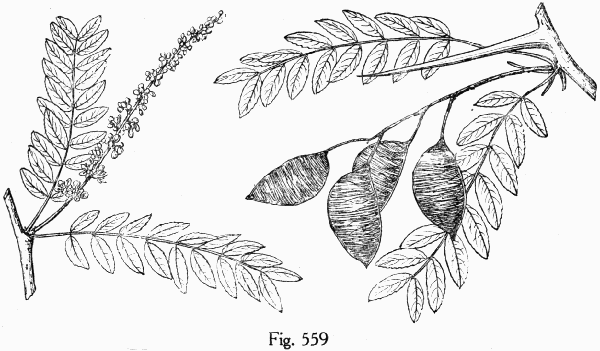
Leaves 5′—8′ long, 12—20-foliolate, or bipinnate, with 3 or 4 pairs of pinnæ; leaflets ovate-oblong, usually rounded or rarely emarginate at apex, unequally cuneate at base, slightly and remotely crenate or often entire below the middle, glabrous with the exception of a few hairs on the short stout petiolule, dull yellow-green and lustrous on the upper surface, dark green on the lower surface, about 1′ long and ⅓′—½′ wide. Flowers appearing in May and June after the leaves are fully grown on short stout purple puberulous pedicels, in slender racemes 3′—4′ long; calyx-tube covered with orange-brown pubescence, the lobes narrow, acute, slightly pilose on the two surfaces, as long as but narrower than the green erect petals rounded at apex; filaments hairy toward the base; anthers large, green; ovary long-stipitate, glabrous. Fruit fully grown in August, pendent in graceful racemes, obliquely ovoid, long-stalked, crowned with a short stout tip, thin, 1′—2′ long, 1′ broad, without pulp, its valves thin, tough, papery, bright chestnut-brown, lustrous and somewhat thickened on the margins; seeds 1 or rarely 2 or 3, flat, nearly orbicular, orange-brown, ½′ in diameter.
A tree, 50°—60° high, with a short trunk 2°—2½° in diameter, usually dividing a few feet from the ground into stout spreading often contorted branches forming a wide irregular flat-topped head, and glabrous orange-brown branchlets becoming in their second year gray or reddish brown, marked by occasional large pale lenticels, and armed with usually flattened simple or short-branched straight or falcate sharp rigid spines 3′—5′ long, about ½′ broad at the base, and dark red-brown and lustrous. Bark ⅛′—¼′ thick, smooth, dull gray or reddish brown, and divided by shallow fissures into small plate-like scales. Wood heavy, very hard and strong, coarse-grained, rich bright brown tinged with red, with thick light clear yellow sapwood of about 40 layers of annual growth.
Distribution. Eastern South Carolina to Florida, through the coast region of the Gulf [611] states to the valley of the Brazos River, Texas, and northward through western Louisiana and southern Arkansas to northwestern Mississippi, middle Kentucky and Tennessee, the bottoms of the Mississippi at La Pointe, Saint Charles County, Missouri, western and southern Illinois and southwestern Indiana; rare east of the Mississippi River and only in deep river swamps; very abundant and of its largest size westward on rich bottom-lands; in Louisiana and Arkansas often occupying extensive tracts submerged during a considerable part of the year.
9. PARKINSONIA L.
Trees or shrubs, with smooth thin bark and terete branches often armed with simple or 3-forked spines. Leaves abruptly bipinnate, alternate or fascicled from earlier axils, short-petiolate, the rachis short and spinescent, with 2—4 secondary elongated rachises bearing numerous minute opposite entire leaflets without stipels; stipules short, persistent and spinescent, or caducous. Flowers perfect on thin elongated jointed pedicels from the axils of minute caducous bracts, in slender axillary solitary or fascicled racemes; calyx short-campanulate, 5-lobed, the lobes slightly imbricated or subvalvate in the bud, narrow, membranaceous, nearly equal, becoming reflexed, deciduous; petals bright yellow, unguiculate, much longer than the lobes of the calyx, spreading, the upper petal rather broader than the others and glandular at the base of the claw; stamens 10, inserted in 2 rows on the margin of the thin disk, free, slightly declinate, those of the outer row opposite the sepals and rather longer than the others; filaments villose below the middle, the upper filament enlarged at base and gibbous on the upper side; anthers uniform, versatile; ovary short-stipitate, pilose, contracted into a slender filiform incurved style infolded in the bud and tipped with a minute stigma; ovules numerous, suspended from the inner angle of the ovary. Legume linear, torulose, acuminate at the ends, 2-valved, the valves thin, convex by the growth of the seeds, contracted between and beyond them, longitudinally striate. Seeds oblong, suspended longitudinally on a slender funicle; hilum minute, near the apex; seed-coat thin, crustaceous, light brown; embryo inclosed on the sides only by thick layers of horny albumen; cotyledons oval, flat, slightly fleshy, the radicle very short and straight.
Parkinsonia, with four species, is confined to the warm parts of America and to southern Africa. Two species occur within the limits of the United States.
The genus is named for John Parkinson (1567—1650), an English botanical author, and herbalist to James I.
CONSPECTUS OF THE NORTH AMERICAN SPECIES.
Flowers in long slender racemes; petals imbricated in the bud; stamens shorter than the petals; legume 1—8-seeded, 12′—18′ long; leaves 7′—8′ long; rachis of the pinnæ flat, wing-margined, 50—60-foliolate; branches with spines.
1. P. aculeata (G, H).
Flowers in short racemes; petals valvate in the bud; stamens longer than the petals; legume 1—2-seeded; leaves about 1′ long; rachis of the pinnæ terete, 8—12-foliolate; branches without spines.
2. P. microphylla (G, H).
1. Parkinsonia aculeata L. Retama. Horse Bean.
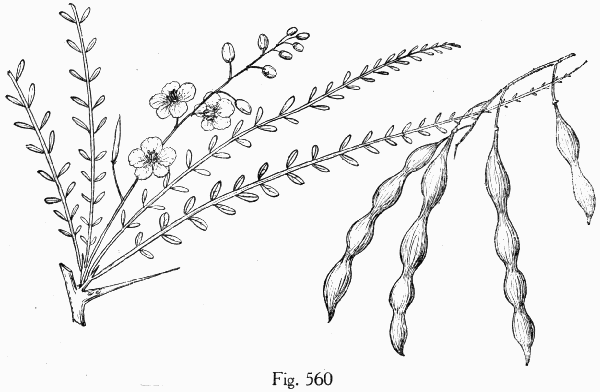
Leaves of two forms, short-petiolate, persistent, light green and glabrous, except for a few hairs on the lower part of the young secondary rachis, 12′—18′ long; primary leaves on young branches, with 2—4 pinnæ, and a spinescent rachis developing into a stout ridged persistent short-pointed chestnut-brown spine 1′—1½′ long and marked near the base by the prominent scars left by the fall of the pinnæ; stipules persistent, appearing as lateral spiny branches on the spines; secondary leaves fascicled from the axils of the primary leaves, nearly sessile with a short terete spinescent rachis and 2 pinnæ; pinnæ flat, 12′—18′ in length, wing-margined, acute at apex, with 25—30 pairs of ovate or obovate petiolulate leaflets, 1/16′—⅛′ long. Flowers appearing on the growing branches during the spring [612] and summer, and in the tropics throughout the year, on slender pedicels ⅓′—½′ in length, in slender erect racemes 5′—6′ long; petals bright yellow, the upper one marked near the base on the inner surface with conspicuous red spots; stamens shorter than the petals. Fruit hanging on pedicels ½′—¾′ in length, in graceful racemes, 2′—4′ long, long-pointed, dark orange-brown, slightly pilose, compressed between the remote seeds; seeds ⅓′ long, nearly terete, with thick albumen and a bright yellow embryo.
A tree, 18°—30° high, with a trunk sometimes a foot in diameter, usually separating 6°—8° from the ground into slender spreading somewhat pendulous branches forming a wide graceful head, and slightly zigzag branchlets puberulous and yellow-green during their first season, becoming glabrous, gray or light orange color and roughened by lenticels in their second and third years. Bark of the trunk about ⅛′ thick, brown tinged with red, the generally smooth surface broken into small persistent plate-like scales. Wood heavy, hard, close-grained, with very thick lighter colored sapwood tinged with yellow.
Distribution. Low moist soil, valley of the lower Rio Grande, Texas; common in northern Mexico and in the valley of the lower Colorado River, Arizona; widely distributed in Lower California; naturalized on Key West, the Bahamas, the West Indian islands, and in many other tropical countries.
Cultivated in most warm countries as an ornament of gardens, and to form hedges.
2. Parkinsonia microphylla Torr.
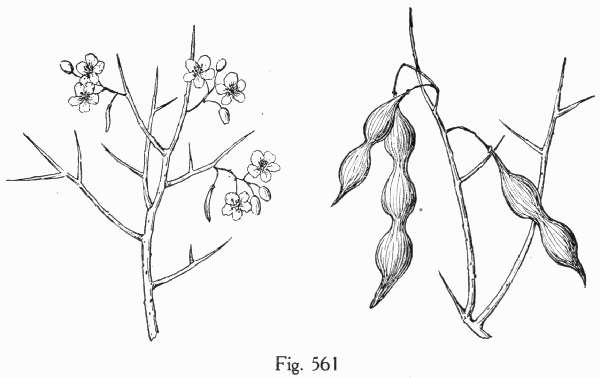
Leaves 1′ long, pale, densely tomentose when they unfold, pubescent at maturity, deciduous at the end of a few weeks; petiole ¼′ long; rachis short, rarely spinescent; leaflets in 4—6 pairs, distant, entire, sessile, broad-oblong or nearly orbicular, obtuse or somewhat acute at apex, oblique at base, ⅙′ long; stipules caducous. Flowers opening in May or early June before the leaves, on slender pedicels, in racemes 1′ or less long from the axils of leaves of the previous year, pale yellow; stamens longer than the petals. Fruit persistent on the branches for at least a year, frequently 1 or 2, rarely 3-seeded, 2′—3′ long, slightly puberulous, especially toward the base, with a long acuminate often falcate apex; seeds compressed, ⅓′ long, with a bright green embryo.
An intricately branched tree, occasionally 20°—25° high, with a trunk a foot in diameter, and stout pale yellow-green rigid branchlets terminating in a stout spine, covered at first with deciduous tomentum, slightly puberulous during their first and second seasons, and often marked by the persistent scales of undeveloped buds. Bark dark orange color, generally [613] smooth, although sometimes roughened by scattered clusters of short pale gray horizontal ridges, becoming on old trees ¼′ thick; more often a shrub, frequently only a few feet tall. Wood heavy, hard, close-grained, dark orange-brown streaked with red, with thick light brown or yellow sapwood of 25—30 layers of annual growth.
Distribution. Deserts of southern Arizona and adjacent regions of California and Sonora, and in northern Lower California; known to attain the size and habits of a tree only in the neighborhood of Wickenburg, Maricopa County, Arizona.
10. CERCIDIUM Tul.
Trees or shrubs, with stout tortuous branches, covered with bright green bark and armed with slender straight axillary spines, and minute obtuse buds. Leaves alternate, abruptly pinnate, petiolate, early deciduous; pinnæ 2 or occasionally 3, 6—8-foliolate; stipules inconspicuous or 0; leaflets ovate or obovate, without stipels. Flowers perfect in short few-flowered axillary racemes, solitary or fascicled, with minute membranaceous early deciduous bracts; calyx 5-lobed, the lobes equal, acute, reflexed at maturity, their margins scarious, slightly revolute; petals orbicular or short-oblong, unguiculate, bright yellow, the upper petal broader and longer clawed than the others, slightly auriculate at base of the blade, the claw conspicuously glandular at base; stamens 10, inserted with the petals on the margin of the disk, free, slightly declinate, exserted; filaments filiform, pilose below, the upper filament enlarged at base and gibbous on the upper side; anthers uniform, ovoid, versatile; ovary short-stalked, inserted at the base of the calyx-tube; styles slender, involute, infolded in the bud, with a minute terminal stigma; ovules suspended from the angle of the ovary opposite the posterior petal. Legume linear-oblong, compressed or somewhat turgid, straight or slightly contracted between the seeds, thickened on the margins, the ventral suture acute, or slightly grooved, tipped with the remnants of the style, tardily dehiscent, 2-valved, the valves membranaceous or subcoriaceous, obliquely veined. Seeds suspended longitudinally on a long slender funicle, ovoid, compressed, the minute hilum near the apex; seed-coat thin, crustaceous; embryo compressed, light green, covered on the sides only by a thin layer of horny albumen; cotyledons oval, flat, rather fleshy; radicle very short, erect, near the hilum.
Cercidium is confined to the warmer parts of the New World, where it is distributed with four or five species from the southern borders of the United States through Mexico, Central America, and Venezuela to Mendoza. Of the three species found within the territory of the United States two are small trees.
[614]
Cercidium produces hard wood sometimes used as fuel.
The generic name, from κερκίδιον, refers to the fancied resemblance of the legume to the weaver’s instrument of that name.
CONSPECTUS OF THE NORTH AMERICAN ARBORESCENT SPECIES.
Legume compressed, with straight margins; leaflets green, slightly glandular.
1. C. floridum (E).
Legume somewhat turgid, the margins often slightly contracted between the seeds; leaflets glaucous.
2. C. Torreyanum (G, H).
1. Cercidium floridum Benth. Green-barked Acacia.
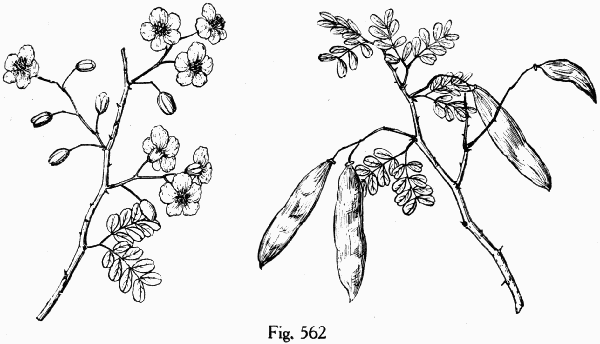
Leaves 1′—1½′ long, with 2 or rarely 3 pinnæ, a broad pubescent petiole and rachis, and oval or somewhat obovate dull green puberulous minutely glandular leaflets about 1/16′ in length, rounded or slightly emarginate at apex, and when they unfold covered on the lower surface with scattered white hairs; petiolules short, stout, pubescent; appearing in April and deciduous in October. Flowers opening with the leaves, and produced in successive crops during three or four months, ¾′ in diameter, on slender pedicels, in 4 or 5-flowered racemes 1½′—2′ long, with small acute minute membranaceous caducous bracts. Fruit compressed, oblong, straight or slightly falcate, acute, narrowly and acutely margined on the ventral suture, glabrous, 2 or 3-seeded, 2′—2½′ long, ½′ broad, tardily dehiscent, the valves papery, yellow tinged with brown on the outer surface, and bright orange color within; seeds ⅓′ long.
A tree, 18°—20° high, with a short crooked trunk 8′—10′ in diameter, stout spreading branches covered with thin smooth bright green bark, forming a low wide head, and branchlets light or dark olive-green, slightly puberulous at first, soon glabrous, marked by occasional black lenticels, and armed with slender spines 1′ or less in length. Bark 1/16′ thick, light brown tinged with red, with numerous short horizontal light gray ridge-like excrescences. Wood light, soft, close-grained, pale yellow tinged with green, with thick lighter colored sapwood.
Distribution. Shores of Matagorda Bay to Hidalgo and Valverde Counties, Texas, and in northern Mexico; not common in Texas; very abundant and a conspicuous feature of vegetation in Mexico from the mouth of the Rio Grande to the foothills of the Sierra Madre.
[615]
2. Cercidium Torreyanum Sarg. Green-barked Acacia. Palo Verde.
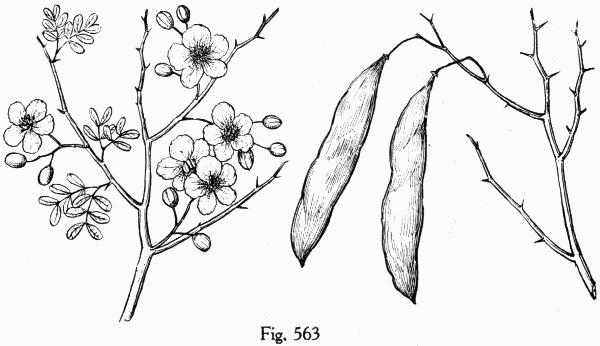
Leaves few and scattered, 1′ long, hoary-tomentose when they first appear, puberulous at maturity, with a slender petiole and 2 pinnæ, with 2 or 3 pairs of oblong obtuse glaucous leaflets narrowed toward the somewhat oblique base, 1/12′—⅙′ long; unfolding in March and April and falling almost immediately when fully grown. Flowers ¾′ in diameter, on slender pedicels ¾′—1′ long, in 4 or 5-flowered racemes about 1′ in length, with small acute membranaceous caducous bracts. Fruit ripening and falling in July, 3′—4′ long, ¼′—⅓′ wide, 2—8-seeded, slightly turgid, often somewhat contracted between the seeds, frequently grooved on the ventral suture; seeds turgid, ⅓′ long.
A low intricately branched tree, leafless for most of the year, 25°—30° high, with a short often inclining trunk 18′—20′ in diameter, stout spreading branches covered with yellow or olive-green bark, forming a wide open irregular head, and glabrous slightly zigzag light yellow or pale olive-green and glaucous branchlets armed with thin straight or curved spines ¼′ long. Bark thin, smooth, pale olive-green, becoming near the base of old trunks reddish brown, ⅛′ thick, furrowed and separating into thick plate-like scales. Wood heavy, not strong, soft, close-grained, light brown, with clear light yellow sapwood.
Distribution. Sides of low cañons and depressions, and sandhills of the desert; valley of the lower Gila River, Arizona, to the Colorado Desert of southern California, and southward into Sonora and Lower California; when in flower in early spring the conspicuous and most beautiful feature of the vegetation of the Colorado Desert.
11. SOPHORA L.
Trees or shrubs, with minute scaly buds, unarmed terete branches prolonged by an upper axillary bud, and fibrous roots. Leaves unequally pinnate, with numerous small or few and ample thin or coriaceous leaflets; stipules minute, deciduous; stipels often 0. Flowers in terminal or axillary racemes, with linear minute deciduous bracts and bractlets; calyx broad-campanulate, often slightly turbinate or obconic at base, obliquely truncate, the short teeth nearly equal or the 2 upper subconnate and often somewhat larger than the others; disk cupuliform, glandular, adnate to the calyx-tube; corolla papilionaceous; petals white or violet blue, unguiculate; standard obovate or orbicular, usually shorter than the oblong, suberect keel-petals, as long or rather longer than the oblong-oblique wings, overlapping each other at the back, barely united; stamens free, or 9 of them slightly united at base, uniform; anthers attached on the back near the middle; ovary short-stipitate, contracted into an incurved style, with a minute truncate or slightly [616] rounded capitate stigma; ovules numerous, suspended from the inner angle of the ovary, superposed, amphitropous. Legume terete, much contracted between the seeds, woody or fleshy, usually many-seeded, each seed inclosed in a separate cell, indehiscent. Seed oblong or oval, sometimes somewhat compressed; seed-coat thick, membranaceous or crustaceous; cotyledons thick and fleshy; radicle short and straight or more or less elongated and incurved.
Sophora is scattered over the warmer parts of the two hemispheres, with about twenty species of trees, shrubs or herbs; of the six North American species two are small trees. Several of the species produce valuable wood, and from the pods and flower-buds of the Chinese Sophora japonica L., a dye is obtained used to dye white cloth yellow and blue cloth green. This tree is often cultivated as an ornament of parks and gardens in northern China, Japan, the eastern United States, and in western, central, and southern Europe.
The generic name is from Sophera, the Arabic name of some tree with pea-shaped flowers.
CONSPECTUS OF THE NORTH AMERICAN ARBORESCENT SPECIES.
Flowers violet blue, in terminal racemes; the upper calyx-lobes larger than the others and united; legume woody; seeds without albumen; leaves coriaceous, persistent.
1. S. secundiflora (C, E, H).
Flowers white, in axillary racemes; calyx-lobes equal; legume fleshy; seeds with albumen; leaves thin, deciduous.
2. S. affinis (C).
1. Sophora secundiflora DC. Frijolito. Coral Bean.
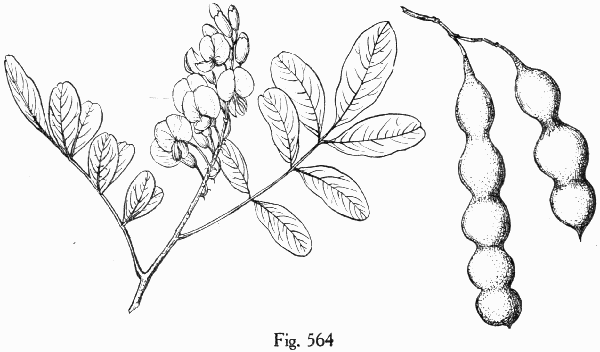
Leaves persistent, covered when they unfold, especially on the lower surface of the leaflets, with silky white hairs, and at maturity 4′—6′ long, with a stout puberulous petiole slightly enlarged at base, and 7—9 oblong-elliptic leaflets rounded, emarginate or sometimes mucronate at apex, gradually contracted at base into a short thick petiolule, coriaceous, lustrous and dark yellow-green above, rather paler below, glabrous or sometimes slightly puberulous along the under side of the stout midrib, entire, with thickened margins, conspicuously reticulate-veined, 1′—2½′ long, ½′—1½′ wide, without stipels. Flowers with a powerful and delicious fragrance, appearing with the young leaves in very early spring, 1′ long, on stout pedicels sometimes 1′ in length, from the axils of subulate deciduous bracts ½′ or more long, and bibracteolate with 2 acute bractlets, in terminal 1-sided canescent racemes 2′—3′ in length; calyx campanulate, slightly enlarged on the upper side, the 3 lower teeth triangular and nearly equal, the 2 upper rather larger and united almost [617] throughout; petals shortly unguiculate, violet blue or rarely white, the broad erect standard marked on the inner surface near the base with a few darker spots; ovary coated with long silky white hairs. Fruit terete, 1′—7′ long, ½′ thick, stalked, crowned with the thickened remnants of the style, covered with thick hoary tomentum, indehiscent, 1—8-seeded, with hard woody walls ¼′ thick; seeds short-oblong, rounded, ½′ long, bright scarlet, with a small pale hilum and a bony seed-coat; albumen 0; cotyledons thick, orange-colored, filling the cavity of the seed; radicle short and straight.
A tree, 25°—35° high, with a straight trunk 6′—8′ in diameter, separating several feet from the ground into a number of upright branches forming a narrow head, and branchlets coated when they first appear with fine hairy tomentum, becoming glabrous or nearly glabrous in their second year and pale orange-brown; more often a shrub, with low clustered stems. Wood very heavy, hard, close-grained, orange-colored, streaked with red, with thick bright yellow sapwood of 10—12 layers of annual growth. The seeds contain a poisonous alkaloid, sophorin, with strong narcotic properties.
Distribution. Borders of streams, forming thickets or small groves, in low rather moist limestone soil; shores of Matagorda Bay, Texas, to the mountain cañons of New Mexico, and to those of Nuevo Leon and San Luis Potosí; of its largest size in the neighborhood of Matagorda Bay; south and west, especially west of the Pecos River, rarely more than a shrub.
Occasionally cultivated in the gardens of the southern states.
2. Sophora affinis T. & G.
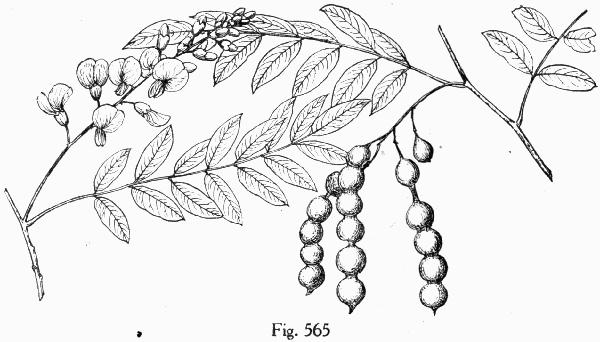
Leaves deciduous, coated when they unfold with hoary pubescence, 6′—9′ long, with a slender puberulous petiole, and 13—19 elliptic, acute or obtuse slightly mucronate leaflets contracted into short stout pubescent petiolules, entire or with slightly wavy thickened margins, thin, pale yellow-green and glabrous above, paler and covered with scattered hairs or nearly glabrous below, 1′—1½′ long and ½′ wide, with a prominent orange-colored midrib, slender primary veins, and conspicuous reticulate veinlets. Flowers ½′ long, appearing in early spring with the young leaves, on slender canescent pedicels nearly ½′ long, from the axils of minute deciduous bracts, in slender pubescent semipendent racemes, 3′—5′ long, from the axils of the leaves at the end of the branches; calyx short-campanulate, abruptly narrowed at base, somewhat enlarged on the upper side, slightly pubescent, especially on the margins of the short nearly triangular teeth; petals short-unguiculate, white tinged with rose color; standard nearly orbicular, slightly emarginate, reflexed, as long and twice as broad as the ovate auriculate wing-petals and the keel-petals; ovary conspicuously [618] stipitate, villose. Fruit ½′—3′ long, indehiscent, black, more or less pubescent, crowned with the thickened remnants of the style, 4—8-seeded, or rarely 1-seeded and then subglobose, with thin fleshy rather sweet walls; persistent on the branches during the winter; seeds oval, slightly compressed, with a thin crustaceous bright chestnut-brown seed-coat; cotyledons surrounded by a thin layer of horny albumen, bright green; radicle long and incurved.
A tree, 18°—20° high, with a trunk 8′—10′ in diameter, dividing into a number of stout spreading branches forming a handsome round-topped head, and slender terete slightly zigzag branchlets, orange-brown or dark brown and slightly puberulous when they first appear, becoming bright green marked by narrow brown ridges, and in their second year by the elevated tomentose leaf-scars. Winter-buds depressed, almost surrounded by the base of the petiole, with broad scales coated on the outer surface with dark brown tomentum and on the inner surface with thicker pale tomentum, and persistent on the base of the growing shoot. Bark of the trunk about ⅛′ thick, dark reddish brown, and broken into numerous oblong scales, the surface exfoliating in thin layers. Wood heavy, very hard and strong, light red in color, with thick bright clear yellow sapwood of 10—12 layers of annual growth.
Distribution. Usually on limestone hills, or on the borders of streams, ravines, or depressions in the prairie, often forming small groves; valley of the Red River at Shreveport, Caddo Parish, Louisiana, to the valley of the Arkansas River, Arkansas, and to southern Oklahoma (Choctaw and Love Counties), and southward in Texas to the valley of the San Antonio and upper Guadalupe Rivers (Kerrville, Kerr County).
12. CLADRASTIS Raf.
A tree, with copious watery juice, smooth gray bark, slender slightly zigzag terete branchlets without a terminal bud, fibrous roots, and naked axillary buds 4 together, superposed, flattened by mutual pressure into an acuminate cone, and inclosed collectively in the hollow base of the petiole, the largest and upper one only developing, the lowest minute and rudimentary. Leaves unequally pinnate, petiolate, with a stout terete petiole abruptly enlarged at base, 7—11-foliolate, deciduous; leaflets usually alternate, broadly oval, the terminal one rhombic-ovate, contracted at apex into a short broad point, cuneate at base, entire, petiolulate, without stipels, covered at first like the young shoots with fine silvery pubescence, and on the midrib with lustrous brown tomentum, at maturity thin, glabrous, dark yellow-green on the upper surface, pale on the lower surface, the midrib and numerous primary veins conspicuous, light yellow below; stipules 0. Flowers on slender puberulous pedicels, bibracteolate near the middle, with scarious caducous bractlets, in long gracefully nodding stalked terminal panicles, the lower branches racemose, and often springing from the axils of 1-flowered pedicels, the main axis slightly zigzag, and, like the branches, covered at first with a glaucous bloom and slightly pilose; bracts lanceolate, scarious, pale, caducous; calyx cylindric-campanulate, enlarged on the upper side, and obliquely obconic at base, puberulous, 5-toothed, the teeth imbricated in the bud, nearly equal, short and obtuse, the 2 upper slightly united; disk cupuliform, adnate to the interior of the calyx-tube; corolla papilionaceous; petals white, unguiculate; standard nearly orbicular, entire or slightly emarginate, reflexed above the middle, barely longer than the straight oblong wing-petals, slightly biauriculate at the base of the blade, marked on the inner surface with a pale yellow blotch; keel-petals free, oblong, nearly straight, obtuse, slightly subcordate or biauriculate at base; stamens 10, free; filaments filiform, slightly incurved near the apex, glabrous; anthers versatile; ovary linear, stipitate, bright red, villose with long pale hairs, contracted into a long slender glabrous slightly incurved subulate style; stigma terminal, minute; ovules numerous, suspended from the inner angle of the ovary, superposed. Legume glabrous, short-stalked, linear-compressed, the upper margin slightly thickened, tipped with the remnants of the persistent style, 4—6-seeded, ultimately dehiscent, the valves thin and membranaceous. Seeds [619] short-oblong, compressed, attached by a slender funicle; without albumen; seed-coat thin, membranaceous, dark brown; embryo filling the cavity of the seed; cotyledons fleshy, oblong, flat; radicle short, inflexed.
Four species are now known. One inhabits the southern United States, two occur in western China and one in Japan.
Cladrastis, from κλάδος and θραυστός, relates to the brittleness of the branches.
1. Cladrastis lutea K. Koch. Yellow Wood. Virgilia.
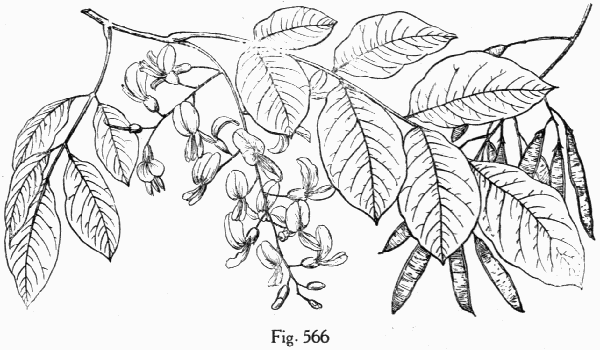
Leaves 8′-12′ in length, with leaflets 3′—4′ long and 1½′—2′ wide, the terminal leaflet rather shorter than the others and 3′—3½′ wide; turning bright clear yellow rather late in the autumn some time before falling. Flowers appearing about the middle of June, slightly fragrant, in panicles 12′—14′ long and 5′—6′ wide. Fruit fully grown by the middle of August, ripening in September and soon falling.
A tree, sometimes 50°-60° high, with a trunk 1½°—2° or exceptionally 4° in diameter, usually divided 6°—7° from the ground into 2 or 3 stems, slender wide-spreading more or less pendulous brittle branches forming a wide graceful head, and zigzag branchlets clothed with pubescence when they first appear, soon becoming glabrous, during their first season light brown tinged more or less with green, very smooth and lustrous, and covered by numerous darker colored lenticels, bright red-brown in their first winter and marked by large elevated leaf-scars surrounding the buds, and dark dull brown the following year. Bark of the trunk ⅛′—¼′ thick, with a silvery gray or light brown surface and rather darker colored than that of the branches. Wood heavy, very hard, strong and close-grained, with a smooth satiny surface, bright clear yellow changing to light brown on exposure, with thin nearly white sapwood; used for fuel, occasionally for gun-stocks, and yielding a clear yellow dye.
Distribution. Limestone cliffs and ridges generally in rich soil, and often overhanging the banks of mountain streams; Cherokee County, North Carolina, and the western slopes of the high mountains of eastern Tennessee; central Tennessee and Kentucky; near Florence, Lauderdale County, and cliffs of the Warrior River, Tuscaloosa County, Alabama; Forsythe, Taney County, and Eagle Rock, Barry County, Missouri; rare and local; most abundant in the neighborhood of Nashville, Tennessee, and in Missouri.
Often planted in the eastern United States as an ornamental tree, and hardy as far north as New England; and rarely in western and southern Europe; usually only flowering in alternate years.
[620]
13. EYSENHARDTIA H. B. K.
Small glandular-punctate trees or shrubs, with slender terete branchlets. Leaves alternate, equally pinnate, petiolate; leaflets oblong, mucronate or emarginate at apex, short-petiolulate, numerous, stipellate; stipules subulate, caducous. Flowers short-pedicellate, in long spicate racemes, terminal or axillary, with subulate caducous bracts; calyx-tube campanulate, conspicuously glandular-punctate, 5-toothed, the acute teeth nearly equal, persistent; disk cupuliform, adnate to the base of the calyx-tube; corolla subpapilionaceous; petals erect, free, nearly equal, oblong-spatulate, rounded at apex, unguiculate, creamy white; standard concave, slightly broader than the wing and keel-petals; stamens 10, inserted with the petals, the superior stamen free, shorter than the others united to above the middle into a tube; anthers uniform, oblong; ovary subsessile, contracted into a long slender uncinate style geniculate and conspicuously glandular below the apex; stigma introrse, oblique; ovules 2 or 3, rarely 4, attached to the inner angle of the ovary, superposed. Legume small, oblong or linear-falcate, compressed, tipped with the remnants of the style, indehiscent, pendent. Seeds usually solitary, rarely 2, oblong-reniform, without albumen; seed-coat coriaceous; embryo filling the cavity of the seed; cotyledons flat, fleshy; radicle superior, short and erect.
Eysenhardtia is confined to the warmer parts of the New World, and is distributed from western Texas and southern New Mexico and Arizona to southern Mexico, Lower California, and Guatemala. Four species are distinguished; of these three species occur within the territory of the United States, and in northern Mexico, and one species is found only in Guatemala. Lignum nephriticum formerly celebrated in Europe for its reputed medical properties and for the fluorescence of its infusion in spring water is the wood of the shrubby Eysenhardtia polystachya Sarg. of western Texas and Mexico.
Of the North American species one is a small tree.
The generic name is in honor of Karl Wilhelm Eysenhardt (1794—1825), Professor of Botany in the University of Königsberg.
1. Eysenhardtia orthocarpa S. Wats.
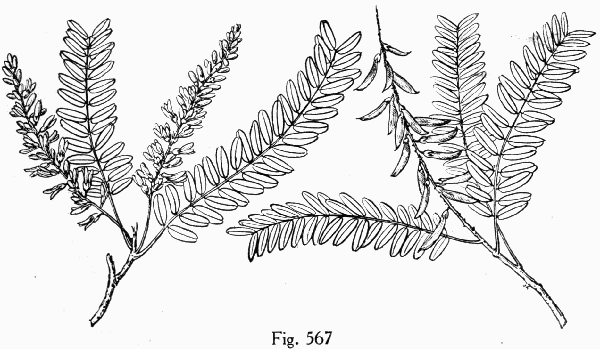
Leaves 4′—5′ long, with a pubescent rachis grooved on the upper side, 10—23 pairs of leaflets, and small scarious deciduous stipules; leaflets oval, rounded or slightly emarginate at apex, with a stout petiolule and minute scarious deciduous stipels, pale gray-green, glabrous or slightly puberulous on the upper surface, conspicuously glandular, with chestnut-brown glands, and pubescent especially on the prominent midrib on the lower surface, [621] reticulate-veined, ½′—⅔′ long, ⅛′—¼′ wide, with thickened slightly revolute margins. Flowers opening in May, nearly ½′ long, on slender pubescent pedicels, in axillary pubescent spikes 3′—4′ long; calyx many-ribbed, pubescent, conspicuously glandular, half as long as the white petals ciliate on the margins, and of nearly equal size and shape. Fruit ½′ long, pendent, nearly straight or slightly falcate, thickened on the edges, with usually a single seed near the apex; seed compressed, light reddish brown, ¼′ long.
A tree, occasionally 18°—20° high, with a trunk 6′—8′ in diameter, separating 3° or 4° above the ground into a number of slender branches, and branchlets coated when they first appear with ashy gray pubescence disappearing during the second year, and then reddish brown and roughened by numerous glandular excrescences; or more often a low rigid shrub. Bark of the trunk about 1/16′ thick, light gray, and broken into large plate-like scales, exfoliating on the surface into thin layers. Wood heavy, hard, close-grained, light reddish brown, with thin clear yellow sapwood of 7 or 8 layers of annual growth.
Distribution. Dry gravelly soil, on arid slopes and dry ridges; valley of the upper Guadalupe River, western Texas, to the Santa Catalina and Santa Rita Mountains, southern Arizona, and southward into northern Mexico; arborescent in the United States only near the summit of the Santa Catalina Mountains.
14. DALEA L.
Glandular-punctate herbs, small shrubs, or rarely trees. Leaves alternate, unequally pinnate, or simple in the arborescent species; stipules generally minute, subulate, deciduous. Flowers in racemes, their bracts membranaceous or setaceous, broad, concave above, glandular-dentate; calyx 5-toothed or lobed, persistent, the divisions nearly equal; corolla papilionaceous; petals unguiculate; standard cordate, free, inserted in the bottom of the tubular disk connate to the calyx-tube, rather shorter than the wing- and keel-petals, the claws adnate to and jointed upon the staminal tube; stamens 10, sometimes 9 through the suppression of the superior stamen, united into a tube cleft above and cup-shaped toward the base; anthers uniform, often surmounted by a gland; ovary sessile or short-stalked, contracted into a slender subulate style, with a minute terminal stigma; ovules 4—6 attached to the inner angle of the ovary, superposed. Legume ovoid, sometimes conspicuously ribbed, more or less inclosed in the calyx, membranaceous, indehiscent, 1-seeded; seed reniform, without albumen; testa coriaceous; embryo filling the cavity of the seed; cotyledons broad and flat; radicle superior, accumbently reflexed.
Dalea is confined to the New World, where it is distributed from the central, western, and southwestern regions of the United States through Mexico and Central America to Peru, Chile, and the Galapagos Islands; usually herbs or low undershrubs, one species of the United States occasionally assumes the habit and attains the size of a small tree.
The generic name is in honor of Samuel Dale (1659—1739), an English botanist and writer on the materia medica.
1. Dalea spinosa A. Gray. Smoke Tree.
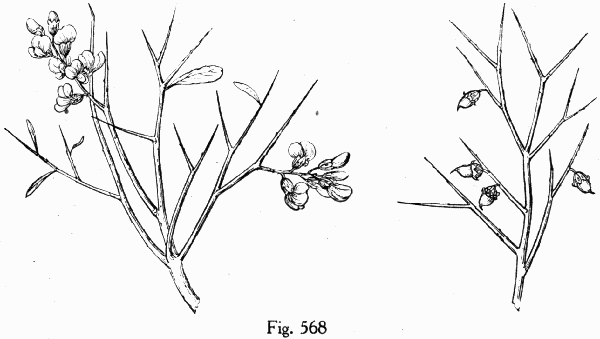
Leaves few, simple, irregularly scattered near the base of the spinose branchlets, cuneate or linear-oblong, sessile or nearly sessile, marked by few large glands, especially on the entire wavy margins, hoary-pubescent, ¾′—1′ long, ⅛′—½′ wide, with a broad midrib and three pairs of lateral ribs, on vigorous young shoots or seedling plants remotely and coarsely serrate; remaining only for a few weeks on the branches; stipules minute, ovate, acute, pubescent. Flowers ½′ long, appearing in June on short pedicels from the axils of minute bracts, in racemes 1′—1½′ long, their rachis slender, spinescent, hoary-pubescent; calyx-tube 10-ribbed, with usually 5 glands between the dorsal ribs, the lobes short, ovate, rounded or more or less ciliate on the margins, reflexed at maturity; petals dark violet blue, standard cordate, reflexed, furnished at base of the blade with two conspicuous glands, wing- and keel-petals attached to the staminal tube by their base only and nearly equal in size, rounded at apex, more or less irregularly lobed at base; ovary pubescent, glandular [622] punctate. Fruit ovoid, pubescent, glandular, twice as long as the calyx, tipped with the remnants of the recurved style; seed ⅛′ long, pale brown irregularly marked with dark spots.
A tree, 18°—20° high, with a short stout contorted trunk sometimes 20′ in diameter and divided near the ground into several upright branches, and branchlets reduced to slender sharp spines coated with fine pubescence, bearing minute nearly triangular scarious caducous bracts, marked by occasional glandular fistules, and developed from stouter branches hoary-pubescent when young, becoming glabrous in their third year and covered with pale brown bark roughened with lenticels and as it exfoliates showing the pale green inner bark; more often a low rigid intricately branched shrub. Bark of the trunk dark gray-brown, nearly ¼′ thick, deeply furrowed, and roughened on the surface by small persistent scales. Wood light, soft, rather close-grained, walnut-brown in color, with nearly white sapwood of 12—15 layers of annual growth.
Distribution. Valley of the lower Gila River, Arizona, through the Colorado Desert to San Felipe and Palm Springs, Riverside County, California, and southward into Sonora and Lower California.
15. ROBINIA L. Locust.
Trees or shrubs, with slender terete or slightly many-angled zigzag branchlets, without a terminal bud, minute naked subpetiolar depressed-globose axillary buds 3 or 4 together, superposed, protected collectively in a depression by a scale-like covering lined on the inner surface with a thick coat of tomentum and opening in early spring, its divisions persistent during the season on the base of the branchlet developed usually from the upper bud. Leaves unequally pinnate, petiolate, deciduous; leaflets entire, penniveined, stipellate, reticulate-venulose, petiolulate; stipules setaceous, becoming spinescent at maturity, persistent. Flowers on long pedicels, in short pendulous racemes from the axils of leaves of the year, with small acuminate caducous bracts and bractlets; calyx campanulate, 5-toothed or cut, the upper lobes shorter than the others, cohering for part of their length; corolla papilionaceous, petals shortly unguiculate, inserted on a tubular disk glandular on the inner surface and connate with the base of the calyx-tube; standard large, reflexed, barely longer than the wing- and keel-petals, naked on the inner surface, obcordate, reflexed; wings oblong-falcate, free; keel-petals incurved, obtuse, united below; stamens 10, inserted with the petals, the 9 inferior united into a tube often enlarged at base and cleft on the upper side, the superior stamen free at the base and connate in the middle [623] with the staminal tube, or finally free; anthers ovoid; ovary inserted at the base of the calyx, linear-oblong, stipitate; style subulate, inflexed, bearded along the inner side near the apex, with a small terminal stigma; ovules numerous, suspended from the inner angle of the ovary, in two ranks, superposed. Legumes in drooping many-fruited racemes, many-seeded, linear, compressed, almost sessile, 2-valved, the seed-bearing suture narrow-winged; valves thin and membranaceous. Seed oblong-oblique, transverse, attached by a stout persistent incurved funicle enlarged at the point of attachment to the placenta; seed-coat thin, crustaceous; albumen thin, membranaceous; cotyledons oval, fleshy; radicle short, much reflexed, accumbent.
Robinia with seven or eight species is confined to the United States and Mexico; of the species found in the United States three are arborescent.
The generic name commemorates the botanical labors of Jean and Vespasien Robin, arborists and herbalists of the kings of France in the sixteenth and seventeenth centuries.
CONSPECTUS OF THE ARBORESCENT SPECIES OF THE UNITED STATES.
Legume without glandular hairs; flowers white.
1. R. Pseudoacacia (A, C).
Legume glandular-hispid (in the arborescent form of No. 2); flowers rose color.
Glands not viscid.
2. R. neo-Mexicana (F, H).
Glands exuding a clammy sticky substance.
3. R. viscosa (A).
1. Robinia Pseudoacacia L. Locust. Acacia. Yellow Locust.
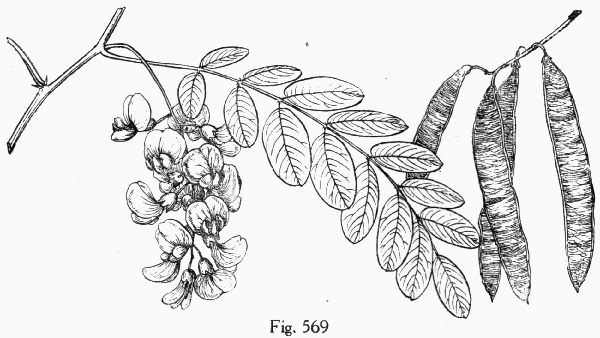
Leaves 8′—14′ long, with a slender puberulous petiole, and 7—19 leaflets; turning pale clear yellow late in the autumn just before falling; stipules ½′ long, linear, subulate, membranaceous, at first pubescent and tipped with small tufts of caducous brown hairs, becoming straight or slightly recurved spines persistent for many years and ultimately often more than 1′ in length; leaflets oval, rounded or slightly truncate and minutely apiculate at apex, when they unfold covered with caducous silvery pubescence, at maturity very thin, dull dark blue-green above, pale below, glabrous with the exception of the slight pubescence on the under side of the slender midrib, 1½′—2′ long and ½′—¾′ wide; petiolules stout, ⅛′—¼′ in length; stipules minute, linear, membranaceous, early deciduous. Flowers opening in May or early in June, filled with nectar, very fragrant, on slender pedicels ½′ long and dark red or red tinged with green, in loose puberulous racemes 4′—5′ long; calyx conspicuously gibbous on the upper side, ciliate on the margins, dark green blotched with red, especially on the upper side, the lower lobe acuminate and much longer than the nearly triangular [624] lateral and upper lobes; petals pure white, with a large pale yellow blotch marking the inner surface of the standard. Fruit ripening late in the autumn, 3′—4′ long and ½′ wide, with bright red-brown valves, usually 4—8-seeded, mostly persistent until the end of winter or early spring; seeds 3/16′ long, dark orange-brown, with irregular darker markings.
A tree, 70°—80° high, with a trunk 3°—4° in diameter, small brittle usually erect branches forming a narrow oblong head, and slender terete or sometimes slightly many-angled branchlets marked by small pale scattered lenticels, coated at first with short appressed silvery white deciduous pubescence, pale green and puberulous during their first summer, becoming light reddish brown and glabrous or nearly glabrous toward autumn. Bark of the trunk 1′—1½′ thick, deeply furrowed, dark brown tinged with red, and covered by small square persistent scales. Wood heavy, exceedingly hard and strong, close-grained, very durable in contact with the ground, brown or rarely light green, with pale yellow sapwood of 2 or 3 layers of annual growth; formerly extensively used in shipbuilding, for all sorts of posts, in construction and turnery; preferred for treenails, and valued as fuel.
Distribution. Slopes of the Appalachian Mountains, central and southern Pennsylvania, to northern Georgia; in southern Illinois; now widely naturalized in the United States east of the Rocky Mountains, and perhaps indigenous as a low shrub in northeastern and western Arkansas and in Oklahoma; nowhere common; in the Appalachian forest growing singly or in small groups up to altitudes of 3500°; most abundant and of its largest size on the western slopes of the Alleghanies of West Virginia; often spreading by underground stems into broad thickets of small and often stunted trees.
Formerly much planted as an ornamental and timber tree in the eastern states; very frequently used in Europe, with numerous seminal varieties of peculiar foliage or habit, for the decoration of parks and gardens, and to shade the streets of cities.
2. Robinia neo-mexicana A. Gray. Locust.
In its typical form a shrub only a few feet high. The hairs on the fruit not glandular-hispid.
Distribution. Mountain cañons and plains, Grant County, New Mexico. Passing into
Robinia neo-mexicana var. luxurians Dieck.
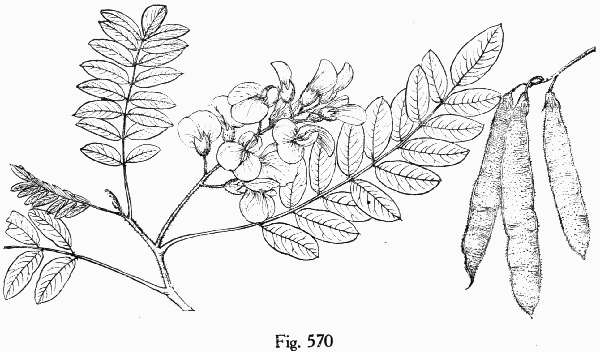
Leaves 6′—12′ long, with a stout pubescent petiole, and 15—21 leaflets; stipules chartaceous, covered with long silky brown hairs, becoming at maturity stout slightly recurved flat brown or bright red spines sometimes 1′ or more long; leaflets elliptic-oblong, rounded or sometimes slightly emarginate at the mucronate apex, cuneate or sometimes rounded [625] at base, 1½′ long, and 1′ broad, coated at first on the lower surface and on the margins with soft brown hairs, and silvery-pubescent on the upper surface, and at maturity thin, pale blue-green, conspicuously reticulate-veined, and glabrous with the exception of the slightly puberulous lower side of the slender midrib and stout petiolule; stipels membranaceous, ¼′ long, often recurved, sometimes persistent through the season. Flowers appearing in May, 1′ long, on slender pedicels ½′ in length and covered with stout glandular hairs, in short compact many-flowered glandular-hispid long-stemmed racemes; corolla pale rose color or sometimes almost white (f. albiflora Kusche), with a broad standard and wing-petals. Fruit 3′—4′ long, about ⅓′ wide, glandular-hispid, with a narrow wing; seeds dark brown, slightly mottled, 1/16′ long.
A tree, sometimes 20°—25° high, with a trunk 6′—8′ in diameter, and branchlets at first pale and coated with rusty brown glandular hairs increasing in length during the summer, and slightly puberulous, bright reddish brown, often covered with a glaucous bloom, and marked by a few small scattered pale lenticels during their first winter. Bark of the trunk thin, slightly furrowed, light brown, the surface separating into small plate-like scales. Wood heavy, exceedingly hard, strong, close-grained, yellow streaked with brown, with light yellow sapwood of 4 or 5 layers of annual growth.
Distribution. Banks of mountain streams; valley of the Purgatory River, Colorado, through northern New Mexico and Arizona to southern Utah; on the Santa Catalina and Santa Rita Mountains, southern Arizona up to altitudes of 7000°; probably of its largest size near Trinidad, Las Animas County, Colorado.
Occasionally cultivated as an ornamental tree in the eastern states, and in western Europe.
× Robinia Holdtii Beiss, a hybrid of Robinia neo-mexicana var. luxurians and R. Pseudoacacia, has appeared in a Colorado nursery and is occasionally cultivated.
3. Robinia viscosa Vent. Clammy Locust.
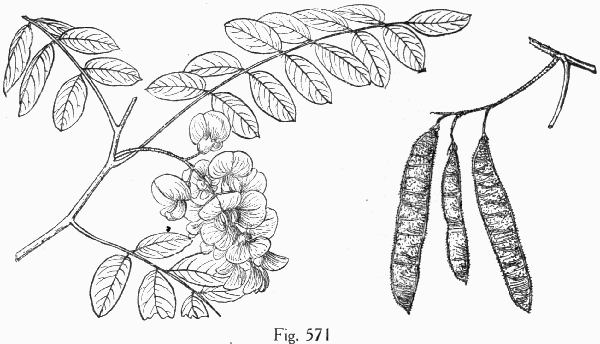
Leaves 7′—12′ long, with a stout nearly terete dark glandular-hispid clammy petiole, and 13—21 leaflets; stipules subulate, chartaceous, often deciduous or developing into short slender spines; leaflets ovate, sometimes acuminate, mucronate, rounded or pointed at apex, and cuneate at base, when they unfold covered below with soft white pubescence, and slightly puberulous above, and at maturity dark green and glabrous on the upper surface, pale and pubescent on the lower surface, especially on the slender yellow midrib and primary veins and on the stout glandular-hispid petiolule, 1½′—2′ long and ⅔′ wide; stipels slender, deciduous. Flowers ⅔′ long, almost inodorous, appearing in June, on slender [626] hairy pedicels from the axils of large lanceolate acuminate dark-red bracts contracted at apex into a long setaceous point exserted beyond the flower-buds and mostly deciduous before the flowers open, in short crowded glandular-hispid racemes; calyx dark red, coated on the outer surface and on the margins of the subulate lobes with long pale hairs; corolla pale rose or flesh color, with a narrow standard marked on the inner face by a pale yellow blotch, and broad wing-petals. Fruit narrow-winged, glandular-hispid, 2′—3½′ long; seeds ⅛′ long, dark reddish brown and mottled.
A tree, 30°—40° high, with a trunk 10′—12′ in diameter, slender spreading branches, and dark reddish brown branchlets covered with conspicuous dark glandular hairs exuding, like those on the petioles and legumes, a clammy, sticky substance, during the first winter bright red-brown, covered with small black lenticels and very sticky, becoming in their second year light brown and dry; or a shrub, often only 5°—6° tall. Bark of the trunk ⅛′ thick, smooth, dark brown tinged with red. Wood heavy, hard, close-grained, brown, with light yellow sapwood of 2 or 3 layers of annual growth.
Distribution. Mountains of North and South Carolina up to altitudes of 3000°, and now naturalized in many parts of the United States east of the Mississippi River and as far north as eastern Massachusetts.
Often planted as an ornament of parks and gardens in all countries with a temperate climate.
16. OLNEYA A. Gray.
A tree, with thin scaly bark, and stout terete hoary-canescent slightly angled branchlets armed with stout infrastipular spines. Leaves equally or unequally pinnate, hoary-canescent, persistent, 10—15-foliolulate, destitute of stipules and stipels, short-petiolate, often fascicled in earlier axils; leaflets oblong or obovate, entire, obtuse, often mucronate at apex, cuneate at base, rigid, short-petiolulate, reticulate-veined, with a broad conspicuous midrib. Flowers on stout pedicels rather longer than the calyx, in short axillary few-flowered hoary-canescent racemes, with acute minute bracts and bractlets deciduous before the expansion of the flowers; calyx hoary-canescent, the lobes ovate, obtuse, almost equal, the two upper lobes connate nearly throughout; disk cupuliform, adnate to the tube of the calyx; corolla papilionaceous; petals unguiculate, purple or violet, inserted on the disk; standard orbicular, deeply emarginate, reflexed, furnished at base of the blade with two infolded ear-shaped appendages covering 2 prominent callosites; wing-petals oblique, oblong, slightly auriculate at base of blade on the upper side, free, as long as the broad obtuse incurved keel-petals; stamens 10, the superior stamen free, filling the slit in the tube formed by the union of the others; filaments filiform; anthers of the same length, oblong, uniform; ovary sessile or slightly stipitate, pilose; style inflexed, bearded above the middle; stigma thick and fleshy, depressed-capitate; ovules numerous, suspended from the inner angle of the ovary, superposed. Legume oblique, compressed, glandular-hairy, light brown, 2-valved, often tipped with the remnants of the long persistent style, 1—5-seeded, the valves thick and coriaceous, becoming unequally and interruptedly convex at maturity. Seeds broad-ovoid, slightly angled on the ventral side, suspended by a short thick funicle, without albumen; seed-coat thin, membranaceous, bright chestnut-brown and lustrous; embryo filling the cavity of the seed; cotyledons thick and fleshy, accumbent on the short incurved radicle.
The genus is represented by a single species of southern Arizona, California, and northwestern Mexico.
Olneya is in memory of Stephen T. Olney (1812—1878), author of a catalogue of the plants of Rhode Island.
1. Olneya tesota A. Gray. Ironwood.
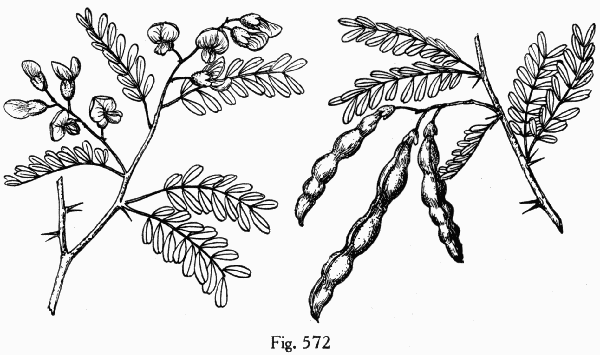
Leaves 1′—2½′ long, with leaflets ½′—¾′ in length, appearing in June and persistent until the following spring. Flowers unfolding with the leaves, nearly ½′ long. Fruit light [627] brown, very glandular, fully grown at midsummer, ripening before the end of August, 2′—2½′ long.
A tree, sometimes 25°—30° high, with a short trunk occasionally 18′ in diameter and usually divided 4°—6° above the ground into a number of stout upright branches, and slender branchlets thickly coated at first with hoary-canescent pubescence disappearing early in their second year, and then pale green and more or less spotted and streaked with red, becoming pale brown in their third season, their spines straight or slightly curved, very sharp and rigid, ⅛′—¼′ long, and persistent at least during two years. Bark of the trunk thin, exfoliating in long longitudinal dark red-brown scales. Wood very heavy, hard and strong, although brittle, rich dark brown striped with red, with thin clear yellow sapwood; valued as fuel and sometimes manufactured into canes and other small objects.
Distribution. Sides of low depressions and arroyos in the desert; valley of the Colorado River south of the Mohave Mountains, California, to southwestern Arizona, and to Sonora and Lower California; most abundant and of its largest size in Sonora.
17. ERYTHRINA L.
Trees or shrubs with erect terete stems and branches, often armed with recurved prickles, or rarely herbaceous. Leaves alternate, pinnately 3-foliolate; stipules small, the stipels gland-like. Flowers papilionaceous, showy, in pairs or fascicled on the rachis of axillary leafless racemes, or in terminal racemes furnished at base with leaf-like bracts; calyx oblique, truncate or 5-toothed; corolla usually scarlet; petals free; standard broad or elongated, erect or spreading, nearly sessile or raised on a long stalk; wing-petals small or wanting, longer or shorter than the keel-petals; stamens 10, united into a tube split on the upper side, the tenth and upper stamen separate or all 10 united; anthers uniform; ovary stipitate, 1-celled; styles subulate, incurved, naked; stigmas small, terminal; ovules numerous, amphitropous, the micropyle superior. Fruit a stipitate linear-falcate pod narrowed at ends, compressed or subterete, constricted or undulate between the seeds, 2-valved; seeds reniform, attached by an oblong basal hilum, exalbuminous.
From twenty-five to thirty species are recognized, all inhabitants of tropical and semitropical regions. In the gardens of warm countries several of the species are cultivated for the beauty of their large and brilliant flowers.
The name is from ἐρυθρός, in allusion to the color of the flowers.
[628]
1. Erythrina herbacea var. arborea Chapm.
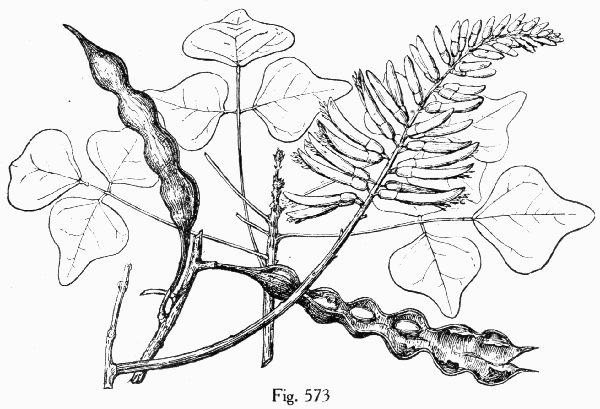
Leaves persistent, usually 6′—8′ long, with a slender petiole and rachis occasionally armed with small recurved prickles; leaflets thin, deltoid to hastate, concave-cuneate at the broad base, the lateral lobes broad and rounded and much shorter than the elongated terminal lobe gradually narrowed and rounded at apex, thin, yellow-green, smooth and glabrous, 2¼′—3½′ long and 1½′—2¼′ wide; petiolules slender, about ¼′ in length, with minute gland-like stipels. Flowers 2′—2¼′ long on short slender pedicels, in narrow leafless racemes 8′—13′ long, the lower flowers fading before those at the apex of the raceme open; calyx dark red, truncate and ciliate at the mouth, ¼′ in length; corolla scarlet; the standard narrow, oblanceolate, gradually narrowed into the long base, about ¼′ long, closely infolded and then more or less falcate; wing-petals slightly longer than the calyx and longer than the keel-petals; stamens diadelphous. Fruit compressed, constricted between the seeds, apiculate at apex, from 4′—6′ long, gradually narrowed into a stout stipitate base often ¾′ in length; seeds compressed, bright scarlet, lustrous, 5/12′ long and about ⅙′ wide, with a dark hilum.
A tree, rarely 25°—30° high, with a tall trunk occasionally a foot in diameter, small erect and spreading branches, and slender yellow-green branchlets armed with short broad recurved spines; more often shrubby and, except in size and habit, not distinguishable from Erythrina herbacea L., an herb with slender spreading stems occasionally 3° long, and common in sandy soil from the coast region of North Carolina to Florida, western Mississippi and Louisiana, and in the valley of the lower Rio Grande, Texas. Bark thin red-brown marked by longitudinal rows of large circular elevated lenticle-like excrescences.
Distribution. Florida, coast region from Miami, Dade County, to the southern shores of Tampa Bay, and on the southern keys.
18. ICHTHYOMETHIA P. Brown.
Trees or shrubs with thin scaly bark and stout terete branchlets without a terminal bud. Leaves unequally pinnate, long-petiolate; leaflets opposite. Flowers papilionaceous, on slender pedicels enlarged at the end, bibracteolate, in lateral panicles, appearing before the leaves; bracts and bractlets minute, scarious; calyx campanulate, 2-lipped, the [629] upper lip emarginate, the lower 3-lobed, persistent, the lobes imbricated in the bud, short and broad; petals inserted on an annular glandular disk adnate to the interior of the calyx-tube, unguiculate, white tinged with red, rarely yellowish white; stamens 10, the filament of the upper stamen free at base only, united above with the others into a long tube; anthers oblong, uniform, versatile; ovary sessile, contracted into a filiform incurved style, with a capitate stigma; ovules numerous, suspended from the inner angle of the ovary, 2-ranked. Legume linear, compressed, raised on a stalk longer than the calyx, slightly contracted between the numerous seeds, tomentose-canescent or glabrate, thin-walled, indehiscent, longitudinally 4-winged, the wings developed from the dorsal and ventral sutures, broad or narrow, continuous or interrupted by the abortion of some of the ovules, membranaceous, their margins undulate or irregularly cut; seeds oval, compressed, without albumen, laterally attached by a short thick funicle; seed-coat thin, crustaceous, red-brown, not lustrous; embryo filling the cavity of the seed; cotyledons plano-convex, oval, fleshy; radicle short, inflexed.
Seven or eight species are now recognized, inhabitants of tropical America where they are distributed from southern Florida, through the West Indies to southern Mexico and Guatemala. Piscidia from the bark of the roots of Ichthyomethia is sometimes used medicinally.
The generic name, from ἰχθύς and μέθυ, indicates the Carib use of one of the species.
1. Ichthyomethia piscipula A. S. Hitch. Jamaica Dogwood.
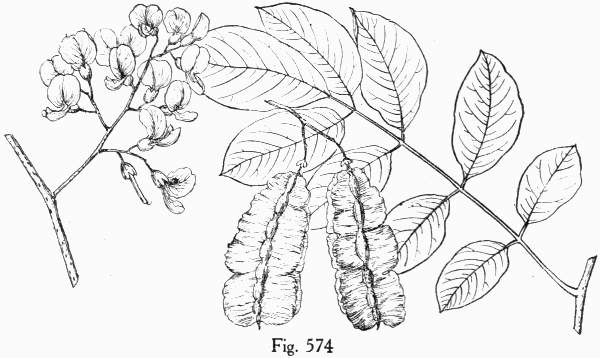
Leaves 4′—9′ long, 5—11-foliolate, with stout petioles; leaflets oval, obovate or broad-oblong, obtuse or short-acuminate at apex, rounded or cuneate at base, with thick pubescent petiolules, when they first appear coated like the petioles with rufous hairs, at maturity coriaceous, glabrous and dark green above, pale and more or less clothed below with rufous or canescent pubescence along the elevated conspicuous midrib, and numerous thin veins arching and united at the entire undulate thickened margins, or covered with soft pubescence below; deciduous in spring. Flowers opening in May, ¾′ long, on slender pedicels sometimes 1½′ in length, in canescent ovoid densely flowered or elongated thyrsoid panicles, with short 3—12-flowered branches, from the axils of the fallen leaves of the previous year; calyx canescent, 5-lobed; petals white tinged with red, the standard hoary-canescent on the outer surface, marked with a green blotch on the inner surface, its claw as long as the calyx; ovary sericeous. Fruit ripening in July and August, broad-winged, light brown, 3′—4′ long and 1′—1½′ across the wings.
A tree, 40°—50° high, with a trunk often 2°—3° in diameter, stout erect sometimes contorted [630] branches forming an irregular head, and branches coated when they first appear with thick rufous pubescence disappearing during their first summer, becoming glabrous or glabrate, bright reddish brown, conspicuously marked by oblong longitudinal lenticels, and large elevated horizontal slightly obcordate leaf-scars marked by the ends of numerous small scattered fibro-vascular bundles. Winter-buds ovoid, acute, ⅛′—¼′ long, with thin hoary-pubescent scales. Bark of the trunk about ⅛′ thick, gray more or less blotched with olive and covered with small square scales. Wood very heavy, hard, close-grained, clear yellow-brown, with thick lighter colored sapwood, very durable in contact with the ground; largely used in Florida in boat-building, and for firewood and charcoal. In the West Indies the bark of the roots, young branches and powdered leaves were used by the Caribs to stupefy fish and facilitate their capture.
Distribution. One of the commonest of the tropical trees of Florida from the shores of Bay Biscayne to the southern keys, and on the west coast from the neighborhood of Peace Creek to Cape Sable; on many of the Antilles and in southern Mexico. Sterile branches collected by C. T. Simpson in the neighborhood of Cape Sable indicate that a second species occurs in Florida.
XXIV. ZYGOPHYLLACEÆ.
Trees or shrubs, with hard resinous wood, and opposite pinnate leaves, with stipules. Flowers perfect, regular; calyx 5-lobed, the lobes imbricated in the bud; petals as many as the calyx-lobes, imbricated in the bud, hypogynous; stamens twice as many as the petals, hypogynous; filaments distinct; anthers introrse, 2-celled, the cells opening longitudinally; ovary 5-celled; styles united, terminating in a minute 5-lobed or entire stigma; ovules numerous, suspended, anatropous; raphe ventral. Fruit capsular, angled or winged, separating at maturity into 5 indehiscent carpels. Seeds solitary or in pairs in each cell; seed-coat thick and fleshy; embryo straight or nearly so; cotyledons oval, foliaceous; radicle short, superior.
Of the fourteen genera of this family, mostly confined to the warmer parts of the northern hemisphere, one only, Guaiacum, has an arborescent representative in the United States.
1. GUAIACUM L. Lignum-vitæ.
Trees or shrubs, with scaly bark, and stout terete alternate branchlets often with swollen nodes. Leaves petiolate, abruptly pinnate, with 2—14 entire reticulate-veined leaflets, and minute mostly deciduous stipules. Flowers terminal, solitary or umbellate-fascicled, pedicellate, from the axils of minute deciduous bracts; calyx-lobes slightly united at base, unequal, deciduous; petals broad-obovate, more or less unguiculate; stamens inserted on the inconspicuous elevated disk opposite to and alternate with the petals; filaments filiform, naked or bearing at base on the inner surface a minute membranaceous scale; anthers oblong; ovary raised on a short thick stalk, obovoid or clavate, 5-lobed, contracted into a slender subulate acute style; ovules 8—10 in each cell, suspended in pairs from the inner angle. Fruit fleshy, 5-celled, smooth, coriaceous, narrowed at base into a short stem, with 5 wing-like angles, ventrally and sometimes dorsally dehiscent. Seeds suspended, ovoid; seed-coat easily separable from the hard bony nucleus closely invested with a thin indistinct tegumen.
Guaiacum is confined to the New World, and is distributed from southern Florida through the Antilles, Mexico, and Central America to the Andes of Peru. Seven or eight species are distinguished.
Guaiacum produces heavy close-grained wood, the cells of the heartwood filled with dark-colored resin. The lignum-vitæ of commerce, largely used for the sheaths of ship-blocks, mallets, skittle-balls, ten-pin balls, etc., is produced principally by Guaiacum officinale L., of the Antilles and South America, and by Guaiacum sanctum L. Guaiacum resin is a stimulating diaphoretic sometimes used in the treatment of gout and rheumatism.
[631]
The generic name is from the Carib Guaiaco or Guayacon, the aboriginal name of the Lignum-vitæ.
1. Guaiacum sanctum L.
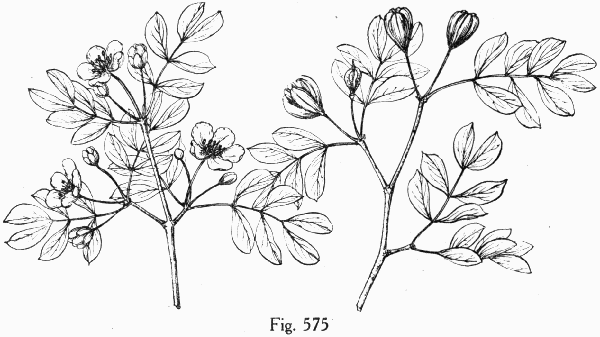
Leaves 3′ or 4′ long, with 3 or 4 pairs of obliquely oblong or obovate mucronate subsessile leaflets, membranaceous, light green and puberulous below when they first appear, becoming subcoriaceous, glabrous, dark green and lustrous on both surfaces, 1′ long and nearly ½′ wide, persistent until the appearance of the new growth in March or early April of the following year; stipules acuminate, tipped with a short mucro, pubescent, ⅛′ long, usually caducous, but sometimes persistent during the season. Flowers ⅔′ in diameter, opening almost immediately after the appearance of the new growth, and continuing to open during several weeks, solitary on a slender pubescent pedicel shorter than the leaves and usually produced 3 or 4 together at the end of the branches from the axils of the upper leaves, their bracts acuminate, minute, the 2 lateral rather smaller than the others; calyx-lobes obovate, slightly pubescent, especially on the outer surface near the base, and smaller than the blue petals twisted below from left to right, and thus appearing to be obliquely inserted; filaments naked; ovary obovoid, prominently 5-angled, glabrous, contracted at base into a short stout stalk. Fruit broad-obovoid, ¾′ long, ½′ wide, bright orange color, opening at maturity by the splitting of the thick rather fleshy valves; seeds black, with a thick fleshy scarlet aril-like outer coat.
A gnarled round-headed tree, sometimes 25°—30° high, with a short stout trunk occasionally 2½°—3° in diameter, slender pendulous branches, and branchlets conspicuously enlarged at the nodes, slightly angled, pubescent when they first appear, becoming in their second year glabrous, nearly white, and roughened by numerous small excrescences. Bark of the trunk rarely more than ⅛′ thick, separating on the surface into thin white scales. Wood dark green or yellow-brown, with thin clear yellow sapwood.
Distribution. Keys of southern Florida from Key West eastward; on the Bahama Islands and on several of the Antilles.
XXV. MALPIGIACEÆ.
Trees, shrubs or vines with opposite simple entire often stipulate persistent leaves; stipules deciduous or 0. Flowers usually perfect or dimorphous, on pedicels articulate near their base from the axils of a bract and furnished below the articulation with two bractlets, in terminal racemes, corymbs or umbels; calyx 5-lobed, the lobes generally imbricated [632] in the bud, usually glandular; petals 5, convolute in the bud, unguiculate; disk inconspicuous; stamens usually 10; filaments generally united at base; anthers short, 2-celled, introrse; ovary of 3 rarely of 2 carpels more or less united into a 3-celled ovary; styles usually 3, distinct, rarely united; stigma terminal or sublateral, inconspicuous; ovule solitary, between orthotropous and anatropous, often uncinate, ascending on the pendulous funicle; raphe ventral; micropyle superior. Fruit drupaceous or samaroid; seeds without albumen, suspended from below the apex of the cell; testa thin; embryo curved or coiled, rarely straight; cotyledons often unequal; radicle short, superior.
This family of nearly sixty genera is confined to tropical and subtropical America, with one arborescent species in the United States.
1. BYRSONIMA Rich.
Trees, or shrubs often scandent, with astringent bark and leaves; stipules usually connate, rarely partly connate or free. Flowers in terminal racemes; lobes of the calyx furnished on the back with two glands; petals unguiculate, their slender claws reflexed in anthesis, the limb concave, penniveined; stamens 10, filaments short, united and bearded at base; ovary 3-celled; styles 3, distinct, oblong or subulate, gradually narrowed into the acute stigma. Fruit a 3-celled drupe; endocarp bony or woody, angled; seeds ovoid to subglobose; embryo circinate, with slender coiled cotyledons; radicle oblong.
Byrsonima with nearly one hundred species is widely distributed in tropical America from southern Florida, where one species occurs, and the Bahama Islands through the West Indies, Mexico, Brazil and Bolivia.
The generic name is from βύρς, a hide, in allusion to the use of the bark in tanning.
1. Byrsonima lucida DC.
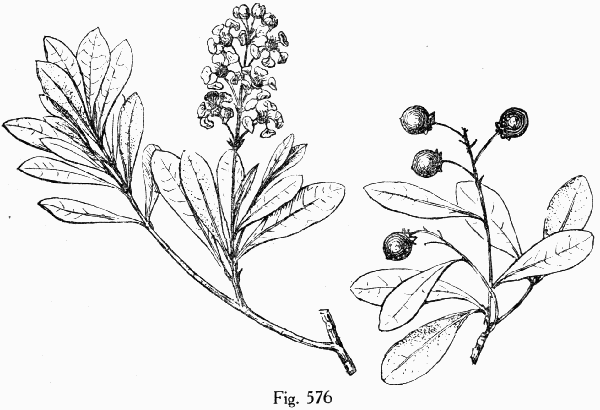
Leaves oblong-obovate, rounded or occasionally abruptly short-pointed at apex, gradually narrowed and cuneate at base, coriaceous, glabrous, dark green and lustrous above, paler, dull and reticulate-venulose beneath, 1′—1½′ long and ¼′—½′ wide, with thickened revolute margins, a slender midrib and obscure primary veins; petioles stout, ⅛′—¼′ in length; stipules free, minute, acute, deciduous. Flowers ¼′ in diameter, appearing throughout [633] the year on slender puberulous pedicels ¼′ to nearly ½′ long from the axils of acuminate caducous bracts a third longer than their acuminate bractlets, in terminal 5—12-flowered erect racemes ¾′—1½′ in length; calyx cup-shaped, persistent under the fruit, with short nearly triangular lobes much shorter than the white petals turning yellow, pink or rose color; styles elongated and persistent on the fruit. Fruit subglobose, greenish, about ¼′ in diameter, the flesh thin and dry; stone woody, rugose, thick-walled, lustrous on the inner surface; seed ovoid, acute, filling the cavity of the stone, pale yellow.
A small tree, rarely 20° high with a trunk 10′ in diameter, covered with pale bark, spreading branches forming a flat-topped head and slender terete pale gray branchlets; more often a many-stemmed shrub.
Distribution. Florida, in sandy soil on the Everglade Keys, Dade County, and on several of the southern keys; on the Bahamas and many of the Antilles; in Florida arborescent on Long Key in the Everglades, and on Big Pine Key.
XXVI. RUTACEÆ.
Trees or shrubs, abounding in a pungent or bitter aromatic volatile oil, with simple or compound usually glandular-punctate leaves, without stipules or rarely with stipular spines. Flowers regular, perfect or unisexual, in paniculate or corymbose cymes; calyx 3—5-lobed, the lobes more or less united at base, imbricated in the bud; petals 3—5, imbricated in the bud; stamens as many or twice as many as the petals; filaments distinct or united below; anthers introrse, 2-celled, the cells opening longitudinally; pistils 1—4, separate or united into a compound ovary sessile or stipitate on a glandular disk; styles mostly united; ovules usually 2 in each cell of the ovary, pendulous, anatropous or amphitropous; raphe ventral; micropyle superior. Fruit of 2-valved carpels, a samara, drupe or capsule. Seeds solitary or several; seed-coat bony or crustaceous, furrowed or punctate; embryo axile in fleshy albumen; radicle short, superior.
Of this large family, widely distributed over the warm and temperate parts of the earth’s surface, four genera only have arborescent representatives in the United States. Citrus Aurantium L., the Bitter-sweet Orange, a native of Asia, has long been naturalized in the peninsula of Florida, where other species of this genus have escaped from cultivation and are now growing spontaneously.
CONSPECTUS OF THE ARBORESCENT GENERA OF THE UNITED STATES.
Fruit of 1—5, 2-valved 1-seeded carpels; flowers diœcious or polygamous.
1. Xanthoxylum.
Fruit of 3 or 4-winged indehiscent 1-seeded carpels; flowers perfect.
2. Helietta.
Fruit a winged samara; flowers polygamous.
3. Ptelea.
Fruit a 1-seeded drupe; flowers perfect or polygamous.
4. Amyris.
1. XANTHOXYLUM L.
Trees or shrubs, with acrid aromatic bark, pellucid aromatic-punctate fruit and foliage, scaly buds, and usually stipular spines. Leaves alternate, unequally or rarely equally pinnate; leaflets generally opposite, often oblique at the base, entire or crenulate. Flowers small, diœcious or polygamous, in axillary or terminal broad or contracted pedunculate cymes; calyx and petals hypogynous; disk small or obscure; stamens as many as the petals and alternate with them, hypogynous, effete, rudimentary or wanting in the female flower; filaments filiform or subulate; pistils 1—5, oblique, raised on the summit of a fleshy gynophore, connivent, sometimes slightly united below, rudimentary, simple or 2—5-parted in the sterile flower; ovaries 1-celled; styles short and slender, more or less united toward the summit; stigmas capitate; ovules collateral, pendulous from the inner angle of the cell. Fruit of 1—5 coriaceous or fleshy 1-seeded carpels, broad-obovoid, sessile or stipitate, ventrally dehiscent. Seed solitary oblong or globose, suspended on a slender funicle, often [634] hanging from the carpel at maturity; seed-coat black, shining, conspicuously marked by the broad hilum; cotyledons oval or orbicular, foliaceous.
Xanthoxylum is widely distributed through tropical and extratropical regions and is most abundant in tropical America. It is represented in North America by one shrub and by four arborescent species of the southern states. The resin contained in the bark, especially in that of the roots, is a powerful stimulant and tonic occasionally used in medicine.
The generic name is from ξανθός and ξύλον.
CONSPECTUS OF THE ARBORESCENT SPECIES OF THE UNITED STATES.
Flowers in axillary contracted cymes; branches armed with stipular spines.
1. X. Fagara (D, E).
Flowers in terminal cymes.
Calyx-lobes and petals 5; leaves unequally pinnate.
Leaves deciduous; branches armed with stout spines.
2. X. clava-Herculis (C).
Leaves persistent; branches without spines.
3. X. flavum (D).
Calyx-lobes and petals 3; leaves equally pinnate, persistent.
4. X. coriaceum (D).
1. Xanthoxylum Fagara Sarg. Wild Lime.
Fagara Fagara Small.
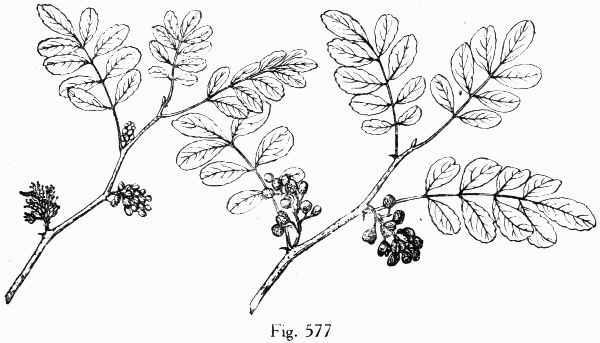
Leaves persistent, 3′—4′ long, with a broad-winged jointed petiole, and 7—9 obovate leaflets rounded or emarginate at apex, minutely crenulate-toothed above the middle, sessile, ½′ long or less, coriaceous, glandular-punctate, bright green and lustrous, with minute hooked deciduous stipular prickles. Flowers on short pedicels from the axils of minute ovate obtuse deciduous bracts, in short axillary contracted cymes, appearing singly or in pairs from April until June, on branches of the previous year, from minute dark brown globular buds, the staminate and pistillate flowers on different trees; sepals 4, membranaceous, much shorter than the 4 ovate yellow-green petals; stamens 4, with slender exserted filaments, 0 in the pistillate flower; pistils 2, with ovate sessile ovaries gradually contracted into long slender subulate exserted styles united near apex and crowned with obliquely spreading stigmas, rudimentary in the staminate flower. Fruit ripening in September, obovoid, rusty brown and rugose, ⅛′—¼′ long; seed dark and lustrous.
A tree, occasionally 25°—30° high, with a slender often inclining trunk, fastigiate branches, and more or less zigzag slender dark gray branchlets armed with sharp hooked stipular [635] spines; more frequently a tall or low shrub. Bark of the trunk about ⅛′ thick, the smooth light gray surface broken into small appressed persistent scales. Wood heavy, hard, very close-grained, brown tinged with red, with thin yellow sapwood of 10—12 layers of annual growth.
Distribution. Coast and islands of southern Florida, and Texas from Matagorda Bay to the Rio Grande and in San Saba, Bandera, and Brown Counties; one of the commonest of the south Florida plants, and arborescent on the rich hummock soil of Elliott’s Key and the shores of Bay Biscayne; in Texas generally shrubby; common in northern Mexico, and widely distributed through the Antilles, southern Mexico, and Central and South America to Brazil and Peru.
2. Xanthoxylum clava-Herculis L. Prickly Ash. Toothache-tree.
Fagara clava-Herculis Small.
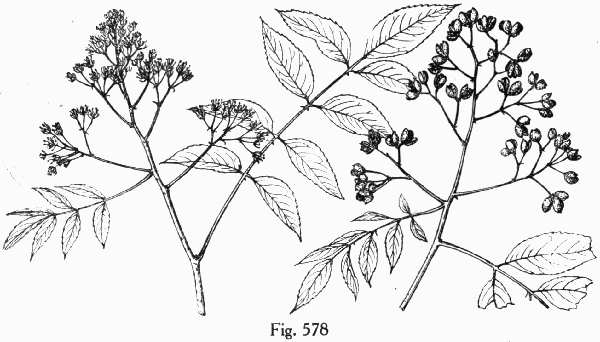
Leaves 5′—8′ long, with a stout pubescent or glabrous spiny petiole, and 3—9 pairs of ovate or ovate-lanceolate sometimes slightly falcate subcoriaceous leaflets usually oblique at base, crenulate-serrate, sessile or short-stalked, 1′—2½′ long, green and lustrous above, paler and often somewhat pubescent below, especially when they unfold; persistent until late in the winter or until the appearance of the new leaves in the early spring. Flowers on slender pedicels ⅓′—¼′ long, from the axils of minute lanceolate deciduous bracts, in ample wide-branched cymes 4′—5′ long and 2′—3′ wide, appearing in very early spring, when the leaves are about half grown, the staminate and pistillate flowers on different individuals; sepals minute, membranaceous, persistent, barely one fourth the length of the oval green petals ⅛′—¼′ long; stamens 5, with slender filiform filaments, conspicuously exserted from the male flowers, rudimentary or wanting in the female flowers; pistils 3, rarely 2, with sessile ovaries and short styles crowned by a slightly 2-lobed stigma. Fruit ripening in May and June, in dense often nearly globose clusters; mature carpels obliquely ovoid, 1-seeded, chestnut-brown, ¼′ long, with a rugose or pitted surface; seeds hanging at maturity outside the carpels.
A round-headed tree, 25°—30°, or exceptionally 50° high, with a short trunk 12′—18′ in diameter, numerous branches spreading nearly at right angles, and stout branchlets covered when they first appear with brown pubescence, becoming glabrous and light gray in their second year, and marked by small glandular spots and by large elevated obcordate leaf-scars displaying a row of large fibro-vascular bundle-scars, and armed with stout straight or sometimes slightly curved sharp chestnut-brown spines ½′ or more long, with a [636] flattened enlarged base; or often a low shrub. Winter-buds short, obtuse, dark brown or nearly black. Bark of the trunk barely 1/16′ thick, light gray, and roughened by corky tubercles, with ovoid dilated bases sometimes 1′ or more across and thick and rounded at apex. Wood light, soft, close-grained, and light brown, with yellow sapwood. The bark, which is collected in large quantities by negroes in the southern states, is used as a cure for toothache and in the treatment of rheumatism.
Distribution. Southeastern Virginia southward near the coast to the shores of Bay Biscayne and Bocagrande, Lee County, Florida, and westward through the Gulf states to northern Louisiana, southern Arkansas (near Arkadelphia, Clark County), and eastern Oklahoma, and through Texas to the valley of the Colorado River ranging northward to Tarrant and Dallas Counties; in the Atlantic states not abundant, and confined to the immediate neighborhood of the coast, growing in light sandy soil and often on the low bluffs of islands or on river banks; from the Gulf coast ranging farther inland, especially west of the Mississippi River; most abundant in eastern Texas, and of its largest size on the rich intervale lands of the streams flowing into the Trinity River. In western Texas a form occurs (var. fruticosum Gray), with short sometimes 3-foliolate more or less pubescent leaves, with small ovate or oblong blunt and conspicuous crenulate rather coriaceous leaflets; this is the common form of western Texas, growing usually as a low shrub.
3. Xanthoxylum flavum Vahl. Satinwood.
Fagara flava Kr. & Urb.
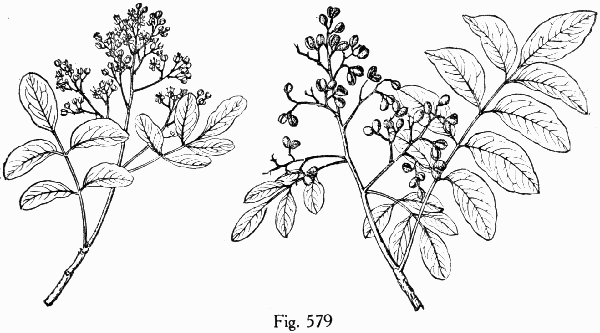
Leaves unequally pinnate, persistent, usually 6′—9′ long, with a stout glandular petiole enlarged at base, and usually 5, sometimes 3, or rarely 1 leaflet, unfolding in Florida during the month of June, and then densely covered with tomentum, and at maturity sparingly hairy on the petiole and on the midrib of the ovate-lanceolate or elliptic, obtuse, often slightly falcate leaflets, sometimes oblique at base, nearly sessile or long-stalked, 2′—3′ long, 1½′—2′ broad, entire or slightly crenulate, coriaceous, pale yellow-green and conspicuously marked by large pellucid glands. Flowers appearing in Florida in June, on a slender pubescent pedicel ¼′ or more long, in wide-spreading pubescent sessile cymes, the male and female on different trees; calyx-lobes 5, minute, acuminate, ciliate on the margins, barely one eighth of the length of the ovate greenish white petals reflexed when the flowers are fully expanded; stamens 5, with slender filaments much longer than the petals, 0 in the pistillate flower; pistils 2 or sometimes 1, with a stipitate obovate ovary and a short style with a spreading entire stigma, minute and depressed in the staminate flower. Fruit ripening in autumn and early winter and sometimes persistent until the [637] spring of the following year; mature carpels obliquely obovoid, short-stalked, 1-seeded, pale chestnut-brown at maturity, about ⅓′ long, faintly marked by minute glands.
A round-headed tree, 30°—35° high, with a trunk 12′—18′ in diameter, and stout brittle branchlets coated at first with thick silky pubescence, becoming light gray, rugose, conspicuously marked by large triangular leaf-scars, and puberulous during their second and third years. Winter-buds narrow-acuminate, ½′ long, coated with short thick pale tomentum. Bark of the trunk ¼′ thick, with a smooth light gray surface divided by shallow furrows and broken into numerous short appressed scales. Wood very heavy, exceedingly hard, brittle, not strong, light orange-colored, with thin rather lighter colored sapwood; occasionally used in southern Florida in the manufacture of furniture, for the handles of tools, and other objects of domestic use.
Distribution. Florida, on the Marquesas Keys and on South Bahia Honda and Boca Chica Keys; on Bermuda, the Bahama Islands, San Domingo, and Porto Rico.
4. Xanthoxylum coriaceum A. Richard.
Fagara coriacea Kr. & Urb.
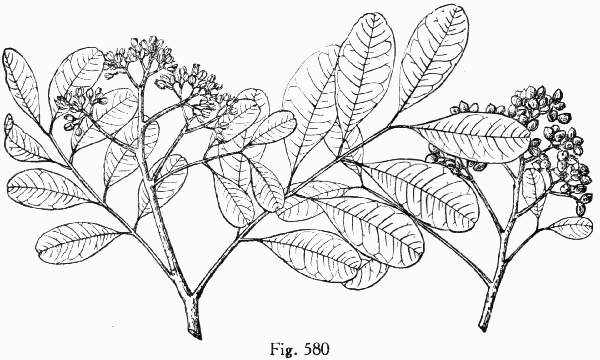
Leaves equally pinnate, persistent, 2′—3′ long, with a stout grooved petiole, and 6—8 oblong-obovate stalked coriaceous dark yellow-green lustrous leaflets rounded or rarely emarginate at apex, 1′—1¾′ long and ⅝′—¾′ wide, with much-thickened revolute entire margins, a stout midrib, slender obscure spreading primary veins, and reticulate veinlets. Flowers yellow, appearing in March on short stout pedicels, in densely flowered terminal cymes; sepals 3, minute, united below, free above, much shorter than the 3 oval or obovate petals rounded at apex; stamens 3; filaments about as long as the petals; anthers ovoid or oval; ovary 3-celled, globose-ovoid; styles thick, 3 (teste Urban). Fruit: mature fruit not seen.
A glabrous tree, sometimes 18°—20° high, with a slender stem, and stout red-brown branches unarmed in Florida specimens, or in the West Indies furnished with short recurved spines; more often shrubby.
Distribution. Florida, shores of Bay Biscayne and near Fort Lauderdale, Dade County; rare; on the Bahama Islands and in Cuba.
2. HELIETTA Tul.
Trees or shrubs, with slender terete branchlets. Leaves opposite, long-petiolate, trifoliolate, persistent; leaflets sessile, obovate-oblong, obtuse, entire or crenate, subcoriaceous, [638] grandular-punctate, the terminal the largest. Flowers regular, perfect, on slender bibracteolate pedicels, in terminal or axillary panicles; calyx 3 or 4-parted, the divisions imbricated in the bud, slightly united at base, persistent; petals 3 or 4, imbricated in the bud, hypogynous, oblong, concave, glandular-punctate, reflexed at maturity; stamens as many as the petals inserted under the disk; filaments shorter than the petals, slightly flattened, glabrous; anthers ovoid, cordate at base, attached on the back below the middle; disk free, cup-shaped, erect, subcorrugated, with a sinuate margin, 4-lobed, the lobes entire or crenate and opposite the petals; ovary minute, sessile, depressed, 3 or 4-lobed, glandular-verrucose or minutely pilose, the lateral lobes slightly compressed, 4-celled; styles united into a single slender column crowned by the globose 3—4-lobed stigma; ovules collateral, anatropous. Fruit obconic, composed of 3 or 4 dry woody 1-seeded indehiscent carpels with a cartilaginous endocarp and with a prominent horizontal wing, separating at maturity. Seed linear-oblong, seed-coat crustaceous, fragile, black; cotyledons straight, obtuse.
Helietta is distributed from the valley of the lower Rio Grande in Texas to Brazil and Paraguay. Four species are recognized, one species extending across the Rio Grande into western Texas.
The generic name is in honor of Lewis Théodore Hélie (1804—1867), a distinguished French physician.
1. Helietta parvifolia Benth.
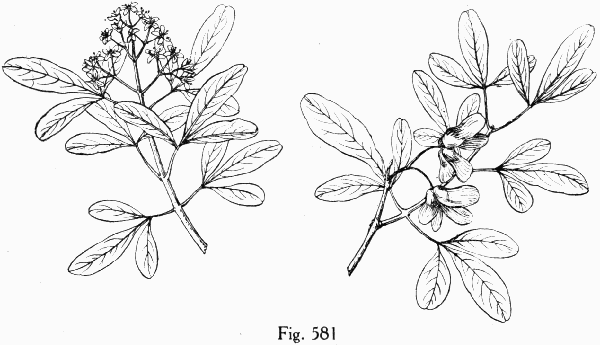
Leaves 1½′—2′ long, with a stout slightly club-shaped petiole, at first puberulent, soon becoming glabrous, and oblong or narrow-obovate leaflets rounded or sometimes slightly emarginate at apex, gradually and regularly contracted at base, entire or slightly and remotely crenulate-serrate, yellow-green and lustrous above, paler below, conspicuously marked by black glandular dots, the terminal leaflet ½′—1½′ long, sometimes ½′ wide, and nearly twice as large as the others; persistent on the branches until early spring. Flowers appearing in April and May, on slender pedicels covered at first like the petioles and calyx with short dense pubescence, with minute acuminate early deciduous bracts, in dichotymously branched subsessile panicles on branchlets of the year from the axils of the upper leaves; petals 4, white, ovate, ⅛′ long, with scattered hairs on the outer surface, and thin scabrous margins, and four or five times longer than the 4 calyx-lobes; stamens 4; ovary 4-lobed, glandular-punctate like the slender style. Fruit ripening in October, oblong, ¼′—⅓′ long, with a rigid broad-ovate sometimes slightly falcate wing rounded at apex, ½′ long, and conspicuously reticulate-veined.
A slender tree, 20°—25° high, with a trunk 5′—6′ in diameter, rather erect branches forming [639] a small irregular head, and slender pale branchlets covered with minute wart-like excrescences, slightly puberulous when they first appear, soon becoming glabrous, and marked during their second year by small inconspicuous leaf-scars; or a low shrub. Bark of the trunk about ⅛′ thick, covered with dark brown closely appressed scales separating in large irregular patches and leaving when they fall a smooth pale yellow surface. Wood hard, very heavy, close-grained, light orange-brown, with rather lighter colored sapwood.
Distribution. Often forming thickets of considerable extent and abundant near Rio Grande, Starr County, Texas; mesas south of the lower Rio Grande; of its largest size and tree-like in habit on the limestone ridges of the Sierra Madre of Nuevo Leon.
3. PTELEA L.
Small unarmed trees or shrubs, with smooth bitter bark, slender terete branchlets, without terminal buds, small depressed lateral buds covered with pale tomentum, and nearly inclosed by the narrow obcordate leaf-scars marked by the ends of 2 or 3 small fibro-vascular bundles, and thick fleshy acrid roots. Leaves alternate or rarely opposite, without stipules, long-petiolate, usually trifoliolate, the leaflets conduplicate in the bud, ovate or oblong, entire or crenulate-serrate, punctate with pellucid dots. Flowers polygamous, on slender bracteolate pedicels, in terminal or compound cymes, greenish white; calyx 4 or 5-parted; petals 4 or 5, hypogynous; stamens 3 or 4, alternate with and as long as the petals, hypogynous, much shorter in the pistillate flower with imperfect or rudimentary anthers; filaments subulate, more or less pilose, especially toward the base; anthers ovoid or cordate; pistil raised on a short gynophore, abortive and nearly sessile in the staminate flower; ovary compressed, 2—3-celled; style short; stigma 2—3-lobed; ovules superposed, amphitropous, the upper ovule only fertilized. Fruit a 2 or 3-celled broad-winged indehiscent samara surrounded by a reticulate wing or rarely wingless. Seed oblong, acute at apex, rounded at base, ascending; seed-coat smooth or slightly wrinkled, coriaceous; cotyledons ovate-oblong.
Ptelea is confined to the United States and Mexico, where four or five species are known; of these one is a small tree. The bark and foliage of Ptelea is bitter and strong-scented and possesses tonic properties.
The generic name is from πτελέα, a classical name of the Elm-tree.
1. Ptelea trifoliata L. Hop-tree. Wafer Ash.
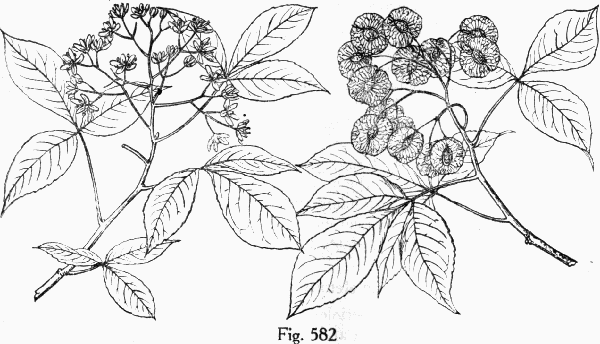
Leaves rarely 5-foliolate on vigorous shoots; leaflets sessile, ovate or oblong, pointed, the terminal leaflet generally larger and more gradually contracted at base than the others, [640] entire or finely serrate, covered at first with short close pubescence, becoming glabrous and rather coriaceous at maturity, dark green and lustrous above, pale below, 4′—6′ long, 2½′—3′ wide, with a prominent midrib and primary veins; turning clear yellow in the autumn before falling; petioles stout, thickened at base, 2½′—3′ in length. Flowers appearing in early spring on slender pubescent pedicels 1′—1½′ long, the pistillate and staminate flowers produced together, the staminate usually less numerous and falling soon after the opening of the anther-cells; calyx and petals pubescent; ovary puberulous. Fruit with a thin almost orbicular sometimes slightly obovate wing, nearly 1′ across, on a long slender reflexed pedicel, in dense drooping clusters remaining on the branches through the winter; seeds ⅓′ long, dark red-brown.
A round-headed tree, rarely 20°—25° high, with a straight slender trunk 6′—8′ in diameter, small spreading or erect branches, and slender branchlets covered at first with short fine pubescence, becoming glabrous, dark brown and lustrous, and marked by wart-like excrescences and by the conspicuous leaf-scars; more often a low spreading shrub. Winter-buds depressed, nearly round, pale or almost white. Wood heavy, hard, close-grained, yellow-brown, with thin hardly distinguishable sapwood of 6—8 layers of annual growth. The bitter bark of the roots is sometimes used in the form of tinctures and fluid extracts as a tonic, and the fruit is occasionally employed domestically as a substitute for hops in brewing beer.
Distribution. Generally on rocky slopes near the borders of the forest, often in the shade of other trees; Long Island, New York, Pennsylvania, and westward through southwestern Ontario (Point Pelee) and southern Michigan to southern Iowa, southeastern Nebraska, and southward to Georgia, Alabama, eastern Louisiana and through Missouri and Arkansas to southeastern Kansas, eastern Oklahoma and eastern Texas. A form with leaflets soft-pubescent on the lower surface (var. mollis T. & G.) occurs in the south Atlantic states from North Carolina to Florida.
Often planted as an ornament of parks and gardens.
4. AMYRIS L.
Glabrous glandular-punctate trees or shrubs, with balsamic resinous juices. Leaves opposite or rarely opposite and alternate, 3-foliolate, without stipules, persistent; leaflets opposite, petiolulate, entire or crenate. Flowers white, minute, on slender bibracteolate pedicels, usually in 3-flowered corymbs in terminal or axillary branched panicles; calyx 4-toothed, persistent; petals 4, hypogynous, much larger than the calyx-lobes, spreading at maturity; disk of the staminate flower inconspicuous, that of the pistillate and perfect flowers thickened and pulvinate; stamens 8, hypogynous, opposite and alternate with the petals; filaments filiform, exserted; anthers ovoid, attached on the back below the middle; ovary ellipsoid or ovoid, 1-celled, rudimentary in the staminate flower; style short, terminal, or wanting; stigma capitate; ovules collateral, suspended near the apex of the ovary, anatropous. Fruit a globose or ovoid aromatic drupe; stone 1-seeded by abortion, chartaceous. Seed pendulous, without albumen; seed-coat membranaceous; cotyledons plano-convex, fleshy, glandular-punctate.
Amyris is confined to tropical America and northern Mexico. Of the twelve or fourteen species which have been distinguished two extend into the territory of the United States; one of these is a small West Indian tree common on the shores of southern Florida, and the other, Amyris parvifolia A. Gray, a Mexican shrub, grows in Texas near Corpus Christi, Neuces County, and near the mouth of the Rio Grande. Amyris is fragrant and yields a balsamic aromatic and stimulant resin, and heavy hard close-grained wood valuable as fuel and sometimes used in cabinet-making.
The generic name, from μύῤῥα, relates to the balsamic properties of the plants of this genus.
1. Amyris elemifera L. Torch Wood.
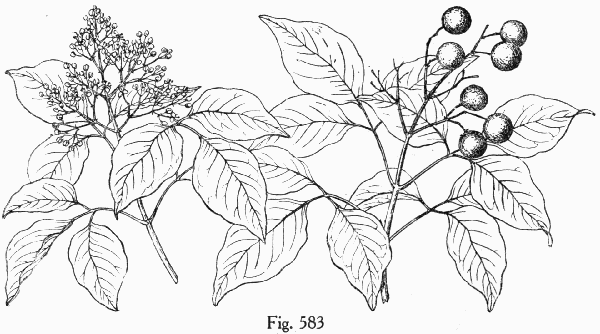
Leaves 3-foliolate, with slender petioles 1′—1½′ long, and broad-ovate or rounded obtuse acute or acuminate leaflets cuneate at base, or sometimes ovate-lanceolate or rhombic-lanceolate, [641] entire or remotely crenulate, coriaceous, lustrous, dark yellow-green, conspicuously reticulate-veined, covered below with minute glandular dots, 1′—2½′ long, with slender petiolules, that of the terminal leaflet often 1′ or more long and twice as long as those of the lateral leaflets. Flowers in terminal pedunculate or nearly sessile panicles appearing in Florida from August to December. Fruit ripening in the spring, ovoid, often nearly ½′ long, black covered with a glaucous bloom, with thin flesh filled with an aromatic oil and of rather agreeable flavor.
A slender tree, 40°—50° high, with a trunk sometimes, although rarely, a foot in diameter, and slender terete branchlets covered with wart-like excrescences, at first light brown, becoming gray during their second season. Bark of the trunk thin, gray-brown, slightly furrowed and broken into short appressed scales. Winter-buds acute, flattened, ⅛′ long, with broad-ovate scales slightly keeled on the back. Wood heavy, exceedingly hard, strong, close-grained, very resinous, extremely durable, light orange color, with thin rather lighter colored sapwood of 12—15 layers of annual growth; often used as fuel.
Distribution. Florida, Mosquito Inlet, Volusia County, to the southern keys; common in the immediate neighborhood of the coast to the rich hummocks of the interior, and of its largest size on Umbrella Key; on the Bahama Islands and on many of the Antilles.
XXVII. SIMAROUBACEÆ.
Trees or shrubs, with bitter juice. Leaves alternate, pinnate, persistent, without stipules. Flowers regular, diœcious; calyx 5-lobed, the lobes imbricated in the bud; petals 5, imbricated in the bud, hypogynous; stamens 10, inserted under the disk; pistil of 5 united carpels; ovary 5-celled; ovule solitary in each cell, anatropous; raphe ventral; micropyle superior. Fruit a drupe.
Of the thirty genera of this family, confined chiefly to the tropics and to the warmer parts of the northern hemisphere, three have arborescent representatives in the flora of North America. Ailanthus altissima Swing., the so-called Tree of Heaven, a native of northern China, has been largely planted as an ornament and shade tree in the eastern United States, and is now sparingly naturalized southward.
CONSPECTUS OF THE ARBORESCENT GENERA OF THE UNITED STATES.
Fruit a drupe or berry.
Ovary deeply 5-lobed; fruit drupaceous.
1. Simarouba. (D).
Ovary not lobed; fruit baccate.
2. Picramnia. (D).
Fruit a 3-winged samara.
3. Alvaradoa. (D).
[642]
1. SIMAROUBA Aubl.
Trees, with resinous juice and tonic properties. Leaves long-petiolate, abruptly pinnate; leaflets usually alternate, long-petiolulate, conduplicate in the bud, entire, coriaceous, glabrous or slightly puberulous below, feather-veined. Flowers in elongated widely branched axillary and terminal panicles; disk cup-shaped, depressed in the sterile flower, pubescent; stamens as long as the petals, in the pistillate flower reduced to minute scales; filaments free, filiform, thickened toward the base, inserted on the back of a minute ciliate scale; anthers oblong, slightly emarginate, introrse, attached on the back below the middle, 2-celled, the cells opening longitudinally; ovary sessile on the disk, deeply lobed, the lobes opposite the petals, rudimentary, lobulate, minute or wanting in the staminate flower; styles united into a short column, with a 3—5-lobed spreading stigma. Fruit composed of 1—5 sessile spreading drupes; flesh thin; stone crustaceous. Seeds inverse, without albumen; seed-coat membranaceous; cotyledons plano-convex, fleshy, the radicle very short, partly included between the cotyledons, superior.
Simarouba with four species is confined to tropical America, and is distributed from the coast of southern Florida to Brazil and Guatemala. The plants of this genus contain a small amount of resin, a volatile oil, and an exceedingly bitter principle, quasin, with tonic properties.
The generic name is formed from Simarouba, the Carib name of one of the species.
1. Simarouba glauca DC. Paradise-tree.
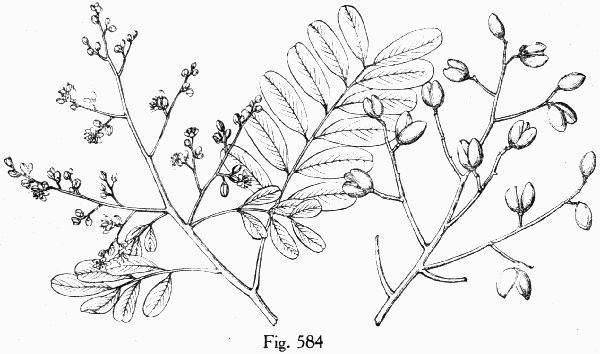
Leaves 6′—10′ long, glabrous, with a stout petiole 2′—3′ in length, and usually 6 pairs of opposite or alternate oblong-obovate or oval leaflets, rounded or slightly mucronate at apex, usually oblique at base, membranaceous and dark red when they first unfold, soon becoming coriaceous, dark green and very lustrous above, pale and glaucous below, 2′—3′ long and 1′—1½′ wide, with revolute margins, a prominent midrib, remote conspicuous primary veins, and stout petiolules ¼′—⅓′ in length. Flowers appearing in early spring, ⅛′—¼′ long, on short stout club-shaped pedicels, in panicles 12′—18′ long, and 18′—24′ broad, with a stout pale glaucous stem and spreading branches from the axils of small acute scarious deciduous bracts; petals fleshy, oval, often acute, pale yellow, and four or five times as long as the glaucous calyx. Fruit nearly fully grown by the end of April and then bright scarlet, about 1′ long, ovoid, sometimes falcate, and slightly angled on the ventral suture, becoming dark purple when fully ripe; seeds papillose, orange-brown, about ¾′ long.
A round-headed tree, growing occasionally in Florida to the height of 50°, with a straight [643] trunk 18′—20′ in diameter, slender spreading branches, and stout glabrous branchlets pale green when they first appear, becoming light brown before the end of the summer, rugose and conspicuously marked during their second season by the large oval leaf-scars. Bark of the trunk ½′—¾′ thick, light red-brown and broken on the surface into broad thick appressed scales. Wood light, soft, close-grained, light brown, with thick rather darker colored sapwood.
Distribution. Florida, from Cape Canaveral and the shores of Bay Biscayne to the southern keys; in Cuba, Jamaica, Nicaragua, and Brazil.
2. PICRAMNIA Sw.
Trees or shrubs, with bitter principles and slender terete branchlets. Leaves alternate, unequally pinnate, persistent, the leaflets subopposite to alternate, entire. Flowers diœcious, occasionally perfect, small, glomerate on long pendulous spikes or racemes opposite the leaves; calyx 3—5-parted, the lobes imbricated in the bud; petals 3—5, imbricated in the bud, rarely wanting; stamens 3—5, opposite the petals, inserted under the lobed depressed disk, in the pistillate flower reduced to linear scales or wanting; filaments naked; anthers 2-celled, introrse, the cells opening longitudinally; ovary inserted on the disk, 2 or 3-celled, rudimentary in the staminate flower; style 2 or 3-lobed, the lobes recurved and stigmatic on the inner surface, or crowned by a 2 or 3-lobed sessile stigma; ovules 2 in each cell, collateral, attached at the inner angle of the cell near its apex, anatropous; raphe narrow; micropyle superior. Fruit baccate, oblong to oblong-obovoid, 2 or by abortion 1-celled, the cells 1-seeded. Seeds filling the cavity of the cell, plano-convex, pendulous from the apex of the cell; hilum minute, apical, the raphe conspicuous; testa membranaceous, adherent to the exalbuminous undivided embryo; radicle superior, inconspicuous.
Picramnia, with about twenty species, is confined to the tropical and subtropical regions of the New World, one species extending into southern Florida. The bitter principle in the plants of this genus makes the bark of several of them useful in domestic remedies.
The generic name, from πικρός and θάμνος, is in reference to this bitter principle.
1. Picramnia pentandra Sw.
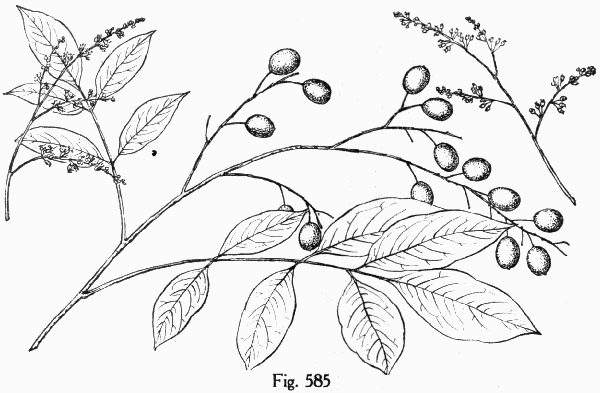
Leaves 8′—12′ long, 5—9-foliolate, with a slender rachis and petiole; leaflets ovate-oblong, abruptly acuminate at apex, gradually narrowed and cuneate at base, coriaceous, glabrous, [644] dark green and lustrous above, 1½′—2½′ long and ¾′—1′ wide, with thickened slightly revolute margins, a prominent midrib, slender primary veins and thin reticulate veinlets; petiolules stout, 1/12′—⅙′ long, that of the terminal leaflet often ¾′ in length. Flowers green on short slender pedicels, in slender pubescent racemes 6′—8′ in length; calyx 5-lobed, the lobes oblong-ovate, acuminate, coated on the outer surface with pale hairs; petals 5, acuminate, hirsute, narrower and longer than the calyx-lobes; stamens 5 in the pistillate flower; filaments slender, glabrous, exserted; anthers short-oblong, obtuse; stigma sessile, 2 or 3-lobed. Fruit red becoming nearly black when fully ripe, ⅓′—½′ in length, about ¼′ in diameter; seeds light brown and lustrous.
A slender tree in Florida, occasionally 18°—20° high, with a straight trunk 4′ or 5′ in diameter, and slender light yellow-green or pale brown branchlets slightly pubescent during their first season; more often a shrub. Bark thin, close, yellowish brown.
Distribution. Florida, shores of Bay Biscayne to the Everglade Keys, Dade County, and on the southern keys; on the Bahama Islands and several of the Antilles, and in Colombia.
3. ALVARADOA Liebm.
Trees or shrubs, with bitter juices and slender terete pubescent branchlets. Leaves alternate, crowded at the end of the branches, unequally pinnate, long-petiolate, many-foliolulate, persistent; leaflets alternate, entire; stipules and stipels none. Flowers in many-flowered axillary or terminal racemes. Fruit a 2 or 3-winged samara, 3-celled below the middle, 2-celled above, crowned with remnants of the styles. Seed erect, compressed; testa membranaceous; albumen none; embryo oblong-compressed; cotyledons flat; radicle inferior, very short.
An anomalous genus, by several authors doubtfully referred to Sapindaceæ, but chiefly on account of its bitter properties now placed in Simaroubaceæ. It consists of three species; of these the widely distributed Alvaradoa amorphoides Liebmann, the type of the genus, occurs in southern Florida. The other species appear to be confined to the islands of Jamaica and Cuba.
1. Alvaradoa amorphoides Liebm.
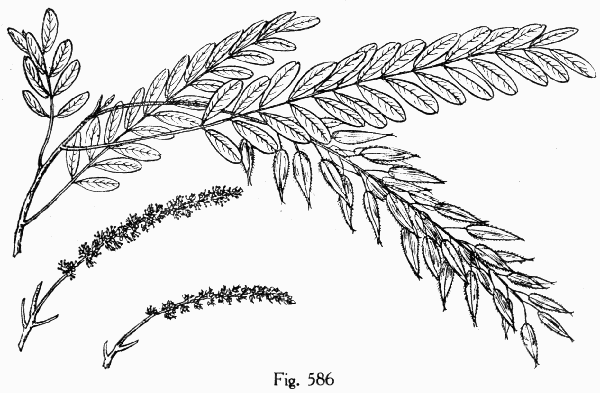
Leaves 4′—12′ long, with 21—41 leaflets and slender petioles; leaflets oblong-obovate, obtuse or occasionally minutely mucronate at apex, gradually narrowed below into a short [645] slender pubescent petiolule, slightly thickened and revolute on the margins, dark green above, pale pubescent below, ½′—¾′ long, about ¼′ wide, with a slender midrib and obscure primary veins. Flowers regular, minute, diœcious, on slender accrescent pubescent pedicels from the axils of ovate minute deciduous bracts, in many-flowered hoary-tomentose racemes 3′—4½′ long, the pistillate accrescent, becoming 4′—8′ in length; calyx campanulate, 5-parted, the lobes ovate, acute, hoary-tomentose on the outer surface; disk 5-lobed; staminate flowers appearing sessile in the bud; their pedicels only slightly accrescent; petals filiform; filaments slender, elongated, slightly villose toward the base, inserted between the lobes of the disk and alternate with the calyx-lobes; anthers introrse, 2-celled, united except at apex, opening longitudinally by marginal slits, their connective orbicular, conspicuous; pistillate flowers on short accrescent pedicels; petals 0 or very rarely present; stamens 0; ovary compressed, unequally 3-angled, villose-hirsute on the margins, 3-celled at base, with two small compressed empty cells, the third larger with two anatropous ovules; styles 2, subulate or recurved, often of unequal length, stigmatic above the middle. Fruit lanceolate, acuminate, narrowly 2-winged, ciliate on the margins with long spreading hairs, slightly tinged with red, ¾′ in length and about two-thirds as long as its slender hairy pedicel; seeds acute at ends, pale yellow, ¼′ long.
A slender tree, in Florida occasionally 30° high, with a trunk 6′—8′ in diameter, and slender branchlets hoary-pubescent during their first year becoming dull red-brown, glabrous and marked by numerous small pale lenticels and by the large obovate obcordate scars of fallen leaves showing the ends of three conspicuous equidistant fibro-vascular bundles; in Florida more often a shrub.
Distribution. Florida, Everglade Keys (Timbo Hummock near Gozman’s Homestead, Caldwell’s Hummock and Long Key), Dade County; in the Bahama Islands, and in Cuba, southern Mexico, Central America and Argentina.
XXVIII. BURSERACEÆ.
Trees or shrubs, with resinous bark and wood. Leaves alternate, pinnate, without stipules. Flowers perfect or polygamous, in clustered racemes or panicles; calyx 4—5-lobed, the lobes imbricated in the bud, persistent; petals 4—5, imbricated in the bud, distinct or slightly united, deciduous; stamens twice as many as the petals, inserted under the annular or cup-shaped disk; filaments distinct, subulate; anthers introrse, 2-celled, the cells opening longitudinally; pistil of 2—5 united carpels; ovary 2—5-celled; styles united; stigma 2—5-lobed; ovules 2 in each cell, pendulous, collateral, anatropous; micropyle superior; raphe ventral. Fruit drupaceous. Seeds without albumen; seed-coat membranaceous; embryo straight; cotyledons foliaceous; radicle short, superior.