Class 1. GYMNOSPERMÆ. (continued 3)
Reading edition
[72]
A tree, shrub, or small bushy tree rarely more than 15° or 16° high, with a short trunk 2° in diameter, slender erect or spreading branches forming a handsome open head, and thin branchlets covered with close smooth bark, at first orange-colored, becoming bright reddish brown, and ultimately purple or dark brown. Bark ¼′—½′ thick, dark grayish brown, irregularly divided into narrow ridges covered with thin persistent oblong scales. Wood light, soft, not strong, light brown, with thick nearly white sapwood.
Distribution. California: dry mountain slopes usually between altitudes of 1300° and 2300° in few widely isolated stations, Red Mountain, Mendocino County, to Mt. Tamalpais, Marin County; Cedar Mountain, Alameda County; Santa Cruz Mountains, Santa Cruz County; Santa Lucia Mountains, Monterey County; often covering great areas on the hills of Marin County with dense thickets only a few feet high.
Occasionally cultivated as C. Goveniana in western and southern Europe as an ornamental tree.
4. Cupressus Macnabiana A. Murr. Cypress.
Cupressus Bakeri Jeps. Cupressus nevadensis Abrams.
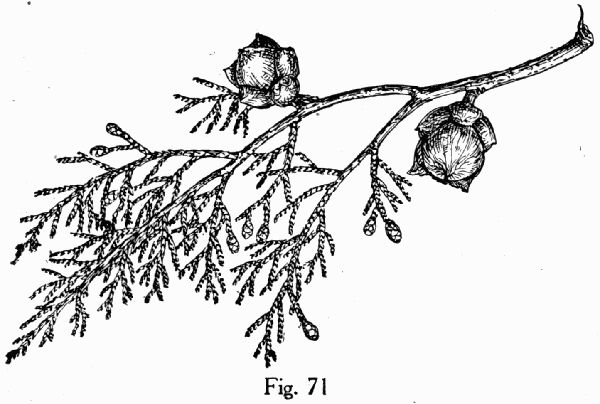
Leaves acute or rounded at apex, rounded and conspicuously glandular on the back, deep green, often slightly glaucous, usually not more than 1/16′ long. Flowers in March and April, male nearly cylindric, obtuse, with broadly ovate rounded connectives: female subglobose, with broadly ovate scales short-pointed and rounded at apex. Fruit oblong, subsessile or raised on a slender stalk, ½′—1′ long, dark reddish brown more or less covered with a glaucous bloom, slightly puberulous, especially along the margins of the 6 or rarely 8 scales, their prominent bosses thin and recurved on the lower scales, and much thickened, conical, and more or less incurved on the upper scales; seeds dark chestnut-brown, usually rather less than 1/16′ long, with narrow wings.
A tree in Oregon occasionally 80° high with a tall trunk sometimes 3½° in diameter, southward rarely more than 30° high, with a short trunk 12′—15′ in diameter, slender branches covered with close smooth compact bark, bright purple after the falling of the leaves, soon becoming dark brown; more often a shrub with numerous stems 6°—12° tall forming a broad open irregular head. Bark thin, dark reddish brown, broken into brown flat ridges, and separating on the surface into elongated thin slightly attached long-persistent scales. Wood light, soft, very close-grained.
Distribution. Rare and local, usually in small groves; dry ridges of Mount Steve and adjacent mountains up to altitudes of 5300°, Josephine County, southwestern Oregon; California; on lava beds, southeastern Siskiyou and southwestern Mono Counties (C. Bakeri); dry hills and low slopes, Mt. Ætna, in central Napa County; through Lake County to Red Mountain on the east side of Ukiah Valley, Mendocino County; in Trinity County between Shasta and Whiskeytown; and on the Sierra Nevada (Red Hill, Piute Mountains near Bodfish) Kern County, at an altitude of 5000° (C. nevadensis).
Occasionally cultivated in western and southern Europe as an ornamental tree.
[73]
5. Cupressus guadaloupensis S. Wats. Tecate Cypress.
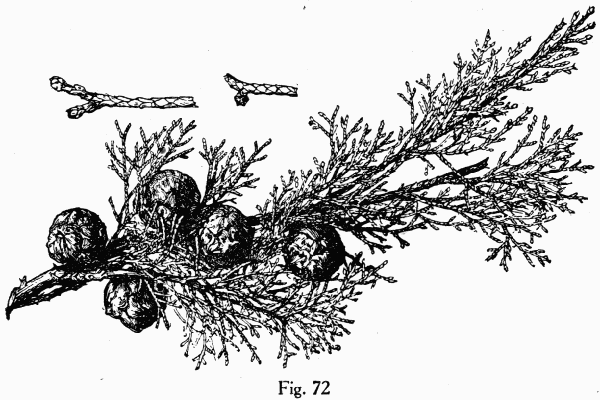
Leaves acute, rounded and minutely glandular-pitted or eglandular on the back, light blue-green, about 1/16′ long. Fruit on stout stems ¼′—⅓′ in length, subglobose to short-oblong, ¾′—1¼′ in diameter, puberulous especially along the margins of the six or eight scales, with prominent flattened or conic acute often incurved bosses; seeds about 70 under each scale, short-oblong, nearly square, light chestnut-brown up to ¼′ in length, with a narrow wing.
A tree in California sometimes 20°—25° in height, with a short slender or on exposed mountain slopes a trunk occasionally 2° or 3° in diameter, few short spreading or ascending branches forming an open head, and light red-brown lustrous branchlets becoming purplish. Bark smooth, lustrous, without resin or fibres, mahogany brown, the thin scales in falling leaving pale marks.
Distribution. San Diego County, California, rare and local; valley of the San Luis Rey River between Valley Centre and Pala; at altitudes between 1100° and 4000° in the gulches and on the summit of Mt. Tecate on the border between the United States and Lower California; on a mountain below Descanso and Pine Valley; in Cedar Cañon between El-nido and Dulzura; in Lower California on San Pedro Mártir Mountain and Guadaloupe Island. The insular form is a larger tree often with larger gland-pits on the leaves, and now often cultivated in California, western Europe, and in other countries with temperate climates.
6. Cupressus arizonica Greene. Cypress.
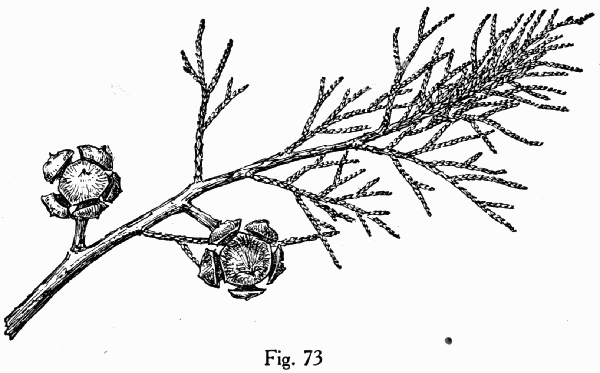
Leaves obtusely pointed, rounded, eglandular or rarely glandular-pitted on the back, pale green, 1/16′ long, dying and turning red-brown in their second season, generally falling four years later. Flowers: male oblong, obtuse, their 6 or 8 stamens with broadly ovate acute yellow connectives slightly erose on the margins: female not seen. Fruit on stout pedicels ¼′—½′ in length, subglobose, rather longer than broad, wrinkled, dark red-brown and covered with a glaucous bloom, the six or eight scales with stout flattened incurved prominent bosses; seeds oblong to nearly triangular, dark red-brown, 1/16′—⅛′ long with a thin narrow wing.
A conical tree 40°—70° high with a trunk 2°—4° in diameter, and stout spreading branches covered with bark separating into thin plates, leaving a smooth red surface, and branchlets [74] dark gray after the leaves fall. Bark on young trunks separating into large irregular curling thin scales, on old trees becoming dark red-brown and fibrous.
Distribution. Mountains above Clifton, Greenlee County, eastern Arizona; on the San Francisco Mountains, Socorro County, and San Luis Mountains, Grant County, western New Mexico; and in Chihuahua. Passing into
Cupressus arizonica var. bonita Lemm.
Cupressus glabra Sudw.
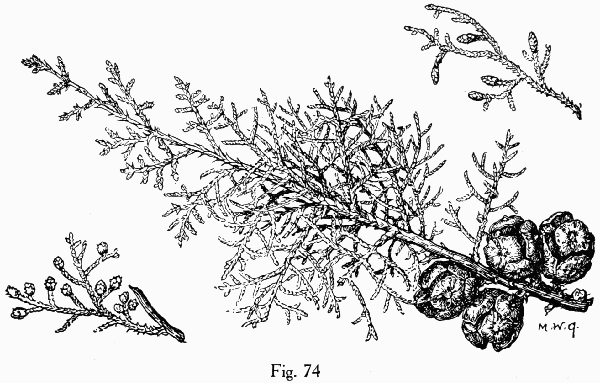
Differing from the type in the prominent oblong or circular glandular depressions on the backs of the leaves.
A tree 30°—70° high, with a trunk 18′—24′ or rarely 5° in diameter, erect branches forming a rather compact conical head. Bark of the trunk and large branches thin, smooth, dark reddish brown, separating into small curled scale-like plates, becoming on old trees dark gray and fibrous. Wood heavy, hard, pale straw color with lighter-colored sapwood, [75] durable in contact with the ground, somewhat used for fence-posts, corral-piles, mine-timbers and in log cabins.
Distribution. Gravelly slopes and moist gulches often in groups of considerable size at altitudes between 4000° and 7000°, Arizona; near Camp Verde, Tonto Basin; Natural Bridge, Payson, etc.; on the Chiracahua Mountains (J. W. Toumey, July, 1894); on the Santa Rita and Santa Catalina Mountains, and in Oak Creek Cañon twenty miles south of Flagstaff (P. Lowell, June, 1911).
Now often cultivated in western Europe as C. arizonica.
12. CHAMÆCYPARIS.
Tall resinous pyramidal trees, with thin scaly or deeply furrowed bark, nodding leading shoots, spreading branches, flattened, often deciduous or ultimately terete branchlets 2-ranked in one horizontal plane, pale fragrant durable heartwood, thin nearly white sapwood, and naked buds. Leaves scale-like, ovate, acuminate, with slender spreading or appressed tips, opposite in pairs, becoming brown and woody before falling, on vigorous sterile branches and young plants needle-shaped or linear-lanceolate and spreading. Flowers minute, monœcious, terminal, the two sexes on separate branchlets; the male oblong, of numerous decussate stamens, with short filaments enlarged into ovate connectives decreasing in size from below upward and bearing usually 2 pendulous globose anther-cells; the female subglobose, composed of usually 6 decussate peltate scales bearing at the base of the ovuliferous scales 2—5 erect bottle-shaped ovules. Fruit an erect globose cone maturing at the end of the first season, surrounded at the base by the sterile lower scales of the flowers, and formed by the enlargement of the ovule-bearing scales, abruptly dilated, club-shaped and flattened at the apex, bearing the remnants of the flower-scales as short prominent points or knobs; persistent on the branches after the escape of the seeds. Seeds 1—5, erect on the slender stalk-like base of the scale, subcylindric and slightly compressed; seed-coat of 2 layers, the outer thin and membranaceous, the inner thicker and crustaceous, produced into broad lateral wings; cotyledons 2, longer than the superior radicle.
Chamæcyparis is confined to the Atlantic and Pacific coast regions of North America, and to Japan and Formosa. Six species are distinguished. Of exotic species the Japanese Retinosporas, Chamæcyparis obtusa Endl., and Chamæcyparis pisifera Endl., with their numerous abnormal forms are familiar garden plants in all temperate regions.
Chamæcyparis is from χαμαί, on the ground, and κυπάρισσος, cypress.
CONSPECTUS OF THE NORTH AMERICAN SPECIES.
Bark thin, divided into flat ridges;
Branchlets slender, often compressed; leaves dull blue-green, usually conspicuously glandular.
1. C. thyoides (A, C).
Branchlets stout, slightly flattened or terete; leaves dark blue-green, usually without glands.
2. C. nootkatensis (B, G).
Bark thick, divided into broad rounded ridges; branchlets slender, compressed; leaves bright green, conspicuously glandular.
3. C. Lawsoniana (G).
1. Chamæcyparis thyoides B. S. P. White Cedar.
Cupressus thyoides L.
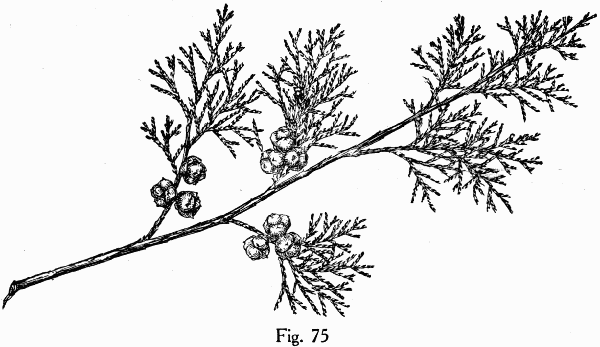
Leaves closely appressed, or spreading at the apex especially on vigorous leading shoots, keeled and glandular or conspicuously glandular-punctate on the back, dark dull blue-green or pale below, at the north becoming russet-brown during the winter, 1/16′—⅛′ long, dying during the second season and then persistent for many years. Flowers: male composed of 5 or 6 pairs of stamens, with ovate connectives rounded at apex, dark brown below the middle, nearly black toward the apex: female subglobose, with ovate acute [76] spreading pale liver-colored scales and black ovules. Fruit ¼′ in diameter, sessile on a short leafy branch, light green, covered with a glaucous bloom when fully grown, later bluish purple and very glaucous, finally becoming dark red-brown, its scales terminating in ovate acute, often reflexed bosses; seeds 1 or 2 under each fertile scale, ovoid, acute, full and rounded at the base, slightly compressed, gray-brown, about ⅛′ long, with wings as broad as the body of the seed and dark red-brown.
A tree, 70°—80° high, with a tall trunk usually about 2 and occasionally 3°—4° in diameter, or northward much smaller, slender horizontal branches forming a narrow spire-like head, and 2-ranked compressed branchlets disposed in an open fan-shaped more or less deciduous spray, the persistent branchlets gradually becoming terete, light green tinged with red, light reddish brown during their first winter, and then dark brown, their thin close bark separating slightly at the end of three or four years into small papery scales. Bark ¾′—1′ thick, light reddish brown, and divided irregularly into narrow flat connected ridges often spirally twisted round the stem, separating on the surface into elongated loose or closely appressed plate-like scales. Wood light, soft, not strong, close-grained, slightly fragrant, light brown tinged with red; largely used in boat-building and cooperage, for wooden ware, shingles, the interior finish of houses, fence-posts, and railway-ties.
Distribution. Cold swamps usually immersed during several months of the year, often forming dense pure forests; near Concord, New Hampshire, southern Maine, southward only near the coast to northern Florida, and westward to southwestern Mississippi; most abundant south of Massachusetts Bay; comparatively rare east of Boston and west of Mobile Bay.
Occasionally planted as an ornamental tree in the eastern states and in the countries of temperate Europe.
2. Chamæcyparis nootkatensis Sudw. Yellow Cypress. Sitka Cypress.
Cupressus nootkatensis Lamb.
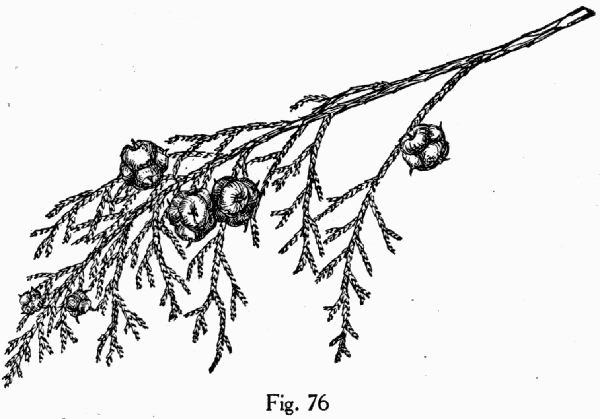
Leaves rounded, eglandular or glandular-pitted on the back, dark blue-green, closely appressed, about ⅛′ long, on vigorous leading branchlets somewhat spreading and often ¼′ long, with more elongated and sharper points, beginning to die at the end of their second year and usually falling during the third season. Flowers: male on lateral branchlets of the previous year, composed of 4 or 5 pairs of stamens, with ovate rounded slightly erose light yellow connectives: female clustered near the ends of upper branchlets, dark liver color, the fertile scales each bearing 2—4 ovules. Fruit ripening in September and October. [77] nearly ½′ in diameter, dark red-brown, with usually 4 or 6 scales tipped with prominent erect pointed bosses and frequently covered with conspicuous resin-glands; seeds 2—4 under each scale, ovoid, acute, slightly flattened, about ¼′ long, dark red-brown, with thin light red-brown wings often nearly twice as wide as the body of the seed.
A tree, frequently 120° high, with a tall trunk 5°—6° in diameter, horizontal branches forming a narrow pyramidal head, stout distichous somewhat flattened or terete light yellow branchlets often tinged with red at first, dark or often bright red-brown during their third season, ultimately paler and covered with close thin smooth bark. Bark ½′—¾′ thick, light gray tinged with brown, irregularly fissured, and separated on the surface into large thin loose scales. Wood hard, rather brittle, very close-grained, exceedingly durable, bright clear yellow, with very thin nearly white sapwood; fragrant with an agreeable resinous odor; used in boat and shipbuilding, the interior finish of houses, and the manufacture of furniture.
Distribution. Islands of Prince William Sound, Alaska, and southward over the coast mountains of Alaska and British Columbia, and along the Cascade Mountains of Washington and Oregon to the northeastern slopes of Mt. Jefferson, extending eastward to the headwaters of the Yakima River on the eastern slope of the range; on Whiskey Peak of the Siskiyou Mountains in the southeastern corner of Josephine County, Oregon and about two miles from the California line; most abundant and of its largest size near the coast of Alaska and northern British Columbia, ranging from the sea-level up to altitudes of 3000°; at high elevations on the Cascade Mountains sometimes a low shrub.
Occasionally cultivated, with its several abnormal forms, as an ornamental tree in the middle Atlantic states and in California, and commonly in the countries of western and central Europe.
3. Chamæcyparis Lawsoniana Parl. Port Orford Cedar. Lawson Cypress.
Cupressus Lawsoniana A. Murr.
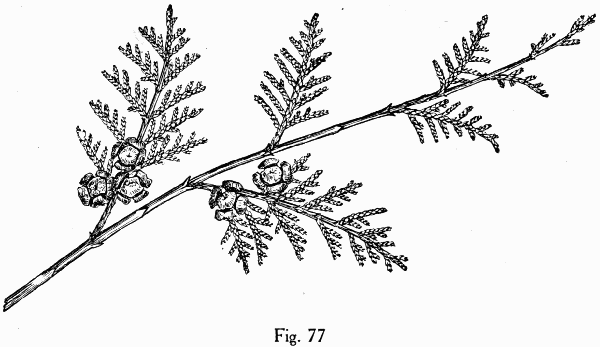
Leaves bright green or pale below, conspicuously glandular on the back, usually not more than 1/16′ long on lateral branchlets, on leading shoots often spreading at the apex, ⅛′ to nearly ¼′ long, usually dying, turning bright red-brown and falling during their third year. Flowers: male with bright red connectives bearing usually 2 pollen-sacs: female with dark ovate acute spreading scales, each bearing 2—4 ovules. Fruit clustered on the upper lateral branchlets and produced in great profusion, ripening in September and October, about ⅓′ in diameter, green and glaucous when full grown, red-brown and often covered with a bloom at maturity, its scales with thin broadly ovate acute reflexed bosses; seeds 2—4 under each fertile scale, ovoid, acute, slightly compressed, ⅛′ long, light chestnut-brown, with broad thin wings.
A tree, often 200° high, with a tall trunk frequently 12° in diameter above its abruptly enlarged base, a spire-like head of small horizontal or pendulous branches clothed with [78] remote flat spray frequently 6′—8′ long. Bark often 10′ thick at the base of old trees and 3′—4′ thick on smaller stems, dark reddish brown, with 2 distinct layers, the inner ⅛′—¼′ thick, darker, more compact, and firmer than the outer, divided into great broad-based rounded ridges separated on the surface into small thick closely appressed scales. Wood light, hard, strong, very close-grained, abounding in fragrant resin, durable, easily worked, light yellow, or almost white, with hardly distinguishable sapwood; largely manufactured into lumber used for the interior finish and flooring of buildings, railway-ties, fence-posts, and boat and shipbuilding, and on the Pacific coast almost exclusively for matches. The resin is a powerful diuretic.
Distribution. Usually scattered in small groves from the shores of Coos Bay, southwestern Oregon, south to the mouth of the Klamath River, California, ranging inland usually for about thirty miles; near Waldorf, in Josephine County, Oregon, on the slopes of the Siskiyou Mountains, and on the southern flanks of Mt. Shasta, California; most abundant north of Rogue River on the Oregon coast and attaining its largest size on the western slopes of the Coast Range foothills, forming between Point Gregory and the mouth of the Coquille River a nearly continuous forest belt twenty miles long.
Often cultivated with the innumerable forms originated in nurseries, in the middle Atlantic states and California, in all the temperate countries of Europe, and in New Zealand.
13. JUNIPERUS L. Juniper.
Pungent aromatic trees or shrubs, with usually thin shreddy bark, soft close-grained durable wood, slender branches, and scaly or naked buds. Leaves sessile, in whorls of 3, persistent for many years, convex on the lower side, concave and stomatiferous above, linear-subulate, sharp-pointed, without glands (Oxycedrus); or scale-like, ovate, opposite in pairs or ternate, closely imbricated, appressed and adnate to the branch, glandular or eglandular on the back, becoming brown and woody on the branch, but on young plants and vigorous shoots often free and awl-shaped (Sabina). Flowers minute, diœcious, axillary or terminal on short axillary branches from buds formed the previous autumn on branches of the year; the male solitary, oblong-ovoid, with numerous stamens decussate or in 3’s, their filaments enlarged into ovate or peltate yellow scale-like connectives bearing near the base 2—6 globose pollen-sacs; the female ovoid, surrounded at the base by many minute scale-like bracts persistent and unchanged under the fruit, composed of 2—6 opposite or ternate pointed scales alternate with or bearing on their inner face at the base on a minute ovuliferous scale 1 or 2 ovules. Fruit a berry-like succulent fleshy blue, blue-black, [79] or red strobile formed by the coalition of the flower-scales, inclosed in a membranaceous skin covered with a glaucous bloom, ripening during the first, second, or rarely during the third season, smooth or marked by the ends of the flower-scales, or by the pointed tips of the ovules, closed, or open at the top and exposing the apex of the seeds. Seeds 1—12, ovoid, acute or obtuse, terete or variously angled, often longitudinally grooved by depressions caused by the pressure of resin-cells in the flesh of the fruit, smooth or roughened and tuberculate, chestnut-brown, marked below by the large conspicuous usually 2-lobed hilum; seed-coat of 2 layers, the outer thick and bony, the inner thin, membranaceous or crustaceous; cotyledons 2, or 4—6, about as long as the superior radicle.
Juniperus is widely scattered over the northern hemisphere from the Arctic Circle to the highlands of Mexico, Lower California, and the West Indies in the New World, and to the Azores and Canary Islands, northern Africa, Abyssinia, the mountains of east tropical Africa, Sikkim, central China, Formosa, Japan and the Bonin Islands in the Old World. About thirty-five species are now distinguished. Of the exotic species cultivated in the United States the most common are European forms of Juniperus communis L. with fastigiate branches, and dwarf forms of the European Juniperus Sabina L., and of Juniperus chinensis L.
Juniperus is the classical name of the Juniper.
CONSPECTUS OF THE NORTH AMERICAN SPECIES.
Flowers axillary; stamens decussate; ovules 3, alternate with the scales of the flower, their tips persistent on the fruit; seeds usually 3; leaves ternate, linear-lanceolate, prickle-pointed, jointed at the base, eglandular, dark yellow-green, channeled, stomatose, and glaucous above; fruit maturing in the third year, subglobose, bright blue, covered with a glaucous bloom; buds scaly (Oxycedrus).
1. J. communis.
Flowers terminal on short axillary branchlets; stamens decussate or in 3’s; ovules in the axils of small fleshy scales often enlarged and conspicuous on the fruit; seeds 1—12; leaves ternate or opposite, mostly scale-like, crowded, generally closely appressed, free and awl-shaped on vigorous shoots and young plants; buds naked (Sabina).
Fruit red or reddish brown.
Bark of the trunk separating into long thin persistent scales; fruit maturing in one season.
Leaves closely appressed to the branchlet, obtusely pointed.
Leaves conspicuously glandular-pitted, ternate or opposite; fruit red, subglobose, ¼′ in diameter.
2. J. Pinchotii (C, H).
Leaves eglandular or slightly glandular; fruit reddish brown.
Leaves ternate, rarely opposite; fruit short-oblong, ¼′—½′ in diameter.
3. J. californica (G).
Leaves opposite, rarely ternate; fruit subglobose, ⅛′—¼′, in one form ¾′ in diameter.
4. J. utahensis (F, G).
Leaves not closely appressed, spreading at the apex, long-pointed, glandular or eglandular; fruit subglobose, ⅓′—½′ in diameter.
5. J. flaccida (L).
Bark of the trunk divided into thick nearly square plates; leaves eglandular or occasionally glandular-pitted; fruit subglobose to short-oblong, ½′ in diameter, ripening at the end of its second season.
6. J. pachyphlæa (H).
Fruit blue or blue-black, with resinous juicy flesh, subglobose to short-oblong, 1/12′—⅓′ in diameter; seeds, 1—4; cotyledons 2.
Leaves denticulately fringed, opposite or ternate; fruit maturing in one season.
Branchlets about 1/12′ in diameter; leaves acute, conspicuously glandular; fruit short-oblong, ¼′—⅓′ in diameter; seeds 2 or 3.
7. J. occidentalis (B, G).
Branchlets not more than 1/24′ in diameter; leaves usually ternate; fruit short-oblong.
Seeds 1 or rarely 2, pale chestnut-brown, obtuse, prominently ridged; leaves acute or acuminate, usually glandular.
8. J. monosperma (F).
[80]
Seeds 1 or 2, dark chestnut-brown, acute, obscurely ridged; leaves obtusely pointed, often eglandular.
9. J. mexicana (C).
Leaves naked on the margins, mostly opposite, glandular or eglandular; fruit subglobose.
Fruit ripening at the end of the first season.
Fruit ¼′—⅓′ in diameter; seeds 1 or 2, rarely 3 or 4; leaves acute or acuminate; branches spreading or erect.
10. J. virginiana (A, C).
Fruit 1/12′—⅙′ in diameter; seeds 1 or 2; leaves acute; branches usually pendulous.
11. J. lucayana (C).
Fruit ripening at the end of the second season, ¼′—⅓′ in diameter; seeds 1 or 2; leaves acute or acuminate.
12. J. scopulorum (B, F).
1. Juniperus communis L. Juniper.
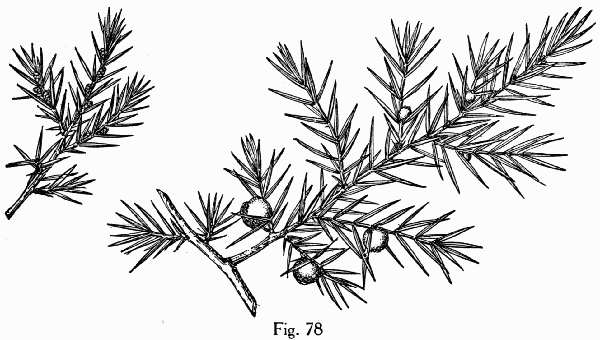
Leaves spreading nearly at right angles to the branchlets, ⅓′—½′ long, about 1/32′ wide, turning during winter a deep rich bronze color on the lower surface, persistent for many years. Flowers: male composed of 5 or 6 whorls each of 3 stamens, with broadly ovate acute and short-pointed connectives, bearing at the very base 3 or 4 globose anther-cells; female surrounded by 5 or 6 whorls of ternate leaf-like scales, composed of 3 slightly spreading ovules abruptly enlarged and open at the apex, with 3 minute obtuse fleshy scales below and alternate with them. Fruit maturing in the third season, subglobose or short-oblong, about ¼′ in diameter, with soft mealy resinous sweet flesh and 1—3 seeds; often persistent on the branches one or two years after ripening; seeds ovoid, acute, irregularly angled or flattened, deeply penetrated by numerous prominent thin-walled resin-glands, about ⅛′ long, the outer coat thick and bony, the inner membranaceous.
In America only occasionally tree-like and 10°—20° tall, with a short eccentric irregularly lobed trunk rarely a foot in diameter, erect branches forming an irregular open head, slender branchlets, smooth, lustrous, and conspicuously 3-angled between the short nodes during their first and second years, light yellow tinged with red, gradually growing darker, their dark red-brown bark separating in the third season into small thin scales, and ovoid acute buds about ⅛′ long and loosely covered with scale-like leaves; more often a shrub, with many short slender stems prostrate at the base and turning upward and forming a broad mass sometimes 20° across and 3° or 4° high (var. depressa Pursh.); at high elevations and in the extreme north prostrate, with long decumbent stems and shorter and more crowded leaves (var. montana Ait.) passing into the var. Jackii Rehdr. with long trailing branches and broader incurved leaves. Bark about 1/16′ thick, dark reddish brown, separating [81] irregularly into many loose papery persistent scales. Wood hard, close-grained, very durable in contact with the soil, light brown, with pale sapwood. In northern Europe the sweet aromatic fruit of this tree is used in large quantities to impart its peculiar flavor to gin; occasionally employed in medicine.
Distribution. Occasionally arborescent in New England, eastern Pennsylvania, and on the high mountains of North Carolina; the var. depressa, common in poor rocky soil, Newfoundland to southern New England, and to the shores of the Great Lakes and northwestward; the var. montana from the coast of Greenland to northern New England, on the high Appalachian Mountains, North Carolina, and to northern Nebraska, along the Rocky Mountains from Alberta to western Texas, and on the Pacific coast from Alaska, southward along mountain ranges to the high Sierras of central California, extending eastward to the mountains of eastern Washington and Oregon, and on the high peaks of northern Arizona up to altitudes of 10,000°—11,500° (P. Lowell); the var. Jackii on the coast mountains from northern California to Vancouver Island; in the Old World widely distributed in many forms through all the northern hemisphere from arctic Asia and Europe to Japan, the Himalayas and the mountains of the Mediterranean Basin.
Often planted, especially in several of its pyramidal and dwarf forms, in the eastern United States and in the countries of western, central, and northern Europe.
2. Juniperus Pinchotii Sudw.
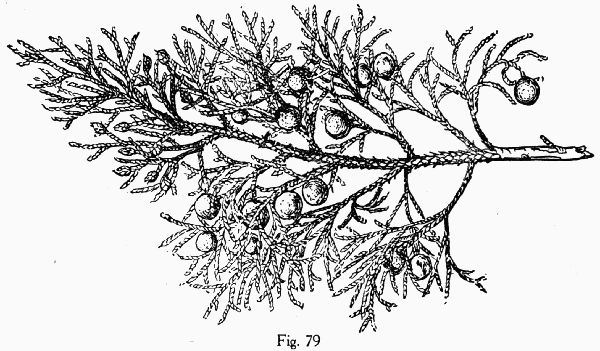
Leaves ternate, obtusely pointed, rounded and glandular-pitted on the back, 1/16′ long, dark yellow-green, turning light red-brown before falling; on vigorous shoots and seedling plants linear-lanceolate, thin, acuminate, eglandular, ¼′—⅓′ in length. Fruit ripening in one season, subglobose, bright red, ¼′ in diameter, with a thin skin and thick dry mealy resinous flesh and 1 seed; seed ovoid, bluntly pointed, deeply grooved, irregularly marked by the usually two-lobed hilum, ⅙′—¼′ long and 2 cotyledons.
A tree rarely 20 feet high, with a trunk 1 foot in diameter, stout wide-spreading branches forming an open irregular head and thick branchlets covered with dark gray-brown scaly bark, their ultimate divisions about 1/12′ in diameter; more often a shrub with several stems 1° to 12° tall. Bark thin, light brown, separating into long narrow persistent scales.
Distribution. Dry rocky slopes and the rocky sides of cañons, Panhandle of western [82] Texas (Armstrong, Potter and Hartley Counties), and in Hardaman, Garza, Tom Green, Kemble, Valverde and Menard Counties; on Comanche Peak near Granbury, Hood County, Texas; in central and on the mountains of southern Arizona.
3. Juniperus californica Carr. Desert White Cedar. Sweet-berried Cedar.
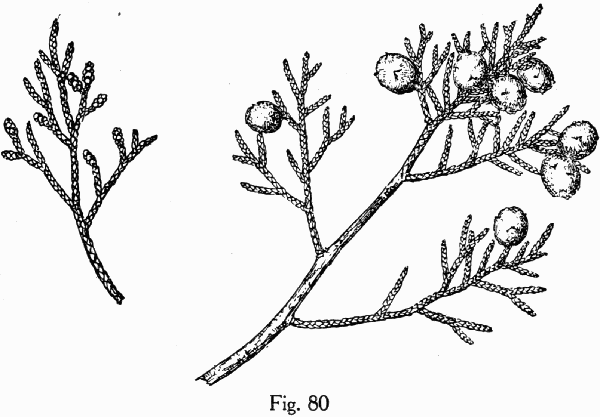
Leaves usually in 3’s, closely appressed, thickened, slightly keeled and conspicuously glandular-pitted on the back, pointed at apex, cartilaginously fringed on the margins, light yellow-green, about ⅛′ long, dying and turning brown on the branch at the end of two or three years; on vigorous shoots linear-lanceolate, rigid, sharp-pointed, ¼′—½′ long, whitish on the upper surface. Flowers from January to March; male of 18—20 stamens, disposed in 3’s, with rhomboidal short-pointed connectives; scales of the female flower usually 6, ovate, acute, spreading, obliterated or minute on the fruit. Fruit short-oblong or ovoid, ½′—¾′ long, reddish brown, with a membranaceous loose skin covered with a thick glaucous bloom, thick fibrous dry sweet flesh, and 1 or 2 seeds; seeds ovoid, obtusely pointed, irregularly lobed and angled, and 4—6 cotyledons.
A conical tree, occasionally 40° high, with a straight, large-lobed unsymmetrical trunk 1°—2° in diameter; more often shrubby, with many stout irregular usually contorted stems forming a broad open head. Bark thin and divided into long loose plate-like scales ashy gray on the outer surface and persistent for many years. Wood soft, close-grained, durable in contact with the soil, light brown slightly tinged with red, with thin nearly white sapwood; used for fencing and fuel. The fruit is eaten by Indians fresh or ground into flour.
Distribution. Dry mountain slopes and hills at altitudes between 400° and 4000°, from Moraga Pass and Mt. Diabolo, Contra Costa County, California, southward on the coast ranges, spreading inland to their union with the Sierra Nevada, and northward at low altitudes along the western slopes of the Sierras to Kern and Mariposa Counties; on the desert slopes of the Tehachapi Mountains, the northern foothills of the San Bernardino Mountains, on the western slopes of the San Jacinto and Cayamaca Ranges, and southward in Lower California to Agua Dulce; arborescent and probably of its largest size on the Mohave Desert.
4. Juniperus utahensis Lemm. Juniper.
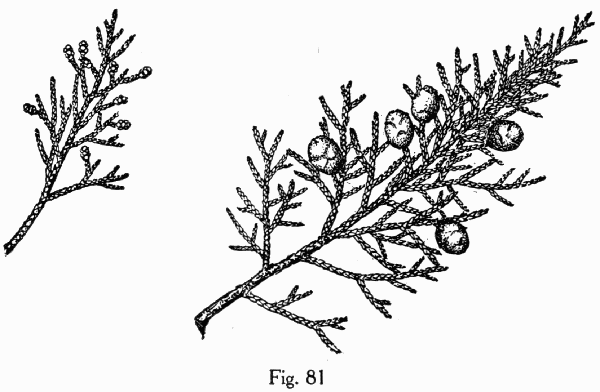
Leaves opposite or in 3’s, rounded, usually glandular, acute or often acuminate, light yellow-green, rather less than ⅛′ long, persistent for many years. Flowers: male with 18—24 opposite or ternate stamens, their connectives rhomboidal; scales of the female flower acute, spreading, often in pairs. Fruit ripening during the autumn of the second season, subglobose or short-oblong, marked by the more or less prominent tips of the flower-scales, reddish brown, with a thick firm skin covered with a glaucous bloom and closely investing [83] the thin dry sweet flesh, ¼′—⅓′ long, with 1 or rarely 2 seeds; seeds ovoid, acute, obtusely angled, marked to the middle by the hilum, with a hard bony shell, and 4—6 cotyledons.
A bushy tree, rarely exceeding 20° in height, with a short usually eccentric trunk sometimes 2° in diameter, generally divided near the ground by irregular deep fissures into broad rounded ridges, many erect contorted branches forming a broad open head, slender light yellow-green branchlets covered after the falling of the leaves with thin light red-brown scaly bark; more often with numerous stems spreading from the ground and frequently not more than 8°—10° high. Bark about ¼′ thick, ashy gray or sometimes nearly white, and broken into long thin persistent scales. Wood light brown, slightly fragrant, with thick nearly white sapwood; largely used locally for fuel and fencing. The fruit is eaten by Indians fresh, or ground and baked into cakes.
Distribution. Southwestern Wyoming (J. Knightii A. Nels.), southwestern Idaho (Pocatello, Bannock County), western Colorado, eastern Utah, and western New Mexico to northern Arizona and southeastern California at altitudes from 5000° to 8000°; the most abundant and generally distributed tree of the Great Basin, forming in the valleys open forests of stunted trees and shrubs, and on arid slopes more numerous and of larger size in dense nearly pure forests.
A variety (var. megalancocarpa Sarg.) occurs in eastern New Mexico and northern Arizona, with fruit sometimes ¾′ in diameter. A tree often 40° high with a single erect stem sometimes 3° in diameter.
5. Juniperus flaccida Schlecht. Juniper.
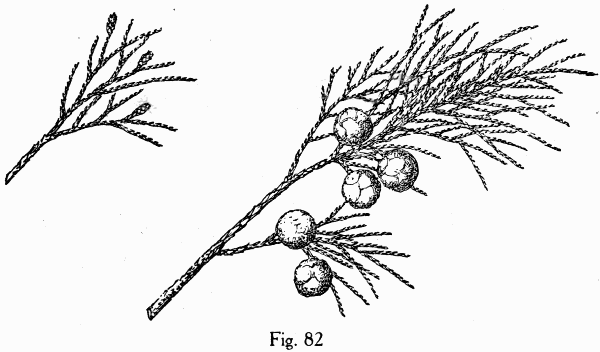
Leaves opposite, acuminate and long-pointed, spreading at the apex, glandular or eglandular on the back, light yellow-green, about ⅛′ long, turning cinnamon-red and dying on the branch; on vigorous young shoots ovate-lanceolate, sometimes ½′ long, with elongated rigid callous tips. Flowers: male slender, composed of 16—20 stamens, with ovate pointed connectives prominently keeled on the back; female with acute or acuminate spreading scales. Fruit subglobose, dull red-brown, more or less covered with a glaucous bloom, ⅓′—½′ in diameter, with a close firm skin and thick resinous flesh; seeds 4—12, pointed at apex, slightly ridged, often abortive and distorted, ⅛′—¼′ long, with 2 cotyledons.
A tree, occasionally 30° high, with gracefully spreading branches and long slender drooping branchlets, covered after the leaves fall with thin bright cinnamon-brown bark separating [84] into thin loose papery scales; often a shrub. Bark about ½′ thick, reddish brown, separating into long narrow loosely attached scales.
Distribution. In the United States only on the slopes of the Chisos Mountains, in Brewster County, southern Texas; common in northeastern Mexico, growing at elevations of 6000°—8000° on the hills east of the Mexican table-lands.
Occasionally cultivated in the gardens of southern France and of Algeria.
6. Juniperus pachyphlæa Torr. Juniper. Checkered-bark Juniper.
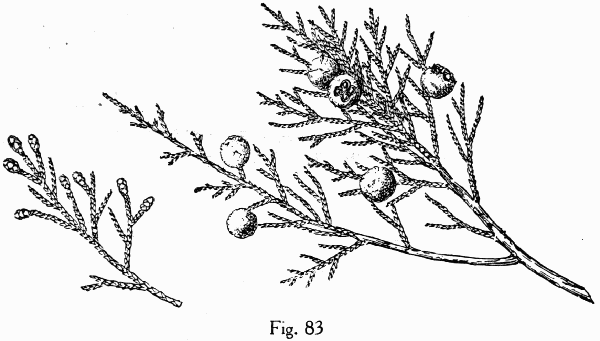
Leaves appressed, acute and apiculate at apex, thickened, obscurely keeled and glandular on the back, bluish green, rather less than ⅛′ long; on vigorous shoots and young branchlets linear-lanceolate, tipped with slender elongated points, and pale blue-green like the young branchlets. Flowers opening in February and March: the male stout, ⅛′ long, with 10 or 12 stamens, their connectives broadly ovate, obscurely keeled on the back, short-pointed: scales of the female flower, ovate, acuminate, and spreading. Fruit ripening in the autumn of its second season, subglobose to short-oblong, irregularly tuberculate, ⅓′—½′ in diameter, usually marked with the short tips of the flower-scales, occasionally opening and discharging the seeds at the apex, dark red-brown, more or less covered with [85] a glaucous bloom, especially during the first season and then occasionally bluish in color, with a thin skin closely investing the thick dry mealy flesh, and usually 4 seeds; seeds acute or obtusely pointed, conspicuously ridged and gibbous on the back, with a thick shell and 2 cotyledons.
A tree, often 50°—60° high, with a short trunk 3°—5° in diameter, long stout spreading branches forming a broad-based pyramidal or ultimately a compact round-topped head, and slender branchlets covered after the disappearance of the leaves with thin light red-brown usually smooth close bark occasionally broken into large thin scales. Bark ¾′—4′ thick, on young stems reddish brown becoming on old trunks whitish, deeply fissured and divided into nearly square plates 1′—2′ long, and separating on the surface into small thin closely appressed scales. Wood light, soft, not strong, brittle, close-grained, clear light red often streaked with yellow, with thin nearly white sapwood; often producing vigorous shoots from the base of the trunk or from the stumps of felled trees.
Distribution. Dry arid mountain slopes usually at elevations of 4000°—6000° above the sea, from the Eagle and Limpio mountains in southwestern Texas, westward along the desert ranges of New Mexico and Arizona, extending northward to the lower slopes of many of the high mountains of northern Arizona, and southward into Mexico.
7. Juniperus occidentalis Hook. Juniper.
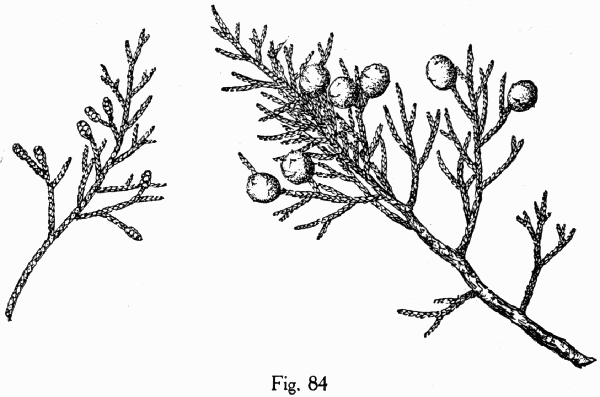
Leaves opposite or ternate, closely appressed, acute or acuminate, rounded and conspicuously glandular on the back, denticulately fringed, gray-green, about ⅛′ long. Flowers: male stout, obtuse, with 12—18 stamens, their connectives broadly ovoid, rounded, acute or apiculate and scarious or slightly ciliate on the margins: scales of the female flower ovate, acute, spreading, mostly obliterated from the fruit. Fruit subglobose or short-oblong, ¼′—⅓′ in diameter, with a thick firm blue-black skin coated with a glaucous bloom, thin dry flesh filled with large resin-glands, and 2 or 3 seeds; seeds ovoid, acute, rounded and deeply grooved or pitted on the back, flattened on the inner surface, about ⅛′ long, with a thick bony shell, a thin brown inner seed-coat, and 2 cotyledons.
A tree, occasionally 60° high, with a tall straight trunk 2°—3° in diameter, more often not more than 20° in height, with a short trunk sometimes 10° in diameter, enormous branches, spreading at nearly right angles and forming a broad low head, and stout branchlets covered after the leaves fall with thin bright red-brown bark broken into loose papery scales; frequently when growing on dry rocky slopes and toward the northern limits of its range a shrub, with many short erect or semiprostrate stems. Bark about [86] ½′ thick, bright cinnamon-red, divided by broad shallow fissures into wide flat irregularly connected ridges separating on the surface into thin lustrous scales. Wood light, soft, very close-grained, exceedingly durable, light red or brown, with thick nearly white sapwood; used for fencing and fuel. The fruit is gathered and eaten by the California Indians.
Distribution. Mountain slopes and high prairies of western Idaho and of eastern Washington to the eastern slopes of the Cascade Mountains; eastern and southern Oregon up to altitudes of 4500°; along the summits and upper slopes of the Sierra Nevada of California, and southward to the San Bernardino Mountains, here abundant in Bear and Holcomb valleys; attaining its greatest trunk diameter on the wind-swept peaks of the California sierras, usually at altitudes between 6000° and 10,000° above the sea.
8. Juniperus monosperma Sarg. Juniper.
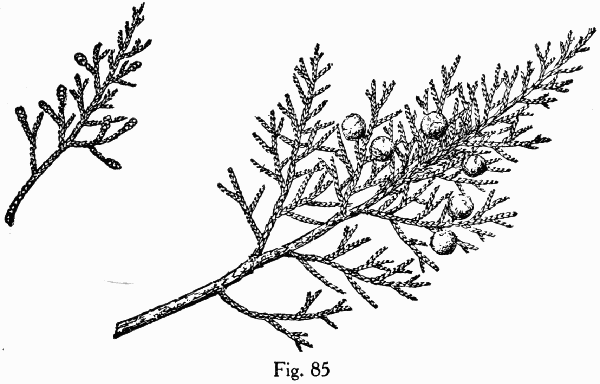
Leaves opposite or ternate, often slightly spreading at apex, acute or occasionally acuminate, much thickened and rounded on the back, usually glandular, denticulately fringed, gray-green, rather less than ⅛′ long, turning bright red-brown before falling; on vigorous shoots and young plants ovate, acute, tipped with long rigid points, thin, conspicuously glandular on the back, often ½′ long. Flowers: male with 8—10 stamens, their broadly ovate, rounded or pointed connectives slightly erose on the margins: female with spreading pointed scales. Fruit subglobose or short-oblong, ⅛′—¼′ long, dark blue or perhaps occasionally light chestnut-brown with a thick firm skin covered with a thin glaucous bloom, thin flesh, and 1 or rarely 2 seeds; seeds often protruding from the top of the fruit, ovoid, often 4-angled, somewhat obtuse at apex, with a small hilum, and 2 cotyledons.
A tree, occasionally 40°—50° high, with a stout much-lobed and buttressed trunk sometimes 3° in diameter, short stout branches forming an open very irregular head, and slender branchlets covered after the falling of the leaves with light red-brown bark spreading freely into thin loose scales; more often a much branched shrub sometimes only a few feet high. Bark ashy gray, divided into irregularly connected ridges, separating into long narrow persistent shreddy scales. Wood heavy, slightly fragrant, light reddish brown, with nearly white sapwood and eccentric layers of annual growth; largely used for fencing and fuel. The fruit is ground into flour and baked by the Indians, who use the thin strips of fibrous bark in making saddles, breechcloths, and sleeping-mats.
Distribution. Along the eastern base of the Rocky Mountains from the valley of the Platte River, Wyoming (near Alcova, Natrona County) and the divide between the [87] Platte and Arkansas rivers in Colorado; western Oklahoma (near Kenton, Cimarron County, common) and western Texas; on the Colorado plateau, northern Arizona; over the mountain ranges of southwestern Wyoming, Nevada, southern New Mexico and Arizona, and southward into northern Mexico; often covering, with the Nut Pine, in southern Colorado and Utah, and in northern and central New Mexico and Arizona, great areas of rolling hills 6000°—7000° above the sea-level; reaching its largest size in northern Arizona.
9. Juniperus mexicana Spreng. Cedar. Rock Cedar.
Juniperus sabinoides Nees.
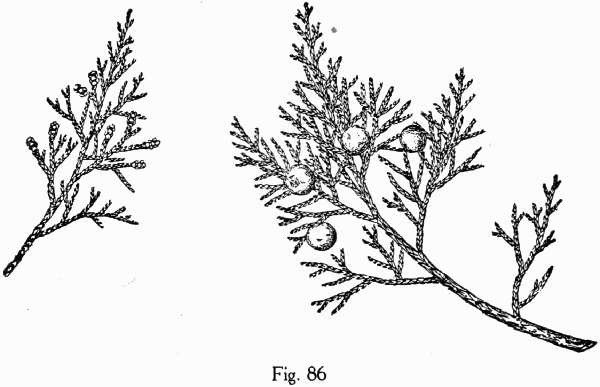
Leaves usually opposite or ternate, thickened and keeled on the back, obtuse or acute at apex, mostly without glands, denticulately fringed, rather more than 1/16′ long, dark blue-green, on vigorous young shoots and seedling plants lanceolate, long-pointed, rigid, ¼′—½′ long. Flowers: male with 12—18 stamens, their connectives ovoid, obtuse, or slightly cuspidate: scales of the female flower ovate, acute, and spreading, very conspicuous when the fruit is half grown, becoming obliterated at its maturity. Fruit short-oblong to subglobose, ¼′—½′ in diameter, dark blue, with a thin skin covered with a glaucous bloom, sweet resinous flesh, and 1 or 2 seeds; seeds ovoid, acute, slightly ridged, rarely tuberculate, dark chestnut-brown, with a small hilum, a thin outer seed-coat, a membranaceous dark brown inner coat, and 2 cotyledons.
A tree, occasionally 100° but generally not more than 20°—30° high, with a short or elongated slightly lobed trunk seldom exceeding a foot in diameter, small spreading branches forming a wide round-topped open and irregular or a narrow pyramidal head, slender sharply 4-angled branchlets becoming terete after the falling of the leaves, light reddish brown or ashy gray, with smooth or slightly scaly bark; often a shrub, with numerous spreading stems. Bark on old trees ¼′—½′ thick, brown tinged with red, and divided into long narrow slightly attached scales persistent for many years and clothing the trunk with a loose thatch-like covering. Wood light, hard, not strong, slightly fragrant, brown streaked with red; largely used for fencing, fuel, telegraph-poles, and railway-ties.
Distribution. From Brazos County over the low limestone hills of western and southern Texas, and southward into Mexico; forming great thickets and growing to its largest size on the San Bernardo River; much smaller farther westward, and usually shrubby at the limits of vegetation on the high mountains of central Mexico.
[88]
10. Juniperus virginiana L. Red Cedar. Savin.
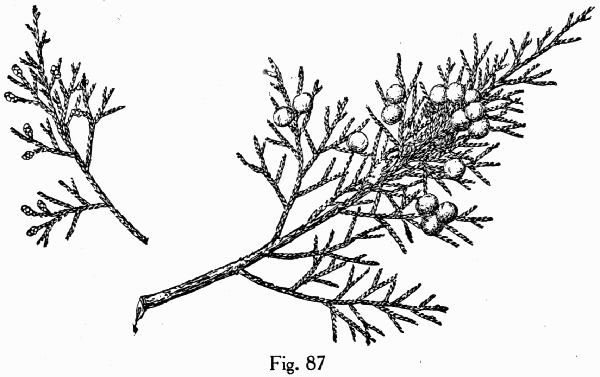
Leaves usually opposite, acute or acuminate or occasionally obtuse, rounded and glandular or eglandular on the back, about 1/16′ long, dark blue-green or glaucous (var. glauca Carr.), at the north turning russet or yellow-brown during the winter, beginning in their third season to grow hard and woody, and remaining two or three years longer on the branches, on young plants and vigorous branchlets linear-lanceolate, long-pointed, light yellow-green, without glands, ½′—¾′ long. Flowers: diœcious or very rarely monœcious: male with 10 or 12 stamens, their connectives rounded and entire, with 4 or occasionally 5 or 6 pollen-sacs; scales of the female flower violet color, acute and spreading, becoming obliterated from the fruit. Fruit subglobose, ¼′—⅓′ in diameter, pale green when fully grown, dark blue and covered with a glaucous bloom at maturity, with a firm skin, thin sweetish resinous flesh, and 1 or 2 or rarely 3 or 4 seeds; seeds acute and occasionally apiculate at apex, ⅙′—⅛′ long, with a comparatively small 2-lobed hilum, and 2 cotyledons.
A tree, occasionally 100° high, with a trunk 3°—4° in diameter, often lobed and eccentric, and frequently buttressed toward the base, generally not more than 40°—50° tall, with short slender branches horizontal on the lower part of the tree, erect above, forming a narrow compact pyramidal head, in old age usually becoming broad and round-topped or irregular, and slender branchlets terete after the disappearance of the leaves and covered with close dark brown bark tinged with red or gray; on exposed cliffs on the coast of Maine, sometimes only a few inches high with long branches forming broad dense mats. Bark ⅛′—¼′ thick, light brown tinged with red, and separated into long narrow scales fringed on the margins, and persistent for many years. Wood light, close-grained, brittle, not strong, dull red, with thin nearly white sapwood, very fragrant, easily worked; largely used for posts, the sills of buildings, the interior finish of houses, the lining of closets and chests for the preservation of woolens against the attacks of moths, and largely for pails and other small articles of wooden ware. A decoction of the fruit and leaves is used in medicine, and oil of red cedar distilled from the leaves and wood as a perfume.
Distribution. Dry gravelly slopes and rocky ridges, often immediately on the seacoast, from southern Nova Scotia and New Brunswick to the coast of Georgia, the interior of southern Alabama and Mississippi, and westward to the valley of the lower Ottawa River, southern Michigan, eastern North and South Dakota, Nebraska and Kansas, and eastern Texas, not ascending the mountains of New England and New York nor the high southern Alleghanies; in middle Kentucky and Tennessee, and northern Alabama and Mississippi, [89] covering great areas of low rolling limestone hills with nearly pure forests of small bushy trees.
Often cultivated, in several forms, in the northern and eastern states as an ornamental tree and occasionally in the gardens of western and central Europe.
11. Juniperus lucayana Britt. Red Cedar.
Juniperus barbadensis Sarg., not L.
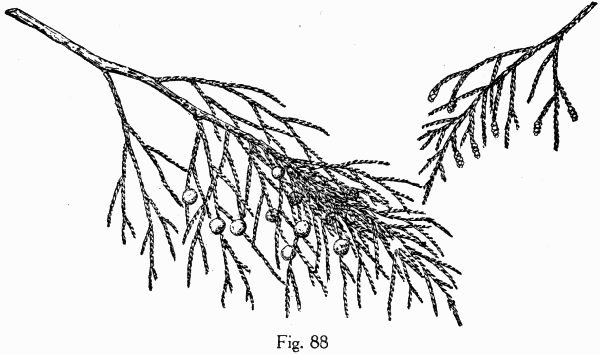
Leaves usually opposite, narrow, acute, or gradually narrowed above the middle and acuminate, marked on the back by conspicuous oblong glands. Flowers opening in early March: male elongated, ⅛′ to nearly ¼′ long, with 10 or 12 stamens, their connectives rounded, entire, and bearing usually 3 pollen-sacs: female with scales gradually narrowed above the middle, acute at apex, and obliterated from the ripe fruit. Fruit subglobose to short-oblong, dark blue, covered when ripe with a glaucous bloom, about 1/24′ in diameter, with a thin skin, sweet resinous flesh, and 1 or 2 seeds; seeds acute, prominently ridged.
A tree, sometimes 50° high, with a trunk occasionally 2° in diameter, small branches erect when the tree is crowded in the forest, spreading when it has grown in open ground and forming a broad flat-topped head often 30° or 40° in diameter, long thin secondary branches erect at the top of the tree and pendulous below, and pendulous branchlets about 1/24′ in diameter, becoming light red-brown or ashy gray at the end of four or five years after the disappearance of the leaves. Bark thin, light red-brown, separating into long thin scales. Wood light, close, straight-grained, fragrant, dull red; formerly exclusively used in the manufacture of the best lead pencils.
Distribution. Inundated river swamps from southern Georgia, southward to the shores of the Indian River, Florida, and on the west coast of Florida from the northern shores of Charlotte Harbor to the valley of the Apalachicola River, often forming great thickets under the shade of larger trees; along streams and creeks in low woods near Houston, Harris County, and Milano, Milano County, Texas (E. J. Palmer); common in the Bahamas, San Domingo, eastern Cuba, and on the mountains of Jamaica and Antigua.
Often planted for the decoration of squares and cemeteries in the cities and towns in the neighborhood of the coast from Florida to western Louisiana, and now often naturalized beyond the limits of its natural range on the Gulf coast; occasionally cultivated in the temperate countries of Europe, and in cultivation the most beautiful of the Junipers.
[90]
12. Juniperus scopulorum Sarg. Red Cedar.
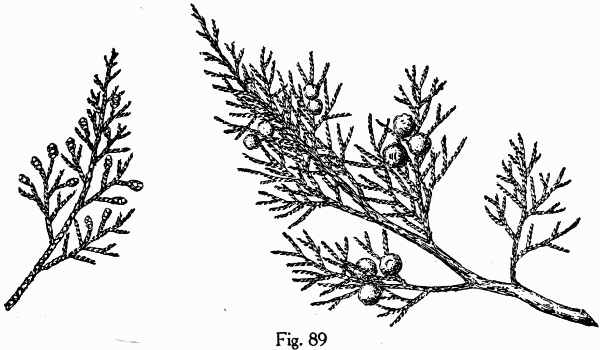
Leaves usually opposite, closely appressed, acute or acuminate, generally marked on the back by obscure elongated glands, dark green, or often pale and very glaucous. Flowers: male with about 6 stamens, their connectives rounded and entire, bearing 4 or 5 anther-sacs: scales of the female flower spreading, acute or acuminate, and obliterated from the mature fruit. Fruit ripening at the end of the second season, nearly globose, ¼′—⅓′ in diameter, bright blue, with a thin skin covered with a glaucous bloom, sweet resinous flesh, and 1 or usually 2 seeds; seeds acute, prominently grooved and angled, about 3/16′ long, with a thick bony outer coat and a small 2-lobed hilum.
A tree, 30°—40° high, with a short stout trunk sometimes 3° in diameter, often divided near the ground into a number of stout spreading stems, thick spreading and ascending branches covered with scaly bark, forming an irregular round-topped head, and slender 4-angled branchlets becoming at the end of three or four years terete and clothed with smooth pale bark separating later into thin scales. Bark dark reddish brown or gray tinged with red, divided-by shallow fissures into narrow flat connected ridges broken on the surface into persistent shredded scales.
Distribution. Scattered often singly over dry rocky ridges, usually at altitudes of 5000° or 6000° but occasionally ascending in Colorado to 9000° above the sea, from the eastern foothill region of the Rocky Mountains from Alberta to the Black Hills of South Dakota, the valley of the Niobrara River, Sheridan County, northwestern Nebraska (J. M. Bates) and to western Texas and eastern and northern New Mexico, and westward to eastern Oregon, Nevada, and northern Arizona; descending to the sea-level in Washington on the shores of the northern part of Puget Sound and on the islands and mainland about the Gulf of Georgia, British Columbia.
II. TAXACEÆ.
Slightly resinous trees and shrubs, producing when cut vigorous stump shoots, with fissured or scaly bark, light-colored durable close-grained wood, slender branchlets, linear-lanceolate entire rigid acuminate spirally disposed leaves, usually appearing 2-ranked by a twist in their short compressed petioles and persistent for many years, and small ovoid acute buds. Flowers opening in early spring from buds formed the previous autumn, diœcious or monœcious, axillary and solitary, surrounded by the persistent decussate scales of the buds, the male composed of numerous filaments united into a column, [91] each filament surmounted by several more or less united pendant pollen-cells; the female of a single erect ovule, becoming at maturity a seed with a hard bony shell, raised upon or more or less surrounded by the enlarged and fleshy aril-like disk of the flower; embryo axile, in fleshy ruminate or uniform albumen; cotyledons 2, shorter than the superior radicle. Of the ten genera widely distributed over the two hemispheres, two occur in North America.
CONSPECTUS OF THE NORTH AMERICAN GENERA.
Filaments dilated into 4 pollen-sacs united into a half ring; seeds drupe-like, green or purple, ripening at the end of the second season; albumen ruminate.
1. Torreya.
Filaments dilated into a globose head of 4—8 connate pollen-sacs; seeds berry-like, scarlet, ripening at the end of the first season; albumen uniform.
2. Taxus.
1. TORREYA ARN.
Tumion Raf.
Glabrous fœtid or pungent aromatic trees, with fissured bark and verticillate or opposite spreading or drooping branches. Leaves thin, long-pointed, abruptly contracted at base, dark green, lustrous and slightly rounded above, thickened and revolute on the margins, with pale bands of stomata on each side of the midvein on the lower surface. Flowers diœcious; the male crowded in the axils of adjacent leaves, on shoots of the previous year, oval or oblong, composed of 6 or 8 close whorls each of 4 stamens, subverticillately arranged on a slender axis; filaments stout and expanded above into 4 globose yellow pollen-sacs united into a half ring, their connectives produced above the cells; the female on shoots of the year less numerous and scattered, sessile, the ovule surrounded by and finally inclosed in an ovoid urn-shaped fleshy sac, and becoming at the end of the second season an oblong-ovate yellow-brown seed, rounded and apiculate at apex, acute and marked at base by the large dark hilum; seed-coat thick and woody, its inner layer folded into the thick white albumen, surrounded and finally inclosed in the thick green or purple enlarged disk of the flower composed of thin flat easily separable fibers, splitting longitudinally when ripe into two parts and separating from the basal scales persistent on the short stout stalk of the seed.
Torreya is now confined to Florida and Georgia, western California, Japan, the island of Quelpart, and central and northern China. Four species are recognized. Of the exotic species the Japanese Torreya nucifera S. & Z. is occasionally cultivated in the eastern states.
The genus is named in honor of Dr. John Torrey, the distinguished American botanist.
CONSPECTUS OF THE NORTH AMERICAN SPECIES.
Leaves slightly rounded on the back, pale below; leaves, branches, and wood fœtid; branchlets gray or yellowish green.
1. T. taxifolia (C).
Leaves nearly flat, green below; leaves, branches and wood pungent-aromatic; branchlets reddish brown.
2. T. californica (G).
1. Torreya taxifolia Arn. Stinking Cedar. Torreya.
Tumion taxifolium Greene.
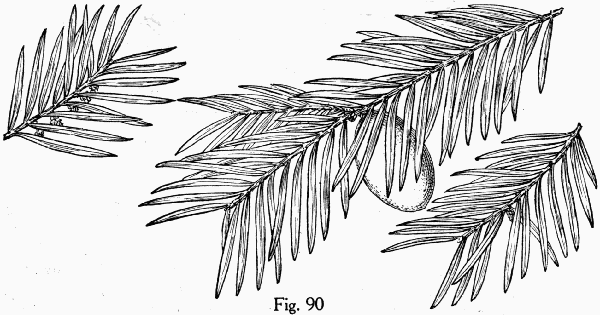
Leaves slightly falcate, 1½′ long, about ⅛′ wide, somewhat rounded, dark green and lustrous above, paler and marked below with broad bands of stomata. Flowers appearing in March and April; male with pale yellow anthers; female broadly ovoid, with a dark purple fleshy covering to the ovule, ⅛′ long, and inclosed at the base by broad thin rounded scales. Seed fully grown at midsummer, slightly obovoid, dark purple, 1′—1¼′ long, ¾′ thick, with a thin leathery covering, a light red-brown seed-coat furnished on the inner surface with 2 opposite [92] longitudinal thin ridges extending from the base toward the apex, and conspicuously ruminate albumen.
A tree, occasionally 40° high, with a short trunk 1°—2° in diameter, whorls of spreading slightly pendulous branches forming a rather open pyramidal head tapering from a broad base. Bark ½′ thick, brown faintly tinged with orange color, and irregularly divided by broad shallow fissures into wide low ridges slightly rounded on the back and covered with thin closely appressed scales. Wood hard, strong, clear bright yellow, with thin lighter colored sapwood; largely used for fence-posts.
Distribution. On bluffs along the eastern bank of the Apalachicola River, Florida, from River Junction to the neighborhood of Bristol, Liberty County, and in the southwestern corner of Decatur County, Georgia (R. M. Harper). Rare and local.
Now often planted in the public grounds and gardens of Tallahassee, Florida.
2. Torreya californica Torr. California Nutmeg.
Tumion californicum Greene.
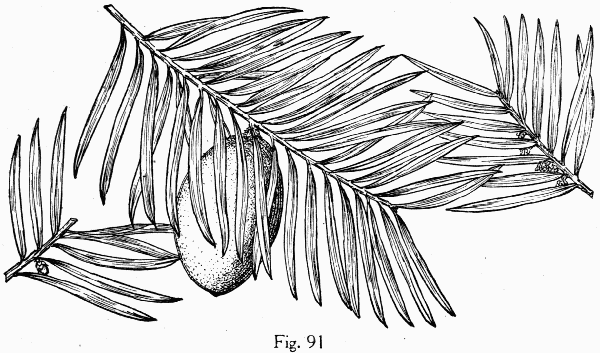
Leaves slightly falcate, nearly flat, dark green and lustrous on the upper, somewhat paler and marked below with a narrow band of stomata, tipped with slender callous [93] points, 1′—3½′ long, 1/16′—⅛′ wide. Flowers appearing in March and April; male with broadly ovate acute scales; female nearly ¼′ long, with oblong-ovate rounded scales. Seed ovoid or oblong-ovoid, 1′—1½′ long, light green more or less streaked with purple.
A tree, 50°—70° but occasionally 100° high, with a trunk 1°—2° or rarely 4° in diameter, and whorls of spreading slender slightly pendulous branches forming a handsome pyramidal and in old age a round-topped head. Bark ⅓′—½′ thick, gray-brown tinged with orange color, deeply and irregularly divided by broad fissures into narrow ridges covered with elongated loosely appressed plate-like scales. Wood light, soft, close-grained, clear light yellow, with thin nearly white sapwood; occasionally used for fence-posts.
Distribution. Borders of mountain streams, California, nowhere common but widely distributed from Mendocino County to the Santa Cruz Mountains in the coast region and along the western slopes of the Sierra Nevada from Eldorado to Tulare Counties at altitudes of 3000°—5000° above the sea; most abundant and of its largest size on the northern coast ranges.
Rarely cultivated as an ornamental tree in California and western Europe.
2. TAXUS L. Yew.
Trees or shrubs, with brown or dark purple scaly bark, and spreading usually horizontal branches. Leaves flat, often falcate, gradually narrowed at the base, dark green, smooth and keeled on the upper surface, paler, papillate, and stomatiferous on the lower surface, their margins slightly thickened and revolute. Flowers diœcious or monœcious: the male composed of a slender stipe bearing at the apex a globular head of 4—8 pale yellow stamens consisting of 4—6 conic pendant pollen-sacs peltately connate from the end of a short filament; the female sessile in the axils of the upper scale-like bracts of a short axillary branch, the ovule erect, sessile on a ring-like disk, ripening in the autumn into an ovoid-oblong seed gradually narrowed and short-pointed at apex, marked at base by the much-depressed hilum, about ⅓′ long, entirely or nearly surrounded by but free from the now thickened succulent translucent sweet scarlet aril-like disk of the flower open at apex; seed-coat thick, of two layers, the outer thin and membranaceous or fleshy, the inner much thicker and somewhat woody; albumen uniform.
Taxus with six or seven species, which can be distinguished only by their leaf characters and habit, is widely distributed through the northern hemisphere, and is found in eastern North America where two species occur, in Pacific North America, Mexico, Europe, northern Africa, western and southern Asia, China, and Japan. Of the exotic species the European, African, and Asiatic Taxus baccata L., and its numerous varieties, is often cultivated in the United States, especially in the more temperate parts of the country, and is replaced with advantage by the hardier Taxus cuspidata S. & Z., of eastern Asia in the northern states, where the native shrubby Taxus canadensis Marsh, with monœcious flowers is sometimes cultivated.
Taxus, from τάξος, is the classical name of the Yew-tree.
CONSPECTUS OF THE NORTH AMERICAN ARBORESCENT SPECIES.
Leaves usually short, yellow-green.
1. T. brevifolia (G).
Leaves elongated, usually falcate, dark green.
2. T. floridana (C).
1. Taxus brevifolia Nutt. Yew.
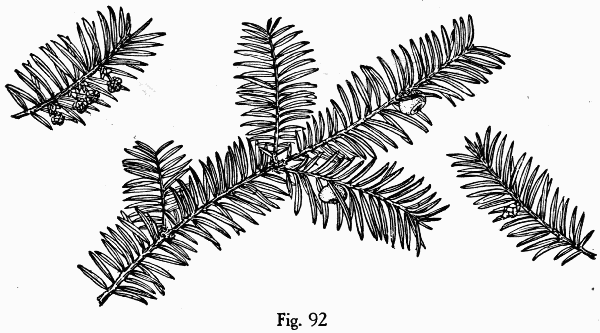
Leaves ½′—1′ long, about 1/16′ wide, dark yellow-green above, rather paler below, with stout midribs, and slender yellow petioles 1/12′ long, persistent for 5—12 years. Flowers and fruit as in the genus.
A tree, usually 40°—50° but occasionally 70°—80° high, with a tall straight trunk 1°—2° or rarely 4½° in diameter, frequently unsymmetrical, with one diameter much exceeding the other, and irregularly lobed, with broad rounded lobes, and long slender horizontal or slightly pendulous branches forming a broad open conical head. Bark about ¼′ thick [94] and covered with small thin dark red-purple scales. Wood heavy, hard, strong, bright red, with thin light yellow sapwood; used for fence-posts and by the Indians of the northwest coast for paddles, spear-handles, bows, and other small articles.
Distribution. Banks of mountain streams, deep gorges, and damp ravines, growing usually under large coniferous trees; nowhere abundant, but widely distributed usually in single individuals or in small clumps from the extreme southern part of Alaska, southward along the coast ranges of British Columbia, Washington, and Oregon, where it attains its greatest size; along the coast ranges of California as far south as the Bay of Monterey, and along the western slopes of the Sierra Nevada to Tulare County at altitudes between 5000° and 8000° above the sea-level, ranging eastward in British Columbia to the Selkirk Mountains, and over the mountains of Washington and Oregon to the western slopes of the continental divide in northern Montana; in the interior much smaller than near the coast and often shrubby in habit.
Occasionally cultivated in the gardens of western Europe.
2. Taxus floridana Chapm. Yew.
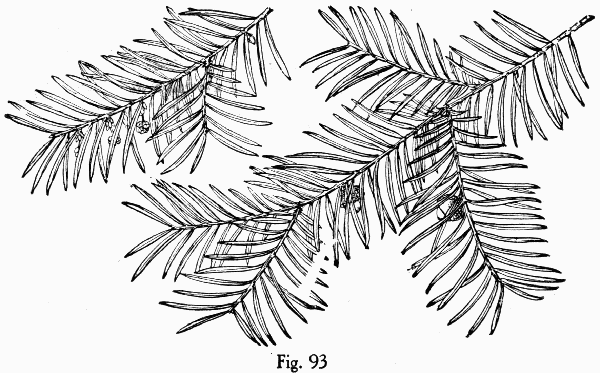
Leaves usually conspicuously falcate, ¾′ to nearly 1′ long, 1/16′—1/12′ wide, dark green above, pale below, with obscure midribs and slender petioles about 1/16′ in length. Flowers appearing in March. Fruit ripening in October.
[95]
A bushy tree, rarely 25° high, with a short trunk occasionally 1° in diameter, and numerous stout spreading branches; more often shrubby in habit and 12°—15° tall. Bark ⅛′ thick, dark purple-brown, smooth, compact, occasionally separating into large thin irregular plate-like scales. Wood heavy, hard, very close-grained, dark brown tinged with red, with thin nearly white sapwood.
Distribution. River bluffs and ravines on the eastern bank of the Apalachicola River, in Gadsden County, Florida, from Aspalaga to the neighborhood of Bristol.
[96]