Class 1. GYMNOSPERMÆ. (continued 2)
Reading edition
Distribution. Well-drained uplands and mountain slopes, often forming a large part of extensive forests, from Prince Edward Island and the valley of the St. Lawrence southward to the coast of Massachusetts, along the interior hilly part of New England, New York, and northern Pennsylvania and on the slopes of the Alleghany Mountains at elevations above 2500 feet from West Virginia to North Carolina and Tennessee.
Occasionally planted in the eastern states and in Europe as an ornamental tree, but growing in cultivation more slowly than any other Spruce-tree.
3. Picea glauca Voss. White Spruce.
Picea canadensis B. S. P.
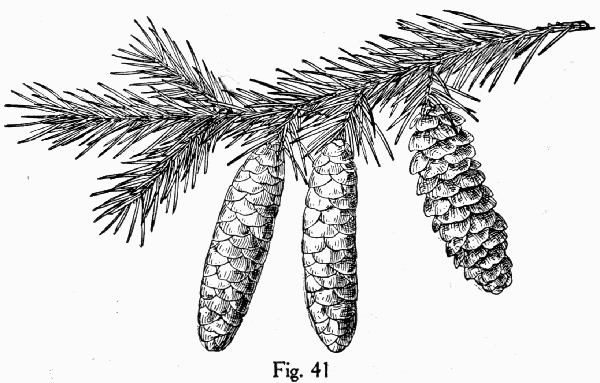
Leaves crowded on the upper side of the branches by the twisting of those on the lower side, incurved, acute or acuminate with rigid callous tips, pale blue and hoary when they first appear, becoming dark blue-green or pale blue, marked on each of the 4 sides by 3 or 4 rows of stomata, ⅓′—¾′ long. Flowers: male pale red, soon appearing yellow from the thick covering of pollen; female oblong-cylindric, with round nearly entire pale red or yellow-green scales, broader than long, and nearly orbicular denticulate bracts. Fruit nearly sessile or borne on short thin straight stems, oblong-cylindric, slender, slightly narrowed to the ends, rather obtuse at apex, usually about 2′ long, pale green sometimes tinged with red when fully grown, becoming at maturity pale brown and lustrous, with nearly orbicular scales, rounded, truncate, and slightly emarginate, or rarely narrowed at apex, and very thin, flexible and elastic at maturity, usually deciduous in the autumn or during the following winter; seeds about ⅛′ long, pale brown, with narrow wings gradually widened from the base to above the middle and very oblique at the apex.
A tree, with disagreeable smelling foliage, rarely more than 60°—70° tall, with a trunk [38] not more than 2° in diameter, long comparatively thick branches densely clothed with stout rigid laterals sweeping out in graceful upward curves, and forming a broad-based rather open pyramid often obtuse at the apex, stout glabrous branchlets orange-brown during their first autumn and winter, gradually growing darker grayish brown. Winter-buds broadly ovoid, obtuse, covered by light chestnut-brown scales with thin often reflexed ciliate margins. Bark ¼′—½′ thick, separating irregularly into thin plate-like light gray scales more or less tinged with brown. Wood light, soft, not strong, straight-grained light yellow, with hardly distinguishable sapwood; manufactured into lumber in the eastern provinces of Canada and in Alaska, and used in construction, for the interior finish of buildings, and for paper-pulp.
Distribution. Banks and borders of streams and lakes, ocean cliffs, and in the north the rocky slopes of low hills, from Labrador along the northern frontier of the forest nearly to the shores of the Arctic Sea, reaching Behring Strait in 66° 44′ north latitude, and southward down the Atlantic coast to southern Maine, northern New Hampshire, Vermont, and New York, shores of Saginaw Bay, Michigan, northern Wisconsin and Minnesota, and through the interior of Alaska.
The variety (var. albertiana Sarg.) of the Gaspé Peninsula and the valleys of the Black Hills of South Dakota and of the Rocky Mountains of northern Wyoming, Montana, Alberta and northward, is a tree with a narrow pyramidal head, sometimes 150° high, with a trunk 3° to 4° in diameter, and shorter and rather broader cones than those of the typical White Spruce of the east, although not shorter or as short as the cones of that tree in the extreme north.
Often planted in Canada, northern New England, and northern Europe as an ornamental tree; in southern New England and southward suffering from heat and dryness.
4. Picea Engelmannii Engelm. White Spruce. Engelmann Spruce.
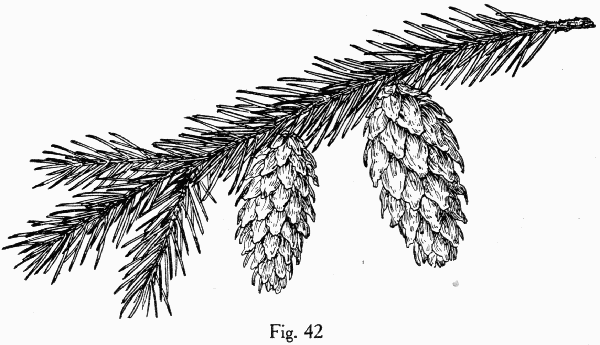
Leaves soft and flexible, with acute callous tips, slender, nearly straight or slightly incurved on vigorous sterile branches, stouter, shorter, and more incurved on fertile branches, 1′—1⅛′ long, marked on each face by 3—5 rows of stomata, covered at first with a glaucous bloom, soon becoming dark blue-green or pale steel-blue. Flowers: male dark purple; female bright scarlet, with pointed or rounded and more or less divided scales, and oblong bracts rounded or acute or acuminate and denticulate at apex or obovate-oblong and abruptly acuminate. Fruit oblong-cylindric to ellipsoidal, gradually narrowed to the ends, usually about 2′ long, sessile or very short-stalked, produced in great numbers on the upper branches, horizontal and ultimately pendulous, light green somewhat tinged with scarlet when fully grown, becoming light chestnut-brown and lustrous, with thin flexible slightly concave scales, generally erose-dentate or rarely almost entire on the margins, usually broadest at the middle, wedge-shaped below, and gradually contracted above into a truncate or acute apex, or occasionally obovate and rounded above; mostly deciduous in the autumn or early in their first winter soon after the escape of the seeds; seeds obtuse [39] at the base, nearly black, about ⅛′ long and much shorter than their broad very oblique wings.
A tree, with disagreeable smelling foliage sometimes 120° high, with a trunk 3° in diameter, spreading branches produced in regular whorls and forming a narrow compact pyramidal head, gracefully hanging short lateral branches, and comparatively slender branchlets pubescent for three or four years, light or dark orange-brown or gray tinged with brown during their first winter, their bark beginning to separate into small flaky scales in their fourth or fifth year; at its highest altitudes low and stunted with elongated branches pressed close to the ground. Winter-buds conic or slightly obtuse, with pale chestnut-brown scales scarious and often free and slightly reflexed on the margins. Bark ¼′—½′ thick, light cinnamon-red, and broken into large thin loose scales. Wood light, soft, not strong, close-grained, pale yellow tinged with red, with thick hardly distinguishable sapwood; largely manufactured into lumber used in the construction of buildings; also employed for fuel and charcoal. The bark is sometimes employed in tanning leather.
Distribution. High mountain slopes, often forming great forests from the mountains of Alberta, British Columbia and Alaska, southward over the interior mountain systems of the continent to southern New Mexico (the Sacramento Mountains) and northern Arizona, from elevations of 5000° at the north up to 11,500° and occasionally to 12,000° at the south, and westward through Montana and Idaho to the eastern slopes of the Cascade Mountains of Washington and Oregon; attaining its greatest size and beauty north of the northern boundary of the United States.
Occasionally planted as an ornamental tree in the New England states and northern Europe, where it grows vigorously and promises to attain a large size; usually injured in western Europe by spring frosts.
5. Picea pungens Englm. Blue Spruce. Colorado Spruce.
Picea Parryana Sarg.
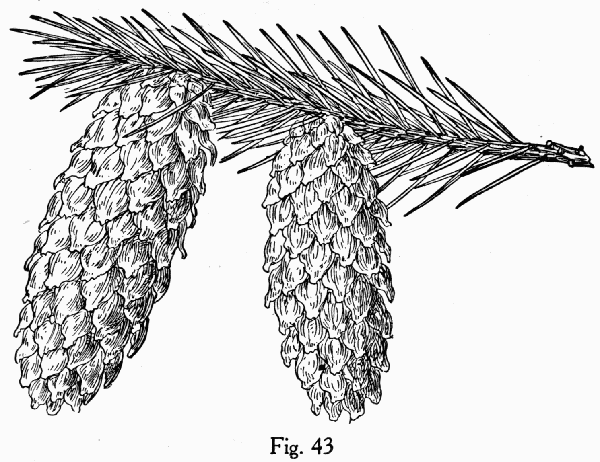
Leaves strongly incurved, especially those on the upper side of the branches, stout, rigid, acuminate and tipped with long callous sharp points, 1′—1⅛′ long on sterile branches, often not more than half as long on the fertile branches of old trees, marked on each side by 4—7 rows of stomata, dull bluish green on some individuals and light or dark steel-blue or silvery white on others, the blue colors gradually changing to dull blue-green at the end of three or four years. Flowers: male yellow tinged with red; female with broad oblong or slightly obovate pale green scales truncate or slightly emarginate at the denticulate apex, and acute bracts. Fruit produced on the upper third of the tree, sessile or short-stalked, oblong-cylindric, [40] slightly narrowed at the ends, usually about 3′ long, green more or less tinged with red when fully grown at midsummer, becoming pale chestnut-brown and lustrous, with flat tough rhombic scales flexuose on the margins, and acute, rounded or truncate at the elongated erose apex; seeds ⅛′ long or about half the length of their wings, gradually widening to above the middle and full and rounded at apex.
A tree, usually 80°—100° or occasionally 150° high, with a trunk rarely 3° in diameter and occasionally divided into 3 or 4 stout secondary stems, rigid horizontal branches disposed on young trees in remote whorls and decreasing regularly in length from below upward, the short stout stiff branchlets pointing forward and making flat-topped masses of foliage; branches on old trees short and remote, with stout lateral branches forming a thin ragged pyramidal crown; branchlets stout, rigid, glabrous, pale glaucous green, becoming bright orange-brown during the first winter and ultimately light grayish brown. Winter-buds stout, obtuse or rarely acute, ¼′—½′ long, with thin pale chestnut-brown scales usually reflexed on the margins. Bark of young trees gray or gray tinged with cinnamon-red and broken into small oblong plate-like scales, becoming on the lower part of old trunks ¾′—1½′ thick and deeply divided into broad rounded ridges covered with small closely appressed pale gray or occasionally bright cinnamon-red scales. Wood light, soft, close-grained, weak, pale brown or often nearly white, with hardly distinguishable sapwood.
Distribution. Banks of streams or on the first benches above them singly or in small groves at elevations between 6500° and 11,000° above the sea; Colorado and eastern Utah northward to the northern end of the Medicine Bow Mountains and on the Laramie Range in southern and on the Shoshone and Teton Mountains in northwestern Wyoming, and southward into northern New Mexico (Sierra Bianca, alt. 8000°—11,000°, Sacramento Mountains, Pecos River National Forest).
Often planted as an ornamental tree in the eastern and northern states and in western and northern Europe, especially individuals with blue foliage; very beautiful in early life but in cultivation soon becoming unsightly from the loss of the lower branches.
6. Picea Breweriana S. Wats. Weeping Spruce.
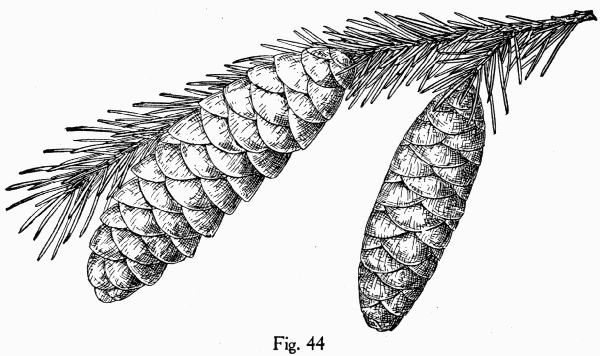
Leaves abruptly narrowed and obtuse at apex, straight or slightly incurved, rounded and obscurely ridged and dark green and lustrous on the lower surface, flattened and conspicuously marked on the upper surface by 4 or 5 rows of stomata on each side of the prominent midrib, ¾′—1⅛′ long, 1/16′—1/10′ wide. Flowers: male dark purple; female oblong-cylindric, with obovate scales rounded above and reflexed on the entire margins, and oblong bracts laciniately divided at their rounded or acute apex. Fruit ellipsoidal, gradually narrowed from the middle to the ends, acute at apex, rather oblique at base, suspended on straight slender stalks, deep rich purple or green more or less tinged with purple when fully grown, becoming light orange-brown, 2′—4′ long, with thin broadly ovate flat scales longer than broad, rounded at apex, opening late in the autumn after the escape of the [41] seeds, often becoming strongly reflexed and very flexible; usually remaining on the branches until their second winter; seeds acute at base, full and rounded on the sides, ⅛′ long, dark brown, and about one quarter the length of their wings broadest toward the full and rounded apex.
A tree, usually 80°—100° high, with a trunk 2°—3° in diameter above the swelling of its enlarged and gradually tapering base, and furnished to the ground with crowded branches, those at the top of the tree short and slightly ascending, with comparatively short pendulous lateral branches, those lower on the tree horizontal or pendulous and clothed with slender flexible whip-like laterals often 7°—8° long and not more than ¼′ thick and furnished with numerous long thin lateral branchlets, their ultimate divisions slender, coated with fine pubescence persistent until their third season, bright red-brown during their first winter, gradually growing dark gray-brown. Winter-buds conic, light chestnut-brown, ¼′ long and ⅛′ thick. Bark ½′—¾′ thick, broken into long thin closely appressed scales dull red-brown on the surface. Wood heavy, soft, close-grained, light brown or nearly white, with thick hardly distinguishable sapwood.
Distribution. Dry mountain ridges and peaks near the timber-line on both slopes of the Siskiyou Mountains on the boundary between California and Oregon, forming small groves at elevations of about 7000° above the sea; on a high peak west of Marble Mountain in Siskiyou County, California; on the coast ranges of southwestern Oregon at elevations of 4000°—5000°.
7. Picea sitchensis Carr. Tideland Spruce. Sitka Spruce.
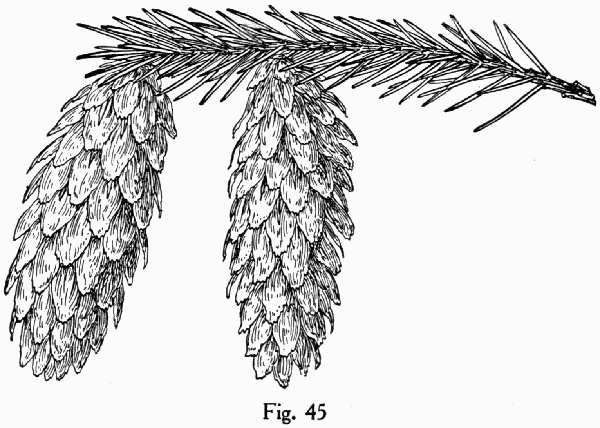
Leaves standing out from all sides of the branches and often nearly at right angles to them, frequently bringing their white upper surface to view by a twist at their base, straight or slightly incurved, acute or acuminate with long callous tips, slightly rounded, green, lustrous, and occasionally marked on the lower surface with 2 or 3 rows of small conspicuous stomata on each side of the prominent midrib, flattened, obscurely ridged and almost covered with broad silvery white bands of numerous rows of stomata on the upper surface, ½′—1⅛′ long and 1/16′—1/12′ wide, mostly persistent 9—11 years. Flowers: male at the ends of the pendant lateral branchlets, dark red; female on rigid terminal shoots of the branches of the upper half of the tree, with nearly orbicular denticulate scales, often slightly truncate above and completely hidden by their elongated acuminate bracts. Fruit oblong-cylindric, short-stalked, yellow-green often tinged with dark red when fully grown, becoming lustrous and pale yellow or reddish brown, 2½′—4′ long, with thin stiff elliptic scales rounded toward the apex, denticulate above the middle, and nearly twice as long as their lanceolate denticulate [42] bracts; deciduous mostly during their first autumn and winter; seeds full and rounded, acute at the base, pale reddish brown, about ⅛′ long, with narrow oblong slightly oblique wings ⅓′—½′ in length.
A tree, usually about 100° high, with a conspicuously tapering trunk often 3°—4° in diameter above its strongly buttressed and much-enlarged base, occasionally 200° tall, with a trunk 15°—16° in diameter, horizontal branches forming an open loose pyramid and on older trees clothed with slender pendant lateral branches frequently 2°—3° long, and stout rigid glabrous branchlets pale green at first, becoming dark or light orange-brown during their first autumn and winter and finally dark gray-brown; at the extreme northwestern limits of its range occasionally reduced to a low shrub. Winter-buds ovoid, acute or conical, ¼′—½′ long, with pale chestnut-brown acute scales, often tipped with short points and more or less reflexed above the middle. Bark ¼′—½′ thick and broken on the surface into large thin loosely attached dark red-brown or on young trees sometimes bright cinnamon-red scales. Wood light, soft, not strong, straight-grained, light brown tinged with red, with thick nearly white sapwood; largely manufactured into lumber used in the interior finish of buildings, for fencing, boat-building, aeroplanes, cooperage, wooden-ware, and packing-cases.
Distribution. Moist sandy, often swampy soil, or less frequently at the far north on wet rocky slopes, from the eastern end of Kadiak Island, southward through the coast region of Alaska, British Columbia, Washington, and Oregon to Mendocino County, California; in Washington, occasionally ranging inland to the upper valley of the Nesqually River.
Often planted in western and central Europe and occasionally in the middle Atlantic states as an ornamental tree.
4. TSUGA Carr. Hemlock.
Tall pyramidal trees, with deeply furrowed astringent bark bright cinnamon-red except on the surface, soft pale wood, nodding leading shoots, slender scattered horizontal often pendulous branches, the secondary branches three or four times irregularly pinnately ramified, with slender round glabrous or pubescent ultimate divisions, the whole forming graceful pendant masses of foliage, and minute winter-buds. Leaves flat or angular, obtuse and often emarginate or acute at apex, spirally disposed, usually appearing almost 2-ranked by the twisting of their petioles, those on the upper side of the branch then much shorter than the others, abruptly narrowed into short petioles jointed on ultimately woody persistent bases, with stomata on the lower surface; on one species not 2-ranked, and of nearly equal length, with stomata on both surfaces. Flowers solitary, the male in the axils of leaves of the previous year, globose, composed of numerous subglobose anthers, with connectives produced into short gland-like tips, the female terminal, erect, with nearly circular scales slightly longer or shorter than their membranaceous bracts. Fruit [43] an ovoid-oblong, oval, or oblong-cylindric obtuse usually pendulous nearly sessile green or rarely purple cone becoming light or dark reddish brown, with concave suborbicular or ovate-oblong scales thin and entire on the margins, much longer than their minute bracts, persistent on the axis of the cone after the escape of the seeds. Seeds furnished with resin-vesicles, ovoid-oblong, compressed, nearly surrounded by their much longer obovate-oblong wings; outer seed-coat crustaceous, light brown, the inner membranaceous, pale chestnut-brown, and lustrous; cotyledons 3—6, much shorter than the inferior radicle.
Tsuga is confined to temperate North America, Japan, central and southwestern China, Formosa, and the Himalayas; nine species have been distinguished.
Tsuga is the Japanese name of the Hemlock-tree.
CONSPECTUS OF THE NORTH AMERICAN SPECIES.
Leaves flat, obtuse or emarginate at apex, with stomata only on the lower surface; cones ovoid, oblong or oblong-ovoid.
Cones stalked.
Cone-scales broad-obovate, about as wide as long, their bracts broad and truncate.
1. T. canadensis (A).
Cone-scales narrow-oval, much longer than wide, their bracts obtusely pointed.
2. T. caroliniana (A).
Cones sessile; cone-scales oval, often abruptly contracted near the middle, their bracts gradually narrowed to an obtuse point.
3. T. heterophylla (B, F, G).
Leaves convex or keeled above, bluntly pointed, with stomata on both surfaces; cones oblong-cylindric, their scales oblong-obovate, longer than broad, much longer than their acuminate short-pointed bracts.
4. T. Mertensiana (B, F, G).
1. Tsuga canadensis Carr. Hemlock.
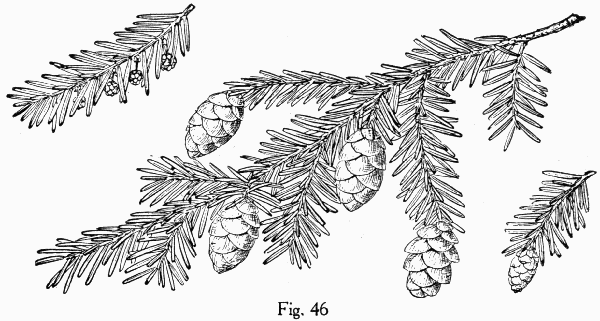
Leaves, rounded and rarely emarginate at apex, dark yellow-green, lustrous and obscurely grooved especially toward the base on the upper surface, marked on the lower surface by 5 or 6 rows of stomata on each side of the low broad midrib, ⅓′—⅔′ long, about 1/16′ wide, deciduous in their third season from dark orange-colored persistent bases. Flowers: male light yellow; female pale green, with broad bracts coarsely laciniate on the margins and shorter than their scales. Fruit on slender puberulous stalks often ¼′ long, ovoid, acute, ½′—¾′ long, with broad-obovate scales almost as wide as long, and broad truncate bracts slightly laciniate on the margins, opening and gradually losing their seeds during [44] the winter and mostly persistent on the branches until the following spring; seeds 1/16′ long, usually with 2 or 3 large oil-vesicles, nearly half as long as their wings broad at the base and gradually tapering to the rounded apex.
A tree, usually 60°—70°, and occasionally 100° high, with a trunk 2°—4° in diameter, gradually and conspicuously tapering toward the apex, long slender horizontal or pendulous branches, persistent until overshadowed by other trees, and forming a broad-based rather obtuse pyramid, and slender light yellow-brown pubescent branchlets, growing darker during their first winter and glabrous and dark red-brown tinged with purple in their third season. Winter-buds obtuse, light chestnut-brown, slightly puberulous, about 1/16′ long. Bark ½′—¾′ thick, deeply divided into narrow rounded ridges covered with thick closely appressed scales varying from cinnamon-red to gray more or less tinged with purple. Wood light, soft, not strong, brittle, coarse-grained, difficult to work, liable to wind-shake and splinter, not durable when exposed to the air, light brown tinged with red, with thin somewhat darker sapwood; largely manufactured into coarse lumber employed for the outside finish of buildings. The astringent inner bark affords the largest part of the material used in the northeastern states and Canada in tanning leather. From the young branches oil of hemlock is distilled.
Distribution. Scattered through upland forests and often covering the northern slopes of rocky ridges and the steep rocky banks of narrow river-gorges from Nova Scotia to eastern Minnesota (Carleton County), and southward through the northern states to Newcastle County, Delaware, cliffs of Tuckahoe Creek, Queen Anne’s County, Maryland, southern Michigan, southern Indiana (bank of Back Creek near Leesville, Laurence County), southwestern Wisconsin, and along the Appalachian Mountains to northern Georgia, and in northern Alabama; most abundant and frequently an important element of the forest in New England, northern New York, and western Pennsylvania; attaining its largest size near streams on the slopes of the high mountains of North Carolina and Tennessee.
Largely cultivated with numerous seminal varieties as an ornamental tree in the northern states, and in western and central Europe.
2. Tsuga caroliniana Engelm. Hemlock.
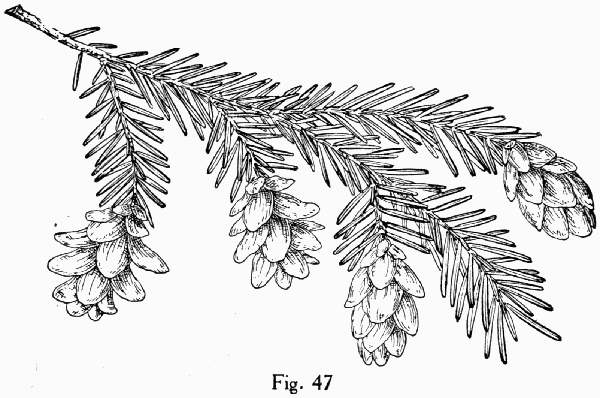
Leaves retuse or often emarginate at apex, dark green, lustrous and conspicuously grooved on the upper surface, marked on the lower surface by a band of 7 or 8 rows of stomata on each side of the midrib, ⅓′—¾′ long, about 1/12′ wide, deciduous from the orange-red bases during their fifth year. Flowers: male tinged with purple; female purple, with broadly ovate bracts, scarious and erose on the margins and about as long as their scales. Fruit on short stout stalks, oblong, 1′—1½′ long, with narrow-oval scales gradually narrowed and rounded at apex, rather abruptly contracted at base into distinct stipes, thin, concave, puberulous on the outer surface, twice as long as their broad pale bracts, spreading nearly at right angles to the axis of the cone [45] at maturity, their bracts rather longer than wide, wedge-shaped, pale, nearly truncate or slightly pointed at the broad apex; seeds ⅙′ long, with numerous small oil-vesicles on the lower side, and one quarter as long as the pale lustrous wings broad or narrow at the base and narrowed to the rounded apex.
A tree, usually 40°—50°, or occasionally 70° high, with a trunk rarely exceeding 2° in diameter, short stout often pendulous branches forming a handsome compact pyramidal head, and slender light orange-brown pubescent branchlets, usually becoming glabrous and dull brown more or less tinged with orange during their third year. Winter-buds obtuse, dark chestnut-brown, pubescent, nearly ⅛′ long. Bark of the trunk ¾′—1¼′ thick, red-brown, and deeply divided into broad flat connected ridges covered with thin closely appressed plate-like scales. Wood light, soft, not strong, brittle, coarse-grained, pale brown tinged with red, with thin nearly white sapwood.
Distribution. Rocky banks of streams usually at elevations between 2500° and 3000° on the Blue Ridge from southwestern Virginia to northern Georgia, generally singly or in small scattered groves of a few individuals.
Occasionally planted as an ornamental tree in the northern states, and in western Europe.
3. Tsuga heterophylla Sarg. Hemlock.
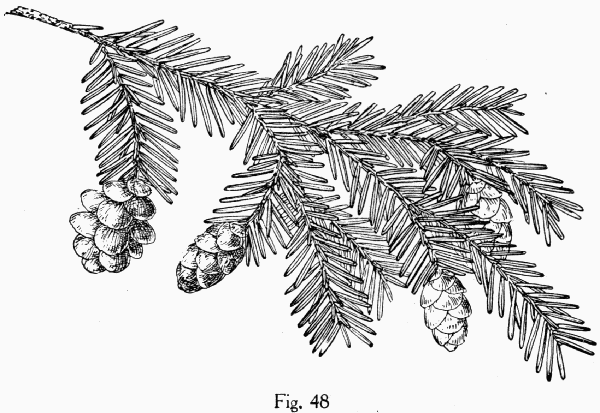
Leaves rounded at apex, conspicuously grooved, dark green and very lustrous on the upper surface, marked below by broad white bands of 7—9 rows of stomata, abruptly contracted at the base into slender petioles, ¼′—¾′ long and 1/16′—1/12′ wide, mostly persistent 4—7 years. Flowers: male yellow; female purple and puberulous, with broad bracts gradually narrowed to an obtuse point and shorter than their broadly ovate slightly scarious scales. Fruit oblong-ovoid, acute, sessile, ¾′—1′ long, with slightly puberulous oval scales, often abruptly narrowed near the middle, and dark purple puberulous bracts rounded and abruptly contracted at apex; seeds ⅛′ long, furnished with occasional oil-vesicles, one third to one half as long as their narrow wings.
A tree, frequently 200° high, with a tall trunk 6°—10° in diameter, and short slender usually pendulous branches forming a narrow pyramidal head, and slender pale yellow-brown branchlets ultimately becoming dark reddish brown, coated at first with long pale hairs, and pubescent or puberulous for five or six years. Winter-buds ovoid, bright chestnut-brown, about 1/16′ long. Bark on young trunks thin, dark orange-brown, and [46] separated by shallow fissures into narrow flat plates broken into delicate scales, becoming on fully grown trees 1′—1½′ thick and deeply divided into broad flat connected ridges covered with closely appressed brown scales more or less tinged with cinnamon-red. Wood light, hard and tough, pale brown tinged with yellow, with thin nearly white sapwood; stronger and more durable than the wood of the other American hemlocks; now largely manufactured into lumber used principally in the construction of buildings. The bark is used in large quantities in tanning leather; from the inner bark the Indians of Alaska obtain one of their principal articles of vegetable food.
Distribution. Southeastern Alaska, southward near the coast to southern Mendocino County, California, extending eastward over the mountains of southern British Columbia, northern Washington, Idaho and Montana, to the western slopes of the continental divide, and through Oregon to the western slopes of the Cascade Mountains, sometimes ascending in the interior to elevations of 6000° above the sea; most abundant and of its largest size on the coast of Washington and Oregon; often forming a large part of the forests of the northwest coast.
Frequently planted as an ornamental tree in temperate Europe.
4. Tsuga Mertensiana Sarg. Mountain Hemlock. Black Hemlock.
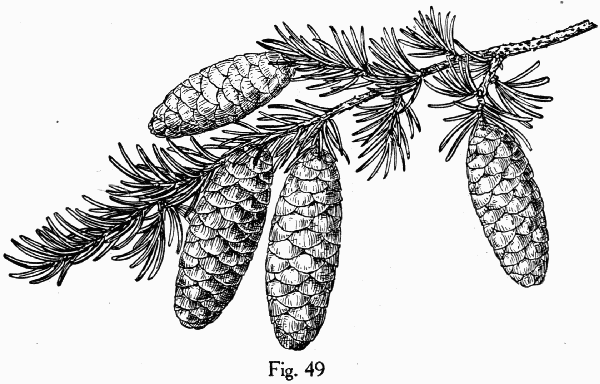
Leaves standing out from all sides of the branch, remote on leading shoots and crowded on short lateral branchlets, rounded and occasionally obscurely grooved or on young plants sometimes conspicuously grooved on the upper surface, rounded and slightly ribbed on the lower surface, bluntly pointed, often more or less curved, stomatiferous above and below, with about 8 rows of stomata on each surface, light bluish green or on some individuals pale blue, ½′—1′ long, about 1/16′ wide, abruptly narrowed into nearly straight or slightly twisted petioles articulate on bases as long or rather longer than the petioles; irregularly deciduous during their third and fourth years. Flowers: male borne on slender pubescent drooping stems, violet-purple; female erect, with delicate lustrous dark purple or yellow-green bracts gradually narrowed above into slender often slightly reflexed tips and much longer than their scales. Fruit sessile, oblong-cylindric, narrowed toward the blunt apex and somewhat toward the base, erect until more than half grown, pendulous or rarely erect at maturity, ⅝′—3′ long, with thin delicate oblong-obovate scales gradually contracted from above the middle to the wedge-shaped base, rounded at the slightly thickened more or less erose margins, puberulous on the outer surface, usually bright bluish purple or occasionally pale yellow-green, four or five times as long as their short-pointed dark purple or brown bracts; seeds light brown, ⅛′ long, often marked on the [47] surface next their scales with 1 or 2 large resin-vesicles, with wings nearly ½′ long, broadest above the middle, gradually narrowed below, slightly or not at all oblique at the rounded apex.
A tree, usually 70°—100° but occasionally 150° high, with a slightly tapering trunk 4°—5° in diameter, gracefully pendant slender branches furnished with drooping frond-like lateral branches, their ultimate divisions erect and forming an open pyramid surmounted by the long drooping leading shoot, and thin flexible or sometimes stout rigid branchlets light reddish brown and covered for two or three years with short pale dense pubescence, becoming grayish brown and very scaly. Winter-buds acute, about ⅛′ long, the scales of the outer ranks furnished on the back with conspicuous midribs produced into slender deciduous awl-like tips. Bark 1′—1½′ thick, deeply divided into connected rounded ridges broken into thin closely appressed dark cinnamon scales shaded with blue or purple. Wood light, soft, not strong, close-grained, pale brown or red, with thin nearly white sapwood; occasionally manufactured into lumber.
Distribution. Exposed ridges and slopes at high altitudes along the upper border of the forest from southeastern Alaska, southward over the mountain ranges of British Columbia to the Olympic Mountains of Washington, and eastward to the western slopes of the Selkirk Mountains in the interior of southern British Columbia, and along the Bitter Root Mountains to the headwaters of the Clearwater River, Idaho; along the Cascade Mountains of Washington and Oregon, on the mountain ranges of northern California, and along the high Sierra Nevada to the cañon of the south fork of King’s River, California; in Alaska occasionally descending to the sea-level, and toward the southern limits of its range often ascending to elevations of 10,000°.
Often planted as an ornamental tree in western and central Europe, and rarely in the eastern United States.
5. PSEUDOTSUGA Carr.
Pyramidal trees, with thick deeply furrowed bark, hard strong wood, with spirally marked wood-cells, slender usually horizontal irregularly whorled branches clothed with slender spreading lateral branches forming broad flat-topped masses of foliage, ovoid acute leaf-buds, the lateral buds in the axils of upper leaves, their inner scales accrescent and marking the branchlets with ring-like scars. Leaves petiolate, linear, flat, rounded and obtuse or acuminate at apex, straight or incurved, grooved on the upper side, marked on the lower side by numerous rows of stomata on each side of the prominent midrib, spreading nearly at right angles with the branch. Flowers solitary, the male axillary, scattered along the branches, oblong-cylindric, with numerous globose anthers, their connectives terminating in short spurs, the female terminal or in the axils of upper leaves, composed of spirally arranged ovate rounded scales much shorter than their acutely 2-lobed bracts, with midribs produced into elongated slender tips. Fruit an ovoid-oblong acute pendulous cone maturing in one season, with rounded concave rigid scales persistent on the axis of the cone after the escape of the seeds, and becoming dark red-brown, much shorter than the 2-lobed bracts with midribs ending in rigid woody linear awns, those at the base of the cone without scales and becoming linear-lanceolate by the gradual suppression of their lobes. Seeds nearly triangular, full, rounded and dark-colored on the upper side and pale on the lower side, shorter than their oblong wings infolding the upper side of the seeds in a dark covering; outer seed-coat thick and crustaceous, the inner thin and membranaceous; cotyledons 6—12, much shorter than the inferior radicle.
Pseudotsuga is confined to western North America, southern Japan, southwestern China and Formosa. Four species are recognized.
Pseudotsuga, a barbarous combination of a Greek with a Japanese word, indicates the relation of these trees with the Hemlocks.
[48]
CONSPECTUS OF THE NORTH AMERICAN SPECIES.
Leaves usually rounded and obtuse at apex, dark yellow-green or rarely blue-green; cones 2′—4½′ long, their bracts much exserted.
1. P. taxifolia (B, E, F, G, H).
Leaves acuminate at apex, bluish gray; cones 4′—6½′ long, their bracts slightly exserted.
2. P. macrocarpa (G).
1. Pseudotsuga taxifolia Britt. Douglas Spruce. Red Fir.
Pseudotsuga mucronata Sudw.
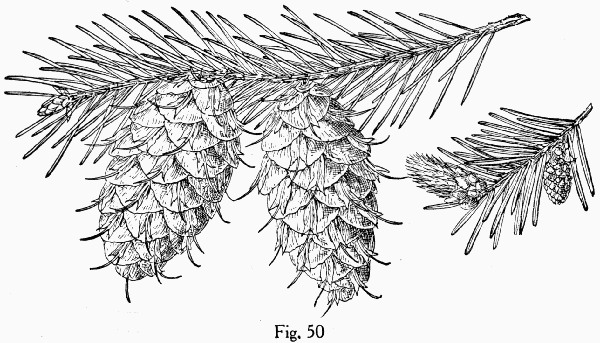
Leaves straight or rarely slightly incurved, rounded and obtuse at apex, or acute on leading shoots, ¾′—1¼′ long, 1/16′—1/12′ wide, dark yellow-green or rarely light or dark bluish green, occasionally persistent until their sixteenth year. Flowers: male orange-red; female with slender elongated bracts deeply tinged with red. Fruit pendant on long stout stems, 4′—6½′ long, with thin slightly concave scales rounded and occasionally somewhat elongated at apex, usually rather longer than broad, when fully grown at midsummer slightly puberulous, dark blue-green below, purplish toward the apex, bright red on the closely appressed margins, and pale green bracts becoming slightly reflexed above the middle, ⅕′—¼′ wide, often extending ½′ beyond the scales; seeds light reddish brown and lustrous above, pale and marked below with large irregular white spots, ¼′ long, nearly ⅛′ wide, almost as long as their dark brown wings broadest just below the middle, oblique above and rounded at the apex.
A tree, often 200° high, with a trunk 3°—4° in diameter, frequently taller, with a trunk 10°—12° in diameter, but in the dry interior of the continent rarely more than 80°—100° high, with a trunk hardly exceeding 2°—3° in diameter, slender crowded branches densely clothed with long pendulous lateral branches, forming while the tree is young an open pyramid, soon deciduous from trees crowded in the forest, often leaving the trunk naked for two thirds of its length and surmounted by a comparatively small narrow head sometimes becoming flap-topped by the lengthening of the upper branches, and slender branchlets pubescent for three or four years, pale orange color and lustrous during their first season, becoming bright reddish brown and ultimately dark gray-brown. Winter-buds ovoid, acute, the terminal bud often ¼′ long and nearly twice as large as the lateral buds. Bark on young trees smooth, thin, rather lustrous, dark gray-brown, usually becoming on old trunks 10′—12′ thick, and divided into oblong plates broken into great broad rounded and irregularly connected ridges separating on the surface into small thick closely appressed [49] dark red-brown scales. Wood light, red or yellow, with nearly white sapwood; very variable in density, quality, and in the thickness of the sapwood; largely manufactured into lumber in British Columbia, western Washington and Oregon, and used for all kinds of construction, fuel, railway-ties, and piles; known commercially as “Oregon pine.” The bark is sometimes used in tanning leather.
Distribution. From about latitude 55° north in the Rocky Mountains and from the head of the Skeena River in the coast range, southward through all the Rocky Mountain system to the mountains of western Texas, southern New Mexico and Arizona, and of northern Mexico, and from the Big Horn and Laramie Ranges in Wyoming and from eastern base of the Rocky Mountains of Colorado to the Pacific coast, but absent from the arid mountains in the great basin between the Wahsatch and the Sierra Nevada ranges and from the mountains of southern California; most abundant and of its largest size near the sea-level in the coast region of southern British Columbia and of Washington and Oregon, and on the western foothills of the Cascade Mountains; ascending on the California Sierras to elevations of 5500°, and on the mountains of Colorado to between 6000° and 11,000°, above the sea.
Often planted for timber and ornament in temperate Europe, and for ornament in the eastern and northern states, where only the form from the interior of the continent flourishes. (P. glauca Mayr.)
2. Pseudotsuga macrocarpa Mayr. Hemlock.
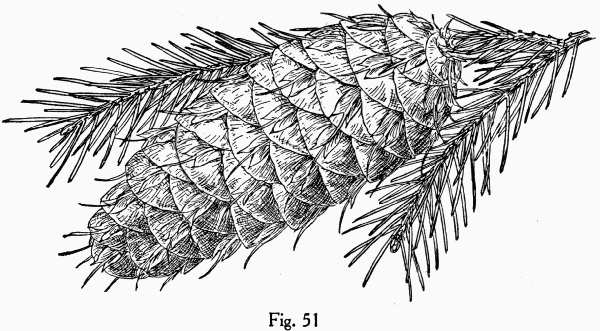
Leaves acute or acuminate, terminating in slender rigid callous tips, apparently 2-ranked by the conspicuous twist of their petioles, incurved above the middle, ¾′—1¼′ long, about 1/16′ wide, dark bluish gray. Flowers: male pale yellow, inclosed for half their length in conspicuous involucres of the lustrous bud-scales; female with pale green bracts tinged with red. Fruit produced on the upper branches and occasionally on those down to the middle of the tree, short-stalked, with scales near the middle of the cone 1½′—2′ across, stiff, thick, concave, rather broader than long, rounded above, abruptly wedge-shaped at the base, puberulous on the outer surface, often nearly as long as their comparatively short and narrow bracts with broad midribs produced into short flattened flexible tips; seeds full and rounded on both sides, rugose, dark chestnut-brown or nearly black and lustrous above, pale reddish brown below, ½′ long, ⅜′ wide, with a thick brittle outer coat, and wings broadest near the middle, about ½′ long, nearly ¼′ wide, and rounded at the apex.
A tree, usually 40°—50° and rarely 90° high, with a trunk 3°—4° in diameter, remote elongated branches pendulous below, furnished with short stout pendant or often erect laterals forming an open broad-based symmetrical pyramidal head, slender branchlets dark reddish [50] brown and pubescent during their first year, becoming glabrous and dark or light orange-brown and ultimately gray-brown. Winter buds ovoid, acute, usually not more than ⅛′ long, often nearly as broad as long. Bark 3′—6′ thick, dark reddish brown, deeply divided into broad rounded ridges covered with thick closely appressed scales. Wood heavy, hard, strong, close-grained, not durable; occasionally manufactured into lumber; largely used for fuel.
Distribution. Steep rocky mountain slopes in southern California at elevations of 3000°—5000° above the sea, often forming open groves of considerable extent, from the Santa Inez Mountains in Santa Barbara County to the Cuyamaca Mountains.
6. ABIES Link. Fir.
Tall pyramidal trees, with bark containing numerous resin-vesicles, smooth, pale, and thin on young trees, often thick and deeply furrowed in old age, pale and usually brittle wood, slender horizontal wide-spreading branches in regular remote 4 or 5-branched whorls, clothed with twice or thrice forked lateral branches forming flat-topped masses of foliage gradually narrowed from the base to the apex of the branch, the ultimate divisions stout, glabrous or pubescent, and small subglobose or ovoid winter branch-buds usually thickly covered with resin, or in one species large and acute, with thin loosely imbricated scales. Leaves linear, sessile, on young plants and on lower sterile branches flattened and mostly grooved on the upper side, or in one species 4-sided, rounded and usually emarginate at apex, appearing 2-ranked by a twist near their base or occasionally spreading from all sides of the branch, only rarely stomatiferous above, on upper fertile branches and leading shoots usually crowded, more or less erect, often incurved or falcate, thick, convex on the upper side, or quadrangular in some species and then obtuse, or acute at apex and frequently stomatiferous on all sides; persistent usually for eight or ten years, in falling leaving small circular scars. Flowers axillary, from buds formed the previous season on branchlets of the year, surrounded at the base by conspicuous involucres of enlarged bud-scales, the male very abundant on the lower side of branches above the middle of the tree, oval or oblong-cylindric with yellow or scarlet anthers surmounted by short knob-like projections, the female usually on the upper side only of the topmost branches, or in some species scattered also over the upper half of the tree, erect, globose, ovoid or oblong, their scales imbricated in many series, obovate, rounded above, cuneate below, much shorter than their acute or dilated mucronate bracts. Fruit an erect ovoid or oblong-cylindric cone, its scales closely imbricated, thin, incurved at the broad apex and generally narrowed below into long stipes, decreasing in size and sterile toward the ends of the cone, falling at maturity with their bracts and seeds from the stout tapering axis of the cone long-persistent on the branch. Seeds furnished with large conspicuous resin-vesicles, ovoid or oblong, acute at base, covered on the upper side and infolded below on the lower side by the base of their thin wing abruptly enlarged at the oblique apex; seed-coat thin, of 2 layers, the outer thick, coriaceous, the inner membranaceous; cotyledons 4—10, much shorter than the inferior radicle.
Abies is widely distributed in the New World from Labrador and the valley of the Athabasca River to the mountains of North Carolina, and from Alaska through the Pacific and Rocky Mountain regions to the highlands of Guatemala, and in the Old World from Siberia and the mountains of central Europe to southern Japan, central China, Formosa, the Himalayas, Asia Minor, and the highlands of northern Africa. Thirty-three species are now recognized. Several exotic species are cultivated in the northern and eastern states; of these the best known and most successful as ornamental trees are Abies Nordmanniana, Spach, of the Caucasus, Abies cilicica Carr., of Asia Minor, Abies cephalonica Loud., a native of Cephalonia, Abies Veitchii Lindl., and Abies homolepis S. & Z., of Japan, and Abies pinsapo, Boiss., of the Spanish Sierra Nevada.
Abies is the classical name of the Fir-tree.
[51]
CONSPECTUS OF THE NORTH AMERICAN SPECIES.
Winter-buds subglobose, with closely imbricated scales.
Leaves flat and grooved above, with stomata on the lower surface (in Nos. 3 and 5, also on the upper surface), rounded and often notched, or on fertile branches frequently acute at apex.
Leaves on sterile branches spreading, not crowded.
Cones purple.
Leaves dark green and lustrous above, pale below.
Bracts of the cone-scales much longer than their scales, reflexed.
1. A. Fraseri (A).
Bracts of the cone-scales shorter or rarely slightly longer than their scales.
2. A. balsamea (A).
Leaves pale blue-green, stomatose above.
3. A. lasiocarpa (B, F, G).
Cones green (green, yellow, and purple in No. 5).
Leaves dark green and lustrous above, pale below.
4. A. grandis (B, G).
Leaves pale blue or glaucous, often stomatose above on the upper surface.
5. A. concolor (F, G, H).
Leaves on sterile branches pointing forward, densely crowded, dark green and lustrous above, pale below.
6. A. amabilis (B, G).
Leaves often 4-sided, with stomata on all surfaces, blue-green, usually glaucous, bluntly pointed or acute, incurved and crowded on fertile branches; cones purple.
Leaves of sterile branches flattened and distinctly grooved above; bracts of the cone-scales rounded and fimbriate above, long-pointed, incurved, light green, much longer than and covering their scales.
7. A. nobilis (G).
Leaves of sterile branches 4-sided; bracts of the cone-scales acute or acuminate or rounded above, with slender tips shorter or longer than their scales.
8. A. magnifica (G).
Winter-buds acuminate, with loosely imbricated scales; bracts of the cone-scales produced into elongated ridged flat tips many times longer than the obtusely pointed scales; leaves acuminate, dark yellow-green above, white below, similar on sterile and fertile branches.
9. A. venusta (G).
1. Abies Fraseri Poir. Balsam Fir. She Balsam.
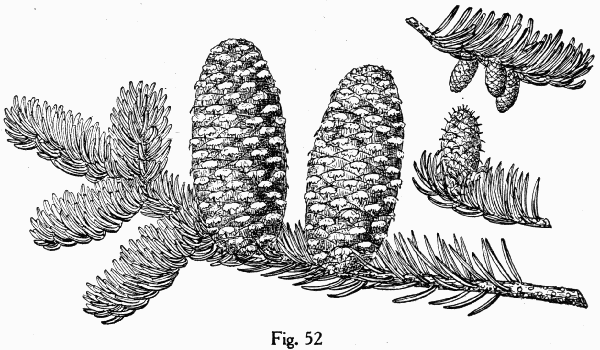
Leaves obtusely short-pointed or occasionally slightly emarginate at apex, dark green and lustrous on the upper surface, marked on the lower surface by wide bands of 8—12 [52] rows of stomata, ½′ to nearly 1′ long, about 1/16′ wide. Flowers: male yellow tinged with red; female with scales rounded above, much broader than long and shorter than their oblong pale yellow-green bracts rounded at the broad apex terminating in a slender elongated tip. Fruit oblong-ovoid or nearly oval, rounded at the somewhat narrowed apex, dark purple, puberulous, about 2½′ long, with scales twice as wide as long, at maturity nearly half covered by their pale yellow-green reflexed bracts; seeds ⅛′ long, with dark lustrous wings much expanded and very oblique at apex.
A tree, usually 30°—40° and rarely 70° high, with a trunk occasionally 2½° in diameter, and rather rigid branches forming an open symmetrical pyramid and often disappearing early from the lower part of the trunk, and stout branchlets pubescent for three or four years, pale yellow-brown during their first season, becoming dark reddish brown often tinged with purple, and obtuse orange-brown winter-buds. Bark ¼′—½′ thick, covered with thin closely appressed bright cinnamon-red scales, generally becoming gray on old trees. Wood light, soft, not strong, coarse-grained, pale brown, with nearly white sapwood; occasionally manufactured into lumber.
Distribution: Appalachian Mountains; Cheat Mountain, near Cheat Bridge, Randolph County, West Virginia, and from southwestern Virginia to western North Carolina and eastern Tennessee, often forming forests of considerable extent at elevations between 4000° and 6000° above the sea-level.
Occasionally planted in the parks and gardens of the northern states and of Europe, but short-lived in cultivation and of little value as an ornamental tree.
2. Abies balsamea Mill. Balsam Fir.
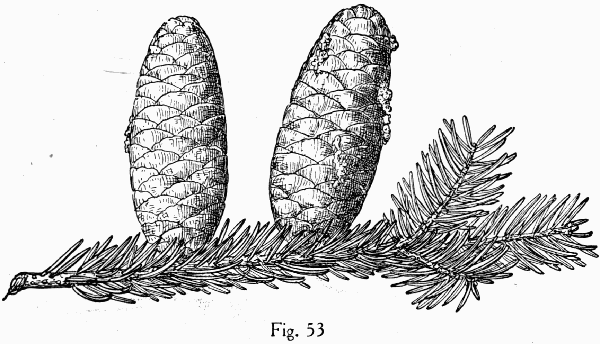
Leaves dark green and lustrous on the upper surface, silvery white on the lower surface, with bands of 4—8 rows of stomata, ½′ long on cone-bearing branches to 1¼′ long on the sterile branches of young trees, straight, acute or acuminate, with short or elongated rigid callous tips, spreading at nearly right angles to the branch on young trees and sterile branches, on the upper branches of older trees often broadest above the middle, rounded or obtusely short-pointed at apex, occasionally emarginate on branches at the top of the tree. Flowers: male yellow, more or less deeply tinged with reddish purple; female with nearly orbicular purple scales much shorter than their oblong-obovate serrulate pale yellow-green bracts emarginate with a broad apex abruptly contracted into a long slender recurved tip. Fruit oblong-cylindric, gradually narrowed to the rounded apex, puberulous, dark rich purple, 2′—4′ long, with scales usually longer than broad, generally almost twice as long; rarely not as long as their bracts, (var. phanerolepis Fern.); seeds about ¼′ long and rather shorter than their light brown wings.
[53]
A tree, 50°—60° high, with a trunk usually 12′—18′; or rarely 30′ in diameter, spreading branches forming a handsome symmetrical slender-pyramid, the lower branches soon dying from trees crowded in the forest, and slender branchlets pale yellow-green and coated with fine pubescence at first, becoming light gray tinged with red, and often when four or five years old with purple. Winter-buds nearly globose, ⅛′—¼′ in diameter, with lustrous dark orange-green scales. Bark on old trees often ½′ thick, rich brown, much broken on the surface into small plates covered with scales. Wood light, soft, not strong, coarse-grained, perishable, pale brown streaked with yellow, with thick lighter colored sapwood; occasionally made into lumber principally used for packing-cases. From the bark of this tree oil of fir used in the arts and in medicine is obtained.
Distribution. From the interior of the Labrador peninsula westward to the shores of Lesser Slave Lake, southward through Newfoundland, the maritime provinces of Canada, Quebec and Ontario, northern New England, northern New York, northern Michigan to the shores of Saginaw Bay, and northern Minnesota and northeastern Iowa, and along the Appalachian Mountains from western Massachusetts and the Catskills of New York to the high mountains of southwestern Virginia; common and often forming a considerable part of the forest on low swampy ground; on well-drained hillsides sometimes singly in forests of spruce or forming small almost impenetrable thickets; in northern Wisconsin and vicinity occurs a form with longer and more crowded leaves and larger cones (var. macrocarpa Kent); near the timber-line on the mountains of New England and New York reduced to a low almost prostrate shrub.
Sometimes planted in the northern states in the neighborhood of farmhouses, but usually short-lived and of little value as an ornamental tree in cultivation; formerly but now rarely cultivated in European plantations; a dwarf form (var. hudsonica Englm.) growing only a few inches high and spreading into broad nests is often cultivated.
3. Abies lasiocarpa Nutt. Balsam Fir.
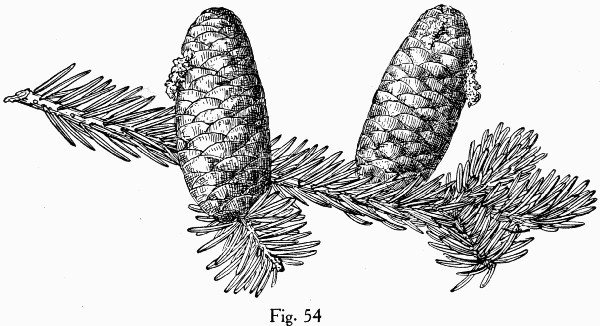
Leaves marked on the upper surface but generally only above the middle with 4 or 5 rows of stomata on each side of the conspicuous midrib and on the lower surface by 2 broad bands each of 7 or 8 rows, crowded, nearly erect by the twist at their base, on lower branches 1′—1¾′ long, about 1/12′ wide, and rounded and occasionally emarginate at apex, on upper branches somewhat thickened, usually acute, generally not more than ½′ long, on leading shoots flattened, closely appressed, with long slender rigid points. Flowers: male dark indigo-blue, turning violet when nearly ready to open; female with dark violet-purple obovate scales much shorter than their strongly reflexed bracts contracted into slender tips. Fruit oblong-cylindric, rounded, truncate or depressed at the narrowed apex, dark purple, puberulous, 2½′—4′ long, with scales gradually narrowed from the broad rounded or nearly truncate apex to the base, usually longer than broad, about three times as long as their oblong-obovate red-brown bracts laciniately cut on the margins, rounded, emarginate and abruptly contracted at the apex into long slender tips; seeds ¼′ long, with dark lustrous wings covering nearly the entire surface of the scales.
A tree, usually 80°—100°, occasionally 175°, or southward rarely more than 50° high, with a trunk 2°—5° in diameter, short crowded tough branches, usually slightly pendulous near the base of the tree, generally clothing the trunks of the oldest trees nearly to their base and forming dense spire-like slender heads, and comparatively stout branchlets coated for three or four years with fine rufous pubescence, or rarely glabrous before the end of their first season, pale orange-brown, ultimately gray or silvery white. Winter-buds subglobose, ⅛′—¼′ thick, covered with light orange-brown scales. Bark becoming on old trees ¾′—1½′ thick, divided by shallow fissures and roughened by thick closely appressed cinnamon-red scales; on the San Francisco Mountains, Arizona, thicker and spongy (var. arizonica Lem.). Wood light, soft, not strong, pale brown or nearly white, with light-colored sapwood; little used except for fuel.
Distribution. High mountain slopes and summits from about latitude 61° in Alaska, southward along the coast ranges to the Olympic Mountains of Washington, over all the [54] high mountain ranges of British Columbia and Alberta, and southward along the Cascade Mountains of Washington and Oregon to the neighborhood of Crater Lake, over the mountain ranges of eastern Washington and Oregon, and of Idaho, Wyoming, Colorado, and Utah to the San Francisco peaks of northern Arizona, and on the Sandia and Mogollon Mountains of New Mexico.
Occasionally planted as an ornamental tree in the northern United States and in northern Europe, but of little value in cultivation.
4. Abies grandis Lindl. White Fir.
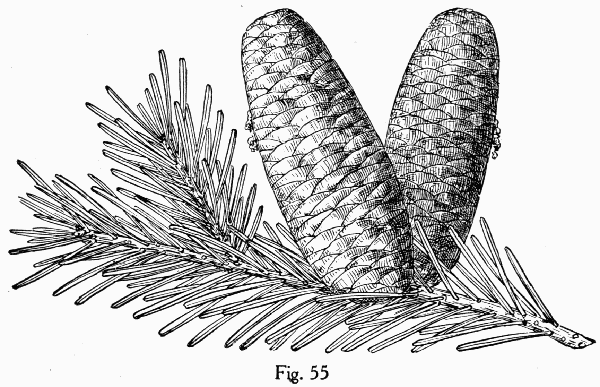
Leaves thin and flexible, deeply grooved very dark green and lustrous on upper surface, silvery white on lower surface, with two broad bands of 7—10 rows of stomata, on sterile branches remote, rounded and conspicuously emarginate at apex, 1½′—2¼′ long, usually about ⅛′ wide, spreading in two ranks nearly at right angles to the branch, on cone-bearing branches more crowded, usually 1′—1½′ long, less spreading or nearly erect, blunt-pointed or often notched at apex, on vigorous young trees ½′—¾′ long, acute or acuminate, [55] usually persistent 4—10 years. Flowers: male pale yellow sometimes tinged with purple; female light yellow-green, with semiorbicular scales and short-oblong bracts emarginate and denticulate at the broad obcordate apex furnished with a short strongly reflexed tip. Fruit cylindric, slightly narrowed to the rounded and sometimes retuse apex, puberulous, bright green, 2′—4′ long, with scales usually about two thirds as long as wide, gradually or abruptly narrowed from their broad apex and three or four times as long as their short pale green bracts; seeds ⅜′ in length, light brown, with pale lustrous wings ½′—⅝′ long and nearly as broad as their abruptly widened rounded apex.
A tree, in the neighborhood of the coast 250°—300° high, with a slightly tapering trunk often 4° in diameter, long somewhat pendulous branches sweeping out in graceful curves, and comparatively slender pale yellow-green puberulous branchlets becoming light reddish brown or orange-brown and glabrous in their second season; on the mountains of the interior rarely more than 100° tall, with a trunk usually about 2° in diameter, often smaller and much stunted at high elevations. Winter-buds subglobose, ⅛′—¼′ thick. Bark becoming sometimes 2′ thick at the base of old trees and gray-brown or reddish brown and divided by shallow fissures into low flat ridges broken into oblong plates roughened by thick closely appressed scales. Wood light, soft, coarse-grained, not strong nor durable, light brown, with thin lighter colored sapwood; occasionally manufactured into lumber in western Washington and Oregon and used for the interior finish of buildings, packing-cases, and wooden-ware.
Distribution. Northern part of Vancouver Island southward in the neighborhood of the coast to northern Sonoma County, California, and along the mountains of northern Washington and Idaho to the western slopes of the continental divide in northern Montana, and to the mountains of eastern Oregon; near the coast scattered on moist ground through forests of other conifers; common in Washington and northern Oregon from the sea up to elevations of 4000°; in the interior on moist slopes in the neighborhood of streams from 2500° up to 7000° above the sea; in California rarely ranging more than ten miles inland or ascending to altitudes of more than 1500° above the sea.
Occasionally planted in the parks and gardens of temperate Europe, where it grows rapidly and promises to attain a large size; rarely planted in the United States.
5. Abies concolor Lindl. & Gord. White Fir.
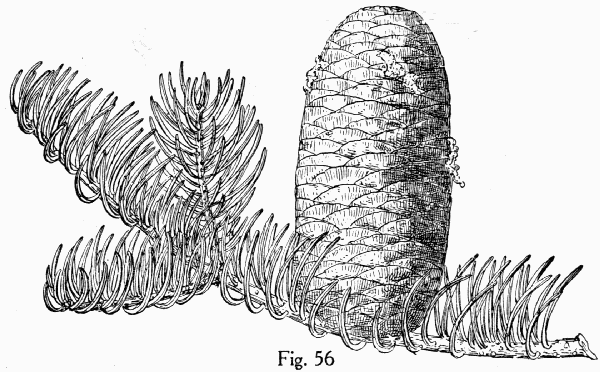
Leaves crowded, spreading in 2 ranks and more or less erect from the strong twist at their base, pale blue or glaucous, becoming dull green at the end of two or three years, with 2 broad bands of stomata on the lower, and more or less stomatiferous on the upper surface, on lower branches flat, straight, rounded, acute or acuminate at apex, 2′—3′ long, about 1/16′ wide, on fertile branches and on old trees frequently thick, keeled above, usually falcate, acute or rarely notched at apex, ¾′—1½′ long, often ⅛′ wide. Flowers: male dark red or rose color; female with broad rounded scales, and oblong strongly reflexed obcordate bracts laciniate above the middle and abruptly contracted at apex into short points. Fruit oblong, slightly narrowed from near the middle to the ends, rounded or obtuse at apex, 3′—5′ long, puberulous, grayish green, dark purple or bright canary-yellow, with scales much broader than long, gradually and regularly narrowed from the rounded apex, rather more than twice as long as their emarginate or nearly truncate bracts broad at the apex and terminating in short slender tips; seeds ⅓′—½′ long, acute at base, dark dull brown, with lustrous rose-colored wings widest near the middle and nearly truncate at apex.
A tree, on the California sierras 200°—250° high, with a trunk often 6° in diameter or in the interior of the continent rarely more than 125° tall, with a trunk seldom exceeding 3° in diameter, a narrow spire-like crown of short stout branches clothed with long lateral branches pointing forward and forming great frond-like masses of foliage, and glabrous lustrous comparatively stout branchlets dark orange color during their first season, becoming light grayish green or pale reddish brown, and ultimately gray or grayish brown. Winter-buds subglobose, ⅛′—¼′ thick. Bark becoming on old trunks sometimes 5′—6′ thick near the ground and deeply divided into broad rounded ridges broken on the surface into irregularly [56] shaped plate-like scales. Wood very light, soft, coarse-grained and not strong nor durable, pale brown or sometimes nearly whiter occasionally manufactured into lumber, in northern California used for packing-cases and butter-tubs.
Distribution. Rocky Mountains of southern Colorado, westward to the mountain ranges of California, extending northward into northern Oregon, and southward over the mountains of New Mexico and Arizona into northern Mexico and Lower California (Mt. San Pedro Mártir Mountains); the only Fir-tree in the arid regions of the Great Basin, of southern New Mexico and Arizona, and of the mountain forests of southern California.
Often planted as an ornamental tree in Europe (the California form usually as A. Lowiana Murr.) and in the eastern states where it grows more vigorously than other Fir-trees.
6. Abies amabilis Forbes. White Fir.
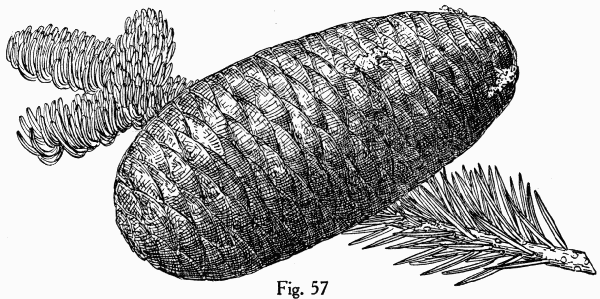
Leaves deeply grooved, very dark green and lustrous on the upper surface, silvery white on the lower, with broad bands of 6 or 8 rows of stomata between the prominent midribs and incurved margins, on sterile branches obtuse and rounded, or notched or occasionally acute at apex, ¾′—1¼′ long, 1/16′—1/12′ wide, often broadest above the middle, erect by a twist at their base, very crowded, those on the upper side of the branch much shorter than those on the lower and usually parallel with and closely appressed against it, on fertile branches acute or acuminate with callous tips, occasionally stomatiferous on the upper surface near the apex, ½′—¾′ long; on vigorous leading shoots acute, with long rigid points, closely appressed or recurved near the middle, about ¾′ long and nearly ⅛′ wide. Flowers: male red; female with broad rounded scales and rhombic dark purple lustrous bracts erose above the middle and gradually contracted into broad points. Fruit oblong, slightly narrowed to the rounded and often retuse apex, deep rich purple, puberulous, 3½′—6′ long, with scales 1′—1⅛′ wide, nearly as long as broad, gradually narrowed from the rounded apex and rather more than twice as long as their reddish rhombic or oblong-obovate bracts terminating in long slender tips; seeds light yellow-brown, ½′ long, with oblique pale brown lustrous wings about ¾′ long.
A tree, often 250° tall, or at high altitudes and in the north usually not more than 70°—80° tall, with a trunk 4°—6° in diameter, in thick forests often naked for 150°, but in open situations densely clothed to the ground with comparatively short branches sweeping down in graceful curves, and stout branchlets clothed for four or five years with soft fine pubescence, light orange-brown in their first season, becoming dark purple and ultimately reddish brown. Winter-buds nearly globose, ⅛′—¼′ thick, with closely imbricated lustrous purple scales. Bark on trees up to 150 years old thin, smooth, pale or silvery white, [57] becoming near the ground on old trees 1½′—2½′ thick, and irregularly divided into comparatively small plates covered with small closely appressed reddish brown or reddish gray scales. Wood light, hard, not strong, close-grained, pale brown, with nearly white sapwood; in Washington occasionally manufactured into lumber used in the interior finish of buildings.
Distribution. High mountain slopes and benches from southeastern Alaska (Boca de Quadra Inlet and Sandfly Bay), to Vancouver Island and southward along the coast ranges to Saddle Mountain near Astoria, Oregon, and on the Cascade Mountains to the slopes of Old Bailey Mountain, Oregon, ranging from the sea level at the north to elevations of from 3000°—6000° southward; attaining its largest size on the Olympic Mountains of Washington, where it is the most common Fir-tree.
Occasionally cultivated as an ornamental tree in the eastern states and in western Europe, but without developing the beauty which distinguishes this species in its native forests.
7. Abies nobilis Lindl. Red Fir.
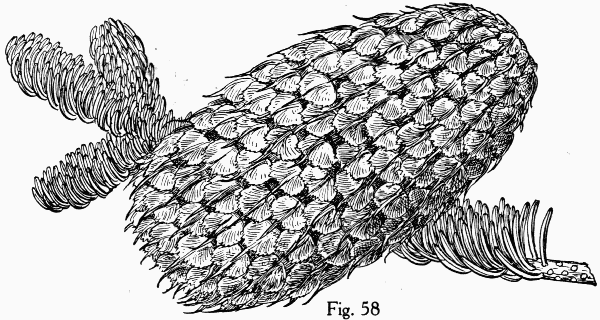
Leaves marked on the upper surface with a deep sharply defined groove, rounded and obscurely ribbed on the lower surface, stomatiferous above and below, dark or light blue-green, often very glaucous during their first season, crowded in several rows, those on the lower side of the branch two-ranked by the twisting of their bases, the others crowded, strongly incurved, with the points erect or pointing away from the end of the branch, on young plants and on the lower sterile branches of old trees flat, rounded, usually slightly notched at apex, 1′—1½′ long, about 1/16′ wide, on fertile branches much thickened and almost equally 4-sided, acuminate, with long rigid callous tips, ½′—¾′ long, on leading shoots flat, gradually narrowed from the base, acuminate, with long rigid points, about 1′ long. Flowers: male reddish purple; female often scattered over the upper part of the tree, with broad rounded scales much shorter than their nearly orbicular bracts erose on the margins and contracted above into slender elongated strongly reflexed tips. Fruit oblong-cylindric, slightly narrowed but full and rounded at apex, 4′—5′ long, purple or olive-brown, pubescent, with scales about one third wider than long, gradually narrowed from the rounded apex to the base, or full at the sides, rounded and denticulate above the middle and sharply contracted and wedge-shaped below, nearly or entirely covered by their strongly reflexed pale green spatulate bracts full and rounded above, fimbriate on the margins, with broad midribs produced into short broad flattened points; seeds ½′ long, pale reddish brown, about as long as their wings, gradually narrowed from below to the nearly truncate slightly rounded apex.
A tree, in old age with a comparatively broad somewhat rounded head, usually 150°—200° and occasionally 250° high, with a trunk 6°—8° in diameter, short rigid branches, short stout remote lateral branches standing out at right angles, and slender reddish brown branchlets [58] puberulous for four or five years and generally pointing forward. Winter-buds ovoid-oblong, red-brown, about ⅛′ long. Bark becoming on old trunks 1′—2′ thick, bright red-brown, and deeply divided into broad flat ridges irregularly broken by cross fissures and covered with thick closely appressed scales. Wood light, hard, strong, rather close-grained, pale brown streaked with red, with darker colored sapwood; occasionally manufactured into lumber and used under the name of larch for the interior finish of buildings and for packing-cases.
Distribution. Slopes of Mt. Baker in northern Washington and southward to the valley of the Mackenzie River, Oregon, and the Siskiyou Mountains, California, at elevations of from 2000°—5000° above the sea; most abundant and often forming extensive forests on the Cascade Mountains of Washington; less abundant and of smaller size on the eastern and northern slopes of these mountains. In Oregon sometimes called Larch.
Often planted in western and central Europe as an ornamental tree, and in the eastern states hardy in sheltered positions as far north as Massachusetts.
8. Abies magnifica A. Murr. Red Fir.
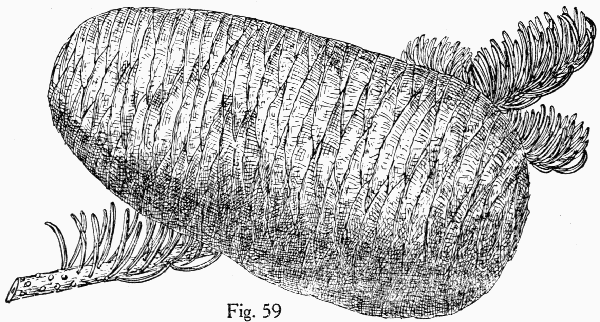
Leaves almost equally 4-sided, ribbed above and below, with 6—8 rows of stomata on each of the 4 sides, pale and very glaucous during their first season, later becoming blue-green, persistent usually for about ten years; on young plants and lower branches oblanceolate, somewhat flattened, rounded, bluntly pointed, ¾′—1½′ long, 1/16′ wide, those on the lower side of the branch spreading in 2 nearly horizontal ranks by the twist at their base, on upper, especially on fertile branches, much thickened, with more prominent [59] midribs, acute, with short callous tips, ⅓′ long on the upper side of the branch to 1¼′ long on the lower side, crowded, erect, strongly incurved, completely hiding the upper side of the branch, on leading shoots ¾′ long, erect and acuminate, with long rigid points pressed against the stem. Flowers: male dark reddish purple; female with rounded scales much shorter than their oblong pale green bracts terminating in elongated slender tips more or less tinged with red. Fruit oblong-cylindric, slightly narrowed to the rounded, truncate, or retuse apex, dark purplish brown, puberulous, from 6′—9′ long, with scales often 1½′ wide and about two thirds as wide as long, gradually narrowed to the cordate base, somewhat longer or often two thirds as long as their spatulate acute or acuminate bracts slightly serrulate above the middle and often sharply contracted and then enlarged toward the base; seeds dark reddish brown, ¾′ long, about as wide as their lustrous rose-colored obovate cuneate wings nearly truncate and often ¾′ wide at apex.
A tree, in old age occasionally somewhat round-topped, frequently 200° high, with a trunk 8°—10° in diameter and often naked for half the height of the tree, comparatively short small branches, the upper somewhat ascending, the lower pendulous, and stout light yellow-green branchlets pointing forward, slightly puberulous during their first season, becoming light red-brown and lustrous and ultimately gray or silvery white. Winter-buds ovoid, acute, ¼′⅓′ long, their bright chestnut-brown scales with prominent midribs produced into short tips. Bark becoming 4′—6′ thick near the ground, deeply divided into broad rounded ridges broken by cross fissures and covered by dark red-brown scales. Wood light, soft, not strong, comparatively durable, light red-brown, with thick somewhat darker sapwood; largely used for fuel, and in California occasionally manufactured into coarse lumber employed in the construction of cheap buildings and for packing-cases.
Distribution. Cascade Mountains of southern Oregon, southward over the mountain ranges of northern California (summits of the Trinity and Salmon Mountains and on the inner north coast ranges), and along the western slope of the Sierra Nevada to the divide between White and Kern Rivers; common in southern Oregon at elevations between 5000° and 7000° above the sea, forming sometimes nearly pure forests; very abundant on the Sierra Nevada, and the principal tree in the forest belt at elevations between 6000° and 9000°; ascending towards the southern extremity of its range to over 10,000°. Small stunted trees from the neighborhood of Meadow Lake, Sierra County, California, with yellowish cones have been described as var. xancocarpa Lemm.
Often planted as an ornamental tree in western and central Europe, and sometimes hardy in the United States as far north as eastern Massachusetts.
A distinct form is
Abies magnifica var. shastensis Lemm. Red Fir.
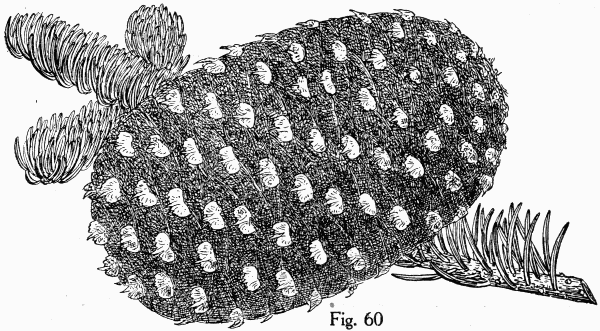
On the mountains of southern Oregon and at high elevations on those of northern California, and on the southern Sierra Nevada, occurs this form distinguished only by the [60] longer rounded or obtusely pointed (not acute) bright yellow bracts which sometimes cover nearly half their scales.
9. Abies venusta K. Koch. Silver Fir.
Abies bracteata D. Don.
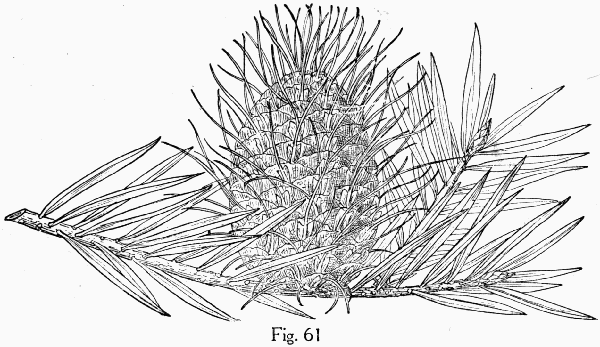
Leaves thin, flat, rigid, linear or linear-lanceolate, gradually or abruptly narrowed toward the base, often falcate, especially on fertile branches, acuminate, with long slender callous tips, dark yellow-green, lustrous and slightly rounded on the upper surface marked below the middle with an obscure groove, silvery white or on old leaves pale on the lower surface, with bands of 8—10 rows of stomata between the broad midrib and the thickened strongly revolute margins, 2-ranked from the conspicuous twist near their base and spreading at nearly right angles to the branch, or pointing forward on upper fertile branches, 1½′—2¼′ long, on leading shoots standing out at almost right angles, rounded on the upper surface, more or less incurved above the middle, 1½′—1¾′ long, about ⅛′ wide. Flowers: male produced in great numbers near the base of the branchlets on branches from the middle of the tree upward, pale yellow; female near the ends of the branchlets of the upper branches only, with oblong scales rounded above and nearly as long as their cuneate obcordate yellow-green bracts ending in slender elongated awns. Fruit on stout peduncles sometimes ½′ long, oval or subcylindric, full and rounded at apex, glabrous, pale purple-brown, 3′—4′ long, with thin scales strongly incurved above, obtusely short-pointed at apex, obscurely denticulate on the thin margins, about one third longer than their oblong-obovate obcordate pale yellow-brown bracts terminating in flat rigid tips 1′—1¾′ long, above the middle of the cone pointing toward its apex and often closely appressed to its sides, below the middle spreading toward its base and frequently much recurved, firmly attached to the cone-scales and deciduous with them from the thick conical sharp-pointed axis of the cone; seeds dark red-brown, about ⅜′ long, and nearly as long as their oblong-obovate pale reddish brown lustrous wings rounded at the apex.
A tree, 100°—150° high, with a trunk sometimes 3° in diameter, comparatively short slender usually pendulous branches furnished with long sinuous rather remote lateral branches sparsely clothed with foliage, forming a broad-based pyramid abruptly narrowed 15°—20° from the top of the tree into a thin spire-like head, and stout glabrous light reddish brown branchlets covered at first with a glaucous bloom. Winter-buds ovoid, acute, ¾′—1′ long, ¼′—⅓′ thick, with very thin, loosely imbricated, pale chestnut-brown, acute, boat-shaped scales. Bark becoming near the base of the tree ½′—¾′ thick, light reddish brown, slightly [61] and irregularly fissured and broken into thick closely appressed scales. Wood heavy, not hard, coarse-grained, light brown tinged with yellow, with paler sapwood.
Distribution. In the moist bottoms of cañons and on dry rocky summits, usually at elevations of about 3000° above the sea on both slopes of the outer western ridge of the Santa Lucia Mountains, Monterey County, California.
Occasionally and successfully grown as an ornamental tree in the milder parts of Great Britain and in northern Italy; not hardy in the eastern United States.
7. SEQUOIA Endl.
Resinous aromatic trees, with tall massive lobed trunks, thick bark of 2 layers, the outer composed of fibrous scales, the inner thin, close and firm, soft, durable, straight-grained red heartwood, thin nearly white sapwood, short stout horizontal branches, terete lateral branchlets deciduous in the autumn, and scaly or naked buds. Leaves ovate-lanceolate or linear and spreading in 2 ranks especially on young trees and branches, or linear, acute, compressed, keeled on the back and closely appressed or spreading at apex, the two forms appearing sometimes on the same branch or on different branches of the same tree. Flowers minute, solitary, monœcious, appearing in early spring from buds formed the previous autumn, the male terminal in the axils of upper leaves, oblong or ovoid, surrounded by an involucre of numerous imbricated ovate, acute, and apiculate bracts, with numerous spirally disposed filaments dilated into ovoid acute subpeltate denticulate connectives bearing on their inner face 2—5 pendulous globose 2-valved anther-cells; the female terminal, ovoid or oblong, composed of numerous spirally imbricated ovate scales abruptly keeled on the back, the keels produced into short or elongated points closely adnate to the short ovule-bearing scales rounded above and bearing below their upper margin in 2 rows 5—7 ovules at first erect, becoming reversed. Fruit an ovoid or short-oblong pendulous cone maturing during the first or second season, persistent after the escape of the seeds, its scales formed by the enlargement of the united flower and ovuliferous scales, becoming woody, bearing large deciduous resin-glands, gradually enlarged upward and widening at the apex into a narrow thickened oblong disk transversely depressed through the middle and sometimes tipped with a small point. Seeds 5—7 under each scale, oblong-ovoid, compressed; seed-coat membranaceous, produced into broad thin lateral wings; cotyledons 4—6, longer than the inferior radicle.
Sequoia, widely scattered with several species over the northern hemisphere during the cretaceous and tertiary epochs, is now confined to the coast of Oregon and California and the mountains of California, where two species exist.
The name of the genus is formed from Sequoiah, the inventor of the Cherokee alphabet.
CONSPECTUS OF THE NORTH AMERICAN SPECIES.
Leaves mostly spreading in 2 ranks; cones maturing in one season; buds scaly.
1. S. sempervirens (G).
Leaves slightly spreading or appressed; cones maturing in their second season; buds naked.
2. S. gigantea (G).
1. Sequoia sempervirens Endl. Redwood.
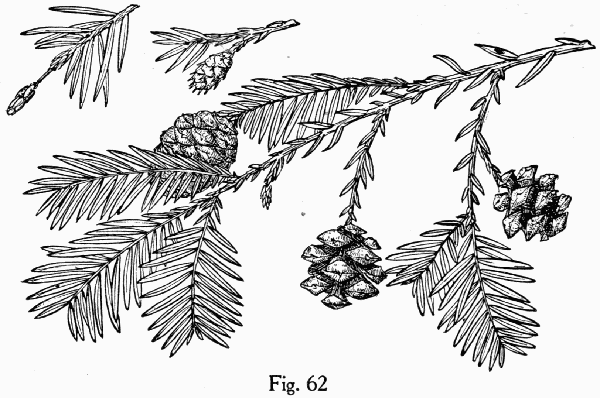
Leaves of secondary branches and of lower branches of young trees lanceolate, more or less falcate, acute or acuminate and usually tipped with slender rigid points, slightly thickened on the revolute margins, decurrent at the base, spreading in 2 ranks by a half-turn at their base, ¼′—½′ long, about ⅛′ wide, obscurely keeled and marked above by 2 narrow bands of stomata, glaucous and stomatiferous below on each side of their conspicuous midrib, on leading shoots disposed in many ranks, more or less spreading or appressed, ovate or ovate-oblong, incurved at the rounded apiculate apex, thickened, rounded, and stomatiferous on the lower surface, concave, prominently keeled and covered with stomata [62] on the upper surface, usually about ¼′ long; dying and turning reddish brown at least two years before falling. Flowers opening in December or January; male oblong, obtuse; female with about 20 broadly ovate acute scales tipped with elongated and incurved or short points. Fruit ripening in October, oblong, ¾′—1′ long, ½′ broad, its scales gradually enlarged from slender stipes abruptly dilated above into disks penetrated by deep narrow grooves, and usually without tips; seeds about 1/16′ long, light brown, with wings as broad as their body.
A tree, from 200°—340° high, with a slightly tapering and irregularly lobed trunk usually free of branches for 75°—100°, usually 10°—15°, rarely 28° in diameter at the much buttressed base, slender branches, clothed with branchlets spreading in 2 ranks and forming while the tree is young an open narrow pyramid, on old trees becoming stout and horizontal, and forming a narrow rather compact and very irregular head remarkably small in proportion to the height and size of the trunk, and slender leading branchlets covered at the end of three or four years after the leaves fall with cinnamon-brown scaly bark; when cut producing from the stump numerous vigorous long-lived shoots. Buds with numerous loosely imbricated ovate acute scales persistent on the base of the branchlet. Bark 6′—12′ thick, divided into rounded ridges and separated on the surface into long narrow dark brown fibrous scales often broken transversely and in falling disclosing the bright cinnamon-red inner bark. Wood light, soft, not strong, close-grained, easily split and worked, very durable in contact with the soil, clear light red; largely manufactured into lumber and used for shingles, fence-posts, railway-ties, wine-butts, and in buildings.
Distribution. Valley of the Chetco River, Oregon, 8 miles north of the California state line, southward near the coast to Monterey County, California; rarely found more than twenty or thirty miles from the coast, or beyond the influence of the ocean fogs, or over 3000° above the sea-level; often forming in northern California pure forests occupying the sides of ravines and the banks of streams; southward growing usually in small groves scattered among other trees; most abundant and of its largest size north of Cape Mendocino.
Often cultivated as an ornamental tree in the temperate countries of Europe, and occasionally in the southeastern United States.
2. Sequoia gigantea Decne. Big Tree.
Sequoia Wellingtonia Seem.
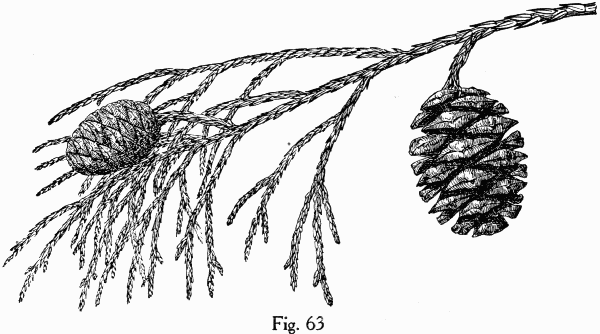
Leaves ovate and acuminate, or lanceolate, rounded and thickened on the lower surface, concave on the upper surface, marked by bands of stomata on both sides of the obscure midrib, rigid, sharp-pointed, decurrent below, spreading or closely appressed above the middle, ⅛′—¼′ or on leading shoots ½′ long. Flowers opening in late winter and early spring; male in great profusion over the whole tree, oblong-ovoid, with ovate acute or acuminate connectives; female with 25—40 pale yellow scales slightly keeled on the back and gradually [63] narrowed into long slender points. Fruit maturing in the second year, ovoid-oblong, 2′—3½′ long, 1½′—2¼′ wide, dark reddish brown, the scales gradually thickened upward from the base to the slightly dilated apex, ¾′—1¼′ long, and ¼′—½′ wide, deeply pitted in the middle, often furnished with an elongated reflexed tip and on the upper side near the base with two or three large deciduous resin-glands; seeds linear-lanceolate, compressed, ⅛′—¼′ long, light brown, surrounded by laterally united wings broader than the body of the seed, apiculate at the apex, often very unequal.
A tree, at maturity usually about 275° high, with a trunk 20° in diameter near the ground, occasionally becoming 320° tall, with a trunk 35° in diameter, much enlarged and buttressed at base, fluted with broad low rounded ridges, in old age naked often for 150° with short thick horizontal branches, slender leading branchlets becoming after the disappearance of the leaves reddish brown more or less tinged with purple and covered with thin close or slightly scaly bark and naked buds. Bark 1°—2° thick, divided into rounded lobes 4°—5° wide, corresponding to the lobes of the trunk, separating into loose light cinnamon-red fibrous scales, the outer scales slightly tinged with purple. Wood very light, soft, not strong, brittle and coarse-grained, turning dark on exposure; manufactured into lumber and used for fencing, in construction, and for shingles.
Distribution. Western slopes of the Sierra Nevada of California, in an interrupted belt at elevations of 5000°—8400° above the level of the sea, from the middle fork of the American River to the head of Deer Creek just south of latitude 36°; north of King’s River in isolated groves, southward forming forests of considerable extent, and best developed on the north fork of the Tule River.
Universally cultivated as an ornamental tree in all the countries of western and southern Europe; and occasionally in the middle eastern United States.
8. TAXODIUM Rich. Bald Cypress.
Resinous trees, with furrowed scaly bark, light brown durable heartwood, thin white sapwood, erect ultimately spreading branches, deciduous usually 2-ranked lateral branchlets, scaly globose buds, and stout horizontal roots often producing erect woody projections (knees). Leaves spirally disposed, pale and marked with stomata below on both sides of the obscure midrib, dark green above, linear-lanceolate, spreading in 2 ranks, or scale-like and appressed on lateral branchlets, the two forms appearing on the same or on different branches of the same tree or on separate trees, deciduous. Flowers unisexual, from buds formed the previous year; male in the axils of scale-like bracts in long terminal drooping panicles, with 6—8 stamens opposite in 2 ranks, their filaments abruptly enlarged [64] into broadly ovate peltate yellow connectives bearing on their inner face in 2 rows 4—9 2-valved pendulous anther-cells; female scattered near the ends of the branches of the previous year, subglobose, composed of numerous ovate spirally arranged long-pointed scales, adnate below to the thickened fleshy ovuliferous scales bearing at their base 2 erect bottle-shaped ovules. Fruit a globose or obovoid short-stalked woody cone maturing the first year and persistent after the escape of the seeds, formed from the enlargement and union of the flower and ovule-bearing scales abruptly dilated from slender stipes into irregularly 4-sided disks often mucronate at maturity, bearing on the inner face, especially on the stipes, large dark glands filled with blood-red fragrant liquid resin. Seeds in pairs under each scale, attached laterally to the stipes, erect, unequally 3-angled; seed-coat light brown and lustrous, thick, coriaceous or corky, produced into 3 thick unequal lateral wings and below into a slender elongated point; cotyledons 4—9, shorter than the superior radicle.
Taxodium, widely distributed through North America and Europe in Miocene and Pliocene times, is now confined to the southern United States and Mexico. Two species are distinguished.
The generic name, from τάξος and εῖδος, indicates a resemblance of the leaves to those of the Yew-tree.
1. Taxodium distichum Rich. Bald Cypress. Deciduous Cypress.
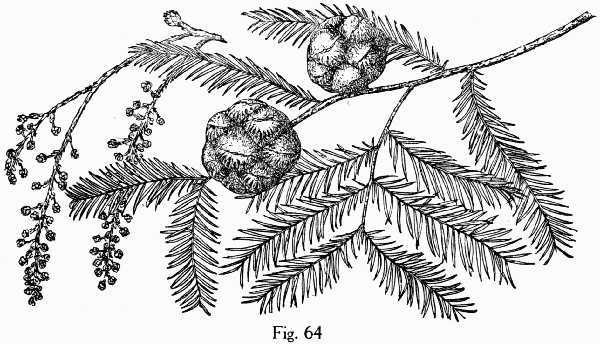
Leaves on distichously spreading branchlets, apiculate, ½′—¾′ long, about 1/12′ wide, light bright yellow-green or occasionally silvery white below; or on the form with pendulous compressed branchlets long-pointed, keeled and stomatiferous below, concave above more or less spreading at the free apex, about ½′ long; in the autumn turning with the branchlets dull orange-brown before falling. Flowers: panicles of staminate flowers 4′—5′ long, 1½′—2′ wide, with slender red-brown stems, obovoid flower-buds nearly ⅛′ long, pale silvery-gray during winter and purple when the flowers expand in the spring. Fruit usually produced in pairs at the end of the branch or irregularly scattered along it for several inches, nearly globose or obovoid, rugose, about 1′ in diameter, the scales generally destitute of tips; seeds with wings nearly ¼′ long, ⅛′ wide.
A tree, with a tall lobed gradually tapering trunk, rarely 12° and generally 4°—5° in diameter above the abruptly enlarged strongly buttressed usually hollow base, occasionally 150° tall, in youth pyramidal, with slender branches often becoming elongated and slightly pendulous, in old age spreading out into a broad low rounded crown often 100° across, and slender branchlets light green when they first appear, light red-brown and rather lustrous [65] during their first winter, becoming darker the following year, the lateral branchlets deciduous, 3′—4′ long, spreading at right angles to the branch, or in the form with acicular leaves pendulous or erect and often 6′ long. Bark 1′—2′ thick, light cinnamon-red and divided by shallow fissures into broad flat ridges separating on the surface into long thin closely appressed fibrous scales. Wood light, soft, not strong, easily worked, light or dark brown, sometimes nearly black; largely used for construction, railway-ties, posts, fences, and in cooperage.
Distribution. River swamps usually submerged during several months of the year, low wet banks of streams, and the wet depressions of Pine-barrens from southern New Jersey and southern Delaware southward generally near the coast to the Everglade Keys, southern Florida, and through the Gulf-coast region to the valley of Devil River, Texas, through Louisiana to southern Oklahoma, through southern and western Arkansas to southeastern Missouri, and through western and northern Mississippi to Tishomingo County, and in western Tennessee and Kentucky to southern Illinois and southwestern Indiana; most common and of its largest size in the south Atlantic and Gulf states, often covering with nearly pure forests great river swamps. From the coast of North Carolina to southern Florida, southern Alabama and eastern and western Louisiana the form with acicular leaves (Taxodium distichum var. imbricarium, Sarg.) is not rare as a small tree in Pine-barren ponds and swamps.
Often cultivated as an ornamental tree in the northern United States, and in the countries of temperate Europe, especially the var. imbricarium (as Glyptostrobus sinensis Hort. not Endl.).
9. LIBOCEDRUS Endl.
Tall resinous aromatic trees, with scaly bark, spreading branches, flattened branchlets disposed in one horizontal plane and forming an open 2-ranked spray and often ultimately deciduous, straight-grained durable fragrant wood, and naked buds. Leaves scale-like, in 4 ranks, on leading shoots nearly equally decussate, closely compressed or spreading, dying and becoming woody before falling, on lateral flattened branchlets much compressed, conspicuously keeled, and nearly covering those of the other ranks; on seedling plants linear-lanceolate and spreading. Flowers monœcious, solitary, terminal, the two sexes on different branchlets; male oblong, with 12—16 decussate filaments dilated into broad connectives usually bearing 4 subglobose anther-cells; female oblong, subtended at base by several pairs of leaf-like scales slightly enlarged and persistent under the fruit, composed of 6 acuminate short-pointed scales, those of the upper and middle ranks much larger than those of the lower rank, ovate or oblong, fertile and bearing at the base of a minute accrescent ovuliferous scale 2 erect ovules. Fruit an oblong cone maturing in one season, with subcoriaceous scales marked at the apex by the free thickened mucronulate border of the enlarged flower-scales, those of the lowest pair ovate, thin, reflexed, much shorter than the oblong thicker scales of the second pair widely spreading at maturity; those of the third pair confluent into an erect partition. Seeds in pairs, erect on the base of the scale; seed-coat membranaceous, of 2 layers, produced into thin unequal lateral wings, one narrow, the other broad, oblique, nearly as long as the scale; cotyledons 2, about as long as the superior radicle.
Libocedrus is confined to western North America, western South America, where it is distributed from Chile to Patagonia, New Zealand, New Caledonia, New Guinea, Formosa, and southwestern China. Eight species are distinguished.
Libocedrus, from λιβάς and Cedrus, relates to the resinous character of these trees.
1. Libocedrus decurrens Torr. Incense Cedar.
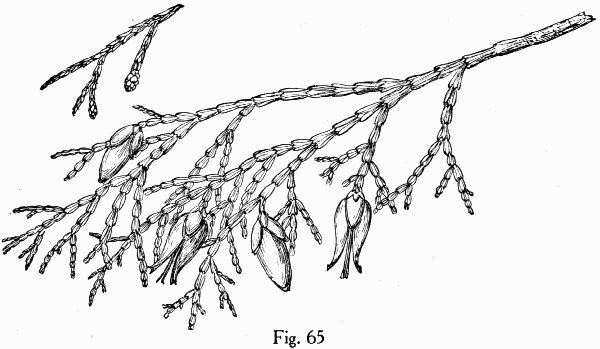
Leaves oblong-obovate, decurrent and closely adnate on the branchlets except at the callous apex, ⅛′ long on the ultimate lateral branchlets to nearly ½′ long on leading shoots, those of the lateral ranks gradually narrowed and acuminate at apex, keeled and glandular [66] on the back, and nearly covering the flattened obscurely glandular-pitted and abruptly pointed leaves of the inner ranks. Flowers appearing in January on the ends of short lateral branchlets of the previous year; male tingeing the tree with gold during the winter and early spring, ovate, nearly ¼′ long, with nearly orbicular or broadly ovate connectives, rounded, acute or acuminate at the apex and slightly erose on the margins; female subtended by 2—6 pairs of leaf-like scales, with ovate acute light yellow-green slightly spreading scales. Fruit ripening and discharging its seeds in the autumn, oblong, ¾′—1′ long, pendulous, light red-brown; seeds oblong-lanceolate, ⅓′—½′ long, semiterete and marked below by a conspicuous pale basal hilum; inner layer of the seed-coat penetrated by elongated resin-chambers, filled with red liquid balsamic resin.
A tree, usually 80°—100° or rarely 150° high, with a tall straight slightly and irregularly lobed trunk tapering from a broad base, 3° or 4° or occasionally 6° or 7° in diameter, slender branches erect at the top of the tree, below sweeping downward in bold curves, forming a narrow open feathery crown becoming in old age irregular in outline by the greater development of a few ultimately upright branches forming secondary stems, and stout branchlets somewhat flattened and light yellow-green at first, turning light red-brown during the summer and ultimately brown more or less tinged with purple, the lateral branchlets much flattened, 4′—6′ long, and usually deciduous at the end of the second or third season. Bark ½′—1′ thick, bright cinnamon-red, and broken into irregular ridges covered with closely appressed plate-like scales. Wood light, soft, close-grained very durable in contact with the soil, light reddish brown, with thin nearly white sapwood; often injured by dry rot but largely used for fencing, laths and shingles, the interior finish of buildings, for furniture, and in the construction of flumes.
Distribution. Singly or in small groves from the southeastern slope of Mt. Hood, Oregon, and southward along the Cascade Mountains; on the high mountains of northern California, on the western slopes of the Sierra Nevada, and in Alpine County on their eastern slope, on the Washoe Mountains, western Nevada, in the California coast ranges from the Santa Lucia Mountains, Monterey County to the high mountains in the southern part of the state; on the Sierra del Pinal and the San Pedro Mártir Mountains, Lower California; most abundant and of its largest size on the Sierra Nevada, of central California at elevations of 5000°—7000° above the sea.
Often cultivated as an ornamental tree in western and central Europe, where it grows rapidly and promises to attain a large size; hardy and occasionally planted in the New England and middle Atlantic states.
[67]
10. THUJA L. Arbor-vitæ.
Resinous aromatic trees, with thin scaly bark, soft durable straight-grained heartwood, thin nearly white sapwood, slender spreading or erect branches, pyramidal heads, flattened lateral pendulous branchlets disposed in one horizontal plane, forming a flat frond-like spray and often finally deciduous, and naked buds. Leaves decussate, scale-like, acute, stomatiferous on the back, on leading shoots appressed or spreading, rounded or slightly keeled on the back, narrowed into long slender points, on lateral branchlets much compressed in the lateral ranks, prominently keeled and nearly covering those of the other ranks; on seedling plants linear-lanceolate, acuminate, spreading or reflexed. Flowers minute, monœcious, from buds formed the previous autumn, terminal, solitary, the two sexes usually on different branchlets; male ovoid, with 4—6 decussate filaments, enlarged into suborbicular peltate connectives bearing on their inner face 2—4 subglobose anther-cells; female oblong, with 8—12 oblong acute scales opposite in pairs, the ovuliferous scales at their base bearing usually 2 erect bottle-shaped ovules. Fruit an ovoid-oblong erect pale cinnamon-brown cone maturing in one season, its scales thin (thick in one species), leathery, oblong, acute, marked near the apex by the thickened free border of the enlarged flower-scales, those of the 2 or 3 middle ranks largest and fertile. Seeds usually 2, erect on the base of the scale, ovoid, acute, compressed, light chestnut-brown; seed-coat membranaceous, produced except in one species into broad lateral wings distinct at the apex; cotyledons 2, longer than the superior radicle.
Thuja is confined to northeastern and northwestern America, to Japan, Korea and northern China. Five species are recognized. Of the exotic species the Chinese Thuja orientalis, L., with many varieties produced by cultivation, is frequently planted in the United States, especially in the south and west, for the decoration of gardens, and is distinguished from the other species by the thick umbonate scales of the cone, only the 4 lower scales being fertile, and by the thick rounded dark red-purple seeds without wings.
Thuja is the classical name of some coniferous tree.
CONSPECTUS OF THE NORTH AMERICAN SPECIES.
Fruit with usually 4 fertile scales.
1. T. occidentalis (A).
Fruit with usually 6 fertile scales.
2. T. plicata (B, F, G).
1. Thuja occidentalis L. White Cedar. Arbor-vitæ.
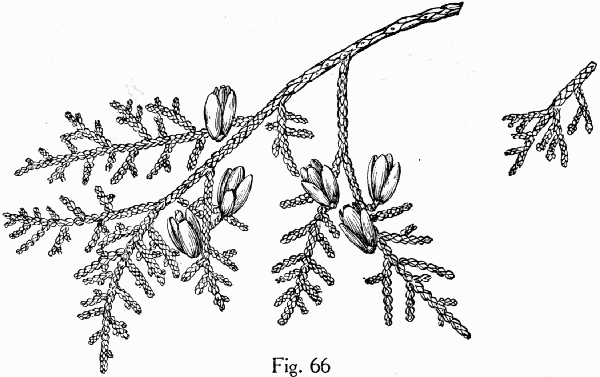
Leaves on leading shoots often nearly ¼′ long, long-pointed and usually conspicuously glandular, on lateral branchlets much flattened, rounded and apiculate at apex, without glands or obscurely glandular-pitted, about ⅛′ long. Flowers opening in April and May, liver color. Fruit ripening and discharging its seeds in the early autumn, ⅓′—½′ long; seeds ⅛′ long, the thin wings as wide as the body.
A tree, 50°—60° high, with a short often lobed and buttressed trunk, occasionally 6° although usually not more than 2°—3° in diameter, often divided into 2 or 3 stout secondary stems, short horizontal branches soon turning upward and forming a narrow compact pyramidal head, light yellow-green branchlets paler on the lower surface than on the upper, changing with the death of the leaves during their second season to light cinnamon-red, growing darker the following year, gradually becoming terete and abruptly enlarged at the base and finally covered with smooth lustrous dark orange-brown bark, and marked by conspicuous scars left by the falling of the short pendulous lateral branchlets. Bark ¼′—⅓′ thick, light red-brown often tinged with orange color and broken by shallow fissures into narrow flat connected ridges separating into elongated more or less persistent scales. Wood light, soft, brittle, very coarse-grained, durable, fragrant, pale yellow-brown; largely used in Canada and the northern states for fence-posts, rails, railway-ties, and shingles. Fluid extracts and tinctures made from the young branchlets are sometimes used in medicine.
Distribution. Frequently forming nearly impenetrable forests on swampy ground or [68] often occupying the rocky banks of streams, from Nova Scotia and New Brunswick, northwestward to the mouth of the Saskatchewan, and southward through eastern Canada to southern New Hampshire, central Massachusetts, New York, central Ohio, northern Indiana and Illinois, and Minnesota; occasionally on the high mountains of Virginia, West Virginia, and northeastern Tennessee, and on the mountains of western Burke County, North Carolina, at an altitude of 3000 feet; very common at the north, less abundant and of smaller size southward.
Often cultivated, with many, often dwarf, forms produced in nurseries, as an ornamental tree and for hedges; and in Europe from the middle of the sixteenth century.
2. Thuja plicata D. Don. Red Cedar. Canoe Cedar.
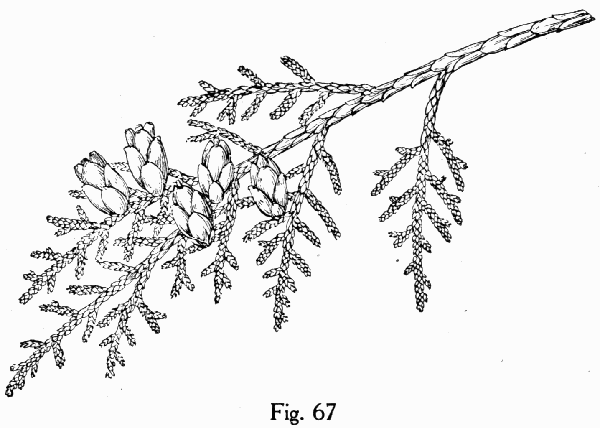
Leaves on leading shoots ovate, long-pointed, often conspicuously glandular on the back, frequently ¼′ long, on lateral branchlets ovate, apiculate, without glands or obscurely glandular-pitted, usually not more than ⅛′ long, mostly persistent 2—5 years. Flowers about 1/12′ long, dark brown. Fruit ripening early in the autumn, clustered near the ends of the branches, much reflexed, ½′ long, with thin leathery scales, conspicuously marked near the apex by the free border of the flower-scale furnished with short stout erect or recurved dark mucros; seeds often 3 under each fertile scale, rather shorter than their usually slightly unequal wings about ¼′ long.
A tree, frequently 200° high, with a broad gradually tapering buttressed base sometimes 15° in diameter at the ground and in old age often separating toward the summit into 2 or 3 erect divisions, short horizontal branches, usually pendulous at the ends, forming a dense narrow pyramidal head, and slender much compressed branchlets often slightly zigzag, light bright [69] yellow-green during their first year, then cinnamon-brown, and after the falling of the leaves, lustrous and dark reddish brown often tinged with purple, the lateral branchlets 5′—6′ long, light green and lustrous on the upper surface, somewhat paler on the lower surface, turning yellow and falling generally at the end of their second season. Bark bright cinnamon-red, ½′—¾′ thick, irregularly divided by narrow shallow fissures into broad ridges rounded on the back and broken on the surface into long narrow rather loose plate-like scales. Wood light, soft, not strong, brittle, coarse-grained, easily split, dull brown tinged with red; largely used in Washington and Oregon for the interior finish of buildings, doors, sashes, fences, shingles, and in cabinet-making and cooperage. From this tree the Indians of the northwest coast split the planks used in the construction of their lodges, carved the totems which decorate their villages, and hollowed out their great war canoes, and from the fibres of the inner bark made ropes, blankets, and thatch for their cabins.
Distribution. Singly and in small groves on low moist bottom-lands or near the banks of mountain streams, from the sea-level to elevations of 6000° in the interior, from Baranoff Island, Alaska, southward along the coast ranges of British Columbia, western Washington, and Oregon, where it is the most abundant and grows to its largest size, and through the California-coast region to Mendocino County, ranging eastward along many of the interior ranges of British Columbia, northern Washington, Idaho, and Montana to the western slope of the continental divide.
Often cultivated as an ornamental tree in the parks and gardens of western and central Europe where it has grown rapidly and vigorously, and occasionally in the middle and north Atlantic states.
11. CUPRESSUS L. Cypress.
Resinous trees, with bark often separating into long shred-like scales, fragrant durable usually light brown heartwood, pale yellow sapwood, stout erect branches often becoming horizontal in old age, slender 4-angled branchlets, and naked buds. Leaves scale-like, ovate, acute, acuminate, or bluntly pointed at apex, with slender spreading or appressed tips, thickened, rounded, and often glandular on the back, opposite in pairs, becoming brown and woody before falling; on vigorous leading shoots and young plants needle-shaped or linear-lanceolate and spreading. Flowers minute, monœcious, terminal, yellow, the two sexes on separate branchlets; the male oblong, of numerous decussate stamens, with short filaments enlarged into broadly ovate connectives bearing 2—6 globose pendulous anther-cells; female oblong or subglobose, composed of 6—10 thick decussate scales bearing in several rows at the base of the ovuliferous scale numerous erect bottle-shaped ovules. Fruit an erect nearly globose cone maturing in the second year, composed of the much thickened ovule-bearing scales of the flower, abruptly dilated, clavate and flattened at the apex, bearing the remnants of the flower-scales developed into a short central more or less thickened mucro or boss; long-persistent on the branch after the escape of the seeds. Seeds numerous, in several rows, erect, thick, and acutely angled or compressed, with thin lateral wings; seed-coat of 2 layers, the outer thin and membranaceous, the inner thicker and crustaceous; cotyledons 3 or 4, longer than the superior radicle.
Cupressus with ten or twelve species is confined to Pacific North America and Mexico in the New World and to southeastern Europe, southwestern Asia, the Himalayas, and China in the Old World. Of the exotic species Cupressus sempervirens L., of southeastern Europe and southwestern Asia, and especially its pyramidal variety, are often planted for ornament in the south Atlantic and Pacific states.
Cupressus is the classical name of the Cypress-tree.
CONSPECTUS OF THE NORTH AMERICAN SPECIES
Leaves dark green.
Leaves eglandular or obscurely glandular on the back.
Leaves obtusely pointed; cones puberulous, 1′—1½′ in diameter; seeds light chestnut-brown.
1. C. macrocarpa (G).
[70]
Leaves acutely pointed; cones ½′—⅔′ in diameter; seeds dark brown or black.
2. C. Goveniana (G).
Leaves glandular-pitted on the back, acute.
Cones ⅔′—1′ in diameter; seeds brown, often glaucous.
3. C. Sargentii (G).
Cones ½′—1′ in diameter, often covered with a glaucous bloom; seeds dark chestnut-brown.
4. C. Macnabiana (G).
Leaves pale bluish green.
Leaves obtusely pointed, with small gland-pits; bark of the trunk smooth, lustrous, mahogany brown; branches bright red.
5. C. guadaloupensis (G).
Leaves acute, eglandular or occasionally obscurely glandular (in var. glabra conspicuously glandular); bark of the trunk dark brown, separating into long narrow persistent fibres; branchlets gray.
6. C. arizonica (H).
1. Cupressus macrocarpa Gord. Monterey Cypress.
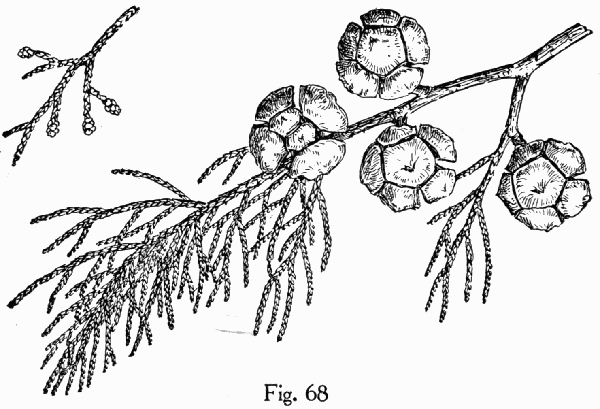
Leaves dark green, bluntly pointed, eglandular, and ¼′—½′ long; deciduous at the end of three or four years. Flowers opening late in February or early in March, yellow. Fruit clustered on short stout stems subglobose, slightly puberulous, 1′—1½′ in diameter, composed of 4 or 6 pairs of scales, with broadly ovoid thickened or occasionally on the upper scales subconical bosses, the scales of the upper and lower pairs being smaller than the others and sterile; seeds about 20 under each fertile scale, angled, light chestnut-brown, about 1/16′ long.
A tree, often 60°—70° high, with a short trunk 2°—3° or exceptionally 5°—6° in diameter, slender erect branches forming a narrow or broad bushy pyramidal head, becoming stout and spreading in old age into a broad flat-topped crown, and stout branchlets covered when the leaves fall at the end of three or four years with thin light or dark reddish brown bark separating into small papery scales. Bark ¾′—1′ thick and irregularly divided into broad flat connected ridges separating freely into narrow elongated thick persistent scales, dark red-brown on young stems and upper branches, becoming at last almost white on old and exposed trunks. Wood heavy, hard and strong, very durable, close-grained.
Distribution. Coast of California south of the Bay of Monterey, occupying an area about two miles long and two hundred yards wide from Cypress Point to the shores of Carmel Bay, with a small grove on Point Lobos, the southern boundary of the bay.
Universally cultivated in the Pacific states from Vancouver Island to Lower California, and often used in hedges and for wind-breaks; occasionally planted in the southeastern states; much planted in western and southern Europe, temperate South America, and in Australia and New Zealand.
2. Cupressus Goveniana Gord.
Cupressus pygmæa Sarg.
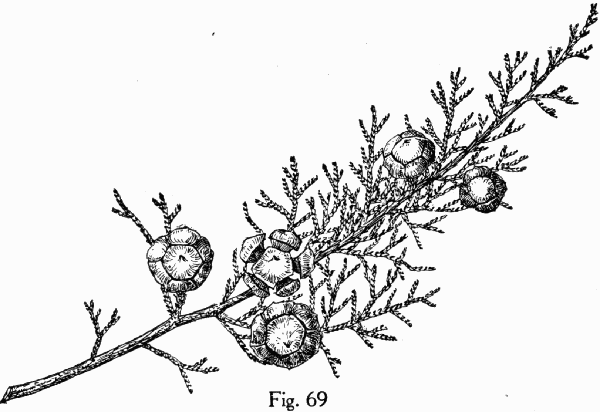
Leaves acutely pointed, dark green. Flowers: male obscurely 4-angled, with broadly ovate peltate connectives: female with 6—10 ovate pointed scales. Fruit usually sessile, [71] subglobose ¼′—⅞′ in diameter, its scales terminating in small bosses; seeds compressed, black, or dark brown, papillose, about ⅛′ long.
A tree rarely 75° high, with a tall trunk up to 2°10′ in diameter, often not more than 25° high, more often a shrub with numerous stems 1°—15° tall, ascending branches, and comparatively stout bright reddish brown branchlets, becoming purple and ultimately dark reddish brown; often beginning to produce fertile cones when only 1° or 2° tall. Bark bright reddish brown, about ¼′ thick, and divided by shallow fissures into flat ridges separating on the surface into long thread-like scales. Wood soft, very coarse-grained, pale reddish brown.
Distribution. California: pine barrens on the western slope of Point Pinos Ridge two miles west of Monterey, and on alkaline soil in a narrow belt beginning about three quarters of a mile from the shore of Mendocino County and extending inland for three or four miles from Ten Mile Run on the north to the Navarro River on the south; arborescent and also of its smallest size only in this northern station.
3. Cupressus Sargentii Jeps. Sargent’s Cypress.
Cupressus Goveniana Engelm., not Gord. (Silva N. Am. x. 107 t. 527)
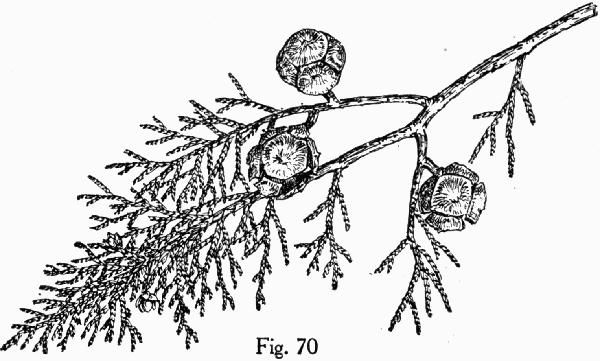
Leaves obscurely glandular or without glands, dark green, pungently aromatic, 1/16′—⅛′ long, turning bright red-brown in drying and falling at the end of three or four years; on young plants ⅛′—¼′ long. Flowers: male with thin slightly erose connectives: female of 6 or 8 acute slightly spreading scales. Fruit often in crowded clusters, short-stalked, subglobose, ½′—1′ in diameter, reddish brown or purple, lustrous, puberulous, its 6 or 8 scales with broadly ovoid generally rounded and flattened and rarely short-obconic bosses; seeds brown, lustrous, often glaucous, with an acute margin, ⅙′ long, about 20 under each fertile scale.