Division II. Dicotyledons. (continued 19)
Reading edition
2. RHODODENDRON L.
Trees or shrubs, with scaly bark, terete branchlets, terminal buds formed in summer, and fibrous roots. Leaves usually clustered at the end of the branches, revolute and entire on the margin, persistent or deciduous. Flowers in terminal umbellate corymbs from buds with numerous caducous scales; calyx 5-parted or toothed, persistent under the fruit, corolla 5—10-lobed, deciduous; stamens 5 or 10, rarely more, more or less unequal, ultimately spreading; filaments subulate-filiform, pilose at the base; disk thick and fleshy, crenately lobed; ovary 5—10-celled; style slender, crowned with a capitate stigma and persistent on the fruit; ovules numerous in each cell, attached in many series to an axile 2-lipped placenta projected from the inner angle of the cell, anatropous. Fruit a woody many-seeded capsule. Seed scobiform; seed-coat loose, reticulate, produced at the ends beyond the nucleus into a short often laciniate appendage; embryo minute, cylindric, axile in fleshy albumen; cotyledons oblong, shorter than the radicle turned toward the hilum.
Rhododendron with some four or five hundred species occurs in eastern Thibet, on the Himalayas, in southwestern China, the Malay peninsula and Archipelago, New Guinea, northern China and Corea, Japan, the mountains of central Europe, on the Caucasus, and in eastern and western North America, the largest number of species being found in southwestern China and on the Himalayas. Of the twenty-three or twenty-four North American species one only is arborescent.
Rhododendron possesses astringent narcotic properties. It produces hard close-grained compact wood sometimes used in turnery and for fuel. Many of the species are cultivated in gardens for the beauty of their large and conspicuous flowers.
The generic name is from ῥόδον and δένδρον, the Rose-tree.
1. Rhododendron maximum L. Great Laurel. Rose Bay.
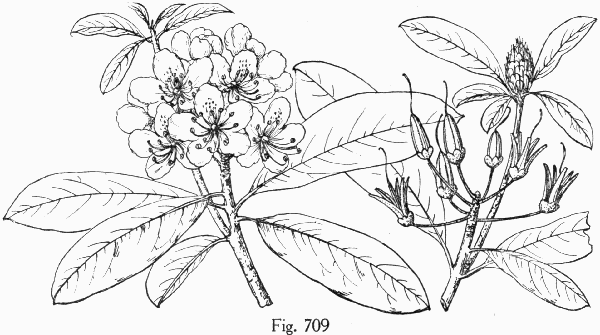
Leaves revolute in the bud, ovate-lanceolate or obovate-lanceolate, acute or short-pointed at apex, and narrowed, cuneate or rounded at base, when they unfold covered with a thick pale or ferrugineous tomentum of gland-tipped hairs, and at maturity glabrous, thick and coriaceous, dark green and lustrous on the upper surface, usually pale or whitish on the lower surface, 4′—12′ long and 1½′—2½′ wide, with a broad pale midrib and obscure reticulate veinlets; persistent for two or three years; petioles stout, ridged above, rounded below, 1′—1½′ in length. Flowers: inflorescence-buds surrounded at first by several loose narrow leaf-like scales, and when fully grown in September cone-shaped, 1½′ long and ½′ broad, with many imbricated ovate scales rounded and contracted at apex into a long slender point, opening late in June after the shoots of the year from buds in the axils of upper leaves have reached their full length; flowers on slender pink pedicels covered with glandular white hairs and furnished at base with two linear scarious bractlets, from the axils of the scales of the inner ranks of the inflorescence-bud, in 16—24-flowered umbellate clusters 4′—5′ in diameter, with accrescent scarious resinous puberulous bracts, those of the outer ranks becoming 1′ long and ⅓′ wide, and shorter than the lanceolate bracts of the inner ranks contracted into a long slender point; calyx light green and puberulous, with rounded remote lobes; corolla prominently 5-angled or ridged in the bud, campanulate, [793] gibbous on the posterior side, puberulous in the throat, light rose color, purplish, or white, 1′ long, cleft to the middle into 5 oval rounded lobes, with conspicuous central veins, the upper lobe marked on the inner face by a cluster of yellow-green spots, and furnished on the outer surface at the bottom of each sinus with a conspicuous dark red gland; stamens 8—12, white, inserted on the bright green disk; filaments enlarged and flattened at base, slightly bent inward above the middle, and bearded with stiff white hairs, the 4 or 5 short ones at the back of the flower for more than half their length and the others only near the base; ovary ovoid, green, coated with short glandular pale hairs, crowned with a long slender glabrous white declining style club-shaped and inflexed at apex, and terminating in a 5-rayed scarlet stigma. Fruit dark red-brown, ovoid, ½′ long, glandular-hispid, ripening and shedding its seeds in the autumn, the clusters of open capsules remaining on the branches until the following summer; seeds oblong, flattened, the coat prolonged at the ends into scarious fringed appendages.
A bushy tree, 30°—40° high, with a short crooked often prostrate trunk occasionally 10′—12′ in diameter, stout contorted branches forming a round head, and branchlets green tinged with red and covered with dark red or slightly ferrugineous glandular-hispid hairs when they first appear, dark green and glabrous in their first winter, gradually turning bright red-brown in their second year, and ultimately gray tinged with red, the thin bark separating on branches four or five years old into persistent scales; more often a broad shrub, with many divergent twisted stems 10°—12° high. Winter-buds: leaf-buds conic, dark green, axillary, or terminal on barren shoots, with many closely imbricated scales, those of the inner ranks accrescent, increasing in length from the outer to the inner, and at maturity 1½′ long, ¼′ wide, gradually narrowed at base, and terminating at apex in a long slender point, light green, glabrous, closely held against the shoot by a resinous exudation from the glandular hairs, and in falling marking the branchlet with numerous conspicuous narrow remote scars persistent for three or four years. Bark of the trunk about 1/16′ thick, light red-brown, broken on the surface into small thin appressed scales. Wood heavy, hard, strong, rather brittle, close-grained, light clear brown, with thin lighter colored sapwood; occasionally made into the handles of tools and used as a substitute for boxwood in engraving. A decoction of the leaves is occasionally employed in domestic practice in the treatment of rheumatism.
Distribution. Nova Scotia, Mt. Chocorua, New Hampshire, and southward in New England and eastern New York and along the Appalachian Mountains to northern Georgia and westward to the northern shores of Lake Erie and to southeastern Ohio (Hocking and Fairfield Counties); rare at the north and an inhabitant of deep cold swamps in a few [794] isolated stations; more abundant on the mountains of western Pennsylvania, becoming exceedingly common farther south and occupying the steep banks of streams up to altitudes of 3000°; of its largest size on the high mountains of eastern Tennessee and the Carolinas, and here often forming thickets hundreds of acres in extent.
Often cultivated as an ornament of parks and gardens in the United States, and in Europe, and one of the parents of a number of distinct and beautiful hybrids.
3. KALMIA L.
Trees or shrubs, with scaly bark, terete branchlets without a terminal bud, minute axillary leaf-buds, elongated axillary inflorescence-buds covered by imbricated scales, and fibrous roots. Leaves ovate-oblong or linear, short-petiolate, with flat entire margins, coriaceous, persistent or deciduous in one species. Flowers on slender pedicels bibracteolate at the base, from the axils of foliaceous coriaceous ovate or acute persistent bracts, in axillary umbels; calyx 5, rarely 6-parted, the divisions imbricated in the bud, persistent under the fruit; corolla 5, rarely 6-lobed, rose-colored, purple, or white, saucer-shaped, with a short tube and 10 pouches just below the 5 or 6-parted limb, the lobes ovate, acute, before anthesis prominently 10 or 12-ribbed from the pouches to the acute apex of the bud, the salient keel of the ribs running to the point of the lobes and to the sinuses; stamens 10, shorter than the corolla; filaments filiform; anthers oblong, each cell opening by a short apical oblong longitudinal pore, at first free in the bud, the filaments then erect, later received in the pouches of the corolla, the filaments becoming bent back by its enlargement and expansion, straightening elastically and incurving on the release of the anthers, and in straightening discharging the pollen-grains; disk prominently 10-lobed; ovary subglobose, 5-celled; style filiform, exserted, crowned with a capitate stigma; ovules numerous in each cell, inserted on a 2-lipped placenta, pendulous or spreading from near the top of the thin columella, few-ranked, anatropous. Fruit a woody many-seeded globose slightly 5-lobed 5-celled capsule, tardily septicidally 5-valved, the valves crustaceous, ultimately opening down the middle by a narrow slit and separating from the persistent placenta-bearing axis. Seeds oblong or subglobose, minute; seed-coat crustaceous or membranaceous; embryo in fleshy albumen, terete, near the hilum; radicle erect, rather shorter than the oblong cotyledons.
Kalmia with six species is North American and Cuban, one species occasionally becoming under favorable conditions a small tree.
The generic name is in honor of the Swedish traveler and botanist, Peter Kalm (1715—1779).
1. Kalmia latifolia L. Laurel. Mountain Laurel.
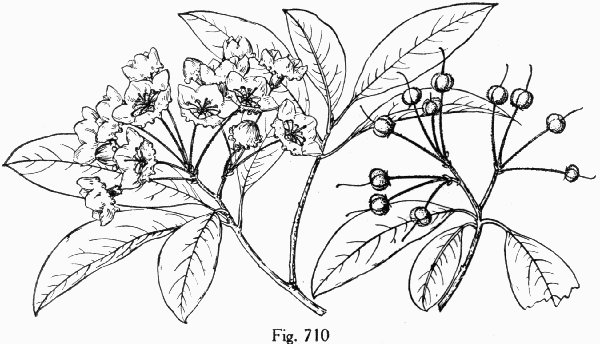
Leaves sometimes in pairs or in 3’s, conduplicate in the bud, each leaf in the bud inclosed by the one immediately below it, oblong or elliptic-lanceolate, acute or rounded and tipped at apex with a callous point, and gradually narrowed at base, rarely oval to oblong-obovate and rounded at ends (f. obtusata Rehd.), when they unfold slightly tinged with pink and covered with glandular white hairs, and at maturity thick and rigid, dark rather dull green above, light yellow-green below, 3′—4′ long and 1′—1½′ wide, with a broad yellow midrib and obscure immersed veins; beginning to fall during their second summer; petioles stout, terete or slightly flattened, about ⅔′ in length. Flowers opening from early in April in southern Mississippi to the 20th of June at the north; inflorescence-buds appearing in the autumn from the axils of upper leaves, beginning to lengthen with the first warm days of spring and usually developing 2 or several lateral branches, the whole forming a compound many-flowered corymb of numerous crowded fascicles more or less covered with dark scurfy scales, 4′—5′ in diameter, and overtopped at the flowering time by the leafy branches of the year; flowers nearly 1′ in diameter, on long slender red or green pedicels covered with glandular hairs, and furnished at base with 2 minute acute bractlets, developed from the axils of acute persistent bracts sometimes ⅓′ long; calyx divided nearly to the base into narrow acute thin green lobes; corolla white (f. alba Rehd.), rose-color, or deep [795] pink (f. rubra Rehd.) viscid-pubescent, marked on the inner surface with a waving dark rose-colored line and with delicate purple penciling above the sacs, rarely with a broad purple or chocolate-colored band (f. fuscata Rehd.). Fruit ripening in September, crowned with the persistent style, 3/16′ in diameter, and covered with viscid hairs, remaining on the branches until the following year; seeds oblong, light brown, scattered by the opening of the valves.
A tree, rarely 30°—40° high, with a short crooked and contorted trunk sometimes 18′—20′ in diameter, stout forked divergent branches forming a round-topped compact head, and slender branchlets light green tinged with red and covered with soft white glandular-viscid hairs when they first appear, soon becoming glabrous, and in their first winter green tinged with red and very lustrous, turning bright red-brown during their second year and paler the following season, the bark then separating into large thin papery scales exposing the cinnamon-red inner bark, and marked with large deeply impressed leaf-scars showing near the centre a crowded cluster of fibro-vascular bundle-scars; more often a dense broad shrub 6°—10° high, with numerous crooked stems. Winter-buds formed before midsummer in the axils of the leaves just below those producing the inflorescence-buds, their inner scales accrescent, and at maturity often 1′ long and ½′ wide, ovate, acute, light green, covered with glandular white hairs, and in falling marking the base of the shoots with conspicuous broad scars. Bark of the trunk hardly more than 1/16′ thick, dark brown tinged with red, and divided by longitudinal furrows into narrow ridges separating into long narrow scales. Wood heavy, hard, strong, rather brittle, close-grained, brown tinged with red, with slightly lighter colored sapwood; used for the handles of tools, in turnery, and for fuel.
Distribution. New Brunswick to the northern shores of Lake Erie and southward in the Atlantic coast region to Virginia and to southern Ohio, Martin and Crawford Counties, Indiana and central Tennessee, along the Appalachian Mountains and their foothills to Georgia, and from western Florida through Alabama to eastern and southern Mississippi and the valley of the Bogue Lusa River, Washington Parish, Louisiana; often growing in low moist ground near the margins of swamps or on dry slopes under the shade of deciduous-leaved trees, or on rich rocky hillsides; most abundant and often forming dense impenetrable thickets on the southern Appalachian Mountains up to altitudes of 3000°—4000°; usually shrubby, and only arborescent in a few secluded valleys between the Blue Ridge and the Alleghany Mountains of North and South Carolina; abundant and of large size along small streams in Liberty County, western Florida. The var. myrtifolia K. Koch with small lance-oblong leaves, and small compact clusters of small flowers, a compact [796] dwarf shrub, and an old inhabitant of European gardens, is occasionally wild in Massachusetts; in an abnormal form (f. polypetala Rehd.) found in western Massachusetts the corolla is divided into 5 narrow petals.
Often cultivated as an ornament of parks and gardens in the eastern states, and in Europe.
4. OXYDENDRUM DC.
A tree, with thick deeply furrowed bark, slender terete glabrous light red or brown branchlets, without a terminal bud, marked by elevated nearly triangular leaf-scars displaying a lunate row of crowded fibro-vascular bundle-scars, and numerous elevated oblong dark lenticels, acid foliage, and fibrous roots. Winter-buds axillary, minute, partly immersed in the bark, obtuse, covered with opposite broad-ovate dark red scales rounded at apex, those of the inner ranks accrescent. Leaves alternate, revolute in the bud, oblong or lanceolate, acute, gradually contracted at base into a long slender petiole, serrate with minute incurved callous teeth, penniveined, with a conspicuous bright yellow midrib and reticulate veinlets, thin and firm, dark green and lustrous on the upper surface, pale and glaucous on the lower surface, glabrous or at first slightly puberulous, deciduous. Flowers on erect clavate pedicels coated with hoary pubescence and bibracteolate above the middle, with linear acute caducous bractlets, in puberulous panicles of secund racemes appearing in summer and terminal on axillary leading shoots of the year, the lower racemes in the axils of upper leaves; calyx free, divided nearly to the base, the divisions valvate in the bud, ovate-lanceolate, acute, pubescent or puberulous on the outer surface, persistent under the fruit; corolla hypogynous, cylindric to ovate-cylindric, white, puberulous, 5-lobed, the lobes minute, ovate, acute, reflexed; stamens 10, included; filaments subulate, broad, pilose, inserted on the very base of the corolla; anthers linear-oblong, narrower than the filaments, the cells opening from the apex to the middle; disk thin, obscurely 10-lobed; ovary broad-ovoid, pubescent, 5-celled; style columnar, thick, exserted, crowned with a simple stigma; ovules attached to an axile placenta rising from the base of the cell, ascending, amphitropous. Fruit a 5-celled ovoid-pyramidal many-seeded capsule crowned with the remnants of the persistent style, 5-lobed, puberulous, loculicidally 5-valved, the valves woody, separating from the central persistent placentiferous axis, many-seeded. Seeds ascending, elongated; seed-coat membranaceous, loose, reticulated, produced at the ends into long slender points; embryo minute, axile in fleshy albumen, cylindric; radicle terete, next the hilum.
The genus consists of a single species.
The generic name is from ὀξύς and δένδρον, in allusion to the acid foliage.
1. Oxydendrum arboreum DC. Sorrel-tree. Sour Wood.
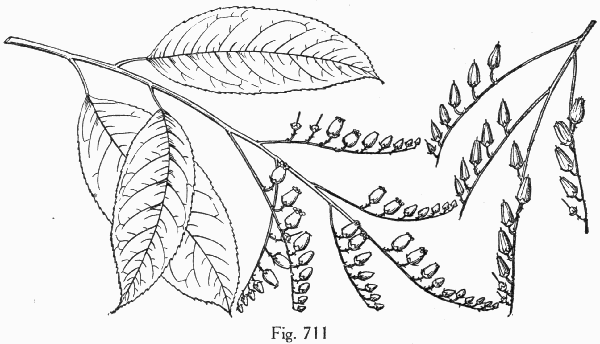
Leaves when they unfold bronze-green, very lustrous and glabrous with the exception of a slight pubescence on the upper side of the midrib and a few scattered hairs on the under side of the midrib and on the petioles, and at maturity 5′—7′ long and 1½′—2½′ wide; turning bright scarlet in the autumn; petioles ⅔′ in length. Flowers opening late in July or early in August, ⅓′ long, in panicles 7′—8′ in length. Fruit ⅓′—½′ long, hanging in drooping clusters sometimes a foot in length, ripening in September, the empty capsules often persistent on the branches until late in the autumn; seeds about ⅛′ long, pale brown.
A tree, occasionally 50°—60° high, with a tall straight trunk 12′—20′ in diameter, slender spreading branches forming a narrow oblong round-topped head, and glabrous branchlets yellow-green and marked by orange-colored lenticels when they first appear, becoming in their first winter orange-colored to reddish brown. Winter-buds about 1/16′ long, their inner scales at maturity 1′ in length, ⅛′ wide, spatulate, acute at apex, and slightly puberulous on the inner surface and on the margins. Bark of the trunk ⅔′—1′ thick, gray tinged with red and divided by longitudinal furrows into broad rounded ridges covered with small thick appressed scales. Wood heavy, hard, very close-grained, brown tinged with red, with lighter colored sapwood of 80—90 layers of annual growth; sometimes used locally for the [797] handles of tools and the bearings of machinery. The leaves have a pleasant acidulous taste, and are reputed to be tonic, refrigerant, and diuretic, and are occasionally used in domestic practice in the treatment of fevers.
Distribution. Well-drained gravelly soil on ridges rising above the banks of streams; coast of Virginia (Norfolk County) to that of North Carolina (near Newbern, Craven County), southwestern Pennsylvania to southern Ohio and Indiana (Perry County), and to western Kentucky and Tennessee, along the Appalachian Mountains and their foothills, and southward to western Florida, the shores of Mobile Bay, the coast region of Mississippi, and West Feliciana Parish, Louisiana; up to altitudes of 3500° on the southern mountains; of its largest size on the western slopes of the Big Smoky Mountains, Tennessee.
Often cultivated as an ornamental plant in the eastern states and hardy as far north as eastern Massachusetts, and occasionally in western and central Europe.
5. LYONIA Nutt.
Trees or shrubs, with slender terete branchlets, and fibrous roots. Leaves petiolate, thin or coriaceous. Flowers on slender pedicels from the axils of ovate acute bracts, in axillary and terminal umbellate fascicles or panicled racemes; calyx persistent, 4—5-toothed or parted, the divisions valvate in the bud; corolla globular, 4 or 5-toothed or lobed, the lobes imbricated in the bud; stamens 8—10, included; filaments flat, incurved, usually slightly adnate to the base of the corolla, dilated and bearded at base, geniculate; anthers oblong, the cells opening below the apex by large oblong pores; disk 10-lobed; ovary 5-celled, depressed in the centre; style columnar, stigmatic at apex; ovules attached to a placenta borne near the summit of the axis, anatropous. Fruit ovoid, many-seeded, loculicidally 5-valved, the valves septiferous and separating from the placentiferous axis, 5-ribbed by the thickening of the valves at the dorsal sutures, the ribs more or less separable in dehiscence. Seeds minute, pendulous, narrow-oblong; seed-coat loose, thin, reticulate, produced at the ends beyond the nucleus into short fringe-like wings; embryo axile in fleshy albumen, cylindric elongated; cotyledons much shorter than the terete radicle turned toward the hilum.
Lyonia with about twenty species is confined to North America, the West Indies, and Mexico. Of the four or five species which occur in the United States one is occasionally a small tree.
The genus is named in honor of John Lyon, an English gardener who made important collections of plants in the United States early in the nineteenth century.
[798]
1. Lyonia ferruginea Nutt.
Xolisma ferruginea Hell.
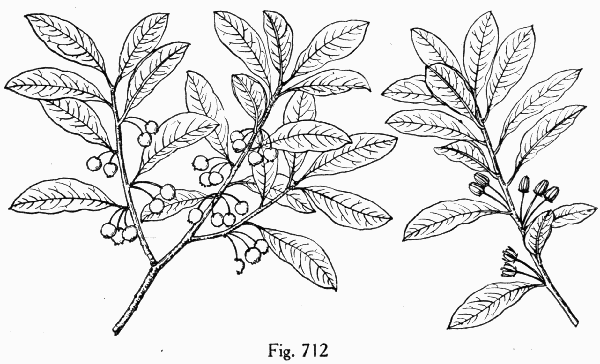
Leaves cuneate-obovate, rhombic-obovate or cuneate-oblong, acute or rounded at apex, usually tipped with a cartilaginous mucro, gradually narrowed at base, and entire, with thickened revolute margins, scurfy when they unfold, and at maturity thick and firm, pale green, smooth and shining or sometimes obscurely lepidote above, covered below with ferrugineous or pale scales, 1′—3′ long and ¼′—1½′ wide, with a prominent midrib and primary veins; appearing in early spring and persistent until the summer or autumn of their second year; petioles short, thick, much enlarged at base. Flowers ⅛′ in diameter, chiefly produced on branches of the year or occasionally on those of the previous year, opening from February until April when the leaves are fully grown, on slender recurved pedicels much shorter than the leaves, in crowded axillary short-stemmed or sessile ferrugineous-lepidote fascicles, with minute acute deciduous bracts and bractlets; calyx 5-lobed, with acute lobes, covered on the outer surface with ferrugineous scales, and about one third as long as the white pubescent corolla, with short reflexed acute teeth slightly thickened and ciliate on the margins; filaments shortened by a conspicuous geniculate fold in the middle; ovary coated with thick white tomentum; style stout, as long or a little longer than the corolla. Fruit on a stout erect stem, oblong, 5-angled, ¼′ long; seed pale brown.
A tree, occasionally 20°—30° high, with a slender crooked or often prostrate trunk sometimes 10′ in diameter, thin rigid divergent branches forming a tall oblong irregular head, and slender branchlets coated when they first appear with minute ferrugineous scales and covered in their second year with glabrous or pubescent light or dark red-brown bark smooth or exfoliating in small thin scales. Winter-buds minute, acute, and covered with ferrugineous scales. Bark of the trunk ⅛′—¼′ thick, divided into long narrow ridges by shallow longitudinal furrows, reddish brown and separating into short thick scales. Wood heavy, hard, close-grained although not strong, light brown tinged with red, with thick lighter colored sapwood.
Distribution. Hummocks and sandy woods; coast region of South Carolina and Georgia, northern Florida to the centre of the peninsula, the shores of Tampa Bay, and to the neighborhood of Apalachicola (Franklin County); in the United States arborescent in the rich soil of the woody hummocks rising in the sandy Pine-covered coast plain, and as a low shrub in the dry sandy sterile soil of Pine-barrens; in the West Indies and Mexico.
[799]
6. ARBUTUS L.
Trees or shrubs, with astringent bark exfoliating from young stems in large thin scales, smooth terete red branches, and thick hard roots. Leaves petiolate, entire or dentate, obscurely penniveined, persistent. Flowers on clavate pedicels bibracteolate at base from the axils of ovate bracts, in simple terminal compound racemes or panicles, with scarious scaly persistent bracts and bractlets; calyx free from the ovary, 5-parted nearly to the base, the divisions imbricated in the bud, ovate, acute, scarious, persistent; corolla ovoid-urceolate, white, 5-toothed, the teeth obtuse and recurved; stamens 10, shorter than the corolla; filaments subulate, dilated and pilose at base, free, inserted in the bottom of the corolla; anthers short, compressed laterally, dorsally 2-awned, the cells opening at the top internally by a terminal pore; ovary glandular-roughened, glabrous or tomentose, sessile or slightly immersed in the glandular 10-lobed disk, 5 or rarely 4-celled; style columnar, simple, exserted; stigma obscurely 5-lobed; ovules attached to a central placenta developed from the inner angle of each cell, amphitropous. Fruit drupaceous, globose, smooth or glandular-coated, 5-celled, many-seeded; flesh dry and mealy; stone cartilaginous, often incompletely developed. Seeds small, compressed or angled, narrowed and often apiculate at apex; seed-coat coriaceous, dark red-brown, slightly pilose; embryo axile in copious horny albumen, clavate; radicle terete, erect, turned toward the hilum.
Arbutus with ten or twelve species inhabits southern and western North America, Central America, western, southern and eastern Europe, Asia Minor, northern Africa, and the Canary Islands. Three species occur within the territory of the United States. Arbutus produces hard close-grained valuable wood often made into charcoal, used in the manufacture of gunpowder. The fruit possesses narcotic properties, and the bark and leaves are astringent.
Arbutus is the classical name of the species of southern Europe.
CONSPECTUS OF THE SPECIES Of THE UNITED STATES.
Bark of old trunks dark red-brown.
Ovary glabrous; leaves oval or oblong.
1. A. Menziesii (B, G).
Ovary pubescent; leaves oval, ovate, or lanceolate.
2. A. texana (C).
Bark of old trunks ashy gray; ovary glabrous, conspicuously porulose; leaves lanceolate or rarely narrow-oblong.
3. A. arizonica (H).
1. Arbutus Menziesii Pursh. Madroña.
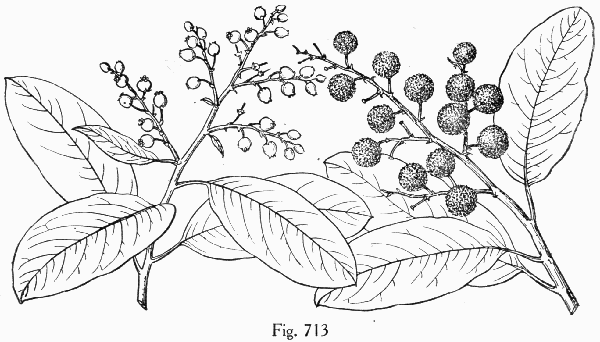
Leaves oval or oblong, rounded or contracted into a short point at apex, and rounded, subcordate or cuneate at base, with slightly thickened revolute entire or occasionally on young plants sharply serrate margins, when they unfold light green or often pink, especially on the lower surface, and glabrous or slightly puberulous, and at maturity thick and coriaceous, dark green and lustrous above, pale or often nearly white below, 3′—5′ long and 1½′—3′ wide, with a thick pale midrib and conspicuously reticulated veinlets; persistent until the early summer of their second year and then turning orange and scarlet and falling gradually and irregularly; petioles stout, grooved, ½′—1′ in length, often slightly wing-margined toward the apex; often producing late in summer a second crop of smaller leaves. Flowers about ⅓′ long, with a glabrous ovary, appearing from March to May on short slender puberulous pedicels from the axils of acute scarious bracts ciliate on the margins, in spicate pubescent racemes forming a cluster 5′—6′ long and broad. Fruit ripening in the autumn, subglobose or occasionally obovoid or oval, ½′ long, bright orange-red, with thin glandular flesh and a 5-celled more or less perfectly developed thin-walled cartilaginous stone; seeds several in each cell, tightly pressed together and angled, dark brown and pilose.
A tree, 80°—125° high, with a tall straight trunk 4°—5° in diameter, stout upright or spreading branches forming a narrow oblong or broad round-topped head, and slender branchlets light red, pea-green, or orange-colored and glabrous when they first appear, or on vigorous young plants sometimes covered with pale scattered deciduous hairs, becoming [800] in their first winter bright reddish brown. Winter-buds obtuse, ⅓′ long, with numerous imbricated broadly-ovate bright brown scales keeled on the back, apiculate at apex, and slightly ciliate. Bark of young stems and of the branches smooth, bright red, separating into large thin scales, becoming on old trunks ⅓′—½′ thick, dark reddish brown, and covered with small thick plate-like scales. Wood heavy, hard, strong, close-grained, light brown shaded with red, with thin lighter colored sapwood of 8—12 layers of annual growth; used for furniture and largely for charcoal. The bark is sometimes employed in tanning leather.
Distribution. High well-drained slopes usually in rich soil or occasionally in gravelly valleys; islands at Seymore Narrows, and southward through the coast region of British Columbia, Washington and Oregon; over the coast ranges of northern California, extending east to Mt. Shasta and south along the western slope of the Sierra Nevada from altitudes of 2500°—4000° to Placer County; on many of the coast ranges south of San Francisco Bay to the mountains of southern California; common and of its largest size in the Redwood-forests of northwestern California; much smaller north of California; rare on the Sierra Nevada and southward except on the Santa Cruz Mountains, and often shrubby in habit.
Occasionally cultivated in the gardens of western and southern Europe.
2. Arbutus texana Buckl. Madroña.
Arbutus xalapensis S. Watson, not H. B. K.
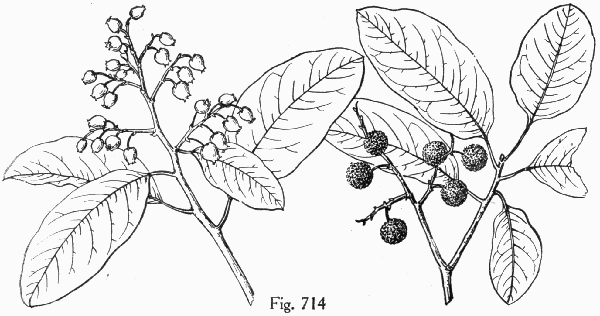
Leaves oval, ovate, or lanceolate, rounded, acute and often apiculate at apex, and rounded or cuneate at base, with slightly thickened usually entire or remotely crenulate-toothed or coarsely serrate margins, often tinged with red when they unfold and pubescent below, and at maturity thick and coriaceous, dark green and glabrous on the upper surface, pale and usually slightly pubescent on the lower surface, 1′—3′ long and ⅔′—1½′ wide, with a thick midrib often villose-pubescent below; petioles stout, pubescent, sometimes becoming nearly glabrous, 1′—1½′ in length. Flowers ¼′ long, with ciliate calyx-lobes and a pubescent ovary, appearing in March on stout recurved hoary-tomentose club-shaped pedicels from the axils of ovate acute hoary-tomentose often persistent bracts, in compact conic hoary-tomentose panicles 2½′ long. Fruit pubescent until half grown, becoming glabrous, usually produced very sparingly, ripening in summer, dark red, ⅓′ in diameter, with thin granular flesh and a rather thick more or less completely formed stone; seeds numerous in each cell, compressed, puberulous.
A tree, in Texas rarely more than 18°—20° high, with a short often crooked trunk 8′—10′ in [801] diameter, separating a foot or two above the ground into several stout spreading branches, and branchlets light red and thickly coated with pubescence when they first appear, becoming dark red-brown and covered with small plate-like scales; often a broad irregularly shaped bush, with numerous contorted stems. Winter-buds about ⅛′ long, with hoary tomentose scales, the outer ovate, acute, the inner obovate and rounded at apex. Bark of young stems and of the branches thin, tinged with red, separating into large papery scales exposing the light red or flesh-colored inner bark, becoming at the base of old trunks sometimes ¼′ thick, deeply furrowed, dark reddish brown, and broken into thick square plates. Wood heavy, hard, close-grained, brown tinged with red, with a lighter colored sapwood of 10—12 layers of annual growth; sometimes used in Texas for the handles of small tools and in the manufacture of mathematical instruments.
Distribution. Texas, dry limestone hills, Travis, Comal, Blanco, Kendall and Bandera Counties, on the Guadaloupe and Eagle Mountains, Culberson and El Paso Counties; southeastern New Mexico (Eddy County); on the mountains of Nuevo Leon in the neighborhood of Monterey.
3. Arbutus arizonica Sarg. Madroña.
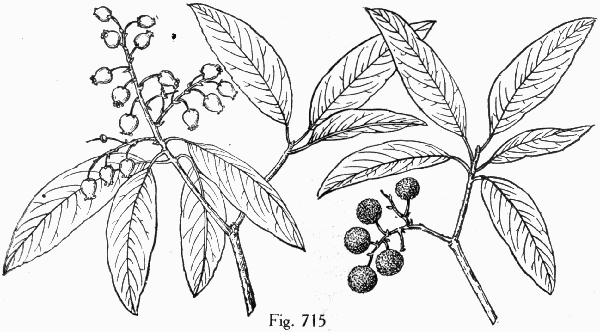
Leaves lanceolate to rarely oblong, acute or rounded and apiculate at apex, and cuneate or occasionally rounded at base, with thickened entire or rarely denticulate margins, when [802] they unfold, tinged with red, and slightly puberulous, especially on the petiole and margins, and at maturity thin, firm and rigid, light green on the upper surface, pale on the lower surface, 1½′—3′ long and ½′—1′ wide, with a slender yellow midrib and obscure reticulate veinlets; appearing in May and after the summer rains in September, and persistent for at least a year; petioles slender, often 1′ in length. Flowers ¼′ long, with a corolla much contracted in the middle, and a glabrous porulose ovary, opening in May on short stout hairy pedicels from the axils of conspicuous ovate rounded scarious bracts, in rather loose clusters 2′—2½′ long and broad, their lower branches from the axils of upper leaves. Fruit ripening in October and November, globose or short-oblong, dark orange-red, granulate, ⅓′ in diameter, with thin sweetish flesh, and a papery usually incompletely developed stone; seeds compressed, puberulous.
A tree, 40°—50° high, with a tall straight trunk 18′—24′ in diameter, stout spreading branches forming a rather compact round-topped head, and thick tortuous divergent branchlets reddish brown and more or less pubescent or light purple, pilose, and covered with a glaucous bloom when they first appear, becoming bright red at the end of their first season, their bark thin, separating freely into thin more or less persistent scales. Winter-buds ⅓′ long, red, the two outer scales linear, acuminate a third longer than those of the next, rank, acute and apiculate and ridged on the back. Bark of young stems and of the branches thin, smooth, dark red, exfoliating in large thin scales, becoming on old trunks ⅓′—½′ thick, irregularly broken by longitudinal furrows and divided into square appressed plate-like light gray or nearly white scales faintly tinged with red on the surface. Wood heavy, close-grained, soft and brittle, light brown tinged with red, with lighter colored sapwood of 30—40 layers of annual growth.
Distribution. Dry gravelly benches at altitude of 6000°—8000° on the Santa Catalina and Santa Rita Mountains, southern Arizona, and on the San Luis and Animas Mountains of southwestern New Mexico (Grant County); on the Sierra Nevada of Chihuahua.
7. VACCINIUM L.
Shrubs or rarely small trees, with slender branchlets, and fibrous roots. Leaves thin or coriaceous, deciduous or persistent. Flowers small, on bibracteolate pedicels, in many-branched axillary racemes, or solitary, their bracts small or foliaceous; calyx-tube adnate to the ovary, 4—5-lobed, the lobes valvate in the bud, persistent; corolla epigynous, 4 or 5-toothed, the teeth imbricated in the bud, urceolate-campanulate; stamens 8—10, inserted on the base of the corolla under the thick obscurely lobed epigynous disk; filaments filiform, free, usually hirsute; anthers awned on the back, the cells produced upward into erect spreading tubes dehiscent by a terminal pore; ovary inferior, 4 or 5-celled, the cells sometimes imperfectly divided by the development from the back of a false partition; style filiform, erect; stigma minute; ovules attached to the interior angle of the cell by a 2-lipped placenta, anatropous. Fruit a berry crowned with the calyx-limb, 4 or 5 or imperfectly 8 or 10-celled, the cells many-seeded. Seed minute, compressed, ovoid or reniform; seed-coat crustaceous; embryo clavate, minute, surrounded by fleshy albumen, axile, erect; cotyledons ovate; radicle terete, turned toward the hilum.
Vaccinium with about one hundred species is distributed through the boreal and temperate regions of the northern hemisphere, and occurs within the tropics at high altitudes north and south of the equator. Of the twenty-five or thirty species which occur in North America one is small trees. The fruits of many of the species are edible, the most valuable being the North American Vaccinium macrocarpum L., the Cranberry.
Vaccinium is the classical name of one of the Old World species.
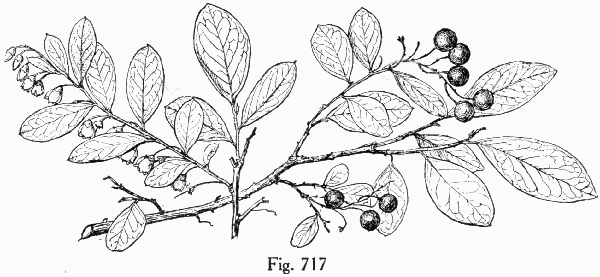
1. Vaccinium arboreum Marsh. Farkleberry. Sparkleberry.
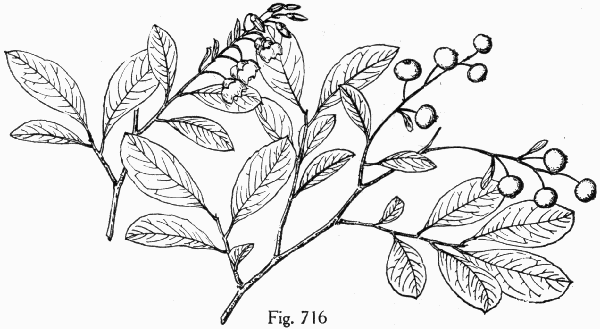
Leaves obovate, oblong-oval or occasionally orbicular, acute, or rounded and apiculate at apex, gradually or abruptly cuneate at base, obscurely glandular-dentate or entire, with thickened slightly revolute margins, light red and more or less pilose or puberulous when they unfold, and at maturity coriaceous, dark green and lustrous above, paler below, glabrous [803] or often puberulous on the midrib and veins, reticulate-venulose, ½′—2½′ long, ¼′—1′ wide, and sessile or short-petiolate; southward persistent for a year, northward deciduous during the winter. Flowers appearing from March to May on slender drooping pedicels ½′ long, bibracteolate near the middle, with 2 minute acute scarious caducous bractlets, solitary in the axils of leaves of the year or arranged in terminal puberulous racemes 2′—3′ long from the axils of leafy or minute acute scarious bracts; corolla white, open-campanulate, slightly 5-lobed, with acute reflexed lobes, longer than the 10 stamens; filaments hirsute; anther-cells opening by oblique elongated pores. Fruit ripening in October, sometimes persistent on the branches until the end of winter, globose, ¼′ in diameter, black and lustrous, with dry glandular slightly astringent flesh of a pleasant flavor.
A tree, 20°—30° high, with a short often crooked trunk occasionally 8′—10′ in diameter, slender more or less contorted branches forming an irregular round-topped head, and slender branchlets light red and covered with pale pubescence when they first appear, glabrous or puberulous and bright red-brown in their first winter, later becoming dark red and marked by minute elevated nearly orbicular leaf-scars; or northward generally reduced to a low shrub, with numerous divergent stems. Winter-buds obtuse, nearly 1/16′ long, with imbricated ovate acute chestnut-brown scales often persistent on the base of the branchlet throughout the season. Wood heavy, hard, very close-grained, light brown tinged with red, with thick hardly distinguishable sapwood; sometimes used for the handles of tools and in the manufacture of other small articles. Decoctions of the astringent bark of the root and of the leaves are sometimes employed domestically in the treatment of diarrhœa. The bark has been used by tanners.
Distribution. Usually in moist sandy soil along the banks of ponds and streams; southeastern Virginia and North Carolina, from the coast to the valleys of the high Appalachian Mountains, southward to the valley of the Caloosahatchie River, Florida, through the Gulf states to the shores of Matagorda Bay, Texas, and through eastern Oklahoma, Arkansas, and Missouri to southern Illinois, and the bluffs of White River, near Shoals, Martin County, and near Elizabeth, Harrison County, Indiana; common in the maritime Pinebelt of the south Atlantic and Gulf states, and of its largest size near the coast of eastern Texas; in the interior less abundant and usually of small size. Passing into
Vaccinium arboreum var. glaucescens Sarg.
Batodendron glaucescens Greene
Differing in its glaucescent, pubescent or glabrous leaves, in its usually larger leaf-like bracts of the inflorescence and often in its globose-campanulate corolla.
[804]
A tree, 10°—20° high, with a short often crooked trunk, pubescent or glabrous gray branchlets, and winter-buds and bark like those of Vaccinium arboreum with which it often grows.
Distribution. Tunnel Hill, Johnson County, Illinois, southern Missouri to eastern Oklahoma (Sapulpa, Creek County) and through Arkansas to western Louisiana (near Shreveport, Rapides Parish) and eastern Texas to Milam County.
LIV. THEOPHRASTACEÆ.
Trees or shrubs, with watery juice, and entire coriaceous persistent leaves. Flowers perfect, regular; calyx campanulate, with 5 sepals imbricated in the bud; corolla 5-lobed, the lobes imbricated in the bud, with 5 staminodia attached below the sinuses; stamens 5, attached to the base of the corolla-tube, opposite the lobes; ovary 1-celled, with a simple style and a slightly 5-lobed stigma; ovules peltate, numerous, attached to a central fleshy placenta, amphitropous. Fruit baccate, many-seeded. Seeds immersed in the thickened placenta filling the cavity of the fruit; seed-coat membranaceous; embryo surrounded by thick cartilaginous albumen.
A tropical American family of four genera with one species reaching the shores of southern Florida.
1. JACQUINIA Jacq.
Trees or shrubs, with terete or slightly many-angled branchlets, without a terminal bud, and fibrous roots. Leaves often punctate with pellucid dark glands. Flowers on slender ebracteolate pedicels from the axils of minute ovate acute persistent bracts, in terminal or axillary clusters; calyx slightly ciliate on the margins, rounded at apex, persistent under the fruit; corolla hypogynous, the lobes obtuse and spreading, furnished with 5 petal-like ovate obtuse spreading staminodia; stamens inserted on the corolla opposite its lobes near the base of the short tube; filaments flattened, broad at base; anthers oblong or ovoid, attached on the back above the base, extrorse, 2-celled, the cells opening longitudinally; ovary ovoid. Fruit ovoid or subglobose, crowned by the remnants of the persistent style, with a thin crustaceous outer coat, inclosing the thick enlarged mucilaginous placenta. Seeds oblong; seed-coat punctate; embryo eccentric; cotyledons ovate, shorter than the elongated inferior radicle turned toward the broad ventral hilum.
Jacquinia with five or six species is confined to tropical America, with one species reaching southern Florida.
The generic name is in honor of Nicholas Joseph Jacquin (1728—1818), the distinguished Austrian botanist.
1. Jacquinia keyensis Metz. Joe Wood. Sea Myrtle.
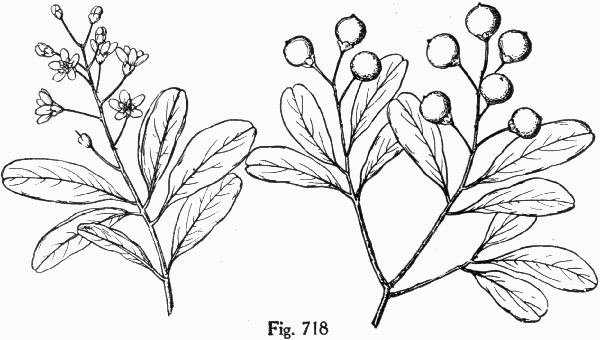
Leaves subverticillate, alternate or sometimes opposite, crowded near the end of the branches, cuneate-spatulate or oblong-obovate, rounded or emarginate or often apiculate [805] at apex, gradually narrowed below, entire, with thickened slightly revolute margins, thick and coriaceous, yellow-green, nearly veinless, with a very obscure midrib, covered on the lower surface with pale dots, 1′—3′ long and ¼′—1′ wide; persistent on the branches until the appearance of the new leaves the following year; petioles short, stout, abruptly enlarged at base. Flowers appearing in Florida from November until June, ⅓′ in diameter, pale yellow, fragrant, on slender club-shaped pedicels ½′ long from the axils of minute ovate coriaceous, reddish bracts slightly ciliate on the margins, in terminal and axillary many-flowered glabrous racemes 2′—3′ long; sepals ovate-orbicular, obtuse; corolla salverform, ⅖′ broad, the lobes longer than the tube; stamens shorter than the staminodia. Fruit ripening in the autumn, ⅓′ in diameter, orange-red when fully ripe; seeds light brown.
A tree, 12°—15° high, with a straight trunk 6′—7′ in diameter, stout rigid spreading branches forming a compact regular round-topped head, and slightly many-angled branchlets yellow-green or light orange-colored and coated with short soft pale ferrugineous pubescence when they first appear, terete, darker and sometimes reddish brown and marked in their second year by orbicular depressed conspicuous leaf-scars and by many scattered pale lenticels, becoming glabrous and red-brown or ashy gray the following season. Winter-buds axillary, minute, nearly globose, immersed in the bark. Bark of the trunk thin, smooth, blue-gray, and usually more or less marked by pale or nearly white blotches. Wood heavy, hard, very close-grained, rich brown, beautifully marked by darker medullary rays.
Distribution. Florida, dry coral soil in the immediate neighborhood of the shore, Gasparilla Island, on the west coast to the southern keys, and to the borders of the Everglades; rare but most abundant and of its largest size in Florida on the Marquesas Keys; on the Bahama Islands and in Cuba and Jamaica.
LV. MYRSINACEÆ.
Trees or shrubs, with watery juice, alternate entire coriaceous punctate leaves, without stipules. Flowers regular, perfect or dimorphous; calyx persistent under the fruit; corolla, without staminodia, glandular-punctate; stamens inserted on the corolla, as many as and opposite its lobes; ovary 1-celled, with an undivided style and a minute terminal stigma; ovules peltate, immersed in the fleshy central placenta, amphitropous. Fruit a drupe. Seed solitary, globose, with copious cartilaginous or corneous albumen; seed-coat membranaceous.
A tropical family of thirty genera, with two arborescent species reaching the shores of southern Florida.
[806]
CONSPECTUS OF THE ARBORESCENT GENERA OF THE UNITED STATES.
Flowers perfect in terminal panicles; anthers on short broad filaments; style elongated.
1. Ardisia.
Flowers dimorphous in small axillary clusters; anthers sessile; stigma sessile or in one form of the staminate flower terminal on a slender style.
2. Rapanea.
1. ARDISIA Sw.
Glabrous trees or shrubs, with leaves punctate below with immersed resinous dots. Flowers resinous-punctate, pedicellate, the pedicels bibracteolate at base or ebracteolate, in terminal or rarely axillary branched panicles, with minute scarious deciduous or caducous bracts and bractlets; calyx free, 5 or rarely 4-lobed or parted, the divisions contorted or imbricated in the bud; corolla 5 or rarely 4—6-parted, the divisions extrorsely or sinistrorsely contorted in the bud, short or elongated, white or rose color; stamens exserted; filaments short or nearly obsolete, free, inserted on the throat of the corolla; anthers usually sagittate-lanceolate, attached on the back just above the base, introrse, 2-celled, the cells opening longitudinally sometimes nearly to the base; ovary globose; ovules numerous, immersed in the globose resinous-punctate placenta. Fruit globose, with thin usually dry flesh and a 1-seeded stone with a usually crustaceous or bony shell. Seed concave or more or less lobed at base, resinous-punctate; hilum basilar, concave, conspicuous; embryo cylindric, transverse; cotyledons flat on the inner face, rounded on the back, shorter than the slender radicle.
Ardisia with about two hundred species inhabits tropical and subtropical regions of the two hemispheres. The genus has few useful properties, but a number of species are cultivated for the beauty of their handsome evergreen foliage and bright-colored fruits.
The generic name is from ἀρδις, in reference to the pointed anthers.
1. Ardisia paniculata Nutt. Marlberry. Cherry.
Icacorea paniculata Sudw.
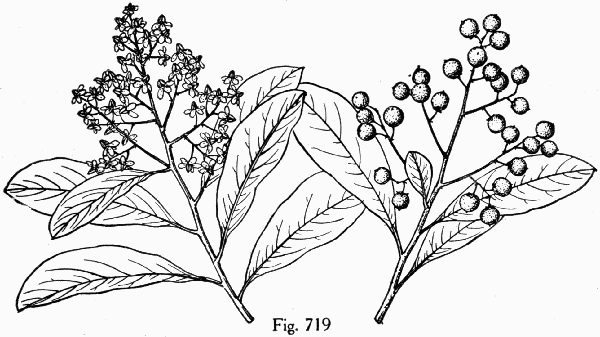
Leaves ovate to oblong-lanceolate or lanceolate-obovate, acute or rounded at the narrow apex, cuneate and gradually contracted at base, entire, with thickened and slightly revolute margins, thick and coriaceous, glabrous, marked by minute scattered dark dots, dark yellow-green on the upper surface, pale on the lower surface, 3′—6′ long and 1′—1½′ wide, with a broad midrib yellow and conspicuous on the under side, slender primary veins and reticulate veinlets; appearing in the summer or early autumn and falling before the appearance [807] of the flowers the following year; petioles stout, grooved, ¼′—½′ in length. Flowers fragrant, usually opening in November or occasionally as early as July, ¼′ in diameter, on slender elongated pedicels without bractlets, from the axils of linear acute caducous bracts, in terminal rusty brown puberulous panicles 3′—4′ long and broad, their lower branches often from the axils of upper leaves; calyx ovoid, divided nearly to the base into 5 ovate acute lobes scarious and ciliate on the margins and marked on the back with dark lines; corolla 5-parted, with oblong rounded divisions sinistrorsely overlapping, or with 1 lobe wholly outside and 1 inside in the bud, conspicuously marked with red spots on the inner surface near the base, becoming reflexed; stamens, with short broad filaments, contracted by a geniculate fold in the middle, and large orange-colored anthers longer than the filaments, their cells opening almost to the base; ovary globose, glandular, gradually contracted into a long slender style ending in a simple stigma. Fruit ripening in early spring, globose, ¼′ in diameter, tipped with the remnants of the style, and roughened by resinous glands, dark brown at first when fully grown, ultimately becoming black and lustrous; stone brown, thin-walled, crustaceous; seed conspicuously lobed at base, bright red-brown, about ⅛′ in diameter.
A slender tree, in Florida rarely more than 20° high, with a short trunk 4′—5′ in diameter, numerous thin upright branches forming a narrow head, and stout terete often contorted branchlets, rusty brown or dark orange-colored and slightly puberulous when they first appear, becoming in their second year dark brown or ashy gray, and marked by many minute circular lenticels and by thin nearly orbicular flat leaf-scars displaying in the centre a group of fibro-vascular bundle-scars. Winter-buds rusty brown; terminal slender, acuminate, ⅛′—¼′ long; axillary globose, minute, nearly immersed in the bark. Bark of the trunk about ⅛′ thick, light gray or nearly white, roughened by minute lenticels, and separating into large thin papery plates. Wood heavy, hard, very close-grained, rich brown beautifully marked by darker medullary rays, with thick lighter colored sapwood.
Distribution. Florida, from Mosquito Inlet to the southern keys on the east coast, and from the shores of the Caloosahatchee River to Cape Romano on the west coast; usually a shrub, occasionally arborescent on the shores of Bay Biscayne and on some of the southern keys; on the Bahama Islands, in Cuba, and southern Mexico.
2. RAPANEA Aubl.
Trees or shrubs, with watery juices and terete branchlets. Leaves alternate, entire or rarely dentate, usually distinctly lepidote, persistent, without stipules. Flowers perfect or unisexual by abortion, minute, 4 or 5, or rarely 6 or 7-merous, sessile or pedicellate, in small axillary sessile or pedunculate fascicles, their bracts deciduous; calyx free, persistent, the sepals imbricate-valvate in the bud, ciliate, usually glandular-punctate; corolla hypogynous, the lobes more or less connate at base, ovate or elliptic, spreading or recurved, glandular-punctate, papillate on the margins, imbricate or rarely convolute in the bud; stamens inserted on the base of the corolla opposite its lobes; filaments 0; anthers short, connate to the corolla, acuminate and papillate at apex, introrse, 2-celled, the cells opening longitudinally; ovary globose or ellipsoidal, 1-celled; stigma capitate, irregularly lobed; ovules few, peltate, immersed in one series near the middle of the free fleshy globose placenta. Fruit dry or fleshy, seed filling the cavity of the fruit, globose, intruded at base; testa thin; albumen copious, corneous, rarely slightly ruminate; embryo cylindric, elongated, transverse, usually curved; cotyledons small, radicle elongated.
Rapanea, with nearly one hundred and fifty species, is widely distributed through the tropical and subtropical regions of the two hemispheres, one species reaching southern Florida.
The generic name is formed from the native name of Rapanea guianensis in British Guiana.
1. Rapanea guianensis Aubl.
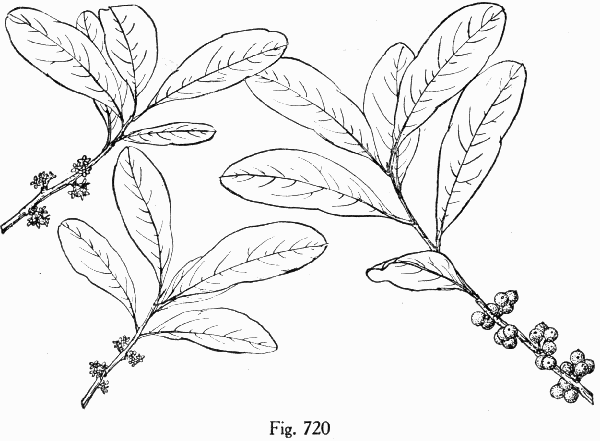
Leaves crowded at the end of the branches, oblong-obovate, obtuse or retuse at apex, gradually narrowed and contracted at base, coriaceous, bright green and lustrous on the [808] upper surface, paler on the lower surface, 2¾′—3½′ long and 1′—1½′ wide, with thickened revolute margins, a thick midrib and obscure veins; petioles stout, narrowly wing-margined, ¼′—⅓′ in length. Flowers in November, minute, short-pedicellate in short pedunculate clusters usually 5, rarely 4-merous, white more or less marked with purple, about ⅙′ in diameter; calyx divided to the middle, the lobes broad-ovate, acute or rounded at apex, slightly ciliate, persistent under the fruit; corolla 2 or 3 times longer than the calyx, the lobes spreading, narrowed and rounded at apex, slightly ciliate on the margins; staminate flowers dimorphous; anthers sagittate-apiculate, inserted below the middle of the petals; ovary in one form crowned by a minute discoid sessile stigma and probably abortive, in the other form gradually narrowed into a slender style, terminating in an oblique stigma and fertile; pistillate flowers, anthers smaller and rudimentary; ovary crowned by a large nearly sessile irregularly lobed papillate stigma deciduous from the fruit. Fruit in clusters crowded on the elongated somewhat thickened spur-like peduncle of the flower-cluster covered with imbricated persistent bracts, dark blue or nearly black, tipped with the persistent style, ⅙′—⅕′ in diameter; exocarp thin and fleshy; endocarp crustaceous, white.
A tree, in Florida occasionally 18°—20° high, with a tall usually more or less crooked trunk 2′—3′ in diameter, small ascending branches forming an open irregular head, and slender gray or light red-brown branchlets roughened for a year or two by the persistent spur-like peduncles of the fallen fruit and later marked by circular scars in the axils of the small transverse leaf-scars; more often a shrub. Bark of the trunk thin, close, pale gray.
Distribution. Florida, shores of Indian River on the east coast and Palmetto, Manatee County, on the west coast, southward to the southern keys; common; on the Bahama Islands, Cuba, Porto Rico, Jamaica and Trinidad, to southern Brazil, and to Mexico and Bolivia.
LVI. SAPOTACEÆ.
Trees or shrubs, with milky juice. Leaves alternate, simple, entire, pinnately veined, mostly coriaceous, petiolate, without stipules. Flowers perfect, regular, small, in axillary clusters; calyx of 5-8 sepals imbricated in the bud, persistent under the fruit; corolla hypogynous, 5—8-cleft, the divisions imbricated in the bud, often with as many or twice as [809] many internal appendages borne on its throat; disk 0; fertile stamens as many as and opposite the divisions of the corolla and inserted on its short tube, often with sterile filaments (staminodia) alternate with them; anthers generally extrorse, 2-celled, the cells opening longitudinally; pistil of united carpels; ovary sessile, usually 5-celled; style simple; ovules solitary in each cell, attached to an axile placenta, ascending, anatropous; raphe ventral; micropyle inferior. Fruit baccate, bearing at apex the remnant of the style, usually 1-celled and 1-seeded. Seed with or without albumen; embryo large; radicle terete, inferior.
This family with fifty genera is chiefly tropical and subtropical, with only Bumelia extending in North America into temperate regions. Some of the species produce valuable timber or edible and agreeable fruits. From Palaquium gutta Burkh., of the Malay Peninsula, gutta-percha is obtained. Five genera are represented by trees in the flora of the United States.
CONSPECTUS OF THE GENERA OF THE UNITED STATES.
Calyx of 5 sepals in a single series.
Staminodia 1 in each sinus of the corolla.
Appendages of the corolla 0; staminodia slender, scale-like.
1. Sideroxylum.
Appendages of the corolla present; staminodia petaloid.
Staminodia linear, fimbriate; seeds, with copious albumen.
2. Dipholis.
Staminodia petaloid, entire or denticulate; seeds, without albumen.
3. Bumelia.
Staminodia and appendages of the corolla 0; leaves covered below with lustrous copper-colored or golden pubescence.
4. Chrysophyllum.
Calyx of 6—8 sepals in 2 series; corolla 6—8-lobed, with 2 appendages in each sinus inside of a scale-like or petaloid staminodia.
5. Mimusops.
1. SIDEROXYLUM L.
Trees, with terete branchlets, naked buds, and long-petiolate persistent leaves, the veins remote and connected by reticulate veinlets. Flowers minute, on ebracteolate pedicels from the axils of minute deciduous bracts, in crowded many-flowered axillary fascicles; calyx 5-parted, the divisions in one series, nearly equal, corolla furnished with 5 or 6 staminodia, and 5 or rarely 6-lobed; filaments slender, elongated, bent outward at the apex; anthers oblong, the cells at first extrorse, sometimes becoming sublateral; staminodia linear, scale-like; ovary contracted into a subulate style tipped with a minute slightly 5-lobed stigma. Fruit dry, 1-seeded, oblong, with thin coriaceous flesh. Seed obovoid or oblong; seed-coat lustrous, light brown, folded on the inner face into 2 obscure lobes rounded at apex; hilum elevated, subbasilar or lateral, oblong or linear; embryo erect in thick fleshy albumen; radicle much shorter than the oblong fleshy cotyledons.
Sideroxylum with a hundred species is widely distributed through the tropics of the two hemispheres, and occurs also with a few species in Australia, Madeira, southern Africa, New Zealand, and Norfolk Island, a single species reaching the shores of southern Florida. Some of the species are large and valuable timber-trees, producing hard handsome durable wood.
The generic name, from σίδηρος and ξύλον, is in reference to the hardness of the wood.
1. Sideroxylum fœtidissimum Jacq. Mastic.
Sideroxylum Mastichodendron Jacq.
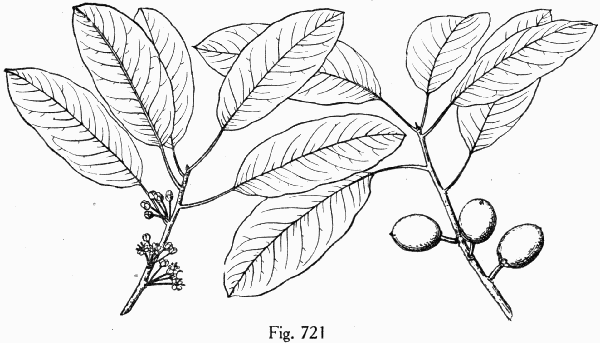
Leaves mostly clustered near the end of the branches, appearing irregularly from early spring until autumn, oval, acute or rounded and slightly emarginate at apex, and gradually narrowed at base, with thickened cartilaginous slightly involute margins, silky-canescent beneath when they unfold, and at maturity thin and firm, glabrous, bright green and lustrous above, lustrous and yellow-green below, 3′—5′ long and 1½′—2′ wide, with a broad pale conspicuous midrib deeply impressed on the upper side and inconspicuous primary veins arcuate near the margins; petioles slender, 1′—1½′ in length. Flowers usually appearing in Florida in the autumn and also in early spring and during the summer on stout orange-colored [810] puberulous pedicels from the axils of minute acute scarious bracts usually deciduous before the opening of the flower-buds, from the axils of young leaves or on the branches of the previous year from leafless nodes; calyx yellow-green, puberulous on the outer surface and deeply divided into broad-ovate rounded lobes rather shorter than the oblong-ovate rounded divisions of the light yellow corolla; staminodia lanceolate, nearly entire, tipped with a subulate point and much shorter than the stamens; ovary oblong-ovoid, glabrous, gradually contracted into an elongated style stigmatic at apex. Fruit ripening in March and April on a much thickened woody stem erect or nearly at right angles to the branch, 1′ long, separating from the calyx in falling, with tough yellow skin, and thick juicy flesh of a pleasant subacid flavor; seed obovoid, rounded above, narrowed at base, ½′ long and ⅓′ wide.
A tree, in Florida 60°—70° high, with a massive straight trunk 3°—4° in diameter, stout upright branches forming a dense irregular head, and thick terete branchlets orange-colored and slightly puberulous when they first appear, becoming glabrous, brown more or less tinged with red, and marked by the conspicuous nearly orbicular leaf-scars displaying 3 large fibro-vascular bundle-scars, and conspicuously roughened by the thickened persistent bases of the fruit stalks. Bark of the trunk ⅓′—½′ thick, dark gray to light brown tinged with red and broken into thick plate-like scales separating into thin layers. Wood heavy, hard, strong, bright orange-colored, with thick yellow sapwood of 40—50 layers of annual growth; in Florida used in boat-building.
Distribution. Florida, Cape Canaveral and Cape Romano to the southern keys; on the Bahama Islands and many of the Antilles.
2. DIPHOLIS A. DC.
Trees or shrubs, with naked buds, and persistent leaves, the slender veins arcuate and united near the margins. Flowers minute, on clavate ebracteolate pedicels from the axils of minute deciduous bracts, in the axils of existing leaves or from the leafless nodes of previous years; calyx ovoid, deeply 5-lobed, the lobes nearly equal, ovate, rounded at apex; corolla campanulate, white, 5-lobed, the spreading lobes furnished on each side at the base with a linear or subulate appendage; stamens exserted; filaments filiform; anthers oblong-sagittate, extrorse; staminodia 5, petaloid, ovate, acute, fimbriately cut on the margins, oblique, keeled on the back, inserted in the same rank and alternate with the stamens; ovary oblong or narrow-ovoid, gradually contracted into a slender style shorter than the corolla and stigmatic at the apiculate apex. Fruit oblong-ovoid, with thin dry flesh. [811] Seed ovoid; seed-coat thick, coriaceous and lustrous; hilum oblong, basilar or slightly lateral; embryo erect in thick fleshy albumen; cotyledons ovate, flat, much longer than the short radicle turned toward the hilum.
Dipholis with three species is confined to the West Indies and southern Florida.
The generic name, from δίς and φολίς, relates to the appendages of the corolla.
1. Dipholis salicifolia A. DC. Bustic. Cassada.
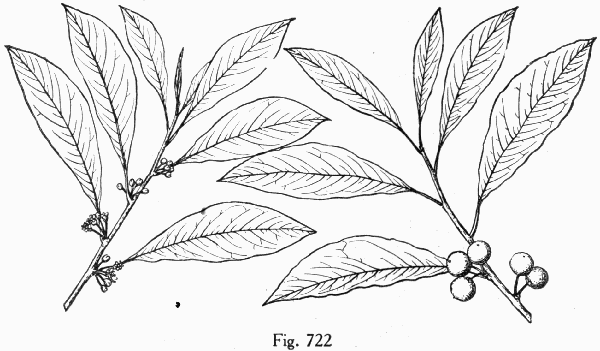
Leaves oblong-lanceolate or narrow-obovate, acute, acuminate, or rounded at apex, gradually contracted at base, with slightly thickened cartilaginous wavy margins, thickly coated when they unfold with lustrous rufous pubescence, and at maturity thin and firm, dark green and lustrous above, pale yellow-green below, 3′—5′ long, ½′—1½′ wide, and glabrous, or slightly puberulous on the lower side of the narrow pale midrib, with inconspicuous veins and reticulate veinlets; appearing in Florida in the spring and remaining on the branches between one and two years; petioles slender, ½′—1′ in length. Flowers opening during March and April, ⅛′ long, on thick pedicels ¼′ in length from the axils of minute ovate acute scarious bracts, and coated with rufous pubescence, in dense many-flowered fascicles crowded on branchlets of the year or of the previous year for a distance of 8′—12′; calyx half the length of the corolla, coated on the outer surface with rusty silky pubescence; appendages of the corolla as long as the oval acute irregularly toothed staminodia; ovary narrow-ovoid, glabrous, gradually contracted into a slender style shorter than the corolla and stigmatic at apex. Fruit solitary or rarely clustered, ripening in the autumn, short-oblong to subglobose, black, ¼′ in length; seed pale brown, about 3/16′ in length.
A tree, in Florida sometimes 40°—50° high, with a straight trunk 18′—20′ in diameter, small upright branches forming a narrow graceful head, and slender branchlets coated with rufous pubescence when they first appear, becoming ashy gray or light brown tinged with red and marked by numerous circular pale lenticels and by small elevated orbicular leaf-scars displaying near the centre a compact cluster of fibro-vascular bundle-scars. Bark of the trunk about ⅓′ thick and broken into thick square plate-like brown scales tinged with red. Wood very heavy, exceedingly hard, strong, close-grained, dark brown or red, with thin sapwood of 4 or 5 layers of annual growth.
Distribution. Florida, rich hummock soil, shores of Bay Biscayne and on the Everglade Keys, Dade County, and on several of the southern keys; on the Bahama Islands and on many of the Antilles.
[812]
3. BUMELIA Sw.
Small trees or shrubs, with terete usually spinescent branchlets, scaly buds, and fibrous roots. Leaves often fascicled on spur-like lateral branchlets, conduplicate in the bud, coriaceous or thin, short-petiolate, obovate and obtuse or elliptic, silky-pubescent or tomentose below, or nearly glabrous, with rather inconspicuous veins arcuate near the entire margins and conspicuous reticulate veinlets, deciduous or persistent. Flowers minute, on slender clavate ebracteolate pedicels from the axils of lanceolate acute scarious deciduous bracts, in many-flowered crowded fascicles in the axils of existing leaves or from the leafless nodes of previous years; calyx ovoid to subcampanulate, 5-lobed, the lobes in one series, imbricated in the bud, ovate or oblong, rounded at apex, nearly equal; corolla campanulate, white, with 5 spreading broad-ovate lobes rounded at apex and furnished on each side at base with a minute acute ovate or lanceolate appendage; stamens 5; filaments filiform; anthers ovoid-sagittate, attached on the back below the middle, the cells opening by subextrorse slits; staminodia petal-like, ovate or ovate-lanceolate, entire or obscurely denticulate, flattened or keeled on the back, sometimes furnished at base with a pair of minute scales; ovary hirsute, ovoid to ovoid-conic, gradually or abruptly contracted into a slender short or elongated simple style stigmatic at the acute apex. Fruit oblong-obovoid or globose, black, solitary or in 2 or 3-fruited clusters; flesh thin and dry or succulent. Seed ovoid or oblong, apiculate or rounded at apex, without albumen; seed-coat thick, crustaceous, light brown, smooth and shining, folded more or less conspicuously on the back into 2 lobes rounded at apex; embryo filling the cavity of the seed; cotyledons thick and fleshy, hemispheric, usually consolidated; radicle short, turned toward the basilar or subbasilar orbicular or elliptic hilum.
Bumelia, with about twenty-five species is confined to the New World, where it is distributed from the southern United States through the West Indies to Mexico, Central America, and Brazil. Of the twelve species in the United States which have been distinguished five are small trees.
Bumelia produces hard heavy strong wood, that of the North American species containing bands of numerous large open ducts defining the layers of annual growth and connected by conspicuous branched groups of similar ducts, presenting in cross-section a reticulate appearance.
The generic name is from βουμελία, a classical name of the Ash-tree.
CONSPECTUS OF THE ARBORESCENT SPECIES OF THE UNITED STATES.
Lower surface of the leaves pubescent or lanuginose.
Leaves short-obovate to oblanceolate or elliptic, covered below with pale or ferrugineous silky pubescence.
1. B. tenax (C).
Leaves oblong-obovate, lanuginose below with ferrugineous or silvery white hairs.
2. B. lanuginosa (A, C, H).
Leaves glabrous or nearly so.
Leaves deciduous.
Leaves oblong-obovate, thick.
3. B. monticola.
Leaves elliptic to oblanceolate, usually acute or acuminate, thin.
4. B. lycioides (A, C).
Leaves persistent, obovate; fruit oblong.
5. B. angustifolia (C, D).
1. Bumelia tenax Willd. Ironwood. Black Haw.
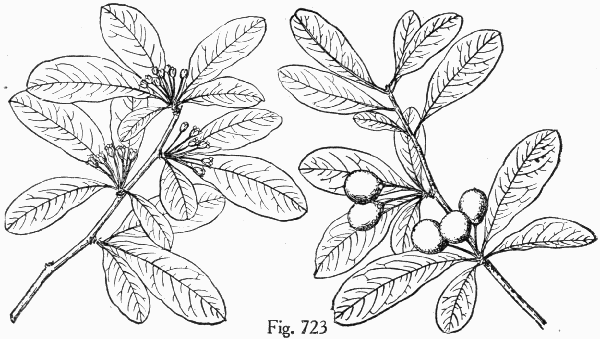
Leaves oblong-obovate to oblanceolate or elliptic, rarely oval or ovate on leading shoots, rounded or acute at apex, cuneate at base, thin, dark dull green, and finally reticulate-venulose on the upper surface, thickly covered below with soft silky pale or gold-colored pubescence, usually becoming dark rusty brown by midsummer, 1′—3′ long and 1⅛′—1½′ wide, with slightly thickened and revolute margins and a prominent midrib; turning yellow and falling irregularly during the winter; petioles slender, hairy, grooved, ¼′—1′ in length. Flowers appearing from May in Florida to July in South Carolina, ⅛′ long, on [813] pedicels ½′—1′ in length and coated like the calyx with rufous silky pubescence, in many-flowered crowded fascicles; calyx ovoid, with oblong lobes; appendages of the corolla large, ovate, acute, crenate, shorter than the ovate staminodia about as long as the lobes of the corolla; ovary narrow-ovoid, gradually contracted into an elongated style. Fruit ripening and falling in the autumn, short-oblong to ellipsoid, ⅓′—½′ in length; flesh sweet and edible; seed oblong, short-pointed at apex, ¼′—⅓′ long.
A tree, 20°—30° high, with a trunk occasionally 5′—6′ in diameter, straight spreading flexible tough branches unarmed or armed with straight stout rigid spines sometimes 1′ in length, and slender branchlets coated when they first appear with silky pale pubescence often tinged with red and soon rusty brown, becoming glabrous before winter, and then dark red and slightly roughened by occasional minute dark lenticels; or often a shrub only a few feet high. Winter-buds minute, subglobose, with imbricated ovate scales rounded at apex and clothed with rusty brown tomentum. Bark of the trunk thick, brown tinged with red, and divided irregularly by deep fissures into narrow flat reticulate ridges covered with minute appressed scales. Wood heavy, hard, close-grained, light brown streaked with white, with lighter colored sapwood.
Distribution. Dry sandy soil; South Carolina (Saint Helena Island and Bluffton, Beaufort County), southward in the coast region of Georgia and east Florida to Cape Canaveral and through the interior of the peninsular to Cedar Keys on the west coast; near Bainbridge, Decatur County, southwestern Georgia.
2. Bumelia lanuginosa Pers. Gum Elastic. Chittam Wood.
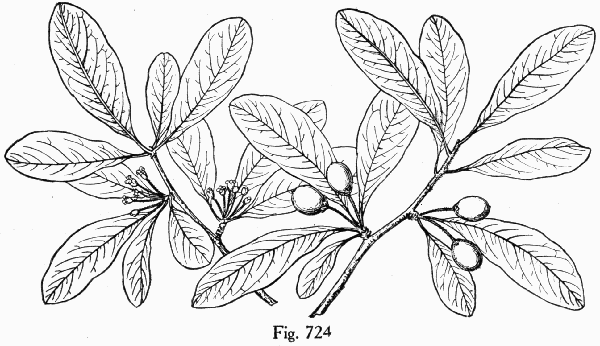
Leaves oblong-obovate, rounded and often apiculate at apex and gradually narrowed at base, coated when they unfold with pale ferrugineous tomentum dense on the lower and loose on the upper surface, and at maturity thin and firm, dark green and lustrous above, more or less lanuginose below with rusty brown or silvery white (var. albicans Sarg.) hairs, 1′—2½′ long and ⅓′—¾′ wide; falling irregularly during the winter; petioles slender, rusty brown or pale pubescent, ⅛′—¾′ in length. Flowers opening in summer on hairy pedicels ⅛′ in length, in 16—18-flowered fascicles; calyx ovoid, with ovate rounded lobes coated on the outer surface with ferrugineous or pale tomentum and rather shorter than the tube of the corolla; appendages of the corolla small, ovate and acute; staminodia ovate, acute, remotely and slightly denticulate, as long as the corolla-lobes; ovary abruptly contracted into a slender elongated style. Fruit on a slender drooping stalk ripening and falling in the autumn, oblong or slightly obovoid, ½′ long, with thick flesh; seed short-oblong, rounded at apex, about ¼′ in length.
A tree, often 40°—50° high, with a tall straight trunk 1°—2° in diameter, short thick rigid [814] branches forming a narrow-oblong round-topped head, unarmed, or armed with stout rigid straight or slightly curved spines frequently developing into spinescent leafy lateral branchlets, and slender often somewhat zigzag branchlets coated with thick rufous or pale tomentum when they first appear, becoming in their first winter red-brown to ashy gray and glabrous or nearly so, and marked by occasional minute lenticels and by small semiorbicular leaf-scars displaying 2 clusters of fibro-vascular bundle-scars; of its largest size in the Texas coast region; much smaller east of the Mississippi River, and there rarely more than 20° tall. Winter-buds obtuse, ⅛′ long, covered with broad-obovate rusty-tomentose scales. Bark of the trunk ½′ thick, dark gray-brown and usually divided into narrow ridges broken into thick appressed scales. Wood heavy, rather soft, not strong, close-grained, light brown or yellow, with thick lighter colored sapwood; producing in Texas considerable quantities of clear viscid gum from the freshly cut wood.
Distribution. Southern and southeastern Georgia, western Florida southward to the neighborhood of Lake City, Columbia County and to Cedar Key, coast of Alabama and inland to Dallas County, southern Mississippi, Louisiana, and Texas to the valley of the San Antonio River and over the Edwards Plateau (Kendall, Kerr and Brown Counties) to the valley of the upper Brazos River (Palo Pinto County), and northward through western Louisiana and western Arkansas to western Oklahoma (Seiling, Dewey County), and to southeastern Kansas (Cherokee County) and southern Missouri as far north as the valley of the Meramec River (near Allenton, St. Louis County), and southern Illinois (near Mound City, Pulaski County); at Calcasieu Pass, on the sandy beaches of the Louisiana coast forming thickets of plants 6°—8° high, and uninjured by salt spray; the var. albicans in eastern Texas from the valley of the lower Brazos to that of the San Antonio River and in the neighborhood of Monterey, Nuevo Leon; most distinct and of its largest size on the bottoms of the Guadalupe River, near Victoria, Victoria County, and here occasionally 70°—80° high, with a trunk 3° in diameter.
Passing into the var. rigida A. Gray, with smaller rather narrower leaves and often more spinescent branches. Brown and Uvalde Counties, Texas; in Coahua and Nuevo Leon, and in the cañons of the mountains of southern Arizona up to altitudes of at least 4000°—5000°; in Texas shrubby in habit; in Arizona forming dense thickets of slender stems often 20°—25° tall and only 2′—3′ in diameter.
3. Bumelia monticola Buckl.
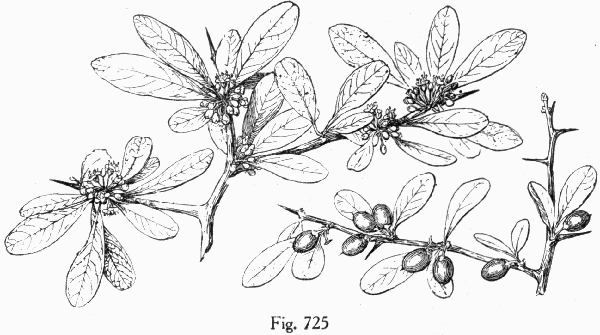
Leaves oblong-obovate, narrowed and acute or rounded and rarely slightly emarginate at apex, cuneate at base, entire, covered above with matted pale hairs and densely below [815] with snow white pubescence when they unfold, and at maturity coriaceous, dark yellow-green, lustrous and glabrous on the upper surface, paler on the lower surface, 1¼′—3′ long and ⅓′—1¼′ wide, with slightly revolute margins, a slender yellow midrib glabrous or slightly pubescent below toward the base and conspicuous reticulate veinlets, deciduous; petioles slender pubescent early in the season, becoming glabrous. Flowers opening from the middle of June to the middle of July, on villose pedicels, becoming sometimes nearly glabrous in the autumn, ⅛′—¼′ in length; calyx pale green, villose-pubescent, its lobes ovate, ciliate on the margins, shorter than the lobes of the corolla, their appendages lanceolate; staminodia rounded at apex, longer than the corolla-lobes. Fruit ripening in September, subglobose to oblong-obovoid, ¼′—⅓′ long and ¼′—⅓′ in diameter; seed oblong, rounded at the ends, about ⅖′ long.
A tree, in favorable positions 20°—25° high, with spinose branches forming an irregular open head, and slender often zigzag red-brown lustrous branchlets, the lateral branchlets often ending in stout spines; more often an irregularly branched shrub 10°—15° high, spreading on the banks of streams into great thickets. Bark of the trunk thick, pale and dark gray, rough and scaly, exfoliating in large scales.
Distribution. Texas, dry limestone cliffs and cañon bottoms and by streams dry during a large part of the year, valley of the upper Guadalupe River (Comal, Kendall and Kerr Counties) to the valley of the Rio Grande (Uvalde County), and northward to the valley of the upper Brazos River (Palo Pinto County); in Cohahuila (near Saltillo).
4. Bumelia lycioides Gærtn. f. Ironwood. Buckthorn.
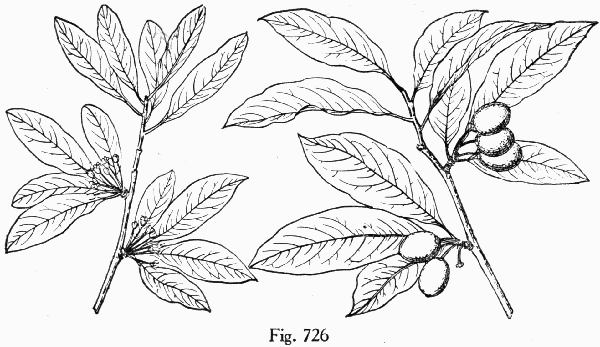
Leaves elliptic to oblanceolate, acute, acuminate, or rarely rounded at apex, gradually narrowed at base, covered when they unfold especially below with silky villose pubescence, soon glabrous, and at maturity bright green and glabrous on the upper surface, light green and sometimes coated on the lower surface with pale pubescence, thin and rather firm, finely reticulate-venulose, 3′—6′ long and ½′—2′ wide, with a pale thin conspicuous midrib sometimes slightly pubescent below near the base, deciduous in the autumn; petioles slender, slightly grooved, mostly pubescent early in the season, usually becoming glabrous, ½′—1′ in length. Flowers appearing at midsummer on slender glabrous pedicels ½′ long, in crowded many-flowered fascicles; calyx glabrous, ovoid-campanulate, with rounded lobes rather shorter than the corolla; staminodia broad-ovate, denticulate, nearly as long as the narrow appendages; ovary ovoid, slightly hairy toward the base only, gradually contracted into a short thick style. Fruit ripening and falling in the autumn, ovoid or obovoid, about [816] ⅔′ in length; flesh thick; seed short-oblong to subglobose, rounded at apex, nearly ¼′ long, with a pale conspicuous hilum.
A tree, 25°—30° high, with a short trunk rarely more than 6′ in diameter, stout flexible branches usually unarmed or furnished with short stout slightly curved spines occasionally developing into leafy spinescent branches, and short thick spur-like lateral branchlets slightly puberulous when they first appear, soon becoming glabrous, light red-brown, rather lustrous, and marked by numerous pale lenticels, and in their second year dark or light brown tinged with red or ashy gray. Winter-buds minute, obtuse, nearly immersed in the bark, with pale dark brown glabrous scales. Bark of the trunk thin, light red-brown, the generally smooth surface broken into small thin persistent scales. Wood heavy, hard, not strong, close-grained, light brown or yellow, with thick lighter colored sapwood.
Distribution. Usually in low moist soil on the borders of swamps and streams; rocky bluffs of the Ohio River near Cannelton, Perry County, southern Indiana, southern Illinois (Hardin, Pope and Pulaski Counties), to southeastern Missouri (Butler County) and to western Kentucky, western and central Tennessee, central Mississippi and northern Louisiana (West Feliciana Parish); and through western Arkansas to the coast region of eastern Texas (Beaumont, Jefferson County, and Columbia, Brazoria County); central Alabama; Florida southward to St. Mark’s, Wakulla County, and to Taylor, Alachua and Volusia Counties, and to northwestern Georgia (Catoosa County), and the valley of the Savannah River in Georgia and South Carolina, and northward through eastern North Carolina to southeastern Virginia (Norfolk County).
5. Bumelia angustifolia Nutt. Ants’ Wood. Downward Plum.
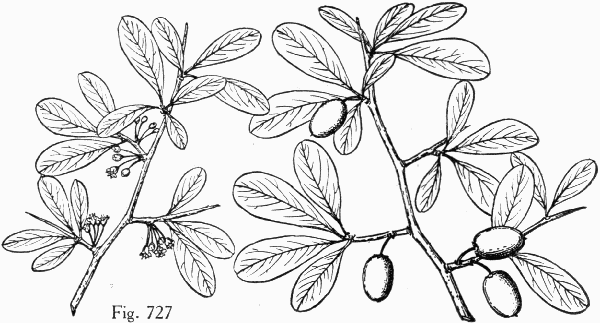
Leaves obovate, rounded at apex, and gradually narrowed and cuneate at base, with slightly thickened revolute margins, glabrous, thick and coriaceous, pale blue-green on the upper surface, paler on the lower surface, 1′—1½′ long and ¼′—1¼′ wide, with a pale slender midrib, and very obscure veins and veinlets; usually persistent on the branches until the end of their second winter; petioles stout, grooved, rarely ¼′ in length. Flowers generally appearing in October and November, on slender glabrous pedicels seldom more than ½′ in length, in few or many-flowered crowded fascicles; calyx glabrous, divided nearly to the base into narrow-ovate lobes rounded at apex and half as long as the divisions of the corolla furnished with linear-lanceolate appendages as long as the ovate acute denticulate staminodia; ovary narrow-ovoid, slightly hairy at base only, gradually contracted into an elongated style. Fruit ripening in the spring, on slender drooping stems, usually 1 fruit only [817] being developed from a fascicle of flowers, oblong or slightly obovoid, rounded at the ends, ½′—¾′ long and ¼′ in diameter, with thick sweet flesh; seed oblong, rounded at apex, ½′ long.
A tree, sometimes 20° high, with a short trunk rarely exceeding 6′—8′ in diameter, graceful pendulous branches forming a compact round head, and rigid spinescent divergent lateral branchlets often armed with acute slender spines sometimes 1′ in length, and when they first appear thickly coated with loose pale or dark brown deciduous tomentum, becoming light brown tinged with red or ashy gray. Winter-buds ovoid, acute, and covered with rufous tomentum. Bark of the trunk ⅓′—½′ thick, gray tinged with red, and deeply divided by longitudinal and cross fissures into oblong or nearly square plates. Wood heavy, hard, although not strong, very close-grained, light brown or orange-colored, with thick lighter colored sapwood.
Distribution. Florida, shores of Indian River to the southern keys, and on the west coast from Cedar Keys to East Cape, and here less abundant and usually on rocky shores and in the interior of low barren islands; on the Bahama Islands and in Cuba.
4. CHRYSOPHYLLUM L.
Trees, with terete branchlets usually coated while young with dense tomentum, and naked buds. Leaves short-petiolate, bright green and glabrous on the upper surface and coated on the lower surface with brilliant silky pubescence or tomentum, persistent. Flowers on pedicels from the axils of minute acute bracts, in dense many-flowered fascicles; calyx usually 5-parted, the divisions nearly equal, obtuse; corolla 5 or rarely 6 or 7-lobed, tubular, campanulate or subrotate, white or greenish white; filaments short, subulate or filiform, enlarged into broad connectives; anthers ovoid or triangular, extrorse or rarely partly introrse, the cells spreading below; ovary usually 5-celled, style crowned by a 5-lobed stigma. Fruit short-oblong, ovoid or globose. Seed ovoid; seed-coat coriaceous, dull or lustrous; hilum subbasilar, elongated, conspicuous; embryo erect, surrounded by more or less pungent fleshy albumen; cotyledons oblong, foliaceous.
Chrysophyllum is tropical, with fifty or sixty species most abundant in the New World, with a small number of species in western and southern tropical Africa, southern Asia, Australia, and the Hawaiian Islands, and with one species in southern Florida. The most valuable species, Chrysophyllum Cainito L., a native of the West Indies and now cultivated in all tropical countries and naturalized in many parts of Central and South America, produces the so-called star-apple, a succulent edible blue or purple and green fruit the size and shape of a small apple.
The generic name, from χρυσός and φύλλον, is in allusion to the golden covering of the under surface of the leaves.
[818]
1. Chrysophyllum oliviforme Lam. Satin-leaf.
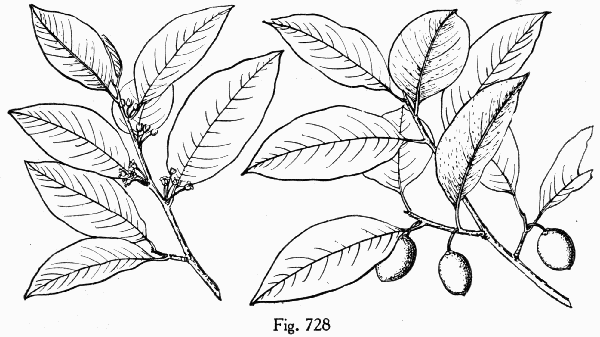
Leaves revolute in the bud, oval, acute or contracted into a short broad point or sometimes rounded at apex, abruptly cuneate at base, thick and coriaceous, bright blue-green on the upper surface and covered on the lower surface and on the petiole with brilliant copper-colored pubescence, 2′—3′ long and 1½′—2′ wide, with a broad prominent midrib deeply impressed on the upper side and numerous straight veins arcuate hear the margins; petioles stout, ½′—⅔′ in length. Flowers appearing in Florida irregularly throughout the year and often found on a branch with ripe or half-grown fruits, on stout pedicels shorter than the petioles, covered like the calyx with rufous tomentum, in few or many-flowered fascicles in the axils of leaves or at the base of lateral branchlets in those of earlier years; calyx divided nearly to the base into broad rounded lobes rather shorter than the tube of the subrotate white corolla with short spreading rounded lobes; ovary 5-celled, pubescent, gradually contracted into a short style crowned by a broad 5-lobed stigma. Fruit usually 1-seeded by abortion, on stems 1′ long, usually only a single fruit being produced from a flower-cluster, ovoid or sometimes nearly globose, dark purple, roughened by occasional excrescences, with a thick tough skin inclosing the juicy sweet mawkish flesh light purple on the exterior, lighter toward the interior, and quite white in the centre; seed narrowed at the ends, ½′ long, covered with a thin light brown coat closely invested with a white glutinous aril-like pulpy mass.
A tree, 25°—30° high, with a tall straight trunk sometimes a foot in diameter, upright branches forming a compact oblong head, and slender slightly zigzag branchlets coated when they first appear with ferrugineous tomentum, becoming in their second year light red-brown or ashy gray and covered with small pale elevated circular lenticels; in sandy soil under the shade of Pine-trees in the Everglade Keys a shrub 6° high or less. Bark of the trunk ¼′ thick, light brown slightly tinged with red, and broken by shallow fissures into large irregularly shaped plates separating on the surface into small thin scales. Wood very heavy, hard, strong, close-grained, light brown shaded with red, with thin lighter colored sapwood.
Distribution. Florida, rich hummocks, from Mosquito Inlet on the east coast to the Everglade Keys, Dade County and to the southern keys, and on the west coast from the shores of the Caloosahatchie River to the neighborhood of Cape Sable; local and nowhere common; on the Bahama Islands, and in Cuba, Porto Rico and Jamaica.
[819]
5. MIMUSOPS L.
Trees or rarely shrubs, with stout terete branchlets, small naked buds, and sweet juice. Leaves usually clustered at the end of the branches, with slender inconspicuous transverse veins and minute reticulate veinlets, persistent. Flowers on clavate pedicels from the axils of minute deciduous bracts; calyx 6—8-parted, the divisions in 2 series, those of the exterior series almost valvate in the bud; corolla white, barely longer than the calyx, subrotate, usually dilated at the throat, 6—8-lobed, the lobes furnished at base with a pair of petal-like appendages; stamens as many as the lobes of the corolla; filaments short, dilated; anthers lanceolate, their connectives excurrent, acute, or sometimes aristate at apex; staminodia as many as the lobes of the corolla, scale-like or petaloid, entire, 2-lobed or laciniate; ovary ovoid, hirsute or puberulous, gradually narrowed into a slender style stigmatic at apex. Fruit globose, 1 or 2-seeded, tipped with the much thickened elongated style; skin crustaceous, indurate; flesh thick and dry. Seed oblong-ovoid, slightly compressed; seed-coat crustaceous, chestnut-brown and lustrous; hilum elongated, lateral or minute, basilar; embryo surrounded by thick fleshy albumen; cotyledons flat, thick and fleshy, much longer than the short erect radicle.
Mimusops with thirty or forty species is widely distributed through the tropics of the two hemispheres, a single species reaching the shores of southern Florida. Several species produce hard heavy timber, edible fruits, or valuable milky juices.
The significance of the generic name, from μιμώ and ὄψις in allusion to the shape of the corolla, is not apparent.
1. Mimusops emarginata Britt. Wild Dilly.
Mimusops Sieberi Chap., not A. DC.
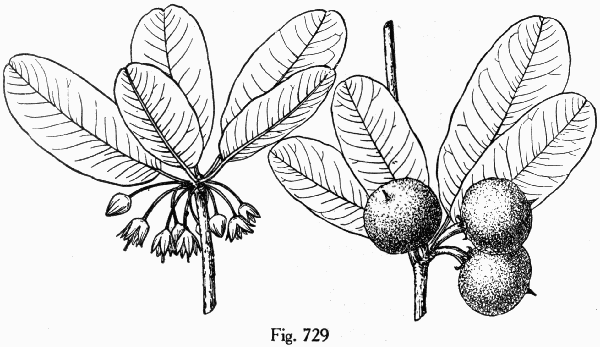
Leaves clustered at the end of the branches, involute in the bud oblong-elliptic, or occasionally slightly obovate, rounded or retuse at apex, rounded or cuneate at base, with slightly thickened revolute margins, bright red when they unfold, and slightly puberulous on the under surface of the midrib, and at maturity thick and coriaceous, bright green and lustrous, covered on the upper surface with a slight glaucous bloom, conspicuously reticulate-venulose, 3′—4′ long and 1′—1½′ wide, with a stout midrib glabrous, or puberulous with rusty hairs below, and deeply impressed above; appearing in Florida in April and May and deciduous during their second year; petioles slender, grooved, rusty-pubescent, especially while young, ½′—1′ in length. Flowers opening in the spring on slender pedicels near the [820] end of the branches, coated with rusty tomentum and 1′ or more long, from the axils of leaves of the year or from those of fallen leaves of the previous year; calyx narrow-ovoid, divided nearly to the base into 6 lobes, those of the outer row lanceolate, acute, covered on the outer surface with rusty brown tomentum and on the inner surface with pale pubescence, thickened and usually marked at the base on the outer surface by black spots, those of the inner row ovate, acute, keeled toward the base, light greenish yellow and pale-pubescent; corolla light yellow tinged with green, ⅔′ in diameter, with 6 spreading lanceolate acute divisions entire or erosely toothed toward the apex, their appendage slender, acute and from one half to two thirds their length; staminodia minute, nearly triangular, entire; ovary narrow-ovoid, dark red, puberulous toward the base with pale hairs, and gradually narrowed into an elongated exserted style stigmatic at apex. Fruit ripening at the end of a year, in the spring or in early autumn, on a stout erect stem about 1′ long, and persistent until after the tree flowers the following year, subglobose to slightly obovoid, flattened and compressed at apex, 1′—1½′ in diameter, usually 1-seeded by abortion, with a thick dry outer coat roughened by minute rusty brown scales, and thick spongy flesh filled with milky juice; seed ½′ long, with an elongated lateral hilum.
A tree, in Florida rarely more than 30° high, with a short gnarled trunk 12′—15′ in diameter and usually hollow and defective, thick branches forming a compact round head, and stout branchlets clustered at the end of the branches of the previous year, coated when they first appear with dark rufous pubescence, becoming glabrous and light orange-brown at the end of a few weeks, and in their second year covered with thick ashy gray or light red-brown scaly bark and marked by elevated obcordate leaf-scars displaying 3 large dark conspicuous fibro-vascular bundle-scars. Winter-buds ovoid, acute, rusty-tomentose. Bark of the trunk about ¼′ thick and irregularly divided by deep fissures into ridges rounded on the back and broken into small nearly square plates. Wood very heavy, hard, strong, close-grained, rich very dark brown, with light-colored sapwood.
Distribution. Florida, only on the southern keys; not common; on the Bahama Islands and in Cuba.
LVII. EBENACEÆ.
Trees or shrubs, with watery juice, and alternate simple entire leaves, without stipules. Flowers diœcious or polygamous, regular, axillary, articulate with the bibracteolate pedicels; calyx persistent; corolla hypogynous, regular; disk 0; stamens more numerous than the lobes of the corolla, inserted on its base, fewer and rudimentary or 0 in the pistillate flower; filaments short; anthers introrse, 2-celled; ovary several-celled; ovules 2 in each cell, suspended from its apex, anatropous; raphe dorsal; micropyle superior. Fruit a 1 or several-seeded berry. Seeds with copious albumen; embryo axile.
The Ebony family with seven genera and a large number of species is widely distributed in tropical and temperate regions, with two representatives of its most important genus, Diospyros, in the flora of the United States.
1. DIOSPYROS L.
Trees or shrubs, with terete branchlets, without a terminal bud, scaly axillary buds, coriaceous leaves revolute in the bud, and fibrous roots. Flowers mostly diœcious, from the axils of leaves of the year or of the previous year; staminate smaller than the pistillate and usually in short few-flowered bracted cymes; pistillate generally solitary; calyx 4-lobed, the lobes valvate in the bud, accrescent under the fruit; corolla 4-lobed, the lobes sinistrorsely contorted in the bud, more or less contracted in the throat, the lobes spreading or recurved; stamens usually 16, inserted on the bottom of the corolla in two rows and in pairs, those of the outer row rather longer than and opposite those of the inner row; filaments free, slender; anthers oblong, apiculate, the cells opening laterally by longitudinal slits; stamens rudimentary or 0 in the pistillate flower; ovary usually 4-celled, each cell more or less completely divided by the development of a false longitudinal partition from its anterior face, rudimentary or 0 in the staminate flower; styles 4, spreading, 2-lobed at [821] apex; stigmas 2-parted or lobed; ovule solitary in each of the divisions of the cells. Fruit globose, oblong or conic, 1—10-seeded, surrounded at base by the enlarged persistent calyx. Seeds pendulous, oblong, compressed; seed-coat thick and bony, dark, more or less lustrous; embryo axile, straight or somewhat curved; cotyledons foliaceous, ovate or lanceolate; radicle superior, cylindric, turned toward the small hilum.
Diospyros, which is chiefly tropical, is widely distributed with more than two hundred species in the two hemispheres, with a few species extending beyond the tropics into eastern North America, eastern Asia, southwestern Asia, and the Mediterranean region.
Diospyros produces hard close-grained valuable wood, with dark or black heartwood and thick soft yellow sapwood. The ebony of commerce is partly produced by different tropical species. The fruit is often edible, and some of the species are important fruit-trees in China and Japan.
The generic name, from Διός and πυρός, is in allusion to the life-giving properties of the fruit.
CONSPECTUS OF THE SPECIES OF THE UNITED STATES.
Flowers on branchlets of the year; anthers opening longitudinally nearly throughout their entire length; filaments pubescent; pistillate flowers with 8 rudimentary stamens; ovary nearly glabrous; leaves oval; fruit green, yellow, orange color or rarely black.
1. D. virginiana (A, C).
Flowers on branchlets of the previous year; anthers opening only near the apex; filaments glabrous; pistillate flowers without rudimentary stamens; ovary pubescent; leaves cuneate-oblong or obovate; fruit black.
2. D. texana (C).
1. Diospyros virginiana L. Persimmon.
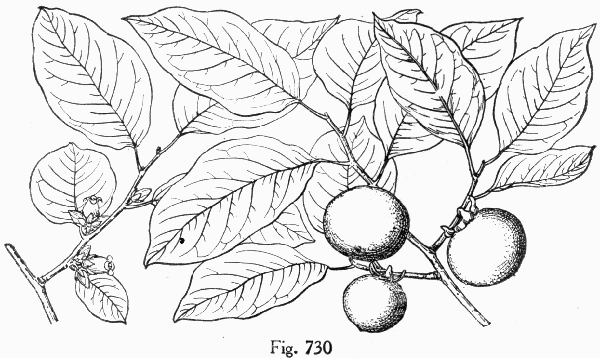
Leaves ovate-oblong to oval or elliptic, acuminate or abruptly acuminate at apex, narrowed and cuneate or rounded or rarely broad and rounded at base, coriaceous, glabrous, dark green and lustrous on the upper surface, pale on the lower surface, 4′—6′ long and 2′—3′ wide, with a broad flat midrib, about six pairs of conspicuous primary veins arcuate near the margins and reticulate veinlets; falling in the autumn usually without much change of color; petioles stout, glabrous or slightly villose-pubescent, ½′—1′ in length. Flowers appearing when the leaves are more than half grown on branchlets of the year, from March in the extreme south to June in the north; the staminate in 2—3-flowered pubescent pedunculate cymes, on pedicels from the axils of minute lanceolate acute caducous bracts and furnished [822] near the middle with two minute-caducous bractlets; the pistillate solitary, on short recurved pedicels, bibracteolate with conspicuous acute bractlets ciliate on the margins and often ¼′ in length; corolla of the staminate flower tubular, ½′ long, slightly contracted below the short acute reflexed lobes forming before expansion a pointed 4-angled bud rather longer than the broad-ovate acute foliaceous ciliate calyx-lobes inflexed on the margins; stamens with short slightly hairy filaments and linear-lanceolate anthers opening throughout their length; pistillate flower ¾′ long, with a greenish yellow or creamy white corolla nearly ½′ broad; stamens 8, inserted in one row below the middle of the corolla, with short filaments and sagittate abortive or sometimes fertile anthers; ovary conic, pilose toward the apex, ultimately 8-celled, and gradually narrowed into the four slender styles hairy at the base. Fruit on a short thick stem, ripening at the north late in autumn or earlier southward, often persistent on the branches during the winter, depressed-globose to ovoid or slightly obovoid, rounded or pointed at apex, ¾′—2′ in diameter, yellow or pale orange color, often with a bright cheek, and covered with a glaucous bloom, turning yellowish brown when partly decayed by freezing, surrounded at base by the spreading calyx 1′—1½′ in diameter, with broad ovate pointed lobes recurved on the margins; flesh austere while green, yellowish brown, sweet and luscious when fully ripened by the action of frost, or in some forms remaining hard and green during the winter; seeds oblong, rounded on the dorsal edge, nearly straight on the ventral edge, rounded at the ends, much flattened, ½′ long and ⅓′ wide, with a thick hard pale brown rugose testa, a narrow pale hilum and a slender raphe.
A tree, occasionally 50°—60° high, with a short trunk 16′—20′ in diameter, spreading often pendulous branches forming a broad or narrow round-topped head, and slender slightly zigzag glabrous or rarely puberulous branchlets with a thick pith-cavity, light brown when they first appear, becoming during their first winter light brown or ashy gray and marked by occasional small orange-colored lenticels and by elevated semiorbicular leaf-scars, with deep horizontal lunate depressions; or in the primeval forest, under the most favorable conditions, sometimes 100°—130° high, with a long slender trunk free of branches for 70°—80° and rarely exceeding 2° in diameter; frequently not more than 15° or 20° high and sometimes shrubby in habit. Winter-buds: axillary, broad-ovoid, acute, ⅛′ long, with thick imbricated dark red-brown or purple lustrous scales often persistent at the base of young branchlets during the season. Bark of the trunk ¾′—1′ thick, dark brown tinged with red, or dark gray, and deeply divided into thick square plates broken into thin persistent scales, with heavy strong dark brown sometimes nearly black heartwood often undeveloped until the tree is over one hundred years old; used in turnery, for shoe-lasts, plane-stocks, and preferred for shuttles to other American woods. The fruit contains tannin, to which it owes its astringent qualities, and is eaten in great quantities in the southern states. The inner bark is astringent and bitter.
Distribution. Light sandy well drained soil, or in the Mississippi basin sometimes on the deep rich bottom-lands of river valleys; Lighthouse Point, New Haven, New Haven County, Connecticut, and Long Island, New York, through southern Pennsylvania, southern Ohio, southern Indiana and Illinois, to southeastern Iowa, eastern Kansas, central Oklahoma, and southward to De Soto County, Florida, southern Alabama, Mississippi, Louisiana, and Texas to the valley of the Colorado River (Burnet County); very common in the south Atlantic and Gulf states, often covering with shrubby growth by means of the stoloniferous roots abandoned fields and springing up by the side of roads and fences; ascending on the Appalachian Mountains to altitudes of 3500°; rare toward the western limits of its range in Texas. In Missouri and Arkansas passing into the var. platycarpa Sarg. with larger broad-ovate leaves rounded or cordate at base or rarely elliptic, more or less densely pubescent on the lower surface, especially on the midrib and petiole, often 2½′—4′ long and 2′—2½′ wide, and at the end of vigorous shoots up to 6′ in length, and depressed-globose, yellow, rarely nearly black (f. atra Sarg.), fruit much depressed at top and bottom, 1¾′—3′ wide and about 1′ high, with sweet succulent flesh, ripening in September or early October, and seeds conspicuously rounded on the dorsal edge, much compressed, dark chestnut-brown and lustrous, only slightly rugose, ¾′ long and ½′ wide. A tree usually [823] not more than 12°—25° high, with a trunk 16′—30′ in diameter and rather stouter branchlets densely villose-pubescent sometimes for two or three years, or becoming glabrate at the end of their first season. Hills near Allenton, St. Louis County, and on the western slopes of the Ozark Mountains and the adjacent prairies of southeastern Missouri and prairies of northwestern Arkansas, eastern Kansas and Oklahoma. In Dade County, Florida, Diospyros virginiana is replaced by the var. Mosieri Sarg. with smaller staminate flowers, nearly globose fruit with rather less compressed dark chestnut-brown lustrous only slightly rugose seeds. A small tree with slightly fissured light gray bark.
Several named varieties of Diospyros virginiana are distinguished and cultivated by pomologists.
2. Diospyros texana Scheele. Black Persimmon. Chapote.
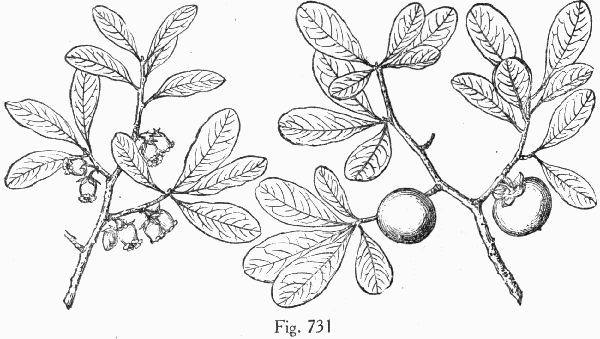
Leaves oblong-cuneate to obovate, rounded and often retuse at apex and cuneate at base, covered below when they unfold with thick pale tomentum and above with scattered long white hairs, and at maturity thick and coriaceous, dark green and lustrous, glabrous or puberulous on the upper surface, paler and pubescent on the lower surface, ¾′—1½′ long and nearly 1′ wide, with a broad midrib and about 4 pairs of arcuate primary veins and reticulate veinlets; unfolding in February and March, and falling during the following winter without change of color; petioles short, thick, and hairy. Flowers appearing in early spring when the leaves are about one third grown, on branches of the previous year; staminate on slender drooping pedicels furnished near the middle with minute caducous bractlets, in 1—3-flowered crowded pubescent fascicles; pistillate on stouter club-shaped pedicels, solitary or rarely in pairs; calyx of the staminate flower ⅛′ long and deeply divided into 5 ovate or lanceolate silky-tomentose lobes recurved after the opening of the flower, and much shorter than the corolla ⅛′ long, creamy white, and slightly contracted below the 5 short spreading rounded lobes ciliate on the margins; stamens, with glabrous filaments shorter than the corolla, and linear-lanceolate anthers opening at apex only by short slits; pistillate flowers without rudimentary stamens, ⅓′ long, with oblong acute silky-tomentose calyx-lobes half the length of the pubescent corolla nearly ½′ across the short spreading lobes; ovary ovoid, pubescent like the young fruit, ultimately 8-celled. Fruit ripening in August, subglobose, ½′—1′ in diameter, and 3—8-seeded, surrounded at base by the large thickened leathery calyx sometimes 1′ in diameter, with oblong pubescent reflexed lobes, the thick tough black skin inclosing thin sweet insipid juicy dark flesh; seeds triangular, rounded on the back, narrowed and flattened at the pointed apex, ⅓′ long, about ⅛′ thick, with a bony lustrous light red pitted coat.
[824]
An intricately branched tree, occasionally 40°—50° high, with a trunk 18′—20′ in diameter, dividing at some distance above the ground into a number of stout upright branches forming a narrow round-topped head, and slender terete slightly zigzag branchlets, coated at first with pale or rufous tomentum, ashy gray, glabrous or puberulous during their first winter, later becoming brown and marked by minute pale lenticels and by small elevated semiorbicular leaf-scars displaying a lunate row of fibro-vascular bundle-scars; often much smaller, and toward the northern and western limits of its range a low many-stemmed shrub. Winter-buds obtuse, barely more than 1/16′ long, with broad-ovate scales rounded on the back and coated with rufous tomentum. Bark of the trunk smooth, light gray slightly tinged with red, the outer layer falling away in large irregularly shaped patches displaying the smooth gray inner bark. Wood heavy, with black heartwood often streaked with yellow and clear bright yellow sapwood; used in turnery and for the handles of tools. The fruit, which is exceedingly austere until it is fully ripe, stains black, and is sometimes used by Mexicans in the valley of the Rio Grande to dye sheepskins.
Distribution. Southwestern Texas, Matagorda County (neighborhood of Matagorda and Bay City) to the lower Rio Grande, and northward to San Saba, Lampasas and Bexar Counties; in Coahuila, Nuevo Leon, and Tamaulipas; possibly in southern Lower California; abundant in western and southern Texas: in the neighborhood of the coast on the borders of prairies in rich moist soil; westward on dry rocky mesas and in isolated cañons; very common and of its largest size in the region between the Sierra Madre and the coast of the Gulf of Mexico in Nuevo Leon and Tamaulipas.
LVIII. STYRACEÆ.
Trees or shrubs, with stellate pubescence or lepidote, watery juice, and scaly buds. Leaves alternate, simple, penniveined, without stipules. Flowers regular, perfect; calyx more or less adnate to the tube of the corolla; disk 0; anthers introrse, 2-celled, the cells opening longitudinally; ovary superior or partly superior, crowned with a simple style; ovules anatropous. Fruit drupaceous, with thin dry flesh, and a thick-walled 1-seeded bony stone. Seeds, with albumen.
The Storax family is confined to North and South America, the Mediterranean region, eastern Asia and the Malay Archipelago. Of the six genera of this family two are represented in the flora of North America.
CONSPECTUS OF THE GENERA OF THE UNITED STATES.
Calyx adherent to the whole surface of the ovary; corolla 4-lobed. Fruit oblong-obovoid, 2 or 4-celled and 2 or 4-winged.
1. Halesia.
Calyx adherent to the base only of the ovary; corolla usually 5-parted. Fruit subglobose, 1-celled.
2. Styrax.
1. HALESIA L. SILVER BELL TREE.
Trees or shrubs, with stellate pubescence, slender terete pithy branchlets, without a terminal bud, axillary buds with imbricated accrescent scales, and fibrous roots. Leaves involute in the bud, thin, elliptic, oblong-ovate or oblong-ovoid, denticulate, deciduous. Flowers opening in early spring, on slender elongated drooping ebracteolate pedicels from the axils of foliaceous acuminate or acute caducous bracts, in fascicles or short racemes from the axils of leaves of the previous year; calyx-tube obconic, adherent to the whole surface of the ovary, the limb short, 4-toothed, with minute triangular teeth, open in the bud; corolla epigynous, campanulate, 4-lobed, or divided nearly to the base, the lobes convolute or imbricated in the bud, thin and white or rarely tinged with rose; stamens 8—16; filaments elongated, shorter than the corolla, slightly attached at base, or sometimes free, flattened below; anthers oblong, adnate or free at the very base; ovary 2 or 4-celled, gradually contracted into an elongate glabrous or tomentose style stigmatic at apex; ovules 4 in each cell, attached by elongated funiculi at the middle of the axis, the 2 upper ascending, [825] the 2 lower pendulous; raphe dorsal; micropyle inferior and superior. Fruit ripening in the autumn, elongated, oblong or obovoid and gradually narrowed at base; skin tough, separable, light green and lustrous, turning reddish brown late in the autumn; exocarp indehiscent, thick, becoming dry and corky at maturity, produced into 2 or 4 broad thin wings cuneate at base and rounded at apex; stone bony, cylindric, obovoid or ellipsoid, gradually narrowed at base into a slender stipe inclosed in the wings, narrowed above and terminating in the enlarged style protruding above the wings, usually obscurely and irregularly 8-angled or sulcate, 1—4-celled. Seed solitary in each cell, elongated, cylindric; seed-coat thin, light brown, lustrous, adherent to the walls of the stone, the delicate inner coat attached to the copious fleshy albumen; embryo terete, axile, erect; cotyledons oblong, as long as the elongated radicle turned toward the minute hilum.