Division II. Dicotyledons. (continued 3)
Reading edition
A tree, usually 30°—45° or rarely 60° high, with a trunk 12′—24′ in diameter, large spreading often drooping more or less contorted branches forming a narrow head, and slender light red-brown branchlets marked by pale lenticels, more or less densely rusty pubescent during their first season and dark gray-brown and glabrous or nearly glabrous the following year. Winter-buds ovoid, covered with rusty pubescence mixed with silvery scales, furnished at apex with long pale hairs; the terminal bud abruptly contracted and long-pointed at apex, ⅖′—½′ in length and ¼′—⅓′ in diameter, and 2 or 3 times larger than the flattened acute lateral buds. Bark thick, deeply furrowed, rough, dark often nearly black. Wood hard, brittle, little used except for fuel.
Distribution. Dry sandy uplands with Post and Black Jack Oaks; northern and eastern Texas (Grayson, Cherokee, San Augustine and Atascosa Counties), and in central Oklahoma (dry sand hills, Muskogee County).
Carya Buckleyi var. arkansana Sarg.
Carya arkansana Sarg.
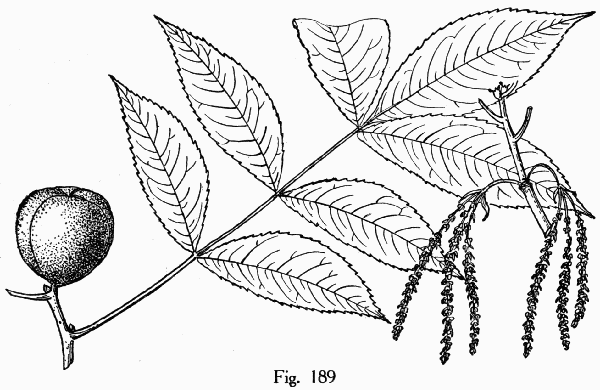
Differing from Carya Buckleyi in the shape of the fruit and sometimes in the bark of the trunk. Fruit obovoid, rounded at apex, rounded or gradually narrowed or abruptly contracted into a more or less developed stipe at base, or ellipsoidal, or ovoid and rounded at the ends, ⅘′—1½′ in length and in diameter, with a husk 1/12′—⅙′ thick, splitting to the middle or nearly to the base by slightly winged sutures; nut oblong to slightly obovoid, rounded at [199] the ends, compressed, slightly 4-angled occasionally to the middle, pale brown, with a shell ⅙′—⅕′ in thickness; seed small and sweet.
A tree from 60°—75° high, with a trunk 2° in diameter; southward usually much smaller. Bark on some trees dark gray, irregularly fissured, separating into thin scales, and on others close, nearly black and deeply divided into rough ridges.
Distribution. Dry hillsides, rocky ridges, or southward on sandy upland; southwestern Indiana (Knox County), southern Illinois, northeastern Missouri and southward through Missouri and Arkansas to eastern Oklahoma, western Louisiana and northern and eastern Texas to the valley of the Atascosa River, Atascosa County; the common Hickory of the Ozark Mountain region, Arkansas, and here abundant on dry rocky ridges at altitudes of 1200°—1800°; in Texas the common Hickory from the coast to the base of the Edwards Plateau; trees with the smallest fruit northward; those with the largest fruit with thickest husks in Louisiana, and in southern Arkansas (f. pachylemma Sarg.), a tree with slender nearly glabrous branchlets, deeply fissured pale gray bark, rusty pubescent winter-buds and fruit 2½′ long and 2′ in diameter, with a husk ½′ in thickness.
Carya Buckleyi var. villosa Sarg.
Hicoria glabra var. villosa Sarg. Hicoria villosa Ashe. Carya villosa Schn. Carya glabra var. villosa Robins.
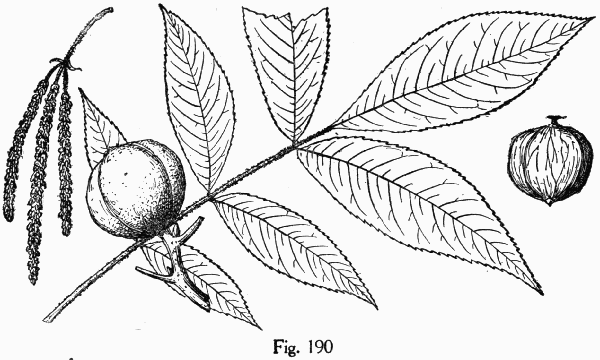
Leaves 6′—10′ long, with slender petioles and rachis pubescent with fascicled hairs early in the season, generally becoming glabrous, and 5—7, usually 7, lanceolate to oblanceolate finely serrate leaflets long-pointed and acuminate at apex, cuneate or rounded and often unsymmetrical at base, sessile or the terminal leaflet sometimes short-stalked, dark green and glabrous above, pale and pubescent below, the lower side of the midrib often covered with fascicled hairs, the upper leaflets 3′—4′ long and 1′—1½′ wide, and twice as long as those of the lowest pair. Flowers: staminate in aments pubescent with fascicled hairs, 4′—8′ long, pubescent, their bract acuminate, not much longer than the rounded calyx-lobes; pistillate in 1 or 2-flowered spikes, rusty pubescent, slightly angled. Fruit obovoid to ellipsoidal, rounded at apex, cuneate and often abruptly narrowed into a stipitate base, rusty pubescent and covered with scattered yellow scales, about 1′ long and ¾′ in diameter, with a husk 1/12′ in thickness, splitting tardily to the base by 1 or 2 sutures or indehiscent; nut ovoid, rounded [200] at base, pointed at apex, only slightly angled, faintly tinged with red, with a shell rarely more than 1/12′ in thickness; seed small and sweet.
A tree 30°—40° high, with a trunk 12′—18′ in diameter, stout often contorted branches and slender branchlets covered at first with rusty pubescence mixed with fascicled hairs and pubescent or glabrous during their first winter. Winter-buds ovoid, acute, covered with rusty pubescence mixed with yellow scales, often furnished near the apex with tufts of white hairs, the terminal ¼′ long and about twice as large as the compressed axillary buds.
Distribution. Dry rocky hills, Allenton, Saint Louis County, Missouri. Distinct from other forms of Carya Buckleyi in the often indehiscent fruit and more numerous and longer fascicled hairs, and possibly better considered a species.
IX. BETULACEÆ.
Trees, with sweet watery juice, without terminal buds, their slender terete branchlets marked by numerous pale lenticels and lengthening by one of the upper axillary buds formed in early summer, and alternate simple penniveined usually doubly serrate deciduous stalked leaves, obliquely plicately folded along the primary veins, their petioles in falling leaving small semioval slightly oblique scars showing three equidistant fibro-vascular bundle-scars; stipules inclosing the leaf in the bud, fugacious. Flowers vernal, appearing with or before the unfolding of the leaves, or rarely autumnal, monœcious, the staminate 1—3 together in the axils of the scales of an elongated pendulous lateral ament and composed of a 2—4-parted membranaceous calyx and 2—20 stamens inserted on a receptacle, with distinct filaments and 2-celled erect extrorse anthers opening longitudinally, or without a calyx, the pistillate in short lateral or capitate aments, with or without a calyx, a 2-celled ovary, narrowed into a short style divided into two elongated branches longer than the scales of the ament and stigmatic on the inner face or at the apex, and a single anatropous pendulous ovule in each cell of the ovary. Fruit a small mostly 1-celled 1-seeded nut, the outer layer of the shell light brown, thin and membranaceous, the inner thick, hard, and bony. Seed solitary by abortion, filling the cavity of the nut, suspended, without albumen, its coat membranaceous, light chestnut-brown; cotyledons thick and fleshy, much longer than the short superior radicle turned toward the minute hilum.
Of the six genera, all confined to the northern hemisphere, five are found in North America; of these only Corylus is shrubby.
CONSPECTUS OF THE NORTH AMERICAN ARBORESCENT GENERA.
Scales of the pistillate ament deciduous; nut wingless, more or less inclosed in an involucre formed by the enlargement of the bract and bractlets of the flower; staminate flowers solitary in the axils of the scales of the ament; calyx 0; pistillate flowers with a calyx.
Staminate aments covered during the winter: involucre of the fruit flat, 3-cleft, foliaceous.
1. Carpinus.
Staminate aments naked during the winter: involucre of the fruit bladder-like, closed.
2. Ostrya.
Scales of the pistillate ament persistent and forming a woody strobile; nut without an involucre, more or less broadly winged; staminate flowers 3—6 together in the axils of the scales of the ament; calyx present; pistillate flowers without a calyx.
Pistillate aments solitary, their scales 3-lobed, becoming thin, brown, and woody, deciduous; stamens 2; filaments 2-branched, each division bearing a half-anther; winter-buds covered by imbricated scales.
3. Betula.
Pistillate aments racemose, their scales erose or 5-toothed, becoming thick, woody, and dark-colored, persistent; stamens 1—3 or 4; filaments simple; wings of the nut often reduced to a narrow border; winter-buds without scales.
4. Alnus.
[201]
1. CARPINUS L. Hornbeam.
Trees, with smooth close bark, hard strong close-grained wood, elongated conic buds covered by numerous imbricated scales, the inner lengthening after the opening of the buds. Leaves open and concave in the bud, ovate, acute, often cordate; stipules strap-shaped to oblong-obovate. Flowers: staminate in aments emerging in very early spring from buds produced the previous season near the ends of short lateral branchlets of the year and inclosed during the winter, composed of 3—20 stamens crowded on a pilose receptacle adnate to the base of a nearly sessile ovate acute coriaceous scale longer than the stamens; filaments short, slender, 2-branched, each branch bearing a 1-celled oblong yellow half-anther hairy at the apex; pistillate in lax semi-erect aments terminal on leafy branches of the year, in pairs at the base of an ovate acute leafy deciduous scale, each flower subtended by a small acute bract with two minute bractlets at its base; calyx adnate to the ovary and dentate on the free narrow border. Nut ovoid, acute, compressed, conspicuously longitudinally ribbed, bearing at the apex the remnants of the calyx, marked on the broad base by a large pale scar and separating at maturity in the autumn from the leaf-like 3-lobed conspicuously serrate green involucre formed by the enlargement of the bract and bractlets of the flower and inclosing only the base of the nut, fully grown at mid-summer and loosely imbricated into a long-stalked open cluster. (Eucarpinus.)
Carpinus is confined to the northern hemisphere, and is distributed from the Province of Quebec through the eastern United States to the highlands of Central America in the New World, and from Sweden to southern Europe, Asia Minor, the temperate Himalayas, Korea, southern China, Japan and Formosa in the Old World. Fifteen or sixteen species are recognized. Of the exotic species, the European and west Asian Carpinus Betulus L. is frequently planted as an ornamental tree in the northeastern United States, where some of the species of eastern Asia promise to become valuable.
Carpinus is the classical name of the Hornbeam.
1. Carpinus caroliniana Walt. Hornbeam. Blue Beech.
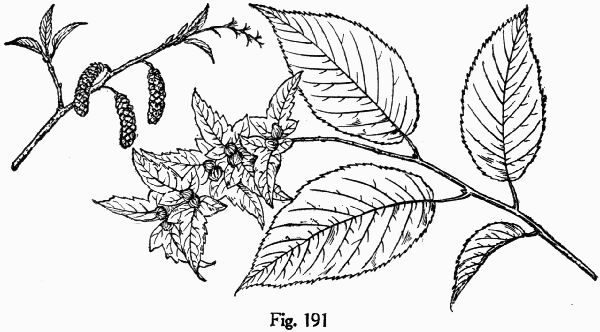
Leaves often somewhat falcate, long-pointed, sharply doubly serrate with stout spreading glandular teeth, except at the rounded or wedge-shaped often unequal base, pale bronze-green, and covered with long white hairs when they unfold, at maturity thin and firm, pale dull blue-green above, light yellow-green and glabrous or puberulous below, with small tufts of white hairs in the axils of the veins, 2′—4′ long, 1′—1¾′ wide, with a slender yellow midrib, numerous slender veins deeply impressed and conspicuous above, and prominent cross veinlets; turning deep scarlet and orange color late in the autumn; [202] petioles slender, terete, hairy, about ⅓′ long, bright red while young; stipules ovate-lanceolate, acute, pubescent, hairy on the margins, bright red below, light yellow-green at the apex, ⅓′ long. Flowers: staminate aments 1½′ long when fully grown, with broadly ovate acute boat-shaped scales green below the middle, bright red above; pistillate aments ½′—¾′ long, with ovate acute hairy green scales; styles scarlet. Fruit: nut ⅓′ long, its involucre short-stalked, with one of the lateral lobes often wanting, coarsely serrate, but usually on one margin only of the middle lobe, 1′—1½′ long, nearly 1′ wide, crowded on slender terete pubescent red-brown stems 5′—6′ in length.
A bushy tree, rarely 40° high, with a short fluted trunk occasionally 2° in diameter, long slightly zigzag slender tough spreading branches pendulous toward the ends, and furnished with numerous short thin lateral branches growing at acute angles, and branchlets at first pale green coated with long white silky hairs, orange-brown and sometimes slightly pilose during the summer, becoming dark red and lustrous during their first winter and ultimately dull gray tinged with red. Winter-buds ovoid, acute, about ⅛′ long, with ovate acute chestnut-brown scales white and scarious on the margins. Bark light gray-brown, sometimes marked with broad dark brown horizontal bands, 1/16′—⅛′ thick. Wood light brown, with thick nearly white sapwood; sometimes used for levers, the handles of tools, and other small articles.
Distribution. Borders of streams and swamps, generally in deep rich moist soil; Nova Scotia and southern and western Quebec to the northern shores of Georgian Bay, southward to the shores of Indian River and those of Tampa Bay, Florida, and westward to central Minnesota, eastern Iowa (Sharpy County), eastern Nebraska (reported), eastern Kansas, eastern Oklahoma, and eastern Texas; reappearing on the mountains of southern Mexico and Central America; common in the eastern and central states; most abundant and of its largest size on the western slopes of the southern Alleghany Mountains and in southern Arkansas and eastern Texas.
2. OSTRYA Scop. Hop Hornbeam.
Trees, with scaly bark, heavy hard strong close-grained wood, and acute elongated winter-buds formed in early summer and covered by numerous imbricated scales, the inner lengthening after the opening of the bud. Leaves open and concave in the bud; petioles slender, nearly terete, hairy; stipules strap-shaped to oblong-obovate. Flowers: staminate in long clustered sessile or short-stalked aments developed in early summer from lateral buds near the ends of short lateral branchlets of the year and coated while young with hoary tomentum, naked and conspicuous during the winter, and composed of 3—14 stamens crowded on a pilose receptacle adnate to the base of an ovate concave scale rounded and abruptly short-pointed at the apex, ciliate on the margins, longer than the stamens; filaments short, 2-branched, each branch bearing a 1-celled half-anther hairy at the apex; pistillate in erect lax aments terminal on short leafy branches of the year, in pairs at the base of an elongated ovate acute leaf-like ciliate scale persistent until midsummer, each flower inclosed in a hairy sack-like involucre formed by the union of a bract and 2 bractlets; calyx adnate to the ovary, denticulate on the free narrow border. Nut ovoid, acute, flattened, obscurely longitudinally ribbed, crowned with the remnants of the calyx, marked at the narrow base by a small circular pale scar, inclosed in the much enlarged pale membranaceous conspicuously longitudinally veined reticulate-venulose involucres of the flower, short, pointed and hairy at the apex, hirsute at the base, with sharp rigid stinging hairs, imbricated into a short strobile fully grown at midsummer, and suspended on a slender hairy stem.
Ostrya is widely distributed in the northern hemisphere from Nova Scotia to Texas, northern Arizona, and to the highlands of southern Mexico and Guatemala in the New World, and through southern Europe and southwestern Asia, and in northern Japan and on the Island of Quelpart in the Old World. Of the four species now recognized two are North American.
Ostrya is the classical name of the Hop Hornbeam.
[203]
CONSPECTUS OF THE NORTH AMERICAN SPECIES.
Leaves oblong-lanceolate, acuminate or acute at apex.
1. O. virginiana (A, C).
Leaves elliptic or obovate, acute or rounded at apex.
2. O. Knowltonii (F).
1. Ostrya virginiana K. Koch. Hop Hornbeam. Ironwood.
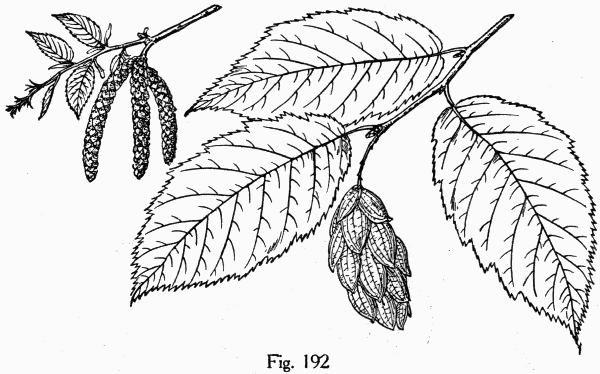
Leaves oblong-lanceolate, gradually narrowed into a long slender point or acute at apex, narrowed and rounded, cordate, or wedge-shaped at the often unequal base, sharply serrate, with slender incurved callous teeth terminating at first in tufts of caducous hairs, when they unfold light bronze-green, glabrous above and coated below on the midrib and primary veins with long pale hairs, at maturity thin and extremely tough, dark dull yellow-green above, light yellow-green and furnished with conspicuous tufts of pale hairs in the axils of the veins below, 3′—5′ long, 1½′—2′ wide, with a slender midrib impressed and puberulous above, light yellow and pubescent below, and numerous slender veins forked near the margins; turning clear yellow before falling in the autumn; petioles hairy about ¼′ long; stipules rounded and often short-pointed at apex, ciliate on the margins with long pale hairs, hairy on the back, about ½′ long and ⅛′ wide. Flowers: staminate aments about ½′ long during their first season, with light red-brown rather loosely imbricated scales narrowed into a long slender point, becoming when the flowers open 2′ long, with broadly obovate scales rounded and abruptly contracted at apex into a short point, ciliate on the margins, green tinged with red above the middle, light brown toward the base; pistillate aments slender, about ¼′ long, on thin hairy stems, their scales lanceolate, acute, light green, often flushed with red above the middle, hirsute at the apex, decreasing in size from the lowest. Fruit: nuts ⅓′ long, about ⅛′ wide, rather abruptly narrowed below the apex, their involucres in clusters 1½′—2′ long and ⅔′—1′ wide, on slender hairy stems about 1′ in length.
A tree, occasionally 50°—60° high, with a short trunk 2° in diameter, usually not more than 20°—30° tall, with a trunk 18′—20′ thick, long slender branches drooping at the ends and forming a round-topped or open head frequently 50° across, and slender, very tough branchlets, light green, coated with pale appressed hairs when they first appear, becoming light orange color and very lustrous by midsummer, glabrous, dark red-brown and lustrous during their first winter, and then growing gradually darker brown and losing their lustre; or covered like the petioles and peduncles with short erect glandular hairs (var. glandulosa Sarg.). [204] Winter-buds ovoid, light chestnut-brown, slightly puberulous, ¼′ long. Bark about ¼′ thick, broken into thick narrow oblong closely appressed plate-like light brown scales slightly tinged with red on the surface. Wood strong, hard, tough, durable, light brown tinged with red or often nearly white, with thick pale sapwood of 40—50 layers of annual growth; used for fence-posts, handles of tools, mallets, and other small articles.
Distribution. Dry gravelly slopes and ridges often in the shade of oaks and other large trees; Island of Cape Breton and the shores of the Bay of Chaleur, through the valley of the St. Lawrence River, and along the northern shores of Lake Huron to western Ontario, Manitoba, Minnesota, eastern North Dakota, the foothills of the Black Hills of South Dakota, eastern, northern and northwestern Nebraska, eastern Kansas and Oklahoma, and southward to northern Florida and eastern Texas; most abundant and of its largest size in southern Arkansas and in Texas. From Quebec and Ontario to western New England, western New York, Ohio and in Central Michigan, the glandular form prevails: the two forms occur in New Jersey, Pennsylvania, Indiana, northern Illinois, southwestern Missouri, Oklahoma, and southward on the high Appalachian Mountains.
2. Ostrya Knowltonii Cov. Ironwood.
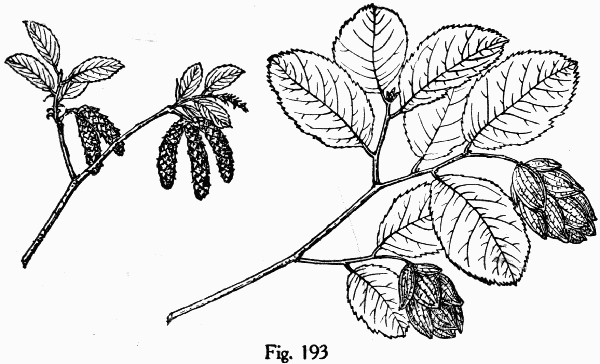
Leaves elliptic to obovate, acute or round at apex, gradually narrowed and often unequal at the rounded cuneate rarely cordate base, sharply serrate with small triangular callous teeth, covered with loose pale tomentum when they unfold, at maturity dark yellow-green and pilose above, pale and soft-pubescent below, 1′—2′ long, 1′—1½′ wide, with a slender yellow midrib slightly raised on the upper side, and slender primary veins connected by obscure reticulate veinlets; turning dull yellow in the autumn before falling; petioles ⅛′—¼′ long; stipules pale yellow-green, often tinged with red toward the apex, ½′ long, about ½′ wide. Flowers: staminate aments on stout stalks covered with rufous tomentum and sometimes ½′ long, rarely sessile, about ½′ long during their first season, with dark brown puberulous scales gradually contracted into a long slender subulate point, becoming when the flowers open 1′—1¼′ long, with broadly ovate concave scales abruptly narrowed into a nearly triangular point, yellow-green near the base, bright red above the middle; pistillate aments about ¼′ long, with ovate-lanceolate light yellow-green puberulous scales ciliate on the margins. Fruit: nuts ¼′ long, gradually narrowed at the apex, their involucres 1′ long, nearly glabrous at the apex, sometimes slightly stained with red toward the base, in clusters 1′—1½′ long and about ¾′ broad, on stems ½′ in length.
[205]
A tree 20°—30° high, with a trunk 12′—18′ in diameter, usually divided 1° or 2° above the ground into 3 or 4 stout upright stems 4′—5′ thick, slender pendulous often much contorted branches forming a narrow round-topped symmetrical head, and slender branchlets dark green and coated with hoary tomentum when they first appear, dark red-brown and pubescent during their first summer, becoming light cinnamon-brown, glabrous, and lustrous in the winter, and ultimately ashy gray. Winter-buds ovoid, dark brownish red, about ⅛′ long. Bark internally bright orange color, ⅛′ thick, separating into loose hanging plate-like scales light gray slightly tinged with red, and 1′—2′ long and wide. Wood light reddish brown, with thin sapwood.
Distribution. On the southern slope of the cañon of the Colorado River in Coconino County, Arizona, at altitudes of 6000°—7000° above the sea (Hance trail, seventy miles north of Flagstaff); in the cañon of Oak Creek, south of Flagstaff (P. Lowell); and on Grand River, Utah (Moab, Grant County, M. E. Jones).
3. BETULA L. Birch.
Trees, with smooth resinous bark marked by long longitudinal lenticels, often separating freely into thin papery plates, becoming thick, deeply furrowed, and scaly at the base of old trunks, short slender branches more or less erect and forming on young trees a narrow symmetrical pyramidal head, becoming horizontal and often pendulous on older trees, tough branchlets, short stout spur-like 2-leaved lateral branchlets much roughened by the crowded leaf-scars of many years, and elongated winter-buds covered by numerous ovate acute scales, and fully grown and bright green at midsummer. Leaves open and convex in the bud, often incisely lobed; stipules ovate and acute or oblong-obovate, scarious. Flowers in 3-flowered cymes, the lateral flowers of the cyme subtended by bractlets adnate to the base of the scale of the ament; staminate aments long, pendulous, solitary or clustered, appearing in summer or autumn in the axils of the last leaves of a branchlet or near the ends of short lateral branchlets, erect and naked during the winter, their scales in the spring broadly ovate, rounded, short-stalked, yellow or orange-color below the middle and dark chestnut-brown and lustrous above it; staminate flowers composed of a membranaceous 4-lobed calyx often 2-lobed by suppression, the anterior lobe obovate, rounded at apex, as long as the stamens, much longer than the minute posterior lobe, and of 2 stamens inserted on the base of the calyx, with short 2-branched filaments, each branch bearing an erect half-anther; pistillate aments oblong or cylindric, terminal on the short spur-like lateral branchlets, their scales closely imbricated, oblong-ovate, 3-lobed, light yellow, often tinged with red above the middle, accrescent, becoming brown and woody at maturity, and forming sessile or stalked erect or pendulous short or elongated strobiles usually ripening in the autumn, deciduous with the nuts from the slender rachis; calyx of the pistillate flower 0; ovary sessile, compressed, with styles stigmatic at apex. Nut minute, oval or obovoid, compressed, bearing at the apex the persistent stigmas, marked at the base by a small pale scar, the outer coat of the shell produced into a marginal wing interrupted at the apex.
Betula is widely distributed from the Arctic circle to Texas in the New World, and to southern Europe, the Himalayas, China, and Japan in the Old World, some species forming great forests at the north, or covering high mountain slopes. Of the twenty-eight or thirty species now recognized twelve are found in North America; of these nine are trees. Of exotic species the European and Asiatic Betula pendula Roth. in a number of forms is a common ornamental tree in the northern states, where several of the Birch-trees of eastern Asia also flourish. Many of the species produce wood valued by the cabinet-maker, or used in the manufacture of spools, shoe-lasts, and other small articles. The thin layers of the bark are impervious to water and are used to cover buildings, and for shoes, canoes, and boxes. The sweet sap provides an agreeable beverage.
Betula is the classical name of the Birch-tree.
[206]
CONSPECTUS OF THE NORTH AMERICAN ARBORESCENT SPECIES.
Strobiles oblong-ovoid, nearly sessile, erect, the lateral lobes of their scales broad and slightly divergent; wing not broader than the nut; leaves with 9—11 pairs of veins; bark of young branches aromatic.
Leaves heart-shaped or rounded at base; scales of the strobiles glabrous; bark dark brown, not separating into thin layers.
1. B. lenta (A, C).
Leaves cuneate or slightly heart-shaped at base; scales of the strobiles pubescent; bark yellow, or silvery white, rarely dull yellowish brown; separating into thin layers.
2. B. lutea (A).
Strobiles oblong or cylindric, erect, spreading or pendant, on slender peduncles; wing broader than the nut; leaves with 5—9 pairs of veins.
Strobiles oblong, erect, ripening in May or June, their scales pubescent, deeply lobed, the lateral lobes erect; leaves rhombic-ovate, glaucescent and more or less silky-pubescent beneath; bark light reddish-brown, separating freely into thin persistent scales.
3. B. nigra (A, C).
Strobiles cylindric, pendant or spreading.
Scales of the strobiles pubescent, with recurved lateral lobes, the middle lobe triangular, nearly as broad as long; leaves long-pointed; petioles slender, elongated.
Leaves triangular to rhombic, bright green and lustrous; bark chalky white, not separable into thin layers.
4. B. populifolia (A).
Leaves ovate, cuneate to truncate or rounded at base, dull blue-green; bark white tinged with pink, lustrous, not easily separable into thin layers.
5. B. cœrulea (A).
Scales of the strobiles with ascending or spreading lateral lobes, the middle lobe usually acuminate, longer than broad; leaves acute or acuminate.
Bark separating freely into thin layers; scales of the strobiles glabrous.
Bark creamy white, or in some forms orange-brown; leaves ovate.
6. B. papyrifera (A, B, C, F).
Bark dull reddish brown or nearly white; leaves rhombic to deltoid-ovate.
7. B. alaskana (A, B).
Bark not separable into thin layers, dark brown; scales of the strobiles glabrous or puberulous; branchlets glandular.
Leaves ovate, acute or acuminate, truncate or rounded at the broad base.
8. B. fontinalis (B, F, G).
Leaves broad-ovate to elliptic, acute, rounded or abruptly short-pointed, cuneate at base.
9. B. Eastwoodæ (F).
1. Betula lenta L. Cherry Birch. Black Birch.
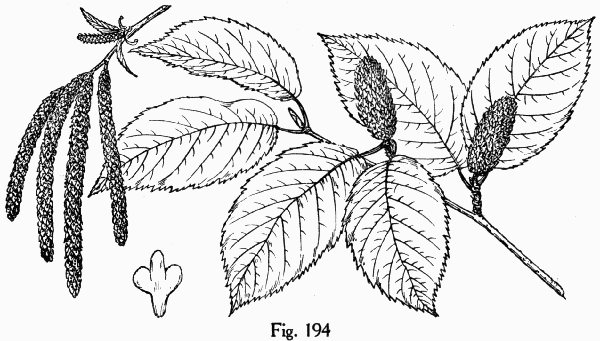
Leaves ovate to oblong-ovate, acute or acuminate, gradually narrowed and often unequal at the cordate or rounded base, sharply serrate with slender incurved teeth, or very rarely laciniately lobed (f. laciniata Rehdr.), when they unfold light green, coated on the lower surface with long white silky hairs, and slightly hairy on the upper surface, at maturity thin and membranaceous, dark dull green above, light yellow-green below, with small tufts of white hairs in the axils of the veins, 2½′—6′ long, 1½′—3′ wide, with a yellow midrib and primary veins prominent and hairy on the lower surface, and obscure reticulate cross veinlets; turning bright clear yellow late in the autumn; petioles stout, hairy, deeply grooved on the upper side, ¾′—1′ long; stipules ovate, acute, light green or nearly white, scarious and ciliate above the middle. Flowers: staminate aments during the winter about ¾′ long, nearly ¼′ thick, with ovate acute apiculate scales bright red-brown above the middle and light brown below it, becoming 3′—4′ long; pistillate aments ½′—¾′ long, about ⅛′ thick, with ovate pale green scales rounded at the apex; styles light pink. Fruit: strobiles oblong-ovoid, sessile, erect, glabrous, 1′—1½′ long, about ½′ thick; nut obovoid, pointed at base, rounded at apex, about as broad as its wing.
[207]
A tree, with aromatic bark and leaves, 70°—80° high, with a trunk 2°—5° in diameter, slender branches spreading almost at right angles, becoming pendulous toward the ends and gradually forming a narrow round-topped open graceful head, and branchlets light green, slightly viscid and pilose when they first appear, soon turning dark orange-brown, lustrous during the summer, bright red-brown in their first winter, becoming darker and finally dark dull brown slightly tinged with red. Winter-buds ovoid, acute, about ¼′ long, with ovate acute light chestnut-brown loosely imbricated scales, those of the inner ranks becoming ½′—¾′ long. Bark on young stems and branches close, smooth, lustrous, dark brown tinged with red, and marked by elongated horizontal pale lenticels, becoming on old trunks ½′—¾′ thick, dull, deeply furrowed and broken into large thick irregular plates covered with closely appressed scales. Wood heavy, very strong and hard, close-grained, dark brown tinged with red, with thin light brown or yellow sapwood of 70—80 layers of annual growth; largely used for floors, in the manufacture of furniture and for fuel, and occasionally in ship and boat-building. Sweet birch-oil distilled from the wood and bark is used for medicinal purposes and for flavoring as a substitute for oil of wintergreen, and beer is obtained by fermenting the sugary sap.
Distribution. Rich uplands from southern Maine to northwestern Vermont, and eastern Ohio and southward to northern Delaware and along the Appalachian Mountains up to altitudes of 4000° to northern Georgia; in Alabama, and in eastern Kentucky and Tennessee; a common forest tree at the north, and of its largest size on the western slopes of the southern Alleghany Mountains.
× Betula Jackii Schn., a natural hybrid of B. lenta with B. pumila Michx., has appeared in the Arnold Arboretum.
2. Betula lutea Michx. Yellow Birch. Gray Birch.
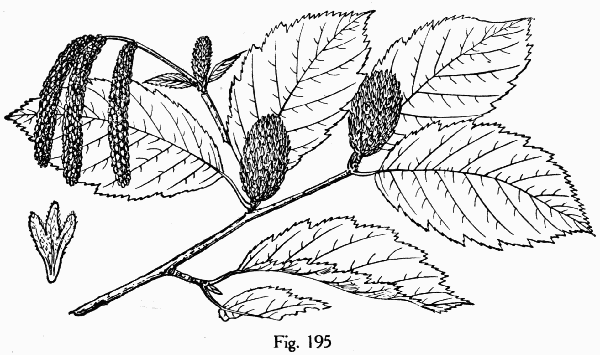
Leaves ovate to oblong-ovate, acuminate or acute at apex, gradually narrowed to the rounded cuneate or rarely heart-shaped usually oblique base, sharply doubly serrate, when they unfold bronze-green or red, and pilose with long pale hairs above and on the under side of the midrib and veins, at maturity dull dark green above, yellow-green below, 3′—4½′ long, 1½′—2′ wide, with a stout midrib and primary veins covered below near the base of the leaf with short pale or rufous hairs; turning clear bright yellow in the autumn; petioles slender, pale yellow, hairy, ¾′—1′ long; stipules ovate, acute, light green tinged with pink above the middle, about ½′ long. Flowers: staminate aments during the winter ¾′—1′ long, about ⅛′ thick, with ovate rounded scales light chestnut-brown and lustrous above the middle, ciliate on the margins, becoming 3′—3½′ long and ⅓′ thick; pistillate aments [208] about ⅔′ long, with acute scales, pale green below, light red and tipped with clusters of long white hair at apex, and pilose on the back. Fruit: strobiles erect, sessile, short-stalked, pubescent, 1′—1½′ long, about ¾′ thick; nut ellipsoidal to obovoid, about ⅛′ long, rather broader than its wing.
A tree, with slightly aromatic bark and leaves, occasionally 100° high, with a trunk 3°—4° in diameter, spreading and more or less pendulous branches forming a broad round-topped head, and branchlets at first green and covered with long pale hairs, light orange-brown and pilose during their first summer, becoming glabrous and light brown slightly tinged with orange, and ultimately dull and darker. Winter-buds about ¼′ long, somewhat viscid and covered with loose pale hairs during the summer, becoming light chestnut-brown, acute, and slightly puberulous in winter. Bark of young stems and of the branches bright silvery gray or light orange color, very lustrous, separating into thin loose persistent scales more or less rolled on the margins, becoming on old trees ½′ thick, reddish brown, and divided by narrow irregular fissures into large thin plates covered with minute closely appressed scales, or sometimes dull yellowish brown (B. alleghaniensis Britt.). Wood heavy, very strong, hard, close-grained, light brown tinged with red, with thin nearly white sapwood; largely used for floors, in the manufacture of furniture, button and tassel moulds, boxes, the hubs of wheels, and for fuel.
Distribution. Moist uplands, and southward often in swamps; one of the largest deciduous-leaved trees of northeastern America; Newfoundland and along the northern shores of the Gulf of St. Lawrence to the valley of Rainy River, and southward to Long Island (Cold Spring Harbor) and western New York, Pennsylvania, northern Delaware, southeastern Ohio, northern Indiana, southwestern Wisconsin, northern, northeastern and central Iowa, and from the mountains of Virginia and West Virginia to the highest peaks of North Carolina and Tennessee at altitudes between 3000° and 5000°; very abundant and of its largest size in the eastern provinces of Canada and in northern New York and New England; small and rare in southern New England and southward.
× Betula Purpusii Schn. believed to be a natural hybrid of B. lutea with B. pumila var. glandulifera Regel has been found in Michigan and in Tamarack Swamps in Hennepin, Pine and Anoka Counties, Minnesota.
3. Betula nigra L. Red Birch. River Birch.
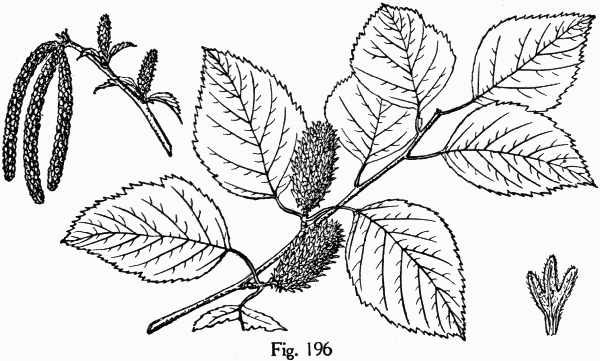
Leaves rhombic-ovate, acute, abruptly or gradually narrowed and cuneate at base, doubly serrate, and on vigorous young branches often more or less laciniately cut into acute [209] doubly serrate lobes, when they unfold light yellow-green and pilose above and coated below, especially on the midrib and petioles, with thick white tomentum, at maturity thin and tough, 1½′—3′ long, 1′—2′ wide, deep green and lustrous above, glabrescent, pubescent or ultimately glabrous below, except on the stout midrib and remote primary veins; turning dull yellow in the autumn; petioles slender, slightly flattened, tomentose, about ½′ long; stipules ovate, rounded or acute at apex, pale green, covered below with white hairs. Flowers: staminate aments clustered, during the winter about ⅞ long and 1/16′ thick, with ovate rounded dull chestnut-brown lustrous scales, becoming 2′—3′ long and ⅛′ thick; pistillate aments about ⅓′ long, with bright green ovate scales pubescent on the back, rounded or acute at apex, and ciliate with long white hairs. Fruit ripening in May and June; strobiles cylindric, pubescent, 1′—1½′ long, ½′ thick, erect on stout tomentose peduncles ½′ long; nut ovoid to ellipsoidal, ⅛′ in length, pubescent or puberulous at apex, about as broad as its thin puberulous wing, ciliate on the margin.
A tree, 80°—90° high, with a trunk often divided 15°—20° above the ground into 2 or 3 slightly diverging limbs, and sometimes 5° in diameter, slender branches forming in old age a narrow irregular picturesque crown, and branchlets coated at first with thick pale or slightly rufous tomentum gradually disappearing before winter, becoming dark red and lustrous, dull red-brown in their second year, and then gradually growing slightly darker until the bark separates into the thin flakes of the older branches; or often sending up from the ground a clump of several small spreading stems forming a low bushy tree. Winter-buds ovoid, acute, about ¼′ long, covered in summer with thick pale tomentum, glabrous or slightly puberulous, lustrous and bright chestnut-brown in winter, the inner scales strap-shaped, light brown tinged with red, and coated with pale hairs. Bark on young stems and large branches thin, lustrous, light reddish brown or silvery gray, marked by narrow slightly darker longitudinal lenticels, separating freely into large thin papery scales persistent for several years, and turning back and showing the light pink-brown tints of the freshly exposed inner layers, becoming at the base of old trunks from ¾′—1′ thick, dark red-brown, deeply furrowed and broken on the surface into thick closely appressed scales. Wood light, rather hard, strong, close-grained, light brown, with pale sapwood of 40—50 layers of annual growth; used in the manufacture of furniture, wooden ware, wooden shoes, and in turnery.
Distribution. Banks of streams, ponds, and swamps, in deep rich soil often inundated for several weeks at a time; near Manchester, Hillsboro County, New Hampshire, northeastern Massachusetts, Long Island, New York, southward to northern Florida through the region east of the Alleghany Mountains except in the immediate neighborhood of the [210] coast, through the Gulf states to the valley of the Navasota River, Brazos County, Texas, and through Arkansas, eastern Oklahoma, southeastern Kansas, and Missouri to Tennessee and Kentucky, southern and eastern Iowa, southern Minnesota, the valley of the Eau Claire River, Eau Claire County, Wisconsin, southern Illinois, the valley of the Kankakee River, Indiana, and southern Ohio; the only semiaquatic species and the only species ripening its seeds in the spring or early summer; attaining its largest size in the damp semitropical lowlands of Florida, Louisiana, and Texas; the only Birch-tree of such warm regions.
Often cultivated in the northeastern states as an ornamental tree, growing rapidly in cultivation.
4. Betula populifolia Marsh. Gray Birch. White Birch.
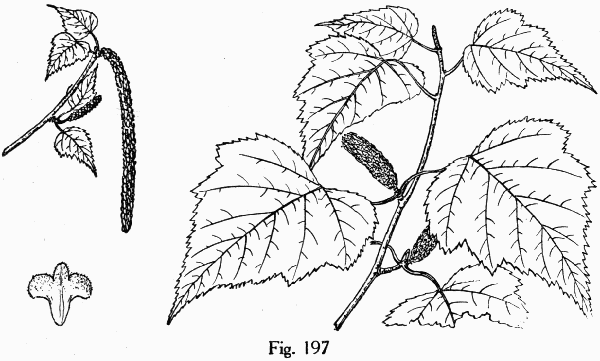
Leaves nearly triangular to rhombic, long-pointed, coarsely doubly serrate with stout spreading glandular teeth except at the broad truncate or slightly cordate or cuneate base, thin and firm, dark green and lustrous and somewhat roughened on the upper surface early in the season by small pale glands in the axils of the conspicuous reticulate veinlets, 2½′—3′ long, 1½′—2½′ wide, with a stout yellow midrib covered with minute glands, and raised and rounded on the upper side, and obscure yellow primary veins; turning pale yellow in the autumn; petioles slender, terete, covered with black glands, often stained with red on the upper side, ¾′—1′ long; stipules broadly ovate, acute, membranaceous, light green slightly tinged with red. Flowers: staminate aments usually solitary or rarely in pairs, 1¼′—1½′ long, about ⅛′ thick during the winter, becoming 2½′—4′ long, with ovate acute apiculate scales; pistillate aments slender, as long as their glandular peduncles about ½′ in length, with ovate acute pale green glandular scales. Fruit: strobiles cylindric, pubescent, obtuse at apex, about ¾′ long and ⅓′ thick, pendant or spreading on slender stems; nut ellipsoidal to obovoid, acute or rounded at base, a little narrower than its obovate wing.
A short-lived tree, 20°—30° or exceptionally 40° high, with a trunk rarely 18′ in diameter, short slender often pendulous more or less contorted branches usually clothing the stem to the ground and forming a narrow pyramidal head, and branchlets roughened by small raised lenticels, resinous-glandular when they first appear, gradually growing darker, bright yellow and lustrous before autumn like the young stems, bright reddish brown during their first winter, and ultimately white near the trunk; often growing in clusters of spreading stems springing from the stumps of old trees. Winter-buds ovoid, acute, pale chestnut-brown, glabrous, about ¼′ long. Bark about ⅓′ thick, dull chalky white on the outer surface, bright orange on the inner, close and firm, with dark triangular markings at the [211] insertion of the branches, becoming at the base of old trees thicker, nearly black, and irregularly broken by shallow fissures. Wood light, soft, not strong, close-grained, not durable, light brown, with thick nearly white sapwood; used in the manufacture of spools, shoe-pegs and wood pulp, for the hoops of barrels, and largely for fuel.
Distribution. Dry gravelly barren soil or on the margins of swamps and ponds; Prince Edward Island, Nova Scotia, New Brunswick, and the valley of the lower St. Lawrence River southward to northeastern, central and on South Mountain, Franklin County, Pennsylvania, and northern Delaware, and westward through northern New England and New York, ascending sometimes to altitudes of 1800°, to the southern shores of Lake Ontario, and at the foot of Lake Michigan, Indiana; rare and local in the interior, very abundant in the coast region of New England and the middle states; springing up in great numbers on abandoned farm-lands or on lands stripped by fire of their original forest covering; most valuable in its ability to grow rapidly in sterile soil and to afford protection to the seedlings of more valuable and less rapid-growing trees.
A form with deeply divided leaves (var. laciniata Loud.) and one with purple leaves (var. purpurea E & B) are occasionally cultivated.
A shrub believed to be a natural hybrid of B. populifolia with B. pumila Michx. has been found near Mt. Mansfield, Vermont.
5. Betula cœrulea Blanch. Blue Birch.
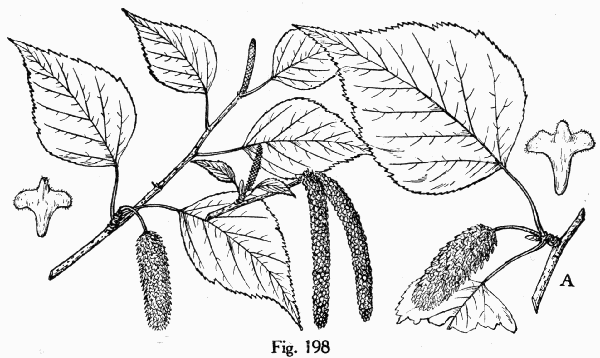
Leaves ovate, long-pointed, broadly or narrowly concave-cuneate at the entire often unequal base, sharply mostly doubly serrate above with straight or incurved glandular often apiculate teeth, covered above when they unfold with pale deciduous glands, at maturity dull bluish green above, pale yellow-green below, and sparingly villose along the under side of the slender yellow midrib and primary veins, 2′—2½′ long, 1′—1½′ wide; petioles slender, ¾′—1¼′ long, yellow more or less deeply tinged with red. Flowers: staminate aments usually in pairs, or singly or in 3’s, 1¼′—2′ long, about 3/16′ thick, with ovate rounded short-pointed scales; pistillate aments slender, about ⅓′ long, with acuminate pale green much reflexed scales. Fruit: strobiles cylindric, pubescent, slightly narrowed at the obtuse apex, about 1′ long and ¼′ thick, pendant on slender peduncles ¼′—½′ in length; nut ellipsoidal, much narrower than its broad wing.
A tree, rarely more than 30° high, with a trunk 8′—10′ in diameter, small ascending finally spreading branches, and slender branchlets marked by numerous small raised pale lenticels, purplish and sparingly villose when they first appear, soon glabrous, becoming [212] bright red-brown; often forming clumps of several stems. Bark thin, white tinged with rose, lustrous, not readily separable into layers, the inner bark light orange color.
Distribution. Moist slopes, Stratton and Windham, Windham County, Vermont, at altitudes of about 1800° (W. H. Blanchard), Haystack Mountain, Aroostook County, Maine (M. L. Fernald); the American representative of the European Betula pendula Roth., and probably widely distributed over the hills of northern New England and eastern Canada. Perhaps with its variety best considered a natural hybrid between B. papyrifera and B. populifolia.
Apparently passing into a form with larger leaves often rounded and truncate at the broad base, 3′—3½′ long and 2′ wide, stouter staminate aments, and strobiles frequently 1½′ long and ½′ thick (var. Blanchardii Sarg. fig. 198 A). This under favorable conditions is a tree 60°—70° high, with a trunk 18′ in diameter; common with Betula cœrulea at Windham and Stratton, Vermont (W. H. Blanchard), and on a hill near the coast in Washington County, Maine (M. L. Fernald).
6. Betula papyrifera Marsh. Canoe Birch. Paper Birch.
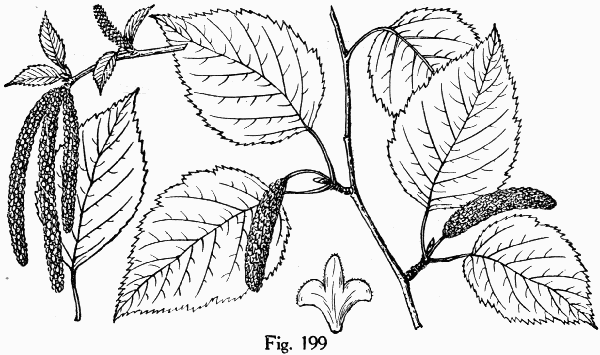
Leaves ovate, acute or acuminate with a short broad point, coarsely usually doubly and often very irregularly serrate except at the rounded abruptly cuneate or gradually narrowed base, bright green, glandular-resinous, pubescent and clothed below on the midrib and primary veins and on the petioles with long white hairs when they unfold, at maturity thick and firm, dull dark green and glandless or rarely glandular on the upper surface, light yellow-green and glabrous or puberulous, with small tufts of pale hairs in the axils of the primary veins and covered with many black glands on the lower surface, 2′—3′ long, 1½′—2′ wide, with a slender yellow midrib marked, like the remote primary veins, with minute black glands, turning light clear yellow in the autumn; petioles stout, yellow, glandular, glabrous or pubescent, ½′—¾′ long; stipules ovate, acute, ciliate on the margins with pale hairs, light green. Flowers: staminate aments clustered during the winter, ¾′—1¼′ long, about ⅛′ thick, with ovate, acute scales light brown below the middle, dark red-brown above it, becoming 3½′—4′ long, and about ⅓′ thick; pistillate aments 1′—1¼′ long, about 1/16′ thick, with light green lanceolate scales long-pointed and acute or rounded at apex; styles bright red. Fruit: strobiles cylindric, glabrous, about 1½′ long and ⅓′ thick, hanging on slender stalks, their scales very rarely entire (var. elobata Sarg.); nut ellipsoidal, about 1/16′ long, much narrower than its thin wing.
A tree, usually 60°—70° tall, with a trunk 2°—3° in diameter, becoming in old age, or when crowded by other trees, branchless below and supporting a narrow open head of [213] short pendulous branches, and branchlets at first light green, slightly viscid, marked by scattered orange-colored oblong lenticels and covered with long pale hairs, dark orange color and glabrous or pubescent during the summer, becoming dull red in their first winter, gradually growing dark orange-brown, lustrous for four or five years and ultimately covered with the white papery bark of older branches. Winter-buds obovoid, acute, about ¼′ long, pubescent below the middle and coated with resinous gum at midsummer, dark chestnut-brown, glabrous and slightly resinous during the winter, their inner scales becoming strap-shaped, rounded at apex, about ½′ long and ⅛′ wide. Bark on young trunks and large limbs thin, creamy white or rarely bronze color or orange-brown and lustrous on the outer surface, bright orange color on the inner, marked by long narrow slightly darker colored raised lenticels, separating into thin papery layers, pale orange color when first exposed to the light, becoming on old trunks for a few feet above the ground sometimes ½′ thick, dull brown or nearly black, sharply and irregularly furrowed and broken on the surface into thick closely appressed scales. Wood light, strong, hard, tough, very close-grained, light brown tinged with red, with thick nearly white sapwood; largely used for spools, shoe-lasts, pegs, and in turnery, the manufacture of wood-pulp, and for fuel. The tough resinous durable bark impervious to water is used by all the northern Indians to cover their canoes and for baskets, bags, drinking-cups, and other small articles, and often to cover their wigwams in winter.
Distribution. Rich wooded slopes and the borders of streams, lakes, and swamps scattered through forests of other trees; Labrador to the southern shores of Hudson’s Bay, and southward to Long Island, New York, northern Pennsylvania, central Michigan, northern Wisconsin, northern-central Iowa, eastern Nebraska, North and South Dakota and Wyoming; common in the maritime provinces of Canada and North of the Great Lakes, and in northern New England and New York; small and comparatively rare in the coast region of southern New England and southward; on the highest mountains of New England and northward the var. minor S. Wats and Cov. is common as a small shrub.
Often planted in the northeastern states as an ornamental tree.
× Betula Sandbergii Britt. and its f. maxima Rosend. generally believed to be natural hybrids of B. papyrifera and B. pumila var. glandulifera Regl. occur in Tamarack swamps in Hennepin County, Minnesota.
Passing into the following varieties.
Betula papyrifera var. cordifolia Fern.
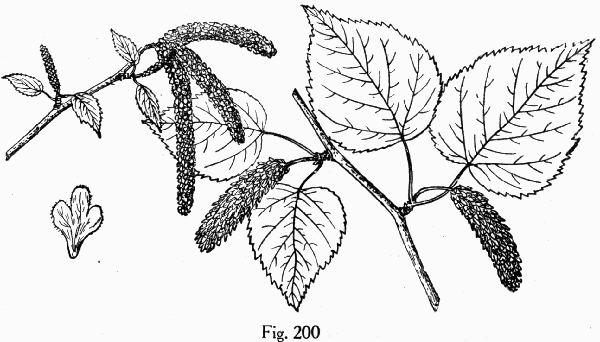
Leaves ovate, abruptly pointed and acuminate or acute at apex, cordate at base, coarsely doubly serrate, glabrous or pilose on the under side of the midrib and veins, often furnished [214] below with axillary tufts of pale hairs, 1½′—3′ long, 1′—2½′ wide; petioles glabrous or rarely villose, ½′—¾′ in length. Fruit: strobiles ¾′—2′ long and ¼′—½′ thick, on villose peduncles up to ¾′ in length; scales glabrous or pubescent.
A tree rarely more than 30° tall, with slender glabrous or pubescent branchlets, and at high altitudes on the New England mountains reduced to a low shrub. Bark separating in thin layers, white or dark reddish brown.
Distribution. Labrador and Newfoundland to northern New England, and westward to the shores of Green Bay, Wisconsin, and those of Lake Superior, Minnesota (Grand Marais, Cook County); on Mt. Mitchell, North Carolina, at an altitude of 5550° (W. W. Ashe).
Betula papyrifera var. subcordata Sarg.
Betula subcordata Rydb.
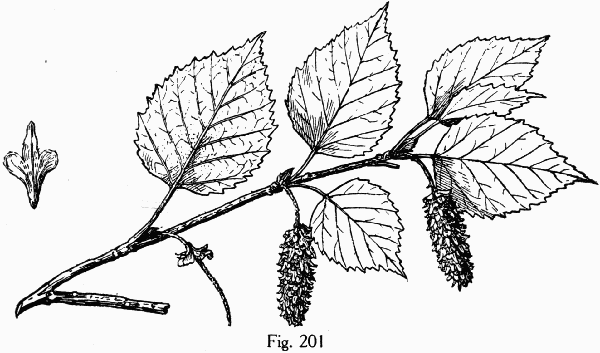
Leaves ovate, acute or acuminate at apex, slightly cordate or rounded at base, rarely slightly lobed above the middle, finely often doubly serrate with teeth pointing forward or spreading, glabrous, 2′—2½′ long, 1′—1½′ wide; petioles sparingly villose or glabrous, ½′—¾′ in length. Fruit: strobiles drooping on slender peduncles 1′—1½′ long, about ⅓′ thick, their scales puberulous, ciliate on the margins, the middle lobe acute, rather longer than the broad truncate lateral lobes; nut obovoid, cuneate at base, 1/12′ long, narrower than its wings.
A tree 25°—40° or occasionally 60° high, with a trunk 12′—18′ in diameter, and slightly glandular glabrous red-brown branchlets. Bark separating freely into thin layers, white or occasionally dark reddish brown or orange color.
Distribution. Alberta (Crow Nest Pass, neighborhood of Jasper and Cypress Hills), through northern Montana and Idaho to western Washington, northeastern Oregon (Minum River Valley) and British Columbia.
Betula papyrifera var. montanensis Sarg.
Betula montanensis Butler.
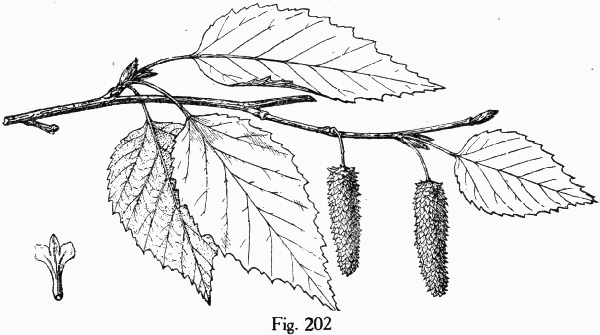
Leaves broadly ovate, acute at apex, truncate or rounded at base to oblong-ovate or lanceolate and long-pointed and acuminate at apex, narrowed and rounded at base, coarsely doubly serrate, thick, dark green above, paler, sparingly pubescent and furnished with [215] conspicuous tufts of axillary hairs below, 3′—5′ long, 2′—2¼′ wide; petioles puberulous, ¾′—1′ in length. Flowers unknown. Fruit: strobiles cylindric, 1¾′—2′ long, ½′ thick, pendent on puberulous peduncles ½′—¾′ in length, their scales puberulous, finely ciliate on the margins, the slender base of those below the middle of the ament rather more than twice as long as the expanded upper portion of the scale.
A tree 40°—50° high, with a trunk 12′—18′ in diameter, and slender branchlets red-brown, lustrous, marked by small pale lenticels and puberulous during their first season. Winter-buds narrow-obovoid, acuminate, dark red-brown, resinous, ⅓′ long. Bark white, or dark gray or brown.
Distribution. Shore of Yellow Bay, Flathead Lake, Flathead County, Montana, and at Sandpoint, Bonner County, Idaho.
Betula papyrifera var. occidentalis Sarg.
Betula occidentalis Hook.
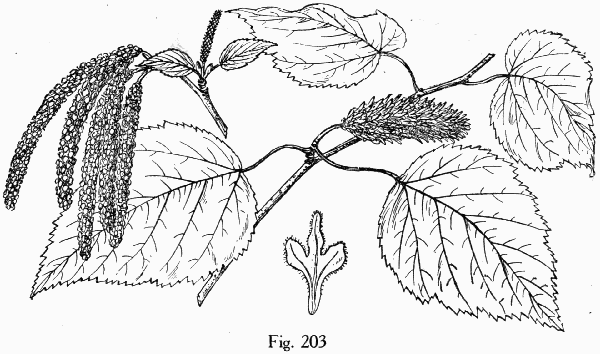
Leaves ovate, acute, or abruptly acuminate at apex, rounded or occasionally cordate or rarely cuneate at the broad base, coarsely and generally doubly serrate with straight or incurved glandular teeth, thin and firm in texture, dull dark green above, pale yellow-green below, and puberulous on both sides of the stout yellow midrib and slender primary veins, 3′—4′ long, 1½′—2′ wide; petioles stout, glandular, at first tomentose, ultimately pubescent or puberulous, about ¾′ long; stipules oblong-obovate, rounded and acute or apisculate at apex, ciliate on the margin, puberulous, glandular-viscid. Flowers: staminate aments during the winter about ¾′ long and ⅛′ thick, with ovate scales rounded or abruptly narrowed and acute at apex; puberulous on the outer surface, ciliate on the margins, becoming 3′—4′ long and about ¼′ thick; pistillate aments about 1′ long and 1/16′ thick, with acuminate bright green scales. Fruit: strobiles cylindric, puberulous, spreading, 1¼′—1½′ long, ¼′—½′ thick, on stout peduncles ¾′ in length, their scales ciliate on the margins; nut oval, about 1/16′ in length, and nearly as wide as its wings.
A tree, 100°—120° high, with a trunk 3°—4° in diameter, comparatively small branches often pendulous on old trees, and pale orange-brown branchlets more or less glandular and coated with long pale hairs when they first appear, becoming bright orange-brown and nearly destitute of glands during their first winter, and in their second year orange-brown, glabrous, and very lustrous. Winter-buds acute, bright orange-brown, ⅛′—¼′ long, their light brown inner scales sometimes becoming ¾′ in length. Bark thin, marked by long oblong horizontal raised lenticels, dark orange-brown or white, very lustrous, separating [216] freely into thin papery layers displaying in falling the bright orange-yellow inner bark.
Distribution. Banks of streams and lakes; southwestern British Columbia and northwestern Washington and eastward through eastern Washington and northern Idaho to northern Montana west of the continental divide; nowhere common and probably of its largest size on the alluvial banks of the lower Fraser River, and on the islands of Puget Sound.
Betula papyrifera var. kenaica A. Henry. Red Birch. Black Birch.
Betula kenaica Evans.
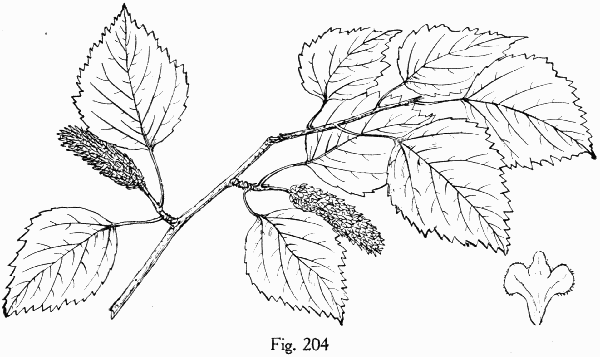
Leaves ovate, acute or acuminate, broadly cuneate or somewhat rounded at the entire base, irregularly coarsely often doubly serrate, glabrous, dark dull green above, pale yellow-green below, 1½′—2′ long, 1′—1¾′ wide, with a slender yellow midrib and 5 pairs of thin primary veins; petioles slender, ¾′—1′ long. Flowers: staminate aments clustered, 1′ long, [217] with ovate acute scales apiculate at apex, puberulous on the outer surface; pistillate aments, ⅓′—½′ long, about 1/16′ thick, on slender glandular pubescent peduncles ½′—¾′ in length; scales acuminate light green strongly reflexed; styles bright red. Fruit: strobiles cylindric, glabrous, 1′ long, their scales ciliate on the margins; nut oval, somewhat narrower than its thin wing.
A tree, 30°—40° high, with a trunk 12′—20′ in diameter, wide-spreading branches, stout branchlets marked by numerous small pale lenticels, bright red-brown during 2 or 3 years, gradually becoming darker. Bark thin, more or less furrowed, very dark brown or nearly black near the base of the trunk, grayish white or light reddish brown and separating into thin layers higher on the stem and on the branches.
Distribution. Coast of Alaska from Cook Inlet southward to the head of the Lynn Canal.
7. Betula alaskana Sarg. White Birch.
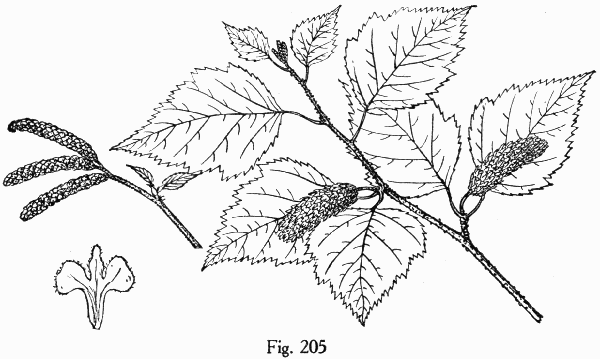
Leaves rhombic to deltoid-ovate, long-pointed, truncate, rounded or broadly cuneate, or on leading shoots occasionally cordate at the entire base, coarsely and often doubly glandular-serrate, thin, dark green above, pale and yellow-green below, 1½′—3′ long, 1′—1½′ wide, with a slender midrib and primary veins pubescent or ultimately glabrous below; petioles often bright red, somewhat hairy at first, finally glabrous, about 1′ long; Flowers: staminate aments clustered, sessile, 1′ long, ⅛′ thick, with ovate acuminate scales puberulous on the outer surface, and bright red, with yellow margins; pistillate aments slender, cylindric, glandular, 1′ long, ⅛′ thick, on stout peduncles nearly ½′ in length. Fruit: strobiles glabrous, pendulous or spreading, 1′—1¼′ long, ⅓′—½′ thick, their scales ciliate on the margins; nut oval, narrower than its broad wing.
A tree, usually 30°—40°, occasionally 80°, high, with a trunk 6′—12′ in diameter, slender erect and spreading or pendulous branches, and glabrous bright red-brown branchlets more or less thickly covered during their first year with resinous glands sometimes persistent until the second or third season. Winter-buds ovoid, obtuse at the gradually narrowed apex, about ¼′ long, with light red-brown shining outer scales sometimes ciliate on the margins, and oblong rounded scarious inner scales hardly more than ½′ long when fully grown. Bark thin, marked by numerous elongated dark slightly raised lenticels, dull reddish brown or sometimes nearly white on the outer surface, light red on the inner surface, close and firm, finally separable into thin plate-like scales.
Distribution. Valley of the Saskatchewan northwestward to the valley of the Yukon, [218] growing sparingly near the banks of streams in forests of coniferous trees and in large numbers on sunny slopes and hillsides; the common Birch-tree of the Yukon basin.
× Betula commixta Sarg., a shrub, growing on the tundra near Dawson, Yukon Territory, is believed to be a hybrid between B. alaskana and B. glandulosa Michx.
8. Betula fontinalis Sarg. Black Birch.
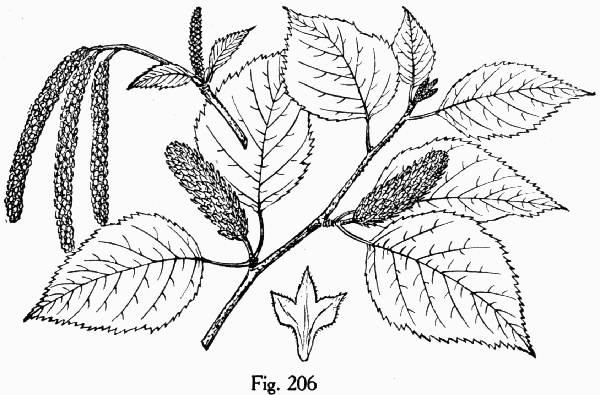
Leaves ovate, acute or acuminate, sharply and often doubly serrate, except at the rounded or abruptly cuneate often unequal base, and sometimes slightly laciniately lobed, pale green, pilose above, and covered by conspicuous resinous glands when they unfold, at maturity thin and firm, dark dull green above, pale yellow-green, rather lustrous and covered by minute glandular dots below, 1′—2′ long, ¾′—1′ wide, with a slender pale midrib, remote glandular veins, and rather conspicuous reticulate veinlets; turning dull yellow in the autumn; petioles stout, puberulous, light yellow, glandular-dotted, flattened on the upper side, often flushed with red, ⅓′—½′ long; stipules broadly ovate, acute or rounded at apex, slightly ciliate, bright green, soon becoming pale and scarious. Flowers: staminate aments clustered, ½′—¾′ long and 1/16′ thick during the winter, with ovate acute light chestnut-brown scales pale and slightly ciliate on the margins, becoming 2′—2½′ long, and about ⅛′ thick, with apiculate scales; pistillate aments short-stalked, about ¾′ long, with ovate acute green scales; styles bright red. Fruit: strobiles cylindric, rather obtuse, puberulous or nearly glabrous, 1′—1¼′ long, ½′ thick, erect or pendulous on slender glandular peduncles, ¼′ to nearly ¾′ in length; their scales ciliate, puberulous, the lateral lobes ascending, shorter than the middle lobe; nut ovoid or obovoid, puberulous at apex, nearly as wide as its wing.
A tree 20°—25° high with a short trunk, rarely more than 12′ or 14′ in diameter, ascending spreading and somewhat pendulous branches forming a broad open head, and slender branchlets, when they first appear light green glabrous or puberulous and covered with lustrous resinous glands persistent during their second season, and dark red-brown in their first winter; more commonly shrubby, with many thin spreading stems forming open clusters, 15°—20° high; often much lower, and frequently crowded in almost impenetrable thickets. Winter-buds ovoid, acute, very resinous, chestnut-brown, ¼′ long. Bark about ¼′ thick, dark bronze color, very lustrous, marked by pale brown longitudinal lenticels becoming on old trunks often 6′—8′ long and ¼′ wide. Wood soft and strong, light brown, with thick lighter-colored sapwood; sometimes used for fuel and fencing.
Distribution. Moist soil near the banks of streams usually in mountain cañons; generally [219] distributed, although nowhere very common: valley of the Saskatchewan (Saskatoon), Saskatchewan, westward to the basin of the upper Fraser and Pease Rivers, British Columbia, southward along the Rocky Mountains to eastern Utah, northern New Mexico and Arizona, the valleys of the Shasta region and the eastern slope of the Sierra Nevada, northern California, and eastward in the United States to the eastern foothills of the Rocky Mountains of Colorado, the Black Hills of South Dakota, and northwestern Nebraska. Passing into
Betula fontinalis var. Piperi Sarg.
Betula Piperi Britt.
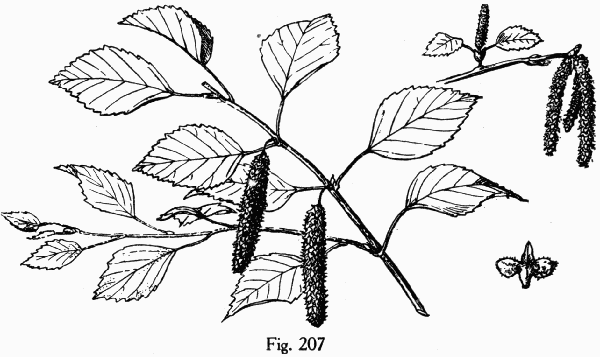
A tree occasionally 50°—60° high with a tall trunk 12′—18′ in diameter, short spreading branches, and usually longer and often narrower strobiles.
Distribution. Spokane, Spokane County, Almota and Pullman, Whitman County, eastern Washington.
9. Betula Eastwoodæ Sarg.
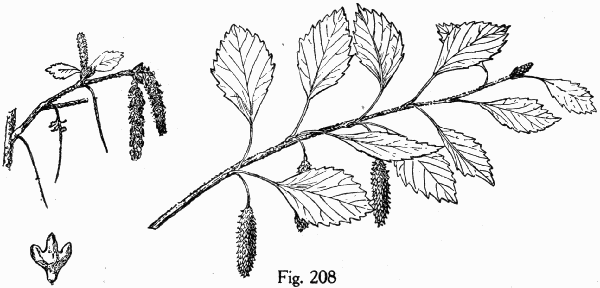
Leaves broad-ovate to elliptic, acute, rounded or abruptly short-pointed at apex, coarsely serrate except at the cuneate base, thick, glabrous, dark green above, pale below, reticulate-venulose, [220] the veinlets more conspicuous on the lower surface, 1′—1½′ long, ¾′—1½′ wide; petioles slender, glabrous ⅕′—⅓′ in length; stipules scarious, ovate-oblong, rounded at apex. Flowers: staminate aments usually solitary or in pairs, sessile, 1′—1¼′ long, ⅕′ thick, with broadly ovate pubescent dark red scales acute and apiculate at apex; pistillate aments ½′ long, about 1/12′ thick, with acute light green scales. Fruit: strobiles pendulous on peduncles ⅓′—½′ long, cylindric, ¾′ in length, about ⅙′ thick, their scales glabrous longer than broad, the lobes narrowed at the rounded apex, ciliate, the lateral slightly spreading, one third shorter than the terminal lobe.
A tree 18°—20° high, with a trunk rarely more than 6′ in diameter, and slender red glabrous branchlets thickly covered with circular white glands. Bark close, chestnut-brown, marked by conspicuous horizontal white lenticels, about ⅕′ thick.
Distribution. Swamps near Dawson, Yukon Territory, forming jungles with Betula glandulosa Michx., B. alaskana Sarg., and various Willows; as a large shrub in Jasper Park near Jasper, Alberta.
4. ALNUS L. Alder.
Trees and shrubs, with astringent scaly bark, soft straight-grained wood, naked stipitate winter-buds formed in summer and nearly inclosed by the united stipules of the first leaf, becoming thick, resinous, and dark red. Leaves open and convex in the bud, falling without change of color; stipules of all but the first leaf ovate, acute, and scarious. Flowers vernal, or rarely opening in the autumn from aments of the year, in 1—3-flowered cymes in the axils of the peltate short-stalked scales of stalked aments formed in summer or autumn in the axils of the last leaves of the year or of those of minute leafy bracts; staminate aments elongated, pendulous, paniculate, naked and erect during the winter, each staminate flower subtended by 3—5 minute bractlets adnate to the scales of the ament, and composed of a 4-parted calyx, and 1—3 or usually 4 stamens inserted on the base of the calyx opposite its lobes, with short simple filaments; pistillate aments ovoid or oblong, erect, stalked, produced in summer in the axils of the leaves of a branch developed from the axils of an upper leaf of the year, and below the staminate inflorescence, inclosed at first in the stipules of the first leaf, emerging in the autumn and naked during the winter, or remaining covered until early spring; pistillate flowers in pairs, each flower subtended by 2—4 minute bractlets adnate to the fleshy scale of the ament becoming at maturity thick and woody, obovate, 3—5-lobed or truncate at the thickened apex, forming an ovoid or subglobose strobile persistent after the opening of its closely imbricated scales; calyx 0; ovary compressed; nut minute, bright chestnut-brown, ovoid to oblong, flat, bearing at the apex the remnants of the style, marked at the base by a pale scar, the outer coat of the shell produced into lateral wings often reduced to a narrow membranaceous border.
Alnus inhabits swamps, river bottom-lands, and high mountains, and is widely and generally distributed through the northern hemisphere, often forming the most conspicuous feature of vegetation on mountain slopes, ranging at high altitudes southward in the New World through Central America to Colombia, Peru, and Bolivia, and to upper Assam and Japan in the Old World. Of the eighteen or twenty species now recognized nine are North American; of these, six attain the size and habit of trees. Of the exotic species, Alnus vulgaris Hill., a common European, north African, and Asiatic timber-tree, was introduced many years ago into the northeastern states, where it has become locally naturalized. The wood of Alnus is very durable in water, and the astringent bark and strobiles are used in tanning leather and in medicine.
Alnus is the classical name of the Alder.
CONSPECTUS OF THE NORTH AMERICAN ARBORESCENT SPECIES.
Flowers opening in spring with or after the leaves; stamens 4; pistillate aments inclosed during the winter; wing of the nut broad; leaves ovate, sinuately lobed, lustrous on the lower surface.
1. A. sinuata (B, F, G).
[221]
Flowers opening in winter or early spring before the unfolding of the leaves; pistillate aments usually naked during the winter.
Wing of the nut broad; leaves ovate or elliptic, rusty-pubescent on the lower surface; pistillate aments often inclosed during the winter; stamens 4.
2. A. rubra (B, G).
Wing of the nut reduced to a narrow border.
Stamens 4; leaves oblong-ovate, glabrous or puberulous on the lower surface.
3. A. tenuifolia (B, F, G).
Stamens usually 2, or 3.
Leaves ovate or oval.
4. A. rhombifolia (B, F, G).
Leaves oblong-lanceolate, acute.
5. A. oblongifolia (H).
Flowers opening in autumn from aments of the year; stamens 4; wing of the nut reduced to a narrow border; leaves oblong-ovate or obovate, dark green and lustrous above, pale yellow-green below.
6. A. maritima (A).
1. Alnus sinuata Rydb. Alder.
Alnus sitchensis Sarg.
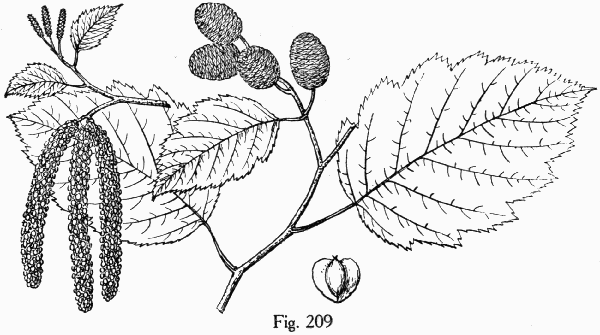
Leaves ovate, acute, full and rounded and often unsymmetrical and somewhat oblique or abruptly narrowed and cuneate at base, divided into numerous short acute lateral lobes, sharply and doubly serrate with straight glandular teeth, glandular-viscid as they unfold, at maturity membranaceous, yellow-green on the upper surface, pale and very lustrous on the lower surface, glabrous, or villose along the under side of the stout midrib with short brown hairs also forming tufts in the axils of the numerous slender primary veins, 3′—6′ long, 1½′—4′ wide; petioles stout, grooved, abruptly enlarged at the base, ½′—¾′ in length; stipules oblong to spatulate, rounded and apiculate at apex, puberulous, about ¼′ long. Flowers: staminate aments sessile, in pairs in the axils of the upper leaves sometimes reduced to small bracts, and single in the axil of the leaf next below, during the winter about ½′ long and ⅛′ thick, with dark red-brown shining puberulous apiculate scales, becoming when the flowers open from spring to midsummer 4′ or 5′ long, with a puberulous light red rachis and ovate acute apiculate 3-flowered scales; calyx-lobes rounded, shorter than the 4 stamens; pistillate aments in elongated panicles, inclosed during winter in buds formed the previous summer in the axils of the leaves of short lateral branchlets, long-pedunculate, ⅓′ long, ⅙′ thick. Fruit: strobiles on slender peduncles in elongated sometimes leafy panicles 4′—6′ in length, oblong, ½′—⅝′ long, about ⅓′ thick, their truncate scales thickened at the apex; nut oval, about as wide as its wings.
[222]
A tree, sometimes 40° high, with a trunk 7′—8′ in diameter, short small nearly horizontal branches forming a narrow crown, and slender slightly zigzag branchlets puberulous and very glandular when they first appear, bright orange-brown and lustrous and marked by numerous large pale lenticels during their first season, much roughened during their second year by the elevated crowded leaf-scars, becoming light gray. Winter-buds acuminate, dark purple, covered especially toward the apex with close fine pubescence, about ½′ long. Bark thin bluish gray, with bright red inner bark; often a shrub only a few feet tall spreading into broad thickets.
Distribution. Northwest coast from the borders of the Arctic Circle to the high mountains of northern California; common in the valley of the Yukon and eastward through British Columbia to Alberta, and through Washington and Oregon to the western slopes of the Rocky Mountains in Montana; at the north with dwarf Willows, forming great thickets; in southeastern Alaska often a tall tree on rich moist bottom-lands near the mouths of mountain streams, and at the upper limits of tree growth a low shrub; very abundant in the valley of the Yukon on the wet banks of streams and often arborescent in habit; in British Columbia and the United States generally smaller and a shrub, growing usually only at altitudes of more than 3000° above the sea, and often forming thickets on the banks of streams and lakes.
2. Alnus rubra Bong. Alder.
Alnus oregona Nutt.
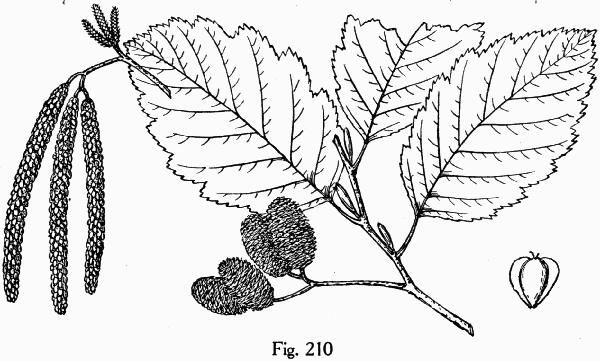
Leaves ovate to elliptic, acute, abruptly or gradually narrowed and cuneate at base, crenately lobed, dentate with minute gland-tipped teeth, and slightly revolute on the margins, covered when they unfold with pale tomentum, at maturity thick dark green and glabrous or pilose with scattered white hairs above, clothed below with short rusty pubescence, 3′—5′ long, 1¾′—3′ wide, or on vigorous branchlets sometimes 8′—10′ long, with a broad midrib and primary veins green on the upper side and orange-colored on the lower, the primary veins running obliquely to the points of the lobes and connected by conspicuous slightly reticulate cross veinlets; petioles orange-colored, nearly terete, slightly grooved, ¼′—¾′ in length; stipules ovate, acute, pale green flushed with red, tomentose, ⅛′—¼′ long. Flowers: staminate aments in red-stemmed clusters, during the winter 1¼′ long, ⅛′ thick, with dark red-brown lustrous closely appressed scales, becoming 4′—6′ long and ¼′ thick, with ovate acute orange-colored glabrous scales; calyx yellow, with ovate rounded [223] lobes rather shorter than the 4 stamens; pistillate aments in short racemes usually inclosed during the winter in buds formed during the early summer and opening in the early spring, ⅓′—½′ long, about 1/16′ thick, with dark red acute scales; styles bright red. Fruit: strobiles raised on stout orange-colored peduncles sometimes ½′ in length, ovoid or oblong, ½′—1′ long, ⅓′—½′ thick, with truncate scales much thickened toward the apex; nut orbicular to obovoid, surrounded by a membranaceous wing.
A tree, usually 40°—50°, occasionally 90° high, with a trunk sometimes 3° in diameter, slender somewhat pendulous branches forming a narrow pyramidal head, and slender branchlets marked by minute scattered pale lenticels, light green and coated at first with hoary tomentum sometimes persistent until their second year, becoming during the first winter bright red and lustrous and ultimately ashy gray. Winter-buds about ⅓′ long, dark red, covered with pale scurfy pubescence. Bark rarely more than ¾′ thick, close, roughened by minute wart-like excrescences, pale gray or nearly white, with a thin outer layer, and bright red-brown inner bark. Wood light, soft, brittle, not strong, close-grained, light brown tinged with red, with thick nearly white sapwood; in Washington and Oregon largely used in the manufacture of furniture and for smoking salmon; by the Indians of Alaska the trunks are hollowed into canoes.
Distribution. Shores of Yakutat Bay, southeastern Alaska, southward near the coast to the cañons of the Santa Inez Mountains, Santa Barbara County, California; common along the banks of streams, and of its largest size near the shores of Puget Sound; in California most abundant in Mendocino, Humboldt and Marin Counties, forming groves on bottom-lands near the coast; often ranging inland for 20 or 30 miles, and occasionally ascending to altitudes of 2000° above the sea.
3. Alnus tenuifolia Nutt. Alder.
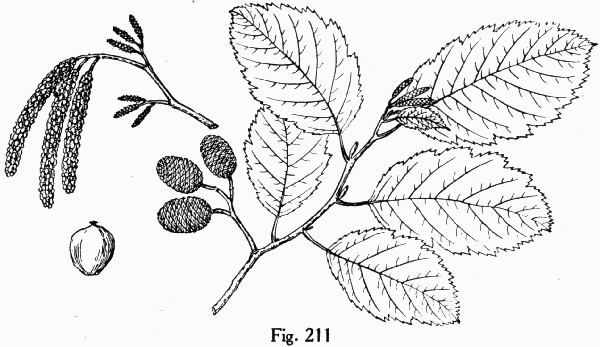
Leaves ovate-oblong, acute or acuminate, broad and rounded or cordate or occasionally abruptly narrowed and cuneate at base, usually acutely laciniately lobed and doubly serrate, when they unfold light green often tinged with red, pilose on the upper surface and coated on the lower with pale tomentum, at maturity thin and firm, dark green and glabrous above, pale yellow-green and glabrous or puberulous below, 2′—4′ long, 1½′—2½′ wide, with a stout orange-colored midrib impressed on the upper side, and slender primary veins running to the points of the lobes; petioles stout, slightly grooved, orange-colored, ½′—1′ in length; stipules ovate, acute, thin, and scarious, ½′ long, about ⅛′ wide, covered with pale pubescence. Flowers: staminate aments 3 or 4 in number in slender-stemmed racemes, nearly sessile or raised on stout peduncles often ½′ long, during the winter light purple, ¾′—1′ long [224] and ¼′ thick, becoming 1½′—2′ in length; calyx-lobes rounded, shorter than the 4 stamens; pistillate aments naked during the winter, dark red-brown, nearly ¼′ long, with acute apiculate loosely imbricated scales, only slightly enlarged when the flowers open. Fruit: strobiles obovoid-oblong, ⅓′—½′ long, their scales much thickened, truncate and 3-lobed at apex; nut nearly circular to slightly obovoid, surrounded by a thin membranaceous border.
A tree, occasionally 30° tall, with a trunk 6′—8′ in diameter, small spreading slightly pendulous branches forming a narrow round-topped head, and slender branchlets marked at first by a few large orange-colored lenticels and coated with fine pale or rusty caducous pubescence, becoming light brown or ashy gray more or less deeply flushed with red in their first winter and ultimately paler; more often shrubby, with several spreading stems, and at the north and at high altitudes frequently only 4°—5° tall. Winter-buds ¼′—⅓′ long, bright red, and puberulous. Bark rarely more than ¼′ thick, bright red-brown and broken on the surface into small closely appressed scales.
Distribution. Banks of streams and mountain cañons from Francis Lake in latitude 61° north to the valley of the lower Fraser River, British Columbia, eastward along the Saskatchewan to Prince Albert, and southward through the Rocky Mountains to northern New Mexico; on the Sierra Nevada of southern California, and in Lower California; the common Alder of mountain streams in the northern interior region of the continent; very abundant on the eastern slopes of the Cascade Mountains, and on the southern California Sierras; forming great thickets at 6000°—7000° above the sea along the headwaters of the rivers of southern California flowing to the Pacific Ocean; the common Alder of eastern Washington and Oregon, and of Idaho and Montana; very abundant and of its largest size in Colorado and northern New Mexico.
4. Alnus rhombifolia Nutt. White Alder. Alder.
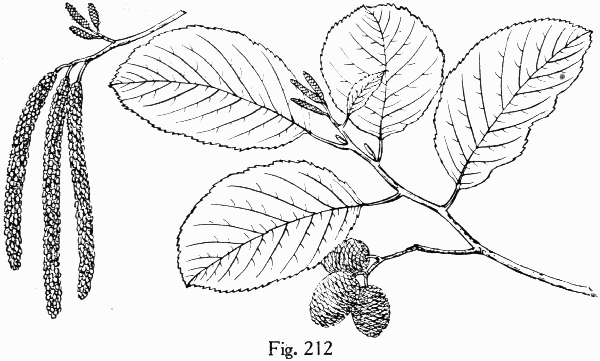
Leaves ovate or oval or sometimes nearly orbicular, rounded or acute at apex, especially on vigorous shoots, gradually or abruptly narrowed and cuneate at base, finely or sometimes coarsely and occasionally doubly serrate, slightly thickened and reflexed on the somewhat undulate margins, when they unfold pale green and covered with deciduous matted white hairs, at maturity dark green and lustrous on the upper surface, frequently marked, especially on the midrib, with minute glandular dots, light yellow-green and slightly puberulous below, 2′—3′ long, 1½′—2′ wide, with a stout yellow midrib and primary veins; petioles slender, yellow, hairy, flattened and grooved on the upper side, ½′—¾′ long; stipules ovate, acute, scarious, puberulous, about ¼′ in length. Flowers: staminate aments in slender-stemmed pubescent clusters, usually short-stalked, during the summer dark olive-brown [225] and lustrous, ¾′—1′ long and about 1/16′ thick, beginning to lengthen late in the autumn before the leaves fall, fully grown and 4′—6′ long and ¼′ thick in January, with dark orange-brown scales, and deciduous in February before the appearance of the new leaves; calyx yellow, 4-lobed, rather shorter than the 2 or occasionally 3 or rarely single stamen; pistillate aments in short pubescent racemes emerging from the bud in December, their scales broadly ovate and rounded. Fruit: strobiles oblong, ⅓′—½′ long, with thin scales slightly thickened and lobed at apex, fully grown at midsummer, remaining closed until the trees flower the following year; nut broadly ovoid, with a thin margin.
A tree, frequently 70°—80° high, with a tall straight trunk 2°—3° in diameter, long slender branches pendulous at the ends, forming a wide round-topped open head, and slender branchlets marked by small scattered lenticels, at first light green and coated with pale caducous pubescence, soon becoming dark orange-red and glabrous, and darker during the winter and following summer. Winter-buds nearly ½′ long, very slender, dark red, and covered with pale scurfy pubescence. Bark on old trunks 1′ thick, dark brown, irregularly divided into flat often connected ridges broken into oblong plates covered with small closely appressed scales. Wood light, soft, not strong, brittle, close-grained, light brown, with thick lighter colored often nearly white sapwood.
Distribution. Banks of streams from northern Idaho to the eastern slope of the Cascade Mountains of Washington and southeastern Oregon, and southward from the valley of the Willamette River, Oregon (near Salem, Marion County, J. C. Nelson) over the coast ranges and along the western slopes of the Sierra Nevada to the mountains of southern California (San Bernardino, San Jacinto, and Cuyamaca Ranges); the common Alder of the valleys of central California, occasionally ascending on the southern Sierra Nevada to altitudes of 8000°, and the only species at low altitudes in the southern part of the state.
5. Alnus oblongifolia Torr. Alder.
Alnus acuminata Sarg., not H. B. K.
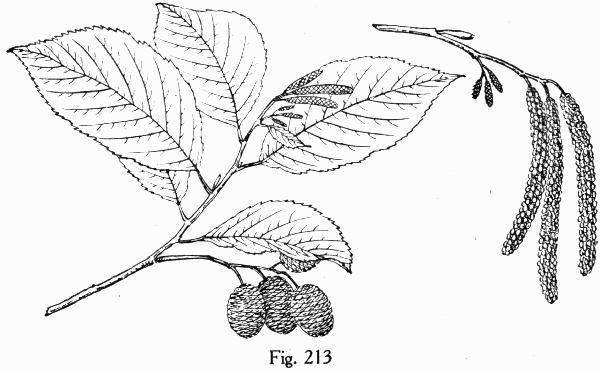
Leaves oblong-lanceolate, acute; or rarely obovate and rounded at apex, gradually narrowed and cuneate at base, sharply and usually doubly serrate, more or less thickly covered, especially early in the season, with black glands, dark yellow-green and glabrous or slightly puberulous above, pale and glabrous or puberulous below, especially along the slender yellow midrib and veins, with small tufts of rusty hairs in the axils of the primary veins, 2′—3′ long, about 1½′ wide; petioles slender, grooved, pubescent, ¾′ long; stipules ovate-lanceolate, [226] brown and scarious, about ¼′ in length. Flowers: staminate aments in short stout-stemmed racemes, during the winter light yellow, ½′—¾′ long and about 1/16′ thick, becoming when the flowers open at the end of February before the appearance of the leaves 2′—2½′ in length, with ovate pointed dark orange-brown scales; calyx 4-lobed; stamens 3 or occasionally 2, with pale red anthers soon becoming light yellow; pistillate aments naked during the winter, ⅛′ to nearly ¼′ long, with light brown ovate rounded scales; stigmas bright red. Fruit: strobiles ½′—1′ long, with thin scales slightly thickened and nearly truncate at apex; nut broadly ovoid, with a narrow membranaceous border.
A tree, in the United States rarely more than 20°—30° high, with a trunk sometimes 8′ in diameter, long slender spreading branches forming an open round-topped head, and slender branchlets slightly puberulous when they first appear, light orange-red and lustrous during their first winter, and marked by small conspicuous pale lenticels, becoming in their second year dark red-brown or gray tinged with red and much roughened by the elevated leaf-scars. Winter-buds acute, red, lustrous, glabrous, ½′ long. Bark thin, smooth, light brown tinged with red.
Distribution. Banks of streams in cañons of the mountains of southern New Mexico and Arizona at altitudes of 4000°—6000° above the sea; in Oak Creek Cañon near Flagstaff, northern Arizona (tree 100° × 3°, P. Lowell); and on the mountains of northern Mexico.
6. Alnus maritima Nutt. Alder.
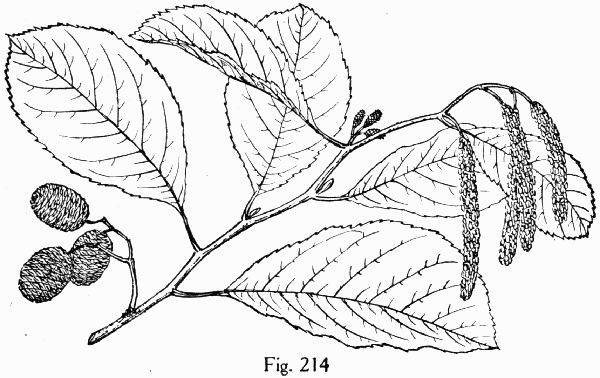
Leaves oblong-ovate, or obovate, acute, acuminate or rounded at apex, gradually narrowed and cuneate at base, remotely serrate with minute incurved glandular teeth, and somewhat thickened on the slightly undulate margins, when they unfold, light green tinged with red, hairy on the midrib, veins, and petioles, and coated above with pale scurfy pubescence, at maturity dark green, very lustrous, and covered below by minute pale glandular dots, 3′—4′ long, 1½′—2′ wide, with a stout yellow midrib and primary veins prominent and glandular on the upper side and slightly puberulous below; petioles stout, yellow, glandular, flattened and grooved on the upper side, ½′—¾′ in length; stipules oblong, acute, about ⅛′ long, dark reddish brown, caducous. Flowers opening in the autumn: aments appearing in July on branches of the year and fully grown in August or early in September; staminate in short scurfy-pubescent glandular-pitted racemes on slender peduncles sometimes 1′ in length from the axils of upper leaves, covered at first with ovate acute dark green very lustrous scales slightly ciliate on the margins and furnished at apex with minute red points, at maturity 1½′—2½′ long, ¼′ to nearly ½′ thick, with dark orange-brown scales raised on slender stalks, and 4 bright orange-colored stamens; pistillate usually solitary [227] from the axils of the lower leaves on stout pubescent peduncles, bright red at apex and light green below before opening, with ovate acute scales slightly ciliate on the margins, about ⅛′ long when the styles protrude from between the scales, beginning to enlarge the following spring. Fruit attaining full size at midsummer and then raised on a stout peduncle, broadly ovoid, rounded and depressed at base, gradually narrowed to the rather obtuse apex, about ⅝′ long and ½′ broad, with thin lustrous scales slightly thickened and crenately lobed at apex, turning dark reddish brown or nearly black and opening late in the autumn and remaining on the branches until after the flowers open the following year; nut oblong-obovoid, gradually narrowed and apiculate at apex, with a thin membranaceous border.
A tree, occasionally 30° high, with a tall straight trunk 4′—5′ in diameter, small spreading branches forming a narrow round-topped head, slender slightly zigzag branchlets, light green and hairy at first, pale yellow-green, very lustrous, slightly puberulous, marked with occasional small orange-colored lenticels, and glandular with minute dark glandular dots during their first summer, becoming dull light orange or reddish brown in the winter, and ashy gray often slightly tinged with red the following season; more often shrubby, with numerous slender spreading stems 15°—20° tall. Winter-buds acute, dark red, coated with pale lustrous scurfy pubescence, about ¼′ long. Bark ⅛′ thick, smooth, light brown or brown tinged with gray. Wood light, soft, close-grained, light brown, with thick hardly distinguishable sapwood.
Distribution. Banks of streams and ponds in southern Delaware and Maryland, and in south central Oklahoma (Johnson and Bryan Counties).
Occasionally cultivated as an ornamental tree in the eastern states and hardy as far north as Massachusetts.
X. FAGACEÆ.
Trees, with watery juice, slender terete branchlets marked by numerous usually pale lenticels, alternate stalked penniveined leaves, and narrow mostly deciduous stipules. Flowers monœcious, the staminate in unisexual heads or aments, composed of a 4—8-lobed calyx, and 4 or 8 stamens, with free simple filaments and introrse 2-celled anthers, the cells parallel and contiguous, opening longitudinally; the pistillate solitary or clustered, in terminal unisexual or bisexual spikes or heads, subtended by an involucre of imbricated bracts becoming woody and partly or entirely inclosing the fruit, and composed of a 4—8-lobed calyx adnate to the 3—7-celled ovary with as many styles as its cells and 1 or 2 pendulous anatropous or semianatropous ovules in each cell. Fruit a nut 1-seeded by abortion, the outer coat cartilaginous, the inner membranaceous or bony. Seed filling the cavity of the nut, without albumen; seed-coat membranaceous; cotyledons fleshy, including the minute superior radicle; hilum, basal, minute.
The six genera of this widely distributed family occur in North America with the exception of Nothofagus, separated from Fagus to receive the Beech-trees of the southern hemisphere.
CONSPECTUS OF THE NORTH AMERICAN GENERA.
Staminate flowers fascicled in globose-stalked heads; the pistillate in 2—4-flowered clusters.
1. Fagus.
Staminate flowers in slender aments.
Pistillate flowers in 2—5-flowered clusters below the staminate, in bisexual aments.
Nut inclosed in a prickly burr.
Leaves deciduous; ovary 6-celled; nut maturing in one season; branchlets lengthening by an upper axillary bud; bud-scales 4.
2. Castanea.
Leaves persistent; ovary 3-celled; nut maturing at the end of the second season; branchlets lengthening by a terminal bud; bud-scales numerous.
3. Castanopsis.
[228]
Nut inclosed only partly in a shallow cup covered by slender recurved scales united only at the base, free above.
4. Lithocarpus.
Pistillate flowers solitary, in few-flowered unisexual spikes; nut more or less inclosed in a cup covered by thin or thickened scales, closely appressed or often free toward its rim.
5. Quercus.
1. FAGUS L. Beech.
Trees, with smooth pale bark, hard close-grained wood, and elongated acute bright chestnut-brown buds, their inner scales accrescent and marking the base of the branchlets with persistent ring-like scars. Leaves convex and plicate along the veins in the bud, thick and firm, deciduous; petioles short, nearly terete, in falling leaving small elevated semioval leaf-scars, with marginal rows of minute fibro-vascular bundle-scars; stipules linear-lanceolate, infolding the leaf in the bud. Flowers vernal after the unfolding of the leaves; staminate short-pedicellate, in globose many-flowered heads on long drooping bibracteolate stems at base of shoots of the year or from the axils of their lowest leaves, and composed of a subcampanulate 4—8-lobed calyx, the lobes imbricated in æstivation, ovate and rounded, and 8—16 stamens inserted on the base of and longer than the calyx, with slender filaments and oblong green anthers; pistillate in 2—4-flowered stalked clusters in the axils of upper leaves of the year, surrounded by numerous awl-shaped hairy bracts, the outer bright red, longer than the flowers, deciduous, the inner shorter and united below into a 4-lobed involucre becoming at maturity woody, ovoid, thick-walled, and covered by stout recurved prickles, inclosing or partly inclosing the usually 3 nuts, and ultimately separating into 4 valves; calyx urn-shaped, villose, divided into 4 or 5 linear-lanceolate acute lobes, its 3-angled tube adnate to the 3-celled ovary surmounted by 3 slender recurved pilose styles green and stigmatic toward the apex and longer than the involucre; ovules 2 in each cell. Nut ovoid, unequally 3-angled, acute or winged at the angles, concave and longitudinally ridged on the sides, chestnut-brown and lustrous, tipped with the remnants of the styles, marked at the base by a small triangular scar, with a thin shell covered on the inner surface with rufous tomentum. Seed dark chestnut-brown, suspended with the abortive ovules from the tip of the hairy dissepiment of the ovary pushed by the growth of the seed into one of the angles of the nut; cotyledons sweet, oily, plano-convex.
Fagus as here limited is confined to the northern hemisphere, with a single American species and seven Old World species; of these one is widely distributed through Europe, another is found in the Caucasus, and the others are confined to eastern temperate Asia. Of exotic species, the European Fagus sylvatica L., an important timber-tree, is frequently planted for ornament in the eastern states in several of its forms, especially those with purple leaves, and with pendulous branches. The wood of Fagus is hard and close-grained. The sweet seeds are a favorite food of swine, and yield a valuable oil.
Fagus is the classical name of the Beech-tree.
1. Fagus grandifolia Ehrh. Beech.
Fagus americana Sweet.
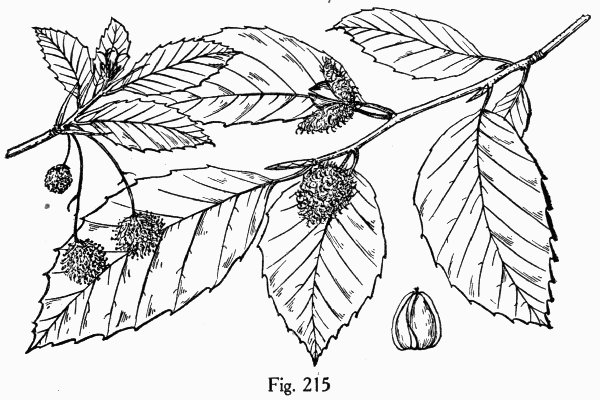
Leaves remote at the ends of the branches and clustered on short lateral branchlets, oblong-ovate, acuminate with a long slender point, coarsely serrate with spreading or incurved triangular teeth except at the gradually narrowed generally cuneate base, when they unfold pale green and clothed on the lower surface and margins with long pale lustrous silky hairs, at maturity dull dark bluish green above, light yellow-green, very lustrous, and glabrous or rarely pilose below (f. pubescens Fern. & Rehd.) with tufts of long pale hairs in the axils of the veins, 2½′—5′ long, 1′—3′ wide, with a slender yellow midrib covered above with short pale hairs, and slender primary veins running obliquely to the points of the teeth; turning bright clear yellow in the autumn; very rarely deeply laciniate; petioles hairy, ¼′—½′ length; stipules ovate-lanceolate on the lower leaves, strap-shaped to linear-lanceolate on the upper, brown or often red below the middle, membranaceous, [229] lustrous, 1′—1½′ long. Flowers opening when the leaves are about one third grown; staminate in globose heads 1′ in diameter, on slender hairy peduncles about 2′ long; pistillate in usually 2-flowered clusters, on short clavate hoary peduncles ½′—¾′ long. Fruit: involucres ½′—¾′ in length often shorter than the nuts, on stout hairy club-shaped peduncles ¼′—¾′ long, fully grown at midsummer, and then puberulous, dark orange-green, and covered by long slender recurved prickles red above the middle, becoming at maturity in the autumn light brown and tomentose, with crowded much recurved pubescent prickles, persistent on the branch after opening late into the winter; nut about ¾′ long.
A tree, usually 70°—80° but exceptionally 120° high, sending up from the roots numerous small stems sometimes extending into broad thickets round the parent tree, in the forest with a long comparatively slender stem free of branches for more than half its length, and short branches forming a narrow head, in open situations short-stemmed, with a trunk often 3°—4° in diameter, and numerous limbs spreading gradually and forming a broad compact round-topped head of slender slightly drooping branches clothed with short leafy laterals, and branchlets pale green and coated with long soft caducous hairs when they first appear, olive-green or orange-colored during their first summer, and conspicuously marked by oblong bright orange lenticels, gradually growing red, bright reddish brown during their first winter, darker brown in their second season and ultimately ashy gray. Winter-buds puberulous, especially toward the apex, ¾′ to nearly 1′ long, about ⅛′ broad, the inner scales hirsute on the inner surface and along the margins and when fully grown often 1′ long, lustrous, brown above the middle, and reddish below. Bark ¼′—½′ thick, with a smooth light steel-gray surface. Wood hard, strong, tough, very close-grained, not durable, difficult to season, dark or often light red, with thin nearly white sapwood of 20—30 layers of annual growth; largely used in the manufacture of chairs, shoe-lasts, plane-stocks, the handles of tools, and for fuel. The sweet nuts are gathered and sold in the markets of Canada and of some of the western and middle states.
Distribution. Rich uplands and mountain slopes, often forming nearly pure forests, and southward on the bottom-lands of streams and the margins of swamps; valley of the Restigouche River, New Brunswick, to the northern shores of Lake Huron and the southern shores of Lake Superior, and southward to Virginia, Ohio, Michigan, the ravines of Rock River near Oregon, Ogle County, Illinois, Minnesota and northern Missouri; southward passing into the var. caroliniana Fern. & Rehd., differing in its ovate to short-ovate thicker leaves, usually rounded or subcordate at base, and often less coarsely serrate or [230] undulate on the margins, glabrous or rarely densely soft pubescent below (f. mollis Fern. & Rehd.), in the often shorter involucre of the fruit with shorter and less crowded prickles; usually on the bottom-lands of streams and the borders of swamps, New Jersey, and southern Ohio and Missouri to western Florida, Alabama, Mississippi, Louisiana, eastern Texas, and northeastern Oklahoma; ascending on the southern Appalachian Mountains to altitudes of 3000°; probably growing to its largest size in eastern Louisiana.
The northern form is occasionally planted in the northern states as a shade and park tree.
2. CASTANEA Adans. Chestnut.
Trees or shrubs, with furrowed bark, porous brittle wood, durable in the ground, terete branchlets without terminal buds, axillary buds covered by 2 pairs of slightly imbricated scales, the outer lateral, the others accrescent, becoming oblong-ovate and acute and marking the base of the branch with narrow ring-like scars, and stout perpendicular tap-roots; producing when cut numerous stout shoots from the stump. Leaves convolute in the bud, ovate, acute, coarsely serrate, except at the base, with thin veins running to the points of the slender glandular teeth, deciduous; petioles leaving in falling small elevated semioval leaf-scars marked by an irregular marginal row of minute fibro-vascular bundle-scars; stipules ovate to linear-lanceolate, acute, scarious, infolding the leaf in the bud, caducous. Flowers opening in early summer, unisexual, strong-smelling; the staminate, in 3—7-flowered cymes, in the axils of minute ovate bracts, in elongated simple deciduous aments first appearing with the unfolding of the leaves from the inner scales of the terminal bud and from the axils of the lower leaves of the year, composed of a pale straw-colored slightly puberulous calyx deeply divided into 6 ovate rounded segments imbricated in the bud, and 10—20 stamens inserted on the slightly thickened torus, with filiform filaments incurved in the bud, becoming elongated and exserted, and ovoid or globose pale yellow anthers; the pistillate scattered or spicate at the base of the shorter persistent androgynous aments from the axils of later leaves, sessile, 2 or 3 together or solitary within a short-stemmed or sessile involucre of closely imbricated oblong acute bright green bracts scurfy-pubescent or tomentose below the middle, subtended by a bract and 2 lateral bractlets, each flower composed of an urn-shaped calyx, with a short limb divided into 6 obtuse lobes, minute sterile stamens shorter than the calyx-lobes, an ovary 6-celled after fecundation, with 6 linear spreading white styles hairy below the middle and tipped by minute acute stigmas, and 2 ovules in each cell, attached on its inner angle, descending, semianatropous. Fruit maturing in one season, its involucre inclosing 1—3 nuts, globose or short-oblong, pubescent or tomentose and spiny on the outer surface, with elongated ridged bright green ultimately brown branched spines fascicled between the deciduous scales, coated on the inner surface with lustrous pubescence, splitting at maturity into 2—4 valves; nut ovoid, acute, crowned by the remnants of the style, bright chestnut-brown and lustrous, tomentose or pubescent at apex, cylindrical, or when more than 1 flattened, marked at the broad base by a large conspicuous pale circular or oval thickened scar, its shell lined with rufous or hoary tomentum. Seed usually solitary by abortion, dark chestnut-brown, marked at apex by the abortive ovules, with thick and fleshy more or less undulate ruminate sweet farinaceous cotyledons.
Castanea is confined to the northern hemisphere, and is widely distributed through eastern North America, southern Europe, northern Africa, southwestern Asia, and central and northern China, Korea, and Japan. Seven species are distinguished. In the countries of the Mediterranean Basin much attention has been given to improving the fruit of the native species Castanea sativa Mill., which is occasionally planted in the middle United States; in Japan the seeds of Castanea crenata S. & Zucc. in many varieties and in China those of Castanea mollissima Bl. are important articles of food. Castanea produces coarse-grained wood very durable in contact with the soil, and rich in tannin. Chestnut-trees suffer in the eastern United States from the attacks of a fungus, Endothia parasitica Anders. which has nearly exterminated them in many parts of the country.
Castanea is the classical name of the Chestnut-tree.
[231]
CONSPECTUS OF THE NORTH AMERICAN SPECIES.
Involucre of the fruit containing 2 or 3 flattened nuts.
1. C. dentata (A, C).
Involucre of the fruit containing a single terete nut.
Involucre of the fruit densely covered with spines; branchlets hoary tomentose.
2. C. pumila (A, C).
Involucre of the fruit covered with scattered spines; branchlets glabrous or sparingly pilose.
3. C. alnifolia (C).
1. Castanea dentata Borkh. Chestnut.
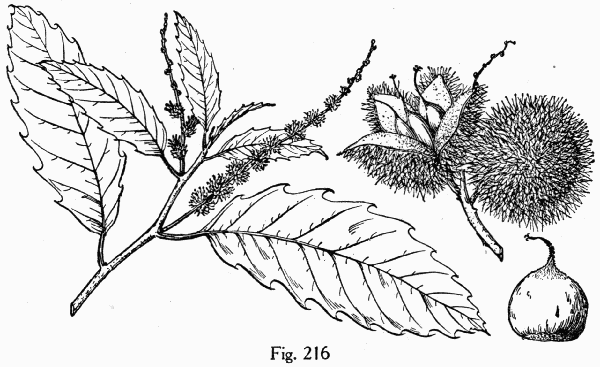
Leaves oblong-lanceolate, acute and long-pointed at apex, gradually narrowed and cuneate at base, when they unfold puberulous on the upper surface and clothed on the lower with fine cobweb-like tomentum, at maturity thin, glabrous, dark dull yellow-green above, pale yellow-green below, 6′—8′ long, about 2′ wide, with a pale yellow midrib and primary veins; turning bright clear yellow late in the autumn; petioles stout, slightly angled, puberulous, ½′ long, often flushed with red; stipules ovate-lanceolate, acute, yellow-green, puberulous, about ½′ long. Flowers: staminate aments about ½′ long when they first appear, green below the middle and red above, becoming when fully grown 6′—8′ long, with stout green puberulous stems covered from base to apex with crowded flower-clusters; androgynous aments, slender, puberulous, 2½′—5′ long, with 2 or 3 irregularly scattered involucres of pistillate flowers near their base. Fruit: involucre attaining its full size by the middle of August, 2′—2½′ in diameter, sometimes a little longer than broad, somewhat flattened at apex, pubescent and covered on the outer surface with crowded fascicles of long slender glabrous much-branched spines, opening with the first frost and gradually shedding their nuts; nuts usually much compressed, ½′—1′ wide, usually rather broader than long, coated at apex or nearly to the middle with thick pale tomentum, the interior of the shell lined with thick rufous tomentum; seed very sweet.
A tree, occasionally 100° high, with a tall straight columnar trunk 3°—4° in diameter, or often when uncrowded by other trees with a short trunk occasionally 10°—12° in diameter, and usually divided not far above the ground into 3 or 4 stout horizontal limbs forming a broad low round-topped head of slightly pendulous branches frequently 100° across, and branchlets at first light yellow-green sometimes tinged with red, somewhat angled, lustrous, slightly puberulous, soon becoming glabrous and olive-green tinged with yellow or brown [232] tinged with green and ultimately dark brown. Winter-buds ovoid, acute, about ¼′ long, with thin dark chestnut-brown scales scarious on the margins. Bark from 1′—2′ thick, dark brown and divided by shallow irregular often interrupted fissures into broad flat ridges separating on the surface into small thin closely appressed scales. Wood light, soft, not strong, liable to check and warp in drying, easily split, reddish brown, with thin lighter colored sapwood of 3 or 4 layers of annual growth; largely used in the manufacture of cheap furniture and in the interior finish of houses, for railway-ties, fence-posts, and rails. The nuts, which are superior to those of the Old World chestnuts in sweetness were formerly gathered in great quantities in the forest and sold in the markets of the eastern cities.
Distribution. Southern Maine to Woodstock, Grafton County, New Hampshire (rare) and to the valley of the Winooski River, Vermont, southern Ontario, and southern Michigan, southward to Delaware and Ohio, southern Indiana, and southwestern Illinois (Pulaski County) along the Appalachian Mountains up to altitudes of 4000° to northern Georgia, and to western Florida (Crestview, Walton County) southeastern (Henry and Dale Counties) and south central (Dallas County) Alabama, Northern, central and southeastern Mississippi (Pearl River County), and to central Kentucky and Tennessee; very common on the glacial drift of the northern states and, except at the north, mostly confined to the Appalachian hills; attaining its greatest size in western North Carolina and eastern Tennessee.
Formerly sometimes planted in the eastern states as an ornamental and timber tree, and for its nuts, of which several varieties have been recognized.
× Castanea neglecta Dode with leaves intermediate between those of C. dentata and C. pumila and an involucre containing a single large nut occurs on the Blue Ridge near Highlands, Macon County, North Carolina.
2. Castanea pumila Mill. Chinquapin.
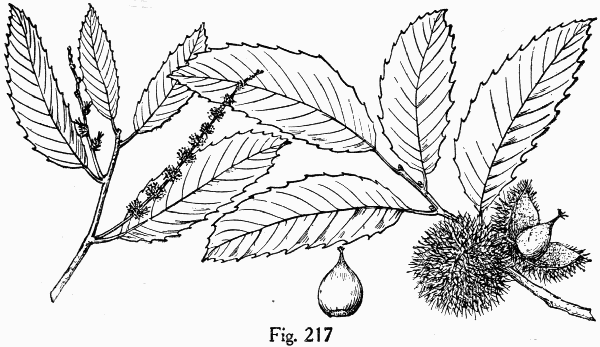
Leaves oblong-elliptic to oblong-obovate, acute, coarsely serrate, with slender rigid spreading or incurved teeth, gradually narrowed and usually unequal and rounded or cuneate at base, when they unfold tinged with red and coated above with pale caducous tomentum and below with thick snowy white tomentum, at maturity rather thick and firm in texture, bright yellow-green on the upper surface, hoary or silvery pubescent on the lower, 3′—5′ long, 1½′—2′ wide; turning dull yellow in the autumn; petioles stout, pubescent, flattened on the upper side, ¼′—½′ long; stipules light yellow-green, pubescent, those of the 2 lowest leaves broad, ovate, acute, covered at apex by rufous tomentum, on later leaves ovate-lanceolate, often oblique and acute, becoming linear at the end of the branch. Flowers: [233] staminate aments ½′ long when they first appear, pubescent, green below, bright red at apex, becoming when fully grown 4′—6′ long, with stout hoary tomentose stems and crowded or scattered flower-clusters; androgynous aments silvery tomentose, 3′—4′ long; involucres 1-flowered, scattered at the base of the ament or often spicate and covering its lower half, sessile or short-stalked. Fruit: involucre 1′—1½′ in diameter, with thin walls covered with crowded fascicles of slender spines tomentose toward the base; nut ovoid, terete, rounded at the slightly narrowed base, gradually narrowed and pointed at apex, more or less coated with silvery white pubescence, dark chestnut-brown, very lustrous, ¾′—1′ long, ⅓′ thick, with a thin shell lined with a coat of lustrous hoary tomentum, and a sweet seed.
A round-topped tree, rarely 50° high, with a short straight trunk 2°—3° in diameter, slender spreading branches, and branchlets coated at first with pale tomentum, becoming during their first winter pubescent or remaining tomentose at the apex, bright red-brown, glabrous, lustrous, olive-green or orange-brown during their second season and ultimately darker; east of the Mississippi River often a shrub spreading into broad thickets by prolific stolons, with numerous intricately branched stems often only 4° or 5° tall. Winter-buds ovoid, or oval, about ⅛′ long, clothed when they first appear in summer with thick hoary tomentum, becoming red during the winter and scurfy-pubescent. Bark ½′—1′ thick, light brown tinged with red, slightly furrowed and broken on the surface into loose plate-like scales. Wood light, hard, strong, coarse-grained, dark brown, with thin hardly distinguishable sapwood of 3 or 4 layers of annual growth; used for fence-posts, rails, and railway-ties. The sweet nuts are sold in the markets of the western and southern states.
Distribution. Dry sandy ridges, rich hillsides and the borders of swamps; southern New Jersey and Pennsylvania to central (Lake County) and western Florida and westward through the Gulf States to the valley of the Neches River, Texas, and through Arkansas to eastern Oklahoma and southwestern Missouri; on the Appalachian Mountains ascending to altitudes of 4500°; most abundant and of its largest size in southern Arkansas and eastern Texas.