Division II. Dicotyledons. (continued 7)
Reading edition
CONSPECTUS OF THE NORTH AMERICAN ARBORESCENT GENERA.
Anthers introrse; mature carpels, fleshy, opening on the back at maturity, persistent; seed-coat thick, pulpy, and bright scarlet; leaves entire, or auriculate at base.
1. Magnolia.
Anthers extrorse; mature carpels dry, indehiscent, deciduous; seed-coat dry and coriaceous; leaves lobed or truncate.
2. Liriodendron.
1. MAGNOLIA L. Magnolia.
Trees, with ashy gray or brown smooth or scaly bark, branchlets conspicuously marked by large horizontal or longitudinal leaf-scars and by narrow stipular rings, and large terete acuminate or often obtusely-pointed more or less gibbous winter-buds usually broadest at the middle, their scales large membranaceous stipules adnate to the base of the petioles and deciduous with the unfolding of each successive leaf, the petiole of the outer stipule rudimentary, adnate on the straight side of the bud, and marked at its apex by the scar left by the falling of the last leaf of the previous season. Leaves entire, sometimes auriculate, persistent or deciduous, often minutely punctate, their numerous primary veins arcuate and more or less united within the margins. Flowers appearing in the American species after the leaves, their stipular spathes thin and membranaceous; sepals 3, spreading or reflexed; petals 6—12 in series of 3’s, concave, erect or spreading; stamens early deciduous, their filaments shorter than the 2-celled introrse anthers and terminating in apiculate fleshy connectives; ovary sessile, 1-celled; style short, recurved, stigmatic on the inner face; ovules horizontal. Fruit a scarlet or rusty brown cone formed of the coalescent 2-seeded drupaceous persistent follicles opening on the back; seeds suspended at maturity by long thin cords of unrolled spiral vessels; seed-coat thick, drupaceous, the outer portion becoming fleshy and at maturity pulpy, red or scarlet, the inner crustaceous; embryo minute at [343] the base of the fleshy homogeneous albumen, its radicle next the hilum; cotyledons short and spreading.
Magnolia with about thirty species is confined to eastern North America, southern Mexico, and eastern and southern Asia, seven species growing naturally in the United States. All the parts are slightly bitter and aromatic, and the dried flower-buds are sometimes used in medicine. Several species from eastern Asia and their hybrids producing flowers before the appearance of the leaves are favorite garden plants in the United States.
The genus is named in honor of Pierre Magnol (1638—1715), professor of botany at Montpellier.
CONSPECTUS OF NORTH AMERICAN SPECIES.
Styles deciduous from the follicles of the fruit; petals greenish or yellow; winter-buds silky tomentose.
Petals greenish; branchlets glabrous.
1. M. acuminata (A, C).
Petals canary yellow; branchlets pubescent.
2. M. cordata (C).
Styles persistent on the follicles of the fruit.
Petals white.
Leaves coriaceous, persistent; fruit and branchlets tomentose.
3. M. grandiflora (C).
Leaves thin, deciduous (semipersistent in 4).
Leaves cuneate at base.
Leaves scattered along the branches, pale and pubescent below; winter-buds glabrous or silky pubescent.
4. M. virginiana (A, C).
Leaves crowded at the ends of the flowering branches, green and glabrous below; winter-buds glabrous.
5. M. tripetala (A, C).
Leaves cordate at the narrow base; fruit tomentose; winter-buds hoary-tomentose.
6. M. macrophylla (C).
Petals pale yellow or creamy white; leaves obovate-spathulate, auriculate, crowded at the ends of the flowering branches; winter-buds glabrous.
Leaves acute; petals pale yellow; tips of the mature carpels elongated, straight or incurved.
7. M. Fraseri (A, C).
Leaves bluntly pointed; petals creamy white; tips of the mature carpels short, incurved.
8. M. pyramidata (C).
1. Magnolia acuminata L. Cucumber-tree. Mountain Magnolia.
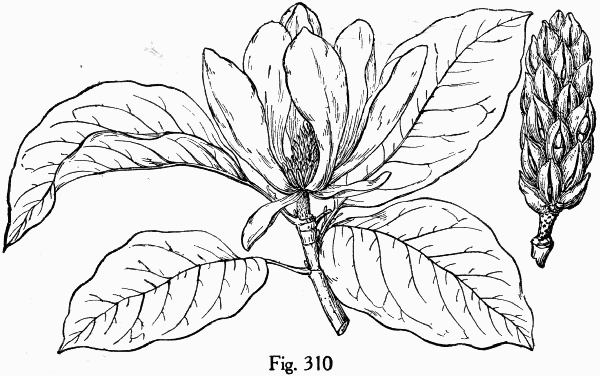
Leaves oblong-ovate, oblong-obovate or elliptic, abruptly short-pointed at apex, rounded, cuneate or rarely slightly cordate at base, when they unfold densely villose below and slightly villose above, and at maturity thin, yellow-green and glabrous on the upper surface, paler and glabrous or villose-pubescent on the lower surface, 6′—10′ long, and 4′—6′ wide, with often undulate margins; turning dull yellow or brown in the autumn before falling; petioles slender, pubescent early in the season, becoming glabrous, 1′—1½′ in length. Flowers on hairy soon glabrous pedicels ½′—¾′ long, bell-shaped, green or greenish yellow covered with a glaucous bloom; sepals membranaceous, acute, 1′—1½′ long, soon reflexed; petals 6, ovate or obovate, concave, pointed, erect, 2½′—3′ long, those of the outer row rarely more than 1′ wide and much wider than those of the inner row. Fruit ovoid or oblong, often curved, glabrous, dark red, 2½′—3′ long, rarely more than 1′ thick; seeds obovoid, acute, compressed, about ½′ long.
A pyramidal tree, 60°—90° high, with a trunk 3°—4° in diameter, comparatively small branches spreading below and erect toward the top of the tree, and slender branchlets coated at first with soft pale caducous hairs, soon bright red-brown, lustrous, and marked by numerous small pale lenticels, turning gray during their third season. Winter-buds: terminal, oblong-ovoid, acuminate, thickly covered with long lustrous white hairs, ½′—⅗′ long, and about three times as long as the obtuse compressed lateral buds nearly surrounded by the narrow elevated leaf-scars conspicuously marked by a double row [344] of large fibro-vascular bundle-scars. Bark ⅓′—½′ thick, furrowed, dark brown, and covered by numerous thin scales. Wood light, soft, not strong, close-grained, durable, and light yellow-brown, with thin lighter colored often nearly white sapwood of usually 25—30 layers of annual growth; occasionally manufactured into lumber used for flooring and cabinet-making.
Distribution. Low mountain slopes and rocky banks of streams; southern Ontario, western New York, central to western Pennsylvania, southern Ohio, Indiana and Illinois, and along the Appalachian Mountains to northern Georgia and to central Kentucky and Tennessee; banks of the Savannah River above Augusta, and in the neighborhood of Lumpkin, Stewart County, Georgia; northern Alabama, northeastern, northwestern and south-central Mississippi; Eagle Rock, Barry County, and on bluffs of the Mississippi River, Cape Girardeau County, Missouri, and Baxter County, Arkansas; in eastern Oklahoma (Page, Le Flore County); in West Feliciana Parish, Louisiana, represented by var. ludoviciana Sarg. differing in its broadly obovate, oval or ovate leaves, and in its larger flowers, 3½′—4′ long, the outer petals 1½′ wide. Rare at the north; most abundant and of its largest size at the base of the high mountains of the Carolinas and Tennessee up to altitudes of 4000°.
Often planted as an ornamental tree in the eastern states and in northern and central Europe.
2. Magnolia cordata Michx.
Magnolia acuminata var. cordata Sarg.
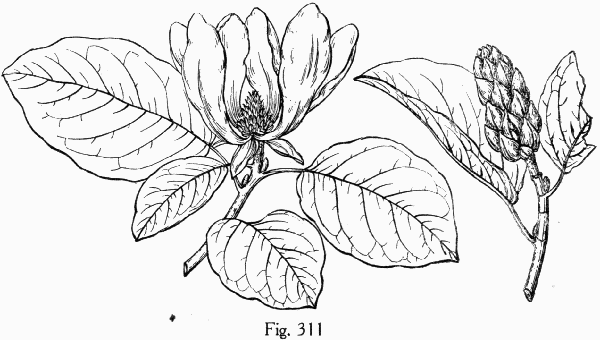
Leaves oblong-obovate to elliptic, abruptly short-pointed or rounded at apex, gradually narrowed and cuneate, broad-cuneate or rarely rounded at base, when they unfold villose-pubescent more densely on the lower than on the upper surface, at maturity dark green, lustrous and glabrous above, paler and covered below with short matted pale hairs, 4′ or 5′ long, 2½′—3½′ wide, with a slender yellow midrib and primary veins; remaining green until late in the autumn and turning brown and falling after severe frost; petioles slender, covered when they first appear with matted silky white hairs, becoming glabrous, ½′—¾′ in length. Flowers on stout pedicels, ¼′—⅓′ long and covered with long silky white hairs, cup-shaped, bright canary yellow; sepals ovate, acute, soon reflexed; petals 6, erect and spreading, 1½′—1¾′ long, ½′—¾′ wide. Fruit oblong, often curved, glabrous, dark red, 1′—1½′ long, ½′—¾′ thick.
A shrub, 4°—8° high, flowering freely when not more than half that size; or in gardens a tree sometimes 20°—30° tall with a trunk 12′—15′ in diameter, spreading branches forming a [345] round-topped head, and slender dark dull red-brown branchlets thickly covered during two years with short pubescence and marked by small pale lenticels. Winter-buds oblong-obovate, often falcate, bluntly pointed, thickly covered with matted pale hairs, the terminal ½′ long and ¼′ thick, the axillary ⅙′—¼′ in length and nearly surrounded by the narrow leaf-scars marked by an irregular row of minute fibro-vascular bundle-scars. Bark dark brown, and covered with small closely appressed scales.
Distribution. Dry Oak-woods, valley of the Savannah River, Georgia; Spears Plantation six miles south and Goshen Plantation sixteen miles south of Augusta, Richmond County, near Mayfield, Hancock County, and Bath, Richmond County. Often cultivated, and preserved in gardens for more than a century; not rediscovered as a wild plant until 1913 (L. A. Berckmans); hardy as far north as eastern Massachusetts.
3. Magnolia grandiflora L. Magnolia.
Magnolia fœtida Sarg.
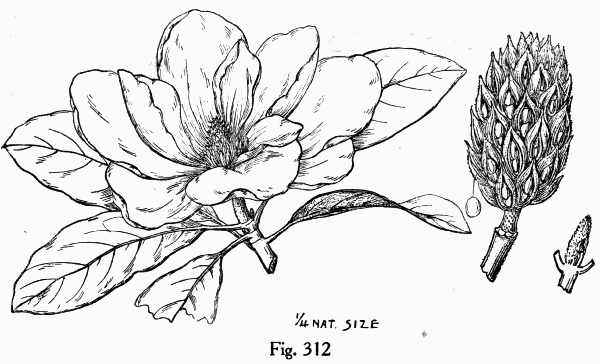
Leaves elliptic to oblong-obovate or ovate, acute and bluntly pointed or acuminate at apex, cuneate at base, coriaceous, bright green and shining above, more or less densely coated below with rusty tomentum, 5′—8′ long, 2′—3′ wide, with a prominent midrib and primary veins, deciduous in the spring at the end of their second year; petioles stout, rusty-tomentose, 1′—2′ in length. Flowers on stout hoary-tomentose pedicels ½′—1′ long, opening from April or May until July or August, fragrant, 7′—8′ across, the petaloid sepals and 6 or sometimes 9 or 12 petals abruptly narrowed at base, oval or ovate, those of the inner ranks often somewhat acuminate, concave, and coriaceous, 3′—4′ long and 1½′—2′ wide; base of the receptacle and lower part of the filaments bright purple. Fruit ovoid or oval, rusty brown, covered while young with thick lustrous white tomentum, at maturity rusty-tomentose, 3′—4′ long, 1½′—2½′ thick; seeds obovoid or triangular-obovoid, more or less flattened, ½′ long.
A tree, of pyramidal habit, 60°—100° or rarely 120°—135° high, with a tall straight trunk 2°—3° or occasionally 4°—4½° in diameter, rather small spreading branches, and branchlets hoary-tomentose at first, slightly tomentose in their second year, and much roughened by the elevated leaf-scars displaying a marginal row of conspicuous fibro-vascular bundle-scars. Winter-buds pale or rusty-tomentose, the terminal 1′—1½′ in length. Bark ½′—¾′ thick, gray or light brown, and covered with thin appressed scales rarely more than 1′ long. Wood hard, heavy, creamy white, soon turning brown with exposure, hardly distinguishable from the sapwood of 60—80 layers of annual growth; little used except for fuel.
[346]
Distribution. Rich moist soil on the borders of river swamps and Pine-barren ponds, or rarely on high rolling hills; coast of North Carolina southward to De Soto County, Florida, extending across the peninsula, and in the neighborhood of the coast through the other Gulf states to the valley of the Brazos River, Texas, ranging inland to central Mississippi and to southern Arkansas, and northward on the bluffs of the lower Mississippi River to the mouth of the Yazoo River, Mississippi; best developed and most abundant on the bluff formation of the lower Mississippi River, and of its largest size in West Feliciana Parish, Louisiana.
Largely cultivated as an ornamental tree in all countries of temperate climate; in the eastern United States precariously hardy as far north as Trenton, New Jersey. Numerous varieties, differing in the form of the leaf and in the duration of the flowering period, have appeared in European nurseries; of these, the most distinct is the variety exoniensis Loud., with a rather fastigiate habit and broadly elliptic leaves densely clothed with rusty tomentum on the lower surface; this variety begins to flower when only a few feet high.
4. Magnolia virginiana L. Sweet Bay. Swamp Bay.
Magnolia glauca L.
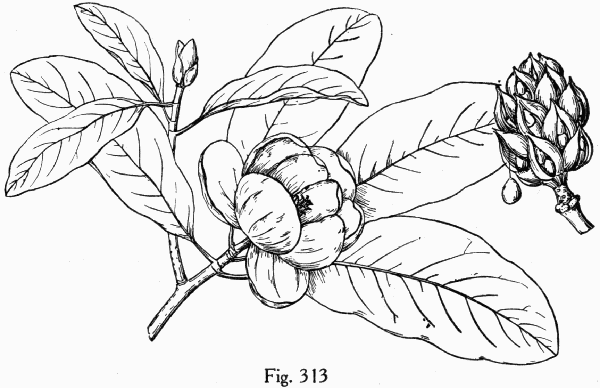
Leaves oblong or elliptic and obtuse or oblong-lanceolate, covered when they unfold with long white silky deciduous hairs, at maturity bright green, lustrous and glabrous on the upper surface, finely pubescent and pale or nearly white on the lower surface, 4′—6′ long, 1½′—3′ wide, with a conspicuous midrib and primary veins; falling in the north late in November and in early winter, at the south remaining on the branches with little change of color until the appearance of the new leaves in the spring; petioles slender, ½′—¾′ in length. Flowers on slender glabrous pedicels ½′—¾′ long, creamy white, fragrant, globular, 2′—3′ across, continuing to open during several weeks in spring and early summer; sepals membranaceous, obtuse, concave, shorter than the 9—12, obovate often short-pointed concave petals. Fruit ellipsoidal, dark red, glabrous, 2′ long and ½′ thick; seeds obovoid, oval, or suborbicular, much flattened, ¼′ in length.
A slender tree, 20°—30° high, with a trunk rarely more than 15′—20′ in diameter, with small mostly erect ultimately spreading branches and slender bright green branchlets hoary-pubescent when they first appear, soon glabrous, marked by narrow horizontal pale lenticels, gradually turning bright red-brown in their second summer; usually a low shrub. Winter-buds covered with fine silky pubescence, the terminal ½′—¾′ long.
[347]
Distribution. Deep swamps; Magnolia, Essex County, Massachusetts, Long Island, New York, and southward from New Jersey generally in the neighborhood of the coast to southeastern Virginia and occasionally in North and South Carolina and Georgia; in Pennsylvania as far west as the neighborhood of Chambersburg, Franklin County. In the southern states usually replaced by the var. australis Sarg., differing in the thick silky white pubescence on the pedicels and branchlets. Leaves persistent without change of color until spring, elliptic to ovate, oblong-obovate or rarely lanceolate, 1′—4′ wide; petioles puberulous, pubescent or tomentose.
A tree, 60°—90° high, with a tall straight trunk occasionally 3° in diameter, small short branches forming a narrow round-topped head, and branchlets usually becoming glabrous in their second year; in southern Florida often much smaller and on the Everglade Keys shrubby, and generally not more than 10° tall. Wood soft, light brown tinged with red, with thick creamy white sapwood of 90—100 layers of annual growth; used in the southern states in the manufacture of broom handles and other articles of wooden ware.
Distribution. Borders of Pine-barren ponds, in shallow swamps and on rich hummocks usually in the neighborhood of the coast; swamps of the lower Cape Fear River near Wilmington, New Hanover County, North Carolina, to southern Florida; common in the interior of the Florida peninsula, and westward to the valley of the Nueces River, Texas; ranging inland to Cuthbert, Randolph County, western Georgia, to Tuskegee and Selma, Alabama, Tishomingo County, northeastern Mississippi, and to Winn and Natchitoches Parishes, western Louisiana; less abundant west of the Mississippi River than eastward.
The northern form is often cultivated as a garden plant in the eastern states and in Europe.
× Magnolia major or Thompsoniana, a probable hybrid between Magnolia virginiana and Magnolia tripetala, raised in an English nursery a century ago, and still a favorite garden plant, is intermediate in character between these species.
5. Magnolia tripetala L. Umbrella-tree. Elkwood.
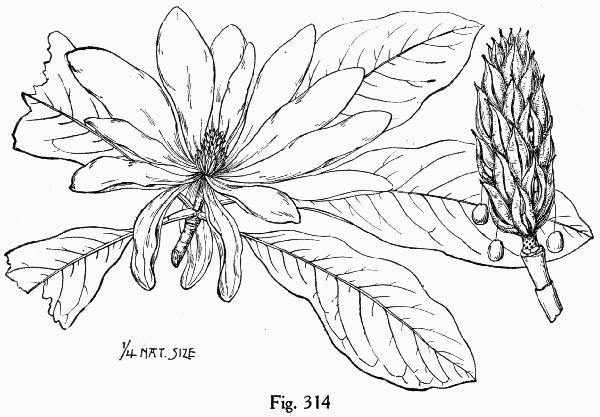
Leaves obovate-lanceolate, narrowed at the ends, acute or bluntly pointed at apex, when they unfold nearly glabrous above, covered below with thick silky caducous tomentum, at maturity membranaceous, glabrous, 18′—20′ long, 8′—10′ wide, with a thick prominent midrib and numerous slender primary veins; falling in the autumn with little change of color; petioles stout, 1′—1½′ in length. Flowers on slender glabrous pedicles covered with a glaucous bloom and 2′—2½′ long, cup-shaped, white; sepals narrowly obovate, 5′—6′ long, [348] 1½′ wide, thin, light green, becoming reflexed; petals 6 or 9, concave, coriaceous, ovate, short-pointed, erect, those of the outer row 4′—5′ long and sometimes 2′ wide, much longer and broader than those of the inner rows; filaments bright purple. Fruit ovoid, glabrous, 2½′—4′ long, rose color when fully ripe; seeds obovoid, ½′ long.
A tree, 30°—40° high, with a straight or often inclining trunk rarely more than 18′ in diameter, stout irregularly developed contorted branches wide-spreading nearly at right angles with the stem or turning up toward the ends and growing parallel with it, and stout brittle branchlets green during their first season, becoming in their first winter bright reddish brown, very lustrous, and marked by occasional minute scattered pale lenticels, and by the large oval horizontal slightly raised leaf-scars with scattered fibro-vascular bundle-scars, brown during their second and gray during their third season; generally much smaller, sometimes surrounded by several stems springing from near the base of the trunk and growing into a large bush surmounted by the head of the central stem. Winter-buds: terminal, acute or bluntly pointed, purple, glabrous, covered with a glaucous bloom, usually about 1′ long; axillary globose, the color of the branch. Bark ½′ thick, light gray, smooth, and marked by many small bristle-like excrescences. Wood light, soft, close-grained, not strong, light brown, with creamy white sapwood of 35—40 layers of annual growth.
Distribution. Deep rather moist rich soil along the banks of mountain streams or the margins of swamps, and widely distributed in the Appalachian Mountain region, but nowhere very common; valley of the Susquehanna River, Pennsylvania (Lancaster and York Counties), to southern Alabama, middle Kentucky and Tennessee, and northeastern Mississippi; in central and southwestern Arkansas; and in southeastern Oklahoma (near Page, Le Flore County, G. W. Stevens), extending in Virginia and North Carolina nearly to the coast; of its largest size in the valleys along the western slopes of the Great Smoky Mountains in Tennessee up to altitudes of 2000°.
Often cultivated as an ornamental tree in the northern states, and in northern and central Europe.
6. Magnolia macrophylla Michx. Large-leaved Cucumber-tree.
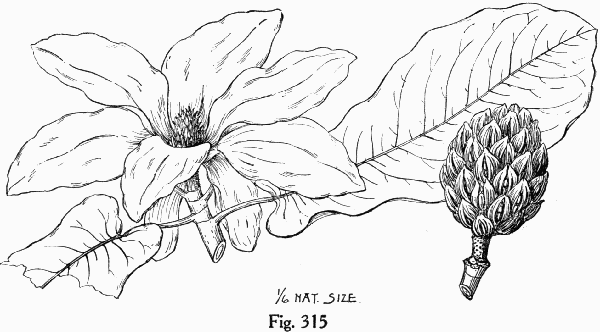
Leaves obovate or oblong, acute or often abruptly narrowed and acute or rounded at apex, narrowed and cordate at base, bright green and glabrous on the upper surface, silvery [349] gray and pubescent, especially along the stout midrib and primary veins on the lower surface, 20′—30′ long, 9′—10′ wide; falling in the autumn with little change of color; petioles stout, 3′—4′ in length, at first tomentose, becoming pubescent. Flowers on stout hoary-tomentose pedicels 1′—1½′ long, soon becoming glabrous or puberulous, cup-shaped, fragrant, 10′—12′ across; sepals membranaceous, ovate or oblong, rounded at apex, much narrower than the 6 ovate concave thick creamy white petals with a rose colored blotch at base, 6′—7′ long and 3′—4′ wide, at maturity reflexed above the middle, those of the inner row narrower and often somewhat acuminate. Fruit ovoid to nearly globose, pubescent, 2½′—3′ long, bright rose color when fully ripe; seeds obovoid, compressed, ⅔′ long.
A tree, 30°—50° high, with a straight trunk 18′—20′ in diameter, stout wide-spreading branches forming a broad symmetrical round-topped head, and stout brittle branchlets hoary-tomentose when they first appear, light yellow-green, pubescent, and conspicuously marked during their first winter by the large irregularly shaped sometimes longitudinal slightly raised leaf-scars with many scattered fibro-vascular bundle-scars, turning reddish brown during their second and gray during their third season. Winter-buds: terminal, bluntly pointed, covered with a thick coat of snowy white tomentum, 1¾′—2′ long, ½′—¾′ thick; lateral, much flattened, brownish, pubescent, ⅛′—¼′ long. Bark generally less than ¼′ thick, smooth, light gray, divided on the surface into minute scales. Wood hard, close-grained, light, not strong, light brown, with thick light yellow sapwood of about 40 layers of annual growth.
Distribution. Sheltered valleys in deep rich soil; nowhere common, and growing generally in isolated groups of a few individuals; Piedmont region of central North Carolina to middle and western Florida, southern Alabama, southern and northeastern Mississippi to the valley of the Green River, Kentucky; in eastern and western Louisiana; probably most abundant in south-central Mississippi.
Occasionally cultivated as an ornamental tree in the eastern states, and in the temperate countries of Europe; hardy as far north as eastern Massachusetts.
7. Magnolia Fraseri Walt. Mountain Magnolia. Long-leaved Cucumber-tree.
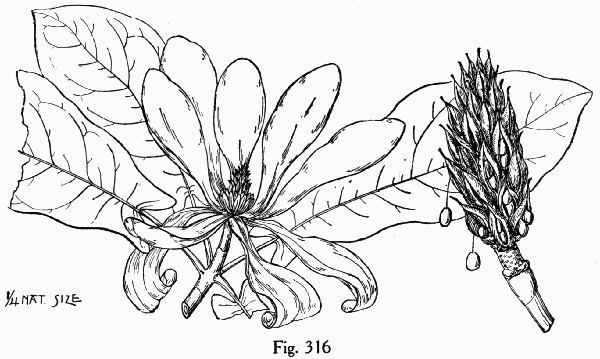
Leaves obovate-spatulate, acute or bluntly pointed at apex, cordate and conspicuously auriculate at base, bright green and often marked on the upper surface when young with red along the principal veins, glabrous, 10′—12′ long, 6′—7′ wide, or on vigorous young plants sometimes of twice that size; falling in the autumn without change of color; petioles slender, 3′—4′ in length. Flowers on stout glabrous pedicels covered with a glaucous bloom and 1′—1½′ long, pale yellow, sweet scented, 8′—10′ across; sepals narrowly obovate, [350] rounded at apex, 4′—5′ long, deciduous almost immediately after the opening of the bud, shorter than the 6 or 9 obovate acuminate membranaceous spreading petals contracted below the middle, those of the inner rows narrower and conspicuously narrowed below. Fruit oblong, glabrous, bright rose-red when fully ripe, 4′—5′ long, 1½′—2′ thick, the mature carpels ending in long subulate persistent tips; seeds obovoid, compressed, ⅝′ long.
A tree, 30°—40° high, with a straight or inclining trunk 12′—18′ in diameter, often undivided for half its length or separating at the ground into a number of stout diverging stems, regular wide-spreading or more or less contorted and erect branches, and stout brittle branchlets soon becoming bright red-brown, lustrous, marked by numerous minute pale lenticels and in their first winter by the low horizontal leaf-scars with crowded compressed fibro-vascular bundle-scars, and grayish in their second year. Winter-buds: terminal, glabrous, purple, 1½′—2′ long, ½′ thick; axillary, minute and obtuse. Bark rarely more than ⅓′ thick, dark brown, smooth, covered by small excrescences, or on old trees broken into minute scales. Wood light, soft, close-grained, not strong, light brown, with thick creamy white sapwood of 30—40 layers of annual growth.
Distribution. Valleys of the streams of the southern Appalachian Mountains from southwestern Virginia and northeastern Kentucky to northern Georgia; in northern Alabama and in West Feliciana Parish, Louisiana (Laurel Hill, R. S. Cocks); in South Carolina eastward to the neighborhood of Aiken, Aiken County; probably most abundant and of largest size on the upper waters of the Savannah River in South Carolina up to altitudes of 4000°.
Occasionally cultivated as an ornamental plant in the eastern states, and in the temperate countries of Europe; hardy as far north as eastern Massachusetts.
8. Magnolia pyramidata Pursh.
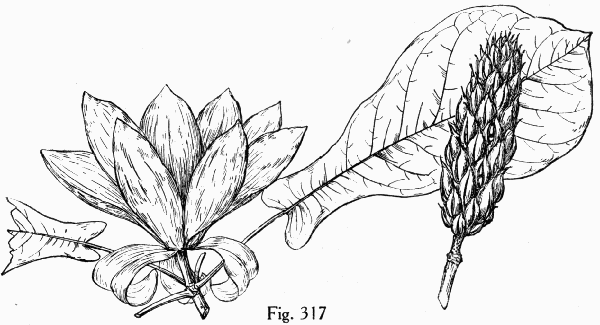
Leaves obovate-spatulate, the apex usually abruptly narrowed into a short blunt point, auriculate at base, with more or less spreading lobes, thin, glabrous, light yellow-green on the upper, pale and glaucous on the lower surface, particularly while young, 5½′—8½′ long, from 3½′—4½′ wide, with a slender yellow midrib, numerous slender forked primary veins and conspicuously reticulate veinlets; petioles slender, 1¼′—2½′ in length. Flowers creamy white, 3½′—4′ across when fully expanded; sepals oblong-obovate, abruptly narrowed to the short-pointed apex, much shorter than the oblong-acuminate petals gradually narrowed from near the middle to the base. Fruit oblong, 2′—2½′ long, bright rose [351] color, the mature carpels ending in short incurved persistent tips; seeds ovoid, compressed.
A slender tree, 20°—30° high, with ascending branches, slender branchlets bright red-brown and marked by small pale lenticels and by the small low oval leaf-scars with many crowded fibro-vascular bundle-scars, later becoming ashy gray.
Distribution. Low rich soil in the neighborhood of streams; near Cuthbert, Randolph County, Georgia; near Mariana, Jackson County, and Bristol, Liberty County, Florida; valleys of the Choctawhatchee River, Dale County, and of the Pea River, Coffee County, and near Selma, Dallas County, Alabama; rare and local.
Occasionally cultivated as an ornamental tree in western Europe.
2. LIRIODENDRON L.
Trees, with deeply furrowed brown bitter bark, and slender branchlets marked by elevated leaf-scars and narrow stipular rings, and compressed obtuse winter-buds, their scales membranaceous stipules joined at the edges, accrescent, strap-shaped, often slightly falcate, oblique at the unequal base, tardily deciduous after the unfolding of the leaf. Leaves recurved in the bud by the bending down of the petiole near the middle, bringing the apex of the blade to the base of the bud, sinuately 4-lobed, heart-shaped, truncate or slightly cuneate at base, truncate at apex by a broad shallow sinus, and minutely apiculate. Flowers appearing after the unfolding of the leaves, cup-shaped, conspicuous, inclosed in the bud in a 2-valved stipular membranaceous caducous spathe; sepals spreading or reflexed, ovate-lanceolate, concave, greenish white, early deciduous; petals erect, rounded at base, early deciduous; filaments filiform, half as long as the linear 2-celled extrorse anthers adnate to the outer face of the connective terminating in a short fleshy point; pistils imbricated on the elongated sessile receptacle into a spindle-shaped column; ovary inserted by a broad base; style narrowly acuminate, laterally flattened, appressed; stigmas short, recurved at the summit; ovules 2, suspended from near the middle of the ventral suture. Fruit a narrow light brown cone formed of the closely imbricated dry and woody indehiscent carpels consisting of a laterally compressed 4-ribbed pericarp, the lateral ribs confluent into the margins of the large wing-like lanceolate compressed style marked vertically by a thin sutural line, the carpels deciduous when ripe in the autumn from the slender elongated axis of the fruit persistent on the branch during the winter. Seeds suspended, 2 or single by abortion; testa thin, coriaceous, and marked by a narrow prominent raphe; embryo minute at the base of the fleshy albumen, its radicle next the hilum.
Liriodendron, widely distributed in North America and Europe during the cretaceous [352] period, is now represented by two species, one in eastern North America, the other L. chinensis Sarg. in central China.
Liriodendron, from λίριον and δένδρον, is descriptive of the lily-like flower.
1. Liriodendron Tulipifera L. Yellow Poplar. Tulip-tree.
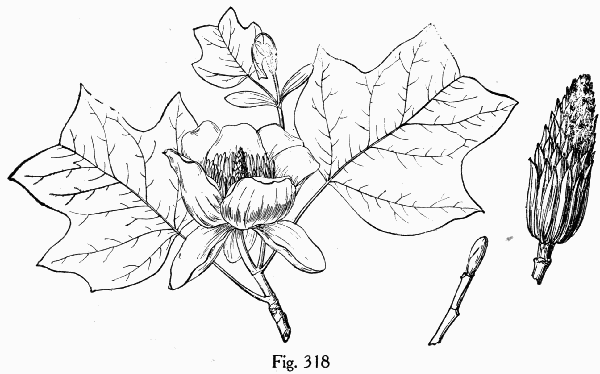
Leaves dark green and shining on the upper, paler on the lower surface, 5′—6′ long and broad; turning clear yellow in the autumn before falling; petioles slender, angled, 5′—6′ in length. Flowers 1½′—2′ deep, on slender pedicels ¾′—1′ long; petals green conspicuously marked with orange at base. Fruit 2½′—3′ long, about ½′ thick, ripening late in September and in October, the mature carpels ½′—1½′ long and about ¼′ wide.
A tree, sometimes nearly 200° high, with a straight trunk 8°—10° in diameter, destitute of branches for 80°—100° from the ground, short, comparatively small branches forming a narrow pyramidal, or in old age a broader spreading head, and slender branchlets light yellow-green and often covered with a glaucous bloom during their first summer, reddish brown, lustrous, and marked during their first winter by many small pale lenticels and roughened by the elevated orbicular or semiorbicular leaf-scars marked by numerous small scattered fibro-vascular bundle-scars, and dark gray during their third year. Winter-buds dark red covered by a glaucous bloom, the terminal ½′ long, much longer than the lateral buds. Bark thin and scaly on young trees, becoming deeply furrowed, brown, and 1′—2′ thick. Wood light, soft, brittle, not strong, easily worked, light yellow or brown, with thin creamy white sapwood; largely manufactured into lumber used in construction, the interior finish of houses, boat-building, and for shingles, brooms, and wooden ware. The intensely acrid bitter inner bark, especially of the roots, is used domestically as a tonic and stimulant, and hydrochlorate of tulipiferine, an alkaloid separated from the bark, possesses the property of stimulating the heart.
Distribution. Deep rich rather moist soil on the intervales of streams or on mountain slopes; Worcester County, Massachusetts, to southwestern Vermont (Pownal, Bennington County), and westward to southern Ontario, southern Michigan and northeastern Missouri, and southward to Orange County (Rock Spring Run), Florida, southern Alabama, Mississippi and Louisiana, southeastern Missouri and northeastern Arkansas; most abundant and of its largest size in the valleys of the lower Ohio basin, and on the slopes of the mountains of North Carolina and Tennessee up to altitudes of 5000°.
Often cultivated as an ornamental tree in the eastern states, and in western and central Europe.
[353]
XVII. ANONACEÆ.
Trees or shrubs, with watery juice, slender terete branchlets marked by conspicuous leaf-scars, and fleshy roots. Leaves alternate, conduplicate in the bud, entire, feather-veined, petiolate, without stipules. Flowers perfect, solitary, axillary or opposite the leaves; sepals 3, valvate in the bud; petals 6, in 2 series, imbricated or valvate in the bud; stamens numerous, inserted on the subglobose or hemispheric receptacle, with distinct filaments shorter than their fleshy connectives terminating in a broad truncate glandular appendage; anthers introrse, 2-celled, opening longitudinally; pistils inserted on the summit of the receptacle; ovary 1-celled; ovules 1 or many, anatropous. Fruit baccate or compound. Seeds inclosed in an aril; seed-coat thin, crustaceous, smooth, brown, and lustrous; albumen ruminate, deeply penetrated by the folds of the inner layer of the seed-coat; embryo minute; radicle next the hilum. Two of the forty-eight or fifty genera of the Custard-apple family, confined almost exclusively to the tropics and more numerous in the Old World than in the New, occur in North America.
CONSPECTUS OF THE NORTH AMERICAN GENERA.
Petals imbricated in the bud; ovules numerous; fruit developed from one pistil.
1. Asimina.
Petals valvate in the bud; ovule solitary; fruit developed from several confluent pistils.
2. Anona.
1. ASIMINA Adans.
Trees or shrubs, emitting a heavy disagreeable odor when bruised, with minute buds covered with cinereo-pubescent caducous scales, and branchlets marked by conspicuous leaf-scars. Leaves membranaceous, reticulate-venulose, deciduous. Flowers, solitary pedicellate, nodding; sepals ovate, smaller than the petals, green, deciduous; petals imbricated in the bud, hypogynous, sessile, ovate or obovate-oblong, reticulate-veined, accrescent, the three exterior alternate with the sepals, spreading, those of the interior row opposite the sepals, erect, and much smaller than those of the outer row; stamens linear-cuneate, densely packed on the receptacle; filaments shorter than the fleshy connective; anther-cells separated on the connective; pistils 3—15, sessile on the summit of the receptacle, projecting from the globular mass of stamens; ovary 1-celled; style oblong, slightly recurved toward the apex and stigmatic along the margin; ovules 4—20, horizontal, 2-ranked on the ventral suture, the raphe toward the suture. Fruit baccate, sessile or stipitate, oval or oblong, smooth. Seeds in 1 or 2 ranks, ovoid, apiculate, compressed, marked at the base by a large pale hilum.
Asimina is confined to eastern North America. Six species are distinguished; of these one is a small tree; the others are low shrubs of the south Atlantic and Gulf regions.
Asimina is from Asiminier, the old colonial name of the French in America for the Pawpaw.
1. Asimina triloba Dunal. Pawpaw.
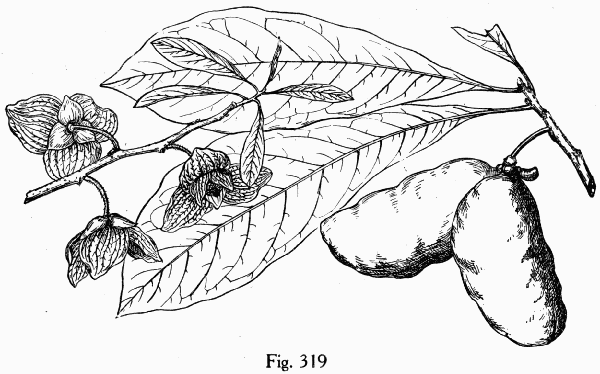
Leaves obovate-lanceolate, sharp-pointed at apex, gradually and regularly narrowed to the base, when they unfold covered below with short rusty brown caducous tomentum and slightly pilose above, and at maturity light green on the upper surface, pale on the lower surface, 10′—12′ long, 4′—6′ wide, with a prominent midrib and primary veins. Flowers nearly 2′ across when fully grown, on stout club-shaped pedicels from axils of the leaves of the previous year, 1′—1½′ long and covered with long scattered rusty brown hairs; sepals ovate, acuminate, pale green, densely pubescent on the outer surface; petals green at first, covered with short appressed hairs, gradually turning brown and at maturity deep vinous red and conspicuously venulose, those of the outer row broadly ovate, rounded or pointed at apex, reflexed at maturity above the middle and 2 or 3 times longer than the sepals, those of the inner row pointed, erect, their base concave, glandular, nectariferous, marked [354] by a broad band of a lighter color. Fruit attached obliquely to the enlarged torus, oblong, nearly cylindric, rounded or sometimes slightly pointed at the ends, more or less falcate, often irregular from the imperfect development of some of the seeds, 3′—5′ long, 1′—1½′ in diameter, greenish-yellow, becoming when fully ripe in September and October dark brown or almost black, with pale yellow or nearly white barely edible flesh on some plants and on others with orange-colored succulent flesh; seeds separating readily from the aril, 1′ long, ½′ broad, rounded at the ends.
A shrub or low tree, sometimes 35°—40° high, with a straight trunk rarely exceeding a foot in diameter, small spreading branches, and slender glabrous or rusty pubescent, light brown branchlets tinged with red and marked by longitudinal parallel or reticulate narrow shallow grooves. Winter-buds acuminate, flattened, ⅛′ long, and clothed with rusty brown hairs. Bark rarely more than ⅛′ thick, dark brown, marked by large ash-colored blotches, covered by small wart-like excrescences and divided by numerous shallow reticulate depressions. Wood light, soft and weak, coarse-grained, spongy, light yellow shaded with green, with thin darker colored sapwood of 12—20 layers of annual growth. The inner bark stripped from the branches in early spring is used by fishermen of western rivers for stringing fish. The sweet and luscious wholesome fruit is sold in large quantities in the cities and towns in those parts of the country where the tree grows naturally.
Distribution. Deep rich moist soil; western New Jersey and western New York (Greece, Monroe County) to the northern shores of Lake Ontario, westward to southern Michigan, southwestern Iowa, southeastern Nebraska, eastern Kansas and eastern Oklahoma, and southward to Western Florida (Taylor County), central Alabama, and through Mississippi and Louisiana to eastern Texas (near Marshall, Harrison County, and Dennison, Grayson County); comparatively rare in the region adjacent to the Atlantic seaboard; very common in the Mississippi valley, forming thick forest undergrowth on rich bottom-lands, or thickets many acres in extent.
Occasionally cultivated in the eastern states, and hardy as far north as eastern Massachusetts; interesting as the most northern representative of the Custard-apple family and its only species extending far beyond the tropics.
2. ANONA L.
Trees or shrubs, with glandular often reticulated bark, terete branchlets marked by conspicuous leaf-scars, and often pubescent during their first season. Leaves coriaceous, often [355] glandular-punctate, persistent or tardily deciduous. Flowers nodding on bracted pedicels; calyx small, 3-lobed, green, deciduous; petals 6 in 2 series, valvate in the bud, hypogynous, sessile, ovate, concave, 3-angled at apex, thick and fleshy, white or yellow, the exterior alternate with the lobes of the calyx, those of the inner row often much smaller than those of the outer row; stamens club-shaped, densely packed on the receptacle; filaments shorter than the fleshy connective; anther-cells confluent; pistils sessile on the receptacle, free or united; ovary 1-celled; style sessile or slightly stipitate, oblong, stigmatic on the inner face; ovule 1, erect; raphe ventral. Fruit compound, many-celled, fleshy, ovoid or globose, many-seeded. Seeds ovoid to ellipsoidal; cotyledons appressed.
Of the fifty species of Anona widely distributed in the tropics of the two worlds, a single species reaches the coast of southern Florida. Of exotic species, Anona muricata L., the Soursop and Anona reticulata L., of the West Indies, and Anona Cherimolia Mill., of western tropical America, are now occasionally cultivated as fruit-trees in Florida.
Anona is the name given by early authors to the Soursop.
1. Anona glabra L. Pond Apple.
Anona palustris Small, not L.
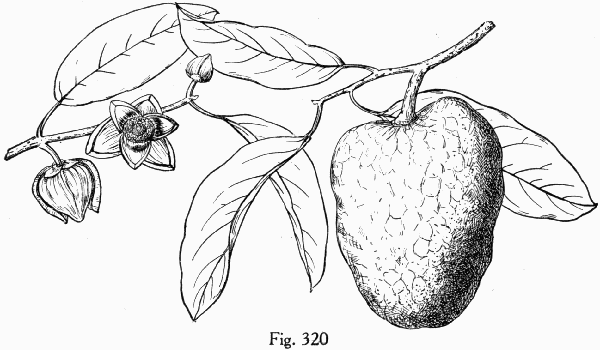
Leaves elliptic or oblong, acute, tapering or rounded at base, bright green on the upper, paler on the lower surface, coriaceous, 3′—5′ long, 1½′—2′ wide, with a prominent midrib; deciduous late in the winter; petioles, stout ½′ in length. Flowers nodding on short stout pedicels thickened at the ends, opening in April from an ovoid 3-angled bud; divisions of the calyx broad-ovate, acute; petals connivent, acute, concave, pale yellow or dirty white, those of the outer row marked on the inner surface near the base by a bright red spot, and broader and somewhat longer than those of the inner row. Fruit ripening in November, broadly ovate, truncate or depressed at base, rounded at apex, 3′—5′ long, 2′—3½′ broad, light green when fully grown, becoming yellow and often marked by numerous dark brown blotches when fully ripe, with a thick elongate fibrous torus and light green slightly aromatic insipid flesh of no comestible value; seeds ½′ long, slightly obovoid, turgid, rounded at the ends, their margins contracted into a narrow wing formed by the thickening of the outer coat.
A tree, 40°—50° high, with a short trunk often 18′ in diameter above the swell of the thickened tapering base sometimes enlarged into spreading buttresses, stout wide-spreading often contorted branches, slender branchlets brown or yellow during their first season, becoming [356] in their second year brown and marked by small scattered wart-like excrescences. Bark ⅛′ thick, dark reddish brown, divided by broad shallow fissures, separating on the surface into numerous small scales. Wood light, soft, not strong, light brown streaked with yellow.
Distribution. Florida: Indian River on the east coast, and the shores of the Manatee River on the west coast to the southern Keys; in shallow fresh water ponds, on swampy hummocks, or on the borders of fresh water streams flowing from the everglades; of its largest size on the shores of Bay Biscayne near the Miami River, growing in the shade of larger trees; forming a pure forest of great extent on the swampy borders of Lake Okechobee; on the Bahama Islands and on several of the Antilles.
XVIII. LAURACEÆ.
Aromatic trees and shrubs, with slender terete or angled branchlets, naked or scaly buds, and alternate punctate leaves without stipules. Flowers small, perfect or polygamo-diœcious, yellow or greenish; calyx 6-lobed, the lobes in 2 series, imbricated in the bud; corolla 0; stamens 9 or 12, inserted on the base or near the middle of the calyx in 3 or 4 series of 3’s, distinct; anthers 4-celled, superposed in pairs, opening from below upward by persistent lids; ovary 1-celled; stigma discoid or capitate; ovule solitary, suspended from the apex of the cell, anatropous. Fruit a 1-seeded berry; seed without albumen; testa thin and membranaceous, of 2 coats; embryo erect; cotyledons thick and fleshy; radicle superior, turned toward the hilum, included between thick and fleshy cotyledons. The Laurel family with about forty genera, confined mostly to the tropics, is represented in North America by seven genera; of these five are arborescent.
CONSPECTUS OF THE NORTH AMERICAN ARBORESCENT GENERA.
Leaves entire, persistent; stamens 12, those of the inner row reduced to staminodes.
Calyx-lobes persistent under the fruit, in our species.
1. Persea.
Calyx-lobes deciduous.
Flower cymose in axillary or subterminal panicles.
2. Ocotea.
Flowers in axillary many-flowered umbels inclosed before anthesis in an involucre of deciduous scales.
3. Umbellularia.
Leaves entire or lobed, deciduous; stamens 9 in the American species; flowers in few-flowered drooping racemes.
4. Sassafras.
Leaves entire, persistent; stamens 9, those of the outer row fertile and united in a column inclosing the pistil; flowers in terminal or axillary cymose panicles.
5. Misanteca.
1. PERSEA Mill.
Trees, with naked buds. Leaves revolute in the bud, alternate, scattered, penniveined, subcoriaceous, rigid, tomentose or rarely glabrous, persistent. Flowers perfect, vernal, in short axillary or axillary and terminal panicles on slender peduncles from axils of the leaves of the year, pedicellate, their pedicels bibracteolate near the middle, the lateral flowers of the ultimate divisions of the inflorescence in the axils of small deciduous lanceolate acute bracts; calyx campanulate, divided nearly to the base into 6 lobes, those of the outer series shorter than the others, deciduous, or enlarged and persistent under the fruit; stamens about as long as the inner lobes of the calyx; filaments flattened, longer than the anthers, hirsute, those of the third series furnished near the base with 2 nearly sessile orange-colored glands rounded on the back and slightly 2-lobed on the inner face; anthers ovoid, flattened, erect, those of the outer series introrse or subintrorse, those of the third series extrorse or laterally dehiscent, the upper cells rather larger than the lower; staminodes large, sagittate, stipitate, 2-lobed on the inner face, beaded at apex; ovary sessile, subglobose, glabrous, narrowed into a slender simple style gradually enlarged at apex into a [357] discoid obscurely 2-lobed stigma. Fruit ripening in the autumn, oblong-obovoid to subglobose, more or less fleshy. Seed globose, pendulous, without albumen; testa thin and membranaceous, separable into 2 coats, the outer cartilaginous, grayish brown, the inner gray or nearly white, closely adherent to the thick dark red cotyledons.
About one hundred species of Persea are distinguished. They are distributed in the New World, from the coast region of the southeastern United States and Texas to Brazil and Chile, and occur in the Canary Islands and in tropical and subtropical Asia. Persea americana Mill., the Avocado or Alligator Pear, a native of the Antilles and cultivated for its edible fruit in all tropical countries, is now sparingly naturalized in southern Florida. Many species yield hard dark-colored handsome wood valued in cabinet-making.
Persea was the classical name of a tree of the Orient, transferred by Plumier to one of the tropical species of this genus.
CONSPECTUS OF THE NORTH AMERICAN SPECIES.
Calyx persistent under the fruit (Tamala Raf. Persea, sec. Eupersea Benth. Notaphoebe sec. Eriodaphne Meisn.)
Peduncles short; leaves oblong to oblong-lanceolate, obscurely veined, glabrous; branchlets puberulous.
1. P. Borbonia (C).
Peduncles elongated; leaves elliptic to lanceolate, conspicuously veined, tomentose on the lower surface; branchlets tomentose.
2. P. palustris (C).
1. Persea Borbonia Spreng. Red Bay.
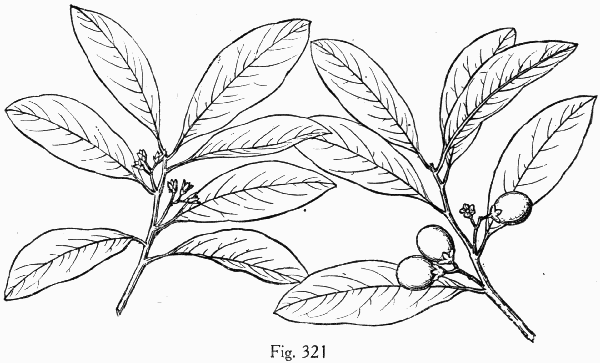
Leaves oblong to oblong-lanceolate, entire, often slightly contracted into a long point rounded at apex, gradually narrowed below, when they unfold thin, pilose, and tinged with red, and at maturity thick and coriaceous, bright green and lustrous above, pale and glaucous below, 3′—4′ long, ¾′—1½′ wide, with thickened revolute margins, a narrow orange-colored midrib, remote obscure primary veins arcuate near the margins, and thin closely reticulated veinlets; unfolding early in the spring, gradually turning yellow a year later, and falling during their second spring and summer; petioles stout, rigid, red-brown, ½′—⅔′ in length, flattened and somewhat grooved on the upper side, in falling leaving small circular leaf-scars displaying the end of a single fibro-vascular bundle. Flowers: peduncles glabrous, ½′—1′ in length; calyx pale yellow or creamy white, about ⅛′ long, with thin lobes [358] ciliate on the margins, the outer broadly ovate, rounded and minutely apiculate, puberulous, about half as long as the oblong-lanceolate acute lobes of the inner series covered within by long pale hairs. Fruit ½′ long, dark blue or nearly black, very lustrous; flesh thin and dry, not readily separable from the ovoid slightly pointed seed.
A tree, 60°—70° high, with a trunk 2½°—3° in diameter, stout erect branches forming a dense shapely head, thick fleshy yellow roots, and branchlets many-angled, light brown, glabrous or coated with pale or rufous pubescence when they first appear, becoming in their second year terete and dark green; usually much smaller. Winter-buds coated with thick rufous tomentum, ¼′ long. Bark ½′—¾′ thick, dark red, deeply furrowed and irregularly divided into broad flat ridges separating on the surface into small thick appressed scales. Wood heavy, hard, very strong, rather brittle, close-grained, bright red, with thin lighter colored sapwood of 4 or 5 layers of annual growth; occasionally used for cabinet-making, the interior finish of houses, and formerly in ship and boat-building.
Distribution. Borders of streams and swamps in rich moist soil, or occasionally in dry sandy loam in forests of the Long-leaved Pine; southern Delaware (Cypress swamp near Dogsboro, Sussex County, teste Nuttall); coast region from Virginia to the shores of Bay Biscayne and Cape Romano, Florida, along the Gulf coast to the valley of the Brazos River, Texas, and northward through Louisiana to southern Arkansas.
2. Persea palustris Sarg. Swamp Bay.
Persea pubescens Sarg.
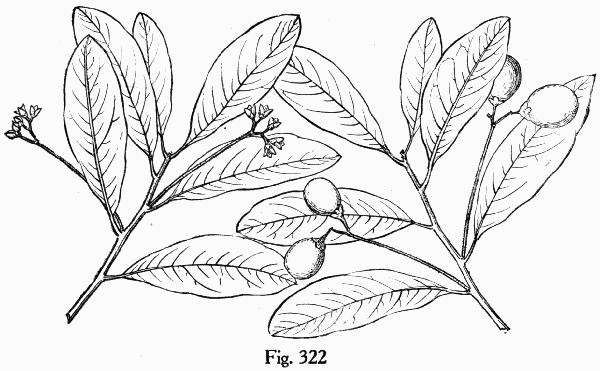
Leaves elliptic or lanceolate, entire, often narrowed toward the apex into a long point, gradually narrowed at base, when they unfold dark red, thin and tomentose, at maturity pale green and lustrous above, pale and pubescent and rusty-tomentose on the midrib and primary veins below, 4′—6′ long, ¾′—1½′ wide, with thick conspicuous veins and slightly revolute margins; persistent until after the beginning of their second year and then turning yellow and falling gradually; petioles stout, rusty-tomentose, ½′—¾′ in length. Flowers: peduncles tomentose, 2′—3′ in length; calyx pale yellow or creamy white, often nearly ¼′ long, with thick firm lobes coated on the outer surface with rusty tomentum, those of the outer series broadly ovate, abruptly pointed at apex, pubescent on the inner surface, about half as long as the ovate lanceolate lobes of the inner series slightly thickened at the apex and hairy within. Fruit nearly black, ¾′ long.
A slender tree, occasionally 30°—40° high, with a trunk rarely exceeding a foot in diameter, [359] and stout branchlets terete or slightly angled while young, coated when they first appear with rusty tomentum reduced in their second season to fine pubescence persistent until the end of their second or third year. Bark rarely exceeding ¼′ in thickness, dull brown, irregularly divided by shallow fissures, the surface separating into thick appressed scales. Wood heavy, soft, strong, close-grained, orange color streaked with brown, with thick light brown or gray sapwood of 36—40 layers of annual growth.
Distribution. Pine-barren swamps, often almost to the exclusion of other plants, usually in the neighborhood of the coast from southeastern Virginia (Dismal Swamp) to the valley of the Caloosahatchee River and the Everglades Keys, Florida, Alabama and Mississippi; extending inland to the neighborhood of Wilmington, North Carolina, Aiken, South Carolina, western Georgia (Meriwether County), the interior of the Florida peninsula and to Autauga, Chilton and Tuscaloosa Counties, Alabama (R. H. Harper).
2. OCOTEA Aubl.
Leaves scattered, alternate or rarely subopposite, penniveined, coriaceous, rigid, glabrous or more or less covered with pubescence. Flowers glabrous or tomentose on slender bibracteolate pedicels from the axils of lanceolate acute minute bracts, in cymose clusters in axillary or subterminal stalked panicles; calyx-tube campanulate, the 6 lobes of the limb nearly equal, deciduous; stamens of the inner series reduced to linear staminodes, with minute abortive anthers; filaments inserted on the tube of the calyx, those of the outer series opposite its exterior lobes, shorter or sometimes rather longer than the anthers, glabrous or hirsute, furnished in the third series near the base with two conspicuous globose stalked yellow glands; anthers oblong, flattened, 4-celled, introrse in the 2 outer series, extrorse, subextrorse, or very rarely introrse in the third series, in the pistillate flower rudimentary and sterile; ovary ovoid, glabrous, more or less immersed in the tube of the calyx, gradually narrowed into a short erect style dilated at apex into a capitate obscurely lobed stigma; in the staminate flower linear-lanceolate, effete or minute, sometimes 0; raphe ventral; micropyle superior. Fruit nearly inclosed while young in the thickened tube of the calyx, exserted at maturity, surrounded at base by the cup-like truncate or slightly lobed calyx-tube; pericarp thin and fleshy. Seed ovoid, pendulous; testa thin, membranaceous.
Ocotea with nearly two hundred species is confined principally to the tropical region of the New World from southern Florida to Brazil and Peru, with Old World representatives in the Canary Islands, South Africa, and the Mascarene Islands. One species grows naturally in Florida.
Ocotea produces hard, strong, durable, beautifully colored wood often employed in cabinet-making.
The name is derived from the native name of one of the species of Guiana.
1. Ocotea Catesbyana Sarg.
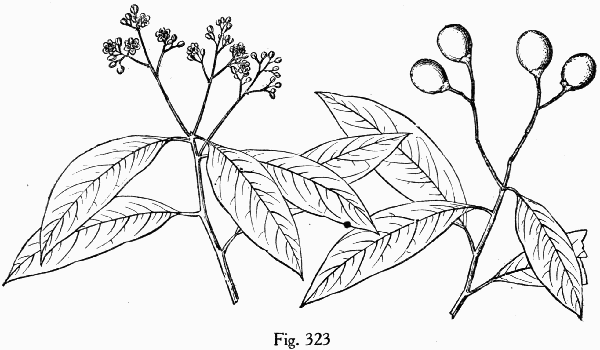
Leaves oblong-lanceolate, entire, slightly contracted above into a long point rounded at apex, when they unfold thin, membranaceous, light green tinged with red, and sometimes puberulous on the lower surface, at maturity thick and coriaceous, dark green and lustrous above, pale below, 3′—6′ long, 1′—2′ wide, with thickened slightly revolute margins, a broad stout midrib, slender remote primary veins arcuate and united near the margins and connected by coarsely reticulate conspicuous veinlets; petioles broad, flat, ⅓′—½′ in length. Flowers perfect, appearing in early summer in elongated panicles, their peduncles slender, glabrous, light red, solitary or 2 or 3 together from the axils of the leaves of the year or from those of the previous year, and 3′—4′ long; calyx nearly ¼′ across when expanded, puberulous on the outer surface, hoary pubescent on the inner surface and on the margins of the lobes, about twice as long as the stamens; filaments of the 2 outer series slightly hirsute at the base and shorter than their introrse anthers; filaments of the third series as long or longer than their extrorse anthers. Fruit ripening in the autumn, ovoid [360] or subglobose, ⅔′ long, lustrous, dark blue or nearly black, the thickened cup-like tube of the calyx truncate or obscurely lobed and bright red like the thickened pedicels; flesh thin and dry; seed with a thin brittle red-brown coat, the inner layer lustrous on the inner surface and marked by broad light-colored veins radiating from the small hilum; embryo ⅓′ long, light red-brown.
A tree, 20°—30° high, with a trunk rarely exceeding 18′ in diameter, slender spreading branches forming a narrow round-topped head, and thin terete branchlets glabrous and dark reddish brown when they first appear, soon becoming lighter colored, and in their second year light brown or gray tinged with red and often marked by minute pale lenticels, and in their second or third year by small semiorbicular leaf-scars, displaying a single central fibro-vascular bundle-scar. Bark about ⅛′ thick, dark reddish brown, and roughened on the otherwise smooth surface by numerous small excrescences. Wood heavy, hard, close-grained, rich dark brown, with thick bright yellow sapwood of 20—30 layers of annual growth.
Distribution. Shores and islands of Florida south of Cape Canaveral on the east coast and of Cape Romano on the west coast; comparatively common except on some of the western keys, and most abundant and of its largest size in the rich wooded hummocks adjacent to Bay Biscayne; in the Bahamas.
3. UMBELLULARIA Nutt.
A pungent aromatic tree, with dark brown scaly bark, slender terete branchlets marked in their second and third years by small semicircular or nearly triangular elevated leaf-scars displaying a horizontal row of minute fibro-vascular bundle-scars, naked buds, and thick fleshy brown roots. Leaves alternate, involute in the bud, lanceolate or ovate-lanceolate, acute or rounded at the narrow apex, cuneate or somewhat rounded at base, entire with thickened slightly revolute margins, petiolate, coated when they appear on the lower surface with pale soft pubescence and puberulous on the upper surface, at maturity thick and coriaceous, dark green and lustrous above, dull and paler below, with a slender light yellow midrib, and remote, obscure, arcuate veins more or less united near the margins, and connected by conspicuous reticulate veinlets. Flowers perfect in axillary stalked many-flowered umbels, inclosed in the bud by an involucre of 5 or 6 imbricated broadly ovate or obovate pointed concave yellow caducous scales, the latest umbels subsessile at the base of terminal leaf-buds; pedicels slender, puberulous, without bractlets, from the axils of obovate membranaceous [361] puberulous deciduous bracts decreasing in size from the outer to the inner; calyx divided almost to the base into 6 nearly equal broadly obovate rounded pale yellow lobes spreading and reflexed after anthesis; stamens inserted on the short slightly thickened tube of the calyx; filaments flat, glabrous, pale yellow, rather shorter than the anthers, those of the third series furnished near the base with 2 conspicuous stipitate orange-colored orbicular flattened glands; anthers oblong, flattened, light yellow, those of the first and second series introrse, those of the third series extrorse; stamens of the fourth series reduced to minute ovate acute yellow staminodes; ovary sessile, ovoid, often more or less gibbous, glabrous, abruptly contracted into a stout columnar style rather shorter than the lobes of the calyx and crowned by a simple capitate discoid stigma. Fruit ovoid, surrounded at base by the enlarged and thickened truncate or lobed tube of the calyx, yellow-green sometimes more or less tinged with purple; pericarp thin and fleshy. Seed ovoid, light brown; testa separable into 2 coats, the outer thick, hard, and woody, the inner thin and papery, closely investing the embryo, chestnut-brown and lustrous on the inner surface.
Umbellularia consists of a single species.
The generic name, a diminutive of umbella, relates to the character of the inflorescence.
1. Umbellularia californica Nutt. California Laurel. Spice-tree.
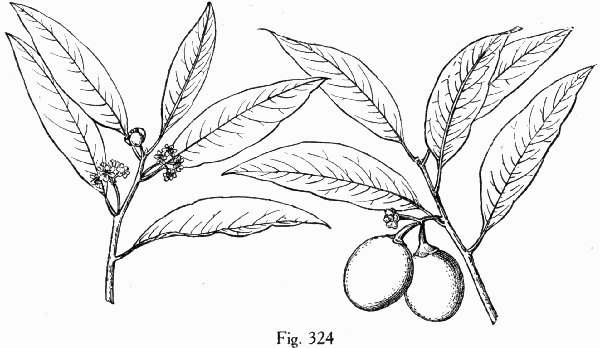
Leaves 2′—5′ long, ½′—1½′ wide, unfolding in winter or early in the spring and continuing to appear as the branches lengthen until late in the autumn; beginning to fade during the summer, turning to a beautiful yellow or orange color and falling one by one during their second season, or often remaining on the branches until the sixth year; petioles 1/10′—⅕′ in length. Flowers appearing in January before the unfolding of the young leaves, the umbels on peduncles sometimes 1′ in length. Fruit about 1′ long, in clusters of 2 or 3, on elongated thickened pedicels, persistent on the branch after the fruit ripens and falls late in the autumn; seeds germinating soon after they reach the ground, the fruit remaining below the surface of the soil and attached to the young plant until midsummer.
A tree, usually 20°—75°, occasionally 100°—175° high, with a trunk 3°—6° in diameter, sometimes tall and straight but usually divided near the ground into several large diverging stems, stout spreading or rarely pendulous (var. pendula Redh.) branches forming a broad round-topped head, and branchlets light green and coated with soft pale pubescence when they first appear, soon becoming glabrous and yellow-green, and in their second and third years light brown tinged with red; at high altitudes, and in southern California much smaller; often reduced to a large or small shrub, or on bluffs facing the ocean to broad mats [362] of prostrate stems. Bark ¾′—1′ thick, dark brown tinged with red, separating on the surface into thin appressed scales. Wood heavy, hard, strong, close-grained, light rich brown, with thick lighter colored sapwood of 30—40 layers of annual growth; the most valuable wood produced in the forests of Pacific North America for the interior finish of houses and for furniture. The leaves yield by distillation a pungent volatile oil, and from the fruit a fat containing umbellulic acid has been obtained.
Distribution. Valley of Coos River, Oregon, southward through the California coast ranges and along the high western slopes of the Sierra Nevada to the southern slopes of the San Bernardino Mountains up to altitudes of 2500°; usually near the banks of water-courses and sometimes on low hills; common where it can obtain an abundant supply of water; most abundant and of its largest size in the rich valleys of southwestern Oregon, forming with the Broad-leaved Maple a considerable part of the forest growth.
4. SASSAFRAS Nees. Sassafras.
Pseudosassafras H. Lec.
Aromatic trees, with thick deeply furrowed dark red-brown bark, scaly buds, slender light green lustrous brittle branchlets containing a thick white mucilaginous pith and marked by small semiorbicular elevated leaf-scars displaying a single horizontal row of minute fibro-vascular bundle-scars, and stout spongy stoloniferous roots covered by thick yellow bark. Flower-bearing buds terminal, ovoid, acute, with 9 or 10 imbricated scales increasing in size from without inward, the 3 outer scales ovate, rounded, often apiculate at apex, keeled and thickened on the back, pale yellow-green below, dull yellow-brown above the middle, loosely imbricated, slightly or not at all accrescent, deciduous at the opening of the bud, much smaller than the thin accrescent light yellow-green scales of the next rows turning dull red before falling, and obovate, rounded at apex, cuneate below, concave, coated on the outer surface with soft silky pubescence, glabrous or lustrous on the inner surface, reflexed, ¾′ long, nearly ½′ broad, tardily deciduous, the 2 inner scales foliaceous, lanceolate, acute, light green, coated on the outer surface with delicate pale hairs, glabrous on the inner surface, infolding the leaves; sterile and axillary buds much smaller. Leaves involute in the bud, ovate or obovate, entire or often 1—3-lobed at apex, the lobes broadly ovate, acute, divided by deep broad sinuses, gradually narrowed at base into elongated slender petioles, feather-veined, with alternate veins arcuate and united or running to the points of the lobes, the lowest parallel with the margins, conspicuously reticulate-venulose, mucilaginous, deciduous. Flowers opening in early spring with the first unfolding of the leaves, the males and females usually on different individuals, in lax drooping few-flowered racemes in the axils of large obovate bud-scales, their pedicels slender, rarely forked and 2-flowered, without bracts, pilose, from the axils of linear acute scarious hairy deciduous bracts, or that of the terminal flower often without a bract; calyx pale yellow-green, divided nearly to the base into narrow obovate concave lobes spreading or reflexed after anthesis, glabrous or pubescent on the inner surface, those of the inner row a little larger than the others; stamens in the American species 9, in the Asiatic 12 with those of the inner series reduced to staminodes, inserted on the somewhat thickened margin of the shallow concave calyx-tube, those of the outer series opposite its outer lobes; filaments flattened, elongated, light yellow, those of the inner series furnished at base with 2 conspicuous orange-colored stipitate glands rounded on the back, obscurely lobed on the inner face, in the Asiatic species alternating with 3 staminodes; anthers introrse, oblong, flattened, truncate or emarginate at apex, 4-celled, 2-celled in the Formosan species, orange-colored, in the female flower reduced to flattened ovate pointed or slightly 2-lobed dark orange-colored stipitate staminodes, 6 in 2 rows in the American species and 12 similar to the stamens and staminodes of the staminate flower in the Asiatic species; or occasionally fertile and similar to or a little smaller than those of the staminate flower; ovary ovoid, light green, glabrous, nearly sessile in the short tube of the calyx, narrowed into an elongated simple style gradually enlarged above into a capitate oblique obscurely lobed stigma; in the staminate flower 0 in the American species, [363] present, usually abortive, rarely fertile in the Asiatic species. Fruit an oblong dark blue or black lustrous berry surrounded at base by the enlarged and thickened obscurely 6-lobed or truncate scarlet or orange-red limb of the calyx, raised on a much elongated scarlet stalk thickened above the middle; pericarp thin and fleshy. Seed oblong, pointed, light brown; testa thin, membranaceous, barely separable into 2 coats, the inner coat much thinner than the outer, dark chestnut-brown, and lustrous.
Sassafras is confined to temperate eastern North America, central China and to Formosa where Sassafras tzumu Hemsl. and S. randaiense Rehd. occur.
Sassafras was first used as a popular name for this tree by the French in Florida.
1. Sassafras officinale Nees & Ebermaier.
Sassafras Sassafras Karst.
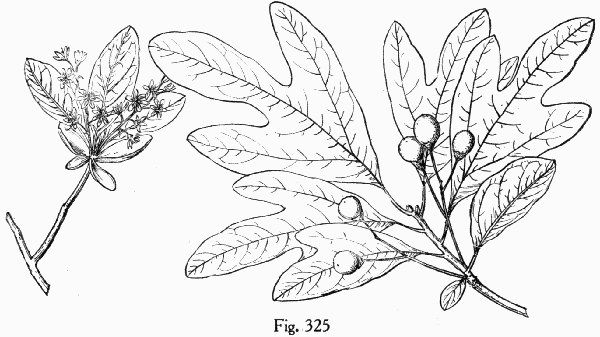
Leaves 4′—6′ long, 2′—4′ wide, densely pubescent when they first appear, pubescent or puberulous below at maturity especially on the midrib and veins; turning in the autumn delicate shades of yellow or orange more or less tinged with red; petioles ¾′—1½′ in length. Flowers ⅓′ long when fully expanded glabrous on the inner surface of the perianth, in racemes about 2′ in length, stamens 9. Fruit ripening in September and October, blue, ⅓′ long, on stalks 1½′—2′ in length, separating when ripe from the thick scarlet calyx-lobes persistent with the stalks of the fruit on the branches until the beginning of winter.
A tree, occasionally 80°—90° high, with a trunk nearly 6° in diameter, short stout more or less contorted branches spreading almost at right angles and forming a narrow usually flat-topped head, and slender branchlets light yellow-green and coated when they first appear with pale pubescence, becoming glabrous, bright green and lustrous, gradually turning reddish brown at the end of two or three years; frequently not more than 40°—50° tall; at the north and in Florida generally smaller and often shrubby. Winter-buds ¼′—⅜′ long. Bark of young stems and branches thin, reddish brown divided by shallow fissures, becoming on old trunks sometimes 1½′ thick, dark red-brown, and deeply and irregularly divided into broad flat ridges separating on the surface into thick appressed scales. Wood soft, weak, brittle, coarse-grained, very durable in the soil, aromatic, dull orange-brown, with thin light yellow sapwood of 7 or 8 layers of annual growth; largely used for fence-posts and rails, in the construction of light boats, ox-yokes, and in cooperage. The roots and especially their bark are a mild aromatic stimulant, and oil of sassafras, used to perfume soap and other articles, is distilled from them. Gumbo filet, a powder prepared from the leaves by [364] the Choctaw Indians of Louisiana, gives flavor and consistency to gumbo soup. Passing into the var. albidum Blake, with glabrous or nearly glabrous young leaves, glabrous often glaucous young branchlets, and lighter colored less valuable wood; uplands of western New England to the mountains of western North Carolina and eastern Tennessee.
Distribution. Usually in rich sandy well-drained soil, southern Maine and eastern Massachusetts, through southern Vermont to southern Ontario, central Michigan, and southeastern Iowa to eastern Kansas and Oklahoma, and southward to central Florida (Orange County) and the valley of the Brazos River, Texas; ascending on the southern Appalachian Mountains to altitudes of 4000°; in the south Atlantic and Gulf states often taking possession of abandoned fields.
Occasionally cultivated in the eastern states as an ornamental tree.
5. MISANTECA Cham. & Schl.
Trees with terete branchlets. Leaves coriaceous, persistent. Flowers perfect, minute, on slender pedicels, in terminal or axillary cymose panicles; peduncles and pedicels from the axils of acuminate caducous bracts and bractlets; perianth fleshy, ovoid or obovoid, 6-toothed; stamens 9, inserted near the middle of the perianth, those of the outer rank united into a fleshy column, furnished at base with three pairs of glands, inclosing the pistil and slightly longer than the perianth, those of the inner ranks, sterile, short or obsolete; anthers extrorse, 2-celled, the cells united; ovary gradually narrowed into a thick style as long as the staminal tube; stigma capitate. Fruit baccate, olive-shaped, surrounded at base by the enlarged ligneous capsular perianth of the flower much thickened on the margin; pericarp thin and fleshy; endocarp thin, crustaceous; seed filling the cavity of the fruit; testa thin, crustaceous; hilum minute, apical; cotyledons plano-convex, fleshy; radicle superior, minute.
Of the three species of the genus now known one occurs in southern Florida and Cuba, and the others in tropical Mexico.
The name of the genus is derived from the name of the tree, Palo Misanteca at Misantha, near the coast of the state of Vera Cruz where the type species was discovered.
1. Misanteca triandra Mez.
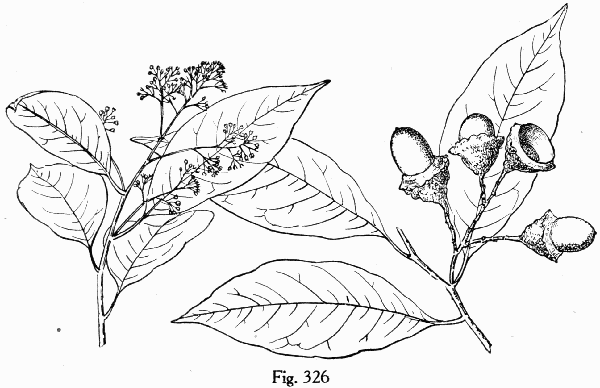
Leaves elliptic-lanceolate, ovate or broad-elliptic, entire, abruptly long-pointed and acuminate at apex, gradually narrowed and acuminate at base, deeply tinged with red and [365] villose on the under side of the midrib when they unfold, soon glabrous, and at maturity dark green and lustrous above, pale below, 3′—4′ long and 1½′—2′ wide, with slightly undulate margins, a prominent midrib, slender primary veins, and reticulate veinlets conspicuous on the lower surface; petioles stout, narrow wing-margined at apex, pubescent when they first appear, soon glabrous, ⅓′—½′ in length. Flowers glabrous or puberulous, purplish, about 1/12′ long, in 3—5-flowered cymes on slender peduncles, in pubescent panicles shorter than the leaves; tube of the perianth funnel-form, the lobes equal, triangular, acute; column of stamens pilose; ovary glabrous. Fruit in few-fruited clusters on much elongated and thickened peduncles, ellipsoidal or slightly ovoid, acute, dark blue, ⅘′ long and ⅗′ thick; cupule light red, thickened and verrucose, acute at base, the margin reflexed, thin and entire on the inner edge, thick and crenulate on the outer edge; seed ellipsoidal, pointed at apex, rounded at base, light brown, slightly ridged when dry.
A tree in Florida 40°—50° high, with a tall trunk 15′—20′ in diameter, small spreading and pendent branches forming a broad round-topped head, and slender red branchlets pubescent when they first appear, soon becoming glabrous, and marked by numerous large pale lenticels.
Rich hummocks between Miami and Homestead, Dade County, Florida; in Cuba and Jamaica.
XIX. CAPPARIDACEÆ.
Annual or perennial herbs, trees, or shrubs, with acrid often pungent juices, alternate or rarely opposite leaves, regular or irregular usually perfect flowers in terminal cymes or racemes or solitary, numerous ovules inserted in two rows on each of the two placentas, capsular or baccate 1-celled fruit, and seeds without albumen. A family of thirty-four genera, mostly confined to the warmer parts of the world and widely distributed in the two hemispheres. Of the seven genera which occur in North America only one has an arborescent representative.
1. CAPPARIS L.
Trees, with naked buds. Leaves conduplicate in the bud, entire, feather-veined, coriaceous, persistent, without stipules. Flowers regular, in terminal cymes; sepals 4, valvate in the bud, glandular on the inner surface; petals 4, inserted on the base of the short receptacle; stamens numerous, inserted on the receptacle, their filaments free, elongated, much longer than the introrse 2-celled anthers opening longitudinally; ovary long-stalked, 2-celled, with 2 parietal placentas; stigmas sessile, orbicular; ovules campylotropous. Fruit baccate, siliquiform (in the North American species) separating into 3 or 4 valves. Seeds reniform, numerous, surrounded by pulp; seed-coat coriaceous; embryo convolute; cotyledons foliaceous, fleshy.
Capparis, with more than one hundred species, mostly tropical, is found in the two hemispheres, the largest number of species occurring in Central and South America. Two of the West Indian species reach the shores of southern Florida, the most northern station of the genus in America; of these one is arborescent.
Capparis, from κάππαρις, the classical name of Capparis spinosa L., is derived from the Persian kabor, capers, the dried flower-buds of that species.
1. Capparis jamaicensis Jacq.
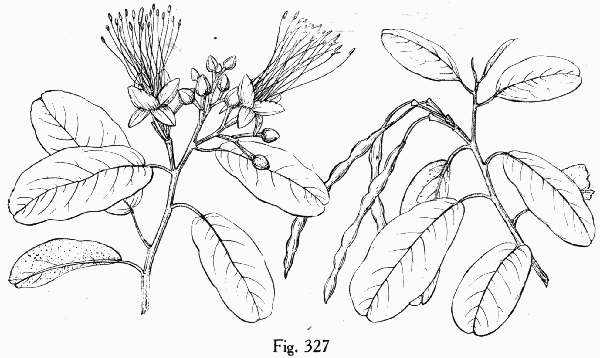
Leaves oblong-lanceolate, rounded and emarginate at apex, slightly revolute, coriaceous, light yellow-green, smooth and lustrous on the upper surface, covered on the lower by minute ferrugineous scales, 2′—3′ long, 1′—1½′ wide, with a prominent midrib and inconspicuous primary veins; petioles stout covered at first with ferrugineous scales often becoming nearly glabrous, ⅓′—½′ in length. Flowers 1¼′ in diameter, opening in Florida in April and May from obtuse or acute, 4-angled buds; sepals ovate, acute, lepidote on the outer surface, furnished on the inner with a small ovate gland, recurved when the flower is [366] fully expanded, and about half the size of the round white petals turning purple in fading; stamens 20—30, with purple filaments villose toward the base, 1½′—2′ long; anthers yellow; ovary raised on a slender stipe about 1½′ in length. Fruit 9′—12′ long, terete, sometimes slightly torulose, pubescent-lepidote, the long stalk appearing jointed by the enlargement of the pedicel and torus below the insertion of the stipe; seed light brown, 1¼′ long.
A small slender shrubby tree, 18°—20° high, with a trunk sometimes 5′—6′ in diameter, and thin angled branchlets dark gray, smooth or slightly rugose, and covered with minute ferrugineous scales. Bark rarely more than ⅛′ thick, slightly fissured, the dark red-brown surface broken into small irregularly shaped divisions. Wood heavy, hard, close-grained, yellow faintly tinged with red, with lighter colored sapwood of about 15 layers of annual growth.
Distribution. Coast of Florida; Cape Canaveral and Cape Sable to the southern keys; generally distributed, but nowhere abundant; common on several of the Antilles.
XX. HAMAMELIDACEÆ.
Trees or shrubs, with watery juice, slender terete branchlets, naked or scaly buds, and fibrous roots. Leaves alternate, petiolate, stipulate, deciduous. Flowers perfect or unisexual; calyx 4-parted or 0; petals 4 or 0; stamens 4—8; anthers attached at the base, introrse, 2-celled; ovary inserted in the bottom of the receptacle, 2-celled; ovules 1 or many, anatropous, suspended from an axile placenta; micropyle superior; raphe ventral. Fruit a woody capsule opening at the summit. Seed usually 1; embryo surrounded by fleshy albumen; cotyledons oblong, flat, longer than the terete radicle turned toward the hilum. The Witch Hazel family with twenty genera is confined to eastern North America, southwestern, southern, and eastern Asia, the Malay Archipelago, Madagascar, and South Africa. Of the three North American genera two are arborescent.
CONSPECTUS OF THE NORTH AMERICAN ARBORESCENT GENERA.
Flowers usually unisexual, capitate, without petals, limb of the calyx short or nearly obsolete; capsules consolidated by their base into a globose head; seed with a terminal wing; leaves palmately lobed.
1. Liquidambar.
Flowers usually perfect, with calyx and corolla; capsules not consolidated into a head; seed without a wing.
2. Hamamelis.
[367]
1. LIQUIDAMBAR L.
Trees, with balsamic juices, scaly bark, terete often winged branchlets, scaly buds, and fibrous roots. Leaves plicate in the bud, alternate, palmately lobed, glandular-serrate, long-petiolate; stipules lanceolate, acute, caducous. Flowers monœcious or rarely perfect in capitate heads surrounded by an involucre of 4 deciduous bracts, the staminate in terminal racemes, the pistillate in solitary long-stalked heads from the axils of upper leaves; staminate flowers without a calyx and corolla; stamens indefinite, interspersed with minute scales; filaments filiform, shorter than the oblong obcordate anthers opening longitudinally; pistillate flowers surrounded by long-awned scales, the whole confluent into a globular head; calyx obconic, its limb short or nearly obsolete; stamens usually 4, inserted on the summit of the calyx; anthers minute, usually rudimentary or abortive, rarely fertile; ovary partly inferior, of 2 united carpels terminating in elongated subulate recurved persistent styles stigmatic on the inner face; ovules numerous. Capsules armed with the hardened incurved elongated styles free above, septicidally dehiscent, consolidated by their base into a globose head; pericarp thick and woody; endocarp thin, corneous, lustrous on the inner surface. Seeds usually solitary or 2 by the abortion of many ovules, compressed, angulate; seed-coat opaque, crustaceous, produced into a short membranaceous obovate terminal wing rounded at the oblique apex.
Liquidambar with about four species is confined to the eastern United States, southern and central Mexico, Central America, southwestern Asia, middle and southeastern China, and Formosa. Liquid storax, an opaque grayish brown resin, is derived from Liquidambar orientalis Mill., a native of Asia Minor.
Liquidambar from liquidus and ambar in allusion to the fragrant juices.
1. Liquidambar Styraciflua L. Sweet Gum. Bilsted.
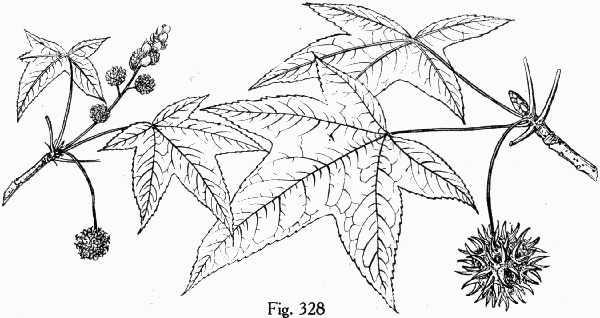
Leaves generally round in outline, truncate or slightly heart-shaped at base, deeply 5—7-lobed, with acutely pointed divisions finely serrate with rounded appressed teeth, when they unfold pilose on the lower surface, soon becoming glabrous with the exception of large tufts of pale rufous hairs in the axils of the principal veins, at maturity thin, bright green, smooth and lustrous, 6′—7′ across, with broad primary veins and finely reticulate veinlets; exhaling when bruised a pleasant resinous fragrance; in the autumn turning deep crimson; petioles slender, covered at first near the base with rufous caducous hairs, and 5′—6′ in length; stipules entire, glabrous, ⅓′—½′ long. Flowers: staminate in terminal racemes 2′—3′ long covered with rufous hairs, in heads stalked toward the base of the raceme and nearly sessile above, ¼′ in diameter, and surrounded by ovate acute deciduous hairy bracts much larger than the lanceolate acute bracts of the female inflorescence ½′ [368] across and conspicuous from the broad stigmatic surfaces of the recurved and contorted styles. Fruit 1′—1½′ in diameter, persistent during the winter, the carpels opening in the autumn; seed ½′ long and rather longer than its wing, with a light brown coat conspicuously marked by oblong resin-ducts.
A tree, 80°—140° high, with a straight trunk 4°—5° in diameter, slender branches forming while the tree is young a pyramidal head, and in old age a comparatively small oblong crown, and slender branchlets containing a large pith, slightly many-angled, covered when they first appear with caducous rufous hairs, light orange color to reddish brown in their first winter, marked by occasional minute dark lenticels and by large arcuate leaf-scars showing the ends of 3 conspicuous fibro-vascular bundles, developing in their second season corky wings appearing on the upper side of lateral branches in 3 or 4 parallel ranks and irregularly on all sides of vertical branches, and increasing in width and thickness for many years, sometimes becoming 2′—3′ broad and 1′ thick. Winter-buds acute, ¼′ long, and covered by ovate acute minutely apiculate orange-brown scales rounded on the back, those of the inner rows accrescent, tipped with red, and about 1′ long at maturity. Wood heavy, hard, straight, close-grained, not strong, bright brown tinged with red, with thin almost white sapwood of 60—70 layers of annual growth; used for the outside and inside finish of houses, in cabinet-making, for street pavement, wooden dishes, and fruit boxes.
Distribution. Fairfield County, Connecticut, and in the neighborhood of the coast to southeastern Pennsylvania, southward to Cape Canaveral and the shores of Tampa Bay, Florida, and westward through southern Ohio, Indiana and Illinois to southeastern Missouri, and through Arkansas to eastern Oklahoma and the valley of the Trinity River, Texas; reappearing on the mountains of central and southern Mexico and on the highlands of Guatemala; in the maritime region of the south Atlantic and Gulf states and in the basin of the lower Mississippi River one of the common trees of the forest, covering rich river bottom-lands usually inundated every year; in the northern and middle states on the borders of swamps and low wet swales; at the north rarely more than 60°—70° tall, with a trunk usually not more than 2° in diameter.
Unsurpassed in the brilliancy of the autumnal colors of the leaves; and often planted as an ornamental tree in the eastern states.
2. HAMAMELIS L. Witch Hazel.
Trees or shrubs, with scaly bark, terete zigzag branchlets, naked buds, and fibrous roots. Leaves involute in the bud, more or less unsymmetrical at base, crenately toothed or lobed, the primary veins conspicuous; stipules acute, infolding the bud, deciduous. Flowers perfect, autumnal or hiemal, in 3 or rarely 4-flowered terminal clusters, from buds appearing in summer, on short recurved peduncles from the axils of leaves of the year, furnished near the middle with 2 acute deciduous bractlets, covered like their acute bracts and bractlets with dark ferrugineous pubescence, each flower surrounded by 2 or 3 ovate acute bracts, the outer slightly united at base into a 3-lobed involucre; calyx 4-parted pale pubescent on the outer surface, orange-brown, yellow or red on the inner surface, persistent on the base of the ovary, the lobes reflexed; petals bright yellow, inserted on the margin of the cup-shaped receptacle, alternate with the sepals, strap-shaped, falling with the stamens when the ovules are fertilized; stamens 8, inserted in 2 rows on the margin of the receptacle, the 4 opposite the lobes of the calyx fertile, the others reduced to minute strap-shaped scales; filaments free, shorter than the calyx, prolonged into a thickened pointed connective; anthers ellipsoid, opening laterally from without by persistent valves; ovary of 2 carpels, free at apex, inserted in the bottom of the receptacle, partly superior, remaining during the winter without enlarging and surrounded and protected by the calyx; styles subulate, spreading, stigmatic at apex, persistent; ovule solitary. Fruit ripening in the autumn, usually 2 from each flower-cluster, capsular, 2-beaked at apex, surrounded for one-third or one-half its length by the enlarged persistent calyx bearing at the base the blackened remnants of the floral bracts, the thick and woody outer layer splitting from [369] above loculicidally before the opening of the thin crustaceous inner layer. Seed oblong, acute, suspended; testa crustaceous, chestnut brown, shining; forcibly discharged when ripe by the contraction of the edges of the valves of the bony endocarp; embryo surrounded by thick fleshy albumen; cotyledons foliaceous; hilum oblong, depressed.
Hamamelis is confined to eastern North America and eastern Asia, with three American and two or three Asiatic species; of the American species two are sometimes small trees, and the third H. vernalis Sarg. is a shrub of southern Missouri, western Arkansas, and eastern Oklahoma.
The name is from άμα, at the same time with, and μηλίς, an Apple-tree, and was applied by the ancients to the Medlar or some similar tree.
CONSPECTUS OF THE NORTH AMERICAN ARBORESCENT SPECIES.
Leaves smooth, conspicuously unsymmetrical at base; flowers autumnal.
1. H. virginiana (A, C).
Leaves roughened by persistent tubercles, slightly unsymmetrical at base; flowers hiemal.
2. H. macrophylla (C).
1. Hamamelis virginiana L.
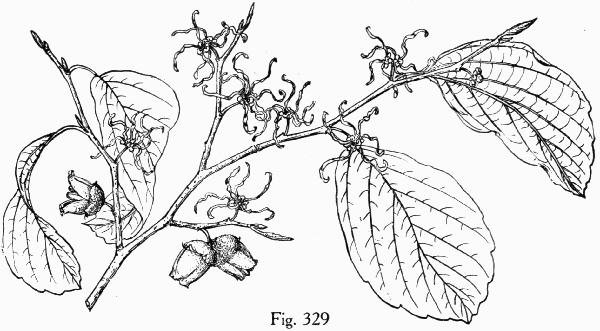
Leaves obovate, acuminate, long-pointed or sometimes rounded at apex, very unequal at base, the lower side rounded or subcordate, the upper usually cuneate and smaller, irregularly and coarsely crenately lobed above the middle, entire or dentate below, when they unfold coated, especially on the lower surface of the midrib and veins and on the petioles and stipules with stellate ferrugineous pubescence, at maturity membranaceous, dull dark green and glabrous or pilose above, lighter colored and lustrous below, and pubescent or puberulous on the stout midrib and 6 or 7 pairs of primary veins, 4′—6′ long, 2′—2½′ wide; turning delicate yellow in the autumn; petioles slender, pubescent early in the season, becoming glabrous ⅓′—1′ in length; stipules lanceolate, acute, coriaceous, ⅓′—½′ long. Flowers opening from the middle of September to the middle of November; calyx orange-brown on the inner surface; petals bright yellow; ½′—⅔′ long. Fruit ripening when the flowers of the season are expanding, ½′ long, pubescent, dull orange-brown and surrounded for half its length by the large persistent calyx; seed ¼′ long.
A tree, occasionally 20°—25° high, with a short trunk 12′—14′ in diameter, spreading branches forming a broad open head, and slender flexible branchlets coated at first with scurfy rusty stellate hairs, gradually disappearing during the summer, and in their first winter glabrous or slightly puberulous, light orange-brown and marked by small white dots, becoming in their second year dark or reddish brown; usually a stout shrub sending [370] up from the ground numerous rigid diverging stems 5°—20° tall. Winter-buds acute, slightly falcate, light orange-brown, covered with short fine pubescence, ¼′—½′ long. Bark ⅛′ thick, light brown, generally smooth but broken into minute thin appressed scales disclosing in falling the dark reddish purple inner bark. Wood heavy, hard, very close-grained, light brown tinged with red, with thick nearly white sapwood of 30—40 layers of annual growth. The bark and leaves are slightly astringent and although not known to possess essential properties are largely used in the form of fluid extracts and decoctions and in homœopathic practice, Pond’s Extract being made by distilling the bark in diluted alcohol.
Distribution. Nova Scotia, New Brunswick, and the valley of the St. Lawrence River to southern Ontario, southern Wisconsin, southeastern Minnesota and northeastern Iowa, and southward to central Georgia and southern Arkansas, growing usually on the borders of the forest in low rich soil or on the rocky banks of streams; of its largest size and probably only arborescent on the slopes of the high Alleghany Mountains in North and South Carolina and Tennessee.
Occasionally cultivated as an ornamental plant in the northern states, and in western and northern Europe.
2. Hamamelis macrophylla Pursh.
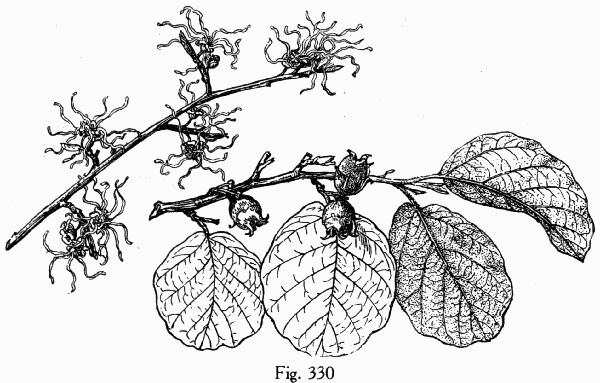
Leaves short-obovate or occasionally broad-elliptic, rounded, acute or rarely acuminate at apex, cuneate, rounded or cordate at the narrow slightly unsymmetrical base, crenate-lobulate above the middle with small rounded lobes, covered with short stellate hairs more abundant on the upper than on the lower surface, and at maturity dark green above, paler below, and roughened by the persistent tubercle-like bases of the stellate hairs, 3′—5′ long, 2′—3′ wide, with a slender midrib and five or six pairs of primary veins; petioles slender, pubescent, ½′—¾′ in length; stipules lanceolate, acuminate, scarious, hoary-pubescent, ⅕′—⅙′ long. Flowers opening in December, January and February; calyx yellow on the inner surface; petals light yellow, ½′ long and less than 1/24′ wide. Fruit ripening in the autumn, about ½′ in length; seed dark chestnut-brown or nearly black.
A tree, often 30°—45° high, producing stoloniferous shoots round the tall trunk often 1° in diameter, erect and spreading branches, and branchlets rusty or hoary-tomentose during their first year, becoming glabrous or nearly glabrous and grayish brown in their second season; often a shrub. Winter-buds rusty-tomentose, about ⅓′ in length.
Distribution. Rich soil, by streams or along the borders of the forest; valley of the lower Savannah River, near Savannah, Chatham County, and along the Wittlocoochee River, Lowndes County, Georgia, to central and western Florida; through Alabama; in [371] southern and central Mississippi, and through Louisiana to eastern Texas (Beaumont, Jefferson County, and Fletcher, Harding County), and southern Arkansas; generally distributed and most abundant in Louisiana; probably of its largest size on the bluffs of the Alabama River in Dallas County, Alabama.
XXI. PLATANACEÆ.
Trees, with watery juice, thick deeply furrowed scaly bark exfoliating from the branches and young trunks in large thin plates, terete zigzag pithy branchlets prolonged by an upper axillary bud, and fibrous roots. Winter-buds axillary, conic, large, smooth, and lustrous, nearly surrounded at base by the narrow leaf-scars displaying a row of conspicuous dark fibro-vascular bundle-scars, covered by 3 deciduous scales, the 2 inner accrescent, strap-shaped, rounded at apex at maturity, marking in falling the base of the branchlet with narrow ring-like scars, the outer scale surrounding the bud and splitting longitudinally with its expansion, the second light green, covered by a gummy fragrant secretion and usually inclosing a bud in its axil, the third coated with long rufous hairs. Leaves longitudinally plicate in vernation, alternate, broadly ovate, cordate, truncate, or cuneate and decurrent on the petiole at base, more or less acutely 3—7-lobed, and occasionally furnished with a more or less enlarged basal lobe, the lobes entire, dentate with minute remote callous teeth, or coarsely sinuate-toothed, penniveined, the veins arcuate and united near the margins and connected by inconspicuous reticulate veinlets, clothed while young like the petioles, stipules, and young branchlets with caducous stellate sharp-pointed branching hairs, pale on the lower and rufous on the upper surface, long-petiolate; turning brown and withering in the autumn before falling; petioles abruptly enlarged at base and inclosing the buds; stipules membranaceous, laterally united below into a short tube surrounding the branchlet above the insertion of their leaf, acute, more or less free above, dentate or entire, thin and scarious on flowering shoots, broad and leaf-like on vigorous sterile branchlets, caducous, marking the branchlet in falling with narrow ring-like scars. Flowers minute, appearing with the unfolding of the leaves in dense unisexual pedunculate solitary or spicate heads, the staminate and pistillate heads on separate peduncles or rarely united on the same peduncle; staminate heads dark red on axillary peduncles; pistillate heads light green tinged with red, on long terminal peduncles, the lateral heads in the spicate clusters sessile and embracing at maturity the peduncle, usually persistent on the branches during the winter; calyx of the staminate flower divided into 3—6 minute scale-like sepals slightly united at base, about half as long as the 3—6 cuneiform sulcate scarious pointed petals; stamens as many as the divisions of the calyx, opposite them, with short nearly obsolete filaments, and elongated clavate 2-celled anthers, their cells opening longitudinally and crowned by a capitate pilose truncate connective; calyx of the pistillate flower divided into 3—6, usually 4, rounded sepals much shorter than the acute petals; stamens scale-like, elongated-obovoid, pilose at apex; ovaries as many as the divisions of the calyx, superior, oblong, sessile, surrounded at base by long ridged jointed pale hairs persistent round the fruit, gradually narrowed into long simple bright red styles papillose-stigmatic to below the middle along the ventral suture; ovules 1 or rarely 2, suspended laterally, orthotropous. Head of fruit composed of elongated obovoid akenes rounded and obtuse or acute at apex, surmounted by the persistent styles, 1-seeded, light yellow-brown; pericarp thin, coriaceous. Seed elongated-oblong, suspended; testa thin and firm, light chestnut-brown; embryo erect in thin fleshy albumen; cotyledons oblong, about as long as the elongated cylindric erect radicle turned toward the minute apical hilum. Wood hard and heavy not strong, light brown tinged with red, with numerous broad conspicuous medullary rays and bands of smaller ducts marking the layers of annual growth. A family of a single genus.
1. PLATANUS L. Plane-tree.
Characters of the family.
A genus of four or five species of eastern and western North America, Mexico, Central America, and of southwestern Asia, all resembling each other except in the form of the lobes [372] of the leaves and the amount of pubescence on their lower surface, in the pointed or obtuse apex of the akene, and in the number of heads of pistillate flowers on their peduncle.
Of the exotic species, the Old World Platanus acerifolia Willd., of doubtful origin, and often considered a hybrid between P. orientalis L. and the Plane-tree of the eastern United States, is now a common street tree in the cities of all the countries of temperate Europe, and is largely used as a street and shade tree in the eastern states and in California.
Platanus is the classical name of the Plane-tree.
CONSPECTUS OF THE NORTH AMERICAN SPECIES.
Heads of fruit usually solitary; leaves broadly ovate, slightly 3—5-lobed, the lobes broad, mostly serrulate, or entire, truncate or rarely cuneate at base.
1. P. occidentalis (A, C).
Heads of fruit racemose.
Leaves 3—5-lobed to below the middle, the lobes entire, remotely and obscurely dentate, or rarely sinuate-toothed, truncate or slightly cordate or cuneate at base.
2. P. racemosa (G).
Leaves deeply 5—7-lobed, the lobes elongated, slender, entire, or rarely remotely dentate, deeply cordate or rarely cuneate or truncate at base.
3. P. Wrightii (H).
1. Platanus occidentalis L. Sycamore. Buttonwood.
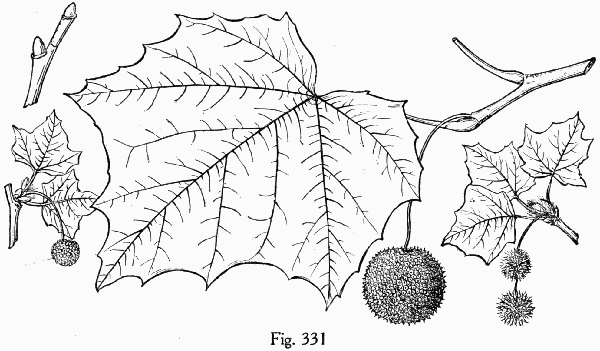
Leaves broadly ovate, more or less 3—5-lobed by broad shallow sinuses rounded at the bottom, the lobes broad, acuminate, sinuate-toothed with long straight or curved remote acuminate teeth, or entire with undulate margins, truncate or slightly cordate, or long-cuneate and decurrent on the petiole at base (var. attenuata Sarg.), thin and firm, bright green on the upper surface, paler on the lower, glabrous at maturity with the exception of a slight pubescence on the under side of the thin midrib and stout yellow veins, 4′—7′ long and broad, or twice as large on vigorous shoots and then frequently furnished with dentate basal lobes; petioles stout, terete or slightly angled, becoming puberulous 3′—5′ in length; stipules 1′—1½′ long, entire or sinuate-toothed. Flowers: peduncles coated with pale tomentum, bearing 1 and sometimes 2 heads of flowers. Fruit: heads 1′ in diameter, on slender glabrous stems 3′—6′ in length; akene about ⅔′ long and truncate or obtusely rounded at apex.
A tree, occasionally 140°—170° high, with a trunk sometimes 10°—11° in diameter above its abruptly enlarged base, often divided near the ground into several large secondary trunks, or rising 70°—80°, with a straight column-like shaft free of branches and with little [373] diminution of diameter, massive spreading limbs forming a broad open irregular head sometimes 100° in diameter, their extremities usually erect or more or less pendulous, and slender branchlets coated at first like the leaves, petioles, and stipules with thick pale deciduous tomentum, during their first summer dark green and glabrous, marked by minute oblong pale lenticels, becoming dark orange-brown and rather lustrous during their first winter and light gray in their second year. Winter-buds ¼′—⅜′ long. Bark of young trunks and large branches rarely more than ½′ thick, dark reddish brown, broken into small oblong thick appressed plate-like scales, smooth, light gray, and separating higher on the tree into large thin scales, in falling exposing large irregular surfaces of the pale yellow, whitish, or greenish inner bark, becoming at the base of large trunks 2′—3′ thick, dark brown, and divided by deep furrows into broad rounded ridges covered by small thin appressed scales. Wood the favorite material for tobacco boxes, ox-yokes, and butcher’s blocks, and now largely used for furniture and the interior finish of houses.
Distribution. Borders of streams and lakes on rich bottom-lands; southeastern Maine to northern Vermont and through southern Ontario and Michigan to central and southern Iowa, southeastern Nebraska, eastern Kansas, and eastern Oklahoma to the valley of the Arkansas River (Clay County), and southward to western Florida (Gladsden County) central Alabama and Mississippi, and the valley of the Rio Grande (Zavalla County) western Texas; common but most abundant and of its largest size on the bottom lands of streams in the basin of the lower Ohio and Mississippi rivers; less abundant and of smaller size in the coast region of the Carolinas and in western Texas; ascending the Appalachian Mountains up to altitudes of 2500°. The most massive if not the tallest deciduous-leaved tree of eastern North America.
Sometimes planted as a street tree, especially in the cities of eastern Texas; passing into
1. Platanus occidentalis var. glabrata Sarg.
Platanus glabrata Fern.
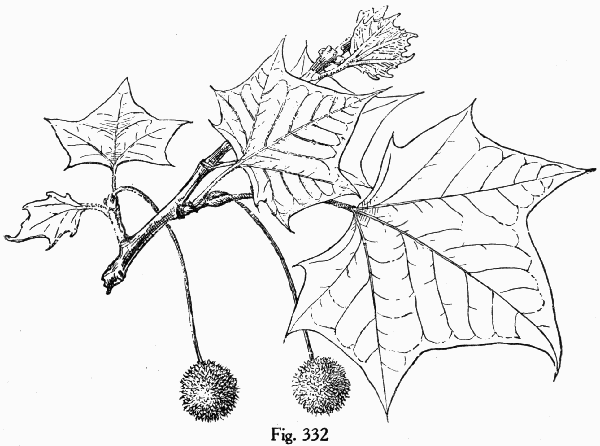
Leaves usually broader than long, truncate, broad-cuneate or rarely cordate at base, 3-lobed by sinuses acute or rounded in the bottom, the lobes long-acuminate, entire, the lateral lobes often furnished near the base with one or rarely with two small acuminate incurved [374] secondary lobes occasionally found also on the terminal lobe, tomentose below and pubescent above when the flowers open the end of March in Texas, later becoming glabrous except on the under side of the midrib and veins, usually about 2¾′—5½′ long and 3′—3½′ wide; petioles pubescent, becoming glabrous. Peduncles bearing one or rarely two heads. Flowers and Fruit like those of the species.
Distribution. Western Texas, common; valley of the Colorado River, near Austin, Travis County, to that of the Devil’s River, Valverde County; in Coahuila and Nuovo Leon; rarely northward with widely scattered individuals; the prevailing form on the Edwards Plateau and in the counties adjacent to the Rio Grande.
2. Platanus racemosa Nutt. Sycamore.
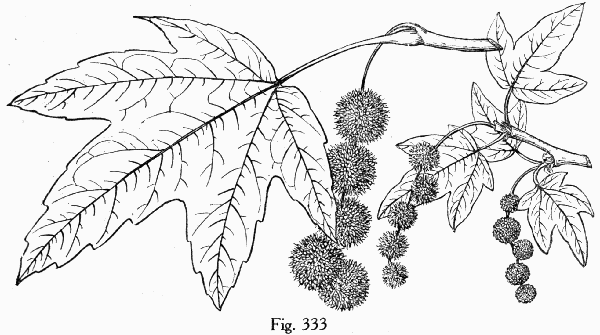
Leaves 3—5-lobed to below the middle by broad sinuses acute or rounded in the bottom, the lobes acute or acuminate, entire, dentate with remote callous tipped teeth, or occasionally coarsely sinuate-toothed, usually cordate or sometimes truncate, or cuneate and decurrent on the petiole at base, thick and firm, light green above, paler and more or less thickly coated below with pale pubescence most abundant along the midrib and primary veins, 6′—10′ long and broad; petioles stout, pubescent, 1′—3′ in length; stipules 1′—1½′ long, entire or dentate, often persistent until spring. Flowers: peduncles hoary-pubescent, bearing usually 4 or 5 heads of staminate flowers and 2—7 heads of pistillate flowers, a head of the staminate flowers occasionally appearing on the pistillate peduncle above the heads of fertile flowers. Fruit: heads ¾′ in diameter, on slender zigzag glabrous or pubescent stems 6′—9′ in length; akene acute or rounded at apex, ⅓′ long, tomentose while young, becoming glabrous.
A tree, 40°—90° high, with a trunk sometimes 9° in diameter above the broad tapering base, erect and free of branches for half its height, more often divided near the ground into secondary stems erect, inclining, or prostrate for 20°—30° at their base, thick heavy more or less contorted spreading branches forming an open irregular round-topped head, and branchlets coated at first with thick pale deciduous tomentum, light reddish brown, and marked by numerous small lenticels in their first winter, becoming gradually darker in their second and third years; usually smaller, with a trunk 2°—4° in diameter. Winter-buds nearly ½′ long. Bark at the base of old trunks 3′—4′ thick, dark brown, deeply furrowed, with broad rounded ridges separating on the surface into thin scales; thinner, smooth, and pale, or almost white higher on the trunk and on the branches.
Distribution. Banks of the streams of western California; valley of the upper Sacramento [375] River (Tehama County) southward through the interior valleys, along the western foothills of the Sierra Nevada and on the southern coast ranges; and on Mount San Pedro Màrtir in Lower California; exceedingly common in all the valleys of the California coast ranges from Monterey to the southern borders of the state, and ascending the southern slopes of the San Bernardino Mountains to altitudes of 3000°—4000°.
3. Platanus Wrightii S. Wats. Sycamore.
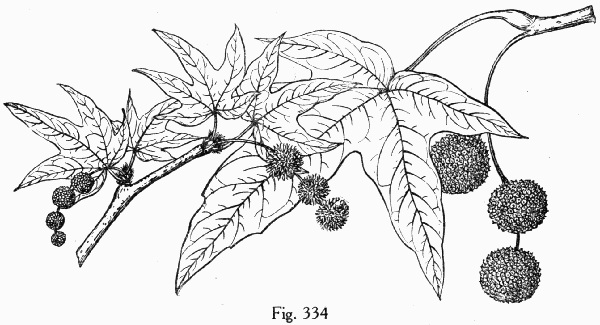
Leaves divided by narrow sinuses to below the middle and sometimes nearly to the center into 3—7 but usually into 3—5 elongated acute lobes entire, or dentate with callous-tipped teeth, or occasionally furnished with 1 or 2 lateral lobes, sometimes deeply cordate by the downward projection of the lower lobes, or often truncate or cuneate at base, thin and firm in texture, light green and glabrous above, covered below with pale pubescence, 6′—8′ long and broad, with a slender midrib, and primary veins connected by conspicuous reticulate veinlets; petioles stout, glabrous or puberulous, 1½′—3′ in length. Flowers: peduncles hoary-tomentose, bearing 1—4 heads of flowers. Fruit: heads on slender glabrous stems 6′—8′ long, about ¾′ in diameter; akenes glabrous, ¼′ long, truncate at apex.
A tree, often 60°—80° high, with a straight trunk 4°—5° in diameter, gradually tapering and free of branches for 20°—30°, or with a trunk divided at the ground into 2 or 3 large stems usually more or less reclining and often nearly prostrate for 15°—20°, thick contorted branches, the lowest growing almost at right angles to the trunk and 50°—60° long, the upper usually erect at first, finally spreading into a broad open handsome head, and slender branchlets coated when they first appear with thick pale tomentum, becoming glabrous or slightly puberulous during their first winter, marked by minute scattered lenticels, and light brown tinged with red or ashy gray, and gradually darker in their second or third year. Winter-buds hardly more than ⅛′ long. Bark at the base of the trunk dark, 3′—4′ thick, deeply and irregularly divided into broad ridges, and covered on the surface with small appressed scales, thinner and separating into large scales 10°—15° above the ground, and gradually passing into the smooth much thinner creamy white bark faintly tinged with green of the upper branches.
Distribution. Banks of streams in the mountain cañons of southwestern New Mexico and southern Arizona; in northern Arizona in Oak Creek Cañon near Flagstaff (P. Lowell); and in Sonora; the largest and one of the most abundant of the deciduous-leaved trees on all the mountain ranges of southern Arizona, extending from the mouth of cañons up to altitudes of 5000°—6000° above the sea.
[376]
XXII. ROSACEÆ.
Trees, shrubs and herbs, with watery juices, terete branchlets, scaly buds, and alternate leaves (opposite in Lyonothamnus), with stipules. Flowers perfect; calyx 5-lobed; petals 5 (0 in Cercocarpus), imbricated in the bud, inserted with the numerous distinct stamens on the edge of a disk lining the calyx-tube; anthers introrse (extrorse in Vauquelinia), 2-celled, the cells opening longitudinally; ovary superior in Lyonothamnus and Heteromeles, often partly superior in Amelanchier; ovules 2 in each cell (1 in Cowania and Cercocarpus, 4 in Lyonothamnus), anatropous. Seeds without albumen (albuminous in Lyonothamnus and Cowania). A family of about ninety genera chiefly confined to the temperate parts of the world and producing many of the most valuable fruits, including the apple, pear, quince, strawberry, raspberry, and blackberry. The six tribes into which the genera of the family are grouped, have arborescent representatives in North America.
CONSPECTUS OF THE NORTH AMERICAN ARBORESCENT GENERA.
Tribe 1. Spiræoideæ. Fruit a woody capsule.
Flowers in terminal cymose corymbs; calyx-lobes persistent; ovary 5-celled; ovules ascending; mature carpels adherent below and opening down the back; albumen 0; leaves simple.
1. Vauquelinia.
Flowers in terminal corymbs; calyx-lobes deciduous; ovary 2-celled; ovules 4 in each cell, pendulous; mature carpels opening on the ventral and partly on the dorsal suture; albumen thin; leaves opposite, simple or pinnately divided.
2. Lyonothamnus.
Tribe 2. Pomoideæ. Fruit a pome composed of the thickened and succulent calyx-tube inclosing the papery or bony carpels; stipules free from the petioles.
Mature carpels papery.
Carpels as many as the styles.
Flowers in few-flowered terminal racemes on short spur-like lateral branchlets; ovary 3—5-celled; styles more or less united below; leaves simple; winter-buds small.
3. Malus.
Flowers in broad compound terminal cymes; ovary 2—4, usually 3-celled; styles distinct; fruit subglobose; leaves unequally pinnate; winter-buds large.
4. Sorbus.
Flowers in large terminal corymbose panicles; ovary nearly superior, 2-celled; styles distinct; fruit obovoid.
5. Heteromeles.
Carpels becoming at maturity twice as many as the styles; flowers in erect or nodding racemes; ovary inferior or partly superior; styles 2—5, more or less united below; fruit subglobose or pyriform; leaves simple, deciduous.
6. Amelanchier.
Mature carpels bony; flowers in terminal cymose corymbs; ovary 1—5-celled; styles distinct; fruit globose to pyriform; leaves simple, deciduous.
7. Cratægus.
Tribe 3. Dryadæ. Calyx-tube turbinate, campanulate or hemispheric; petals 5; ovary composed of 1 or several carpels; fruit an akene tipped with the elongated plumose style.
Flowers terminal on short branchlets, solitary; calyx-tube turbinate; carpels 5—12; leaves alternate, toothed or pinnatifid.
8. Cowania.
Tribe 4. Cercocarpæ. Calyx-tube salver-shaped; petals 0; ovary composed of a single carpel; fruit an akene, tipped with the elongated plumose style.
Leaves alternate, simple, entire or serrate.
9. Cercocarpus.
Tribe 5. Prunoideæ. Fruit a 1-seeded drupe; ovary 1-celled; style terminal; ovules pendulous.
Flowers in fascicled umbels, or racemes; leaves simple, deciduous or persistent.
10. Prunus.
[377]
Tribe 6. Chrysobalanoideæ. Fruit a 1-seeded drupe; ovary 1-celled; style lateral, ovules ascending.
Flowers in axillary or terminal cymose panicles; leaves simple, persistent.
11. Chrysobalanus.
1. VAUQUELINIA Corr.
Trees or shrubs, with slender terete branchlets and scaly bark. Leaves alternate or rarely opposite, lanceolate, serrate, long-petiolate, reticulate-veined, coriaceous, persistent; stipules minute, acute, deciduous. Flowers on slender bibracteolate pedicels, in compound terminal leafy cymose corymbs; calyx short-turbinate, coriaceous, 5-lobed, the lobes ovate, obtuse or acute, erect, persistent; petals 5, orbicular or oblong, white, becoming reflexed, persistent; stamens 15—25, inserted in 3 or 4 series, equal or semiequal, those of the outer row opposite the petals; filaments subulate, exserted, persistent; anthers versatile, extrorse; carpels 5, opposite the sepals, inserted on the thickened base of the calyx-tube and united below into a 5-celled ovoid tomentose ovary crowned with 5 short spreading styles dilated into capitate stigmas; ovules subbasilar, ascending, prolonged at the apex into thin membranaceous wings; raphe ventral; micropyle superior. Fruit a woody ovoid 5-celled tomentose capsule inclosed at the base by the remnants of the flower, the mature carpels adherent below and at maturity splitting down the back. Seeds 2 in each cell, ascending, compressed; testa membranaceous, expanded into a long terminal membranaceous wing; embryo filling the cavity of the seed; cotyledons flat; radicle straight, erect.