Division II. Dicotyledons. (continued 12)
Reading edition
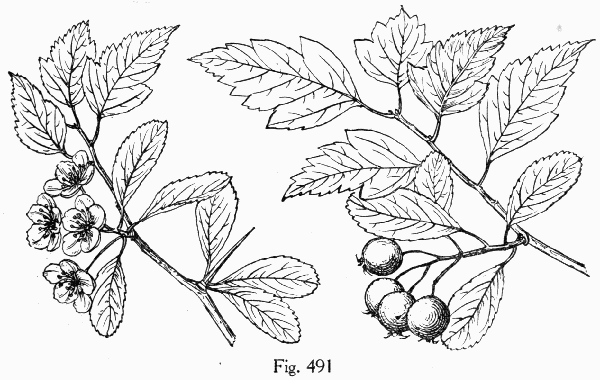
Leaves narrow-rhombic to oval, gradually narrowed at the ends, acute or acuminate and apiculate at apex, entire toward the base, finely serrate above with incurved teeth tipped with minute bright red glands, nearly fully grown when the flowers open toward the middle of June, and then light yellow-green, covered above with short pale hairs and pale and glabrous below, and at maturity thick and firm, dark green, glabrous and lustrous above, pale below 1½′—2′ long, and ¾′—1′ wide, with a stout midrib rose color on the upper side, dark obscure forked veins, and reticulate veinlets; turning late in the autumn to brilliant shades of [535] orange and bright scarlet; petioles slender, glandular near the base, with 2 or 3 large stipitate dark red caducous glands, and about ⅓′ in length; leaves at the end of vigorous shoots lanceolate, acuminate, coarsely serrate, often irregularly and deeply divided into 2 or 3 acute lateral lobes, 3′—3½′ long, and 1¼′—1½′ wide. Flowers about ⅝′ in diameter, on short slender pedicels, in compact glabrous few or many-flowered corymbs; calyx-tube glabrous, the lobes nearly triangular, entire, often bright red toward the apex; stamens 20; anthers small, yellow; styles 5. Fruit ripening toward the end of September, on stout pedicels, in compact drooping clusters, globose, ¼′ in diameter, dull vinous red and very lustrous when fully grown, ultimately blue-black; calyx small, with reflexed persistent lobes; flesh thin, yellow, dry and sweet; nutlets 5, thick, rounded and slightly ridged on the back, ⅛′—3/16′ long.
A tree, occasionally 20° high, with a short stem, long slender spreading branches gracefully drooping at the ends, covered with bright red or reddish brown bark, separating on old trunks near the ground into long slightly attached narrow plate-like gray scales, and slender glabrous bright red lustrous branchlets armed with numerous straight slender spines ¾′—1½′ long; often forming clumps or small thickets with numerous stems 8°—15° tall springing from a single root.
Distribution. Banks of the Cimarron, Gunnison, White, Tomichi, Eagle, San Juan, and other Colorado streams on both slopes of the continental divide at altitudes of 6000°—8000° above the sea.
XVIII. MACRACANTHÆ.
Tomentosæ Sarg.
CONSPECTUS OF THE ARBORESCENT SPECIES.
Leaves thin, with midrib and veins only slightly impressed on their upper surface; anthers rose color or red.
Mature leaves pale pubescent below.
Leaves ovate to ovate-oblong; fruit in erect clusters, obovoid, orange-red; stamens 20.
140. C. tomentosa (A, C).
Leaves ovate, oval, or obovate, in drooping clusters, globose to subglobose, bright red or orange-red; stamens 5—10.
141. C. Chapmanii (A, C).
Mature leaves glabrous (slightly pubescent on the midrib and veins below in 142).
Stamens 20.
Leaves elliptic to suborbicular, smooth above; fruit in drooping clusters, subglobose to short-oblong.
142. C. Gaultii (A).
Leaves elliptic, scabrate above; fruit in erect clusters, subglobose.
143. C. vegeta (A).
Stamens 10; leaves ovate, scabrate above; fruit short-oblong.
144. C. Deweyana (A).
Leaves subcoriaceous to coriaceous, with midrib and veins deeply impressed on their upper surface and pubescent below.
Anthers rose color.
Stamens 20.
Leaves elliptic, acute at the ends; fruit globose.
145. C. succulenta (A).
Leaves broadly oval or obovate; fruit subglobose to short-oblong.
146. C. gemmosa (A).
Stamens 10.
Leaves broad-obovate or oval; fruit globose, villose at the ends; calyx-lobes coarsely glandular-serrate.
147. C. illinoiensis (A).
Leaves broad-obovate to oval or rhombic; fruit subglobose; calyx-lobes entire.
148. C. integriloba (A).
Anthers yellow; stamens 10; leaves broad-obovate to elliptic or oval; fruit in erect clusters, globose.
149. C. macracantha (A).
[536]
140. Cratægus tomentosa L.
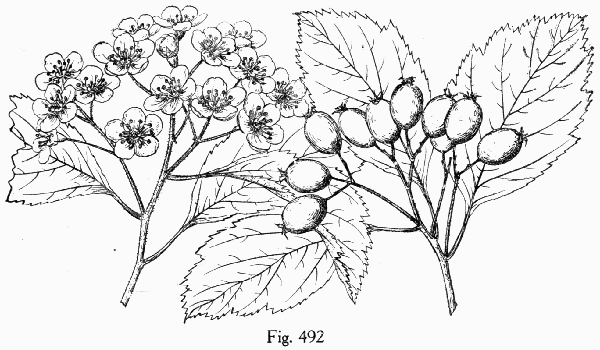
Leaves ovate, oblong-ovate, rhombic or elliptic, acute, acuminate or rarely rounded at apex, gradually narrowed to the cuneate entire base, sharply and usually doubly serrate above with broad spreading usually glandular teeth, and often divided above the middle into several short lateral lobes, nearly fully grown when the flowers open from the 1st to the middle of June, and at maturity thin and firm, gray-green, coated below with pale persistent pubescence, puberulous or ultimately glabrous above, conspicuously reticulate-venulose, 2′—5′ long, and 1′—3′ wide, with a broad midrib and slender primary veins; turning brilliant orange and scarlet in the autumn before falling; petioles stout, glandular, wing-margined, ½′—¾′ in length; leaves at the end of vigorous shoots sometimes broad-obovate to semiorbicular, rounded and abruptly short-pointed at apex, rounded at base, and 3′—4′ long and wide; more often oblong-obovate, acuminate, and 5′—6′ in length. Flowers ½′ in diameter, on slender villose pedicels, in villose corymbs; calyx-tube obconic, hoary-tomentose, the lobes lanceolate, acute, coarsely or pinnately serrate, usually glandular, stamens 20; anthers pale rose color; styles 2—5. Fruit ripening in October, on slender erect pubescent pedicels, in broad many-fruited clusters, obovoid or rarely subglobose, ½′ in diameter, erect, dull orange-red, translucent when fully ripe, mostly persistent on the branches until the following spring; flesh thick, orange-yellow, sweet and succulent; nutlets about ¼′ long and broad, rounded at the ends, the ventral cavities broad and deep.
A tree, 15°—20° high, with a trunk 5′—6′ in diameter, covered with smooth pale gray or dark brown furrowed bark, slender spreading often nearly horizontal smooth gray branches forming a wide flat head, and slender branchlets covered when they first appear with thick hoary tomentum, becoming dark orange color and puberulous in their first winter, and ashy gray in their second season, and unarmed, or armed with occasional slender straight dull ashy gray or very rarely bright chestnut-brown spines 1′—1½′ long.
Distribution. Near Troy, Rensselaer County, New York, westward through New York to southwestern Ontario, through Ohio, southern Michigan, Indiana and Illinois to central Minnesota and southward to Pennsylvania and along the Appalachian Mountains to northeastern Georgia, and to central Iowa, northeastern Missouri to the valley of the Meramec River, and to eastern Kansas; near Nashville, Davidson County, Tennessee; in the neighborhood of Augusta, Richmond County, Georgia; and in Dallas County, Alabama (R. S. Cocks).
Occasionally cultivated as an ornamental tree in the gardens of western Europe.
[537]
141. Cratægus Chapmanii Ashe.
Cratægus mollita Sarg.
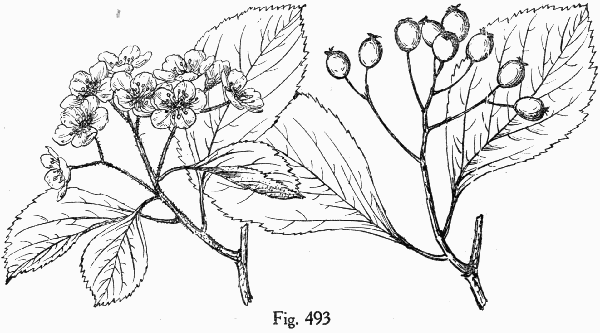
Leaves ovate, oval, or obovate, acuminate, gradually narrowed and acute or concave-cuneate at the entire base, sharply serrate above with glandular teeth, and often slightly lobed above the middle, about half grown when the flowers open early in June and then covered above with short soft pale hairs and pale-tomentose below, and at maturity dark dull green and smooth or scabrate above, pale-tomentulose below, especially on the slender yellow midrib and primary veins, 2½′—3′ long, and 1½′—2½′ wide; turning yellow or brown in the autumn before falling; petioles stout, wing-margined at apex, tomentose early in the season, becoming nearly glabrous, ½′—¾′ in length; leaves at the end of vigorous shoots sometimes 6′ long and 4′ wide. Flowers about ⅜′ in diameter, on long stout hoary-tomentose or pubescent pedicels, in broad many-flowered tomentose corymbs; calyx-tube narrowly obconic, tomentose, the lobes acuminate, glandular-serrate, sparingly villose; stamens 10; anthers rose color; styles 2 or 3. Fruit ripening the middle of September, on elongated slightly villose pedicels, in broad lax drooping many-fruited clusters, globose to subglobose, bright red, about ⅝′ in diameter; calyx only slightly enlarged, with reflexed coarsely glandular-serrate lobes; flesh juicy, succulent, yellow; nutlets 2 or 3, about ¾′ long and nearly as broad, thin, rounded at the obtuse ends, rounded and obscurely ridged on the back, the ventral cavities broad and deep.
A tree, sometimes 20° high, with a short trunk 6′—8′ in diameter, covered with gray scaly bark, erect branches forming a broad open head, and slender branchlets hoary-tomentose early in the season, becoming bright red-brown and lustrous, and armed with occasional stout straight or curved bright chestnut-brown spines 1½′—2′ long.
Distribution. Banks of streams in the Appalachian region from Virginia to northern Georgia and eastern Tennessee; in southern Missouri (Taney County, C. mollita).
142. Cratægus Gaultii Sarg.
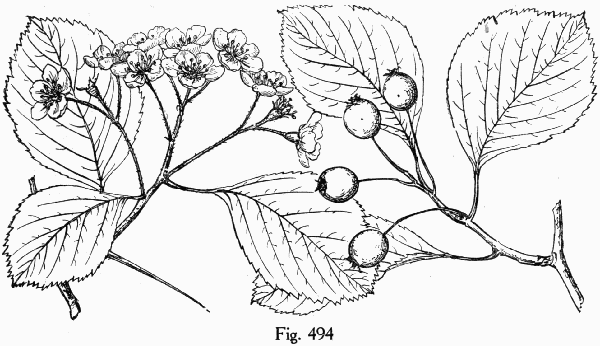
Leaves elliptic to suborbicular, acute or rounded at apex, concave-cuneate or rounded at the entire base, coarsely doubly serrate above with straight glandular teeth, and occasionally divided above the middle into short acute lobes, nearly fully grown when the flowers open at the end of May and then very thin, yellow-green and sparingly villose above, pale and slightly pubescent below, and at maturity thin and firm in texture, glabrous, dark dull green on the upper surface, pale on the lower surface, 2½′—3′ long, and 2′—2¾′ wide, with a stout yellow midrib deeply impressed above, and 6 or 7 pairs of primary veins extending [538] obliquely to the point of the lobes; petioles stout, wing-margined to below the middle, villose on the upper side early in the season with matted white hairs, becoming nearly glabrous, ½′—1′ in length. Flowers ⅝′ in diameter, on long slender slightly villose pedicels, in broad many-flowered hairy corymbs, their bracts and bractlets linear, acuminate, glandular, mostly persistent until the flowers open; calyx-tube narrowly obconic, glabrous, the lobes broad, acuminate, coarsely glandular-serrate, glabrous on the outer, villose on the inner surface; stamens 18—20; anthers pale pink; styles 2 or 3. Fruit ripening from the middle to the end of September, on slender slightly hairy pedicels, in few-fruited drooping clusters, subglobose to short-oblong, ½′—⅝′ long; calyx prominent, with spreading appressed coarsely serrate lobes; flesh thick, yellow, soft and juicy; nutlets 2 or 3, rounded at the ends, about 3/16′ long and nearly as wide, the ventral cavities long, deep, and narrow.
A tree, 20°—25° high, with a trunk often 10′ in diameter and 6°—7° long, spreading branches forming a broad round-topped head, and slender slightly zigzag glabrous light red-brown lustrous branchlets, unarmed, or armed with occasional straight slender dark purple shining spines 1¼′—1¾′ long.
Distribution. Open pastures, Milton Township and Gleneilyn, Du Page County, and Mokena, Will County, northeastern Illinois.
143. Cratægus vegeta Sarg.
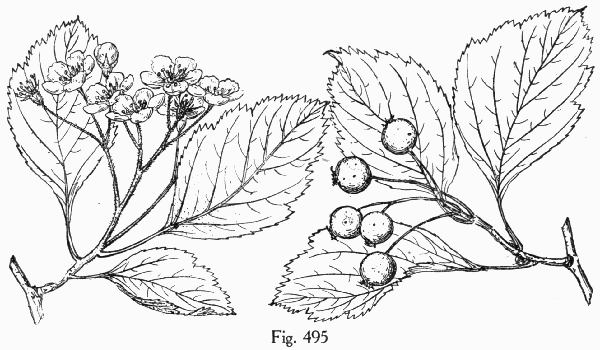
Leaves elliptic, acuminate, gradually narrowed and concave-cuneate at the entire base, finely often doubly serrate above, with straight glandular teeth, and slightly divided above the middle into numerous short acute lobes, nearly fully grown when the flowers open at the end of May and then membranaceous, dark yellow-green and roughened above by short rigid pale hairs and densely pubescent below, and at maturity thin and firm in texture, dark dull green and scabrate on the upper surface, pale and pubescent on the lower surface on the slender midrib, and 5 or 6 pairs of thin primary veins arching obliquely to the point of the lobes, 3′—4′ long, and 1¾′—2½′ wide; petioles slender, broadly wing-margined at apex, villose on the upper side early in the season, becoming glabrous and rose color in the autumn, ½′—¾′ long. Flowers ⅝′—¾′ in diameter, on long slender villose pedicels, in usually 10—12-flowered hairy corymbs, with linear to linear-obovate acute glandular bracts and bractlets becoming reddish and mostly persistent until after the flowers open; calyx-tube narrowly obconic, villose, the lobes slender, acuminate, glandular-serrate, villose; stamens 20; anthers small, light pink or red; styles 2 or 3, usually 3. Fruit ripening late in September, on slender elongated rigid slightly villose pedicels, in few-fruited erect clusters, subglobose, scarlet, lustrous, marked by small pale dots, about ⅜′ in diameter; calyx prominent, with a short [539] tube and spreading reflexed serrate lobes; flesh thin, yellow, dry and mealy; nutlets 2 or 3, ¼′ long and nearly as broad, full and rounded at the ends, the ventral cavities broad and deep.
A tree, 20°—25° high, with a tall straight trunk sometimes 8′ in diameter, stout wide-spreading branches forming a symmetrical round-topped head, and very slender nearly straight branchlets, light orange-green when they first appear, becoming bright red-brown and lustrous at the end of their first season and darker the following year, and unarmed, or sparingly armed with slender nearly straight purple shining spines about 4′ long.
Distribution. Oak-woods in moist rich soil near the banks of the Calumet River, Calumet, Cook County, Illinois.
144. Cratægus Deweyana Sarg.
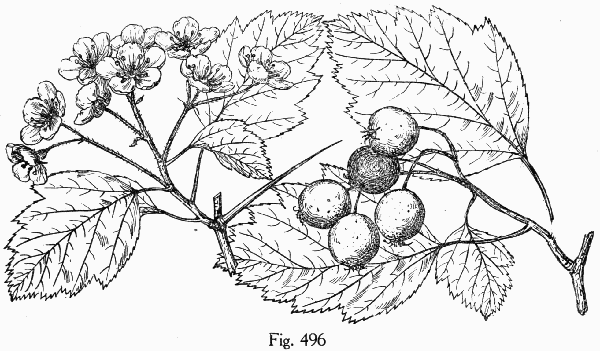
Leaves ovate, acuminate or abruptly long-pointed at apex, abruptly narrowed and concave-cuneate at the entire often unsymmetric base, coarsely doubly serrate above with straight or incurved gland-tipped teeth, and slightly divided above the middle into several pairs of small acuminate spreading lobes, about one third grown when the flowers open during the last week of May and then membranaceous, dark yellow-green, and covered above with short lustrous white hairs, and light yellow-green and glabrous below, and at maturity thin, yellow-green and scabrate on the upper surface, pale on the lower surface, 3′—4′ long, and 2′—2¾′ wide, with a stout midrib deeply impressed on the upper side, and 6 or 7 pairs of thin primary veins arching to the point of the lobes; petioles stout, wing-margined at apex, deeply grooved, sparingly villose on the upper side, soon glabrous, glandular with occasional minute dark glands, usually dull orange color in the autumn, ¾′—1′ in length; leaves at the end of vigorous shoots more deeply lobed and more coarsely serrate, subcoriaceous, often 4′ long and 3½′ wide, and gradually narrowed into stout broad-winged coarsely glandular petioles, their stipules foliaceous, stipitate, lunate, acutely lobed, glandular-serrate with minute dark red glands, sometimes ½′ long, persistent through the season. Flowers about ½′ in diameter, on slender hairy pedicels, in wide lax slightly villose corymbs; calyx-tube narrowly obconic, villose at base, glabrous above, the lobes slender, elongated, acuminate, finely glandular-serrate usually only above the middle, dark green and glabrous on the outer surface, villose on the inner surface; stamens 7—10, usually 10; anthers small, dark rose color; styles 2 or 3, usually 2. Fruit ripening from the first to the middle of October and falling a few weeks later, on long slender puberulous pedicels, in wide many-fruited drooping clusters, subglobose to short-oblong, rounded at the ends, scarlet, lustrous, [540] marked by occasional large pale dots, ½′ in diameter; calyx prominent, with elongated glandular-serrate lobes dark red on the upper side near the base, usually erect and incurved, mostly persistent on the ripe fruit; flesh when fully ripe thick, yellow and sweet; nutlets usually 2, occasionally 3, about 3/16′ long and ⅛′ wide, rounded at the ends, rounded and conspicuously ridged on the back, the ventral cavities broad and shallow.
A tree, 20°—25° high, with a tall trunk sometimes 10′ in diameter, covered with light gray bark becoming rough and scaly near the base, slender branches, the lower horizontal and wide-spreading, the upper ascending and forming a wide open irregular head, and stout glabrous branchlets dark orange-brown when they first appear, deep red-brown and lustrous on the upper, gray-brown and lustrous on the lower side during their first winter, becoming gray slightly tinged with red the following year, and armed with numerous stout curved chestnut-brown or purple spines 1½′—2′ long and occasionally persistent on old stems.
Distribution. Western and central New York; Hagaman swamp near Rochester, and Rush, Monroe County, Portage, Livingston County, Castile and Silver Springs, Wyoming County, and near Ithaca, Thompkins County; not common.
145. Cratægus succulenta Link.
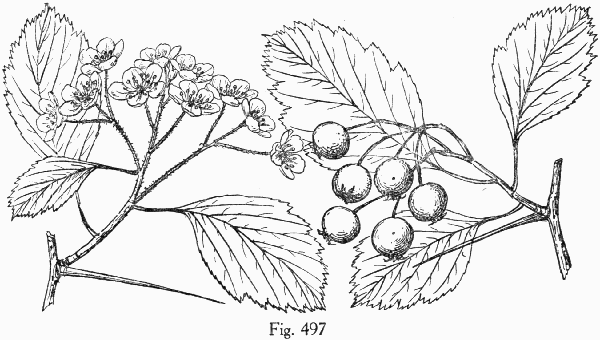
Leaves elliptic, acute or acuminate at apex, gradually narrowed from near the middle to the entire base, coarsely and usually doubly serrate above with spreading glandular teeth, and divided above the middle into numerous short acute lobes, nearly fully grown when the flowers open at the end of May or early in June and then membranaceous, covered above with soft pale hairs, and puberulous or rarely nearly glabrous below, and at maturity coriaceous, dark green, glabrous and somewhat lustrous above, pale yellow-green and mostly puberulous below on the stout yellow midrib, and 4—7 pairs of slender veins extending obliquely to the point of the lobes and deeply impressed on the upper side, usually 2′—2½′ long and 1′—1½′ wide; petioles stout, more or less winged above, frequently bright red after midsummer, generally about ½′ in length; leaves at the end of vigorous shoots occasionally ovate, and often 2½′ long and 3′ wide. Flowers about ⅔′ in diameter, on long slender hairy pedicels, in broad lax villose corymbs; calyx-tube narrowly obconic, villose or glabrous, the lobes broad, acute, laciniate, glandular with bright red glands, and generally villose; stamens usually 20, sometimes 15; anthers small, rose color; styles 2 or 3, surrounded at base by a ring of pale hairs. Fruit beginning to ripen about the middle of September and sometimes remaining on the branches until the end of October, on slender elongated pedicels, in [541] broad loose many-fruited drooping clusters, globose, bright scarlet, marked by large pale dots, ½′—⅔′ in diameter; calyx prominent, with a broad shallow depression, and much enlarged coarsely serrate closely appressed persistent lobes; flesh thick, yellow, becoming juicy, sweet and pulpy; nutlets 2 or 3, ⅓′ long, ¼′ broad, prominently ridged on the back, the ventral cavities wide and deep.
A tree, occasionally 20° high, with a short trunk 5′—6′ in diameter, covered with dark red-brown scaly bark, stout ascending branches forming a broad irregular head, and stout more or less zigzag glabrous dark orange-brown lustrous branchlets becoming dull gray-brown in their second season and ultimately ashy gray, and armed with numerous stout slightly curved bright chestnut-brown shining spines 1½′—2½′ long; or usually shrubby and much smaller, and often flowering when only a few feet high.
Distribution. Coast of northeastern Massachusetts; southwestern Vermont; eastern and western New York; near London, Ontario; widely distributed in Pennsylvania; northeastern Illinois.
146. Cratægus gemmosa Sarg.
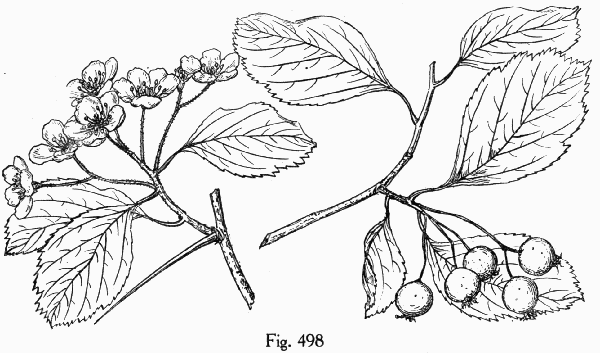
Leaves broad-oval or rarely broad-obovate, gradually narrowed and cuneate or occasionally rounded at the entire base, sharply and usually doubly serrate from below the middle with straight glandular teeth, and often slightly lobed toward the acute or acuminate apex with short acute lobes, dark red and villose as they unfold, nearly fully grown when the flowers open from the middle to the end of May and then membranaceous, light yellow-green, nearly glabrous above and pale and villose below, and at maturity thick and firm in texture, very dark dull green on the upper surface, pale on the lower surface and pubescent on the under side of the stout yellow midrib deeply impressed and occasionally puberulous above, and on the 4 or 5 pairs of slender primary veins extending obliquely to the end of the leaf, 1½′—2½′ long, and 1′—2′ wide; petioles stout, villose or pubescent, more or less winged above, glandular while young with minute bright red caducous glands, usually pink in the autumn, ¼′—½′ in length; leaves at the end of vigorous shoots more coarsely serrate, frequently divided into short acute lateral lobes, and often 4′ long and 3′ wide, with a rose-colored midrib and stout spreading primary veins. Flowers ½′—¾′ in diameter, on slender hairy pedicels, in broad open compound villose many-flowered corymbs, with lanceolate or oblanceolate acuminate glandular-serrate conspicuous bracts and bractlets; calyx-tube narrowly obconic, more or less villose with matted pale hairs, or nearly glabrous, the lobes lanceolate, acuminate, glabrous or villose on the outer surface, villose on the inner surface, coarsely glandular-serrate with bright red glands; stamens 20; anthers small, rose color; styles 2 [542] or 3, surrounded at the base by a narrow ring of pale tomentum. Fruit ripening early in October and becoming very succulent just before falling, on long slender pedicels, in drooping many-fruited glabrous or puberulous clusters, subglobose to short-oblong, scarlet, lustrous, ½′ in diameter; calyx prominent, with an elongated narrow tube, and reflexed villose lobes bright red toward the base on the upper side; flesh thick, bright yellow, sweet and succulent; nutlets usually 3, or 2, ¼′ long, broad and flat, full and rounded at the ends, ridged on the back with a prominent rounded ridge, the ventral cavities broad and deep.
A tree, occasionally 30° high, with a tall trunk 10′—12′ in diameter, covered with dark brown scaly bark, stout spreading or ascending branches forming a broad rather open symmetrical head, stout zigzag glabrous red-brown or gray-brown lustrous branchlets armed with straight or slightly curved thick chestnut-brown spines usually about 2′ long, and winter-buds sometimes ¼′ in diameter.
Distribution. Rich forest glades, or the margins of woods, usually in low rich soil; eastern New York, near Albany, Albany County; western New York (Munroe and Livingston Counties); southern Ontario (La Salle on the Niagara River and near London); northwestern Ohio (Oak Harbor, Ottawa County); southern Michigan; common; Illinois (Calumet, Cook County, and Manley, Fulton County); southern Wisconsin (Waukesha, Waukesha County and near Madison, Dane County).
147. Cratægus illinoiensis Ashe.
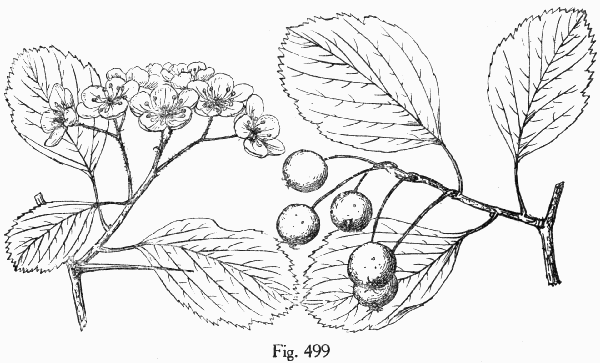
Leaves broad-obovate to oval, rounded or rarely acute at the wide apex, broad-cuneate and entire at the base, coarsely and often doubly serrate above, with straight or incurved teeth tipped with minute deciduous glands, and sometimes slightly and irregularly divided toward the apex into short acute lobes, when they unfold covered below with a thick coat of hoary tomentum and pilose above, and when the flowers open about the 20th of May membranaceous, yellow-green, covered above with short pale hairs and pubescent below, and at maturity thick and firm in texture, dark green and glabrous on the upper surface, pale and pubescent on the lower surface, particularly on the stout midrib and 4—6 pairs of primary veins deeply impressed on the upper side, 2′—2½′ long, and 1½′—2′ wide; petioles stout, slightly winged toward the apex, generally bright red below the middle after midsummer, and usually ½′—⅔′ in length; leaves at the end of vigorous shoots usually elliptic, acute or acuminate, more coarsely dentate and more often lobed, sometimes decurrent nearly to the base of the stout petiole, 3′—4′ long, and 2½′—3′ wide. Flowers about ⅝′ in diameter, on slender slightly hairy pedicels, in broad compact villose corymbs; calyx-tube narrowly [543] obconic, coated with long matted pale hairs, the lobes broad, acuminate, very coarsely glandular-serrate with large stipitate bright red glands, glabrous on the outer surface except at the base, villose on the inner surface; stamens 10; anthers rose color; styles 2 or usually 3. Fruit ripening early in October and persistent on the branches until after the beginning of winter, on stout bright red pedicels, in few-fruited drooping villose clusters, globose, scarlet, lustrous, marked by occasional dark dots, more or less villose at the ends, ½′ in diameter; calyx prominent, with a short villose tube, and spreading lobes gradually narrowed from a broad base, sparingly glandular-serrate or nearly entire, villose, mostly deciduous before the fruit ripens; flesh thin, yellow, dry and mealy; nutlets 2 or 3, ¼′ long, broad and thick, rounded at the ends, the ventral cavities broad and deep.
A tree, rarely more than 18° high, with a trunk 4′—5′ in diameter, covered with thin close bark broken on the surface into pale plate-like scales, and divided into several long erect and spreading slender branches forming a wide open-topped head, and stout somewhat zigzag branchlets covered at first with scattered pale caducous hairs, bright orange-brown and lustrous during their first season, becoming dark brown in their second year and ultimately ashy gray, and armed with numerous slender straight or curved bright chestnut-brown shining spines 1½′—3′ long.
Distribution. Open woods along the gravelly banks of small streams in Stark and Peoria Counties, Illinois; not common.
148. Cratægus integriloba Sarg.
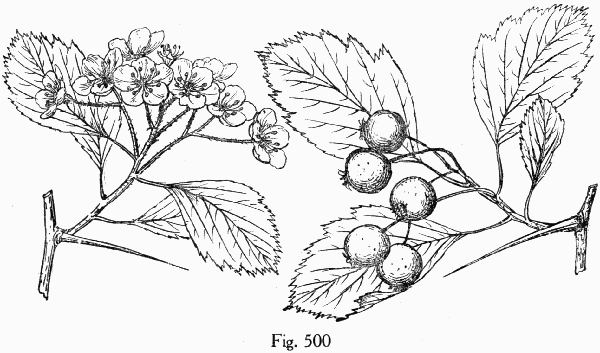
Leaves broad-obovate, oval or rhombic, acute, gradually or abruptly narrowed below the middle, entire at the cuneate base, coarsely doubly serrate above with spreading glandular teeth, and irregularly divided into numerous short acute or acuminate lobes, coated in early spring with soft pale caducous hairs, nearly fully grown when the flowers open during the first week in June, and at maturity glabrous, thin and firm in texture, dark green and lustrous on the upper surface, pale yellow-green on the lower surface, 1½′—2′ long, and 1′—1½′ wide, with a slender midrib often dark red at the base, and 4—6 pairs of slender primary veins deeply impressed on the upper side; petioles stout, more or less broadly winged toward the apex, at first puberulous, soon glabrous, often red on the lower side, ⅓′—¾′ in length; leaves at the end of vigorous shoots more coarsely serrate, more deeply lobed, often 3′ long and 2½′ wide, with stout broadly winged petioles. Flowers ¾′ in diameter, on long slender villose pedicels, in broad open crowded villose corymbs; calyx-tube broadly obconic, coated toward the base with long matted white hairs and glabrous above, the lobes linear-lanceolate, [544] elongated, entire or very rarely furnished with occasional caducous glands; stamens 10; anthers large, rose color; styles 2 or 3, surrounded at base by a narrow ring of snow-white hairs. Fruit ripening at the end of September or early in October, on short stout pedicels, in drooping or erect many-fruited slightly villose clusters, subglobose, bright scarlet, lustrous, marked by large pale dots, ⅓′—½′ in diameter; calyx enlarged, prominent, with elongated entire lobes, dark red on the upper side at base, much reflexed and persistent; flesh thin, yellow, sweet and pulpy; nutlets 2 or 3, about ¼′ long, thick and broad, rounded at the narrow ends, the ventral cavities broad and deep.
A tree, occasionally 18°—20° high, with a straight erect trunk 6′—8′ in diameter, wide-spreading or erect branches forming an open irregular head, and stout nearly straight or occasionally slightly zigzag glabrous branchlets, lustrous and red-brown or orange-brown during their first summer and ultimately dull ashy gray, and armed with stout nearly straight bright chestnut-brown shining spines 1½′—2½′ long and often pointed toward the base of the branch.
Distribution. Low limestone ridges, Province of Quebec, south of the St. Lawrence River near the Lachine Rapids, and at Caughnawaga, Rockfield, and Adirondack Junction.
149. Cratægus macracantha Koehne.
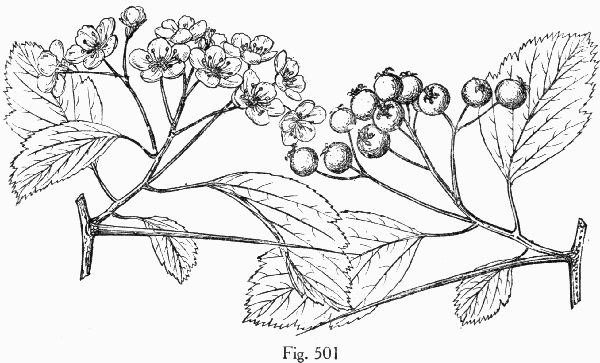
Leaves broad-obovate to elliptic or oval, acute or rounded and sometimes short-pointed at apex, gradually or abruptly narrowed and cuneate at the entire base, coarsely and often doubly serrate above with straight or incurved gland-tipped teeth, and usually divided above the middle into numerous short acute or acuminate lobes, when they unfold often bright red and coated on the upper surface with soft pale hairs, more than half grown when the flowers open late in May and then dull yellow-green, nearly glabrous on the upper surface and pale and puberulous on the lower surface, and at maturity coriaceous, dark green and glabrous above, frequently puberulous below on the midrib, and on the 4—6 pairs of slender primary veins extending obliquely to the point of the lobes and deeply impressed on the upper side, usually 2′—2½′ long and 1½′—2′ wide; petioles stout, more or less winged above, frequently bright red after midsummer and usually about ½′ in length; leaves at the end of vigorous shoots often broad and rounded at base, coarsely dentate, 3′—4′ long, and 2½′—3′ wide. Flowers about ¾′ in diameter, on long slender hairy pedicels, in broad more or less villose corymbs; calyx-tube narrowly obconic, more or less villose or nearly glabrous, the lobes long, narrow, acuminate, glandular with minute dark glands, glabrous on the outer surface, slightly villose on the inner surface; stamens usually 10, occasionally 8—12; anthers pale yellow; styles 2—3, surrounded at the base by a broad ring of hoary tomentum. [545] Fruit ripening at the end of September and often remaining on the branches for several weeks longer, on erect slender pedicels, in broad open many-fruited usually slightly villose clusters, globose, often hairy at the ends until nearly ripe, crimson, very lustrous, ¼′—⅓′ in diameter; calyx large and conspicuous, the lobes coarsely serrate, reflexed and persistent; flesh thin, dark yellow, dry and mealy; nutlets 2 or 3, about ¼′ long and wide, broad and rounded at the ends, the ventral cavities deep and irregular.
A tree, occasionally 15° high, with a tall stem 5′—6′ in diameter, covered with pale close bark, stout wide-spreading branches forming an open rather irregular head, and stout slightly zigzag glabrous light chestnut-brown very lustrous branchlets, becoming dull reddish brown in their second year, and armed with numerous slender usually curved very sharp bright chestnut-brown shining spines 2½′—4′ long.
Distribution. Western Vermont (near Middlebury, Addison County); central and western New York; southern Ontario (near Toronto); northeastern Illinois (Barrington County); and eastern Pennsylvania (Bucks and Northampton Counties).
XIX. DOUGLASIANÆ.
CONSPECTUS OF THE ARBORESCENT SPECIES.
Leaves subcoriaceous, lustrous above, obovate to broad-ovate, coarsely serrate, usually lobed; stamens 5—20, normally 10; spines numerous, short and stout.
150. C. Douglasii.
Leaves thinner, dull bluish green, lanceolate to oblong-obovate or elliptic, acute at the ends, finely serrate, not lobed; stamens 10—20; spines few, long and slender or wanting.
151. C. rivularis.
150. Cratægus Douglasii Lindl.
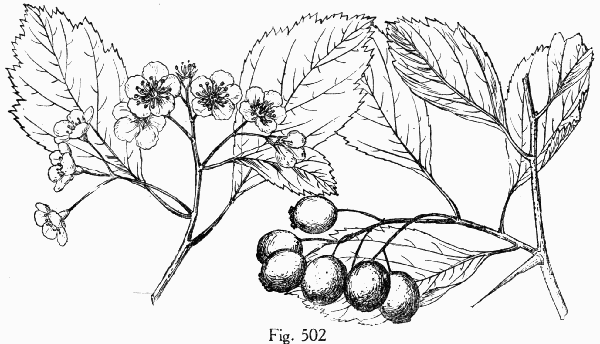
Leaves broad-obovate to ovate, gradually narrowed below to the cuneate entire base, coarsely serrate above with minute glandular teeth, and often incisely lobed toward the acute apex, nearly fully grown and coated above and on the midrib and veins below with short pale hairs when the flowers open in May, and at maturity thin, glabrous, dark green and lustrous above, paler below, 1′—2′ long, and ½′—1½′ wide; petioles slender, wing-margined above, sparingly glandular, villose early in the season, becoming glabrous, ½′—¾′ in length; leaves at the end of vigorous shoots broad-obovate, incisely lobed at the broad apex, often [546] deeply divided into lateral lobes, or occasionally 3-lobed, 3′—4′ long, and 2′—3′ wide. Flowers ½′—7/12′ in diameter, on long slender glabrous pedicels, in broad glabrous corymbs, with linear caducous bracts and bractlets; calyx-tube broadly obconic, glabrous, the lobes gradually narrowed from a broad base, entire or occasionally minutely dentate, acute and bright red at apex, glabrous on the outer surface, villose on the inner surface; stamens 10 or rarely 5 by abortion; anthers small, pale rose color; styles 2—5, surrounded at base by tufts of long pale hairs. Fruit ripening and falling in August and September, on slender pedicels, in compact, many-fruited drooping clusters, short-oblong, truncate at apex, black and lustrous, very rarely chestnut-colored (f. badia Sarg.), about ½′ long; calyx persistent; flesh thick, sweet and succulent, light yellow; nutlets usually 5, about ¼′ long, narrowed at base, broad and rounded at apex, ridged on the back with a narrow ridge, the ventral cavities irregular, small and shallow.
A tree, 30°—40° high, with a long trunk 18′—20′ in diameter, stout branches spreading and ascending and forming a compact round-topped head, and slender rigid glabrous bright red or orange-red lustrous branchlets unarmed, or armed with straight or slightly curved blunt or rarely acute bright red ultimately ashy gray spines ⅓′—1′ long; often shrubby and spreading into wide thickets.
Distribution. Banks of mountain streams; valley of the Parsnip River, British Columbia, through Washington and Oregon to the valley of the Pitt River, California, and eastward in the United States through the northern Rocky Mountain region to the Bighorn Mountains, Wyoming; passing into the var. Suksdorfii Sarg. differing in its 20 stamens, fruit not more than ⅓′ in diameter, usually in few-fruited clusters and ripening from the 1st of July to the middle of August. A shrub with numerous stems occasionally 25° high; banks of the Columbia River and borders of bottom-lands, western Klickitat County, Washington.
151. Cratægus rivularis Nutt.
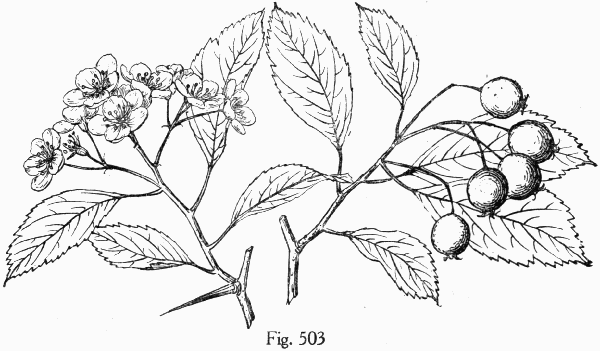
Leaves lanceolate to narrowly oblong-obovate or elliptic, acute, acuminate or abruptly acuminate at apex, gradually narrowed and concave-cuneate at the long entire base, and very finely crenately serrate above with glandular teeth, when they unfold tinged with red, villose above and coated below with matted pale hairs, more than half grown when the flowers open late in May and then hairy on the midrib and veins above and pale and glabrous below, and at maturity thin, dull bluish green and smooth on the upper surface, pale yellow-green on the lower surface, about 2′ long and ¾′ wide, with a slender yellow midrib and 3 or 4 pairs of thin obscure primary veins; petioles slender, slightly winged at apex, at [547] first villose, becoming glabrous and rose-colored below the middle, and about ½′ in length; leaves at the end of vigorous shoots often rhombic, coarsely serrate, often slightly incisely lobed, coriaceous, 3′ long, and 2′ wide, with a stout broadly winged petiole. Flowers ½′ in diameter, on long slender pedicels, in rather compact glabrous corymbs; calyx-tube broadly obconic, glabrous, the lobes linear, entire or glandular with minute caducous glands, glabrous on the outer surface, sparingly villose on the inner surface, often tinged with red; stamens 10—20; anthers pale rose color. Fruit ripening in September, on long pedicels, in drooping few-fruited clusters, short-oblong, full and rounded at the ends, dark crimson and marked by many large white dots when fully grown, becoming black and lustrous at maturity, ⅓′—½′ long; calyx slightly enlarged, persistent, with elongated closely appressed entire lobes slightly villose and dark red on the upper side below the middle; flesh thin, yellow, dry and mealy; nutlets 3—5, ¼′ long, narrowed and rounded at the ends, slightly ridged on the back, the ventral cavities broad and shallow.
A tree, occasionally 20° high, with a slender trunk covered with dark brown scaly bark, erect branches forming a narrow rather open head, and slender bright red-brown lustrous branchlets marked by numerous pale lenticels, and unarmed or armed with straight slender spines usually about 1′ long.
Distribution. Banks of mountain streams, often forming thickets; southeastern Idaho, (Pocatello and Inkom, Bannock County); northeastern Nevada (Lee, Elk County) to southwestern Wyoming, eastern Utah, southwestern Colorado, and northern New Mexico.
XX. ANOMALÆ.
CONSPECTUS OF THE ARBORESCENT SPECIES.
Stamens 5—15; corymbs glabrous; leaves scabrate above.
152. C. scabrida (A).
Stamens 20; corymbs villose; leaves glabrous above.
153. C. virilis (A).
152. Cratægus scabrida Sarg.
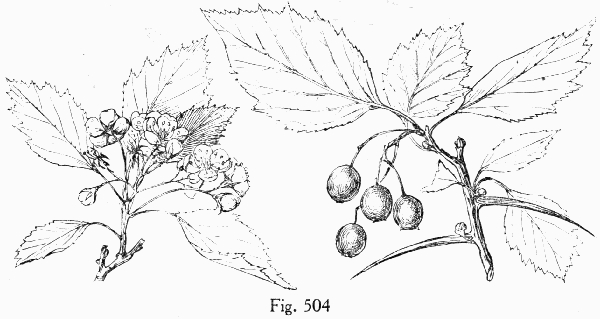
Leaves oval to obovate, acuminate, gradually narrowed from near the middle to the acuminate base, irregularly glandular-serrate nearly to the base, and divided above into numerous short spreading lobes coated above when the flowers open at the end of May with short pale hairs, and at maturity thick and firm, dark green and scabrate on the upper surface, pale yellow-green and glabrous on the lower surface, 2′—3′ long, and 1½′—2′ wide; petioles slender, occasionally glandular, often slightly winged toward the apex, ½′—1¼′ in length. Flowers ¾′ in diameter, on slender glabrous pedicels, in broad glabrous corymbs; [548] calyx narrowly obconic, glabrous, the lobes linear-lanceolate, long-acuminate, finely glandular-serrate; stamens 5—15; anthers small, pale yellow; styles 3, surrounded at base by a thick tuft of pale tomentum. Fruit in loose drooping clusters, subglobose, scarlet, ½′ in diameter, only the base of the reflexed calyx-lobes persistent on the ripe fruit; flesh yellow, thick, dry and mealy; nutlets 3, rounded and prominently ridged on the back, ⅓′ long, the ventral depression wide, shallow, irregular, often obscure.
A tree, 15°—20° high, with a trunk 6′ to 8′ in diameter, spreading horizontal branches forming a broad round-topped head, and stout slightly zigzag glabrous branchlets marked by oblong pale lenticels, dark chestnut-brown during their first season, becoming ashy gray during their second year, and armed with slender straight or curved spines 1½′—2′ in length; or often a tall intricately branched shrub.
Distribution. Valley of the St. Lawrence River, near Montreal, Province of Quebec to the neighborhood of Toronto, southern Ontario; northern and western Vermont; southern New Hampshire (slopes of Little Monadnock Mountain); western Massachusetts, and western New York.
153. Cratægus virilis Sarg.
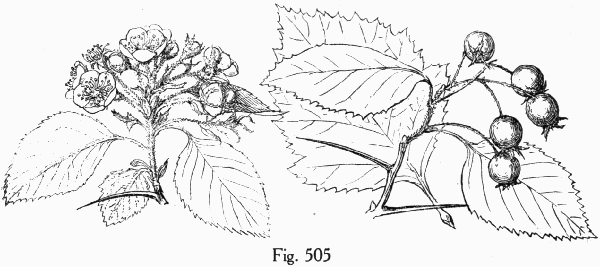
Leaves oblong-obovate, acuminate or rounded and short-pointed at apex, concave-cuneate and gradually narrowed to the acute entire base, finely doubly serrate above with straight glandular teeth, and slightly divided above the middle into 3 or 4 pairs of small acuminate lobes, nearly fully grown when the flowers open during the first week of June and then thin, yellow-green, smooth and slightly hairy above and pale bluish green and covered below with short white hairs most abundant on the stout yellow midrib and slender primary veins, and at maturity thin, glabrous, dark green and lustrous on the upper surface, slightly villose on the lower surface, 2½′—3′ long, and 1¾′—2′ wide; petioles stout, wing-margined often to below the middle, slightly villose on the upper side early in the season, soon glabrous, ⅗′—1′ in length; leaves at the end of vigorous shoots subcoriaceous, oval to rhombic, acuminate, often long-pointed, 3′—4′ long, and 2′—2½′ wide, with a rose-colored midrib and stout broadly winged petiole. Flowers about ½′ in diameter, on slender villose pedicels, in broad lax hairy usually 15—18-flowered corymbs; calyx-tube narrowly obconic, coated with long matted pale hairs, the lobes slender, acuminate, irregularly glandular-serrate near the middle, glabrous on the outer, slightly villose on the inner surface, reflexed after anthesis; stamens 20, anthers slightly tinged with pink, styles 4 or 5. Fruit ripening from the middle to the end of September, on puberulous reddish pedicels, in erect or spreading few-fruited clusters, short-oblong to ovoid, scarlet, lustrous, pubescent especially near the rounded ends, marked by small dark dots, ⅖′—½′ long, and about 1⅓′ in [549] diameter; calyx prominent, with long slender spreading and reflexed coarsely serrate usually persistent lobes villose on the upper surface; flesh thin, yellow, rather dry; nutlets 4 or 5, acute at the ends, prominently ridged on the back with a broad deeply grooved ridge, generally furnished with obscure ventral depressions, about ¼′ long.
A tree, sometimes 30° high, with a short trunk frequently 1° in diameter, covered with dark scaly bark, stout ascending branches forming a narrow open irregular head, and slender nearly straight glabrous branchlets dark orange-green when they first appear, becoming light chestnut-brown, lustrous and marked by pale lenticels in their first season, and armed with stout straight or slightly curved bright chestnut-brown shining spines 1½′—2′ in length, long persistent and becoming branched on old stems.
Distribution. Fence rows, southwest of the village of Weston, near Toronto, Ontario.
8. COWANIA D. Don.
Trees or shrubs with scaly bark and rigid terete branchlets. Leaves alternate, simple, lobed or rarely linear, subcoriaceous, straight-veined, glandular-dotted on the upper surface, tardily deciduous or persistent, short-petiolate; stipules adnate to the base of the petiole. Flowers solitary at the end of short lateral branches; calyx-tube turbinate, persistent, the limb 5-lobed, deciduous, the lobes imbricated in the bud; disk thin, adnate to the tube of the calyx, its margins thickened; petals 5, obovate, spreading, larger than the calyx-lobes; stamens numerous, inserted in two rows in the mouth of the calyx-tube, incurved, persistent; anthers peltate, eglandular, 2-celled, opening longitudinally; carpels 5—12, inserted in the bottom of the calyx-tube, free, villose, 1-celled; style short, villose, stigma simple, filiform; ovule solitary, ascending; raphe linear, dorsal; micropyle inferior. Fruit composed of 5—12 1-celled ellipsoidal akenes, included in the tube of the calyx, and tipped with the much elongated persistent styles covered with long white hairs; seed filling the cavity of the carpel, linear-obovoid, erect; hilum basal, minute; testa membranaceous; albumen thin; cotyledons oblong, radicle inferior.
Cowania is confined to the dry interior region of the United States and Mexico. Three species can be distinguished; of these the type of the genus, Cowania mexicana D. Don, sometimes attains the size and habit of a small tree. The genus was named in honor of James Cowan (died 1823), an English merchant who traveled in Mexico and Peru and sent plants to England.
1. Cowania mexicana D. Don.
Cowania Stansburiana Torr. Cowania Davidsonii Rydb.
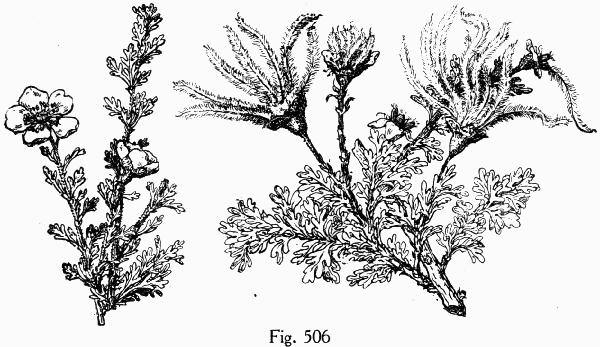
Leaves short-petioled, cuneate, revolute on the margins, 3 or rarely 5-lobed above the middle, the lobes linear, entire or slightly divided, coriaceous, dark green above, hoary-tomentose [550] below, ⅓′—½′ long, tardily deciduous or persistent until spring; leaves on vigorous shoots and on flower-bearing branchlets occasionally linear and entire; stipules ciliate on the margins, united below and adnate to the short persistent petiole, free above the middle and acute at apex, persistent and becoming woody on the flower-bearing branchlets. Flowers appearing in early spring, 1′ in diameter; calyx-tube more or less tomentose and covered with rigid glandular hairs, the lobes rounded at apex, hoary-tomentose; petals broad-obovate, rounded and emarginate at apex, cuneate and short-stipitate below, pale yellow or nearly white. Fruit ripening in October, about ¼′ long and as long as the calyx-tube, the elongated style often 2′ in length.
A tree, occasionally 20°—25° high, with a tall trunk 6′—8′ in diameter, short spreading branches forming a narrow head, and slender rigid branchlets red and glandular during their first season, becoming dark reddish brown and glabrous the following year. Bark of the trunk pale gray, separating freely into long narrow thin loosely attached plates; more often a shrub with spreading stems often only a few feet tall.
Distribution. Dry rocky slopes and mesas, usually at altitudes between 6000° and 8000°; northern Utah and central Nevada, through Arizona and western New Mexico to northern Mexico; common and probably of its largest size near the southern rim of the Grand Cañon, and on the lower slopes of the San Francisco Mountains, Arizona.
9. CERCOCARPUS H. B. K. Mountain Mahogany.
Trees or shrubs, with scaly bark, rigid terete branches, short lateral spur-like branchlets conspicuously roughened for many years by the crowded narrow horizontal scars of fallen leaves, minute buds, the scales of the inner rows accrescent on the growing shoots and often colored. Leaves alternate, simple, entire or serrate, coriaceous, straight-veined, short-petiolate, persistent; stipules minute, adnate to the base of the petiole, deciduous. Flowers axillary on the short lateral branchlets, sessile or short-pedicellate, solitary or fascicled, the pedicels sometimes lengthening before the fruit ripens; calyx-tube long, cylindric, abruptly expanded at apex into a cup-shaped, 5-lobed deciduous limb, the lobes imbricated in the bud; disk thin, slightly glandular, adnate to the tube of the calyx; petals 0; stamens 15—30, in 2 or 3 rows; filaments incurved in the bud, free, short, terete; anthers oblong, pubescent or tomentose, distinct and united by a broad connective; ovary composed of a single carpel inserted in the bottom and included in the tube of the calyx, acute, terete, smooth, striate or sulcate, sericeous, rarely bicarpellate; style terminal, filiform, villose or glabrate, crowned with a minute obtuse stigma; ovule solitary, subbasilar, ascending; raphe dorsal; micropyle [551] inferior. Fruit a linear-oblong coriaceous slightly ridged angled or sulcate akene, included in the persistent tube of the spindle-shaped calyx more or less deeply cleft at the apex, and tipped with the elongated persistent style clothed with long white hairs. Seed solitary, linear, acute, erect; hilum conspicuous lateral above the oblique base; testa membranaceous; embryo filling the cavity of the seed; cotyledons ovate-oblong, elongated, fleshy; radicle inferior.
Cercocarpus is confined to the dry interior and mountainous regions of North America. Twenty-one species, often of doubtful value, have been distinguished; seventeen are credited to the territory of the United States and the others to Mexico. The heavy hard brittle wood of all the species makes valuable fuel and is occasionally used in the manufacture of small articles for domestic and industrial use.
The generic name, from κέρκος and καρπός, refers to the peculiar long-tailed fruit.
CONSPECTUS OF THE ARBORESCENT SPECIES OF THE UNITED STATES.
Flowers usually in many-flowered clusters.
Leaves coarsely serrate above the middle.
Leaves oval to semiorbicular or obovate, hoary-tomentose below, sinuate-dentate; flowers short-pedicellate.
1. C. Traskiæ.
Leaves oval to slightly obovate, green and glabrous below, denticulate with broad apiculate teeth; flowers long-pedicellate.
2. C. alnifolius.
Leaves finely serrate above the middle, obovate to oval, pale and villose below; flowers short-pedicellate.
3. C. betuloides.
Flowers solitary or rarely in 2 or 3-flowered clusters, nearly sessile.
Leaves narrow-lanceolate, lance-elliptic or oblanceolate, acute at the ends, entire, pale or rufous below.
4. C. ledifolius.
Leaves oblong-obovate to narrow-elliptic, entire or slightly dentate below the apex, villose-pubescent.
5. C. paucidentatus.
1. Cercocarpus Traskiæ Eastw.
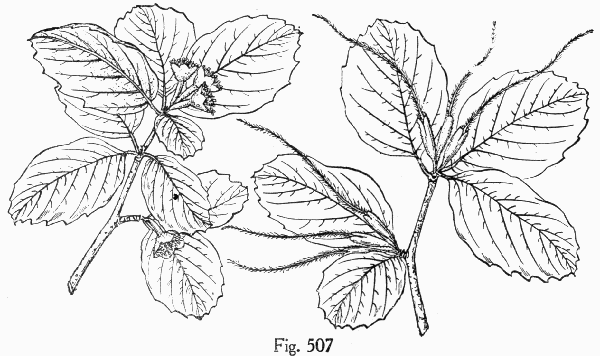
Leaves oval to semiorbicular or obovate, rounded or acute at apex, cuneate, rounded or occasionally somewhat cordate at the narrow base, revolute on the margins, entire below, coarsely sinuate-dentate above the middle with slender teeth tipped with minute dark glands, when they unfold covered above with soft pale hairs and below with thick hoary tomentum, and at maturity coriaceous, dark green, lustrous and villose or nearly glabrous [552] on the upper surface, pale-tomentose on the lower surface, 1½′—2′ long, and 1′—1½′ wide, with prominent primary veins running obliquely to the point of the teeth, and, like the stout midrib, conspicuously impressed on the upper side; petioles stout, hoary-tomentose, about ¼′ in length; stipules acuminate, scarious, covered on the margins with long white hairs, ¼′ long. Flowers appearing early in March, nearly sessile, in 1—5 usually 4 or 5-flowered clusters, hoary-tomentose, ½′—¾′ long; calyx broad, glabrous on the inner surface; anthers tomentose. Fruit: mature calyx, light reddish brown, villose-pubescent, deeply cleft at apex, ½′ long; akene slightly ridged on the back, ⅓′ in length, covered with long lustrous white hairs; style 1½′—2′ in length.
A tree, occasionally 25° high, with a trunk often inclining, usually much contorted, 2′—10′ in diameter and 6°—8° long, stout wide-spreading branches, and stout branchlets, hoary-tomentose when they first appear, marked by numerous small scattered lenticels, bright reddish brown during two or three years, ultimately dark gray-brown and conspicuously roughened by the enlarged ring-like leaf-scars. Bark light gray, sometimes slightly broken by shallow fissures and marked by irregular cream-colored blotches.
Distribution. Steep sides of a deep narrow arroyo on the south coast of Santa Catalina Island, California.
2. Cercocarpus alnifolius Rydb.
Cercocarpus parvifolius Sarg., in part, not Nutt.
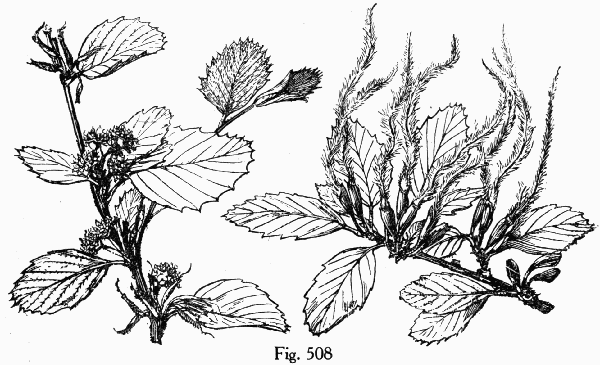
Leaves occasionally persistent until late in the spring, oval to slightly obovate, rounded or rarely acute at apex, rounded or cuneate at base, and coarsely serrate above the middle with broad apiculate teeth, when they unfold covered above with soft white hairs and pale and villose on the midrib and veins below, and at maturity thick, glabrous, dark green and lustrous on the upper surface, pale and yellow-green on the lower surface, 1½′—2½′ long, and 1′—2′ wide, with a stout midrib and 6—7 pairs of slender prominent veins; petioles stout, sparingly villose early in the season, soon glabrous, ⅓′—½′ long; stipules ovate, abruptly long-pointed, covered with silky white hairs. Flowers on slender hairy pedicels ⅓′—½′ long, in 2—15 usually 4 or 5-flowered clusters; calyx-tube villose, about 5/12′ long, the limb villose on the outer surface, ¼′ broad. Fruit: mature calyx-tube many-nerved, deeply cleft at apex, villose-pubescent, dark chestnut-brown, ⅓′—½′ long; akene covered with long silky hairs; style 2′—2½′ in length.
A tree, 12°—20° high, with one or two or three trunks, occasionally 8′ in diameter, small [553] erect and spreading branches forming a narrow round-topped head, and slender branchlets green and sparingly villose when they first appear, soon becoming glabrous, and in their second year chestnut-brown and lustrous and marked by minute pale lenticels. Bark about ¼′ thick, dark reddish brown, fissured and divided into small closely appressed scales.
Distribution. Hillsides, Descanso Cañon, about a mile and a half up the coast west of Avalon, Santa Catalina Island, and on Santa Cruz Island, California.
3. Cercocarpus betuloides Nutt.
Cercocarpus parvifolius var. betuloides Sarg.
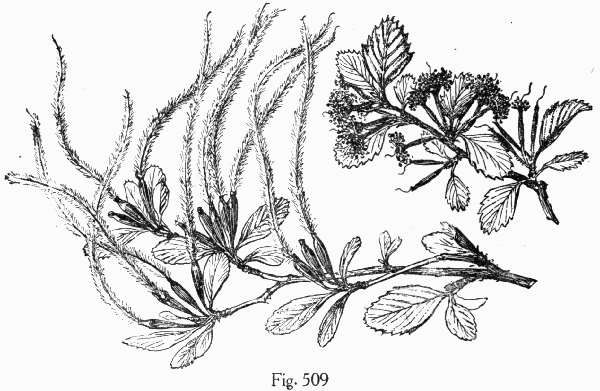
Leaves obovate to oval, acute or rounded at apex, cuneate at base, finely serrate above the middle with straight or incurved glandular teeth, dark green on the upper surface, pale and villose-pubescent or tomentose sometimes becoming nearly glabrous on the lower surface, 1′—1¼′ long, and ⅓′—½′ wide, with a thin midrib, and 5—8 pairs of slender primary veins more or less deeply impressed on the upper side of the leaf; petioles densely villose, often becoming glabrous, about ¼′ in length; stipules scarious, acuminate. Flowers nearly sessile, in 1—3-flowered clusters; calyx-tube densely villose, about ⅓′ long, the limb turbinate, villose on the outer surface, glabrous on the inner surface, ¼′ wide. Fruit on slender slightly villose pedicels ¼′—⅓′ in length; mature calyx-tube often slightly gibbous, deeply cleft at apex, light chestnut-brown, sparingly villose, 1/12′ in diameter; akene covered with stiff spreading hairs; style 2′—3′ in length.
A tree, occasionally 25° high, with a single trunk, small ascending and spreading branches forming an open irregular head, and slender red-brown branchlets covered when they first appear with loose pubescence, soon becoming glabrous; more often a tall or low shrub with several stems. Bark smooth, separating into thin deciduous scales.
Distribution. Common and widely distributed over the California coast ranges from Siskiyou County to the Santa Monica and San Bernardino Mountains.
4. Cercocarpus ledifolius Nutt.
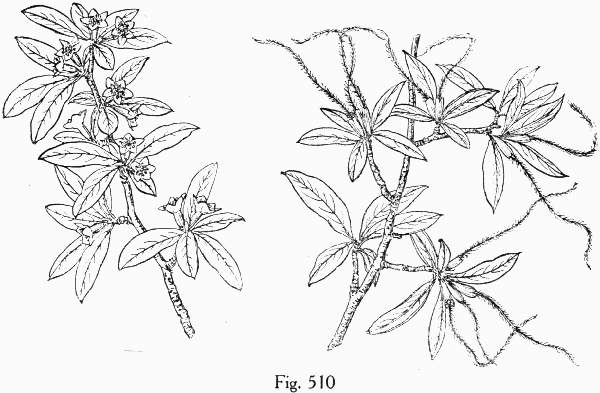
Leaves narrow-lanceolate, lance-elliptic or oblanceolate, acute at the ends, apiculate, entire with thick revolute margins, coriaceous, reticulate-veined, puberulous while young, and at maturity dark green, lustrous and glabrous on the upper surface and pale or rufous and tomentulose on the lower surface, resinous, ½′—1′ long, and ⅓′—⅔′ wide, with a broad [554] thick midrib deeply grooved on the upper side, and obscure primary veins; persistent until the end of their second summer; petioles broad, about ⅛′ in length; stipules nearly triangular. Flowers solitary, sessile in the axils of the clustered leaves, ⅔′ long; calyx hoary-tomentose. Fruit: mature calyx-tube almost ½′ long, nearly cylindric, rather larger above than below, 10-ribbed, obscurely 10-angled, slightly cleft at apex, hoary-tomentose; akene pointed at the ends, obscurely angled, chestnut-brown, ¼′ long, covered with long pale or tawny hairs; style 2′—3′ in length, generally contracted by 1 or 2 partial corkscrew twists.
A resinous slightly aromatic tree, occasionally 40° high, with a short trunk sometimes 2½° in diameter, stout spreading usually contorted branches forming a round compact head, and red-brown branchlets coated at first with pale pubescence, soon becoming glabrous, frequently covered with a glaucous bloom, silver gray or dark brown in their second year, and for many years marked by the conspicuous elevated leaf-scars. Bark red-brown, divided by deep broad furrows, and broken on the surface into thin persistent plate-like scales, becoming on old trunks 1′ thick. Wood bright clear red or rich dark brown, with thin yellow sapwood of 15—20 layers of annual growth.
Distribution. Dry gravelly arid slopes at altitudes of 5000°—9000°; mountain ranges of the interior region of the United States from eastern Washington and Oregon, to lower Green and Snake River valleys, Wyoming, and through Utah and Nevada to southwestern Colorado; in California to the eastern slope of the Sierra Nevada, the northern slopes of the San Bernardino Mountains, on Mt. Pinos, San Diego County, and on the northern coast mountains (Snow Mountain to Scott Mountain, Jepson).
5. Cercocarpus paucidentatus Britt.
Cercocarpus eximius Rydb.
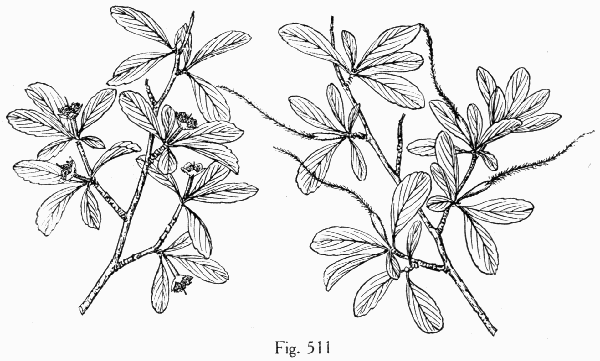
Leaves oblong-obovate to narrow-elliptic, acute or rounded and often apiculate at apex, gradually narrowed from above the middle and acute at base, their margins revolute, often undulate, and entire or dentate toward the apex with few small straight or incurved apiculate teeth, when they unfold coated with hoary tomentum, and at maturity thick, gray-green and covered with soft white hairs or nearly glabrous on the upper surface, pale and tomentulose on the lower surface, ½′—1′ long and ¼′—½′ wide, with a thin prominent midrib and primary veins; petioles stout, tomentose, ultimately pubescent or nearly glabrous, 1/16′—⅕′ in length; stipules linear-lanceolate, tomentose, about half as long as the petioles. Flowers appearing from March to May and often again in August, nearly sessile, solitary, [555] in pairs or rarely in 3-flowered clusters in the axils of the crowded leaves; calyx-tube slender, ⅙′—¼′ long, thickly covered on the outer surface, like the short rounded lobes, with long white hairs. Fruit: mature calyx-tube short-stalked, light red-brown, villose, deeply cleft at apex, about ¼′ long; akene nearly terete, covered with long white hairs; style 1′—1½′ in length.
A tree, 20°—25° high, with a long straight trunk sometimes 6′—8′ in diameter, erect rigid branches forming a narrow open or irregular head, and slender bright red-brown lustrous branchlets marked irregularly by large scattered pale lenticels, covered at first with a thick coat of hoary tomentum, villose or pubescent for two or three years and ultimately ashy gray or gray tinged with red, the spur-like lateral branchlets much roughened by the ring-like scars of fallen leaves. Bark about ⅛′ thick, divided by shallow fissures and broken on the surface into small light red-brown scales.
Distribution. In forests of Pines and Oaks usually at altitudes of about 5000°, on the dry ridges of the mountains of western Texas, and of southern New Mexico and Arizona; in Arizona ranging northward to Oak Creek Cañon, near Flagstaff, Coconino County (P. Lowell); and southward over the mountains of northern Mexico.
10. PRUNUS B. & H. Plum and Cherry.
Trees or shrubs, with bitter astringent properties, slender branchlets, marked by the usually small elevated horizontal leaf-scars with 2 or 3 fibro-vascular bundle-scars, and small scaly buds, their scales imbricated in many rows, those of the inner rows accrescent and often colored. Leaves convolute or conduplicate in the bud, alternate, simple, usually serrate, petiolate, deciduous or persistent; stipules free from the petiole, usually lanceolate and glandular, often minute, early deciduous. Flowers in axillary umbels or corymbs, or in terminal or axillary racemes, appearing from separate buds before, with, or later than the leaves, or on leafy branches; calyx 5-lobed, the lobes imbricated in the bud; disk thin, adnate to the calyx-tube, glandular, often colored; petals 5, white, deciduous; stamens usually 15—20, inserted with the petals in 3 rows, those of the outer row 10, opposite the petals, those of the next row alternate with them and with those of the inner row, sometimes 30 in 3 rows; filaments filiform, free, incurved in the bud; anthers oval, attached on the back; ovary inserted in the bottom of the calyx-tube, 1-celled; style terminal, dilated at apex into a truncate stigma; ovules 2, suspended; raphe ventral; the micropyle superior. Fruit a 1-seeded drupe; flesh thick and pulpy or dry and coriaceous; stone bony, smooth, rugose, or [556] pitted, compressed, indehiscent. Seed filling the cavity of the nut, suspended; seed-coat thin, membranaceous, pale brown; cotyledons thick and fleshy; radicle superior.
Prunus with about one hundred and twenty species is generally distributed over the temperate regions of the northern hemisphere, and is abundant in North America, eastern Asia, western and central Asia and central Europe, ranging southward in the New World into tropical America, and to southern Asia in the Old World. Of the twenty-five or thirty species which occur in the United States, twenty-two are arborescent in habit. Several of the species bear fruits which are important articles of human food; many contain in the seeds and leaves hydrocyanic acid, to which is due their peculiar odor, and the fruit of some of the species is used to flavor cordials. The wood of Prunus is close-grained, solid, and durable, and a few of the species are important timber-trees.
Prunus is the classical name of the Plum-tree.
CONSPECTUS OF THE NORTH AMERICAN ARBORESCENT SPECIES.
Flowers in sessile axillary umbels; fruit usually slightly 2-lobed by a ventral groove, generally more than ½′ in diameter, red to nearly black or yellow, often covered with a glaucous bloom. Prunophora. Plums.
Leaves convolute in the bud, their petioles usually without glands.
Leaves broad-ovate to orbicular; fruit often 1′ or more in diameter, red or yellow, nearly destitute of bloom.
1. P. subcordata (G).
Leaves ovate-lanceolate to oblong or obovate; fruit ½′ in diameter or less, blue, nearly black, red or yellow, covered with a glaucous bloom.
2. P. umbellata (C).
Leaves conduplicate in the bud.
Leaves dull dark green, usually abruptly pointed at apex.
Fruit red, rarely yellow, or blue in one form of 2 and 5; leaves oblong to obovate; stone of the fruit compressed.
Leaves crennate-serrate, their petioles biglandular; calyx-lobes glandular.
3. P. nigra (A).
Leaves sharply serrate with slender often apiculate teeth.
Leaves narrowed and usually cuneate at base.
Leaves glabrous or villose on the midrib below; petioles and calyx-lobes usually without glands.
4. P. americana (A, C, F).
Leaves pubescent below; fruit covered with a thick glaucous bloom.
Petioles eglandular or with a single gland near the apex; pedicel of the flower glabrous; calyx-tube puberulous; stone of the fruit rounded at base.
5. P. lanata (A, C).
Petioles glandular near the apex with 1—3 prominent glands; pedicel of the flower furnished near the apex, like the glabrous calyx-tube, with long white hairs; stone of the fruit pointed at base.
6. P. tenuifolia (C).
Leaves usually broad and rounded at base, ovate to elliptic or obovate, conspicuously reticulate-venulose; petioles glandular.
7. P. mexicana (C).
Fruit purple, covered with a glaucous bloom; leaves lanceolate to oblong-ovate; petioles and calyx-lobes without glands; stone of the fruit turgid.
8. P. alleghaniensis (A).
Leaves thin and lustrous, acute or acuminate, narrowed at base; petioles usually glandular; fruit red or yellow, the stone turgid.
Calyx-lobes glandular.
Leaves oblong-obovate to oblong-oval or rarely oblong-lanceolate.
9. P. hortulana (A).
Leaves elliptic to lanceolate.
10. P. Munsoniana (A, C).
Calyx-lobes without glands; leaves lanceolate to oblong-lanceolate.
11. P. angustifolia (A, C).
[557]
Flowers in axillary umbels or corymbs; fruit bright red and lustrous, ½′ in diameter or less; leaves conduplicate in the bud. Mahaleb. Bird Cherries.
Leaves oblong-lanceolate, acuminate or rarely acute at apex.
12. P. pennsylvanica (A, B, F).
Leaves oblong-obovate to oblanceolate, usually obtuse, occasionally acute at apex.
13. P. emarginata (B, F, G).
Flowers in terminal racemes on leafy branches of the year; fruit globose, red or rarely yellow; leaves conduplicate in the bud. Padus. Wild Cherries.
Calyx-lobes deciduous from the fruit; leaves oblong-oval or obovate, abruptly pointed, cuneate, rounded or in one form cordate at base.
14. P. virginiana (A, B, F, G).
Calyx-lobes persistent on the fruit.
Petioles biglandular near the apex.
Leaves oblong to oblong-lanceolate, acuminate, glabrous, or rarely pubescent on the midrib below.
15. P. serotina (A, C).
Leaves oval, broad-ovate or rarely obovate, acute, short-pointed or rounded at apex, villose-pubescent below.
16. P. alabamensis (C).
Leaves obovate, oval or elliptic, short-pointed or rounded at apex, covered below with rufous hairs.
17. P. australis (C).
Petioles without glands; leaves elliptic to ovate or slightly obovate, acute, rounded or abruptly short-pointed at apex, in one form rusty pubescent on the midrib below.
18. P. virens (E, F, H).
Flowers in racemes from the axils of persistent leaves of the previous year; fruit globose or slightly three-lobed; leaves conduplicate in the bud. Laurocerasus. Cherry Laurels.
Calyx-lobes rounded, undulate on the margins; leaves oblong-lanceolate, acuminate, entire or rarely remotely spinulose-serrate; fruit black, the stone broad-ovoid, acute, cylindric.
19. P. caroliniana (C).
Calyx-lobes acute, minute.
Leaves elliptic to oblong-ovate, entire; fruit orange-brown, the stone subglobose.
20. P. myrtifolia (D).
Leaves ovate to ovate-lanceolate, acute, rounded or emarginate at apex, conspicuously spinulose-dentate; fruit red, becoming purple or nearly black, the stone ovoid, short-pointed.
21. P. ilicifolia (G).
Leaves ovate to lanceolate, acuminate or abruptly short-pointed at apex, usually entire; fruit dark purple or nearly black, the stone ovoid to obovoid, short-pointed.
22. P. Lyonii (G).
1. Prunus subcordata Benth. Wild Plum.
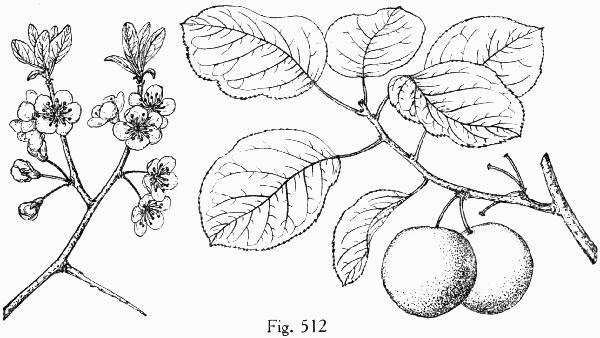
Leaves broad-ovate or orbicular, usually cordate, sometimes truncate or rarely cuneate at base, and sharply often doubly serrate, when they unfold puberulous on the upper surface and pubescent on the lower surface, and at maturity glabrous, or puberulous below, slightly coriaceous, dark green above and pale below, 1′—3′ long and ½′—2′ wide, with a broad midrib and conspicuous veins; northward turning brilliant scarlet and orange or red and yellow in the autumn before falling; petioles slender, usually eglandular, ½′—¾′ in length; stipules lanceolate, acute, glandular-serrate. Flowers appearing before the leaves in March and April, ⅔′ in diameter, on slender glabrous or pubescent pedicels ¼′—½′ long, in 2—4-flowered umbels; calyx-tube campanulate, glabrous or puberulous, the lobes oblong-obovate, rounded at apex, pubescent on the outer surface, more or less clothed with pale hairs on the inner surface, half as long as the obovate white petals rounded above and narrowed below into a short claw. Fruit ripening in August and September, on stout pedicels ½′—⅔′ long; short-oblong, ½′—1¼′ long, with dark red or sometimes bright yellow skin, and more or less subacid flesh; stone flattened or turgid, acute at the ends, ⅓′—1′ long, narrowly wing-margined on the ventral suture, conspicuously grooved on the dorsal suture.
A tree, 20°—25° high, with a trunk sometimes a foot in diameter, dividing 6°—8° from the [558] ground into stout almost horizontal branches, and glabrous or pubescent bright red more or less spinescent branchlets marked by occasional minute pale lenticels, becoming darker red or purple in their second year, and ultimately dark brown or ashy gray; or often a bush, with stout ascending stems 10°—12° tall, or a low much-branched shrub. Winter-buds acute, ⅛′ long, with chestnut-brown scales, scarious on the margins, those of the inner rows ¼′ long at maturity, oblong, acute, and generally bright red. Bark about ¼′ thick, gray-brown, deeply fissured, and divided into long thick plates broken on the surface into minute persistent scales. Wood heavy, hard, close-grained, pale brown, with thin lighter colored sapwood of 5 or 6 layers of annual growth.
Distribution. Dry rocky hills and open woods usually in the neighborhood of streams, sometimes forming thickets of considerable extent; central Oregon to northeastern California in the region east of the Cascade and Sierra Nevada Mountains, and common to central California; on the foothills of the western slopes of the Sierra Nevada up to altitudes of 4000° south to the Yosemite Valley, and on the coast ranges to Black Mountain, Santa Clara County; of its largest size on the borders of small streams in southern Oregon and northern California; at high altitudes, and in the arid regions of southeastern Oregon a low shrub producing sparingly small sometimes pubescent fruit (var. oregona Wight); Klamath Indian Reservation, near Klamath Falls and in Sprague River Valley, Klamath County.
2. Prunus umbellata Ell. Sloe. Black Sloe.
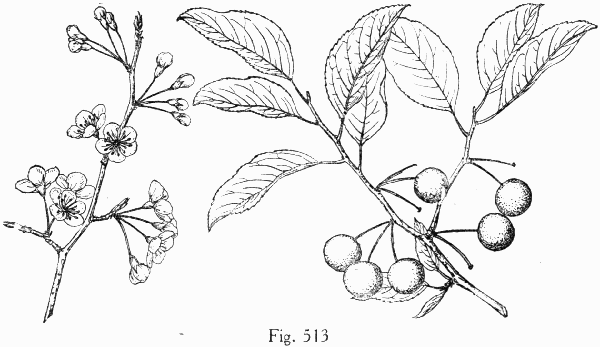
Leaves obovate-lanceolate to oblong, acute at the ends or sometimes rounded or slightly cordate at base, finely and sharply serrate with remote incurved glandular teeth, and usually furnished with 2 large dark glands at the base, when they unfold bright bronze-green, with red margins, midrib, and petiole, glabrous above and pubescent or glabrous below with the exception of a few hairs along the prominent orange-colored midrib and primary veins, and at maturity thin, dark green above, paler below, 2′—2½′ long and 1′—1½′ wide, petioles stout, glabrous or pubescent, about ⅓′ in length; stipules lanceolate, setaceous, glandular-serrate, ¼′—⅔′ long. Flowers opening in March and April before the appearance of the leaves, ⅔′ in diameter, on slender glabrous pedicels ½′ long, in 3 or 4-flowered umbels; calyx-tube broad-obconic, glabrous or puberulous, the lobes sometimes slightly clavate at the acute red apex, scarious on the margins, and hoary-tomentose on the inner surface; petals nearly orbicular, contracted at the base into a short claw. Fruit ripening from July to September, on slender stems ½′ to nearly 1′ long, globose, without a basal depression, about ½′ in diameter, with a tough thick black or on some individuals yellow, and on others bright red skin covered with a glaucous bloom, and thick acid flesh; stone flattened with [559] thin brittle walls, ½′ long, ¼′—5/16′ wide and half as thick, acute at the ends, slightly rugose, conspicuously ridged on the ventral suture, and slightly grooved on the dorsal suture.
A tree, sometimes 15°—20° high, with a short often crooked or inclining trunk 6′—10′ in diameter, slender unarmed branches forming a wide compact flat-topped head, and slender branchlets more or less densely coated at first with pale pubescence, soon becoming glabrous, lustrous and bright red, and in their second year dark dull brown and marked by occasional orange-colored oblong lenticels; or frequently a low shrub. Winter-buds about 1/16′ long, with acute chestnut-brown apiculate scales, those of the inner rows at maturity ¼′ long and red at the apex. Bark ¼′ thick, dark brown, separating into small appressed persistent scales. Wood heavy, hard, close-grained, dark reddish brown, with thick lighter colored sapwood of about 30 layers of annual growth. The fruit is used in large quantities in making jellies and jams.
Distribution. Stanly County (near Albemarle, J. S. Holmes), North Carolina, and South Carolina southward, usually in the neighborhood of the coast, to Orange County, Florida, and westward to eastern Texas and southern Arkansas. The form with red fruit common in the interior of the Florida peninsula (Orange County). Variable in the amount of its pubescence and slightly variable in the shape of the fruit, and passing into var. injucunda Sarg. (Prunus mitis Beadl.). A small tree with branchlets hoary tomentose when they first appear, becoming pubescent, and puberulous in their second season, leaves more or less tomentose below, villose pedicels, calyx and ovary, and subglobose to short-oblong fruit. Central and southern Georgia (base of Stone Mountain and Little Stone Mountain, De Kalb County, and near Augusta, Richmond County), and eastern Alabama (near Auburn, Lee County). More distinct is
Prunus umbellata var. tarda Wight
Prunus tarda Sarg.
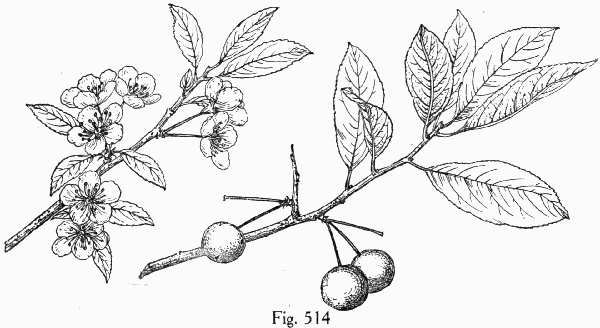
Differing from the type in the more oblong stone of the later-ripening fruit, lighter-colored bark and larger size.
Leaves oblong or oval, or occasionally obovate, acute or acuminate and short-pointed at apex, gradually narrowed and cuneate at base, and finely serrate with straight or incurved teeth tipped with dark minute persistent glands, when they unfold glabrous or rarely scabrous or puberulous above and cinereo-tomentose below, and at maturity thick and firm, dark yellow-green and glabrous on the upper surface, pale and pubescent or puberulous on the lower surface, especially along the prominent light yellow midrib and thin primary [560] veins, 1½′—3′ long and ¾′—1¼′ wide; petioles stout, tomentose or ultimately pubescent, ⅓′—½′ in length, glandular at apex with 2 large round stalked dark glands, or often eglandular; stipules acicular, often bright red, about ⅓′ long. Flowers appearing early in April with or before the leaves, about ¾′ in diameter, on slender glabrous pedicels, in 2 or 3-flowered umbels; calyx-tube narrow-obconic, glabrous toward the base, villose above, the lobes acute, entire, villose on the outer surface, hoary-tomentose on the inner surface; petals oblong-obovate, gradually contracted below into a short claw. Fruit ripening late in October or early in November, on stout rigid pedicels, short-oblong to subglobose, ⅓′—½′ long, clear bright yellow on some trees, bright red on others, and on others purple, dark blue, or black, with tough thick skin, and thick very acid flesh; stone ovoid more or less compressed, very rugose, obscurely ridged on the ventral suture and slightly grooved on the dorsal suture, acute and apiculate at apex, and rounded at base.
A tree, 20°—25° high, with a tall trunk 18′—20′ in diameter, wide-spreading branches forming an open symmetrical head, and slender branchlets marked by small scattered dark lenticels, light-green and hoary-tomentose when they first appear, becoming glabrous, light red-brown and lustrous during their first summer and darker at the end of their second year. Winter-buds narrow, acute, the color of the branchlets, 1/16′—⅛′ long. Bark ½′—⅝′ thick, light brown tinged with red, and divided by shallow interrupted fissures into flat ridges broken on the surface into small loose plate-like scales.
Distribution. Glades and open woods in the neighborhood of Marshall, Harrison County, Texas, to western Louisiana, southern Arkansas, and western Mississippi.
3. Prunus nigra Ait. Red Plum. Canada Plum.
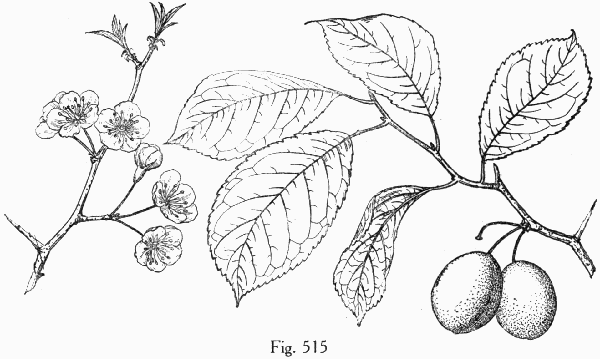
Leaves oblong-ovate to obovate, abruptly contracted at apex into a long narrow point, cuneate, truncate or slightly cordate at base, and doubly crenate-serrate with small dark glandular teeth, when they unfold faintly tinged with red and pubescent on the under surface or glabrous with the exception of conspicuous tufts of slender white or rufous hairs in the axils of the primary veins, and at maturity thick and firm, dull dark green on the upper surface, pale on the lower surface, 3′—5′ long and 1½′—3′ wide, with a conspicuous pale midrib and slender veins; petioles stout, biglandular at apex with 2 large dark glands, ½′—1′ in length; stipules lanceolate or on vigorous shoots often 3—5-lobed, glandular-serrate, ½′ long. Flowers appearing in early spring with or before the leaves, 1¼′ in diameter, on slender glabrous dark red pedicels, ½′—⅔′ long, in 3 or 4-flowered umbels; calyx-tube broad-obconic, dark red on the outer surface, bright red on the inner surface, the lobes narrow, acute, glandular, glabrous or occasionally pubescent on the outer surface, reflexed after the flowers open; [561] petals broad-ovate, rounded at apex, more or less erose on the margins, contracted at base into a short claw, white, turning pink in fading. Fruit ripening from the middle to the end of August, oblong-oval, 1′—1¼′ long, with a tough thick orange-red skin nearly destitute of bloom, and yellow rather austere flesh; stone oval, compressed, 1′ long, ⅔′ wide, thick-walled, acutely ridged on the ventral suture and slightly grooved on the dorsal suture.
A tree, 20°—30° high, with a trunk sometimes 8′—10′ in diameter, divided usually 5°—6° from the ground into a number of stout upright branches forming a narrow rigid head, stout slightly zigzag branchlets marked by numerous pale excrescences, bright green, glabrous or puberulous at first, and dark brown tinged with red in their second season, and stout spiny lateral spur-like secondary branchlets. Winter-buds acuminate, ⅛′—¼′ long, with chestnut-brown, triangular scales pale and scarious on the margins. Bark about ⅛′ thick, light gray-brown, with a smooth outer layer exfoliating in large thick plates of several papery layers, and in falling exposing the darker slightly fissured scaly inner bark. Wood heavy, hard, close-grained, rich bright red-brown, with thin lighter colored sapwood.
Distribution. In the alluvial soil of river valleys and on limestone hills; western New Brunswick (near the mouth of the Aroostook River) to the valley of the Saint Lawrence River and westward to the southern shore of Georgian Bay, the northern shore of Lake Superior (west of Port Arthur, Ontario), the valley of the Winnipeg River, Manitoba, and southward to northern New England, central and western New York, northern Ohio (Lorraine County), southern Michigan, northeastern Illinois, southeastern and western Wisconsin (valley of the Wisconsin River), eastern Minnesota and North Dakota.
Often cultivated in Canadian gardens and occasionally in those of the northern states as a fruit-tree or for the beauty of its flowers. Varieties are propagated by pomologists.
4. Prunus americana Marsh. Wild Plum.
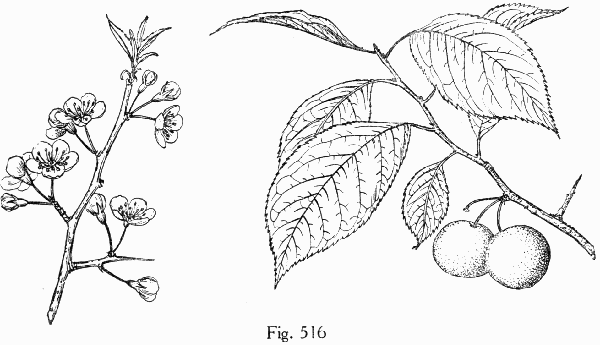
Leaves oval to oblong-oval or slightly obovate, acuminate at apex, narrowed and cuneate or rounded at base, and sharply often doubly serrate with slender apiculate teeth, when they unfold glabrous or slightly pubescent, and often furnished below with conspicuous axillary tufts of pale hairs, and at maturity thick and firm, more or less rugose, dark green on the upper surface, pale and glabrous on the lower surface, 3′—4′ long and 1½′—1¾′ wide, with a thin midrib glabrous or villose-pubescent on the lower side, and slender primary veins; petioles slender, eglandular or furnished near the apex with one or two glands, glabrous or puberulous, ½′—¾′ in length. Flowers appearing in early spring before or with the unfolding of the leaves, 1′ in diameter, bad-smelling, on slender glabrous pedicels [562] ⅓′—⅔′ long, in 2—5-flowered umbels; calyx-tube narrow-obconic, bright red, glabrous or puberulous, green on the inner surface, the lobes lanceolate to oblong-lanceolate, obtuse or acute, eglandular or obscurely glandular above the middle, usually dentate toward the apex, glabrous or puberulous on the outer surface, soft-pubescent on the inner surface; petals rounded and irregularly laciniate at apex, contracted below into a long narrow claw, bright red at base, ½′ long and ¼′ wide. Fruit ripening in June at the south and from the middle of August to early October at the north, subglobose or slightly elongated, usually rather less than 1′ in diameter, in ripening turning from green to orange often with a red cheek, becoming bright red when fully ripe, usually destitute of bloom and more or less conspicuously marked by pale spots, with a thick tough acerb skin and bright yellow succulent rather juicy acid flesh; stone oval slightly rugose rounded at apex, more or less narrowed at base, ¾′—1′ long and ⅖′—⅗′ wide, often as thick as broad, slightly and acutely ridged on the ventral suture and obscurely grooved on the dorsal suture.
A tree 20°—35° high, with a trunk rarely exceeding 1° in diameter and dividing usually 4° or 5° from the ground into many spreading branches often pendulous at the end and forming a broad graceful head and slender glabrous branchlets at first bright green, light orange-brown during their first winter, becoming darker and often tinged with red and marked by minute circular raised lenticels, and furnished with long slender remote sometimes spinescent lateral branchlets; usually spreading by shoots from the roots into broad thickets, or in the Gulf States growing with a single stem. Winter-buds acute, ⅛′—¼′ long, the chestnut-brown scales more or less erose on the margins, the inner scales when fully grown foliaceous, ½′ long, oblong, acute, remotely serrate, with 2 narrow acuminate lateral lobes. Bark about ½′ thick, dark brown tinged with red, the outer layer separating into long thin persistent plates, southward often lighter-colored. Wood heavy, hard, close-grained, strong, dark rich brown tinged with red, with thin lighter-colored sapwood. The fruit is sometimes used in the preparation of jellies and preserves, and is eaten raw or cooked.
Distribution. In the middle and northern states in rich soil, growing along the borders of streams and swamps; in the south Atlantic states often in river swamps; west of the Mississippi on bottom-lands, dry uplands and low mountain slopes; western Connecticut (Gaylordsville, Litchfield County), Eastern Greenbush, Rensselaer County and central New York to southern Ontario, central Michigan and northern Indiana, and northwestward to North Dakota, Manitoba (near Brandon), the Bitter Root Mountains, Wyoming and western Montana (Dixon, Sanders County), and southward to western Florida, central Mississippi, Alabama, eastern Louisiana, Missouri, southern Arkansas, eastern Kansas and Oklahoma, and in the Rocky Mountain region along the eastern foothills of Colorado to [563] northern New Mexico (near Las Vegas, San Miguel County); and northeastern Utah (near Logan, Cache County); on the southern Appalachian Mountains ascending to altitudes of 3000°, and in South Carolina and Georgia extending to the immediate neighborhood of the coast; in the Rocky Mountain region usually a low shrub forming large thickets. Passing into the var. floridana Sarg., differing in its much thinner finely serrate leaves and purple fruit. A small tree without root suckers; low rich woods near St. Marks, Wakulla County, western Florida; common.
5. Prunus lanata Mack. & Bush.
Prunus americana lanata Sudw. Prunus Palmeri Sarg.
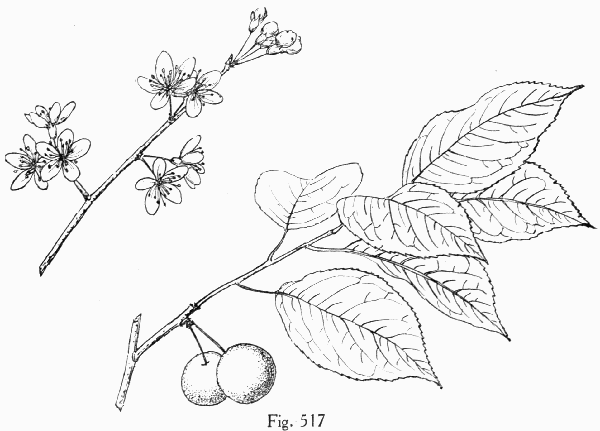
Leaves ovate to oblong-obovate, elliptic or rarely slightly obovate, abruptly acuminate and long-pointed at apex, gradually narrowed and cuneate or rarely rounded at base, and coarsely often doubly serrate with apiculate spreading teeth, when they unfold sparingly covered above by short caducous hairs and below by long white spreading hairs, and at maturity thin, light yellow-green and glabrous on the upper surface, pale and more or less densely covered below with close soft pubescence at the south often becoming fuscous late in the season, and villose on the midrib and primary veins, 2½′—4′ long and 1½′—2½′ wide; petioles slender, pubescent, eglandular or furnished with a gland near the apex, ½′—⅔′ in length, stipules linear, acuminate, occasionally 3-lobed, villose, sparingly glandular. Flowers about ¾′ in diameter, on slender glabrous pedicels ½′—⅔′ in length, in 2—5-flowered umbels; calyx-tube narrow-obconic, puberulous, the lobes long, acuminate, entire or rarely slightly serrate toward the apex, ciliate on the margins, puberulous and more or less tinged with red on the outer surface, pubescent on the inner surface; petals oblong-oval, narrowed and rounded at apex, gradually narrowed below into a long claw, about ¼′ wide; stamens about 25; style elongated, exceeding the stamens. Fruit on drooping glabrous pedicels, ellipsoid, deep crimson covered with a glaucous bloom, often 1′ long and ⅘′ in diameter, with thick succulent flesh; stone oblong, compressed, rounded at base, pointed and apiculate [564] at apex, ridged on the dorsal edge with a thin narrow ridge, thin and slightly grooved on the ventral edge.
A tree 20°—30° high, with a trunk 12′—18′ in diameter, small erect branches and slender unarmed branchlets light yellow-green and puberulous or pubescent when they first appear, usually becoming glabrous before the end of their first season, light orange-brown during their first season and dark red-brown the following year; sometimes a shrub only a few feet tall; usually growing with a single well-developed trunk; occasionally spreading by suckers from the roots into small thickets. Winter-buds acute, ⅛′—⅙′ long, with light chestnut-brown puberulous scales ciliate on the margins. Bark pale gray-brown, exfoliating in large thin scales.
Distribution. Hillsides and river-bottom lands; southern Indiana (near Columbus, Bartholomew County, and Gordon Hills, Gibson County), through southern Illinois (Gallatin, Pope, Richland and Johnson Counties) to western Kentucky (Ballard and Hickman Counties); through Missouri and Arkansas to eastern Oklahoma, western Louisiana and eastern Texas to Wilson County (Southerland Springs); through eastern Louisiana (West Feliciana and Tammany Parishes), and near Selma, Dallas County, Alabama.
6. Prunus tenuifolia Sarg.
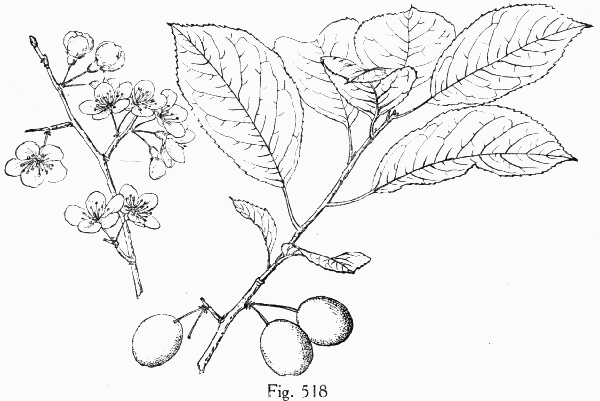
Leaves oblong to oblong-obovate or elliptic, gradually narrowed and acute or acuminate and often abruptly long-pointed at apex, cuneate or often narrowed and rounded at base, finely doubly serrate with teeth pointing to the apex of the leaf, at maturity thin, dark yellow-green and sparingly covered above with short soft white hairs, paler and soft pubescent below, especially on the slender midrib, and 7 or 8 pairs of thin primary veins connected by occasional cross veinlets, 3′—4′ long and 1¼′—2′ wide; petioles slender, pubescent, becoming puberulous or nearly glabrous, glandular near the apex with 1—3 prominent dark glands, or eglandular. Flowers ⅘′ in diameter, opening from the middle to the end of March, on slender pedicels ⅖′—⅘′ long, furnished near the apex with a few long white hairs, in 2—4-flowered sessile umbels; calyx-tube narrow-obconic, glabrous with the exception of occasional long scattered white hairs near the base, the lobes narrow, entire, or minutely dentate near the rounded apex, ciliate on the margins, pubescent on the outer surface, densely villose on the inner surface, reflexed after anthesis; petals white, ovate-oblong, narrowed and rounded at apex, crenulate above the middle, gradually narrowed below into a [565] short claw. Fruit on stout slightly hairy or glabrous stems, oblong to oblong-obovoid, red, covered with a thick glaucous bloom, ⅗′—¾′ long and ½′—⅗′ in diameter, with a thick skin and thin flesh; stone oblong, compressed, pointed at the ends, slightly sulcate at apex, unsymmetric, ridged on the full and rounded dorsal edge with a broad thin ridge, thin nearly straight and only slightly grooved on the ventral edge, ⅖′—⅗′ long and about ½′ wide.
A tree 30° high, with a tall trunk usually about 12′ but occasionally 18′ in diameter, stout spreading branches and stout or slender glabrous branchlets light orange green when they first appear, becoming light gray or red-brown and lustrous at the end of their first season, and dark dull red-brown the following year. Bark of the trunk and large branches thick, pale gray, and broken into long plate-like scales.
Distribution. Dry Oak-woods near Jacksonville and Larissa, Cherokee County, Texas.
7. Prunus mexicana S. Wats. Big Tree Plum.
Prunus arkansana Sarg.
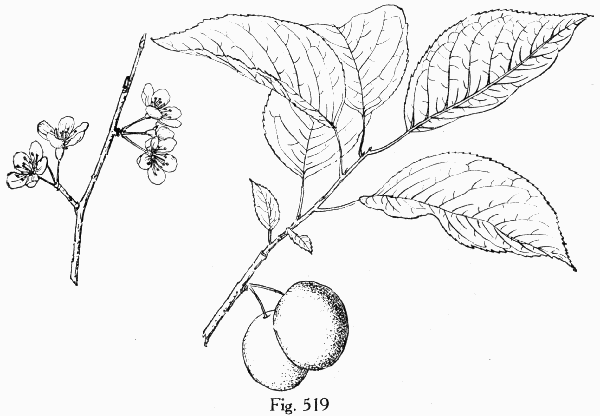
Leaves ovate to elliptic or obovate, abruptly long-pointed and acuminate at apex, rounded or rarely cuneate and often glandular at base, and finely doubly serrate with apiculate slender straight or slightly incurved teeth, at maturity thick, dark yellow-green, glabrous and lustrous on the upper surface, paler and sparingly covered on the lower surface with long soft white hairs most abundant on the prominent midrib and primary veins and on the numerous conspicuous reticulate veinlets, 1¾′—3¼′ long and 1¼′—2′ wide; petioles stout, pubescent or puberulous, glandular at apex with large dark glands, or eglandular, ⅖′—⅗′ in length. Flowers appearing in March before the leaves, 1′ in diameter, on slender glabrous pedicels in 3 or 4-flowered sessile umbels; calyx-tube narrow-obconic, glabrous, the lobes oblong or oblong-ovate, about as long as the tube, rounded and laciniate at apex or entire, ciliate and glandular on the margins with small sessile glands, puberulous on the outer surface, hoary-tomentose on the inner surface, reflexed after anthesis; petals sometimes puberulous on the outer surface toward the base, ovate-orbicular to oblong-ovate, rounded at the narrow apex, crenulate, abruptly or gradually narrowed below into a short claw, about 3 times as long as the calyx-lobes; style longer than the stamens. Fruit [566] ripening from the end of August to early October, subglobose to short-oblong, rounded at the ends, dark purple-red with a slight glaucous bloom, 1¼′—1⅓′ long and 1′—1¼′ in diameter, with thick succulent flesh; stone smooth obovoid to nearly circular, turgid, unsymmetric, narrowed and rounded at base, rounded or short-pointed at apex, ridged on the rounded dorsal edge with a broad thin ridge, thin, less rounded and grooved on the ventral edge, ¾′—1′ long and about ½′ wide.
A tree from 20°—25° high, with a trunk sometimes 8′—10′ in diameter, stout branches forming an open irregular head, and slender glabrous branchlets light orange-brown, very lustrous and marked by dark lenticels during their first winter and dull gray-brown the following year. Winter-buds ovoid, acute, glabrous, ¼′ long. Bark dark, nearly black or light gray, exfoliating in plate-like scales on young stems and large branches, becoming rough and deeply furrowed on old trunks.
Distribution. Open woods on rich alluvial bottom-lands, upland prairies and hillsides; southeastern Kansas (near Parsons, Labette County), through Arkansas to western Oklahoma (Navina, Logan County, Minca, Grady County), western Louisiana, northern and eastern Texas to the valley of the San Antonio River, ranging westward in Texas over the Edwards Plateau and to Brown and Palo Pinto Counties; in West Feliciana Parish, eastern Louisiana; in Coahuila and Nuevo Leon.
Passing into the following varieties:
Prunus mexicana var. reticulata Sarg. Differing in its thicker leaves more often narrowed at base, with more prominent reticulate veinlets, pubescent pedicels, globose fruit ripening late in September or in October, with thin, bitter, astringent flesh and dark deeply furrowed bark.
Distribution. Uplands and along the margins of river bottoms; neighborhood of Denison and Sherman, Grayson County, northern Texas.
Prunus mexicana var. polyandra Sarg.
Differing in the narrowed base of the leaves, the more numerous stamens, in its earlier ripening fruit, with an obovoid compressed stone pointed at apex and gradually narrowed and acute at base.
Distribution. Rich woods near Fulton, Hempstead County, Arkansas.
Prunus mexicana var. fultonensis Sarg.
Differing in its thinner leaves pubescent below over the whole surface, and in its smaller dark bluish-purple fruit, ripening in June, with thin flesh and a compressed stone pointed at apex and gradually narrowed and acute at base.
Distribution. Rich woods near Fulton, Hempstead County, Arkansas.
8. Prunus alleghaniensis Porter. Sloe.
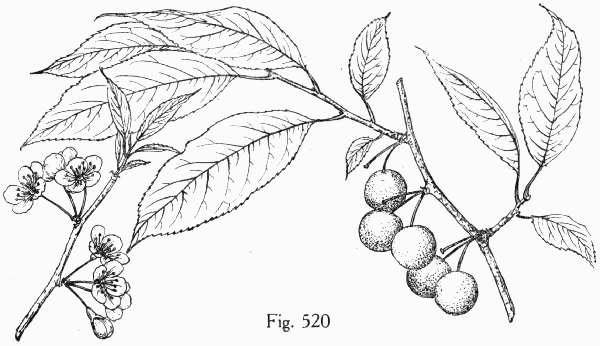
Leaves lanceolate to oblong-ovate, often long-pointed, finely and sharply serrate with glandular teeth, and furnished at base with 2 large rather conspicuous glands, when they unfold covered with soft pubescence, and at maturity puberulous on the upper surface, and glabrous with the exception of a few hairs in the axils of the veins, or covered, especially along the broad midrib and conspicuous veins, with rufous pubescence on the lower surface, rather thick and firm in texture, dark green above and paler below, 2′—3½′ long and ⅔′—1¼′ wide; petioles slender, grooved, pubescent or puberulous, ¼′—⅓′ in length. Flowers appearing in May with the unfolding of the leaves, ½′ in diameter, on slender puberulous pedicels ½′—⅔′ long, in 2—4-flowered umbels; calyx-tube narrow-obconic, pubescent or puberulous on the outer surface, the lobes ovate-oblong, rounded at apex, scarious on the margins, and coated with pale tomentum on the inner surface; petals rounded at apex, contracted at base into a short claw, turning pink in fading. Fruit ripening the middle of August, on stout puberulous pedicels, subglobose or slightly oval to obovoid, ⅓′—⅔′ in diameter, with thick rather tough dark reddish-purple skin covered with a glaucous bloom, and yellow juicy austere flesh; stone thin-walled, turgid, two thirds as thick as broad, ¼′—½′ long, pointed at the ends, ridged on the ventral suture, and slightly grooved on the dorsal suture.
A slender tree, occasionally 18°—20° high, with a trunk sometimes 6′—8′ in diameter, dividing [567] into numerous erect rigid branches, and branchlets at first coated with pale caducous pubescence, becoming dark red and rather lustrous in their first winter, and ultimately nearly black, and unarmed, or sometimes armed with stout spinescent lateral spur-like branchlets. Winter-buds acuminate or obtuse, 1/16′ long, their inner scales accrescent, scarious, oblong, acute, ⅔′ long, bright red at apex. Bark ¼′ thick, dark brown, fissured and broken on the surface into thin persistent scales. Wood heavy, hard, close-grained, brown tinged with red, with thin pale sapwood of 10—12 layers of annual growth. The fruit is made into preserves, jellies and jams.
Distribution. Low moist soil, often forming shrubby thickets sometimes of considerable extent, and dry ridges; slopes of Tusseys Mountain in the northwestern part of Huntingdon County, and over the main range of the Alleghany Mountains into Clearfield and Elk Counties, Pennsylvania; rocky ridges near the Natural Bridge, Rockbridge County, Virginia, and lower slopes of Peak Mountain on South Fork of Buffalo Creek, Ashe County, North Carolina (W. W. Ashe), and in southern Connecticut; of its largest size on limestone bluffs south of the Little Juniata River, Pennsylvania. A shrubby variety with leaves broader in proportion to their length and less acuminate at apex (var. Davisii Wight) occurs in Roscommon and Montmorency Counties, Michigan.
9. Prunus hortulana Bailey. Wild Plum.
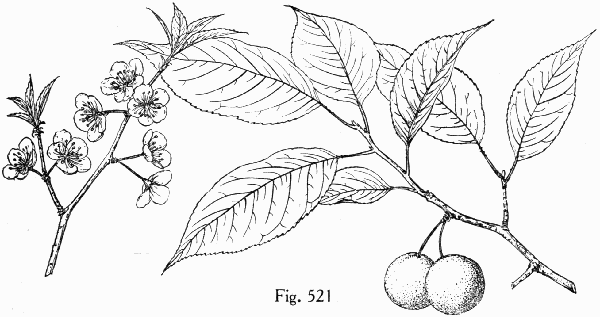
Leaves oblong-obovate to oblong-oval or rarely to oblong-lanceolate, acuminate and contracted at apex into a long slender point, cuneate or more or less rounded at the narrow base, and finely serrate with incurved lanceolate glandular teeth, when they unfold pilose with slender white hairs, and at maturity glabrous above, pilose below in the axils of the primary veins and along the midrib with tawny hairs, thin but firm, dark green and lustrous on the upper surface paler on the lower surface, 4′—6′ long and 1′—1½′ wide, with a broad conspicuous orange-colored midrib, primary veins connected near the margins of the leaf, and prominent reticulate veinlets; petioles slender, orange-colored, 1′—1½′ in length and furnished above the middle with numerous scattered dark glands; stipules lanceolate, acuminate, glandular-serrate, early deciduous. Flowers appearing in April or early in May when the leaves are about one-third grown, ⅔′—1′ in diameter, on slender puberulous pedicels ½′ long, in 2—4-flowered umbels; calyx-tube narrow-obconic, the lobes about as long as the tube, oblong-ovate, acute or rounded at apex, glandular-serrate, glabrous or puberulous on the outer surface, pubescent or tomentose on the inner surface chiefly toward the base, reflexed after the unfolding of the narrow oval or oblong-orbicular petals rounded and occasionally emarginate at apex, contracted below into a long narrow claw, entire, erose, or occasionally serrate, and white often marked with orange toward the base. Fruit ripening in September and October, on stout stems, globose or rarely ellipsoid, ¾′—1′ in diameter, [568] with thick deep red or sometimes yellow lustrous skin, and hard austere thin flesh; stone turgid, ⅔′—¾′ long, compressed at the ends, abruptly short-pointed or rounded at apex, rounded or truncate at base, conspicuously ridge-margined on the ventral suture and broadly and deeply grooved on the dorsal suture, thick-walled, usually conspicuously or rarely obscurely rugose and pitted.
A tree 20°—30° high, without suckers from the roots, with a slender often inclining trunk, frequently 5′—6′ or occasionally 10′—12′ in diameter, dividing usually several feet above the ground into thick spreading branches forming a broad round-topped head, and stout rigid branchlets marked by minute pale lenticels, glabrous or slightly puberulous during their first summer, rather dark red-brown, and usually unarmed or on vigorous trees armed with stout spinescent lateral chestnut-colored branchlets; or often a shrub, with many stems forming thicket-like clumps. Winter-buds minute, obtuse, with chestnut-brown scales slightly ciliate on the margins, those of the inner ranks becoming oblong-lanceolate, acute, glandular-serrate, sometimes ½′ in length. Bark thin, dark brown, separating into large thin persistent plates, and displaying the light brown inner layers.
Distribution. Low banks of streams in rich moist soil; southwestern Illinois to Scott County, Iowa, and to eastern Kansas and northeastern Oklahoma, and to central Kentucky and northwestern Tennessee; most abundant and of its largest size in Missouri. The handsomest of American Plum-trees, and hardy as far north as eastern Massachusetts. Several selected forms are grown and valued by pomologists. Passing into var. Mineri Bailey, with darker green duller leaves, and sometimes more scaly bark. Southwestern Illinois to central Missouri; and into var. pubens Sarg. differing from the type in its pubescent leaves, petioles and young branchlets. In the neighborhood of Webb City, Jasper County, Missouri.
Often cultivated by pomologists in many selected forms.
10. Prunus Munsoniana Wight & Hedrick
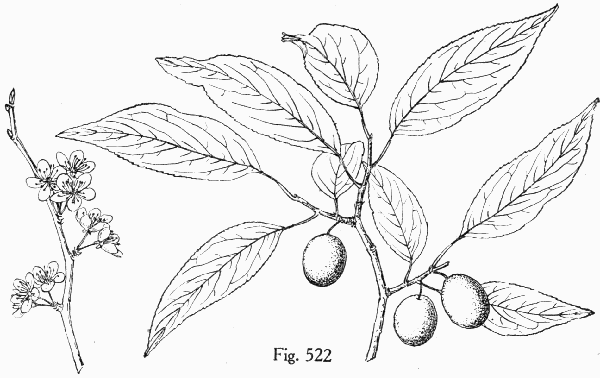
Leaves elliptic to lanceolate, acute or acuminate at apex, gradually narrowed and cuneate or rounded at base and finely glandular-serrate, when they unfold densely villose-pubescent above and glabrous below, and at maturity thin, light green and lustrous on the upper surface, pale on the lower surface, 2½′—4′ long and ¾′—1¼′ wide, with a slender midrib often red and usually pubescent or sparingly villose on the lower side, and slender primary veins often furnished with small axillary clusters of white hairs; petioles slender, usually biglandular toward the apex, the groove on the upper side covered with white pubescence, often bright red, ¾′ in length; stipules linear, glandular-serrate. Flowers appearing in Texas before the leaves at the end of March and as late as May after the appearance of the leaves at [569] the northern limits of its range, ½′—⅗′ in diameter, on slender glabrous pedicels ⅖′—1′ long, in 2—4-flowered umbel-like clusters; calyx-tube broad-obconic, glabrous, obscurely nerved, the lobes ovate, acute or acuminate, minutely glandular-serrate, glabrous or rarely slightly pubescent on the outer surface, pubescent on the inner surface below the middle; petals about ¼′ long, obovate to oblong-obovate, entire or sparingly erose, white, about ¼′ long, abruptly contracted into a short claw. Fruit ripening in July and August, subglobose to short-oblong, ¾′ long, bright red with a slight bloom, marked by pale dots and occasionally by yellow blotches, rarely yellow, with a thin skin and light or dark yellow juicy aromatic fibrous flesh often of good quality; stone oval, compressed, pointed at apex, truncate or obliquely truncate at base, thick-margined and grooved on the ventral suture, grooved on the dorsal suture, irregularly roughened on the surface, about ½′ long.
A tree spreading into dense thickets, the oldest central stem sometimes 20° high and 5′ or 6′ in diameter, diminishing in height and size to the margin of the thicket, with erect, rarely slightly spinescent branches, and slender glabrous red-brown lustrous branchlets marked by numerous pale lenticels. Winter-buds obtuse, chestnut brown, glabrous, rarely more than ⅛′ long. Bark thin, usually smooth and reddish or chestnut-brown on young stems, becoming gray or grayish brown and separating into thin plate-like scales on older trunks.
Distribution. Usually in rich soil; southern Illinois (Alexander, Gallatin, Pope, Johnson and Richland Counties); southwestern Kentucky; central Tennessee; northern Mississippi; central Missouri to southeastern Kansas, and through Arkansas to eastern Oklahoma, western Louisiana (Natchitoches and Lincoln Parishes), and northern Texas (west to Clay and Lampasas Counties); now occasionally naturalized from cultivated trees in eastern Texas, and eastward to Georgia, eastern Kentucky, southern Ohio, and in northern Missouri. Hardy in eastern Massachusetts and western New York.
Cultivated in orchards, a tree sometimes 20°—30° tall with a trunk 6′—8′ in diameter, and rather small wide-spreading branches forming a handsome round-topped head. Selected forms of the wild plants are valued by pomologists who have produced several hybrids by crossing Prunus Munsoniana with other American and with Old World species. The “Wild Goose Plum,” one of the best known forms of Prunus Munsoniana, has flowered and produced fruit for many years in the Arnold Arboretum.
11. Prunus angustifolia Marsh. Chickasaw Plum.
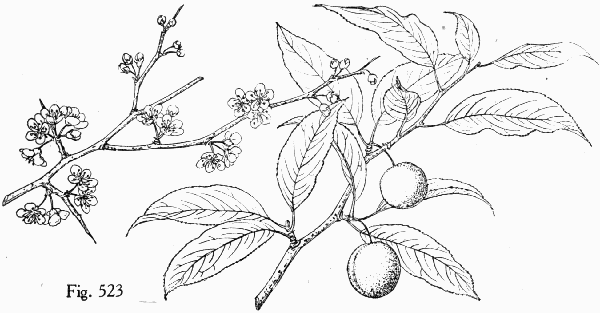
Leaves lanceolate to oblong-lanceolate, pointed at the ends, apiculate at apex, and sharply serrate with minute glandular teeth, glabrous or at first sometimes furnished with axillary tufts of long pale hairs, bright green and lustrous on the upper, paler and rather [570] dull on the lower surface, 1′—2′ long and ⅓′—⅔′ wide; petioles slender, glabrous or puberulous, biglandular near the apex with 2 conspicuous red glands, bright red, ¼′—½′ in length; stipules linear or lobed, glandular-serrate, ½′ long. Flowers appearing before the leaves from the beginning of March at the south to the middle of April at the north, ⅓′ in diameter, on slender glabrous pedicels ¼′—½′ long, in 2—4-flowered umbels; calyx-tube campanulate, glabrous, the lobes oblong, obtuse, entire ciliate on the margins with slender hairs, pale-pubescent on the inner surface, reflexed at maturity; petals obovate, rounded at apex, contracted at base into a short broad claw, white or creamy white. Fruit ripening between the end of May and the end of July, globose or subglobose, about ½′ in diameter, bright red or yellow, rather lustrous, nearly destitute of bloom, with a thin skin, and juicy subacid flesh; stone turgid, rugose, compressed at the ends, nearly ½′ long, more or less thick-margined on the ventral suture and grooved on the dorsal suture.
A tree, 15°—25° high, with a trunk rarely exceeding 8′ in diameter, slender spreading branches, and bright red and lustrous branchlets glabrous or covered at first with short caducous hairs, becoming in their second year dull, darker and often brown, marked with occasional horizontal orange-colored lenticels, and frequently armed with long thin spinescent lateral branchlets; spreading into thickets. Winter-buds acuminate, 1/16′ long, with chestnut-brown scales. Bark about ⅛′ thick, dark reddish brown and slightly furrowed, the surface broken into long thick appressed scales. Wood heavy, although rather soft, not strong, light brownish red with lighter colored sapwood. The fruit is often sold in the markets of the middle and southern states.
Distribution. Widely naturalized especially in the south Atlantic and Gulf states from southern Delaware and Kentucky to central Florida and eastern Texas, occupying the margins of fields and other waste places near human habitations usually in rich soil; probably native in central Texas and Oklahoma. Passing into var. varians Wight & Hedrick, differing from the type in its usually larger leaves occasionally up to 2½′ in length and to 1′ in width, in the longer pedicels of the flowers and in the ovoid to ellipsoid often pointed stone of the red or yellow later ripening fruit. A tree usually spreading into thickets, occasionally 12° high with a trunk 4′ or 5′ in diameter, small branches and slender often spinescent chestnut-brown branchlets. Usually in richer soil than the type, southwestern Kansas (Arkansas City, Desha County), through eastern Oklahoma and southern Arkansas to northern and central Texas (Cherokee County); now occasionally naturalized in the eastern Gulf States and possibly indigenous in Dallas County, Alabama, and Orange County, Florida.
A number of selected forms of this variety, including most of those formerly referred to Prunus angustifolia, are grown and valued in southern orchards but are not hardy in the north.
[571]
12. Prunus pennsylvanica L. Wild Red Cherry. Bird Cherry.
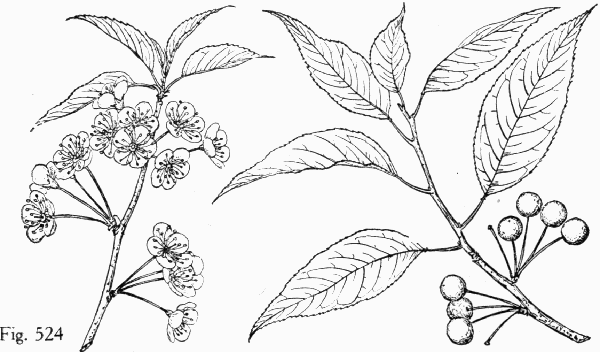
Leaves oblong-lanceolate, sometimes slightly falcate, acuminate or rarely acute, and finely and sharply serrate with incurved teeth often tipped with minute glands, when they unfold bronze-green, pilose below and slightly viscid, soon becoming green and glabrous, and at maturity bright and lustrous on the upper surface, rather paler on the lower surface, 3′—4½′ long and ¾′—1¼′ wide; turning bright clear yellow some time before falling in the autumn; petioles slender, glabrous or slightly pilose, ½′—1′ in length, and often glandular above the middle; stipules acuminate, glandular-serrate, early deciduous. Flowers appearing in early May when the leaves are about half grown, or at the extreme north and at high altitudes as late as the 1st of July, ½′ in diameter, on slender pedicels nearly 1′ long, in 4 or 5-flowered umbels or corymbs; calyx-tube broad-obconic, glabrous, marked in the mouth of the throat by a conspicuous light orange-colored band, the lobes obtuse, red at apex, and reflexed after the flowers open; petals ¼′ long, nearly orbicular, contracted at base into a short claw, creamy white. Fruit ripening from the 1st of July to the 1st of September, globose, ¼′ in diameter, with a thick light red skin, and thin sour flesh; stone oblong, thin-walled, slightly compressed, pointed at apex, rounded at base, about 3/16′ long, and ridged on the ventral suture.
A tree, with bitter aromatic bark and leaves, 30°—40° high, with a trunk often 18′—20′ in diameter, regular slender horizontal branches forming a narrow usually more or less rounded head, and slender branchlets light red and sometimes slightly puberulous when they first appear, soon glabrous, bright red, lustrous and covered with pale raised lenticels in their first winter, and developing in their second year short thick spur-like lateral branchlets and then covered with dull red bark marked by bright orange-colored lenticels, the outer coat easily separable from the brilliant green inner bark; at the extreme north often a low shrub. Winter-buds ovoid to ellipsoid, acute, about 1/12′ long, with bright red-brown acute scales, ciliate on the margins. Bark of young stems and of the branches smooth and thin, bright reddish brown, becoming on old trunks ⅓′—½′ thick, and separating horizontally into broad persistent papery dark red-brown plates marked by irregular horizontal bands of orange-colored lenticels and broken into minute persistent scales. Wood light, soft, close-grained, light brown, with thin yellow sapwood. The fruit is often used domestically and in the preparation of cough mixtures.