Chapter VIII
Reading edition
REIGN OF CHARLES II. (continued).
Demands of Parliament—A Bogus Commission—Crushing the Covenanters in Scotland—The Dutch in the Thames—Panic in London and at Court—Humiliation of England—Peace is Signed—Fall of Clarendon—The Cabal—Sir William Temple at the Hague—The Triple Alliance—Scandals at Court—Profligacy of the King and the Duke of Buckingham—Attempt to Deprive the Duke of York of the Succession—Persecution of Nonconformists—Trial of Penn and Mead—The Rights of Juries—Secret Treaty with France—Suspicious Death of Charles's Sister—"Madam Carwell"—Attack on Sir John Coventry—National Bankruptcy—War with Holland—Battle of Southwold Bay—William of Orange saves his Country—Declaration of Indulgence—Fall of the Cabal—Affairs in Scotland and Ireland—Progress of the Continental War—Mary Marries William of Orange—Louis Intrigues with the Opposition—Peace of Nimeguen—The Popish Plot—Impeachment of Danby—Temple's Scheme of Government—The Exclusion Bill—Fresh Persecutions in Scotland—Murder of Archbishop Sharp—Bothwell Bridge—Anti-Catholic Fury—Charges against James—Execution of Lord Stafford.
The career of vice which Charles had run since his restoration to the throne of England, the scandalous scenes and ruinous extravagance at Court, the loose women and debauched courtiers who figured there, and the great calamities which had latterly fallen on the nation, and, as it was generally believed, in consequence of the flagrant wickedness of the ruling persons, had by this time produced a profound impression on the public mind. Unprecedented sums had been voted for the prosecution of the Dutch War, and some terrible battles had been fought at sea; but these, so far from bringing any solid advantage to the nation, had ruined its finances, and greatly damaged the navy. Besides this, there was a general and well-founded belief that the money which should have gone to fit out the navy and pay the brave seamen, had been squandered on the royal mistresses and minions. The sailors had been left in destitution, and remained so; their tickets, which had been given them as tokens of their demands for wages, had to a large extent never been redeemed, whilst the effeminate courtiers made fortunes.
When Parliament met on the 21st of September, 1666, more money was demanded, and the Commons liberally voted one million eight hundred thousand pounds, but on several conditions, one of which was that the laws should be put in force against the Catholics, who were suspected to have fired the capital. Though a Committee appointed to consider this charge failed to connect the Papists with the Fire, yet the cry remained, and Charles was compelled to order by proclamation all priests and Jesuits to quit the kingdom; all recusants to be proceeded against according to law; all Papists to be disarmed, and officers and soldiers to be dismissed from the army who should refuse the oaths of Allegiance and Supremacy. There had been a demand from the aristocracy and their tenants in England, in 1663, to prevent the importation of cattle from Ireland. The landlords wanted high rents, and the tenants cried out that they could not pay them if they were to be undersold by the Irish; as if Ireland were not a part of the empire as well as England, and justly entitled to the same privileges. It was in vain that the more liberal and enlightened members asked how Ireland was to purchase our manufactured goods, if we would not take her raw produce. The Bill was passed, and sixty thousand beeves and a large quantity of sheep were thus refused entrance annually at our ports. To obviate this difficulty, the Irish slaughtered the cattle, and sent them over as dead carcasses. This was violently opposed, and this session a Bill passed, also excluding the meat. But the third and last demand on Charles was the most alarming. It was no other than that a Parliamentary Commission should be appointed to examine and audit the public accounts. It was well known that not only the king's mistresses, but many other persons about the Court, had made very free with the public revenue with the connivance of Charles. Lady Castlemaine was commonly declared to carry on a great trade in selling favours, and receiving bribes from the subjects, and lavish grants from the king.
The alarm which the passing of a Bill for this Commission of Inquiry through the Commons carried into all the courtly recesses of corruption was excessive. The whole Court was in a turmoil of consternation; there was a terrible outcry that if this were allowed, there was an end of the prerogative. Lord Ashley, the Treasurer of the Prize Money, and Carteret, the Treasurer of the Navy, were aghast, and implored Charles to declare openly that he would never consent to it. The grave and virtuous Lord Clarendon strenuously supported them, telling the king that he must not "suffer Parliament to extend their jurisdiction to cases that they had nothing to do with." He desired the king to "be firm in the resolution he had taken, and not to be put from it." And he promised when the Bill came into the Lords he would oppose it with all his power. And this was the advice of a man who himself tells us in his "Life" of the corruptions practised—of the corruptions of these very men, Ashley and Carteret; of the good round sums taken from the privy purse by "the lady," as she was called, and of the extensive grants to her of lands in Ireland, where they were not so likely to be inquired about; of the miserable condition of the navy; the dissolute life of the king; his own remonstrances, and the constant endeavours of the courtiers to divert the king's attention from anything serious.
But there was a cause much more influential than public good or public virtue which forwarded the Bill, in spite of the Court. The Duke of Buckingham had a quarrel with "the lady," and she prejudiced the king against him, and the duke was determined to have his revenge by exposing "the lady's" gross peculations. The Bill, therefore, passed the Commons, and came into the Lords, where Buckingham and his party supported it, and Clarendon and the guilty courtiers opposed it. Buckingham himself was as dissolute and unprincipled a man as any about Court, not even excepting the king and the licentious Lord Rochester. The Bill passed, and the king, in his resentment, disgraced Buckingham, deprived him of all his employments, and ordered his committal to the Tower, which he avoided only by absconding. Buckingham, however, once out of the way, the king and his virtuous Chancellor soon managed to be allowed to appoint the Commission of Inquiry themselves, by which the whole affair was converted into a mockery, and came to nothing.
During this session of Parliament, wild work had been going on in the west of Scotland. The people there had resisted the ejectment of their ministers from their pulpits by Episcopalian clergy; they received them with curses, and often with showers of stones. When the Act against conventicles was passed, they still met with their old pastors in barns and moorlands, and then the soldiery under Sir James Turner were let loose upon them. They flew to arms and fought the soldiers, and made a prisoner of Turner himself. Their ministers, Semple, Maxwell, Welsh, Guthrie, and others, incited them to wield the sword of the Lord and of Gideon, and to resist the Malignants to the death. Lauderdale was in London, and the ministers told the people that the fire of London had given enough to the Government to do at home. But Sharp was in Scotland, and he put himself at the head of two troops of horse and a regiment of foot guards, and assisted by Dalziel, a man of considerable military reputation, he pursued the Covenanters to Rullion Green, in the Pentlands. There, on the 28th of November, 1666, they came to a pitched battle, in which the Covenanters were defeated, fifty being killed, and a hundred and thirty taken prisoners. The Covenanters had treated Turner and all others who fell into their hands with great lenity, but none was shown to them by Sharp. Ten of them, were hanged on one gallows in Edinburgh, and thirty-five were sent to Galloway, Ayr, and Dumfries, and there gibbeted in the face of their own friends. The implacable archbishop, with the fury of a renegade, made keen search after all who had been concerned in the affair; it was declared that eternal damnation was incurred by the rebels against the Church, and the horrors of the rack, thumbscrews, and iron boot were put vigorously into operation again. A young preacher, Maccail, whom Sir Walter Scott has represented under the name of Macbriar, was hideously tortured, but died in a rapture of joy, not a syllable of disclosure escaping him. Dalziel, a brutal and drunken captain, revelled in cruelty and outrage amongst the Whigs or Whiggamores, as they were called; hanged a man because he would not betray his own father; quartered his soldiers on people to ruin them, and perpetrated such atrocities that the Earls of Tweeddale and Kincardine went up to Court to warn the king against driving the people once more to desperation. Their representations were not without effect, but this leniency was of short duration.
The war with the Dutch and French being still continued, it was necessary for Charles to put his fleet once more in order; but his Exchequer exhibited its usual emptiness, and the Parliamentary supply would be some time before it reached the treasury. The customary resource had been to send for the bankers and capitalists of London, and make over to them some branches of the public revenue for immediate advances, these advances to be at the rate of eight per cent., and to be repaid by the taxes till all were discharged. But the losses by the fire had incapacitated the money-lenders at this crisis, and Charles, therefore, unwisely listened to the suggestion of Sir William Coventry, to lay up the principal ships in ordinary, and send out only two light squadrons to interrupt the enemy's trade in the Channel and the German Ocean. The Duke of York at once declared that this was directly to invite Holland to insult the English coasts, and plunder the maritime counties; but the want of money overruled the duke, and the consequences were precisely what he foresaw.
Charles hoped to evade the danger of this unguarded state by a peace. Louis XIV., who was anxious to conquer Flanders, made overtures through Lord Jermyn, now Earl of St. Albans, who lived in Paris, and was said to be married to the queen-mother, and he also at the same time opened negotiations with Holland, to enforce an abstinence of aid to the Flemings from that quarter, and to make peace between Holland and England. These measures effected, he would be set free from any demands of Holland to assist them against England, and he would bind Charles to afford no aid to the Spaniards. Charles was perfectly willing to accede to these plans, so that he might not be called on for more money, and after a time it was agreed that Commissioners should meet at Breda to settle the terms of peace. France was to restore the West Indian Islands taken from England, and England was to oppose no obstacle to Louis' designs against Spain. But as hostilities were not suspended, De Witt, the Dutch minister, still burning for revenge for the injuries committed by the English on the coast of Holland, declared that he would "set such a mark upon the English coast as the English had left upon that of Holland."
He knew the unprotected state of the Thames, and he ordered the Dutch fleet, to the amount of seventy sail, to draw together at the Nore. The command was entrusted to De Ruyter and the brother of De Witt. The English, roused by the danger, threw a chain across the Medway at the stakes, mounted the guns on the batteries, and got together a number of fire-ships: but here the consequence of the heartless conduct of the Government to the seamen and workmen who had been employed by them hitherto and defrauded of their pay became apparent. No sense of patriotism could induce them to work for the Government. The Commissioners of the Navy were nine hundred thousand pounds in debt, notwithstanding the liberal supplies of Parliament, and the merchants would not furnish further stores except for ready money. One portion of the Dutch fleet sailed up as far as Gravesend, the other was ordered to destroy the shipping in the Medway (June, 1667). The fort at Sheerness was in such a miserable condition, that it was soon levelled to the ground. Monk had been sent down to defend the mouth of the Medway, and he raised batteries, sank ships in the narrowest part of the channel before the boom, and placed guard-ships for its protection. But the Dutch found out another channel accessible at high water, and running their fire-ships on the boom, broke the chain, silenced the batteries, and burnt the guard-ships. Monk retreated to Upnor Castle, but the Dutch soon appeared before it with their squadron; the castle was not supplied with powder, and few of the ships in the river had any. The Royal Charles was taken, the finest ship in the English fleet, the Royal James, the Royal Oak, and the London were burnt. A still greater mortification was to find numbers of the incensed English sailors manning the Dutch vessels, who shouted, "Before we fought for tickets, now we fight for dollars." Had De Ruyter pushed on for London, he might have destroyed all the merchant ships in the river; but Prince Rupert at Woolwich having sunk a number of ships to block up the channel, and raised batteries to sweep the passage, it was easier to commit devastations on the southern coast, and this squadron, under Van Ghent, dropped down to the Nore and joined the main fleet. For six weeks the Hollanders sailed proudly along our coasts, harassing the inhabitants, and attempting to burn the ships at Portsmouth, Plymouth, and Torbay. Twice De Ruyter attempted again to ascend the Thames, but by this time, in addition to the force of Rupert, Sir Edward Spragge was posted with eighteen sail of the line to oppose him.
But the panic on land was inconceivable. "The people of Chatham," says Clarendon, "which is naturally an array of seamen and officers of the navy, who might and ought to have secured all those ships, which they had time enough to have done, were in distraction; their chief officers have applied all those boats and lighter vessels, which should have towed up the ships, to carry away their own goods and household stuff, and given what they left behind for lost." "Nothing," he adds, "would have been easier than to have destroyed Chatham, and all the ships which lay higher up the river. But London was still worse. The noise of this, and the flames of the ships which were burning, made it easily believed in London that the enemy had done all that they might have; they thought they were landed in many places, and that their fleet was come up as far as Greenwich. Nor was the confusion there less than it was in the Court itself, where they who had most advanced the war, and reproached all those who had been against it as men who had no public spirit, and were not solicitous for the honour and glory of the nation—and who had never spoken of the Dutch but with scorn and contempt, as a nation rather to be cudgelled than fought with—were now the most dejected men that can be imagined; railed very bitterly at those who had advised the king to enter into that war, which had already sacrificed so many gallant men, and would probably ruin the kingdom, and wished for a peace on any terms." All the world, he says, rushed to Whitehall, and entered at pleasure, some advising the Court to quit the metropolis, and "a lord, who would be thought one of the greatest soldiers in Europe, to whom the Tower was committed, lodging there only one night, 'declared that it was not tenable,' and desired not to be charged with it, whereupon those who had taken their money there carried it away again."
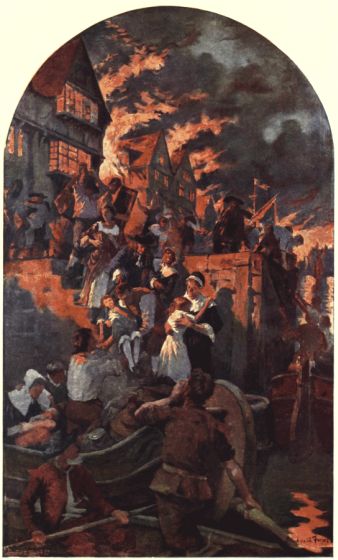
From the Design for the Wall Painting in the Royal Exchange.
THE GREAT FIRE OF LONDON, 1666.
By STANHOPE A. FORBES A.R.A.
[See larger version]
This is a melancholy picture of what a weak and profligate Government can reduce a great country to in less than six years. "It was said," observes Macaulay, "that the very day of that great humiliation, the king feasted with the ladies of his seraglio, and amused himself with hunting a moth about the supper-room. Then, at length, tardy justice was done to the memory of Oliver. Everywhere men magnified his valour, genius, and patriotism. Everywhere it was remembered how, when he ruled, all foreign powers had trembled at the name of England; how the States-General, now so haughty, had crouched at his feet, and how, when it was known that he was no more, Amsterdam was lighted up for a great deliverance, and children ran along the canals, shouting for joy that the 'Devil' was dead. Even Royalists exclaimed that the State could be saved only by calling the old soldiers of the Commonwealth to arms. Soon the capital began to feel the miseries of a blockade. Fuel was scarcely to be procured. Tilbury Fort, the place where Elizabeth had, with manly spirit, hurled foul scorn at Parma and Spain, was insulted by the invaders. The roar of foreign guns was heard for the first and last time by the citizens of London. In the Council it was seriously proposed that, if the enemy advanced, the Tower should be abandoned. Great multitudes of people assembled in the streets, crying out that England was bought and sold. The houses and carriages of ministers were attacked by the populace, and it seemed likely that the Government would have to deal at once with an invasion and an insurrection."
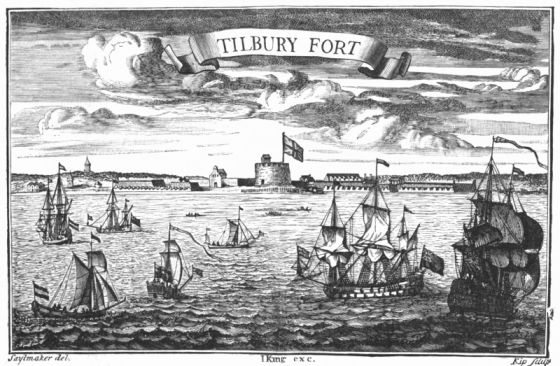
TILBURY FORT.
[See larger version]
However, deliverance came from an unexpected quarter, and the excitement in the public mind—which had been naturally aroused and alarmed by the disgraceful condition into which a corrupt and feeble administration had allowed affairs to drift—gradually subsided, and seldom has a great crisis been so luckily overcome. For whilst the Dutch had thus been humiliating England, Louis XIV. had been pushing his conquests in Flanders. With an army of seventy thousand men he compelled Binche, Tournay, Oudenarde, Courtrai, and Douai to surrender; and he was besieging Lille when the States of Holland hastened to come to terms with France and England to prevent the nearer approach of Louis to their own territories. On the 21st of July peace was signed between England and Holland and England and France, by which the Dutch kept the disputed island of Pulerone, and ceded to the English Albany and New York. France restored Antigua, Montserrat, and part of St. Kitts, and received back Nova Scotia. Denmark, which had sided with the Dutch, also signed a treaty of peace with England.
The peace was immediately succeeded by the fall of Clarendon. He had been the companion and adviser of Charles from the very boyhood of the king, and accordingly the mischief of every measure, and the disgrace which had now fallen on the nation, were all attributed to him. With great talents Clarendon had too much virtue to approve, far less flatter, the vices and follies of the Court in which he lived, and not enough to make him abandon it, and assume the character of a noble and disinterested censor. He had the sternness and gravity of Cato, but he lacked his great and patriotic principles. He began as a liberal, but went over to the Royalist cause, and was a rigid advocate of the high prerogatives of the Crown, and of the supremacy of the Church. The Puritans looked on him as a combination of Strafford and Laud. He certainly would not have so far violated public right as to countenance the raising of Ship Money, or the violation of the privileges of Parliament by the seizure of its members. But the Puritans hated him for the support that he gave to the Act of Uniformity, and for so hotly resisting the king's grant of indulgence to tender consciences. On the other hand, the Royalists hated him because he maintained the inviolability of the Bill of Indemnity, by which they were restrained from ousting the purchasers from their estates lost during the Commonwealth; and they hated him not the less because he had managed to raise his daughter to the rank of Duchess of York, and thus to give himself, although a commoner, the appearance of being not only father-in-law of the next king, but father of a line of kings. They accused him of having selected the present queen as one not likely to have children, in order to favour the succession of his own, and probably one of the real causes of Charles's change towards him resulted from the courtiers having inspired him with this belief. The Commons hated him because he had uniformly endeavoured to repress their authority. He never could be brought to see the enlarged influence which the progress of wealth and intelligence had given to the Commons; nor had all that had passed under his eyes of their extraordinary power under Charles I., awakened him to the knowledge of their real position in the State. In vain did more clear-sighted men point out to him the concessions which were necessary to enable the Parliament and the Government to move on harmoniously together. The nobility disliked him because he had, by his influence with the king and the marriage of his daughter with the heir-apparent, placed himself above them, and, from the haughtiness of his nature, taken no pains to conceal that invidious position. The people detested him, for they believed that he ruled the king, and therefore was the author of all their miseries and disgraces. They accused him of selling Dunkirk, and therefore called his splendid palace, overlooking and every way outshining the royal one, Dunkirk House. The Chancellor, undoubtedly, had an incurable passion for money and acquisition of wealth, and for displaying it in the grandeur of his house, and the magnificent collection of his pictures. When the Dutch fleet was riding in the Thames, the enraged people turned all their fury on him. They broke his windows, destroyed the trees in his grounds, trod down his garden, and erected a gallows at his door.
But the intensity of aversion to him was felt at Court. He was from his youth of grave and decorous character. The lewdness and fooleries of the courtiers excited his undisguised disgust. We have seen that he could stoop to persuade the queen to tolerate the most insufferable indignities, yet he never ceased to speak to Charles of the infamy and extravagance of his mistresses, and the scandalous lives of the courtiers who fluttered around them. The only wonder is, that the malice of Castlemaine and her allies had not long ago driven him from the Court; and it speaks volumes for the hold which he had on the regard of the monarch, that he could resist their hatred so long. But now Buckingham, who had quarrelled with Lady Castlemaine, and had done his best to expose her, had made up the feud, and they directed their common enmity against their common foe. Shaftesbury, Monk, Clifford, Lauderdale, Sir William Coventry, Arlington, and others, joined them in one determined and concentrated attack. They made their onslaught when all classes were uttering their execrations upon him. He had advised the king, when the Dutch fleet was at Chatham, to dissolve Parliament, and maintain ten thousand men that he had raised by forced contribution from the neighbouring counties, to be repaid out of the next Supplies; this caught wind, and was regarded as returning to the idea of the king ruling by a standing army and without a Parliament. Charles had grown tired of his preachments about the profligacy of his life and Court, and allowed the old Chancellor to drift before the storm; he was suspected more than all of sacrificing him to his resentment for having brought about the marriage of Miss Stewart with the Duke of Richmond, though Clarendon, in a letter to Charles, denied it.
Clarendon, with his characteristic pride, refused at first to resign. He waited on the king, and reminded him of his long and faithful services, and told him that he would not consent to appear guilty by surrendering the seals. The king talked of the power of Parliament. Clarendon replied he did not fear Parliament, and told the king that Parliament could do nothing against him without his consent. But unfortunately the spirit of the censor came over him, and, entreating the king not to allow the cabal of the courtiers to prevail against him, he broke out into some severe strictures on "the lady" and her abettors. The king rose and quitted the room without saying a word, and "the lady," quickly informed of the Chancellor's disgrace, rushed to the window to watch, with Arlington and May, the fallen minister retire in confusion. Charles sent Sir Orlando Bridgeman for the seals, and on the assembling of Parliament on the 10th of October, Buckingham and Bristol, who again came out of his hiding-place, urged his impeachment. Accordingly the Commons presented articles of impeachment at the bar of the Lords, charging the Chancellor with cruelty and venality in his office, with unlawful accumulation of wealth, with the sale of Dunkirk, the disclosure of the king's secrets, and the design of ruling by military force. Still Clarendon stood his ground; but the king let fall an expression in the hearing of one of his friends, that he wondered what Clarendon was still doing in England, and the old man took the hint and got across the Channel, though the proposal to imprison him till his trial had been overruled. He did not go, however, without leaving a written vindication of his public conduct, which so offended Parliament, that it ordered the paper to be burnt by the common hangman. In this vindication he declared that he had only retired for awhile, and should return at a proper time to prove his innocence, "uncontrolled by the power and malice of men who had sworn his destruction." This caused the Commons to pass a Bill ordering his trial on the 1st of February, and declaring him, in default of appearance, banished for life, incapable of ever after holding office, and liable to all the penalties of high treason. Clarendon boldly prepared to face his enemies, but illness stopped him at Calais till it was too late, and he was thus doomed to exile for life. He lost his wife about the time of his fall, which was a great blow to him, for they had lived in great affection. He continued to live chiefly at Montpellier and Moulins, engaged in writing his history of the Rebellion and of his own life, as well as a reply to Hobbes' "Leviathan" and other works; but sighing for recall, and importuning the king to allow him to return to his native country and the society of his children. Charles, however, paid no attention to his prayers, and he died at Rouen in 1674.
Clarendon being removed, the whole of the ministry established at the Restoration was broken up. Ormond was absent on his government in Ireland, Southampton was dead, Monk was grown incapacitated from drink and years, and Nicholas had retired. The new ministry acquired the notorious and appropriate name of the cabal, from the initials of their names,—Sir Thomas Clifford, First Commissioner of the Treasury, afterwards Lord Clifford; the Earl of Arlington, Secretary of State; the Duke of Buckingham, Master of the Horse, which office he purchased from Monk; Lord Ashley, Chancellor of the Exchequer, afterwards Earl of Shaftesbury and Lord Chancellor; and the Duke of Lauderdale. Before this time the word cabal merely meant a cabinet. It is so used by Whitelock, Pepys, and Evelyn, from the year 1650. The present cabinet was styled by D'Estrades, "la cabale d'Espagne." The word became infamous from the conduct of these men, who were soon concerned in the king's sale of himself to Louis XIV., and most of them received large sums from France for their most treasonable and unpatriotic services. Clifford was the most honest and honourable, but he had the knack of quarrelling with his colleagues, being of a hot and overbearing temper. Bennet, Lord Arlington, was a mere courtier, had spent much time on the Continent, and picked up its frivolity and vices. He could divert the king by his lively sallies in conversation, please the ladies, and assume an imposing gravity in public debate that deceived the public. He was at heart a Romanist, but took care to conceal it. As for Buckingham, he was a most thoroughly debauched and unprincipled character, not without certain talents and literary tastes. He had written farces, and was a connoisseur in music and architecture. But he was a jaded man of pleasure, and having been out of favour with the king, was now all the more bent on complying with his humour to win his favour. He and Arlington were bitter enemies, but put on an appearance of friendship now they were in office together. Ashley was a man who could change sides, but always with an eye to the main chance. He had been a zealous Republican, and now was as zealous a Royalist; and, as for Lauderdale, he, too, had been an out-and-out Covenanter, but was now a coarse, brutal persecutor of those of his old faith, and by his diabolical cruelties has acquired a name in history amongst the most odious of inquisitors.
One of the earliest acts of the cabal gave fairer promise of sound and good policy than their after proceedings. They sent Sir William Temple to the Hague to endeavour to heal the difference with Holland, which had inflicted such incalculable evils on both countries. Not the least of those ills was the opportunity which was afforded Louis of pushing his ambitious designs on Flanders, and ultimately on Holland and Spain. Both England and Holland saw so clearly the gross folly which they had displayed that Sir William soon came to terms with the States, and by the 25th of April, 1668, he had got definite treaties signed between Holland and England, and between these countries and Sweden, to make common cause for checking the further advance of the French, and to induce France to make peace with Spain. There was also a secret treaty, binding each other to make war on France for the defence of Spain. This league became known as the Triple Alliance. Louis, who made pretences to the crown of Spain, was hoping, from the infirm health of its young monarch, Charles II., to obtain that kingdom, or to partition it between himself and Leopold, the German emperor, with whom there was a secret treaty for that very purpose. So far, therefore, from opposing the plans of the new allies, he fell in with them on certain conditions—namely, that he should retain the bulk of his conquests in the Netherlands. Holland beheld this arrangement with alarm, and refused to sanction it, upon which it was concluded without her approbation, and to punish the States, Castel-Rodrigo, the Spanish governor of the Netherlands, gave up instead of Franche Comté, Lille, Tournay, Douai, Charleroi, and other places in Flanders, so that the French king advanced his frontier into the very face of Holland. This was settled by the peace of Aix-la-Chapelle.
But whilst Charles was thus publicly pursuing a policy much to the satisfaction of the nation, both on account of the improved prospects for trade, and because the Triple Alliance was an essentially Protestant one, he was secretly agitating the question whether he should not openly avow Popery, and was bargaining with Louis to become his pensioner, so as to relieve himself from any need to apply to Parliament, and by this means to assume absolute power. Parliament, which met on the 10th of February, 1668, made a rigid inquiry into the proceedings of the late administration. They accused Commissioner Pett of neglect when the Dutch fleet entered the river, Admiral Penn of the embezzlement of one hundred and fifteen thousand pounds' worth of prize goods, and Brounker, who had absconded, of giving orders to shorten sail after the victory of the 3rd of June. They then voted three hundred and ten thousand pounds, much less than Buckingham had demanded; and Charles, having in his opening speech recommended some plan to be adopted, the better to satisfy the minds of his Protestant subjects, it immediately awoke a jealousy of indulgence to the Papists and Dissenters. It was found that Bridgeman, the Lord-Keeper, Sir Matthew Hale, the Chief Baron, Bishop Wilkins, and Buckingham and Ashley had been engaged in a scheme to tolerate the Presbyterians and other sects. All the old bigotry of the House burst forth; there were violent denunciations of any liberty to Nonconformists, and they again voted the continuance of the Conventicle Act. They then adjourned from the 8th of May to the 11th of August.
Buckingham, who, during the session of Parliament, had not found himself very popular, now the object of driving out Clarendon was accomplished, in seeking to strengthen his party by removing such as were not favourable to him, drove his plans almost too far. He had a dread of Clarendon returning through the influence of his daughter, the Duchess of York, and he endeavoured to undermine the duke with the king. He blamed the conduct of the Admiralty, at the head of which James was; he displaced James's friends, and put his own dependents into offices in James's own department, in spite of his remonstrances; he spread rumours that the duke had lost the royal favour, and was about to be dismissed from the office of Lord Admiral. He even affected to go about with armed followers, on the plea of being in danger from the duke. But Charles soon convinced the minister that these attempts were vain, and then Buckingham began to pay court to the duke, which was repelled with contempt. The only mode of maintaining favour with Charles was to find plenty of money, and as Buckingham had failed in that, he recommended retrenchment and economy, which suited Charles still less. For the rest, both Court and minister went on their way of open profligacy, and it would have been difficult to say which was the most void of shame or principle, the king or his chief servant. Charles was surrounded by Sedley, Buckhurst, and other libertines, who treated all the decencies of life with contempt, and the monarch laughed and encouraged them. Though Miss Stewart had become Duchess of Richmond, he continued his attentions to her. He had elevated actresses to places in his harem, who bore the familiar names of Moll Davies and Nell Gwynn. Moll Davies was a dancer, Nelly was an actress of much popularity, and was a gay, merry, and witty girl, who extremely amused the king by her wild sallies. By Mary Davies he had a daughter, who afterwards married into the noble family of Radclyffe. Nell was the mother of the first Duke of St. Albans; and Castlemaine, who had now a whole troop of little Fitzroys, was during the next year made Duchess of Cleveland. Another lady was already on the way from France, sent by the cunning Louis XIV. for his own purposes. As for Buckingham, he very successfully imitated his royal master. In January of this year he fought a duel with Lord Shrewsbury, whose wife he had seduced; and Pepys says that it was reported that Lady Shrewsbury, in the dress of a page, held the duke's horse whilst he killed her husband. He then took her to his own house, and on his wife remarking that it was not fit for herself and his mistress to live together, he replied, "Why, so I have been thinking, madame, and therefore I have ordered your coach to carry you to your father's."
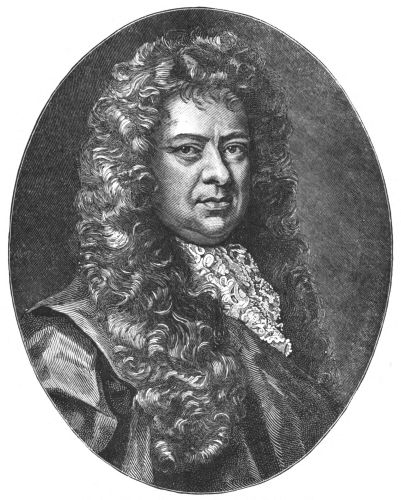
SAMUEL PEPYS. (After the Portrait by Sir Godfrey Kneller.)
[See larger version]
In this precious Court the subject of religion was just now an interesting topic. The Duke of York told Charles secretly that he could no longer remain even ostensibly a Protestant, and meant to avow his Popery. Charles replied that he was thinking of the very same thing, and they would consult with the Lords Arundel and Arlington, and Sir Thomas Clifford. They had a private meeting in the duke's closet; but though their three counsellors were Catholics open or concealed, they advised Charles to consult with Louis XIV. before taking so important a step. The French king was apprehensive that his avowal of Popery would occasion disturbances amongst his subjects, but these might be put down by the assistance of French money and French troops. That was the object at which Louis knew that this abandoned king was really driving, and the price of this assistance was to be England's co-operation in Louis's schemes of boundless ambition. Instead of Charles inducing Louis to maintain peace with Holland, it was the object of Louis to drive Charles to break again the Triple Alliance, and plunge once more into the horrors of a wicked and mischievous war with that country. Charles hated the Dutch for the treatment he had received in Holland whilst an exile, and for the humiliations he had been subjected to in the last war. Louis wanted not only to swallow up the bulk of that country in his vast plans of aggrandisement, but also make himself master of Spain in case of the death of the young Spanish king. The pretended desire of Charles to adopt open Popery was merely a feint to secure the French king's money, and the next question which he raised was, whether he should avow himself before the rupture with Holland or afterwards. The Duke of York was in earnest, Charles was only playing with the Catholic scheme as a bait; and he afterwards told his sister, the Duchess of Orleans, at Dover, that "he was not so well satisfied with the Catholic religion, or his own condition, as to make it his faith." Lord Arundel and Sir Richard Billings were sent to Paris to secure the promised cash, and to keep up the farce of his conversion.
Whilst these infamous negotiations were going on, Buckingham was exerting himself to ruin the Duke of York's prospects of the succession. He observed the king's fondness for his natural son by Lucy Walters, who had borne the name of Crofts, and he caught at the idea of Charles legitimating him. Charles had created him Duke of Monmouth, and married him to the wealthy heiress of Buccleuch. Buckingham asked the king why not acknowledge a private marriage with his mother, and suggested that plenty of witnesses might be found to swear to it; but the answer of Charles destroyed this vision, who declared that he would see the lad hanged sooner than own him as his legitimate son. Buckingham, still not disconcerted, proposed an absurd scheme of carrying the queen privately to the Plantations, where she would never more be heard of; and next a divorce from her on account of her barrenness, and a second marriage. Bishop Burnet, afterwards of Sarum, had decided that such cause was sufficient for divorce, and that it only wanted an Act of Parliament authorising the divorced parties to marry again. Charles listened sufficiently to cause them to attempt such an Act. It was sought for in the case of Lord Ross, whose wife was living in open adultery; but it was soon rumoured what was the ultimate object of it. The Duke of York, therefore, opposed the Bill with all his might, and Charles supported it with equal ardour, even taking his seat on the throne in the Lords whilst it was discussed, to encourage his party. The Bill was carried, and the right to marry again has always since then been recognised in Bills of Divorce; but Charles again disappointed Buckingham, for he showed no desire to make use of it in his own case.
The King obtained from Parliament considerable supplies in the spring Session of 1670, for his consent to the renewal of the Conventicle Act, and the fury of persecution was let loose against the Nonconformists. Spies and informers were everywhere, and many of the Dissenters, to save their property, and their persons from prison, were fain to forego their usual assembling for worship in their chapels. The Society of Friends, however, scorned to concede even in appearance to this religious intolerance. They persisted in meeting as usual. They were dragged thence before magistrates, and on refusing to pay the fines were thrust into prison. No sooner were they liberated, however, than they returned, as usual, to their meetings, and when the doors were locked against them, assembled in the street, and held their meetings there. On one of these occasions, William Penn, son of Admiral Penn, and afterwards the celebrated founder of Pennsylvania, was taken with William Mead, another minister of the Society, at an open-air meeting in Gracechurch Street. They were thrust into Newgate, and brought to trial in September, 1670, before the Recorder of London, John Howell, and the Lord Mayor, Samuel Starling. This trial forms one of the most brilliant facts in the history of the independence of trial by jury, and has often been reprinted. Both Penn and Mead made noble defences, and terribly puzzled the Recorder as to the law of the case. They demanded to know on what law the indictment was based. The Recorder replied the "common law." They begged to be shown it. On this he flew into a passion, and asked them if they thought he carried the common law on his back. It had been founded on hundreds of adjudged cases, and some of the ablest lawyers could scarcely tell what it was. Penn replied that if it was so difficult to produce, it could not be common law. He still pressed for this law, and the Recorder replied, "It is lex non scripta, that which many have studied thirty or forty years to know, and would you have me tell you in a moment?" "Certainly," replied Penn; "if the common law be so hard to be understood, it is far from being common." And he proceeded to tell them what the law was, and how the rights of prisoners were secured by the Acts of Henry III. and Edwards I. and III. On this the court became furious, and the Lord Mayor said, "My lord, if you take not some course with this pestilent fellow, to stop his mouth, we shall not be able to do anything to-night."
This was the style of treatment throughout the trial, but the prisoners stood firm, and were therefore taken away and thrust into the bail-dock whilst the Recorder charged the jury. But as the prisoners could catch what he was saying, which was most grossly false, Penn shouted out that it was contrary to all law to charge the jury in the absence of the prisoners. He then told the jury that they were his judges, and that they could not return a verdict till they were fully heard. The Recorder shouted, "Pull that fellow down, pull him down." Under such circumstances of violence, violence only too common in those days, the jury proceeded to bring in their verdict, which was, "Guilty of Speaking in Gracechurch Street." "And is that all?" exclaimed the Lord Mayor. "You mean guilty of speaking to a tumultuous assembly." The foreman replied, "My lord, that is all that I have in commission." In a fury, and with much browbeating, the jury were sent back to amend their verdict, but when again called into court, they brought it in writing, with all their signatures, only strengthening it by adding, "or preaching to an assembly." As that was no crime, the court in a rage ordered the jury to be shut up all night without meat, drink, fire, candle, tobacco, or any of the most necessary accommodations. Penn enjoined them to stand firm, and not give away their right, and one of them, named Edward Bushell, declared they never would. When brought up the next day, the jury declared they had no other verdict. This infuriated the Lord Mayor and Recorder beyond patience, and they vowed they would have a verdict out of them, or they should starve for it. Bushell replied they had acted according to their conscience, whereupon the Mayor said, "That conscience of yours would cut my throat, but I will cut yours as soon as I can." The Recorder added, addressing Bushell, "You are a factious fellow; I will set a mark upon you, and whilst I have anything to do in the City, I will have an eye upon you." The Lord Mayor, addressing the jury, said, "Have you no more wit than to be led by such a pitiful fellow? I will cut his nose."
Penn protested against their jury being thus insulted and abused. "Unhappy," he exclaimed, "are these juries, who are threatened to be starved, fined, and ruined if they give not in their verdict contrary to their consciences." "My lord," cried the Recorder, "you must take a course with this fellow;" and the Mayor shouted, "Stop his mouth! Gaoler, bring fetters and stake him to the ground!" To which Penn replied, "Do your pleasure: I matter not your fetters!" On this the Recorder exclaimed, "Till now I never understood the reason of the policy and prudence of the Spaniards in suffering the Inquisition among them; and certainly it will never be well with us till something like the Spanish Inquisition be in England." The jury was again shut up all night under the same condition of starvation, darkness, and destitution of common conveniences; but like brave men, after being thus imprisoned and starved for two days and two nights, they shortened their verdict into "Not guilty."
Defeated by the noble endurance of this truly English jury, the court fined every member of it forty marks, for not doing as the bench required, and committed them to prison till it was paid. They also fined Penn and Mead for contempt of court, and sent them to prison, too, till it was paid. The parties thus shamefully treated, however, had shown they were Englishmen, and were not likely to sit down with this tyranny quietly. They brought the case before the Lord Chief Justice Vaughan, who pronounced the whole proceedings illegal, and from the bench delivered a noble defence of the rights of juries.
This trial is a fair specimen of the spirit and practice of those times. The greater part of the magistrates and judges took their cue from the spirit of the Government; and the scenes of violence and injustice, of persecution for religion, and of robbery by officials of the outraged people, were of a kind not easily conceivable at this day.
Parliament being prorogued to October, Charles was now engaged in completing the secret treaty between himself and Louis, by which he was to be an annual pensioner on France to an extent releasing him in a great measure from dependence on his own Parliament. On his part, he was to employ the naval and military power of England to promote the wicked designs of Louis against his neighbours on the Continent. The conditions of the treaty were these:—1st, That the King of England should profess himself Catholic at such time as should seem to him most expedient, and after that profession should join Louis in a war on Holland when the French king thought proper; 2nd, That to prevent or suppress any insurrection in consequence of this public avowal, Louis should furnish him with two millions of livres (nearly one hundred thousand pounds) and an armed force of six thousand troops if necessary; 3rd, That Louis should not violate the treaty of Aix-la-Chapelle, and Charles should be allowed to maintain it; 4th, That if new rights on the Spanish monarchy should accrue to Louis, Charles should aid him with all his power in obtaining these rights; 5th, That both monarchs should make war on Holland, and neither conclude peace without the knowledge and consent of the other; 6th, That the King of France should bear the charge of the war, but receive from England a force of six thousand men; 7th, That Charles should furnish fifty, Louis thirty men-of-war, the combined fleet to be commanded by the Duke of York; and that to support the charge of the war, the King of England should, during the war, receive annually three million of livres, about one hundred and fifty thousand pounds. England was to receive of the Dutch spoil Walcheren, Sluys, and the Island of Cadsand, and the interests of the Prince of Orange were to be guaranteed. These were the chief provisions of the Treaty of Dover.
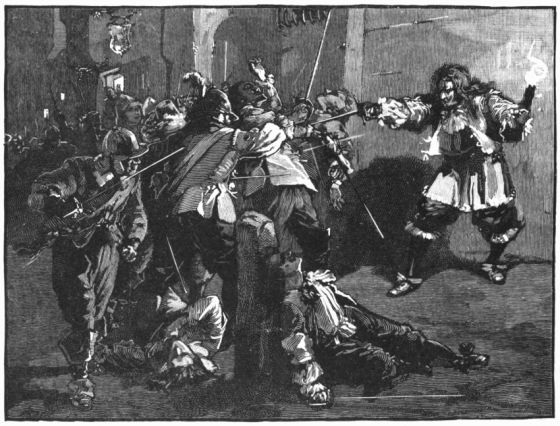
THE ASSAULT ON SIR JOHN COVENTRY. (See p. 233.)
[See larger version]
Perhaps the whole history of the world does not furnish a more infamous bargain, not even the partition of Poland in later days. Here was a King of England selling himself to the French monarch for money, to enable him to put down Protestantism and Parliament in Britain, to do all and more than his father lost his head for attempting—for Charles I. never plotted against the Protestant religion. This was bad enough, but the bargain went to enable France to put its foot on the neck of England, and to employ its forces to destroy Protestantism abroad—Protestantism and liberty; to throw Holland, and eventually all the Netherlands, and then Spain, into the power of France, making of it an empire so gigantic that neither freedom, nor Protestantism, nor any political independence could ever more exist. Had this infamous scheme come to light in Charles's time, the Stuarts would not have been driven out in 1688, but then and there. But that this odious bargain did actually take place, and was acted on, so far as Charles's domestic vices and extravagance permitted, later times produced the fullest evidence. The above Treaty was deposited with Sir Thomas Clifford; and Sir John Dalrymple, seeking in the archives at Paris for material for his "Memoirs of Great Britain and Ireland," published in 1790, unexpectedly stumbled on the damning evidences—under the hands of Charles and his ministers themselves—of this unholy transaction and its reward. The Duke of York was at first said to be averse from this secret treason and slavery, but he fell into it, and received his share of the money, as well as Buckingham, through whose agency a second treaty was effected, raising the annual sum to five million of livres, or nearly two hundred and fifty thousand pounds a year; the article requiring the king's change of religion being omitted altogether, Charles, meanwhile, having shown his readiness to engage in the Dutch war, which was the main question. Ashley and Lauderdale, Clifford and Arlington were also in the secret, and had their reward. Many were the suspicions of this diabolical business which oozed out, and much talk was the consequence at times; the proofs were preserved with inscrutable secrecy during the lives of the parties concerned, discovery being utter and inevitable destruction. The French copy of the Treaty has hitherto escaped all research.
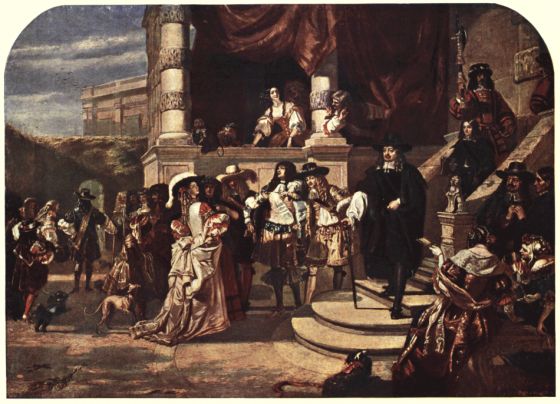
THE DISGRACE OF LORD CLARENDON AFTER HIS LAST INTERVIEW WITH THE KING IN WHITEHALL PALACE, 1667.
From the Painting by E. M. WARD in the National Gallery of British Art.
[See larger version]
To induce Charles to declare war without waiting for his confession of Catholicism, Louis sent over Charles's sister, Henrietta, Duchess of Orleans. The king met her at Dover, and the point was discussed, but Charles would not move another step till the Treaty was formally signed, and the first payment made. The duchess, indeed, was much more earnest on her own affairs. She was most miserably married to the Duke of Orleans, the brother and heir-apparent of Louis, who treated her with cruelty and neglect for other women. She was anxious for a divorce and to live in England, but Charles would not hear of what was so hostile to his interests. The unfortunate duchess returned to Paris, and within three weeks she was a corpse, though only twenty-six years of age. There was every reason to believe that she was poisoned, though the doctors, on a postmortem examination, declared there were no signs of poison; but what was the value of the testimony of medical men given at the risk of their heads? On her deathbed, when questioned by Montague, the ambassador, as to her belief on that point, though warned by her confessor to accuse nobody, the poor woman would not say that she had no suspicions, but only shrugged her shoulders, a significant expression of her internal conviction.
The duchess left behind her in England one of her maids, a Mademoiselle Querouaille, or, as the English came to call her, Madam Carwell, whom Louis had selected as a spy and agent, feeling assured that she would soon captivate this amorous king, which she did at once, and became, in the usual way, his mistress, and at the same time maid of honour to the queen. She was soon advanced to the title of Duchess of Portsmouth, and so well did she serve the purposes of Louis, that in 1673 he gave her also a French title and estate. It was now thought by Charles and James that they could venture to put down the liberties, and, as James earnestly advocated, the religion of the nation. It was proposed to fortify Portsmouth, Hull, and Plymouth, at which towns French soldiers might be introduced, and James having the command of the fleet, no interruption to their transit could take place. When Parliament met in October, Charles observed that both Holland and France were increasing their navies—he could have told them really why—and on pretence of necessary caution, he demanded large supplies to place our own navy on a proper footing. There were complaints of prodigality and hints of Popery thrown out, but a sum of no less than two million five hundred thousand pounds was voted, by taxes on land, stock, law proceedings, and salaries—in fact, an income and property tax. There was a proposal to tax theatres, and when it was objected that the theatres contributed to his Majesty's pleasure, Sir John Coventry asked sarcastically, "whether his Majesty's pleasure lay amongst the men or the women players?"
For this remark Sir John was made to pay severely. The King and the whole Court were furious at his hard hit against the Moll Davieses and Nell Gwynns. The king declared that he would send a detachment of the Guards to watch in the street where Sir John Coventry lived, and set a mark upon him. The Duke of York in vain endeavoured to dissuade the king; the Duke of Monmouth, who was living on terms of great professed friendship with Coventry, yet undertook the execution of the business. He sent Sandys, his lieutenant, and O'Brien, the son of Lord Inchiquin, with thirteen soldiers, who waited for Sir John as he returned from Parliament on the evening of the 21st of December, 1670, and encountering him in the Haymarket, assaulted him. Sir John placed his back to the wall, snatched the flambeau from the hands of his servant, and with that in one hand he so well plied his sword with the other, that he wounded several of the soldiers, and got more credit by his gallantry than for any action in his life. But he was overpowered by numbers in the end, beaten to the ground, and then had his nose cut to the bone with a penknife, to make a mark for life, to teach him respect for the king. They then went back to the Duke of Monmouth's, where O'Brien, who was wounded in the arm, had it dressed. Coventry had his nose so well sewed up, that the trace of the outrage was scarcely discernible; but the House of Commons, even such a House, resented this dastardly attempt on one of its members, and it passed an Act making it felony without benefit of clergy to cut or maim the person, and banishing for life the four principal offenders unless they surrendered before a certain day, as well as rendering the crime incapable of pardon, even by Act of Parliament. But Monmouth and his assistants got out of the way, and the Parliament never had the virtue to enforce its own Act.
The year 1671 was chiefly employed in preparing for the war with Holland. Though Charles was under condition to become an avowed Roman Catholic, he published a proclamation, declaring that, as he had always adhered to the true religion as established, he would still maintain it by all the means in his power. De Witt, who was aware of what was going on, hastened to make a treaty with Spain, and Louis demanded a free passage through the Netherlands to attack Holland, or declared that he would force one at the head of sixty thousand men. Whilst war was thus impending, the Duchess of York, Hyde's daughter, died. She had been for some time a professed Catholic. Henrietta Maria, the mother of Charles, had died in August, 1669, at the Castle of Colombe, near Paris.
Charles and his ministers of the Cabal bribed by Louis (who even pensioned the mistress of Buckingham, Lady Shrewsbury, with ten thousand livres a year) prepared to rush into the war against Holland in the hope of retrieving past disgraces, and securing some valuable prizes. At the close of the last session, on pretence of maintaining the Triple Alliance, the very thing they were intending to betray, and of keeping Louis of France in check, whom they were, in fact, going to assist in his aggressions, they procured eight hundred thousand pounds from the Commons, and then immediately prorogued Parliament. But this most unprincipled trick was nothing to what they were preparing to perpetrate.
During the recess of Parliament, it was suddenly announced by proclamation on the 2nd of January, 1672, that the Exchequer was shut. To understand what was meant by this most flagitious act, we must recollect that Charles was in the habit of anticipating the supplies voted, by borrowing of the London bankers and goldsmiths, and granting them some branch of revenue to refund themselves with interest. He had at this time obtained one million three hundred thousand pounds in this manner, but calculating that the Dutch war could not be carried on without larger means than the recent Parliamentary grant, it was therefore announced that Government was not prepared to repay the principal borrowed, or, in other terms, could not grant the annual security of the incoming taxes, but the lenders must be content with the interest. This would enable the Government to receive the revenue themselves instead of paying their just debts with it. The consternation was terrible. The Exchequer had hitherto kept its engagements honourably, and had thus obtained this liberal credit. The lenders, in their turn, could not meet the demands of their creditors. The Exchange was in a panic, many of the bankers and mercantile houses failed, a great shock was given to credit throughout the kingdom, and many annuitants, widows, and orphans, who had deposited their money with them, were reduced to ruin. Ashley and Clifford were said to have been the authors of the scheme, but Ashley was a man of infinite schemes, and probably was the original inventor. Government declared that the postponement of payment should only be for one year; but the greater part of the money was never again repaid, and this sum so fraudulently obtained became the nucleus of the National Debt.
The manner in which the Government commenced the war on Holland was characterised by the same infamous disregard of all honourable principle. Though Charles had bound himself to make war on the Dutch, he had no cause of quarrel with them, whatever he pretended to have. When Louis menaced them with hostilities, Charles offered himself as a mediator, and the Dutch regarded him as such. Under these circumstances he sent Sir Robert Holmes with a large fleet to intercept a Dutch fleet of merchantmen coming from the Levant, and calculated to be worth a million and a half. Holmes, in going out, saw the squadron of Sir Edward Spragge at the back of the Isle of Wight, which had lately returned from destroying the Algerine navy; and though his orders were to take all the vessels along with him that he could find at Portsmouth, or should meet at sea, lest Spragge should obtain some of the glory and benefit, he passed on and gave him no summons. The next day he descried the expected Dutch fleet; but to his chagrin he found that it was well convoyed by seven men-of-war, and the merchantmen, sixty in number, were many of them well armed. The vast preparations of Louis, and some recent movements of the English, had put them on their guard. Notwithstanding Charles's hypocritical offers of friendly mediation, he had withdrawn the honourable Sir William Temple from the Hague, and sent thither the unprincipled Downing, a man so detested there, that the mob chased him away. Van Nesse, the Dutch admiral, successfully resisted the attack of Holmes, who only managed to cut off one man-of-war and four merchantmen. The chagrin of Charles was equal to the disgrace with which this base action covered him and his ministers. Both his own subjects and foreigners denounced the action in fitting terms, and Holmes was styled "the cursed beginner of the two Dutch wars."
There was nothing now for it but to declare war, which was done by both England and France. Charles mustered up a list of trumpery charges, which, bad as they were, would have come with a better grace before attacking his allies without any notice—the detention of English traders in Surinam; the neglect to strike the Dutch flag to him in the narrow seas; and refusal to regulate their trade relations according to treaty. Louis simply complained of insults, and declared his intention to assert his glory. Under such thin veils did Louis and his bond-slave Charles attempt to hide their real intentions.
The Dutch fleet was not long in appearing at sea with seventy-five sail under De Ruyter. On the 3rd of May the Duke of York, admiral of the English fleet, consisting of only forty sail of the line, descried this powerful armament posted between Calais and Dover, to prevent his junction with the French fleet. He managed, however, to pass unobserved, and join the French squadron under D'Estrées, La Rabiniere, and Du Quesne. On the 28th they came to an engagement near Southwold Bay; the battle was terrible—scarcely any of these sanguinary conflicts of those times with the Dutch more so.
Owing to the wind and tide, not more than twenty of the English sail could engage the enemy. The French squadron under D'Estrées formed in opposition to the Zeeland squadron of Banker; but they stood away under easy sail southward and never came to action; in fact, it was the well-known policy of Louis to allow the Dutch and English to play the bulldogs with each other, and to spare his own infant navy. The Duke of York, with a part of the Red squadron, opposed De Ruyter; the Earl of Sandwich, with part of the blue, Van Ghent and the Amsterdam fleet. The English were so surrounded by multitudes of the enemy, that they could afford little aid to each other, and were exposed on all sides to a most merciless fire. By eleven o'clock the Duke of York's ship was totally disabled, and had lost one-third of her men. He himself escaped out of a cabin window, and got on board the St. Michael, of seventy guns. Poor old Admiral Montagu, Earl of Sandwich, in the Royal James, did marvels of valour. Surrounded by the enemy, he boarded a seventy-gun ship that lay athwart his hawse, and killed Van Ghent, the Dutch admiral; but assailed by two fire-ships, he destroyed one, and the other destroyed him. The Royal James was blown up, and thus the old man, who had so long figured both under the Commonwealth and Crown, finished his career. He had a foreboding of his fate, and told Evelyn, when he took leave of him to go on board, that he would see him no more. Two hundred of his men escaped.
In the afternoon the St. Michael, to which the Duke had fled, was also sinking, and he had to remove to the London. In the evening the Dutch fleet drew off, and the next morning the two divisions of the English fleet joined and offered battle, but De Ruyter tacked about and a chase commenced. Twice the English were on the point of pouring their broadsides into the enemy, when a fog saved them, and on the second day the Dutch took refuge within the Wierings. The duke showed unquestionable courage on this occasion; no real advantage to the country, however, but much cost and damage, resulted from this unnatural war to prostrate a Protestant country, in order to pander to the mad ambition of the French king. Louis all this time was taking advantage of the Dutch being thus engaged. He marched upon Holland with one hundred thousand men, assisted by the military talent of Turenne, Condé, and Luxembourg. He took Orsoi, Burick, Wesel, and Rhinberg on the Rhine, crossed the river at Schneck in the face of the enemy, and overran three of the seven united provinces. The city of Amsterdam itself was in consternation, for the fires of the French camp could be seen from the top of the Stadt House. Even the great De Witt was in despair; but at this crisis Holland was saved by a youth whose family had been jealously thrust from the Stadtholdership. This was William of Orange, afterwards William III. of England.
William of Nassau was the nephew of the English King, being the son of Charles's sister. He was then only twenty-one years of age, of a sickly constitution, and at that time of no experience in State or military affairs. The House of Nassau had acquired almost sovereign power in Holland, from having rescued the country from the cruel yoke of Spain, and had rendered the office of stadtholder almost synonymous with king. The municipal body, the aristocracy of the country, jealous of the powers and aims of the House of Orange, at the death of William's father had abolished for ever the office of stadtholder, and placed the government of the country in the hands of the Town Council, the Provincial States, and the States-General. De Witt, the Grand Pensionary of the Province of Holland, was made Chief Minister, and conducted the government with consummate ability. William of Orange was a posthumous child and a ward of De Witt, who was also at the same time at the head of the Louvestein faction, which was violently opposed to the House of Nassau. But William of Orange stood high in the affections of the people. They regarded with as much jealousy the municipal oligarchy which ruled the country as that did the House of Nassau. They felt that the Orange family had achieved the independence of Holland, and, being themselves shut out from all influence in State affairs, they sympathised with the young prince. Besides, he had a princely fortune, the possession of territories entrenched behind the river Maas, and the dykes of South Holland, not easily invaded, and was not only a prince of the German Empire, but of the royal blood of England.
The people, now seeing the critical condition to which the Louvestein faction had reduced their country, demanded that the command of the army should be put into the hands of William. De Witt, who could not prevent it, endeavoured to persuade the people to bind the prince by an oath never to aspire to the stadtholdership; but the Orange party now seized their opportunity to rouse the people against the oligarchy, and they did it to such effect that De Witt and his brother were torn to pieces by the populace before the gates of the palace of the States-General at the Hague (July 24, 1672). William, who had no share in the murder, however, committed the same grave error as he did afterwards in England, in the case of the massacre of Glencoe—he rewarded the murderers, and accepted the office of Commander-in-Chief. Low as the country was reduced, its very danger was its strongest means of rescue. Germany and Spain, alarmed for the consequences to Europe, sent promises of speedy assistance, and even Charles II. seemed to perceive the folly of his proceedings. The war at sea had brought nothing but expense and bloodshed. If Spain came to a rupture with France, England would lose the benefit of its lucrative Spanish trade. Charles had sent six thousand troops, according to treaty, to assist Louis in Holland, under the command of his son Monmouth, who displayed no talents as a general, but plenty of courage—a quality of the family. With him he sent Buckingham, Arlington, and Saville as plenipotentiaries. These ministers now hastened to the Hague, and expressed the friendly feeling of England towards Holland. The Dowager Princess of Holland, who knew what friendliness had been shown towards his nephew by Charles, who, Buckingham said, did not wish to use Holland like a mistress, but love like a wife, replied, "Truly, I believe you would love us as you do your wife!"—a hard hit. From the Hague they proceeded to the camp of Louis, who, however, before he would treat with the Dutch, made the English sign a new treaty that they would not agree to any separate peace.
The terms then proposed by these allies show how little they were aware of the power yet lurking in the invalid but stubborn and subtle young Prince of Orange. Charles required, on his part, the dignity of stadtholder for the prince, his nephew, the acknowledgment of England's sovereignty of the narrow seas, ten thousand pounds per annum for liberty of fishing on the English coasts, and the fortresses of Goree, Flushing, and some others as a guarantee for the payment. Louis demanded all the territory lying on the left bank of the Rhine, all such places as the French had formerly wrested from Spain, seventeen millions of livres as indemnification of the costs of the war, which he had himself commenced, and an annual gold medal in acknowledgment of his surrendering the three provinces he had now taken, but in reality in retaliation for the medal which the States had cast on the formation of the Triple Alliance. They were also to grant freedom of worship to the Catholics.
William of Orange bade them reject the whole of these conditions. He told them that even were they beaten to the last, they could transport themselves with their wealth to the Indian Archipelago, and then erect in Java and the isles a new and more resplendent Holland, with a new and vast world around them for their empire. The courage of the people rose at the dauntless spirit of their young prince, and they resolved to resist to the last man. William ordered the dykes to be cut; the invaders were obliged by a precipitate retreat to seek their own safety. Amsterdam was saved, and the different towns of Holland stood isolated amid a vast sea, which no enemy could approach without a large fleet of flat-bottomed boats, and supplies which must be conveyed by the same mode. Meanwhile William, where he could reach the French, beat them in several smart actions, and thus further raised the courage of his countrymen, whilst forces from Germany were fast pouring down the Rhine to their aid.
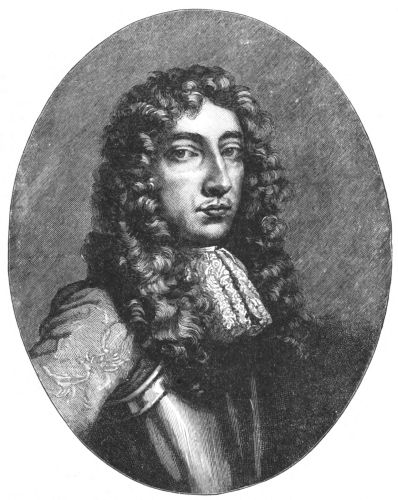
ANTHONY ASHLEY COOPER, FIRST EARL OF SHAFTESBURY. (After the Portrait by Sir Peter Lely.)
[See larger version]
Louis XIV., who by no means relished a campaign of this kind, returned to Paris, and left Turenne to contend with the enemy, who, though he displayed the highest military talents, and still held many strong places, saw that the conquest of Holland was little better than hopeless. At sea the Duke of York arrived off the Dogger Bank, to intercept the Dutch East India fleet in vain, and De Ruyter lay snug in port.
At home Charles had promoted his Cabal Ministry, as if they had done some great deed, to honours and titles. Clifford was called Lord Clifford of Chudleigh; Lord Arlington, Earl of Arlington; and Ashley, Earl of Shaftesbury. Buckingham and Arlington received the honour of the Garter. In order to protect the bankers whom he had kept out of their money from the suits commenced against them by their creditors in Chancery, Charles desired Bridgeman to enter an injunction there, but Bridgeman doubted the rectitude of the proceeding, and he was removed, and Shaftesbury put in his place (1672), who at once issued the injunction, and appointed a distant day for hearing evidence against it. Ashley, as the new Lord Chancellor, displayed a vanity and eccentricity which caused him to be greatly ridiculed by the lawyers. He went to preside on the bench in "an ash-coloured gown silver-laced, and full-ribboned pantaloons." He at first acted with much self-sufficiency and conceit, but was soon brought to his senses by the lawyers, and afterwards became one of the most tame and complying judges that ever sat on the bench. Violent altercation, however, arose between Ashley and Arlington, who expected Ashley's place made vacant in the Treasury, which was given to Clifford.
On the 5th of February, 1673, Parliament was summoned after a recess of nearly a year and a half. Ashley undertook to justify the shutting of the Exchequer and the Dutch war. But the days of the Cabal were numbered. The king, by their advice, had, during the recess, issued a Declaration of Indulgence. This was done with the hope of winning the support of the Nonconformists and the Papists. But of all subjects, that of indulgence of conscience in religion, at that period, was the most double-edged. The Nonconformists were ready enough to enjoy indulgence, but then the eternal suspicion that it was intended only as a cloak for the indulgence of Popery made them rather satisfied to be without it than enjoy it at that peril. No sooner, therefore, had they granted Charles the liberal sum of one million two hundred thousand pounds, to be collected by eighteen monthly assessments, than the Commons fell on this Proclamation of Indulgence. The members of the Church and the Nonconformists united in their denunciation of it. On the 10th of February they resolved, by a majority of one hundred and sixty-eight to one hundred and sixteen, that "penal statutes, in matters ecclesiastical, cannot be suspended except by Act of Parliament." Charles stood for awhile on his prerogative, but the effervescence in the House and country was so great that he gave way, and his declaration, on the 8th of March, that what he had done should not be drawn into a precedent, was received with acclamations by both Houses, and by rejoicings and bonfires by the people. Shaftesbury immediately passed over to the Country party, as the Opposition was called.
The Cabal was now forced to submit to another humiliation. The Country party introduced, at the instance of Shaftesbury, an Act requiring every person holding any office, civil or military, not only to take the oath of Allegiance and Supremacy, but also to receive the Sacrament in the form prescribed by the Church of England, or be incapable of accepting or holding such office. All such persons were likewise required to make a declaration against Transubstantiation, under a penalty of five hundred pounds, of being disabled from suing in any court of law, and from being a guardian or executor. This Act was passed by both Houses unanimously, the Nonconformists being promised that another Bill should be introduced to protect them from the operation of this. But before it was done Parliament was prorogued on the 29th of March, and they were caught in their own trap.
No sooner was this Act passed, which became known as the Test Act, and continued in force till the reign of George IV., than the Cabal fell to pieces. Its immediate effect was to compel Lord Clifford and Arlington to resign: the wedge was thus introduced into the Cabal, and the Duke of York, who resigned his office of Lord High Admiral, became inimical to them. The office of Lord Treasurer, resigned by Clifford, was given by the king to Sir Thomas Osborne, a gentleman of Yorkshire, who was created Earl of Danby, and became in reality Prime Minister. The rise of Danby was the certain destruction of the Cabal. His foreign policy was entirely opposed to theirs: he saw clearly enough the ruinous course of aggrandising France at the expense of the Protestant States of Europe; his views of domestic policy were more profound, though not less unprincipled than theirs. He saw the necessity of combining the old Royalist and Church interests for the support of the throne, but he set about this process by buying up the favour of the Cavaliers, the nobles, the country gentlemen, and the clergy and universities. He was not the first to bribe—the Cabal had done that so far as Parliament members were concerned—but Danby, like Walpole, and the ministers after him, bought up by direct bribes or lucrative appointments any and every man that could secure his views.
When Parliament reassembled on the 7th of January, 1674, there appeared alarming proofs of some whispered disclosures having taken place during the disruptions in the Cabal, regarding the king's secret treaty with Louis. Charles solemnly denied his having any secret engagement whatever with France. Parliament also exhibited its uneasiness regarding the practices of the Papists. The Duke of York, since the prorogation of Parliament on the 4th of November last, had married Maria D'Este, a Catholic princess, sister of the Duke of Modena. This had roused all the fears of the country regarding the succession, and the Commons recommended severe measures against the Papists, and that the militia should be ready at an hour's notice to act against any disturbances on their part. They also demanded the removal from the ministry of all persons Popishly affected, and of those who advised the alliance with France and the rupture with Holland, and the placing a foreigner at the head of the army. Both army and navy, in fact, were commanded by foreigners—Prince Rupert had succeeded the Duke of York as admiral; Schomberg was sent with the army to Holland.
Charles himself not having been able in the autumn to draw his pension from Louis, and Parliament now holding fast its purse-strings, he was ready to listen to terms from Holland, whereby the triumph of the Country party was completed. On this the States offered, through the Spanish ambassador, Del Fresno, the terms which they had once already refused. The conquests on both sides should be restored, the honour of the flag conceded to England, and eight hundred thousand crowns should be paid Charles for indemnification for the expenses of the war. Had the terms been far inferior, the fact of the money would probably have decided the matter with Charles. As to the dignity of stadtholder for William, the States themselves settled that, by conferring it on him and his heirs for ever, before the time of their treaty, and nothing whatever was said of the ten thousand pounds for liberty to fish. On the 9th of February the treaty was signed, and on the 11th announced to Parliament by Charles.
We may now take a brief glance at proceedings in Scotland and Ireland.
In Scotland Archbishop Sharp had pursued his persecuting and coercive system to such an extent, that Charles was obliged to order him not to overstep his proper duties, but to confine himself to spiritual concerns alone. Such was the hatred which this renegade Churchman had excited, that in 1668 a young man of the name of Mitchell, who had witnessed the horrible cruelties which followed the battle of Rullion Green, believed himself called upon to put Sharp to death. He therefore posted himself in front of the archbishop's palace in St. Andrews, and as the archbishop came out with the Bishop of Orkney to get into his carriage, he stepped up and fired at Sharp, who was just seated; but at the same moment the Bishop of Orkney raised his arm to enter the carriage, and received the ball in his wrist. There was a cry that a man was killed, but some one exclaimed, "It is only a bishop!" and Mitchell, coolly crossing the street, mixed with the crowd, walked away, and changed his coat; and though the Council offered a large reward for his apprehension, it was six years before he was discovered.
The Earl of Rothes had been removed from the office of Royal Commissioner, and the Earl of Tweeddale, who now occupied that post, endeavoured to soften the spirit of persecution, and granted a certain indulgence. This was to admit the ejected ministers to such of their livings as were vacant, or to appoint them to others, provided they would accept collation from the bishop, and attend the presbyteries and synods. But this was to concede the question of episcopacy, and the king's supremacy in the Church. The more complying of the ejected members, to the number of forty-three, accepted the offer; but they found that by so doing they had forfeited the respect of their flocks, who deserted their churches, and crowded to other preachers more stanch to their principles. Lauderdale soon after returned to Scotland, and his very first proceeding was to pass an Act to appoint Commissioners to co-operate with English Commissioners, to endeavour to effect a union of the two kingdoms. His next was to pass another, converting the Act of Allegiance into an act of absolute Supremacy. This at once annihilated the independence of the Kirk; and a third Act was to give the king a right to maintain an army, and to march it to any part of the king's dominions. This was so evidently a step towards despotism, that not only in Scotland, but in the English Parliament, the indignation was great, and the English Commons presented an address to the Crown, praying for Lauderdale's removal. The address, however, produced no effect. Lauderdale proceeded, plausibly offering indulgence to such easy-principled ministers as would accept livings subject to the oath of Supremacy and the acknowledgment of bishops, whilst at the same time he passed an Act in July, 1670, more rigorously prohibiting conventicles within private houses or in the open air. Any minister preaching or praying at such meetings was to suffer forfeiture of both life and property. The Scots did not understand this kind of indulgence, which allowed their ministers to enter their churches by the sacrifice of their moral principles, and put them to death if they took the liberty of following their consciences. The people took arms and went to their meetings, determined to defend their preachers and themselves. Lauderdale then, with the aid of Archbishop Leighton, extended the "indulgence" to all such ministers as would attend presbyteries, where the bishops should have no negative voice; but this did not deceive the people. The rigour against their own chosen ministers and places of worship was kept up, and they declared that bishops, even without a negative voice in the presbyteries, were bishops still; that such assemblies had no resemblance to those previous to 1638; that they had no power of the keys, no ordination, no jurisdiction; that the whole was but a snare to draw in unwary or self-interested ministers, and after them their flocks. To assent to such terms would be apostacy from the principles of the Kirk. Lauderdale made another step in his "indulgence" in 1673. He named eighty ejected ministers, and ordered them to repair to their churches and officiate there, but nowhere else, under severe penalties. This was to lock up the conventicles in which these preachers ministered. About one-fourth of the number refused to obey, and were confined by order of the Council to particular places. But this did not diminish the number of conventicles: it only excited a schism between the complying and the non-complying. He next passed an act of grace, pardoning all offences against the Conventicle Acts committed before the 4th of March, 1674; but this only encouraged the people to fresh freedom in their attendance on conventicles. They regarded his concessions as certain proofs of his weakness, and scorning any compliance with episcopacy and royal supremacy, their independent meetings spread and abounded more than ever. They assembled in vacant churches, where they would not have entered to listen to what they called an intrusive minister, or in the open air in glen or mountain, around a lofty pole erected as a signal. "The parish churches of the curates," says Kirton, "came to be like pest-houses, few went into any of them, and none to some; so the doors were kept locked." No policy, however severe or plausibly insinuating, could induce the wary Scots to swallow the hated pill of episcopacy.
In Ireland, the prohibition of importing Irish cattle into England was followed by a like prohibition from the Scottish Parliament, and the Irish Parliament retaliated by prohibiting Scottish woollens being imported into Ireland. These illiberal measures only spread mischief and misery on all sides. So long as the Duke of Ormond retained the lord-lieutenancy, he endeavoured to mitigate these evils. He procured the liberty of free trade between Ireland and all foreign countries, whether at war or peace with England; and five hundred families of Walloons were induced to settle in Ireland and to establish the manufacture of woollen and linen cloths. But the many sufferers from the Act of Settlement, which confirmed the possession of the Irish lands in the hands of the English soldiers and adventurers, complained greatly of Ormond, and his enemies at Court procured his removal in 1669. After him succeeded Lord Robartes, and next Lord Berkeley; but it mattered little who governed, nothing could induce the natives to sit down quietly under the loss of their estates, and that, too, whilst they had been often firm loyalists and the intruders rebels. In 1671 a Commission was appointed to inquire into all alleged grievances, consisting of Prince Rupert, Buckingham, Lauderdale, Anglesey, Ashley, and others. This lasted till March 26th, 1673, but ended in nothing. The possessors of the Irish lands were too powerful at Court, and no result followed but fresh severities against the Catholics, who were expelled from all corporations, and their priests banished the kingdom.
The war between France and the confederates—Holland, Austria, and Spain—had now spread all over Europe, both by land and sea. Louis poured his soldiers in torrents into the Netherlands, and excited insurrections in the dependencies of Spain. He managed to excite sedition against her in Sicily, and against Austria in Hungary. De Ruyter, the famous admiral, was despatched by the Prince of Orange to assist the Spaniards in Sicily, and was killed at Messina. On the other hand, Louis's great general, Turenne, was killed at the battle of Salzbach, on the Rhine. After his death, the Austrian general, Montecucculi, defeated the French repeatedly, and recovered Alsace. But Vauban, who introduced a new system of fortification, recovered the ascendency of Louis, by teaching the French how to defend towns. Louis maintained this enormous war at a cost which brought an immense burden on France, and laid the foundation of the great Revolution which horrified Europe. On the other hand, William of Orange manfully maintained the conflict under many disadvantages. His authority at home was often questioned; the governors of the Spanish Netherlands frequently crossed his plans, and his German allies frequently failed him. Yet reverse after reverse was not able to damp his spirit, or overcome his imperturbable tenacity of purpose. Charles, during this awful struggle of his nephew, was enjoying peace, but a most inglorious peace, purchased by the money of Louis, to allow him to destroy all the independent States of Europe. Not even the interests of his own subjects were protected. In the course of seven months fifty-three sail of merchantmen were captured by the French cruisers. The sufferers made loud complaints, and Charles promised to obtain restoration, but very little was ever obtained. He received his annual pension from Louis; and though he drew it through Chiffinch, his pander and man of the back stairs, the transaction was well known to his ministers Danby and Lauderdale, and his brother the Duke of York.
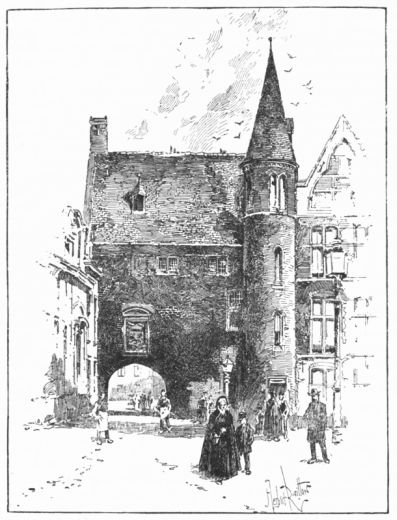
VIEW IN THE HAGUE: THE GEVANGENPOORT IN WHICH CORNELIUS AND JOHN DE WITT WERE IMPRISONED (1672).
[See larger version]
When he reassembled his Parliament on the 5th of February, 1677, the Country party, headed by Shaftesbury and Buckingham in the Lords, contended that the Parliament was legally at an end. That, by two statutes of Edward III., it was required that Parliaments should be held once a year, or oftener; and this Parliament having been prorogued for a period of fifteen months, had ceased to exist. But Lord Chancellor Finch truly replied, that by the Triennial Act of Charles I. the vacations were extended to three years. In the Commons there was also a motion for a dissolution, but it was postponed. The motion of Buckingham in the Lords to vote the present Parliament effete was negatived, and he, Salisbury, Shaftesbury, and Wharton, were ordered by the House to retract their illegal opinions, and beg pardon of the House and the king. They refused, and were committed to the Tower. The following day the motion for a dissolution in the Commons was lost by a minority of one hundred and forty-two to one hundred and ninety-three. Defeated in the attempt to break up this corrupt Pension Parliament, the Opposition in the Lords next endeavoured to secure the succession against a Catholic prince. Charles had no children but illegitimate ones, and James, therefore, was heir to the Crown. The Bill passed the Lords, and provided that on the demise of the king, the bishops should tender a declaration against Transubstantiation to the heir; and if he refused to take it, they should appoint to all bishoprics and benefices, and take charge of the education of the king's children; but the Commons rejected the Bill on the ground of the undue power which it conferred on the bishops; and they immediately threw out another Bill of the Peers for abolishing the punishment of death for Popish recusancy. The two Houses, however, agreed in abolishing the detestable writ De hæretico comburendo.
This Parliament has been accused of singular inconsistency in calling upon the king to declare war against France, in order to check that country in its ominous progress against Holland and the Netherlands, and yet refusing him money. A very valid plea for anxiously desiring the declaration of war, and yet shrinking from putting money into Charles's hands, might have been advanced had it been an honest Parliament. The nation saw with great discontent and humiliation the growing ascendency of France, the increase of Louis's navy, the expansion of his ambitious plans, the danger of Protestant Holland, and the despicable position into which England had fallen. It had fears of Popery, fears of absolutism through a standing army. There were dark rumours, though no direct proofs, of the king's secret league with France. Whilst they, therefore, would have willingly granted him money for a war with France, they dreaded to do it, knowing how it would go in folly, and believing how it would go to strengthen despotism. They did not leave him destitute; he had the excise, and they now granted six hundred thousand pounds for the building of new ships; but they took care to tie it up, by proper securities, to its legitimate purpose. How well they were justified was shown by the first use which the king made of the money now received from France. The bulk of it went to purchase votes in the House of Commons.
Unfortunately, this Parliament was little more honest than the king himself; it was receiving bribes on all sides. Dalrymple shows that Spanish, Dutch, German, and French money was freely distributed amongst the members. In 1673 three leaders of the Opposition in the Commons were bribed with six thousand pounds, to induce them to vote unusually large supplies, and they did it. They were now in the pay of all the chief contending countries in Europe. When they raised the cry of war on this occasion, the king expressed his readiness, but demanded six hundred thousand pounds at the least for the necessary expenditure. Thereupon Spain bribed the patriots to vote for it with twenty thousand pounds, and the King of France bribed them against war with a still larger sum. The proposal was thrown out, Louis having feed not only the Parliament but the ministers and the king. On receiving about two hundred thousand pounds from Louis, Charles adjourned Parliament on the 16th of April, and did not call it together again till the next January. Never, surely, had everything like principle or patriotism so thoroughly abandoned the nation. Soon after the adjournment, Buckingham, Salisbury, and Wharton, made their submission to the king, and were released; Shaftesbury held out seven months longer, and then followed their example.
During the recess the Prince of Orange came to England. Though William could place little dependence on the alliance of his uncle Charles, yet he could not be insensible that a marriage with Mary opened up a prospect towards the throne of England, and that an alliance between the two Protestant nations must mutually strengthen their position in Europe. He therefore began to cultivate the friendship of Danby, the Prime Minister, and then solicited the union which he had before declined. The overture was received with a coldness that the more sensibly impressed the prince with the political blunder which he had committed. He therefore humbled himself, and requested permission to make a visit to London and apologise for his past conduct and explain his future views. Charles not only resented William's refusal of his former offer, but he was jealous of his intrigues with the popular leaders; and though he did not forbid his coming, he stipulated that he should return before the meeting of Parliament. On the 9th of October he joined his uncle at Newmarket, and, having the services of Danby and Temple, Charles was soon persuaded to his marriage with the princess. James appeared at first averse from the connection, but he soon acquiesced; and whilst Charles boasted of having made this alliance to secure the religion of the nation, James took credit to himself from his consent, of proving how false were the suspicions which had been expressed of his intention to make changes in both the religion and the State. The marriage gave universal satisfaction, and during the festivities with which it was celebrated at Court, in November, 1677, William engaged the king in the project of a general peace. The following were the proposals arrived at by them, to be submitted to the different Powers: That Holland and France should mutually restore the conquests that they had made; that the Duchy of Lorraine should be restored to the duke, its rightful sovereign; and that France should keep possession of the places won from Spain, except Ath, Charleroi, Oudenarde, Courtrai, Tournai, Condé, and Valenciennes, which should be restored, and form a chain of fortresses between the new frontier of France and the old ones of Holland. Charles despatched Lord Feversham to lay the proposals before Louis; but the French king would not listen to them, and tidings reached William which caused him immediately to hasten home.