Chapter XVI
Reading edition
THE REIGN OF ANNE.
Accession of the Queen—Meeting of the Houses of Parliament—Scotland and Ireland—Power of Marlborough—The Revenue—Tory Colour of the Ministry—The Coronation—Declaration of War—Marlborough goes to the Seat of War—General Aspect of Affairs—Marlborough's Difficulties—His Campaign—Operations by Sea—Meeting of Parliament—Supply—Marlborough's Dukedom—The Occasional Conformity Bill—Dismissal of Rochester—Opening of the Campaign of 1703—Fall of Bonn—Failure to take Antwerp—Savoy and Portugal join the Allies—Visit of the Archduke Charles to England—The Storm—Jacobite Conspiracy—Ashby versus White—Queen Anne's Bounty—Marlborough's Great Plans—The States-General hoodwinked—His March—Dismay of the French—Junction with Eugene—Advance on the Danube—Assault of the Schellenberg—The Prince of Baden's Conceit—Approach of Tallard—The Eve of Blenheim—The Battle—Conclusion of the Campaign—Marlborough's Diplomacy—Capture of Gibraltar—Battle of Malaga—Proceedings in Parliament—The Campaign of 1705—Attempt to recover Gibraltar—Peterborough's Exploits in Spain—Proposal to Invite the Electress Sophia to England—Consequent Legislation—Battle of Ramillies—Eugene relieves Turin—Disasters in Spain—Meeting of the Commissioners for the Union—Condition of the Treaty—Opposition in Scotland—Riots in Edinburgh—Conduct of the Opposition—The Measure carried by Bribery—Its Discussion in the English Parliament—The Royal Assent given.
When Anne succeeded to the throne she was in her thirty-eighth year. She was fat, indolent, and good-natured. She had long been under the complete management of the imperious Lady Marlborough, and through her Marlborough expected to be the real ruler of the country. Through them the queen had imbibed a deep-rooted hatred of the Whigs, whom they had taught her to regard as the partisans of King William, and the real authors of all the indignities and mortifications which she had endured during his reign. The Tories therefore calculated confidently on recovering full power under her, and had resolved to place Marlborough at the head of the army. The queen, on her part, had a great leaning towards the Tories, as the enemies of the Whigs and the friends of the Church, to which she was strongly attached. The endeavours which had been made in her father's time to make a Catholic of her, and in her brother-in-law's time to level the distinctions between Church and Dissent, had only rooted more deeply her predilection for the Church; nor did the fact of her husband being a Lutheran, and maintaining his Lutheran chapel and minister in the palace, at all diminish this feeling.
No sooner was the king dead than Lord Jersey and other courtiers who had been eagerly watching the shortening of his breath hastened to bring the news to Anne, who, with Lady Marlborough, sat on that Sunday morning waiting for the message which should announce her queen; and Bishop Burnet, among others, conveyed the sad tidings to her. Though it was Sunday, both Houses of Parliament met, for they were empowered still to sit by an Act passed in William's reign, and the death of William was announced to the Commons by Mr. Secretary Vernon. There was much speechifying, Mr. Granville saying, "We have lost a great king, and got a most gracious queen." Both Houses then proceeded to the palace with addresses of felicitation, and were graciously received. The Privy Council also waited on the queen, who assured them of her determination to maintain the laws, liberties, and religion of the country, to secure the succession in the Protestant line, and the Church and State as by law established. The Privy Council having taken the oaths, she caused a proclamation to be issued, signifying her pleasure that all persons in office should continue to hold their respective posts till further orders.
On the 11th of March she went in state to the House of Lords. She was accompanied in her coach by her consort, the Prince of Denmark, and Marlborough carried the Sword of State before her. Lady Marlborough occupied the place close behind the queen. Anne had a remarkably rich and touching voice, and it had been cultivated, at the suggestion of her uncle, Charles II., for elocutionary delivery, as especially important for a monarch. She concluded her speech with these words:—"As I know my own heart to be entirely English, I can sincerely assure you that there is not anything that you can expect or desire from me which I shall not be ready to do for the happiness and prosperity of England, and you shall always find me a strict and religious observer of my word." Not only did she receive the thanks of both Houses for her gracious assurances, but congratulatory addresses from the City of London, from the bishop and clergy of London, from the various bodies of Dissenters, and the different counties and chief towns of the kingdom.
Some difficulty had been expected in Scotland from the Jacobites, but all passed over easily, the Jacobites thinking that as Anne had no issue, the Stuarts would be sure to enjoy "their ain again" on her death. The Secretaries of State for Scotland, and such of the Scottish Privy Councillors who were in London, waited on her, read to her their "Claim of Rights," and tendered her the Coronation Oath with many professions of loyalty; and this ceremony being completed, the Earl of Marchmont, the Chancellor of Scotland, was dispatched to represent the queen in the General Assembly of the Kirk which was about to meet. In Ireland the natives were so rigorously ruled that they excited no alarm.
The queen announced the coronation for the 23rd of April, and took up her abode at Windsor, as St. James's was completely hung with black, and was too gloomy for living in. She also took immediate possession of William's favourite residence at Kensington, which George of Denmark had always coveted. William's remains were unceremoniously transferred to "the Prince's Chamber" at Westminster, and the Dutch colony, as the attendants of William were called, were routed out, to their great indignation. Before a week had expired Anne accomplished what she had so often attempted in vain—she conferred the Order of the Garter on Marlborough. He was appointed Captain-General of the English army, both at home and abroad, and, soon after, Master of the Ordnance. The Prince of Denmark was made Lord High Admiral, with the title of Generalissimo of the Forces; but as he was both ignorant of and indisposed to the management of both naval and military affairs, Marlborough was the real Commander-in-Chief of the forces.
The Commons voted her Majesty the same revenue as King William had enjoyed, and pledged themselves to the repudiation of the pretended Prince of Wales, and to the defence of her Majesty's person and the Protestant succession. On the 30th of March the queen went to the House of Lords and ratified the Act for the revenue and for her household, and generously relinquished one hundred thousand pounds of the income granted. At the same time she passed a Bill continuing the Commission for examination of the public accounts; but these necessary inquiries were always defeated by the principal persons who were deep in the corruption. The villainy was almost universal, and, therefore, was carefully screened from efficient search.
In naming her Ministers the Tory bias of the queen at once showed itself. Godolphin, the family ally of the Marlboroughs, was appointed Lord Treasurer; Nottingham was made principal Secretary of State, and was allowed to name Sir Charles Hedges as the other Secretary in place of Mr. Vernon; Rochester, the queen's uncle, was made Lord-Lieutenant of Ireland; the Duke of Somerset, Lord President of the Council, was dismissed to make way for the Earl of Pembroke, who could scarcely rank as a Tory, but disclaimed being a Whig: the Earl of Bradford was made Treasurer of the Household through the influence of Rochester; the Marquis of Normanby received the Privy Seal—a reward for his happy flattery; and the Earl of Jersey retained his post of Chamberlain for his assiduous transmission of the news of William's "shortening breath." Sir Nathaniel Wright remained Lord Keeper; and Sharp, Archbishop of York, became the queen's adviser in all ecclesiastical matters. The only Whigs who retained office were the Duke of Devonshire, Lord High Steward, and Mr. Boyle, Chancellor of the Exchequer; and, on Shrewsbury's refusing the post of Master of the Horse, the Duke of Somerset, though displaced as Lord President, was induced to accept that office. The Prince of Denmark appointed a council for himself, into which he introduced none but Tories. At the head of this board, which was deemed wholly illegal, but which was not called in question by Parliament from respect to the queen, he placed Sir George Rooke, a most decided antagonist to the Whigs, and made him President of the Commission for Managing the Fleet.
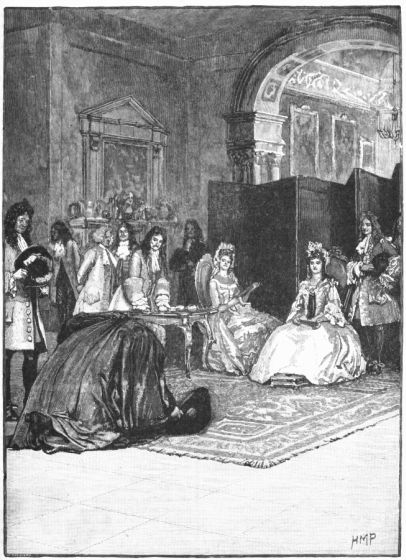
BISHOP BURNET ANNOUNCING HER ACCESSION TO ANNE. (See p. 535.)
[See larger version]
On the 23rd of April the coronation took place, being St. George's Day. The queen was so corpulent and so afflicted with gout that she could not stand more than a few minutes at a time, and was obliged to be removed from one situation to another during this fatiguing ceremony in an open chair. Tenison, the Archbishop of Canterbury, officiated, and the whole ceremony and banquet did not end till eight in the evening. Everybody, say the newspapers, was satisfied, even the thieves, who managed to carry off the whole of the plate used at the banquet in Westminster Hall, together with a rich booty of table-linen and pewter.
During March and April there was a continual arrival of ambassadors-extraordinary to congratulate her Majesty on her accession. Prussia, Denmark, Sweden, most of the German States, and particularly those of Zell and Hanover, sent their envoys; and there was a strong discussion in the Council on the necessity of declaring war against France. Marlborough and his faction were, of course, for war, in which he hoped to win both glory and affluence; but Rochester and the majority of the Council, including the Dukes of Somerset and Devon, and the Earl of Pembroke, strongly opposed it, on the ground that the quarrel really concerned the Continental States and not us, and that it was sufficient on our part to act as auxiliaries, and not as the principal. The queen, however, being determined by the Marlborough influence to declare war, laid her intentions before Parliament, which supported her, and accordingly war was proclaimed on the 4th of May, the Emperor and the States-General issuing their proclamations at the same time. Louis was charged with having seized on the greater part of the Spanish dominions, with the design of destroying the liberties of Europe, and with grossly insulting the queen by declaring the pretended Prince of Wales the real king of Great Britain and Ireland. When these charges were read over by De Torcy to Louis, he broke out into keen reproaches against the Queen of England, and vowed that he would "make Messieurs the Dutch repent of their presumption." He delayed his counter-declaration till the 3rd of July. The Commons presented an address to her Majesty, praying her Majesty to unite with the Emperor and the States to prohibit all intercourse with France and Spain, and at the same time to promote commerce in other directions; and the Lords addressed her, praying her to sanction the fitting out of privateers to make reprisals on the enemies' ships, which interrupted our trade, and also to grant charters to all persons who should seize on any of the French and Spanish territories in the Indies. The queen thanked them for their zeal, and prorogued Parliament on the 25th of May.
We may now turn our attention to the progress of the war. When the States-General received the news of the death of William, they were struck with the utmost consternation. They appeared to be absolutely paralysed with terror and dismay. There was much weeping, and amid vows and embraces they passed a resolution to defend their country with their lives. The arrival of the address of the Queen of England to her Privy Council roused their spirits, and this was followed by a letter from the Earl of Marlborough, addressed to the Pensionary Fagel, assuring the States of the queen's determination to continue the alliance and assistance against the common enemy. The queen herself addressed to the States a letter confirming these assurances, and despatched it by Mr. Stanhope, who was again appointed Ambassador at the Hague. Marlborough himself, who left England on the 12th of May to assume his foreign command, arriving directly afterwards in the character not only of Commander-in-Chief of the British forces, with a salary of ten thousand pounds a year, but of Ambassador Extraordinary and Plenipotentiary, assured the States that the Queen of England was resolved to maintain all the alliances, and resist the encroachments of the French in the same spirit as the late king.
War had been going on some time on the Rhine before Marlborough arrived there, and still longer before he was prepared to join in it. In Germany many negotiations had been going on to induce the petty States to act as contingents of the Empire, or to keep them from joining the French against their own nation. The House of Brunswick had engaged to bring to the allied army ten thousand men; Prussia had engaged to co-operate, and Saxe-Gotha and Wolfenbüttel to abandon the French. The Electors of Bavaria and Cologne, who had, most traitorously to the Empire, aided France in her attempts to enslave Germany, pretended now to stand neutral, but the neutrality was hollow; and the position of affairs in Poland effectually prevented the northern Powers of Germany from sending assistance to the Allies in Flanders. Charles XII., still pursuing the Elector of Saxony as King of Poland, threatened to invade Saxony. He marched first to Warsaw, and ordered the Cardinal-Primate to summon a Diet to choose another king, and Augustus, the Saxon King, posted himself at Cracow. This state of affairs overawed Prussia, and beyond the Alps the condition of Savoy and Milan, where the French were strong, tended to prevent a full concentration of force in the Netherlands against France.
The position of the contending forces on the Rhine and in the Netherlands was this:—The Prince of Saarbrück, at the head of twenty-five thousand men, Dutch, Prussians, and Badenese, was besieging Kaiserwerth. Athlone and Cohorn were covering the siege of Kaiserwerth, Athlone (Ginkell) lying between the Rhine and the Meuse, Cohorn with ten thousand at the mouth of the Scheldt. On the other hand, Tallard, with thirteen thousand men on the opposite side of the Rhine, annoyed the besiegers of Kaiserwerth with his artillery, and managed to throw into the town fresh troops, ammunition, and supplies. Count Delamotte and the Spanish Marquis of Bedmar covered the western frontier of the Spanish Netherlands, and the Prince of Baden was posted on the Upper Rhine.
Whilst in this position Cohorn marched into the Netherlands, destroyed the French lines between the forts of Donat and Isabella, and levied contributions on the chatellany of Bruges; but Bedmar and Delamotte advancing, he cut the dykes, inundated the country, and retired under the walls of Sluys. Meanwhile the Duke of Burgundy, taking the command of the army of Boufflers at Zanten, near Cleves, formed a design to surprise Nimeguen in conjunction with Tallard, who suddenly quitted his post near Kaiserwerth, and joined Burgundy. Nimeguen was without a garrison, and ill supplied with artillery, and must have fallen an easy prey, had not Athlone, perceiving the object of the enemy, by a masterly march got the start of them, and posted himself under the walls of the town before the arrival of the French guards.
Marlborough all this time was undergoing his first experience of the difficulties of acting at the head of a miscellaneous body of allies, and with the caution of Dutch burgomasters. He had blamed William severely for his slow movements, and now he was himself hampered by the same obstructions. It was the end of June before he could bring into order the necessary arrangements for taking the field. Nor could he have effected this so soon had not the near surprise of Nimeguen alarmed the Dutch for their frontiers, and quickened their movements. The fall of Kaiserwerth was another circumstance in his favour. He collected the forces which had been engaged there, marched the English troops up from Breda, and in the beginning of July found himself at Nimeguen at the head of sixty thousand men. Even then he did not find himself clear of difficulties. His bold plans were checked by the presence of two field deputies which the Dutch always sent along with their generals, and who would not permit him to undertake any movement until they had informed the States-General of it and received their sanction. Thus it was not the general in the field, but the States-General at a distance, who really directed the evolutions of the war; and the only wonder is, that a general in such absurd leading-strings could effect anything at all. Besides this standing nuisance, Marlborough found Athlone, the Prince of Saarbrück, and the other chief generals, all contending for equal authority with him, and refusing to submit to his commands; and when the States-General freed him, by a positive order, from this difficulty, the Hanoverians refused to march without an order from Bothmar, their Ambassador at the Hague. Instead of sending to Bothmar, Marlborough summoned him to the camp, as the proper place for him if he was to direct the movements of the Hanoverian troops, and got rid of this obstacle only to find the Prussians raising the same difficulties.
It was not till the 7th of July that he crossed the Waal and encamped at Druckenburg, a little south of Nimeguen. It was the 16th when he crossed the Meuse and posted himself at Overhasselt, with the French forces in front at the distance of two leagues and a half, entrenched between Goch and Gedap. Here, in a letter to Godolphin, he complained that still the fears of the Dutch hampered his movements. He then recrossed the river at Grave, and reached Gravenbroek, where he was joined by the British train of artillery from Holland. Thus prepared, he advanced on the French; on the 2nd of August was at Petit Brugel in their front; but they retired before him, leaving Spanish Guelderland in his power. He determined to bring the French to an engagement, but was restrained by the fears of the Dutch deputies; but, fortunately for him, the French generals had their fears too, and the Duke of Burgundy, finding Marlborough pressing on him in spite of his obstructions, resigned his command rather than risk a defeat, and returned to Versailles, leaving the command to Boufflers. The deputies of the States, encouraged by these symptoms, recommended Marlborough to clear the French from Spanish Guelderland, where the places which they still held on the Meuse interrupted the commerce of that river. Though the Dutch were merely looking at their own interests in this design, Marlborough was glad to attack the enemy anywhere. He despatched General Schultz to reduce the town and castle of Werk, and in the beginning of September laid siege to Venloo, which, on the 28th of the month, surrendered. Fort St. Michael, at Venloo, was stormed by the impetuous Lord Cutts, unrivalled at that work, at the head of the English volunteers, amongst whom the young Earl of Huntingdon greatly distinguished himself. He next invested and reduced Ruremond and the fort of Stevensweert; and Boufflers, confounded by the rapid successes of Marlborough, retiring on Liége, the English general followed him, reduced the place, stormed the citadel, and seized in it three hundred thousand florins in gold, and a million florins in bills on the substantial merchants of the city, who promptly paid the money. This terminated the campaign. Marlborough had wonderfully raised his reputation, won the entire confidence of the States, and, having seen the French retire behind their lines, he distributed his troops into winter quarters, and projected his journey homewards.
The operations at sea had not been so decisive as those of Marlborough on land. On the 12th of May Sir John Munden, sent out to intercept the French fleet convoying the Viceroy of Mexico from Corunna to the West Indies, chased fourteen sail of French ships into Corunna, but, judging the fortifications too strong to attack them there, put out to sea, and soon afterwards returned home for provisions, to the great indignation of the people. Munden was tried by court-martial and acquitted, but the Prince of Denmark dismissed him from the service notwithstanding. King William having planned the reduction of Cadiz, the queen was now advised to put the project into execution. Sir George Rooke was sent out with a squadron of fifty ships of the line, besides frigates, fire-ships, and smaller vessels, and carrying the Duke of Ormond with a land force of fourteen thousand men. The fleet sailed from St. Helens near the end of June, and anchored on the 12th of August within two leagues of Cadiz. The governor of fort St. Catherine was summoned to surrender, but he refused; and on the 15th the Duke of Ormond landed under a fire from the batteries, and soon took the forts of St. Catherine and St. Mary. He issued a proclamation declaring that they came, not to make war on the Spaniards, but to free Spain from the yoke of France, and that the people and their property should be protected. But the English soldiers paid no regard to the proclamation, but got drunk in the wine stores and committed great excesses. Some of the general officers were found as eager as the soldiers for pillaging; and the inhabitants, resenting their sufferings, held aloof. To complete the mischief, the land and sea commanders, as has been too commonly the case, fell to quarrelling. Ormond wanted to storm the Isla de Leon; Rooke deemed it too hazardous. An attempt was made to batter Matagorda fort, but failed, and the troops were re-embarked.
As the fleet was returning from its inglorious enterprise, it was met by Captain Hardy, who informed the commander that the galleons from the West Indies had entered Vigo Bay under convoy of a French squadron. A council of war was immediately summoned, and it was resolved to tack about and proceed to Vigo. They appeared before the place on the 11th of October. The passage into the harbour they found strongly defended by forts and batteries on both sides, and the passage closed by a strong boom of iron chains, topmasts, and cables. The admirals shifted their flags into smaller vessels, for neither first nor second rates could enter. Five-and-twenty English and Dutch ships of the line of lesser size, with their frigates, fire-ships, and ketches, now prepared to make the attempt to force the boom and burn the fleet, and the Duke of Ormond prepared the way by landing two thousand eight hundred men six miles from Vigo, and marching on the harbour, where he attacked and carried a strong fort and a platform of forty pieces of cannon at its mouth. The moment the British colours were seen flying on the fort the fleet put itself in motion. Admiral Hopson led the way in the Torbay, and, running with all sail set, dashed against the boom and burst through it. He was followed by the whole squadron under a tremendous fire from the ships and batteries; but both ships and batteries were soon silenced, the batteries by the soldiers on land, the ships by the fleet. They captured eight ships of war and six galleons; the rest were set fire to by themselves or the French, to prevent them from falling into the hands of the English. The Spaniards had lost no time in removing as much of the plate and merchandise as they could; but the Allies seized on seven millions of pieces of eight in plate and other goods, and the Spaniards are supposed to have saved twice as much. Sir George Rooke left Sir Cloudesley Shovel, who had just arrived, to bring home the prizes, and sailed for England with the rest of the fleet and troops in triumph, complaining that Cadiz, too, might have been taken had Ormond done his duty, and Ormond retorting the blame upon him.
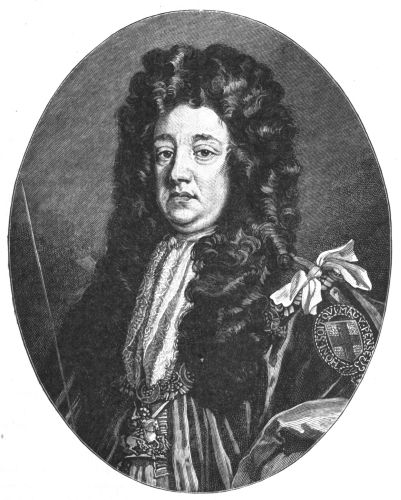
LORD GODOLPHIN. (After the Portrait by Sir Godfrey Kneller.)
[See larger version]
Had this terminated the usual campaign it might have been considered, to a certain extent, a success; but an expedition, sent out to cruise in the waters of the West Indies, under the brave old Benbow, had a worse fate. He came up with a French fleet under Du Casse, steering along the shore of Santa Martha, and though he had ten sail of the line, and the enemy only the same, he found himself deserted by most of his captains, under the plea that the enemy was too strong. Benbow, upbraiding their cowardice, attacked the whole fleet with only two vessels. The battle lasted, off and on, from the 19th of August to the 24th, some others of the ships occasionally joining him. On the last day his leg was shattered by a chain-shot, and he was wounded in the face and in the arm; yet he caused himself to be placed on the quarter-deck in a cradle, and continued issuing his orders to the last. Seeing it in vain to contend longer, he returned to Jamaica, and ordered a court-martial to be held. The reason assigned for the disobedience of the officers was the rough conduct of Benbow, who was one of the old boisterous school of seamen, but brave and honest. The disgrace thus inflicted on his command, combining with his shattered condition, soon also brought him to his grave.
Marlborough returned to England in November, and was received with great applause. Notwithstanding some sharp criticisms on his campaign, the public saw clearly enough that he was a far superior general to William, and augured great things from his future command. The queen met her new Parliament on the 20th of October, which turned out to be so completely Tory as to carry all before it in that direction. The Government had no occasion to make much exertion to obtain that result; it was enough that the queen's decided leaning to the Tories was known. Addresses of congratulation on the brilliant success of the British arms under Marlborough were presented by both Houses, which, they said, "retrieved" the ancient honour and glory of the English nation. This word "retrieved" roused all the spleen of the Whigs, who knew that it was meant as a censure on them and King William, who, they contended, had maintained the honour of the English nation by joining the great confederacy by which the security of the queen's throne at that moment was established, and by training our soldiers to their ancient pitch of discipline and valour. They moved that the word "maintained" should be substituted for "retrieved," but it was carried against them, amid the most unmeasured abuse of the memory of the late king, Marlborough being cried to the skies at his expense.
The Tories next showed their strength in calling in question various elections of Whig members, and carried the inquiry against them with the most open and impudent partiality.
The Commons then voted the supplies, and in practice justified the Whigs, by being as lavish for the war as they had been. They voted forty thousand seamen, and the same number of land forces, to act along with the Allies. They granted eight hundred and thirty-three thousand eight hundred and twenty-six pounds for their maintenance; three hundred and fifty thousand pounds for Guards and garrisons; seventy thousand nine hundred and seventy-three pounds for ordnance; and fifty-one thousand eight hundred and forty-three pounds for subsidies to the Allies—altogether, one million three hundred and six thousand six hundred and forty-two pounds for the war alone, independent of the usual national expenses, and these soon required an increase. The queen demanded of the Commons a further provision for her husband, the Prince of Denmark, in case of her decease. Howe moved that one hundred thousand pounds a year should be settled on the prince in case he should be the survivor. No objection was offered to the amount, but strenuous opposition was given to a clause in the Bill exempting the prince from the provision in the Act of Settlement, which prevented any foreigner, even though naturalised, from holding any employments under the Crown; but the Court was bent on carrying this, and did so.
Having secured her husband, Anne then sent a message to the Commons to inform them that she had created the Earl of Marlborough a duke for his eminent services, and praying them to settle five thousand pounds a year on him to enable him to maintain his new dignity. This was so glaring a case of favouritism that the Commons, with all their loyalty, expressed their decided disapprobation. The outcry was so great that the Marlboroughs declined what they saw no means of getting—the grant—and the queen intimated that fact to the House; but she immediately offered her favourites two thousand pounds a year out of her privy purse, which, with affected magnanimity, they also declined, hoping yet to obtain, at some more favourable crisis, the Parliamentary grant; and, after that really happened, they then claimed the queen's offer too. But the opposition of the Tories, whom Marlborough had been serving with all his influence in Parliament, alienated him from that party, and he went over to the Whigs.
What galled Marlborough as much as anything was that he had been in the House of Lords strongly supporting one of the most illiberal attempts of the Tories to destroy the effect of the Act of Toleration. The extreme Tories regarded the Church as entitled to confer all favours, and they were determined to give it a power by which all corporations and elections should be thrown into the hands of the Government. For this purpose Mr. Bromley, Mr. Annesley, and Mr. St. John, who, as a man of notoriously unorthodox principles, ought at least to have been tolerant, brought in the Occasional Conformity Bill. They complained that Dissenters and other disaffected persons took the oaths, and often went again to the Dissenting meetings; that this was a gross piece of hypocrisy, and left the Church exposed to much danger from them. They proposed, therefore, to insist that all who had taken the Sacrament and test for offices of trust, or for the magistracy of corporations, and afterwards went to any meeting of the Dissenters, should forfeit their employments, pay a fine of one hundred pounds, and five pounds for every day that they continued to hold their office after having been at a Dissenters' meeting, as well as be disabled from holding any other employment till after a year's conformity. The Bill was carried in the Tory Commons by an overwhelming majority; but it was as strongly opposed in the Lords, where the Whigs were not disposed to pull down the greatest trophy of their legislation. The Bishops generally voted against the Bill, and Burnet was extremely active against it. Probably few of them were actuated by a sense of the monstrosity of the Test and Corporation Acts, which compelled all to take the Sacrament, whether opposed to it in that form or not, and thus shut out the honest and pious, and let in those who had neither honesty nor religion. But they saw that it would again let loose all the detestable race of spies and informers from which the country was now happily free, and would, in reality, only injure instead of benefiting the Church, by making her an object of general hatred. The Tories themselves affected great veneration for the Toleration Act, whilst they would thus have stifled all toleration.
The queen and the whole Court exerted themselves to force the Bill through the Upper House, as they had done that for the prince's salary. Marlborough argued vehemently for it, but the Whig lords hit upon a way of defeating it by seeming to comply. They agreed to its passing on condition that all who took the test, and then went to conventicles, should simply be deprived of their employments and be fined twenty pounds. They knew that the Commons would not allow the slightest interference of the Lords with the money part of the Bill, and this proved to be the case. The Lords searched their rolls, and showed numerous cases in which they had altered fines, but the Commons refused to admit any such power. A conference in the Painted Chamber was held, but with a like result, and after long contention the Bill was, happily for the nation, dropped.
A Bill was next brought in to allow another year of grace to all who had not taken the oath abjuring the pretended Prince of Wales. The Tories contended that the Jacobite party had now come over to the queen; but it was shown on the other side that this was but a specious deception; that the agents of St. Germains were in as full activity as ever; were constantly coming and going; and whilst they appeared to favour the queen, it was only to get as strong a party as possible into the House, eventually to abolish both the abjuration and the Protestant Succession Bill: that to this end they now advised all persons to take the Abjuration Bill, and to be able to get into Parliament or power. The Bill was carried in the Commons; but the Lords again tacked two clauses to it, one declaring it high treason to endeavour to alter the succession as settled in the Princess Sophia, and the other to impose the oath on the Irish. These were not money clauses; whoever refused them must appear disinclined to the Protestant succession. The Commons were completely entrapped, and, to the surprise of everybody, they accepted the clauses, and thus the Bill, which was originally favourable to the Jacobites, became much more rigid against them. The queen sent the Lord Keeper, on the 27th of February, 1703, to prorogue Parliament.
Lord Rochester was now entirely removed from the queen's councils. His near relationship to the queen, and his being accounted the champion of the Church, made him presume in the Council, where he was blustering and overbearing. He was disappointed in not being placed at the head of the Treasury, and quarrelled continually with Lord Godolphin. He had now voted against Marlborough's grant of five thousand pounds a year, and thus incurred the mortal hatred of the all-powerful Lady Marlborough. It was clear that Rochester must give way, or the Council must be rent by continual feuds. He was opposed to the war—another cause of hostility from the Marlboroughs—to whom it was money, fame, and everything. He received such intimations from the queen as caused him to retire into the country in disgust. As he refused all summonses to attend the Council, her Majesty ordered him to proceed to his government in Ireland, where his presence was much needed. He replied with great insolence that he would not go to Ireland, and the post of Lord-Lieutenant was conferred on the Duke of Ormond. Still declining to attend the Council, the queen ordered that he should no more be summoned, and thus terminated Anne's connection with her relatives by the mother's side. The elder brother of Rochester, Lord Clarendon, had been excluded the Court for refusing the abjuration of the pretended Prince of Wales, and his son, Lord Cornbury, little better than an idiot, was sent to govern the North American colonies, that he might be out of the way, a system of colonial management by which these colonies were at length entirely estranged. Rochester survived this disgrace but a very few weeks.
It was proposed between the Emperor of Germany and the Allies that the campaign of 1703 should be opened with effect, and by measures which should go far to paralyse France. The Archduke Charles, the Emperor's second son, was to declare himself King of Spain, to propose for the hand of the Infanta of Portugal, and to proceed to that country to prosecute his claims on Spain by the assistance of the English and Dutch fleets. Meanwhile the Emperor promised to take the field with such a force as to drive the Elector of Bavaria, the active and able ally of France, out of his dominions. But Louis, as usual, was too rapid in his movements for the slow Germans. He ordered Marshal Villars, who lay with thirty thousand men at Strasburg, to pass the Rhine, and advance into Bavaria to the support of the Elector. The war was thus skilfully diverted by Louis from the Rhine into the very neighbourhood of the Emperor. On the other hand, Marlborough, who was the soul of the war on the Lower Rhine, had been detained by his exertions to counteract the efforts of Louis XIV. in another quarter. Insurrections had broken out amongst Louis's Protestant subjects in the Cevennes, who had been barbarously oppressed. Marlborough, who cared more for the paralysing of Louis than for the interests of Protestantism, strongly proposed in the Council that assistance should be sent to the mountaineers of the Cevennes. This was fighting Louis with his own weapons, who was exciting insurrection in Hungary and Bohemia amongst the subjects of the Emperor. Nottingham and others of the Council as strongly opposed this measure, on the principle of not exciting subjects against their legitimate sovereign; but Marlborough prevailed. Arms and ammunition were forwarded to the Cevennes, and direct communications were ordered to be opened with the insurgents, which would have compelled Louis to detain a large force for the subjugation of these rebels, which otherwise would have gone to the Rhine; but these aids never reached the unfortunate mountaineers.
Marlborough reached the Hague on the 17th of March, much earlier still than William used to arrive there. Nor had the war paused for his arrival. He had stimulated the Prussians to be in action much earlier. In February they had reduced the fortress of the Rhineberg, and then proceeded to blockade Guelders, the last place in the power of France on the frontiers of Spanish Guelderland. It was fortunate, for the unity of command, that Athlone and Saarbrück, Marlborough's jealous rivals, were both dead; so that now Marlborough had only the Dutch camp deputies as clogs on his movements, but they were quite sufficient often to neutralise his most spirited projects. He found Villeroi and Boufflers posted on the frontiers of the Spanish Netherlands, and his design was to attack and drive them out of Flanders and Brabant. But here, in the very commencement, he was obliged by the States-General to give up his own views to theirs. They desired an immediate attack on Bonn, persuading themselves that the Elector of Cologne would rather capitulate than risk the ruin of the town. Marlborough went reluctantly but not inertly into this plan, foreseeing that it would waste much precious time, and prevent him from falling on Villeroi and Boufflers at the right moment, when the attempt to support the Elector of Bavaria had drawn many of their forces away into Germany. He was the more chagrined the more he saw of the want of energy in the Allies. He proceeded to Nimeguen to arrange with Cohorn the plan of the siege of Bonn. He visited and inspected the garrisons at Venloo, Ruremond, Maestricht, and the other places which he took in the previous campaign on the Meuse. Arriving at Cologne, he found preparations made for a siege, but in a most negligent manner; and Cohorn especially excited his disgust by proposing to defer the siege of this place till the end of summer. But Marlborough knew too well the necessity of preventing an attack from that quarter; ordered the place to be invested, and then marched on Bonn with forty battalions, sixty squadrons, and a hundred pieces of artillery. The trenches were opened on the 3rd of May, and it was assaulted from three different quarters at once; on one side by the forces under the hereditary prince of Hesse-Cassel, on another by those under Cohorn, and on the third by Lieutenant-General Fagel. The city capitulated on the 15th, and the commander, the Marquis D'Allegré, and his garrison were conducted to Luxemburg. During the siege continually arrived the news of the successes of the Elector of Bavaria, and the failures of the Imperial troops; and Villeroi and Boufflers advanced, took Tongres, and menaced the Allies from that quarter with forty thousand men.
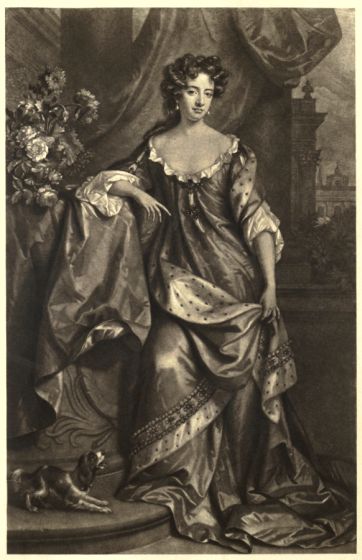
H.R.H. THE PRINCESS ANNE OF DENMARK, AFTERWARDS QUEEN OF ENGLAND.
From the Painting by W. Wissing and J. Vandervaart.
[See larger version]
No sooner was Bonn reduced than Marlborough determined to prosecute his original plan of driving the French from Flanders. He now dispatched Cohorn, Spaar, and Opdam to commence operations at Bergen-op-Zoom, whilst he addressed himself to dislodge Villeroi and Boufflers from Tongres. In order to divide the energies of the French, a part of his plan was that the powerful English and Dutch fleet was to keep the coast of that country in alarm from Calais to Dieppe, and actually to make a descent on the land near the latter port. But the French resolved to cut off the division of Opdam from the main army. Boufflers, with twenty thousand men, surprised him, and the Dutch falling into confusion, Opdam believed the day lost, and fled to Breda.
VIEW IN LISBON: THE PRÁÇA DE DOM PEDRO.
[See larger version]
Opdam's miscarriage had greatly deranged Marlborough's plan of attack on Antwerp. Spaar and Cohorn were already near Antwerp with their united forces, but the check received by Opdam's division delayed the simultaneous advance. Villeroi lay in the path of Marlborough near St. Job, and declared that he would wait for him; but the moment the duke advanced to Hoogstraat to give him battle, he set fire to his camp and retreated within his lines with all haste. Boufflers had joined Bedmar in Antwerp, and Marlborough advanced and laid siege to Huy, which surrendered on the 27th of August. He now called a council of war to decide the plan of attack on Antwerp, and was well supported by the Danish, Hanoverian, and Hessian generals, but again found opposition from the Dutch officers and the deputies of the States, who deemed the attempt too dangerous. They recommended him to attempt the reduction of Limburg, by which they would acquire a whole province; and despairing now of accomplishing his great object, the reduction of Antwerp, this campaign—having the Dutch officers, the Dutch deputies, and the Dutch Louvestein faction all working against him—he turned aside to Limburg, and reduced it in a couple of days. This acquisition put into the power of the Allies the whole country from Cologne, including Liége; and Guelders being afterwards stormed by the Prussian General Lottum, the whole of Spanish Guelderland remained theirs.
Elsewhere the war went in favour of the French, and the affairs of the Emperor never appeared more gloomy; instead of recovering Spain, Louis was fast depriving him of his Empire. He was supporting against him the rebellious Hungarians, who were in arms under Prince Ragotski, and who had plenty of oppressions to complain of. Suddenly, however, some gleams of light shot across his gloom. The Duke of Savoy, who seldom remained true to one side long, grew alarmed at the French being masters of the Milanese, and was induced to open communications with the Emperor. But the secret negotiations were speedily discovered by the French, and the Duke of Vendôme received orders to disarm the Savoyards who were in his army; to demand that the troops of Savoy should be reduced to the scale of 1696, and that four principal fortresses should be put into the hands of France. But the Duke of Savoy was by no means inclined to submit to these demands. He treated them as insults to an ally, and ordered the arrest of the French ambassador and several officers of his nation. Louis, astonished at the decision of these proceedings, wrote the duke a most menacing letter, informing him that as neither honour, interest, religion, nor the oaths of alliance were regarded by him, he should leave the Duke of Vendôme to deal with him, who would give him four-and-twenty hours to determine his course in. This imperious letter only hastened the duke's alienation. He concluded the treaty with Vienna, and answered Louis's letter by a defiance. He acknowledged the Archduke Charles King of Spain, and despatched envoys to Holland and England. Queen Anne immediately sent an ambassador to Turin; and a body of Imperial horse under Visconti, followed by fifteen thousand foot under Count Staremberg, issued from the Modenese, and in the midst of the most stormy weather and through miry roads marched to join the Duke of Savoy at Canelli. The French harassed them fearfully on the march, but could not prevent their junction, by which Piedmont was placed in security.
In the same way, Portugal had declared for the Emperor. The fear of having Louis in possession of Spain had operated with Portugal, as similar causes had operated with Savoy. The King of Portugal agreed to give his daughter to the Archduke Charles, on condition that the right to the throne of Spain was transferred to him. England and Holland were to support the Portuguese and the new King of Spain from the sea. The treaty was concluded at Lisbon, and a fleet of forty-nine sail, under Sir Cloudesley Shovel, lay off Lisbon to protect the coasts from the French. Charles was to be conveyed to Lisbon by a powerful fleet, having on board twelve thousand soldiers, who were, on landing, to be joined by twenty-eight thousand Portuguese. The allied fleets had done nothing of importance during this summer.
The Archduke Charles, having assumed the title of King of Spain, set out from Vienna about the middle of September, and reached Düsseldorf on the 16th of October, where he was met by the Elector Palatine and the Duke of Marlborough, who was commissioned by Queen Anne to offer his congratulations. Marlborough accompanied Charles of Austria to the Hague, where they were both received with high honours by the States-General. Marlborough then hastened over to England to be ready to receive the royal guest on his way to Portugal. On the 26th of December the new King of Spain arrived at Spithead in the Dutch squadron sent to convey him. The queen dispatched the Dukes of Somerset and Marlborough to conduct him to Windsor, and Prince George met him on the way at Petworth, the seat of the Duke of Somerset, and conducted him to Windsor on the 29th. The king was entertained in great state for three days at Windsor, during which time he was politic enough to ingratiate himself with the Duchess of Marlborough. When the duchess presented the bason and napkin after supper to the queen for her to wash her hands, the king gallantly took the napkin and held it himself, and on returning it to the queen's great favourite, he presented her with a superb diamond ring.
After three days the king returned to Portsmouth, and on the 4th of January, 1704, he embarked on board the fleet commanded by Sir George Rooke, for Portugal, accompanied by a body of land forces under the Duke of Schomberg. The voyage was, however, a most stormy one, and when the fleet had nearly reached Cape Finisterre, it was compelled to put back to Spithead, where it remained till the middle of February. His next attempt was more successful, and he landed in Lisbon amid much popular demonstration, though the Court itself was sunk in sorrow by the death of the Infanta, whom he went to marry.
Before the arrival of Charles in England, it had been visited by one of the most terrible storms on record. The tempest began on the 27th of November, 1703, attended by such thunder and lightning as had never been experienced by living man. The Thames overflowed its banks, and was several feet deep in Westminster Hall. The houses in London seemed shaken from their foundations, and many actually fell, burying the inhabitants in their ruins. The loss in London alone was estimated at a million sterling, and the storm raged with equal fury in other places. Bristol was a great sufferer; but the greatest destruction fell on the fleet. Thirteen ships of war were lost, and fifteen hundred seamen, including Rear-Admiral Beaumont, who foundered in the Downs. Many of the oldest trees in the parks were torn up, and the lead on the churches was rolled up in scrolls. This unparalleled storm raged most fiercely along the southern and western counties, being scarcely felt in the northern ones. The Bishop of Bath and Wells, with his wife, was killed in the episcopal palace by the fall of a stack of chimneys.
The queen opened Parliament on the 9th of November. She spoke of the new treaties with the Duke of Savoy and the King of Portugal as subjects of congratulation; and on the 12th the Lords presented an address to the queen, expressing their satisfaction at her having entered into these treaties, and even displayed a zeal beyond them. The Commons on their part voted fifty-eight thousand soldiers and forty thousand sailors as the standard of the army and navy, and they granted the requisite supplies with the utmost readiness. No sooner was this patriotic demonstration made, than the Commons again introduced the Occasional Conformity Bill, and carried it by a large majority, on pretence that the Church was in danger; but the Lords attacked it with greater animosity than ever, and threw it out.
At this moment the nation became alarmed with the rumour of a conspiracy amongst the Jacobites in Scotland. When the queen, on the 17th of December, went to the Lords to give her assent to the Land Tax Bill, she informed them that she had made discoveries of a seditious nature in Scotland, which, as soon as it could be done with prudence, she assured them should be laid before them. The Lords, in their loyalty, were not disposed to wait for these disclosures, but appointed a Committee to inquire into the plot, and even went so far as to take some of the parties implicated out of the hands of the queen's messengers, to examine them themselves.
The year 1704 opened amid these inquiries. The Queen laid before the House of Lords the papers concerning the Highland plot, with one exception, which the Earl of Nottingham asserted could not yet be made public without tending to prevent further discovery. This only stimulated the Lords, who addressed the queen, praying that the whole of the papers might be submitted to them. The queen replied that she did not expect to be pressed in this manner, but she ordered the papers in question to be delivered to them under seal. The Peers pursued the inquiry with renewed vigour, and soon issued a report that it appeared to them that there had been a dangerous conspiracy, instigated by Simon Fraser, Lord Lovat, carried on for raising a rebellion in Scotland, and invading that kingdom with French forces, in order to subvert her Majesty's Government and bring in the pretended Prince of Wales, and that they were of opinion that nothing had given so much encouragement to this conspiracy as the Scots not coming into the Hanover succession as fixed in England. They therefore besought the queen to procure the settlement of the Crown of Scotland on the Princess Sophia, and when that was done they would use all their influence for a union of the two kingdoms.
Anne expressed her entire concurrence in these views, and the Lords then presented another address in answer to the second address of the Commons. They charged the Commons with manifesting a want of zeal for the queen's safety, and with showing a strange reluctance that the particulars of the plot should be brought to light, obstructing all through, as much as in them lay, the necessary inquiry; and fresh fuel was immediately furnished to the flame already blazing between the two Houses. One Matthew Ashby, a freeman of Aylesbury, brought an action against William White and others, the constables of Aylesbury, for preventing him from exercising his franchise at the last election. This was an unheard-of proceeding, all matters relating to elections being from time immemorial referred to the House of Commons itself. The circumstances of the case, however, furnished some reason for this departure from the rule. It appeared that four constables made the return, who were known to have bargained with a particular candidate, and to have so managed that the election should be his. In appeals to the Commons the party which happened to be in power had in a most barefaced manner always decided in favour of the man of their own side. Ashby, therefore, sought what he hoped would prove a more impartial tribunal. He tried the cause at the assizes, and won it; but it was then moved in the Queen's Bench to quash these proceedings as novel and contrary to all custom. Three of the judges were opposed to hearing the case, the matter belonging notoriously to the House of Commons; and they argued that, if this practice were introduced, it would occasion a world of suits, and make the office of returning members a very dangerous one. The Lord Chief Justice Holt alone was in favour of it. He contended that there was a great difference between the election of a member and a right to vote. The decision of the election undoubtedly belonged to the Commons, but the right to vote being founded upon a forty-shilling freehold, upon burgage land, upon a prescription, or the charter of a borough, was clearly establishable by a court of law. The judges at length permitted the trial, but, being three against one, the decision was for the constables. This aroused the indignation of the whole Whig party, and the cause was removed by a writ of error to the House of Lords. The Lords, after a full hearing, and taking the opinions of the judges, confirmed the judgment given in favour of Ashby at the assizes.
The Commons now took up the affair with great warmth. They passed five resolutions—namely, that all matters relating to elections and the right of examining and determining the qualifications of electors belonged solely to them; that Ashby was guilty of a breach of their privileges, and they denounced the utmost weight of their resentment against all persons who should follow his example and bring any such suit into a court of law, as well as against all counsel, attorneys, or others who should assist in such suit. They ordered these resolutions to be affixed to the gates of Westminster Hall. The Lords took instant measures to rebut these charges. They appointed a committee to draw up a statement of the case, and resolved upon its Report "that every person being wilfully hindered from exercising his right of voting might seek for justice and redress in common courts of law against the officer by whom his vote had been refused; that any assertion to the contrary was destructive of the property of the subject, against the freedom of election, and manifestly tending to the encouragement of bribery and corruption; and finally that the declaring Matthew Ashby guilty of a breach of privilege of the House of Commons was an unprecedented attempt upon the Judicature of Parliament in the House of Lords, and an attempt to subject the law of England to the will and votes of the Commons."
They ordered the Lord-Keeper to send copies of the case and their votes to all the Sheriffs of England, to be by them communicated to the boroughs in their respective counties. The House of Commons was greatly enraged at this, but it had no power to prevent it, and it had the mortification to see that the public feeling went entirely with the Lords, who certainly were the defenders of the rights of the subject, whilst the Commons, corruptly refusing a just redress to such appeals, endeavoured to prevent the sufferers from obtaining it anywhere else.
One of the most striking acts of this reign was the grant of the first-fruits and tenths of church livings to the poor clergy. The tenths were about eleven thousand pounds a year, and the first-fruits about five thousand pounds. These moneys had been collected by the bishops since the Reformation and paid to the Crown. They had never, says Burnet, "been applied to any good use, but were still obtained by favourites for themselves and friends, and in King Charles's time went chiefly amongst his women and children. It seemed strange that, whilst the clergy had much credit at Court, they had never resented this as sacrilege unless it were applied to some religious purpose, and that during Archbishop Laud's favour with King Charles I., or at the restoration of King Charles II., no endeavours had been used to appropriate this to better uses; sacrilege was charged on other things on very slight grounds, but this, which was more visible, was always forgot." But the fund was too convenient a fund for favourites to get grants upon. It is much to the credit of Burnet that he managed to divert this misused fund from the greedy clutches of courtiers and mistresses, to the amelioration of the condition of the unhappy working clergy. He proposed the scheme first to William, who listened to it readily, being assured by Burnet that nothing would tend to draw the hearts of the clergy so much towards him, and put a stop to the groundless clamour that he was the enemy of the clergy. Somers and Halifax heartily concurred in the plan; but the avaricious old Sunderland got a grant of it upon two dioceses for two thousand pounds a year for two lives, which frustrated the aims of the reformers. Burnet, however, succeeded better with Anne. He represented that there were hundreds of cures that had not twenty pounds a year, and some thousands that had not thirty pounds, and asked what could the clergy be or do under such circumstances? Therefore, on the 7th of February, 1704, Sir Charles Hedges, the Secretary of State, announced to the Commons that her Majesty had remitted the arrears of the tenths to the poor clergy, and had resolved to grant in future the whole of the first-fruits and tenths for the augmentation of small livings. The Commons replied in an address, expressing their sense of her pious care for the Church, and brought in a Bill to enable her to alienate this branch of the revenue, and to create a corporation by charter, to apply the money, according to the queen's intention, in increasing the wretched stipends of the poorer clergy. There was an attempt made to relieve the clergy altogether from the payment of first-fruits and tenths, and to devote some other fund to the relief of the poor clergy; but as Anne's intention was not to relieve the rich but to comfort the poor, she would not listen to it. The Statute of Mortmain was also relaxed by a provision of the Bill, so far as to allow individuals to make augmentations to benefices by deed of gift or by bequest. The Bishops were unanimous for the Bill, and addresses of thanks from all the clergy of England were presented to Anne on the occasion of this noble gift of what has been ever since known as Queen Anne's Bounty. However, Anne was far from being so generous to Dissenters, or to any other sect in the kingdom. On the contrary, she had just before allowed the Parliament of Ireland to stop the poor sum of twelve hundred pounds per annum, which had been paid by the late king to the indigent Presbyterian ministers of Ulster, who had so manfully defended the north of Ireland against James.
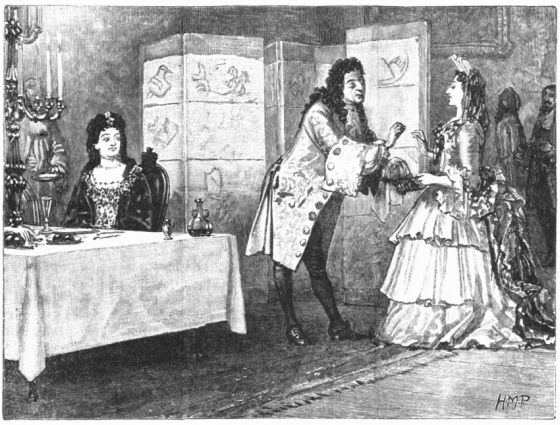
THE KING OF SPAIN AT WINDSOR: HIS GALLANTRY TO THE DUCHESS OF MARLBOROUGH. (See p. 546.)
[See larger version]
On the 3rd of April the queen prorogued Parliament till the 4th of July. The Convocation had during this time kept up its bitter controversy, and had done nothing more except thank the queen for the grant of the first-fruits and tenths, and the Commons for having espoused their cause.
Marlborough had left London for the Hague on the 15th of January whilst Parliament was sitting. He was promised fifty thousand British troops under his own immediate command, and he was planning a campaign which gave the first evidence of a real military genius being at the head of the Allied forces, since these Dutch wars began. He saw that the Elector of Bavaria, by his alliance with the French, was striking at the very heart of the Empire, and that, if permitted to continue his plans, he would soon, with his French allies, be in possession of Vienna. Nothing could be more deplorable than the condition of Austria. Besides the successes of the Elector of Bavaria, the insurgents of Hungary were triumphant, and between the two the Empire was on the verge of ruin. The Elector of Bavaria had possessed himself of all the places on the Danube as far as Passau, and should he come to act in concert with the Hungarians, Vienna would be lost. Prince Eugene put himself into communication with Marlborough, and these two great generals determined on striking a blow which should at once free Austria from its dangers. This was no other than a bold march of a powerful army to the Danube, and the destruction of the Elector of Bavaria.
This was a design so far out of the mediocre range of Dutch campaigns that it was determined not to let its real character become known till it could be instantly put in execution, certain that the States-General, terrified at so daring a scheme, would prohibit it at once. To go securely to work, therefore, by the advice of Eugene, the Emperor applied to the Queen of England to send an army to his rescue. Marlborough supported the application with all his energy, and, having procured the queen's consent, he left England on the 15th of January, was in the Hague on the 19th, and put himself into secret communication with the Grand Pensionary Heinsius. He fully approved of the scheme, and promised to give it his most strenuous support. It was thought, however, imprudent to confide the real extent of the plan to other persons, not only because it was sure to alarm the States-General, but because it had been all along observed that every proposal, as soon as it became known to the Government or heads of the army, was immediately treacherously conveyed to the French. The proposal made to the States-General, therefore, was merely that the next campaign should be made on the Moselle, as if the design were to penetrate into France along that river.
The States-General, as was expected, appeared thunderstruck by even the proposal of carrying the war to the Moselle, and it was only by the zeal of Heinsius that they were brought to consent to it. That accomplished, they were induced to grant a subsidy to the Prince of Baden, and another to the Circle of Suabia, and to take into pay four thousand Würtembergers instead of the same number of Dutch and English despatched to Portugal. There was a promise of money given to the Prince of Savoy, with an assurance of so vigorous a campaign on this side of the Alps that the French should not be able to send many troops against him. Similar assurances of co-operation were given to the Elector Palatine and to the new King of Prussia. These matters being arranged, Marlborough hastened back to England, and persuaded the queen to remit a hundred thousand crowns to Suabia, and to make a large remittance to the Prince of Baden out of the privy purse. He then put himself on a good understanding with the now partly Whig Ministry, himself as well as his indefatigable duchess coming out in Whig colours. He then returned to the Netherlands in the beginning of April. He found in his absence that the terms of his design, little of it as was known, had been actively operating in the cautious Dutch mind, and the States of Zealand and Friesland in particular were vehemently opposed to so bold a measure as carrying the war to the Moselle. Marlborough, who had brought with him to support him in command his brother General Churchill, Lieutenant-General Lumley, the Earl of Orkney, and other officers of distinction, told the States plainly that he had the authority of his queen for taking such measures as he thought best for the common cause, and that he was determined to march with his forty thousand men to the Moselle. This struck with silence the opposers of the measure: the States consented with a good grace to the proposition, and gave him such powers as they never would have done had they any idea to what an extent he meant to use them. Prince Eugene alone, who was commanding the Allied army on the Upper Danube, was in the secret. Leaving Overkirk with a strong force to guard the frontiers of Holland, he commenced at once his march to Utrecht, where he spent a few days with Albemarle, thence to Ruremond, and so to Maestricht, and on the 8th of May advanced to Bedburg, in the Duchy of Juliers, which had been appointed as the place of rendezvous. There he found General Churchill with fifty-one battalions, and ninety-two squadrons of horse.
Being joined by various detachments of Prussians, Hessians, Lüneburgers, and others, and also by eleven Dutch battalions, Marlborough, on the 19th of May, commenced his great expedition into the heart of Germany. On the 26th he was at Coblentz, and from the grand old fortress of Ehrenbreitstein he watched the passage of his army over the Moselle and the Rhine. He wrote to the States-General for fresh reinforcements in order to secure his most important movement, and marched along the banks of the Rhine to Broubach. There he also wrote to the King of Prussia, praising the Prussian troops, and entreating him to send him more of them. While he was at Mainz, he halted a day to rest his troops, and there received the agreeable news that the States were sending after him twenty squadrons, and eight battalions of Danish auxiliaries; but at the same time he was mortified to find that the Prince of Baden had managed so badly as to allow the ten thousand troops forwarded by Tallard to join the Elector of Bavaria without molestation, and had lost the most tempting opportunities, whilst the Elector was marching through narrow defiles, of cutting off his march and reducing him to extremities.
The French were filled with wonder at this march of Marlborough, far out from the usual scene of the English operations, and could not for some time realise the object of it. At one time they expected only an attack on the Moselle, but that river and the Rhine being crossed, they apprehended that his design was to raise the siege of Landau, and this was confirmed by the advance of the Landgrave of Hesse to Mannheim. But when he crossed the Neckar and advanced on Erpingen, and was continually strengthened by fresh junctions of Prussians, Hessians, and Palatines, they began to comprehend his real object. He waited at Erpingen for the coming up of General Churchill with the artillery and part of the infantry, and he employed the time in sending a despatch to warn the Prince of Baden that Tallard and Villeroi were about to unite their armies, pass the Rhine, and hasten to the support of the Elector of Bavaria. He pressed on the prince the extreme importance of preventing this passage of the French army. He told him that they must not trouble themselves about any damage that Villeroi might do on the left bank of the Rhine, if he could only be kept there, as in that case he felt assured that six weeks would see the army of the Elector of Bavaria annihilated, and the Empire saved.
Marlborough was anxious to keep the Prince of Baden engaged on the Rhine, so that he might himself have the co-operation of the far abler Eugene on the Danube. On the 9th of June he crossed the Neckar again, marched to Mondelsheim, and on the 10th met for the first time Prince Eugene, who was destined to be for ever connected with his name in military glory. At Hippach Marlborough reviewed his cavalry in the presence of Eugene, who expressed his utmost admiration at their appearance and discipline. He was equally struck with the lively and ardent expression of the countenances of the English soldiers, which Marlborough handsomely assured him was caused by their pleasure in seeing so renowned a commander. To the intense mortification of Eugene and Marlborough, the Prince of Baden, whom they were anxious to detain on the Rhine, quitted the post where his presence was so much required, and came up and joined them. He was determined to be in the quarter where the greatest share of reputation was to be won, and from his princely rank he did not hesitate to claim the chief command.
This notion of their princely claims, combined with their mediocrity of military talent, has always been the mischief of a campaign in alliance with the small princes of Germany. The whole plan of Marlborough and Eugene was in danger of defeat, and Eugene was compelled to go to the Rhine, and Marlborough to admit of the Prince of Baden taking the command on alternate days. He secretly resolved, however, that any actions of consequence should be entered upon only on his own day. Eugene had now taken his departure, and on the 15th of June was at Philippsburg, on the Rhine, and Marlborough felt it time to press on, for the States-General were now continually sending to him alarming accounts of the French, and entreating him to send back part of his army for their defence. Accordingly, on the 20th, he set forward, and passed successfully the narrow, dangerous, and troublesome pass of Geislingen, lying amongst the mountains which separated him from the plains of the Danube. This pass was two miles long, heavy with the deepest mud, and abounding with torrents swollen by the rains. Once through, he came into contact with the forces of the Prince of Baden, which were posted at Wertersteppen. On the 24th the united armies reached Elchingen, near the Danube. The Elector of Bavaria, who was posted at Ulm, retired, at his approach, along the banks of the Danube to a former encampment of himself and his French allies, in a low and swampy place between Lauingen and Dillingen. Marlborough advanced to the little river Brenz, and encamped within two leagues of the enemy, with his right at Amerdighem and his left at Onderingen. There he waited till the 27th, when his brother, General Churchill, came up with the artillery and part of the infantry. The army now amounted to ninety-six battalions, two hundred and two squadrons, with forty-eight pieces of artillery, pontoons, etc. He still, however, judged it prudent to wait for the Danish horse under the Duke of Würtemberg, which were daily expected.
During this delay the Elector forestalled the Allies in securing the fortress of the Schellenberg, situated on a lofty hill overhanging the town of Donauwörth. Marlborough saw the immense advantage thus gained, and determined, cost what it might, to drive them from this stronghold. It was held by the General Count D'Arco, with twelve thousand men; and it was clear that it could not be forced without great loss. But there was no time to delay. So long as the Elector held Schellenberg he kept them in check, and was enabled to wait for the arrival of French forces sent to relieve him. The Prince of Baden was confounded at the daring of such an undertaking, and strongly opposed it; but Marlborough told him that every day's delay only enabled the enemy to strengthen himself by fresh entrenchments both there and in their swampy camp. On the 1st of July Marlborough, having the command for the day, ordered the assault of the Schellenberg. At three o'clock in the morning this hardy attempt began. The picked troops advanced to the front of the Schellenberg, crossing, on bridges prepared for the occasion, the deep and rapid stream called the Wernitz, about noon. The Austrian grenadiers were far in the rear, and it was five in the afternoon before the order was given for the column to ascend. It was a murderous prospect for the assailants. The hill was steep and rugged; the ascent was rendered additionally difficult by a wood, a rivulet, and a deep ravine; whilst the summit of the hill was covered with soldiers ready to pour down the most destructive storm of shot, and that with the prospect of an unlimited supply of soldiers and ammunition from Donauwörth and the camp on the other side of the Danube, which was connected with this side by a bridge. Lord Mordaunt with fifty English grenadiers led the way as a forlorn hope. The officers of the attacking column were nearly all killed, and it appeared likely to be swept down the hill, but a battalion of English Guards stood its ground firmly, and restored the courage of the rest, and once more they advanced. D'Arco then gathered in his flanks and threw the whole weight of his soldiery upon them to annihilate them, still pouring murderous discharges of grape into them. It appeared impossible that any body of men could exist under such disadvantages, and the whole column seemed giving way, when General Lumley rushed forward at the head of a body of horse, rallied the failing ranks, and led them again to the charge. During this terrible conflict the assailants had not been sacrificed unavenged. They had exterminated their enemies almost as fast as they came, and at this moment a powder magazine exploding in the camp of the Bavarians, spread such consternation that the Allies, taking advantage of the panic, rushed forward, burst into the entrenchments, and threw the whole force into confusion. This confusion was put to the climax by the Bavarians observing the Prince of Baden ascending the hill from the side of Donauwörth, at the head of the Imperial troops. The panic was complete; the French and Bavarians broke in every direction, and made the best of their way down the hill to secure the passage of the bridge over the Danube. The Allies gave chase, and made a fearful carnage amongst the fugitives. By the time they reached the bridge, such was the rush and crush to cross it that it gave way. Numbers were plunged into the stream and perished; numbers were driven by the force behind over the banks; numbers were massacred on the spot. Of the twelve thousand troops who had ascended the Schellenberg, only three thousand ever rejoined the Elector of Bavaria, but many came in as stragglers and joined the Allies. There were seven or eight thousand destroyed on that bloody evening.
What was to be expected from the particular spirit which the Prince of Baden had shown, took place. Though he deprecated the attack of the Schellenberg at all, and though he allowed the English to bear the terrible brunt of the ascent, and came up in the rear of the engagement, because he reached the entrenchments before Marlborough himself came up, he claimed the honour of the victory. Had he headed the attacking column, he would have had no other claim but that of a brave officer, for the whole plan of the campaign and the whole plan of the attack of the Schellenberg were Marlborough's. Had the prince had his way, there would have been no battle at all. Marlborough repelled the mean attempt to steal his victory with contempt, and spoke some homely truths to the Prince. It served the Louvestein faction in the Netherlands, however, with a pretext to injure Marlborough, by casting a medal bearing the portrait of the Prince, and on the reverse the lines of Schellenberg. But all over the world, not excepting Germany, justice was done to Marlborough, and from that moment his name became famous, celebrated in songs even by the French, dreaded by French children, whose mothers stilled them with the terrible word "Malbrouk."
But the French were hastening to prevent the destruction of their Bavarian ally. Marlborough received the news that they had promised to send to the Elector, under Tallard, fifty battalions of foot, and sixty squadrons of horse of the best troops in France, which should make him stronger than the Confederates. These troops had already crossed the Rhine, and were making their way through the Black Forest. At the same time Eugene, though obliged to divide his forces, at once to watch Villeroi on the Rhine and to check the march of Tallard, promised Marlborough that he would do his uttermost to retard the junction. Meanwhile the Elector, in too dangerous a proximity to the victorious army, abandoned Donauwörth, broke up his camp, and retreated towards Augsburg, leaving his own dominions open to the incursions of the Allies. Marlborough lost no time in availing himself of the chance. He prepared to cross the deep and rapid river Lech, which was effected on the 7th of July at Gunderkingen.
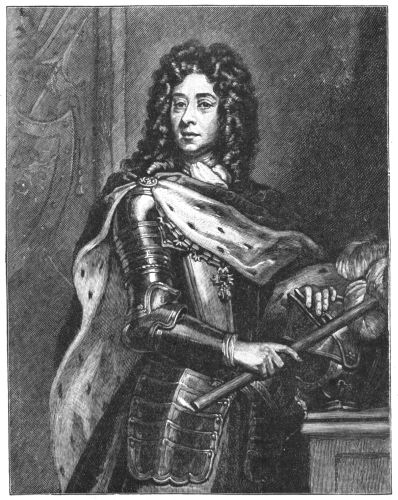
PRINCE EUGINE OF SAVOY. (After the Portrait by Sir Godfrey Kneller.)
[See larger version]
Marlborough was now in Bavaria, and the garrison at Neuburg retreating to Ingolstadt, he had the whole of the country at his mercy. He posted his camp at Mittelstetten on the 10th, and sent word to the Elector that if he did not choose to come to terms he would do his best to ruin his country; but the Elector, strongly encamped under the walls of Augsburg, and promised early succour by the French, made no sign of treating. Marlborough suffered his troops to levy contributions on the country round, and his army lived luxuriously at the expense of the unfortunate Bavarians. The true policy of the Allies was to march on the Elector, and dispose of him before the French could come up; but for this the Prince of Baden was in too ill a humour. In fact, the two generals were on the worst possible terms with each other, and the consequence was, the obvious interests of the campaign were sacrificed to the feud and jealousy of the leaders. Marlborough proposed to march on Munich, the capital, and take it, but the Prince would not furnish the necessary artillery, and the thing was impossible. Marlborough spent five days in taking Rain, a fortress of little consequence. He also dispatched thirty squadrons to assist Eugene in obstructing the march of the French to join the Elector. He contrived also to open negotiations with the Elector of Bavaria. The envoy of the Emperor offered to the Elector to restore all his dominions, and pay him a subsidy of two hundred thousand crowns, on condition of his breaking with the French and assisting the Emperor with twelve thousand men. But the negotiation came to nothing, for Tallard was now rapidly advancing with his army, and the Elector, instead of keeping an appointment with the Emperor's envoy, sent him word that since the King of France had made such powerful exertions to support him, he thought himself in honour obliged to remain firm to his alliance. The Allied generals were so much exasperated at this result that they gave up the whole country, as far as the walls of Munich, to the ravages of the soldiery, and three hundred burning towns, villages, and castles marked the terrible fury of the Allies, and left an indelible stain on the glories of that campaign.
Scarcely had Marlborough removed from before Augsburg when the Elector quitted his camp and marched to Biberach, and there effected a junction with Tallard.
On the 6th of August Prince Eugene galloped into Marlborough's camp to announce this fact, and to take measures for competing with them. It was resolved between them to get rid of the fatal incubus of the Prince of Baden, with his pride and his jealousy, by leaving him to continue the siege of Ingolstadt, for which purpose they left him twenty-three battalions and thirty-one squadrons. Marlborough then prepared again to cross the Lech and the Danube, and advance to Exheim. Here Prince Eugene, who had set out to bring up his force to form a junction with Marlborough, galloped back to inform him that the united French and Bavarian army was in full march towards Dillingen, evidently intending to attack the little army of Eugene. It was, therefore, agreed that the troops of Eugene should fall back, and those of Marlborough should cross the Danube to make a speedy junction with them. Eugene took possession of the strong camp on the Schellenberg, and had his main position at Donauwörth. On the evening of the 10th Marlborough began to throw detachments of his army across the Danube—an operation of no little difficulty, owing to his having to cross the Aicha, the Lech, and the Wernitz, as well as the Danube, and all these floods were swollen by the rains. The whole of the army, however, was got over at different points on the 11th, and on the 12th Marlborough's baggage and artillery came up.
The English Guards were pushed forward towards Schwenningen, and Marlborough and Eugene ascended together the tower of a village church to get a view of the country. There they discovered the French and Bavarians busy marking out a camp between Blenheim and Lutzingen. They saw at once the great advantage they should have by falling on the enemy before they had strongly entrenched themselves, and whilst in the confusion of encamping themselves. No sooner, however, did they issue their orders, than some of the general officers demurred as to the danger of attacking the foe in so strong a position as the one they had chosen. But Marlborough told them that circumstances compelled them to fight, and the sooner the better. Marlborough and Eugene were busy planning the order of the battle, and at two o'clock of the morning of the 13th of August, the forces were in full advance. In another hour they were across the Kessell, with a combined force of fifty-two thousand men and fifty-two pieces of artillery.
Tallard saw the march of the Allied army with great satisfaction. He thought it would now be easy for him to interpose a strong force between Marlborough and the army of the Prince of Baden before Ingolstadt. But the Allies did not mean to give him any time for that. They pushed briskly forward over very difficult ground, intersected by rivulets and ditches; and as they were seen at seven in the morning steadily advancing, the French and Bavarians hastily abandoned the new lines which they were forming, and retreated towards their old camp. On still went Marlborough and Eugene, accompanied in advance by a Prussian officer who had fought there the preceding year, and knew the country well. They found the enemy posted along the rising ground from Blenheim to Lutzingen, with a gap between the villages, which they had endeavoured to render secure by posting there a strong body of cavalry. At the same time, between Blenheim and the Danube, was made a strong barricade of waggons, behind which were stationed a brigade of dismounted dragoons. Three brigades of cavalry took up their stand in the village, and barricaded all entrances or openings with waggons, felled trees, planks, or whatever could be found. Tallard was in command at Blenheim, the Elector of Bavaria and General Marsin at Lutzingen. The castle and church-tower at Blenheim were filled with soldiers, and the Count Clerambault was ordered to defend the village of Blenheim by his artillery to the last.
Against this position, defended by fifty-seven thousand men, or about five thousand more than the Allies, advanced the Confederate army. In front of the enemy also ran the little river Nebel, which was deep, and the bottom muddy. Marlborough led on the left wing against Blenheim, and Eugene the right against Lutzingen. The first of the army to cross the Nebel and advance against Blenheim was a body of English and Hessians under Major-General Wilkes and Lord Cutts. Cutts, who was famous for a storm, was ordered to make an impetuous attack on the village; and, getting across the Nebel by means of fascines, he led his horse under a terrible fire of grape right against the palisadoes and barricades. The French poured into the assailants, however, such a storm of grape as mowed down great numbers of officers and men, amongst whom was General Rowe, who had advanced to the very face of the palisadoes with his lieutenant-colonel and major. The English in the van were thrown into confusion and assailed by three squadrons of gendarmes; but the Hessians advanced to their aid, and the French were driven back to their lines. Lord Cutts then led on his horse, and maintained a desperate fight under the fire of the protected French. Whilst they were engaged in this deadly mélée the brigades of Hudson and Ferguson had crossed the stream, and marched right up to the village, silencing some batteries which commanded the fords of the river. The fight was maintained hand to hand, the opponents thrusting at each other through the interstices of the palisadoes; but the contest was too unequal between the covered and uncovered, and with the soldiers from the old castle and the church-tops pouring down showers of musket-balls on the Allies.
During this time Marlborough had been leading another body of troops along the banks of the Nebel, and joining them under a terrible fire of grape opposite to the gap between the villages, and only waiting, to bear on this point, for the artillery, under the Prince of Holstein-Beck, getting over the river. The Prince no sooner had got partly across the stream than his advance was furiously attacked by the Irish Brigade, which was in the pay of Louis XIV. They cut the advance nearly to pieces, and would have effectually prevented the transit of artillery had not Marlborough himself hastened to the spot and beaten them off, as well as heavy bodies of French and Bavarian cavalry. He then posted a body of horse along the river to protect the crossing of the forces.
Lord Cutts during this had fallen back from the entrenchments of the village, finding it impossible to clear a way into it without artillery. But the artillery over, Marlborough united his forces with those of Eugene, which were bearing on Lutzingen, and was preparing for his grand design of cutting the French and Bavarians asunder, by throwing his whole weight on the cavalry posted between the villages. It was not, however, till five in the afternoon that he was able to lead on the attack, consisting of two columns of horse supported by infantry. He dashed rapidly up the hill towards the important point, on which was concentrated Tallard's cavalry, and part of the infantry from the village. Marlborough gained the summit of the hill under heavy loss, but there the enemy stood in such solid force that he was driven back for a hundred paces. The heat of the battle was at this point, and if Marlborough had been compelled to give way, there was little chance of succeeding against the enemy; but he returned with all his vigour to the charge, by this time his artillery had gained the summit, and after a desperate struggle the fire of the French began to slacken. As soon as he perceived that, he made a grand charge, broke the horse, and cut to pieces or made prisoners of seven regiments of infantry.
Tallard, seeing his cavalry in flight, and his infantry fast being overpowered, sent messengers to call the Elector to his aid, and to order up the rest of the infantry from Blenheim. But the Elector was in full engagement with Eugene, and found enough to do to maintain possession of Lutzingen. Nor did Marlborough allow time for the coming up of fresh enemies. He attacked Tallard with such impetuosity, and such an overwhelming force of cavalry, that he was completely disorganised, and, turning his horse, galloped off towards Sonderheim, another part of his cavalry making for Hochstadt. Marlborough pursued Tallard at full speed, slaughtering his men all down the declivity towards the Danube, where they had thrown over a bridge between Hochstadt and Blenheim; but being so pressed, and at the same time attacked in the flank, numbers were forced into the river and perished. Tallard, being surrounded, and his son killed, was compelled to surrender near a mill behind the village of Sonderheim, together with the Marquis of Montperous, General of Horse, the Majors-General de Seppeville, De Silly, De la Valiere, and many other officers. Those who fled towards Hochstadt fared little better. They became entangled in a morass, where they were cut to pieces, drowned in the Danube, or made prisoners, except the celebrated brigade of Grignan, and some of the gendarmes, who regained the heights of Hochstadt.
Meanwhile Prince Eugene had been sharply engaged with the Elector of Bavaria at Lutzingen, and after receiving several repulses had succeeded in driving the Elector out of Lutzingen; and, turning his flank, he posted himself on the edge of a ravine to mark the condition of the field in general. He there received a message from Marlborough to say that he was now able to come to his assistance if he needed it; but the prince replied that he had no need of it, for the forces of Marsin and the Elector were driven out of Lutzingen and Oberclau, and that his cavalry were pursuing them to Morselingen and Teissenhoven, whence they retreated to Dillingen and Lauingen. Marlborough despatched a body of cavalry to Eugene near the blazing village of Lutzingen; but the darkness now settling down, the commander, amid the smoke of powder and of the burning village, mistook the troops of Eugene for the Bavarians and wheeled round, so that the opportunity was lost of inflicting fresh injury on the fugitives.
There were still twelve thousand men unsubdued in Blenheim, and Marlborough began to surround the place. These forces had lost their commander, Clerambault, who had been carried away in the rush down the hill and was drowned in the Danube; but the men still made a vigorous resistance. Every minute, however, they were getting more hemmed in by troops and artillery. Fire was set to the buildings, and every chance of escape was cut off. For some time they maintained a killing fire from the walls and houses; but as the flames advanced, they made several attempts at cutting through their assailants, but were driven back at every point. They finally offered to capitulate, but Marlborough would hear of nothing but an unconditional surrender, to which they were obliged to assent. Besides these, whole regiments had laid down their arms, and begged for quarter. Thus was annihilated at a blow the invincible army of France, which was to have seized on Vienna, destroyed the Empire, and placed all Germany and the Continent under the feet of Louis. The event had fully justified the bold design of Marlborough; instead of fighting the enemy in detail, he attacked him at his very heart, and closed the campaign by a single master-stroke.
Soon after the battle three thousand Germans, who had been serving in the French army, joined the Allies; and on the 19th of August, six days after the battle, Marlborough and Eugene began their march towards Ulm. Three days before that, the garrison of Augsburg had quitted that city, and Marlborough and Eugene called on the Prince of Baden to leave a few troops at Ingolstadt to invest it, as it must now necessarily surrender, and to join them with the rest of his forces, that they might sweep the enemy completely out of Germany. Marshal Tallard was sent under a guard of dragoons to Frankfort, and Marlborough encamped at Sefillingen, near Ulm. There he and Eugene were joined by Louis of Baden, and, leaving a sufficient force to reduce Ulm, the combined army marched towards the Rhine. At Bruchsal, near Philippsburg, the Prince of Baden insisted that they should all stay and compel the surrender of Landau. This was opposed to the whole plans of Marlborough and Eugene, which were to give the French no time to reflect, but to drive them over their own frontiers. The Prince was now more than ever obstinate. The glory which Marlborough had won, and part of which he had tried to filch from him, was extremely galling to him, and especially that so much honour should fall to the lot of a heretic. The generals were obliged to follow his fancy; they allowed the Prince to sit down before the town, and Marlborough and Eugene encamped at Croon-Weissingen to support him. This took place on the 12th of September, and Landau held out till the 23rd of November, when it capitulated on honourable terms, and the King of the Romans characteristically came into the camp to have the honour of taking the place—so fond are these German princes of stepping into other people's honours instead of winning them for themselves. By this delay the precious remainder of the campaign was lost, and the French had time given them to recover their spirits, and to take measures for holding what was yet left them. After this the Confederate army sat down before Trarbach, which surrendered to the hereditary Prince of Hesse-Cassel in the middle of December, which closed the campaign.
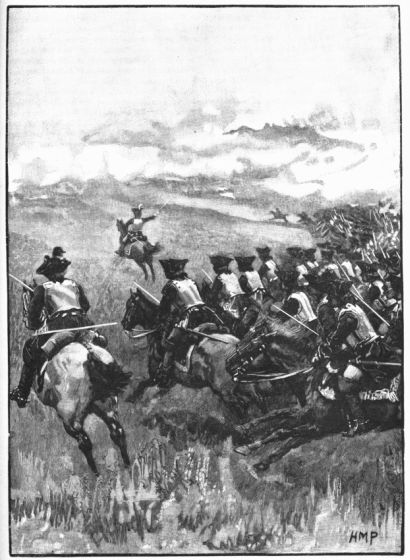
BATTLE OF BLENHEIM: CHARGE OF MARLBOROUGH'S HORSE. (See p. 555.)
[See larger version]
Marlborough had not waited for these insignificant operations, but had proceeded to Berlin to engage the King of Prussia to suspend his claims on the Dutch, and to enter more zealously into the alliance for the perfect clearance of the French from Germany. He prevailed on the king to promise eight thousand troops for the assistance of the Duke of Savoy, and to be commanded by the Prince Eugene; and he exerted himself with the Emperor to effect a settlement with the insurgents in Hungary, but his own triumphs stood in the way of his success. The Emperor, since Marlborough's victories, was so elated that he would listen to no reasonable terms. From Berlin Marlborough proceeded to Hanover, and paid his court to the family which was to succeed to the Crown of England. Thence he went to the Hague, where he was received with high honours by the States-General on account of the victories which he would never have achieved could they have restrained him. He arrived in England in the middle of December, carrying with him Marshal Tallard and the rest of the distinguished officers, with the standards and other trophies of his victories. He was received with acclaim by all classes except a few ultra-Tories, who threatened to impeach him for his rash march to the Danube. As Parliament had assembled, Marlborough took his seat in the House of Peers the day after his arrival, where he was complimented on his magnificent success by the Lord Keeper. This was followed by a deputation with a vote of thanks from the Commons, and by similar honours from the City. But perhaps the most palpable triumph of Marlborough was the transferring of the military trophies which he had taken, from the Tower, where they were first deposited, to Westminster Hall. This was done by each soldier carrying a standard or other trophy, amid the thunders of artillery and the hurrahs of the people; such a spectacle never having been witnessed since the days of the Spanish Armada. The royal manor of Woodstock was granted him, and Blenheim Mansion erected at the cost of the nation.