Chapter XI · (continued 2)
Reading edition
The high-crowned hat or broad-leaved sombrero of Spain not harmonising well with the periwig, the crown was suddenly lowered, the brim turned up, and a drooping feather thrown backwards over it. The petticoat breeches came in as early as 1658; and, in the following year, Randal Holmes thus describes a gentleman's dress:—"A short-waisted doublet and petticoat breeches, the lining being lower than the breeches, is tied above the knees; the breeches are ornamented with ribands up to the pocket, and half their breadth upon the thigh. The waistband is set round with ribands, and the shirt hanging out over them." These petticoat breeches soon grew into actual skirts, and the doublet or jacket, which at the beginning of the reign scarcely came below the breast, towards the end of it was so elongated that it was an actual coat, and had buttons and buttonholes all down the front.
Along with a particular costume described by Evelyn, which Charles adopted in 1666, consisting of a long close vest of black cloth or velvet pinked with white satin; a loose surcoat over it of an Oriental character, and instead of shoes and stockings, buskins or brodequins; he also wore small buckles instead of shoestrings. Charles was so proud of this dress that he vowed he would never wear any other; but it did not last long, and buckles did not become the general fashion till the reign of Queen Anne.
Long and short kersey stockings were an article of export in this period, as well as stockings of leather, silk, or woollen, and worsted for men and children. Socks also occur under the name of "the lower end of stockings." Amongst the imports were hose of crewel, called Mantua hose, and stockings of wadmal. Neckcloths or cravats of Brussels and Flanders lace were worn towards the end of the "Merry Monarch's" reign, and tied in a knot under the chin, the ends hanging down square.
The costume of Knights of the Garter assumed its present shape, the cap of estate, with its ostrich and heron plume, and the broad blue ribbon worn over the left shoulder and brought under the right arm, where the jewel or lesser George hangs, being introduced just before the publication of Ashmole's "History of the Order." The baron's coronet dates from this reign.
The costume of James II.'s reign varied little from that of Charles. The hats indeed assumed various cocks, according to the fancy of some leader or party. One cock was called the Monmouth cock.
The ladies in the voluptuous reign of Charles II. abandoned the straight-laced dresses with the straight-laced manners of their Puritan predecessors. Bare bosoms and bare arms to the elbows were displayed, and the hair, confined only by a single bandeau of pearls, or adorned by a single rose, fell in graceful profusion upon their snowy necks. The rounded arm reclined on the rich satin petticoat; whilst the gown of the same rich material extended its voluminous train behind. Lely's portraits are not to be regarded as representing the strict costume of the age, but they give us its spirit—a studied negligence, an elegant déshabillé. The starched ruff, the steeple-crowned hat, the rigid stomacher, and the stately farthingale were, however, long retained by less fashionable dames of the country; and when the ruff was discarded, a rich lace tippet veiled the breast. The women of ordinary rank also still retained much of this costume, with the hood and tippet.
In their riding habits the ladies imitated the costume of the men as nearly as they could. Evelyn says that he saw the queen in September, 1666, going to take the air "in her cavalier riding-habit, hat, and feathers, and horseman's coat." This seems to be a very rational dress for the occasion, yet the sight did not please Mr. Pepys, for he remarks about the same time—"Walking in the galleries at Whitehall, I find the ladies of honour dressed in their riding garbs, with coats and doublets, with deep skirts—just for all the world like men, and buttoned in their doublets up to the breast, with periwigs and with hats. So that only for a long petticoat dragging under their men's coats, nobody could take them for women in any point whatever, which was an odd sight, and a sight that did not please me."
Yet Mrs. Stuart, afterwards Duchess of Richmond, did please him:—"But, above all, Mrs. Stuart, in her dress, with her hat cocked and a rich plume, with her sweet eye, and little Roman nose, and excellent taille, is now the greatest beauty I ever saw, I think, in my life."
The military costume of the period remained much the same as during the civil wars and Commonwealth; but vambraces were abandoned by the arquebusiers, and defensive armour was gradually falling into disuse. The helmet and corset, or cuirass, or the gorget alone, worn over a buff coat, formed all the defence of steel worn by the officers at this period. "The arms, offensive and defensive," says the statute of the 13th and 14th of Charles II., "are to be as follows:—The defensive armour of the Cavalry to consist of a back, breast, and pot, and the breast and pot to be pistol-proof. The offensive arms a sword, and case of pistols, the barrels whereof are not to be under fourteen inches in length. For the Foot, a musketeer is ordered to have a musket, the barrel not under three feet in length; a collar of bandeliers, with a sword. Pikemen to be armed with a pike of ash, sixteen feet long, with a back, breast, head-piece, and sword."
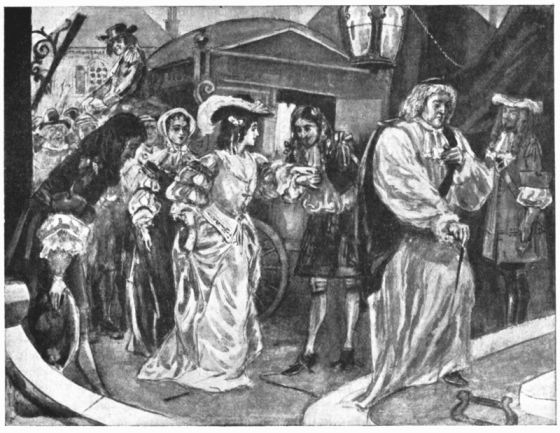
COSTUMES OF THE TIME OF CHARLES II.
[See larger version]
The familiar names of several of the regiments of the British army commence from Charles II.'s reign. The Life Guards were raised in 1661—composed and treated, however, like the Gardes du Corps of the French,—being principally gentlemen of families of distinction, who themselves, or their fathers, had fought in the Civil War. In the same year the Blues were embodied, and called the Oxford Blues, from their first commander, Aubrey, Earl of Oxford. The Coldstream Guards date their formation from 1660, and two regiments were added to the one raised about ten years previously by General Monk at Coldstream, on the borders of Scotland. To these were added the 1st Royal Scots, brought over from France at the Restoration; the 2nd, or Queen's, raised in 1661; the 3rd, or Old Buffs, so named from their accoutrements being composed of buffalo leather, embodied in 1665; the Scottish Fusiliers, afterwards the 21st, raised in 1678, and so called from their carrying the fusil, invented in France in 1630—being a firelock lighter than the musket, but about the same length; and the 4th, or King's Own, raised in 1680.
During this reign the bayonet—so called from Bayonne, where it was invented—was sometimes three-edged, sometimes flat, with a wooden hilt like a dagger, and was screwed or merely stuck into the muzzle of the gun. The bayonet superseded the rapier attached to the musket-rest in James's reign. Even then the bayonet was a far inferior weapon to what it subsequently became, as it had to be removed to fire and charge again. The Grenadiers were introduced in 1678, and were so called from being practised to fling hand grenades, each man having a pouch full. To these James added, in 1685, the 1st, or King's regiment of Dragoon Guards, the 2nd, or Queen's Dragoon Guards, and the 5th and 7th regiments, called the Royal Fusiliers; and in 1688, the year of the Revolution, the 23rd, or Welsh Fusiliers, were raised.
We need not repeat what has been so frequently stated in these pages about the profligacy of the Court and aristocracy in Charles II.'s reign, which soon polluted the spirit of the greater part of the country. However harsh and repulsive were the manners and social maxims of the Puritans, they were infinitely preferable to the licentiousness and blasphemy of the Cavaliers, who mistook vulgarity and obscenity for gentility. Notwithstanding the traditionary feeling left by the Royalist writers of these times, and too faithfully taken up by such writers as Sir Walter Scott, it is now beginning to be perceived that the Cavaliers were, in reality, the vulgar of the age. If to swear, gamble, bully, murder, and use the most indecent language, and lead the most indecent lives, be marks of vulgarity, these were the distinctive marks of too many of the Cavaliers. The Puritans, with all their acerbity and intolerance, had a reverence for sound and Christian principles at the core of their system. Virtue and moral piety were their admiration, however rudely they demonstrated it. But the Cavaliers gloried in every opposite vice the more, because the Puritans, whom they despised, denounced them. We have seen the spirit of private assassination which animated them, and led them to the murder of Dorislaus, the Commonwealth ambassador in Holland; of Ascam, its minister at Madrid; of Colonel Lisle, at Lausanne; and their repeated attempts on the life of Cromwell, in pursuance of their avowed doctrine of assassination shown in the tract called "Killing no Murder." This does anything but justify their high claim to the title of men of honour, and finds no parallel in the principles or practices of the Puritans of England, though the Scottish Covenanters stooped to this base practice in the murder of Archbishop Sharp.
Then as to profane swearing, their conversation, larded with oaths, would have disgraced the most uncouth trooper of to-day. "The new band of wits and fine gentlemen," says Macaulay, "never opened their mouths without uttering a ribaldry of which a porter would now be ashamed, and without calling on their Maker to curse them, sink them, confound them, blast them, and damn them." "No man," says Lord Somers, "was accounted a gentleman, or person of any honour, that had not in two hours' sitting invented some new modish oath, or found out the late intrigue between the Lord B. and the Lady P., laughed at the fopperies of priests, and made lampoons and drollery on the sacred Scriptures themselves." As to drinking and gambling, these vices were beyond conception; and the plunder of the people by the Cavalier troopers was carried on as if they had been in an enemy's country.
We have only to refer to the abandoned character of the women of Charles's Court, and amongst the aristocracy, who imitated the monarch in selecting mistresses and even wives from the stage, to remind the reader of the immoral character of the age. As we have already said, any one who would convince himself of the sink of infamy and obscenity which society was then, has only to look at the plays which were acted; at their language, declaimed by women without a blush or any evidence of disgust; plays written even by such men as Dryden. "Whatever our dramatists touched," says Macaulay, "they tainted. In their imitations the houses of Calderon's stately and high-spirited Castilian gentlemen became sties of vice, Shakespeare's 'Viola' a procuress, Molière's 'Misanthrope' a ravisher, Molière's 'Agnes' an adulteress. Nothing could be so pure or so heroic, but that it became foul and ignoble by transfusion through those foul and ignoble minds." The same writer, making a few exceptions—and a noble one in the case of Milton—says of the poets of that age that "from Dryden to D'Urfey the common characteristic was hard-hearted, shameless, swaggering licentiousness, at once inelegant and inhuman."
Whilst such was the condition of the Court, the aristocracy, the theatre, and the literature of the country, we may imagine what was the condition of the lower orders. The state of London was little, if anything, improved in civilisation—by no means improved in its moral tone—since the days of James I. The city was rising in a more healthy and substantial form from the fire, with wider streets, and better drainage; but it was still badly lighted, and disgraced by filthy kennels.
At the close of Charles II.'s reign London was lighted, by contract, by one Herring, who engaged to place a lamp at every tenth door, when there was no moon, from six to twelve o'clock at night, from Michaelmas to Lady-Day; and this was thought to be a wonderful advance. To us it would appear just darkness visible; and vast tracts of population were destitute of even this feeble glimmer. Whitefriars still continued the haunt of thieves, bullies, desperate debtors, and abandoned women, who rushed out and defended themselves from any visitations of duns or constables. The neighbourhood of Whitehall itself was little better, from the resort of the bully-mob of those who called themselves gentlemen. These young men, often belonging to good families, or the sons of wealthy citizens, assembled for noise and mischief in theatres and in the streets. They had been successively known as the "Darr Hearts," "the Heroics," "the Muns," "Tityre Tu's," "the Hectors," "the Roaring Boys," and "Bonaventors," so continually figuring in the comedies of the time. They now bore the name of "the Scourers," and frequented the theatres to damn plays, and the coffee-houses to pick up the last sayings of the wits, which were commonly not very cleanly, when such men as Rochester, Sedley, Dryden, and Wycherley were the stars there. They then sallied into the streets in bands, breaking windows, tearing off knockers, defacing signs, upsetting stalls, fish- or fruit-sellers, storming taverns, beating quiet passengers, and rudely insulting respectable women. Frequently they came to a regular fight with some other mob of "Scourers," and then rushed headlong, knocking down all whom they met. The watchmen carefully kept out of their way, and the military had to disperse them when they became particularly riotous. One great delight of these genteel ruffians was to hustle passengers into the kennel, or into Fleet Ditch and its tributaries, which ran then in open Styx-like blackness along the streets. To add to these dangers of walking the City in the evening thieves and pickpockets assaulted the passers by from dark entries below; and it was the common practice to empty all sorts of filth out of chamber windows. The City apprentices still kept up their riotous character. On one occasion, having attacked and beaten their masters, they were some of them put into the pillory; whereupon they tore down the pillory, and when set up again they again pulled it down. There were feuds and street encounters everywhere. The weavers and butchers, the frequenters of bear-gardens and theatres, or sword-players, were continually falling into parties and ending the dispute by a general mêlée.
The aristocracy had evacuated the City-especially since the fire—and had located themselves along the Strand, Lincoln's Inn Fields, Bloomsbury, Soho, and all quarters tending towards Whitehall; others located themselves in Covent Garden; and in the fields now covered by the piles of Bedford Square and the British Museum stood the magnificent mansions of Bedford House and Montague House. But most of the sites of the splendid squares and streets of our now West End were open country, or the rubbish-heaps of the neighbourhood. Club-life was just beginning. There were numbers of political clubs, the most famous of which was the King's Head, or Green Ribbon Club, from the members wearing a green ribbon in their hats, to distinguish them from their opponents. There was the club of Shaftesbury and the Whig party, which was engaged in the design of excluding the Duke of York from the succession, and which raised all the Titus Oates plots to accomplish their object. It met at the King's Head Tavern opposite to the Temple Gate. But coffee-houses, now become general, were in reality clubs; and every class and party had its coffee-house, where its members met. There was the literary coffee-house, called Will's, situate between Covent Garden and Bow Street, where Dryden was the great man, and where literary lords, literary lawyers, dramatists, players, and wits of all sorts met to settle the merits of literature and the stage. There were lawyers' coffee-houses, citizens' coffee-houses, doctors' coffee-houses, the chief of them Garraway's; Jesuits' coffee-houses, Puritans' coffee-houses, and Popish coffee-houses, where every man found his fellows, and partisans met and learned the news; and in these haunts the spirit of party and of religious antagonism was carried to its fiercest height. The chief place of public lounging was the New Exchange in the City, and Spring Gardens, Hyde Park, and the Mulberry Garden, which were continually occurring in the comedies of the day as the places of assignation, as well as the fashionable masquerades.
But whilst such were the most marked features of life in London at that day, we are not to suppose that there was not a large number of the population who retained a love of virtue, purity, and domestic life. The religious were a numerous class; and the stern morality of the Nonconformists beheld with pity and indignation the dissipated flutterings of the corrupt world around them. Besides these there was a numerous population of sober citizens, who, though they did not go with the Puritans in religion, were disgusted with the French manners, maxims, houses, and cookery, and stood by their native modes and ideas with sturdy John Bullism. The musical taste of the age tended to draw them together to more rational enjoyments than debauchery and the tainted stage, and the increasing use of coffee and tea gave to musical and social parties a more homelike and refined character.
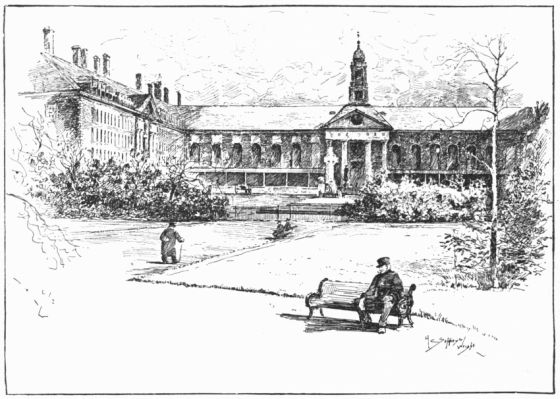
CHELSEA HOSPITAL.
[See larger version]
The popular sports and amusements still, however, were of the usual description. All the old cruel sports of bear-baiting, bull-baiting, and cock-fights, which the Puritans had suppressed, came back with royalty. Horse-racing was in vogue; and gambling was such a fever amongst the wealthy, that many great estates were squandered at cards; and the Duke of St. Albans, when more than eighty years of age, and quite blind, used to sit at the gaming-table from day to day, with a man beside him to tell him the cards. Billiards, chess, backgammon, and cribbage were in great request; and bowls, ninepins, boat-racing, yacht-racing, running at the ring, were sports both with the people and the gentry. Ladies joined in playing at bowls; skating was introduced by the courtiers, who had spent much time in Holland. Swimming and foot-races were fashionable. Colonel Blood planned to shoot Charles once when he went to swim in the Thames near Chelsea, and the Duke of Monmouth, as we have seen, in his popular tour ran races against all comers, first without boots, and then beat them running in his boots whilst the others ran without.
Charles prided himself on his pedestrian feats. The common people were as much delighted as their ancestors with all the exhibitions of Bartholomew Fair and Smithfield, of fire-eaters, jugglers, rope-dancers, dancing dogs and monkeys, Punch, feats of strength, and travelling theatres, where some Scripture story was represented, as is yet the case on the Continent.
In the country, life continued to move on at its usual rate. Land had not approached to anything like its present value, and education was an immense way farther behind, so that a large number of the aristocracy, including nearly the whole of the squirearchy, continued to live on their estates, and rarely made a visit to London. The ravages which the Civil War had made in all parts of the country had left traces on many a rental which were yet far from being obliterated; and the contempt into which the clerical office had fallen since the Reformation, and absorption of the Church lands, left one outlet for the sons of the squirearchy at this time little available. The landed gentry, therefore, for the most part continued to occupy a position of much local importance, but, with few exceptions, did not mingle with the great world of London, or aspire to lead in social or political rivalry on the national arena. The squire was on the bench and at the quarter sessions; he was often colonel of the militia, and knew his importance in the country; but beyond that he was little heard of except when civil strife called him out to defend the altar and the throne. But within his own little world he was all in all, proud of his power, and prouder of his pedigree; but if the Squire Westerns of Fielding's time are faithfully portrayed, how much more rustic, Toryfied, and confined in the range of their ideas and experience must they have been nearly two hundred years before. Few of them had the ambition to distinguish themselves by literary attainments—such accomplishments they left to the Drydens and Danbys of the metropolis. Many heirs of estates, therefore, at this era never went to a university, or, if they did, made but a brief abode there, and returned little better for the sojourn, depending on their property to give them all the éclat they aspired to. To enjoy the sports of the field, attend the county race meeting and county ball, to live surrounded by huntsmen and gamekeepers, to keep a coarse but exuberant table, and to terminate the day's sport by a drunken carouse, included the pursuits and habits of three-fourths of this class.
As these gentry went little to town, their manners were proportionally rustic, and their circle of ideas confined, but from their confinement the more sturdy. Toryism of the extremest type was rampant amongst them. Church and State, and the most hearty contempt of everything like Dissent and of foreigners, were regarded as the only maxims for Englishmen; and the most absolute submission of the peasantry to the despotic squirearchy was exacted. In a justice-room if a man was poor it was taken for granted that he was wrong. Justice Shallows and Dogberrys were not the originals of the pages of Shakespeare, but of the country bench of magistrates and its constabulary. Ideas travelled slowly, for books were few. A Bible, a Common Prayer-book, and a "Guillim's Heraldry" were the extent of many a gentleman's library. Newspapers were suppressed by the restrictions on the press during the latter part of Charles's reign; and the news-letters which supplied the country contained a very meagre amount of facts, but no discussion.
There were few coaches, except in the districts immediately round London, or to the distance of twenty or thirty miles, and the roads were in general impassable in winter. On all but the main lines of highway, pack-horses carried the necessary merchandise from place to place through deep narrow tracks, some of which remain to our time. It took four or five days to reach London by coach from Chester, York, or Bristol, and this was attended by perils and discomforts that made travellers loth to encounter such a journey, and often to make their wills before starting. Macaulay has summed up the terrors of the road, as given by our Diarists, in the following passage:—"On the best lines of communication the ruts were deep, the descents precipitous, and the ways often such that it was hardly possible to distinguish them in the dusk from the unenclosed heath and fen on both sides. Ralph Thoresby, the antiquary, was in danger of losing his way on the Great North Road between Barnby Moor and Tuxford, and actually lost his way between Doncaster and York; Pepys and his wife, travelling in their own coach, lost their way between Newbury and Reading. In the course of the same tour they lost their way near Salisbury, and were in danger of having to pass the night on the plain. It was only in fine weather that the whole breadth of the road was available for wheeled vehicles. Often the mud lay deep on the right and the left, and only a narrow track of firm ground rose above the quagmire. At such times obstructions and quarrels were common, and the pass was frequently blocked up during a long time by carriers neither of whom would give way. It happened almost every day that coaches stuck fast, until a team of cattle could be procured from some neighbouring farm to tug them out of the slough. But in bad seasons the travellers had to encounter inconveniences still more serious. Thoresby, who was in the habit of travelling between Leeds and the capital, has recorded in his Diary such a series of perils and disasters as might suffice for a journey to the Frozen Ocean, or to the desert of Sahara. On one occasion he learned that the floods were out between Ware and London, that passengers had to swim for their lives, and that a higgler had perished in the attempt to cross. In consequence of these tidings he turned out of the high road, and was conducted across some meadows, when it was necessary for him to ride to the skirts in water. In the course of another journey he narrowly escaped being swept away by an inundation of the Trent. He was afterwards detained at Stamford four days, on account of the state of the roads, and then ventured to proceed only because fourteen members of the House of Commons, who were going up in a body to Parliament, with guides and numerous attendants, took him into their company. On the roads of Derbyshire travellers were in constant fear for their necks, and were frequently compelled to alight and lead their beasts. The great route through Wales to Holyhead was in such a state that, in 1685, a viceroy, going to Ireland, was five hours travelling fourteen miles—from St. Asaph to Conway. Between Conway and Beaumaris he was forced to walk a great part of the way, and his lady was carried in a litter. His coach was, with much difficulty, and by the help of many hands, brought after him entire. In general, carriages were taken to pieces at Conway and borne on the shoulders of stout Welsh peasants to the Menai Straits. In some parts of Kent and Sussex none but the strongest horses could, in winter, get through the bog, in which at every step they sank deep. The markets were often inaccessible during several months. It is said the fruits of the earth were sometimes suffered to rot in one place, while in another place, distant only a few miles, the supply fell short of the demand. The wheeled carriages in this district were generally pulled by oxen. When Prince George of Denmark visited the stately mansion of Petworth in wet weather he was six hours going nine miles; and it was necessary that a body of sturdy hinds should be on each side of his coach, in order to prop it. Of the carriages which conveyed his retinue several were upset and injured. A letter from one of the party has been preserved, in which the unfortunate courtier complains that, during fourteen hours, he never once alighted, except when his coach was overturned or stuck fast in the mud."
To avoid the nuisance of carriages on such roads the habit prevailed of travelling on horseback; but then it was necessary to go well armed, and, if possible, in company, for the country was infested with highwaymen. The adventures of horsemen were commonly as numerous and exciting as those of the folk who used carriages, though mails and carriages were also frequently stopped by the highwaymen of the day. To abate the difficulties of the road, on the Restoration the turnpike system was adopted—a new era in road-making—and what were called flying coaches were put on the amended ways, which conveyed passengers at a better rate.
During the Commonwealth, travellers met equally provoking impediments in passing through towns, if they dared to travel on Sundays. There was a fine for such a breach of the Sabbath; and Elwood describes his ludicrous dilemma when riding to a Friends' Meeting on Sunday, on a borrowed horse, with a borrowed hat and great-coat; for his father had locked up his own horse, hat, and coat to keep him from the conventicle. Being stopped and brought before a magistrate, he was ordered to pay the fine; but he replied that he had no money. "You have a good horse, however," observed the magistrate. "That is borrowed," said Elwood. "Well, you have a good great-coat." "That is borrowed, too," added Elwood. "Nay, then, we must have your hat, it is a good one." "That also is borrowed," continued the young Quaker. At which the magistrate, declaring that he never saw such a traveller in his life, who had nothing but what was borrowed, ordered him to be detained till the morrow, and then sent back again.
In the times we are now reviewing the tables were turned, and the Royalist churchmen and squirearchy were employing their country leisure in breaking up the conventicles of all sorts of Dissenters, pulling down the meeting-houses of the obstinate Quakers, and sending them to prison by shoals. Sir Christopher Wren, by order of the king, tried his hand at pulling down Quakers' meeting-houses, before he built St. Paul's. The spirit of political and ecclesiastical party violence raged through the country, and formed a strange contrast, in the cruelties and oppression practised on the truly religious portion of the community, to the profligacy of the gentry and, above all, of the Court. What rendered this condition of things more gloomy was the low position which the country clergy then occupied. The property of the Church having fallen into the hands of the aristocracy, the generality of country livings were poor, and depended chiefly on the small tithes and a miserable glebe of a few acres. Whilst some few men of distinguished abilities, like Burnet, Tillotson, Barrow, and Stillingfleet, rose to distinction and occupied the few wealthy dignities and livings, the parish clergymen were too commonly men of low origin and little education. Men of family disdained the office, and the chaplain of a great house was looked on as little better than a servant; he married the cook or the housekeeper, and became the hanger-on of some country hall, joining in the rude riot and the ruder jests of his patron. Even so late as Fielding's time, the relative position of the squire and the parson were those of Western and parson Adams.
Perhaps the most pleasing feature of country life was that of the position of the yeoman, or man of small independent property. This class had been increased by the various distributions of great estates; and it is calculated that at this time one-seventh at least of the population consisted of men with their families who lived on their own little demesnes producing from fifty to a hundred pounds a year. The number of men who farmed the lands of the aristocracy at that time is affirmed to have been much fewer than those who farmed their own. This independence of condition gave them independence of mind, and it was amongst this class that the strongest resistance to the dominance and intolerance of the squirearchy was found. Many of them during the Civil War and the Commonwealth adopted the Puritan faith, and continued to maintain it in defiance of Five-Mile Acts, Conventicle Acts, and Acts of Uniformity. From them descended the sturdy spirit which, uniting with a kindred spirit in towns, continued to vindicate the liberties and manly bearing of the British population.
Nor amid the corruptions and bitternesses of the times had all the ancient poetical customs of the people disappeared. Neither the asceticism of the Puritan nor the profligacy of the Cavalier had been able to utterly extinguish such customs as had a touch of nature in them. The Londoners made their swarming excursions to Greenwich, and Richmond, and Epping Forest, where they gave way to all their pent-up fun and frolic, and enlivened the banks of the Thames with their songs as they rowed to and fro. The old holidays of the departed church still survived. Valentine's Day was still a day of love missives, and of presents of gloves, jewellery, silk stockings, and ornamental garters from gentlemen to their valentines. Mayday reassumed its jollity; may-poles, put down by the Commonwealth, again lifted their heads; and Herrick's beautiful verses resumed their reality:—
"There's not a budding boy or girl this day But is got up and gone to bring in May; A deal of youth ere this is come Back, and with whitethorn laden, home."
The Puritans beheld the return of the custom with horror. In 1660, the year that Charles II. and may-poles came back again, a Puritan, writing from Newcastle, says:—"Sir,—The country as well as the town abounds with vanities, now the reins of liberty and licentiousness are let loose. Maypoles, and players, and jugglers, and all things else now pass current. Sin now appears with a brazen face." Just as Charles and James were landing in the merry month of May, at Dover, Thomas Hall published his "Funebria Floræ, the Downfall of May Games"—a most inopportune moment. With equal horror, the Puritans beheld the old sports at village wakes and Whitsuntide, the jollity of harvest homes, and the mirthful uproar of Christmas, come back. New Year's Day, with its gifts—a Roman custom as old as Romulus—not only reappeared as a means of expressing affection amongst friends, but as a source of great profit to the king and nobility. For as Numa ordered gifts to be given to the gods on that day, so gifts were now presented by the nobility to the king, and long after his time by the dependents of the nobility, and those who sought favour from them, to the nobles. Pepys says that the whole fortunes of some courtiers consisted in these gifts. But Christmas boxes, which originated in New Year's gifts, and have become confounded with them in England, have survived the New Year's gifts of the time we are reviewing.
The great evidences of the growth of a nation are the increase of its trade, its population, and its governmental revenue. When these three things continue to augment, pari passu, there can be no question of the substantial progress of a nation. All these had been steadily on the increase during this period, and the advocates of royalty point to these circumstances to prove the mischiefs of the Civil War and the Commonwealth. It would be enough in reply, even did we admit the reality of the alleged facts, to observe that the mischief, whatever it was, was necessitated by the crimes and tyrannies of royalty. But we have only to look carefully at the whole case to see that the prosperity following the Restoration had its source in the Commonwealth. In spite of the violent changes and dislocations of society during the period of the conflict with Charles I., these upheavings and tempests threw down and swept away a host of things which cramped and smothered the free action of commerce and internal industry. The lava which burst in fiery streams from the volcano of revolution, though it might for a time destroy life and property, only required a little more time to moulder and fertilise the earth. A host of mischievous monopolies were annihilated in this convulsion. The foreign commerce was carefully extended. Not only at home were Englishmen relieved from the incubus of Government absolutism, and interference with private speculation, but the haughty fleets of Dutch, and French, and Spaniards were swept from the ocean, and English merchants were encouraged to extend their enterprises, not only by the greater security at sea, but by the act of the Long Parliament allowing the import of commodities from its colonies and possessions in America, Asia, and Africa, only in English bottoms. This, it has been contended, did us no good, because it compelled the Dutch to turn their attention to the Baltic trade, and enabled them to get the precedence of us there. But this is a mistake; for the removal of the overbearing fleets of the Dutch, and the stimulus given to our commerce by this privilege, led to a far greater amount of mercantile activity in England, and helped us to assume a position in which at a later date we could safely introduce the principles of free navigation.
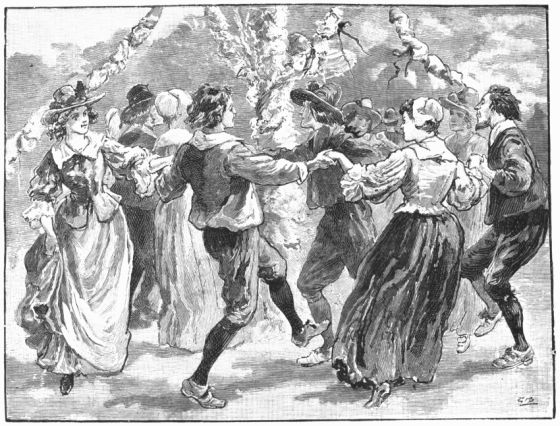
MAY DAY REVELS IN THE TIME OF CHARLES II.
[See larger version]
Cromwell fostered British commerce by all the means in his power, and most successfully; and the commercial activity thus excited acquired power, and continued to increase ever afterwards. He encouraged and extended the colonies, especially by the acquisition of Jamaica, and the trade with the West Indies and American colonies added increasingly, during the period now under review, to our commercial wealth and navy. The writer of "The World's Mistake in Oliver Cromwell," published in the "Harleian Miscellany," says:—"When this tyrant, or Protector, as some call him, turned out the Long Parliament in April, 1653, the kingdom had arrived at the highest pitch of trade it ever knew. The riches of the nation showed itself in the high value of land and of all our native commodities, which are the certain marks of opulence." Besides this, the great quantity of land thrown into the hands of small proprietors, from time to time, and from a succession of causes, ever since the breaking up of the Roman Church, and all its monasteries and convents by Henry VIII., was every day telling more markedly on the wealth and spirit of the people. We have just seen what a powerful body the yeomanry had grown; and, from the same causes, a large accession of capital had flowed into trade. The culture of these divided lands was enormously increased; instead of lying as vast deserts and hunting grounds, they now were become fertile farms. The internal resources of the country were rapidly and constantly developing themselves; and from the cool transfer of the taxation from the aristocracy to the people at large, it had become the interest of the monarchs, if they did little positively to accelerate the growth of national wealth, at least to leave in freedom the capital-increasing exertions of the population. The more the people traded abroad, the greater were the proceeds of the customs; the more they consumed, the greater the proceeds of the excise; now the chief items of the royal revenue. All the sources of national wealth originated in the Long Parliament and the Commonwealth, for the transfers of the customs and excise were first made then, and only resumed after the Restoration.
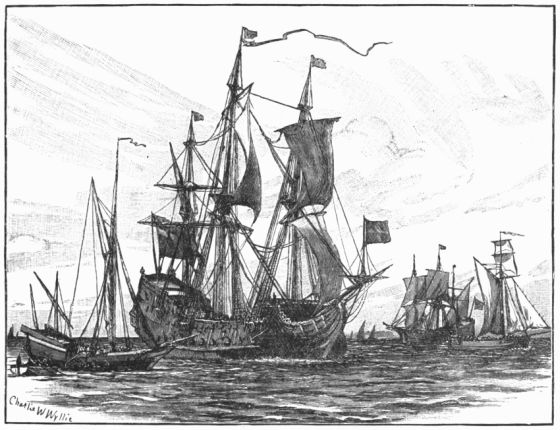
SHIPS OF THE TIME OF CHARLES II.
[See larger version]
We may now notice the rapid growth of these items of revenue. In the first year of Charles II.'s reign—namely, 1660—the proceeds of the customs were £361,356; in the last year of James's reign, 1688, they were £781,987. Thus, in twenty-eight years the customs had more than doubled themselves. We have not the same complete accounts of the excise, imports and exports, for the same period; but those which we have show the same progressive ratio. In 1663, the imports and exports together amounted to £6,038,831; in 1669, or only six years afterwards, they were £6,259,413; and, since 1613, they had risen up to this amount from £4,628,586. This showed a steady increase of consumption in the nation. During this time the imports exceeded the exports considerably, demonstrating the fact that the internal wealth was greater than the export of goods; but the balance of trade gradually adjusted itself, and, in 1699, the excess of exports over imports was £1,147,660; showing that even exportable articles of manufacture, of raw produce, or of commodities the growth of our colonies and settlements, had continued to increase. The proceeds of the excise in 1660, when Charles became possessed of it, amounted only to about one million; but increased so rapidly that in little more than a century it reached ten millions.
The value of land, and of all kinds of property, rose in proportion. Davenant, in his "Discourses on Trade," shows that the value of the whole rental of England in 1660 was but £6,000,000; in 1688 it was £14,000,000. So that, in 1660, the whole land of England, at twelve years' purchase, was worth only £72,000,000; but, in 1688, at fourteen years' purchase, its then estimated value, it was worth £254,000,000.
As to the mercantile shipping of the country, its tonnage in 1688 was nearly double what it was in 1666. Sir William Petty, in his "Political Arithmetic," published in 1676, states that, within the previous forty years, the houses in London had doubled themselves: the coal trade from Newcastle had quadrupled itself, being then 80,000 tons yearly; the Guinea and American trades had grown up from next to nothing to 40,000 tons of shipping; the customs were trebled; the postage of letters increased from one to twenty; the whole income of Government, in short, was trebled; and the number and splendour of coaches, equipages, and household furniture were wonderfully increased.
These effects were surely no results of the wise measures of such monarchs as Charles and James; they were traceable, as clearly as light to the sun, to the bold and able heads of the Long Parliament and Commonwealth, to their victories over the enemies and rivals of the nation, and to the able regulations which they had made in all quarters for the honourable maintenance of our name and the prosperity of our commerce. What such men as Charles and James did may be seen by examining the condition of what fell under their own management. What the nation at large did by its native energy we have just seen; what these monarchs did let us now see. The royal navy, in 1666, amounted only to 62,594 tons; but in 1685, the last year of Charles, it amounted to 103,558 tons; and, though it fell off a little under James, in 1688, the last year of James, it still reached 101,892 tons. This looks admirable on the surface; but it is necessary to look under the surface, and then we perceive a marvellous difference. The nation had become justly proud of its navy, which had destroyed the great Armada, and, under Blake, had put down the supremacy of Holland and Spain at sea; and though the Commons were averse from trusting Charles II. with money, after they saw that it all went to concubines and parasites, they were never appealed to on the subject of the navy in vain. When Danby was minister, they voted at once £600,000 for the building of thirty new men-of-war. On the evidence of Pepys, the Secretary of the Admiralty, we have it, that scarcely any of this magnificent array of ships were fit for use. The very thirty new vessels for which the £600,000 had been voted had been built of such villainous timber that they were absolutely unseaworthy; and the rest were so rotten and worm-eaten that they would have sunk if they were carried out of port. The same testimony was borne by the French ambassador, Bonrepaux, who, when Charles made a bluster as if he would go to sea, in 1686, examined our fleet, and reported to his Government that it need not trouble itself about the English navy, for that both ships and men were merely nominal. In fact, the money which should have repaired the ships and paid the officers and men had gone the way of all Charles's money. Pepys was pursued in the streets by starving sailors, who demanded the redemption of their tickets; shoals of them lay in the streets, without food or means of procuring shelter; many of them perished of hunger, and some officers are said to have shared the same fate. The whole was the most shameful scene of waste of the public money, neglect of vessels and of men, of utter indolence on the part of the Crown, and consequent negligence on the part of the authorities; of scandalous corruption in many of them, and knavery and peculation in contractors. Such was the state of things that, in 1667, or seven years after the Commonwealth, the Dutch, under De Ruyter, entered the Thames, destroyed the fortifications at Sheerness, took and burned some of our largest ships, and threw the capital into paroxysms of terror. "Many English sailors," says Pepys, "were heard on board the Dutch ships, crying, 'We did heretofore fight for tickets—now we fight for dollars!'"
Besides the causes already enumerated for the rapid progress of England in wealth and prosperity at this period, the persecutions of Protestants abroad, which drove hither their weavers and artisans, and the union with Scotland, giving internal peace and security, had a wonderful influence. De Witt, the celebrated Dutch minister, refers to these causes in a remarkable passage of his work called "The Interest of Holland," published in 1669. "When," he says, "the compulsive laws of the Netherland Halls had first driven the cloth-weaving from the cities into our villages, and, by the cruelty of the Duke of Alva, the say-weaving went also after it, the English by degrees began to send their manufactures throughout Europe; they became potent at sea, and no longer to depend on the Netherlands. Also by that discovery of the inexpressibly rich cod-bank of Newfoundland, those of Bristol in particular made use of that advantage. Moreover, the long persecution of Puritans in England has occasioned the planting of many English colonies in America, by which they derive a very considerable foreign trade thither; so that this mighty island, united with Ireland under one king, seated in the midst of Europe, having a clear, deep coast, with good havens and bays, in so narrow a sea that all foreign ships that sail either to the eastward or the westward are necessitated, even in fair weather, to shun the dangerous French coast, and sail along that of England, and in stormy weather to run in and preserve their lives, ships, and merchandise in the bays—so that England now, by its conjunction with Scotland, being much increased in strength, as well as by manufactures as by a great navigation, will in all respects be formidable to all Europe."
The clear-sighted Dutch diplomatist has summed up the grand points of England's advantages at that and succeeding periods, and some of these deserve our particular attention. The union with Scotland, though yet dependent only on the Crown of the two countries resting on the same head, was a circumstance of infinite advantage. It gave a settlement and security to all the northern portions of the island which they had never enjoyed before. Till James VI. of Scotland became James I. of England, not only agriculture but all kinds of manufacturing and commercial enterprise were kept in check by the frequent hostile inroads of the Scots. Even when there was peace between the Crowns, the fierce people inhabiting both sides of the Border were in continual bickerings with each other; and a numerous body of mosstroopers, whose only profession was plunder, harassed the rich plains of England by their predatory raids. The state of things described by Sir Walter Scott as existing in these regions only about a century ago, gives us a lively idea of what must have been the savagery of the Borderers at the time we are describing. If he himself, as he tells us, was probably the first who drove a gig into Liddesdale, and if at that time the wilds and moorlands of the Border were peopled by tribes of freebooters as lawless as savages, what must have been the state of the northern counties whilst the two countries were at feud? We are told that even the judges and king's officers could not reach the towns on the Border without a strong military guard.
But as the union of the Crowns became settled and consolidated, a new era commenced north of the Trent. These counties, full of coal and ironstone, abounding with streams and all the materials for manufacture, began to develop their resources, and to advance in population and activity at an unexampled rate. Birmingham and Sheffield extended their hardware trade; Leeds and its neighbouring villages, its cloth manufactures; Manchester, its cotton-spinning, though yet little aided by machinery; and Liverpool was rapidly rising as a port by its trade with Ireland. The union of the Crowns was, in fact, the beginning of that marvellous impetus which has at this day covered all the north with coal-works, iron-works, potteries, spinning and weaving factories, and towns, which have grown up around them with their 530,000 people, like Birmingham; their 425,000, like Sheffield; their 445,000, like Leeds; their 780,000, like Manchester (with Salford); and 716,000, like Liverpool. It was the same security amid attendant advantages which raised the immense commercial and manufacturing population of Glasgow, Paisley, Greenock, and neighbouring towns on the other side of the Border—Glasgow alone now numbering its 787,000 people.
In the south and west Norwich and Bristol were most flourishing towns. Norwich owed its growth and prosperity to the establishment of the worsted manufacture, brought thither by the Flemings as early as the reign of Henry I., in the thirteenth century, and to the influence of four thousand other Flemings, who fled from the cruelty of the Duke of Alva in Elizabeth's time, bringing their manufacture of bombazines, which has now expanded itself into a great trade in bombazines, shawls, crapes, damasks, camlets, and imitations of Irish and French stuffs. Norwich had its fine old cathedral, its bishop's palace, its palace of the Duke of Norfolk, adorned with the paintings of Italy, and where the duke used at this time to live with a state little less than royal. It had also a greater number of old churches than any town in England, except London: old hospitals and grammar schools, and the finest market-place in the kingdom.
Bristol, next to London, was the great trading port, and the commerce with America and the West Indies was fast swelling its importance. One of its most lucrative and, at the same time, most infamous sources of commerce was the conveyance of convicts to the Plantations of America and Jamaica. We have seen the eagerness of the courtiers of James II., and even the queen and ladies, for a share of this traffic, and the numbers of the unfortunate men implicated in the insurrection of Monmouth who were sent off thither and sold. Jeffreys himself condemned eight hundred and forty of them to this slavery, and calculated that they were worth ten pounds apiece to those who had to sell them to the British merchants, who probably made much more of them. That the profits were enormous is evident by the avidity with which victims were sought after, and with which innocent persons were kidnapped for the purpose. Bristol, indeed, at that time was engaged in a veritable white slave-trade, and the magistrates were deep in it, which fact coming to Jeffreys' knowledge, he made it a plea for extorting money from them.
To understand, however, the immense difference between the England of that day and of the present, we have only to state that the population of none of these pre-eminent towns amounted to 30,000, few county towns exceeded 4,000 or 5,000, and the whole population of England was, according to various calculations, at the most five millions and a half, nor was it increasing at all rapidly.
To protect the trade of England, Charles II. passed an Act (statute 12 Car. II., c. 18), commonly called the Navigation Act, carrying out the principle of the Act of the Commonwealth already referred to, confining the import of all commodities from Asia, Africa, or America to English bottoms, and also all goods from Europe to English ships, or the ships of the particular country exporting them. The next year a similar Act was passed by the Scottish Parliament. The Act of the Commonwealth had effected its purpose—the depression of the Dutch carrying trade—and it was now time to relax these restrictions, but we shall see that even at a later day it required a struggle to repeal these laws, and to convince people, by the subsequent immense increase of foreign commerce, of the impolicy of them. Charles's Government went further, and, in 1662, forbade any wine but Rhenish, or any spirits, grocery, tobacco, potashes, pitch, tar, salt, resin, deals, firs, timber, or olive oil, to be imported from Germany or the Netherlands. In 1677, alarmed at the vast importation of French goods and produce, his Government prohibited every French article for three years; but the Act remained unrepealed till the 1st of James II., by which our merchants and shopkeepers were deprived of great profits on these silks, wines, fruits, and manufactured articles, and the public of the comfort of them.
Another evidence of the growth of the country was the increase of the business of the post-office. The origin of the English post-office is due to Charles I., who, at the commencement of his disputes with the Parliament, established a system of posts and relays. This the Civil War put an end to; but the Commonwealth, in 1656, established the post-office, with several improvements. At the accession of Charles, a new Act was passed (12 Car. II., c. 25); and three years afterwards the proceeds of this office and of the wine duties were settled on the Duke of York and his heirs male. The duke farmed it out at £21,500, but on his accession the revenue amounted to £65,000. By this post a single letter was carried eighty miles for twopence; beyond eighty miles threepence was charged, and there was an advance according to the weight of packets. The privilege of franking was allowed, though not expressly granted in the Act, to peers and members of Parliament. There were mails, however, only on alternate days, and in distant and difficult parts of the country, as on the borders of Cornwall and the fens of Lincolnshire, only once a week. Wherever the Court went mails were sent daily; this was the case, also, to the Downs, and, in the season, to Bath and Tunbridge Wells. Where coaches did not run, men on horseback carried the bags. The increasing business of London soon demanded a more frequent delivery, and the penny post was first started by William Dockwray, which delivered letters six times a day in the City, and four times in the outskirts. At this time the post-office business included the furnishing of all post-horses—whence the name; and the Governments on the Continent generally retain more or less of this practice. The growth of England from the time of the Stuarts till now receives a significant proof in the present gross revenue for letters, stamps, telegrams, and other post office business being upwards of £16,000,000 a year.
The transmission of the mails made it necessary to improve the roads, and hence arose the toll-bar system, by an Act of 15 Car. II., which ordered the repairing of highways and the erection of bars or gates upon them, in Hertfordshire, Cambridgeshire, and Huntingdonshire, owing to the Great North Road being so much cut up by the heavy malt and barley waggons going to Ware, whence their contents were forwarded by water to London and other towns. The system was found so advantageous that it gradually became general.
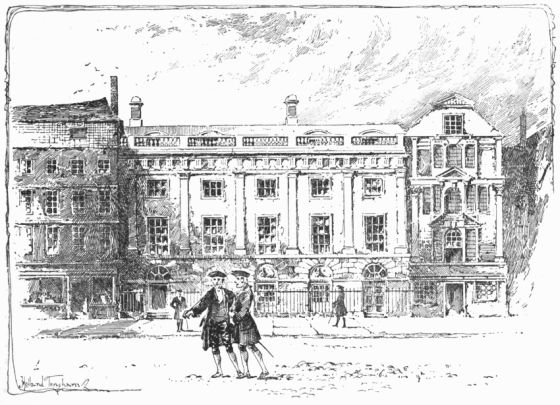
THE OLD EAST INDIA HOUSE IN 1630.
[See larger version]
The extension and improvement of our manufactures was greatly promoted by the persecution of the Protestants in France and the Spanish Netherlands. The revocation of the Edict of Nantes, in 1685, compelled thousands of citizens to seek refuge in England, who, as we have seen, were at first warmly patronised by James II., but afterwards as much discouraged. Their value to the country was, however, too obvious for the community to sanction this neglect. They settled in Spitalfields, and introduced the weaving of silks, brocades, and lutestrings; and the trade and the descendants of these refugees until lately distinguished the same quarter of London. It is supposed that they also brought with them the art of making the finest kinds of writing paper, which was previously imported from France.
Before this, and from the very beginning of this period, other foreigners—refugees tempted by liberal offers—had introduced other manufactures. In the year of Charles's accession, the Anglo-French population of Jersey and Guernsey were allowed to import wool from England duty free, and pushed their manufacture—worsted hosiery—to great perfection. In 1660 some Flemings introduced the improved arts of dyeing and dressing woollen cloths, by which they raised our cloths to an equality with the Continental ones. Other foreigners in the same year were encouraged to commence the manufacture of linen and tapestry. Some others settled at Ipswich, in 1669, and the Scots, who had carried the linen-weaving to Ireland, were at this time making great progress with it there. In 1670 the Duke of Buckingham brought from Venice men skilled in the manufacturing of glass; the Dutch loom was brought over, and, in 1676, the printing of calicoes, now so vast a trade at Manchester, was commenced in London, in imitation of those brought from India. In 1680 machines for ribbon-weaving were introduced, to which Coventry owed so much of her trade. The art of tinning sheet-iron was brought over from Germany by natives of that country, at the instigation of Andrew Yarranton, the agent of an English company. A Dutchman erected the first wire-mill in England at Sheen, near Richmond; and pinchbeck was introduced by its inventor under the patronage of Prince Rupert. In fact, the seeds of many of the greatest branches of English manufactures were sown during this period.
One of our largest trading companies also was fast growing, and was destined to lay the foundation of the grandest colonial territory which the world ever saw. Most of the companies which had previously existed were now gone down, or were broken up by the increasing aversion of the nation to monopolies; but the East India Company were every day acquiring fresh life and power. The scene of their operations lay so distant from public observation, particularly at that day when the means of communication were so tardy and partial, and the Press did not maintain an instant and perpetual attention upon everything concerning the realm, that the Government were only too glad to leave with the Company the whole management of those remote affairs, especially as they poured so much profit into the country, of which the Government had their share. Accordingly, Charles had scarcely seated himself on his throne than he renewed the charter of the Company granted by Cromwell in 1657, with augmented powers. This charter, dated the 3rd of April, 1661, gave the Company the most absolute and unconditional power. They were authorised to seize and send home any Englishman presuming to trade in the East, and found so trading either in India or the Indian seas. They were empowered to appoint their own judges, and conduct the whole civil and military establishment; to make war or peace with any of the native powers, or any powers not Christian; to build any ports they pleased there or in St. Helena for their accommodation and defence. In short, the most complete absolutism was conferred on them in their territories, or such as they should gain, and the most entire secrecy of transactions, by shutting out every individual who might be disposed to pry into or criticise their proceedings.
Bombay, which Charles had received with Catherine from Portugal, as part of her marriage portion, was, in 1667, handed over to the Company, and the effect of this addition of territory and of power was soon seen. In 1676 their accumulated profits had doubled their capital, and the price of their stock rose to 245 per cent. The following facts, drawn from a publication supposed to be written by Sir Josiah Child, entitled "The East India Trade a most Profitable Trade to this Kingdom," which appeared in 1667, will show the extraordinary traffic of the Company at that early period. They employed, the writer said, from thirty to thirty-five ships of from three hundred to six hundred tons burden. Their annual exports amounted to £430,000, and their imports to £860,000; consisting of silks, raw and wrought, calico, drugs, pepper, indigo, saltpetre, etc. They, moreover, licensed other traders, who brought from India diamonds, pearls, musk, ambergris, etc., to the amount of £150,000, and took out goods from England to double that amount.
The writer proceeds to show how profitable this trade was to the public as well as to the Company:—"The pepper I reckon at eightpence a pound weight; so necessary a spice for all people, which formerly cost us three shillings and fourpence a pound, being nowhere to be had but in India; and were we obliged to have it from the Dutch, they would probably raise it as high as they do their other spices; yet, supposing it so low as one shilling and fourpence a pound, it would be a further expense of £6,000 to the nation. Saltpetre is of that absolute necessity that, without it, we should be like the Israelites under the bondage of the Philistines—without the means of defending ourselves. Possibly, if we had no Indian trade, we might, in time of peace, purchase it, though it would cost us double what it does now. But, in case of war, where could we have sufficient? Not surely from our enemies. Or would our gentlemen, citizens, and farmers be willing to have their cellars and rooms dug up, as in Charles I.'s reign, and be deprived of freedom in their own houses, exposed and laid open to saltpetre-men? Which method would be, besides, by no means equal to the affording us the necessary supplies. Raw silk we might possibly be supplied with from other parts, though not so cheap as from India; and Indian wrought silks serve us instead of so much Italian or French silks, which would cost us almost treble the price of Indian silks, to the kingdom's loss of about £20,000 a year. Calicoes serve instead of the like quantity of French, Dutch, and Flemish linen, which would cost us thrice as much; hereby £200,000 or £300,000 is saved to the nation."
Amongst the articles of the greatest luxury which the Company imported was tea. So long as we procured tea from the Dutch merchants it was too dear for general use. So late as 1666—that is, six years after the Restoration—it cost fifty shillings a pound from the Dutch East India Company; but the English Company soon afterwards made their way to China, in 1678, and imported four thousand seven hundred pounds of it; and from this period we may date the more frequent use of tea. It was long, however, before it became the formidable rival of beef and beer at breakfast, or superseded these articles at the afternoon meal. It was at first sold in the liquid state in London, and it was many years before it made its way through the country; many ladies, in ignorance of its true use, committing the mistake of boiling the leaves, and serving them up as greens, throwing away the liquid!
In 1677, under the privilege of a new charter from Charles, the Company began to earn money in their Indian territories. These privileges were again extended by a fresh charter from Charles in 1683, and by James in 1686. In 1687 the Company laid the foundations of Calcutta, and went on rapidly acquiring trade and territory, to be noticed at a later period.
Meanwhile, the trade with our American and West Indian colonies was becoming valuable. During the latter years of the Stuart dynasty, the exports to these colonies had risen to the amount of about £400,000 per annum, in different manufactures, provisions, household furniture, etc.; and the imports thence in tobacco, sugar, ginger, cotton wool, fustic, indigo, cocoa, fish, furs, and timber to nearly a million. Thus the trade and wealth of England at the close of this period were in a condition of healthy and rapid development, and our colonial system was beginning to attract the "envy and admiration of the world." What this has grown to by a steady progression in our time may be seen by comparing the revenue of the country now with what it was then. Then it amounted to about £1,500,000; now it amounts from all sources to over £141,000,000.
Notwithstanding the rapid growth of the country in commerce and internal wealth, it would be a false indication that the working classes were well off. They were a body without education, without political rights, and, consequently, without that intelligence and union which can alone insure the fair reward of their labour; nor was the humanity of the most civilised portion of the community at that period of a degree which regarded the sufferings of others with much feeling. All accounts of it leave the impression that it was a hard and cruel age; as is usually the case, when sensuality and barbarity go hand in hand. The sanguinary vengeance which Charles took on the leaders of the Commonwealth immediately on his restoration; the savage persecutions for religion in England and Scotland; the terrible use of the iron boot and the thumbscrew in the latter country; the bloody campaign of Jeffreys in England; the sale of convicts, and the kidnapping of innocent people for the Plantations; public whippings, pilloryings, brandings, and tongue-borings, as in the case of James Naylor—all indicate a brutal and unfeeling tone of society. Macaulay quotes from writers of the age many other revolting traits of this stamp. "Whigs were disposed to murmur because Stafford was suffered to die without seeing his bowels burned before his face. Tories reviled and insulted Russell as his coach passed from the Tower to the scaffold in Lincoln's Inn Fields. As little mercy was shown by the populace to sufferers of a humbler rank. If an offender was put into the pillory, it was well if he escaped with life, from the shower of brickbats and paving-stones. If he were tied to the cart's tail, the crowd pressed round him, imploring the hangman to give it the fellow well, and make him howl. Gentlemen arranged parties of pleasure to Bridewell, on court days, for the purpose of seeing the wretched women who beat hemp there whipped. A man pressed to death for refusing to plead, or burned for coining, excited less sympathy than is now felt for a galled horse or an overdriven ox. Fights, compared with which a boxing-match is a refined and humane spectacle, were the favourite diversions of a large part of the town. Multitudes assembled to see gladiators hack each other to pieces with deadly weapons, and shouted with delight when one of the combatants lost a finger or an eye. The prisons were hells on earth—seminaries of every crime and every disease. At the assizes, the lean and yellow culprits brought with them from their cells to the dock an atmosphere of stench and pestilence which sometimes avenged them signally on the bench, bar, and jury. But on all this misery society looked with profound indifference."
But we shall soon find that this conclusion is, on the whole, too sweeping. Even that age had its philanthropists, and we may name the crowds who flocked to witness the agonies of a hanging man to point in some degree the wide distance between the mobs of this age and that. But, as concerns the condition of the people, the important difference is that the humanity which now pervades the community was scarcely to be recognised then. The poor were treated with little tenderness. Though four-fifths of the working people were engaged in agriculture, agriculture was then extended over a very small portion of the country. There was a surplus of hands, and these, therefore, were poorly paid, whilst their clothing and provisions were comparatively high. Not more than half the area of the island was then, it is supposed, in cultivation, and the tillage was rude and slovenly. The rate of wages for agricultural labourers, wood-cutters, shepherds, and the like, differed in different parts of England, but in the best it did not average more than four shillings a week with food, or six shillings without. In 1661, the magistrates of Essex fixed the rate of wages from March to September at eightpence a day with food, and one shilling and twopence without; and for the other months, sixpence with food, and a shilling without. Women had, of course, less. In most counties a similar scale was fixed by the magistrates; and an Act of Elizabeth empowered them to punish whoever gave more or less, and the labourer who received more or less. Wheat at that time was seventy shillings a quarter—a price enormously in excess of current prices. All kinds of clothing that they could make themselves were much higher than with us, because manufacturing was not so extensive.
The wages of artisans were but little better, except in London, where first-rate bricklayers and carpenters could earn two shillings or two-and-sixpence a day. In many counties, indeed, they were restricted to the same rate as that of the labourers. In 1685 this was the case in Warwickshire, where the daily wages of masons, bricklayers, carpenters, shinglers, and other handicraftsmen, were fixed with those of ploughmen, miners, ditchers, etc., at only sixpence a day. A shilling a day is quoted as extravagant wages. The consequence was that children were compelled to work as early as six years of age. This was very much the case at Norwich; and writers of the time refer with pride to the fact that before nine years of age children earned more than was necessary for their own support by twelve thousand pounds a year! The consequence of the miserable pay and the dearness of food and clothing was an amount of pauperism scarcely less than in the reign of Henry VIII. or Elizabeth. The poor rates amounted at that period to from seven to nine hundred thousand pounds a year.
The condition of the poor was rendered infinitely worse two years after the restoration of Charles II. than it had been, by an Act which was passed to prevent them from settling in any other place than the one where they had previously resided. This was the origin of the law of settlement, which continued down to 1834 to harass the poor, and to waste the parochial funds in litigation. In fact, Sir Frederick Eden, in his work on "The State of the Poor," asserts that it caused more litigation, and was more profitable to the lawyers, than any other Act ever passed.
The preamble of the Act of 1662 recounts the prevalence of pauperism, and at the same time professes that this enactment "is for the good of the poor"! "The necessity," it says, "number, and continued increase of the poor, not only within the circles of London and Westminster, with the liberties of each of them, but also through the whole kingdom of England and dominion of Wales, is very great and exceeding burdensome, being occasioned by reason of some defects in the law concerning the settlement of the poor, and for want of due provision of the regulations of relief and employment in such parishes or places where they are legally settled, which doth enforce many to turn incorrigible rogues, and others to perish for want, together with the neglect of the faithful execution of such laws and statutes as have formerly been made for the apprehension of rogues and vagabonds, and for the good of the poor."
It was therefore provided that any two justices of the peace should, on complaint made by the churchwardens and overseers of the poor, within forty days after the arrival of any new comer in the parish, proceed to remove him by force to the parish where he had last a legal settlement, either as native, householder, sojourner, apprentice or servant, unless he either rented a house of ten pounds a year, or could give such security against becoming chargeable as the judges should deem sufficient. This was made more stringent by a subsequent Act, 1 James II. c. 17, which, to prevent any one from getting a settlement by the neglect or oversight of the parish authorities, dated the day of his entrance into the parish only from the time that he gave a written notice of his new abode and the number of his family.
These enactments, in fact, converted the free labourers of England into serfs. They were bound to the soil, and could not move from the spot unless by the will of the overseers and justices. It was not necessary that a man should become chargeable to the parish in order to effect his removal; it was enough that the authorities could assume that he might become so; and it was not till 1795—in fact, till the reign of George III.—that this oppressive law was ameliorated, allowing working people to change their abode as they saw a better chance of employment elsewhere, so long as they did not come upon the parish.
The unsatisfactory state of pauperism to which the law of settlement brought the kingdom set numbers of heads at work to plan schemes of employing the destitute poor; and Sir Josiah Child proposed that persons should be appointed for this purpose, to be called "the fathers of the poor." This seems to be the origin of the modern guardians of the poor. It was too early in the history of endeavour to educate and employ the poor, for these recommendations to receive much general attention; but there were some individuals who set themselves zealously to work to convert the swarming paupers into profitable workers and respectable members of society. The most eminent of these were two shopkeepers of London, Andrew Yarranton and Thomas Firmin. Yarranton was a linendraper; and, being employed by "twelve gentlemen of England" to bring over men from Saxony and Bohemia who understood the art of tinning sheet-iron, he there made close observation of the manufacture of linen, and conceived the idea of introducing the linen manufacture, and employing the unemployed poor upon it and the manufacture of iron. He went to Ipswich, to see whether the linen manufacture could not be established there; but he found the poor already so well employed in the stuff and say and Colchester trade, that he did not think it a suitable place. He calculated the paupers at that time at a hundred thousand, and reckoned that by employing this number at fourpence a day each would occasion a profitable outlay amongst them of upwards of six hundred thousand pounds, by which means almost the whole of the poor-rates would be saved. In 1677 he published a book containing his views called "England's Improvement by Sea and Land," showing how to set at work all the poor of England, with the growth of our own lands; to prevent unnecessary suits at law, with the benefits of a voluntary register; where to procure vast quantities of timber for the building of ships, with the advantage of making the great rivers of England navigable. He gave rules for the prevention of fires in London and other cities, and informed the several companies of handicraftsmen how they might always have cheap bread and drink. In short, Mr. Yarranton was a regularly speculative man, but one who had a good share of calculating common sense in the midst of his manufacturing and philanthropic schemes. Apparently he travelled the kingdom well, and made careful observations as to the best localities for carrying on his proposed trades; and he seems to have come to the conclusion that the midland counties would be the best for the linen manufacture, and that most people might be employed on it. The midland counties he regarded as admirably adapted for the growth of flax, from the fertility of the land, and for the trade, because of the easy conveyance of goods by water on the rivers Trent, Soar, Avon, and Thames, from the counties of Nottingham, Leicester, Warwick, Northampton, and Oxford. He found many parts of England already so well supplied with manufactures, that he did not think the poor required more work there; and his descriptions of the manufactures going on in different parts of the island give a lively view of the manufacturing industry of the time. "In the West of England," he says, "clothing of all sorts, as in Gloucestershire, Worcestershire, Shropshire, Staffordshire, and a small portion of Warwickshire; in Derby, Nottingham, and Yorkshire, the iron and woollen manufactures; in Suffolk, Norfolk, and Essex, the woollen manufacture; in Kent, Sussex, and Surrey, some cloth, iron, and materials for shipping. Then the counties to raise provisions and to vend them at London, to feed that great mouth, are Cambridge, Huntingdon, Buckingham, Hertford, Middlesex, and Berks."
A publication like this of Andrew Yarranton was calculated to produce the most beneficial change in the condition of the people. It pointed out the true resources and wealth of the nation, and showed a way to get rid of pauperism, and at the same time to raise and enrich the whole realm. It made landowners aware of the extent to which their estates would be augmented in value by the introduction of popular industries; and one of its most immediate effects seems to have been its influence on Yarranton's fellow London shopkeeper, Mr. Thomas Firmin.
In "The Life of Mr. Thomas Firmin, late citizen of London, written by one of his most intimate acquaintance," 1698, we learn that he was a shopkeeper of Leadenhall Street. We learn, moreover, that he was born at Ipswich in 1632, and began the world as a tradesman with a hundred pounds. His character for probity and ability was already such that he flourished, married a citizen's daughter with five hundred pounds, and in process of time occupied superior premises in Lombard Street. Here, though a confirmed Unitarian, and entertaining the celebrated Unitarian leader, Mr. Biddle, and procuring him an allowance of one hundred crowns from Cromwell whilst he was kept prisoner in Scilly, yet he was on intimate terms with Dr. Tillotson, and many other eminent Churchmen. Though not bearing on our main subject, the following extract is worth diffusing amongst the religious of to-day:—"During the imprisonment of Mr. Biddle at Scilly, Mr. Firmin was settled in Lombard Street, where first Mr. Jacomb, then Dr. Outram, was minister. With these two, being excellent preachers and learned men, he maintained a respectful and kind friendship. Now also he grew into intimacy with Dr. Whichcot, Dr. Worthington, Dr. Wilkins, afterwards Bishop of Chester; Mr. Tillotson (for he was not yet doctor), Archbishop of Canterbury; but in their dignity, and to their very last, Mr. Firmin had the same place and degree in their friendship and esteem that at any time formerly he had. While Dr. Tillotson preached the Tuesday's lecture at St. Lawrence, so much frequented by all the divines of the town, and by a great many persons of quality and distinction, when the doctor was obliged to be at Canterbury, where he was dean, or was out of town, either for diversion or health, he generally left it to Mr. Firmin to provide preachers for his lecture; and Mr. Firmin never failed to supply his place with some very eminent preacher, so that there never was a complaint on the account of Dr. Tillotson's absence; and this Mr. Firmin could easily do, for now there was hardly a divine of note, whether in London or in the country, that frequented London, but Mr. Firmin was become acquainted with him; which thing helped him much to serve the interests of many hopeful young preachers and scholars, candidates for lectures, schools, cures, or rectories, for whom he would solicit with as much affection and diligence as other men do for their sons or other near relations. See here a trader, who knew no Latin or Greek, no logic or philosophy, compassed about by an incredible number of learned friends who differed so widely in opinion from him."
The secret of it was Firmin's freedom from bigotry, and his perfectly benevolent character. When the Plague broke out in 1665, which carried off nearly a hundred thousand people, and left vast numbers destitute from the flight of the employers, Firmin seized on the plan of manufacturing linen, so earnestly recommended by Yarranton, and this upon a method first set on foot by Thomas Gouge, the clergyman of St. Sepulchre's. This was to buy up both flax and hemp rudely dressed, and give it out to the poor to spin at their own homes. He built a house in Aldersgate, which he called his great work-house, or spinning-house, and there he gave out the flax and hemp, and took in the yarn. The object of Firmin was not to make money by the speculation, but to allow the poor people all the profit; and, indeed, he allowed them more, for he sank a considerable sum of money in it. But he was fast growing rich, and he was too wise to allow himself to become the slave of riches; and though from six hundred pounds his capital had grown to twenty thousand pounds, he determined not to leave more than five thousand pounds behind him. His object was to employ the people instead of giving them money as a charity; and he observed that he found it greatly to the relief of the poor; for that they could earn threepence or fourpence a day, working only such times as they could spare from any other occupations, "who, being at work in their own homes, and where they could with convenience attend it, many of them became so much pleased with it, that so much money given them for doing nothing would not have done them half so much good as that which they got by their own labour in this employment."
But Firmin had not studied the dry rules of political economy, and had, therefore, no objection to give money too where he saw it was needed. He had studied in the school of Christ, who said, "The poor ye have always with you"; and "What you do to one of these little ones you do also unto me." He was not opposed to all almshouses and hospitals, lest people should calculate on them and grow lazy. Concerning this work-house and the spinners, he would often say that "to pay the spinners, to relieve 'em with money begged for 'em, with coals and sheeting, was to him such a pleasure as magnificent buildings, pleasant walks, well-cultivated orchards and gardens, the jollity of music and wine, or the charms of love or study, are to others."
The East India and Guinea Companies, as well as many private persons, took his goods; and the Fire of London, following the Plague, gave him plenty of work to do in the way of assisting the destitute. Firmin added woollen spinning and weaving to the spinning of flax and hemp; but, after all, he considered the making of linens the most adapted to employ the people in such circumstances. "I know of no commodity of the like value," he says, "that can be set up with less stock. Three parts of four, even of that cloth which comes not to above two shillings an ell, will be paid for work to the spinner and weaver; and many times a woman will spin a pound of flax that cost but sixpence or sevenpence to that fineness, that she will receive twelvepence or fourteenpence for her pains, which will make an ell of cloth worth three shillings; at which rate five parts of six will be paid for labour: nay, sometimes I have seen a pound of flax, not worth above one and sixpence at most, spun to that fineness that it hath been worth ten shillings; and in other parts I have seen a pound of flax of not much higher value spun to that fineness that it hath been worth three or four pounds sterling."
Firmin next set children to work in schools of industry—a plan again introduced as new in our own day. The idea, he confesses, came from abroad, but he had the honour of introducing it in England. "I have," he says, "at this time some children working for me, not above seven or eight years old, who are able to earn twopence a day, and some, that are a little older, two shillings a week; and I doubt not to bring any child about that age to do the like; and still, as they grow up and become proficients, even in this poor trade of spinning, they will be able to get more and spin better than older people. Neither would I have those schools confined only to spinning, but to take in knitting, and make lace or plain work, or any other work which children shall be thought most fit for." He then refers to the foreign practice, and to the fact of children being employed at Norwich, where it was computed that they had earned twelve thousand pounds more than they had spent in knitting fine Jersey stockings.
This was a plan admirable for teaching children all kinds of businesses and household work, but liable to enormous abuses; and the trading community seized on it and carried it into coal mines, and cotton and other factories, to that fearful extent of cruelty that compelled the Legislature of our time to step in and protect the unhappy children. Firmin's honest and benevolent mind did not foresee this evil use of the idea; yet he was by no means incautious. He used to beg often as much as five hundred pounds a year, and distribute it amongst the poor; but he always took pains to inquire into cases of real necessity, and visited the sufferers in their own houses to convince himself of their actual distress.
In Yarranton, Gouge, and Firmin we see the pioneers of that great host of philanthropists who have from time to time followed in their steps, till now the whole country is alive with schools, ragged schools, reformatories, schemes of industry, and the numerous institutions which are on foot to improve the condition of the poor. In that age we see the germs of the vast manufacturing system which has made one great workshop of Britain, and caused its redundant population to overflow to the amount of nearly a quarter of a million a year into other countries and hemispheres, carrying their industrious habits and skill to found new nations. Indeed, taking altogether the age under review, notwithstanding the dissoluteness of the Government and the selfishness of the upper and middle classes, and the roughness of the lower, it was an epoch in which the elements of future greatness were rife. The rigour and independence which punished the tyranny of Charles I., and created the Commonwealth, though they seemed to recede in Charles II.'s reign, again displayed themselves under James II., and driving away the impracticable Stuarts, established an elective monarchy, the Bill of Rights, and religious freedom. In that period philanthropy became united with manufacturing and commercial enterprise, whence have sprung the glory and greatness of England; and then, too, in the writings of Child, Davenant, Petty, and others, dawned the first principles of political economy, afterwards elaborated into a system by Adam Smith, and still perfecting itself as a science by the correction of its errors, and the blending of a spirit of humanity with its original exactness of deduction. The great principles of the Commonwealth moulding the monarchy at the Revolution to its demands, settled permanently the liberties and the ascendency of the English race.
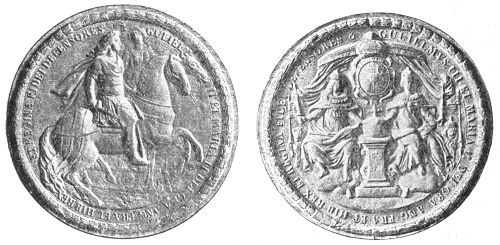
GREAT SEAL OF WILLIAM AND MARY.