Chapter V · (continued 2)
Reading edition
But all argument was lost on that fiery section. Scott and Haselrig continued their assaults on the whole frame of government more strenuously than ever; and on the 4th of February, fifteen days from the meeting of Parliament, amid the confused bickering of Scott and Haselrig with the wearied House, arrived the Usher of the Black Rod to summon the members to the Other House, which he called boldly the House of Lords. Haselrig, in the midst of his harangue, was reminded of the presence of the Black Rod. "What care I for Black Rod?" he exclaimed, but he was compelled to obey.
The Protector expressed the intensity of his disappointment that the very men who had importuned him to assume the burden of Government, and even the title of king, should now, instead of attending to the urgent business of the nation, endeavour violently to destroy that Government, and throw everything into chaos. "I can say in the presence of God," he continued, "in comparison with Whom we are but like poor creeping ants upon the earth, I would have been glad to have lived under a wood-side, to have kept a flock of sheep rather than have undertaken such a Government as this. But undertaking it by the advice and petition of you, I did look that you, who had offered it unto me, should make it good." He added, "And if this be the end of your sitting, and this be your carriage, I think it high time to put an end to your sitting; and I do dissolve this Parliament." And thus closed the last Parliament of Cromwell, after a session of a fortnight.
Having dismissed his Parliament, Cromwell had to take summary measures with the host of conspirators whom his refractory Parliaments had only tended to encourage. Since the "Killing no Murder" of Sexby, there were numbers who were by no means careful to conceal that they loved these doctrines, and persuaded the discontented that to kill Cromwell was to cure all the evils of the nation. The Royalists, on their part, who had always been advocates and practisers of assassination, were more than ever on the alert. In the beginning of the year 1658 the plan of an invasion was completed. The King of Spain furnished one hundred and fifty thousand crowns towards fitting it out: arms, ammunition, and transports were purchased in Holland, and the port of Ostend was to be the place of embarkation. The greatest drawback to the hopes of the Royalists were the dissipated and debauched habits of the king. Ormond, writing to Hyde, observed that he feared Charles's immoderate delight in empty, effeminate, and vulgar conversation was become an irresistible part of his nature, and would never suffer him to animate his own designs and the actions of others with that spirit which was necessary for his quality, and much more for his fortunes. Yet this was the man on whom their hopes of the restoration of monarchy were built. Ormond and O'Neil ventured to England in disguise, in order to ascertain what were really the resources and the spirit of the Royalists in the country. Ormond had private communication with all parties—with the Earls of Manchester and Denbigh, with Rossiter and Sir William Waller, as Presbyterians opposed to Cromwell and the Independents; with Saye and Sele and others, who were willing that Charles should return on his signing the same articles that his father had offered in the Isle of Wight; and with such of the fanatic Levellers as held the opinions of Sexby. But he found little that was encouraging amongst any of them. If we are to believe Clarendon, he was betrayed by one of those in whom he most trusted, Sir Richard Willis, who was high in the confidence of Charles, but was at the same time a paid spy of Cromwell's. It is certain that one day in March the Protector said to Lord Broghill, "An old friend of yours is in town, the Duke of Ormond, now lodged in Drury Lane, at the Papist surgeon's there. You had better tell him to be gone." Broghill found that this was the case, and gave Ormond the necessary hint, who hurried back to Bruges, and assured Charles and his Court that Cromwell had many enemies, but there was at present no chance of a successful invasion.
But if Cromwell was disposed to allow Ormond to escape, he was compelled to make an example of some other of the Royalist agitators. On the 12th of March the Protector sent for the Lord Mayor and aldermen to Whitehall, informed them that the Duke of Ormond had been lurking in the City to excite rebellion, and that it was necessary to take strict measures for putting down the seditious of all sorts. At the same time he ordered the fleet to sweep the coasts of the Netherlands, which drove in there two fleets intended for the Royalist expedition, and blockaded Ostend. He then determined to bring to justice some of the most incorrigible agitators. Sir Henry Slingsby, who had been confined in Hull ever since the outbreak of Penruddock, had not even there ceased his active resistance, employing himself to corrupt the officers of the garrison, who, being instructed by the governor, appeared to listen to his views, so that ere long he was emboldened to offer them commissions from Charles Stuart. Another person arrested was Dr. Hewit, an Episcopalian clergyman, who preached at St. Gregory's, near St. Paul's, and was a most indefatigable advocate of a royal invasion. There were numbers of the Royalist apprentices and others in the City, who were not patient enough to wait for the invasion; they resolved to rise on the 15th of May, fire the houses near the Tower, and by sound of drum proclaim the king. The Protector told Thurloe that "it was not fit that there should be a plot of this kind every winter," and Thurloe had made himself thoroughly aware of all their proceedings. As the time approached, the ringleaders were seized at the "Mermaid," in Cheapside. A High Court of Justice was appointed according to Act of Parliament, and Slingsby, Hewit, and the City incendiaries were tried. There was ample proof of their guilt. Hewit denied the authority of the court and refused to plead, but he was all the same condemned with Slingsby and six of the City traitors to death.
In the Netherlands Sir William Lockhart admirably supplied the place of Sir John Reynolds, acting both as ambassador and general. The Allied army opened the campaign of 1658 with the siege of Dunkirk. The Prince of Condé had in vain assured the Spaniards that this would be the case, whilst they imagined that the intention of the Allies was to besiege Cambray. When Don John saw his mistake, he determined to attack the Allies and raise the siege. But Turenne and Lockhart would not wait to be attacked; they marched to meet the Spaniards, and surprised them before they had received their supply of ammunition for the intended assault. Don John hastily drew up his forces along a ridge of sandhills, and gave the command of the right wing to the Duke of York, and the left to Condé, himself commanding the centre. Lockhart was too ill to take the command, but gave it to Colonel Morgan, who, with his English forces, found himself opposed to the Duke of York. The English dashed up the sandhill, and soon drove the infantry of the enemy before them. They were then charged by the Duke of York at the head of the Spanish cavalry, and the battle was terrible, but nearly half of the duke's men fell under the well-directed fire of his countrymen. The left wing, however, under Condé, had given way, and the duke, leaving his rallied infantry to contend with the English in front, directed the charge of his cavalry against their flank. It was in vain; the centre gave way without fighting, and the brave English defending themselves against their numerous assailants till relieved by a body of French horse, the whole line of the Spaniards collapsed. The Duke of York, who had fought gallantly, was saved in the first charge only by the temper of his armour, and in the second he was surrounded by the enemy, and, according to his own account, only extricated himself by assuming the character of a French officer, and leading on several troopers to the charge till he saw a chance of riding off. Marshal Turenne gave the credit of the victory to the gallantry of the English, who had, at the close of the battle, scarcely a single officer left alive. At Whitehall the victory was attributed to the prayers of the saints at Court, for it happened that the Protector had set apart that day for a solemn fast, and, says Thurloe, "whilst we were praying, they were fighting, and the Lord gave a signal answer."
The Lord Falconberg was despatched to carry congratulations to Louis XIV., who was at Calais, and soon afterwards these were returned by the Duke of Crequi and M. Mancini, the nephew of Mazarin, who expressed his regret that, owing to the urgency of affairs, he was unable to come himself, as he said he had long desired; but he sent a magnificent sword from the king, and a fine piece of tapestry from himself. Dunkirk was given up to the English, Gravelines was taken, Ypres surrendered, and all the towns on the banks of the Lys fell into the hands of the conquerors.
Here closed the victorious career of Oliver Cromwell; these were the last of his triumphs, and nearly the last of his life. Though he now stood apparently at the summit of fortune, both domestic and foreign enemies being for the time subdued, yet the grand platform of life and mortal glory was already giving way beneath him. His health was undermined by the long conflict with a host of enemies, and circumstances around him were gloom. Sickness had entered, death was about to select its victims from his own house. His daughter Frances was left a young widow by the death of Lord Rich, son of the Earl of Warwick, twelve days after the dissolution of Parliament; his daughter Claypole, his favourite daughter, was lying ill, and beyond the reach of medical art at that period, and his own iron frame was yielding. Around him, in his outward affairs, the circumstances were full of anxiety. He knew that he had repulsed, but not destroyed, the domestic enemies of his Government. They were as alert as ever to the chance of starting up and again attempting to overturn his power. All his three Parliaments had proved thoroughly unmanageable, and had reduced him to the very measures so strongly condemned in Charles I.—continual interruption of the debates, invasion of privileges, and abrupt dissolutions to prevent the completion of hostile measures. The only circumstance in his favour was that Charles's arbitrary acts were for the formation of despotism; his for that of a rational liberty. Under no previous Government had the people enjoyed such just laws, such just judges, and so much liberty, especially religious liberty.
But, like Charles, Cromwell was now governing without a Parliament, and, like him, being without a Parliament, he was without funds. The wars on sea and land had emptied his exchequer, and to raise supplies by arbitrary means would cover him with the odium which had clung to the king he had overthrown. He appointed a committee of nine persons to consider as to the best means of calling a Parliament likely to work with the existing Government, and also to decide on the successor to the Protectorate. But on this committee there were secret enemies, and it came to no conclusion as to the Parliament; but as to the succession, it determined that since the succession had been left to the Protector, it was a matter of no consequence. Suspecting their motives, and deriving no benefit from them, he dismissed the committee towards the end of July, and was left with no resource but the ingenuity of Thurloe, his secretary, who borrowed where he could, but was often refused. This could not, however, last. His army was his grand prop, and so long as it was duly paid and clothed there was no danger, but let payment fall into arrears, and it would soon begin to listen to the suggestions of the Republican and Anabaptist officers. With these gloomy circumstances, his suspicions seem to have grown of those about him, or of assassins who might make more successful attempts than before; as his health failed his fears acquired a decided mastery. He is said to have worn armour under his clothes: we know that he had long carried loaded pistols. Clarendon says he had become much "less easy of access, nor so much seen abroad; and he seemed to be in some disorder when his eyes found any stranger in the room, upon whom they still seemed fixed. When he intended to go to Hampton Court, which was his principal delight and diversion, it was never known till he was in the coach which way he would go; and he was still hemmed in by his guards before and behind; and the coach, in which he went was always thronged as full as it could be with his servants, who were armed, and he seldom returned the same way he went, and rarely lodged two nights together in one chamber, but had many furnished and prepared, to which his own key conducted him."
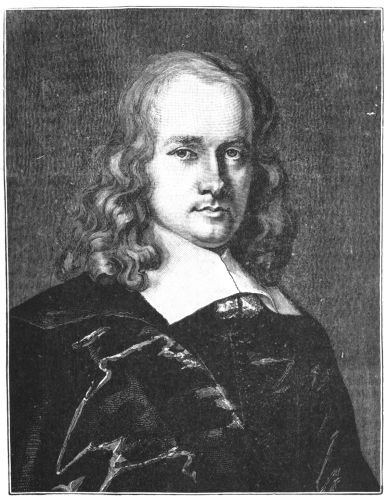
JOHN THURLOE.
[See larger version]
Though this is the statement of an enemy, we can very well believe it, for Cromwell's life had been for years aimed at by assassins, both Royalist and Republican, by paid bravoes of Charles II., and by fanatics. These various fears and anxieties told strongly as his health failed. He reached his fifty-ninth year in April, and was therefore pretty advanced towards his sixtieth. For fourteen days before the death of Mrs. Claypole, the Protector was almost day and night by her bedside, not being able to attend to any business in his deep anxiety. Mrs. Claypole died on the 6th of August, and George Fox going to Hampton Court, to represent to Cromwell the persecutions of his friends, on the 20th of that month, met him riding in Hampton Court Park at the head of his Life Guards, and was so struck with his altered appearance, that he said "he felt a waft of death go forth against him, and when he came up to him he looked like a dead man." On hearing George's statement, he desired him to come to the palace to him; but next day, when Fox went thither, he was told that he was much worse, and that the physicians were not willing he should speak with anybody.
Cromwell died on the 3rd of September, the day of Dunbar and Worcester, the day which he had set down as his fortunate day, and which was in nothing more so than in this last event. He laid down a burden which he had often said "was too heavy for man," and with the possession of that form of government which he sincerely deemed essential to truth and liberty still in his grasp. It was a form of government which had no foundation in the convictions of the people, and which sooner or later was bound to fall; and the old prejudices in favour of royalty bring back a fresh lesson of martyrdom to its votaries. The Dictatorship was at an end; it had been maintained by Cromwell's innate vigour, and could only last as long as he did. The day that he died was a day of terrible wind, and his enemies declared that the devil came in it to fetch him away; but his friends said that Nature could not witness the departure of so great a spirit without marking its strong emotion. Many are the sayings of his last hours reported by friends and foes, but it is certain that he expressed his firm belief that he died in the unbroken covenant with God.
On his deathbed the Protector had been asked to name his successor. Empowered by the "Petition and Advice," he had already named him in a sealed packet, which now, however, could not be found, and though he was supposed to say Richard, it was so indistinctly, that it was by no means certain. However, Richard was proclaimed in London and Westminster, and then in all the large towns at home, and in Dunkirk, and the colonies abroad. At first all appeared favourable for the peaceable succession of Richard. All parties hastened to congratulate him. Foreign ministers sent addresses of condolence and intimations of their desire to renew their alliances. From all parts of the country, and from the City, and from one hundred congregational churches, poured in addresses, conceived in the most fulsome affectation of religion. Cromwell had been a Moses, but his son was a Joshua. Elijah was gone, but Elisha remained.
The Royalists were confounded to find everything pass over so smoothly, but all who knew the retiring disposition of Richard, and the volcano of raging materials which lay in the sects, factions, and parties which at that moment divided and agitated England, could only look on it as the lull before the tempest. Richard Cromwell had all his life long displayed a liking only for a quiet country life. He had no ambitions, either military or political. He had lived in his domestic retirement, entering neither the field nor the cabinet, and his father, in his letters, was continually calling him "indolent Dick." It was impossible that such a man could ever curb the fierce and conflicting factions with which he was surrounded; it is most probable that he only longed to be well rid of the whole onerous burden.
There were various leaders in the army so nearly equal in rank and influence that there was sure to be strife for the chief command. Fleetwood had married a sister of the present Protector; Desborough was his uncle; his brother Henry, who was Lord-Lieutenant of Ireland, was a much more resolute and able man than himself; and Monk, in Scotland, had great power in his hands. The chief command in the army lay, by the late Instrument, in the Protector himself; but the officers of the army met and drew up a petition that the chief command should be conferred on some one of the generals who had shown his attachment to the cause by his services, and that no officer should be deprived of his commission except by sentence of a court-martial. Richard, by the advice of Thurloe, replied that he had appointed General Fleetwood lieutenant-general of the forces, but that to give up the supreme command would be to violate the "Petition and Advice," by which he held his own authority. This did not content the officers; they still held their meetings, a liberty which Oliver had wisely suppressed, and there were many suspicions expressed amongst them. They asserted that Henry Cromwell would soon be placed above Fleetwood, who, though conscientious, was very weak and vacillating, and they demanded that Thurloe, St. John and Pierpoint, Richard's ablest counsellors, should be dismissed, as enemies to the army. It was clear that a collision must take place between these parties and Thurloe, and his friends advised Richard to call a Parliament, by which he would not only be able to curb the power of the officers, but to raise money for the payment of the soldiers. The nation was keeping a large fleet under Ayscue, or Ayscough, part of which was cruising in the Baltic, to protect the English allies, the Swedes, against the Danes and Dutch, and another, under Montague, was blockading the Dutch coast. Money, therefore, was absolutely necessary to defray expenses, and Richard consented to call a Parliament. It was a necessary evil, a formidable undertaking. For the five months that passed before their meeting, Richard ruled with all the outward state, and with more than the quiet of his father. But his father, with all his vigour and tact, had never been able to manage a Parliament, most of the members of which immediately set about to overthrow him; what hope, then, that Richard could contend with such a restless and domineering body? It was absolutely impossible, and he was speedily made sensible of it. To introduce as many members of the Commons as he could favourable to his views, he departed from his father's plan of only calling them from the larger boroughs and the counties, and restored the franchise to the lesser and decayed boroughs. Every means was used besides to obtain the return of men favourable to the Government; and in Scotland and Ireland, from whence thirty members each were admitted, the elections were conducted under the eyes of the commander of the forces. But, notwithstanding, from the very first assembling of the Commons, they showed that they were likely to be as unmanageable as ever. When Richard summoned the Commons to meet him in the Lords scarcely half the members attended, lest they should sanction the existence of a body which they disclaimed. The Commons were as much divided as the army. There were the friends of the Government, who were instructed to stand firm by the "Petition and Advice," and the Government, founded by it, of one ruling person and two Houses of Parliament. Then there were the Presbyterians and Republicans, who were for no Lords nor Protector either, and were led on by Haselrig, Scott, Bradshaw, Lambert, Ludlow, and others of those united parties, with whom Vane and Fairfax now co-operated. Fairfax, from the moment when he showed his disapprobation of the death of Charles I., had retired into private life, but now he reappeared, and though become a Royalist at heart, his spirited lady no doubt having roused that feeling in him, he voted with the Republican party, as most likely to prevail against the Protectorate, and thus pave the way to monarchy. Besides these, there were many neutrals or moderates, and a considerable sprinkling of young Royalists, who, by Charles's advice, had got in under other colours.
However much these parties differed amongst themselves, there were sufficient of them adverse to the Protectorate to commence an immediate attack upon it. They fell at once to debating the legality of the "Petition and Advice," and of course Government by a single person and two Houses. They asked what was the "Petition and Advice," and they declared it to be an instrument of no validity, passed by a very small majority of a House from which a hundred members had been forcibly excluded. The debates were long and violent. Though Parliament met on the 27th of January, 1659, it was the 14th of February before they had decided that Richard's right to the Protectorate should be settled by another Bill, but with much restricted prerogative, and it was not till the 28th of March that they allowed the right of the other House to sit, but with no superiority to the Commons, and with no authority to send messages to it except by members of the House. These points settled, there were high demands for a searching inquiry into the management of all departments of the State, with heavy charges of waste, embezzlement, oppression, and tyranny, in the collection of the excise. Threats of impeachment were held out against Thurloe and the principal ministers, as well as against Butler and some others of the officers.
This aroused the generals, who were themselves divided into two great factions. One set met at Whitehall under Ingoldsby, Whalley, Goffe, Lord Charles Howard, and others favourable to the Protector; another, under Fleetwood and Desborough, met at Wallingford House, who, though the Protector's own relations, were bent on their own and the army's ascendency. They were joined by Lambert, who, after being deprived of his commission, had remained at Wimbledon, cultivating his garden, and seeming to be forgotten; but now he came forth again and was received with enthusiasm by the soldiers, who had great confidence in his ability. Desborough used also to meet with a third party, consisting chiefly of the inferior officers, at St. James's.
At this place of meeting a council of officers was organised, which soon became influential with the Wallingford House, or Fleetwood's, section. Here they drew up an address to Richard, complaining of the arrears of their pay being withheld, and of the neglect with which the army was treated; of the attempts to overthrow the Acts passed by the Long Parliament, and the encouragement thereby given to the Royalists, who were flocking over from Flanders, and exciting discontent against "the good old cause," and against the persons and interests of those who had shed their blood for the Commonwealth. This address was presented on the 14th of April by Fleetwood, with no less than six hundred signatures. Though it did not even mention the name of this Parliament, that body felt that it was directed entirely against them, and immediately voted that no meeting or general council of officers should be held without the consent and order of the Protector, and that no person should hold any command by sea or land who did not forthwith sign an engagement that he would not in any way disturb or prevent the free meeting and debates of Parliament, or the freedom of any member of Parliament. This was certain to produce a retort from the army—it was an open declaration of war upon it; and accordingly Fleetwood and Desborough waited on Richard and assured him that it was absolutely necessary to dissolve Parliament; and Desborough, who was a bold, rough soldier, declared that if he did not do it, he felt sure the army would soon pull him out of Whitehall.
It may be questioned how far this declaration was warranted by the real facts of the case. The majority of the army was probably opposed to any violence being shown to the son of the great Protector, but in critical times it is the small knot of restless, unscrupulous spirits who rule the inert mass, and impose their own views upon the sluggish and the timid; and Desborough well knew the irresolute and impressionable character of Richard Cromwell.
On the other hand, many members of Parliament protested that they would stand by him, that if he allowed the army to suppress Parliament, he would find it immediately his own master, and would be left without a friend. Ingoldsby, Goffe, and Whalley supported this view, and one of them offered to go and kill Lambert, who was the originator of all the mischief. Richard called a council to consider the proposition. Whitelock represented the danger of dissolving Parliament, and leaving himself at the mercy of the army; but Thurloe, Lord Broghill, Fiennes, and Wolseley declared there was no alternative, for if the army and Parliament came to strife, the Cavaliers would rise and bring in Charles. Richard reluctantly gave way, and on the 22nd of April he signed a commission empowering Fiennes, the Keeper of the Seal, to dissolve Parliament. Fiennes summoned the Commons to the Upper House by the Usher of the Black Rod, but they shut the door in the face of that officer, and refused to obey, adjourning themselves for three days. Fiennes, however, declared Parliament dissolved, the Commons having been duly summoned to witness it, and a proclamation was issued to that effect.
The warning of Whitelock was at once verified; the moment that the Parliament ceased, all regard to Richard by the army ceased with it. From that moment he was deserted except by a small knot of officers—Goffe, Whalley, and Ingoldsby,—and he was as completely annihilated as Protector as if all parties had deposed him by assent and proclamation. The council of officers proceeded to take measures for the exercise of the supreme power. They placed guards to prevent the adjourned Commons from re-taking their seats at Westminster as they proposed, and by their own authority dismissed Ingoldsby, Goffe, Whalley, and the other officers who had adhered to Richard, from their commands in the army, and restored Lambert and all the others who had been cashiered by Oliver. Having thus restored the Republicanism of the army, they determined to recall the Rump, as a body which they believed they could command; and they accordingly issued an order for the reassembling of the House of Commons which Oliver had so unceremoniously dismissed on the 20th of April, 1653. At this call, Lenthall, the old Speaker of the Rump, with about forty or fifty members of the Rump, hastened the next day to Westminster, where Lambert kept guard with the troops, and after some discussion in the Painted Chamber, they went in a body to the House through two files of Lambert's soldiers, and took their places as a real Parliament. But their claim to this exclusive right was immediately disputed. The same day, the 7th of May, a large number of the members who had been excluded by Pride's purge, in 1648, of whom one hundred and ninety-four were still alive, and eighty of them residing in the capital, assembled in Westminster Hall, and sent up to the House a deputation of fourteen, headed by Prynne, Annesley, and Sir George Booth, to demand equal liberty to sit; but as this would have overwhelmed them with a Presbyterian majority, the doors were closed against them: they were kept back by the soldiers who filled the lobby, who were ironically called "the keepers of the liberties of England," and they were informed that no member could sit who had not already signed the engagement. On the 9th, however, Prynne made his way into the House, and kept his seat, in spite of all efforts to dislodge him, till dinner-time; but going out to dine, he found himself shut out on his return.
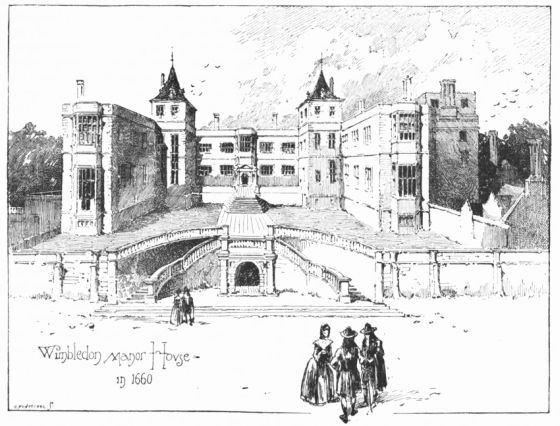
THE MANOR HOUSE, WIMBLEDON (1660).
[See larger version]
The Rump now proceeded to appoint a Committee of Safety, and then a Council of State, which included Fairfax, Lambert, Desborough, Bradshaw, Fleetwood, Ashley Cooper, Haselrig, Vane, Ludlow, St. John, and Whitelock. Letters were received from Monk in Scotland, congratulating the Rump on their return to power, but hypocritically begging them to keep in mind the services of Cromwell and his family. Lockhart sent over from Flanders the tendered services of the regiments there, and was confirmed in his office of ambassador, and also commissioned to attend a conference between the ministers of France and Spain, to be held at Fuentarabia, whither Charles Stuart had also betaken himself. Montague sent in the adhesion of the fleet, and, what was still more consoling, Henry Cromwell, whose opposition in Ireland was much dreaded, resigned his office, and was permitted to retire into private life.
The Wallingford House party of officers alone created serious apprehension. They sent in a list of fifteen demands, which were immediately taken into consideration, and the Rump successively voted, in compliance therewith, that a form of government should be passed calculated to preserve the liberties of the people, and that it should contain no single person as Protector, nor House of Peers. They also agreed that liberty of conscience should be allowed to all believers in the Scriptures who held the doctrine of the Trinity, except Papists and Prelatists. But one of these demands was for lands of inheritance to be settled on Richard Cromwell to the value of ten thousand pounds a year, and a pension on her Highness, his mother, of ten thousand pounds a year. On this it was remarked that Richard was still occupying Whitehall as if he were Protector, and they made it conditional that he should remove thence. They proposed that if he retired from the Protectorate, they would grant him twenty-nine thousand pounds for the discharge of his debts, two thousand pounds for present necessities, and ten thousand pounds to him and his heirs. Richard cheerfully signed a formal abdication in May, 1659, but his pension was never paid. After the Restoration he fled to the Continent, where he remained for twenty years. He returned in 1680, and lived peaceably on his estate at Cheshunt, or at Mardon, in Hursley, near Winchester, which he received with Dorothy Mayor, and there spent a jolly life in old English state, dying in 1712. During his father's life, he is said in convivial hours to have drunk the health of his father's landlord, Charles Stuart; and he possessed a chest which contained the addresses and congratulations, even the protestations of profound fidelity from corporations, congregations, and almost all the public men, and on this chest he would seat himself in his jocund hours, amongst his convivial friends, and boast that he was sitting on the lives and fortunes of most of the leading men of England. Henry Cromwell also passed his life as a quiet country gentleman on his estate of Swinney, near Soham, in Cambridgeshire, till his death in 1673. His government of Ireland was, on his resigning, put into the hands of five commissioners, and the command of the army was given to Ludlow.
Charles and his party abroad, watching the continual bickerings of their enemies in England, put in motion all their machinery to create confusion, and to seize the opportunity of taking every possible means of procuring a revolt amongst them. Charles, to encourage his partisans, announced his intention of coming to England to head them. The 1st of August was fixed on for a rising, and Charles hastened into Boulogne, to be ready to pass over into Wales or Cornwall. The Duke of York was to lead over six hundred of the Prince of Condé's veterans, and, crossing from Boulogne, land on the coast of Kent, whilst the Duke of Gloucester was to proceed from Ostend with four thousand troops under Marshal Marsin. Unfortunately for them, their plans had been revealed to Thurloe by Sir Richard Willis, one of the king's sealed knot of seven trusted confidants. Convinced by this treason that the enterprise would fail, Charles sent circular letters to stop the rising. But these in some instances arrived too late. Many appeared in arms, and were fallen upon and routed or taken prisoners by the Parliamentarians. Sir John Gore, the Lady Mary Howard, daughter of the Earl of Berkshire, in addition to many other persons of distinction, were arrested on charges of high treason. In Cheshire Sir George Booth raised the royal standard, and took possession of Chester; but on learning the news of the king's deferring the enterprise, and that General Lambert was marching against them, he and his associates fled to Nantwich, where Lambert overtook and totally routed them. Colonel Morgan, with thirty of his men, fell on the field; the Earl of Derby was taken disguised as a servant; Sir Thomas Middleton, who was eighty years old, fled to Chirk Castle, but soon surrendered; and Booth himself, disguised as a woman, and riding on a pillion, was betrayed and taken on the road to London, near Newton Pagnell. This unlucky outbreak and defeat threw the adherents of Charles abroad into despair. Montague, the admiral, who had been won over, and had brought his fleet to the mouth of the Thames to facilitate the passage of the king's troops, pretended that he had come for provisions, and, though he was suspected, he was allowed to return to his station. Charles himself, now almost desperate, made a journey to Fuentarabia, where Mazarin and Don Louis de Haro, the ministers of France and Spain, were engaged in a treaty, in the hope that, if it were concluded, he might obtain some support from them. But he was very coldly received; Mazarin would not even see him. In fact, his fortunes were apparently at the lowest ebb, but it was in reality only the dark hour before the dawn. The day of his fortune was at hand.
Parliament, on Lambert's victory, voted him thanks and one thousand pounds to purchase a jewel in memory of it; but Lambert distributed the money amongst his soldiers. Parliament resenting this, regarded it as intended to win the soldiers to his cause, that he might tread in Cromwell's steps, and make himself Dictator. It was well known that he had entertained hopes of being named his successor, and this suspicion was immediately confirmed by his officers, whilst on their march at Derby, signing a petition, and sending it up with a demand that Fleetwood should be made permanently Commander-in-Chief, and Lambert his lieutenant-general. No sooner did Haselrig see this petition, than he denounced it as an attempt to overturn Parliament, and moved the committal of Lambert and its author to the Tower. But Fleetwood repelled the charge by assuring them that Lambert, who was already in town when the petition was got up, knew nothing of it. The House, however, ordered all copies of the paper to be destroyed, and voted that any addition to the number of officers was needless, chargeable, and dangerous. At the same time they proceeded to conciliate the soldiers by advancing their pay, and, to discharge their arrears, on the 5th of October they raised the monthly assessment from thirty-five thousand pounds to one hundred thousand pounds.
Matters were, however, gone too far to be thus settled between Parliament and the army. Haselrig, Scott, and their associates were of that class of sanguine Republicans, who in their zeal think only of the principles they wish to establish, without calculating how far the country is prepared for them, and thus blindly rush on their own defeat. The Wallingford House military council prepared another paper called a petition, but which was a far more hostile communication, asserting that whoever cast scandalous imputations on the army should be brought to condign punishment. That was distinct enough, but Haselrig and his party had got the adhesion of three regiments, and relied on the promises of Monk in Scotland, and Ludlow in Ireland. On the 11th of October a vote was passed, declaring it high treason to levy any money on the people without consent of Parliament, and, therefore, as the existing taxes expired on the first day of the new year, Haselrig's following believed that they had thus rendered the army wholly dependent on them. Next day Haselrig moved and carried a motion that Desborough, Lambert, six colonels, and a major, should be deprived of their commissions for signing the late petition. By another vote Fleetwood was deprived of the office of Commander-in-chief, but made president of a board of seven members, for the management of the army. The blind zealots had witnessed to little purpose the history of late years, and the movements of armies. On the next day Lambert, with three thousand men, marched into Westminster, where he found the Houses of Parliament guarded by two regiments of foot, and four troops of horse. On his way he met Lenthall, the Speaker, attended by a guard. He ordered that official to dismount, and on refusing, according to Clarendon, pulled him from his horse, and sent him to his own house. The soldiers, on the two parties meeting, at once coalesced, and the Rump was again dismissed. The officers at Wallingford House took upon themselves to annul Haselrig's votes of the last three days, and establish a provisional Committee of Safety of twenty-three members. There was a party amongst them for restoring Richard Cromwell, who came up from Hampshire escorted by three troops of horse; but this party was outvoted by a small majority, and he retired.
Whilst these confused changes were taking place—eddies in the national affairs, but neither progress nor honour, Parliament having no power to restrain the army, nor the army any one man of a genius capable of controlling the rest,—there was at least one commander who was silently and reservedly watching the course of events, resolved to go with the strongest side, if such a side could be found. This was General Monk. He was originally a Royalist, and of a strongly Royalist family. His elder brother, with the rest of his relations, had always been zealously devoted to the king, and it is said that his wife was a most ardent advocate for the king's interest. These circumstances had caused Charles frequently to sound him by his emissaries; but though he received them courteously, and listened patiently to their statements, he gave no outward evidence that he was likely to comply with their entreaties. He was a man of deep and impenetrable secrecy and caution, of few words, and a gloomy, unimpassioned manner. Cromwell, during his life, was quite aware of the overtures and royal promises made to Monk, but could not discover the slightest thing in him to warrant a suspicion of his leaning in the smallest degree that way, and he therefore contented himself with jocularly remarking to him in a postscript in one of his letters, "'Tis said there is a cunning fellow in Scotland, called George Monk, who lies in wait there to serve Charles Stuart; pray use your diligence to take him, and send him up to me."
There was not much likelihood of Monk swerving from the Commonwealth while the strong man Cromwell lived, but now, amid such scenes of weakness, he no doubt began to feel that the royal party would have to be recalled. Such a presentiment, however, lay locked in his taciturn breast. The officers sent Colonel Cobbet to Monk in Scotland, who, however, expressed his firm adherence to the Commons, and when he heard of what Lambert and the officers had done, he wrote strong letters to them, complaining of the violence which they had done to the power and authority of Parliament. He imprisoned Cobbet, and purging his army of all who were fanatics or inclined to Lambert and his party, he sent them under guard to the Border, and dismissed them into England, under penalty of death if they returned. He immediately placed strong garrisons in the castle of Edinburgh and in the citadel of Leith, and, collecting cavalry, marched to Berwick, where he placed a strong garrison. Letters were written to Lenthall in the name of himself and his officers, assuring the Parliamentary party that "he called God to witness that the asserting of the Commonwealth was the only interest of his heart." Whilst Haselrig, Lenthall, and the rest were gratified by these protestations, they remarked with wonder, and soon with deep suspicion, that he had cashiered all those officers whom they had introduced into his army, and restored those whom they had expelled. There was no alternative, however, but to act with him and watch him. In the meantime Monk had called a convention of the Scottish Estates at Berwick, and informing them that "he had received a call from heaven and earth to march into England for the better settling of the Government there," he recommended the peace of the kingdom to their care, and obtained from them a grant of sixty thousand pounds, from the arrears of taxes. He then took up his headquarters at Coldstream, and waited the course of events.
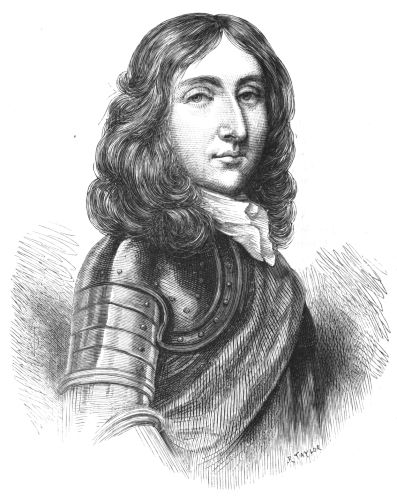
RICHARD CROMWELL. (After the Portrait by Walker.)
[See larger version]
The Committee of Safety, on hearing of the movements of Monk, despatched Lambert with an army of seven thousand men to meet him on his march, and if he could not win him to co-operation with the rest of the army, to resist his advance by force. But having seen Lambert on his way northward, the committee sent directly to Monk a deputation to endeavour to bring him over to their views, by offers of many advantages. Monk received the deputation very courteously, expressed every desire to unite with the rest of the army, provided there were some ruling power to whom all parties might be subject, and sent three commissioners to treat with the Committee of Safety on the subject. This greatly encouraged the Committee of Safety, who thought their sending Lambert against Monk had frightened him, and whilst they prepared to receive Monk's commissioners, they ordered Lambert to hasten on his march.
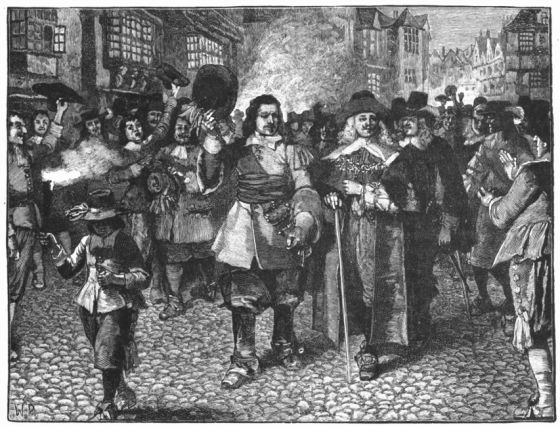
RECEPTION OF MONK IN THE CITY OF LONDON. (See p. 160.)
[See larger version]
But affairs nearer home were every day becoming more disheartening. Haselrig and Morley had gone down to Portsmouth, where they were well received by the governor, and were looked up to as representing the authority of Parliament. Fleetwood sent down troops to oppose them, but the troops themselves went over to them. This success encouraged the apprentices and other dissatisfied persons in London to rise, and demand the restoration of Parliament; and though Colonel Hewson attacked and killed some of them, the spirit and the disturbance only grew the stronger. To finish the matter, Admiral Lawson appeared with the fleet in the Thames, and declared for the Parliament on the 17th of December, and, as soon as they heard this, Haselrig and Morley marched with their forces to London. At their approach the troops in Westminster revolted from the Committee and joined them, declaring that they would live and die with the Parliament. They received those officers who had lately been dismissed, and all marched into Lincoln's Inn Fields, and so to Chancery Lane, where they halted before Lenthall's house, fired three volleys of musketry, and hailed him not only Speaker of the Commons, but Lord-General of the army. This was on Christmas Eve, and Desborough's regiment, which Lambert had sent back to check these counter-movements, on hearing this news, at St. Albans, also declared for the Parliament, and sent the Speaker word of the adhesion. During all this reaction, Fleetwood had still sat with the Committee of Safety, but exhibiting the strangest want of courage and decision. When urged to go and use his influence with the soldiers, to prevent their defection, he fell on his knees and prayed, or declared that it was useless, that "God had spit in his face, and would not hear him."
Whitelock relates that at this juncture he strongly advised Fleetwood to join him and go away to the king, convinced that Monk was deceiving the Parliament, and that the return of Charles was inevitable. He said, therefore, that it was better to get away to him and make terms for themselves and friends whilst the time allowed. Fleetwood was convinced, and ordered Whitelock to prepare for the journey; but Vane, Desborough, and Berry coming in, he quickly altered his mind, and declared that he had pledged his word to Lambert before he marched to do nothing of the kind without his consent. Whitelock repeated that if he did not do it, then all was lost; but Fleetwood, weak but honourable, replied he could not help it; his word was pledged: and in the end he submitted himself to the Parliament.
Lenthall, the Speaker, at the head of a party of soldiers who made themselves merry on their new Lord-General, went into the City, informed the Lord Mayor and Aldermen that the Parliament was assembling, and, on his own authority, ordered from the Tower the governor and officers put there by the Committee of Safety, and placed in command Sir Anthony Ashley Cooper, who had brought in Admiral Lawson, assisted by several members of Parliament. On the 26th of December the Rump met again in that House from which they had been twice so ignominiously expelled. Their first proceeding was to annul their act against the payment of excise and customs, so that they might not be without money, and their next to dismiss Lambert, Desborough, Berry, and other officers, and to order them to retire farther from London; and they ordered Vane, who had adhered to the Committee of Safety, to confine himself to his house at Raby. Thus they were throwing down with their own hands the very bulwarks which should prevent their falling helplessly into the power of Monk and his army. Still more, they sent an order to Lambert's regiments to quit their commander, and retire to such quarters as they appointed. The soldiers having heard of their comrades in the south having gone over to the Parliament, did not hesitate to obey its orders, and Lambert found himself left alone with only about a hundred horse. At Northallerton his officers took their leave of him with tears, and he retired quietly to a house which he had in the country. Thus the expectation of a sharp encounter between Monk and Lambert was at an end, and the road was open to Monk to march to London without opposition.
He had received assurances from Lord Fairfax, that within twelve days he would join him or perish in the attempt, and he forthwith called together his friends, and demanded the surrender of York. On the 1st of January, 1660, the gates of York were thrown open to Fairfax and his followers, and the same day Monk commenced his march southward from Coldstream. Monk remained five days at York in consultation with Fairfax, who did not hesitate to avow his readiness to assist in the restoration of the king. Clarendon tells us that Charles had sent Sir Horatio Townsend to Fairfax, expressing confident hopes of Monk, and requesting him to co-operate with him; and that Parliament had become so apprehensive of him that before his arrival at York they wrote to him, advising him to send back part of his forces, as being needless now in England, while they might prevent danger in Scotland. Monk paid no attention, and the Parliament began to wish him back in Scotland altogether. But it does not appear that Monk in any way committed himself to Fairfax by his words, whatever his conduct might indicate. On the contrary, at York he caned an officer who charged him with a design of bringing in Charles Stuart. On his quitting York Fairfax disbanded his forces, and Monk pursued his march in the same mysterious silence. Parliament had appointed a Council of State, and framed the oath for its members to embrace a most stringent abjuration of royalty and of the Stuart family. The soldiers sympathising with Parliament, the officers on reaching Nottingham proposed signing an engagement to obey Parliament in all things except the bringing in of Charles Stuart. Monk declared this unnecessary, Parliament having expressed itself so strongly on that head; and at Leicester he wrote a reply to certain Royalist petitioners in Devonshire, stating his confidence that monarchy could not be reintroduced, that the excluded members of 1648 could not be safely reinstated, and that it was their bounden duty to obey and support the present Government.
At Leicester arrived two of the most democratic members of Parliament, Scott and Robinson, to watch his proceedings, but ostensibly to do him honour. He received them with all respect, and such was his apparent devotion to Parliament, that they were thoroughly satisfied and highly delighted. At every place he was met by addresses from towns and counties, praying him to restore the excluded members, and procure a full and free Parliament. He replied on all occasions that he was but the servant of Parliament in a military capacity, and referred the applicants to the two deputies for their answers. These gentlemen, who were vehemently opposed to any such restoration of the excluded members, gave very free denials, with which Monk did not in any way interfere.
This conduct, we are assured by Clarendon, extremely confounded Charles and his partisans, who had calculated greatly on Monk's secret inclinations, but the dispersal of Lambert's forces, the retirement of Fairfax, and the vigorous adherence of Monk to Parliament, puzzled and depressed them. It might have been supposed that though Monk had so impenetrably concealed his designs from the adherents of the Commonwealth, that he had a secret understanding with Charles. Clarendon, who was fully in the king's confidence, and his great adviser, solemnly assures us that there was nothing of the kind; that all attempts to arrive at his purpose had been unavailing. By the consent of Charles, Monk's brother, a clergyman in Devonshire, had been induced by Sir Hugh Pollard and Sir John Grenville, the king's agents, to visit the general in the north, and endeavour to persuade him to declare for the king. But Monk took him up very shortly, and advised him to go home and come no more to him with such propositions. To the last moment this secret and solemn man kept the same immovable, impenetrable course. There is little doubt but that he felt, from the miserable weakness and disunion of both the officers and the Parliamentary leaders, the great all-controlling mind being gone, that the king must come again, and that he was ready to do the work at the safe moment. But that till he was positively certain the way was clear of every obstacle, no power on earth should move him. It is probable that he was indifferent to the fact whether the king or the Parliament ruled, but that he would decide for the stronger when it was unmistakably the stronger, and not till then.
To prevent alarm to the Parliament, he brought only five thousand troops with him from York, being much fewer than those which were quartered in London and Westminster; but from St. Albans on the 28th of January he wrote to the Speaker, requesting that five of the regiments there might be removed to other quarters before his arrival, lest there should arise strife between his soldiers and those so lately engaged in rebellion against the Parliament. This startled the Parliament, and dull must those members have been who did not perceive that they committed a series of gross blunders in destroying the greater part of the army, and disbanding their best officers, to clear the stage for a new master. But there was nothing for it but complying. They ordered the regiments to remove, but they refused. Why, they asked, were they to quit their quarters to make room for strangers? Was it expected that they should march away with several weeks' pay in arrear? But their officers, who should have supported them, were dismissed or under restraint, and by coaxing and the distribution of some money, they were induced to go. The greatest difficulty was found with a regiment which occupied Somerset House, and declared they would hold it as a garrison and defend it. But at length they, too, were persuaded to retire, and the next day, the 3rd of February, Monk marched through the City into the Strand and Westminster, where his soldiers were quartered, and himself conducted to Whitehall.
Soon after his arrival Monk, was led to the House of Commons, where a chair was placed for him within the bar, and Lenthall made him an address, applauding his wisdom and services to the Commonwealth, declaring his dispersal of their enemies as a glorious mercy, and returning him thanks. Monk replied, observing that there were demands for a full and free Parliament, but that while it was as well not to impose too many oaths, care must be taken to keep out both the Cavaliers and the fanatic party. Of course, the section of the fanatic party already in the House, with Scott and Haselrig at their head, heard this with resentment; and Monk's sincerity was immediately put to the test by the oath of abjuration of the Stuarts, as a member of the Council of State, being put to him. He parried this, by observing that seven of the councillors already sitting had not taken the oath, and that as for himself, he had given sufficient proofs of his devotion to Parliament. This increased the suspicion against him, and a more explicit proof of his sincerity was put upon him. The Common Council of London had refused to raise money in the City except at the order of a full and free Parliament. The House, therefore, commanded Monk to march into the City to seize ten of the leading opponents in the Council, and to break down the gates and portcullises of the City.
On the 9th of February, two hours after midnight, he received this trying order. If he refused, his commission would be immediately withdrawn, and his plans cut short; therefore he obeyed, and marching into the City, began with all coolness and imperturbability to remove the posts and chains from the streets. The citizens, who expected different conduct from him, and entreated him to desist, assailed his men during their labour with groans and hisses. The posts and chains removed, Monk wrote to the Parliament that he considered that sufficient had been done to crush the spirit of the citizens, but he received a peremptory order to complete the business, which he did by destroying the gates and portcullises, though the soldiers themselves expressed their indignation. He then returned in no agreeable mood to Whitehall. There, however, news awaited him of conduct on the part of Parliament, which seemed to him to show that they now thought that they had made him their pliant instrument, and destroyed at the same time his popularity with the people. Whilst he had been doing this ungracious work in the City, they had been receiving with high approbation a petition from the so-called fanatic or extreme party, headed by the celebrated Barebone, praying that no man might sit in Parliament, or hold any office under Government, who did not take the oath to abjure Charles Stuart, or any single person. This was so plainly aimed at Monk, who had excused himself from this oath, that a council of his officers was at once called, whose resentment of this ungrateful conduct was expressed in a letter drawn up in his name, and despatched to the House the next morning, complaining bitterly of their allowing this attack upon him, and advising that they should take immediate measures for filling up all the vacancies in Parliament, as the only measure which would satisfy the people. To show that this was not a mere admonition but a command, he instantly quitted Whitehall, marched back into the City, summoned again the Common Council, which he had dispersed, and assured them that the conduct of Parliament had now convinced him that they were betraying the interests of the country, that he was sorry he had obeyed them so far as to do injury to "that famous city, which in all ages had been the bulwark of Parliament and of general liberty;" and that therefore he had determined to unite his lot with theirs, and to obtain through them a full and free Parliament.
This announcement was received not only with astonishment, but with enthusiastic expressions of joy. The Lord Mayor and Council plighted their troth with him and the officers, he was invited to dine at the Guildhall, and all the bells in the City were set ringing in exultation. The Corporation attended the general to his lodgings amid the acclamations and the bonfires of the people, at which they roasted rumps in ridicule of the Parliament, and heaped on it every infamy which wit and ribaldry could devise. This coup d'état awoke the Parliament to their blunder; they had made an enemy of the very man and army into whose hands they had put a power which could instantly crush them. There were some zealots, the Haselrigs and Scotts, who advised restoring Fleetwood to the chief command, and bringing back the exiled regiments; but Sunday, which intervened, enabled the more sober counsel to prevail, and they sent a deputation to invite the general to return to Whitehall, and promised that the writs for the excluded members should be ready by the day appointed. But these incidents had made an advance in Monk's proceedings. He had seen, as he came up the country, the universal demand for the restoration of the Long Parliament, and the unmitigated contempt for the present one. He had felt the pulse of the country also as to the return of the king, and his intercourse with the City had only confirmed the impression that the whole body of excluded members must come back as a stepping-stone to the recall of Charles. The Presbyterian interest in the City was as strong as ever, and its enmity to the Independents unabated. He therefore called together his officers to discuss with the deputation the points at issue, and the officers insisted that the excluded members must be restored. Monk then placed the City in a state of defence, and returned to Whitehall. There he summoned the excluded members who were in town, together with the members of the sitting Parliament, and read them a paper, in which he assured them that the people at large demanded a full and free Parliament, as the only means of settling these "bleeding nations." He declared that he would impose no restrictions on them himself, but that his guards should freely admit all the excluded as well as the other members, to take measures for a dissolution of the present Parliament, and the calling of a new one, full and free, on the 20th of April next. He did not believe, he said, that monarchy or prelacy would be tolerated by the people, but that a moderate Presbyterian government, with liberty of conscience, appeared most likely to be acceptable. And as to the Peers, if it were not proper to restore to them their House, yet he thought their hereditary marks of honour should be left them.
This speech confounded Royalists and Extremists alike. He recommended a Presbyterian government and the exclusion of monarchy; but he saw well enough what the effect of his measure would be; the Royalist excluded members would rush in, and the recall of the king would be the inevitable consequence. Accordingly the excluded members proceeded directly to the House with the other members. The guard under Sir Anthony Ashley Cooper opened and admitted them. At this sight Haselrig, Scott, and the Republican party thought it high time to consult their own security, and disappeared from the scene. The House at once set to work; annulled all the orders by which they had been excluded; elected a new Council of State, in which the most influential members were Royalists; appointed Monk Commander-in-Chief, and Commander of the Fleet in conjunction with Montague; granted him twenty thousand pounds in lieu of Hampton Court, which the Rump had settled on him; freed from sequestration Sir George Booth and his associates, who had risen for the king, together with a great number of Cavaliers and Scottish lords taken at the Battle of Worcester; borrowed sixty thousand pounds of the Common Council, established for the present the Presbyterian confession of faith; ordered copies of the Solemn League and Covenant to be hung up in all churches; placed the militia and all the chief commands in the hands of the principal nobility and gentry; and only stipulated that no person should be capable of office or command who did not subscribe to the confession—"that the war raised by the two Houses of Parliament against the late king was just and lawful, until such time as force and violence were used upon the Parliament in the year 1648."
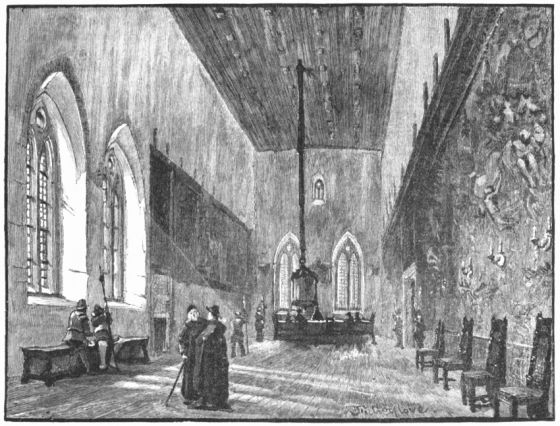
INTERIOR OF THE PAINTED CHAMBER, WESTMINSTER, LOOKING EAST.
[See larger version]
But at this point it was contended by the Royalists that the House of Lords was as much a House as themselves, and that they could not legally summon a new Parliament without them; but Monk would listen to nothing of this kind. He declared that as much had been conceded as the country would bear; and the Parliament was compelled to dissolve itself at the time fixed.
There could certainly be no longer any uncertainty as to whither things were tending. The Royalists were again in full power all over the kingdom, the very insurgents in the cause of Charles were liberated, freed from all penalties, and in many cases advanced to places of trust; yet Monk still dissembled. Ludlow, a staunch Republican, on the re-admission of the excluded members, went to Monk to sound him as to his intentions, and urged the necessity of supporting the Commonwealth, which had cost them so much. Monk replied with solemn hypocrisy, "Yea, we must live and die together for a Commonwealth." Yet Monk had now made up his mind: he saw that all was prepared, all perfectly safe, and during the recess he was busy arranging with the king's agents for his return. Immediately on Monk's joyful reception by the City, a Mr. Baillie, who had gone through Cheapside amongst the bonfires, and heard the king's health drunk in various places, and people talking of sending for the king, had posted off to Brussels, where Charles was. On this Sir John Grenville and a Mr. Morrice, a Devonshire Royalist, were instantly sent over to Monk, with propositions for the king's return. Clarendon assures us that so early as the beginning of April these gentlemen were in London, and in consultation with Monk, who told them that if the king would write a letter to Parliament containing the same statements, he would find a fit time to deliver it, or some other means to serve his Majesty; but that Charles must quit Flanders to give his partisans confidence that he was out of the power of the Spaniards, and would be free to act on their call; that he must go to Breda, and date his papers thence.
All this was done, and so little secrecy was observed by the Royalists on the Continent, that it was immediately known at all the courts that the king was about to be recalled, and Spaniards, Dutch, French princes and ministers, who had treated Charles with the utmost neglect and contempt, now overwhelmed him with compliments, invitations, flatteries, and offers. The Dutch Court, where was his sister, the mother of the young Stadtholder, had been as discourteous as the rest, but they now united in receiving him and doing him honour. Breda already swarmed with English Royalists, who flocked from every quarter to pay their respects.
This was observed in England with a complacency which sufficiently indicated that men's minds were made up to the restoration of the monarchy. The ultra-Republican party alone, whose zeal never condescended to measure the chances against them, endeavoured to raise the soldiers to oppose the menaced catastrophe. The army had on former occasions maintained the Commonwealth. The emissaries of the Republicans, therefore, spread themselves everywhere amongst the soldiers, warning them of the certainty of all their sacrifices, their labours, and their victories being in vain if they did not once more save the State. The old fire revived; the soldiers contemplated the loss of their arrears if the Royalists came into power, the officers the loss of their lands and their commands. They began to express vehement discontent, and the officers flocked into the capital and called on Monk to take measures for the maintenance of the Commonwealth. He professed to be bound to that object, though he had at the time in his pocket a commission from Charles constituting him Lord-General of all the military in the three kingdoms. He ordered the officers to return to their posts, and put an oath of obedience to the Parliament to the privates—all who refused it being discharged.
Disappointed in this quarter, the Republicans managed to effect the escape of Lambert, who had been committed to the Tower, and who now appeared in Warwickshire, where he induced six troops of horse and some infantry to accept his command. On the approach of General Ingoldsby, however, who was sent against him, his troops deserted him, he was captured, and conducted back to the Tower with every indignity.
On the 25th of April the new Parliament assembled; the Royalists showed a decided majority, and though the Presbyterian party managed to carry the election of Sir Harbottle Grimstone as Speaker, the Royalist tendency was overwhelming as to the main objects. Ten of the Peers assembled in their House, and elected the Earl of Manchester Speaker, and on beholding this the rest of the Peers hurried up to town, and soon there appeared a full House, excepting such Peers as had served in the king's Parliament at Oxford, or whose patents dated subsequently to the commencement of the civil war.
But all the interest was concentrated on the proceedings of the House of Commons. On the 1st of May Sir John Grenville presented himself at the door of the House, and requested to speak with the Lord-General. Monk went to him, and received, as a matter of which he knew nothing, a letter addressed to the Speaker. Looking at the seal, and affecting to discover that it bore the royal arms, he ordered the guards to take care that the bearer did not escape. Grenville was speedily called in, and asked how he became possessed of this letter, and on replying that he brought it from the king, he was ordered into custody as a traitor. But here Monk interfered, saying that this was unnecessary; he perceived that he was a kinsman of his, and would be security for him. The letters were now opened, and proved to be really from the king, one addressed to the Commons, another to the Lords, a third to the Lord Mayor and Corporation, and the fourth to Monk and Montague, lord-admirals. In the letter to the Commons Charles informed them that, in the present unhappy circumstances of the nation, he recommended them to consider whether the only way to restore peace and prosperity was not to return to the ancient and time-honoured constitution of king, Lords, and Commons, under whom the kingdom had flourished so many ages. He professed that no man had a more profound veneration for Parliament and its rights than himself, and that to convince them of it, he had endorsed a declaration of his views, in which he had left everything to their settlement.
This paper was the celebrated Declaration of Breda, to which the people afterwards so often called Charles's attention, and which he took the earliest opportunity to forget, and falsify by a return to all the Stuart despotisms, oppressions, and persecutions. In this paper he granted a free pardon to all who should accept it within forty days; the confirmation of all estates and titles, and in religion "liberty to tender consciences, and that no man should be disturbed or called in question in any way regarding religion." But these promises "on the word of a king" were rendered perfectly nugatory, by excepting such persons and such measures as Parliament should in its wisdom see fit to determine otherwise. This specious declaration, which had been drawn up by Hyde, Ormond, and Nicholas, in fact secured nothing, for once in power, a servile Parliament might undo everything, as it eventually did. Prynne, who was in the House, pointed all this out, and warned them that Charles had been too long under the counsels of his mother, and too long in France and in Flanders—"the most Jesuited place in the world"—to be in religion anything better than a Papist; that at best he would be found only a Prelatist, and that his word had already been proved, on various occasions, of no more value than his father's. The Royalists, he said, would never cease instilling into him that the Presbyterian religion, now the religion of the nation, had destroyed his great-grandmother, tormented his grandfather, and put to death his father; and that as certain as there was a restoration, there would be a destruction of all the liberties of England, civil and religious. The pious Sir Matthew Hale urged on them the necessity of some better guarantee than this declaration of constitutional rights before they readmitted the king.
But all warning was lost on the House: the crisis was come, Parliament and nation seemed smitten with a sudden oblivion of their past miseries and oppressions under the Stuarts, and every branch of the community seemed impatient to be the first to put its neck once more under their yoke, and under the foot of the most debauched, unprincipled, and scandalous member which the family had ever seen. Instead of sending Grenville to the Tower, the Commons voted him thanks and a present of five hundred pounds. The Speaker, in communicating these votes to Grenville, launched into the most extravagant terms of joy on the prospect "of having their king again." The Commons drew up a most glowing letter to his Majesty, in which they declared their thankfulness to God for putting the thoughts of returning into the king's mind, "to make him glorious in the eyes of his people;" protesting that "the persons of their kings had always been dear unto Parliaments," and that they "could not bear to think of that horrid act committed against the precious life of their late king," and so forth. They not only delivered this letter to Sir John Grenville, but appointed twelve of their members to wait on his Majesty at the Hague. The London Corporation were as enthusiastic and as profuse of their proffered devotion; they presented Grenville with three hundred pounds, also appointed some of their members to wait on the king, made haste to erect the royal statue in Guildhall, and to pull down the arms of the Commonwealth.
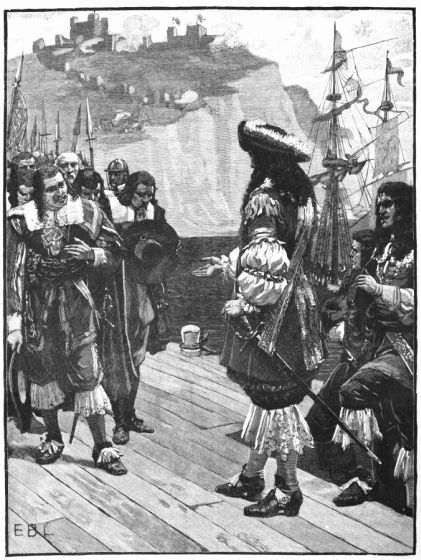
LANDING OF CHARLES II. AT DOVER. (See p. 165.)
[See larger version]
Montague had long been prepared to go over to the king on the first opportunity; and lest he might seem to be sent by the Parliament, and not by his own voluntary act, he set sail for the coast of Holland, leaving Lawson to bring over the deputations going to his Majesty. He lay to at Scheveling, and sent word to the king that his fleet was at his command. The Duke of York, whom Charles had made admiral, went on board, and was received with all respect and submission. Soon after came up the other ships with six members of the Peers, twelve of the Commons, fourteen from the City of London, and eight or ten of the most popular ministers in London of the Presbyterian party, including Reynolds, Calamy, Case, and Marten. These gentlemen entered zealously on the hopeless task of endeavouring to persuade Charles to leave their form of worship in the ascendant, and to abstain from the use of the Common Prayer Book and the surplices; but they got no further satisfaction than that he would leave all that to the wisdom of Parliament. On the 24th of May he embarked at Scheveling, in the Naseby, which the day before had been rechristened the Royal Charles, the rest of the ships at the same time having doffed their republican appellations of unpleasant memory, and assumed right royal ones. On the 26th he landed at Dover, where, amid the thunder of cannon, he was received by Monk at the head of a splendid assemblage of the nobility and gentry. From Dover to Canterbury, and thence to London, the journey was one triumphant procession. The crowds of gentry and of shouting people presented only the aspect of a most loyal nation, amongst whom it was hard to imagine that such a thing as a Commonwealth had ever existed. On Blackheath Charles was received by the army with acclamations. The Lord Mayor and Corporation invited him to a splendid collation in a tent prepared for the purpose. All the way to Whitehall, attended by the chief nobility and by his Life Guards, and several regiments of cavalry, the houses being hung with tapestry, and the windows crowded with applauding men and women, the king riding between his two brothers, beheld nothing but an enthusiastic people. When he dismissed the last of his congratulators from the hall where his father perished, he turned to one of his confidants and said, "It surely must have been my own fault that I did not come before, for I have met no one to-day who did not protest that he always wished for my restoration."