Chapter XII · (continued 2)
Reading edition
On the 19th of October the second session of William's first Parliament met. The Commons were liberal in voting supplies; they granted at once two million pounds, and declared that they would support the king to the utmost of their ability in reducing Ireland to his authority, and in prosecuting the war with France. The required sum was to be levied partly by a poll-tax, partly by new duties on tea, coffee, and chocolate, partly by an assessment of one hundred thousand pounds on the Jews, but chiefly by a tax on real property. The Jews, however, protested that they would sooner quit the kingdom than submit to the imposition, and that source was abandoned. The Commons next took up the Bill of Rights, and passed it, omitting the clause respecting the succession of the House of Brunswick, which measure was not brought forward again for eleven years. They, however, took care, at the suggestion of Burnet to insert a clause that no person who should marry a Papist should be capable of ascending the throne; and if any one on the throne so married, the subjects should be absolved from their allegiance.
After thus demonstrating their zeal for maintaining the throne in affluence and power, the Commons next proceeded to display it in a careful scrutiny of the mode in which the last supplies had been spent. The conduct of both army and navy had not been such as to satisfy the public. The Commons had, indeed, not only excused the defeat of Herbert at Bantry Bay, but even thanked him for it as though it had been a victory. But neither had Schomberg effected anything in Ireland; and he loudly complained that it was impossible to fight with an army that was not supplied with the necessary food, clothing, or ammunition. This led to a searching scrutiny into the commissariat department, William himself being the foremost in the inquiry, and the most frightful peculation and abuses were brought to light. The muskets and other arms fell to pieces in the soldiers' hands; and, when fever and pestilence were decimating the camp there was not a drug to be found, though one thousand seven hundred pounds had been charged Government for medicines. What baggage and supplies there were could not be got to the army for want of horses to draw the waggons; and the very cavalry went afoot, because Shales, the Commissary-General, had let out the horses destined for this service to the farmers of Cheshire to do their work. The meat for the men stank, the brandy was so foully adulterated that it produced sickness and severe pains. In the navy the case was the same; and Herbert, now Lord Torrington, was severely blamed for not being personally at the fleet to see into the condition of his sailors, but was screened from deserved punishment by his connections. The king was empowered by Parliament at length to appoint a Commission of Inquiry to discover the whole extent of the evil, and to take remedies against its recurrence.
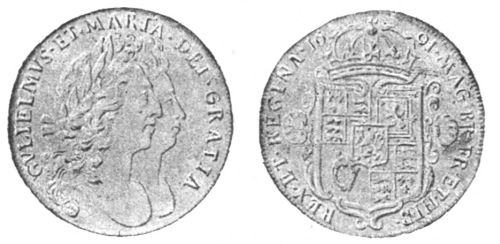
FIVE-GUINEA PIECE OF WILLIAM AND MARY.
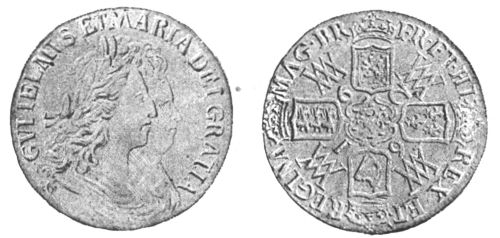
CROWN OF WILLIAM AND MARY.
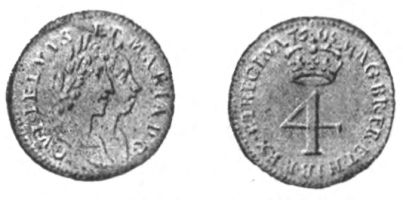
FOURPENNY PIECE OF WILLIAM AND MARY.
Then the Commons reverted again to their fierce party warfare. Whigs and Tories manifested an equal desire to crush their opponents if they had the power, and they kept William in a constant state of uneasiness by their mutual ferocity, and their alternate eagerness to force him into persecution and blood. Edmund Ludlow, one of the regicides, who had managed to escape the murderous vengeance of Charles and James, but whose companion, John Lisle, had fallen by the hands of Charles's assassins at Lausanne, had been persuaded that he might now return to England unmolested. But he soon found that he was mistaken. The Tories vehemently demanded his arrest of the king, and William was obliged to promise compliance; but he appeared in no haste in issuing the warrant; and probably a hint was given to Ludlow, for he escaped again to the Continent, and there remained till his death.
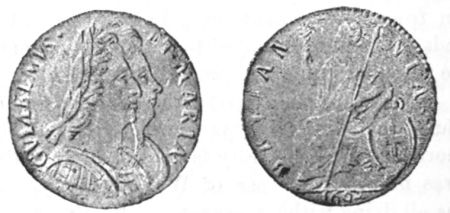
HALFPENNY OF WILLIAM AND MARY.
On the other hand, the Whigs were as unrelaxing in their desire of persecuting the Tories. They refused to proceed with the Indemnity Bill, which William was anxious to get passed as a final preventive of their deadly intentions. They arrested and sent to the Tower the Earls of Peterborough and Salisbury for going over from their party to that of James in the last reign, in order to impeach them of high treason. The same was done to Sir Edward Hales and Obadiah Walker. They appointed a committee to inquire into the share of various individuals in the deaths of Lord William Russell, Sidney, and others of the Whig party. The committee was termed "the Committee of Murder," and they summoned such of the judges, law officers of the Crown, and others as had taken part in these prosecutions. Sir Dudley North and Halifax were called before them, and underwent a severe examination; but they did not succeed in establishing a charge sufficient to commit them upon. Halifax had already resigned the Speakership of the House of Lords, and they sought to bring William to deprive him of the Privy Seal. In these proceedings of the Commons, John Hampden, the grandson of the great patriot, and John Howe, were the most violent. Hampden went the length of saying that William ought to dismiss every man who had gone over to him from the late king, and ought not to employ any one who entertained Republican principles. This declaration, from a man who had himself been a full-length Republican and the friend of Sidney, threw the House into a roar of laughter; but that did not abash Hampden. On behalf of a committee of the Commons, he drew up an address so violent that it was altogether dropped, calling on the king to dismiss the authors of the late malversations and the consequent failures of the army and navy.
The Whigs next brought in a Bill to restore to the corporations their charters, which had been taken away by Charles II.; but, not content with the legitimate fact of the restoration of these ancient rights, they again seized on this as an opportunity for inflicting a blow on the Tories. They introduced at the instigation of William Sacheverell, a clause disqualifying for seven years every mayor, recorder, common councilman, or other officer who had been in any way a party to the surrender of these charters. They added a penalty of five hundred pounds and perpetual disqualification for every person who, in violation of this clause, should presume to hold office in any corporation. They declared that if the Lords should hesitate to pass this Bill, they would withhold the supplies till it was acquiesced in.
But William did not hesitate to express his displeasure with the Bill, and with the indecent hurry with which it was pushed forward. A short delay was interposed, and meanwhile the news of the intended passing of the Bill was carried into every quarter of the kingdom, and the Tories, Peers and Commons, who had gone down to their estates for Christmas, hastened up to town to oppose it. The battle was furious. The Whigs flattered themselves that, if they carried this Bill, the returns to the next Parliament would be such that they should be able to exclude their opponents from all power and place. After a fierce and prolonged debate, the Bill was thrown out, and the Tories, elated by their victory, again brought forward the Indemnity Bill; but this time they were defeated in turn, and the Whigs immediately proceeded with their design of converting this Bill into one of pains and penalties; and to show that they were in earnest, they summoned Sir Robert Sawyer before the House for his part in the prosecution of the Whigs in the last reign. He had been Attorney-General, and conducted some of the worst cases which were decided under Jeffreys and his unprincipled colleagues, with a spirit which had made him peculiarly odious. The case of Sir Thomas Armstrong was in particular brought forward—a very flagrant one. Sir Thomas had been charged with being engaged in the Rye House plot. He had escaped to the Netherlands, but the authorities having been bribed to give him up, he was brought back, and hanged, without a hearing, as an outlaw. It was a barbarous case, and deserved the severest condemnation. But it was pleaded, on the other hand, that Sawyer had rendered great services to the Whig cause; that he had stoutly resisted the attempts of James to introduce Popery and despotism; that he had resigned his office rather than advocate the Dispensing Power, and had undertaken the defence of the seven bishops. No matter; he was excepted from indemnity and expelled the House. A committee of the whole House proceeded to make out a complete list of all the offenders to be excluded from the benefit of the Bill.
This brought William to a resolve which, if carried into effect, would have given a death-blow to the Whig party, and have neutralised the glory of their accomplishment of the Revolution. He sent for his chief ministers, and announced to them his determination to relinquish the fruitless task of endeavouring to govern a country thus torn to pieces by faction; that he was weary of the whole concern, and would return to Holland, never more to meddle with English affairs, but abandon them to the queen; that for ten months he had been vainly endeavouring to make peace between the factions of Whig and Tory, and to prevent them from rushing at each other's throats; that they clearly regarded nothing but their mutual animosities, for in their indulgence they utterly neglected the urgent affairs of the nation. Their enemy was in Ireland, yet it had no effect in bringing them to their senses. Still worse, every department of the Government was overrun with corruption, peculation, and neglect. The public service was paralysed; the public peace was entirely destroyed; and as for himself, with far from robust health and with the duty of settling the Government upon him, it was useless further to contend; he could contend no longer. A squadron was ready to bear him away, and he could only hope that they would show more regard to the wishes of the queen than they had to his.
Whether William was in earnest, or whether he only had recourse to a ruse to bring the combatants to their senses, the result was the same. The ministers stood confounded. To drive the king from the country by their quarrels, and that at a time when the old and implacable enemy of Protestantism and liberty was at their doors, would be a blow to freedom and to their own credit from which the most disastrous consequences must flow. They entreated him on their knees and with tears to forego this design, promising all that he could desire. William at length consented to make one more trial; but it was only on condition that the Bill of Indemnity should pass, and that he should himself proceed to Ireland, and endeavour, by his own personal and determined effort, to drive James thence.
Accordingly, on January 27, 1690, he called together the two Houses, and, announcing his intention to proceed to Ireland, declared the Parliament dissolved, amid the utmost signs of consternation in the Whigs, and shouts of exultation from the Tories. This act of William's to defeat the malice of the Whigs, and his continued firm resistance to their endeavours to fine and disqualify the Tories, had a wonderful effect on that party. A numerous body of them deputed Sir John Lowther to carry their thanks to the king, and assure him that they would serve him with all their hearts and influence. Numbers of them who had hitherto stood aloof began to appear at Court, and attended the levee to kiss the king's hand. William gave orders to liberate those whom the Whigs had sent to prison on charges of treason.
On the 1st of February the hour arrived in which all ecclesiastics who had neglected to take the Oaths of Allegiance and Supremacy would be deposed. A considerable number of them came in in time; but Sancroft, the Primate, and five of his bishops, stood out, and were deprived of their bishoprics, but were treated with particular lenity.
It was soon found that the conduct of the Whigs had alienated a great mass of the people. Their endeavours, by Sacheverell's clause, to disqualify all who had consented to the surrender of the corporation charters, had made mortal enemies of those persons, many of whom were at the moment the leading members of the corporations, and therefore possessing the highest influence on the return of members to the new Parliament. The same was the case in the country, amongst those who had been sheriffs or other officers at that period. The consequence was that the Tories returned a decided majority to the new House, and amongst them came up Sir Robert Sawyer from Cambridge, whilst the violence of Hampden had caused his exclusion.
The revival of the Tory influence introduced great changes in the ministry. Halifax resigned the Privy Seal. Mordaunt—now Earl of Monmouth—Delamere, Sidney Godolphin, and Admiral Herbert—now Earl of Torrington—were dismissed. Caermarthen was continued Lord President of the Council, and Prime Minister. Sir John Lowther was appointed First Lord of the Treasury, in place of Monmouth. Nottingham retained his post as Secretary of State; and Thomas Herbert, Earl of Pembroke, was placed at the head of the Admiralty, Torrington having, to his great discontent, to yield that position, but retaining that of High Admiral, and being satisfied by a splendid grant of ten thousand acres of Crown land in the Peterborough fens. Delamere, too, was soothed on his dismissal by being created Earl of Warrington. Richard Hampden became Chancellor of the Exchequer.
Parliament met on the 20th of March, and the Commons, under the new Tory influence, elected Sir John Trevor Speaker, who was besides made First Commissioner of the Great Seal. In this man is said to have commenced that system of Government corruption of Parliament—the buying up, or buying off of members, which grew to such a height, and attained its climax under Sir Robert Walpole. Trevor was an unscrupulous Tory, and Burnet says he was "furnished with such sums of money as might purchase some votes." He undertook, accordingly, to manage the party in the House. The Whigs were in the worst of humours, but they had now learnt that it was not wise to push matters with the Crown too far, and as a body they watched their opportunity for recovering by degrees their ascendency. Some of the more violent, however, as the Earl of Shrewsbury and the notorious Ferguson, entered into immediate correspondence with James.
William, in his opening speech, dwelt chiefly on the necessity of settling the revenue, to enable him to proceed to Ireland, and on passing the Bill of Indemnity; and he was very plain in expressing his sense of the truculent spirit of party, which, in endeavouring to wound one another, injured and embarrassed his Government still more. He informed them that he had drawn up an Act of Grace, constituting the Bill of Indemnity, and should send it to them for their acceptance; for it is the practice for all such Acts to proceed from the Crown, and then to be voted by the Peers, and finally by the Commons. He then informed them that he left the administration during his absence in Ireland in the hands of the Queen; and he desired that if any Act was necessary for the confirmation of that authority, they should pass it. The Commons at once passed a vote of thanks, and engaged to support the Government of their Majesties by every means in their power. On the 27th of March they passed unanimously the four following resolutions—namely, that all the hereditary revenues of King James, except the hearth-tax, were vested now in their present Majesties; that a Bill should be brought in to declare and perpetuate this investment; that the moiety of the excise granted to Charles and James should be secured by Bill to their present Majesties for life; and finally, that the customs which had been granted to Charles and James for their lives should be granted for four years from the next Christmas. William was much dissatisfied with the last proviso, and complained that the Commons should show less confidence in him, who had restored their liberties, than in Charles and James, who destroyed them. Sir John Lowther pressed this point on the Commons strongly, but in vain; and Burnet told King William that there was no disrespect meant towards him, but that the Commons wished to establish this as a general principle, protective of future subjects from the evils which the ill-judged liberality of past Parliaments had produced.
The next measure on which the Whigs and Tories tried their strength was a Bill brought in by the Whigs to do what was already sufficiently done in the Bill of Rights—to pronounce William and Mary the rightful and lawful sovereigns of this realm, and next to declare that all the acts of the late Convention should be held as valid as laws. The first part, already sufficiently recognised, was quietly passed over; but the Tories made a stout opposition to extending the Act beyond the year 1689, on the plea that nothing could convert the self-constituted Convention into a legal Parliament. But the distinction was a mere party distinction; for, if the Convention was not a legal body, nothing could render its acts so. The Earl of Nottingham, who headed this movement, entered a strong protest on the journal of the Lords against it, and this protest was signed by many peers, and amongst them the Whig peers, Bolton, Macclesfield, Stamford, Bedford, Newport, Monmouth, Herbert, Suffolk, Warrington, and Oxford. The Bill, however, was carried, and with still more ease in the Commons.
The Tories, mortified at the triumph of the Whigs, now brought in a Bill to change the military government of the City of London as the lieutenancy of the counties had been changed. They thanked the king for having by his measures brought in so many Churchmen and thrown out so many Nonconformists. This Bill the Whigs managed to impede till the session closed; but not so with another from the Tory party, ordering payment of the five hundred pounds fines incurred by all who had taken office or served as magistrates without taking the necessary Oaths of Allegiance and Supremacy. This was carried, and the money ordered to be paid into the Exchequer, and a separate account of it to be kept.
The defeat of the Whigs only infused more fierceness in the party warfare. They hastened to bring in a Bill compelling every person in office, civil, ecclesiastical, or military, to take an oath to abjure King James and his right to the Crown, thence called the Abjuration Oath. This oath might, moreover, be tendered by any magistrate to any subject of their Majesties whatever, and whoever refused it was to be committed to prison, and kept there till he complied. It was hoped by the Whigs that this Bill would greatly embarrass the Tories who had taken office under the present monarchy, and accordingly it met with a decided opposition in the Commons, and was thrown out by a majority of one hundred and ninety-two to one hundred and seventy-eight. It was then, with some alteration, introduced as a fresh Bill into the Lords. William went down to the Lords to listen personally to the debate; and several of the peers made very free and pertinent remarks on the uselessness of so many oaths to bind any disloyal or unconscientious person.
The Bill was defeated in the Lords by being committed, but never reported, for on the 20th of May, after King William had given his consent to the Bill, which he had recommended, for conferring on the queen full powers to administer the government during his absence in Ireland, and also to that revising the quo warranto judgment against the City of London, the Marquis of Caermarthen appeared in the House with an Act of Grace ready drawn and signed by the king.
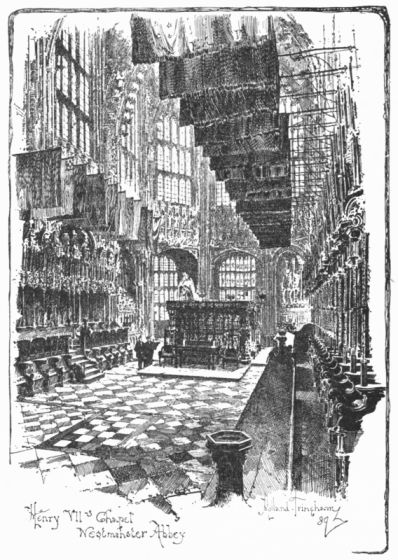
HENRY VII.'S CHAPEL, WESTMINSTER ABBEY.
[See larger version]
William had tried in vain to curb the deadly animosities of the contending parties by Bills of Indemnity. These could be discussed and rejected, not so an Act of Grace: it issued from the sovereign, and came already signed to Parliament. It must be at once accepted or rejected by each House, and in such a case as the present, where it was meant as a healing and pacifying act, it could not be rejected without a disloyal and ungracious air. Accordingly it was received with the deference which it deserved, and both Houses gave their sanction to it, standing bareheaded, and without one dissenting voice. From the benefit of this Act of Grace, pardoning all past offences, were, it is true, excepted thirty names, prominent amongst whom were the Marquis of Powis, the Lords Sunderland, Huntingdon, Dover, Melfort, and Castlemaine; the Bishops of Durham and St. Davids; the Judges Herbert, Jenner, Withers, and Holloway; Roger Lestrange; Lundy, the traitor governor of Londonderry; Father Petre; and Judge Jeffreys. This last monster of infamy was already deceased in the Tower, but it was well understood that if the others named only kept themselves at peace they would never be inquired after. Neither party, however, thanked William for the constrained peace. The Whigs were disappointed of the vengeance they burned to enjoy; the Tories, and even those who had the most narrowly escaped the intended mischief, ungenerously said that if William had really anything to avenge, he would not have pardoned it.
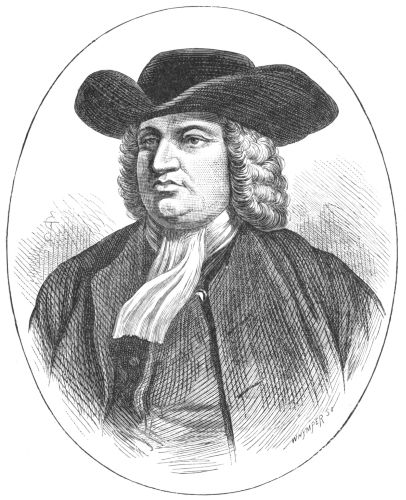
WILLIAM PENN.
[See larger version]
The day after the passing of this important Act he prorogued Parliament. The Convocation which had been summoned, and met in Henry VII.'s Chapel—St. Paul's, its usual meeting-place, having been burnt down in the Great Fire, was not yet rebuilt—had been prorogued some time before. Its great topic had been the scheme of comprehension, which was warmly advocated by Burnet and the more liberal members, but the High Church was as high and immovable as ever. Nothing could be accomplished, and from this time the Nonconformists gave up all hope of any reunion with the Church.
William now made preparations for the Irish campaign. It was time, for Schomberg had effected little, and the English fleet had done worse than nothing at sea. It was not only in Ireland that the danger of William lay, or whence came his troubles. He had to maintain the contest on the Continent against Louis XIV., against James in Ireland, against corruption and imbecility in his fleet, against the most wholesale mismanagement and peculation in every department of the English Government, and against the feuds and disaffection of his own courtiers and servants. Whilst the contests which we have just related were agitating Parliament, William was vigorously at work inquiring into the malversation all around him. Shales, the Commissary-General, was dismissed, and a new spirit was introduced into the commissariat under the vigilant eye of William himself. Instead of the vile poisons and putrid meats, excellent provisions were supplied to the army. The villainies by which the poor soldiers had been robbed of their clothing, and bedding, and tents, terminated, and they were soon well clothed, lodged, and equipped. The road to Chester swarmed with waggons conveying wholesome supplies, and a fleet lay there ready to convey the king over, with additional troops and stores. Before he set out himself, the army in Ireland amounted to thirty thousand effective men.
But the affairs of the Channel fleet were in the worst possible condition. William there committed the error of continuing Torrington, better known as Admiral Herbert—who had been suspected of a leaning towards James, and who had been already beaten at Bantry Bay—in the chief command, when he removed him from his post of First Lord of the Admiralty. Herbert was a debauched, effeminate fellow, indulging in all sorts of license and luxury, whilst his sailors were suffering the most atrocious treatment. They had such meat served out to them that neither they nor even dogs could touch it. They were ill-fed, ill-clothed, ill-paid; the contractors and the officers were enriching themselves at their expense; and, what was worse, they were compelled to bear the disgrace of having our commerce interrupted in all directions by the French cruisers. Whilst they lay inactive in Portsmouth, the French scoured the English coast, and captured trading vessels with their cargoes to the value of six hundred thousand pounds.
William had, however, difficulties at home to surmount before he could depart for Ireland. Just as he was prepared to set out, the discovery was made of an extensive traitorous correspondence between a number of concealed Jacobites and the Court of St. Germains. Some of his own ministers and courtiers were deep in it. Two messengers had been despatched from James's queen from St. Germains, with letters to the conspiring Jacobites. One of these, of the name of Fuller, was induced by some means to betray the secret. He went boldly to Whitehall, and delivered his despatches to William. Crone, the other, was arrested, and soon after another messenger of the name of Tempest. The disclosures made through this means revealed an extensive ramification of treason that was enough to appal the stoutest heart and coolest brain. The queen's own relative, Clarendon, was one of the most zealous plotters; Ailesbury and Dartmouth, who had both taken the oaths to the new monarchs, were among the most guilty; and the latter, though an admiral, was prepared, in connection with other officers, to betray the coast defences, and to carry over their ships to the enemy. William Penn was arrested on account of an intercepted letter to James, and charged with treason; but he denied any treasonable intentions, and said he only corresponded with James as an old friend. Nothing of a criminal nature could be proved against him, and he was soon liberated. Viscount Preston, who had been raised to that dignity by James, but was not admitted by the peers to possess a valid patent of nobility, was another; and what was far more mortifying, the Earl of Shrewsbury, who had so recently resigned the seals as Secretary of State, was discovered to be deeply implicated. It was found that the conspiracy was spread far and wide throughout the country, and that the Jacobites in Worcestershire, Lancashire, Yorkshire, and other northern counties, were laying in arms and ammunition, and gentlemen who had received commissions from James were actually mustering and drilling troops on the solitary moorlands. The correspondence was as active between England and Ireland, as between England and France.
Amid dangers of such magnitude it may seem strange that William should venture to leave England, and burthen his wife with the cares and responsibilities of such a crisis, amid the machinations of so many determined enemies; but his affairs as imperiously demanded his presence in Ireland, and he therefore took the best measures that he could for the assistance and security of the queen. He appointed a council of nine of the most efficient and trusty persons he could think of, some Whigs, some Tories. They were Devonshire, Dorset, Monmouth, Edward Russell, Caermarthen, Pembroke, Nottingham, Marlborough, and Lowther. In making this selection William must have put aside many personal prejudices. Marlborough was appointed as most likely to advise the queen as to military affairs, though he was the known partisan and adviser of Anne. Russell, who was an admiral and Treasurer of the Navy, was the person to advise her in naval matters, and Caermarthen was, from his experience, and as having a great regard for the queen, the man on whom she could most rely for the management of the main business of the State. William solemnly laid upon them the great trust which he reposed in them, and called upon them as men and statesmen, to afford the queen every assistance which her being left under such trying circumstances demanded for her. He likewise informed Rochester that he was well acquainted with the treasonable practices of his brother Clarendon, and bade him warn him from him to tempt him no further to a painful severity.
Having arranged this matter, William set out on the 4th of June for Chester, where he embarked on the 11th, and landed at Carrickfergus on the 14th. He proceeded immediately towards Belfast, and was met by Schomberg on the way. William was attended by Prince George of Denmark, the Duke of Ormond, the Earls of Oxford, Scarborough, and Manchester, Mr. Boyle, and many other persons of distinction. He appointed the whole of his army to rendezvous at Loughbrickland, and immediately set about organising his plans, and preparing his stores for an active campaign. Before we enter upon that, however, we must take a hasty glance at what Schomberg had done during the autumn, winter, and spring.
This was little for so numerous an army, commanded by so experienced a general. Schomberg was, it is true, eighty years of age, and many complained that time had diminished his fire, and that much more ought to have been effected. But William, who may be supposed a most competent judge, cast no blame upon him; on the contrary, he thanked him for having preserved his army at all, his troops having had to contend with the horrors of a deficient and most villainous commissariat, as we have already shown.
Schomberg on landing had taken Carrickfergus, Newry, and Dundalk, where he entrenched himself. He had found the country through which he passed a perfect waste. It could afford him no provisions, and, if he were compelled to fall back, no shelter. James, on his landing, had advanced from Dublin to Drogheda, where he was with twenty thousand men, besides vast numbers of wild Irish, armed with scythes, pikes, and skeans. But Schomberg found himself in no condition for fighting. His baggage could not reach him for want of waggons, and from the state of the roads. His arms were many of them good for nothing, being the vile rubbish furnished by the contractors under the management of the fraudulent Ministry and the infamous Commissary-General Shales. His soldiers were suffering from want of proper clothing, shoes, beds, and tents. Worse still, the soldiers were fast perishing with fever. Bad food, bad clothing, bad lodging, and drenching and continual rains without proper shelter, were fast doing their work on the English army. Schomberg did his best. He stimulated his soldiers to make roofs to their huts of turf and fern, and to make their beds of heather and fern, raised on dry mounds above the soaking rains. But all was in vain. The soldiers were become spiritless and demoralised. They were either too listless to move or too excited by whisky, which they managed to get, to follow his recommendations. Scenes like those which appeared in London during the Plague now horrified his camp. The soldiers gave way to wild license, drank, swore, sang bacchanalian songs, drank the Devil's health, and made seats of the corpses of their dead comrades at their revels, which they declared were the only ones they had to keep them out of the wet.
The sickness appeared at the same time in the English fleet which lay off the coast at Carrickfergus, and swept away almost every man from some of the vessels. By the commencement of November, Schomberg's army could not number more than five thousand effective men. The Irish in James's army did not suffer so much, and they rejoiced in the pestilence which was thus annihilating their heretic enemies. But the weather at length compelled James to draw off, first to Ardee, and then into winter quarters in different towns. Schomberg, thus set at liberty, quickly followed his example, and quartered his troops for the winter in the different towns of Ulster, fixing his headquarters at Lisburn. His army had, however, lost above six thousand men by disease.
In February, 1690, the campaign was begun by the Duke of Berwick, James's natural son, who attacked William's advanced post at Belturbet; but he met with such a reception that he nearly lost his life, being severely wounded and having his horse killed under him. In fact, the condition of the two armies had been completely changed during the winter by the different management of the two commanders. Schomberg had been diligently exerting himself to restore the health and to perfect the discipline of his troops. As spring advanced he received the benefit of William's exertions and stern reforms in England. Good, healthy food, good clothing, bedding, tents, and arms arrived. Fresh troops were from time to time landing, amongst them regiments of German and Scandinavian mercenaries. By the time of William's arrival the army was in a fine and vigorous condition, and amounted to thirty thousand men.
Not so the army of James: it had grown more and more disorderly. James and his Court had returned to Dublin, where they spent the winter in the grossest dissoluteness and neglect of all discipline or law. Gambling, riot, and debauchery scandalised the sober Catholics, who had hoped for a saviour in James. Of all the army, the cavalry alone had been maintained by its officers in discipline. The foot soldiers roamed over the country at pleasure, plundering their own compatriots. James's own kitchen and larder were supplied by his foragers from the substance of his subjects, without regard to law or any prospect of payment. It was in vain that remonstrances were made; James paid no attention to them. His bad money was gone; he had used up all the old pots, pans, and cracked cannon, and applied to Louis for fresh remittances, which did not arrive. To complete the ruin of his affairs, he requested the withdrawal of Rosen and D'Avaux, who, heartless as they were, saw the ruinous course things were taking, and remonstrated against it. Lauzun, an incompetent commander, was sent over to take their place, accompanied by about seven thousand French infantry. When Lauzun arrived in Ireland, the desolation of the country, the rude savagery of the people, and the disorders of the Court and capital, were such as to strike him and his officers with astonishment and horror. He declared in his letters to the French minister, Louvois, that the country was in so frightful a state that no person who had lived in any other could conceive it; that James's chief functionaries pulled each his different way, instead of assisting the king; and that "such were the wants, disunions, and dejection, that the king's affairs looked like the primitive chaos."
Unfortunately, Lauzun was not the man to reduce chaos to order. He had accompanied Mary, the queen of James, in her flight from London to Paris, and had there too won the good graces of Madame Maintenon; and by the influence of these ladies, who imagined him a great general, he obtained this important command. He had to fill the place of both D'Avaux and Rosen, of ambassador and general, without the sagacity and skill which would have fitted him for either. He conceived the greatest contempt and hatred of the Irish, and was not likely to work well with them. Such was the condition in which James was found on the landing of King William.
William, we have said, pushed on immediately to Belfast, and thence, without permitting himself to be delayed by the congratulatory multitudes that surrounded him, he hastened forward to his main army at Loughbrickland. The soldiers of his army consisted of a variety of nations, many of whom had won fame under great leaders. There were Dutch, who had fought under William and his great generals against those of Louis of France; Germans, Danes, Finlanders, French Huguenots, now purged of their false countrymen; English and Scottish troops, who had fought also in Holland, in Tangier, at Killiecrankie; and Anglo-Irish, who had won such laurels at Londonderry, Enniskillen, and Newton Butler. All were animated by the presence of the king, and of his assembled generals of wide renown, and with the confidence of putting down the Popish king, and his French supporters and Irish adherents, who had robbed and expelled them and their families. The Germans and Dutch burned to meet again the French invaders of their country, the desolators of the Palatinate; and the French Protestants were as much on fire to avenge themselves on their Catholic countrymen, who had been their oppressors. It was not merely English troops acting on ordinary grounds of hostility against Irish ones, but representatives of almost all Protestant Europe collected to avenge the wrongs of Protestants and of their own countries.
William was confident in his army, and declared that he was not come to Ireland to let the grass grow under his feet. Schomberg still recommended caution when it was no longer needed, and thus gave a colour to the words of those who accused him of having shown too much caution already, which they insinuated was but the result of old age. On the 24th of June, only ten days after landing, William was in full march southwards. James did not wait for his coming, but abandoned Dundalk and retreated into Drogheda. His generals, indeed, represented to him that caution and delay were his best policy against so powerful a force, and even recommended that he should retreat beyond Dublin and entrench himself at Athlone, as a more central and defensible position; but James would not listen to this, and Tyrconnel strengthened him in the resolution.
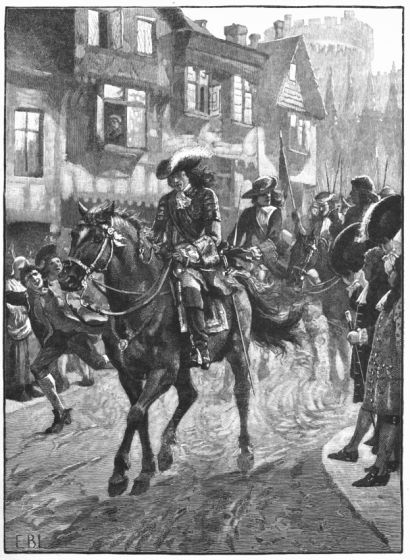
JAMES ENTERING DUBLIN AFTER THE BATTLE OF THE BOYNE. (See p. 431.)
[See larger version]
The morning of the 1st of July, destined to become a great epoch in Ireland, rose brilliantly, and the opposing armies were in motion by four o'clock. William overnight had given the word "Westminster" as the recognition sign, and ordered his men to wear each a green sprig in his hat, to distinguish them from the enemy, who, out of compliment to France, wore a white cockade, generally of paper. According to William's disposition of battle, Meinhart Schomberg, the son of the old general, supported by Portland and Douglas with the Scottish guards, was to take the right and secure the bridge of Slane. He himself headed the left wing near Drogheda with a strong force of cavalry, and Schomberg the centre, which was opposite Oldbridge, where he was supported by the Blues of Solmes, and the brave Londonderries and Enniskilleners, and on his left the French Huguenots under Caillemot, and between them and William the Danes. Meinhart Schomberg found the bridge of Slane already occupied by Sir Neil O'Neil, with a regiment of Irish Dragoons; but the English charged them briskly, killed O'Neil, and made themselves masters of the bridge. This was a grand advantage at the outset. It enabled the English to attack the right wing of James, and endangered their seizure of the pass of Duleek, a very narrow defile in the hills, about four miles in their rear, by which they would cut off altogether their retreat. Lauzun, who had posted the main strength of the Irish infantry at the foot of Oldbridge, and supported them by Sarsfield's horse, was compelled to despatch the horse towards Slane Bridge, to guard against this danger, thus weakening his centre.
Nearly at the same moment that this movement took place, William put himself at the head of his cavalry, and with his sword in his left hand, for his right arm was too sore and stiff from a gunshot received on the previous day to hold it, he dashed into the river and led his wing across. At the same moment Schomberg gave the word, and the centre was in motion. Solmes' Dutch Blues led the way, and their example was instantly followed by the men of Londonderry and Enniskillen, and at their left the Huguenots. The men waded through the stream, holding aloft their muskets and ammunition. The brunt of the encounter was there, for there the enemy had expected the main attack, and had not only concentrated their forces there, horse and foot, but had defended the bank with a breastwork and batteries. The English had to advance against the deadly fire from these defences, and from the thronging Irish, who raised the wildest hurrahs, whilst they could return no fire till they were nearly across and sufficiently raised from the water. Then they saw the breastwork and the batteries lined with one mass of foes. They, however, pushed resolutely forward, fired, charged the foe, and in an instant the whole demoralised Irish broke and fled. Never was there so complete and ignominious a rout. These men, on whom so much depended, but who, despite all warnings to James, had been suffered to plunder and riot without restraint or discipline, now dispersed with so dastardly a rapidity that it was more like a dream than a reality.
The engagement was now general, from the left where William commanded, almost under the walls of Drogheda, to the bridge of Slane. The English and their allies had forced their way across the river, and were engaged in fierce contest with the Irish horse and the French cavalry and foot. When Schomberg saw the cavalry of Tyrconnel and Hamilton bear down upon his centre, and that they had actually driven back Solmes' Blues into the river, he dashed into the river himself, to rally and encourage them. Probably stung by a generous sense of shame, for he had discouraged the attempt to attack the Irish army in that position, the old man now exhibited an opposite degree of incaution, for without defensive armour he rushed into the mêlée, disregarding the advice of his officers to put on his cuirass. As he rode through the river, Caillemot was borne past him to the north bank mortally wounded, but still crying to his brave Huguenots, "On! on! my lads! To glory! to glory!" Schomberg took up the cry of encouragement to the men, appalled by the loss of their general, and said, "Allons, messieurs, voilà vos persécuteurs!" But scarcely had he uttered the words when he, too, received a mortal wound and fell. When he was found he was dead, with a bullet wound through his neck, and a couple of sword gashes on his head.
For half an hour the battle raged with a fury such as the oldest soldiers of the Netherlands now declared they had never seen surpassed. Hamilton and Tyrconnel led on their cavalry against Schomberg's forces with a steadiness and bravery that were as much to their credit as their conduct in civil life had been disgraceful. William, on his part, had found a warm reception on the left. The Irish horse withstood him stoutly, and drove back his guards and the Enniskilleners repeatedly. On his first coming up to the Enniskilleners, he was mistaken for one of the enemy, and was near being shot by a trooper. The mistake being rectified, the Enniskilleners followed him with enthusiasm. William threw away all thought of danger, and led them into the thickest of the fight. At one moment a ball carried away the cock of his pistol, at another the heel of his boot, but he still led on. The Enniskilleners fought desperately, and the horse of Ginkell charged brilliantly.
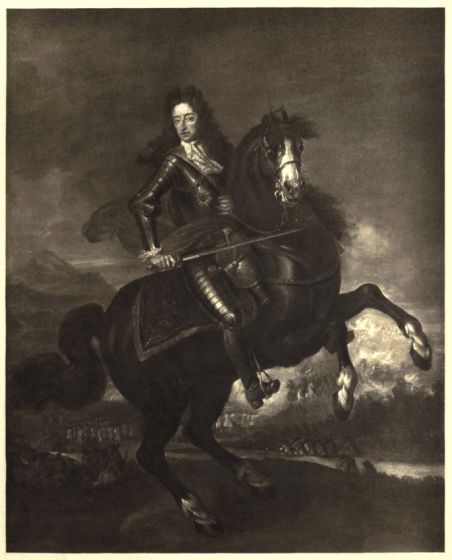
KING WILLIAM III. AT THE BATTLE OF THE BOYNE.
From the Painting probably by Jan. Wyck, in the National Portrait Gallery.
[See larger version]
They were thus fighting their way towards the centre, and had advanced as far as Plottin Castle, about a mile and a half from Oldbridge, when the Irish horse made a last furious effort, drove back the Enniskilleners, and killed a number of them. William rallied them, and again led them to the charge, broke the Irish cavalry, and took prisoner Hamilton, who had been heading this gallant charge. When William saw, wounded and a prisoner, the man who had proved so traitorous to him when sent to Ireland, he said, "Is this business over, or will your horse make more fight?" "On my honour, sir," replied Hamilton, "I believe they will." "Your honour, indeed!" muttered William; but ordering the wounded man to be properly attended to, he rode forward to join the main body and end the fight.
That was now soon over. The centre and the right wing had done dreadful execution. They had nearly annihilated whole regiments. One of them had only thirty men left without a wound. They had fought in a manner worthy of a better cause and a better leader, for James had early abandoned the field, and left his deluded followers to the mercy of the enemy. No sooner did he see the Irish fly before the enemy at Oldbridge than, from his safe position on the hill of Donore, he gave orders for all the baggage and the artillery, except six pieces, already in full employ in the engagement, to be conveyed with all speed on the road to Dublin, so as to effect their passage through the defile of Duleek; and, escorted by Sarsfield's horse, he made all haste after them.
If James was one of the worst and most infatuated monarchs that ever reigned in time of peace, in war he was the most dastardly. In England he fled disgracefully on the approach of William, without a blow, and here again he showed the same utter want of spirit and energy. He had taken no care to keep his soldiers disciplined and in proper tone for the coming war, and he deserted them at the first symptoms of reverse. If the English had pushed on briskly from the bridge of Slane, they might still have intercepted him, and brought him prisoner to William; but, the conflict over, they relaxed their efforts, and William gave orders to spare the flying troops as much as possible. When Lauzun and Tyrconnel approached the pass of Duleek with their retreating cavalry, they found it choked with a confused mass of waggons, artillery, and terrified fugitives. They therefore faced about, and repelled the pursuers till the rout had got through. The cavalry of William still followed the flying throng as far as the Neale, a second pass, and till it grew dark, when they returned to the main army. James continued his panic flight, however, never stopping till he reached Dublin. The city had all day been in a state of intense excitement. First had come the news that William was wounded, then that he was dead; amid the rejoicing of the Jacobites came the horrid news of the defeat, followed about sunset by James himself, attended by about two hundred cavalry, haggard, wayworn, and covered with dust. All that night kept pouring in the defeated troops, and early in the morning James, not deeming himself safe, took leave of the mayor, aldermen, and officers of his army, upbraiding the Irish with their cowardice in having deserted him almost without a blow, and vowing that he would never trust to an Irish army again. The Irish returned the compliment, and declared that, if the English would exchange kings, they were ready to fight again, and to conquer too. If any man had ever caused his own misfortune and defeat, it was James; but he never took the means to avoid discomfiture, and he never saw, or at least, never seemed to see, that the blame lay with himself. Without, therefore, making another effort, though he had a large army still on foot, and all the south of Ireland to employ it in, he continued his flight towards Waterford, in terror all the way lest he should be overtaken by William's cavalry, and, reaching Waterford on the third day, he got away by water, without loss of time, to Kinsale, whence he sailed for France, quitting Ireland at the spot where he had entered it.
It might have been expected that Tyrconnel and Lauzun would yet rally their forces at Dublin, and make a resolute stand there. But the decisive defeat of the Boyne, the untrustworthiness of the Irish infantry, the loss on the field amounting to upwards of one thousand five hundred, and those chiefly cavalry, the desertion of vast numbers of infantry on the road southward, and the precipitate flight of James, discouraged them. Towards evening of the same day that James left, Tyrconnel and Lauzun mustered their forces and marched out of the city, determining to make their stand on the Shannon, within the strong defences of Athlone and Limerick. No sooner had they evacuated the city than the Protestants issued from their retreats, liberated all the prisoners, and sent off messengers to invite William to enter his new capital in triumph. This he did on the 6th of July, and then made for Waterford.
William's object in reaching Waterford was to take ship for England—not, like James, to abandon his army out of mere cowardice—but in order to protect England too. He had received news that the French, under Tourville, were hovering on the southern coast of England; that they had again defeated the British fleet under the wretched Torrington, and were meditating invasion of the country. He hastened on; the Irish troops at his approach abandoned Clonmel and Kilkenny. Waterford was similarly evacuated, and William, nominating Count Solmes commander-in-chief during his absence, was about to embark, when he received further intelligence. Tourville had made a partial descent at Teignmouth in Devonshire, sacked it, and then drawn off in consequence of the menacing attitude of the inhabitants of the western counties. He therefore hastened to rejoin his army, which was on the way towards Limerick, where Douglas had found such resistance that he had been compelled to raise the siege. On the 9th of August he sat down before that town, and found the Irish determined to make a resolute defence of it.
The Irish, ashamed of their conduct at the battle of the Boyne, and seeing their Saxon masters once more rapidly recovering their ascendency in the island, one and all, men and officers, determined on here making a stand to the death. They did not owe their spirit to their French allies, for Lauzun and his officers ridiculed the idea of defending the place, which they regarded as most miserably fortified. Tyrconnel joined them in that opinion; but Sarsfield encouraged his countrymen, and exhorted them to cast up breastworks of earth, which, in our times—as at Sebastopol—have convinced military men that they are far more impervious to cannon than stone or brick walls. He could not convince the French, who had lost all faith in Irish prowess, and who pined to return to France from the miseries and privations of Ireland; nor Tyrconnel, who was old, and completely dispirited by the action of the Boyne. He and the French drew off with the French forces into Galway; and Boisseleau, a Frenchman, who did sympathise with the Irish, and Sarsfield, were left to defend the place. They had yet twenty thousand men, who were animated by a new spirit, and were destined to make the defence of Limerick as famous as that of Londonderry.
Limerick stood partly on an island in the Shannon; and to take that part it was necessary to have boats, for only a single bridge connected the two parts of the town, or the two towns, as they were called—the English and the Irish. William had a quantity of tin boats on the way for this service, and his cannon and ammunition were also following him. Sarsfield seized immediately on this circumstance when it came to his knowledge. He got out of the city in the night, surprised the escort of the guns, and destroyed the guns, blew up the powder, and made good his return to the town. This exploit raised Sarsfield wonderfully in the opinion of his countrymen, and at the same time raised their own spirits.
William sent for fresh guns from Waterford, and pressed on the siege; but the autumnal rains began to deluge the low, marshy banks of the Shannon, and to sweep away his men with fever. The Irish, on the other hand, had received a fresh stimulus to exertion in the arrival of Baldearg O'Donnel, the chief of one of the most famous old races of Ulster, who had been in the service of Spain, and had returned to assist his countrymen in this last effort to throw off the yoke of the Saxon. The high veneration for the name of the O'Donnel, and the character of the man, placed him at the head of a large class of the Irish in Limerick. There was a prophecy that an O'Donnel was to conquer the English, and the enthusiastic Celts believed that this was the time. And, in truth, the prediction appeared beginning to verify itself, for, after a desperate attempt to take the town by storm on the 27th of August, William resolved to raise the siege, and place his troops in healthy quarters for the winter. During this attempt, William had another narrow escape from a cannon-ball. His men, too, after breaching the walls in several places, and carrying the counterscarp, or covered way, suffered great loss. On the 30th the siege was raised, and William hastened to Waterford, and thence to England. He left the government of the island in the care of three Lords Justices, namely, Viscount Sidney, Lord Coningsby, and Sir Charles Porter. About the same time Tyrconnel and Lauzun quitted Ireland for France, leaving the affairs of James in a council of civilians, and the army under a commission, at the head of which stood the Duke of Berwick as commander-in-chief, and in the very lowest place the brave Sarsfield, of whom the aged Tyrconnel entertained a jealousy worthy of himself and of his master.
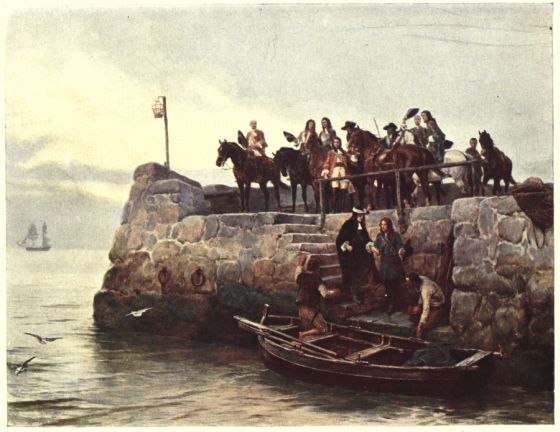
Reproduced by André & Sleigh, Ld., Bushey, Herts.
A LOST CAUSE: THE FLIGHT OF JAMES II. AFTER THE BATTLE OF THE BOYNE, 1690.
By ANDREW C. GOW, R.A. From the Painting in the National Gallery of British Art.
[See larger version]
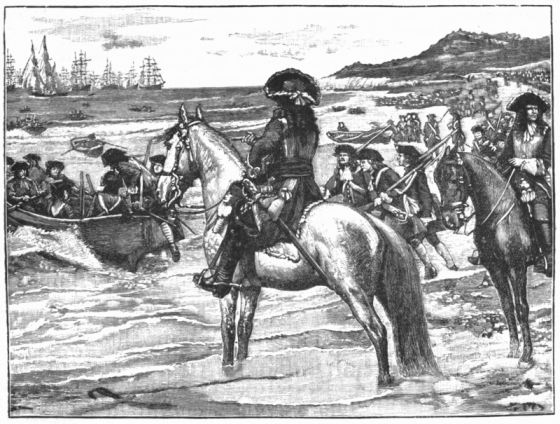
THE FRENCH RETREATING FROM TORBAY. (See p. 434.)
[See larger version]
We must now take notice of what had been passing in England and Scotland during William's campaign in Ireland. Immediately after his departure the traitor Crone was brought to the bar, and, after a full and fair trial, convicted and condemned to death. Pardon, however, was offered him on condition of his revealing what he knew of the Jacobite machinations. After a violent struggle with himself, and after two respites, he complied, and gave important information to the Privy Council. The evidences of an active conspiracy of the Jacobites were too prominent to be overlooked. Tourville, the French admiral, was hovering on the coasts of Devon and Dorsetshire, and the Jacobites, as expecting a descent of a French force, were all in a state of the greatest excitement. It was deemed necessary to arrest a number of the most dangerous conspirators, amongst whom was Clarendon, the queen's uncle; and he and the rest were committed to the Tower. Torrington was ordered to join the fleet in the Downs, and chase the French admiral from the coast. At St. Helens he was joined by a powerful Dutch squadron, under the command of Admiral Evertsen, and they lay off Ventnor, whilst Tourville with his fleet lay off the Needles. An engagement was expected every hour, when Torrington was seen to draw off from the coast of the Isle of Wight, and retreat before the French admiral towards the Strait of Dover. The alarm in London became excessive. The scheme of the Jacobites, as it was revealed to the Council, was to enter the Thames; the Jacobites in London had agreed to rise and seize the queen, and proclaim James. James himself had engaged to leave Ireland to Lauzun and Tyrconnel, and throw himself once more amongst his adherents in England. Another squadron of the French was to land at Torbay; and the country once in their possession, the united French fleet was to cut off the return of William from Ireland. With a knowledge of these plans, and the doubtful conduct of Torrington, the Privy Council was in a state of great agitation. Caermarthen was for the most decisive measures, in which he was energetically supported by Monmouth. They proposed that Russell, who was not only a first-rate officer, but a determined one, should be sent over to the fleet, and Monmouth, at his own request, as a military officer, was sent with him. A dispatch, however, was sent before them, ordering Torrington to come to an engagement at all hazards, and this compelled him to act before Russell and Monmouth could get on board. On the 30th of June, the day before the battle of the Boyne, he felt himself compelled to come to an engagement with Tourville off Beachy Head. Tourville had eighty-two men-of-war; the united fleet of England and Holland did not exceed sixty; but a Blake or Russell would have thought little of the difference. Torrington, as had been too plainly evident in the affair of Bantry Bay, was a man of very different stuff. When compelled to fight, he determined that the Dutch should bear the brunt of it. He therefore placed the Dutch vessels in the van, and gave the signal to engage. The Dutch fought with their usual bravery, and for many hours sustained almost the whole fury of the battle, little supported by the English. Torrington showed no inclination to engage, but appeared rather disposed to see the Dutch, whom he hated, annihilated. A few of the English captains did their duty gallantly; but, so far as Torrington was concerned, had it not been for the Dutch, the French might have ascended the Thames, as Van Tromp formerly did, and insulted the whole seaboard of the country at their pleasure. When the Dutch had lost two admirals and many other officers they drew off, their ships being in a terribly shattered condition. One of their dismantled ships fell into the hands of the French, the others Torrington ordered to be either burnt or towed away; and, ignominiously retiring into the Thames, he pulled up the buoys, to prevent the French from following. Tourville, however, had suffered so much from the Dutch, that he drew off towards his own coast, and left the Londoners to suffer all the alarms without the danger of invasion. London, indeed, was in the same state of terror as in the time of the Dutch invasion of the Thames. The wildest rumours were every hour arriving. The confidence in Torrington was gone, and he was generally denounced as being a traitor to the Government. Either he was a most incompetent commander or his heart was not in the cause: and the latter was no doubt the fact; for, though his treason was not patent at this time, it afterwards became certain enough that he maintained a close correspondence with the Courts of both St. Germains and Versailles. But, whether traitor or imbecile, London was in no degree confident of his being able to repel the French. It was believed by numbers that the dockyards at Chatham would be destroyed, the ships in the Thames under protection of the Tower be set fire to, and the Tower itself be cannonaded. To add to the gloom and affright, the news of the defeat of Count Waldeck at Fleurus, in the Netherlands, by Luxemburg, Louis's general, just then arrived. Paris was ablaze with fireworks and rejoicings; London was all gloom and panic.
And truly there were menacing circumstances. Tourville was bearding the English on their own coasts; Torrington dared not or would not go to encounter him; and Marshal Humières lay with a strong force on the opposite shores, not far from Dunkirk, in readiness, it was believed, to go on board Tourville's fleet and make a descent on England, where the Jacobites were prepared to join the invaders. But on the fourth day after the battle of Beachy Head arrived the news of William's splendid victory on the Boyne, and the spirit of the nation rose at once. It was felt that the ascendency of James was over, and the news of his ignominious flight, which soon followed, completely extinguished the hopes of his partisans, and gave stability to the throne of William and Mary.
And this was soon strikingly demonstrated. Tourville triumphantly ranged along the English coasts, after his victory at Beachy Head, without opposition, and he now imagined that nothing was necessary to the restoration of James but a descent on England with a tolerable force, which was certain to be welcomed by the expectant Jacobites. Accordingly Tourville took on board a considerable body of soldiers, and made for the coast of Devon. His fleet numbered a hundred and eleven sail, but of these a large number were mere Mediterranean galleys, rowed by slaves, and sent as transports to carry over the troops. On the 22nd of July he landed at Torbay, where William himself had landed; but, instead of finding the gentry or the people ready to join him in support of King James, the whole west rose as one man at the glare of the beacon signals which blazed on the hill-tops. Messengers were spurring from place to place all night to carry the exact intelligence to the authorities; and the next morning all Devonshire appeared to be marching for Torbay. Tourville speedily beheld numbers of armed horsemen, the gentry and yeomanry of the neighbourhood, assembled on the hills, and everything warned him to embark again as quickly as possible. But he would not retire without leaving some trace of his visit. He despatched a number of his galleys to Teignmouth, where the French landed, set fire to the town, burned down a hundred houses, destroyed the fishing-boats in the harbour, killed or drove away all the live stock they could find, and demolished the interior of the churches, the pulpits, the communion-tables, and the Bibles and Prayer-books, which they tore up and trampled under foot in their hatred of Protestantism. This specimen of what England was to expect if she received back James at the point of French bayonets produced the most salutary effects on the whole nation.
Mary showed herself equal to the emergency in the absence of her husband. She applied to the Lord Mayor to know what state of defence the City was in, and received the most prompt and satisfactory answer. His lordship assured her that the City would stand by her to a man; that it had ten thousand men, well armed and disciplined, prepared to march, if necessary, at an hour's notice; that it would raise six regiments of foot and two regiments of horse at its own cost, and pay besides into the royal treasury a hundred thousand pounds. The country everywhere displayed the same loyalty. The yeoman cavalry of the different counties assembled in arms; those of Suffolk, Essex, Hertford, and Buckingham, marched to Hounslow Heath, where Mary received them amid acclamations of loyalty; she received the cavalry troops of Kent and Surrey on Blackheath. The militia was called out; noblemen hurried to their counties to take command of the forces there; and others, amongst whom was the lately recreant Shrewsbury, flocked to Whitehall to offer their lives and fortunes for the defence of the throne. The miners of Cornwall appeared, ten thousand in number, armed as best they might be, ready to expel the invaders. Those of the Jacobites who stubbornly retained their faith in James, who still designated him as the "stone which the builders had foolishly rejected," and who by their secret press urged the people to the assassination of William, and to vengeance on his Protestant supporters, slunk into hiding-places and remained prudently quiet. Even the non-juring clergy and bishops excited the indignation of the masses as men who encouraged by their conduct the hopes of the Papists; and the Bishop of Norwich was attacked in his palace, and was only rescued by the prompt measures of the authorities. The non-jurors were suspected of leaning not only to James, but to Popery; and a new liturgy, which had been printed and industriously circulated, praying, in no ambiguous words, for the restoration of James by a foreign invasion, and for the murder of William, was widely believed to proceed from them, although they strenuously denied it.
Such was the position of things in England when William returned from Ireland. In Scotland great changes had taken place. The remains of the Jacobite force in the Highlands had been effectually put down. In the spring of 1690 James had sent over an officer with the commission of General-in-Chief of the Jacobite forces in Scotland. General Buchan, therefore, took precedence of the drunken and incompetent Cannon; but all the troops that he could muster were not more than one thousand four hundred, and these were surprised and crushed by William's general, Sir Thomas Livingstone, who occupied Inverness. General Mackay completed the subjugation of the Highlands by building a fort at Inverlochy, called, after the king, Fort William, which effectually held the Camerons and Macdonalds in check. The last chance of James was over in that quarter.
At Edinburgh the battle with the disaffected politicians came very soon to a similar end. The most prominent of them, Montgomery, Ross, and Annandale, offered to yield their opposition if William would admit them to favour and office; but William disdained to purchase their adhesion, and they then, in resentment, flung themselves into the arms of James. The treaty was carried on through the medium of James's agent in London, one Neville Payne; and Mary, James's queen, sent over dispatches, creating Montgomery for his treason Earl of Ayr and Secretary of State, with a pension of ten thousand pounds to relieve his immediate necessities, for he was miserably poor and harassed by creditors. Ross was to be made an earl, and have the command of the Guards; and Annandale was to be a marquis, Lord High Commissioner, and Governor of Edinburgh Castle. But this measure, which the Court of St. Germains fondly fancied was going to give them the ascendency in the Scottish Parliament, produced an exactly contrary effect. The old Tory Jacobites were so much incensed at this favour shown to these renegade Whigs, whilst they themselves were passed over, that the whole plot went to pieces in an explosion of jealousy, and on the meeting of the nobles the new proselytes of Jacobinism, who were to have turned the scale in favour of the Stuart dynasty, were found to be utterly helpless and abandoned.
This turbulent and factious party being thus broken up, and some of them going over to the new Government voluntarily as the means of safety, and others being brought over by timely offers of place or money, the settlement of the affairs of Scotland became tolerably easy. The Presbyterian religion was declared the established religion of Scotland. Contrary to the will of William, a Toleration Act for that kingdom had been rejected. The confession of faith of the Westminster Assembly was adopted; the remaining Presbyterian ministers who had been rejected at the Restoration, now reduced from three hundred and fifty to sixty, were restored, and the Episcopalian ministers were forcibly ejected in turn, and Presbyterians installed. The old synodal polity was restored, and the sixty old restored ministers, and such as they should appoint, were ordered to visit all the different parishes, and see that none but godly ministers, sound in the Presbyterian faith, were occupying the manses and the pulpits. This, however, did not satisfy a section of the old Cameronian school. They complained that the Parliament had betrayed the Solemn League and Covenant, and had sworn, and had caused others to swear, to a non-Covenanting monarch, and they refused to bow the knee to this Baal. Thus a non-juring party sprang up also in Scotland. In William's opinion, however, too much had been done in the way of conformity; and on his return from Ireland he selected as Lord High Commissioner to Scotland Lord Carmichael, a nobleman of liberal mind, and accompanied this appointment by a letter to the General Assembly, declaring that he would never consent to any violent or persecuting measures, and that he expected the same from them. "We never," he nobly observed, "could be of the mind that violence was suited to the advancing of true religion; nor do we intend that our authority shall ever be a tool to the irregular passions of any party. Moderation is what religion enjoins, what neighbouring churches expect from you, and what we recommend to you." And the determination of the monarch put a strong and beneficial restraint on the spirit of the religious zealots of the North.
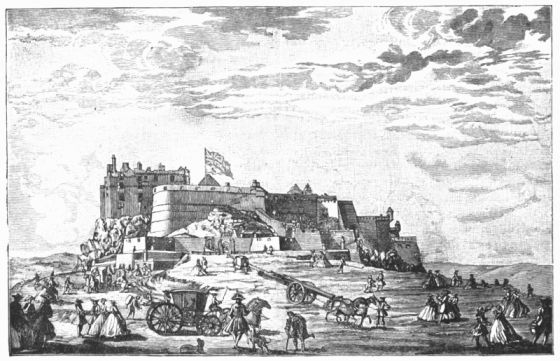
EDINBURGH CASTLE IN 1725. (From a Print of the Period.)
[See larger version]
William had returned from Ireland with a great accession of power and éclat. He had shown that the imbecile and bigoted James could not stand for a moment before him; he had reduced Ireland to such general subjection that the remaining insurgents in the south could not long hold out. To hasten this result, and to cut off the access of fresh reinforcements from France, he now sent out an expedition, which had been some time preparing under Marlborough, to reduce Cork and Kinsale, and garrison them for himself. That strange but able man, Marlborough, though he was at this very moment in full correspondence with the Court of St. Germains so as to meet all chances, and even the now remote one of James ever regaining the throne, though he was disliked and suspected by William and Mary, yet himself proposed this expedition, anxious to grasp some of the glory of re-conquering Ireland, and perhaps not inattentive to the equally attractive prospect of winning booty. Marlborough was already lying at Portsmouth with his squadron when William reached London; and sailing thence on the 18th, he landed at Cork on the 21st of September, with five thousand men. The Duke of Würtemberg there joined him with his four thousand Danes, together making a strong force, but which was in danger of becoming paralysed by the German duke insisting on taking the chief command on account of his superior rank. Marlborough was not a man willingly to resign any position likely to do him honour; but he consented to share the command, taking it on alternate days. With him he had also the Duke of Grafton, one of Charles II.'s illegitimate sons, who had fallen under suspicion of leaning to his uncle James, but, to prove his loyalty to William, came out as a volunteer. Cork was vigorously attacked, and in forty-eight hours it capitulated. The garrison, between four and five thousand men, surrendered as prisoners, and Marlborough promised to use his endeavours to obtain the favour of William for both them and the citizens. He forbade his troops to plunder, but was obliged to use force to repel the hordes of wild people who rushed in and began ransacking the Catholics. The Duke of Grafton fell in the attack.
Without losing a day, Marlborough sent forward his cavalry to Kinsale to demand its surrender, and followed with his infantry. The Irish set fire to the town, and retired into two forts, the Old Fort and the New Fort. The English, however, managed to put out the fire, and Marlborough arriving, invested the forts, and took the Old Fort by storm, killing nearly five hundred men, who refused to surrender. The garrison of the New Fort, after seeing Marlborough prepared to storm that too, yielded on condition that they might go to Limerick. They were twelve hundred strong. In this fort was found abundance of provisions, a thousand barrels of wheat, and eighty pipes of claret.
Having executed this mission, and secured the two forts for the king, Marlborough re-embarked, and reached London again in little more than a month from the day that he sailed from Portsmouth. William, astonished at the rapidity of this success, declared that there was no officer living who had seen so little service, who was so qualified for a general as Marlborough. The English people went still further, and declared their countryman had achieved more in a single month than the king's Dutch favourites in two campaigns.
On the 2nd of October William opened the new session of Parliament. He was received with the warmest demonstrations of attachment. He had shown himself strong, and James had shown himself weak. The country had been alarmed by the menace of invasion, and all parties were disposed to rally round the monarch who gave them every promise of security and pre-eminence. In his speech he paid the highest tribute to the bravery of the army, and declared that, had his affairs allowed him to have begun the campaign earlier, he should have been able to clear the whole country of the enemy. In order to do that in the ensuing campaign, and to put a check on the too conspicuous designs of the French, it would be essential to grant liberal supplies. He reminded them of the dishonour which had befallen the English flag, and of the necessity of promptness in Parliament to enable him to wipe away the stain, and to secure the reputation of England by crushing the efforts of the king of France.
His speech was received with loud acclamations. Thanks were voted for his achievements in Ireland, and to the queen for her able administration during his absence; and the Commons proceeded to vote supplies on a scale which had yet had no example. The army was fixed at sixty-nine thousand men, of whom twelve thousand were to consist of cavalry. The navy was to consist of twenty-eight thousand men; and the cost of the whole, including ordnance, was estimated at four million pounds. In return for this unprecedented force and unprecedented allowance for it, the Commons demanded that they should appoint a commission of nine to examine and bring forward the accounts: the commissioners to be all members of their own House. The proposition was acceded to without opposition by both the peers and the king, and a Bill, including the appointment of the commissioners, was prepared and passed. On the 15th of November a Bill received the royal assent for doubling the excise on beer, ale, and other liquors; and on the 20th of December another Bill passed for granting certain duties upon East India goods, wrought silks, and other merchandise; and a second Bill for increasing the duties on wine, vinegar, and tobacco.
In considering ways and means, the Commons proposed, as they had laid so many burdens on themselves, that the persons of all those who had been engaged in the rebellion in Ireland should be attainted, and their estates confiscated, and the proceeds be applied to the discharge of the expenses of the war; and they brought in and passed a Bill for that purpose. But the Lords did not appear inclined to sanction so wholesale a confiscation of the estates of all the Catholics of Ireland, as this would have amounted to; nor could it be very acceptable to the king, though they proposed to place a considerable portion of the forfeitures at his disposal. The Lords allowed the Bill to lie on their table, notwithstanding several urgent reminders from the Commons, and so at last it dropped. This must have been what William particularly desired, for it was contrary to his natural clemency to let loose the fiends of party fury after the sufficiently deadly evils of war, and it was contrary to his promises to many who had submitted on assurances of impunity; and having got the chief supplies which he wanted, he sought to shorten the Session as much as possible, by telling Parliament that, by a certain day, it was necessary for him to leave for Holland on important affairs. Yet, after the liberal votes of the Commons, still keeping in memory the disgrace of the navy, he added that, if some annual provision could be made for augmenting the navy, and building some new men-of-war, "it would be a very necessary care for that time, both for the honour and safety of the nation." The Commons thought so much the same that they voted an additional five hundred thousand pounds expressly for building new ships of war.
The last proceeding which marked this Session was the discovery of a fresh Jacobite plot. The Tory minister Caermarthen had long been the object of the particular enmity of the Whigs, and they were doing everything possible to undermine his influence. At last their efforts appeared to be growing perceptible. The king had introduced into the ministry, one after another, men to whom Caermarthen had a particular aversion, or who were particularly hostile to his power. Godolphin was made First Lord of the Treasury; Marlborough was rising fast in the military department; and Sidney was sent for by William from Ireland, without consulting Caermarthen, and appointed Secretary of State. His enemies were eagerly watching for the favourable moment to come down on the declining minister and complete his ruin, when he suddenly, at the very close of the year and the Session, laid before William all the particulars of a desperate plot of the Jacobites, which showed plainly enough that a minister of such vigilance was not to be lightly dispensed with. Fortune, however, rather than his own sagacity, had favoured the Prime Minister.
The anticipated absence of William from England in the spring appeared to offer a favourable conjuncture for James making another attempt for the recovery of the throne. The Jacobites, therefore, had met and concluded to send three of their number to St. Germains to consult with the Court there on the best means of effecting this object. It was proposed that James should make great protestations of his determination to allow of and secure the political and religious rights of all his subjects, and that he should come attended only by so moderate a force that it should not look like a French invasion. The opinions of the leading Jacobites were to be conveyed by these messengers in a packet of letters to be carefully concealed; and amongst the writers of these letters were the Earl of Dartmouth, Viscount Preston—so-called—and the Earl of Clarendon. This weak man, whom William had warned through Rochester of his knowledge of his practices, and who had declared that he would never again meddle with treason, was again as busy as ever. A vessel was engaged, called the James and Elizabeth, to carry over the three agents, namely, Preston, Ashton, and Elliott, who were to come on board on the last night of the year. The skipper of the James and Elizabeth, though offered extraordinary pay for the trip, suspecting what was the nature of his passengers, gave notice of the fact to Caermarthen, who sent and boarded the vessel at midnight, when the traitors were secured along with their papers, which were conveyed to the Secretary of State's office at Whitehall, where Caermarthen and Nottingham passed the night in examining the contents of the fatal packet, and the next morning laid them before the king.
This great discovery, which fell like a thunderbolt on the Jacobites, was scarcely less disconcerting to the Whigs. It was hopeless after this to attempt anything against so alert and trusty a minister. William, relieved from all apprehensions of danger by this timely discovery, left the three traitors in the custody of his Government, and the leaders yet at large under their eye, and hastened to get over to Holland. On the 5th of January he prorogued Parliament till the 31st of March; and in his farewell speech he said that he thought it proper to assure them that he should make no grants of the forfeited lands in England or Ireland; that those matters could be settled in Parliament in such a manner as should be thought most expedient. Unfortunately, this was a promise which William failed to keep, and which brought upon him no lack of trouble in the future. On the 6th, whilst his English subjects were indulging in all the festivities of the season, William set out, attended by a splendid train of courtiers, for the Hague, where a great Congress was appointed to consider the best means of resisting the aggressions of Louis of France. He was received by his subjects, after a dangerous voyage, with shouts of joy.
William's spirit and sound sense seemed to reanimate the drooping energies of the Allies. The quota of troops to be furnished by every prince was determined; it was agreed to bring two hundred and twenty thousand men into the field in spring, and never to rest till they had not only driven Louis from the territories of his neighbours, but had compelled him to give toleration to his Protestant subjects. These matters arranged, William made use of the influence which the new alliance with the Duke of Savoy gave him, to procure a cessation of the persecutions of the duke's Protestant subjects, the Waldenses. To him these simple mountain shepherds—Christians of a Church remaining independent of Rome from the earliest times—owed it that they could once more live in peace; that numbers of them were released from dungeons, and their children, who had been torn from them to be educated in Popery, were restored.
All being thus favourably settled, the princes dispersed to their several States, and William retired to obtain a short period of relaxation at Loo. But he was speedily roused from his repose. The proceedings of the Congress had been closely and anxiously watched by Louis of France. He saw that its deliberations were certain to produce a profound impression on Europe, and he resolved to neutralise this by one of his sudden and telling blows. At once all his available means and forces were put in motion. A hundred thousand soldiers were in rapid march on Mons, one of the most important fortresses of the Spanish Netherlands. Louis did not even trust the operations of this assault to his famous general, Luxemburg, and the greatest military genius of the age, Vauban; but he hurried to the scene of action himself, early as the season was—in March. Five days after the siege commenced Louis was there, accompanied by the Dauphin, the Dukes of Orleans and of Chartres. He pushed on the attack with vigour, to have it over before any assistance could arrive. Though suffering from the gout, he went about amongst the soldiers, encouraging them by the blandest and most familiar addresses; helped personally to bind up their wounds in the hospitals, and partook of the broth prepared for them. With his quick perception of the dangers from his adversaries, he had noticed the diversion which it was intended that the Duke of Savoy should make, by taking the field on that side; and he had suddenly thrown an army into Savoy, captured Nice, and provided the duke with enough to do to hold his own. By this means he had been able to bring from the Maritime Alps a large body of troops to this siege.
William was sensible of the disastrous effect which the fall of Mons would have on the spirits of his Allies, and on the Courts of Sweden and Denmark which had been brought to the point of joining the confederation; he therefore rushed from his place of temporary retirement, mustered the forces of the States-General, sent dispatches after the German princes, urging them to bring up all the troops they could collect to the rescue of Mons, and to the generals of the Spanish troops in Flanders. By forced marches he advanced towards the devoted city; but all the vices of confederations were now glaringly apparent in contrast to the single and prompt action of a despot. The German princes, naturally slow, were already far off; the Spanish generals were utterly unprepared for such an emergency; and William found it almost impossible to procure even horses to drag his artillery and stores. He sent on, however, hasty messengers to apprise the people of Mons of his approach; but the vigilance of the French prevented them from reaching the city. An immense quantity of artillery was thundering against the walls of Mons; breaches were made in them; a redoubt was carried, sword in hand; shells fell in showers on the roofs and streets of the town, which was burning in ten places. The inhabitants, appalled by the terrible destruction awaiting them, threatened to murder the garrison if they did not surrender; and the garrison, ignorant of the relief which William was bringing, surrendered on the 20th of April. William, deeply chagrined, returned to the Hague, and thence hastened back to London; whilst Louis, in proud triumph, returned to Versailles to receive the congratulations of his courtiers on his splendid coup-de-main.
On William's return to London, he found his Government had tried the traitors, Preston, Ashton, and Elliott. Preston and Ashton were found guilty, and sentenced to death; Elliott was not brought to trial. By some it has been asserted that the evidence of his being admitted into the real interior of the plot was not clear; by others, that he purchased his escape by disclosures. Ashton was hanged on the 18th of January—the very day on which William had embarked at Gravesend for Holland. Preston, after much vacillation between the desire to accept a proffered pardon and repugnance to the conditions attached to it—that of making a full disclosure of his accomplices—at length chose life and dishonour, and made charges against Clarendon, Dartmouth, Turner Bishop of Ely, and William Penn. Clarendon was sent for a time to the Tower; Dartmouth, who was accused, as an admiral, of the heinous crime of intending to betray Portsmouth to the French, indignantly repelled the accusation, and died in the Tower without having been brought to trial. Turner escaped to France. Penn was accused of writing to James to assure him that, with thirty thousand men, he might command England. But this message to James rested on the evidence of the lying and infamous Melfort, who was totally unworthy of all belief; and Penn, so far from shrinking from the charge, went straight to Sidney, the Secretary of State, and denied the whole allegation. That he had a friendly feeling for and commiseration of James, he did not deny; but he declared himself a faithful subject of William and Mary, and, so far from being willing to aid any design against them, if he became aware of any such he would at once disclose it. Instead of clapping Penn in the Tower—which the Government would have done, had they any such letters inviting James to come over with thirty thousand men,—he was suffered to depart in full freedom. He afterwards made a religious journey on the Continent as a minister of the Society of Friends, and then he returned to England; but without any attempt on the part of Government to molest him.
But there were deeper and more real traitors than any of these around William—namely, Admiral Russell, Sidney Godolphin, and Marlborough. These men, encouraged by the fall of Mons and the triumphant aspect of Louis's affairs, renewed with fresh activity their intrigues with the Court of James. It was in vain that William heaped riches, honours, and places of confidence upon them; they were ready to receive any amount of favours, but still kept an eye open to the possible return of James, and made themselves secure of pardon from him, and kept him duly informed of all the intended movements of William both at home and on the Continent. Russell was made High Admiral in place of Torrington. He was Treasurer of the Navy, enjoyed a pension of three thousand pounds a year, and a grant from the Crown of property of great and increasing value near Charing Cross. But, with an insatiable greediness, he still complained of unrequited services; and, having a shoal of poor and hungry relatives badgering him for places and pensions, he complained that their incessant demands could not be gratified; and he cherished the hope that he could sell his treason at a favourable crisis to King James at no mean price. Godolphin was First Commissioner of the Treasury, sat in the Privy Council, and enjoyed the confidence of the sovereign; his former conduct in being one of the most pliant tools of James, ready to vote for his Act of Indulgence, being overlooked. Yet he was sworn, through the agency of a Mr. Bulkeley, to serve the interests of James. Hand in hand with him went Marlborough, who—though he was now fast overcoming the long-retained prejudices of William, and had been honoured by his commission in the expedition to Ireland, and by his warm approbation on his return, and had the prospect of a brilliant command of the army in Flanders, where he could indulge his highest ambition—was yet a most thorough traitor, making a hypocritical pretence of great sorrow to James for his desertion of him, and, through Colonel Sackville, and Lloyd, the non-juring Bishop of Norwich, offering, on a good opportunity, to carry over the whole army to James.
Amid these lurking treasons, the exultation of the Jacobites over the fall of Mons was open and insolent. They came by swarms out of their hiding-places, and thronged the Park and the neighbourhood of the Palace, even insulting the queen in her drives before William's return.
William's indignation on hearing these facts roused him to put the laws in force against the non-juring bishops. The most extraordinary lenity had been shown them. They had been suffered to reside in their sees and occupy their palaces; they had been offered to be excused taking the oaths on condition that they would live quietly, and discharge their ecclesiastical functions of ordaining ministers, confirming their young flocks, and other such duties, but without avail. Now that Turner was discovered in treasonable correspondence with St. Germains, and the rest refused to disavow what he had attributed to them in his letters, it was resolved to eject them. Sancroft was ejected from Lambeth, and Tillotson was nominated Archbishop of Canterbury in his place; Ken was removed from Bath and Wells, and Kidder instituted in his stead. In place of Turner, succeeded Dr. Patrick; Fowler was appointed to Gloucester, and Cumberland to Peterborough. Soon after Lamplugh, Archbishop of York, died and Dr. Sharp took his place. Sancroft continued to maintain all his old pugnacity, and nominated other bishops in opposition to William's Government as sees fell vacant. But perhaps the most savage outcry was raised on the appointment of Dr. Sherlock to the deanery of St. Paul's, vacated by the election of Tillotson to Canterbury. Tillotson himself was furiously assailed by the Jacobites as a thief and a false shepherd, who had stolen into the fold of the rightful pastor. Sherlock had been a zealous non-juror himself, but had been seriously convinced of the Scriptural ordinance to submit to any Government, whatever its origin, which was firmly established. He was, therefore, violently and scurrilously assailed as a perjured apostate. Amongst the ejected non-juring clergy, Henry Dodwell was so insolent, that William remarked, "That Dodwell wants me to put him in prison, but I will disappoint him." The magnanimous forbearance of William, and the audacious impertinence of the non-jurors in consequence, form a wonderful contrast.
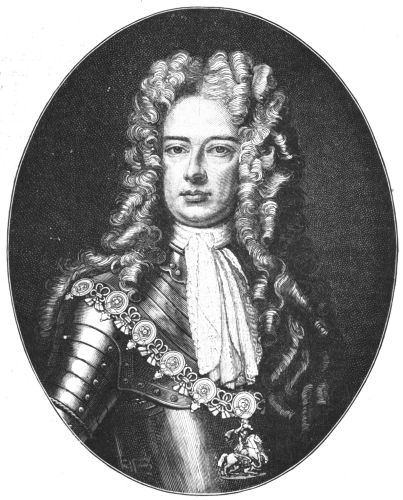
THE DUKE OF MARLBOROUGH. (After the Portrait by Sir Godfrey Kneller.)
[See larger version]
Scarcely had William time to settle these affairs, and arrange the plan of campaign in Ireland, when he was compelled to return to Holland. Unaware as yet of the more recent treason of Marlborough, he took him with him. He had conceived the highest opinion of his military talents, and he was confirmed in this opinion, on his arrival at the Hague, by the Prince of Vaudemont, a distinguished commander in the Dutch service. He praised highly the Generals Talmash and Mackay; as to Marlborough, he declared that he had every quality of a general; that his very look showed it, and that he was certainly destined to do something great. William replied that he was of the same conviction.
William found himself at the head of seventy thousand men of various nations, the different contingents of the Allies, and the beginning of the campaign was very promising. He sent Marlborough on to Flanders to collect the forces there, and form a camp to cover Brussels against the advance of Luxemburg and the French. His convenient position no doubt suggested to James the idea of his immediate execution of his promised treason. James, therefore, sent him word that he expected his fulfilment of his engagement; but to this startling demand Marlborough replied that the time was not come. It was necessary to have first obtained a complete ascendency over the troops, or, instead of following him, they would abandon him, and the only consequence would be making things worse. William's immediate arrival put an end to the temptation, and he marched against Luxemburg, who retired before him. He next sent a detachment against Marshal Boufflers, who was besieging Liége, and, having succeeded in this, he crossed the Sambre, to endeavour to bring Luxemburg to an engagement. But this crafty general, who had an inferior though well-appointed army, took care to avoid a general action, calculating that William's army, made up of so many nonentities, would, if let alone, ere long go to pieces. Thus the summer was spent in marches and counter-marches without any result, except of wearying out the patience of William, who in September surrendered the command to the Prince of Waldeck, and retired to his favourite hunting-seat at Loo, and soon after returned to England.
The summer campaign was carried on by the Allies in other quarters with more or less success. In Spain the French made some barbarous inroads, but were vigorously repelled. They were more successful in their combat with the Duke of Savoy. Marshal Catinat took several of their towns, besieged Coni, and advanced within three leagues of Turin, the duke's capital. Just, however, as they were hoping for a signal triumph, they were arrested by the appearance of a new hero, destined, in co-operation with Marlborough, to shake to the foundations the power of Louis XIV. This was Eugene, Prince of Savoy. Eugene, being joined by young Schomberg with a few troops, and some money from William, at the suggestion of Schomberg made a sudden march across the mountains, raised the siege of Coni, and then, issuing on the plains, drove back Catinat, and regained Carmagnola. On the Rhine, where the Elector of Saxony commanded, nothing of moment was effected; but the French allies, the Turks, who were harassing Austria, received a severe defeat at Salankeman, on the Danube, which placed the Emperor of Germany at his ease.
The campaign in Ireland did not begin till June. The condition of that island during the winter was miserable in the extreme. The ravages which the Irish—mad with oppression, ignorance, and revenge, let loose by the frightful policy of James—had inflicted on the country from the north to the south, such as we have described them, must necessarily have left it a prey to famine, chaos, and crime. In the north, where the Protestants had regained the power, there was the commencement of restoration. Those who had fled to England with their movable property came swarming back. It was, indeed, to towns burnt down and fields laid waste; but they brought with them money, and, still more, indomitable energies, which impelled them instantly to begin rebuilding their dwellings, at least in such a manner as to shelter them from the elements, and to cultivate and sow their fields. Commerce came back with them; and the estuaries of the Foyle, the Lagan, the Bann, the Carlingford, and the Boyne were busy with ships and boats pouring in food, seed, and live-stock. So soon as Nature had time to do her part and to ripen her crops, there would be once more comparative plenty, and there was an animating prospect of a secure permanence of peace and order. But in the south, and still more the south-west, where the troops of James still held their ground, the condition of things was as appalling as can be conceived. In the north the Protestants kept a tight hand on the native Irish; they refused them the possession of arms; they forbade them to proceed more than three miles from their own dwellings, except to attend market; and not more than five Papists were to meet together on any occasion or pretence. They forbade them to approach the frontier within ten miles, to prevent them from communicating with the enemy. If outrages were committed, they were visited with unsparing severity. But if the north was strict and yet struggling, the south was in a fearful state of calamity. The soldiers traversed the country, levying contributions of cattle and provisions wherever they could find them. They were no better than so many bandits and rapparees, who swarmed over the desolated region, carrying violence, terror, and spoliation wherever they came. There was no money but James's copper trash, bearing high nominal values. Provisions and clothes, where they were to be had, fetched incredible prices; and merchants feared to approach the ports, because they were in as much danger of wholesale robbery as the shopkeepers and farmers on land.