Chapter XII · (continued 3)
Reading edition
In the Irish camp the utmost license, disorder, and destitution prevailed. The Duke of Berwick was elected to command during the absence of Tyrconnel in France; but his power was a mere fiction, and he let things take their course. Sarsfield was the only officer who had any real influence with the soldiers. But early in the spring Tyrconnel returned, bringing some supplies of money and clothing; and in April a fleet also arrived, bringing arms, ammunition, flour, and provisions. With these came what was much needed—two general officers—St. Ruth and D'Usson. St. Ruth was a general of considerable experience. He had lately served in Savoy, and had the prestige of victory; but he was vain and cruel, was mortally hated by the Huguenots for his persecutions of them, and was called by them "the hangman." His very name, therefore, was a guarantee for the Huguenot troops in the English service fighting to the utmost. He was astonished and disgusted at the dirty, ragged, and disorderly crew that bore the name of the Irish army; but he began actively to repress their license, and to drill them into some discipline.
On the 6th of June Ginkell took the field against him with a body of efficient troops, reinforced by some excellent regiments from Scotland, and having now under his command Talmash and Mackay, two brave officers. At the head of the French refugees was the Marquis Ruvigny, the brother-in-law of General Caillemot, who fell at the Boyne. On the 7th Ginkell reached Ballymore, and compelled the fortress there, containing a garrison of one thousand men, to surrender, and sent all the prisoners to Dublin. Having placed the fortress, which stood on an island in the lake, in good defence, he marched forward, and, on the 18th, sat down before the very strongly-fortified town of Athlone. On his march he had been joined by the Duke of Würtemberg and his Danish division.
Athlone stood on the Shannon, the river cutting it in two. The stream there was deep and rapid, and was spanned by a bridge on which stood two mills, worked by the current below, and on the Connaught side was a strong fort, called King John's Fort, with a tower seventy feet high, and flanking the river for a distance of two hundred feet. The town on the Leinster side, where Ginkell was, was defended by bold earthen ramparts, the most indestructible of any kind by cannon. Ginkell, however, lost no time in attacking it. On the 20th his cannon were all in order for bombarding, and he opened a terrible fire on the town. Under cover of his fire the troops rushed to the walls, and the French refugees were the first to mount a breach, and one of them, flinging his grenade, fell with a shout of triumph. His example was quickly followed. The assailants sprang over the walls in hundreds, clearing the way with hand grenades; and the Irish giving way, there was a hot pursuit along the bridge, by which they sought to escape into the other half of the town. The crash and confusion there were such, that many of the flying Irish were trodden under foot, and others were forced over the parapets of the bridge, and perished in the Shannon. The near side of the town was in Ginkell's possession, with the loss of only twenty men killed and forty wounded.
The cannonade was continued on the bridge and on the town across the river, and the next day it was repeated with increased effect from batteries thrown up along the river bank. The next morning it was discovered that the mills were greatly damaged; one, indeed, had taken fire, and its little garrison of sixty men had perished in it. A great part of the fort had also been beaten down. The French officers had constructed a tête-de-pont at the end of the bridge to assist the fort, had broken down some of the arches, and made the conquest of a passage by the bridge next to impossible. To add to the difficulty of the enterprise, St. Ruth had hastened from Limerick with an army superior in numbers to that of Ginkell. But this force was more imposing in appearance than formidable in reality. St. Ruth, calculating on the difficulty of the passage, imagined that he could hold the place with little loss till the autumnal rains drove the English from the field through sickness. He therefore ordered D'Usson to attend to the defence of the passage, and fixed his camp about three miles from the town.
There was a weak spot, however, which was pointed out to Ginkell—a ford at some little distance from the bridge. It is true that a force was posted to guard this ford, commanded by Maxwell, an officer who had recently been to St. Germains with dispatches from the Duke of Berwick, and was put into command at this ford by Tyrconnel in defiance of St. Ruth—the interference of Tyrconnel in military affairs, much to the disgust of St. Ruth, being as constant as if he were commander-in-chief as well as lord-lieutenant. Sarsfield soon became aware of the design of Ginkell to attempt this ford, and warned St. Ruth of it. But the vanity of that officer made him treat the warning with scorn. "What!" said he, "attempt the ford; they dare not do it, and I so near." Warned again, he exclaimed, "Monsieur! Ginkell's master ought to hang him for attempting to take Athlone, and mine ought to hang me if I let him." Sarsfield, who knew better what the enemy dared do, said as he withdrew, "He does not know the English."
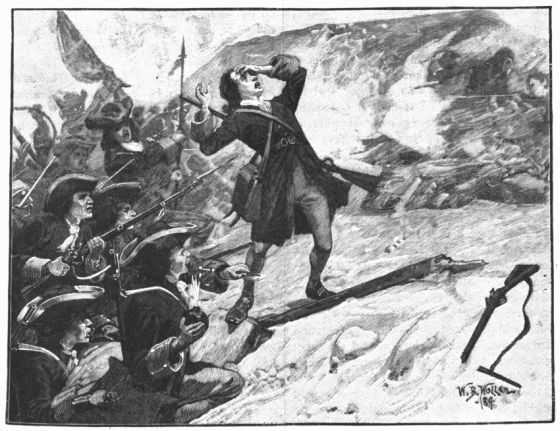
THE ASSAULT OF ATHLONE. (See p. 443.)
[See larger version]
Ginkell himself, after reconnoitring the ford and the breastwork opposite, had no great desire for the attempt. He continued the cannonade on the fort and town till the end of June, and it became necessary, from the want of forage, to advance or retreat. A council of war was called. Mackay was against the attempt, but Würtemberg, Talmash, and Ruvigny were for it, and Ginkell, though hesitatingly, consented. There was observed a degree of carelessness in the Irish soldiers guarding the ford; there had been a rumour in their camp that the English were about to retreat in despair, and the light-hearted Hibernians had begun to relax their vigilance, and to gamble and idle about. It was resolved to seize the opportunity and dash over at once. Fifteen hundred grenadiers were selected for the service, and a handsome present was distributed to each man. The Duke of Würtemberg, Talmash, and a number of other officers volunteered to accompany them as privates, and the spirits of the men rose to enthusiasm. In memory of the auspicious day at the Boyne they stuck each a green twig in their hats, and, locking their arms twenty abreast, they plunged into the stream. In their ardour they lifted up the Duke of Würtemberg and bore him on their shoulders. Six battalions were drawn up ready to support them, under the command of Mackay. The stream, even at the ford, was deep enough to reach their chins, and very strong; but the resolute men pressed on, and soon got firm footing, and, with a stunning shout, reached the other bank. The Irish, suddenly aroused to the danger, hurried to the bank, fired a single volley, and broke. The grenadiers the next moment were over the breastwork, and in full pursuit of the enemy. In a few minutes they had chased the guards from the head of the bridge; planks were thrown over the broken arches, and the troops, rushing over, enabled others to cross in rude pontoons; and in less than an hour the English were masters of the town, with the loss of only twelve men killed and about thirty wounded.
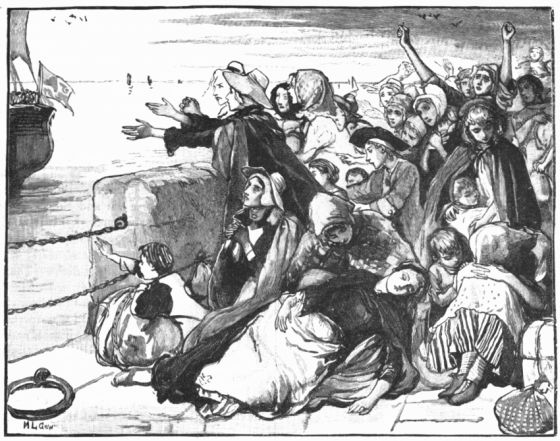
SCENE AT THE REMOVAL OF THE IRISH SOLDIERS FROM LIMERICK. (See p. 447.)
[See larger version]
D'Usson made a vain attempt to regain the town; he was repelled with ruinous loss, and was himself thrown down by the flying rout and nearly trampled to death. St. Ruth, when he heard that the town was taken, exclaimed, "Taken! that is impossible, and I close at hand." But he found it no longer safe to be so close at hand. In the night, covered with shame at his folly and absurd confidence, he struck his tents, and made a hasty retreat towards Aghrim, where, encouraged by the natural strength of bogs and hills, he halted and entrenched himself. There was the fiercest bickering in the camp; the French party and the Irish charging each other with the misfortune. St. Ruth, to excuse himself, laid the blame on Maxwell, whose duty it was to guard the ford. Maxwell was not there to defend himself, for his soldiers fled faster than he, and he was made prisoner. But Tyrconnel, who had always supported Maxwell, protested that he had done his duty like a brave man, and had, along with himself, repeatedly warned St. Ruth of his temerity. The dispute rose so high that Tyrconnel quitted the camp, and retired to Limerick in high dudgeon.
Being relieved from the presence and interference of Tyrconnel, St. Ruth again resolved to fight. He was stung by the loss of reputation which he had sustained at Athlone, and by the reflection of its injurious impression at the Court of France. Sarsfield, one of those Cassandra-like counsellors who give the most prudent advice but are never listened to, attempted to dissuade him. He pointed out how far superior in discipline and bottom were the troops of Ginkell to those which he now commanded, and recommended a system of excursive warfare, which should harass and, by seizing favourable crises, defeat the English piecemeal. His words were lost on St. Ruth, who prepared for the approach of Ginkell by going amongst his soldiers personally to rouse their desire to reconquer their good name, and by sending the priests amongst them to stimulate them by religious motives. Ginkell did not let him wait long. As soon as he had settled the defences of Athlone, he pursued his march towards Aghrim.
On the 12th of July he came up with the army of St. Ruth, and found it very strongly posted. Before him was a morass of half a mile across; beyond the morass rose the hills round the old ruined castle of Aghrim, and at their feet, between them and the bog, the infantry were strongly entrenched, and supported by the cavalry posted commandingly on the slopes of the hills. Difficult as was the approach, it was recommended by Mackay to make an instant attack, whilst the spirits of the troops were high from the first sight of the enemy they had so lately beaten. The battle was determined on, though it was getting late in the afternoon. The infantry struck boldly into the red bog, and plunged on courageously, though often up to their waists in mud and water. Mackay led his horse against their right, and Eppinger's dragoons and Portland's horse advanced against their left. The cavalry found their way through the bogs very difficult; the Dutch and English dragoons met with a repulse in the pass of Urachree, and the infantry were in front of the enemy long before the cavalry could operate on the wings. The Irish infantry that day fought bravely. They poured a fierce fire into the English, and were well supported by the horse. The battle became desperate; the English fought their way into the entrenchments, and drove the Irish up one of the hills; but there they found two old Danish forts, the old castle of Aghrim, and every hedge and thicket lined with muskets. The contest was unequal, and the infantry found themselves at length driven back to the margin of the bog. Elated at the sight, St. Ruth exclaimed, "The day is ours! Now will we drive these English back to the gates of Dublin!"
But he was deceived. Talmash rallied the foot, and led them again to the conflict; and whilst the struggle was renewed and the day fast closing, St. Ruth perceived the horse of Mackay and Ruvigny, the English and Huguenot cavalry, approaching on the right. They came over but a few soldiers abreast, through a narrow track between the bogs; but they soon formed in a dense body, and St. Ruth rode off to encounter them and stop them from out-flanking his force. As he galloped up towards them, a cannon-shot carried off his head. The officers threw a cloak over his body to prevent his fall from disheartening his men. But the absence of command was soon felt. The English fought with fresh fury; and Sarsfield, who was in the rear with the reserve, waiting orders, did not advance till the Irish ranks were broken and all was over. The flight became general. The English horse pursued and hewed down the fugitives as long as they could see; and had not Sarsfield covered the miserable fugitives with his horse, scarcely a man of the infantry would have been left.
The English army camped for the night on the ground which had been occupied by the enemy. Nearly twenty thousand English and their allies entered the battle against something more than the same number of Irish and French. On the side of the English six hundred were killed and one thousand wounded. On the part of the Irish four thousand fell on the field, and nearly as many are said to have perished in the flight. The panic-stricken multitude, flinging their arms away, continued their flight, some of them to Limerick, and others to Galway, where D'Usson was now in command. Whole waggon-loads of muskets and other arms were picked up and purchased by Ginkell at a few pence apiece.
The English spent the next day in burying their own dead; but left the corpses of the Irish on the field, and marched forward to attack Galway. D'Usson, who had about two thousand five hundred men in Galway, made at first a show of resistance, calculating on the assistance of Baldearg O'Donnell. But O'Donnell, after endeavouring in vain to bargain for an earldom, consented to accept five hundred pounds a year and a commission in William's army. This unexpected event compelled D'Usson to surrender, on condition that he might march out and join the Irish army in its last place of retreat, Limerick.
Ginkell soon followed and invested the town. The last struggle for a monarch little worthy the cause of so much bloodshed was now to be fought out. At Limerick the Irish were to make their last stand for the possession of their native country. If they failed here, the Saxon remained absolute lord of their soil.
On the 14th of August the advanced guard of Ginkell's army appeared in sight of Limerick. On the same day Tyrconnel, who was in authority in this city, died of apoplexy, and D'Usson and Sarsfield were left in full command of the troops. A commission was produced, which appointed three lords-justices—Plowden, Fitton, and Nagle; but the city was in reality a military garrison, and the military ruled. There were fifteen thousand infantry in the town, and three or four thousand cavalry posted on the Clare side of the Shannon, communicating with the town on the island by the Thomond bridge. By this means communication was kept up with the country on that side, so that provisions might be brought in; and several cargoes of biscuits and other dry stores were imported from France. The country all around, however, had been so swept by successive forages, that it was difficult to collect any cattle or corn, and the stoutest hearts were little confident of being able to maintain a long defence.
Ginkell took possession of the Limerick side of the town, and reoccupied the ground before held by the besiegers. He commenced by erecting fresh batteries of far heavier cannon than William brought to bear on the city, and soon poured a fiery storm of balls and shells into it, which crashed in the roofs and laid whole streets desolate. At the same time a squadron of English men-of-war sailed up the Shannon, and closed access to the city or escape from it by water. The town, however, held out till the 22nd of September, when Ginkell, beginning to fear the rains and fevers of autumn, and that they might compel him to draw off, and thus continue the war to another year, determined to obtain possession of the bridge, and attack the cavalry on the other side. He therefore passed the river by a bridge of William's tin boats, and, assaulting the cavalry, put them to utter rout. They left their camp with many arms and much store of provisions, and fled with as much precipitation as they had done from Aghrim, scattering again the whole country with their arms. Ginkell next attacked the fort which defended the bridge, carried it and the bridge, and thus was able to invest the whole town. In the haste to draw up the movable part of the bridge nearest to the city, the soldiers retreating from the fort were shut out, and a terrible massacre was made of them on the bridge. Out of eight hundred men only one hundred and twenty escaped into Limerick.
This disaster broke the spirit of the Irish entirely. Even the stout-hearted Sarsfield was convinced that all was over, and it was resolved to capitulate. An armistice was agreed to. The Irish demanded that they should retain their property and their rights; that there should be perfect freedom for the Catholic worship, a Catholic priest for every parish, full enjoyment of all municipal privileges, and full capability to hold all civil and military offices. Ginkell refused these terms, but offered others so liberal that they were loudly condemned by the English, who were hungering after the estates of the Irish. He consented that all such soldiers as desired to continue in the service of James should be not only allowed to do so, but should be shipped to France in English vessels; that French vessels should be permitted to come up and return in safety; that all soldiers who were willing to enter William's service should be received, and that on taking the oath of allegiance all past offences should be overlooked, and they and all Irish subjects taking the oaths should retain their property, should not be sued for any damages or spoliation committed during the war, nor prosecuted for any treason, felony, or misdemeanour, but should, moreover, be capable of holding any office or practising any profession which they were capable of before the war. They were to be allowed to exercise their religion in peace as fully as in the reign of Charles II. It is to the disgrace of England that this part of the treaty should not have been kept.
These terms were accepted, and the treaty was signed on the 3rd of October, and thus terminated this war, which, in the vain endeavour to restore a worthless monarch, had turned Ireland into a desert and a charnel-house. When it came to the choice of the soldiers to which banner they would ally themselves, out of the fifteen thousand men, about ten thousand chose to follow the fortunes of James, and were shipped off with all speed, as they began to desert in great numbers. Many of those who actually embarked did it under a solemn assurance from Sarsfield that their wives and children should go with them; but, once having the men on board, this pledge was most cruelly broken, and the greatest part of the women and children were left in frantic misery on the shore. The scenes which took place on this occasion at Cork are described as amongst the most heartrending in history. But this agony once over, the country sank down into a condition of passive but gloomy quiet, which it required more than a century to dissipate. Whilst Scotland again and again was agitated by the endeavours to reinstate the expelled dynasty, Ireland remained passive; and it was not till the French Revolution scattered its volcanic fires through Europe that she once more began to shake the yoke on her galled neck. Yet during all this time a burning sense of her subjection glowed in her blood, and the name of the Luttrel who went over to the Saxon at the dividing day at Limerick, and received for his apostacy the estates of his absent brother, remained a term of execration amongst the Irish. Meanwhile the Irish regiments which went to France won a brilliant reputation in the wars of the Continent, and many of the officers rose to high position in France, in Spain, in Austria, and Prussia. Their descendants still rank with the nobility of those countries.