CASSELL'S Illustrated History of England. (continued 2)
Reading edition
As was foreseen, the English Parliament made overtures to the Scots for assistance, and the Scots were by no means loth to grant it, provided they could make advantageous terms. A Commission was sent to Edinburgh to treat, and the Scots on their part resolved to call a Parliament to receive their offers. The time fixed for the reassembling of the Scottish Parliament was not come by a full year, and the Duke of Hamilton had most particularly pledged himself to the king to prevent it from meeting. Yet on the 22nd of June, notwithstanding his remonstrance, it came together, and on the 20th of July the Commissioners from the English Parliament arrived, and were received by both Parliament and General Assembly with exultation, and their letters from the Parliament of England were read with shouts of triumph—by many, with tears of joy. Their arrival was regarded as a national victory.
The conduct of Hamilton was now suspicious. If he was honest he had misled the king, for he found he had no power to resist the popular feeling in Scotland; but the general opinion coincided with that of Montrose, that he was a traitor. The Royalists called upon him to summon them to his aid, to assemble them in a large body, mounted and armed, and, supported by them, to forbid the meeting of Parliament as illegal. But that, Hamilton assured them, would frighten the people, and lead to disturbance. He proposed that the meeting should take place, that all the Royalist members should appear in their places, and then he would declare the meeting illegal, and dismiss it. To their astonishment, however, Hamilton did not dismiss it, but allowed it to sit. On this Montrose posted away to England, followed the king to Gloucester, and represented to him the conduct of Hamilton as confirming all former declarations of his perfidy. After the battle of Newbury, Charles listened more at leisure to these representations. He was so far convinced that he thought of ordering the Earl of Newcastle to send for Hamilton and his brother Lord Lanark, and to confine them at York. But at that moment the two brothers, probably aware of the proceedings of Montrose, appeared themselves at Oxford, where Charles ordered the Council to examine into the charges against them. Lanark managed to escape from custody, and hastened direct to London and to the Parliament, which received him most cordially, a pretty strong proof of mutual understanding. This satisfied Charles of Hamilton's complicity, and he sent him in custody to the castle of Bristol, thence to Exeter, and thence to Pendennis in Cornwall.
The Commissioners sent to Scotland were Henry Vane the younger, Armyn, Hatcher, Darley, and Marshall, with Nye, an independent. The Scots proposed to invade England on condition that the Parliament adopted the Covenant, and engaged to establish uniformity of religion in both countries, "according to the pattern of the most reformed Church," which, of course, meant Presbyterianism. But the Commissioners knew that this was impossible, for though a considerable number of the people were Presbyterian in doctrine, many more were Independent, and just as sturdy in their faith, to say nothing of the large section of the population which held conscientiously to both Episcopacy and Catholicism. Vane himself was a staunch Independent, and he was at the same time one of the most adroit of diplomatists. He consented that the Kirk should be preserved in its purity and freedom, and that the Church of England should be reformed "according to the Word of God." As the Scots could not object to reformation according to the Word of God, and "the example of the first Reformed churches," which they applied especially to their own, they were obliged to be content with that vague language. Vane also obtained the introduction of the word League, giving the alliance a political as well as a religious character. It was concluded to send a deputation with the Commissioners to London, to see the solemn "League and Covenant" signed by the two Houses of Parliament, at the head of which went Alexander Henderson, the well-known Moderator of the Assembly. Whilst they were on their journey, the ministers in Scotland readily proclaimed from their pulpits that now the Lord Jesus had taken the field against antichrist, that Judah would soon be enslaved if Israel was led away captive, and that the curse of Meroz would fall on all who did not come to the help of the Lord against the mighty.
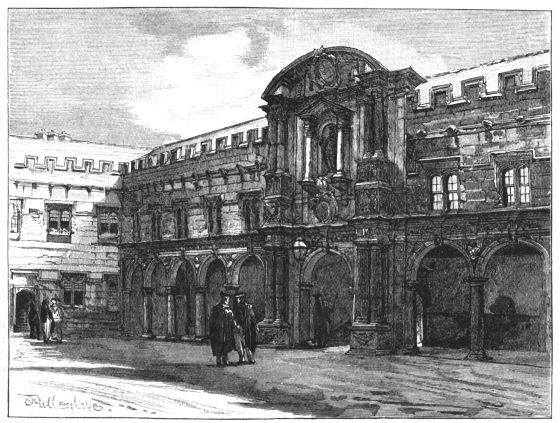
ARCHBISHOP LAUD'S LIBRARY, EAST QUADRANGLE, JOHN'S COLLEGE, OXFORD.
[See larger version]
On the 25th of September, the very day that Essex arrived in London after the battle of Newbury, and received the thanks of Parliament, the two Houses met with the Westminster divines in the church of St. Margaret, where, after various sermons, addresses, and blessings, the two Houses signed the League and Covenant, and their example was followed by the Scottish Commissioners and the divines. It was then ordered to be subscribed in every parish by all persons throughout the country.
It was agreed that the Estates of Scotland should send an army of twenty-one thousand men into England, headed by the old Earl of Leven. They were to receive thirty-one thousand pounds a month,—one hundred thousand pounds of it in advance, and another sum at the conclusion of peace. Sixty thousand pounds were soon remitted, the levies began, and in a few months Leslie mustered his army at Harlaw.
The union of the Scots with the Parliament was an alarming blow to the Royalists. If they had found it difficult to cope with Parliament alone, how were they to withstand them and the Scots? To strengthen himself against this formidable coalition, Charles turned his attention to Ireland. There the army had actually grown to fifty thousand men. As the restorers of the English influence, these were to be paid out of the estates of the revolted Irish, and numbers of both English and Scots had flocked over. A large body of Scots had landed under the command of General Monro, eager to avenge the massacre of their Presbyterian brothers in Ulster. The natives had been driven back, and the invaders were busy parcelling out the evacuated lands. Two million and a half of acres had been promised by the English Parliament as the reward of the victors.
To resist the tempest which threatened to exterminate them, the Irish Catholics formed themselves into a confederation, and created a kind of Parliament at Kilkenny. They imitated in everything the measures by which the Scots had succeeded in enfranchising their religion. They professed the most profound loyalty to the sovereign, and asserted that they were in arms only for the protection of their religion and their lives. They established a synod which assumed the same religious authority as the Scottish Assembly, and ordered a covenant to be taken, by which every one bound himself to maintain the Catholic faith and the rights of the sovereign and the subject. They appointed generals in each province, and all necessary officers for the command of their force. Charles, who suspected the allegiance of the Earl of Warwick, had contrived to remove him, and appointed the Marquis of Ormond in his place. To him the confederate Catholics transmitted their petition, avowing the most unshaken loyalty, declaring that they had only taken up arms to defend their lives and properties from men who were equally the enemies of the king and their own,—from the same puritanic people, so they said, who were seeking to deprive the king of his crown. These petitions, forwarded to Charles, suggested to him the idea of deriving use from these forces. As they prayed him to assemble a new Parliament in Ireland, to grant them the freedom of their religion and the rights of subjects, he instructed Ormond to come to terms with them, so that in their pacification they might be able to spare a considerable body of troops for his assistance in England. This was effected in September, 1643, and the confederates contributed directly thirty thousand pounds for the support of the royal army, fifteen thousand pounds in money, and fifteen thousand pounds in pensions.
This was not accomplished without exciting the notice of the English Parliament, who sent over Commissioners to endeavour to win over the Protestants in Ormond's army, but in vain. In November Ormond shipped five regiments to the king. These were sent to Chester to garrison that town under Lord Byron; but they were rather marauders than soldiers; they had been raised by the Parliament, yet fought against it for the king; and they were as loose in discipline as in principles. In about six weeks after their arrival, they were visited by Sir Thomas Fairfax at Nantwich, when fifteen thousand of them threw down their arms, amongst them the afterwards notorious General Monk. Nor was this the only mischief occasioned to the royal cause by these Irish troops. Their arrival disgusted the royal forces under Newcastle in the North, who declared they would not fight with Catholics and Irish rebels.
Whilst the Scots were mustering to enter England, the Marquis of Newcastle was bearing hard on the Parliament forces in Yorkshire. He had cleared the country of them except Hull, which he was besieging; and Lincolnshire was also so overrun with his forces, that Lord Fairfax, governor of Hull, was obliged to send his son, Sir Thomas, across the Humber, to the help of the Earl of Manchester. Fairfax united with Cromwell near Boston, and at Winceby-on-the-Wolds, about five miles from Horncastle, the united army under Manchester came to a battle with the troops of Newcastle, and completely routed them, thus clearing nearly all Lincolnshire of them. Cromwell had a horse killed under him, and Sir Ingram Hopton, of Newcastle's army, was killed. The battle was won by Cromwell and Fairfax's cavalry.
The close of 1643 was saddened to the Parliament by the death of Pym (December 8). It was, indeed, a serious loss, following that of Hampden. No man had done so much to give firmness to the Commons, and clearness to the objects at which they aimed. His mind was formed on the old classic model of patriotic devotion. He had no desire to pull down the Crown or the Church, but he would have the one restrained within the limits of real service to the country, and the other confined to those of its communion. Therefore he recommended, sternly, resistance to the royal power—preferring civil war to perpetual slavery—and the exemption of bishops and clergymen from all civil offices. Seeing from the first the ends that he would attain, guided by the most solemn and perspicuous principles, he never swerved from them under pressure of flattery or difficulty, nor would he let the State swerve. His eloquence and address, but far more his unselfish zeal, enabled him to prevail with the Commons and intimidate the Lords. He boldly told the Peers that they must join in the salvation of the country, or see it saved without them, and take the consequences in the esteem or the contempt of the people. They would have fared better had they profited by his warning. Pym was the Aristides of the time: he sought no advantage to himself, he gained nothing from his exertions or his prominent position, but the satisfaction of seeing his country saved by his labours. He derived no influence from his wealth or rank, for he had none of either. His whole prestige was intellectual and moral. He wore himself out for the public good, and died as poor as he commenced, the only grant which he received from the State being an honourable burial in Westminster Abbey.
At the opening of 1644 Charles had devised a scheme for undermining the authority of the Parliament, namely, by issuing a proclamation for its extinction. Clarendon, who was now the Lord Chancellor, very wisely assured him that the members of Parliament sitting at Westminster would pay no heed to his proclamation, and that a better measure would be to summon Parliament to meet at Oxford. That would give every member of both Houses, who was at all inclined to again recognise the royal authority, the opportunity to join him; and, on the other hand, a Parliament assembling by call and authority of the king at his court, would stamp the other as illegal and rebellious. The advice was adopted, and at the summons forty-three Peers and one hundred and eighteen Commoners assembled at Oxford. These, however, consisted of such as had already seceded from the Parliamentary party, and the king claimed as the full number of his Parliament at Oxford, eighty-three Lords, and one hundred and seventy-five Commons. According to Whitelock, there met at Westminster twenty-two Lords only, and eleven more were excused on different accounts, making thirty-three; of the Commons there were more than two hundred and eighty. The king, in his Parliament, promised all those privileges which he had so pertinaciously denied to all his past Parliaments, and a letter, subscribed by all the members of both Houses, was addressed to the Earl of Essex, requesting him to inform "those by whom he was trusted," that they were desirous to receive commissioners, to endeavour to come to a peaceable accommodation on all matters in dispute. Essex returned the letter, refusing to forward a paper which did not acknowledge the authority of the body addressed. The point was conceded, and Charles himself then forwarded him a letter addressed to the Lords and Commons of Parliament assembled at Westminster in his own name, soliciting, by advice of the Lords and Commons of Parliament assembled at Oxford, the appointment of such commissioners "for settling the rights of the Crown and Parliament, the laws of the land, and the liberties and property of the subject." But there was no probability of agreement, and so the Oxford Parliament proceeded to proclaim the Scots, who had entered England contrary to the pacification, and all who countenanced them guilty of high treason.
The Scots passed the Tweed on the 16th of January, 1644. The winter was very severe, and the march of the army was dreadful. They made their way, however, to Newcastle, where the Marquis of Newcastle had just forestalled them in getting possession of it. They then went on to Sunderland. Newcastle offered them battle, but the Scots, though suffering from the weather and want of provisions, having posted themselves in a strong position, determined to wait for the arrival of Parliamentary forces to their aid. The defeat of Lord Byron at Nantwich permitted Sir Thomas Fairfax and Lord Fairfax, his father, to draw towards them, and these generals having also defeated at Leeds the Royalists under Lord Bellasis, the son of Lord Falconberg, Newcastle betook himself to York, where he was followed by both the Fairfaxes and the Scots.
Charles was lying at Oxford with a force of ten thousand men; Waller and Essex, with the Parliamentary army, endeavoured to invest him in that city, but as they were marching down upon him from two different quarters, he issued from it with seven thousand men and made his way to Worcester. As these two generals detested each other and could not act in concert, Essex turned his march towards the West of England, where Prince Maurice lay, and Waller gave chase to the king. Charles, by feint of marching on Shrewsbury, induced Waller to proceed in that direction, and then suddenly altering his course at Bewdley regained Oxford. After beating up the Parliamentary quarters in Buckinghamshire, he encountered and worsted Waller at Cropredy Bridge, and then marched westward after Essex.
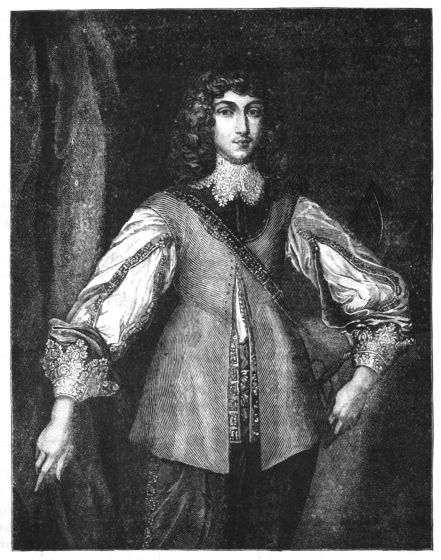
PRINCE RUPERT. (After the Portrait by Vandyke.)
[See larger version]
While these manœuvres were in progress, the Earl of Manchester, having as his lieutenant-general Oliver Cromwell, marched northward to co-operate with Leslie and the Fairfaxes at York against Newcastle. Charles, who saw the imminent danger of Newcastle, and the loss of all the North if he were defeated, sent word to Prince Rupert to hasten to his assistance. Rupert had been gallantly fighting in Nottinghamshire, Cheshire, and Lancashire, and everywhere victorious. He had compelled the Parliamentary army to raise the siege of Newark, had taken Stockport, Bolton, and Liverpool, and raised the siege of Lathom House, which had been nobly defended for eighteen weeks by the Countess of Derby. On receiving the king's command, he mustered what forces he could, and reached York on the 1st of July. The Parliamentary generals, at his approach, raised the siege, and withdrew to Marston Moor, about four miles from the city. Rupert had about twenty thousand men, with whom he had committed dreadful ravages on the Lancashire hills; he had now relieved the marquis, and might have defended the city with success, but he was always ready to fight, and Newcastle having six thousand men, making, with his own forces, twenty-six thousand, Rupert persuaded him to turn out and chastise the Roundheads. The English and Scots had about the same number. So little did the Parliamentarians expect a battle, that they were in the act of drawing off their forces to a greater distance, when Rupert attacked their rear with his cavalry. On this they turned, and arranged themselves in front of a large ditch or drain, and the Royalists posted themselves opposite. The Scots and English occupied a large rye field bounded by this ditch, and they placed their troops in alternate divisions, so that there should be no jealousy between them. It was not till five o'clock in the afternoon of the 2nd of July that the two armies had arranged themselves for the fight, and then they stood gazing on each other for two hours, each loth to risk the disadvantage of crossing the ditch first. Newcastle, who did not want to fight, had retired to his carriage in ill-humour, and all began to think that there would be no battle till the morrow, when Rupert, who was posted on the right wing with his cavalry, another body of cavalry covering the flank of the infantry on the left, made one of his sudden and desperate charges. Like all these exploits of his, it was so impetuous, that it bore the Parliamentary cavalry on their left wing clear away before it, and the officers and their horse were speedily in full flight, pursued by the fiery Rupert, who, as was his wont, forgot all but the fugitives before him, and with three thousand cavalry galloped after them for some miles. The Royalist infantry followed up the effect by attacking that of the Parliament with such fury, that the latter was thrown into confusion, and the three generals, Manchester, Lord Fairfax, and Leslie, believing all lost, fled with the rest, in the direction of Tadcaster and Cawood Castle. Cromwell, who commanded the right wing of the Parliamentary army, was thus left to fight or flee, as might happen, but nothing daunted, he attacked the Royalist cavalry with such vigour that he completely routed them, and then turned again to oppose the horse of Rupert, who were just returning from the chase, to find their side in flight. These and a body of pikemen,—Newcastle's "white coats"—fought desperately. The cavalry, on exhausting their charges, flung their pistols at the enemies' heads, and then fell to with their swords. At length the victory remained with Cromwell, Rupert drew off, and Cromwell remained all night on the field. He sent messages after the fugitive generals to recall them, but Leslie was already in bed at Leeds when the news reached him, when he exclaimed, "Would to God I had died on the place!" Cromwell won great renown by this action. He kept the field all night with his troopers, who were worn out by the tremendous exertions of the day, and were in expectation every moment of a fresh attack from Rupert, who might have collected a large body of troops together to overwhelm him. But he had lost the battle by his incurable rashness, after having induced the unwilling Newcastle to risk the engagement, and he made his retreat into Lancashire, and thence into the western counties.
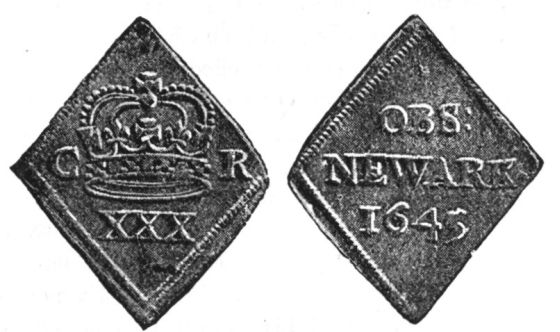
SIEGE-PIECE OF CHARLES I.—NEWARK (HALF-CROWN).
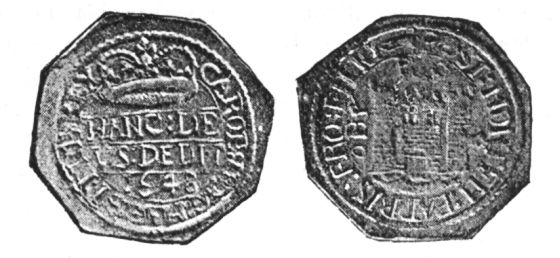
SIEGE-PIECE OF CHARLES I.—PONTEFRACT (SHILLING).
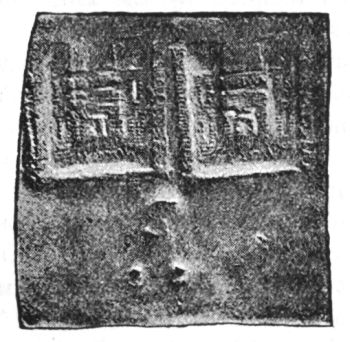
SIEGE-PIECE OF CHARLES I.—BEESTON (TWO SHILLINGS).
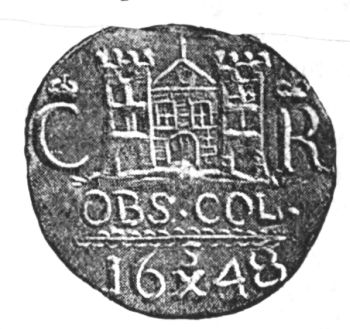
SIEGE-PIECE OF CHARLES I.—COLCHESTER (TEN SHILLINGS, GOLD).
Four thousand one hundred and fifty bodies of the slain were buried on the moor; the greater part of the arms, ammunition, and baggage of the Royalists fell into the hands of Cromwell, with about a hundred colours and standards, including that of Rupert himself, and the arms of the Palatinate. Newcastle evacuated York and retired to the Continent, accompanied by the Lords Falconberg and Widderington, and about eighty gentlemen, who believed the royal cause was totally ruined. This the bloodiest battle of the war was fought on the 2nd of July, and on the morning of the 4th the Parliamentary forces were again in muster, and sat down before the walls of York. On the 7th, being Sunday, they held a public thanksgiving for their victory, and on the 11th being ready to take the city by escalade, Glenham, the governor, came to terms, on condition that the garrison should be allowed to march out with all the honours of war, and retire to Skipton. On the 16th they evacuated the city, and the Parliamentarians entered, and marched directly to the cathedral, to return thanks for their victory. The battle of Marston Moor had indeed utterly destroyed the king's power in the North. Newcastle alone stood out; but this the Scots invested, and readily reduced, taking up their quarters there for the present.
In the West, matters for awhile wore a better aspect for the king. Essex, on the escape of the king from Oxford, directed his course west. The Royalists were strong in Devon, Cornwall, and Somersetshire; but to effectually compete with them, Waller should have united his forces with the commander-in-chief. He was too much in rivalry with him to do that. The king set off after Essex, to support his forces in the western counties, and Essex, as if unaware of the royal army following him, continued to march on. The queen, who had been confined of a daughter at Exeter, on the approach of Essex requested of him a safe conduct to Bath, on pretence of drinking the waters, whence she proposed to get to Falmouth, and thence back to France. Essex ironically replied that he would grant her an escort to London, where she could consult her own physicians, but where he knew that she was proclaimed guilty of high treason. Henrietta Maria, however, made her way to Falmouth without his courtesy, and thence in a Dutch vessel, accompanied by ten other ships, she reached France, though closely pursued by the English admiral, who came near enough to discharge several shots at the vessel.
Essex advanced to Lyme Regis, where he relieved Robert Blake, afterwards the celebrated admiral, who was there closely besieged by Prince Maurice; and still proceeding, took Taunton, Tiverton, Weymouth, and Bridport. This was something like victory; but meanwhile, all men were wondering at his apparent unconsciousness that the Royalist forces were enclosing him, and that with the exception of about two thousand horse under Middleton, which kept at a distance and never united with him, he was wholly unsupported by Waller's troops. In this manner he advanced into Cornwall, where Prince Maurice joined his forces with those of the king to cut off his return. At this crisis many began to suspect that he meant to go over to the king's party, but in this they misjudged him, for at this time Charles made overtures to him, but in vain. He received a letter from the king, promising him if he would join him in endeavouring to bring the Parliament to terms, he would guarantee both the liberties and religion of the people; and another from eighty-four of the king's principal officers, protesting that if the king should attempt to depart from his engagements they would take up arms against him. Essex sent the letter to the Parliament, proving his faith to them; but it would have been still better if he could have proved to them also his military ability. But near Liskeard, he suffered himself to be hemmed in by different divisions of the royal army, and his supplies to be cut off by allowing the little port of Fowey to fall into the hands of the king's generals, Sir Jacob Astley and Sir Richard Grenville. He was now attacked by Charles on the one hand, and Colonel Goring on the other. Essex sent pressing demands to Parliament for succour and provisions, but none came; and one night in September his horse, under Sir William Balfour, by a successful manœuvre, passed the enemy, and made their way back to London. Essex, with Lord Roberts and many of his officers, escaped in a boat to Plymouth, and Major-General Skippon, with the fort, capitulated, leaving to the king their arms and artillery.
Essex had no right to expect anything but the most severe censure for his failure; he retired to his house, and demanded an investigation, charging his disasters to the neglect of Waller. The Parliament, however, instead of reproaching him, thanked him for the fidelity which he had shown when tempted by the king, and for his many past services.
To Cromwell the general aspect of things had become well nigh intolerable. But it was in vain that he endeavoured to move the heavy spirit of his superior, the Earl of Manchester, and hence they came more and more to disputes. Cromwell was insubordinate because it was impossible that fire could be subordinate to earth. In vain he pointed out what ought to be done, and he grew impatient and irritated at what was not done. That irritation and impatience became the greater as he turned his eyes on what Essex, Waller, and the rest of the Parliamentary generals were doing. It seemed to him that they were asleep, paralysed, when a few bold strokes would bring the war to a close.
Charles having broken up Essex's army in Cornwall, and put Essex himself to flight, made a hasty march back again to Oxford to avoid being himself in turn cooped up in the narrow West. Already the Parliament was mustering its forces for that purpose. Essex and Waller were again set at the head of troops, and the victorious forces of Marston Moor, under Manchester and Cromwell, were summoned to join them. They endeavoured to stop the king in his attempt to reach Oxford, and encountered him again near the old ground of battle at Newbury. Charles was attacked in two places at once—Shaw on the eastern, and at Speen on the western side of the town. The Earl of Essex was ill, or, as many believed, pretended to be so; at all events, the command fell to Manchester. On the 26th of October, the first brush took place, and the next morning being Sunday, the attack was renewed more vigorously. The soldiers of Manchester, or rather of Cromwell, went into the fight singing psalms, as was their wont. The battle was fiercely contested, and it was not till ten o'clock at night that Charles retreated towards Wallingford. It was full moonlight, and Cromwell prepared to pursue him, but was withheld by Manchester. Again and again did Cromwell insist on the necessity of following and completing the rout of the royal army. "The next morning," says Ludlow, "we drew together and followed the enemy with our horse, which was the greatest body that I saw together during the war, amounting at least to seven thousand horse and dragoons; but they had got so much ground, that we could never recover sight of them, and did not expect to see any more in a body that year; neither had we, as I suppose, if encouragement had not been given privately by some of our party."
In other words, there were strong suspicions that the aristocratic generals did not want to press the king too closely. This became apparent ten days after. Charles, on retreating, had done exactly as he did before at this same Newbury; he had thrown all his artillery into the Castle of Donnington, and now he came back again to fetch it, nobody attempting to hinder him, as nobody had attempted to reduce Donnington and secure the artillery. So extraordinary was the conduct of the Parliamentary generals, that though Charles passed through their lines both in going and returning from Donnington, and even offered them battle, no one stirred. The generals dispersed their army into winter quarters, and both Parliament and people complained of the affair of Newbury. The Parliament set on foot an inquiry into the causes of the strange neglect of public duty, and they soon found one powerful cause in the jealousies and contentions of the generals. It was time a new organisation was introduced, and Cromwell saw that besides the incapacity of the commanders, there were aristocratic prejudices that stood in the way of any effectual termination of the war.
Cromwell was at the head of the Independents, and these were as adverse to the dominance and intolerance of the Presbyterians, as Cromwell was to the slow-going generals. He knew that he should have their support, and he determined to come to a point on the vital question of the arrangement of the war. He had declared plumply, in his vexation, "That there never would be a good time in England till we had done with lords;" and he had horrified the milk-and-water aristocrats, by protesting that "if he met the king in battle, he would fire his pistol at him as he would at another." He was now resolved to have lords out of the army at least, and therefore, on the 25th of November, 1644, he exhibited a charge in the House of Commons against the Earl of Manchester, asserting that he had shown himself indisposed to finish the war; that since the taking of York he had studiously obstructed the progress of the Parliamentary army, as if he thought the king already too low, and the Parliament too high, especially at Donnington; and that since the junction of the armies he had shown this disposition still more strongly, and had persuaded the Council not to fight at all.
Manchester, eight days after, replied at great length, accusing Cromwell of insubordination, and was supported by Major-General Crawford, whom the Scottish Presbyterians had got into the army of Manchester, to counteract the influence of Cromwell and the Independents. Crawford even dared to charge Cromwell with leaving the field of Newbury from a slight wound. Cromwell, on the 9th of December, leaving such charges to be answered by Marston Moor and his share of Newbury, proposed a measure which at once swept the army of all its deadweights. In the Grand Committee there was a general silence for a good space of time, one looking on the other, to see who would venture to propose the only real remedy for getting rid of the Essexes and Manchesters out of the army, when Cromwell arose and proposed the celebrated Self-denying Ordinance. It is now time to speak, he said, or for ever hold the tongue. They must save the dying nation by casting off all lingering proceedings, like those of the soldiers of fortune beyond the sea, who so pursued war because it was their trade. "What," he asked, "did the nation say?" That members of both Houses had got good places and commands, and by influence in Parliament or in the army, meant to keep them by lingering on the war. What he told them to their faces, he assured them was simply what all the world was saying behind their backs. But there was a sure remedy for all that, and for himself, he cared to go no farther into the inquiry, but to apply that remedy. It was for every one to deny themselves and their own private interests, and for the public good to do what Parliament should command. He told them that he would answer for his own soldiers, not that they idolised him, but because they looked to Parliament, and would obey any commands the Parliament should lay upon them for the Cause.
Accordingly, the same day, Mr. Tate, of Northampton, formally moved the Self-denying Ordinance—that is, that no member of either House should hold a command in the army or a civil office. This was so surprising a measure, that even Whitelock observed that "our noble generals, the Earls of Denbigh, Warwick, Manchester, the Lords Roberts, Willoughby, and other lords in your armies, besides those in civil offices, and your members the Lord Grey, Lord Fairfax, Sir William Waller, Lieutenant-General Cromwell, Mr. Hollis, Sir Philip Stapleton, Sir William Brereton, Sir John Meyrick, and many others must be laid aside if you pass this ordinance." The proposition seen in these dimensions was daring and drastic. Manchester, Essex, Denzil Holles, Meyrick, Stapleton, and others, who had so long gone on side by side with Cromwell, Whitelock, and others, were now not only indignant at Cromwell's bold and aspiring tone, but bitterly opposed to him on the ground of faith and Church government. They were for preserving Church and State, and they were linked with the Scots, who were vehement for the general acceptation of the Presbyterian doctrine, if they could not carry its formula. They met at Essex House, and concerted how they were to put down not only this troublesome man, but the troublesome party of which he was the representative, the Independents, who were for liberty in the Church and the State, and would hear nothing of the domination of synods and presbyteries any more than of bishops. They sent to Whitelock and Maynard, to consult them as lawyers, on nothing less than impeaching Cromwell as an incendiary. The Lord Chancellor of Scotland addressed them thus:—"Ye ken varra weel that, Lieutenant-General Cromwell is no friend of ours, and since the advance of our army into England, he hath used all underhand and cunning means to take off from our honour and merit with this kingdom—an evil requital of all our hazards and services; but so it is, and we are nevertheless fully satisfied of the affections and gratitude of the gude people of this nation in general. It is thought requisite for us, and for the carrying on of the cause of the twa kingdoms, that this obstacle or remora may be moved out of the way, who, we foresee, will otherwise be no small impediment to us, and the gude design that we have undertaken. He not only is no friend to us, and to the government of our Church, but he is also no well-willer to his excellency, whom you and us all have cause to love and honour; and if he be permitted to go on in his ways, it may, I fear, endanger the whole business. Ye ken varra weel the accord atwixt the twa kingdoms, and the union by the Solemn League and Covenant, and if any be an incendiary betwin the twa nations, how he is to be proceeded against."
Whitelock replied that the word "incendiary" meant just the same thing in English as it did in Scottish, but that whether Cromwell was an incendiary, was a thing that could only be established by proofs, and that, he thought, would be a tough matter. Maynard agreed with Whitelock, and though Holles and others of the Presbyterian party urged an immediate impeachment, the Scots cautiously paused.
The question of the Self-denying Ordinance was vigorously debated for ten days in the Commons. Vane seconded the motion of Tate, and another member observed that two summers had passed over, and they were not saved. A fast was appointed for imploring a blessing on the new project. The people of London, on the 12th of December, petitioned the House, thanking them for their proceedings, and, after serious debate and opposition, the Bill was passed on the 19th. On the 21st it was sent up to the Peers, where it was vigorously attacked by Essex, Manchester, and the rest of the Lords affected. On the 13th of January, 1646, the Lords threw it out. But the Commons went on remodelling the army, fixed its numbers at twenty-one thousand effective men, namely, fourteen thousand foot, six thousand horse, and one thousand dragoons. They then nominated Sir Thomas Fairfax commander-in-chief instead of Essex; Skippon, the old train-band major, was made major-general; the lieutenant-general was left unnamed, the Commons, in spite of their own ordinance, resolving that Cromwell should hold that post, but avoiding to increase the opposition to the general measure by not mentioning him.
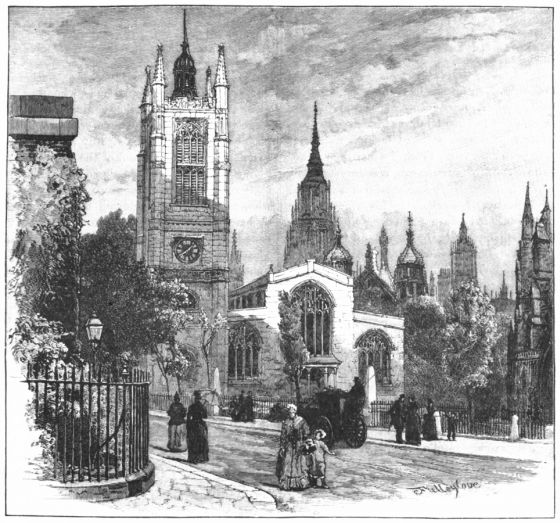
ST. MARGARET'S, WESTMINSTER. (1888.)
[See larger version]
On the 28th of January, the Commons, having completed the organisation of the army and the appointment of the officers, again sent the Ordinance up to the Peers who, seeing that they should be obliged to swallow it, moulded it into a more digestible shape, by insisting that all officers should be nominated by both Houses, and that no one should be capable of serving who did not take the Solemn League and Covenant within twenty days. But the Lords were struck with an apprehension that the Commons meant to do without them in the end, and they therefore exercised their rights in opposing the acts of the Lower House. They refused to sanction one-half of the officers appointed by Sir Thomas Fairfax, who had been introduced to the Commons on the 18th of February, thanked for his past services, and complimented on his appointment. To remove the suspicion of the Lords, the Commons assured them by message that they had bound themselves to be as tender of the honours and rights of the Peers as they were of their own. This pacified the Lords, and yielding to a necessity too strong for them, Essex, Manchester, Denbigh, and the rest resigned their commands, and on the 3rd of April the Self-denying Ordinance was passed by the Peers. Sir Thomas Fairfax proceeded to Windsor to remodel the army according to this Act. He did not find it an easy task; many, who were dismissed by the Act or for their past conduct, were unwilling to be cashiered; others would not serve under the new officers; and Dalbier, who had been one of the worst counsellors of Essex, lay apart with eight troops of horse, as if he contemplated going over to the king. At length, however, he came in, and the work was completed.