Chapter XV
Reading edition
REIGN OF WILLIAM III. (concluded).
William Meets his Parliament—Reduction of the Standing Army—Visit of Peter the Great—Schemes of Louis—The East India Company—Spanish Partition Scheme—Its Inception and Progress—Somers's Hesitation—The Treaty is Signed—New Parliament—Tory Reaction—Dismissal of the Dutch Guards—William forms an Intention of Quitting England—Attack on the late Ministry—Jobbery in the Admiralty—Paterson's Darien Scheme—Douglas's Reasons against It—Enthusiasm of the Scots—Departure of the First Expedition and its Miserable Failure—The Untimely End of the Second Expedition—Second Partition Scheme—Double-dealing of the French—New Parliament—Attack on Somers—Report on the Irish Grants—Resumption Bill passed—William's Unpopularity—Death of the Duke of Gloucester—Conclusion of the New Partition Treaty and its Results—Charles makes over his Dominions to the French Candidate—His Death—Disgust of William at Louis's Duplicity—Tory Temper of the House—The Succession Question—Debates on Foreign Policy—The Succession Act passed—New Negotiations with France—Attack on the Whig Ministers—Acknowledgment of the Spanish King—Impeachment of the Whigs—The Kentish Petition—Its Reception by the House—The Legion Memorial—Panic in the House—Violent Struggle between the two Houses—The Impeachments dropped—William goes Abroad—The Grand Alliance and its Objects—Beginning of the War—Death of James II.—Louis acknowledges the Pretender—Reaction in England—New Parliament and Ministry—The King's Speech—British Patriotism is Roused—Voting of Supplies—The Bills of Attainder and Abjuration—Illness and Death of William—His Character.
William met his Parliament on the 3rd of December. He congratulated it on the achievement of a peace in which the Confederates had accomplished all they had fought for—the repression of the ambitious attempts of France to bring under its yoke the rest of the kingdoms on the Continent. She had been compelled to yield up everything which she had seized from the commencement of the war. But he reminded them that this had not been accomplished except at a heavy cost. They had supported him nobly in furnishing that cost, and he trusted they would not now be less prompt to discharge the remaining unpaid claims, and in taking measures to liquidate by degrees the debts incurred. He expressed his hope that they would provide him for life with a sufficient Civil List to maintain the necessary dignity of the Crown. Though the war was over, he reminded them that there were many reasons why the army and navy should yet be maintained on a respectable footing.
The Commons voted him an address, in which they united in the congratulations on the restoration of peace, but passed over the subject of the army. William noticed the omission, and felt it deeply. Nobody was more aware than himself that, though they had bound France by the treaty of Ryswick, no bonds of that kind ever held Louis XIV. any longer than it suited his necessities or his schemes of aggrandisement. He observed that Louis still kept on foot his large armies, and that he still retained James and his Court at St. Germains, in open violation of the treaty; and the circumstances of Spain, whose king was gradually dying childless, with Louis intently watching to pounce on his dominions, filled him, as it did every far-seeing man, with deep anxiety. Though no king ever less sought to infringe the liberties of his subjects, yet William, naturally fond of an army and of military affairs, was especially anxious at this crisis for the retention of a respectable force. He knew that Europe, though freed from actual war, was, through the restless ambition of Louis, still living only in an armed peace.
The Commons did not leave him long in suspense. In a few days they went into the subject of the proposal to keep up the army. The spirit of the House was high against a standing army. All the old arguments were produced—that a standing army was totally inconsistent with the liberties of the people; that the moment you put the sword into the hands of mercenaries, the king became the master of the rights of the nation, and a despot. They asked, "If a standing army were to be maintained, what should they have gained by the revolution?" The Tories, who were anxious to damage the Whigs, and the Jacobites, who were anxious to damage William's government altogether, were particularly eloquent on these topics. The true patriots, and they were few, were eloquent from principle. It was in vain that the friends of William represented that it was a very different thing to maintain an army in particular circumstances which depended on the will of Parliament, from maintaining one at the sole pleasure of the king. The opponents of a standing army contended that a militia was the natural force for internal defence, which could be brought to nearly as much perfection as regular troops, and could be called out when wanted; and that the navy was our proper army, and that if kept in due efficiency it was able, not only to protect us and our trade, but to render all such assistance to other nations as became a generous and Christian nation. By a division of a hundred and eighty-five votes against a hundred and forty-eight, the House resolved that all the forces raised since 1686 should be disbanded.
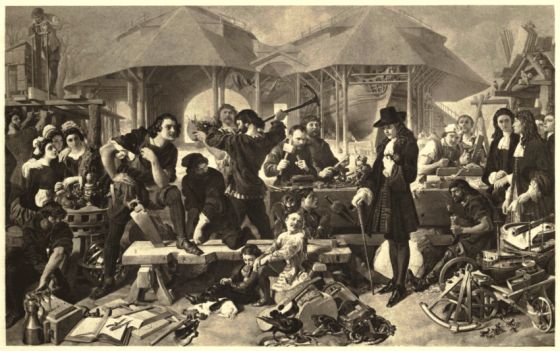
PETER THE GREAT AT DEPTFORD DOCKYARD.
From the Painting by Daniel Maclise, R.A. in the Royal Holloway College, Egham.
[See larger version]
This fell with an appalling shock on William. All his army of brave mercenaries, his Dutch guards, his Huguenot cavalry, must be sent away. He would, it was found, be left only with about eight thousand regular troops. Never was there such a stripping of a martial monarch, who had figured at the head of upwards of a hundred thousand men against the greatest military power of Europe. He made little remark publicly, but he poured out his grief to his great correspondent the Dutch Grand Pensionary, Heinsius, and to Burnet. To them he said that it would make his alliance of so little value, his state so contemptible, that he did not see how he was to carry on the government; that he never could have imagined, after what he had done for the nation, that they would treat him thus; and that, had he imagined it, he would never have meddled with the affairs of England; that he was weary of governing a country which had rather lay itself open to its enemies than trust him, who had acted all his life so faithfully for them. But it was useless complaining; the country was resolved on having no standing army, and every attempt of Ministers to modify or enlarge the resolution was disregarded. They proposed that the Bill should be committed, because it would leave the king in the hands of the old Tory regiments; and, again, that five hundred thousand pounds per annum should be granted for the maintenance of Guards and garrisons. Both motions were negatived. There was a strong feeling excited against Sunderland, on the supposition that he had encouraged the king in his desire for a large army, because he warmly argued for it; and that minister, equally odious to both parties, felt it safest to retire. He therefore resigned his post of Lord Chamberlain, though William did all he could to dissuade him from doing so, and sought the seclusion of his princely abode of Althorp.
These were the last transactions of the English Government in 1697; but there was at this moment a person residing in England who was destined to produce greater changes in the face of Europe, and in its relations, than any who had gone before him. This was Peter the Czar of Muscovy, who was at this time residing at Sayes Court, a house of the celebrated John Evelyn, at Deptford, and studying the fleet and shipbuilding of England, in order to create a naval power for himself. He was only a youth of five-and-twenty, and was the monarch of a country then sunk in barbarism, which was unrepresented at the Courts of Europe, was little heard of by the rest of the Continent, and whose merchants were forbidden, on pain of death, to trade with other countries. Yet already Peter had raised a regular army, and something of a navy, putting them under the management of Scottish and French officers. By means of these, in 1696, he had besieged and taken Azov. He had put himself through all the ranks of the army, beginning as a common soldier; and he had then determined to see personally the chief maritime nations, Holland and England, and learn what he could of the arts that made them so powerful. He set out with only twelve attendants, amongst whom were his two chief princes, Menschikoff, who had been originally a pieman, and Galitzin. These were to act as his ambassadors to the Courts of Holland and England, he himself remaining incognito. He first settled at Zaandam, in Holland, where he lived in a small lodging, dressed and worked with his attendants as ship-carpenters, learning to forge the ironwork of ships, as well as to prepare their woodwork. He had a yacht on the Zuyder Zee, and practised its management, and studied rope-making and sail-making. He found himself too much crowded about and stared at on his removal to London, where he spent his time chiefly in the dockyards of Deptford, Woolwich, and Chatham. William used to go and see him at Sayes Court, and sent the Marquis of Caermarthen to attend upon him, where they are said to have drunk brandy and pepper together during the long winter evenings. In the ensuing April disturbances at home called him away, but not before he had destroyed Evelyn's fine holly hedges by driving over them in the deep snows in his sledge, to Evelyn's great mortification.
At the opening of the year 1698, all appeared peace in Europe, but it was the quiet only which lies in the bosom of a volcano. Enormous expenditure of blood and treasure had been made to repel the unprincipled schemes of Louis XIV. Europe seemed to have triumphed over him. He had suddenly surrendered all that he had striven for, as if he perceived the impossibility of his aspirations. Nothing was less the fact. Never had he been so daring in his plans of aggrandisement as at this moment. Why should he continue to drain his kingdom of its population and its substance to grasp merely at Flanders, when, by exerting the arts of diplomacy, he might possess himself, not only of Flanders, but of all Spain, the north of Italy, the Sicilies, the South American and Indian dependencies? This grand scheme Louis now resolved to compass. He had married, as we have said, the Infanta, Maria Theresa, the sister of Charles II. of Spain, and had children by her. On marrying her he had sworn to renounce all claims to the Spanish throne through her; but this weighed nothing with Louis. He resolved that a son of the Dauphin—that is, his grandson through Maria Theresa—should be put forward as the French candidate in lieu of his father. Against him was the Emperor of Germany, the first cousin of Charles II., but he had resigned his claims in favour of his son by a second marriage—the Archduke Charles. By his first marriage with a younger sister of Charles II. he was the grandfather of the Electoral Prince of Bavaria. But the rights of this claimant, like those of the Dauphin's son Philip, were somewhat discountenanced by the fact that his grandfather's marriage had been accompanied by a renunciation of rights. It will be seen, therefore, that the question was one of some intricacy, and it was complicated by doubts as to the validity of the renunciations. Louis determined that the House of Austria should be set aside, and his own issue occupy the Spanish throne, when France, in fact, stretching from Gibraltar to Flanders, and including a large share of Italy, would be able to give law to the Continent, and swallow up Flanders and Holland, if not Germany too. This was the danger which wrought on the anxious heart of William at this moment.
Montague, in the height of his popularity, undertook and carried a measure which eventually, however, did the Whigs infinite mischief. Ministers had applied to the East India Company for a loan. The Company offered to lend them seven hundred thousand pounds, to be repaid out of the supplies at the convenience of Government. The new Company, which had so long been striving after a charter, hearing of the proposal, immediately outbade the old Company, offering to lend the Government two million pounds at eight per cent. The bait was too tempting to resist; a Bill was brought into the Commons, and passed its first reading by a large majority. The old Company, alarmed, petitioned the House, stating the claims it possessed, from having been encouraged by many royal charters to invest its capital, and to create a trade with India. It begged the House to consider that a thousand families depended on the stock, and that the property of the Company in India, producing an annual revenue of forty-four thousand pounds, would all be destroyed or reduced to trifling value. They deposed that they had expended a million of money in fortifications alone; that during the war they had lost twelve ships and cargoes worth fifteen hundred thousand pounds; that since the last subscription they had paid two hundred and ninety-five thousand pounds for customs, and above eighty-five thousand pounds in taxes. They had furnished ten thousand barrels of gunpowder when the Government was greatly pressed for it, and taken eighty thousand pounds' worth of Exchequer Bills. The House weighed the proposal, but was persuaded by Montague to give the preference to the new Company. On this the old Company offered, notwithstanding their great losses, to advance two millions to Government, on condition that the charter to the new Company was not granted. The offer came too late; the Bill for the new Company was passed, and carried also in the Lords, but with considerable opposition, and a protest from one-and-twenty peers. This Act was, notwithstanding, deemed a very unjust and arbitrary measure; and the arguments of the Whigs for a standing army, and their embezzlements in the Government offices and by most flagrant contracts, seriously affected their popularity.
Towards the end of July William went to Holland, and having addressed the States-General, and given audience to a number of ambassadors at the Hague, he betook himself to his favourite seat at Loo, where, in August, he was joined by Portland, the Pensionary Heinsius, and the Count Tallard, an emissary from Louis XIV. In this retirement they discussed one of the boldest projects which could possibly be entertained by statesmen, namely, a partition of the Spanish dominions. That the scheme was Louis XIV.'s there can be no question, and, daring as it was, served but as the blinding manœuvre which covered still more daring ones. The ultimate object of Louis was the seizure of the crown and territories of Spain, to which we have already alluded, but William, with great address, at once set to work to countermine him.
This plan of dividing the empire of Spain amongst such parties as should suit the views of William and Louis had been suggested by France, apparently very soon after the peace of Ryswick, and had been going on all the spring in England in profound secrecy. One of the motives for sending Portland to Paris in January had been to learn the full particulars of this scheme, which had been somewhat mysteriously opened to William. In writing to Heinsius on the 3rd of January, when Portland was about to start for France, William expressed his surprise as to the real meaning of "something that was proposed to be done by the Republic, France, and England, towards the maintenance of the peace," and imagined it might relate to their position with the Emperor. However, he added, "the earl of Portland will readily be able to get at the bottom of this affair in France, and that is another reason for hastening his departure as much as possible."
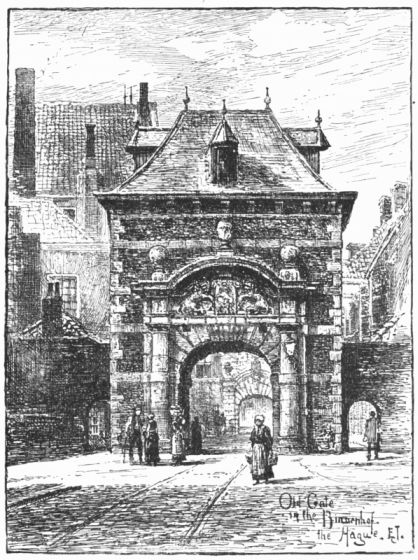
VIEW IN THE HAGUE: OLD GATE IN THE BINNENHOF, WITH THE ARMS OF THE COUNTY OF HOLLAND.
[See larger version]
Portland was scarcely settled in his diplomatic position in Paris when the scheme was broached to him, but at first cautiously. On the 15th of March he wrote to William that the Ministers Pomponne and De Torcy had communicated to him, but in the profoundest secrecy, that the king their master desired to make him the medium of a most important negotiation with the king of England. The impending death of the king of Spain was likely to throw the whole of Europe into war again, unless this were prevented by engagements entered into by the kings of France and England to prevent it. For if the Emperor were allowed to succeed to Spain with its dependencies, Flanders, Italy, and the colonies, he would become so powerful that he would be dangerous to all Europe. Portland declared that he could give no opinion, nor could the king his master give an answer, so far as he could see, until he had the full views of the king of France on the subject; and that the naval and maritime interests of England and Holland might be greatly affected by any arrangement regarding the succession of the Spanish territories. The French Ministers said it would be easy to order matters regarding the Low Countries to the satisfaction of England and Holland, and that France would guarantee that the crown of Spain should not be annexed to that of France; but as to the Indies, or the security of English trade in the Mediterranean, Portland could draw nothing from them. The views of France were so far not very clear; but Portland added the important piece of information that the Count de Tallard was at that very moment setting out for London, ostensibly to congratulate William, but really to prosecute this negotiation.
Accordingly, Tallard arrived in London on the 19th of March, and he and William, in strict secrecy, admitting no one else to their confidence, discussed this scheme of Louis. This was no other than that the crown of Spain, with the Spanish Netherlands and colonies, should not be allowed to pass to the Emperor, but should be settled on the Electoral Prince of Bavaria, the third claimant; that Naples, Sicily, Sardinia, the province of Guipuzcoa on the French side of the Pyrenees, Fontarabia, San Sebastian, Ferrol, and some towns on the Tuscan coast then owned by Spain, and called Presidii, should be settled by a mutual treaty between them on the Dauphin; and that Milan should be settled on the Archduke Charles, the second son of the Emperor, to whom he had resigned his rights.
The negotiations were carried on in England in closest secrecy between William and Tallard, William entering into engagements which most momentously affected England as well as all Europe, without taking a particle of advice from his Council, much less seeking the advice of Parliament—a proceeding which we should now consider unconstitutional, but which was then by no means unusual. When he quitted England after the dissolution of Parliament, it was only the more unobservedly to complete this extraordinary business. Tallard followed him to Loo, and they were soon after joined by Portland. It was now about the middle of August, and William wrote to Somers, desiring him to send him full powers under the Great Seal to complete the negotiation, leaving the names in blanks. He said he had ordered Portland to write to Vernon, the Secretary of State, to draw out the commission with his own hand, so that no creature should know anything of it except Somers and one or two of the other most trusted Ministers. He told Somers that it was confidently believed that the King of Spain could not outlive the month of October—might die much sooner, and, therefore, not a moment was to be lost.
In consequence of this communication, Somers, who was seeking health at Tunbridge Wells, immediately called into his counsels Russell (now Lord Orford), Montague, and Shrewsbury. He informed William that Montague and Secretary Vernon had come down to him at Tunbridge; they had seriously discussed this very momentous question, and that it seemed to them that it might be attended with very many ill consequences if the French did not act a sincere part; that the people of England would undoubtedly resent being drawn into any fresh war; and that it required deep consideration what would be the condition of Europe should this proposed partition be carried out. To them it seemed that if Sicily were in French hands, they would become entire masters of the Levant trade; that if they obtained any of the Spanish ports on the Tuscan coast, Milan would be so entirely shut in from independent intercourse or commerce by sea and land that it would be utterly powerless; that if France had Guipuzcoa and the other Spanish places on the French side of the Pyrenees, the rest of Spain would be as completely open to French invasion as Catalonia now was; and, finally, if this negotiation was concluded, what guarantee had William for the king of France's faithful execution of it? Were England and Holland to sit still and see France enforce this partition? "If that be so," says Somers, "what security ought we to expect from the French that, while we are neuter, they will confine themselves to the terms of the treaty, and not attempt to take further advantage?" These considerations were sound, but William had certainly chosen the lesser of two evils, for the placing of the French candidate on the throne of Spain would have entirely overturned the European balance.
In obedience to the king's orders, Somers sent the carte blanche with the Great Seal affixed; but he had failed in inducing Vernon to give him a warrant for affixing the Seal. The Secretary was too well aware of the unconstitutional character of this proceeding to issue such a warrant, and Somers was obliged to content himself with keeping the king's letter as his authority for the act. Undeterred by the plain suggestions of Somers and the other Ministers as to the total want of security which he had for Louis's observance of this treaty, and the dangerous power it conferred on France, William was in such haste to conclude the treaty, that the Earl of Portland and Sir Joseph Williamson had signed a rough draft before Somers's carte blanche arrived; and on the 11th of October, or about six weeks after its receipt, the formal treaty was signed by Portland, Williamson, Tallard, and Heinsius.
William returned to England in the beginning of December. He arrived on the 4th, and opened his new Parliament on the 6th. It had been obliged to be prorogued owing to his prolonged stay, having been called for August. The Ministers in William's absence had not taken much pains to influence the elections, and it soon appeared that a very independent body of gentlemen had been sent up. Not only had the electors put forward men of free principles, but the press had warmly urged the selection of a Liberal Speaker as essential to the full exercise of Parliamentary freedom. There were three candidates for the Speakership more particularly in view—Sir Edward Seymour, Sir Thomas Littleton, and Harley, the one supported by the Tories.
A paper on the choice of a Speaker had been actively circulated, which said that the great Lord Burleigh declared "that England could never be undone except by a Parliament," and that whenever we were enslaved like our Continental neighbours, it would be by the joint influence of a corrupt Parliament and a standing army. It cried down Seymour as a man who had constantly been bargaining with the Court since the days of the Pension Parliament of Charles II.; and it declared that men holding office under the Crown were most unfit for the office of Speaker. This was aimed at Littleton, which seemed a good omen for the Court, but, as it soon appeared, was no sound indication, for Harley was not elected, but Littleton.
In his opening speech William told the Commons that, notwithstanding the state of peace, it would be necessary for them to consider well the strength which they ought to maintain both at sea and on land; that the honour and even safety of the nation depended on not stripping it too much of its forces in the eyes of foreign nations. It was necessary, he contended, that Europe should be impressed with the idea that they would not be wanting to themselves. They had acquired a great position among the nations, and it was their duty to preserve it. He recommended them to make some progress in the discharge of the debts incurred in this long and expensive war, for an English Parliament could never, he imagined, neglect the sacred obligations which it had assumed. He also suggested to them some measures for the improvement of trade and for the discouragement of profaneness, and he begged them to act with unanimity.
The remarks on the necessity of maintaining more troops than the last Parliament had determined on, and on defraying the debts incurred by the war, seemed to rouse an extraordinary spirit of anger and disrespect in the new House. It neglected the ordinary courtesy of an Address. Before leaving for Holland in the summer, William left a sealed paper, ordering Ministers not to reduce the army in compliance to less than sixteen thousand men. Probably this was become known, and there had got abroad a persuasion that the king meant to resist the will of the Parliament in this respect; no other cause appeared sufficient to explain the animus which now manifested itself. The House resounded with speeches against standing armies, and on the waste of the people's substance on foreign wars, and it resolved that all the land forces of England in English pay should not exceed seven thousand, and that these should all be natural-born subjects; that not more than twelve thousand should be maintained in Ireland—these, too, all natural-born subjects, and to be supported by the revenue of Ireland. The Ministers had told the king before the meeting of Parliament that they thought they could obtain a grant of ten or twelve thousand in England, and William had replied that they might as well leave none as so few. But now that this storm broke out, the Ministers, seeing no possibility of carrying the number they had hoped for, sat silent, to the great disgust of the king.
This resolution went to strip William of his Dutch Guards whom he had brought with him, and who had attended him in so many actions, and of the brave Huguenots, who had done such signal service in Ireland. The spirit of the Commons, instead of being merely economical, was in this instance petty and miserable. It was neither grateful nor becoming to its dignity, to make so sweeping a reduction of the army, to begrudge the king who had rescued them from the miserable race of the Stuarts, and had so nobly acquiesced in everything which regarded their liberties, the small satisfaction of a few Dutch and Huguenot troops. The Huguenots especially, it might have been expected, would have experienced some sympathy from the Parliament, not only in return for their own gallant services, but because their friends and fellow-religionists were at this moment suffering the severest persecution. But a deep dislike of foreigners had seized the nation, and this had been rendered the more intense from the lavish wealth which William heaped on Portland and others, and from his retiring every year to spend the summer months in Holland. They had never been accustomed to have their monarch passing a large portion of his time abroad, and they regarded it as an evidence that he only had any regard for the Dutch. The Commons, without considering his feelings, introduced a Bill founded on their resolution, carried it briskly through the House, and sent it up to the Lords, where it also passed.
Deeply annoyed, William is said to have walked to and fro on learning that the Commons insisted on his dismissing the Dutch Guards, and to have muttered, "By God, if I had a son, these Guards should not quit me." He wrote to Lord Galway, one of his foreign friends, "There is a spirit of ignorance and malice prevails here beyond conception." To Heinsius he wrote in a similar strain, "that he was so chagrined at the conduct of the Commons, that he was scarcely master of his thoughts, and hinted at coming to extremities, and being in Holland sooner than he had thought." In fact, he was so much excited as to menace again throwing up the government. He sat down and penned a speech which he proposed to address to the two Houses; it is still preserved in the British Museum. It ran:—"My Lords and Gentlemen,—I came into this kingdom, at the desire of the nation, to save it from ruin, and to preserve your religion, laws, and liberties; and for this object I have been obliged to sustain a long and burthensome war for this kingdom, which, by the grace of God and the bravery of this nation, is at present terminated by a good peace; in which you may live happily and in repose if you would contribute to your own security, as I recommended at the opening of the Session. But seeing, on the contrary, that you have so little regard for my advice, and take so very little care of your own safety, and that you expose yourselves to evident ruin in depriving yourselves of the only means for your defence, it would neither be just nor reasonable for me to be witness of your ruin, not being able on my part to avoid it, being in no condition to defend and protect you, which was the only view I had in coming to this country." And it then went on to desire them to name proper persons to take charge of the government, promising, however, to come again whenever they would put him in his proper place, with proper power to defend them. The entreaties of Somers, however, induced him to abandon his purpose.
The mischief which the Whigs had done themselves by granting a charter to the new East India Company, in violation of the existing charter of the old Company, merely because the former Company had offered them a large money bait, encouraged the Tories greatly in their endeavours to regain power. They exhorted the old Company to petition that means should be taken to enable it to maintain its trade and property against the new Company for the remaining portion of the twenty-one years of its charter; and there were not wanting some in the House who declared that the new charter, granted in violation of an existing one, and from such corrupt motives, should be abolished. Montague, however, who had passed the Act for this charter, was able to protect it, but not to prevent fresh onslaughts on the unpopular Whigs. They were charged with gross corruption, and with embezzlement of the public revenue, for the purchase of great estates for themselves, and the grievous burthen of the people by taxation. Russell, Earl of Orford, was specially singled out by the Commons. He was both First Lord of the Admiralty and Treasurer of the Navy, as well as Admiral, and assumed great authority, forgetful of the humble station from which he had risen. He was charged with keeping large sums of public money for his own private use, instead of paying the officers and seamen when their pay was due. They called for his accounts, and there appeared to be four hundred and sixty thousand pounds in his hands. In his defence he represented that this was actually in course of payment, and that part of the sum was yet in tallies, which must be converted into cash before it could be distributed. But this did not satisfy the Commons. They voted an address to the king, complaining of the impropriety of one and the same person being Lord High Admiral, Chief Commissioner of the Board of Admiralty, and Treasurer; of gross misapplication of the public money; of many unnecessary changes introduced into the navy; of delays in granting convoys; and of favouritism to particular officers. Orford was prudent enough to retire from his offices before the storm which was gathering burst in all its fury upon him. The Tories, elated by this success, endeavoured to get Sir George Rooke put into Orford's place; but the Whigs were yet strong enough and imprudent enough to get the Earl of Bridgewater named First Lord of the Admiralty—a man almost wholly unacquainted with naval affairs; and Lord Haversham, another of the "land admirals," as the sailors called these unprofessional men, succeeded to Priestman, one of the Junior Lords, who retired.
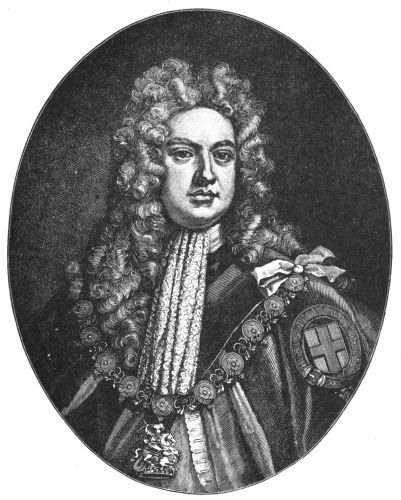
CHARLES MONTAGUE, EARL OF HALIFAX. (After the Portrait by Sir Godfrey Kneller.)
[See larger version]
Those matters being settled, the House voted fifteen thousand pounds for sailors for the year, the vote expressly stipulating for sailors only, lest the king should include some land forces under the name of marines. They also granted one million four hundred and eighty-four thousand pounds for the service of the year, to be raised by a land and income tax of three shillings in the pound. To this Act, availing themselves of their sole right to introduce money Bills, they also "tacked" a clause appointing commissioners to take an account of the estates forfeited in Ireland by the last rebellion, in order to their being applied in ease of the subjects in England. This was another sharp reminder of the king's proceedings. It had been promised by him that he would not bestow the forfeited estates without the sanction of the House, but in disregard of this he had given large estates to his favourites. William was deeply mortified by this clause, and some of the Lords entered a protest against it, on the ground that the clause was foreign to the contents of the Bill, and was contrary to the practice of Parliament. The king, however, did not venture to refuse his signature to the Act, which he passed on the 4th of May, 1699, and at the same time prorogued the Parliament.
Before quitting England, William was obliged to almost entirely remodel his Ministry. The Duke of Leeds retired from the Presidency of the Council; his influence had expired with the discovery of his bribe from the East India Company. The Earl of Pembroke, a moderate Tory, who performed his official duties with zeal and integrity, was put in his place. Villiers, Earl of Jersey, having returned from his embassy to France, was made Secretary of State in place of the Duke of Shrewsbury, who became Lord Chamberlain. The Earl of Manchester went as ambassador to France in place of Jersey, and Lord Lonsdale, another Tory, obtained the Privy Seal. On the 2nd of June, William, having appointed a regency, embarked for Holland, where he retired to Loo, but not to peace of mind, for he saw events marching to an ominous result. The forces of England and of the Continent were disbanded, except those of Louis, which were rapidly increased; and not only the Spanish monarchy, but all Europe, appeared at his mercy. But before following these movements, we must trace some nearer home.
Ireland was quiet. The Parliament of that kingdom had voted one hundred and twenty thousand pounds for the maintenance of the twelve thousand troops ordered by the English Parliament to be quartered in that country, and the Duke of Bolton and the Earls of Berkeley and Galway were appointed Lords Justices.
In Scotland far different was the state of things. There excitement raged against the Ministry of England, and not the less against the king, who disowned their Company, organised to carry out the Act granted for trading to Africa and the Indies. The charter for this Company was granted by the Scottish Parliament, and ratified by William in 1695. Its professed object was to trade with the East and West Indies and Africa; but there was a plan for carrying out these objects, which does not seem to have been made known to the Government, or made public generally, till after the acquisition of the charter. This was to seize on the Isthmus of Darien, to establish a strong colony there, and not only to grow rich through possession of the gold mines, but to found ports both on the Atlantic and on the Pacific, so that a great carrying trade might be prosecuted between Europe and China and the East Indies by that route.
William Paterson, the projector of this scheme, was the same man who had projected and carried into being, through the influence of Montague, the Bank of England. He has been generally represented as a visionary speculator and schemer, and has not unfrequently been confounded with John Law, of Lauriston, the author of the famous South Sea Bubble and Mississippi Scheme, which spread such ruin through both France and England. Paterson, however, was a very different man. Undoubtedly he was a most speculative genius, but in his speculations there was something grand, substantial, and based, for the most part, on the purest moral principles. The Bank of England is a lasting memorial of his real sagacity and acute talents. It was well devised, and immediately rose to entire success. Through some disagreement in the mode of management Paterson sold out his stock, and proposed the erection of an Orphan Bank, connected with the Orphan Fund established by the Corporation of London already mentioned. This was not entertained, and he then projected his grand scheme for the Scottish Company to trade to the Indies. This scheme, so far from being visionary, had all the elements of a great and far-seeing reality. The unsound portion of Paterson's project was the not sufficiently taking into account these political obstacles:—Spain possessed, or rather claimed to possess, the Isthmus of Darien. Louis of France was contemplating the seizure of Spain, and its American territories. William was under treaty of peace with both Spain and Louis. It was impossible, therefore, to obtain possession of the Isthmus of Darien without producing a fresh European war. To attempt it by treaty was useless, for Spain would never consent to permit England, of which she was in the highest degree jealous, thus to establish a great mercantile colony in the midst of her most valuable Transatlantic colonies, from which she was annually drawing her cargoes of gold and other valuable products. Louis of France, who was resolved to succeed to the Spanish Empire, was as little likely to permit such a thing. To obtain possession of Darien, then, could only be done by invasion, and that invasion must produce immediate war, for which William was not prepared.
But the scheme was got up ostensibly to trade to the East and West Indies and Africa. There was no mention of Panama; and its prospects were so fair that they seized on the imaginations of the English and Scottish public. The Company was to have the monopoly of trade with Asia, Africa, and America for thirty-one years. Paterson had spent ten years in the West Indies, and, as it is supposed, in Panama. At all events, he had the reputation of being intimately acquainted with those regions and their resources. His proposals of the Company were eagerly accepted both in London and Edinburgh. Though it was intended to raise only three hundred and sixty thousand pounds as the original stock for both countries, three hundred thousand pounds were subscribed in London alone in a few days. But this remarkable success excited all the vindictive feelings of Companies whose interests this new league appeared likely to affect. The East India Companies, new and old, immediately were on the alert, and raised such a feeling in the House of Commons that it resolved to impeach Paterson and the bankers, Coutts and Cohen, for the commission of an illegal act in daring to levy money in England without the sanction of the English Legislature. In the meantime a subscription list had been opened at Hamburg, and by this the Dutch East India Company was equally alarmed, and the influence both of the Dutch and of the English Companies was made to bear on the king. William, who had been too much absorbed by his warfare with Louis to perceive the hostile feelings which he was exciting by passing the Scottish Act, now made haste to condemn his own precipitancy. He complained that he had been deceived by the Scottish Government, and at once gave orders to prohibit the scheme, and sent similar orders to his consul at Hamburg to forbid the subscription there. The senate of the city of Hamburg was induced to prohibit the canvassing of the Company's agents; and the English subscribers, alarmed at the menaces of the king and Commons, withdrew their names. Nor were these all the enemies of this scheme. There were Scottish traders united for commerce with India by the ordinary route, and these joined in the cry. One of these, Mr. Robert Douglas, attacked the scheme in a very able letter. In this letter we are first let into the secret that the real destination is not so much the West Indies as Darien, on the mainland. It is not, however, from Paterson having mentioned expressly Darien that Douglas declares it to be that place, but he infers it from the fact that the locality darkly hinted at by Paterson is at once near the Caribbean isles, and at the same time so situated "that it will alter the whole method of trade in Europe, and effectually ruin both the English and Dutch East Indian Companies, because it opens a shorter, safer, and more convenient way to the East Indies by the Pacific from England and Holland."
Douglas then points out that it is not nearer or more convenient than the old way to the western or Bombay coast of the Indian peninsula; that it was then a very dangerous route, because our merchant vessels on that track would have to pass the Dutch, Batavian, and Spice Island settlements, which would show the utmost hostility to such a traffic; but still more, that it was impossible, because this Isthmus of Panama was the track by which Spain conveyed her treasure from Peru to Portobello; that as to the rightful possession of the country by Spain, the city of Darien, called Santa Maria, was one of the first cities built by them on the mainland of America, as the province was the first province possessed by them. These were sound reasons why the king could not consent to any such invasion of the territory of Spain, and why Spain was not likely to concede it by treaty. These reasons should have made Paterson and the Scots pause.
Unwarned by the great outcry, the firm opposition, and insurmountable obstacles, Paterson and the Scots went on. The Scottish people, who conceived the idea of achieving enormous wealth in the golden regions of Central America, regarded themselves as victims of the jealousy of William's favourite Dutch, and of the haughty monopolising spirit of the English, and the whole country was in a ferment. They considered themselves insulted and most perfidiously treated by the king, who had freely sanctioned the Company, and then as unceremoniously disowned and trampled on it. They went on with the subscriptions, and speedily the amount rose to four hundred thousand pounds. The highest and most intelligent of the Scottish nobility, as well as the people generally, were sanguine contributors. Their younger sons saw a new highway to opulence and distinction suddenly opened. Many lords mortgaged all that they could to secure an ample share of the expected benefits. Their tenantry and servants were enthusiastic in their adhesion to it; and the officers whom the peace had left at large, prepared for fresh campaigns and adventures in the golden regions.
The Company had a number of stout ships built in Holland to convey the emigrants and their stores. On the 25th of July, 1698, four of these ships—the St. Andrew, the Unicorn, the Caledonia, and the Endeavour—containing one thousand two hundred men, set sail from Leith. Such was the excitement that all Edinburgh seemed to have poured out to see the departure of the colonists, and hundreds of soldiers and sailors who could not be engaged clamoured to be taken on board. Many contrived to get into the vessels and endeavour to conceal themselves in the hold, and when discovered they clung to the timbers and riggings, offering service without pay.
When the vessels had sailed, the Scottish Parliament unanimously addressed the king on behalf of the Company and the validity of the charter. The Lord President, Sir Hugh Dalrymple, the brother of Lord Stair, and Sir James Stuart, the Lord Advocate, also presented memorials defending the rights of the Company. Paterson committed the error of sailing in the fleet as a private individual. He had incurred the resentment of the Company by having remitted twenty thousand pounds to Hamburg for stores, part of which, through no fault of his own, was embezzled by the agent. The Company, therefore, refused to give him the command of the colony, but appointed a council of seven members without a head. This was certain to entail want of unity of purpose, and consequent failure. Paterson was the only man qualified by his abilities, his experience, and his knowledge of the country to take the command. He is said to have seen and conversed with the celebrated buccaneer Dampier and his surgeon Lionel Wafer on the statistics of Darien; and, if the expedition was sent at all, it should have been under his entire control. Nothing, in the political circumstances, could have insured the establishment of the colony; but Paterson's guidance would have prevented the dire calamities which ensued. He was certain that the vessels were not properly furnished with provisions and stores before setting out, and he in vain urged an examination. When out at sea a few days, he was enabled to get an examination, when there was discovered to be a serious deficiency, but then it was too late. They next sailed for Madeira, where their sealed orders were opened, and they then bore away for the West Indies. They put into St. Thomas's, and there might have obtained plenty of provisions from a ship-captain but for the perverseness of the council. The advice of Paterson was uniformly rejected out of jealousy. On the 30th of October they landed in a fine bay on the coast of Darien, capable of holding one thousand ships, and about four miles east of Golden Island.
The incapable council, in spite of Paterson's advice, would plant their new town in a bog, but the effects on their health soon forced them to remove to higher ground. They erected a fort and threw up defences at Acta, which they named New St. Andrews; and on a hill opposite made a signal-station, where they placed a corps of Highlanders to keep a good look-out for the approach of any enemy.
But the miserable management of the council brought speedy misfortune on the infant colony. The people were suffering from want of everything. Paterson soon lost his wife, and numbers sank under disappointment, insufficient food, and the climate. The natives were friendly to them, but wanted them to go and fight the Spaniards. It was soon found that the mountains and forests offered enormous obstacles to a transit to the shores of the Pacific. The different leaders of the expedition fell to quarrelling, and Paterson endeavoured in vain to reconcile them. They sent out vessels to the West Indian islands for provisions. One they lost, and another endeavouring to get to New York, after beating about for a month, was driven back. Amid the rapidly-sinking colonists and the fatal feuds of the leaders, they received on the 18th of May, 1699, the stunning news that the king had issued a proclamation denouncing the act of the colonists as having infringed his treaty with Spain by forcibly entering the Spanish territory of Panama, and forbidding any of the English governors of the West Indian islands to furnish them with provisions or any necessaries.
The moment Louis XIV. heard of their settling in Darien he had offered to the king of Spain to send ships and forces and drive them out for him. The Spanish Minister at London, the Marquis de Canales, on the 3rd of May presented a remonstrance against this breach of the peace with his master. Dalrymple, who has left much information on this expedition in his "Memoirs," says the Dutch and English opponents were at the bottom of this remonstrance; that Spain had let the affair go on a long time without noticing it; and that the rights of the Company had been debated before William, in presence of the Spanish ambassador, before the colony sailed. All this may be true, for the real destination of the expedition was kept secret till the fleet arrived at Madeira, and Spain protested as soon as she discovered whither it had gone. William, who was just now making treaties with Louis, and anxious to be on good terms with Spain, strictly enforced the orders to deprive the suffering colony of all means of remaining. These measures of the king produced the most fatal consequences in the colony. Every one, says Paterson, was in haste to be gone from it. In vain he tried to persuade them to stay for more positive orders. Pennicook, the captain of the fleet, was reported to be intending to steal away with his ship, on the supposition that they had all been proclaimed pirates, and would be hanged. The poor colonists continued to die off rapidly, and news now came that the Spaniards were marching against them with a strong force.
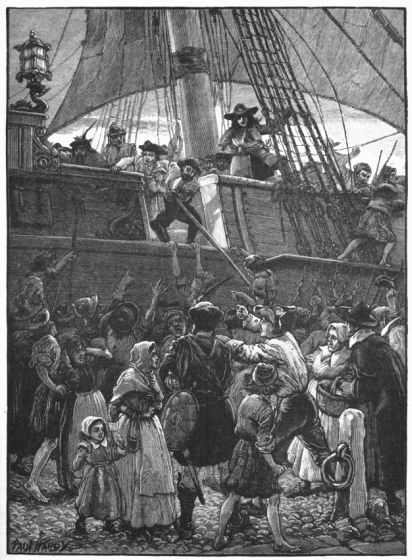
SCENE AT THE DEPARTURE FROM LEITH OF THE DARIEN EXPEDITION. (See p. 512.)
[See larger version]
Famine, sickness, and the fear of being massacred in their weakness by the enemy, compelled the colonists to evacuate the place. On the 18th of June, 1699, the Unicorn, St. Andrew, and Caledonia sailed from Golden Island for New York. On the voyage they met the sloop which they had sent to Jamaica for provisions. It had got none, owing to the royal proclamation, and they all proceeded on their route. They lost one hundred and fifty out of two hundred and fifty of their number on the voyage, and arrived at New York in October, more like skeletons than living men. On the 13th of November Paterson and his companions reached England in the Caledonia. The indignation of the Scots at their treatment was beyond bounds, and the more so because, unacquainted with the real facts of the case, they had sent out a second expedition of one thousand three hundred men.
The history of this second expedition was as miserable as that of the first. On arriving, the new adventurers, instead of a flourishing colony, found the place deserted, and only a few miserable Indians to tell them the fate of their predecessors. With this new arrival came four Presbyterian clergymen, who assumed the command, and seemed to think of nothing but establishing a presbytery in all its rigour and uncharitableness. Paterson, like Penn in Pennsylvania, and Lord Baltimore in Baltimore, had proclaimed perfect civil and religious liberty to men of all creeds and nations. This was now reversed; there was nothing but the most harsh and senseless Phariseeism. Instead of a comfort, these men proved one of the worst curses of this unfortunate colony, thwarting and damping the exertions of the people, and continually threatening them with hell fire. Two of these ministers perished.
In the midst of these miseries arrived Captain Campbell, of Ferrol, with a force of his own men. He attacked and dispersed a body of one thousand Spaniards sent against him; but this was only a fresh offence against Spain, and, therefore, against William. They were soon, however, assailed by a more powerful Spanish squadron. Campbell got away to New York, the rest of the colony capitulated, and there was an end of the unhappy expedition to Darien. The Spaniards humanely allowed the remnant of this wretched company to embark in one of their vessels, the Rising Sun; but as the British authorities at all the islands refused them any succour or stores whatever, only eighty of them arrived alive in England.
Scotland was in a frenzy of indignation at this cold-blooded conduct of the king, who, if he had visited the projectors with severity, ought to have had some compassion for the poor deluded sufferers. The exasperated Scots called on the king to withdraw his proclamation against a Company which had an undoubted right by charter to trade to the West Indies, if not to the mainland. They demanded that the Scottish Parliament should be summoned; but William only sent evasive answers, and the fury of the people rose to such a height that nothing was talked of but that the king had forfeited his right to the allegiance of Scotland by his conduct, and of war with England.
Meanwhile the partition treaty had become known to the Court at Madrid, and William's share in it excited great indignation. At the same time the agents of Louis had prevailed on the dying king to nominate the Electoral Prince of Bavaria his heir to the crown. Scarcely, however, was this done when this young prince died, being only eight years of age. Louis still kept up the farce of disinterestedness, and persuaded William to enter into a second treaty, mentioned later on, settling the crown of Spain on the Archduke Charles, but leaving the Italian States to the Dauphin. Again were William, Portland, and Tallard, with an agent of the Emperor, busy on the new partition at Loo. But whilst they were busy there, the French ambassador was equally busy at Madrid, inflaming the mind of the imbecile king against William and the Emperor, and prevailed on him, as we shall see, to leave the whole Spanish monarchy to the Dauphin's son Philip. The king of Spain was also induced to send a strong remonstrance against the interference of William in the affairs of the Spanish monarchy to Mr. Stanhope, the English Minister at Madrid. Similar remonstrances were presented for form's sake to the Ministers of France and Holland. The Spanish Minister in London, Canales, was ordered to present a still stronger remonstrance to the Lords Justices in London, in which the Court of Spain informed them that his Spanish Majesty would take the necessary measures himself for the succession of his crown; adding that if these proceedings, these machinations and projects, were not speedily put an end to, there would undoubtedly commence a terrible war, in which the English, who had felt what the last war had brought upon them, would have the worst of it. Canales, who had a high personal resentment against William, who had forbidden him the Court for the insolence of appearing covered, announced haughtily that on the meeting of Parliament he should appeal to it against the king's proceedings.
No sooner was this paper transmitted to Loo than William sent orders to the Spanish ambassador to quit England in eighteen days, and during that period to confine himself to his house. He was informed that no communication whatever would be received from him or any of his servants. Mr. Stanhope was instructed at the Court of Madrid to complain of this conduct of Canales, as an attempt to excite sedition in the kingdom by appealing to the people and Parliament against the king. Mr. Stanhope was then instructed to cease all diplomatic intercourse with the Court and to return home. The Spanish Court, on its part, justified the act of its Minister, and Mr. Stanhope took his leave. The Spanish ambassador at the Hague delivered a similar memorial to that delivered in London, which the States-General refused to read. In these circumstances William returned to England about the middle of October.
The temper of his people had not improved during his absence. The Tories were bent on driving every Whig from office. They even now compelled the lately all-powerful Montague to resign his seat at the Treasury Board as well as the Chancellorship of the Exchequer. Montague was well aware of the humour of the present House of Commons, and anticipated an attack on his two offices by his resignation. Lord Tankerville, formerly Lord Grey of Wark, took his place at the Treasury, and Smith, another member of that Board, became Chancellor. At the same time William gave the office of Lord Chamberlain to the Duke of Shrewsbury, vacant since the retirement of Sunderland. Besides Shrewsbury, there remained no other Whig in office except Somers, and the Tories were at this moment endeavouring to spring a mine under his feet.
William met his Parliament on the 16th of November. He addressed them with much studied care to avoid topics of offence, but he found it impossible. He recommended them to take further measures, both by sea and land, for the safety of the kingdom, to punish unlawful and clandestine trading, and to devise, if possible, measures for the employment of the poor. He expressed his resolution to discourage vice, and declared that he would do anything in his power towards the welfare of the nation. "And to conclude," he said, "since our aims are only for the general good, let us act with confidence in each other; which will not fail, with God's blessing, to make me a happy king, and you a great and flourishing people."
The very words "let us act with confidence" roused up this captious Parliament. They sent him a remonstrance instead of an Address of thanks, complaining of there being some who endeavoured to sow distrust and dissension between them and the king. It was in vain that William protested that this supposition was totally unfounded, and that if any should presume to bring to him any calumnies against his faithful Commons, he would treat them as his worst enemies; they were unappeased. They wanted, in fact, occasion to drive Somers from his councils, and they soon found a plea.
During the war, piracy had grown to a great height upon the coasts of North America, and the colonists were themselves deep in it. Lord Bellamont, the Governor of New York, had recommended that a man-of-war should be sent to clear the pirates away; but the Admiralty objected that they had not sailors enough to spare for such a service. It was then determined by the Lord Chancellor Somers, the Duke of Shrewsbury, the Earls of Romney, Orford, and Bellamont, with a few private individuals, to send out a vessel at their own expense. This the king approved of, and promised to contribute one-half of the expense, and stipulated for one-tenth of the profits. Besides the usual letters of marque given to privateers, the captain was furnished with a warrant under the Great Seal, authorising him to make war on the pirates and the French, both in those and other seas. Unfortunately, this commission was given to a man who was himself a notorious pirate—one Captain Kidd, whose fame still lives on the American coasts, and is the theme of popular ballads. The man promptly showed in his true colours.
The old East India Company complained bitterly of Kidd's outrages in the Indian seas, declaring that they would bring it into trouble with the Great Mogul. In the beginning of December a motion was made in the Commons that "the letters patent granted to the Earl of Bellamont and others of pirates' goods were dishonourable to the king, and contrary to the laws of nations and the laws and statutes of the realm, invasive of property, and destructive of trade and commerce." There was a violent debate, in which the Tories contended that the Lord Chancellor Somers had knowingly affixed the Great Seal to the commission to enrich himself, his colleagues, and the king, out of the plunder of unfortunate merchants. The motion was rejected by a large majority; the character of Somers stood too high for such a charge to reach him. But the Opposition did not rest here; it was determined to wound the king and his Government in every possible quarter.
There lay a cause in Ireland much more dangerous to the king and his Chancellor than the affairs of Captain Kidd. William had promised not to bestow any of the confiscated lands there without consent of Parliament. In disregard of his word he had conferred immense estates on his Dutch favourites, Portland, Albemarle, Athlone, and his French one, Lord Galway (Ruvigny), as well as on his mistress, Mrs. Villiers. The Commons, therefore, appointed Commissioners to inquire into the royal grants there. These Commissioners were the Earl of Drogheda, Sir Francis Brewster, Sir Richard Leving, Hamilton, Annesley, Trenchard, and Langford. The four last-named Commissioners were earnest supporters of the Commons' inquiry; but it was soon perceived by them that the Earl of Drogheda, Brewster, and Leving were in the interest of the Government. When they came to draw up their report, those three Commissioners vehemently dissented, and made an appeal to each House of Parliament, declaring that the report had not their concurrence, and that it was not borne out by the evidence laid before them. They complained that the other Commissioners had endeavoured to overbear them in a most arbitrary manner, trying to influence them by letters and instructions which they alleged they had received from members of the Commons. The Commons, however, regarding Drogheda, Brewster, and Leving as tools of the Court, paid no attention to their remonstrance. They received the report signed by the other four, who, on their part, complained that in the prosecution of their inquiry they had been greatly hindered by the backwardness of the people of Ireland to give information for fear of the vengeance of the grantees, and from reports industriously spread that the inquiry, through the influence of the Crown and the new grantees, would come to nothing. The three dissentient Commissioners agreed to much of this, but attributed the fear of the people to the grantees at large, and not to those recently favoured by Government. They affirmed that John Burke, commonly called Lord Bophin, had agreed to pay to Lord Albemarle seven thousand five hundred pounds for procuring from the king letters patent restoring him to his honours and estates. They gave amazing details of the wholesale plunder of cattle, horses, sheep, etc., from the Catholics, which had never been accounted for to the Crown. The report stated the persons who had been outlawed since the 13th of February, 1689, for participation in the rebellion amounted in England to fifty-seven, but in Ireland to 3,921; that the lands confiscated in Ireland since that period amounted to 1,060,792 acres, with a rental of £211,623; which, at twenty years' purchase were of the value of over £4,000,000; that some of these lands had been restored to their ancient proprietors, but chiefly by heavy bribes to the persons who had betrayed his Majesty's trust in them. They then gave a list of seventy-six grants under the Great Seal, amongst which stood prominent those to Lord Romney, who as Lord Sidney had been Lord-Lieutenant of Ireland, consisting of 49,517 acres; two to the king's recent favourite, Keppel of Guelderland, made by William Earl of Albemarle, amounting to 106,633 acres; to William Bentinck, Lord Woodstock, the son of Portland, 135,820 acres; to Ginkell, Earl of Athlone, 26,480 acres; and to Ruvigny, the Huguenot, Earl of Galway, 36,148 acres. After all the deductions and allowances, they valued the estates forfeited since the 13th of February, 1689, and not restored at £2,699,343—a ridiculous over-estimate.
The Commons instantly set themselves to frame a Bill of Resumption of all the grants. They ordered the report of the Commissioners, the speeches and promises of the king regarding these forfeited estates, and their former resolutions regarding them, to be printed, that the whole country might judge of this matter for itself. And they resolved that any member of the Privy Council who should procure or be concerned in procuring grants from the Crown for their own purposes, should be deemed guilty of a high crime and misdemeanour. As the Tories were the means of carrying this Resumption Bill, the Whigs, to avenge themselves, moved by way of amendment that all grants made since the 6th of February, 1684, should be resumed, and the Tories were caught in their own snare, for they could not with any show of consistency oppose a measure of their own originating. Therefore the Bill passed, and they were compelled to disgorge all the Crown property they had settled on themselves from the accession of James. Ministers proposed to insert a clause to reserve one third of the forfeited property for the king's own disposal; but the Commons would not listen to it, and resolved not to receive any petition from any person whatever concerning the grants. That justice might be done to purchasers and creditors in the Act of Resumption, they appointed thirteen trustees to hear and determine all claims, to sell to the highest purchasers, and to appropriate the money to pay the arrears of the army. The Lords introduced some alterations, but the Commons rejected them, and to prevent the Bill from being lost in the Lords they consolidated it with a money Bill for the service of the year. The Lords demanded a conference, and the Commons, exasperated at their interference in a money Bill, prepared to go greater lengths. They assumed the aspect of the Commons in Charles I.'s time. They ordered the doors to be closed, and called for a list of the Privy Councillors. They then moved that John, Lord Somers, should be expelled from the service of the king for ever. The resolution was not carried, but the temper of the House was such as made wise men tremble for an approaching crisis. The king was disposed to refuse to pass the Bill even if the Lords did; but when the Commons left the Bill in the hands of the Lords, and that House was warned on all sides that they would have to pass the Bill, or the consequences might be fatal, he gave way, though with undisguised resentment. The Commons were proceeding with a fresh resolution for an address to his Majesty, praying that not any foreigner, except Prince George of Denmark, should be admitted to his Majesty's Council in England or Ireland, the resolution being aimed at Portland, Albemarle, and Galway, when the king sent a private message to the peers, desiring them to pass the Resumption Bill, and on the 11th of April he went down to the House, and gave it the royal assent. He then ordered the Earl of Bridgewater, in the absence of Somers, who was ill, to prorogue Parliament, and it was accordingly prorogued to the 23rd of May without any speech.
William left England in the beginning of July, but before his departure he endeavoured to persuade Somers to give way to the rancour of the Commons, and resign the Seals. Somers refused to resign voluntarily, arguing that it would imply a fear of his enemies, or a consciousness of guilt; but William, who knew the necessity of leaving a better feeling behind him if possible, sent Lord Jersey to Somers for the Seals, and offered them successively to Chief Justice Holt, and to Treby the Attorney-General; both declined, however, what would have turned the enmity of Parliament on them, and William was eventually obliged to bestow them on Nathan Wright, one of the Serjeants-at-Law, a man of no mark and very indifferent qualifications for the office. William offered the government of Ireland to Shrewsbury; but he, too, declined the office, and set out for Italy. Every one seemed afraid of engaging in his Government, so bitter was the Parliament against him. Even his trusty Portland, now absolutely groaning under the weight of riches which William had heaped upon him, retired from his place in his household, and Lord Jersey was appointed Chamberlain, and Lord Romney, Groom of the Stole. William had never left the kingdom in circumstances of so much unpopularity, and scarcely had he gone when the Duke of Gloucester, the only child of the Princess Anne, died at the age of eleven (July 30, 1700). This gave fresh hopes to the Jacobites. They sent a messenger to St. Germains with the news, and began to bestir themselves all over the kingdom. In truth, the outlook was very gloomy for the Protestant succession. No such successor was as yet appointed. The health and spirits of William were fast sinking. His person and government were extremely unpopular. The House of Brunswick had treated his advances with marked contempt, but they now came forward, urged by the critical state of things, and made their first visit of acknowledgment to the king. The Princess Sophia, Electress Dowager of Hanover, was the person on whom the eyes of the Protestants were now turned; but the nation was in a state of much uncertainty. It was rumoured that even Anne had sent a conciliatory letter to her father, and the public mind was disturbed by fears of a disputed succession, and of the reviving chances of a Stuart king.
William during this year had been busy concluding the new treaty of partition. Tallard, Portland, and Jersey had assisted in it. It was signed by them in London early in March, and by Briord and the Plenipotentiaries of the States at the Hague on the 25th of October. It had substituted the Archduke Charles, the second son of the Emperor, for the deceased Electoral Prince of Bavaria, as heir to Spain with the Spanish Flanders and colonies; but the Dauphin was still to possess Naples and the other Italian States, with Lorraine and Bar, which the Duke of Lorraine was to exchange for Milan. In case of the archduke dying, some other son of the Emperor was to succeed, but not the king of the Romans, for it was stipulated that Spain and the Empire, or France and Spain, were never to be united under one crown. The first treaty was made known to the different Powers, and excited much astonishment and disapprobation. The Emperor of Germany, notwithstanding his son was made successor to the Spanish monarchy, Flanders, America, and the Indies, was not conciliated. He expressed his amazement that the kings of other countries should take it upon them to carve up the Spanish monarchy without the consent of the present possessor and the Estates of the kingdom. He denied the right of these Powers to compel him to accept a part when he was heir to the whole, and to pronounce his forfeiture of even that part if within three months he did not consent to this unwarrantable proceeding. The other princes of Germany were unwilling to excite the enmity of the House of Austria by expressing their approval of the scheme, and Brandenburg, which was just now in treaty with the Emperor for the acknowledgment of Prussia as a kingdom, which was signed on the 16th of November, of course united with him. The Italian States were alarmed at the prospects of being handed over to France, and the Swiss declined to sanction the treaty. In Spain the aristocracy, who had vast estates in Sicily, Naples, and the other Italian provinces, and who enjoyed the viceroyalties, and governorships, and other good offices there, were greatly incensed at the idea of all these passing to the French.
The miserable and dying king was in agonies. He had already made a will, leaving the crown and all its dependencies to the Emperor, but neither he nor the Emperor had taken the precaution of securing the Italian provinces by marching a strong army thither—probably from fear of arousing Louis to a premature war. He now called a Council of State to deliberate on the succession; but the unfortunate prince had to deliberate with a Council which had long been bought over by the French. Only two of the Council had the patriotism to vote that the question should be submitted to the Cortes; they were overborne by the voices of the rest, who had been corrupted by Harcourt, the French Minister. Amongst them were prominent the Marquis de Monterey and Cardinal Portocarrero. They advised that they should consult the faculties of law and theology, and these faculties were already bribed by France. The French faction persuaded further the starving people that all their troubles had been produced by the partisans of Austria; and the enraged mob surrounded the palace and demanded to see the king, who was compelled to show himself, though he was too weak to stand without help. All this time the condition of the king of Spain was frightful. His conscience, accustomed to be swayed by his religious advisers, was torn to and fro by the contending exertions of Portocarrero and the queen. Portocarrero was a man of vast influence; he was not only cardinal but Archbishop of Toledo, and affected a deep concern for the king. Charles, intensely attached to his own family, and having a strong persuasion that its claims were the claims of the nation, was yet so tortured by the arguments of the priests of the opposite factions, and the entreaties of the queen, that no poor soul was ever in so dreadful a purgatory. At length, after the most violent contests, he sank in passive weakness, and on the 2nd of October he signed the will dictated by France. Having done it, he burst into tears, and sighed out "Now I am nothing!"
But this signing was effected in deepest secrecy; neither the queen nor any one but a small junto of the French faction was aware of it. As Charles, however, still lingered between life and death for a month yet, the French made every preparation for the event, and Portocarrero took possession of the Great Seals, and dispersed all his agents, so as to secure the transfer of the crown to France. On the 1st of November, 1700, the unhappy monarch died, at the age of thirty-nine, and the will was made known, to the consternation of the queen and the Austrian and English ambassadors, who were till that moment in profound ignorance of it. As soon as the news reached Paris, Count Zinzendorf, the Imperial ambassador, presented himself at Versailles, and inquired whether the king meant to abide by the treaty of partition or accept the will. The Marquis de Torcy answered for Louis that he meant certainly to abide by the treaty. But this was only to gain time. Louis had long made up his mind, and when he heard that Charles was dead, he exclaimed, "There are no longer any Pyrenees." William's statesmanlike plans had been foiled by his confederate's treachery.
William had returned to England towards the end of October, a few days before the death of the King of Spain. He was deeply chagrined at this unexpected event, but, in the present temper of England—disgusted with his proceedings with Louis for the partition of Spain—he could not openly complain. Not the less, however, did he unburthen his feelings to his friend the Pensionary Heinsius. Writing to him, he said, "I never relied much on the engagements with France, but I must confess that I did not think they would on this occasion have broken, in the face of the whole world, a solemn treaty before it was well accomplished." He confessed that he had been duped, and that he felt it the more because his English subjects did not disguise their opinion that the will was better than the partition, against which one party had complained because of the large amount given to France, the other at the injustice of forestalling the wishes of the French, and both at the secrecy with which the negotiations had been conducted. He expressed his deep anxiety regarding the Spanish Netherlands, which, it seemed, must fall into the hands of France, and as to what barrier was to be set up between them and Holland; and he concluded by saying that he should bear all the blame for having trusted to France after his experience that no trust was to be put in it.
But, besides his health and the mortification of Louis's triumphant deceit, William had plenty of troubles from the temper of his Parliament, and the state of the factions which harassed his Government. With such gloomy auspices came in the year 1701. The king had now replaced the retiring Whigs of his Ministry by Tories. Lord Godolphin was made First Commissioner of the Treasury; Lord Tankerville succeeded Lord Lonsdale, deceased, as Privy Seal; Lord Rochester was sent as Lord-Lieutenant to Ireland; and Sir Charles Hedges was appointed Secretary of State. By their advice Parliament was dissolved, and writs were issued for the meeting of the new one on the 6th of February.
When Parliament met, it was found that the late Speaker, Sir Thomas Littleton, had absented himself from the House, and the Tories proposed in his stead Robert Harley, who was now fast rising into favour with that party. The king had requested Littleton, in fact, to withdraw, that the Tories might get in their man; but there was such a ferment in the House that it was obliged to be adjourned till the 20th. Then the Whigs brought forward Sir Richard Onslow, but he was defeated by a majority of two hundred and forty-nine to one hundred and twenty-five. This showed that a strong Tory Commons had been returned, and yet it was not true that all the Tories were unanimous. There was, indeed, a considerable breach in the party. Those of them who had been passed over in the selection of the Ministry, or had other causes of pique against the Government, remained in opposition, and occasioned the king and their own party no little embarrassment. Amongst these were the Duke of Leeds, the Marquis of Normanby, the Earl of Nottingham, Seymour, Musgrave, Howe, Finch, and Showers. It was strongly suspected, too, that Louis had made use of Tallard to bribe some members of Parliament and of the Government to an awful extent to oppose any measures for war and Continental combinations.
In his opening speech William informed the Parliament that the death of the Duke of Gloucester had rendered it necessary that they should take into consideration the succession to the Crown after him and the Princess Anne, who had now no heir; for the happiness of the nation and the security of the Protestant religion made it the subject of the highest moment. The subject of next importance, and scarcely inferior, he said, was the death of the late King of Spain, and the succession arranged by his will, which had made so great an alteration in affairs abroad as demanded their most serious consideration for the interests and safety of England, and the preservation of the peace of Europe and of the Protestant religion. That these great topics might have due consideration, he had desired that they should receive it in a new Parliament. He next referred to the necessity for making a proper provision for the current expenditure, and for the reduction of the debt, and recommended them to put the fleet into effective condition.
The Electress Sophia of Hanover, the next in succession to Anne, was the daughter of Frederick the Prince Palatine, and Elizabeth Queen of Bohemia, therefore granddaughter of James I. No sooner did Sophia hear of the death of the Duke of Gloucester than she took with her her daughter, the Electress of Brandenburg, and made a visit to William at Loo. She had a twofold object, to obtain his promise of favouring her succession to the crown of England, and his acknowledgment of Brandenburg as a kingdom under the name of Prussia, a favour which the Emperor, as we have seen, had already conceded. William seems to have assured the Electress of his intention to support both her claim to the English crown, and that of her daughter to the title of Queen of Prussia, and immediately left for England.
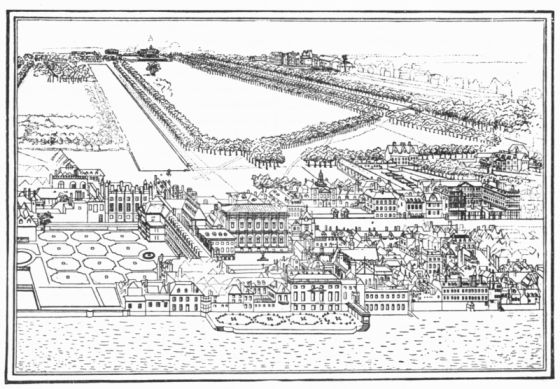
THE ROYAL PALACE OF WHITEHALL FROM THE THAMES, IN THE BEGINNING OF THE 17TH CENTURY.
[See larger version]
At the same time, the Court of St. Germains was on the alert to get the Prince of Wales accepted, and the English Jacobites sent Mr. F. Graham, a brother of the late Lord Preston, to James, to make certain proposals regarding the succession of the Prince of Wales. It was proposed that he should be sent to England and there educated in Protestantism; but this condition James was certain not to agree to, and accordingly the whole scheme fell to the ground. It is said that the Princess Anne was favourable to the prince's succession could he have been brought up a Protestant; but his parents declared that they would rather see him dead.
The Tories, who were averse from a Continental war, appear to have held a large meeting, to propose an address to his Majesty, praying him to acknowledge the new King of Spain; and had they done this, they would probably have found the king ready to listen to them, for the States were urging him to do the same thing. But though the proposition was warmly advocated, Mr. Monckton, happening to say that if they carried this motion, the next he supposed would be to recommend the acknowledgment of the Prince of Wales, the idea appeared to startle the meeting, and the matter was dropped. But the Whig party was still inclined to war. They had been the advocates and supporters of the former one; they knew that William was strongly disposed to it, and that to support him was the way to regain his favour. Besides, Marlborough was anxious to distinguish himself at the head of an army; in that respect he was at one with the Whigs, and had their support. The Whigs saw the fast-failing health of William, and looked towards the Princess Anne with whom the Marlboroughs were everything. A strong spirit of war, therefore, manifested itself in the Commons, in spite of the inclinations of Ministers. Secretary Vernon, writing to the Earl of Manchester at Paris, told him that so great a spirit had rarely been seen in the House of Commons for supporting the interests of England and Holland; and this was fully borne out by a unanimous vote of the House on the 24th of February, declaring that it would stand by the king, and support him in all such measures as went to maintain the independence of England, the security of the Protestant religion, and the peace of Europe. The question, however, of the best mode of maintaining peace, whether by conceding the French claims on Spain, or arming to resist them, was warmly debated by the different factions. William was agreeably surprised at the tone of the House, and on the 17th he informed them of his satisfaction at their assurances, which he took to be important for the honour and safety of England. He then handed to them the pressing memorial of the States-General to him, to acknowledge the Duke of Anjou as the king of Spain. They had themselves agreed to do this, in terror lest the French should march over their defenceless frontiers; yet they told William that they would do nothing without his consent and approbation. They counted, however, fully on this, and painted earnestly the dangers to which they were exposed by any opposition to France, and called on him to supply the English aid secured to them by treaty. But they did not seem inclined to vote supplies for the purpose.
Parliament now entered on the great deliberation of the Session, the appointment of the successor to the crown after the Princess of Denmark. It was a subject which the king had recommended from the throne at the commencement of the Session, and which the failing health of William and the prospect of agitations all over Europe warned them not to defer. This important business, however, was set about in an extraordinary manner. Roger Coke says a Whig member meant to bring in a Bill to fix the succession on the House of Brunswick, but that the Tories, becoming aware of it, set Sir John Bowles, one of their own party, to bring one in. This Bowles was a half-crazy man, and in the end became altogether insane; and the Bill being put into his hands looked as though the Tories meant to cast contempt upon it. The Bill was sent into Committee, and Bowles was put in the chair; but whenever the discussion was brought in the members hastened out of the House, and the matter seemed to hang for several weeks as though no one would proceed with it under the present management. But at length Harley took it up in earnest, and remarked that there were some very necessary preliminary questions to be settled before they proceeded to vote the different clauses of the Bill; that the nation had been in too great haste when it settled the Government on the previous occasion, and had consequently overlooked many securities to the liberties of the nation which might have been obtained; that now they were under no immediate pressure, and it would be inexcusable to fall into the same error. Before, therefore, they proceeded to nominate the person who should succeed, they ought to settle the conditions under which he and his descendants should succeed. This advice was taken, much to the surprise of William, who found the Tories, now in the ascendant, endeavouring to curtail the royal prerogative, and by every one of their restrictions casting a decided censure upon him. The public, likewise, were so much puzzled by this conduct that they suspected that the motion of Harley was intended to defeat the Brunswick succession altogether. But the terms on which William and Mary had been admitted to the throne were the work of the Whigs, and the Tories could not let slip this opportunity of showing how negligent they had been of the rights of the nation.
Accordingly, after great discussions carried on for about three months, the following resolutions were agreed to and embodied in the Bill:—"That whoever should hereafter come to the possession of this Crown shall join in communion with the Church of England as by law established; that in case the Crown and dignity of this realm shall hereafter come to any person not being a native of this kingdom of England, this nation be not obliged to engage in any war for the defence of any dominions or territories which do not belong to the Crown of England without the consent of Parliament; that no person who shall hereafter come to the possession of the Crown shall go out of the dominions of England, Scotland, or Ireland without consent of Parliament; that from and after the time that further limitations by this Act shall take effect, all matters and things relating to the well-governing of this kingdom, which are properly cognisable in the Privy Council by the laws and customs of the realm, shall be transacted there, and all resolutions taken thereupon shall be signed by such of the Privy Council as shall advise and consent to the same; that after the limitations shall take effect, no person born out of the kingdom of England, Scotland, or Ireland, or the dominions thereunto belonging, although he be naturalised and made a denizen, except such as are born of English parents, shall be capable to be of the Privy Council, or a member of either House of Parliament, or to enjoy any office or place of trust, either civil or military, or to have any grant of lands, tenements, or hereditaments from the Crown to himself, or to any other in trust for him; that no person who has an office or place of profit under the King, or receives a pension from the Crown, shall be capable of serving as a member of the House of Commons; that after the limitation shall take effect, judges' commissions shall be made quamdiu se bene gesserint,[A] and their salaries ascertained and established, but, upon the address of both Houses of Parliament, it may be lawful to remove them; that no pardon under the Great Seal of England be pleadable to an impeachment by the Commons in Parliament." Having settled these preliminaries, the Bill provided that the Princess Sophia, Duchess Dowager of Hanover, be declared the next in succession to the Crown of England in the Protestant line after his Majesty and the Princess Anne, and the heirs of their bodies respectively; and that the further limitation of the Crown be to the said Princess Sophia and the heirs of her body, being Protestants.
When this extraordinary Bill was sent up to the Lords, it was not expected to pass there without much opposition and cutting down. There was, in fact, an evident reluctance there, as well as in the Commons, to enter on the question. Many lords absented themselves, and others, as the Marquis of Normanby, the Earls of Huntingdon and Plymouth, and the Lords Guildford and Jeffreys, opposed it. Burnet attempted to move some amendments; but some lords crying out "No amendments! no amendments!" none were further attempted, and the Bill was sent down to the Commons as it went up.
Had such a sweeping Bill as this passed the Houses some years ago, William would have refused to ratify it, as he refused so long to ratify the Triennial Bill. Certainly it was from beginning to end the most trenchant piece of censure on his conduct.
During these transactions negotiations were going on at the Hague between England, France, Holland, and Spain. Mr. Stanhope, Envoy Extraordinary to the States-General, was empowered to treat, in union with Holland, for a continuation of the peace on certain conditions. These conditions were, that Louis should withdraw all his troops from the Spanish Netherlands, and engage to send no fresh ones into any of the Flemish towns; that no troops but native-born troops of Flanders or Spain should be kept there, except in Nieuport and Ostend, which should be given up to king William as cautionary towns, and in Luxemburg, Namur, and Mons, which should be garrisoned by the States-General, for the security of their frontiers, but without prejudice to the rights and revenues of the Crown of Spain; that no towns in the Spanish Netherlands, nor any port belonging to Spain, should be given up to or exchanged with France on any pretence whatever; that the subjects of England should enjoy the same liberties and privileges as they did on the demise of the late king of Spain, and in as ample a manner as the French or any other nation, in all parts of the Spanish dominions, whether by land or sea; that the Emperor should be invited to join, and that any other princes or States who desired to unite for the preservation of the peace of Europe should be admitted to the treaty.
D'Avaux, the French Minister, received these demands with an air of the utmost astonishment, and declared that they could not have been higher if his master had lost four successive battles. That the French troops would be removed from Flanders as soon as Spain could send forces to replace them, he said was certain; but for the rest of the Articles, he could only send them to Versailles for the consideration of the king. Louis expressed the utmost indignation at these demands, which he declared to be most insolent, and could only be put forward by William with a desire to provoke a war. He said that he would renew the treaty of Ryswick, which was all that could be reasonably expected. In fact, though the demands were no more than were necessary for the security of Holland, William, knowing the nature of Louis, and that he was now at the head of France, Spain, and a great part of Italy, could not seriously have expected that he would accede to them. Perhaps William intended him to reject them, as that would furnish a good casus belli, and would enable him to rouse the spirit of the English people to a martial tone. Accordingly he communicated the refusal of the French Court to accede to the terms offered; but the Commons, feeling that the object was to engage them in support of a Continental Congress, which might lead them into another war more oppressive than the former one, they thanked his Majesty in an address for his communication, but called for copies of the Partition Treaty, that they might inform themselves on the precise terms agreed upon in that treaty with France. The Tories, however much they might be disposed to maintain the same course themselves, would by no means omit the opportunity of damaging the Whig Ministers who had been concerned in that business. They had already agreed to send ten thousand men to the aid of the States-General in support of the treaty of 1677, and they now set to work to establish by this inquiry a plea against Lord Somers, Portland, and the others engaged in the treaty.
The Lords, not to be behind, also called for copies of the two treaties. They appointed a Committee to examine them, and placed Nottingham, a thorough Tory, in the chair. There was a sprinkling of Whigs in the Committee to give it an air of fairness, and a strong contest went on between the two parties. On the fourth resolution, that there were no instructions in writing given to the Plenipotentiaries of England, and that, if verbal orders were given, they were given without being submitted to the Council, Portland, who had been almost the sole manager of these treaties, in conjunction with William, by permission of the king informed them that he had, by the king's order, laid the matter before six of the king's Ministers—namely, Pembroke, Marlborough, Lonsdale, Somers, Halifax, and Secretary Vernon. These lords then endeavoured to excuse themselves by admitting that, the Earl of Jersey having read the first treaty to them, they had objected to various particulars, but being informed that the king had already carried the matter as far as possible, and could get no better terms, and that, in fact, everything was settled, they had nothing for it but to desist from their objections. Various protests were entered against the resolutions in Committee, but the Report, when brought up, was to this effect:—That the lords spiritual and temporal had found, to their great sorrow, that the treaty made with the French king had been very prejudicial to the peace and safety of Europe; that it had probably given occasion to the late king of Spain to make his will in favour of the Duke of Anjou; that the sanction of France having possession of Sicily, Naples, several ports in the Mediterranean, the province of Guipuzcoa, and the Duchy of Lorraine, was not only very injurious to the interests of Europe, but contrary to the pretence of the treaty itself, which was to prevent too many territories being united under one crown; that it appeared that this treaty never was submitted to the consideration of the Council, or the Committee of the Council [in our phrase, the Cabinet], and they prayed his Majesty in future to take the advice of his natural-born subjects, whose interest and natural affection to their country would induce them to seek its welfare and prosperity. This last observation was aimed at Portland.