Chapter XI
Reading edition
PROGRESS OF THE NATION FROM THE CIVIL WAR TO THE GREAT REVOLUTION.
Religion: Nonconformist Sects—Imprisonment of Bunyan—Fox and the Society of Friends—The Punishment of James Naylor—Expulsion of Roger Williams—Other Religious Sects—Literature: Milton—His Works—Cowley—Butler—Dryden—Minor Poets—Dramatists of the Restoration—Prose Writers: Milton and Dryden—Hobbes—Clarendon—Baxter—Bunyan—Walton—Evelyn and Pepys—Founding of the Royal Society—Physical Science—Discoveries of Napier, Newton, and Flamsteed—Mathematicians and Chemists—Harvey and Worcester—Painting, Sculpture, and Engraving—Coinage—Music—Furniture—Costume—Manners and Customs—State of London—Sports and Amusements—Country Life—Travelling—The Clergy—Yeomen—Village Sports—Growth of the Revenue and Commerce—Growing prosperity of the North of England—The Navigation Act—Norwich and Bristol—Postal Arrangements—Advantages Derived from the Industries of the Foreign Refugees—The East India Company—Condition of the People: Wages—The Poor Law—Efforts of Philanthropists.
The struggles of the Church we have sufficiently traced in our recent chapters. With the Restoration it came back to full power and possession of its revenues and honours, and held them firmly against all rivals till James menaced them with the recall of the Roman hierarchy, when, joining with the alarmed public, it compelled the monarch himself to fly, and continued on its own vantage-ground. The only notice of religious phenomena at this period demanded of us is rather what regards the sects which now became conspicuous.
The leading sects, the Presbyterians, the Independents, and the Baptists—then called Anabaptists—differed little in their faith. They were all of the Calvinistic school, whilst the Episcopal Church was already divided by the contending parties of Calvinists and Arminians. We have related the struggles of the Presbyterians, English and Scottish, for the possession of the Establishment in England to the exclusion of all other faiths; the triumph of the Independents, with more liberal views, through Cromwell and the army, and the expulsion of both these parties from the national pulpits following on the Restoration. The Baptists, though many of them were high in the army and the State during the Commonwealth, never displayed the political ambition of the other two great denominations. They cut, indeed, no figure in the secular affairs of the nation, but they were most honourably distinguished by their assertion of the right of private opinion. They were as tolerant of religious liberty as the Independents, or more so, from whom they differed only in their views of the rite of Baptism. Their early history in England was adorned by the appearance in their pulpits of one of the most extraordinary men of modern times—John Bunyan, whose "Pilgrim's Progress" continues to delight all classes of men, and will continue to do so as long as the English language is read. Bunyan, a tinker by trade, was serving in the Parliamentary army at Leicester, at the time of the battle of Naseby; and when Charles I. fled to that town John was ordered out as a sentinel, and his life was saved by another soldier volunteering to take his duty, who was shot at his post. Bunyan was thrown into prison for daring to preach under Charles II., and lay in gaol twelve years and a half, solely because he had a conscience of his own; and was only liberated on the Declaration of Indulgence by James II. A Mr. Smyth, a clergyman of the Church of England, who adopted their faith, was the first to open a chapel for the Baptists in London, and, encouraged by his example, others were soon opened, and the views of the denomination soon spread over England and Wales, in later times to be eloquently expounded by Robert Robinson and Robert Hall.
But the most remarkable organisation of a religious body was that of the Society of Friends, or, as they soon came to be nicknamed, Quakers, whose founder, George Fox, was born at Drayton, in Leicestershire, in 1624. His father was a weaver, and George was apprenticed to a shoemaker, who also had a little farm. He informs us in his own journal that he preferred the farming, and chiefly devoted himself to it. When he was about nineteen he became deeply impressed with a religious feeling. It was a time when religious discussion was making rapid progress amongst the people from the more general access to the Bible, and many were dissatisfied with the different churches, which seemed too much engaged in attempts at worldly aggrandisement, and at achieving a dominance over each other. George was one of these. In seeking for clear views of religious faith, such as could set his mind at rest, he went to various clergymen of the Established Church first, but he found no light. One of them bade him take tobacco and sing psalms; and another, Cradock of Coventry, was beginning to speak comfortably to George as they walked in the garden, when the embryo reformer unluckily happened to set his foot on a flower-border, which threw the clergyman into such a rage that the discourse was abruptly brought to an end.
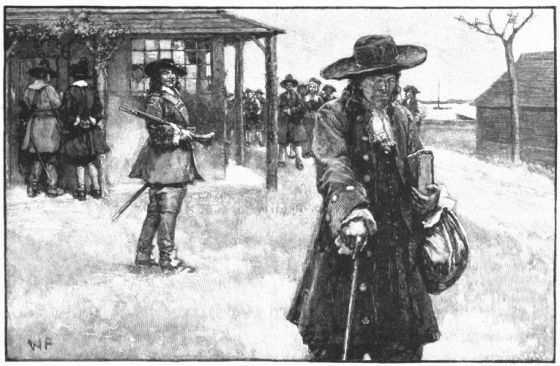
ROGER WILLIAMS LEAVING HIS HOME IN MASSACHUSETTS. (See p. 354.)
[See larger version]
Finding no relief or illumination from professors, as he called them, Fox wisely took his Bible, and used to retire into a hollow tree in the fields, where he read and prayed earnestly to God to enlighten his understanding to comprehend the sacred volume, and the genuine will of the Lord. The result was that he came to a clear and steadfast conviction that Christianity was strictly a spiritual thing, having nothing specifically to do with States and Governments, with worldly pomp and power, and strivings after mortal honours and high places; that Christ simply and strictly defined it when He said, "My kingdom is not of this world." He saw that it was the grand principle by which the soul of man is intended to be regenerated—born again, in fact, and made fitting to enter into the kingdom of disembodied souls, in the presence of God and His angels. He found himself, in a word, called back from the conflicting views and empty ceremonies of the time to Christianity as it existed among the Apostles—a perfectly spiritual, and holy, and disinterested thing, embodying the wisdom and the truth of God, and inhabiting, not formal creeds and outward ceremonies, but the heart of man, and thence influencing all his thoughts and actions for good. George perceived that all fixed creeds, all rites and ceremonies, all investments in State power, were but as cobwebs and old rags with which the self-interest and self-love of men had enveloped, encumbered, and degraded it; and he felt himself called to go forth and proclaim this, which he emphatically styled "the truth."
Fox carried his great Christian text into every act and department of life. He was the first to elevate woman to her true place—an intellectual, moral, and political equality with man; basing his principle on the apostolic declaration that male and female are all one in Christ Jesus. Acting on this principle, the women of his Society became preachers, and transacted their own affairs of association in their own meetings. He refused to take an oath before a magistrate, because Christ expressly forbade His disciples to swear at all under any circumstances; he refused to say "Thou" to a poor man, and "You" to a rich one, as was then the odious practice; he refused to take off his hat as a mark of homage to the wealthy and great, on the same principle that it was a custom of pride and invidious distinction; and he addressed prince or magistrate with the respectful boldness which became a man sensible that the only true dignity was the dignity of truth. The sufferings which were brought upon him and his followers by these novel doctrines and practices from all parties were terrible. About three thousand of them were imprisoned, even under the more liberal rule of the Commonwealth, and as many under Charles II. Their property was spoliated, their meeting-houses were pulled down, and their families grossly insulted in their absence. Yet the doctrine spread rapidly, and many eminent men embraced it; amongst others, William Penn, the son of Admiral Penn, and the learned Robert Barclay, who wrote the celebrated vindication of their faith.
At the same time the violent agitation of the period, and the enthusiasm of this new doctrine, led some of Fox's followers into considerable extravagances. The most prominent case was that of James Naylor, who for a time was undoubtedly led into insanity by the effervescence of his mind under his religious zeal; and allowed women to lead his horse into Exeter, crying "Holy! holy! holy!" and spreading their scarves and handkerchiefs in the way before him, as if he had been the Saviour come again. Naylor professed that this homage was not offered to him personally, but to Christ within him. His case occupied the House of Commons for nearly two months altogether. There were violent debates on it from morning till night; but at length, on the 17th of December, 1656, it was voted that he should be set in the pillory in Palace Yard for two hours; then be whipped from Westminster to the Old Exchange, London, twice, wearing a paper containing a description of his crimes; should have his tongue bored through with a hot iron by the hangman for his blasphemy; be branded on the forehead with the letter B; that he should be sent to Bristol, and there whipped through the city on a market-day, paraded face backwards on a saddleless horse, and then sent back to Bridewell, in London, where he should be kept to hard labour, and debarred from the visits of his friends, and from access to pens, ink, and paper.
All this was rigidly inflicted upon him, and borne heroically. After two years' confinement in Bridewell he was dismissed, thoroughly cured of his hallucination, ready to admit it, but as firm in his adhesion to the principles of Quakerism as ever; and the Society, pitying his fall, never withdrew from him their sympathy or the enjoyment of his membership. He died soon after his release.
In America, in New England, the Quakers were more fiercely persecuted than in England by the Puritans, who had themselves fled from persecution. In Massachusetts and Connecticut they were ordered to have their ears cut off if men, to be publicly whipped if women; and for a second offence to have their tongues bored through if they dared to come into these colonies; and this not deterring them, they hanged several men and women. Endicott, the Governor of Connecticut, when one of them quoted the words of St. Paul, "For in Him we live, and move, and have our being," irreverently replied, "And so does every cat and dog."
This intolerance of the Puritans was equally exerted against one of their own members, the venerable Roger Williams, who was driven from Massachusetts for courageously advocating the doctrine of perfect freedom of conscience. In fact, Roger Williams was one of the very first, if not the first man, who proclaimed this great doctrine; and therefore deserves to be held in eternal remembrance. The honour of being the earliest publisher of the right of spiritual freedom must, perhaps, be awarded to Leonard Busher, who published a work on the subject in 1614, and dedicated it to King James. Roger Williams, expelled from Massachusetts, proceeded to Narraganset Bay, and became the founder of the colony of Rhode Island and Providence Plantations, where the most perfect freedom of religious faith was allowed.
Besides the sects in England already enumerated, there were many minor ones. The "Millenarians," or "Fifth Monarchy Men," whose views we have already explained. To this sect Major-General Harrison belonged; and they created a riot under Venner, the wine-cooper. There was a sect called "The Seekers," amongst whom Fox once fell, and many of them joined him, believing they had found what they sought. There were the "Ranters," a body noted for their noise and vociferation; "Behmenists," or disciples of the German mystic, Jacob Behmen; "Vanists," followers of the religious views of Sir Harry Vane; and lastly, "Muggletonians," the disciples of one Ludovick Muggleton and John Reeve.
Muggleton was a journeyman tailor, and he and Reeve pretended to be the two witnesses mentioned in the eleventh chapter of "The Revelation." They were fanatics of the wildest and most furious character, and professed to have power to save or damn all whom they pleased, and they "dealt damnation round the land" with the utmost freedom. The Quakers and Behmenists were the objects of their most violent denunciations, probably because Fox and Penn protested against their wild and fanatic doctrines, which were the antipodes of those of Fox; for, instead of representing God as a pure spirit, they asserted that He had a corporeal body, and came down to earth in it as Christ, leaving the prophet Elias in heaven to rule in His absence. They contended that man's soul is inseparably united to his body, dies and rises again with it. They professed to have an especial knowledge of "the place and nature of heaven, and the place and nature of hell;" with the persons and natures of devils and angels. The truculent ravings of these fanatics may be seen in the works and letters of Muggleton, still extant. In one letter he delivers sentence of damnation on six-and-twenty Quakers at once. "Inasmuch," he says, "as God hath chosen me on earth to be the judge of blasphemy against the Holy Ghost, therefore, in obedience to my commission from the true God, I do pronounce all these twenty-six persons whose names are above written, cursed and damned in their souls and bodies from the presence of God, elect men, and angels in eternity." But this was little: he declared all Quakers, and Behmenists, and numbers of other people damned and cursed for ever.
This repulsive apostle of perdition was tried at the Old Bailey, and convicted of blasphemy in 1676, and died in 1697, at the age of eighty-eight.
We have seen with what a desolating sweep the bloody conflicts of the Parliament against the encroachments of kingship prostrated the pursuits of literature and art. We might have expected that the return to established tranquillity under restored monarchy would have caused a new spring of genius. But in no reign in England, and in no country except France, have debauchery and the most hideous grossness so defiled the productions of poetry and the drama.
Amid the satyr crew of degraded men and women who then represented the literary world of England, some few, however, maintained a pure and dignified career. At the head of these, equally exalted above the rest by genius and purity of life and morals, stood John Milton (b. 1608; d. 1674), one of the greatest epic poets, if not the greatest, that the world has produced. Milton had saturated himself with the poetic spirit, imagery, and expression of the Prophetic bards, as well as with knowledge of those of Greece and Rome; and he brought to bear an immense mass of varied learning on his subject with a power of appropriation that gave to it a new and wonderful life instead of the aspect of pedantry. The names of people and places which he moulds into his diction seem to open up to the imagination regions of unimagined grandeur and beauty amid strains of solemnest music; and the descriptions of scenery, such as abound in "Comus," "Lycidas," and "Arcades," as well as those diffused through "Paradise Lost" and "Paradise Regained," are like the most exquisite glimpses into the most fair and solitary landscapes, breathing every rural fragrance, and alive with all rural sounds and harmonies.
But it was when he was old, and poor, and blind, and living among the hatred and the ribald obscenity of the Restoration, that he had scaled those sublime altitudes of genius, and seemed to walk on the celestial hills amid their pure and glorious inhabitants, rather than on earth surrounded by rankest impurities and basest natures. It was when
"His soul was like a star, and dwelt apart,"
when he had fallen on evil days, that he had alone allowed himself leisure to work out these the earliest of his aspirations. Long before—when he had returned from his pleasant sojourn in Italy, where he saw Galileo in his prison, and was himself received and honoured by the greatest men of the land, as in anticipation of his after glory, and was now engaged in defending the sternest measures of the Republicans—in his "Reasons of Church Government urged against Prelacy" he unfolded the grand design of his master work, but kept it self-denyingly in his soul till he had done his duty to his country. The views which he cherished in his literary ambition are as exalted in their moral grandeur as his genius was in its native character. These were, he said, "That what the greatest and choicest arts of Athens, Rome, or modern Italy and those Hebrews of old did for their country, I, in my proportion, with this over and above of being a Christian, might do for mine, not caring to be named once abroad, though perhaps I could attain unto that, but content me with these British islands as my world." At this period, it seems, he had not made up his mind whether he should adopt "the epic form, as exemplified by Homer, Virgil, and Tasso, or the dramatic, wherein Sophocles and Euripides reign; or in the style of those magnificent odes and hymns of Pindarus and Callimachus, not forgetting that of all those kinds of writing the highest models are to be found in the Holy Scriptures in the Book of Job, in the Song of Solomon, and the Apocalypse of St. John, in the grand songs interspersed throughout the Law and the Prophets." But in one thing he was fixed—that the work should be one "not raised from the heat of youth, or the vapours of wine, like that which flows at waste from the pen of some vulgar amorist, or the trencher fury of some rhyming parasite, nor to be obtained by the invocation of Dame Memory and her siren daughters, but by devout prayer to that Eternal Spirit who can enrich with all utterance and knowledge, and sends out His seraphim with the hallowed fire of His altar, to touch and purify the lips of whom He pleases."
"So prayed, more gaining than he asked, the bard, Holiest of men."
So he waited, fighting the battles of his country side by side with Cromwell and Hampden, Pym and Marvell; and when at length he found leisure to achieve his last great triumph, he was left alone in the field. He had outlived the long battle of king and people, in which extraordinary men and as extraordinary events had arisen, and shaken the whole civilised world. Blind, poor, and old, as if some special guardianship of Providence had shielded him, or as if the very foes who had dragged the dreaded Cromwell from his grave feared the imprecations of posterity, and shrank from touching that sacred head—there sat the sublime old man at his door, feeling, with grateful enjoyment, the genial sunshine falling upon him; or dictating immortal verses to his daughters, as the divine afflatus seized him.
Much has been said of the small sum received for his "Paradise Lost," and the slow recognition which it met with. But it is not a fact that "Paradise Lost" was coolly greeted. Long before Addison gave his laudatory critique in the Spectator, the glory of Milton's great poem had been attested by Barrow, Andrew Marvell, Lord Anglesea, who used often to visit him in Bunhill Fields, by the Duke of Buckingham, and by many other celebrated men. Sir John Denham appeared in the House of Commons with a proof-sheet of "Paradise Lost" in his hand, wet from the press, and, being asked what it was, replied, "part of the noblest poem that ever was written in any language or age." The poem went into two editions during the author's life, and he corrected it for a third, which was published soon after his death. In fact, Milton's fame had to rise from under piled heaps of hatred and ignominy on account of his politics and religion, for he had attacked the Church as formidably as the State in his treatise on "The Best Mode of Removing Hirelings" out of it, as well as in his book against prelacy; but it flung off all that load of prejudice, and rose to universal acknowledgment.
We need not detain ourselves with much detail of his other poetical works, which are now familiar to all readers. They consist of his early poems, including the exquisite "L'Allegro" and "Il Penseroso," his "Comus" and "Lycidas," a mask and an elegy: his magnificent sonnets, his "Samson Agonistes," a sacred drama, but constructed strictly on the Grecian model. It has been often said that Milton had no genius for the drama; the "Samson" is a sufficient refutation of that opinion. It is full of dramatic power and interest; it is like some ancient piece of sculpture, unique, grand, massive, and solemn; and, indeed, had Milton devoted himself to the drama, it would have been rather in the style of Sophocles than of Shakespeare, for he was too lofty and earnest in his whole nature for real humour, or for much variation in mood and manner. He could never have been a comic poet, but, had he willed it, would undoubtedly have been a great tragic one. The epic character, however, prevailed in him, and decided his career.
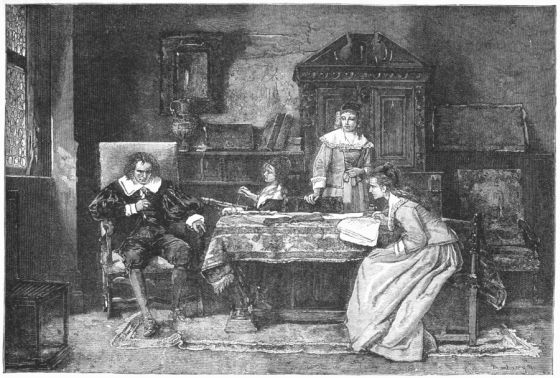
MILTON DICTATING "PARADISE LOST" TO HIS DAUGHTERS. (See p. 356.)
(After the Picture by Munkacsy.)
[See larger version]
Besides these poetical works, were his odes, including the splendid ones of the "Nativity" and the "Passion," and a great number of translations from the chief poets of Greece, Rome, and Italy, original poems written in Latin and Italian, portion of the Psalms "done into metre," and "Paradise Regained." This last poem, though bearing no degree of equality to the "Paradise Lost," is yet a noble poem, and would have made a great reputation for any other man. It is clearly not so well thought out and elaborated as the "Paradise Lost," which was the dream of his youth, the love and the labour of his prime. "Paradise Regained," on the other hand, was the chance suggestion of Thomas Elwood, his Latin reader, and closed with the temptation of Christ in the wilderness, instead of including the Crucifixion and Ascension, which might have given the poet a scope equal in magnificence to that of his former great epic. Of his prose works we shall speak presently.
The most popular of all poets of this period was Abraham Cowley (b. 1618; d. 1667). He is a striking example of those authors whom the critics of the time cry to the skies, and whom more discriminating posterity are willing to forget. Cowley, in his lifetime, had ten times the fame of Milton. Johnson, so unjust to many of our poets, can hardly be said to be so to Cowley. He says—"Though in his own time considered of unrivalled excellence, and as having taken a flight beyond all that went before him, Cowley's reputation could not last. His character of writing was not his own; he unhappily adopted that which was predominant. He saw a certain way to present praise; and, not sufficiently inquiring by what means the ancients have continued to delight through all the changes of human manners, he contented himself with a deciduous laurel."
He, in fact, for popularity's sake, preferred art, or rather artifice, to nature. Yet there are many beautiful thoughts, much real fancy and wit scattered through his poems; but they are too often buried in outrageous conceits and distorted metre. He never seems really in earnest, but always playing with his subject, and constructing gewgaws instead of raising immortal structures.
Cowley was a zealous Royalist; he went over to France when the queen of Charles I. retired thither, and became her secretary for her private correspondence with Charles. Afterwards he was sent over in the character of a spy on the Republican party and its proceedings. "Under pretence of privacy and retirement, he was to take occasion of giving notice of the posture of things in this nation;" but became suspected, and was arrested. He then fawned on Cromwell, wrote verses in his honour, which, however, were only shown in private; and, when the Commonwealth began to exhibit signs of dissolution, he again hastened to the exiled Court in France, and came back in the crowd of Royalists eager for promotion. But his flattering of Cromwell had been reported, and he was treated with coldness. Yet after some time, through Buckingham and the Earl of St. Albans, he obtained a lease of some lands, and, after the ill reception of his play of "The Cutter of Colman Street," he retired into the country, first to Barn Elms, and next to Chertsey, in Surrey, where he died in his forty-ninth year.
The great satirist of the age was Samuel Butler (b. 1600; d. 1680), who in his "Hudibras" introduced a new kind of poetry—a comic doggerel, now styled, as sui generis, Hudibrastic. Butler was the son of a yeoman, and had been educated for the Church without those connections which lead to promotion. With an immense accumulation of learning, and talent enough to have made half a dozen bishops, he became at one time a clerk to one Jeffreys, a justice of the peace at Earl's Coomb, in Worcestershire, and afterwards to Sir Samuel Luke, at Woodend, in Bedfordshire. In these situations he gleaned the characters and materials for his "Hudibras," a burlesque on the Puritans. Sir Samuel Luke was the actual Hudibras. The poem ridicules the Puritans in every way, but especially for attempting to put down bear-baiting; and accordingly the first canto—
"The adventure of the bear and fiddle Is sung, but breaks off in the middle."
Hudibras and his man Ralpho attack the bear, but are defeated, and then Hudibras retires and makes love to a rich widow. He is a Presbyterian, and Ralpho an Independent; and in the course of the story all the leading characters of the Commonwealth, Cromwell, Fleetwood, Desborough, Lambert, are ridiculed by name, as are Pym, Calamy, Case, Byfield, Lentham, and the rest under more or less transparent nicknames, as Ashley Cooper, under the name of the "politician," and John Lilburne, under that of "brother haberdasher." The first part was published in 1663, the second in 1664, and the third in 1678, fourteen years later. Still the poem remained unfinished. It did not require, however, even the second part to make it famous. It was received with one universal burst of laughter and applause by the Royalists. Charles II. and his courtiers were merrier over it than all, and Charles quoted it continually with unfailing gusto. The Earl of Dorset resolved to seize the opportunity, and introduce the author, through Buckingham, to Charles. Buckingham gave him an audience, but just as they were entering on conversation, Buckingham saw some ladies of loose character going past, ran out after them, and the poet was not only forgotten, but could never get a second interview. Clarendon, however, promised to see him duly rewarded, but never kept his word, and Butler lived poor and died neglected, at the age of eighty. This shameful neglect has been much commented on; but no one seems to have reflected that there may have been more in this than mere neglect. Butler, in his double-edged satire, made some very hard hits at the Church, and, while ridiculing the Puritans, gave some not very light back-strokes to the licentiousness of the Royalists. He wrote an avowed "Satire on the Licentiousness of the Age;" and in his third part so far vented his resentment at his neglect as to satirise Charles himself for being led by the apronstrings of his numerous mistresses. He laughed at the sages of the newly established Royal Society in his "Elephant in the Moon;" and such a man is more frequently kicked than rewarded. The Church did not forget his sallies against it, and refused him burial in Westminster Abbey. When he wrote the questions and answers between the man disguised as a devil and Hudibras—
"What makes a church a den of thieves?— A dean, a chapter, and white sleeves. What makes all points of doctrine clear?— About two hundred pounds a year. And that which was proved true before, Prove false again?—Two hundred more"—
though the sting was intended for the Puritans, the Puritans laid hold on the passage, and quoted it against the Church, and this and like blows rebounded, no doubt, on the poets head.
The most illustrious name of this period next to that of Milton is that of John Dryden (b. 1631; d. 1701). He wrote almost every kind of poetry—satires, odes, plays, romantic stories—and translated Juvenal, Persius, the epistles of Ovid, and Virgil. It was unfortunate for the genius of Dryden that he was generally struggling with poverty, and by marrying an aristocratic and uncongenial wife, the sister of Sir Robert Howard, he was all the more compelled to exert his powers to live in the style which their circumstances demanded. Hence he produced an immense mass of writings which added little to his fame. Foremost amongst these are his plays, nearly thirty in number, which were mostly unsuccessful, and which abound with such gross indecencies that, had they even high merit otherwise, they would be found to be unperusable. He had the presumption to new-model Shakespeare's "Midsummer Night's Dream" and the "Tempest"—two of the most poetical compositions in existence—and blurred them with the foul leprosy of obscenity. He treated the "Paradise Lost" in the same way; nor did his necessities lead him to these enormities only; but there is little doubt they drove him to apostatise from his religion, and from his original political faith. His first poem of any note was a most eulogistic elegy on the death of Cromwell, in which, amongst many other such things, he said—
"Heav'n in his portrait showed a workman's hand, And drew it perfect, yet without a shade."
His very next poem, and that of some length, was "Astræa Redux; a Poem on the Happy Restoration and Return of his Sacred Majesty Charles II.," immediately followed by "A Panegyric on his Coronation," in which he heaps still more glowing praise on the young royal libertine, and flings dust as liberally at his late idol:—
"While our cross stars denied us Charles's bed, Whom our first flames and virgin love did wed, For his long absence Church and State did groan, Madness the pulpit, faction seized the throne; Experienced age in deep despair was lost, To see the rebel thrive, the loyal crossed."
The accomplished sycophant received as his reward the office of Poet Laureate, with three hundred pounds a year; and he paid officiously more than his peppercorn of praise in the "Annus Mirabilis, or Year of Wonders, 1666," in which the sea fights with the Dutch and the Fire of London were commemorated in elegiac stanzas, and the most fulsome and almost impious adulation was poured in showers on both the king and his heir apparent, the Duke of York—not forgetting an especial poetical address to the duchess on her husband's victories over the Hollanders. No doubt Dryden made himself sure that his Laureate salary was safe, but he was mistaken. James, though "the best who ever bore the name," could forget benefits, and even flatteries; but he never forgot an ill turn, or anything that endangered his great design of restoring Popery; and Dryden, to please the Church and the late king, whom he did not know to be at heart a Papist, had written his "Religio Laici," in which he had pulled the Catholic Church to pieces, and lauded superlatively the Anglican hierarchy. James first took away his butt of sack, and then his salary; whereupon Dryden directly turned Catholic, and wrote "The Hind and the Panther," to beslaver Popery, kick down Protestantism, and reconcile the public to James's invidious scheme of abolishing the Test Act for his own purposes. This succeeded, and Dryden continued to receive his pay, and do his dirty work during James's reign. It was expected that he would wheel round again on William and Mary's success; but he lived and died Catholic.
With all respect for the genius of Dryden, it is thus impossible for a truthful historian to take any but a melancholy view of his personal character, and of the mass of his writings. They are, in fact, mostly on subjects that do not fall within the legitimate province of true poetry. His "Absalom and Achitophel"—written to ridicule Monmouth and Shaftesbury, with their accomplice, Buckingham, under the name of "Zimri," and to damage the Whig party generally—is transcendently clever; but even the highest satirical and political verse is not poetry—it is only cleverness in verse; and this is the grand characteristic of Dryden's poetry—it is masterly verse. There is no creative faculty in it; it is a matter of style rather than of soul and sentiment; and in style he is a great master. This made Milton say that Dryden was a good rhymester, but no poet; and in Milton's conception of poetry, and in that which has taught us to venerate Homer, Shakespeare, Milton, Wordsworth, Shelley, and others, Dryden was not a poet of the highest rank. A modern critic has given him great credit for "creative power and genius" in his adaptations of some of Chaucer's tales; but this is a mistake. The creative genius is Chaucer's; Dryden has only remodelled the tales in modern language; the ideas, the invention, are all Chaucer's; Dryden's share consists in his wonderful, elastic, musical diction, in which he undoubtedly excels every English author in the heroic measure. Pope's is more artificial, but is far behind in musical rhythm and elastic vigour. Dryden's heroic verse is music itself, and music full of its highest elements. In it the trumpet sings, the drum beats, the organ blows in solemn thunder, the flute and fife shrill forth eloquence, and all mingled instruments seem to chorus in a combination of blissful sounds and feelings. In the latter part of his life Dryden, standing independent of all Government drudgery, shows more worthily both in life and verse. His translation of Virgil yet remains the best in our language. He had done with his contemptible squabbles with Elkanah Settle and Shadwell, who won from him the honours and profits of the theatre; and his "Fables," as he called them—tales from Chaucer—seemed to inspire him with a more really poetic feeling. In them he seemed to grow purer, and to open his soul to the influences of classical and natural beauty, to the charms of nature, and of old romance. These tales will always remain the truest monuments of Dryden's fame. His odes, much as they have been praised, are rather feats of art than outpourings of poetic inspiration. His "Alexander's Feast" is but a description of the effects of music on a drunken conqueror and a courtesan. Who now would dream of placing it by the side of Coleridge's "Ode to France," or Wordsworth's "Intimations of Immortality from Recollections of Childhood"? But any one turning to "Palamon and Arcite" will find himself in a real fairyland of poetry, and perceive how much Keats, Leigh Hunt, and other modern poets have formed themselves on his style, and have even adopted his triplets.
We have given so much space to these the greatest poets of this period, that we have little for the rest. We have mentioned Andrew Marvell's beautiful ballad, "The Emigrants" (p. 180), and Wither's poems (p. 178), in our previous review. Sir John Denham's descriptive poem, "Cooper's Hill," had great popularity, and is a good specimen of that class of verse. Waller was a reigning favourite for his lyrics, which are elegant, but destitute of any high principle or emotion, as the man was, who wrote a panegyric on Cromwell and another on Charles II.; and when Charles told him he thought that on Cromwell the better, replied, "Sir, we poets never excel so well in writing truth as in writing fiction." Amongst the courtiers of Charles, Buckingham and Rochester were poets. Buckingham's comedy, "The Rehearsal," which was written to ridicule the heroic drama copied by Dryden from the French, still finds admirers; and the genius of Rochester was unquestionable, but still inferior to his obscenity. Sir Charles Sedley, another courtier, wrote comedies and songs almost equally famous for their dissoluteness. Charles Cotton, the author of "Virgil Travestied," was a writer of much wit, but nearly equal grossness, though he was the intimate friend of Izaak Walton, who was also no mean poet. The Earls of Roscommon and Dorset were popular, the first for his "Essay on Translated Verse," written in verse, and the other for his splendid ballad written at sea, commencing "To all you ladies now on land." Pomfret, a clergyman, wrote a didactic poem called "The Choice," which Dr. Johnson declared to be more frequently read than almost any poem in the language, and which Southey believed to be the most popular poem in the language. It is, in reality, one of the common-places gone by. Sir William Davenant, a reputed son of Shakespeare, wrote "Gondibert," a heroic poem in elegiac stanzas, which has good parts, but, as a whole, is intolerably dull. Sir Richard Fanshawe was celebrated as a translator, especially of Guarini's "Pastor Fido." Another translator from Greek and Spanish was Thomas Stanley, the learned editor of Æschylus, and the author of "The History of Philosophy." Besides these may be mentioned Bulteel, a popular songwriter; Philip Ayres, a lyrical poet; Dr. Henry More, author of a poem, "The Life of the Soul," in Spenserian stanzas; and Flatman, an imitator of Cowley.
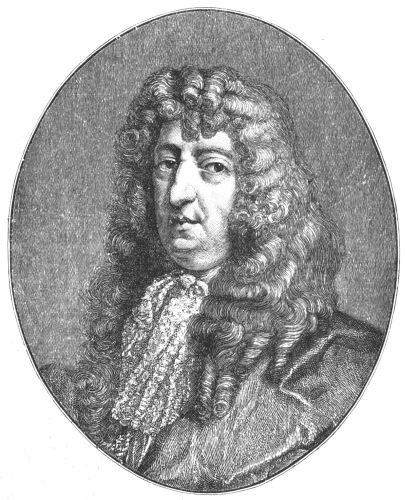
SAMUEL BUTLER.
[See larger version]
The dramatic writing of the period was rather voluminous than first-rate. Davenant wrote above twenty plays, masks, etc.; but the most eminent dramatists were the unfortunate Otway, Nathaniel Lee, Sir George Etherege, Wycherley, Crowne, Southern, and Jasper Mayne. Otway's "Orphan" and "Venice Preserved" still maintain their fame; he wrote altogether ten plays. Nathaniel Lee wrote ten tragedies, a great mixture of talent and bombast. The most celebrated of them are his "Theodosius" and his "Rival Queens." Crowne wrote seventeen plays, in which the selections made by Charles Lamb in his "Dramatic Specimens" show that there exists perhaps the most pre-eminent dramatic genius of the age. Etherege is the author of three comedies of great polish and brilliancy, and set the pattern for Wycherley, and for Congreve, Farquhar, and Vanbrugh in the next period. Wycherley wrote four comedies equally remarkable for vigour and indecency. In fact, it is scarcely necessary to repeat that the whole of the dramatic literature of this period is thoroughly disfigured with the coarsest and most revolting sensuality and obscenity. Southern belongs properly to the next era, as he produced only two of his plays during this period—his tragedy of "The Loyal Brother," and his comedy of "The Disappointment." Shadwell and Settle inundated the stage with worthless plays; and Mrs. Aphra Behn, a courtesan as well as writer, was the author of a whole host of comedies, novels, and poems. Of the two comedies by Jasper Mayne—who, by-the-by, was a clergyman—"The City Match" is the better. Perhaps we ought not to close this review of the poets without a mention of the most successful poetaster of the age, Nahum Tate, who was in such estimation as to be allowed to supply our churches with his most wretched version of the Psalms, and to be employed by Dryden to continue his satire of "Absalom and Achitophel."
At the head of the prose writers of this period, as of the poets, we must place Milton. Though his writings are for the most part on controversial subjects, they were subjects of such immense importance that they acquired a lasting value. They bear a certain relation to his poetry. This in its highest exhibition celebrated the triumph of the Deity over the powers of evil. His prose writings were employed to support the struggle of liberty against the advocates of all political evil—absolutism. Poetry seemed to have become the habitual expression of his mind, and, therefore, there is in his prose style a certain awkwardness and stiffness. He moves like David in armour that he had not well proved; and his utterance, solemn and full of deep thought and erudition, is, as it were, forced and formal. But when he warms up with the greatness of his subject, he runs into a strain of grave eloquence which has scarcely an equal in the language.
The great prose works of Milton comprise his "History of England" from the earliest times to the Conquest, including all the old legends of the chroniclers, the arrival of Brute from Rome, the story of King Lear, and those fine fables which have been the storehouses of poets and dramatists; his "Tractate on Education;" his magnificent "Areopagitica;" his "Tenure of Kings and Magistrates;" the "Eikonoklastes;" the "Defensio pro Populo Anglicano" and "Defensio Secunda"—vindicating the conduct of England in deposing impracticable kings; his "Treatise on the Best Manner of Removing Hirelings out of the Church;" his essay on "Civil Power in Ecclesiastical Causes;" his "State Letters," written at the command of Cromwell; an "Art of Logic;" a "Treaty of True Religion, Heresy, Schism, Toleration, and what Best Means may be used against the Growth of Popery;" and his "Familiar Letters," in Latin. Besides these he left in manuscript a "Brief History of Muscovy," and a "System of Theology"—both since published. It may be safely said that scarcely any other writer has left such a sound and profound body of knowledge of all that is necessary for the maintenance of freedom, civil and religious, in the State.
Dryden is also a vigorous prose writer; but nothing can be more characteristic of the two men than the prose of Milton and Dryden. The one is grave, solemn, independent, upholding the sacred interests of religion and liberty; the other, that of Dryden—besides short lives of Polybius, Lucian, and Plutarch, and an "Essay on Dramatic Literature"—consists chiefly of a mass of his dramatic writings, couched in the most extravagant and unmanly terms of flattery. It is in vain to say that this was the spirit of the time; we have only to turn to Milton and behold that a great soul despised such sycophancy as much then as now.
Clarendon's "History of the Rebellion" and Memoirs of his own life assume a permanent importance from the position which he occupied in the struggles of those times; as literary compositions they are unique in style, but as historical authority, it is necessary to read them with caution.
Hobbes (b. 1588; d. 1679), the celebrated philosopher of Malmesbury, was one of the most powerful minds of the age. By his works, called the "Leviathan," his treatise on "Human Nature," on "Liberty and Necessity," and his "Decameron Physiologicum," with others of the like kind, he became the head of a great school of writers, which found wide acceptance in France, Germany, and England. Mr. Mill says—"Hobbes is a great name in philosophy, on account both of what he taught, and the extraordinary impulse which he communicated to the spirit of free inquiry in Europe." But, on the other hand, it has been well observed by a modern writer that, "as for what is properly to be called his system of philosophy—and it is to be observed that in his own writings his views in metaphysics, in morals, in politics, are all bound and built up together into one consistent whole—the question of the truth or falsehood of that seems to be completely settled. Nobody now professes more than a partial Hobbism. If so much of the creed of the philosopher of Malmesbury as affirms the non-existence of any essential distinction between right and wrong, the non-existence of conscience or the moral sense, the non-existence of anything beyond mere sensation in either emotion or intelligence, and other similar negatives of his moral and metaphysical doctrine, has still its satisfied disciples, who is now a Hobbist either in politics or mathematics? Yet certainly it is in these latter departments that we must look for the greater part of what is absolutely original in the notions of this teacher. Hobbes's philosophy of human nature is not amiss as a philosophy of Hobbes's own human nature. Without passions or imagination himself, and steering his own course through life by the mere calculations of an enlightened selfishness, one half of the broad mass of Humanity was to him nothing better than a blank."
Hobbes was a thorough advocate of personal monarchy, as is testified by his "De Corpore Politico," his "Leviathan," and "Behemoth," the last being a history of the Civil War from 1640 to 1660. Hobbes lived to a great age, praised by his admirers as an example of independence. His arguments were ably answered by Cudworth, by Clarendon, Bishops Cumberland, Bramhall, and Tenison, by Dr. Henry More in his "History of Philosophy;" by Eachard, and others.
A writer who has had a different influence was Richard Baxter (b. 1615; d. 1691). Baxter held the same position in the religious world as Halifax in the political one. Halifax gloried in the name of a "Trimmer." He was constantly occupying the middle post in the world of party. Sometimes one party congratulated itself that it had him, but presently it found him defending measures of its opponents. In fact, he was an independent thinker, and, extending his hand to either party as he thought it right at the moment, he turned the balance of conflicting opinions. Exactly so with Baxter; a clergyman of the Church of England, he was yet a decided Nonconformist. He was a Monarchist in theory, but was so disgusted with the Royalists for their licentiousness and notions of absolutism, that he went over to the camp of Cromwell and preached in it. But when Cromwell assumed the supreme power, again Baxter was on the other side, condemning to his face his usurpation. Baxter's mediating views led him to hope, on the return of Charles II., that Nonconformity and the Church might shake hands. He believed in Charles's "Healing Declaration," and drew up an accommodating Liturgy, but found himself deceived; the Hierarchy rejected such compromises. He became a sufferer from Nonconformity, and yet remained an advocate of Conformity to a certain extent. So was it in his theological views; with one hand he embraced Calvin, with the other Arminius. He rejected Calvin's doctrine of Reprobation, yet accepted his theory of Election—that is, that certain persons are pre-ordained from all eternity as instruments for certain work by God; but he agreed with Arminius's assertion that all men whatever are capable of salvation, for that Christ distinctly declared that He died for all, and that whoever believed should be saved. The views of Baxter were adopted by large numbers, who became a sect under the name of "Baxterians;" but they were gradually absorbed into the different denominations of the Independents, Baptists, etc., who may now be considered as generally holding Baxter's mild and amiable opinions. Watts and Doddridge were eminent professors of Baxter's creed. The chief works of Baxter are his "Methodus Theologiæ," his "Catholic Theology," and his "Saints' Everlasting Rest." The last is by far the most popular. It has been circulated by tens of thousands into all quarters where the English language reaches, and, like the "Pilgrim" of Bunyan, is to be found on the shelves of the cottage and the farm in the remotest nooks. Perhaps no book ever gave so much consolation to the spirits of so many simple and earnest seekers after religious rest as this work of the venerable Richard Baxter.
Bunyan (b. 1628; d. 1688) was a contemporary of Baxter, but a man of a more robust and sturdy temper. Lying twelve years in Bedford gaol for his religious faith, he there produced his immortal "Pilgrim's Progress," a work which, as the production of an illiterate tinker, was contemptuously ignored by the critics and the learned of the time, till it had spread like a flood over the whole land and was become the delight of the nation. The "Pilgrim" is a wonderful work for any man, and Bunyan was undoubtedly a genius of the very first class.
With Baxter and Bunyan, the gentle angler, Izaak Walton (b. 1593; d. 1683), claims a place for his "Lives of Religious Worthies," and not less for his "Complete Angler," one of the first works, along with "Percy's Reliques of Ancient English Poetry," which awoke the love of nature.
Side by side with these worthies stands John Evelyn (b. 1620; d. 1706), a man who mixed with the Court in Charles II.'s reign without defiling himself. He was the model of a true English gentleman—pious, honourable, and exerting himself at once to maintain sound morals and to promote science. His Memoirs present a lively picture of the dissolute age in which he lived; and he sought to draw men away from the sink of corruption by encouraging them to plant and cultivate their estates. For this he wrote his "Sylva; or, a Discourse of Forest Trees," still a standard and most delightful work. He was one of the first members and promoters of the Royal Society, and wrote "Numismata, a Discourse of Medals;" a "Parallel of Ancient and Modern Architecture;" a work on Theology; and the first "Gardener's Almanac."
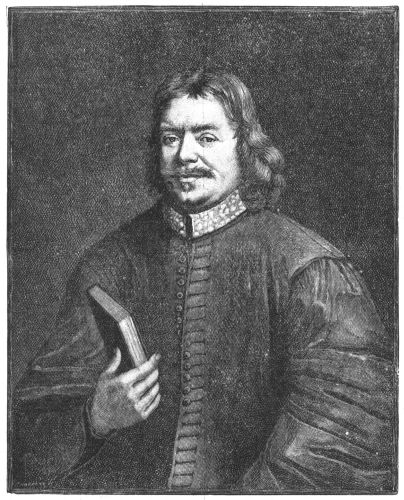
JOHN BUNYAN.
[See larger version]
As a memoir-writer of the same period Samuel Pepys (b. 1632; d. 1703) is more popular than Evelyn. Pepys was Secretary to the Admiralty in the reigns of Charles II. and James II.; and his inimitably-gossiping volumes of whatever he saw during those times have been often reprinted and read everywhere with great unction. Pepys, besides this, continued a most invaluable collection of old ballads begun by Selden, from which Bishop Percy amply helped himself in collecting his "Reliques;" so that to Pepys and John Selden we really owe much of that great revolution in taste and poetry which we ascribe almost exclusively to Percy. Another Memorialist of this period was Sir William Temple, a man who, like Evelyn, maintained a high moral status, and was held in great esteem for his philosophical essays. In Scotland Sir George Mackenzie stood conspicuous for his "Institution of the Laws of Scotland," and not less for various works of taste, as his "Aretina; or, The Serious Romance," and his "Religio Stoici; or, The Virtuoso." Burnet, the author of "The Sacred Theory of the Earth," also belongs to this period. In his work the Biblical account of the origin of the earth is made the foundation of a scientific treatise.
The Church at this period possessed great and eloquent men—Tillotson, Sherlock, Barrow, South, Stillingfleet, and others. Their sermons remain as storehouses of religious argument. They were nearly all of the Arminian school. Barrow was, besides, one of the ablest geometricians that have appeared.
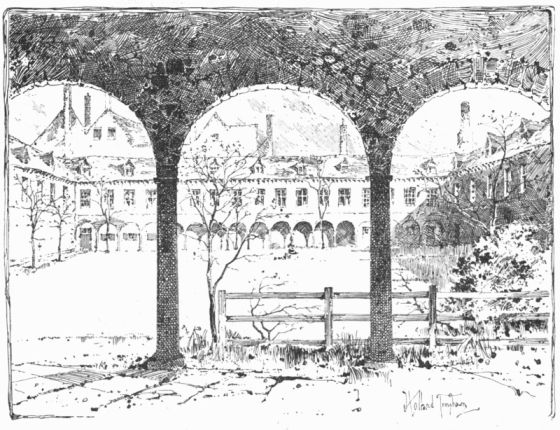
GRESHAM COLLEGE, WHERE THE ROYAL SOCIETY WAS FIRST HOUSED.
[See larger version]
During the period now under review a great step in the progress of science was made by the foundation of the Royal Society. The honour of originating this famous society belongs to Mr. Theodore Haak, a German, who was resident in London. At his suggestion a number of scientific gentlemen, including Dr. Goddard, a physician in Wood Street, but also a preparer of lenses for telescopes; Dr. Wallis, the mathematician; Dr. Wilkins, afterwards Bishop of Chester; Drs. Ent, Gisson, and Merrit, and Mr. Samuel Foster, professor of astronomy in Gresham College. These meetings began in 1645, and were held at one of their houses, or in Gresham College, or at apartments in Cheapside. Though some of these gentlemen were removed by promotion, others continued to join it, as Boyle, Evelyn, Wren—afterwards Sir Christopher. In 1662 a royal charter was obtained, and in the following year additional privileges were granted under a second charter. The first President was Lord Brouncker, and the first council consisted of Mr.—afterwards Lord—Brereton, Sir Kenelm Digby, Sir Robert Moray, Sir William Petty, Sir Paul Neile, Messrs. Boyle, Slingsbey, Christopher and Matthew Wren, Balle, Areskine, Oldenburg, Henshaw, and Dudley Palmer, and Drs. Wilkins, Wallis, Timothy Clarke, and Ent. Balle was the first treasurer, and Wilkins and Oldenburg the first secretaries. The Society was pledged not to meddle with questions of theology or State, and their chief subjects of notice were the physical sciences, anatomy, medicine, astronomy, mathematics, navigation, statistics, chemistry, magnetism, mechanics, and kindred topics. In the spring of the second year the Society numbered a hundred and fifteen members; amongst them, besides many noblemen and gentlemen of distinction, we find the names of Aubrey, Dr. Barrow, Dryden, Cowley, Waller, and Sprat, afterwards Bishop of Rochester. The Society commenced the publication of its Transactions in 1665, which became a record of the progress of physical and mathematical science for a long series of years.
During the short period over which the present review ranges—that is, from the Restoration in 1660 to the Revolution in 1688, that is, only twenty-eight years—some of the greatest discoveries in science were made which have occurred in the history of the world; namely, the discovery of the circulation of the blood by Dr. William Harvey; the improvement of the tables of logarithms constructed by Napier; the invention of fluxions by Newton, and the calculus of fluxions, or the differential calculus, by Leibnitz; the discovery of the perfected theory of gravitation, by Newton; the foundation of modern astronomy, by Flamsteed; and the construction of a steam-engine by the Marquis of Worcester, originally suggested by Solomon de Caus, a Frenchman.
Napier (b. 1550; d. 1617) published his tables of Logarithms in 1614, under the title of "Mirifici Logarithmorum Canonis Descriptio," and in the same or the next year he and his friend, Henry Briggs, gave them their improved and perfect form, for from that time to the present they have admitted of no further improvement. They came from the hands of their author and his assisting friend perfect. The principle of their construction Napier did not declare; but this important revelation was made by Briggs and Napier's son in 1619. By these tables Napier superseded the long and laborious arithmetical operations which great calculators had previously to undergo, and which the most simple trigonometrical operations demanded. Without this wonderful aid even Newton could not have lived to formulate the principles that he drew from, and established for ever upon, the material accumulated by prior mathematicians. Napier in fact furnished by these tables a scale by which not only the advantages which he proposed of shortening arithmetical and trigonometrical labour were effected, but which enabled his successors to weigh the atmosphere and take the altitudes of mountains, compute the lengths and areas of all curves, and to introduce a calculus by which the most unexpected results should be reached. "By reducing to a few days the labour of many months," says Laplace, "it doubles, as it were, the life of an astronomer, besides freeing him from the errors and disgust inseparable from long calculations."
We are not, however, to suppose that Napier was the first who had a perception of the nature of logarithms. In almost all grand discoveries the man of genius stands upon the shoulders of preceding geniuses to reach that culminating point which brings out the full discovery. In very early ages it was known that if the terms of an arithmetical and geometrical series were placed in juxtaposition, the multiplication, division, involution, and evolution of the latter would answer to and might actually be effected by a corresponding addition, subtraction, multiplication, and division of the former. Archimedes employed this principle in his "Arenarius," a treatise on the number of the sands. Stifel, in his "Arithmetica Integra," published at Nürnberg in 1644, exhibits a still clearer notion of the use of this principle; but the merit of Napier was this—that whilst those who preceded him could only apply the principle to certain numbers, he discovered the means of applying it to all, and thus was enabled to construct and bring to perfection at once his admirable tables. There was an attempt to show that he had stolen the idea from Longomontanus, but that great mathematician settles this matter by himself attributing the whole invention to Napier.
Besides the Logarithms, Napier—or, to give him his full title, Lord Napier of Merchiston—is also noted for his elegant theorems, called his "Analogies," and his theorem of "the five circular parts," which furnishes a ready solution of all the cases of right-angled spherical triangles. He also invented what are called "Napier's Bones," to facilitate the performance of multiplication and division; instruments of such value, that had he not discovered the logarithms, they would have, to a certain extent, supplied their place.
The discoveries of Sir Isaac Newton (b. 1642; d. 1727), however, put the crown to the glories of this period. Their extent can only be learnt by a perusal of his "Principia; or, Mathematical Principles of Natural Philosophy," containing his complete theory of the laws of the universe, based on the grand doctrine of Gravitation, of which he published afterwards a popular view under the title of "De Mundi Systemate," enunciating the truths contained in the third book of the "Principia;" his "Optics," containing his theories of light and colour, founded on a host of curious experiments; his "De Quadratura Curvarum," containing an exposition of his method of fluxions; his "Method of Fluxions and Analysis by Infinite Series." A great many of those discoveries were made known to the public through his communications to the Royal Society. The announcement of his binomial theorem, by which he was able to determine the area and rectification of curves, the surface and contacts of the solids formed by their revolution and the position of their centre of gravity—a theory of infinite avail in his determination of the laws of the planetary bodies—is dated 1664, that of his "Method of Fluxions," 1665; but he did not claim this till 1669. He professed to have written a tract on the subject in 1664, but he did not produce this tract till he had seen some of the same results published in Mercator's "Logarithmotechnia," four years afterwards. In 1666 he demonstrated the great law of gravitation, and applied it to the planets, but was baffled in his attempts to apply it to the moon through a false estimate of the earth's diameter. This was corrected by Picard's measurement of an arc of the meridian, with which Newton became acquainted in 1682, and then after sixteen years' delay he completed his system. But his "Principia" was not published collectively till 1687; his "Optics" till 1704, with his "De Quadratura Curvarum."
Unparalleled as were the achievements of Newton, these were not accomplished, any more than any other great performances, without substantial hints and assistance from preceding or contemporary genius. The very principle of gravitation had been pointed out by Robert Hooke, and Newton was compelled to admit, and offered to publish a scholium acknowledging the fact, that Hooke, Wren, and Halley had already deduced this law—that the gravitation of the planets was as the curvic square of the distance—from Kepler's second law of analogy between the periodic times and the mean distances of the planets. Newton's defenders say that he probably made this concession for the sake of peace; but was Newton likely to surrender a great truth, vitally affecting his fame for science and discovery, if there were not solid grounds for it?
Still less to the credit of Newton was his conduct towards Leibnitz in the dispute regarding the Differential Calculus. Leibnitz having heard through Oldenburg that Newton had made discoveries as to the measurement of tangents, in fact, as to his binomial theorem, and as to fluxions, desired to have some account of them, and Newton, through Oldenburg, communicated to Leibnitz his binomial theorem, but concealed his knowledge of fluxions under a most abstruse anagram, which was formed from the words, "Data Equatione quotcunque fluentes quantitates envolvente fluxiones invenire, et vice versâ." It has been well observed that if Leibnitz could draw any light from that anagram, he must have possessed superhuman sagacity. Leibnitz, however, having himself made most important discoveries in fluxions, at once and candidly communicated the theory of what he called, and what is still called, the differential calculus, to Newton. This, Newton, in a scholium included in his "Principia," admitted to be a method hardly differing from his own except in the form of words and symbols. Yet in the third edition of the "Principia" he omitted this confession, claimed the exclusive invention of the differential calculus for himself, and branded Leibnitz as a plagiarist. The fact was, that Leibnitz had gone a step beyond Newton. Newton had discovered fluxions, but Leibnitz had discovered the fluxionary calculus, or, as he termed it, the differential calculus.
Still more discreditable was the conduct of Newton to Flamsteed (b. 1646; d. 1719). Flamsteed was the first Astronomer Royal. Charles II. established an observatory at Greenwich, one of the best things he ever did. The observatory was, in fact, the queen's house in Greenwich Park, and Flamsteed was appointed Astronomical Observator, with the magnificent salary of a hundred pounds a year, and not a single instrument, not even a telescope. It was in vain that he applied for instruments; and his appointment might have been a sinecure had he not procured instruments at his own expense, and taught pupils to maintain himself. But through all these difficulties he went on making observations, and in time not only made a mass of the most valuable lunar observations, but had made a map and catalogue of the stars, such as there had never been before for completeness and accuracy. His catalogue included three thousand three hundred stars, "whose places were more accurate than any determined in the next fifty years, and whose selection and nomenclature has served as a basis to every catalogue since that time." Bailey, Flamsteed's biographer, claims—and very justly claims—that the commencement of modern astronomy dates from his observations, for no one would care to go beyond them to compare any made in our day.
Newton was very intimate with Flamsteed, and with good cause, for he depended on his supplying him with the necessary observations to enable him to establish his lunar theory, and it is on evidence that Flamsteed furnished him with every lunar observation that he made. When Flamsteed had completed his catalogue, he proposed to publish it, and Prince George of Denmark, knowing that Flamsteed had expended on his instruments two thousand pounds more than his salary, offered to pay for the printing. A committee, consisting of Newton, Sir Christopher Wren, Dr. Arbuthnot, Dr. Gregory, and Mr. Roberts, was appointed to superintend this publication. The whole story, based on letters and documents of the time found at Greenwich observatory, is too long to be detailed here; but the upshot of it is, that the catalogue and observations of Flamsteed were printed and published, not as his own, but as those of Halley. In vain did Flamsteed protest against this most scandalous deed. Newton and his associates were strong in the favour of the queen and Halifax, and Newton used the most opprobrious language to the man by whose labours he had so greatly benefited, and whom he had now helped to rob of his dearest possession—his fame. The softest name that he gave him was that of "puppy." Flamsteed could obtain no redress—though they had broken his seal to come at his catalogue—till after the death of Queen Anne and Halifax, when he was enabled to get possession of the remainder of the books called Halley's, styled, "Historia Celestis libri duo." He immediately began preparations for publishing them himself, and demanded his MSS. from Newton, who refused, and was sued for them by Flamsteed. In the meantime, to avoid being compelled to give up the MSS. to the rightful owner, Newton handed them over to Halley! Every insult was offered to Flamsteed. He was summoned before the Royal Society to answer whether he had his instruments in order, a matter in which the Society had no authority, and what made the matter more atrocious, the instruments were Flamsteed's own. Newton even twitted Flamsteed with his one hundred pounds a year salary, at which Flamsteed indignantly reminded him that he had been receiving three hundred pounds a year himself ever since he came to London. Flamsteed's work was not completed till after his death, when it appeared under the name of "Historia Cœlestis Britannica."
It is difficult to conceive more overbearing, unjust, and unworthy proceedings than those of Newton against Flamsteed. Sir David Brewster, in his "Life of Newton," endeavoured to defend him by asserting that Flamsteed did not appreciate Newton's theory; as if Flamsteed was not quite at liberty to have his own opinion, an opinion shared by many at the time, and which theory, in the first edition of the "Principia," the only one then out, was in some respects grossly incorrect—"rejected," as Flamsteed remarked, "by the heavens." Brewster also urged that Flamsteed showed unwillingness to furnish Newton with the requisite lunar observations. He was under no obligation whatever to do so; yet, as proved, he furnished him with all he had made. It is contended also that the committee had a right to break the seal of Flamsteed to get at his catalogue—an assertion than which nothing can be more immoral.
On the whole view of this case, as it rests on broad facts, we are compelled, in justice between man and man, to declare our opinion that Flamsteed was not only one of the most illustrious astronomers which England has ever produced, but also one of the most ill-used of men; and without derogating an iota from the scientific merits of Sir Isaac Newton, it is clear, from his conduct to both Leibnitz and Flamsteed, that he adds another proof to that of Bacon, that intellectual greatness and moral greatness do not necessarily reside in the same mind.
Amongst the other men of mathematical note in this period we may mention Henry Briggs, the coadjutor of Napier. His "Trigonometrica Britannica" showed that he had had a near view of the binomial theorem afterwards discovered by Newton. This work was published after his death by his friend, Henry Gellibrand, also an able mathematician. Thomas Harriott, author of a work on algebra—"Artis Analyticæ Praxis"—is said to have discovered the solar spots before Galileo, and the satellites of Jupiter only a few days after Galileo. Jeremiah Horrocks was beforehand with Newton in the theory of the lunar motions, which Newton afterwards demonstrated to be the necessary consequence of gravitation. Dr. Wallis, Crabtree, Gascoigne, Milbourn, Shakerley, and Gunter—the author of Gunter's Scale—were all men of high merit in those branches of science. Barrow we have already mentioned as a distinguished geometrician as well as a theologian. He was only excelled in optics by Newton himself; and in his "Sectiones Geometricæ" he nearly anticipated Newton's principle of fluxions. James Gregory, professor of mathematics at Edinburgh, the first constructor of a reflecting telescope; and his nephew, David Gregory, of Oxford; John Collins, author of various philosophical works and papers; Roger Cotes, author of "Harmonia Mensurarum," etc.; and Dr. Brook Taylor, author of "Methodus Incrementorum," were all substantial contributors to the higher sciences at this era. Halley, whose name occurs so unfavourably in the affair with Flamsteed, succeeded him as Astronomer Royal, and is noted as being the first to find out the exact return of a comet which bears his name, and for his catalogue of the southern stars, published in 1679. Besides his profound astronomical talents, he added in various ways to the knowledge of the time. He was the first to construct tables of mortality; introduced improvements in the diving-bell; and wrote treatises on the variations of the compass, on the trade winds, and other subjects.
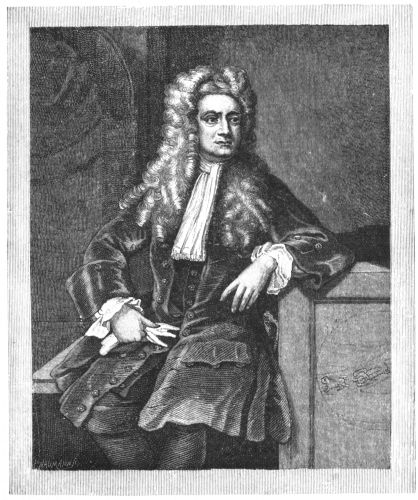
SIR ISAAC NEWTON.
[See larger version]
In pneumatics and chemistry the Honourable Robert Boyle made some discoveries, and considerably improved the air-pump; and Robert Hooke, already mentioned as one of the earliest theorists of gravitation, also had a pretty clear notion of the gas now termed oxygen. Thomas Sydenham is a great name in medicine of this time; and the department of natural history took a new start under the hands of Ray, Willoughby, Lester, and others. Ray published his "Historia Plantarum," and edited Willoughby's works on birds and fishes. Conchology was advanced by Martin Lester, and Woodward opened up the new region of mineralogy. The two most extraordinary discoveries, however, next to those of Newton, were those of the circulation of the blood by Harvey (b. 1578; d. 1657), and of the steam-engine by Solomon de Caus, introduced into England by the Marquis of Worcester (b. 1601; d. 1667).
The theory of the circulation of the blood, like almost every other great theory founded on fact, was not left for Harvey to think out ab origine. That the blood flowed from the heart to the extremities was known to the ancients, and stated by Aristotle. Galen even had argued, from the discovery of valves in the pulmonary artery, that the blood was also returned to the heart. Servetus, of Geneva, the same who was put to death for heresy, had demonstrated the circulation through the lungs, and again this theory had been propounded by Rualdus Columbus in 1559. In 1571 Cæsalpinus of Arezzo came still nearer to the true theory, from observing the swelling of veins below a ligature—thence inferring that the blood flowed from the extremities as well as to them. It is clear, therefore, that all but positive demonstration was arrived at when Harvey appeared. But though this demonstration was all that was now needed, it was a work of no ordinary courage and genius. The few facts known were overlaid by such a mass of absurd and contradictory notions amongst medical men, that nothing but the nicest and completest experiments could establish the truth. This Harvey undertook to do, and accomplished it. He informed Boyle, as we learn from that philosopher's "Treatise on Final Causes," that the idea of the true circulation was first suggested to him when studying under Fabricius Aquapendente, at Padua, by noticing the valves in the veins—the same that had attracted the attention of Galen. To ascertain the fact, he made numerous accurate experiments on both dead and living animals, and the result was the clearest proof of the fact that the blood is propelled from the heart through the arteries, and returned to it through the veins. Besides this, his experiments threw a flood of light on the action of the heart, on its diastolic and systolic functions, as observed both in adult subjects and in the fœtus; on the true action of the lungs on the blood, and other important points. His completed views were so opposed to the notions of the Faculty at the time, that a stupendous prejudice was raised against him, and his practice fell off greatly from the clamour which was raised against what his fellow-practitioners called his wild speculations. It is a well-known fact that not one medical man who had passed his fortieth year ever admitted the discovery of Harvey. The most famous anatomists abroad joined in the outcry against his theory. Primrosius, Parisanus, Riolanus, professors of anatomy at Paris, and Plempius, professor at Louvain, were violent against it. Harvey very modestly permitted the storm to blow, certain that a truth built on positive facts would in the end prevail. He refused to answer the attacks of any one but Riolanus; but his friend, Dr. Ent, ably wielded the pen in his defence, and Harvey had the pleasure to see Plempius before long confess himself a convert, and many others then followed.
Besides Harvey's great discovery, he made many other anatomical investigations with great care and ability, and especially on a vital subject, detailed in his treatise "De Generatione." His merits became so fully acknowledged that he was elected President of the College of Physicians.
But the gifted men of this age who could determine the laws of worlds, and systems of worlds, and the vital principles of the living body, failed to perceive the wondrous capabilities of another invention destined to revolutionise society at a later day. The Marquis of Worcester, whom we have seen figuring conspicuously as the Earl of Glamorgan, in the civil strife of Charles I.'s reign, constructed a steam-engine—a very rude one, of course—which Sorbiere, a Frenchman, saw at work at his lordship's house at Vauxhall in 1663. It was capable of throwing up water to a great height. This engine is described by the marquis in his "Century of Inventions," published this same year, 1663. It is the sixty-eighth in the catalogue, and entitled "An admirable and most forcible way to drive up water by fire." He used a cannon for his boiler, and says he has seen "water run like a constant fountain-stream forty feet high. One vessel of water rarefied by fire driveth up forty of cold water."
The marquis had learned this invention from the work of a Frenchman, Solomon de Caus, entitled "Les Raisons des Forces Mouvantes." This De Caus had travelled in England, and had importuned his own countrymen to examine what he deemed a wonderful discovery—the power of steam; but, like Thomas Gray, when urging on England a system of railroads, he was treated as a bore and a maniac. The marquis found De Caus actually confined in the Bicêtre in Paris as a madman, for wanting to convince his countrymen of the marvellous powers of steam. The marquis's own notion appeared to be that the engine might be employed chiefly for the raising of water—a trait attributed to him by Stuart, in his "Anecdotes of Steam-Engines," published in 1651, in which the writer mentions a little engine at work at his house in Lambeth, which "might be applied to draw or hale ships, boates, etc., up rivers against the stream; to draw carts, wagons, etc., as fast without cattel; to draw the plough without cattel, to the same dispatch, if need be."
The views of the marquis were thus rapidly expanding on the subject; and it is wonderful that the invention should have been suffered to sleep a century and a half longer. Still more wonderful is it that the powers of steam slept so long, when, according to Gibbon, the architect of St. Sophia, Constantinople, centuries ago, was so well aware of it that he used to shake the house of his neighbour, an enemy of his, with steam machinery.
Of architecture there was none belonging to this period. The glorious old Gothic had closed for the time its career, and even the most eminent architects despised it. Inigo Jones introduced an Italian style, and committed the atrocity of erecting Grecian screens in Gothic cathedrals; and we shall find Wren, the architect of the noble classical fabric of St. Paul's, equally incapable of perceiving the beauty of Gothic. To him it was barbarian.
With Charles II. came in French taste, and almost all the professors of painting, sculpture, and engraving were foreigners. The whole art of painting was expended in portraiture and on the decorations of walls and ceilings after the fashion of Le Brun, but not with his genius. Verrio and Sir Peter Lely engrossed the patronage of the Court, and the admiration of the public.
Antonio Verrio, a Neapolitan painter, who transferred himself to France and then to England, covered immense spaces of wall and ceiling at Windsor Castle and other places with his gods, goddesses, and similar figures, pouring them out, as Walpole observes, without much invention and as little taste, but certainly with a great show of colour. He painted most of the ceilings at Windsor, one side of the Hall of St. George and the chapel, most of which works are now destroyed. On the ceiling of St. George's Hall he drew Ashley Cooper, Earl of Shaftesbury, as Faction dispersing libels; and the housekeeper, Mrs. Marriott, as Fury, because she had offended him. He was paid an enormous sum for these works, and spent it in ostentation. He had a house in St. James's Park, and was also master gardener to the king. Walpole gives an extraordinary example of his freedom in demanding money of the king. He had just received a thousand pounds when he appeared at Court, and found Charles in such a circle that he could not approach him; but, nothing daunted, he called out to him that he desired to speak to him. Being asked what he wanted, he replied, "Money." The king smiled, and reminded him of the thousand pounds just had. "Yes," said he, "but pedlars and painters cannot give long credit; that was soon paid away, and I have no gold left." "At that rate," said Charles, "you would spend more than I do." "True," replied the impudent foreigner; "but does your majesty keep an open table as I do?"
Being a Tory, at the Revolution he refused to paint for King William; but was employed by the Earl of Exeter at Burleigh House, and the Earl of Devonshire, at Chatsworth, where plenty of his works remain. Dr. Waagen says he received more from Lord Exeter alone than Raphael or Michael Angelo received for all their immortal works. The earl paid him for twelve years one thousand five hundred pounds a year—that is, eighteen thousand pounds, besides his keep and equipage at his disposal. At length the earl persuaded him to work for King William at Hampton Court, where, besides other things, he painted the staircase so badly that he was suspected to have done it on purpose.
In the wake of Verrio came Jacques Rousseau and Charles de la Fosse, the painters of the dome of the Invalides in Paris. Some few Englishmen, too, were employed in fresco-painting. Among them were Isaac Fuller, remains of whose performance may be seen in the dome of St. Mary Abchurch, in London; John Freeman, a scene painter; and Robert Streater, a man of superior skill, who painted the ceiling of the theatre at Oxford, and many other ceilings, besides historical subjects, and even still life.
Lely, the painter of Charles's beauties, now at Hampton Court, was a native of Germany, but had studied chiefly in Holland, where Charles is supposed to have met with him. His ladies are endowed with remarkable beauty and grace, but there is a certain likeness running through them all, especially in the complexion, the tone and tint of the flesh, as well as the disposal of the drapery, which gives one the inevitable impression that they are to a great degree got up, and made rather after his peculiar model than their own real appearance. However, whether they are striking likenesses or not, they are beautiful pictures. His draperies are arranged in broad folds, and he relieves his figures by a landscape background, which made Walpole say, "His nymphs trail fringes and embroidery through meadows and purling streams." The essence of Lely's painting is Court artifice. It is showy, affected, and meretricious. Besides his Court portraits he occasionally attempted the historic, one of the best of this kind which he executed being "Susannah and the Elders," at Burleigh House. Amongst a crowd of foreigners who sought to share Sir Peter Lely's popularity were Henry Gascar, James Huysman, and Sunman, from the Netherlands—all excellent portrait painters. Netscher also came to England for a time; and William Wissing, of Amsterdam, an admirable artist, succeeded Lely at his death, and was only eclipsed by the rising fame of Kneller, a German, who afterwards became King William's Court painter. Of the French school was Philip Duval, a pupil of the celebrated Le Brun.
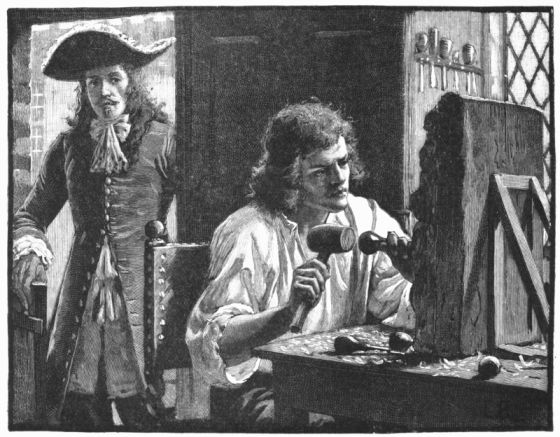
EVELYN "DISCOVERING" GRINLING GIBBONS. (See p. 372.)
[See larger version]
Amongst native portrait painters may be mentioned Michael Wright, a Scotsman, who painted the judges for the Guildhall of London; though he is more noted for his portrait of Lacy, the actor, in three characters; of Henry Anderton, a pupil of Streater's, who became very popular; of John Greenhill, and Thomas Flatman, the last being also a poet of some note.
A number of Dutch and Flemish painters of still life were also employed in England at this period, of whom the most celebrated were Vansoon, Hoogstraten, Roestraten, and Varelst, who also attempted portraiture. There were also Abraham Hondius, animal painter, and Danker, Vosterman, Griffier, Lancrinck, and the two Vanderveldes, landscape painters. The Vanderveldes were justly in high esteem; Lancrinck was the painter of Lely's backgrounds.
The two great sculptors were Caius Gabriel Cibber, a native of Holstein, and Grinling Gibbons, whom Macaulay calls a Dutchman, but who, though supposed to be of Dutch extraction, was an Englishman, born in Spur Alley, London. Cibber—who was the father of Colley Cibber, afterwards Poet Laureate, and immortalised by Pope in the "Dunciad"—is now chiefly known by his two figures of "Raging" and "Melancholy Madness," which adorned the principal gate of old Bethlehem Hospital, and were afterwards removed to South Kensington—works of real genius. He also erected the bas-reliefs on the pedestal of the London Monument, and did much work at Chatsworth.
Grinling Gibbons was found by John Evelyn in a cottage at Deptford, carving his celebrated "Stoning of St. Stephen," after Tintoretto, and by him introduced at Court. He executed a marble statue of Charles II. for the area of the Royal Exchange, and another in bronze of James II. for the garden at the back of Whitehall, which fixed his high merit as a sculptor; but his unrivalled genius in carving soon drew him from sculpture, and he became extensively employed at Windsor, Chatsworth, Petworth, and other great houses, carving flowers, feathers, foliage, and like ornaments, which rival in wood the lightness and accuracy of nature. In the chapel at Windsor he executed abundance of carving of doves, pelicans, palm-branches, etc. At St. Paul's he did much of the foliage and festoons of the stalls and the side aisles of the choir. At Chatsworth there are feathers in lime-wood that rival those of the living goose; and he there executed in wood a point-lace cravat of marvellous delicacy. At Southwick, in Hants, he embellished an entire gallery, and a room at Petworth, which is generally regarded as amongst his very finest performances.
Engraving at this era fell also greatly into the hands of foreigners. Loggan, Booteling, Valet, Hollar, and Vanderbank were amongst the chief; but there were two Englishmen who were not less patronised by their countrymen. Robert White was a pupil of Loggan's, and, like his master, excelled in portraits. Walpole enumerates two hundred and fifty-five works of this artist, many of them heads drawn by himself, and striking likenesses. But William Faithorne was unquestionably at the head of his profession. Faithorne in his youth fought on the royal side, and was taken by Cromwell at the siege of Basing House along with Hollar. Hollar left England during the Commonwealth, and resided at Antwerp, where he executed his fine portraits from Leonardo da Vinci, Holbein, and other great masters. On the Restoration he returned to England, and did the plates in Dugdale's "Monasticon," "History of St. Paul's," and "Antiquities of Warwickshire," and in Thoroton's "Nottinghamshire;" and he made drawings of the town and fortress of Tangier for Charles, which he engraved, some of these drawings still remaining in the British Museum. Faithorne took refuge in France, and there studied under Nanteuil, and acquired a force, freedom, richness, and delicacy in portrait engraving which were unequalled in his own time, and have scarcely been surpassed in ours. He drew also in crayons.
The art of mezzotint was introduced at this period by Prince Rupert, who was long supposed to have invented it; this, however, has since then been doubted; but its introduction by him is certain; and it became so much cultivated as to become almost exclusively an English art.
The coins of this period were the work of the Roteri family. Of these there were John and Norbert (his son), Joseph and Philip. Their father was a Dutch banker, who had obliged Charles during his exile by the loan of money, on condition that, in case of restoration, he should employ his sons. They were men of much taste and skill, as their coins show, though by no means equal to Simon, the coiner of Cromwell. They, however, introduced some decided improvements into our coin, particularly that of graining or letters on the rims of the coin. Charles called in all the Commonwealth money, and coined fresh. In 1662 the gold coin called a guinea was first invented, from gold brought from the coast of Guinea, and bore the stamp of an elephant under the king's head, in honour of the African company which imported it. In the last year of Charles's reign he coined farthings of tin, with only a bit of copper in the middle. The figure of Britannia still retained on our copper coinage was first introduced in the copper coinage of Charles (see p. 205), and was modelled by Philip Roteri from Miss Stuart, afterwards Duchess of Richmond, of whom Charles was deeply enamoured, much to the scandal of all decent subjects.
James II. followed the fashion of Charles in coining tin halfpence and farthings with copper centres. After his abdication he was reduced in Ireland to the necessity of coining money out of old brass cannon, and pots and pans, and, when these failed, out of pewter.
With the Restoration came back mirth and music, which had been banished by the Puritans from both churches and private houses. However, it is but just to except Cromwell and Milton from censure. Cromwell was especially fond of the organ, and gave concerts in his own house when at the head of the Government. Milton, as might be supposed from his poetical nature, and the solemn music of his verse, was equally attached to harmony of sounds. He was the friend of Henry Lawes, one of the greatest composers of the time, and addressed to him the well-known sonnet on the publication of his airs, beginning
"Harry, whose tuneful and well-measur'd song First taught our English music how to span Words with just note and accent."
But perhaps the Royalists were all the more musical on their return to power to mark their contempt of the gloomy Puritans, and music burst forth in church and chapel, in concert, and theatre, and private house with redoubled energy. The theatres and operas did not delay to draw the public by the charms of music as well as of representation. Even during the latter years of the Commonwealth Sir William Davenant opened a kind of theatre under the name of masque and concert, and enlivened it by music. The Royalists at Oxford during the time Charles I.'s Court was there, held weekly musical parties with the members of the University; and no sooner was the Commonwealth at an end than the heads of houses, fellows, and other gentlemen renewed these parties, and furnished themselves with all necessary instruments, and the compositions of the best masters. But what marks the musical furore of this period more than all was the flocking of the aristocracy and the finest musical performers to the miserable house of a dealer in coal-dust in Clerkenwell, where musical parties were held. "It was," says Dr. John Hawkins, "in Aylesbury Street, Clerkenwell. The room of the performance was over the coal-shop; and, strange to tell, Tom Britton's concert was the weekly resort of the old, the young, the gay, the fair of all ranks, including the highest order of nobility." Dr. Pepusch and frequently Handel played the harpsichord there—though this must have been at a later period, for he did not arrive in England till 1710. Mr. Needler, Accountant-General of the Excise; Hughes the poet, Wollaston the painter, and many other amateurs were among the performers. Walpole says Britton took money from his visitors, but Hawkins entirely denies it.
The example of Tom Britton was contagious, and similar places of musical entertainment, but on the principle of professional emolument, were soon opened east and west. Amongst the first of these was Sadler's Wells.
One of the finest composers for the theatre and opera was Matthew Lock. He was appointed Composer in Ordinary to Charles II., and composed a church service and some anthems; but he was much more famous for his setting of songs, and the music to plays. He wrote that to Davenant's alteration of "Macbeth," to Shadwell's opera, "Psyche," and various other dramas. He received a salary of two hundred pounds a year as Director of the King's Music. He became a convert to Catholicism, and was made Organist to Catherine, the queen of Charles. But the rage for everything French was growing, and Lock was succeeded in his office by a Frenchman, Cambert, who produced an English opera; and he by Louis Grabut, another Frenchman, who set Dryden's "Albion and Albanius," a satire on Shaftesbury—a poor performance. After Charles quarrelled with Louis XIV., Italian taste superseded the French, and Italian music and musicians were patronised. Amongst the latter Nicola Matteis was a popular violinist.
But that which possessed the most decided merit was the church music of this period. It was not that which one would have expected in the reign of Charles II., but we must do him the justice to say that he seems to have encouraged greatly the musical services of the Church. He united all the distinguished composers and performers, to assist in restoring this service to its former glory; and, amongst the survivors of his father's reign, reappeared Dr. Child, Dr. Christopher Gibbons, Dr. Rogers, Dr. Wilson, Henry Lawes, Milton's friend, Byrne, Lowe, and Cook, commonly called Captain Cook, from his having borne a commission in the Royalist army. Cook was made Master of the Children of the Choir, in the Royal Chapel; Child, Gibbons, and Lowe, Organists; Lawes, Clerk of the Cheque; Rogers, Organist at Eton; Byrne, Organist at St. Paul's; and Wilson was attached to the service in Westminster Abbey.
By these means the church musical service was soon raised to a high pitch of excellence; a spirit was diffused through the whole kingdom from the king's chapel, and the cathedral services became as fine as ever. Captain Cook trained his boy-choristers to admiration, and out of them arose some of the best composers of sacred music that England possesses. Amongst them are Pelham Humphrey, Michael Wise, John Blow, and, superior to them all, Henry Purcell. Some of these produced anthems whilst mere striplings, which still remain in use. Amongst these Pelham Humphrey greatly distinguished himself; and was, therefore, sent by Charles to Paris, to study under the famous Lulli, and then made gentleman of his chapel. At the death of Cook, his master, he succeeded to his office. Michael Wise became for a time, Organist of Salisbury Cathedral, but returned to the Royal Chapel as one of the gentlemen. His anthems are still greatly admired. Blow succeeded Humphrey as Master of the Children, and was Organist of Westminster Abbey. He published various compositions, both sacred and secular, some of which are yet in much esteem, while others have fallen into neglect.
But the musical master of the age was Henry Purcell (b. 1658; d. 1695), organist of Westminster Abbey, and afterwards of the king's chapel. His sacred music, especially his "Te Deum" and "Jubilate," has never been surpassed. Dr. Burney declared him superior to all the foreign composers of the day—Carissimi, Stradella, Scarlatti, Keiser, Lulli, and Rameau; but others do not except any composers of any previous age. In his secular music he again surpassed himself. His music of the drama is voluminous. He set the songs in Nahum Tate's "Dido;" the music for Lee's "Theodosius;" that for the "Tempest," as altered by Dryden, which is still heard with delight; that for the "Prophetess," altered by Dryden and Betterton, from Beaumont and Fletcher; the songs of Dryden's "King Arthur," in which are the lovely air "Fairest Isle," the charming duet "Two Daughters of this Aged Stream are We," and the inimitable frost-scene. He furnished the music for Howard's and Dryden's "Indian Queen." In Dryden's altered "Boadicea," the duet and chorus "To Arms," and the air "Britons, strike home," are still heard with acclamations on all occasions of patriotic excitement. Besides these he wrote airs, overtures, and set tunes for numerous other dramas, as Dryden's and Lee's "Timon of Athens," "Œdipus," "The Fairy Queen," altered from the "Midsummer Night's Dream," and Dryden's "Tyrannic Love." He wrote many odes, glees, catches, rounds, many single songs and duets, twelve sonatas for two violins and a bass, etc. The air of "Lillibullero" is attributed to him. His widow published many of these after his death, in two folio volumes called "Orpheus Britannicus." The music of Purcell is national property, and, in spite of more recent genius, will long continue to be heard with rapture.
Notwithstanding Charles II.'s restoration of church music, he endeavoured to degrade it by the introduction of French customs, and at one time introduced a band of twenty-four fiddlers into his chapel, in imitation of Louis XIV. Tom D'Urfey ridiculed it in the song, "Four-and-twenty Fiddlers all in a Row;" and Evelyn describes his disgust at witnessing this strange sight, "more fit for a tavern or playhouse than a church." The public feeling, indeed, soon caused the king to withdraw the Gallic innovation.
Amongst the musical productions of this time we may note Blow's "Amphion Anglicus," Roger North's "Memoir of Music," still in manuscript; Sir Francis North's "Philosophical Essay on Music," Lord Brouncker's translation of Descartes' "Musicæ Compendium." Marsh, Archbishop of Armagh, was the first to treat acoustics methodically, in a paper in the "Philosophical Transactions." Dr. Wallis, one of the founders of the Royal Society, and an eminent mathematician, wrote much in the "Philosophical Transactions" on musical subjects, and published an edition of "Ptolemy's Harmonies." Thomas Mace, John Birchensha, Christopher Simpson, and John Playford are musical authors of that age.
The furniture of this period had the general characteristics of the last age. Cane backs and seats began to be used in chairs, and the beautiful marqueterie work adorned tables, cabinets, clock-cases, wardrobes, and other rich pieces of furniture. The Louis Quatorze style, with its rich sweeps and abundance of carving and gilding, began to appear in England, but did not attain to general use till a later period. The floors began to be covered with gay-coloured mats and carpets, but the richest pieces of Turkey carpet were still more frequently used for table-covers. Oil-cloth was now introduced from Germany, and manufactured in London. The Gobelins tapestry manufactory was established in France in 1677, and towards the end of this period the walls of the great mansions of England were covered with the products of its looms.
The costume of gentlemen underwent rapid and various metamorphoses in Charles II.'s time. From the rich and elegant costume of Charles I. it degenerated first into one with an exceedingly short doublet, without any under waistcoat, loose petticoat breeches, with long drooping lace ruffles at the knee. This costume, however, still retained much of the Vandyke style. It had the high-crowned hat and plume of feathers, the falling lace collar, and the natural hair. But soon came the monstrous peruke, or periwig, as the word was corrupted to in England, copied from the fashion of the Court of Louis XIV., which superseded the natural hair in both men and women, the women appearing to have adopted it first. Then followed the square, long coat, and huge jack-boots, and cocked hat, which became the general dress of the next century. False hair had been worn by both sexes in the times of Elizabeth and James I., but never to the same preposterous extent as now. Charles II., though adopting the periwig fashion himself, and thus confirming it, yet refused to allow the clergy to use it. He wrote a letter to the University of Cambridge, ordering the clergy neither to wear periwigs, nor smoke tobacco, nor read their sermons; and, on a fellow of Clare Hall venturing to preach before him in a wig and holland sleeves, he ordered the statutes concerning decency of apparel to be put in force against him and similar offenders.