Chapter XII
Reading edition
REIGN OF WILLIAM AND MARY.
Accession of William and Mary—Discontent of the Church and the Army—William's First Ministry—His Dutch Followers—The Convention becomes a Parliament—Oath of Allegiance—Settlement of the Revenue—Suspension of the Habeas Corpus Act—The Mutiny Bill—Settlement of Religion—The Coronation—Declaration of War with France—Violence of the Revolution in Scotland—Parties in the Scottish Parliament—Letter from James—Secession of Dundee—Edinburgh in Arms—Settlement of the Government—Dundee in the Highlands—Battle of Killiecrankie—Mackay Concludes the War—The Revolution in Ireland—Panic among the Englishry—Londonderry and Enniskillen Garrisoned—Negotiations of Tyrconnel—His Temporary Success—Landing of James—He Enters Dublin—His Journey into Ulster—The Siege of Londonderry—It is Saved—Legislation of the Irish Parliament—Arrival of Schomberg—Factiousness of the English Whigs—State of the English Army in Ireland—Renewed Violence of the Whigs—The Corporation Act Thrown Out—William Threatens to Leave England—Dissolution of Parliament—Tory Reaction—Venality of the New Parliament—Settlement of the Revenue—Whig Propositions—The Act of Grace—Preparations for War—A Jacobite Plot—William goes to Ireland—Progress of the War under Schomberg—Gradual Improvement of his Position and Ruin of the Jacobite Army—The Battle of the Boyne—Flight of James—William Enters the Irish Capital—News from England—Siege of Limerick—Battle of Beachy Head—Landing of the French in Torbay—Courage of the English People—Settlement of Scotland—Marlborough's Successes in Ireland—Parliament Grants Liberal Supplies—Preston's Plot Thwarted—William Sets Out for Holland—Vigour of Louis—Fall of Mons—Trial of Jacobite Conspirators—Treason in High Places—Punishment of the Non-Jurors—The Continental Campaign—Condition of Ireland—Arrival of St. Ruth—Siege of Athlone—Battle of Aghrim—Second Siege and Capitulation of Limerick.
William of Orange had now fully succeeded in his enterprise. By the resolution of the two Houses of Parliament on the 13th of February, 1689, he was admitted to hold the Crown for his life in conjunction with his wife, who was not merely queen consort, but queen regnant. They were declared to be elected to that office and dignity by the free choice of the nation. They could neither of them claim the Crown by direct succession, for James was alive, and protesting against the idea of his abdication. Mary could not claim by succession, even if James had abdicated; for, although there had been much endeavour to prove the infant son of James a supposititious child, the effort had failed. There was no sufficient proof of the fact, but much evidence against it; and nobody now doubts that the infant who afterwards acquired the name of the Pretender was the real son of James and the queen. Had the right of succession been admitted, neither William nor Mary could have succeeded; but this right was now, in fact, denied. The right for the subjects to elect their own monarchs was proclaimed by the Bill of Rights; and by that right, and no other, William and Mary sat on the English throne.
But splendid as was the position which William had achieved—that of the monarch of one of the very first kingdoms of the world—his throne was no bed of roses. The Catholics and the Tories still retained their old leaning towards James. True, many of the Tories had been greatly embittered against James by his later measures, but now that he was deposed, and a monarch sat on the throne who had been notoriously brought in by the Whigs, a strong reaction took place in them. They professed surprise at William assuming the sceptre; they pretended that they had expected from his declaration that he intended only to assist them in bringing James to reason, and in putting him under proper constitutional restraints. Numbers of them were already in full correspondence with the banished prince. The clergy were equally disaffected. They had resisted the attempts of James to bring in Popery, but they had now got a Presbyterian king, and were not very sanguine of his support of the hierarchy.
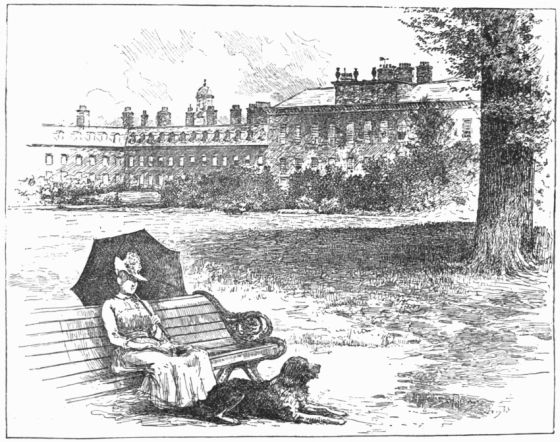
KENSINGTON PALACE. (From a Photograph by F. G. O. Stuart, Southampton.)
[See larger version]
Similar feelings prevailed in the army. It had been powerful in numbers, but had done nothing to withstand a foreign prince at the head of foreign troops marching through the country, and placing himself on the throne. They had not been exactly defeated, because they had not come to a regular engagement; but they saw a foreign prince, supported by his foreign troops, presiding in the country; and though not beaten, they felt humbled, and were now as near to mutiny as they had been ready to revolt under James.
As for the Whig party, which had invited and supported William, they were only eager for office and emolument. It was not patriotism in the bulk of them which animated them, but the triumph of their party; and they thought that nothing could ever pay them for the favour they had conferred on William. The accounts of those writers who were present and cognisant of their proceedings represent them as clamorous for place, honour, and emolument, no one thinking that William could do enough for them, and every one ready to upbraid him for giving to others those posts to which they thought they were more entitled.
His first public measure was to announce that all Protestant subjects who were in office on the 1st of December last should retain their posts till further notice. On the 17th of February he published the list of his Privy Council, which contained men of almost all parties—Danby, Halifax, and even old Sancroft, the Archbishop of Canterbury, in order to show the Church that its interests would be protected. This and all other endeavours, however, failed to win over the High Church prelate.
If some of the members of the Council gazed at each other in astonishment to find themselves included in one body, still more was that the case with the Ministry. Danby, though a Tory, was made President of the Council; but whilst this offended others, who remembered that he had opposed the idea of the throne being vacant, though he had resisted the appointment of a regency, he himself was woefully disappointed in not receiving the White Staff. But William neither now nor till the end of his reign entrusted the office of Lord High Treasurer to a single person, but put it in commission. On the other hand, Halifax, who had not joined William's party till the last moment, received again the Privy Seal, and was continued Speaker of the House of Lords, to the great disgust of the Whigs, who remembered how long he had deserted them, and how successfully he had opposed them on the question of the Exclusion Bill. To add to their chagrin, the Earl of Nottingham was made Secretary of State. Nottingham had been foremost amongst those who had maintained the doctrine of passive obedience; who had denied that the throne could for an instant become vacant; who had declined to give up James or to call in William, but had also led this party in submitting to the decision of the Convention in favour of William and Mary, on the ground that we are enjoined by the New Testament to be subject to the powers that be. The other Secretary, the Earl of Shrewsbury, was indeed a Whig, and in the highest favour with that party. He had been foremost in calling in William; but then he was a mere youth, only eight-and-twenty years of age. Admiral Herbert expected to be appointed Lord High Admiral, and to have the entire control of the Admiralty; but he had the mortification to see a number of others placed at the Board of Admiralty to share his authority, though he bore nominally the name of First Lord of it. Churchill expected to be made Master of the Ordnance for his treason to James; but William had too certain evidence that he was at this very moment a traitor to himself; was in correspondence with the Court of St. Germain's, and believed that he would be one of the first to run if any future success warranted a hope of James's restoration. He was therefore appointed only to a post in the household, along with Devonshire, Mordaunt, Oxford, Dorset, Lovelace, and others; whilst the gallant foreigner Schomberg was made Master of the Ordnance.
Whilst the leaders, therefore, were deeply disappointed, all aspirants to favour were extremely jealous of the three staunch Dutch adherents of William—Bentinck, Overkirk, and Zulestein—whom William kept about him with a very natural feeling, for they had been faithful to him through all his arduous struggles in his own country, and were now, indeed, almost the only men in whom he could put implicit confidence. The main thing in which Danby, Halifax, Nottingham, and Shrewsbury agreed was in complaining that William did not make them his confidants, but preferred the secret advice of Bentinck, whom he soon made Earl of Portland, and the counsel of Sidney, whom he created Lord Sidney. William had but too much cause for keeping the knowledge of his thoughts and intentions from those around him, for many amongst his privy councillors and chief ministers would have betrayed them at once to the exiled monarch. Danby had been heard to say, even after James had quitted England, that if he would only abandon his priests, he might come back again; and others besides Churchill were in regular traitorous correspondence with James's Court. With all William's caution, not a thing was discussed in his council but was immediately transmitted to St. Germain's. To his trusty countrymen already mentioned William gave profitable offices near his person. His great friend Bentinck was made Groom of the Stole, with five thousand pounds a year; Overkirk Master of the Horse; and Zulestein had charge of the robes.
These arrangements being made, on the 18th of February, William, for the first time, addressed the two Houses of Parliament. It is remarkable that the very subject which he introduced to them was a demand for liberal supplies to carry on the war on the Continent. He had, he said, no choice in the matter, as France had already begun war on England.
William reminded them, too, that their domestic affairs would demand serious attention, and especially the condition of Ireland, where a strong feeling was known to exist for the fallen dynasty, through the interests of the Catholic religion. He exhorted them, moreover, to take immediate measures for securing the despatch of business. This alluded to the settlement of the great question whether the Convention could continue to sit legally after the deposition of the monarch who had called it. The question had been debated in the Council, and now, on the king's retiring, the lords immediately laid on the table of the House a Bill declaring the Convention a valid Parliament. It was speedily carried and sent down to the Commons; but there it excited a warm debate. The Whigs were vociferous for it; the Tories, who believed that the calling of a new Parliament would be in their favour, were as vehemently against it. The depositions of Edward II. and Richard II. were referred to and strongly argued upon; but the case in point was the Convention which recalled Charles II., and continued to sit and act long after. Sir John Maynard moreover contended that, as they were like men who found themselves in a trackless desert, it was not for them to stand crying, "Where is the king's highway?" but to take the track that would lead them out of it. That track was the precedent of Charles II.'s reign. The House passed the Bill without a division, and it received the Royal assent on the tenth day after the accession.
A clause in this Bill provided that, after the 1st of March, no person could sit or vote in either House until he had taken the new oath of allegiance to their majesties. Great excitement was occasioned by this oath. It was hoped by the Tories and High Church there would be found a sufficient number of persons of influence who would refuse the oath, so as to render the seat of the new monarchs unstable, and open the way to the return of James. Care was taken to consult the prejudices of the adherents to the old notions of right divine as much as possible, and the words "rightful and lawful sovereigns," after deliberation were omitted; but this did not prevent many from refusing it. As the day approached for taking the oath, the capital was full of rumours. It was said that the Duke of Grafton had escaped to France in order to reconcile himself to his uncle; and numerous other persons were supposed to have followed his example. When the day arrived, however, Grafton was one of the first to present himself; and the number of the lords who declined it, amongst them the Earls of Clarendon, Lichfield, and Exeter, with the Archbishop of Canterbury and some of the bishops, was small. Of the bishops, five were of those who refused to obey the commands of James to publish his Indulgence, and had been sent to the Tower. Rochester, the brother of Clarendon, was expected to refuse the oath, as he had adhered to James after Clarendon had abandoned him; but Clarendon's income was secure from his estate. Rochester had a pension of four thousand pounds a year, which he would lose if he refused the oath—a strong argument, which seems to have proved convincing, for he took the oath. Four hundred of the Lower House had taken the oath on the 2nd of March, and amongst them Seymour, who had led the Tory Opposition; but when the oath was extended to the clergy and other individuals in office, above four hundred of the clergy, including some of the most distinguished dignitaries, refused it; and thus began the great schism of the non-jurors, who long continued to figure as the unswerving advocates of divine right.
The next great question was that of the revenue. The Parliaments of Charles and James had been exceedingly munificent in their grants of income. In the heat of their loyalty at the Restoration, the Commons forgot all the salutary fears of their predecessors, and gave up every point for which they had contended with Charles I. Tonnage and poundage were granted for life, and afterwards confirmed to James. They settled on these monarchs half of the excise in perpetuity, and half for life. The fixed revenue of Charles and James had been one million two hundred thousand pounds, but the actual revenue had been a great deal more. It was now found by examination of the accounts that James had been in the annual receipt of no less than two millions, of which ninety thousand pounds had been expended in secret service money. William had, since arriving at Whitehall, been in the habit of collecting and applying this magnificent revenue as chief of the State; and seemed to expect that it would be now settled on him. The first question discussed was, whether an income granted to a monarch for life could be received legally by his successor in case of his abdication so long as he lived. Many of the chief lawyers contended that the revenue was granted to the monarch in his political capacity, and not to the man, and that, therefore, the prince who came to discharge his official duties so long as he lived was rightfully in receipt of it. But the more common sense opinion prevailed, that the prince who superseded another by the call of the nation must receive all his rights as well as his call from the nation. The House therefore passed to the question of the amount of the revenue, and they did not appear very much disposed to use the same lavish folly towards William as they had done towards the late monarchs. Instead of granting him a life revenue, they granted him one million two hundred thousand pounds, the sum allowed to Charles II., but only for three years, one half of which was to be appropriated to the civil list, the other half to the public defences. William was sensibly chagrined by this caution, and complained much of want of confidence in him, and of unusual parsimony. He presented a claim of seven hundred thousand pounds from the Dutch, the cost of the expedition which had placed him on the throne. The Commons consented to pay six hundred thousand pounds, and William received the sum for his careful countrymen with a very ill grace. The Commons did not the less displease him by reducing his demand for the navy from one million one hundred thousand pounds to seven hundred thousand pounds, and by granting the supply for the army for only six months; Sir Edward Seymour all the time warning them that it was the foolish liberality of Charles II.'s Parliament which enabled him to enslave the nation as he had done.
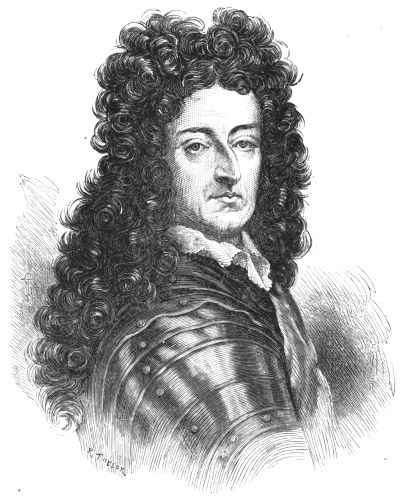
WILLIAM III.
[See larger version]
One thing which did William great credit, however, was the recommendation to the Commons to abolish the abominable hearth-tax. As he had advanced from Torbay to London, the people had importuned him on all sides to set aside this detestable tax, which had been farmed out to rapacious collectors, who treated the people with every species of insult, cruelty, and violence in enforcing payment of it. It was a most unequal tax, which fell with disproportionate weight on the very poor; for as it was levied, not by the value of the property, but by the number of chimneys, the peasant in many cases paid nearly as much as a man of really great substance; and where the money was not ready when called for, the tax-gatherers forced open even bedrooms, and sold the very bed from beneath the sick, and the table at which the family sat. William was much impressed by its injustice, and, at his special desire, the Act was repealed.
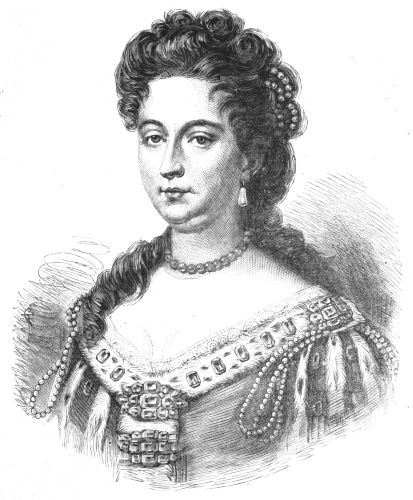
MARY II.
[See larger version]
Whilst in the midst of the money debates, a circumstance occurred which materially hastened the decision, and no doubt increased the liberality of the Commons. William announced to them that James had sailed from Brest, with an armament, for Ireland. But the alarm of James's descent on Ireland, and the disaffection in the army, roused the Commons from their tone of caution. They passed resolutions of patriotic devotion to the Crown, and in an address assured William that their lives and fortunes were at his service in its defence. They went further. As there were great numbers of political persons in custody—persons openly disaffected to the present dynasty having been prudently secured during the progress of the revolution,—now that the revolution was completed, and authorised judges were once more on the bench, it was feared that these prisoners would demand their habeas corpus, and come forth at the very moment when all the adherents of James were on the alert to watch the effect of his reception in Ireland. The Commons, therefore, passed an Act to suspend the Habeas Corpus Act for the present.
But simultaneously the Commons were passing another Act of scarcely less significance. Hitherto there had been no military power of controlling and punishing soldiers or officers who offended against discipline or their oath. They were subject only to the civil tribunals, and must be brought there, and tried and punished as any other subjects. James had obtained from his servile judges a decision that he might punish any deserter from his standard summarily; but this was not law, and the Commons, now alarmed by an affair at Ipswich, where a regiment of Scottish soldiers had mutinied, passed an Act called the Mutiny Bill, by which any military offenders might be arrested by military authority, and tried and condemned by court-martial in perfect independence of the civil authority. This Bill, which passed without a single dissentient vote, at once converted the soldiers into a separate class, and in effect founded what all parties disclaimed and affected to dread—a standing army. Like the Act for the suspension of the Habeas Corpus, it was only for a limited period; but the unsettled state of the kingdom at the moment of its expiration caused it to be renewed, and it became a permanent institution, though to this day we annually go through the ceremony of formally renewing the Mutiny Bill.
The passing these extraordinary measures excited the alarm of many even well-disposed to the revolution; but to the adherents of the Stuart dynasty they afforded the opportunity for the most vehement declamation against the new monarch. The person, the manners, the spirit, and intentions of William were severely criticised. He was undeniably of a close and gloomy temperament, and found it impossible to assume that gaiety and affability of demeanour which to Charles II. were natural. He had the manners and the accent of a foreigner, and chilled all those who approached him at Court by his cold and laconic manners. In fact, he knew that he was surrounded by traitors, and could unbend only in the company of his Dutch favourites. He became extremely unpopular, and not all the endeavours and the agreeable and cordial manners of the queen could prevent the serious effect of his own reserved temper. At the same time more was truly to be attributed to the force of circumstances than to any bias of William towards tyranny. In one direction William was anxious to extend the liberties of the nation. He was for establishing the utmost freedom of religious opinion. He would have abolished the Test Act, and granted free enjoyment of all Christian creeds and of office to members of all denominations; but though there was no fear of a leaning to Popery in him, he found himself stoutly opposed in these intentions by his subjects. The Church was split into High Church and Low Church, jurors and non-jurors; but every party in the Church, and almost every body of Dissenters, was averse from conceding any liberty of creed or capability of office to the Catholics. Again, the Church was bent against admission of any one to office who refused to subscribe to the Thirty-nine Articles, and to take the oaths, not only of Allegiance but of Supremacy. Under these circumstances William found it impossible to set aside the Test Act or the Corporation Act; but he brought in and passed the celebrated Toleration Act. Yet even this Act, from which we still date our enjoyment of religious liberty, was circumscribed. It did not repeal the obnoxious Act of Uniformity, the Five Mile Act, the Conventicle Act, and those other statutes which so harassed and oppressed the Dissenters; but it exempted them from their operation on certain conditions. They must subscribe thirty-four out of the Thirty-nine Articles, which most of them could do; the Baptists were excused from professing belief in the efficacy of infant baptism; and the Quakers from taking an oath if they professed a general belief in Christianity, promised fidelity to the Government, and made a declaration against transubstantiation. This Act, therefore, cautious and meagre as it appeared, gave a freedom to the Dissenting world which it had hitherto been destitute of.
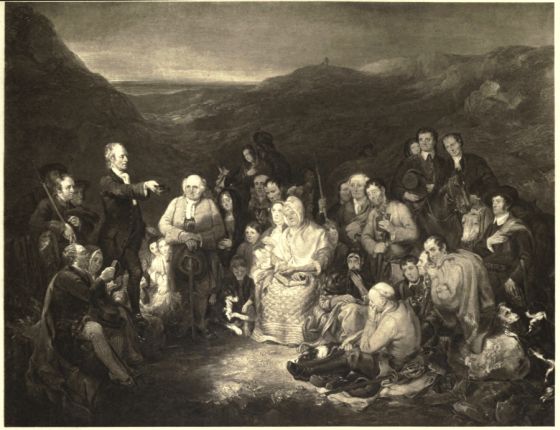
COVENANTERS PREACHING.
From the Picture by Sir George Harvey, R.S.A., in the Corporation Art Gallery, Glasgow.
[See larger version]
William made a resolute effort also to heal the great schism of the Church, and admit, by a comprehensive Bill, the main body of Nonconformists. By this Bill as introduced, it was proposed to excuse all ministers of the Established Church from the necessity of subscribing the Thirty-nine Articles; they were only to make this declaration: "I do approve of the doctrine, and worship, and government of the Church of England by law established, as containing all things necessary to salvation; and I promise in the exercise of my ministry to preach and practise according thereunto." The same looseness of declaration was extended to the two universities. Presbyterian ministers could be admitted to the pulpits and livings of the Church by accepting from a bishop a simple command to preach, administer the sacraments, and perform all the ministerial offices of the Church. Except in a few churches, the clergyman might wear the surplice or not, as he wished; might omit the sign of the cross in baptism; might christen children with or without godfathers and godmothers; might administer the Sacrament to persons sitting or kneeling, as they pleased. Besides this, the Bill proposed a Commission to revise the liturgy, the canons, and the constitution of the ecclesiastical courts. But it was soon found that no such sweeping changes could be effected. There was no determined opposition to the revision of the liturgy, but the danger to the rites on which the High Church laid so much stress soon called forth powerful resistance. It was represented that all manner of anomalous and contradictory practices would soon rend to pieces the harmony and decorum of the Church. Presbyterian and Puritan would set at defiance the most honoured practices of the Establishment. The Dissenting body were as much alarmed as the High Church. This wide door of admission to the Church, it was feared, would draw away a whole host of their ministers and members; and as the Test Act was by no means to be removed, they would thus become additionally unable to contend for its future abolition. The Bill, after much discussion and many modifications, fell to the ground.
The next attempt was to modify the Oaths of Allegiance and Supremacy, so as to accommodate the consciences of the Non-jurors; but it was finally agreed that all persons holding ecclesiastical or academical preferment who did not take the oaths before the 1st of August should be suspended, a pecuniary allowance to the deprived, in some cases to be at the option of the king, but not to exceed one-third of the income forfeited. This was followed by the passing of a new Coronation Oath, by which their majesties bound themselves to maintain the Protestant religion as established by law, and the coronation took place on the 11th of April.
These domestic matters being thus settled, war was declared against France on the 13th of May. The inhuman desolation of the Palatinate in the preceding winter, where Louis's general, Duras, had laid waste the whole country, burned down the towns, leaving all of that fertile and populous district one black and terrible desert, had roused the powers of Europe against him. Germany, Spain, Holland, and England all prepared for vengeance, and the people and Parliament of England were equally loud in denunciation of the worthless desolator.
Whilst these affairs had been progressing in England, Scotland had been equally active. The Scots had even more profound cause of hatred to James, and more hope of effectual relief from William, than the English. In England the Church had managed to maintain its ascendency, and the fierceness of persecution had been somewhat restrained. There the iron boot and thumbscrews, and the fury of Tory troopers, had not perpetrated the horrors that they had done north of the Tweed. The Scots had had the hateful yoke of Episcopacy forced on them, their Church completely put down, and their liberties in a variety of ways crushed by the authorised licence of James's delegated ministers.
No sooner, therefore, had James fled than the suppressed feeling of the people burst forth. At Edinburgh crowds assembled, took down the heads of the slaughtered Whigs from the gates, and committed them in solemn ceremony to the earth. The episcopal clergy were set upon in many parts of Scotland, especially in the West, where the Covenanters prevailed, and where they had suffered so much from the emissaries of the Church. The Covenanters now chased them away from their manses, ransacked them, turned their wives and children out, broke all the furniture, or set fire to it. They tore the gown from the back of the clergyman if they could catch him, destroyed all the prayer-books they could find, locked up the church, and warned ministers not to be found there again. Two hundred clergymen were thus forcibly ejected. Christmas Day was selected for the commencement of this summary process, to mark their abhorrence of such superstitious festivals. As amid this violence many began to plunder, the Presbyterian ministers and elders assembled, and resolved that in future every incumbent of a parish should have due notice served on him to quit his parsonage peaceably, to avoid the necessity of being driven out by force.
The bishops and dignitaries made an instant appeal to William for protection, and a proclamation was issued—for William had no military force in Scotland—ordering the people to desist from further violence towards the clergy till the Parliament should determine the form of the establishment. But so little regard was paid to it, that on the same day that it was published at Glasgow, the mob rushed to the cathedral, and drove out the congregation with sticks and stones.
On the 14th of March the Scottish Convention of Estates met. By the able management of Sir James Dalrymple of Stair—afterwards Lord Stair—and his son, Sir John Dalrymple, who was an able debater, it was so managed that chiefly Whigs were returned. Sir James was a man of great legal learning, and consummate talent, though of doubtful character, who had been deprived of his position as a privy councillor and Chief Lord of the Court of Session, and had gone over to Holland, and was William's main adviser as to Scottish affairs. His son, Sir John, longer continued to side with the Stuarts, and was made Lord Advocate; but at the Revolution he appeared in the other party, and was supposed to have been for some time in effect pledged to William's cause in secret through his father. He at once declared for William on his landing, and exerted himself zealously for his interests in Scotland.
With the Dalrymples was associated George Lord Melville, who had also been for some time with William in Holland. On the other hand, the celebrated Graham of Claverhouse, Viscount Dundee, and Colin Lindsay, Earl of Balcarres, were the chief agents of James in Scotland. These two leaders had pretended to go over to William, or at least to acquiesce in the change of dynasty; had waited on him on his arrival at Whitehall, and been well received by him. William was urged to arrest these noblemen, as too deeply implicated in the tyrannies of James and the murder of the Covenanters ever to be allowed to mingle with the new order of things; but William would not listen to the advice, determining to give every one a fair trial of living peaceably. So far did they promise this, that William granted them an escort of cavalry on their return to Scotland, without which they would not have been allowed by the Covenanters to reach Edinburgh alive. The name of Claverhouse was a horror in every Scottish home in the Lowlands, where he was loathed for his terrible cruelties towards the Presbyterian population.
No sooner did they reach Edinburgh than they set to work with all possible activity to assist the interests of James in the Convention and the country. The Duke of Gordon, who held the castle for James, was on the point of surrendering it when they arrived; but they exhorted him to hold out, and called upon all the Royalists who were elected at the Convention to take their places and defend the absent king's interests. When the Estates met, the Earl of Argyll, who had been proscribed by James, took his seat amid the murmurs of the Jacobites, who declared that, as a person under legal attainder, he was incapable of performing any office in the State. This was, however, overruled by the majority. Melville, who had been living abroad too, and had reappeared with William, presented himself, but without any opposition. The Duke of Hamilton was put in nomination by the Whigs for the presidency of the Convention, and the Duke of Athol by the Jacobites. Neither of them was a man whose conduct in the late reign was entitled to respect. Hamilton had adhered to James to the last, and had acquiesced in many invasions of the laws and liberties of Scotland; Athol had not only been a violent partisan of James, but had fawned on William immediately on his arrival, and, being coldly received, had wheeled round again. Hamilton was chosen president; and the moment this was discovered twenty of the Jacobites instantly went over to the stronger side. It was a striking fact that in Scotland, while the great body of the people had stood to the death for their principles, the nobility had become so corrupt through compliance with the corrupt Court, and in eagerness for office, that public principle was at the lowest ebb amongst them.
The Convention having thus organised itself, sent a deputation to the Duke of Gordon demanding the surrender of the castle, as its cannon might at any moment knock in the roof of the Parliament House, and drive thence the Convention. Gordon requested twenty-four hours to consider the proposition; but Dundee and Balcarres again succeeded in inducing him to hold out. The Convention determined to try the force of arms. They summoned the castle to surrender in due form, and pronounced the penalties of high treason on all who dared to occupy it in defiance of the Estates. They called out a guard to stop communication with the castle, and made preparations for a regular siege of the fortress. The next day a messenger arrived from King James with a letter, which, on being read, was found to be a furious denunciation of the Convention, and of every one who had shown a willingness to receive William. At the same time it offered pardon to all traitors who should return to their duty in a fortnight, with the alternative, if they refused, of the utmost vengeance of the Crown. There was no regret for any past acts which might have tended to alienate his subjects, no promises of future redress. The very friends of the king, whom nothing could alter or improve, were astonished and dispirited, and they stole away out of the Convention, pursued through the streets by the groans and curses of the crowd. At the same time, a letter was read from William, modest and liberal, trusting to the result of the free deliberations of the Estates. James, as was always the case with him, had done incalculable service to the cause of his rival. His most bigoted adherents could not avoid seeing that, were he restored to the throne, he would only continue to pursue the blind and foolish course which had already driven him from it. What added to the disgust of all parties was, that the letter was countersigned by Melfort, James's Secretary of State—a furious Papist and apostate from Protestantism, and nearly equally abhorred by both Protestants and Catholics.
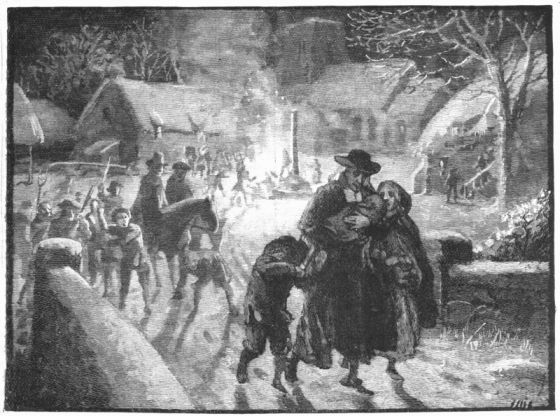
COVENANTERS EVICTING AN EPISCOPALIAN CLERGYMAN. (See p. 403.)
[See larger version]
The Royalists, thus hopeless of effecting anything in the Convention, and yet unwilling to yield up the cause, adopted the advice of Dundee and Balcarres, who had the authority of James to open a rival Convention at Stirling. Athol consented to go with them; but on Monday, the 18th, he showed a fear of so far committing himself, and requested the party to wait for him another day. But the case of Dundee did not admit even a day's delay. The Covenanters of the West, whom Hamilton, and the Dalrymples had summoned to Edinburgh, and who for some time had come dropping in in small parties, till all the cellars and wynds of the city were thronged with them, vowed to kill the hated persecutor; and he made haste to flee, accompanied by his dare-devil followers, all as well-known to, and as detested by, the Covenanters as himself for their atrocities in the West. Whilst the Convention was in deliberation, sentinels from the castle hurried in to say that Claverhouse had galloped up to the foot of the fortress on the road to Stirling, accompanied by a detachment of his horsemen, and that he had climbed up the precipice high enough to hold a conversation with Gordon.
At this news the Convention was thrown into a tumult of indignation. Hamilton ordered the doors to be locked, and the keys laid on the table, so that no one should go out but such persons as should be sent by the assembly to call the citizens to arms. By this means all such Royalists as were in became prisoners till such time as the citizens were ready. Lord Leven, the second son of Lord Melville, who inherited the title of old General Leslie in right of his mother, was sent to call the Covenanters to arms; and presently the streets were thronged with the men of the West in rude military array, sufficient to ensure the safety of the Estates. As the drums beat to arms, Dundee descended from the rock and, waving his cap, with the cry that he went to where the spirit of Montrose called him, rode off towards Stirling.
The Convention now proceeded with their business. They sent a letter of thanks to William, which the bishops to a man refused to sign; the Bishop of Edinburgh having, as chaplain, before prayed for the return of James. William has been said to have privately wished that Episcopacy might be established in Scotland; but, if so, such specimens of the prelatic spirit there must have gone far to extinguish that desire. Other symptoms of opposition were not wanting, even yet. The Duke of Queensberry arrived from London, and revived the spirits of the Jacobites. Again they urged the Duke of Gordon to fire on the city, but he refused; and the chances of resistance were now taken away by the arrival of General Mackay with the three regiments of Scots who had served under William in Holland. The Convention immediately appointed Mackay general of their forces; and, thus placed at their ease, they proceeded to arrange the government. They appointed a committee, after the manner of the Lords of the Articles, to draw up the plan which should be adopted. As a last means of postponing this business, a proposal was made by the Jacobites to join with the Whigs to concert a scheme of union of the kingdom with England. This was a scheme which was now growingly popular. During the Commonwealth the trade of England had been opened to Scotland. All custom-houses, and levying of duties on goods imported or exported between the countries, had been removed. The Scots had been admitted to perfect freedom of foreign trade with England, and the benefit had become too apparent to be lightly relinquished. But, on the Restoration, all this had been altered. The old and invidious restrictions had been renewed, and the great loss of wealth thus induced had wonderfully modified the spirit of national pride which opposed the abandonment of the ancient independence of the nation. The Dalrymples and Lord Tarbet were favourable to this proposition, but the Convention at large was too wise to endanger the defeat of the acknowledgment of the new sovereign by an indefinitely-prolonged debate on so vital a question. They proceeded to declare that James, by his misconduct, had "forfaulted" his right to the crown; that is, that he had forfeited it—a much more manly and correct plea than that James had "abdicated," which he continued to protest that he never had done, and he was at this moment in arms with Ireland asserting his unrelinquished claim to it. As the term "forfaulted," according to Scottish law, would have excluded all his posterity, an exception was made in favour of Mary and Anne, and their issue. This resolution was warmly defended by Sir John Dalrymple, and as warmly by Sir James Montgomery, the member for Ayrshire, who had been a determined champion of the Covenanters; and was resisted by the bishops, especially by the Archbishop of Glasgow. It was carried with only five dissentient voices, and was then read at the Market Cross, in the High Street, by Hamilton, attended by the Lord Provost and the heralds, and the Earl of Argyll, the son of James's decapitated victim. Sir John Dalrymple and Sir James Montgomery were deputed to carry it, with the second resolution that the crown should be offered to William and Mary, to London. To define on what principles this offered transfer of the crown was made, a Claim of Right, in imitation of the English Bill of Rights, was drawn up and accompanied it.
But with the acknowledgment of William as King of Scotland he was far from having acquired a state of comfort. In both his Governments his ministers and pretended friends were his continual tormentors. In England his Council and his chief ministers were at daggers drawn—every one dissatisfied with the post he occupied, jealous of the promotion of his rivals, and numbers of them in close correspondence with the Court of James. In Scotland it was precisely the same; it was impossible to satisfy the ambition and the cupidity of his principal adherents. The Covenanters were exasperated because the Episcopalians were merely dismissed from the Establishment, and were not handed over to retaliation of all the injuries they had received from them. Sir James Montgomery, who expected a much higher post, was offered that of Chief Justice Clerk, and refused it with disdain. He at once concerted plans of opposition, and made his attack amidst a whole host of similarly disappointed aspirants. Amongst these were two who had been in the insurrections of Monmouth and Argyll—Sir Patrick Hume and Fletcher of Saltoun, men of great ability, but of reckless and insubordinate character. A club was formed, in which these men, with Montgomery, the Lords Annandale and Ross, and a whole tribe of minor malcontents, did all in their power to thwart and embarrass the government of William. The chief promotion had been conferred on the Duke of Hamilton, who was made Lord High Commissioner; the Earl of Crawford, a very indigent, but very bitter Presbyterian, who before this appointment did not know where to get a dinner, was made President of Parliament; Sir James Dalrymple was appointed the Principal Lord of Session, and his son, Sir John, was restored to his office of Lord Advocate. Lord Melville became Secretary of State, and Sir William Lockhart Solicitor-General. But whilst some of these thought they ought to have had something higher or more lucrative, there were scores for whom the limited administration of Scotland afforded no situation in accordance with their own notions of their merits, and these hastened to join the opposition.
Meanwhile Dundee was exerting himself in the Highlands to rouse the clans in favour of King James. But this he found an arduous matter. The Highlanders, at a distance from the scenes and the interests which divided both England and the Lowlands of Scotland, occupied with their hunting and their own internal feuds, cared little for either King James or King William. If anything, they would probably have given the preference to William, for James had more than once sent his troops after them to chastise them for their inroads into the domains of their Saxon fellow-subjects. Dundee himself had retired to his own estate, and offered to remain at peace if he received from William's ministers a pledge that he should not be molested. But, unfortunately for him, an emissary from James in Ireland, bearing letters to Dundee and Balcarres, was intercepted, and immediately Balcarres was arrested, and Dundee made his escape into the Highlands. There, though he could not move any of the clans by motives of loyalty to declare for James, he contrived to effect this object through their own internal enmities. Most of them had an old and violent feud with the clan Campbell. The Argyll family had, through a long succession of years, extended its territories and its influence over the Western Highlands at the expense of the other clans, some of which it had nearly extirpated; and now the head of the family came back from exile in the favour of the new monarch, and all these clans, the Stuarts, the Macnaghtens, the Camerons, the Macdonalds, the Macleans, were in alarm and expectation of a severe visitation for past offences, and for unpaid feudal dues. They were, therefore, moved from this cause to unite against William, because it was to unite against MacCallum More, the chieftain of Argyll. If William was put down, Argyll was put down. Whilst Dundee was busy mustering these clans, and endeavouring to reconcile their petty jealousies and bring them to act together, he sent earnestly to James in Ireland to despatch to him a tolerable body of regular troops, for without them he despaired of keeping long together his half savage and unmanageable Highlanders. Till then he avoided a conflict with the troops sent by the Convention under Mackay against him. It was in vain that Mackay marched from one wild district to another; the enemy still eluded him amongst the intricate fastnesses and forests of the Highlands till his troops were wearied out with climbing crags, and threading rugged defiles and morasses; and he returned to quarters in Stirling, Aberdeen, and other towns at the foot of the mountain district.
It was the opinion of Lord Tarbet, who understood the statistics of the Highlands well, that, if William would send about five thousand pounds to enable the clans to discharge their debts to the Earl of Argyll, and obtain from that chieftain an assurance that he would abstain from hostilities against them, they would all submit at once, and leave Dundee to find support where he could. But his advice was attempted to be carried out in so absurd a manner, by choosing an agent from the clan Campbell as the mediator on the occasion, that the clans refused to treat with him, and became all the more devoted to the interests of James.
Things were in this position when in June a civil contention broke out in Athol. The marquis, unwilling to declare for either side, had retired to England, and his eldest son, Lord Murray, who had married a daughter of the Duke of Hamilton, and declared for King William, was opposed by the marquis's steward, who declared for King James. The steward held Blair Castle, and Lord Murray besieged him in it. This called out Dundee to repel Murray and support the steward, the adherent of James; and Mackay, hoping now to meet with him, put his forces in march for the place of strife. The two armies, in fact, at length came into contact in the stern pass of Killiecrankie, near Dunkeld. This was then one of the wildest and most terrible defiles in the Highlands; the mountain torrent of the Garry roaring through its deep and rocky strait.
The forces of Dundee consisted of about three thousand Highlanders, and a body of Irish, under an officer of the name of Cannon, amounting to about three hundred, an ill-armed and ragged rabble whom James had sent over instead of the efficient regiments for which Dundee had so earnestly prayed. On the other hand, Mackay commanded about the same number of regular troops; these were the three Scottish regiments which he had brought from Holland, a regiment of English infantry—afterwards the Thirteenth of the Line—and two regiments of Lowland Scots, newly raised, commanded by the Lords Kenmore and Leven. He had, besides, two troops of horse, one of which was led by Lord Belhaven.
On the morning of Saturday, the 17th of June, Mackay had just struggled through the pass of Killiecrankie, his twelve hundred baggage-horses—for no wheel-carriages could approach such a place—were scarcely through, when the enemy was upon them. The men had thrown themselves down on an open space on the banks of the Garry, to recover from their fatigue, when they were called to resume their arms by the appearance of Dundee leading on his troops of wild Highlanders. Cameron of Lochiel, a man of distinguished bravery and ability, was second in command, and urged Dundee to come to an engagement without the least delay. The two armies drew up, that of Mackay with the Garry on its left, that of Dundee with the stream on its right. Lord Murray and the few forces with him united with the forces of Mackay.
It was early in the afternoon when the hostile parties began to fire on each other, and the regular troops of Mackay did considerable execution on the Highlanders; yet it was seven o'clock in the evening before Dundee gave the order to charge. Then the Highlanders raised a wild shout, which was returned by the enemy with a cry so much less lively and determined, that Lochiel exclaimed, "We shall do it now; that is not the cry of men who are going to win." The Highlanders dropped their plaids and rushed forward. They were received by a steady fire of the Lowlanders; but, as these prepared to charge with the bayonet, they were so much delayed by the nature of the operation—having, according to the practice of the time, to stick the bayonets into the muzzles of their guns, instead of, as now, having them already fixed beneath them—that the Highlanders were down upon them before they were prepared, and cut through and through their lines. Having discharged their fire-arms, the Celts threw them away, and assailed the Lowland troops with dirk and claymore. The whole of the Scottish regiments broke, and were scattered like leaves before a whirlwind. Balfour was killed at the head of his regiment; Mackay's brother fell whilst gallantly endeavouring to keep together his men; and Mackay himself was compelled to give way. The English horse were yet on the ground, and Mackay spurred towards them, and called on them to charge and break the onslaught of the furious Highlanders on the foot; but he called in vain; in spite of the brave example of Belhaven, the horse fled as fast as their steeds could carry them. There was nothing for it but for Mackay to endeavour to save himself; and, followed by only one servant, he managed to cut his way through the enemy and reach a neighbouring height.
There the scene that presented itself was astounding. His whole army had vanished except the English regiment, which kept together in perfect order, and a few of the troops of Lord Leven. These had poured a murderous fire into the ranks of the Highlanders, and still shot numbers of them down as in fiery rage they pursued the flying Lowlanders down the ravine, where the confused mass of enemies were plunged in chaotic strife—one violent, horrid effort to escape or to kill. In this strange mêlée were involved the twelve hundred pack-horses, which alone effected a diversion for the fugitives, the Highlanders stopping to make themselves masters of so rich a booty.
Mackay lost no time in getting the English regiment, with Lord Leven and his remnant of men, and such few others as he could collect, across the Garry. This being effected he halted, and again looked back, expecting that he should be hotly pursued, but no such thing; the Highlanders were, in fact, too agreeably detained by the plunder. But this supposition did not account to him for the easy manner in which such a general as Dundee allowed of his retreat, and he declared to his guards that he was sure Dundee must have fallen. And in this opinion he was right. Dundee had fallen in the very commencement of the general charge. He had led it on, contrary to the advice of Lochiel, who had urged on him the necessity of not exposing himself too much. Waving his hat, and calling his soldiers to follow him, he dashed forward, when a bullet struck him below the cuirass, which was raised by his action of rising in his stirrups and waving his arm, and he fell to the ground. The tradition of the Highlands is, that Dundee was believed to have made a compact with the devil, and bore a charmed life, which no ball of lead or iron could touch; that a soldier of Mackay's army, seeing him galloping unharmed amid showers of flying balls, plucked a silver button from his own coat, and fired at him with instant effect. The fall of the general was observed only by a few of his own soldiers who were near him, and one of them caught him in his arms. He asked, "How goes the day?" "Well for King James," said the man, "but I am sorry for your lordship." "If it be well for the king," replied Dundee, "it matters the less for me," and expired.
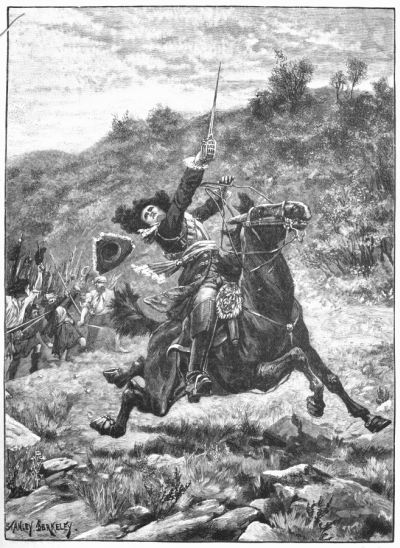
BATTLE OF KILLIECRANKIE: THE LAST CHARGE OF DUNDEE. (See p. 408.)
[See larger version]
Mackay made his way over the mountains by Weem Castle and Castle Drummond to Stirling. On the way he overtook the fugitives from Ramsay's regiment, who had fled at the first onset. They were completely cowed and demoralised; and it was only by threatening to shoot any man that left the track that he could prevent them from dispersing amongst the hills. Many of them, after all, managed to elude his vigilance, and were killed by the Highlanders for their clothes. It was reported that Mackay lost two thousand men in the battle, and that five hundred were made prisoners; but, on the other hand, a great number of the Highlanders fell on the field. The rest, before retreating with the booty, piled a great heap of stones on the spot where Claverhouse fell. This is still shown, and is the only monument of John Graham, Viscount Dundee, for the Church of Blair Athol in which he was buried has long since disappeared, and his tomb with it.
The news of the defeat of Mackay caused consternation throughout the Lowlands, and even in London, whither it was carried by couriers charged with earnest appeals to the king to hasten forces on to Scotland, to protect the people from the torrents of victorious barbarians from the mountains, who were with terror expected to devastate the whole country. The Scottish Convention urged Hamilton to dismiss them, that they might provide for their safety; but fast on the heels of the first news came that of the certain death of Dundee, which at once reassured the country; for, without him, the Highlanders were regarded as comparatively innocuous, as a body without a head. And this was very near the truth; for the command had now fallen on the Irish officer Cannon, who, with his ragamuffin brigade, was not likely to remain long very formidable. In fact, he very soon managed to disgust the proud Highland chieftains. Lochiel returned home, and many of the Celts, satisfied with their plunder, followed his example. Others, however, stimulated by the hope of similar good fortune, came rushing from their hills, adding, by their conflicting prejudices and wild insubordination, only to the weakness of the force. Cannon dispatched a party of the Robertsons into the Lowlands to collect cattle and provisions for his army; but Mackay came upon them at St. Johnstone's, and killed one hundred and twenty of them, and took thirty prisoners. This revived the spirit of his troops, and infused new confidence through the country. In fact, Mackay was an excellent general, and was unremitting in his exertions to renew the courage and discipline of his troops. He had seen the fatal effect of the clumsy use of the bayonets at Killiecrankie, and he lost no time in having them made to screw upon the muskets, so that these could be fired with them ready fixed.
And very soon he had need of all his generalship. The ministers at Edinburgh had ordered him to garrison Dunkeld with the Cameronian regiment newly raised. The town was unfortified; and in vain Mackay protested against exposing his men thus to the attack of the whole body of the Highlanders encamped at Blair Castle. But the Highland army, led on by Cannon, were received with a spirit worthy of the old race of Covenanters, were repulsed, and driven back with great slaughter. The young commander Lieutenant-Colonel Cleland, and after him Captain Monro, fell at the head of the besieged; but the victory was decisive. The Highlanders dispersed with their booty to their homes; Cannon, with his disorderly Irish, escaped to the Isle of Mull; the fame of Mackay and his troops was higher than ever, and the war in Scotland was at an end.
We have continued to this point the affairs of Scotland, that we might not interrupt the still more important transactions which at the same time took place in Ireland. On the 12th of March, two days before the opening of the Scottish Convention, James had landed in Ireland. That island was peculiarly open to the influence of James, for the bulk of the population were Catholics, and they were thrown into a state of great excitement by the hope of being able to drive the Protestants from their estates by his appearance there with a French army, of wreaking vengeance on them for all their past oppressions, and of regaining their ancient patrimony.
From the moment almost that James had mounted the throne of England, he began his preparations for putting down Protestantism in Ireland, and raising a military power there which should enable him to crush it also in England. The Protestant judges had been removed one after another from the bench, so that little justice could be obtained in Irish tribunals by Protestant suitors. The Protestants were diligently weeded out of the army, and lying Dick Talbot, the Earl of Tyrconnel, James's most obsequious tool, was his Lord-Lieutenant, and bent on carrying out his plans to the fullest extent. There arose a terrible panic amongst the Protestants that a general massacre was contemplated, and the Englishry began to collect whatever of value they could carry with them, and escape across the Channel into England or Wales. Tyrconnel sent for the leading Protestants to Dublin, and protested with many oaths that the whole rumour was a malicious and groundless lie. Nobody, however, put any faith in his assurances, and the exodus rapidly increased, whilst such Protestants as possessed any means of defence in towns, armed themselves, threw up fortifications, and determined to sell their lives dear. Such was the case at Kenmare, in Kerry; at Bandon, Mallow, Sligo, Charleville, Enniskillen, and Londonderry.
Such was the state of Ireland at the time of the landing of William at Torbay. Tyrconnel despatched a body of Popish infantry in December, 1688, to take possession of Enniskillen. The inhabitants summoned the Protestants of the surrounding country to their aid, rushed out on the soldiers as they approached the gates of the town, and defeated them. They then appointed Gustavus Hamilton, a captain in the army, their governor, and determined to hold their own against the lieutenant-governor. Londonderry likewise shut its gates in the face of the Earl of Antrim, who armed a Popish regiment to garrison their town. This exploit was the work of thirteen apprentices, whose bold and decisive deed was quickly imitated by the rest of the inhabitants. The town was put into a posture of thorough defence, the country round was alarmed, the Protestant gentry flocked in with armed followers, horse and foot, and Antrim thought it prudent to retire to Coleraine.
At another time Tyrconnel would have taken a bloody vengeance on the courageous Protestants of Ulster, but matters in England appeared too critical to permit him such indulgence. He had recourse, therefore, to artifice. He despatched Lord Mountjoy, the Master of the Ordnance, with his regiment, which included many Protestants, to Londonderry. Mountjoy was a Protestant himself, though an adherent of King James; had much property in Ulster, and was highly respected there. The citizens of Londonderry willingly admitted him within their walls, and suffered him to leave a garrison there, consisting solely of Protestant soldiers, under the command of Lieutenant-Colonel Lundy as governor. To the people of Enniskillen Mountjoy was less courteous; he somewhat curtly treated a deputation thence, and advised them to submit unconditionally to James. Tyrconnel even affected to enter into negotiation with William, and General Richard Hamilton was not very wisely despatched by William to Ireland to treat with him. Hamilton had been in command under Tyrconnel till a recent period, and had been sent by him with reinforcements to James in England. There, finding James had fled, he coolly went over to William, and, strangely enough, was deemed sufficiently trustworthy to be returned to his old master as negotiator. He no sooner arrived than he once more declared for King James. Tyrconnel, however, did not himself so soon throw off the mask of duplicity. He protested to the Prince of Orange that he was quite disposed to treat for the surrender of Ireland, and to the alarmed Catholics of Ireland—who got some wind of his proceedings—that he had not the most distant idea of submitting. On the other hand, he prevailed on Lord Mountjoy, who had so well served him at Londonderry, to go on a mission to James at St. Germains, professedly to procure a concession from James that his Irish subjects should submit to William for the present, and not rush into a contest to which they were unequal, but wait for better times. The real truth was, that James had already despatched Captain Rush from St. Germains to Tyrconnel to assure him that he was coming himself with all haste with a powerful fleet and army. Tyrconnel was, therefore, desirous to get Mountjoy secured, as he was capable of uniting the Protestants and heading them against the bloody butchery that James and Tyrconnel destined for them. Mountjoy somewhat reluctantly fell into the snare. He proceeded to France, accompanied by Chief Baron Rice, a fanatical Papist, who had boasted that he would drive a coach and six through the Act of Settlement. Rice had secret instructions to denounce Mountjoy as a traitor, and to recommend James to make him fast. No sooner, therefore, did he present himself at St. Germains than he was clapped into the Bastille.
This act of diabolical treachery being completed, Tyrconnel now abandoned further disguise, and prepared to hand over the whole Protestant population of Ireland to the exterminating fury of the Catholic natives. "Now or never! now and for ever!" was the watchword of blood and death to all the Englishry. It was embroidered on the viceregal banner, and floated over the castle of Dublin. The Catholics were called on to arm and secure Ireland for the Irish. The call was obeyed with the avidity of savages. Those who had not arms manufactured them out of scythes, forks, and other rural implements. Every smithy was aglow, every hammer resounding in preparation of pike and skean, the Irish long knife. By February, 1689, the army of Ireland was swelled with regulars and irregulars to a hundred thousand men. There was one universal shout of Bacchanalian acclaim, and rush to secure the plunder of the Protestants. The houses of the wealthy were ransacked, the cattle driven off, the buildings, and even the heaths set fire to. The wild marauders roasted the slaughtered cattle and sheep at huge fires often made of timbers of the buildings, emptied the cellars, and sang songs of triumph over the heretic Englishry, and of Ireland restored to its legitimate owners. What an Ireland it was likely to become under them was soon evident. They were not content to kill enough to satisfy their hunger; these children of oppression and ignorance, like wolves, destroyed for the mere pleasure of destroying; and D'Avaux, the French ambassador, who accompanied James over the country from Kinsale to Dublin, describes it as one black, wasted desert, for scores of miles without a single inhabitant, and calculates that in six weeks these infuriate savages had slaughtered fifty thousand cattle and three or four hundred thousand sheep.
Before such an inundation of fury and murder, the few Protestant inhabitants were swept away like chaff before the wind. All the fortified towns and houses in the south were forced by the ruthless mob and soldiery, or were abandoned, and the people fled for their lives to seek an asylum in Ulster. Those of Kenmare managed to get across in a small vessel to Bristol.
In all this fearful scene of devastation Hamilton, who had come over as the emissary of William, was one of the most active and unpitying agents. Enniskillen and Londonderry were the only Protestant places which now held out, and Hamilton commenced his march northward to reduce them. This march was only another wild blast of desolation, like that which had swept the south, and left the country a howling wilderness. In addition to Hamilton's regular troops, hosts of the self-armed and merciless Irish collected on his track, and burnt, plundered, and murdered without mercy. The people fled before the rout, themselves burning their own dwellings, and laying waste with fire the whole district, so that it should afford no shelter or sustenance to the enemy. The whole of the Protestant population retreated northwards, leaving even Lisburn and Antrim deserted. Thirty thousand fugitives soon found themselves cooped up within the walls of Londonderry, and many thousands were shut up in Enniskillen.
At this crisis James landed at Kinsale, and marched to Cork. He had brought no army, but a number of officers to command the Irish troops. His General-in-Chief was Count Rosen, a man of much military experience. Next to him were Lieutenant-General Maumont, Brigadier-General Pusignan, and four hundred other officers of different ranks. He was accompanied by Count D'Avaux, who had been ambassador in England, a man clever, shrewd, keenly observant, and with little mercy or principle. His object was to secure Ireland rather for Louis than for James, and he served his master with cunning and zeal. James brought with him arms for ten thousand men, abundance of ammunition, and a military chest of about a hundred and twenty thousand pounds sterling. Before quitting St. Germains Louis XIV. himself had paid James a parting visit, displayed towards him the most marked friendship, embraced him at parting, and told him, in his epigrammatic way, that the greatest good that he could desire for him was that they might never meet again.
James landed on the 12th of March, and two days after was in Cork. The Irish received him with enthusiastic acclamations as a saviour; but the effects of his anticipated arrival, and the measures concerted by himself and carried out by the brutal Tyrconnel, met him on the instant. He was anxious to push on to Dublin; but the whole country was a desert, and horses could not be procured in sufficient numbers to convey his baggage, nor food to sustain them on the way. During the detention consequent on this, Tyrconnel arrived to welcome His Majesty to Ireland. On the 24th of March he entered Dublin amid the hurrahs and the festive demonstrations of flowers, garlands of evergreens, of tapestry and carpets hung from the windows, of processions of young girls in white, and friars and priests with their crosses, and with the host itself. At sight of that, James alighted, and, falling on his knees in the mud, bared his head in humble devotion. The next morning James proceeded to form his Privy Council. This was composed of his natural son, the Duke of Berwick, the Duke of Powis; the Earls of Abercorn, Melfort, Dover, Carlingford, and Clanricarde; the Lords Thomas Howard, Kilmallock, Merrion, Kenmare; Lord Chief Justice Herbert, the Bishop of Chester, General Sarsfield, Colonel Dorrington, and, strangely enough, D'Avaux, who should have retained the independent position of ambassador; the Marquis D'Abbeville, and two other foreigners. The Protestant Bishop of Meath, at the head of his clergy, appeared before him, imploring his protection, and permission to lay before him the account of the injuries they and their flocks had received. James affected to declare that he was just as much as ever desirous to afford full liberty of conscience, and to protect all his subjects in their rights and opinions; but he said it was impossible to alter what had already taken place, and he gave an immediate proof of the impartiality which Protestants were likely to receive at his hands by dismissing Keating, Chief Justice of the Common Pleas, the only Protestant judge still remaining on the bench.
These measures dispatched, it became the question whether, in the interval before the meeting of Parliament, James should continue in Dublin, or should proceed to the army besieging Londonderry, and encourage it by his presence. This called forth the conflicting views and interests of his adherents, and his whole court became rent by struggling factions. The English exiles warmly urged the king to proceed to Ulster. They cared little for the fate of Ireland, their views and wishes were fixed on England. In the north, as soon as Londonderry was put down, it was easy for James to go across to Scotland, there to commence the campaign for the recovery of the English crown. But this was the very thing which his Irish partisans dreaded. They felt certain that if James recovered the English throne, they should be left to contend with the colonists of Ulster themselves; and the victorious ascendency of that small but sturdy body of people was too vividly burnt into their minds by ages of their domination. They therefore counselled James to remain as a king at Dublin, and leave his generals to put down the opposition in the north; and in this they were zealously seconded by D'Avaux and the French. James on the throne of England would be a very different person to James on the throne of Ireland only. In the one case, if he succeeded, he might ere long become independent of Louis; if he failed, the English Protestant king would soon subdue Ireland to his sway. But if James continued only monarch of Ireland, he must continue wholly dependent on Louis. He could only maintain himself there by his aid in men and money, and then Ireland would become gradually a French colony—a dependence most flattering to the pride and power of France—a perpetual thorn in the side of England.
The contention between the two parties was fierce, and Tyrconnel joined with the French and Irish in advising James to remain at Dublin. On the other hand, Melfort and the English pointed out to him the immense advantage to his prospects to settle the last remains of disaffection in the north, and to appear again in arms in his chief kingdom, where they persuaded him that the Highlanders and all the Catholic and Royalist English would now flock to his standard. William, they assured him, was to the highest degree unpopular; a powerful party in Scotland were opposed to him, and in the ascendant. These views prevailed. James, attended by D'Avaux and the French officers, set out for Ulster. The journey was again through a country blasted by the horrors of war and robbery. There was no fodder for their horses, scarcely a roof to shelter the heads of the travellers; and, after a long and terrible journey, plunging and struggling through deep roads, and bogs where there was no road at all, famished and worn out by fatigue, they reached Charlemont on the 13th of April. When James at length arrived before Londonderry, the fall of that place did not appear likely to be quite so early an event as he had been led to believe. Rosen, however, treated lightly the resistance which the inhabitants could make. The walls of the town were old, the ditches could scarcely be discerned, the gates and drawbridges were in disorder, and the town was commanded at various points by heights from which artillery might play upon it. What was still more favourable to James, it was well known that Lundy, the governor, was a traitor. Rosen was placed in the chief command, and Maumont next to him over the head of Hamilton. Lundy meanwhile depressed the spirits of the people within by telling them that it was useless to attempt to defend such a place, and kept up a secret correspondence with the enemy without, informing them of all that passed there, and of its weak points and condition. He did more—he contrived to send away succours which arrived from England. Colonel Cunningham appeared in the bay with a fleet having on board two regiments for the defence of the place. Cunningham and his chief officers went on shore and waited on the governor. Lundy called a council, taking care to exclude all but his own creatures; and these informed Cunningham that it was mere waste of men and money to land them; the town was perfectly indefensible; and that, in fact, he was going to surrender it. His supporters confirmed this view of the case, and Cunningham and his officers withdrew, and soon after made sail homeward, to the despair of the inhabitants; Lundy, as he saw them depart, sending word into the enemy's camp that he was ready to surrender.
But the spirit of the inhabitants was now roused. They openly declared Lundy a traitor, and, if they could have found him, would have killed him on the spot. He had, however, concealed himself, and at night was enabled, by connivance of his friends, to escape over the walls in disguise. As night approached, the people, to their astonishment, found the gates set open, and the keys were not to be found. People said they had seen the confederates of Lundy stealing out, and the alarm flew through the place. The townsmen came together, and called all to arms by beat of drum. A message was despatched to Cunningham to bring in his forces; but he was already on the move, and declared that his orders permitted him only to follow the commands of the governor.
Thus deserted, the inhabitants courageously resolved to depend on their own energies. They placed Major Baker and Captain Murray at the head of the armed citizens, who amounted to seven thousand, many of them Ulster gentlemen of family, and endowed with all the dauntless spirit which had made them so long masters of the north of Ireland. At this moment, too, the Rev. George Walker, the Rector of Donaghmore, who had been driven in along with the rest of the fugitives, displayed that spirit, eloquence, and ability which inspired the whole place with a wonderful enthusiasm, and which have made his name famous amongst the Protestant patriots of Ireland. Walker was appointed joint governor with Major Baker, and they set themselves to work to organise their armed people into military bodies with their proper officers, to place cannon on all the most effective points, and post sentinels on the walls and at the gates. The forces of James were already drawn up before the place, expecting the promised surrender of Lundy. Presently a trumpeter appeared at the southern gate, and demanded the fulfilment of the governor's engagement. He was answered that the governor had no longer any command there. The next day, the 20th of April, James sent Lord Strabane, a Catholic peer of Ireland, offering a free pardon for all past offences on condition of an immediate surrender, and a bribe to Captain Murray, who was sent to hold a parley with him, of a thousand pounds and a colonelcy in the royal army. Murray repelled the offer with contempt, and advised Strabane, if he valued his safety, to make the best of his way out of gunshot.
At this unexpected answer, James displayed the same pusillanimity which marked his conduct when he fled from England. Instead of ordering the place to be stormed, he lost heart, and, though he had been only eleven days before the town, set off back to Dublin, taking Count Rosen with him, and leaving Maumont in command, with Hamilton and Pusignan under him. Then the siege was pushed on with spirit. The batteries were opened on the town, to which the townsmen replied vigorously; and, on the 21st of April, made a desperate sally under Captain Murray, killed General Maumont and two hundred of the Irish, and, under cover of a strong fire kept up by a party headed by Walker, regained the town. The siege under Hamilton, who succeeded to the command, then languished. On the 4th of May the townspeople made another sally, and killed Pusignan. After this sallies became frequent, the bold men of Londonderry carried off several officers prisoners into the town, and two flags of the French, which they hung up in the cathedral. It was at length resolved by the besiegers to carry the place by storm, but they were repelled with great loss, the very women joining in the mêlée, and carrying ammunition and refreshments to the defenders on the walls. As the storming of the town was found to be impracticable, Hamilton commenced a blockade. The troops were drawn round the place, and a strong boom thrown across the river, and the besiegers awaited the progress of famine.
All this time the people of Enniskillen had been making a noble diversion. They had marched out into the surrounding country, levied contributions of provisions from the native Irish, and given battle to and defeated several considerable bodies of troops sent against them. They took and sacked Belturbet, and carried off a great quantity of provisions; they made skirmishing parties, and scoured the country in the rear of the army besieging Londonderry, cutting off straggling foragers, and impeding supplies. The news of the continued siege of Londonderry, and the heroic conduct of the people of both these places, raised a wonderful enthusiasm in England on their behalf. Lundy, who had reached London, and Cunningham, who had brought back his regiments, were arrested, and Lundy was thrown into the Tower and Cunningham into the Gatehouse. Kirke was also dispatched with a body of troops from Liverpool to relieve the besieged in Londonderry. On the 15th of June his squadron was discerned approaching, and wonderful was the exultation when it was ascertained that Kirke had arrived with troops, arms, ammunition, and supplies of food.
It was high time that relief should have come, for they were reduced to the most direful extremities, and were out of cannon-ball, and nearly out of powder. But they were doomed to a horrible disappointment. Kirke, who could be bold enough in perpetrating barbarities on defenceless people, was too faint-hearted to attempt forcing the boom in the river, and relieving the place. He drew off his fleet to the entrance of Lough Foyle, and lay there in tantalising inactivity. His presence, instead of benefiting them, brought fresh horrors upon them; for no sooner did James in Dublin learn that there was a chance of Kirke's throwing in fresh forces and provisions, than he dispatched Rosen to resume the command, with orders to take the place at all costs.
This Rosen, who was a Russian, from Livonia, was a brutal savage, and vowed that he would take the place, or roast the inhabitants alive. He first began by endeavouring to undermine the walls; but the besieged so briskly attacked the sappers, that they soon killed a hundred of them, and compelled them to retire. Filled with fury, Rosen swore that he would raze the walls to the ground, and massacre every creature in the town,—men, women, and children. He flung a shell into the place, to which was attached a threat that, if they did not at once surrender, he would collect from the whole country round all the people, their friends and relatives, the women, the children, the aged, drive them under the walls, and keep them there till they perished. He knew that the besieged could give them no support, for they were perishing fast themselves from famine, and its attendant fevers and diseases. The fighting men were so weak that they often fell down in endeavouring to strike a blow at the enemy. They were living on dogs, rats, any vile thing they could seize. They had eaten up all the horses to three, which were mere skin and bone. They had salted the hides and chewed them to keep down their ravening hunger. There were some amongst them who began to talk of eating the bodies of those who fell in the action. Numbers perished daily in their houses of exhaustion, and the stench arising from the unburied dead was terrible and pestilential. Many of their best men had died from fever, amongst them Major Baker, their military governor, and Colonel Mitchelbourne had been elected in his place. They were reduced to fire brickbats instead of cannon-balls; and their walls were so battered, that it was not they but their own spirit which kept out the enemy. Yet, amid these horrors, they treated the menace with silent contempt, and sent out an order that any one even uttering the word "Surrender," should be instantly put to death.
The savage Rosen put his menace into force. He drove the wretched people from the country, at the point of the pike, under the walls. On the 2nd of July this melancholy crowd of many hundreds was seen by the besieged from the walls, hemmed in between the town and the army—old men incapable of bearing arms, miserable women, and lamenting children, where, without food or shelter, they were cooped up between their enemies and their friends, who could not help them. Many of these unhappy people had protections under James's own hand, but Rosen cared not for that. For two days and nights this woful throng of human beings was kept there, in spite of the strong remonstrances of Hamilton and other English officers, who were not accustomed to such devilish modes of war. The indignant men in Londonderry erected gallows on the walls, and sent Rosen word that, unless he let the perishing people go, they would hang up the principal of their prisoners. But it was not till many of the victims had died, and a storm of indignation at this unheard-of barbarity assailed him in his own camp, that Rosen opened his ranks and allowed the poor wretches to depart.
James, who was himself by no means of the melting mood, was shocked when he heard of this diabolical barbarity, and the comments upon it amongst those around him. He recalled Rosen and restored the command to Hamilton. Then the siege again went on with redoubled fury, and all the last expiring strength of the besieged was required to sustain it. Hamilton also terrified them by continual ruses and false rumours. He ordered his soldiers to raise a loud shout, and the besieged to be informed that Enniskillen had fallen, and that now there was no hope whatever for them. The besieged were so depressed by this news, for they had no means of testing it, that they offered to capitulate, but could obtain no terms that they could accept. And all this time the imbecile or base Kirke was lying within a few miles of them with abundance of provisions, and a force capable with ease of forcing its way to them. He had even the cruelty to send in a secret message to Walker that he was coming in full force, and then to lie still again for more than a fortnight. At length, however, he received a peremptory order from William to force the boom and relieve the town. No sooner did this order reach him than he showed with what ease he could have accomplished this at first, six weeks ago. The boom was burst asunder by two vessels—the Mountjoy and Phœnix—dashing themselves against it, while they were covered by a third, the Dartmouth, and the place was open (July 30) to the conveyance of the troops and the provisions. Kirke was invited to take the command, and the Irish camp, despairing of any success, drew off on the 1st of August, and raised this most memorable siege, in which four out of the seven thousand defenders perished, besides a multitude of other inhabitants, amounting, according to some calculations, to eight or nine thousand souls. On the side of the Irish as many are said to have fallen; and of the thirty-six French gunners who directed the cannonade, all had been killed but five. Besides the miseries endured in the town, those of the poor people who survived being driven under the walls found, on their return to what had been their homes, that they were their homes no longer. Their villages, crops, ricks, buildings, all had been burnt down, and the whole country laid waste.
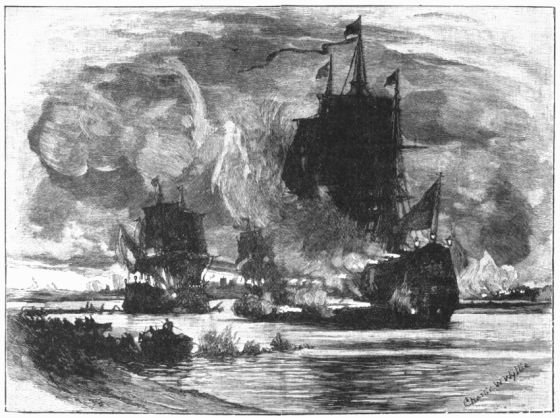
THE "MOUNTJOY" AND "PHŒNIX" BREAKING THE BOOM AT LONDONDERRY. (See p. 416.)
[See larger version]
The Enniskilleners had meanwhile been actively engaged against other detachments of James's army, but had bravely beaten them off, and on the same day that Londonderry was relieved had won a signal victory over them at Newton Butler, attacking five thousand Irish under General Macarthy, though they themselves numbered only about three hundred, and killing, it is said, two thousand, and driving five hundred more into Lough Erne, where they were drowned. This decisive defeat of the Irish hastened the retreat of the army retiring from Londonderry. They fled towards Dublin in haste and terror, leaving behind their baggage. Sarsfield abandoned Sligo, and James was on the very point of abandoning Dublin in the midst of the panic that seized it. At the same time came from Scotland the news of the death of Dundee at Killiecrankie; and on the 13th of August Marshal Schomberg landed at Carrickfergus with an army of sixteen thousand, composed of English, Scots, Dutch, Danes, and French Huguenots. Matters were fast assuming a serious aspect for James; his affairs not only in the field, but his civil government, falling every day into a more ominous condition.
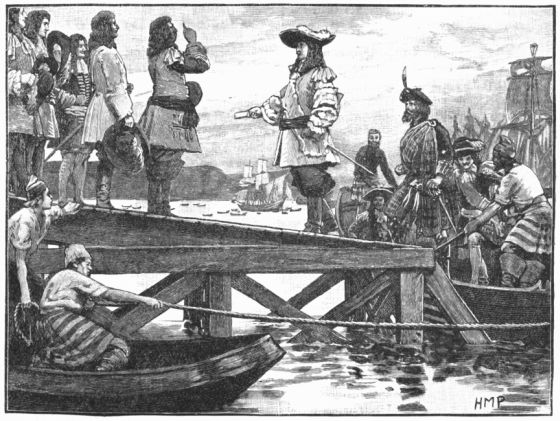
LANDING OF MARSHAL SCHOMBERG AT CARRICKFERGUS. (See p. 416.)
[See larger version]
One reason for James quitting the siege of Londonderry in person was that the time for the assembling of his Irish Parliament drew near. No sooner did he reach Dublin than he was met by the news that the English fleet under Admiral Herbert had been beaten by the French at Bantry Bay. Herbert had been ordered to intercept the French fleet between Brest and Ireland; but he had missed it, and James had safely landed. Whilst he was still beating about, a second squadron, under Chateau Renard, had also made its way over, and anchored with the first in Bantry Bay. On Herbert discovering them there, confident in their superior numbers, they came out, and there was a sharp fight. In the evening Herbert sheered off towards the Scilly Isles, and the French with great exultation, as in a victory, returned into the bay. James found the French at Dublin in high spirits at the unusual circumstance of beating English sailors; but his English adherents were by no means pleased with this triumphing over their countrymen, hostile though they were; and James, who had always prided himself on the English navy, is said, when D'Avaux boasted how the French had beaten the English, to have replied gloomily, "It is the first time." Even the English exiles in France showed a similar mortification, though the French victory, such as it was, was in their cause. Both sides, however, claimed the victory. In England Parliament voted thanks to Herbert; in Dublin James ordered bonfires and a Te Deum.
On the 7th of May, the day after the Te Deum, James met his Parliament. What sort of a Parliament it was, and what it was likely to do in Ireland may be surmised from the fact that there were only six Protestants in the whole House of Commons, consisting of two hundred and fifty members. Only fourteen lords appeared to his summons, and of these only four were Protestants. By new creations, and by reversal of attainders against Catholic peers, he managed to add seventeen more members to the Upper House, all Catholics, so that in the whole Parliament there were only ten Protestants, and four of these were the Bishops of Meath, Ossory, Cork, and Limerick. The majority of these members were not only Catholic, eager to visit upon the Protestants all the miseries and spoliations which the latter had inflicted on them, but they were men totally unaccustomed to the business of legislation or government, from having been long excluded from such functions, and condemned to pass their time on their estates in that half savage condition which qualified them rather for bandits than for lawgivers and magistrates.
James's first act was that of complete toleration of liberty of conscience to all Christian denominations. This sounded well, and was in perfect keeping with his declarations and endeavours in England for which he had been driven out, and England had now an opportunity of observing with what justice; of judging whether or not his real object had been wrongfully suspected. In his speech from the throne, he reverted with great pride to these endeavours, and to his determination still to be the liberator of conscience. This was language worthy of the noblest lawgiver that ever existed; but, unfortunately, James's English subjects never could be persuaded of his sincerity, and did not believe that this happiness would arrive as the result of his indulgence. The very next Act which he now passed decided that they had not mistrusted him without cause. Scarcely had he passed the Act of Toleration, when he followed it up by the repeal of the Act of Settlement, by which the Protestants held their estates, and their rights and liberties in Ireland. This just and tolerant monarch thus, at one stroke, handed over the whole Protestant body to the mercy of the Irish Catholics, and to one universal doom of confiscation. The Bill was received with exultation by this Parliament, which portended all the horrors which were to follow.
But there were other parties whose estates were not derived from the Act of Settlement, but from purchase, and another Act was passed to include them. It was a Bill confiscating the property of all who had aided or abetted the Prince of Orange in his attempt on the Crown, or who were absent and did not return to their homes before the 5th of October. The number of persons included in this great Act of Attainder, as it was called, amounted to between two and three thousand, including men of all ranks from the highest noble to the simplest freeholder. All the property of absentees above seventeen years of age was transferred to the king. The most unbounded lust of robbery and revenge was thus kindled in the public mind. Every one who wanted his neighbour's property, or had a grudge against him, hurried to give in his name to the Clerk of the House of Commons, and, without any or much inquiry, it was inserted in the Bill.
To make the separation of England and Ireland complete, and to set up the most effectual barrier against his own authority, should he again regain the throne of England, James permitted his Parliament to pass an Act declaring that the Parliament of England had no power or authority over Ireland, and this contrary to the provisions of Poynings' Act, which gave the initiative power to the English Council, and made every Irish Act invalid unless first submitted to the King and Council of England.
Having transferred the property of the laity back to the Irish, another Act made as sweeping a conveyance of that of the Church from the Protestant to the Catholic clergy. Little regard had been had to Catholic rights in piling property on the Protestant hierarchy, and as little was shown in taking it back again. The Anglican clergy were left in a condition of utter destitution, and more than this, they were not safe if they appeared in public. They were hooted, pelted, and sometimes fired at. All colleges and schools from which the Protestants had excluded the Catholics were now seized and employed as Popish seminaries or monasteries. The College of Dublin was turned into a barrack and a prison. No Protestants were allowed to appear together in numbers more than three, on pain of death. This was James's notion of the liberty of conscience, and a tender regard for "every man's rights and liberties." It was a fine lesson, too, for the clergy and gentry who had welcomed him to Ireland as the friends of passive obedience. They had now enough of that doctrine, and went over pretty rapidly to a different notion. The Protestants everywhere were overrun by soldiers and rapparees. Their estates were seized, their houses plundered, their persons insulted and abused, and a more fearful condition of things never existed in any country at any time. The officers of the army sold the Protestants protections, which were no longer regarded when fresh marauders wanted more money.
This model Parliament voted twenty thousand pounds a year to Tyrconnel for bringing this state of things about, and twenty thousand pounds a month to the king. But the country was so completely desolated, and its trade so completely destroyed by this reign of terror and of licence, that James did not find the taxes come in very copiously; and he resorted to a means of making money plentiful worthy of himself. He collected all the old pots, pans, brass knockers, old cannon, and metal in almost any shape, and coined clumsy money out of them, on which he put about a hundred times their intrinsic value. The consequence was that shopkeepers refused to receive this base coin. All men to whom debts were due, or who had mortgages on other men's property, were opposed to having them discharged by a heap of metal which in a few weeks might be worth only a few pence a pound. Those who refused such payment were arrested, and menaced with being hanged at their own doors. Many were thrown into prison, and trade and intercourse were plunged into a condition of the wildest anarchy. The whole country was a scene of violence, confusion, and distress. Such was the state of Ireland and of James's Court when, as we have seen, Schomberg landed with his army at Carrickfergus on the 23rd of August, and roused James, his Court, and the whole country to a sense of their danger, and of the necessity for one great and universal effort. A spirit of new life seemed to animate them, and James, receiving fresh hope from the sight, marched from Dublin at the head of his troops to encounter Schomberg.
During the summer the Court of William had not been an enviable place. In the spring the Parliament had proceeded to reverse the judgments which had been passed in the last reign against Lord William Russell, Algernon Sidney, the Earl of Devonshire, Cornish, Alice Lisle, and Samuel Johnson. Some of the Whigs who had suffered obtained pecuniary compensation, but Johnson obtained none. He was deemed by the Whigs to be too violent—in fact, he was a Radical of that day. The scoundrel Titus Oates crawled again from his obscurity, and, by help of his old friends the Whigs, managed to obtain a pension of three hundred pounds a year. This done, there was an attempt to convert the Declaration of Rights into a Bill of Rights—thus giving it all the authority of Parliamentary law; and in this Bill it was proposed, in case of William, Mary, and Anne all dying without issue, to settle the succession on the Duchess Sophia of Brunswick Lüneburg, the daughter of the Queen of Bohemia, and granddaughter of James I.; but it failed for the time. A Bill of Indemnity was also brought in as an Act of oblivion of all past offences; but this too was rejected. The triumphant Whigs, so far from being willing to forgive the Tories who had supported James, and had been their successful opponents during the attempts through Titus Oates and his fellow-plotters to exclude James from the succession, were now clamorous for their blood and ruin. William refused to comply with their truculent desires, and became, in consequence, the object of their undisguised hatred. They particularly directed their combined efforts against Danby, now Earl of Caermarthen, and Halifax. They demanded that Caermarthen should be dismissed from the office of President of the Council, and Halifax from holding the Privy Seal, and being Speaker of the House of Lords. But William steadfastly resisted their demands, and declared that he had done enough for them and their friends, and would do no more especially in the direction of vengeance against such as were disposed to live quietly and serve the State faithfully.