Chapter XVII · (continued 2)
Reading edition
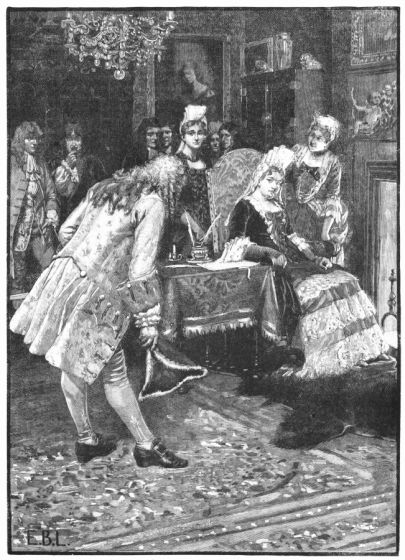
THE DUKE OF MARLBOROUGH'S INTERVIEW WITH ANNE. (See p. 599.)
[See larger version]
Such was continually the fluctuating condition of the war in Spain. The Spaniards had no inclination to support Charles, and the Allies only sent troops sufficient to win victories, but not to maintain them, still less to secure the passes in the Pyrenees and keep back fresh French armies. It was another of our futile attempts to support a man who, unless he could support himself, had no business there. At this juncture the Tories, having risen into power, withheld fresh reinforcements. They were not hearty in the war, and our small army there was left to contend with impossibilities. The English and Imperialists unwillingly following in the track of the king towards Catalonia, for the sake of better procuring provisions on the route, had separated and marched at some distance from each other, though in parallel lines. In this condition they were suddenly overtaken by Vendôme on the 8th of December, and Stanhope, with his five thousand men, found himself surrounded by the main army of the French. This was an instance of want of circumspection which was not anticipated in General Stanhope after his vigorous and able operations hitherto, and procured him severe blame. He managed to despatch a messenger to Stahremberg for help; but his powder was nearly exhausted, and after courageously defending himself till the next day, he was compelled to surrender himself in the little town of Brihuega. Stahremberg was accused of tardy movement for the relief of Stanhope, but he was probably prevented from coming up by the forces of Vendôme, who attacked him also on the 10th at Villaviciosa. Vendôme's troops are said to have doubled in number those of Stahremberg. Stahremberg's left wing was routed, and great slaughter made of them; but Stahremberg himself maintained the fight with his right wing till night, when the French retreated, having suffered equally severely with the troops of Stahremberg. The Imperial general, however, found himself unable to pursue the advantage; he ordered all the guns to be spiked, and retreated as fast as possible into Catalonia. Vendôme pursued him, took Balaguer on the way, in which he left a garrison, and followed Stahremberg to the very walls of Barcelona. About the same time the Duc de Noailles invested Gironne, and took it in the severity of the winter weather; and thus was Charles, after a few months' campaign, which began so splendidly, stripped of the whole Spanish monarchy, with the exception of Catalonia, which was itself greatly exposed and very inefficiently defended.
At home the new Parliament met on the 25th of November. There was a strong infusion of Tories sent up, but there was still also a strong party of Whigs. The Tories, however, carried the Speakership in the person of Mr. Bromley, in the place of the late Whig Speaker, Onslow; but the chief managers of the Sacheverell trial had managed to secure their own return. The queen, on the other hand, showed her prejudice by knighting Mr. Constantine Phipps, Sacheverell's counsel, and making him Lord Chancellor of Ireland, and giving other promotions to marked Tories. In her Speech, Anne declared that she would support the Church of England, maintain the Constitution, and grant the indulgence allowed by law to scrupulous consciences. The word was no longer "toleration," but "indulgence," the very phrase used by Sacheverell—another proof of the queen's leaning towards the doctor. And this phrase now became general in the High Church, the doctrine being that whatever liberty the Dissenters enjoyed was of indulgence, and not of right. In the House of Lords the Earl of Scarborough moved the usual vote of thanks to the Duke of Marlborough, but the Duke of Argyll opposed it; and the duke's friends let the matter drop, hoping to carry it when the duke returned. Other signs of the great change which had taken place in the domestic policy of the nation quickly followed. The Earl of Peterborough, who had so long suffered from the overwhelming shade of Marlborough, was appointed Ambassador-Extraordinary to the Imperial Court. The Earl of Rivers was appointed Ambassador to Hanover; and Richard Hill, a kinsman of Mrs. Masham, Ambassador-Extraordinary to the States-General, and also to the Council of State appointed for the government of the Spanish Netherlands, in the place of Lieutenant-General Cadogan. Colonels Meredith, Macartney, and Honeywood, were deprived of their regiments for drinking confusion to the enemies of the Duke of Marlborough. The Marlborough reign was at an end.
The Tories being now in power, there was an entire revolution of opinion and of measures. Everything which had been applauded and encouraged under the Whigs was now to be decried; everything which had been kept down was to be set on high. When Marlborough, therefore, arrived during the Christmas holidays, it was to a most cold reception. There were no longer popular acclamations, nor Lords and Commons hurrying to offer him thanks and eulogies for his eminent services. The public mind had been carefully indoctrinated on this point, and the great commander landed in a most expressive silence. He waited, as was his duty, on the queen, was admitted to about half an hours audience, and the next morning attended a meeting of the Privy Council. But both in the Presence and the Council Chamber the same ominous and freezing silence reigned. The queen plainly told him that he was now no longer to expect the thanks of Parliament as formerly; and she added that, notwithstanding, she trusted he would act in harmony with her Ministers. Marlborough showed no outward signs of resentment. He was anxious still to continue the command of the army, and to put the finish to his successes by compelling a satisfactory peace from Louis, now reduced to the most terrible straits.
The duke saw that it was time for the duchess to resign her offices. The queen had repeatedly insisted to Marlborough that the duchess should deliver up the gold keys, the token of her offices of Groom of the Stole and Mistress of the Robes; but that resolute woman refused to comply. Marlborough, unable to obtain the keys, endeavoured to mollify the queen's anger at the delay. His appeal, however, did not decrease the queen's impatience, and Marlborough imperatively demanded the keys from his wife. For some time she vehemently refused to part with them, but after a violent and stormy altercation (according to Cunningham) she finished by flinging them at his head. The duke snatched them up and hurried to the palace with them, where, says the same authority, the Queen received them with far greater pleasure than if he had brought her the spoils of the army; at which, he says, "the duchess flew about the town in a rage, and with eyes and words full of vengeance."
There was no doubt that the queen's exultation was great at being at length liberated from the heavy and imperious yoke of the Marlboroughs. People who had absented themselves from Court for years, now presented themselves there to pay their respects, and, amongst them, the Duke of Beaufort congratulated Anne that he could now salute his queen in reality. The duchess's places were immediately given to the Duchess of Somerset and Mrs. Masham. The Tory raid against the Whigs was pursued with unpausing ardour. An inquiry was set on foot in the Lords into the conduct of the war in Spain. The Earl of Peterborough's turn was now come. He was examined before a committee, and imputed the mismanagement of the war in Spain to Galway and General Stanhope. Galway made an able defence, but the House, notwithstanding, passed a resolution that Lord Peterborough had most honourably distinguished himself by his able counsels and active services in Spain; and that Galway, Lord Tyrawley, and General Stanhope had been very culpable in advising an offensive war in Spain, which had caused all our misfortunes, and especially the battle of Almanza. But in blaming the generals they blamed also the Ministers who sanctioned the war, and then so badly supported it. The failure of the attempt on Toulon was attributed to the same cause. Thanks were voted to Lord Peterborough; and in rendering them it was not forgotten to make some caustic criticisms on Marlborough.
To increase the power of the Tory landlords in the House of Commons, and diminish that of the Whig supporters in the boroughs, an Act was introduced—and the Commons were weak enough to pass it—making it necessary that every candidate for Parliament in the counties should possess six hundred a year in real property, and for a borough seat three hundred; and this law lasted to our time, when, however, it was repealed.
But in spite of the triumphant position of the Tories, Harley found his individual position far from enviable. His caution made him inimical to the more violent Tories, who were impatient to exercise their power without restraint; of which his colleague St. John, at once ambitious and unprincipled, artfully availed himself to undermine the man by whom he had risen. But an incident occurred to excite a fresh interest in Harley, and give a new impetus to his power. Amongst the horde of foreigners—Germans, Italians, French, and Poles—who contrived to draw English money by acting as spies on their own governments, and very frequently on the English one too, was the so-called Marquis of Guiscard. This man had been in receipt of five hundred pounds a year. He had obtained the salary, it is said, through St. John, being a devoted companion of that accomplished scoundrel in his dissipations. Harley doubted the value of his services, and reduced the pension to four hundred pounds a year; and St. John is also said to have suffered him to endure the curtailment without much remonstrance, and then, to avoid Guiscard's importunities, refused to see him. Guiscard immediately offered his services to the French Government as a spy on the English Court, through a letter to one Moreau, a banker of Paris. The letter was intercepted, and Guiscard arrested. On being brought before the Privy Council he desired to speak in private to St. John, whom, it is suspected, he intended to assassinate, but St. John refused his demand. He then exclaimed, "That is hard! not one word!" and suddenly stepping up to Harley, he cried, "Have at thee, then!" and stabbed him with his penknife. The knife, striking against the breastbone, broke near the handle; but the excited foreigner struck him again with such force that Harley fell to the ground covered with blood. St. John, seeing Harley fall, exclaimed, "The villain has killed Mr. Harley!" drew his sword, and ran him through. The whole Council was up and in confusion. All drew their swords and surrounded the murderous prisoner. He was wounded in various places, and knocked down by blows from the hands of others. The doorkeepers and messengers rushed in at the noise, and Guiscard was dragged to prison. He died in Newgate of his wounds; and such was the curiosity of the populace to see his body that the turnkey kept it in pickle, and made a good sum by showing him for several days.
Harley's wound was not serious, but it served to make a political hero and martyr of him; Guiscard being represented as a Papist, and instigated from France to destroy this champion of England and the Church. On Harley's appearance in the House of Commons he was congratulated on his happy escape in a most eulogistic speech by the Speaker; and an Act was passed, making it felony without benefit of clergy to attempt the life of a Privy Councillor. The Earl of Rochester dying at this juncture, left Harley entirely at the head of the Cabinet, and he was immediately raised to the peerage, first as Baron Wigmore, and then as Earl of Oxford and Mortimer. He was, moreover, appointed Lord Treasurer, much to his own gratification and glory, but little to the furtherance of the national business, for he was naturally inert and indecisive, whilst all around him was a scandalous scene of corruption, intrigue, and neglect.
Marlborough had set out for Holland in the month of February. He assembled his army at Orchies, between Lisle and Douay, about the middle of April, and Marshal Villars encamped between Cambray and Arras. The duke soon after passed the Scarpe, and took post between Douay and Bouchain, where he was joined by his faithful comrade-in-arms Prince Eugene; but that great general was soon compelled to leave him to repel the French forces which were directed against Germany on the Upper Rhine. The army of Marshal Villars was a very numerous one, and he had defended his lines with redoubts and other works so formidably that he thought he would at last checkmate Marlborough. These lines extended from Bouchain, on the Scheldt, along the Sanset and the Scarpe to Arras, and thence along the Upper Scarpe to Cambray. But Marlborough did not despair of entering them by stratagem, if not by force. He ordered a great quantity of fascines to be prepared, and made a pretence of a direct attack on the lines where he was; but he at the same time secretly despatched Generals Cadogan and Hompesch to surprise the passage of the Sanset at Arleux. Brigadier Sutton was also despatched with the artillery and pontoons to lay bridges over the canals near Goulezen, and over the Scarpe at Vitry. By the time that these operations could be effected, Marlborough suddenly quitted his position at nine in the evening, marched the whole of his army through the night, and by five in the morning had crossed the Scarpe at Vitry. There, receiving the information that Hompesch had secured the passes of the Sanset and the Scheldt, Marlborough continued his march on Arleux; and, after a march of ten leagues without halting, was encamped on the Scheldt between Estrun and Ois. Thus, by this unexampled dexterity and exertion, he was completely within the boasted impregnable lines of Villars. This general, on becoming aware of his opponent's motions, pursued him with headlong haste, but he arrived too late to prevent his design; and, whilst the Duke of Marlborough was extolled as a general of consummate ability, Villars was ridiculed even by his own officers for suffering himself to be outwitted.
The Dutch deputies this time, so far from retarding the duke's enterprise, were desirous that he should at once attack Villars; but he would not hazard a battle whilst his men were fatigued by their enormous march. He determined, on the contrary, to commence the siege of Bouchain. The place was remarkably strong, and difficult of access from its situation in a marsh; yet, by the 10th of August, 1711, he had compelled it to surrender, the garrison of six thousand becoming prisoners of war. With this exploit Marlborough closed his brilliant career. His enemies at home—Oxford, St. John, Dartmouth, and the Tories in general—had fondly hoped that this campaign he was going to certain defeat and disgrace; but, in spite of all his disadvantages, he had placed the Allied armies, by this conquest of Bouchain, on the highway to Paris. The Allies were in possession of the Meuse, almost as far as the Sambre; of the Scheldt from Tournai; and of the Lys as far as it was navigable. They had reduced Spanish Guelderland, Limburg, Brabant, and Flanders, with the greatest part of Hainault, and were in a position, by one more vigorous campaign, to carry the war to the very gates of Louis's capital. Such a triumph, however, the malice of the Tories had determined that Britain and the world should not witness. After the capture of Bouchain, the Allied armies went into quarters in the frontier towns, ready for the campaign of the spring; and in the middle of November Marlborough returned to England.
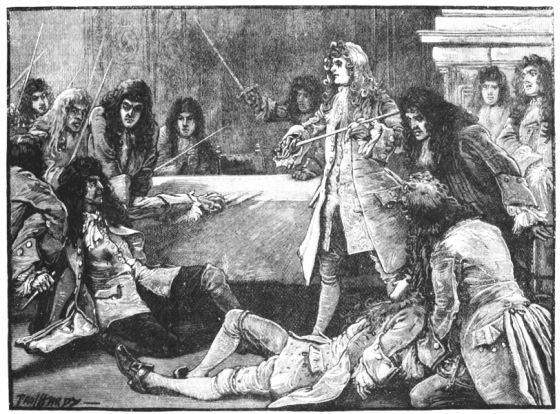
THE FRACAS IN THE PRIVY COUNCIL. (See p. 600.)
[See larger version]
In Spain, whither the Duke of Argyll had been sent to command the English forces, nothing had been done, from the want of everything to carry on the war, and the expedition of Mrs. Masham's brother Jack Hill to Quebec had met with the fate which might have been expected. This expedition had been planned by Colonel Nicholson, who had taken possession of Nova Scotia and garrisoned Port Royal. He had brought to England four American Indians to excite attention, and represented the great advantages which would accrue from the conquest of Canada and the expulsion of the French from that part of the world. The idea was excellent, and, had it been carried out with ability, might have anticipated the policy of Lord Chatham and the victory of Wolfe; but the Ministers were not hearty in the cause. Harley is said to have been averse from it, and St. John to have advocated it because he saw that it would gratify Mrs. Masham. In an ill-advised hour, therefore, the command of this important expedition was confided to a man against whose total unfitness for command of every sort Marlborough had earnestly warned them. At Boston, in New England, the expedition was joined by two regiments of colonists and about four thousand men, consisting of American planters, Palatines, and Indians, encamped at Albany, in order to march by land into Canada, whilst the fleet advanced up the St. Lawrence. The squadron had already entered the river when, on the 21st of August, it was assailed by a violent tempest. Eight transports were driven aground and wrecked, and eight hundred men perished—some by drowning, others by the tomahawks of the Indians and the muskets of the French colonists. The damage, however, was of no important extent to a really able commander; but the poor witless Hill, thrust into responsibility by favouritism, was utterly confounded. The fleet put back to Spanish River Bay, where a council was held, and, as the forces were only victualled for six weeks, it was determined to return home.
But whilst Marlborough had been ably preparing the way in Flanders for finishing the war in triumph, and compelling the King of France to make such a peace as should secure the peace of Europe and indemnify England for all that she had suffered and expended for that object, the Tory Ministers and the queen had been as busy undermining and rendering abortive his plans and exertions. They were determined to make peace at any cost, so that the Whigs should receive nothing but reproaches from the nation for having led it into so long and bloody a war without any real results. The Tories were to render the war useless, and the Whigs to bear the blame of it.
St. John was clearly ready to admit the Pretender instead of the House of Hanover, and had been in close correspondence with the Court of St. Germains, and there is every reason to believe that it was with the cognisance and approval of the queen, who hated the House of Hanover. But Harley was bent on maintaining the Protestant succession, whilst he was equally determined on the achievement of a peace damaging to the Whigs. He knew too well that, however the queen might lean towards the restoration of her brother, the Pretender, the nation would never submit to it. He therefore entered into a secret negotiation with France on another basis to that of St. John.
Nothing is more certain than that the queen was strongly inclined to admit the claims of her brother, James Stuart, the Old Pretender, if he could be brought to renounce the Catholic religion, and that she entered into a correspondence on this head. It is true that she continued to express doubts of his being really her brother, yet she every now and then let observations escape her which showed that she really believed him to be so. It was on the ground of this conviction that she corresponded with him regarding his succession to the Crown, and was only compelled to give up his claim because she could not bring him to abandon his attachment to his religion. Amongst those who supported the claims of the Pretender were her uncle Rochester and Marshal Tallard—still prisoner of war at Nottingham, and kept there by Louis on the understanding that he was more useful there as a secret negotiator than he would be anywhere else at the head of an army.
After the disgrace of Guiscard the Abbé Gualtier became the agent of Harley for carrying on the proposals for peace with France. Gualtier was a man of very infamous life, but he was a more cautious and diplomatic man than Guiscard. He and Tallard urged on the Pretender's claims to the last moment. So late as May of the year 1711 the Pretender addressed a long letter to Queen Anne, which is to be seen in the Macpherson State Papers, in which, addressing her as his sister, he appeals to her by the natural affection which he bears her, and which he protests that their common father bore her till his death, to see him righted. He reminds her of her promises which she had made to her father on this head, and argues that, as he never would relinquish his just claims, the only way to prevent the continual excitement, disquietude, and wars injurious to the realm, is to admit his claim. And he concludes thus:—"And now, madam, as you tender your own honour and happiness, and the preservation and re-establishment of an ancient royal family, the safety and welfare of a brave people, who are almost sinking under present weights, and have reason to fear far greater, who have no reason to complain of me, and whom I must still and do love as my own, I conjure you to meet me in this friendly way of composing our differences, by which only we can hope for those good effects which will make us both happy, yourself more glorious than in all the other parts of your life, and your memory dear to all posterity."
The Pretender offered to give all liberty to the Church and to the Dissenters, but he would not abandon his own religion. On reading this letter the disappointed queen said to the Duke of Buckingham—who had married her half-sister, James II.'s natural daughter Catherine, by Catherine Sedley, and who was in her confidence—"How can I serve him, my lord? You well know that a Papist cannot enjoy this crown in peace. Why has the example of the father no weight with the son?" Here she acknowledged that the Pretender was the son of James. But she added, "He prefers his religious errors to the throne of a great kingdom; he must thank himself, therefore, for his exclusion." Still she begged Buckingham to try further to persuade him; it was in vain, and Anne gave up the hope of his restoration, and turned her whole mind to the conclusion of a peace including the Protestant succession.
Gualtier was despatched to Versailles secretly, and, to avoid detection, without any papers, but with full instructions relating to the proposals for peace. He introduced himself to De Torcy, the Prime Minister of Louis, and assured him that the English Government was prepared to enter into negotiations for peace independently of the Dutch, whom De Torcy had found so immovable. This was delightful news to the French Minister, who was overwhelmed with the necessities of France, which were come to that pass that peace on any terms, or invasion, appeared inevitable. In his own memoirs De Torcy says that "to ask a French Minister then whether he wished for peace, was like asking a man suffering under a long and dangerous malady whether he wished to be better." On being convinced that Gualtier was a bonâ-fide agent of the English Court, the French Court was thrown into the most delightful astonishment. Gualtier told De Torcy that it was not necessary to commit himself by written documents on the matter; he had only to write a simple note to Lord Jersey, saying that he was glad to have heard of his lordship's health through the Abbé, and had charged him with his thanks; that this would give the English Ministers to understand that their proposition had been favourably entertained, and that the negotiation would be gone into in earnest.
So far as the English Ministers were concerned, they now rushed on with that reckless impetuosity of which wily politicians like Louis and De Torcy were sure to take advantage. Gualtier was authorised to write to De Torcy in the name of the English Ministry, requesting his most Christian Majesty to communicate to them the terms on which he would feel disposed to make a general peace—just as if England, and not France, were at an extremity, and in a condition not to dictate, but only to accept of terms. Louis was so general in his answer that it was necessary for Gualtier to make another journey to Versailles—thus giving the idea that it was England rather than France which was all anxiety for a peace. Gualtier returned with certain propositions, but Marlborough was now driving Villars before him, and was in possession of Bouchain, and prepared to make himself master of Paris in another campaign. We were entitled to make the amplest demands, and our Allies were entitled to know what they were, and to enjoy the benefit of circumstances. Our Ministers continued to negotiate without the Dutch and Germans, because they meant to accept terms which they knew their allies would not condescend to. But the intelligence of our proceedings soon reached the Hague, and the States-General quickly demanded an explanation, and at the same time announced again to De Torcy, that they were prepared to treat in co-operation with England. The English Ministers were thereupon compelled to communicate the French memorial to the States-General. Lord Raby, the British ambassador at the Hague, wrote urging the necessity of keeping faith with the Dutch, who were greatly incensed at our taking measures for a peace without them, and apprising them that every letter received from France conveyed the delight of the French in the prospect of being able to sow discord amongst the Allies. The States soon informed the Ministers of England that they were quite prepared to go along with them in the treaty for peace, but they would insist on the conditions being ample and satisfactory. In order to convert Lord Raby into a devoted advocate of a disgraceful and undignified policy, St. John wrote to inform him that it was her Majesty's pleasure that he should come over to England, in order to make himself perfect master of the important subjects about to be discussed. Lord Raby was a Wentworth, nearly allied in descent to the Earl of Strafford who was beheaded in the time of Charles I., and he had long been soliciting for himself the renewal of that title. St. John therefore adroitly announced to him that, on his reaching London, it was her Majesty's gracious intention to confer that honour upon him. This intimation at once threw Raby into a fever of gratitude, and he made the most ardent professions of doing all in his power to serve her Majesty.
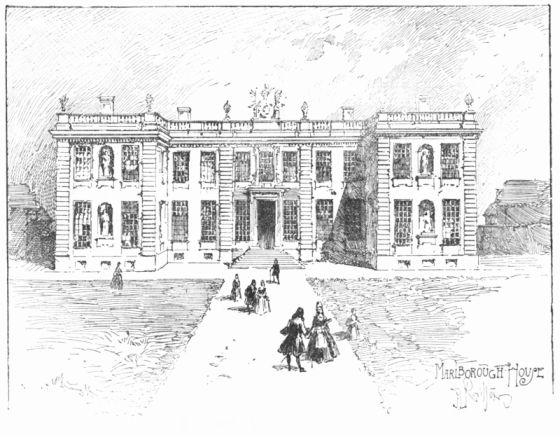
MARLBOROUGH HOUSE IN THE TIME OF ANNE.
[See larger version]
These obstacles to their entering into a dishonourable peace being removed, Gualtier was once more despatched to Versailles, and this time accompanied by Matthew Prior, a poet of some pretension and much popularity, but much more distinguished as a diplomatist. He had lived in France, knew the French and French Court well, having been secretary to the embassies of the Earls of Portland and Jersey. Prior was a man of courtly and insinuating manners, and devoted to Harley and the Tory interest. The propositions which he brought from the queen as the basis of the peace were—that the Dutch should have a barrier in the Netherlands; that the German Empire should have another on the Rhine; that the Duke of Savoy should receive back all towns or territories taken during the war; that proper protection should be obtained for the trade of England and Holland; that France should acknowledge the title of Anne and the Protestant succession; that the fortifications of Dunkirk should be destroyed; that Gibraltar and Port Mahon should continue in British possession; that Newfoundland and Hudson's Bay should also be acknowledged as British, but that the French should be allowed to trade to Hudson's Bay; that in other respects France and England should retain their possessions in America as they did before the war; that the Assiento, or contract for supplying the Spanish Colonies of South America with slaves—which had formerly been held by the Portuguese, but, since 1702, by the French—should be made over to England, with four towns on the Spanish Main, anywhere between the Straits of Magellan and California, as depôts for the slaves when first brought over. The terms might have been better, but they were substantial. As Prior and Gualtier had no powers to accept terms from France, M. Mesnager, an expert diplomatist, deputy from Rouen to the Board of Trade in Paris, was despatched to London with the English envoys. They were to return in all secrecy, and Mesnager was furnished with certain instructions wholly unknown to Prior and Gualtier. These were, that an equivalent for the destruction of the fortifications of Dunkirk was to be demanded; and that some towns in Flanders which the French had lost, particularly Lille and Tournay, should be restored. These demands he was to keep very close, and only cautiously but firmly open to the principal negotiators. But the secret was out that a treaty was on foot with France, and the general opinion was that the Ministers were bent on making peace on any terms. The Government, nevertheless, kept the matter as much out of sight as possible. The queen sent Prior to apologise to Mesnager for his being received in so secret a manner, and Oxford, St. John, Jersey, and Shrewsbury were appointed to confer with him privately. On the 8th of October the English Commissioners and Mesnager had agreed upon the preliminaries and signed them. Mesnager was then privately introduced to the queen at Windsor, who made no secret of her anxiety for peace, telling him she would do all in her power to complete the treaty and live in good-fellowship with the King of France, to whom she was so closely allied in blood. At supper she said publicly that she had agreed to treat with France. The Ministers were just as incautious, for Swift was invited by St. John the same evening to sup with him and a small party in his apartments in Windsor Castle. This party consisted of no other persons than Mesnager himself, Gualtier, and the infamous Abbé Dubois, tutor to the young Duke of Orleans, this profligate having also been engaged in assisting Mesnager in the treaty. With them was Prior. All these particulars Swift wrote, as he wrote everything, to Stella in Ireland. Yet when the preliminaries were handed to Count Gallas, the Imperial ambassador, who, in his indignation, immediately had them translated and inserted in one of the daily papers, the queen was so angry that she forbade his reappearing at Court, and informed him that he could quit the kingdom as soon as he thought proper. He departed immediately, and the queen, to prevent an explosion on the part of the Allies, wrote to the Emperor to say that she should be happy to receive any other person that he might send. Raby, now Earl of Strafford, was hurried to the Hague to announce to the States the fact of her having signed these preliminaries, and to desire them to appoint a spot where the Plenipotentiaries of the Allies and France should meet to discuss them. Both the Dutch and the Emperor were startled and greatly confounded at the discovery of the nature of the terms accepted. They used every means to persuade the queen to draw back and accept no terms except those which had been offered to France after the battle of Malplaquet, but rather to push on the war vigorously, certain that they must very soon obtain all they demanded.
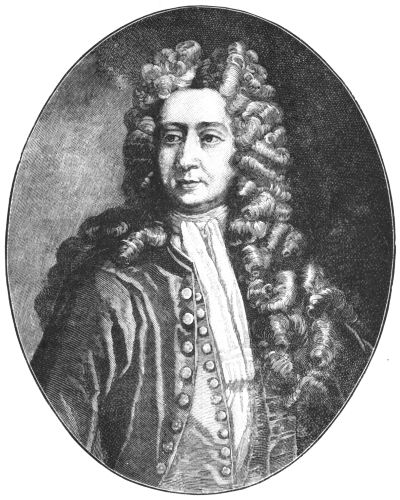
HENRY ST. JOHN (AFTERWARDS VISCOUNT BOLINGBROKE).
[See larger version]
Nor was the excitement less at home. The news was out—the preliminaries were before the public by the act of the Imperial ambassador, and the Whigs were in a fury of indignation. They accused the Ministers of being about to sacrifice the country, its power, and interests to a shameful cowardice at the very moment that the labours and sufferings of years had brought it to the verge of triumph, and when Louis XIV. was old and tottering into the grave, leaving his kingdom exhausted and powerless. But notwithstanding the violent opposition both at home and abroad, the Ministers persisted in their course. The queen wrote to the Electress Sophia of Hanover, entreating her and her son to use their exertions with the Allies for the peace of Europe. She sent over the Earl of Rivers to further her appeal; but the Electoral Prince, so far from dreading to endanger his succession, sent back a letter by Earl Rivers to the queen, strongly condemning the terms on which the peace was proposed, and he ordered his ambassador, the Baron von Bothmar, to present a memorial to the queen, showing the pernicious consequences to Europe of allowing Philip to retain Spain and the Indies. This bold and independent act greatly exasperated the queen and her Ministers, and was extolled by the Whigs. There had been attempts to influence the Elector by offering him the command of the army in Flanders, in case of the removal of Marlborough, but that also he declined.
Many of the Tories were as much opposed to the terms of the treaty as the Whigs, and it was proposed to unite in a strong remonstrance against the conduct of the Ministers in being willing to accept them; but the intention getting wind, the queen suddenly prorogued Parliament to the 7th of December, with the expectation of the arrival of absent Scottish peers, who were all Tories, and a determination, if necessary, to create a batch of English Tory peers. Notwithstanding all resistance, it was finally settled with the Allies that their representatives should meet those of England and France, to treat for a general peace, at Utrecht, on the 1st of January, 1712.
The Ministers, in the meantime, went on strengthening their position. Sir Simon Harcourt was created Baron Harcourt, and was raised from Lord Keeper of the Seal to Lord Chancellor; the Duke of Buckingham was appointed President of the Council in place of Lord Rochester, deceased, and was succeeded in his office of Steward of the Household by Earl Paulet, who had quitted the Treasury to make way for Harley's elevation to the Treasurership. The Duke of Newcastle dying, Robinson, Bishop of Bristol, was made Lord Privy Seal, a new thing since the days of Wolsey and Laud for a Churchman. In Scotland the Jacobites were so much elated by the proceedings of the Tories, and by whispers of what really took place, while Mesnager was in secret conference with the queen—namely, a zealous advocacy on his part of the setting aside the Protestant succession, and the re-admission of the Pretender's claims—that they proceeded to great lengths. They were in the end so daring as to induce the Faculty of Advocates of Edinburgh to receive a medal of the Pretender from the same ardent Duchess of Gordon who had sent him word to come when he pleased, and to what port he pleased, and that he would be well received. This medal had on the obverse side a head of the Pretender, with the words, "Cujus est?" and on the reverse the island of Britain and the word "Reddite." This they not only received, but sent hearty thanks to the duchess for it. The Hanoverian Ambassador was made aware of this incident, and presented a memorial on the subject, which, however, only served to bring Sir David Dalrymple, a zealous Whig and advocate for the Protestant succession, into trouble, on the plea that he ought to have prosecuted Mr. Dundas of Arniston for returning public thanks for the medal, whilst Arniston himself, who boldly published a vindication of his conduct, was suffered to escape.
On the opening of Parliament on the 7th of December, the queen announced that "notwithstanding the arts of those who delighted in war, both time and place were appointed for opening the treaty for a general peace." This was carrying into the Royal Speech the animus which the Tories had shown against the Whigs in all their speeches and pamphlets lately. They had endeavoured to make the Whigs odious to the nation as a faction bent on war solely for its own selfish interests, and regardless of the interests of the nation or the sufferings of mankind. Though the Speech contained other matters, everything else passed without criticism or notice. This declaration produced a vehement sensation, and roused all the party fire on both sides. The Ministers were astonished to see the Earl of Nottingham, who had hitherto gone with them, now adopt the Whig side in a very vigorous and telling speech. He denounced the preliminaries as basely surrendering the great objects of the war, and moved that a clause should be inserted in the Address to the effect that no peace could be safe or honourable to Great Britain or to Europe, if Spain and the Indies should be allotted to any branch of the House of Bourbon. In the discussion it was shown that the statement in the queen's Speech, that the Allies were all prepared to adopt the preliminaries, was utterly untrue. The Earl of Anglesey contended, on the other side, that it was high time to ease the nation of the monstrous burthens of the war; and he aimed some heavy blows at the Duke of Marlborough, affirming that a good peace might have been effected after the battle of Ramillies, but for the private interests of certain persons.
This called up Marlborough in his own defence. He bowed towards the place where the queen was listening to the debate incognita, and appealed to her, much to her embarrassment, whether, when he had the honour to serve her Majesty as plenipotentiary as well as general, he had not always faithfully informed her and her Council of all the proposals of peace which had been made, and had desired instructions for his guidance in such affairs. He appealed also to Heaven, whether he was not always anxious for a safe, honourable, and lasting peace, and whether he was not always very far from entertaining any design of prolonging the war for his own private advantage, as his enemies had most falsely insinuated. When the question was put, the amendment of the Earl of Nottingham was carried by a majority of sixty-two to fifty-four—that is, of only eight—notwithstanding all the exertions of the Court party, and much to its astonishment. In the Commons, however, the Ministry had a stronger party, and there they assured the queen in their Address that they would do all in their power to disappoint as well the acts and designs of those who for private views might delight in war, as the hopes of the enemy conceived from the divisions amongst themselves. Walpole moved an amendment similar to that of the Lords, and it was lost by a majority of two hundred and thirty-two to one hundred and six.
The Ministers were determined now to be rid of Marlborough. He not only stood at the head of the Whigs at home, and threw his great military reputation into the scale against the Tories in this question of peace or war, but whilst he retained his command of the army, he immensely strengthened the opposition of the Allies to the present terms of pacification. It was resolved that he should be dismissed, a measure which they felt would destroy much of his influence. The Whigs, moreover, at this crisis fell into a snare laid for them by the Earl of Nottingham, which extremely damaged them, and in the same proportion benefited the Tories. He persuaded them that if they would only consent to the passing of the Occasional Conformity Bill, there were numerous persons of influence ready to quit the ranks of Oxford and St. John; and though the Whigs were entirely opposed in principle to this illiberal and unjust measure, they were weak enough, in the hope of strengthening their party, to permit it to pass. The Dissenters, greatly exasperated at this treachery, abandoned the Whig cause; the promised proselytes did not come over, and Lord Dartmouth adds that "Lord Nottingham himself had the mortification afterwards to see his Bill repulsed with some scorn, and himself not much better treated."
In this state of affairs closed the year 1711. During the Christmas holiday the Ministry matured several measures for the advancement of their party. They were still in a minority in the Lords, and they sought to remedy this by inducing the queen to create twelve new peers. Lord Dartmouth, in his notes to Burnet, expresses his astonishment on seeing the queen suddenly take from her pocket a list of twelve new lords, and ordering him to bring warrants for them. Dartmouth, unprepared for so sweeping a measure, asked whether her Majesty intended to have them all made at once; and Anne replied, "Certainly; that the Whigs and Lord Marlborough did all they could to distress her; that she had made fewer lords than any of her predecessors; and that she must help herself as well as she could." Among these new peers were again two Scotsmen, but not peers, only the sons of peers, and the husband of her favourite, Mrs. Masham. The witty Lord Wharton did not spare a joke upon them at the time, by asking one of them, when the question was put, whether "they voted by their foreman?" as though they had been a jury.
The disgrace of Marlborough was now completed. On the 21st of December he had been charged in the House of Commons with having made use of his command of the army to make enormous sums of money at the expense of the men; that he had appropriated one hundred and seventy-seven thousand pounds by taking two and a half per cent. on all subsidies for foreign troops maintained by England, and sixty-three thousand pounds from Sir Solomon de Medina and Antonio Alvarez Machado, the Jew contractors for bread for the army; that his secretary, Cardonnel, had exacted five hundred gold ducats from the contractors each time a new contract was signed, all which had to be taken out of the quality of the food or clothing of the soldiers. The queen therefore wrote to him, informing him that as there was a serious charge made against him by the Commissioners of Accounts, she thought it best to dismiss him from all his employments in order that the matter might be impartially investigated. Nor did she neglect to add that the conduct of his wife towards herself had made her more willing to adopt this measure.
Marlborough, in defence, pleaded to the queen, as he had to the Commissioners of Inquiry, that he had appropriated nothing which had not been the established perquisites of the commander-in-chief of the army in the Low Countries both before the Revolution and since; and that, whatever sums he had received from those sources, he had employed in the service of the public in keeping secret correspondence, and in getting intelligence of the enemy's motions and designs; and that, and he could certainly say it with justice, he had employed this money so successfully, that he had on no occasion suffered himself to be surprised, but had often been able to surprise and defeat the enemy. To this cause, next to the blessing of God and the bravery of the troops, he attributed most of the advantages of the war. There can be little doubt that Marlborough made the best of the power granted him for appropriating these sums; that was his weak point; but he does not appear to have exceeded the letter of his warrant; and the truth is that the system itself was more in fault than the general.
But notwithstanding Marlborough's proofs that his appropriations were according to long-established custom, the Commons admitted no such plea. They voted that the two and a half per cent. deducted by him from the pay of the foreign troops was public money, and that he ought to account for it. They threatened to institute proceedings for its recovery through the law officers of the Crown, and they expelled Cardonnel, the duke's secretary, from the House for his receipt of the fees mentioned in the contracts. They had the satisfaction, also, of punishing Robert Walpole, one of Marlborough's most staunch defenders, for taking, when Secretary of War, five hundred guineas, and a note for five hundred more, on the signing of a contract for forage for her Majesty's troops quartered in Scotland. The deed deserved punishment, but it was one which all secretaries perpetrated equally with Walpole, as he showed, and which would never have been noticed had Walpole yielded to the Tory entreaties and carried his great abilities to their side. They, however, voted the fact a high breach of trust, and of notorious corruption, and ordered his expulsion from the House and his committal to the Tower. The borough of Lynn, which Walpole represented, immediately re-elected him; but the Commons pronounced him incapable of sitting in that Parliament, and declared the election void.