Chapter III
Reading edition
END OF THE REIGN OF CHARLES I.
Differences between the Presbyterians and Independents—The King at Holmby—Attempt to Disband the Army—Consequent Petitions to Parliament—The Adjutators—Meeting at Newmarket—Seizure of the King—Advance of the Army on London—Stubbornness of the Presbyterians—The Army Marches through London—Its Proposals to Charles—Their Rejection—The King throws away his Best Chances—The Levellers—Cromwell's Efforts on behalf of Charles—Renewed Intrigues of Charles—Flight to Carisbrooke—Attempts to Rescue the King—Charles Treats with the Scots—Consequent Reaction in his Favour—Battle of Preston and Suppression of the Insurrection—Cromwell at Edinburgh—The Prince of Wales in Command of the Fleet—Negotiations at Newport—Growing Impatience of the Army—Petitions for the King's Trial—Charles's Blindness and Duplicity—He is Removed to Hurst Castle—Pride's Purge—Supremacy of the Independents—The Whiggamores—Hugh Peters' Sermon in St. Margaret's, Westminster—Ordinance for the King's Trial—Trial and Execution of Charles I.
For a long time the difference of opinion between the Presbyterians and the Independents had been growing more marked and determined. The latter, from a small knot of Dissenters, had grown into a considerable one, and the more influential, because the most able and active, leaders of both Parliament and army were of that sect. Under the head of Independents, however, ranged themselves, so far as politics were concerned, a variety of other Dissenters—Arminians, Millenaries, Baptists and Anabaptists, Familists, Enthusiasts, Seekers, Perfectists, Socinians, Arians, and others—all of whom claimed freedom of worship, according to their peculiar faiths. On the other hand, the Presbyterians, backed by the Scots, were bent on establishing a religious despotism. Their tenets and form of government were alone to be tolerated. They were as resolute sticklers for conformity as the Catholics, or Charles and Laud themselves. They set up the same claims to be superior to the State, and allowed of no appeal from their tribunals to those of the civil magistrate. Having established the Directory for the form of worship, they erected an assembly, with its synods, and divided the whole kingdom into provinces, the provinces into classes, the classes into presbyteries or elderships. They declared that "the keys of the kingdom of heaven were committed to the officers of the Church, by virtue whereof they had power to retain and remit sins, to shut the kingdom of heaven against the impenitent by censures, and to open it to the penitent by absolution." They claimed a right to inquire into the private lives of persons, and of suspending the unworthy from the Sacrament.
All these assumptions the Independents denied, and would not admit any authority over the free action of individual congregations. The Commons, through the influence of Selden and Whitelock, proposed to the Assembly of Divines nine questions respecting the nature and object of the divine right to which they aspired, and before they could answer these, the army and the Independents, its leaders, had effected still more embarrassing changes. The king being conquered, and the Scots having withdrawn, the contest lay no longer between the king and Parliament, but between the Presbyterians and Independents, or, what was nearly synonymous, the Parliament and the Army.
The king was conducted to Holmby by easy journeys, and treated by his attendants with courtesy. The people flocked to see him, and showed that the traditions of royalty were yet strong in them. They received him with acclamations, uttered prayers for his preservation, and not a few of them pressed forward to be touched for the "evil." On his arrival at Holmby, he found a great number of ladies and gentlemen assembled to welcome him, with every demonstration of pleasure, and his house and table well appointed and supplied. He passed his time in reading, in riding about the country, and in different amusements—as chess and bowls, riding to Althorpe, or even to Harrowden, because there was no good bowling-green at Holmby. One thing only he complained of, and requested to have altered. The Parliament sent him clergymen of their own persuasion to attend him; he begged that any two out of his twelve chaplains might be substituted, but was refused. The Presbyterian ministers allotted him were Thomas Herbert, and Harrington, the author of "Oceana," with whose conversation Charles was much pleased on all subjects but religion and form of government. But though Charles passed the bulk of his time in relaxation, he was not insensible to his situation; and when he had been left there for three months without notice, he addressed to Parliament a letter in which he proposed to allow Presbyterian Church government for three years, his own liberty of worship being granted, and twenty clergymen of the Church of England admitted to the Westminster Assembly; the question of religion at the end of that period was to be finally settled by himself and the two Houses in the usual way, and the command of the army was also to be left to Parliament for ten years, and then to revert to him. The Lords gladly assented to this offer, but the Commons did not entertain it, and other matters soon claimed their attention.
The Presbyterians had, during the active engagements of the army, and the consequent absence of the leading Independents, strengthened their ranks by many new members of Parliament, and they now set about to reduce the power of their opponents by disbanding the greater part of the army. They decreed in February that three thousand horse, twelve hundred dragoons, and eight thousand four hundred foot, should be withdrawn from Fairfax's army and sent to Ireland, and that besides one thousand dragoons and five thousand four hundred horse, all the rest of the army should be disbanded, except as many soldiers as were necessary to man the forty-five castles and fortresses which remained. This would have completely prostrated the power of the Independents; and Cromwell, on whose shrewd character and military success they now looked with terror, would have been first sacrificed, as well as Ireton, Ludlow, Blake, Skippon, Harrison, Algernon Sidney, and others, who had fought the real battle of the late contest. The heads of the Presbyterians in Parliament consisted of unsuccessful commanders—Holles, Waller, Harley, Stapleton, and others—who hated the successful ones, both on account of their brilliant success and of their religion. Fairfax, though a Presbyterian, went along with his officers in all the love of toleration.
It was voted in the Commons, not only that no officer under Fairfax should have higher rank than that of colonel, but that no one should hold a commission who did not take the Covenant and conform to the government of the Church as fixed by Parliament. This would have been a sweeping measure, had the Parliament not had a very obvious party motive in it, and had it paid its soldiers, and been in a condition to discharge them. But at this moment they were immensely in arrears with the pay of the army, and that body, feeling its strength, at once broke up its cantonments round Nottingham, and marched towards London, halting only at Saffron Walden. This movement created a terrible alarm in the City, Parliament regarded it as a menace, but Fairfax excused it on the plea of the exhausted state of the country round their old quarters. The Commons hastened to vote sixty thousand pounds towards the payment of arrears, which amounted to forty-three weeks for the horse and eighteen for the infantry. In the City, the Council and the Presbyterians got up a petition to both Houses, praying that the army might be removed farther from London; but at the same moment a more startling one was in progress from the Independents, addressed to "the supreme authority of the nation, the Commons in Parliament assembled." It not only gave this significant hint of its opinion where the real power of the State lay, but denounced the House of Lords as assuming undue authority, and complained of the persecution and exclusion from all places of trust of those who could not conform to the Church government imposed. The House of Commons condemned this Republican petition, and ordered the army not to approach nearer than twenty-five miles of London. A deputation was sent down to Saffron Walden, where Fairfax summoned a convention of officers to answer them. These gentlemen, on the mention of being sent to Ireland, said they must know, before they could decide, what regiments, what commanders were to go, and whether they were sure of getting their arrears and their future daily pay. They demanded their arrears and some recompense for past services. The Commissioners, not being able to answer these demands, returned and reported to the Commons, mentioning also a petition in progress in the army. Alarmed at this, the Commons summoned to their bar some of the principal officers—Lieutenant-General Hammond, Colonel Robert Hammond, his brother, Colonel Robert Lilburn, Lieutenant-Colonel Grimes, and Colonel Ireton, Cromwell's son-in-law, a member of the House; and they voted that three regiments, commanded by the staunch Presbyterian officers Poyntz, Copley, and Bethell should remain at home. But what roused the army more than all besides, was a motion made by Denzil Holles, and carried, that the army's petition, which was not yet presented, was an improper petition, and that all who were concerned in it should be proceeded against as enemies to the State and disturbers of the public peace.
This declaration of the 30th of March was little short of an act of madness. It could only excite the indignation of a power against which the Parliament, grown unpopular, and divided against itself, was but as a reed in a whirlwind. The officers pronounced it "a blot of infamy" upon them, and the Parliament was glad to attempt to lay the storm by voting, on the 8th of April, that the regiments of Fairfax, Cromwell, Rossiter, Whalley, and Graves, should remain in England. A week afterwards the Commons sent down another deputation, accompanied by the Earl of Warwick, who harangued the officers earnestly to engage for Ireland, promising that Major-General Skippon should command them. Many were pleased with them, but more cried out, "Fairfax and Cromwell! Give us Fairfax and Cromwell, and then we all go!"
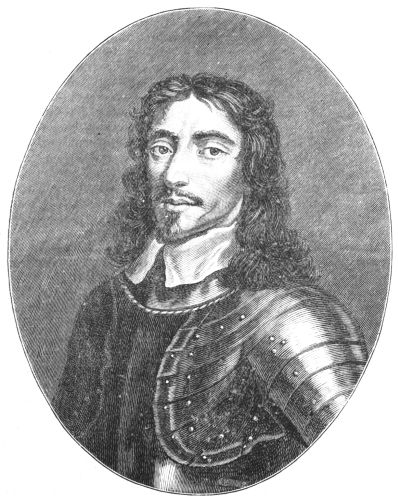
LORD FAIRFAX. (After the Portrait by Cooper.)
[See larger version]
On the return of the deputation without success, the Commons debated whether they should not disband the whole army. Holles strongly recommended it, and that they should give the soldiers six weeks' pay on disbanding. He thought it would be easy then to engage the men to go to Ireland under other officers, and that four of those officers who were regarded as most hostile in this movement should be summoned to the bar of the House. How miserably he was mistaken was immediately shown, for a petition was presented that very day (the 27th of April), signed by Lieutenant-General Hammond, fourteen colonels and lieutenant-colonels, six majors, and one hundred and thirty captains, lieutenants, and other commissioned officers. It was drawn up in energetic language, complaining of the calumnies spread abroad regarding the army, and enumerating the services they had done, the sacrifices they had made for the Commonwealth, and praying for the payment of the soldiers' arrears. It declared, indeed, that this movement of petitioning had commenced amongst the soldiers, and that the officers had been induced to take it up to prevent anything unacceptable to the House from being put forward.
But the petition of the officers did not prevent the petition of the men. When they saw the Commons did not immediately comply with the petition of the officers, smarting under the vote of disbandment, coupled with the withholding of their pay, horse dragoons and infantry went on their own way. They had lately entered into an association to make their complaints known. The officers had established a military council to consult on and take care of the interests of the army, and the men established a council too. Two commissioned officers, but not exceeding in rank ensigns, and two private soldiers from each regiment, met from time to time to discuss the wants of the army. They were called Adjutators or assistants in the cause, and the word soon became corrupted into Agitators. Thus there was a sort of army Parliament—the officers representing the Peers, the soldiers the Commons. The whole scheme has been, and it is probable very justly, ascribed to the genius of Cromwell. What confirms the supposition is, that an old friend of his, Berry, a captain, became its president, and that Ayres and Desborough, his two particular friends, the latter of whom had married his sister, were in close communication with the leading officers amongst the Agitators.
These movements on the part of the army, and the zealous manner in which Cromwell rose and vindicated the conduct of the soldiers on this occasion, warning the House not to drive so loyal and meritorious a body as the army to desperation, caused them to order him, Skippon, and Fleetwood to go down to the army and quiet its discontent by assuring the soldiers of pay and indemnification. These three, on the 7th of May, met the officers, who demanded time to prepare an answer after consulting their regiments. There appeared to have been doubts and dissension sown by the Presbyterians, and as the different regiments came to opposite conclusions, the Parliament thought it might venture to disband them. On the 25th it was settled that such regiments as did not volunteer for Ireland should be disbanded at fixed times and places. Fairfax, pleading indisposition, left the House and hastened down to the army, and immediately marched it from Saffron Walden to Bury St. Edmunds. The soldiers declared that they would not disband till they were paid, and demanded a rendezvous, declaring that if the officers did not grant it they would hold it themselves. Fairfax announced this to the Parliament, praying it to adopt soothing measures; and that, though he was compelled to comply with a measure out of order, he would do what he could to preserve it. The House, on the 28th, sent down the Earl of Warwick, the Lord Delaware, Sir Gilbert Gerrard, and three other members of the Commons, to promise eight weeks' pay, and to see the disbanding effected. On hearing the terms from the Commissioners, the soldiers exclaimed:—"Eight weeks' pay! We want nearer eight times eight!" There was universal confusion; the men refused to disband without full payment. They hastened to their rendezvous at Bury St. Edmunds, each man paying fourpence towards the expenses; and they ordered that the army should draw together, and a general rendezvous be held on the 4th of June. At Oxford the soldiers seized the disbanding money as part payment, and demanded the rest, or no disbanding.
On the 4th and 5th of June, accordingly, the grand rendezvous was held on Kentford Heath, near Newmarket. They entered into a covenant to see justice done to one and all, and not till then to listen to any other orders or terms. Meanwhile, a still more extraordinary scene had taken place, of which the direct springs may be guessed, but which springs were so closely concealed that no clever historian could ever lay them bare. Scarcely was the honourable House of Commons in possession of the news of the Kentford Heath rendezvous, when it was paralysed by this still more amazing announcement.
The House of Lords, not liking the proceedings of the army, had ordered the king for greater safety to be removed from Holmby to Oatlands, nearer the capital. The army anticipated that move; and by whose orders no man knows, nor ever will know, Cornet Joyce, of Whalley's regiment, followed by a strong party of horse, presented himself on the 2nd of June, a little after midnight, at Holmby House. After surrounding the house with his troop, said to be one thousand strong, he knocked and demanded admittance, telling Major-General Brown and Colonel Graves that he was come to speak to the king. "From whom?" demanded these officers, awoke from their sleep. "From myself," said Joyce; whereat they laughed. But Joyce told them it was no laughing matter. They then advised him to draw off his troops, and in the morning he should see the Commissioners. Joyce replied that he was not come there to be advised by them, or to talk to the Commissioners, but to speak to the king; and speak to him he would, and that soon. At this threat Brown and Graves bade their soldiers stand to their arms and defend the place; but the soldiers, instead, threw open the doors, and bade their old comrades welcome. Joyce then went direct to the chamber of the Commissioners, and informed them that there was a design to seize the king, and place him at the head of an army to put down that under General Fairfax; and that, to prevent another war, he was come to secure the person of the king, and see that he was not led into further mischief; for, added the cornet, "there be some who endeavour to pull down king and people, and set up themselves."
The Commissioners desired him not to disturb the king's sleep, but to wait till morning, and they would tell his majesty of his arrival and business. In the morning Joyce found that Brown had contrived to send off Graves to fetch up the king's guard; and "some of his damning blades did say and swear they would fetch a party." But Joyce—a stout fellow for a tailor, which he had been—did not trouble himself about that, for he knew the guard would not move, and at length insisted on being admitted to the king himself.
According to Joyce's own account, it was ten o'clock in the evening again when he was ushered, with two or three of his followers, into the royal presence. The soldiers took off their hats, and displayed no rudeness, but a blunt proceeding to business. According to Clarendon, the cornet told the king that he was sorry to have disturbed his sleep, but that he must go with him. Charles asked whither. He said to the army. But where was the army, replied the king. The cornet said they would show him. His majesty asked by what authority they came. Joyce said "By this!" and showed him his pistol, and desired his majesty to cause himself to be dressed, because it was necessary they should make haste. The king sent for the Commissioners, who asked Joyce whether he had any order from Parliament. He said no. From the general? No. What, then, was his authority? He gave the same reply as to the king, by holding up his pistol. They said they would write to the Parliament to learn its pleasure, to which Joyce replied, they could do so, but the king meanwhile must go with him.
Finding that the soldiers sent for would not come, and that the officers of the guard said that Joyce's troop were not soldiers of one regiment, but drawn from several regiments, and that Joyce was not their proper officer, it was clear that there was a general design in the affair, and the king said he would go with them at six in the morning. At the hour appointed the king appeared on horseback, and found the troop all mounted and ready. The king had overnight demanded of Joyce whether he should be forced to do anything against his conscience, and whether he should have his servants with him; and Joyce replied that there was no intention to lay any constraint on his majesty, only to prevent his being made use of to break up the army before justice had been done to it. Before starting, Charles again demanded from Joyce, in the presence of the troop, where was his commission, enjoining him to deal ingenuously with him, and repeating, "Where, I ask you again, is your commission?" "Here," said Joyce, "behind me," pointing to the soldiers. Charles smiled, and said, "It is a fair commission, and as well written as I have ever seen a commission written in my life; a company of handsome, proper gentlemen, as I have seen a great while. But what if I should refuse to go with you? I hope you would not force me. I am your king; you ought not to lay violent hands on your king. I acknowledge none to be above me here but God." He then demanded again whither they proposed to conduct him. Oxford and Cambridge were named, to both of which places Charles objected. Newmarket was next named, and to that he consented. So the first day they rode to Hinchinbrook, and the next to Childersley, near Newmarket.
The news of these proceedings of the army carried consternation into the two Houses of Parliament, and into the City, where the Presbyterian party was in full strength. They ordered the immediate arrest of Cromwell, which they had been intending some time, but they were informed that he left town the very same morning that Joyce appeared at Holmby—a significant fact—and was seen riding away with only one attendant. He reached the headquarters of the army with his horse all in foam. The House voted to sit all the next day, though it was Sunday, and have Mr. Marshall to pray for them. Rumour declared that the army was on its march, and would be there the next day at noon. The House ordered the Committee of Safety to sit up all night, taking measures for the protection of the City; the train-bands to be called out, and all the lines of communication guarded. The next day the shops were shut, the town was in indescribable confusion, and terror in every face, as though the army was already there. The Parliament wrote to Fairfax, commanding that the army should not infringe the order of the two Houses, by coming within twenty-five miles of London, that the king should be returned to the care of the Commissioners who attended him at Holmby, and that Colonel Rossiter's regiment should guard his person. Fairfax replied that the army had reached St. Albans before he received their command, but it should proceed no farther; that he had sent Colonel Whalley with his regiment to meet his majesty on his way from Holmby, and offered to return him thither, but that he preferred the air of Newmarket, and that all care should be taken of his person.
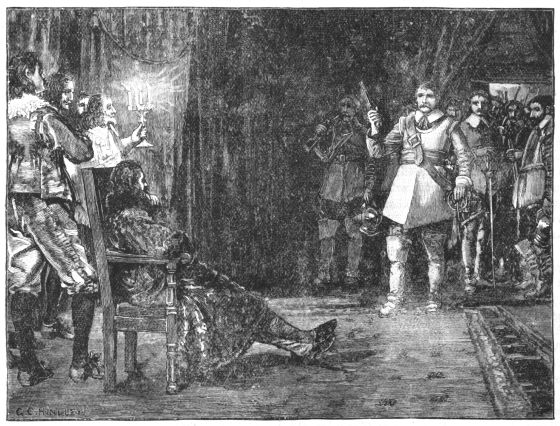
CORNET JOYCE'S INTERVIEW WITH CHARLES. (See p. 63.)
[See larger version]
In fact, Charles was delighted with the change. He had escaped from the harsh keeping and the strict regimen of the Presbyterians, whom he detested, and felt himself, as it were, a king again at the head of an army: the dissensions now rushing on so hotly between his enemies wonderfully encouraging his hopes of making friends of the more liberal party. He was in a condition of greater freedom and respect in the army than he had been at Holmby: there was a larger number of troops and the officers were superior. He was relieved from the presence of Cornet Joyce. All restraint being taken off from persons resorting to him, he saw every day the faces of many that were grateful to him. No sooner did he ask for the attendance of his own chaplains than those he named (Drs. Sheldon, Morley, Sanderson, and Hammond) were sent for, and performed the service regularly, no one being forbidden to attend. The king was left to his leisure and his friends, only removing with the army as it moved, and in all places he was as well provided for and accommodated as he had been in any progress. The best gentlemen, Clarendon admits, of the several counties through which he passed, daily resorted to him without distinction. He was attended by some of his old trusty servants in the places nearest his person. On hearing of his present condition, the queen sent Sir John Berkeley from Paris, and his old groom of the chambers, who had been living at Rouen, to be with him again, and they were freely admitted by Cromwell and Ireton. "Many good officers," says Clarendon, "who had served his majesty faithfully, were civilly received by the officers of the army, and lived quietly in their quarters, which they could not do anywhere else, which raised a great reputation to the army throughout England, and as much reproach upon Parliament." This was raised still more by the army's address to Parliament, desiring that "care might be taken for settling the king's rights, according to the several professions they had made in their declarations; and that the royal party might be treated with more candour and less rigour." Even the most devoted of Royalists, Sir Philip Warwick, says, "The deep and bloody-hearted Independents all this while used the king very civilly, admitting several of his servants and some of his chaplains to attend him, and officiate by the service-book."
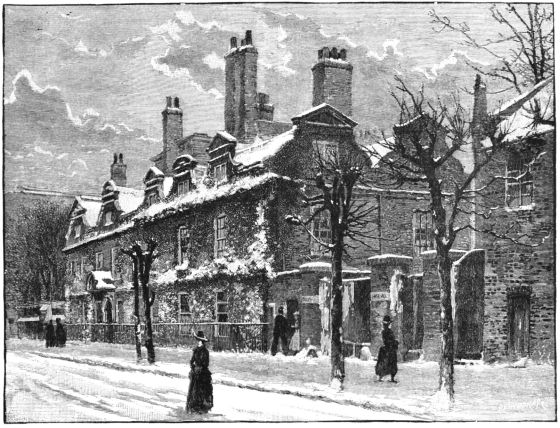
FAIRFAX HOUSE, PUTNEY. (From a Photograph by W. Field & Co., Putney.)
[See larger version]
The Commons ordered all officers to attend their regiments, and sent down Commissioners to inform the army of the votes of the two Houses. The army gave the Commissioners such a reception as no Commissioners had ever witnessed before. Twenty-one thousand men had assembled to a rendezvous on Triploe Heath, near Royston; and the General and the Commissioners rode to each regiment, to acquaint them with the Parliamentary votes as to their instalment of pay, their disbanding, and their not approaching within twenty-five miles of London. The answer was sent up in shouts of "Justice! justice!" A petition also from the well-affected people of Essex was delivered on the field to the General in presence of the Commissioners, against the disbanding, declaring "that the Commonwealth had many enemies, who watched for such an opportunity to destroy the good people." A memorial was, moreover, drawn up and signed by the General and all the chief officers, to the Lord Mayor and Corporation of London, warning them against false representations of the intentions of the army, for that the war being at an end, all that they desired and prayed for was that the peace of the kingdom should be settled according to the declarations of Parliament before the army was called out, and that being done, the army should be paid before it was disbanded.
So far from pacifying the Parliament, these proceedings alarmed it infinitely more, and it issued an order that the army should not come within forty-five miles of the capital. On its part, the army collected addresses from Norfolk, Suffolk, Essex, and the surrounding counties, praying the purgation of the House from all such members as were disqualified from sitting there by corruption, delinquency, abuse of the State, or undue election; and on the 16th of June, from its headquarters at St. Albans, the army formally impeached of high treason eleven of the most active Presbyterian members. This impeachment was presented to the House by twelve officers of the army—colonels, lieutenant-colonels, majors, and captains. Within a few days the General and officers sent a letter to the House, informing it that they would appoint proper persons to conduct the impeachment, and make good their charges; and desired the House to suspend the accused forthwith, as it was not fitting that those persons who had done their best to prejudice the army should sit as judges of their own actions.
This, says Clarendon, was an arrow out of their own quiver, which the Commons did not expect; and though it was a legitimate consequence of the impeachments of Strafford, Laud, and others, they endeavoured to set it at defiance. The Parliament and its army were, in fact, come to the pass which the brave old Royalist, Sir Jacob Astley, had foreseen when he surrendered his regiment at Stowe, in 1646:—"You have done your work, my masters, and may go and play, unless you will fall out amongst yourselves."
The army, to settle the matter, marched from St. Albans to Uxbridge, and at that sight the eleven members withdrew from the House of Commons, and the Commons assumed a modest and complying behaviour, voting the army under Fairfax to be the real army of England and worthy of all respect. They sent certain proposals to Fairfax, which induced him to remove his headquarters from Uxbridge to Wycombe. The eleven members, looking on this as a degree of submission to Parliament, immediately plucked up courage, and Holles and the rest appeared in their places, preferring charges in return against the officers, and demanding a fair trial. But they soon perceived their mistake, and, soliciting the Speaker's leave of absence and his passport to go out of the kingdom, disappeared.
The struggle between the army and Parliament—that is, between the Presbyterian and Independent interests—was all this time raging. For six weeks the army was advancing or retiring, according as the Parliament acted; the Parliament only giving way through intimidation. According as affairs stood, the City was either peaceful or in alarm, now shutting its shops, now carrying on much negotiation; the army lying still near, and paid more regularly, out of terror, by the Parliament. At length the army had so far succeeded as to have the insulting declaration of Holles—"the blot of ignominy"—erased from the journals of the House, and the ordinance of the 4th of May—procured by Holles—for the placing of the militia of the City in more exclusively Presbyterian hands—revoked. But towards the end of July the strong Presbyterian element in London was again in such ferment that it forgot its terrors of the army, and proceeded to daring extremities. The Presbyterian faction demanded that conventicles—that is, the meeting-houses of all classes, except Presbyterians—should be closed, and called on the citizens to meet in Guildhall to hear the Covenant read, and sign an engagement—soldiers, sailors, citizens, and apprentices—to drive away the army and bring the king to Westminster, and make a treaty with him. A hundred thousand signatures were put to this paper, and had the courage been half as great as the bluster the army had been swept to destruction. On the 26th of July, a few days afterwards, a vast rabble surrounded the Houses of Parliament, calling on both Lords and Commons to restore the order regarding the City militia; they crowded into the Houses with their hats on, crying, "Vote! vote!" and their numbers keeping the doors open. Under this intimidation both Lords and Commons voted the restoration of the Presbyterian ordinance for the change of the militia, and adjourned to Friday.
On Friday the two Houses met, but were astonished to find that their Speakers had fled, accompanied by several members of both Houses, and were gone to the army. It was found that Sir Henry Vane, the Earl of Northumberland, the Earl of Warwick, and other Lords and Commoners were gone. Had it been only Sir Henry Vane and the Independents who had gone, it would have astonished nobody; but neither Lenthall, the Speaker of the Commons, nor the Earl of Manchester, the Speaker of the Lords, was suspected of any great leaning to the army, whilst Warwick was a staunch Presbyterian, and Northumberland so much in the favour of that party as to have the care of the royal children. This circumstance showed the violence of the mob which had forced Parliament, and rendered moderate men resolved to escape rather than submit to be its puppets. There were no less than fifteen Lords and a hundred Commoners who had thus resented mob intimidation.
On making this lamentable discovery, the two Houses elected temporary Speakers, and issued orders forbidding the army to advance, recalling the eleven fugitive members, and ordered Massey, Waller, and Poyntz to call out the militia and defend the City.
No sooner had Fairfax heard the news of these proceedings than he instantly sent the king to Hampton Court, and marched from Bedford to Hounslow Heath, where he ordered a general rendezvous of the whole army. On Hounslow Heath, at the appointed rendezvous, the Speakers of the two Houses, with their maces, and attended by the fugitive Lords and Commons, stated to the general that they had not freedom in Westminster, but were in danger of their lives from tumult, and claimed the protection of the army. The general and the officers received the Speakers and members with profound respect, and assured them they would reinstate them in their proper places, or perish in the attempt. Nothing, in fact, could have been such a godsend to the army; for, besides their own grievances, they had the grievances of the coerced members to redress, and the sanctity of Parliament to defend. They ordered the most careful accommodation for the comfort of the members, and a guard to attend them, consulting them on all their measures. Fairfax quartered his army about Hounslow, Brentford, Twickenham, and the adjacent villages, at the same time ordering Colonel Rainsborough to cross the Thames at Hampton Court with a brigade of horse and foot and cannon, and to secure Southwark and the works which covered the end of London Bridge.
Meanwhile, never was London in more terrible confusion. The Commons, having no mace of their own, sent for the City mace. The colonels were in all haste calling out the militia. On Saturday and Monday, August 1 and 2, the shops were all shut, nothing going on but enlisting and mustering. St. James's Fields were in a stir with drilling; news constantly coming of the approach of the army. "Massey," says Whitelock, "sent out scouts to Brentford; but ten men of the army beat thirty of his, and took a flag from them. The City militia and Common Council sat late, and a great number of people attended at Guildhall. When a scout came in and brought news that the army made a halt, or other good intelligence, they cried, 'One and all!' But if the scouts brought word that the army was advancing, then they would cry as loud, 'Treat! treat! treat!' and thus they spent the night."
Tuesday, August the 3rd, was a fearful day. The people of Southwark declared that they would not fight against the army, and went in crowds to Guildhall, demanding peace, at which Poyntz lost all patience, drew his sword, and slashed many of them, some mortally.
The Southwarkers kept their word, for they received Rainsborough and his troops; the militia openly fraternised with the soldiers, shaking hands with them through the gates, and abandoned to them the works which protected the City. Rainsborough took possession, without opposition, of all the forts and works on that side of the river from Southwark to Gravesend. In the morning the authorities of the City, finding that Southwark was in possession of the army, and the City gate on that side in their hands, were completely prostrated and hastened to make their submission. Poyntz, accustomed to conquest in the field, and the hardihood of the Presbyterian soldiers, was filled with contempt for these cringing, cowering citizens. What! had they not ten thousand men in arms, a loan of ten thousand pounds arranged and orders to raise auxiliary troops to the amount of eighteen regiments? Had they not plenty of ammunition and arms in the Tower, whence they had drawn four hundred barrels of gunpowder and other material for present defence? But all availed not; the citizens hastened to lay themselves and the City at the feet of Fairfax. He had fixed his headquarters at Hammersmith, but he met the civic authorities at Holland House, Kensington, where he dictated the following conditions:—That they should abandon the Parliament now sitting and the eleven impeached members; should restore the militia to the Independents; surrender all their forts, including the Tower; recall their declarations, and conduct themselves peaceably.
On Friday, the 6th of August, Fairfax entered the City, preceded by a regiment of infantry and another of cavalry. He was on horseback, attended by his body-guards and a crowd of gentlemen. A long train of carriages, containing the fugitive Speakers and members (Lords and Commons), followed, and then another regiment of cavalry. The soldiers marched three abreast, with boughs of laurel in their hats. The late turbulent multitudes completed their shame by raising forced acclamations as they passed. Fairfax thus proceeded through Hyde Park, where the Corporation met him, and offered him a great gold cup, which he curtly declined, and so rode on to the Houses of Parliament, where he replaced the Speakers in their respective chairs, and the members in their old places. Not one of the Lords who had remained, except the Earl of Pembroke, ventured to appear, and he declared that he considered the proceedings since the departure of the Speakers as null. No sooner were the Speakers in their places than Parliament voted thanks to the general and the army; made Fairfax commander of all the forces in England and Wales, and Constable of the Tower. It ordered a gratuity of a month's pay for the army, and that the City militia should be divided, and Southwark, Westminster, and the Tower Hamlets should command their own. The Lords voted all Acts of Parliament from the departure of the Speakers, on the 26th of June, to their return on the 6th of August, void; but the resolution did not pass the Commons, where there was a large body of Presbyterians, without much opposition.
The eleven impeached members fled, and were allowed to escape into France, whereupon they were voted guilty of high treason, as well as the Lord Mayor and four aldermen of London, two officers of the train-band, and the Earls of Suffolk, Lincoln, and Middleton, the Lords Willoughby, Hunsdon, Berkeley, and Maynard. The civic officers were sent to the Tower. The City was ordered to find the one hundred thousand pounds voted for the army. Fairfax distributed different regiments about Whitehall and the Houses of Parliament for their protection, and others in the Strand, Holborn, and Southwark, to keep the City quiet. His headquarters were moved to Putney, with forces at Chelsea and Fulham. On Sunday he and the officers attended the preaching of Hugh Peters, the army chaplain, at Putney Church, and thus the Independents were in full power, and the Presbyterians signally humbled.
Before, and also whilst, these events had been taking place, the army had made overtures to the king for peace and a solid settlement of the kingdom. As we have seen, from the moment that the king came into their hands, they had treated him in a far different style to the Presbyterians. He seemed, in his freedom of action, in the admission of his children and friends to his society, in the respect and even friendliness shown him to feel himself a king again. There were many reasons why the Independents should desire to close with the king. Though they had the army with them, they knew that the Presbyterians were far more numerous. London was vehemently Presbyterian, and the Scots were ready to back that party, because essentially the same in religion as themselves. The Independents and all the Dissenters who ranged themselves under their banners were anxious for religious liberty; the Scottish and English Presbyterians had no more idea of such a thing as belonging to Christianity than had the Catholics or the Church of England as represented by Charles and Laud.
From the moment that the king was received by the army, he seems to have won on the goodwill of the officers. Fairfax, on meeting him on his way from Holmby, kissed his hand, and treated him with all the deference due to the sovereign. Cromwell and Ireton, though they did not so far condescend, and kept a degree of distant reserve, as remembering that they had to treat Charles as an enemy, were soon softened, and Cromwell sent him assurances of his attachment, and of his desire to see his affairs set right. Many of the officers openly expressed commiseration of his misfortunes, and admiration of his real piety, and his amiable domestic character. It was not long before such relations were established with him, and with his confidential friends Berkeley, Ashburnham, and Legge, that secret negotiations were commenced for a settlement of all the difficulties between him and his people. The officers made him several public addresses expressive of their sincere desire to see a pacification effected; and Fairfax, to prepare the way, addressed a letter to the two Houses, repelling the aspersion cast upon the army of its being hostile to the monarchy, and avowing that "tender, equitable, and moderate dealings towards him, his family, and his former adherents," should be adopted to heal the feuds of the nation.
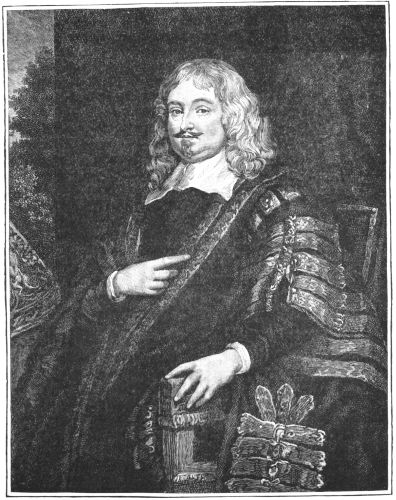
LORD CLARENDON. (After the Portrait by Sir Peter Lely.)
[See larger version]
It has been the fashion to consider Cromwell as a consummate hypocrite, and to regard all that he did as a part acted for the ultimate attainment of his own ends. This is the view which Clarendon has taken of him; but, whatever he might do at a later period, everything shows that at this time both he and his brother officers were most really in earnest, and, could Charles have been brought to subscribe to any terms except such as gave up the nation to his uncontrolled will, at this moment his troubles would have been at an end, and he would have found himself on a constitutional throne, with every means of honour and happiness in his power. Nothing more convincingly demonstrates this than the conditions which the Parliament submitted to him. They, in fact, greatly resembled the celebrated conditions of peace offered at Uxbridge, with several propositions regarding Parliament and taxation, which mark a wonderfully improved political knowledge and liberality in the officers. They did not even insist on the abolition of the hierarchy, but merely stipulated for the toleration of other opinions, taking away all penalties for not attending church, and for attending what were called conventicles. The command of the army by Parliament was to be restricted to ten years; only five of the Royalist adherents were to be excluded from pardon, and some less objectionable mode of protecting the State against Catholic designs than the present oppressive laws against recusants was to be devised. Parliaments were to continue two years, unless dissolved earlier by their own consent; and were to sit every year for a prescribed term, or a shorter one, if business permitted. Rotten boroughs, or such as were insignificant, were to be disfranchised, and a greater number of members returned from the counties in proportion to the amount of rates; and all that regarded election of members or reforms of the Commons should belong exclusively to the Commons. There were very judicious regulations for the nomination of sheriffs and of magistrates; the excise was to be taken from all articles of life at once, and from all other articles very shortly: the land-tax was to be fairly and equally apportioned; the irritating maintenance of the clergy by tithes was to be done away with; suits at law were to be made less expensive; all men to be made liable for their debts; and insolvent debtors who had surrendered all their property to their creditors were to be discharged.
The whole project was decidedly creditable to the officers of the army. Charles's own friends and advisers were charmed with it, and flattered themselves that at length they saw a prospect of ending all troubles; but they were quickly undeceived, and struck down in dumb astonishment by Charles rejecting them.
Charles was still the same man; he was at the same moment secretly listening to the overtures of the Scottish Commissioners, who were jealous of the army, and instead of seizing the opportunity to be once more a powerful and beloved king, he was flattering himself with the old idea that he would bring the two great factions "to extirpate each other." Sir John Berkeley, his earnest adviser, says:—"What with having so concurring a second as Mr. Ashburnham, and what with the encouraging messages of Lord Lauderdale and others from the Presbyterian party and the city of London, who pretended to despise the army, and to oppose them to death, his Majesty seemed very much elated; inasmuch that when the proposals were solemnly sent to him, and his concurrence most humbly and earnestly desired, his Majesty, not only to the astonishment of Ireton and the rest, but even to mine, entertained them with very tart and bitter discourses, saying sometimes that he would have no man suffer for his sake, and that he repented of nothing so much as the Bill against the Lord Strafford, which, though most true, was unpleasant for them to hear; that he would have the Church established according to law, by the proposals. They replied it was none of their work to do it; that it was enough for them to waive the point, and, they hoped, enough for his Majesty, since he had waived the government of the Church in Scotland. His Majesty said that he hoped God had forgiven him that sin, and repeated often, 'You cannot be without me; you will fall to ruin if I do not sustain you!'"
It was still the old man; the old intolerable, incorrigible talk. He could not give up a single proposition to save all the rest—his life, his family, his crown, and kingdom. The officers looked at one another in amazement; the king's friends in consternation. Sir John Berkeley whispered in his ear that his Majesty seemed to have some secret strength that they did not know of, on which Charles seemed to recollect himself, and spoke more softly; but it was too late, for Colonel Rainsborough, who was least inclined for the pacification, rode to the army and made known the king's obstinacy. The agitators rushed together in crowds, and, excessively chagrined at the rejection of such terms, burst into the bedchamber of Lord Lauderdale, whom they suspected of having thus perverted the king's mind, and compelled him, in spite of his standing in his position as Commissioner from the Estates of Scotland, to rise, and get off back again to Edinburgh.
At this crisis the alarm at the proceedings in London, and the march upon it just related, took place. Still the officers did not cease their exertions to persuade the king to adopt the proposals; but he was waiting to see what turn affairs would take, and listening at the same time to the Scots and the Irish Catholics. This idea was so little concealed that, talking with Ireton, he let slip the observation, "I shall play my game as well as I can." On which Ireton replied, "If your Majesty has a game to play, you must give us leave also to play ours." As the bluster of the City seemed to subside before the approaching army, Charles sent Berkeley to ask the officers, "If he should accept the proposals, what would ensue?" They said, "We will offer them to the Parliament." "And if they should reject them, what then?" The rest of the officers hesitating to answer such a question, Rainsborough said bluntly, "If they won't agree, we will make them!" to which all the rest instantly assented. Berkeley carried this decisive answer to Charles, but there, he says, he had very different work; he was just as unyielding as ever. Cromwell and Ireton then begged that though the king would not sign the proposals, he would at least write a kind letter to the army, which should show the country that they were doing nothing contrary to his Majesty's mind. With the co-operation of Berkeley, Ashburnham, and others of the king's friends, they met at Windsor, and drew up such a letter, but they could not prevail on him to sign it till the City had yielded, and it was too late. Still the officers, to prove that their triumph had not altered in the least their desire for agreement with the king, again voted the proposals as their terms of settlement. Charles renewed his discussion with them, and was every day sending messages by Ashburnham to Cromwell and Ireton, yet never coming nearer; but, on the other hand, bringing those officers into suspicion with a new and fanatic party which had arisen, which originally called themselves Rationalists, but soon after Levellers.
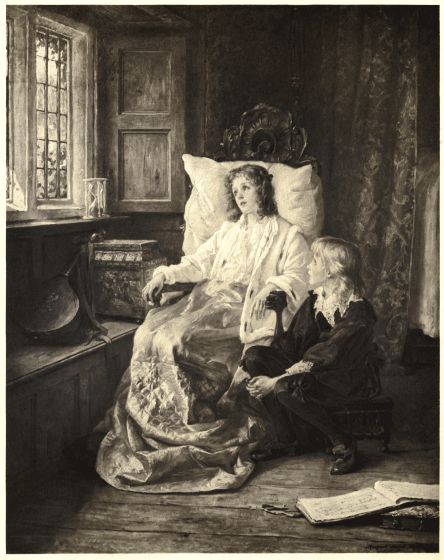
THE CHILDREN OF CHARLES I.
From the Picture by Miss Margaret I. Dicksee, in the Oldham Art Gallery
[See larger version]
The Levellers were, in fact, a set of men amongst whom Lilburne, now Colonel John Lilburne, was a leading character. They had imbibed from the Old Testament, which was their favourite study, a spirit of Republicanism combined with a wild fanatic style of language. They found in the remarks on monarchs in the Scriptures, on the election of Saul by Israel, a clear denunciation of all kings, and they declared they would no longer seek after kings, who aimed only at absolute power; nor after lords, who sought only honours and places; but they would have a free government by a Parliament, and a free religion. They drew up a paper called "The Case of the Army," and another called "The Agreement of the People," which were presented to the general and the Agitators of the eleven regiments. Religious Republicanism was abroad in the army, and they drew up a new constitution, at which a biennial Parliament, with six monthly sessions, a widely-extended franchise, and a more equally-distributed representation, was at the head. There were to be neither king nor lords in their system. Colonels Pride and Rainsborough supported their views: Cromwell and Ireton strenuously opposed them. They were, therefore, immediately the objects of attack, and represented as being in a close and secret compact with the king, the Ahab of the nation, to betray the people. Lilburne was busily employed in writing and printing violent denunciations in flaming style, and strongly garnished with Bible terms. Parliament denounced the doctrines of the Levellers as destructive of all government, and ordered the authors to be prosecuted.
Whilst this fanatic effervescence had broken out in the army, the Presbyterians in Parliament and the Scottish Commissioners made one effort more for the recovery of their ascendency. Regarding the religious toleration proposed in the army conditions as something horrible and monstrously wicked, they drew up fresh proposals of their own, and presented them to the king. If Charles could not endure the army proposals, he was not likely to accept those of the Presbyterians, who gave no place to his own Church at all; and he told them that he liked those of the army better. This answer Berkeley showed to the officers of the army before it was sent; they highly approved of it, and promised to do all they could in the House to get an order voted for a personal treaty, "and," Berkeley adds, "to my understanding, performed it, for both Cromwell and Ireton, with Vane and all their friends, seconded with great resolution this desire of his Majesty." Cromwell, indeed, he says, spoke so zealously in its favour that it only increased, both in the House and out of it, the suspicion of his having made a compact with the king to restore him. The more the officers argued for a personal treaty, the more the Presbyterians in the House opposed it; but at length a resolution was carried for it. It was thought that it would occupy twenty days, but it went on for two months, and came to nothing—other and strange events occurring.
The Levellers, after this display of zeal on the part of Cromwell, vowed that they would kill both him and the king, whom they not only styled an Ahab, a man of blood, and the everlasting obstacle to peace and liberty, but demanded his head as the cause of the murder of thousands of free-born Englishmen. Cromwell declared that his life was not safe in his own quarters, and we are assured that Lilburne and another Agitator named Wildman had agreed to assassinate him as a renegade and traitor to liberty. To check this wild and dangerous spirit in the army, Cromwell and Ireton recommended that it should be drawn closer together, and thus more under the immediate discipline of its chief officers. This was agreed upon, and a general rendezvous was appointed to take place at Ware on the 16th of November.
During the interval Charles was royally lodged at Hampton Court, and was freely permitted to have his children with him, but all the time he was at his usual work of plotting. The Marquis of Ormond, having surrendered his command in Ireland to the Parliament, was come hither; and Lord Capel, who had been one of Charles's most distinguished commanders, being also permitted by Parliament to return from abroad, a scheme was laid, whilst Charles was amusing the army and Parliament with the discussion of the "Proposals," that the next spring, through the Scottish Commissioners, who were also in the plot, a Scottish army should enter England forty thousand strong, and calling on the Presbyterians to join them should march forward. At the same time Ormond should lead an army from Ireland, whilst Capel summoned the rest of the king's friends in England to join the converging forces, and plant the king on the throne. But this wholesale conspiracy could not escape the secret agents of Cromwell; the whole was revealed to him, and he bitterly upbraided Ashburnham with the incurable duplicity of his master, who, whilst he was negotiating with the army, was planning its destruction.
From this moment, whatever was the cause, and the preceding incidents appear both certain and sufficient, Cromwell, Ireton, and the army in general, came to the conclusion that all attempts to bring so double-faced and intriguing a person to honourable and enduring terms were vain; that if he were restored to power, he would use it to destroy every one who had been compelled to oppose his despotic plans; if he were not restored, they would be in a perpetual state of plottings, alarms, and disquietudes, destructive of all comfort or prosperity to the nation. As the officers drew back from further intercourse with the king, the menaces of the Levellers became louder; and there were not wanting persons to carry these threats to the king. He saw the Levellers growing in violence, and in numbers; in fact, Leveller and Agitator were synonymous terms; the infection had spread through the greater part of the army. The fact of the officers having been friendly with him, had made them suspicious to the men; they had driven Ireton from the council, and there were loud threats of impeaching Cromwell. Several regiments were in a state of insubordination, and it was doubtful whether, at the approaching rendezvous, Fairfax could maintain the discipline of the army. The reports of the proceedings of the Levellers (who really threatened to seize his person to prevent the Parliament or officers agreeing with him) and their truculent manifestoes, were all diligently carried to Charles by the Scottish Commissioners, who, according to Berkeley, "were the first that presented his dangers to him." He was assured by Mr. Ackworth that Colonel Rainsborough, the favourite of the Levellers, meant to kill him; and Clarendon says that "every day he received little billets or letters, secretly conveyed to him without any name, which advertised him of wicked designs upon his life;" many, he adds, who repaired to him brought the same advice from men of unquestionable sincerity.
Charles resolved to escape, and, as he was in some cases as religiously scrupulous of his word as he was in others reckless of it, he withdrew his promise not to attempt to escape, on the plea that he found himself quite as rigorously watched as if he were not on honour. Colonel Whalley, who commanded his guard, at once ordered it to be doubled, and dismissed all the king's servants except Legge, refusing further admittance to him. Notwithstanding this, he found means of communicating with Ashburnham and Berkeley, and consulted with them on the means of escape, and the place to escape to. He suggested the City, and Ashburnham advised him to go to the house of the Lord Mayor, in London, there to meet the Scottish Commissioners, agree with them on their last propositions, and then send for the Lords. Berkeley disapproved of this, believing they would not bring over the Commons; and then Ashburnham recommended the king to flee to the Isle of Wight, and throw himself on the generosity of Colonel Hammond, the governor there. This, he says, he did, because Colonel Hammond had a few days before told him he was going down to his government, "because he found the army was resolved to break all promises with the king, and that he would have nothing to do with such perfidious actions."
This seems to have inspired a belief in these men that Hammond was secretly in favour of the king, strengthened, no doubt, by the fact that Dr. Hammond, the king's chaplain, was his uncle, and had lately introduced him to his Majesty as an ingenuous and repentant youth, and, notwithstanding his post, of real loyalty. They forgot that Hammond had another uncle, Lieutenant-General Hammond, who was as democratic as the chaplain was loyal, and was a great patron of the Adjutators. They seem to have reckoned as little on the honour of the young man, who was a gentleman and officer, and had married a daughter of John Hampden.
There were other schemes, one to seek refuge in Sir John Oglander's House, in the Isle of Wight; and there was a talk of a ship being ordered to be somewhere ready for him; but when the escape was made, it appeared to have been just as ill contrived as all the rest of Charles's escapes. Ashburnham and Berkeley had contrived to meet the king in the evening in the gallery of Hampton Court, and settled the mode of escape. It was the king's custom, on the Mondays and Thursdays, to write letters for the foreign post, and in the evenings he left his bedchamber between five and six o'clock and went to prayers, and thence to supper. On one of these evenings, Thursday, the 11th of November, Whalley, finding the king much later than usual in leaving his chamber, became uneasy, went thither, and found him gone. On the table he had left some letters, one to the Parliament, another to the Commissioners, and a third to Colonel Whalley. In the letter to the Parliament he said liberty was as necessary to kings as others; that he had endured a long captivity in the hope that it might lead to a good peace, but that, as it did not, he had withdrawn himself; that, wherever he might be, he should earnestly desire a satisfactory agreement without further bloodshed, and was ready to break through his cloud of retirement and show himself the father of his country whenever he could be heard with honour, freedom, and safety.
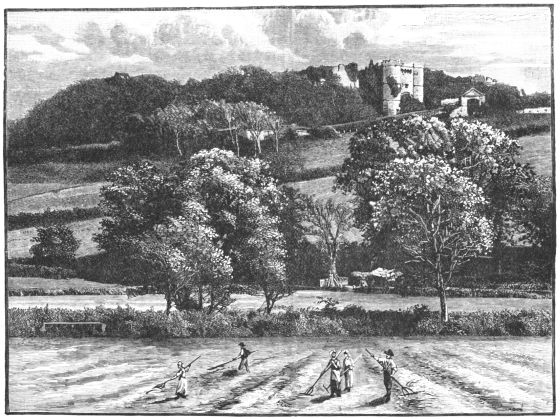
CARISBROOKE CASTLE, ISLE OF WIGHT. (From a photograph by F. G. O. Stuart, Southampton.)
[See larger version]
It appeared that he had escaped by way of Paradise, a place so called in the gardens; his cloak was found lying in the gallery, and there were tramplings about a back gate leading to the waterside. Legge accompanied him down the backstairs, and Ashburnham and Berkeley joined them at the gate. The night was dark and stormy, which favoured their escape. They crossed the river at Thames Ditton, and made for Sutton, in Hampshire, where they had horses in readiness. Why they had not provided horses at a nearer point does not appear. In the night they lost their way in the forest, and reaching Sutton only at daybreak, and hearing that a county committee on Parliamentary business was sitting there, they got out their horses, and rode away towards Southampton.
That night Cromwell was aroused from his bed at Putney with a startling express that the king had escaped. He at once despatched a letter to the Speaker, Lenthall, dated twelve o'clock, with the tidings for Parliament, and the news was announced next morning to both Houses. The confusion may be imagined; orders were issued to close all ports; and those who concealed the place of the king's retreat, or harboured his person, were declared guilty of high treason, and menaced with loss of all their estate, and with death without mercy. On the 13th of November Whalley gave a narrative to the Lords of the particulars of his escape as far as known. It appeared that the repeated howling of a greyhound in the king's chamber first assured them that he could not be there. However, on Monday, the 15th, a letter from Colonel Hammond, from the Isle of Wight, much to the relief of Parliament and army, announced that the absconded king was safe in his hands at Carisbrooke Castle.
Charles was at first treated by Colonel Hammond with great leniency, and again employed the time on his hands in negotiation. As the army had restored unity to itself, he sought to obtain its concurrence to a personal treaty, and sent Berkeley to Fairfax, Cromwell, and Ireton, at Windsor. On his way there he fell in with Cornet Joyce, who carried off the king from Holmby, who informed him of an ominous proposition discussed by the Agitators, namely, to bring the king to trial; not, he said, with any design of putting him to death, but to prove on evidence who really bore the blame of the war. This prelude too truly prefigured the interview itself. Fairfax, Cromwell, and Ireton received Berkeley with severe aspects and distant coldness, and told him that they were but the servants of the Parliament, and referred him to it. He was not prevented by this, however, from sending a secret message to Cromwell, reminding him of his promises, and letting him know that he had secret instructions from the king to him. But Cromwell had now had convincing proofs of the king's duplicity; he refused to receive the letters, informed Berkeley that he would do all in his power towards effecting a real peace, but was not disposed to risk his head for the king's sake. Repulsed here, Charles applied to Parliament, which sent him four propositions as the basis of agreement, namely, that his Majesty should concur in the Bill for settling the militia; should recall all the proclamations, oaths, etc., against Parliament; should disqualify all peers made since the renewal of the Great Seal from sitting in the House of Peers; and should pass a Bill for the adjournment of Parliament being placed in the power of the Houses themselves. These Bills were sent by Commissioners to Carisbrooke; but the Scottish Commissioners, who dreaded the acceptance of them as rendering the English Parliament independent of the League and Covenant, hastened there, too, with a modified treaty of their own. Charles, thus encouraged, refused the four Bills; the Commissioners kissed hands and returned, and Charles signed the proposals of the Scots, which guaranteed the independence of their own religion, on condition of finding an army of forty thousand men for the restoration of the king.
Charles was not left long in ignorance of the effect of his refusal of the Parliamentary proposals, and of the discovery of his secret treaty with the Scots. Colonel Hammond received orders to take every measure for the safe keeping of the king, and for preventing the lurking of suspicious vessels in Southampton Water, as it was known that a ship had been engaged by the queen to carry off Charles and land him at Berwick, in readiness to co-operate with the Scottish movement. Hammond dismissed Ashburnham, Legge, and Berkeley, with all other Royalists, from the island; sent away a vessel, supposed to be the very one engaged by the queen; and put the king under strict surveillance and a double guard. He was no longer an apparently free guest, but a close prisoner.
This treatment only doubled his determination to escape. Ashburnham, Berkeley, and Legge, though banished from the island, kept saddle-horses on the coast ready, in case of the king's escaping from Carisbrooke; and his friends from all quarters corresponded with him, and their letters were conveyed to him by Henry Firebrace, who was in some employment in the castle, and was occasionally engaged by one of the warders to take his place before the king's chamber-door, when he put the correspondence entrusted to him through a crevice of the door. The whole island resented the incarceration of the king, and there were loud threats of rising and liberating him by force. One Captain Burley was mad enough to make the attempt. At midnight a drum was beaten. Burley put himself at the head of a rabble in Newport, without, as reported, having a single musket among them, and was speedily taken and executed.
On the 3rd of January, 1648, the two Houses discussed the relations with the king, and in the Commons the plainest Republican sentiments were avowed. The refusal of the four Bills by the king was deemed convincing proof that no possibility was left of ever coming to agreement with him. Sir Thomas Wroth declared that kings of late had conducted themselves more like inmates of Bedlam than anything else, and that he did not care what government was set up if it were not by kings or devils. Ireton contended that the relation of king and subjects implied mutual bonds and duties; the king was to protect the people, and the people to maintain the king in his duty, but that Charles had abandoned his duty, had ceased to protect his people, nay, had made war on them, and therefore had annulled the compact; that, seeing this, the army was resolved to stand by the Parliament for the establishment of national right. Cromwell, after many had proceeded in a like strain, asserted that it was time to fulfil the wearied expectation of the people, and to show that they could govern and defend the kingdom by their own power, and to decide that there was nothing to be hoped from a man whose heart God had hardened in obstinacy. In fact, in Parliament, almost as much as in the army, a large party had come to the conclusion that it was odious in the sight of God to be governed by a king.
The result was a vote that Parliament would make no further applications or addresses to the king, nor receive any message from him, except by full consent of both Houses, under penalty of high treason. The Lords concurred in the vote, and a public declaration was circulated to that effect; and it was also agreed that the Committee of Public Safety should again sit and act alone, without the aid of any foreign coadjutors. This was a plain hint to the Scots that Parliament knew of their late treaty. Hitherto they had formed part of the Committee of both kingdoms, so that they had shared the government of England. This was withdrawn; the Scots therefore demanded the payment of the last one hundred thousand pounds due to them by the treaty of evacuation, and announced their intention to retire on receiving it.
This decided step of Parliament, and the rigour with which Charles was guarded, put the Scots, the Presbyterians, the Royalists all on the alert. They stirred up everywhere a feeling of commiseration for him, as harshly and arbitrarily used; it was represented that the vote of non-address amounted to a declaration that all attempts at reconciliation were at an end, and that the Independents meant to give effect to the doctrines of the army and put the king to death. These efforts were productive of a rapidly and widely spreading sentiment in the king's favour, and soon formidable insurrections were on foot. The king himself omitted no means of attempting his escape. By his plans his second son, the Duke of York, had made his escape from the care of the Earl of Northumberland in female attire, and got to Holland. Towards the end of March Charles tried to escape out of the window of his chamber. A silken cord was prepared to let him down; and, to prove the safety of the descent, Firebrace forced himself between the iron stanchions of the window and let himself down; but the king, in essaying to follow, stuck fast, and, after violent efforts, found it impossible to get through. Cromwell announced to Hammond, in a letter still extant, that Parliament was informed that aquafortis had been sent down to corrode this obstructing bar; that the attempt was to be renewed during the coming dark nights, and that Captain Titus and some others about the king were not to be trusted. At the same time he informed him that the Commons, in reward of his vigilance and services in securing and keeping the king, had raised his pay from ten to twenty pounds a week, had voted him one thousand pounds, and settled upon him and his heirs five hundred pounds per annum.
The reaction in favour of the king now began to discover itself on all sides. Charles published an appeal to the nation against the proceedings of Parliament, which seemed to cut off all further hope of accommodation. Parliament issued a counter-statement, and numerous rejoinders were the consequence—the most able from the pen of Hyde, the Chancellor, and Dr. Bates, the king's physician. Whilst these elements of strife were brewing in England, the Duke of Hamilton, released from Pendennis Castle and restored to the favour of the king, returned to Scotland, and the Marquis of Ormond to Ireland, to muster forces to operate with a simultaneous rising in England. The Scottish muster proceeded with vigour, though stoutly opposed by the Duke of Argyll, and the work of revolt commenced in March, in Wales. Poyer, the Mayor of Pembroke, and governor of the castle, declared for the king, and at the summons of Fairfax refused to yield up his command. Powell and Langherne, two officers of disbanded regiments, joined him, and many of their old soldiers followed them. The Royalists ran to arms, eight thousand men were soon afoot in the Principality, Chepstow and Carnarvon were surprised, and Colonel Fleming was killed. Cromwell was despatched to reduce these forces at the head of five regiments. He quickly recovered Carnarvon and Chepstow, defeated Langherne, and summoned Poyer to surrender. But Pembroke stood out, and was not reduced till July, though Colonel Horton encountered Langherne at St. Fagan's, near Cardiff, and completely routed him.
Meanwhile, in other quarters insurrections broke out. On the 9th of April a mob of apprentices and other young fellows attacked the train-bands in Moorfields, struck the captain, took his colours, and marched with them to Westminster, crying, "King Charles! King Charles!" There they were attacked and dispersed, but they rallied again in the City, broke open houses to obtain arms, and frightened the mayor so that he took refuge in the Tower. The next day Fairfax dispersed them, but not without bloodshed. Soon after three hundred men from Surrey surrounded the Parliament houses, cursing the Parliament, insulting the soldiers, and demanding the restoration of the king. They were not repulsed without some of them being killed. Similar outbreaks took place in Norwich, Thetford, Canterbury, and other places. Pontefract Castle was surprised by eighty cavaliers, each with a soldier mounted behind him.
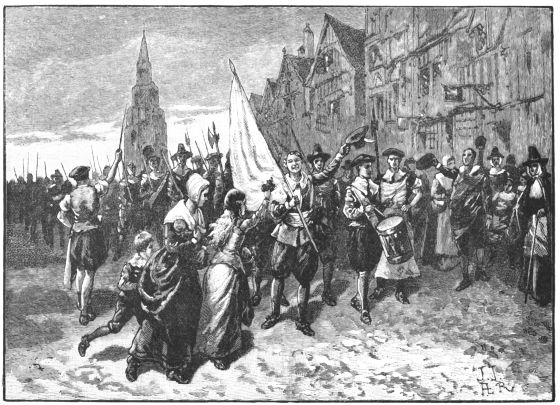
RISING OF THE LONDON APPRENTICES ON BEHALF OF CHARLES. (See p. 75.)
[See larger version]
Parliament, at the same time, was besieged with petitions for disbanding the army and restoring the king. To allay the ferment in the capital, whilst the army was engaged in the provinces, Parliament passed a resolution that no change should be made in the government by kings, Lords, and Commons. Fairfax withdrew his troops from the Mews and Whitehall, and Major-General Skippon was made commander of the City militia, to act in concert with the Lord Mayor and Corporation. The men of Kent and Essex rose in great numbers for the king. At Deal, off which Colonel Rainsborough, now acting as admiral, was lying, the people rose. The fleet, consisting of six men-of-war, revolted, hoisted the royal colours, and sailed to Helvoetsluys, where they called for the Duke of York to take the command. The effect of this event was neutralised, however, by a victory, which Fairfax obtained on the 1st of June over the Royalists at Maidstone, where, after a hard fight of six hours, he slew two hundred in the streets, and took four hundred prisoners. This defeat prevented the junction of this body with another under Colonel Goring, now Earl of Newport, who marched to Blackheath, and demanded entrance into the City. The Independent party were in a perilous position there. There was, as we have seen, a numerous body in London in favour of the king, who had no reliance on the militia. To conciliate public opinion, the Parliament ordered the release of the aldermen imprisoned at the desire of the army, and revoked the impeachment against the six Lords and eleven Commoners. Holles and his associates resumed their seats and their old measures, voted for a renewed negotiation with Charles on condition that he should restore Presbyterianism, and give the command of the army to Parliament for ten years. Luckily for the Independents, the Lords rejected these propositions, and voted a treaty without any conditions. At the same time the Common Council, showing a decided leaning towards the king, offered to protect him from danger and insult if he would come to the capital. The danger to the Independent interest was only repelled by the obstinacy of their old enemy Holles, who would consent to nothing which did not establish Presbyterianism.
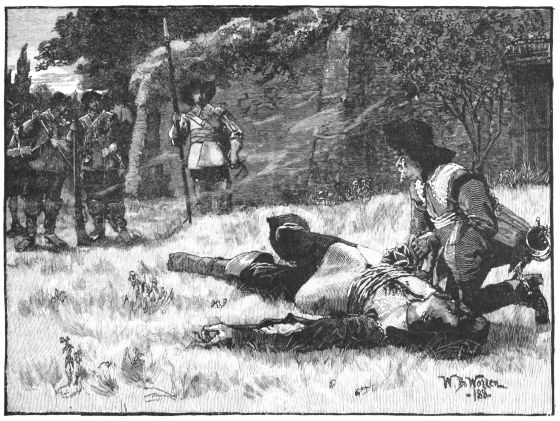
EXECUTION OF SIR CHARLES LUCAS AND SIR GEORGE LISLE. (See p. 78.)
[See larger version]
Whilst these discussions agitated the City, Fairfax marched on Goring, who quitted Blackheath, crossed the Thames into Essex with five thousand horse, where he was joined by Lord Capel, with Royalists from Hertfordshire, and Sir Charles Lucas, with a body of horse from Chelmsford. They concentrated their united force at Colchester, where they determined to hold out till the advance of the Scots, and thus detain the commander-in-chief in the south. The Scots were now in reality on the march. The Duke of Hamilton had not been able to muster more than a fourth of his promised forty thousand. Though he proclaimed everywhere that Charles had promised to take the Covenant and uphold the Presbyterian religion, Argyll and the old covenanting body wholly distrusted these assurances; the Assembly of the Kirk demanded proofs of the king's engagement; the ministers from the pulpits denounced the curse of Meroz on all who engaged in this unholy war, and the women cursed the duke as he passed, and pelted him with stones from their windows.
The English Royalists under Langdale, about four thousand brave Cavaliers, had surprised Berwick and Carlisle, and awaited with impatience Hamilton's arrival. Lambert, the Parliamentary general, advanced and besieged Carlisle, and Hamilton was urged to advance and relieve it. He sent forward a detachment, and on the 8th of July arrived himself, being already supported by three thousand veterans from the Scottish army in Ireland, and, now uniting with Sir Marmaduke Langdale, he presented a formidable force. Lambert retired at his approach, and had Hamilton been a man of any military talent, he might have struck an effective blow. But from the moment that he crossed the Border, he appeared to have lost all energy. His army was paralysed by internal dissensions. The Scottish Presbyterian soldiers were scandalised at having to fight side by side with Langdale's Prelatists and Papists, whom they had been accustomed to see ranged against them as the enemies of the Covenant. In forty days he had advanced only eighty miles, and when he reached the left bank of the Ribble, near Preston, Cromwell had reduced Pembroke, marched rapidly northward through Gloucester, Warwick, Leicester, to Nottingham, where he left his prisoners with Colonel Hutchinson, governor of the castle, and soon joined Lambert at Otley Park, and forced back Langdale from Clitheroe on the main body at Preston. Hamilton at the last moment was all unprepared. Monroe, with his veterans, lay still at Kirkby Lonsdale. Yet Hamilton, with his fourteen thousand, should have been a match for Cromwell, Lambert, and Lilburne's nine thousand. But Cromwell attacked them with such vigour that, after a hard battle of six hours, he routed the whole force. The Cavaliers fought like lions, and only retreated from hedge to hedge before the foe; they called repeatedly on the Scots for reinforcements and ammunition, but not being able to get either, retreated into the town. There they discovered that their allies were engaged in a fierce contest with the enemy for possession of the bridge. Cromwell won the bridge, and the Scots fled in the night towards Wigan. Hamilton retreated with some of the English towards Warrington. Lieutenant-general Baillie, with a great party of the Scottish army, surrendered on quarter in that town. Monroe, who was lying at Kirkby, ignorant of the battle or of the coming up of the fugitives, retreated to Scotland—the only body of Scots who regained their country. Hamilton, on the 20th of August, three days after the battle, was overtaken by Lambert and Lord Grey of Groby, and surrendered at Uttoxeter. Langdale's Cavaliers dispersed in Derbyshire, and he himself, in woman's apparel, was discovered at Widmerpool, in Nottinghamshire; but by the contrivance of Lady Saville, escaped dressed as a clergyman to London, where he remained with Dr. Barwick in the character of an Irish minister driven from his parish by the Papists. So ended Hamilton's boasted invasion. This blow totally annihilated his party in Scotland; Argyll and the Covenanters rose into the ascendant. Argyll soon after this seized a ship containing ten thousand stand of arms, which had been sent from Denmark for Hamilton's expedition. He invited Cromwell to Edinburgh, where he was received with great distinction, and was honoured by the thanks of the Scottish ministers as the preserver of Scotland under God. The members of the faction of Hamilton were declared enemies to religion and the kingdom, and incapable of serving in Parliament or the Assembly of the Kirk. On the 16th of August Cromwell left Edinburgh, Argyll and the nobles of that party accompanying him some miles on his way, and taking leave of him with many demonstrations of respect.
At the same time that the Scots began their march, a rising which had been made in concert with Hamilton, took place in London. The Earl of Holland, who had become contemptible to all parties by twice going over to the Parliament and twice returning to the king, entered London with five hundred horse, and called on the citizens to join him for Charles. The inhabitants had been too recently punished for their apprentice rising to make a second experiment. Holland fell back, therefore, on Kingston-on-Thames, where he was attacked and defeated by Sir Michael Levesey, and Lord Francis Villiers, brother to the young Duke of Buckingham, was slain. Holland himself had induced the brother of Buckingham to follow him; the latter escaped to the Continent, and returned at the Restoration, like most of his party, no better for his experience. Holland and Colonel Dalbier retreated to St. Neot's, where a party of soldiers sent by Fairfax from Colchester met them, and took Holland and killed Dalbier, who was cut to pieces by the soldiers on account of his having been a renegade from the Parliamentary army.
The fate of the Scottish army decided that of Goring at Colchester. There was nothing further to stand out for; he surrendered at discretion, and was sent to prison to await the award of Parliament, with Lord Capel, and Hastings, the brother of the Earl of Huntingdon. But two of his officers, Sir George Lisle and Sir Charles Lucas—the brother of Lord Lucas, and heir to his title and estates—were shot. All sides were growing savage. These two officers fell bravely and deserved a better fate. Lucas, tearing open his doublet, cried, "Fire, rebels!" and instantly fell. Lisle ran to him, kissed his dead body, and then turning to the soldiers, told them to come nearer. One of them said, "I'll warrant you we shall hit you." He replied, "Friends, I have been nearer, when you have missed me." The death of these noble fellows sullied the fair reputation of Fairfax, who afterwards deeply regretted it.
On the revolt of the ships at Deal, under the command of Rainsborough, whom they left ashore, the Parliament appointed the Earl of Warwick, the brother of the Earl of Holland, but more in the confidence of the Reformers, Lord Admiral of the Fleet, and sent him to oppose the insurgent fleet. No sooner was it heard in Paris that the English ships had sailed for Holland, and called on the Duke of York to command them, than it was thought highly expedient that the Prince of Wales should hasten thither himself and take the command. Accordingly, he travelled in all haste to the Hague, accompanied by Prince Rupert, and the Lords Hopton and Colepepper. The prince was received with acclamations by the fleet at Helvoetsluys, and with other vessels, making altogether nineteen, he sailed to the coast of England. It was thought by that party that it was best to sail along the English coast, showing their strength for some time, and then to proceed to the mouth of the Thames. At that time the insurrection in Kent was proceeding under Hales, L'Estrange, and the Earl of Norwich, which Fairfax soon dealt with at Maidstone; but whilst it was in force the prince might have made a safe descent on the Isle of Wight, and attempted the rescue of his father. The castle of Carisbrooke was not strong, and there were few forces besides its garrison in the island; but though Charles anxiously expected the fleet, and sent repeated messages, no attention was paid to them. For nearly a month the prince had the full command of the coast. Fairfax was engaged with the insurgents at Colchester, and the rest of the army was occupied in Wales, and in waiting for the approach of the invasion from Scotland; yet the heir-apparent made no movement for the rescue of his father, which everyone would have thought would have been the first thing with him.
Warwick posted himself at the mouth of the Thames, to prevent any advance towards London, or any relief to Colchester; but he did not deem himself strong enough till he should be joined by another fleet under Sir George Ayscough, from Portsmouth. With this arrival Warwick was in a condition to attack the prince's fleet, but he lay still, nor did the prince appear more inclined to assail him. He was satisfied to intercept merchantmen coming into port, and then demand their ransom from the City. This occasioned a brisk correspondence between London and the prince, under cover of which proposals were made by the prince and his counsellors for the City opening its gates and declaring for the king. But the demand of the prince for ten thousand pounds as ransom of the merchant ships disgusted the City, and presently after came the news of the total defeat of the Scottish army at Preston. On this the prince sailed away again to Helvoetsluys, without attempting anything more. His fleet, according to Clarendon, like the Court and army of his father, was rusted with factions, and so incapable of any decided course of action. But the Earl of Warwick did not present a more flattering aspect. Though it is confessed that he was amply strong enough after Ayscough's junction to have beaten the prince, he satisfied himself with watching him off, and followed him at a respectful distance to the Dutch coast. He is said there to have persuaded the disappointed sailors to return to the service of the Parliament, and thus recovered most of the ships. But the public was greatly dissatisfied with his conduct, and the Independents did not hesitate to declare that they were always betrayed by the cowardice or disaffection of noble commanders. The whole war bore striking evidences of this fact; and Clarendon asserts that Warwick had an understanding with his brother Holland, and would almost certainly have gone over had the Scottish invasion succeeded. Clarendon declares that the Parliament of Scotland had sent Lord Lauderdale to the Hague, to invite Prince Charles to go to Scotland and put himself at the head of affairs there for his father, in order to encourage the endeavour to put down the Independents, who were at once hostile to the king and the Solemn League and Covenant; but that the news of the defeat of Hamilton defeated that object. By the end of August all the attempts of the Royalists were crushed.
The Presbyterians took the opportunity while Fairfax, Cromwell, and the leading Independents were absent with the army, to propose a fresh treaty with Charles. On hearing of this movement, Cromwell wrote to the Parliament, to remind it of its vote of non-addresses, and that to break it and make fresh overtures to the king, who would still adhere to his inadmissible demands, would be an eternal disgrace to them. But the immediate defeat of Hamilton so much raised the terror of the Presbyterians at the overwhelming weight which this would give to the army and the Independent party, that they hastened the business. Charles readily acceded to it, and would fain have obtained his wish of carrying on the negotiation in London, especially as a large party there were urgent for accommodation with him. But the Parliament dare not thus far run counter to the victorious army, and a compromise was effected. Charles was permitted to choose any place in the Isle of Wight where the conference should take place, and he decided on the town of Newport. From the Parliament five Lords, including Northumberland and Pembroke, and ten Commoners, including Vane the younger, Grimstone, Holles, and Pierpoint, were appointed Commissioners, and on Charles's part appeared the Duke of Richmond, the Marquis of Hertford, the Earls of Southampton and Lindsay, with other gentlemen, and a number of his chaplains and lawyers. These were not admitted to sit with the Parliamentary Commissioners and the king, and were not to interpose opinions or arguments during the discussion, which were to be direct from Charles; but they were suffered to be in the room behind a curtain, where they could hear all, and to whom Charles was at liberty to retire to consult them. The conditions were the same as were submitted at Hampton Court, and the king again consented to the surrender of the command of the army for ten years; but he would not accede to the abolition of Episcopacy, but merely to its suspension for three years; moreover, the episcopal lands were not to be forfeited, but granted on long leases, and he would not bind himself to accept the Covenant. In fact, he stood just as rooted to his own notions as if he had as great a chance as ever of obtaining them. In vain the Presbyterians prayed him with tears to yield, to prevent the utter ruin of himself and them. The Commission met on the 18th of September, and it was limited to the 4th of November; but that time arrived and nothing further was concluded. The Commissioners took their leave and proceeded to Cowes, but they were met by a resolution of the Commons to prolong the Conference to the 21st, which was afterwards extended to the 25th of November.
There were signs and circumstances enough abroad to have brought any other man to make the best terms he could. On the 11th of September, before the meeting of the Commission, a petition of many thousands of well-affected men in the cities of London and Westminster, in the borough of Southwark, and the neighbouring villages, "had been presented, praying that justice might be done on the chief author of the great bloodshed which had been perpetrated in the war." They called for the execution of Holland, Hamilton, Capel, Goring, and the rest of the Royalist officers now confined at Windsor. Clarendon says that Capel, at the execution of Lisle and Lucas at Colchester, had spoken so fiercely about it, saying they had better shoot all the rest of the prisoners, and had so upbraided Ireton in particular, to whose vindictive disposition he attributed the bloody deed, that the army was vehement for the death of these men. Numbers of other petitions to the same effect came up from the country and from the regiments, declaring that after so many miraculous deliverances from their treacherous and implacable enemies by the Almighty, it was sinful to delay any longer the punishment of these instruments of cruelty, and especially of the king, the chief offender, the raiser of the war, and the stubborn rejecter of all offers. The army was the more vehement, because one of their most gallant and long-tried leaders, Colonel Rainsborough, had been foully murdered by a number of Royalists.
No wonder that the army was become impatient of further tolerance of such an enemy. Colonel Ludlow, who was also a member of Parliament, protested that it was time that the country laid to heart the blood spilt, and the rapine perpetrated by commission from the king, and to consider whether the justice of God could be satisfied, or His wrath appeased, if they granted an act of oblivion as the king demanded. No; the blood of murdered thousands cried from the ground; as the Book of Numbers declared, "blood defiled the land, and the land could not be cleansed except by the blood of him who shed it." He failed in converting Fairfax to his creed on this head; but Ireton was a more willing listener, and he joined his regiment in petitioning, on the 18th of October, that crime might be impartially punished, without any distinction of high or low, and that whoever should speak or act in favour of the king, before he had been tried and acquitted of shedding innocent blood, should be adjudged guilty of high treason. The example was followed by several other regiments; on the 21st Ingoldsby's regiment petitioned in direct terms for the trial of the king, and declared the treaty at Newport a trap; and on the 16th of November a long and stern remonstrance was addressed by the assembled officers of the army to the House of Commons, demanding that "the capital and grand author of all the troubles and woes which the nation had endured should be speedily brought to justice for the treason, blood, and mischief of which he had been guilty; that the Lords should be abolished, and the supreme power vested in the Commons; that if the country desired any more kings, they should be elected by the Commons; that a period should be fixed for the close of this Parliament; and that any future king should be sworn to govern by the aid of Parliament alone." This startling remonstrance was signed by Rushworth, the historian, secretary to Fairfax, the general himself accompanying the remonstrance by a letter. A violent debate upon this remonstrance took place in the House; but Cromwell was now fast advancing to the capital, and the House adjourned.
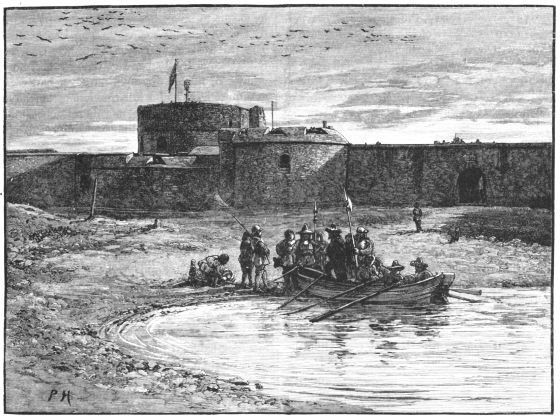
ARRIVAL OF CHARLES UNDER GUARD AT HURST CASTLE. (see p. 82.)
[See larger version]
All these ominous proceedings were lost on Charles; whilst he was negotiating, he was, in his usual manner, secretly corresponding with his party in various quarters, apologising for the smallest concessions, on the principle that he did not mean to abide by them. On the 24th of October, after conceding the command of the army, he wrote to Sir William Hopkins, "To deal freely with you, the great concession I made to-day was merely in order to my escape, of which if I had not hope, I would not have done it." He had written on the 10th of October to Ormond in Ireland, with which country he had agreed to have no further intercourse, telling him that the treaty would come to nothing, and encouraging him privately to prosecute the scheme for a rising there with all his vigour, and to let his friends know that it was by his command, but not openly, or this would, of course, knock the treaty on the head. But a letter of Ormond's fell into the hands of the Independents, by which they discovered for what he had been sent over from France to Ireland, and the Commissioners would not proceed till Charles had publicly written to deny any authority from him to Ormond. All the while that the negotiations were proceeding, he was expecting the execution of a plan for his escape; and he told Sir Philip Warwick that if his friends could not rescue him by the time he had requested relief, yet he would still hold on, till he had made some stone in that building his tombstone.
With such a man all treaty had long been hopeless; he would never consent to the demands upon him, and without his consent the whole war had been in vain; nay, did he consent, it was equally certain that, once at liberty, he would break every engagement. What was to be done? The Independents and the army had come to a solemn conviction that there was but one way out of it. The king must be tried for his treason to the nation, and dealt with as any other incorrigible malefactor.
Cromwell, on his way back from Scotland, had called at Pontefract, to take vengeance on the assassins of Colonel Rainsborough, but finding affairs pressing in London, left Lambert to reduce the place and secure the murderers, and hastened towards the capital. He had relied much on Colonel Hammond to keep the king safe, and not to give him up into the hands of Parliament, till full justice had been obtained. But no result accruing from the treaty, the Commissioners prepared to take their leave of the king on the 28th of November. On the 25th Hammond had received an order from Fairfax to proceed to headquarters at Windsor, and on the 26th Colonel Ewer, a zealous Republican, arrived at Newport to take charge of the king, and confine him in Carisbrooke Castle, or elsewhere.
Hammond, who knew well what was the meaning of this, refused to give up his charge, declaring that in all military matters he would obey his general, but that this charge was committed to him by the Parliament, and that he would yield it to no order but theirs. Ewer returned, but the next day was the last day of the Commissioners. Charles, seeing the desperate pass at which matters had arrived, suddenly gave way, and agreed that the seven individuals excepted from pardon should take their trials—namely, the Marquis of Newcastle, Sir Marmaduke Langdale, who had been confined in Nottingham Castle, but had escaped, Lord Digby, Sir Richard Grenville, Sir Francis Doddrington, Lord Byron, and Mr. Justice Jenkins; that the bishops should be abolished, and their lands vested in the Crown till a final settlement of religion.
When the Commissioners took their leave, Charles warned the lords of the party that in his ruin they saw their own. Though he had given up everything at the last moment, he could not flatter himself that this would be accepted, because he knew that the army, which held the real power, had protested against this treaty altogether, as a violation of the vote of non-addresses, and had no faith in his observance of any conditions whatever. With the Commissioners Hammond also departed, and Charles was left in the hands of Major Rolfe, a man who had been charged with a design to take away the king's life six months before. But Charles was not intended to remain in this man's custody; a body of troops under Lieutenant-colonel Cobbet was already on its way to receive the charge. The friends of the king, on learning this, once more implored him to endeavour to escape. The Duke of Richmond, the Earl of Lindsay, and Colonel Coke, urged him to instant flight; they acquainted him with the watchword, and Coke told him he had a boat and horses ready. But all their persuasions were vain; Charles would not move. He pleaded that he had given his parole to the Parliament for twenty days after the treaty. And this was the same man who had been writing North and South during the whole treaty, to assure his friends that he meant to break his word on every point of the treaty, the first moment that he was at liberty. The real reason, we may believe, why Charles did not attempt to escape, was, that he had no hope of it. In all his attempts he never had escaped, and must have had a full conviction that he never could. At five in the morning Cobbet and his troop arrived, and the king was informed that he must arise and accompany it.