Chapter VII · (continued 2)
Reading edition
Sandwich was scarcely in independent command when he heard of a most magnificent chance. Two Dutch merchant fleets, one from the East Indies and one from the Levant, to avoid the English fleet at the Texel, united and sailed round the north of Ireland and Scotland, and took shelter in the neutral harbour of Bergen, in Norway. They were jointly valued at twenty-five millions of livres. Sandwich sailed thither after them, and the King of Denmark, the sovereign of Norway, though at peace with the Dutch, was tempted, by the hope of sharing the booty, to let Sandwich attack them in port. Sandwich, however, was not satisfied to give the king half, as demanded, and in spite of Alefeldt, the governor, who begged him to wait till the terms were finally settled with the monarch, he ordered Captain Tyddiman to dash in and cut the ships out and all the Dutch vessels. But Tyddiman found himself between two fires; the Dutch defended themselves resolutely and the Danes, resenting this lawless proceeding, fired on them from the fort and batteries. Five of Sandwich's commanders were killed, one ship was sunk, much damage was done to the fleet, and it was glad to escape out of the harbour. Sandwich, however, was lucky enough soon after to secure eight men-of-war and about thirty other vessels, including two of the richest Indiamen, which were dispersed by a storm whilst under the convoy of De Witt. The unscrupulous Sandwich made free to appropriate two thousand pounds' worth of the booty, and allowed his officers to do the same, which occasioned his dismissal from the fleet; but to soften his disgrace, he was sent as ambassador to Spain. Parliament, to carry on the war, granted the king a fresh supply of one million two hundred and fifty thousand pounds, and, at the same time, voted the one hundred and twenty thousand pounds to the duke.
Whilst these events had been transpiring the plague had been raging in the City of London, and had thence spread itself to various parts of the country. It raged with a fury almost unexampled in any age or nation. It had shown itself during the previous winter in a few individual cases, and as spring advanced, it terribly extended its devastations. In May it burst forth with frightful violence in St. Giles's, and, spreading over the adjoining parishes, soon threatened both Whitehall and the City. The nobility fled to the country, the Court retreated to Salisbury, and left Monk to represent the Government in his own person, and he boldly maintained his ground through the whole deadly time. As the hot weather advanced the mortality became terrible, and the people fled in crowds into the country, till the Lord Mayor refused to grant fresh bills of health, and the people of the neighbouring towns and villages declined to receive any one from London into them. Those who escaped out of the metropolis had to camp in the fields, whichever way they turned the inhabitants being in arms to drive them away. In June the City authorities put in force an Act of James I. They divided the City into districts, and allotted to each a staff of examiners, searchers, nurses, and watchmen. As soon as the plague was ascertained to be in a house, they made a red cross upon the door a foot in length, and wrote over, "Lord, have mercy upon us!" No one was allowed to issue out of the houses bearing that fatal sign for a month, if they could keep them in. Persons escaping out of these infected houses, and mingling with others, were liable to suffer death as felons. But to remain in these houses was to perish of plague or famine, and numbers broke wildly from them at all hazards, thus carrying the infection on all sides. Many in their frenzy jumped naked from the windows, rushed wildly through the streets, and plunged into the river.
It was calculated that forty thousand work-people and servants were left destitute by the flight of their employers, and subscriptions were made to prevent them from starving, for they were not allowed to leave the City. The king gave one thousand pounds a week, the City, six hundred pounds, the Queen Dowager, the Archbishop of Canterbury, and many noblemen contributed liberally. But the aspect of the place was terrible. The dead carts were going to and fro continually to collect the bodies put out into the streets, announced by the tinkling of a bell, and at night by the glare of links. The corpses were cast into pits, and covered up as fast as possible. The most populous and lately busy streets were grass-grown; the people who walked through them kept along the middle, except they were meeting others, and then they got as far from each other as possible. Amid all this horror, the sight of ghastly death, and the ravings of delirium, whilst some brave souls devoted themselves to the assistance of the suffering and dying, crowds of others rushed to taverns, theatres, and places of debauch, and a strange maniacal mirth startled the silence of the night, and added horror to the work of death. The weekly numbers who perished rose from one thousand to eight thousand. The wildest rumours of apparitions and strange omens were afloat. The ghosts of the dead were said to be seen walking round the pits where their bodies lay; a flaming sword was said to stretch across the heavens from Westminster to above the Tower, and men, raised by the awful excitement of the scene into an abnormal state, went about, as was done at the destruction of Jerusalem, announcing the judgments of God. One man cried as he passed, "Yet forty days, and London shall be destroyed;" another stalked nakedly along, bearing on his head a chafing-dish of burning coal, and declaring that the Almighty would purge them with fire. Another came suddenly from side streets and alleys in the darkness of the night, or in open day, uttering in a deep and fearful tone, the unvarying exclamation, "Oh, the great and dreadful God!" The confounded people declared that it was a judgment of God on the nation for its sins, and especially the sins of the King and Court, and the dreadful persecution of the religious by the Government and clergy. The Presbyterian ejected preachers frequently mounted into the pulpits now deserted by their usual occupants, and preached with a solemn eloquence to audiences who listened to them from amid the shadows of death, and thus gave great offence to the incumbents, who had abandoned their own charges. This was made one plea, after the danger was over, for passing the Five Mile Act in October of this year (1665). Many other metropolitan clergy stood by their flocks, and displayed the noblest characters during the pestilence. This terrible plague swept off upwards of one hundred thousand people during the year; and though it ceased with the winter, it raged the following summer in Colchester, Norwich, Cambridge, Salisbury, and even in the Peak of Derbyshire.
Whilst the plague had been raging, numbers of the Republicans, Algernon Sidney among the rest, had gone over to Holland and taken service in its army, urging the States to invade England, and restore the Commonwealth, and a conspiracy was detected in London itself for seizing the Tower and burning the City. Rathbone, Tucker, and six others, were seized and hanged, but Colonel Danvers, their leader, escaped. Parliament attainted a number of the conspirators by name, and also every British subject who should remain in the Dutch service after a fixed day. But neither plague nor insurrection had any effect in checking the wild licence and riot of the Court. The same scenes of drinking, gambling, and debauchery went on faster than ever after the Court removed from Salisbury to Oxford. The king was in pursuit of a new flame, Miss Stewart, one of the queen's maids of honour, and the Duke of York was as violently in love with her. Charles could not eat his breakfast till he visited both her and Castlemaine; and even Clarendon complains that "it was a time when all licence in discourse and in actions was spread over the kingdom, to the heart-breaking of many good men, who had terrible apprehensions of the consequences of it."
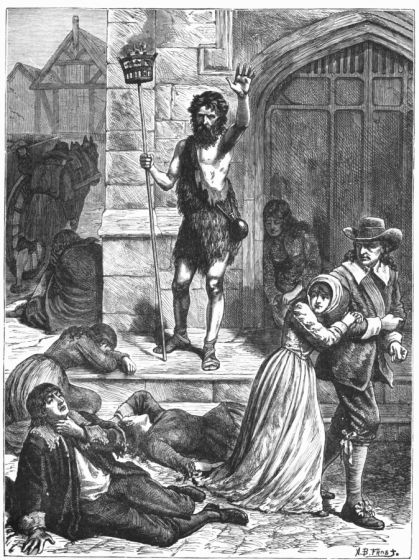
THE GREAT PLAGUE: THE MANIAC PRONOUNCING THE DOOM OF LONDON. (See p. 216.)
[See larger version]
The war, meanwhile, went on, and now assumed a more formidable aspect, for Louis XIV. made a sudden veer round in his politics, and joined the Dutch. He was actually under conditions of peace and assistance with them, and they called upon him to fulfil his engagements; but they publicly would have called in vain, had not Charles of late become too independent of his French paymaster, by having received liberal supplies from Parliament. Louis liked extremely to see Holland and England exhausting one another whilst he was aiming at the acquisition of the Netherlands; but it was not his policy to leave Charles free from his control. Charles, meanwhile, had been neglecting the very sailors who were to fight his battles against the united power of France and Holland. The sailors who had fought so gallantly last summer had lain during the winter in the streets, having received no pay. Pepys says that, whilst the plague was raging in London, they were besieging the Navy Office with clamorous demands. "Did business, though not much, at the Navy Office, because of the horrible crowd and lamentable moan of the poor seamen that lie starving in the streets for lack of money, which do trouble and perplex me to the heart; and more at noon when we were to go through them, for then above a whole hundred of them followed us, some cursing, some swearing, and some praying to us."
Whilst the royal duke had received one hundred and twenty thousand pounds for fighting one battle and leaving it unfinished, and the poor men were thus turned adrift to starvation and danger of death from the plague, the fleet had lost nearly all its experienced officers, who had been turned off because of their having helped the immortal Blake to shed glory on the Commonwealth, and their places were supplied by young, insolent, ignorant sprigs of the aristocracy, who neither knew their business, nor were disposed to do it if they did. Pepys, who, as Secretary to the Admiralty, saw all this, says that Admiral Penn spoke very freely to him on the subject, and lamented the loss which the fleet had experienced in the cashiered officers.
Such was the state of our navy when it put to sea to face the enemy. The command was entrusted to Monk and Prince Rupert. And here were fresh proofs of the wretched management of this miserable monarch. Monk had taken desperately to drinking, and to this commander the fortunes of England were entrusted in conjunction with Rupert, who, with the courage of a lion, was never in the right place at the right time. On the 1st of June, 1666, Monk discovered the Dutch fleet under De Ruyter and De Witt lying at anchor off the North Foreland. They had eighty-four sail, and Monk would have had an equal number, but Rupert had received an order to go in quest of the French fleet with thirty sail. Monk, therefore, having little more than fifty sail, was strongly advised by Sir John Harman and Sir Thomas Tyddiman not to engage with such unequal numbers, especially as the wind and sea were such as would prevent the use of their lower tier of guns. But Monk, who was probably drunk, would not listen, and was encouraged by the younger and more inexperienced officers. He bore down rapidly on the Dutch fleet, having the weather gauge, and the Dutchmen were taken so much by surprise that they had not time to weigh anchor, but cut their cables, and made for their own coast. But there they faced about, and Monk, in his turn, was obliged to tack so abruptly, that his topmast went by the board, and whilst he was bringing his vessel into order, Sir William Berkeley, who had not noticed the accident, was amid the thick of the enemy, and, being unsupported, was soon killed on his quarter-deck, and his ship and a frigate attending him were taken. Sir Thomas Tyddiman refused to engage, and Sir John Harman, surrounded by the Dutch, had his masts shot away, and was severely wounded. The masts and rigging of the English vessels were cut to pieces by chain shot, a new invention of Admiral De Witt's, and Monk, with his disabled ships, had to sustain a desperate and destructive fight till it was dark. He then gave orders to make for the first English port, but in their haste and the darkness they ran upon the Galloper Sand, where the Prince Royal, the finest vessel in the fleet, grounded, and was taken by the Dutch. The next day Monk continued a retreating fight, and would probably have lost the whole fleet, but just then Rupert, with the White squadron, appeared in sight. The next morning the battle was renewed with more equal forces till they were separated by a fog, and when that cleared away the Dutch were seen in retreat. Both sides claimed the victory, but the English had certainly suffered most, and lost the most ships. The only wonder was that they had not lost the whole. Nothing, however, could exceed the lion-like courage of the seamen. "They may be killed," exclaimed De Witt, "but they cannot be conquered." They very soon reminded him of his words, for before the end of June they were at sea again, fought, and defeated him and De Ruyter, pursued them to their own coast, entered the channel between Vlie and Schelling, and destroyed two men-of-war, one hundred and fifty merchantmen, and reduced the town of Brandaris to ashes. De Witt, enraged at this devastation, vowed to Almighty God that he would never sheath the sword till he had taken ample revenge.
In August a French fleet, under the Duke of Beaufort, arrived from the Mediterranean to join the Dutch fleet, under De Ruyter, which was already in the Channel watching for position. Rupert, however, was on the look-out, and De Ruyter took refuge in the roadstead of Boulogne, but whilst Rupert was preparing to prevent the advance of Beaufort up the Channel, a storm obliged him to retreat to St. Helier, by which Beaufort was enabled to reach Dieppe; and the Dutch, severely damaged by the tempest, returned home. But this storm had produced a terrible catastrophe on land. A fire broke out in the night, between the 2nd and 3rd of September, in Pudding Lane, near Fish Street, where the Monument to commemorate the event now stands. It occurred in a bakehouse, which was built of wood and had a pitched roof, and the buildings in general being of timber, it soon spread. The wind was raging furiously from the east, and the neighbourhood being filled with warehouses of pitch, tar, resin, and other combustible materials, the conflagration rushed along with wonderful force and vehemence. The summer had been one of the hottest and driest ever known, and the timber houses were in a state to catch and burn amazingly. Clarendon says, "The fire and the wind continued in the same excess all Monday, Tuesday, and Wednesday, till afternoon, and flung and scattered brands into all quarters; the nights more terrible than the days, and the light the same, the light of the fire supplying that of the sun." The timidity of the Lord Mayor favoured the progress of the flames. He at first refused to admit the military to prevent the plunder of the houses, and to keep off the crowds where efforts were attempted to stop the fire; but nothing of this sort could be done, for the pipes from the New River were found to be empty, and the machine which raised water from the Thames was burnt to ashes. It was proposed to blow up some of the houses with gunpowder, to arrest the progress of the fire; but the aldermen, whose houses would be the first to be exploded, would not allow it, and thus permitted the advance of the raging element without saving their own property. Nearly the whole of the City from the Tower to Temple Bar was soon one raging mass of fire, the glare of which lit up the country for ten miles around.
The terrors of the catastrophe were fearfully aggravated by the wild rumours and suspicions that flew to and fro. It was declared to be the doings of the Papists in combination with the French and Dutch, and the pipes of the New River works at Islington being empty confirmed it. One Grant, a Catholic and partner in the works, was accused of having turned off the water on the preceding Saturday, and carried away the keys; but it was afterwards shown by the books of the company that Grant was not a partner there till the 25th of September, three weeks afterwards. There were plenty of people ready to depose that they had seen men carrying about parcels of combustibles, which, on being crushed, burst out in inextinguishable flame, and others throwing fire-balls into houses. There were twenty thousand French resident in the city, and they were declared to be engaged with the Catholics to massacre the whole population during the confusion of the fire. Distraction and terror spread on every side—some were labouring frantically to extinguish the flames, others were hurrying out their goods and conveying them away, others flying from the expected massacre, and others coming out armed to oppose the murderers. Not a foreigner or Catholic could appear in the streets without danger of his life. What made it worse, an insane Frenchman, of the name of Hubert, declared that it was he who set fire to the first house, and that his countrymen were in the plot to help him. He was examined, and was so evidently crazed, the judges declared to the king that they gave no credit whatever to his story, nor was there the smallest particle of proof produced; but the jury, in their fear and suspicion, pronounced him guilty, and the poor wretch was hanged. The inscription on the Monument after the fire, however—and which was not erased till December, 1830—accused the Catholics of being the incendiaries, for which reason, Pope, a Catholic, referring to this particular libel, says:—
"Where London's Column, pointing at the skies, Like a tall bully, lifts the head and lies."
"Let the cause be what it would," says Clarendon, "the effect was terrible, for above two parts of three of that great city, and those the most rich and wealthy parts, where the greatest warehouses and the best shops stood, the Royal Exchange, with all the streets about it—Lombard Street, Cheapside, Paternoster Row, St. Paul's Church, and almost all the other churches in the City, with the Old Bailey, Ludgate, all Paul's Churchyard, even to the Thames, and the greatest part of Fleet Street, all which were places the best inhabited, were all burnt without one house remaining. The value or estimate of what that devouring element consumed over and above the houses, could never be computed in any degree." The houses were calculated at thirteen thousand two hundred, covering, more or less, one hundred and thirty-six acres. Eighty-nine churches were consumed.
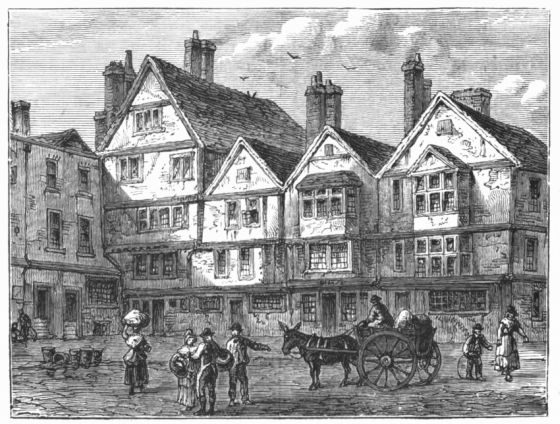
PIE CORNER, SMITHFIELD, WHERE THE GREAT FIRE REACHED ITS LIMITS.
[See larger version]
Towards the evening on Wednesday the wind abated, and buildings were blown up to clear the ground round Westminster Abbey, the Temple Church, and Whitehall. The next day, the weather being calm, the danger was thought to be over, but in the night the fire burst out again in the neighbourhood of the Temple, in Cripplegate, and near the Tower. The king, the Duke of York, and many noblemen assisted to blow up houses in those quarters, and thus contributed to save those places, and finally stop the conflagration. Nothing is said so completely to have roused Charles as this catastrophe, and both he and the duke were indefatigable in giving their personal attendance, encouragement, and assistance. They placed guards to prevent thieving, and distributed food to the starving inhabitants. In the fields about Islington and Highgate two hundred thousand people were seen occupying the bare ground, or under huts and tents hastily constructed, with the remains of their property lying about them. Charles was indefatigable in arranging for the accommodation of this unfortunate mass of people in the neighbouring towns and villages, till their houses could be rebuilt. But for months afterwards the enormous field of ruins presented a burning and smoking chaos. Had Charles and his brother conducted themselves at other times as during this brief but awful time, they had left very different names and effects behind them. The great misfortune for the moment even softened down the acrimony of bigotry and party; but this did not last long. An inquiry was instituted, both by the Commons and the Privy Council, into the cause of the calamity, but nothing was elicited to prove it the work of incendiaries.
The people at large firmly believed that the plague and the fire were judgments for the sins of the King and Court.
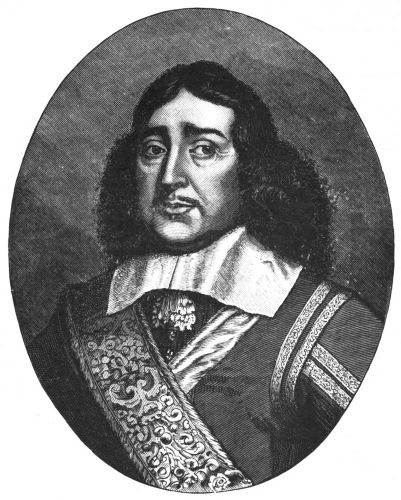
GEORGE MONK, DUKE OF ALBEMARLE.
[See larger version]