Chapter VIII · (continued 2)
Reading edition
In spite of the season, the end of November, Louis had taken the field, according to his novel plan of winter campaign, and invested Guislain, which was expected to fall in a few days.
This decisive conduct on the part of Louis roused the wrath of Charles; he had adjourned Parliament from the 16th of April to the 15th of January. He expressed his surprise to Louis at the unreasonableness of his conduct, and despatched directions to Hyde, the ambassador at the Hague, to enter into a separate treaty with the States, on the model of the Triple Alliance, engaging not only to defend each other against all aggressors, but to continue to force the other parties to come to fair terms. Such a treaty was signed at the Hague on the 31st of December. Louis, on hearing of it, stopped the payment of Charles's pension, but at the same time he proposed, through Montagu, the English ambassador, a truce of twelve months, during which all might be arranged, and then he threw out a bait which he knew would be extremely tempting to Charles,—that if he could persuade his nephew to consent to the cession of Condé, Valenciennes, and Tournai, their full value should be paid to the king in bars of gold, concealed in bales of silk, and any sum that the Lord Treasurer might name in reward of his services should be remitted in diamonds and pearls. But both Danby and the Duke of York set their faces against any such disgraceful compromise; Danby remaining steady to his views of the danger of the French ascendency, and the duke being zealous for the interests of his new son-in-law, and in the hope of receiving the command of any auxiliary force sent from England to co-operate with Holland. At the duke's suggestion the English forces were recalled from the army of France, a strong squadron was sent to the Mediterranean to reinforce the fleet under Sir John Narborough, and the Port of Ostend was demanded from Spain as a depôt for the English army in Flanders.
This unusual vigour induced Louis to set in motion the forces of the Opposition both in England and Holland. To Barillon, his ambassador at London, he sent over the younger Ruvigny, who was related to Lady Vaughan, and intimate with the Russell family. The ambassadors first tried to bring Charles over again by the most liberal offers of money; they warned him to beware of the pernicious counsels of Danby, who was seeking popularity; and to Danby himself they paid the highest compliments, and begged him to use his influence with the king. Charles, who never long resisted the temptations of money, was not, however, yet to be moved, and the ambassadors then tried their influence with the Opposition. They found Holles and Lord William Russell extremely hostile to the Court, but suspicious of a secret engagement between Charles and Louis. This suspicion the ambassadors did their best to root out, and Holles and Russell engaged to attach to the supply conditions which should cause the king to reject it. The ambassadors promised that Louis, on his part, should use all his influence to cause a dissolution of Parliament, and to ruin Danby, measures which the Opposition desired. They even offered money to the Opposition, and asked Lord William Russell to give them the names of such persons as they should reward for their services in this matter. Russell repelled the offer with indignation, and replied that he should be sorry to have anything to do with men who could be bought with money. They did not, however, find others of the patriots quite so scrupulous. Louis, at the same time, was at work at the Hague, insinuating through his agents that William, now connected with England, was joined with Charles, whom the Dutch most cordially hated, in a common scheme for ruling Holland and England by a military force, and that their only safety lay in peace and disbandment of troops. Their arts were so successful, that the Dutch began to cry for peace on any terms.
When Parliament met on the 28th of January, Charles announced that he had made a league, offensive and defensive, with Holland, for the protection of Flanders, and that if France would not consent to a peace on fair terms, they would endeavour to force it; but that he should require to put ninety ships into commission, and raise thirty or forty thousand troops, and a liberal supply would be necessary to defray the cost. This was the very thing that the Country party had been clamouring for, but they had now been drawn into a false position by the acts of Louis; and though they could not condemn the proposals, they declared that no peace ought to be made with France, except such as should restrain that country to the limits set by the treaty of the Pyrenees. This, under the present circumstances, it would be folly to ask of Louis, and Charles reproached the Opposition with the inconsistency of their conduct, in throwing obstacles in the way of the very measure they had clamoured for, especially after he had followed their own advice in making the treaty with Holland. The Ministry, however, carried a vote for the maintenance of the necessary fleet and army, and a supply was granted on general taxes to cover the expenditure.
Meanwhile Louis had pushed his military operations forward in the Netherlands with a vigour which confounded his enemies. Towards the end of January he proceeded from Paris to Metz; Namur and Mons were invested, and before the end of March he had made himself master of Ypres and Ghent. By this means he had opened a road into the very heart of Holland, and exposed Brussels to his attacks; and both on the Continent and in England the cry was now for more vigorous measures. Three thousand soldiers were sent by Charles to Ostend, and the levy of forces was proceeded with briskly. But the more Charles exerted himself to raise troops and prepare actively for war, the more the Opposition expressed their suspicions of the use intended for these troops. Russell talked of Popery, and Sir Gilbert Gerrard declared that the forces would never be used against any foreign enemy; that their object was nearer home. They demanded, therefore, that the king should at once declare war against France, recall his Commissioners from Nimeguen, and dismiss the French ambassador. This language on the part of men many of whom had been receiving their money to compel a peace advantageous to France, surprised not a little Barillon and Ruvigny, who remonstrated with Holles and Russell, Shaftesbury and Buckingham. But they were told that the real object was to embarrass the king in raising these troops; for that, once raised, he would secure the leaders of the Opposition, and then would obtain from the slavish Parliament any supplies that he might demand, thus at once making himself independent of Parliament and of Louis.
That the Opposition had grounds for their fears there was little question, and the French envoys were obliged to be satisfied with this odd-looking sort of friendship. Charles undoubtedly had rather have the army and the supplies than go to war with Louis; and the consternation of the confederates now opened up to him a new chance of obtaining Louis's money, and keeping the peace. Both the Prince of Orange and Spain, by its ambassadors, informed him that they would now no longer object to the cession of Tournai and Valenciennes, if France would restore the other five towns, with Ypres and Ghent. Charles, who now thought all difficulty removed, hastened to write these conditions to Louis, and so confident was he that they would be accepted, that he caused Danby to add, in a private letter, that if the peace were effected on these terms, he should expect a pension of six millions of livres for the next three years for his services. In a postscript the king himself wrote, "This is writ by my order.—C. R." This letter, afterwards produced against Danby, occasioned his ruin.
But Louis was not so easily satisfied after his recent victories. He demanded Ypres and Condé as well as Tournai and Valenciennes. Charles professed to be disgusted with this grasping disposition, but both Holland and Spain expressed their willingness to yield. The conquest of Ghent and French gold produced their effect, and an armistice was entered into to allow time for preparing the articles of peace. To satisfy Charles, Louis assented to his demand of a pension of six million livres, on condition that he bound himself to break with Holland if it refused to sign the treaty on the conditions now offered, to recall his troops from Flanders, to reduce his army to six thousand men, and to prorogue and then dissolve Parliament.
When Parliament met on the 23rd of May, they demanded that Charles should immediately declare war or disband the whole of the troops recently raised. They voted two hundred thousand pounds on condition that the troops should be at once paid off with it, and two hundred thousand pounds more for the navy. The king asked for three hundred thousand pounds a year in addition to his present income, to enable him to punish the pirates of Algiers, and take that position in the Continental politics which the rank of England required; but to this the Commons turned a deaf ear.
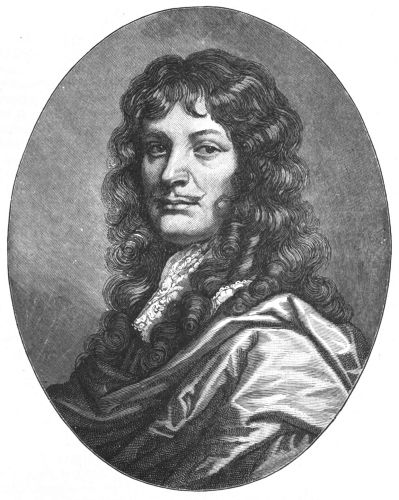
SIR WILLIAM TEMPLE. (After the Portrait by Sir Peter Lely.)
[See larger version]
By the middle of June the plenipotentiaries at Nimeguen had settled all the preliminaries of peace, and were on the point of signing, when Louis started another difficulty—that he would continue to hold the six towns stipulated to be restored to Spain, till the Emperor of Germany had restored the conquests made from his ally, the King of Sweden. The confederates refused to admit any such condition, and preparations were again made for war. Charles sent over four thousand men under the Earl of Ossory to join the English forces in Flanders, and Temple hastened to the Hague, to complete a fresh treaty with the States, binding each other to prosecute the war against Louis unless he abandoned the claim for Sweden. This might have had effect with Louis, had he not convincing evidence that Charles was not in earnest. At the very moment of this apparent spirit, Charles was bargaining for more money with Barillon, in the chamber of his French mistress, the Duchess of Portsmouth. At Barillon's instigation, one Ducros, a French monk, was sent to Temple, at Nimeguen, desiring him to persuade the Swedish ambassadors to concede their claims and make peace; and Louis, by giving a hint of this fact to the States General, so alarmed them at the perfidy of their pretended ally, that they hastened to sign the treaty with France, without any stipulation in favour of Spain. The Spanish Netherlands were at the mercy of Louis, and the coalition against him was completely broken up.
William of Orange, who was extremely mortified at having to treat for peace on such terms, and rightly attributing the necessity to the conduct of Charles, took the opportunity to give a parting chastisement to the French, though he had not, as has been asserted, knowledge of the conclusion of the treaty. On the 4th of August, four days after the signing of the peace by Beverning, the Dutch plenipotentiary at Nimeguen, he attacked the Duke of Luxembourg before Mons. Luxembourg had reduced the city to great distress, and had not relaxed his siege during the armistice; William, therefore, knowing nothing, or affecting to know nothing of the signing of the peace—though at that time it was known in London—fell on the duke with all the forces he could muster, Dutch, English, and Spanish, and a desperate battle took place. William took the abbey of St. Denis in front of the French camp; Villahermosa, the Spanish general, took the ruined fortress of Casteau, but was driven out of it again before night. The English troops under Lord Ossory did wonders. About five thousand men fell on one side or the other. At night the two armies resumed their places. It was expected that William the next day would utterly rout Luxembourg; and had the continuance of the war permitted, might have made his long-contemplated march into France. But the next day Luxembourg desired a conference, and informed William that the peace was concluded, and William retired towards Nivelles, and the French towards Ath. He had managed to prevent the important fortress of Mons falling into the hands of France.
Scarcely had these events taken place, when William was surprised by an overture from Charles, to unite with him, according to the treaty between them, to compel Louis to grant the Spaniards the terms formerly offered at Nimeguen. The motive for this does not appear clear. If he knew of its conclusion, as he must have done, he could not expect William immediately to violate the peace just made. Probably he wished to appear to the Spaniards to be anxious to keep his engagement to them, for he made the same professions to them, and on the faith of that the Spaniards demanded better terms; but equally probable is the idea that he wanted an excuse for not disbanding the army. William is said, however, to have exclaimed to Hyde, who brought the message, "Was ever anything so hot and so cold as this Court of yours? Will the king never learn a word that I shall never forget since my last passage to England, when, in a great storm, the captain all night was crying to the man at the helm, 'Steady! steady! steady!' If this despatch had come twenty days ago, it had changed the face of affairs in Christendom, and the war might have been carried on till France had yielded to the treaty of the Pyrenees, and left the world in quiet for the rest of our lives; as it comes now, it will have no effect at all." Louis resented the interference of Charles at this moment, and suspended the payment of his pension. He, however, receded from some of his terms, and referred the settlement of the differences with the Spaniards and the Emperor of Germany to the Dutch. Before the end of October peace was concluded with all parties. Holland had recovered all she had lost, and obtained an advantageous treaty of commerce with France. Spain had lost Franche-Comté, and twelve fortresses in Flanders; Germany had regained Philippsburg in exchange for Freiburg; Sweden recovered what it had lost to Denmark and the Elector of Brandenburg; and Louis was left with a power and reputation that made him the arbitrator of Europe.
We now come to one of the most extraordinary displays of a succession of plots, or pretended plots, which ever occurred in the history of any nation. From a small and most improbable beginning they spread and ramified themselves in all directions, involving the most distinguished persons of the State, ascending to the royal house, threatening the lives of the Duke of York, of the queen, and even of the king. Though defeated in their highest aims, they yet brought to execution a considerable number of persons of various ranks, including several noblemen and commoners of distinction. When they appeared to be extinguished for a short period, they broke out again with fresh force, and struck down fresh victims; and whilst much of the machinery of the agitators remained in the deepest obscurity, the mind of the nation was wrought up to a condition of the most terrible suspicion, wonder, and alarm. In the half-absurdity of the charges, the half-development of ominous truths, the public was thrown into a long fever of terror and curiosity, and seemed to lose its judgment and discretion, and to be ready to destroy its noblest citizens on the evidence of the most despicable of mankind.
From the moment that some obscure indications of a secret league between the king and Louis of France had emerged to the light, the people were haunted by fears and rumours of plots, and designs against the national liberty. Especially since the Duke of York had avowed himself a Catholic, and the king had a French Catholic mistress, and spent much time with the French ambassador, Barillon, in her apartments, there were continual apprehensions of an attempt to introduce Popery, and to suppress the public freedom by a standing army. The country was nearer the mark than it was aware of, and had it come by any chance to the knowledge of the full truth that their monarch was the bond-slave of France, to favour its ambitious designs of averting the balance of power on the Continent, and extending the French empire, at the expense of its neighbours, to the widest boundary of the Empire of Charlemagne, the immediate consequence would have been revolution, and the expulsion of the Stuarts a few years earlier. But as the real facts were kept in profound secrecy, all manner of vague rumours rose from the facts themselves, like smoke from a hidden fire.
There was a party, moreover, in Parliament, called the Country party, or, in our modern phrase, the Opposition, which now included several of the displaced statesmen of the Cabal, especially Buckingham and Shaftesbury. These men had no scruples to restrain them from embarrassing the Government, and in particular from denouncing their successful rival, the Lord Treasurer Danby. They knew well the secret which the public only suspected; but they had been too much mixed up with it to render it safe to reveal too much of it. But enough might be employed to destroy the Prime Minister, and to gain another end—the exclusion of the Duke of York and the prevention of a Papist succession.
To destroy Danby, who was thoroughly anti-Gallican in his policy; to exclude James from the throne and secure a Protestant succession; to compel the king to rule by a Protestant Government, and to have recourse to Parliament for support; there certainly appeared nothing more likely than to raise a terror of a Papist conspiracy, and to link it sufficiently with suspicious connection with France. This was done with marvellous success amid a wonderful exhibition of strange events, except that of excluding James from the throne, and even this was all but accomplished. Probably the conception of the scheme was due to the fertile mind of Shaftesbury, and its execution to the same master of chicane, assisted by the unscrupulous Buckingham.
On the 12th of August, as the king was walking in the park, one Kirby, a chemist, who had been occasionally employed in the royal laboratory, and was therefore known to Charles, approached and said, "Sir, keep within the company. Your enemies have a design upon your life, and you may be shot in this very walk." Charles stepped aside with him, and asked him the meaning of his words. He replied that two men, Grove and Pickering, had engaged to shoot him, and that Sir George Wakeman, the queen's physician, had agreed to poison him. Charles showed very little change of manner or countenance, but told Kirby to meet him that evening at the house of Chiffinch, his well-known procurer, and pursued his walk. In the evening Kirby repeated what he had said, and added that he received the information from Dr. Tongue, rector of St. Michael's, in Wood Street, who was well known to several persons about the Court. This Dr. Tongue was a singular mixture of cunning and credulity, who had long been an alarmist, and who had printed yearly and quarterly pamphlets against the Jesuits, "to alarm and awaken his Majesty and the two Houses." Tongue was sent for, and brought a mass of papers, divided into forty-three articles, giving a narrative of the conspiracy, which he pretended had been thrust under his door. Charles referred him to Danby, and to him Tongue repeated the story of Grove, otherwise called Honest William, and Pickering, and said he would find out their abode, or point them out when walking, according to their daily custom, in the park. Orders were given to arrest these assassins, but they did not appear, and Tongue gave various frivolous reasons for their non-appearance. It was said that they were gone to Windsor, but they could not be found there. Charles came at once to the conclusion that the whole was a hoax, and when Danby requested permission to lay the narrative before the Privy Council, he replied, "No, not even before my brother! It would only create alarm, and might put the design of murdering me into somebody's head."
The contempt which the king showed and expressed for the whole affair might have caused it to drop, but there was unquestionably a party at work behind, which would not suffer it to stop. Tongue informed Danby that he had met with the person whom he suspected of having drawn up the papers; that he had given him a more particular account of the conspiracy, but he begged that his name might be concealed, lest the Papists should murder him. He moreover assured Danby that on a certain day a packet of treasonable letters would pass through the post-office at Windsor, addressed to Bedingfield, the confessor of the Duke of York. Danby hastened to Windsor to intercept the packet, but found it already in the hands of the king. Bedingfield had delivered them to the duke, saying that the papers appeared to contain treasonable matter, and that they certainly were not in the hands of the persons whose names they bore. The duke carried them at once to the king.
These papers now underwent a close examination, and the result was that all were convinced that they were gross forgeries. One was clearly in the same hand as the papers presented before by Tongue; the rest, though in a feigned hand, bore sufficient evidence of being the work of the same person. The king was more than ever convinced that the whole was a hoax, and desired that no further notice might be taken of it. Kirby frequently made his appearance at Court, but Charles always passed him without notice. As there appeared no prospect of proceeding with the matter at Court, the person who had conveyed the papers to Dr. Tongue now went to Sir Edmundbury Godfrey, an active justice of the peace at Westminster, and made affidavit, not only of the truth of the former papers, but also of thirty-eight more articles, making altogether eighty-one articles. This mysterious person now appeared as one Titus Oates, a clergyman, and it was ascertained that he had been lodging at Kirby's, at Vauxhall, and that Dr. Tongue had also retired thither, on the plea of concealment from the Papists. Godfrey, on perceiving that Coleman, secretary to the late Duchess of York, and a friend of his own, was named in the affidavit as a chief conspirator, immediately communicated the fact to Coleman, and Coleman communicated it to the Duke of York.
James was now more than ever convinced that, whatever were the plot, its object was to bring the Catholics into odium, and lead to his exclusion from the throne, and demanded of Charles that it should be inquired into. Danby now seemed to favour the king's view of keeping it quiet, but this only led James to suspect that the minister wished to hold it back till Parliament met, when its disclosure might be useful in an impeachment with which he was menaced. Charles, at the duke's renewed entreaty, reluctantly ordered Tongue and Oates to appear before the Privy Council. Accordingly Titus Oates, soon to become so notorious, appeared before the Council on the 28th of September, 1678, in a clerical gown and a new suit of clothes, and with an astonishing assurance delivered in writing the following strange story. The Pope, he said, claimed Great Britain and Ireland, on the ground of the heresy of the prince and people, and had commanded the Jesuits to take possession of it for him. De Oliva, general of the Order, had arranged everything for this purpose, and had named under the seal of the Society, all the persons to fill the offices of the State. Lord Arundel was created Lord Chancellor; Lord Powis, Treasurer; Sir William Godolphin, Privy Seal; Coleman, Secretary of State; Lord Bellasis, General of the Army; Lord Peters, Lieutenant-General; Lord Stafford, Paymaster. All inferior offices, and all the dignities of the Church were filled up, many of them with Spaniards and other foreigners. Moreover, the Jesuits were dispersed throughout Ireland, organising insurrections and massacres; in Scotland they were acting under the guise of Covenanters; in Holland they were raising a French party against the Prince of Orange, and in England preparing for the murder of the king, and of the duke, too, if he did not consent to the scheme. They had no lack of money. They had one hundred thousand pounds in the bank, had sixty thousand pounds in yearly rents, had received from La Chaise, the confessor of the French king, a donation of ten thousand pounds, and a promise from De Corduba, the Provincial of New Castile, of as much more. In March last a man named Honest William, and Pickering, a lay brother, had been commissioned to shoot the king at Windsor, and had been severely punished for the failure of the attempt. On the 24th of April a consultation had been held by Jesuits from all parts, at the White Horse Tavern in the Strand, to decide on the mode of killing the king; when three sets of assassins were engaged—the two already mentioned, two Benedictine monks, Coniers and Anderton, and four Irishmen. Ten thousand pounds had been offered to Wakeman, the queen's physician, to poison the king, but he had refused to do it for less than fifteen thousand pounds, which was agreed to, and five thousand pounds had been paid down. He had often seen Wakeman since amongst the Jesuits. The Irish assassins were to receive twenty guineas each for stabbing the king. Honest William was to receive fifteen hundred pounds, and Pickering thirty thousand masses, valued at the same sum. They were to shoot the king with silver bullets. A wager, he said, was laid that the king should eat no more Christmas pies, and that if he would not become R.C. (Roman Catholic, or Rex Catholicus), he should no longer be C.R. Oates averred that he had gone to the Jesuits at Valladolid, thence with letters from them to Burgos, thence to Madrid, back to England, thence had gone to St. Omer, and back to England with fresh instructions. They made him cognisant of their plans for the murder, and he saw on their papers all the names signed. Since his return he had discovered that they set fire to London in 1666, and had used seven hundred fire-balls, familiarly called Tewkesbury mustard pills, as containing a notable biting sauce. Their success encouraged them to set fire to Southwark in 1676, by which they had gained two thousand pounds above their expenses, as they had by carrying off diamonds in the London fire made fourteen thousand pounds. They had now a plan to set fire to Wapping, Westminster, and the ships in the river. There were twenty thousand Catholics in London, who had engaged to rise in twenty-four hours or less, and could easily cut the throats of one hundred thousand Protestants. In Scotland eight thousand Catholics had agreed to take arms; a general massacre of Protestants was planned in Ireland; Ormond was to be murdered; forty thousand black bills were provided for the Irish massacre, and Coleman had sent thither two hundred thousand pounds. Poole, the author of the "Synopsis," Dr. Stillingfleet, and De Brunt were also to be put to death.
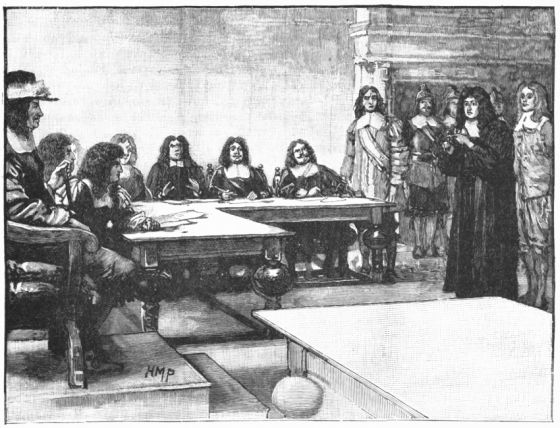
TITUS OATES BEFORE THE PRIVY COUNCIL. (See p. 250.)
[See larger version]
The recital of this astounding story was listened to with amazement and incredulity. The listeners looked at one another in wonder at the audacity of the man who could relate such horrible and improbable designs, and expect to be believed, after the account which he gave of the mode by which he professed to obtain his information. This was that he had feigned a conversion to discover the designs of the Jesuits; had been duly admitted to the priesthood and to their monasteries, and finally entrusted with the conveyance of their diabolical messages. The Duke of York declared the whole to be a most impudent imposture, but others thought no man in his senses would come forward with such a startling tale, and implicate so many persons of consideration without some grounds. Where, they asked, were his proofs? Where were the papers that had been confided to him, which would be evidence against the traitors? Oates confessed that he had no such papers, but that he would undertake to procure abundance if he were furnished with warrants and officers to arrest the persons whom he had accused, and seize their papers. This was granted, and the next day the inquiry went on. It was objected to the letters seized at Windsor, that they were written in feigned hands, and were full of orthographical errors. Oates replied that that was the art of the Jesuits, who gave such documents a suspicious look, that if discovered they might pretend that they were forged. But Charles, who became even more persuaded that the thing was got up, asked Oates what sort of a man Don John was, as he professed to have been introduced to him at Madrid. Oates replied at once that he was tall, dark, and thin. The king turned to the duke and smiled, for they both were well acquainted with Don John's person, which had more of the Austrian than the Spaniard, and was fair, stout, and short. "And where did you see La Chaise," added Charles, "pay down the ten thousand pounds from the French king?" "At the house of the Jesuits," replied Oates, unhesitatingly, "close to the Louvre." "Man!" exclaimed Charles, who knew Paris better than Oates, "the Jesuits have no house within a mile of the Louvre."
These palpable blunders confirmed Charles in his opinion, and seemed to annihilate the veracity of Oates. The king, certain of the whole affair proving a sheer invention, went away to Newmarket, and left the duke and Danby to finish the inquiry. But they who had set Oates to work knew more than he did, and presently such confirmation was given to Oates's assertions as astonished every one. At first, the clue appeared broken. On examining the papers of Harcourt, the Provincial of the Jesuits, nothing bearing the slightest indications of a plot could be discovered; but not so with the papers of Coleman. This man was the son of a clergyman in Suffolk, who had turned Catholic, and was not only appointed secretary to the Duchess of York, but after her death was much in the confidence of James. Coleman was undoubtedly a great dabbler in conspiracy. He had maintained a correspondence with Father La Chaise, the confessor of Louis XIV., with the Pope's nuncio at Brussels, and other Catholics, for the re-establishment of the Catholic religion in England, and he made himself a centre of intelligence to the Catholics at home and abroad. He lived in great style, and his table was frequented by the Whig members during the sitting of Parliament. He sent weekly news-letters to the Catholics in various quarters, and made in them the severest remarks on the ambition of the French king and the conduct of the English Government. Yet all this time he was importuning Louis to furnish money for the establishment of the Catholic Church in England again. He obtained three thousand five hundred pounds from the bankers whom Charles had broken faith with on the shutting of the Exchequer, on pretence of influence with Parliament, and two thousand five hundred pounds from Barillon, to distribute amongst members of Parliament.
In 1675 a foreigner of the name of Buchateau, but who was called Louis Luzancy, had come to England, pretending to be a Catholic who was desirous of joining the English Church, and who gave information to some of the Opposition leaders that Father St. Germain, confessor to the Duchess of York, had threatened to murder him if he did not recant Protestantism. This made a great sensation, and he then said he had made the discovery of a Popish plot, in which the king was to be killed, and the streets of London were to run with the blood of massacred Protestants. Though it was soon shown by Du Maresque, a French Protestant clergyman, that Luzancy had fled from France for forgery, and a swindling transaction at Oxford soon proved that he was a great scoundrel, yet his story won him much patronage: he was ordained and presented to the living of Dovercourt, in Essex, during this present year. His pretended plot was very like this of Oates's, and might possibly be its model. He had accused Coleman of similar practices, but Coleman had boldly faced him and put him to silence. But now Coleman had fled, itself a sign of guilt; amongst his papers were found abundant evidence of his correspondence with the French Court in 1674, 1675, and 1676. In one letter he said to La Chaise, "We have here a mighty work upon our hands, no less than the conversion of three kingdoms, and by that, perhaps, the utter subduing of a pestilent heresy, which has for a long time domineered over a great part of this northern world. There never were such hopes of success since the days of Queen Mary." He declared the duke devoted to the cause and also to the French king. He said, "I can scarcely believe myself awake, or the thing real, when I think of a prince in such an age as we live in converted to such a degree of zeal and piety as not to regard anything in the world in comparison of God Almighty's glory, the salvation of his own soul, and the conversion of our poor kingdom." He declared that Charles was inclined to favour the Catholics, and that money would do anything with him. "Money cannot fail of persuading the king to anything. There is nothing it cannot make him do, were it ever so much to his prejudice. It has such absolute power over him he cannot resist it. Logic built upon money has in our Court more powerful charms than any other sort of argument." Therefore he recommended three hundred thousand pounds to be sent over on condition that Parliament should be dissolved.
These discoveries perfectly electrified the public. That there was a plot they now had no doubt whatever, and the information touching so close on the real secret of Charles's pension, must have startled even him. Coleman, in these letters, stated that Parliament had been postponed in 1675 till April, to serve the French designs, by preventing Holland from obtaining assistance from England. Yet when Oates had been confronted with Coleman before his flight, though Oates pretended great intimacy with him, he actually did not recognise him. Another proof, if any were wanted, that Oates was acting on the knowledge of others, not on his own. Whoever they were, they had become acquainted with Coleman's French correspondence, and who so likely as Shaftesbury and the Whigs who used to frequent this man's house, and who were themselves deep in a similar intrigue with the French Court?
Still more astounding events, however, followed close on this discovery. No sooner was this discovery in the letters of Coleman made, than Sir Edmundbury Godfrey, the magistrate before whom Oates had made his affidavit of the plot, who was a particular friend of Coleman's, and had warned him of his danger, was missing, and was found murdered amongst some bushes in a dry ditch between Primrose Hill and Old St. Pancras Church. Godfrey was of a sensitive disposition, which sometimes approached to insanity. On the apprehension of Coleman, Godfrey had been seized with great alarm, and expressed his conviction that he should be the first martyr of this plot. On the 12th of October he burnt a large quantity of papers, and that day he was seen hurrying about the town in a state of serious absent-mindedness. From that day he was missing, and it was not till the sixth day that his body was found. He lay forward, resting on his knees, his breast, and the left side of his face. His sword was thrust through his heart with such violence, that it appeared at his back. His cane was stuck upright in the bank, his gloves lay near it on the grass, his rings were on his fingers, and his money was in his purse. All these circumstances seemed to indicate suicide; and to confirm it, it was reported that when the sword was withdrawn, it was followed by a rush of blood. This, however, the doctors denied, and on being stripped, the purple mark round his neck showed that he had been strangled, and then thrust through, and his body, cane, and gloves so disposed as to persuade the parties that he had killed himself.
But who, then, were the murderers? This was never discovered, but the public, putting together all the circumstances, declared that the Papists had done it, and that Oates's story was all true. That Catholics, or at least such as were in the scheme of Coleman, had done it, appears very probable, although it has been argued that they had no motive. But it must be remembered that Godfrey was a friend and associate of Coleman's. He had always been a partisan of the Catholics; he gave Coleman warning to fly; he showed great alarm himself, and commenced burning papers. All these circumstances indicate complicity. That he was deep in the secrets of the party, and had dangerous papers in his possession, is clear. Coleman was in custody, and something might be drawn out of him. Godfrey might be arrested, and a man of his nervous temperament might reveal what concerned the lives of many others. There were the strongest motives, therefore, for those who had any concern in the dangerous conspiracy of Coleman, to have Godfrey at least out of the way.
The public mind was in the wildest state of alarm and fermentation. Every hour teemed with fresh rumours. Murders, assassinations, and invasions were the constant talk of the panic-struck public. The City put itself into a posture of defence; chains and posts were put up, and no man deemed himself safe.
In this state of the public mind Parliament met on the 21st of October. Charles informed Parliament that he had obtained more favourable terms for Spain by his army in Flanders, but that the expense had been enormous; the supplies were not only exhausted, but the revenue of the next year was anticipated, and it would require a liberal grant even to disband the army. He alluded but passingly to the plot, for it touched too nearly on the tender ground of his French secret, but said he left the examination of the plot entirely to the law. But both Danby and the Opposition rushed into the question, contrary to the wish of Charles. Danby was anxious to divert the House from the threatened impeachment of himself, and the Opposition to establish a Popish plot, to damage the Duke of York's prospects in the succession.
Oates was called before both Houses, as well as Dr. Tongue, and such was the effect of their statements, that guards were placed in the cellars under the Parliament House, to prevent another gunpowder plot; and Charles was implored to order every Catholic, not a householder, to quit London, to dismiss all Papists from his service, and have his food prepared only by orthodox cooks. Committees were appointed to search the conspiracy to the bottom. Shaftesbury took the lead in that of the Lords, and there was busy work issuing warrants for searches and arrests, sending out informers and officers, examining and committing prisoners. In consequence of the charges made by Oates against Lords Arundel, Powis, Bellasis, Petre, and Stafford, as having received appointments from the Pope of the chief offices of State, they were arrested and committed to the Tower.
The Commons introduced a new Test Act to exclude every Catholic from Parliament. This had indeed been effected in the Commons in the preceding session by the Oath of Supremacy, and the declaration against Transubstantiation; but the present test went to exclude the Catholic peers from their House also. It prescribed the taking of the Oaths of Supremacy and Allegiance, and a declaration that the Church of Rome was an idolatrous church. Such a test had been frequently introduced before and thrown out, but in this public furore it rapidly passed the Commons, and reached a third reading in the Lords, when James, with tears in his eyes, entreated them to exempt him from so severe an exclusion, protesting that his religion should always remain a thing between God and his own soul. A proviso, exempting him from its operation, was added to the Bill; but in the Commons this passed by only two votes. Thus the Catholic peers were excluded by Titus Oates from their seats, and their successors did not regain them till 1829.
Under the stimulating effect of the repeated summonses of Oates before Parliament, and his continually augmenting disclosures, both Houses voted that "There had been and still was a damnable and hellish plot contrived and carried on by the Popish recusants for assassinating and murdering the king, and for subverting the Government, and rooting out and destroying the Protestant religion." Titus Oates was declared "the saviour of his country," and a pension of twelve hundred pounds a year was, at the instigation of Parliament, settled on him. To increase the effect of his disclosures, the funeral of the murdered Godfrey was conducted with every circumstance of public parade. He had been carried from Primrose Hill to his own house, and thousands had crowded thither to see the martyr of Protestantism. Seventy-two divines, in full canonicals, walked in procession to St. Martin's-in-the-Fields, where he was buried, and they were followed by a thousand gentlemen in mourning, including many members of Parliament. Dr. Lloyd, his friend and Rector of the parish, preached a sermon from the text, "As a man falleth before the wicked, so fellest thou." And he had two stout fellows in the pulpit with him, dressed as clergymen, to defend him from the Papists.
The fury against the Catholics now amounted to a frenzy. Two thousand suspected traitors were thrust into the prisons of the metropolis, and thirty thousand Catholics, who refused to take the obnoxious oaths, were compelled to quit their homes in London, and remove to twenty miles' distance from Whitehall. The train-bands and volunteers, to the number of twenty thousand, were occasionally kept all night under arms; batteries were planted, and every military precaution was taken to prevent a surprise. The terror spread over the whole country; orders were issued to disarm the Catholics everywhere, and every one was compelled to take the oaths, or give security for keeping the peace.
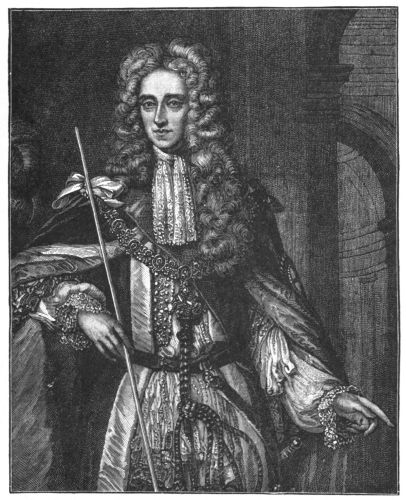
THOMAS OSBORNE, FIRST DUKE OF LEEDS. (From the Portrait by Van der Vaart.)
[See larger version]
And who was this Titus Oates, who had been able to conjure up such a storm? One of the most loathsome of mankind. His real name was Ambrose. He was the son of a ribbon weaver, who turned Anabaptist preacher during the Commonwealth, and managed to secure an orthodox pulpit at the Restoration. Titus was sent to Cambridge, where he took orders, and became a curate in different parishes, and afterwards chaplain on board a man-of-war. But wherever he went, the worst of characters pursued him, as addicted to a mischievous and litigious temper, and to the most debased and disgraceful vices. Out of every situation he was expelled with infamy, and was convicted twice of perjury by a jury. Reduced by his crimes to beggary, he fell into the hands of Dr. Tongue, and by him was engaged to simulate the character of a convert to Catholicism, so as to be able to discover all that he could of the secret views and designs of the Papists. He was reconciled, as the Catholics term it, to the church by a priest of the name of Berry or Hutchinson, who was first of one religion and then of another, and nothing long, and sent to the Jesuits' College at Valladolid, in Spain. But he was successively ejected both from that college and from St. Omer, with accumulated infamy. Returning to England he became the ready tool of Tongue, who no doubt was also the tool of deeper and more distinguished agitators behind. The Jesuits had held one of their triennial meetings at the Duke of York's. This Tongue and Oates converted into a special meeting, for the prosecution of their great national plot, but fixed it at the White Horse in the Strand. They then forged their mass of letters and papers, purporting to be the documents and correspondence of these Jesuits, planning the assassination of the king. These were written in Greek characters by Oates, copied into English ones by Tongue, and communicated as a great discovery to Kirby. Such were the apparent unravellers of the alleged plot; but these puppets had their strings pulled by far more masterly men, who were constantly extending their ground and linking up fresh machinery in the scheme. The weak part of the affair was, that on the testimony of Oates alone the whole rested. Those whom he incriminated, to a man, steadily denied any knowledge or participation in any such plot as he pretended. It was necessary to have two witnesses for convicting traitors, and other tools were not long wanting. Government had offered a large reward and full pardon to any one who could discover the assassins of Sir Edmundbury Godfrey, and in a few days a letter was received from one William Bedloe, desiring that he might be arrested in Bristol and brought to London to give evidence. The warrant for his apprehension was, singularly enough, sent to Bedloe himself, who caused his own arrest by delivering it to the Mayor of Bristol. This Bedloe turned out to be as thorough a scoundrel as Oates himself. He had been employed as a groom by Lord Bellasis, and afterwards in his house; had travelled as a courier on the Continent, and occasionally passed himself off as a nobleman. He had been seized and convicted of swindling transactions in various countries, and was just released from Newgate, when his eye was attracted by the reward of five hundred pounds for the discovery of the murderers of Godfrey.
In his first examination by the king and the two Secretaries of State, he disavowed all knowledge of the plot, but said he had seen the dead body at Somerset House, where the queen lived, and that Le Fevre, the Jesuit, told him that he and Walsh, another Jesuit, a servant of Lord Bellasis's and attendant in the queen's chapel, had smothered him between two pillows, and that they offered him two thousand pounds to assist in conveying the body away. The next day, before the House of Lords, he contradicted himself dreadfully, for the story of the two pillows did not accord with the state of the body when found. Now he said that he was not smothered, but strangled with a cravat. And so far from knowing nothing of the plot, he confessed to knowing all about the commissions offered to the Lords Arundel, Powis, Bellasis, and others, and he added wonders and horrors of his own. Ten thousand men, he said, were to land from Holland in Bridlington Bay, and seize Hull; Jersey and Guernsey were to be invaded by a fleet and army from Brest; an army from Spain of twenty or thirty thousand men was to land at Milford Haven, and there be joined by Powis and Petre with another army. There were forty thousand men ready in London, to kill all the soldiers as they came out of their lodgings. He was to have four thousand pounds for a great murder, meaning no doubt that of the king, and the Government was to be offered to one, if he would hold it of the Church. The king, Monmouth, Ormond, Buckingham, and Shaftesbury were to be killed. Lords Carrington and Brudenel were named as engaged in the plot, and were immediately arrested. When Charles heard this astounding story, so diametrically opposed to his former tales, he exclaimed, "Surely the man has received a new lesson during the last four-and-twenty hours!" and no doubt he had. These additions and improvements were constantly going on, without regard to the most glaring self-contradictions; but the temper of Parliament made them disregard obvious falsehoods of the most flagrant kind. So long as there was a chance of excluding the Duke of York from Parliament, these horrible stories were kept before the public imagination; but the moment the proviso passed in his favour, the attack was diverted into another and a higher channel. Buckingham had formerly endeavoured to induce Charles to divorce the queen: now a deadly attack was made upon her.
On the 23rd of November, a Mr. Lloyd sought an interview with the king, and informed him that Titus Oates was in possession of information that would incriminate the queen. Charles, who had shown more sense than any one through the whole business, and might have crushed it in a short time if he had had half the active exertion that he had shrewdness, expressed his decided disbelief, yet admitted Oates to make his statement. It was this, that he saw a letter in July, in which Wakeman, the queen's physician, asserted that her majesty had given her consent to the murder of the king; that he himself was at Somerset House one day in August, with several Jesuits, and was left in the antechamber whilst they went in to the queen; that the door being ajar, he heard a female voice exclaim, "I will no longer suffer such indignities to my bed! I will join in his death and the propagation of the Catholic faith;" that when the Jesuits retired he looked into the room and saw there only the queen. Now Oates had repeatedly and distinctly declared that he knew of no other persons implicated except those he had informed of; and when he made the charge against Wakeman, had said not a word of this grave accusation. Charles was certain that it was altogether false, but to prove the man, sent the Earls of Ossory and Bridgewater to make him point out the room and antechamber; but he could not do it. Charles again declared that the fellow had been instigated by some interested person, and ordered strict guard to be kept over him, and no one to be allowed to speak with him. Bedloe, however, was brought forward to confirm Oates's statement, and declared that he had overheard a conversation between Catherine and Lord Bellasis, Coleman, and some French gentlemen, in the gallery of the queen's chapel, in which she, after shedding tears, consented to the king's murder. Bedloe had been careful not to point out any private rooms for this scene, because he had made a fatal blunder in laying the scene of Godfrey's murder in a room always occupied by the queen's footmen, and at the very time that the king was there; and not only was there a throng of persons all over the palace, but a sentinel was posted at every door, and a detachment of the Guards was drawn out in the court.
Bedloe, however, delivered his charge in writing to the House of Commons, and then Oates appeared at the Bar, and, with a front of brass and in a loud voice, exclaimed, "I, Titus Oates, accuse Catherine, Queen of England, of high treason." The astounded Commons immediately sent an address to Charles, requesting that the queen might be removed from Whitehall, and desired a conference with the Lords. The Lords, however, were not so precipitate; they desired first to see the depositions made before the Council, then summoned Oates and Bedloe, and strictly examined them. They particularly pressed them to explain why this monstrous charge had not been produced before, and as they could give no sufficient reason, they declined any conference on the subject. Shaftesbury exerted himself to overrule this conclusion, but in vain; and the charge was dropped, the king observing, "They think I have a mind for a new wife; but for all that I won't see an innocent woman abused." Impeachments, however, were received by the Lords against the peers whom these miscreants had accused.
And now began the bloody work which these villains had remorselessly elaborated for a number of innocent persons, to serve the great end of their employers. The first victim, however, was one whom a third base wretch, thirsting for blood-money, a broken-down Scotsman, of the name of Carstairs, had accused. This was Stayley, a Catholic banker, whom the man said he had heard telling a Frenchman of the name of Firmin, of Marseilles, in a tavern in Covent Garden, that the king was the greatest rogue in the world, and that he would kill him with his own hand. Carstairs had gone to Stayley and told him what he professed to have heard, but offered to suppress the fact for two hundred pounds. Stayley treated him with deserved contempt, but he was arrested within five days and tried for his life. Burnet, on hearing the name of the accuser, hastened to Sir William Jones, the Attorney-General, and told him that this Carstairs was a man of the vilest character, and not to be believed on his oath; but Jones asked him who had authorised him to defame the king's witness, and Burnet timidly withdrew. Firmin could have decided what Stayley had really said, but he was kept in custody and not allowed to appear on the trial, and Stayley was condemned and hanged.
Coleman perished next, on the evidence of Oates and Bedloe, that he had been plotting with the French Court; but he contended it was only to obtain money for restoring Catholicism, and not to injure any person. It was clear that he had received money from the French king, and therefore was guilty of a serious crime, but it was equally clear that both Oates and Bedloe fabricated much falsehood against him. His own letters, however, were insurmountable evidence of his guilt. Next came Ireland, Fenwick, Grove, Whitbread, and Pickering. Ireland, a Jesuit priest, was accused of having signed, with fifty other Jesuits, a resolution to kill the king, and the others of having engaged to assist in the design. Oates swore to the guilt of the whole, Bedloe only to that of Ireland, Grove, and Pickering, who were condemned, and died protesting that they, before their apprehension, had never heard of such a thing as a plot, much less had any concern in one. Bedloe claimed to be the chief witness respecting the death of Godfrey; but though he had unscrupulously seconded the evidence of Oates, Oates would not support him in this case. He was obliged, therefore, to look out for a second witness, and it was two months before he could find one. At length, on the 21st of December, one Prance, a silversmith, who had worked in the queen's chapel, was apprehended on suspicion, he having absented himself from his house for several days about the time of Godfrey's murder. The moment Bedloe saw him, he exclaimed, "That man is one of the murderers." It was in vain that he denied it, equally vain that he brought witnesses to prove that he did not leave home at the time of Godfrey's death, but a week before. He was thrown into Newgate, and loaded with irons; some say he was tortured, others that he was worked upon by threats and promises. He confessed, and accused three others—Hill, Green, and Berry, three servants in Somerset House. But scarcely had he done so, when he entreated to be brought before the king and Council again, and there on his knees, and with every sign of agony and remorse, protested that all that he had said was false, that he knew nothing whatever of either the murder or the murderers. Afterwards, in prison, where he was chained to the floor, the horror of his feelings was such, that Dr. Lloyd, who preached Godfrey's funeral sermon, and now was become Dean of Bangor, said that he was occasionally bereft of his reason. When urged to confess, he again, however, repeated his former statement, but with various strange additions; then Dr. Lloyd declined to have anything more to do with it, but left him to Boyce, the gaoler. Prance afterwards said that Boyce wrote many things that he copied after him, and he could see that Boyce had been with Bedloe and Lord Shaftesbury, and that he was told he must make his evidence agree with Bedloe's, or he would be sure to be hanged. The first story of Prance was that they had killed Godfrey because he was an enemy to the queen's servants; that Green strangled him with a handkerchief, and punched him on the breast with his knee: but finding him not dead, wrung his neck; that on the following Wednesday night, about twelve o'clock, the body was put into a sedan chair and taken to the Soho, and there conveyed on horseback before Hill to the place in the fields where he was found, and where they thrust his sword through him.
Hill, Green, and Berry stoutly denied the whole affair, and pointed out the gross contradictions between the evidence of Bedloe and Prance; but Chief Justice Scroggs, who presided at all these trials, and showed himself a most brutal and unprincipled judge, overruled all that. Mrs. Hill, who brought witnesses into court in favour of her husband, complained vehemently that they were browbeaten and laughed at. "My witnesses," she exclaimed, "are not rightfully examined; they are modest, and are laughed at." The unhappy victims were all condemned, and died still protesting their innocence. Berry, who was a Protestant, was respited a week, with a promise of pardon if he would confess; but he would not—a sufficient proof of the man's innocence, who would not purchase life by a lie.
These victims having suffered, the drama of plots now produced a new act. It was one of the great objects, as we have said, not only to damage the succession of the Duke of York and to alarm the king, but to ruin the Prime Minister, Danby, who had superseded the Cabal. Intrigues were entered into with Montagu, the ambassador at Paris, for this purpose. Montagu was, of course, in the secret of the money transactions between the English and French Courts, and could, if it were his interest, produce enough to destroy Danby, without letting too much light in upon the whole foul business; for not only the king on one side, but the patriots and the Opposition on the other, were equally implicated. A fortunate incident facilitated their plans. Montagu and Danby were at feud, and Danby only wanted a fair pretext to remove Montagu from his post at Paris. In this position of things Montagu furnished ample ground for his recall. He had made love to Charles's famous mistress, the Duchess of Cleveland, now superseded by the Duchess of Portsmouth. Cleveland was living in Paris a life as little creditable as her life had been in England. But Montagu deserted her for her daughter, and, on her resenting this, threatened if she continued to annoy him, to expose her intrigues in the French Court, for she was become a great political tool of Louis in his practices on England. But Cleveland was not a woman to submit to be snubbed and menaced even by a king, much less by a minister: she wrote at once to Charles a furious letter against Montagu, for she had still great influence with the king. She alleged that Montagu, who had been employed by Charles to find out an astrologer, who had foretold accurately Charles's restoration and entry into London on the 29th of May, 1660, had bribed this man to give such answers to the king as suited his own purposes. He had often told her that both the king and the duke were fools—one a dull, governable fool, and the other a wilful fool; that he wished the Parliament would send them both on their travels again; that the king always chose a greater beast than himself to govern him, and much of the like kind.
Montagu did not wait for the blow which was sure to follow this missive, but suddenly, without notice or permission, left Paris and appeared in England. He put himself in communication with Shaftesbury and his party, and also with Barillon, who would be only too glad to get Danby dismissed from office. Danby watched the movements of Montagu with anxiety, knowing that he had the power to make fatal disclosures. To secure himself from the attack of the Government, and at the same time to enable him to effect his own purpose, Montagu offered himself as a candidate for Parliament at Grinstead, but was defeated by the influence of Danby. At Northampton he was returned by the mayor, Sir William Temple, while the Government nominee was returned by the sheriff; but the popular party defended his election, and Montagu gained his seat. It was agreed with the Opposition that he should lay a charge against Danby of treasonable correspondence with France, and other offences, and that they should move for his impeachment on these grounds. Besides this, Montagu had made a bargain with Barillon that one hundred thousand livres should be paid to the most powerful of the Opposition, for their endeavours to crush Danby, and one hundred thousand livres to himself, or forty thousand livres of rentes on the Hôtel de Ville, or a pension of fifty thousand livres—according to the decision of the king—if Danby were excluded from office.
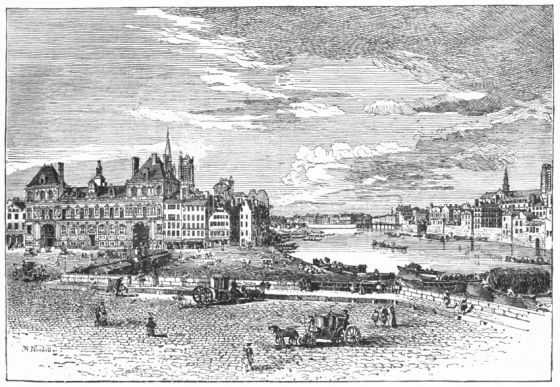
HÔTEL DE VILLE, PARIS, IN THE EIGHTEENTH CENTURY. (From an Engraving by Rigaud.)
[See larger version]
Danby was not ignorant of the storm brewing, and it was thought best not to wait for its bursting; but the king sent and seized Montagu's papers, on pretence that he had been intriguing with the Pope's nuncio in Paris; and Erneley, the Chancellor of the Exchequer, announced this fact to the House. It was a very adroit proceeding, but Montagu soon discovered that the precious casket containing the most important papers had been overlooked in the search. Montagu stated to the House that Danby had missed his aim, that the papers were safe, and a deputation was despatched to fetch them. They returned with a small despatch box, and from this Montagu produced two letters of Danby, one of them the letter in which Danby solicited a pension of six million livres, on condition that he procured a peace from the allies, and to which Charles had added the words, "This is writ by my order.—C. R."
On the reading of this letter the House was thrown into a violent agitation. The secret dealings of the king were partly brought to light. It was now seen that Charles's zeal for the war was only a pretence to extract money from the nation, and, this obtained, that he was ready to sell the honour of the country to France; and that the minister had consented to the infamous transaction. They immediately voted Danby's impeachment by a majority of sixty-three, and appointed a committee—of which Montagu was one—to draw up the articles. There was a danger that Danby would retort on Montagu by producing letters of his own, proving that he was mixed up with these transactions from the beginning, and had indeed been made the medium of their proposal; but Montagu trusted to the impossibility of detaching their evidence from such as would have angered the country against the king. He was right; yet two of his letters were sent by Danby to the House, one giving information that Ruvigny was sent to London to treat through Lord William Russell with the Opposition, and the other containing a proposal from Montagu of a grant of money to Charles on the conclusion of peace. These, at another time, would have produced a wonderful sensation, but they were now cast aside to pursue the higher game, and the next day—December 21st—the impeachment of Danby was sent up to the Lords.
On the 23rd Danby replied to the charges by pleading that he had written the letter from the dictation of the king, who had certified the fact by his own hand in the postscript; that it was well known that he was neither a Papist nor a friend to the French alliance, but that he had reason to believe that his accuser, a man who, from his perfidy and breach of the most sacred trust, all men must abhor, had been assisted by French counsel in getting up this impeachment. He denied any guilty practices, and demanded only a fair trial. There was a motion made to commit him to the Tower, but this was overruled, and a day was fixed on which the Lord Treasurer should make his defence. But to defeat this, Danby now advised the king to do that which he had repeatedly dissuaded him from—namely, to dissolve the Parliament. Accordingly, on the 30th of December, it was prorogued for four weeks, and before it could meet again, namely, on the 24th of January, 1679, he dissolved it by proclamation, summoning another to meet in forty days.
This Pension Parliament had now lasted nearly eighteen years. A wonderful change had come over the spirit of this Parliament since its first meeting. Soon after Charles's return no Parliament could be more slavishly submissive. It had restored to him almost everything that the Long Parliament had taken from his father—the power of the army, the customs, and excise; it had passed the most severe and arbitrary Acts for the supremacy of the Church, and the plunder and persecution of Catholics and Dissenters. The Act of Uniformity, the Corporation Act, the Test Act, the Conventicle Act, the Five-Mile Act, the Act which excluded Catholic peers from their House, by which the Church and Crown had been exalted, and the liberties of the people abridged, were all the work of this Parliament. But in time, a different temper displayed itself in this very pliant House. It stiffened and became uncompliant. But this was not at all by a growth of virtue in it. Various circumstances had produced this change. Buckingham, Shaftesbury, and others of the Cabal ministry and their adherents, had lost place and favour, and had organised a stout Opposition. Their chief objects were to mortify and thwart the king, to destroy the prospect of the Popish Duke of York's succession, and to overthrow their rival, Danby. In the prosecution of these selfish ends, they had, as usual, assumed the easy mask of patriotism, and had been joined by the Republican and Patriot party. They had got up the cry of Popery, and driven the nation frantic by alarm of Popish plots, and into much bloodshed, of which the end was not yet. Their present attack on Danby was to thrust down a much better man than themselves, though by no means a perfect one. But Danby had always detested the French alliance, and the use made of it to ruin the Protestant nations on the Continent and destroy the balance of power, in favour of France. He had consented, it is true, but most reluctantly, to write some of the king's begging letters to Louis, and now the Opposition, whose hands were filthy with handling Louis's bribe, had contrived to make him appear not the enemy, but actually the ally and tool of France. Montagu, the great broker of these corruptions, who had taken good care of himself, was become the chastiser of a man who was not a tenth part so guilty as himself. But the darkest part of this story is the share which the Patriotic party had in this receipt of French money, and amongst them Algernon Sidney and Hampden, the grandson of the great patriot. But in excuse for them it may be urged that they did not vote against their consciences.
When the new Parliament met it was found to be more violently anti-Roman than the old one. The duke's known, the king's suspected, Popery created a feeling in the nation that nothing could remove, and which the recent excitements about a Popish plot had roused into a universal flame. This flame the popular party took every means to fan; and though the Government exerted all its power, its candidates were everywhere received with execrations, and assertions of the bloody machinations of the Papists. The new Parliament, therefore, came up with vehement zeal against the plotters, and with unabated determination to punish Danby. But the warning which the progress of the election gave was not lost on Danby. He considered that it would be one of the most powerful means of abating the public jealousy of Popery, if the king could be induced to send the duke out of the kingdom. Charles recoiled at so harsh a measure, and tried the vain expedient of inducing James to pretend at least conversion, by sending the Primate and other bishops to persuade him to return to the Established Church. It was of course useless, and then Charles was obliged to advise James to withdraw for awhile, and reside at Brussels. James complied on two conditions—that the king should give him a formal order to leave the kingdom, so that he might not seem to steal away out of fear; and that he should pledge himself publicly that he would never acknowledge the legitimacy of Monmouth, who had given out that he had four witnesses, in case of Charles's death, to prove his marriage with his mother. This was done in presence of the Council, the members adding their signatures, and Charles ordered the instrument to be enrolled in Chancery. James quitted London with the duchess on the 4th of March, leaving his daughter Anne with her uncle, that the people might not suppose that he sought to convert her to Popery at Brussels.
On the 6th of March Parliament met, and the Commons were immediately engaged in a dispute with the Crown regarding the election of a Speaker. They elected their old one, Mr. Seymour; the Lord Treasurer appointed Sir Thomas Mears, one of his most active opponents in the last Parliament. But during the interval since the dissolution, Danby had been hard at work to convert, by some means or other, some of his most formidable enemies. After some altercation the Commons gave way, and Mears was appointed.
But this exercise of royal prerogative only embittered the House to punish Danby and screen Montagu. The Lords passed a resolution that the dissolution of Parliament did not affect an impeachment—a doctrine which has become constitutional. Montagu had absconded, but reappeared when his election to Parliament gave him personal protection. Everything, therefore, portending the conviction of Danby, Charles ordered him to resign his staff, and then announced this fact to Parliament, at the same time informing them that as he had ordered him to write the letters in question, he had granted him a pardon, and that he would renew the pardon a dozen times if there were a continued attempt to prosecute him for an act simply of obedience to his sovereign.
But this attempt to take their victim out of their hands was resented by the Commons as a direct breach of their privileges, and having looked for a copy of this pardon in Chancery, and not finding it, they learned from the Lord Chancellor that the pardon had been brought ready drawn by Danby to the king, who signed it; and that the Seal had not been affixed by himself, but by the person who carried the bag, at Charles's own order. This irregularity the more inflamed the Parliament. Powle, one of the French pensioners, with that air of injured virtue which politicians so easily assume, inveighed indignantly against Danby, who, he said, had brought the country to the brink of ruin by pandering to the mercenary policy of Louis—the very thing he had opposed,—and had raised a standing army and paid it with French money. Moreover, he had concealed the Popish plot, and spoken of Oates with contempt. The Commons forthwith passed a Bill of Attainder, and the Lords sent to take Danby into custody; but he had absconded. On the 10th of April, however, he surrendered himself to the Lords, and was sent to the Tower. Lord Essex was appointed Lord Treasurer in his stead, and Lord Sunderland, Secretary of State, took the station of Prime Minister. Essex was popular, solid, and grave in his temperament, but not of brilliant talent. Sunderland was a very different man. He was clever, intriguing, insinuating in his manners, but as thoroughly corrupt and unprincipled as the worst part of the generation in which he lived. He had long been ambassador at the Court of France, and the very fact of his holding that post between two such monarchs as Louis and Charles, was proof enough that he was supple, and not restrained by any nice sense of morals or honesty. He was perfidious to all parties—a Cavalier by profession, but at the same time that he was serving arbitrary monarchs most slavishly, he was Republican in heart. He was especially attentive to the mother of Monmouth and the Duchess of Portland, because he knew that they had great influence with his master.
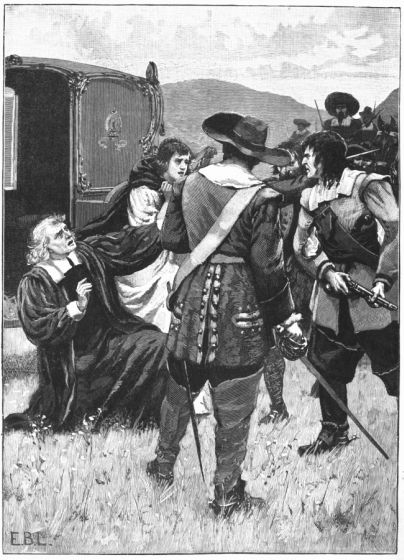
ASSASSINATION OF ARCHBISHOP SHARP. (See p. 263.)
[See larger version]
At this crisis Sir William Temple proposed to Charles a measure which he thought most likely to abate the virulence of Parliament, and at the same time prevent ministers from pursuing any clandestine purposes to excite the suspicion of the Parliament and nation. Temple had always shown himself above and apart from the mere interested ambitious and selfish objects of the king's ministers. Whenever he was wanted, he was called from his philosophic retreat of Moor Park, in Surrey, to do some work of essential benefit to the nation, which it required a man of character and ability to accomplish. He had effected the Triple Alliance and the marriage of the Princess Mary with William of Orange; he had refused to have any concern with the intrigues of the Cabal; and now, when Parliament was fast hastening to press on the prerogative, he proposed that the Privy Council should be increased to thirty members, half consisting of officers of State, and half of leading and independent members of the Lords and Commons. All these were to be entrusted with every secret movement and proposition of government; and the king was to pledge himself to be guided by their advice. Temple augured that nothing pernicious could be broached by unscrupulous ministers in a body where half were independent members of Parliament, holding no office from the Crown; and that, on the other hand, Parliament could not so vehemently suspect the tendency of measures which had first the approbation of their own popular leaders. The House of Commons had now driven three successive ministries from office—Clarendon, the Cabal, and Danby—and was still bent on a career violently opposed to the Crown. If Temple had calculated that the effect would be to neutralise or convert the democratic members, he would have been right; but that such a Council could ever work any other way was impossible. The king would never long submit measures, intended to maintain his prerogative, to a Council which was not likely to carry his views at once to both Houses; but he might, and undoubtedly would, in many cases, succeed in bringing over the Opposition orators to his interest. This was the immediate effect on most of them. Shaftesbury, Lord Russell, Saville, Viscount Halifax, Powle, and Seymour, the late Speaker, were included in the Council. But Temple soon found that men of such contrary views would not pull well together, and was compelled to break his chief condition, and compose a sort of inner council, of himself, Capel, Halifax, Essex, and Sunderland, who prepared and really managed everything. Halifax was a man of the most brilliant talents, ambitious, yet not thinking himself so, but so little swayed by mere party, that he was called a trimmer, and gloried in the title. For the rest—Capel, Cavendish, and Powle lost the confidence of the Commons, which looked on the new institution with distrust; Russell and Shaftesbury alone spoke out as boldly as ever, and retained more influence in the two Houses than they gained in the Council. In fact, the Opposition members soon found that they might propose, but the king would not be outvoted in his own Council. The very first measure suggested, was that all persons of Popish tendencies should be weeded out of office, out of the posts of lord-lieutenants, the magistracy, and the courts of law; but Charles, perceiving that the object was to remove the staunchest supporters of the Crown, quickly put an end to it. He called for the rolls, and wherever he saw a name marked for removal, gave such ludicrous and absurd reason for its retention, that there was no gravely answering him. One objected to, he said, was a "good cocker," another an "expert huntsman," "kept good foxhounds," or a "good house," "had always excellent chines of beef," and the like. Arguments were thrown away on the king, and the matter came to nothing.
On the other hand, Shaftesbury, who had been made President of the Council by Charles himself, undiverted by this from his great object, pursued his Popery alarms out of doors, where the king could not checkmate him. A fire broke out in a printing-house in Fetter Lane, and the servant was induced to confess that one Stubbs had promised her five pounds to do it, who in turn said Gifford, his confessor, had set him on, urging it was no sin; and he added that London was to be set on fire again by French Papists. The absurd story soon grew into a rumour that the Duke of York was coming with a French army to claim the throne and re-establish Popery with all its horrors. Shaftesbury declared in the Lords that Popery must be rooted out if there was to be any liberty left; that Popery and slavery, like two sisters, went ever hand-in-hand; that one might now go first, now the other; but wherever one was seen, the other was certainly not far off. The Commons eagerly seizing on the temper of the nation, voted unanimously a Bill of Exclusion against the Duke of York, and that a Protestant successor should be appointed, as though the duke were actually dead. Sir William Temple attempted to weaken this movement by attributing it to Monmouth and Shaftesbury, between whom, it was asserted, there was a secret understanding that if Monmouth's scheme of proving his legitimacy succeeded, Shaftesbury should be his Prime Minister. Probably by the advice of Temple, Charles proposed a plan for a compromise—that in case a Popish prince succeeded, every power of altering the law should be taken out of his hands; that no judges, justices, lord-lieutenants, privy councillors, or officers of the navy should be appointed without consent of Parliament; and that no livings or dignities in the Church should be at the option of the king, but of a board of the most pious and Protestant divines. Shaftesbury, however, ridiculed all these precautions, as attempting to bind Samson with green withes, which he could snap with the greatest ease. The Commons were of that mind, and on the 21st of May, 1679, passed their Exclusion Bill by a majority of two hundred and seven against one hundred and twenty-eight. The Commons followed this up by proceeding in a body to the House of Lords, and demanding judgment against Danby. They also required that the Prelates should not vote on Danby's case, fearing that their numbers might give the Crown a majority; but to this the Lords were opposed, and though the bishops offered to concede the point, the king forbade them, as the matter involved his prerogative. The Commons persisting in their demand, now instituted a strict inquiry into the cases of bribery of members of Parliament by the late minister, and ordered one of his agents, Fox, the Treasurer of the Navy, to proceed to Whitehall in company of three members, and bring his books and papers for examination. The king resented the searching of his house as a gross insult, and the books and papers were refused; but Fox was compelled to state how many members he had paid money to, and he named twenty-seven individuals. This was on the 24th of May, and Charles, to cut the inquiry short, suddenly sent for the Commons, and prorogued Parliament for ten weeks. Shaftesbury was so enraged at this unexpected obstruction to his plans, that he vowed in the House of Lords that it should cost the king's advisers of this measure their heads.
This prorogation was, on other accounts, one of the most remarkable eras in our Parliamentary annals, for before pronouncing the Parliament prorogued, the king gave his consent to the Habeas Corpus Act, and allowed the Act establishing the censorship of the press to expire. The carrying of the Habeas Corpus Act was owing mainly to the influence of Shaftesbury, and was a benefit of such magnitude, that it might cover a multitude of the sins of that extraordinary man, who, with all his faults, had a genuine substratum of patriotism in him. The press had hitherto never been free. Elizabeth cut off the hands of Puritans who offended her, and her successors dragged them into their Star Chamber. Even the Long Parliament, when they abolished the Star Chamber, declined to liberate the press, notwithstanding Milton's eloquent appeal for the liberty of unlicensed printing. The press was at length free, but only for a time, being too dangerous an engine to the corrupt government which so long succeeded.
Whilst the blood of unfortunate victims of imaginary plots was flowing in England, in Scotland the same ruthless persecution had continued against the Covenanters. Lauderdale had married the Countess of Dysart, a most extravagant and rapacious woman, who acquired complete influence over him; and to find resources for her expense, he levied fines on the Nonconformists with such rigour and avidity, that it was believed that he really sought to drive the people to rebellion, in order to have a plea for plundering them. Such was the woful condition of Scotland, delivered over by the lewd and reckless king to a man who combined the demon characters of cruelty, insult, and avarice, in no ordinary degree. Complaints from the most distinguished and most loyal inhabitants were only answered by requiring them to enter into bonds that neither they, nor their families, nor tenants should withdraw from the Established Church, under the same penalties as real delinquents. The gentry refused to enter into such bonds. Lauderdale, therefore, determined to treat the whole West of Scotland as in an actual state of revolt, and not only sent troops with artillery to march into the devoted districts, but let loose upon them bands of wild Highlanders, and commanded even the nobility, as well as others, to give up their arms. The outraged population—left exposed to the spoliation of the Highlanders, who, though they spared the lives, freely robbed the inhabitants—sent a deputation of some of their most eminent men to lay their sufferings before the king himself. They were, however, dismissed with a reprimand, Charles replying, "I perceive that Lauderdale has been guilty of many bad things against the people of Scotland, but I cannot find that he has acted in anything contrary to my interest."
At length Lauderdale's confederate, Archbishop Sharp, was murdered by a band of Covenanting enthusiasts in Fife. There the cruelties of the archbishop were pre-eminently intolerable. There David Hackston of Rathillet, his brother-in-law, John Balfour of Kinloch, or Balfour of Burley, as he is immortalised by Sir Walter Scott in "Old Mortality," James Russell of Kettle, and six others determined to take vengeance on a notorious creature of Sharp's, one Carmichael, who had pursued his levy of fines with such brutality, as to have beaten and burnt with lighted matches women and children, to compel them to betray their masters, husbands, brothers, or fathers. On the 3rd of May, 1679, Carmichael had been out hunting, but hearing of Rathillet and his band being on the watch for him, he left the field and got home. The conspirators were returning disappointed, when a greater prey fell into their hands. The wife of a farmer at Baldinny sent a lad to tell them that the archbishop's coach was on the road, going from Ceres towards St. Andrews. The delighted men gave chase, and, compelling the old man to leave his coach, barbarously murdered him. The assassins only crossed to the other side of Magus Muir, where the bloody deed had been perpetrated, and in a cottage they spent the remainder of the day in prayer and praising God for the accomplishment of what they deemed this noble work. They then rode into the West, where they joined Donald Cargill, one of the most noted of the Cameronian preachers, with Spreul, and Robert Hamilton, a young man of good family, and a former pupil of Bishop Burnet's, who had been excited by the persecutions of the people to come out and attempt their relief.
The murder of the archbishop only roused the Government to more determined rigour, and the persecuted people, grown desperate, threw off in great numbers all remaining show of obedience and resolved to resist to the death. The more moderate Presbyterians lamented and condemned the murder of the Primate, but the more enthusiastic looked upon it as a judgment of God. They resolved to face the soldiery, and they had soon an opportunity, for Graham of Claverhouse, a man who acquired a terrible fame in these persecutions, being stationed at Glasgow, drew out a troop of dragoons and other cavalry, and went in pursuit of them. He encountered them at a place near Loudon Hill, in a boggy ground called Drumclog, where the Covenanters, under Hamilton, Balfour, and Cleland, defeated his forces, and put them to flight, killing about thirty of them, including a relative of Claverhouse's (June 11, 1679). The insurgents under Hamilton, elated with their victory, marched after Claverhouse into Glasgow itself, but were repulsed. They went on, however, increasing so fast, that Claverhouse evacuated Glasgow, and marched eastward, leaving all the west of Scotland in their hands.
On the news reaching London, Charles despatched the Duke of Monmouth, with a large body of the royal guards, to quell the rebellion. On the 21st of June, as the Covenanters lay near the town of Hamilton, they received the intelligence that Monmouth, with his forces joined to those of Claverhouse, was approaching. The insurgents had soon taken to quarrelling amongst themselves, and the more moderate section were now for submitting on favourable terms. Rathillet and the more determined would not hear of any surrender, but marched off and left the waverers, who sent a memorial to Monmouth, declaring that they were ready to leave all their complaints to a free Parliament, and free Assembly of the Church. The duke, who showed much mildness throughout this campaign, replied that he felt greatly for their sufferings, but that they must lay down their arms, and then he would intercede for them with the king. On the receipt of this answer the greatest confusion prevailed; the moderate durst not risk a surrender on such terms, remembering the little mercy they had hitherto received from the Government; the more violent, with a fatal want of prudence, now insisted on cashiering their officers, who had shown what they called a leaning towards Erastianism, or, in other words, a disposition to submit to the civil power.
Whilst they were in this divided state, Monmouth's army appeared in sight on the 22nd of June. The Covenanters, therefore, compelled to fight or fly, seized on the bridge of Bothwell, which crossed the Clyde between the village of Bothwell and the town of Hamilton. It was narrow, and in the centre there stood a gateway. Here Rathillet, Balfour, and others posted themselves with about three hundred men to defend this pass. But the army of Monmouth, on the slope of the hill descending from Bothwell to the Clyde, commanded the opposite hill, on which the Covenanters were posted, with his artillery, and under its fire a strong body of troops advanced to force the bridge. Balfour and Rathillet defended their post bravely, but the gate was at length carried, and they were pushed back at the point of the bayonet. They found themselves unsupported by the main body, which, on the artillery playing murderously upon them, had retreated to Hamilton Heath, about a quarter of a mile distant. There they rallied, and repulsed one or two charges, and broke a body of Highlanders; but undisciplined, disunited, and without artillery to cope with that of Monmouth, they were only exposed to slaughter. They turned and fled.
Monmouth commanded a halt, to spare the fugitives. But Claverhouse pursued and cut them down to the number of four hundred men, besides taking twelve hundred prisoners. Some of the ministers and leaders were executed, the more obstinate were sent as slaves to the Plantations, many of them being lost at sea, and the rest were liberated on giving bonds for conformity. The efforts of Monmouth procured an indemnity and indulgence, which might, after this severe chastisement, have produced the most salutary effect; but this was speedily superseded by the old, faithless, and cruel régime of Lauderdale, and the still more brutal rule of the Duke of York.
During this time the Popish plot, with fresh actors and ramifications, was agitated by the anti-Papal party with unabated zeal. On the 24th of April, 1679, a Protestant barrister, Nathaniel Reading, was tried for tampering with the evidence against Catholic noblemen in prison, in order to reduce the charge from treason to felony. It appeared that Bedloe had engaged him to do it, and then informed against him. There appeared on the trial many damning circumstances against the character and veracity of Bedloe, yet Reading was condemned to pay a fine of one thousand pounds, and to suffer a year's imprisonment.
Bedloe, Oates, and Prance were again, however, brought forward in June against Whitbread and Fenwick, who had been illegally remanded to prison on their former trial, and three other Jesuits—Harcourt, Gavan, and Turner—were now also examined, and a new witness, one Dugdale, a discarded steward of Lord Aston's, was introduced. Oates had little to add to his former story, but Bedloe and Prance were prolific in new charges. It was in vain that the prisoners pointed out their gross prevarications and palpable falsehoods. They were all condemned, as well as Langhorne, a celebrated Catholic barrister. The infamous Jeffreys, now Recorder of London, sentenced them, amid the loud acclamations of the spectators, and they were all executed, after being offered a pardon on condition of confessing the plot, and disclosing what they knew. Langhorne was promised his life if he would reveal the property of the Jesuits, and on its proving only of the value of twenty thousand or thirty thousand pounds, he was told it was too insignificant to save his life. A second time his life was offered him if he would reveal the plot, but he replied he knew of no plot, and all were executed with the usual horrors. Next came up for trial Sir George Wakeman, the queen's physician, and Corker, Rumby, and Marshall, Benedictine monks; but the diabolical perjury of Oates this time received such an exposure, that the prisoners were all acquitted. Philip Lloyd, the clerk of the Council, deposed that when Oates had been questioned by the Lord Chancellor whether he knew anything personally of Sir George Wakeman, he had solemnly sworn that he did not, yet this morning he had charged him with different acts of treason committed in his own presence.
Notwithstanding this rebuff to the despicable informer, the three monks were recommitted on a fresh charge, and in every quarter of the kingdom similar persecutions were carried on, numbers were thrown into prison, and eight other Catholics were executed in different places.
The Duke of York was every day becoming more uneasy in his residence at Brussels. Knowing the intrigues of Shaftesbury and his party to advance the claims of Monmouth, he repeatedly solicited the king to let him return, and Charles falling ill in August, at Windsor, consented, and James made his appearance at Court, much to the consternation of Monmouth and his supporters. The king recovering, to put an end to the intrigues and feuds between the two dukes, Charles sent Monmouth to Brussels, instead of James, and ordered James to retire to Scotland. Being, as usual, pressed for money, Charles again importuned Louis for one million livres for three years; but Louis replied that he did not see at this period what services England could render him for that expense: and James advised him to manage without the money, by adopting a system of rigid economy. In August he prorogued Parliament for a year, and endeavoured to carry on without the French king's pension. On seeing this, Louis, through Barillon, renewed his offers, but Charles felt too proud to accept them, and then the French king once more turned to the Patriots, so-called, to instigate fresh annoyances. Barillon paid to Buckingham one thousand guineas, two thousand five hundred guineas were distributed amongst Baber, Littleton, Harbord, and Poole; and Montague received fifty thousand livres in part payment of his reward for overthrowing Danby. The consequences were now seen. On the 17th of November, the anniversary of the accession of Queen Elizabeth, an anti-Popish procession was organised by Shaftesbury and that party, though carried on under the auspices of the Green Ribbon Club. The bellman went first, ringing his bell, and exclaiming at intervals, "Remember Mr. Justice Godfrey!" Then came a man in the habit of a Jesuit, supporting before him on horseback an effigy of the murdered magistrate, followed by a long train of men and women, habited as monks, nuns, priests, and Catholic bishops in capes and mitres, and Protestant bishops in lawn sleeves, six cardinals with their caps, and, lastly, the Pope on a litter, with his arch-prompter, the Devil, by his side. This procession, commencing in Moorgate, traversed the streets at night with flambeaux, amid a hundred thousand spectators, who were frantic with cries of vengeance against Papists and Popery. At Temple Bar, in front of the club-house, they burnt the whole array of Popish effigies, amid fireworks and rending shouts.
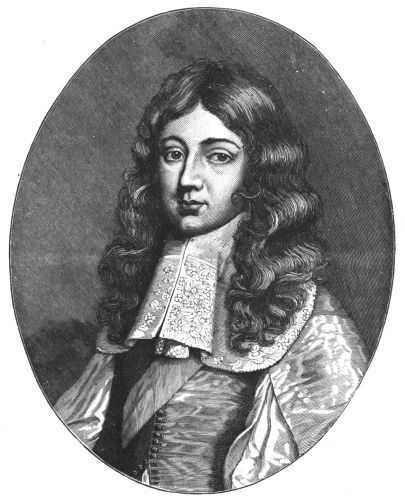
THE DUKE OF MONMOUTH.
[See larger version]