Chapter V
Reading edition
THE COMMONWEALTH (concluded).
Naval Victory over the Dutch—Death of Van Tromp—Quasi-Royal State of the Lord-Protector—Disaffection against Cromwell—His Vigorous Rule—Charles II. offers a Reward for his Assassination—Rebellions in Scotland—Cromwell's Dealings with the Portuguese Ambassador—Reform of the Court of Chancery—Commission for Purgation of the Church—The Reformed Parliament—Exclusion of the Ultras—Dissolution of Parliament—Danger from Plots—Accident to the Protector—Death of Cromwell's Mother—Royalist Outbreaks—Cromwell's Major-Generals—Foreign Policy—War with Spain—Massacre of the Piedmontese—Capture of Jamaica—The Jews Appeal for Toleration—Cromwell's Third Parliament—Plots against his Life—The Petition and Advice—Cromwell Refuses the Royal Title—Blake's Brilliant Victory at Santa Cruz—Death of Blake—Successes against Spain—Failure of the Reconstructed Parliament—Punishment of Conspirators—Victory in the Netherlands—Absolutism of Cromwell—His Anxieties, Illness, and Death—Proclamation of Richard Cromwell—He calls a Parliament—It is Dissolved—Reappearance of the Rump—Richard Retires—Royalist Risings—Quarrels of the Army and the Rump—General Monk—He Marches upon London—Demands a Free Parliament—Royalist Reaction—Declaration of Breda—Joyful Reception of Charles.
In May, 1653, the fleets of England and Holland, each amounting to one hundred sail, put to sea. That of England was under the command of Monk, Dean, Penn, and Lawson; that of Holland under Van Tromp, De Ruyter, De Witt, and Evertsens. At first they passed each other, and whilst Monk ravaged the coast of Holland, Van Tromp was cannonading Dover. At length, on the 2nd of June, they met off the North Foreland, and a desperate conflict took place, in which Dean was killed at the side of Monk. Monk immediately threw his cloak over the body, to avoid discouraging the men, and fought on through the day. In the night Blake arrived with eighteen additional sail, and at dawn the battle was renewed. The result was that the Dutch were beaten, lost one-and-twenty sail, and had thirteen hundred men taken prisoners, besides great numbers killed and wounded. The English pursued the flying vessels to the coast of Holland, and committed many ravages amongst their merchantmen. But the undaunted Van Tromp, on the 29th of July, appeared again at sea, with above a hundred sail. Monk stood out to sea for more battle-room, and one of the Dutch captains, seeing this, said to Van Tromp that they were running; but Van Tromp, who knew the English better, replied curtly, "Sir, look to your own charge, for were there but twenty sail, they would never refuse to fight us." Monk, on his part, ordered his captains to attempt making no prizes, but to sink and destroy all the ships they could. The battle, therefore, raged furiously, from five in the morning till ten; but at length the gallant Van Tromp fell dead by a musket-shot, and the courage of the Dutch gave way. In this fight the Dutch lost thirty ships, about one thousand prisoners, besides great numbers of slain, the English losing only two vessels.
These splendid victories enabled Cromwell to conclude advantageous treaties with Holland, France, Denmark, Portugal, and Sweden. Most of these Powers sent over ambassadors to congratulate him on his elevation, and these were received at Whitehall with much state. The royal apartments were furnished anew in very magnificent style, and in the banqueting-room was placed a chair of State raised on a platform with three steps, and the Lord-Protector gave audience seated in it. The ambassadors were instructed to make three obeisances, one at the entrance, one in the middle of the room, and the third in front of the chair, which the Protector acknowledged with a grave inclination of the head. The same ceremony was repeated on retiring. Cromwell received the ambassadors of Holland to dinner, sitting on one side of the table alone, and the ambassadors with a few of the lords of the Council on the other. The Lady-Protectress at the same time entertained their ladies. In his appearances abroad the Protector assumed very much the state of a king with State coaches, Life Guards, pages, and lacqueys richly clothed. He took up his abode instantly in the royal palaces, quitting the Cockpit altogether, Whitehall being his town house, and Hampton Court his country one, where he generally went on Saturday afternoon, and spent the Sunday.
It was not, however, without many heartburnings and some plots for his destruction that his wonderful elevation was witnessed by many of his old comrades, as well as his natural enemies.
The Anabaptists and Fifth-Monarchy men, who carried their notions of political liberty as far beyond Cromwell as the Chartists of more modern times carried theirs beyond the Whigs, were exceedingly violent, and denounced him as an apostate and deceiver. Feak and Powell, two Anabaptist preachers in Blackfriars, thundered from their pulpits against him as the "beast in the Apocalypse," the "old dragon," and the "man of sin." "Go, tell your Protector," they cried, "that he has deceived the Lord's people, and is a perjured villain." They declared that he was worse than the last tyrant usurper, the crookback Richard, and would not reign long.
Having borne the violent abuse of these men for some time, he at length sent them to the Tower. But amongst his own generals and former colleagues were men not less exasperated. Harrison and Ludlow were Fifth-Monarchy men, who believed that none but Christ ought to reign, and they joined the most disaffected. Harrison being asked if he would own the new protectoral government, answered fiercely, "No!" and Cromwell was obliged to send him to his own house in the country, and afterwards to commit him also to the Tower. Vane and others were not less angered, though less openly violent.
Cromwell expressed much sorrow at these symptoms of resentment amongst his old friends, and declared that he would much rather, so far as his own inclinations were concerned, have taken a shepherd's staff than that of the Protector. In Scotland and Ireland there was much dissatisfaction at the new revolution, as it was called. Even Fleetwood, his son-in-law, scarcely knew how to receive it, and Ludlow and Jones expressed no unequivocal discontent. Colonel Alured had been sent to Ireland to conduct certain forces to Monk in the Scottish Highlands, but he was an Anabaptist, and became so insubordinate that Cromwell dismissed him both from his commission and from the army. Ludlow refused to continue on the Irish Civil Commission. Cromwell, however, sent over his son Henry on a visit to Fleetwood, so that he might learn the true state of the army, and the most active or formidable of the malcontent officers were removed to England, or by degrees dismissed from the service.
In Scotland similar disaffection was apparent, but there active service against the Royalists, who were also astir with fresh vigour on this occasion, tended to divert their attention from their discontents. Charles II., from Paris, about Easter, issued a proclamation, supposed to be drawn up by Clarendon, offering five hundred pounds a year and a colonelcy in the army to any one who would take off by sword, pistol, or poison, "a certain base, mechanic fellow, by name Oliver Cromwell," who had usurped his throne. His partisans in Scotland seized the opportunity to renew the war. The Earls of Glencairn and Balcarres, Angus, Montrose, Seaforth, Atholl, Kenmure, and Lorne, the son of Argyll, were up in arms. Charles sent over General Middleton to take the chief command, and Cromwell ordered Monk again from the victorious fleet to hasten to the Highlands to oppose him, Colonel Robert Lilburne having in the meantime made a successful assault upon them. Monk speedily defeated Middleton and his associates, and the Scots lords lost no time in making their submission. Cromwell had subdued the rebellion completely by August, but still earlier he had abolished all separate rule in Scotland. In April he published three ordinances, by which he incorporated England with Scotland, abolished the Monarchy and Parliament in that country, and absolved the people from their allegiance to Charles Stuart, erecting courts baron instead of those suppressed. The people who contended through so many bloody wars against English monarchs who had attempted the same thing, now quietly submitted to this plebeian but energetic conqueror, and the Kirk only defied his authority by meeting in assembly in Edinburgh on the 20th of July. But there presently appeared amongst them Colonel Cotterel, who bade them depart, and marched them a mile out of the city between two files of soldiers, to the astonishment and terror of the inhabitants, where he informed them that if any of them were found in the capital after eight o'clock the next morning, or attempted to sit or meet more than three together, he would imprison them as disturbers of the public peace. Our old acquaintance, Baillie, beheld this amazing spectacle with consternation. "Thus," he exclaimed, "our General Assembly, the glory and strength of our Church upon earth, is by your soldiery crushed and trodden under foot. For this our hearts are sad and our eyes run down with water." Yet it does not appear that real religion suffered at all by Cromwell's innovations, either in Scotland or in England, for Kirkton says of the Kirk, "I verily believe there were more souls converted unto Christ in that short period of time than in any season since the Reformation. Ministers were painsful, people were diligent. At their solemn communions many congregations met in great multitudes, some dozens of ministers used to preach, and the people continued, as it were, in a sort of trance, so serious were they in spiritual exercises, for three days at least." Baxter, in England, though a decided enemy of Cromwell, confessed that, by his weeding out scandalous ministers, and putting in "able, serious preachers, who lived a godly life," though of various opinions, "many thousands of souls blessed God" for what was done.
The proclamation of Charles, rendered abortive in the Highlands, was not without its effects in England. One Major Henshaw came over from Paris, and proposed to assassinate Cromwell as he went to Hampton Court. His plan was to get thirty stout men for the purpose. A young enthusiastic gentleman named Gerard undertook to procure twenty-five of them, and Colonel Finch and Henshaw were to bring the other five. Vowel, a schoolmaster of Islington, was very zealous in the plot, and aided in procuring arms; Billingsley, a butcher of Smithfield, engaging to seize the troopers' horses grazing in Islington fields. The soldiers were then to be fallen upon at the Mews, Charles II. was to be proclaimed, Rupert was to appear with a large force of Royalists, English, Irish, and Scots, and there was to be a general rising. Saturday, the 20th of May, was the day fixed for Cromwell's assassination; but before this wild scheme could be commenced, forty of the conspirators were seized, some of them in their beds. Vowel was hanged, and Gerard was beheaded on the 10th of July—the manner of the latter's punishment being thus changed at his own request, as being a gentleman and a soldier.
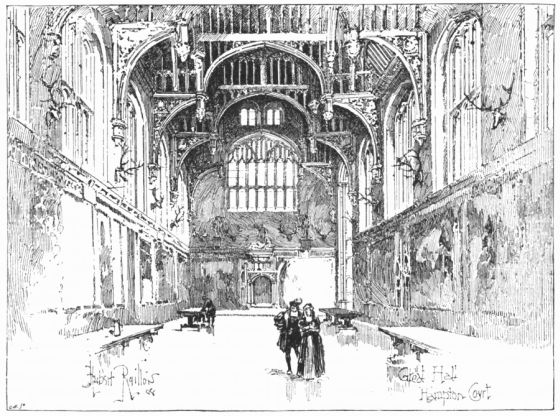
THE GREAT HALL, HAMPTON COURT PALACE.
[See larger version]
The same day, and on the same scaffold as Gerard, was executed Don Pantaleone Sa, the brother of the Portuguese Ambassador. Sa had a quarrel with this same Gerard, who was called "Generous Gerard," an enthusiastic Royalist. They came to fighting at the Royal Exchange, where Gerard, drawing his rapier, forced the Don to fly, whereupon the next day he returned to the Exchange in search of Gerard, with a body of armed followers, and mistaking a man of the name of Greenway for Gerard, they killed him, wounded Colonel Mayo, and were not subdued without much riot. Sa was seized, tried, and condemned for this deliberate murder. He pleaded that he belonged to the embassy, and was therefore exempt from the tribunals of this country, but neither this nor the zealous exertions of his brother, the ambassador, could save him; he was condemned to die. Cromwell, though on the verge of concluding a treaty with Portugal, would not concede a pardon to the bloodthirsty Portuguese, who had been found guilty by a jury of half Englishmen and half foreigners. He went to Tower Hill in a coach and six, attended by numbers of the attachés of the embassy in mourning, and his brother signed the treaty and left the country. Such an exhibition of firmness and impartiality, refusing to make any distinction in a murderer, whether noble or commoner, evinced great moral courage in Cromwell; but another execution, which took place a short time before—namely, on the 23rd of June—was not so creditable to him. This was the hanging of an old Catholic priest, named Southworth, who had been convicted thirty-seven years before, under the bloody laws of James against Popish priests, and had been banished. Being now discovered in the country, he was tried for that offence and put to death. On the scaffold he justly upbraided the Government with having taken arms for liberty, yet shedding the blood of those who differed from them on religious grounds. The stern persecution of Popery was, in fact, a blot on Cromwell's character; he had not in that respect outgrown his age.
Whilst these and other plots were exacting from the Protector a severe compensation for his high position, he was yet steadily prosecuting measures for the better administration of the national government. Being empowered by the Instrument of government, with his Council, not only to raise sufficient money for the necessary demands of government, but also "to make laws and ordinances for the peace and welfare of these nations," he actually made no less than sixty ordinances, many of them of singular wisdom and excellence. He and his Council, in fact, showed that they were in earnest to make the execution of justice cheap and prompt, and to revive a pure and zealous ministry of the gospel. In one of these ordinances they effected the Herculean labour which Barebone's Parliament had aimed at—the reformation of the Court of Chancery, the ordinance for this purpose consisting of no less than sixty-seven articles. Well might Cromwell, on the opening of Parliament, refer with pride to this great event, an event which would have taken our modern law-makers twenty years to accomplish, which, in fact, they have not accomplished yet. "The Chancery," he said in his speech, "is reformed." What a speech in four words, sufficient to have made the reign of any king famous! "The Chancery is reformed—I hope to the satisfaction of all good men." This had partly been done by distributing the causes through the other "courts of law at Westminster, where Englishmen love to have their rights tried." In order, too, to effect a most just and speedy discharge of the laws, he put better judges on the Bench, amongst them the pious Sir Matthew Hale, and made Thurloe, the friend of Milton, Secretary of State.
Two others of his ordinances were intended to purify the Church of unfit ministers, and to introduce fit and pious ones. This established two commissions, one for the examination of all clergymen offering themselves for the incumbency of any church living, and the other for inquiring after and expelling any "scandalous, ignorant, or insufficient ministers who already occupied such." These commissioners were to be permanent, so that the Church in all parts of the country should be purged of improper preachers, and supplied with able and good ones. The supreme commission for the trial of public preachers consisted of thirty-eight members—twenty-nine clergymen, nine laymen—and these were both Presbyterians and Independents, some even Anabaptists, for the Protector was less interested in what sect they belonged to, than in the fact that they were pious and able men. The commission for purging the Church consisted of from fifteen to thirty Puritan gentlemen and Puritan clergymen for each county; and when they dismissed a minister for unfitness, his family had some income allowed them. Many of the members of these last boards were chosen indiscriminately from the friends or enemies of the Protectorate, provided they were known men of real piety and judgment. Amongst these were Lord Fairfax, Thomas Scott, a zealous Republican, Admiral Blake, Sir Arthur Haselrig, Richard Mayor, the father-in-law of Richard Cromwell, for whom Cromwell entertained a high regard and respect, and had him in both Parliament, Council, and various commissions. Baxter was one of them, and, as we have said, spoke well of the operation of the system.
But the 3rd of September arrived, Oliver's fortunate day, on which he had appointed the meeting of Parliament. As the day fell on a Sunday, the members met in the afternoon for worship in Westminster Abbey, where they waited on the Protector in the Painted Chamber, who addressed them in a speech, and they then went to the House and adjourned to the next morning. Cromwell went that day to the House in great State, in his carriage, with his Life Guards, a captain of the guard walking on each side, and the Commissioners of the Great Seal and other State officers following in coaches. After a sermon in the Abbey Church they proceeded to the Painted Chamber, where the Protector made a speech of three hours in the delivery. A chair of State, marvellously resembling a throne, raised on steps, and with a canopy, was placed for the Protector, who sat with his hat on, whilst the members sat bareheaded. On rising to speak he took off his hat, and made what Whitelock styles "a large and subtle speech." It was largely illustrated by Scripture quotations, it is true, for that was inseparable from the religious temperament of Cromwell; but it gave a clear review of the causes which had led to the overthrow of the monarchy, the rise of the Commonwealth, and particularly of its then form, as well as of the measures which he had adopted in Council, in the interim between his appointment and the meeting of Parliament. He told them that he regarded their greatest functions to be at that time "healing and settling;" a profound truth—for the nation, and in it every class of men, had been so torn and rent in every fibre, that to soothe and heal was the highest art and policy. Every man's hand, and every man's head, he justly observed, had been against his brother, and no sooner had they put down despotism, than liberty itself began to grow wild, and threaten them with equal danger. The Levellers, the Fifth-Monarchy men, the Communists of St. George's Hill, had compelled them to put the drag on the chariot wheels of freedom, or it would soon have taken fire. In all such revolutions, the principles of human right are pushed on by sanguine men, beyond all chance of support from a settled public opinion; and Oliver truly told them that had they gained their object for a moment, it could not have lasted long, but would have in the meantime served the turn of selfish men, who, having obtained public property, would have "cried up property and interest fast enough."
He referred with satisfaction to the means taken to insure a pure ministry, and argued for the necessity of State interference in religion, but such interference should only be for promoting a good and virtuous ministry, and by no means infringe on "liberty of conscience and liberty of the subject, two as glorious things as any that God hath given us." His fears of religious license were chiefly excited by Fifth-Monarchists; yet he did not deny that such a monarchy must come in process of time. "It is a notion," he said, "that I hope we all honour, and wait and hope for the fulfilment of, that Jesus Christ will have a time to set up a reign in our hearts, by subduing those lusts, and corruptions, and evils that are there, which now reign more in the world that I hope in due time they shall do. And when more fulness of the Spirit is poured forth to subdue iniquity, and bring in everlasting righteousness, then will the approach of that glory be. The cardinal divisions and contentions, among Christians so common, are not the symptoms of that kingdom. But for men on this principle to betitle themselves, that they are the only men to rule kingdoms, govern nations, and give laws to people, and determine of property and liberty, and everything else, upon such a pretension as this is, truly they had need to give clear manifestations of God's presence with them, before wise men will receive or submit to their conclusions." Still he recommended tenderness towards them, and that if their extravagances necessitated punishment, this should "evidence love, and not hatred."
He next referred to the treaties with foreign nations, amongst which, he said, that with Portugal had obtained "a thing which never before was since the Inquisition was set up there—that our people who trade thither have liberty of conscience, liberty to worship God in chapels of their own."
He finally inculcated on them the necessity for maintaining as much peace as possible, not only that they might restore the internal condition of the nation, and reduce the excessive taxation occasioned by the war on land and sea, but also to prevent foreign nations from depriving us of our manufacturing status, as they had been busily doing during our internal dissensions.
To one of his assertions we are bound to demur. "One thing more this Government hath done—it had been instrumental to call a free Parliament, which, blessed be God, we see here this day. I say a free Parliament, and that it may continue so, I hope is in the heart and spirit of every good man in England, save such discontented persons as I have formerly mentioned. It is that which, as I have desired above my life, so I shall desire to keep it above my life." The truth was that it was as free a Parliament as the circumstances of the times would admit; indeed, as was soon seen, it was much too free. A free Parliament would have brought back royalty in the State, or Presbyterian absolutism in religion. Republicanism and Independency, though in the ascendant through the genius of Cromwell and the power of the army, was in a minority. Republicanism even was divided against itself, divided into moderate Republicanism and Levelling, Fifth-Monarchy and Communism in alliance. From this so-called free Parliament, Episcopalians and Catholics were excluded; this so-called free Parliament had been carefully watched during the elections, the lists of the returned had been sent up to the Council, and such as were deemed too dangerous were disallowed, amongst others Lord Grey of Groby. But even then it was found too free, and the very first thing that it set about was to call in question the Government which had authorised it.
There was a stiff contest for the Speakership, but Lenthall was chosen instead of Bradshaw, who was also nominated, because Lenthall had been Speaker of the Long Parliament, and its old members had still hope of restoring it. Amongst the members were old Sir Francis Rouse, Lord Herbert, the son of the Earl of Worcester, Fleetwood, Lambert, the Claypoles, one of whom had married a daughter of the Protector's, Cromwell's two sons, his friends the Dunches, Sir Ashley Cooper, and Lord Fairfax. Amongst the Republicans there were Bradshaw, Haselrig, Scott, Wallop, and Wildman, old Sir Henry Vane, but not the younger; and amongst the Irish members were Lord Broghill, who had fought so stoutly against Charles, and Commissary-General Reynolds. No sooner did they begin business than they opened a debate on the question of sanctioning the present form of government, a question from which they were precluded by the very Instrument which had made them a Parliament. The debate was carried on for no less than eight days, during which Bradshaw, Scott, Haselrig, and other Republicans contended that the members of the Long Parliament had been illegally deprived of their right, and that the Government in one person and a Parliament was but another form of tyranny. One speaker declared that he had fought to put down one tyrant, and was ready to fight to put down another. What right but the sword, it was asked, had one man to put down a legal Parliament, to command his commanders? They moved to go into committee on the subject, and carried it.
Cromwell was not the man to suffer this. He sent to the Lord Mayor, and ordered him to take measures to preserve the peace of the City, marched three regiments into it, and then summoned Lenthall, and bade him meet him in the Painted Chamber, on Tuesday, the 12th of September, with the Commons. Harrison, who was zealously getting up petitions for the support of the inquiry into the constitution, was clapped into the Tower. When Cromwell met the Commons, he expressed his surprise that a set of men from whom so much healing management had been expected, should immediately attempt to overturn the Government which called them together. The Instrument consisted of incidentals and fundamentals. The incidentals they were at liberty to discuss, but the fundamentals—of which the article that the power resided in one person and a Parliament was one—were out of their range. He very zealously asserted that he had been called to the head of the nation by God and the people, and that none but God and the people should take his office from him. His own wish had been to lead the life of a country gentleman, but necessity had forced him thence, and three several times he had found himself placed by the course of events at the head of the army, and by them at the head of the Government. As to the dismissal of the Long Parliament, he had been forced to that by its endeavouring to perpetuate itself, and by its tyranny and corruption. He said "that poor men, under its arbitrary power, were driven like flocks of sheep, by forty on a morning, to the confiscation of goods and estates, without any man being able to give a reason why two of them had deserved to forfeit a shilling." He had twice resigned the arbitrary power left in his hands, and having established a Government capable of saving the nation, he would sooner lie rotting in his grave and buried with infamy than suffer it to be broken up. They had now peace at home and abroad, and it would be a miserable answer to give to the people, "Oh, we quarrelled for the liberty of England; we contested and went to confusion for that."
To prevent any such evil consequences, he informed them that he had caused a stop to be put to their entrance into the Parliament House; he did not turn them out this time, he shut them out—and that none would be readmitted that did not first sign an Engagement to be true and faithful to the Protector and Commonwealth of England, Scotland, and Ireland, not to propose or consent to alter the Government, as settled in a single person and Parliament.
On hearing this, the honourable members looked at one another in amazement, but one hundred and forty thought well to sign the Engagement, which lay in the lobby of the House that day, and within a month three out of the four hundred had signed. Of course all the ultra Republicans refused to sign, and were excluded—Bradshaw, Haselrig, Scott, Wildman, and the rest.
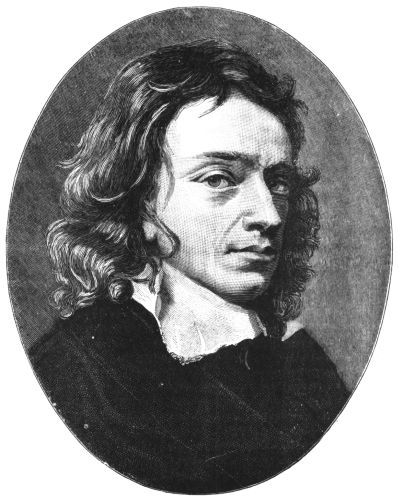
JOHN MILTON. (After the Miniature by Samuel Cooper.)
[See larger version]
This summary dealing did not cure the Parliament of considering the question for touching which they had thus been purged of a hundred members. On the 19th of September, only a week after the check they had received, they went into committee to discuss the "Instrument of Government." They took care not to touch the grand point which they had now pledged themselves not to meddle with—the government by a Protector and Parliament; but they affected to consider all the other articles as merely provisional, decreed by the Protector and the Council, but to be confirmed or rejected by Parliament. They discussed these one by one, and on the 16th of October proceeded to the question, whether the office of Protector should be elective or hereditary. Lambert advocated the office being hereditary, and pointed out the many disadvantages of the elective form. He strongly recommended the office being confined to the Cromwell family, and this, of course, was attributed to the instigation of Cromwell himself. They decided for the elective form. On the 11th of December they voted that the Protector should have a veto on Bills touching liberty of conscience, but not such as suppressed heresies, as if what they called suppressing heresies were not direct attacks on liberty of conscience. Thus they crept round the very roots of the Protectoral authority, nibbling at the powers he had forbidden them to discuss, and they proceeded to give proof of their intention to launch into all the old persecutions for religion, if they possibly could, by summoning before them John Biddle, who may be regarded as the father of the Unitarians. He had been thrice imprisoned by the Long Parliament, for holding that he could not find in Scripture that Christ or the Holy Ghost was styled God. The Parliament committed him to the Gatehouse, and ordered a Bill to be prepared for his punishment.
It was high time that they were stopped in their incorrigible spirit of persecution; and by now proceeding to frame a Bill to include all their votes on the articles of the Instrument they were suddenly arrested in their progress. The Instrument provided that Parliament should not be adjourned under five months. On the 22nd of January, 1655, the Protector chose to consider that the months were not calendar but lunar months, which then expired. The Parliament, counting the other way, deemed themselves safe till the 3rd of February, but on the 22nd of January Oliver summoned them to the Painted Chamber, and observed to them, that though he had met them at first with the hope that their hearts were in the great work to which they had been called, he was quite disappointed in them. He complained that they had sent no message to him, taken no more notice of his presence in the Republic than if he had not existed, and that with all patience he had forborne teasing them with messages, hoping that they would at length proceed to some real business. "But," added he, "as I may not take notice of what you have been doing, so I think I have a very great liberty to tell you that I do not know what you have been doing; that I do not know whether you have been dead or alive. I have not once heard from you all this time. I have not, and that you all know."
He then reminded them that various discontented parties—the Royalists, the Levellers, and others—had been encouraged by their evident disposition to call in question the Government, to raise plots, and that if they were permitted to sit making quibbles about the Government itself, the nation would soon be plunged again into bloodshed and confusion. He, therefore, did then and there dissolve them as a Parliament.
The plots to which the Protector alluded had been going on for some time, and even yet were in full activity. We shall trace their main features, but we may first notice an incident which showed that Cromwell was prepared for them, resolved to sell his life manfully if attacked. On the 24th of September, 1654, immediately after compelling the Parliament to subscribe the Engagement, the Protector was out in Hyde Park, taking dinner under the shade of the trees, with Thurloe, the secretary, a man whom he constantly consulted on the affairs of the nation. After this little rural dinner, which gives us a very interesting idea of the simplicity of the great general's habits and tastes, he tried a team of six fine Friesland coach horses, presented to him by the Duke of Oldenburg. Thurloe was put into the carriage, Cromwell mounted the coachman's seat, and a postillion rode one of the fore horses. The horses soon became unruly, plunged, and threw the postillion, and then, nearly upsetting the carriage, threw the Protector from his seat, who fell upon the pole and had his legs entangled in the harness. On went the mad horses at full gallop, and one of Cromwell's shoes coming off, which had been held by the harness, he fell under the carriage, which went on without hurting him, except by some bruises. In the fall, however, a loaded pistol went off in his pocket, thus revealing the fact that he went armed.
And indeed he had great need. His mother, who died just now, on the 16th of November, and who was ninety-four years old, used, at the sound of a musket, says Ludlow, to imagine that her son was shot, and could not be satisfied unless she saw him once a day at least. Her last words to him do not give us any idea of hypocrisy in mother or son—"The Lord cause His face to shine upon you, and enable you to do great things for the glory of the Most High God, and to be a relief unto His people. My dear son, I leave my heart with thee. A good night!"
Amongst the plotters were both Royalists and Republicans. The ejected members of Parliament, in their different quarters, were stirring up discontent against Cromwell, and even declaring that it were better to have Charles Stuart back again. Colonel Overton, who had been questioned at the time of Colonel Alured's dismissal, was once more called up and questioned. In Scotland, where he lay, the Protector discovered an agitation to supersede Monk, and make the Republican Overton Commander-in-chief, and leaving only the garrisons, to march the rest of the army into England on the demand of pay and constitutional reform. Overton was committed to the Tower.
Allen—who, with Sexby and another agitator, in 1647 presented a remarkable petition from the army to the Long Parliament, and had become adjutant-general—was arrested at his father-in-law's house, in Devonshire, at the end of January, 1655, on a charge of plotting disturbances in Ireland, and exciting discontent in Bristol and Devon. Allen was a zealous Anabaptist, and the excitement amongst them and other army republicans was great and extensive. Pamphlets were published, letters and agitators passed from one regiment to another, and a general rising was planned, with the seizure of Edinburgh Castle, Hull, Portsmouth, and other strong places. Cromwell was to be surprised and put to death. Colonel Wildman, one of these fanatics, who had been ejected from Parliament by refusing to sign the Recognition, was taken on the 12th of February at Exton, near Marlborough, in Wilts, by a party of horse, as he was in his furnished lodgings upstairs, leaning on his elbows, and in the act, with the door open, of dictating to his clerk, "A Declaration of the free and well-affected people of England, now in arms against the tyrant Oliver Cromwell." He was secured in Chepstow Castle, and his correspondents, Harrison, Lord Grey of Groby, and others, were secured in the Tower. Colonel Sexby for the time escaped.
About the same time a Royalist plot was also in progress. Charles Stuart, who had removed from Paris to Cologne—the French Government not wishing to give offence to Cromwell—had concocted a plot with Hyde, his Chancellor, to raise the Royalists in various quarters at once, fancying that as Cromwell had given so much offence to both people and Parliament, there was great hope of success. Charles went to Middelburg, on the coast of Holland, to be ready at a call, and Hyde was extremely confident. In Yorkshire there was a partial outbreak under Lord Mauleverer and Sir Henry Kingsby, which was speedily quelled, Kingsby being seized and imprisoned in Hull. This abortive attempt was under the management of Lord Wilmot, now Earl of Rochester, who was glad to make his escape. Another branch of the plot, under the management of Sir Joseph Wagstaff, who came over with Rochester, fared no better. Wagstaff attempted to surprise Winchester on the 7th of March, during the assizes. Penruddock, Grove, and Jones, Royalist officers, were associated with him, and about two hundred others entered Salisbury about five o'clock on the morning of the 11th, posted themselves in the market-place, liberated the prisoners from the gaol, and surprised the sheriff and two judges in their beds. Wagstaff proposed to hang the judges, but Penruddock and the rest refused to allow it; he then ordered the high sheriff to proclaim Charles Stuart, but neither he nor the crier would do it, though menaced with the gallows. Hearing that Captain Unton Crook was after them with a troop of horse, and seeing no chance of a rising, they quitted the town about three o'clock, and marched through Dorsetshire into Devonshire. At South Molton Captain Crook came up with them, and speedily made himself master of fifty of the insurgents, including Penruddock, Grove, and Jones, but Wagstaff escaped. They had expected a body of conspirators from Hampshire to join them at Salisbury, and these were actually on their way when they heard of the retreat of Wagstaff's band, and immediately dispersed. Similarly feeble outbreaks took place in the counties of Northumberland, Nottingham, Shropshire, and Montgomery. Penruddock, Grove, and Jones were beheaded at Exeter, and about fifteen others suffered there and at Salisbury; the rest of the deluded prisoners were sold to Barbadoes. Charles returned crest-fallen to Cologne, and Hyde, convinced that his plans had been betrayed, attributed the treason to Manning, whom, having secured, they had shot in the following winter, in the territory of the Duke of Neuburg.
To prevent more of these outbreaks, Cromwell planned to divide the whole country into military districts, over each of which he placed an officer, who was to act chiefly with the militia, and not with the Levelling regulars. These officers he created major-generals, beginning first with Desborough in the south-west, and, before the year was out, he had despatched, each to his district, the other major-generals—Fleetwood, Skippon, Whalley, Kelsey, Goffe, Berry, Butler, Wortley, and Barkstead, who effectually preserved the peace of the nation. During the spring also, undaunted by these disturbances, Cromwell progressed with his internal reforms, and with the greatest of all, the reform of Chancery. This was no easy matter. The lawyers were as turbulent as the Anabaptists in the army. Two of the Commissioners of the Great Seal, Whitelock and Widdrington, refused to enforce the reform, and were obliged to resign. Lisle and Fiennes, the other Commissioners, dared to carry out the change. Lenthall, the Speaker, now Master of the Rolls, protested that he would be hanged at the Rolls gate before he would obey; but he saw fit to alter his mind, and the Protector, so far from bearing any ill-will to the two conscientious Commissioners, Whitelock and Widdrington, soon after made them Commissioners of the Treasury.
We may now look back a little, to observe what Cromwell had been doing beyond the shores of the kingdom. We have seen that almost all the nations of Europe sent embassies to congratulate him on his elevation to the Protectorate. The vigour of his rule speedily made them more anxious to stand on good terms with him. He soon made peace with Sweden as a Protestant country, and from natural sympathy with the Protestant fame of the great Gustavus. He concluded peace also with Holland, but with France and Spain there were more difficulties.
France had, both under Richelieu and Mazarin, lent continual aid and refuge to the Royalist cause against the Reformers. The queen, whom the Republicans had chased from the throne, was a princess of France, and was living there with numbers of the Royalists about her. Charles, the heir to the throne of England, was pensioned by France, and maintained a sort of court in Paris, whence continual disturbances and alarms were coming. It is true, the French Court had never been very munificent to the exiled Queen of England and her family. Henrietta was found by Cardinal Retz without fire, and almost without food, and Charles and his countrymen were so poor, that Clarendon, in June, 1653, wrote, "I do not know that any man is yet dead for want of bread, which I really wonder at. I am sure the king owes all that he has eaten since April, and I am not acquainted with one servant who hath a pistole in his pocket. Five or six of us eat together one meal a day for a pistole a week; but all of us owe, for God knows how many weeks, to the poor woman that feeds us." He adds that he wanted shoes and shirts, and that the Marquis of Ormond was in no better condition. The Court of Charles was as much rent with divisions and jealousies as it was poor. His brave conduct in England raised great hopes of him, but on his return to France he relapsed into all sorts of dissipations and intrigues, which made him contemptible. Amongst a troop of mistresses, Lucy Walters, or Barlow, as she was called, the mother of the afterwards celebrated Duke of Monmouth, was the most notorious.
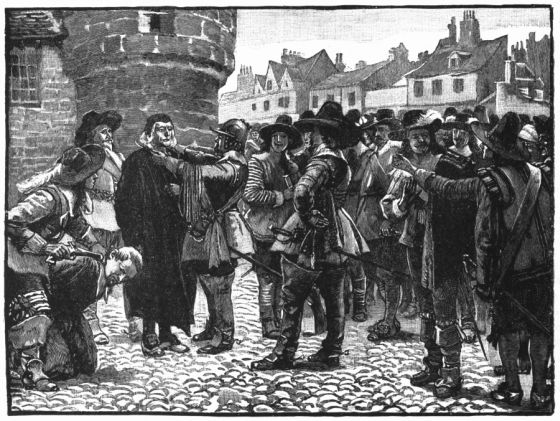
THE ROYALIST PLOTTERS AT SALISBURY INSULTING THE SHERIFF. (See p. 131.)
[See larger version]
As Mazarin saw the growing power of Cromwell, he was glad to get Charles removed from Paris, and his abode transferred to Cologne; but, being still the pensioner of France, Charles was equally capable of annoying England from that place, as the late outbreaks showed. These circumstances no doubt rendered it very difficult for the conclusion of a peace between Cromwell and France, for Cromwell insisted on the withdrawal of the French support from the exiled family, and though France was fully disposed to abate the evil as far as possible, it could not in honour entirely abandon them. Mazarin made every possible concession on other points, and the French ambassador, Bordeaux, urged the progress of the treaty with all earnestness. But besides the grand obstacle, there were others raised by Spain. France and Spain were at war: Spain was supporting the Prince of Condé and the French insurgents, and the Spanish ambassador was indefatigable in representing that whilst Spain had been the very first to acknowledge the English Commonwealth, France had been constantly supporting the Royalist power, and in 1653 he offered to seize Calais and make it over to England as the price of the Commonwealth making peace with Spain, and common cause against France.
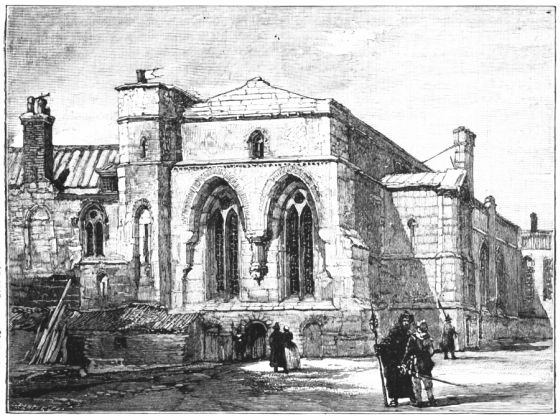
THE PAINTED CHAMBER, WESTMINSTER.
[See larger version]
But there were motives which always weighed heavily with Cromwell—religion and the honour of the English flag. He had an enduring repugnance to the Catholic faith, and Spain was essentially Catholic, and at the same time was maintaining an insolent domination in the waters of the West Indies. The fame of her exclusion thence of the flags of all other nations from her colonies, and of her many atrocities committed on English colonies—as at St. Kitts in 1629, at Tortuga in 1637, and Santa Cruz in 1650—was an irresistible provocative to the combative spirit of the Protector. He demanded of the Spanish ambassador that Spain should abolish the Inquisition, and admit the English flag to the West Indian seas. De Leyda replied that he was asking from his king his two eyes, and as Cromwell would not concede either point, he demanded his passports in June, 1654, and took his leave.
Cromwell lost no time in enforcing his views on Spain—as no doubt he felt bound conscientiously to do on the great principle of suppressing Popish cruelties, and spreading the triumph of Protestantism. He sent Blake with a powerful fleet in October of that year into the Mediterranean, and another powerful armament under Admirals Penn and Venables, with secret orders which were not to be opened till they arrived in certain latitudes. This fleet, whose preparation and destination kept all Europe in wonder and anxiety, sailed west, and was, in fact, destined for the West Indies. Blake, with his fleet, passed the Straits of Gibraltar, and presented to the inhabitants of the shores of the Mediterranean a spectacle such as they had not seen since the days of the Crusades—a powerful English fleet. It consisted of thirty sail, and its commission was to seize the French vessels wherever it could find them, especially to seek out and attack the fleet under the Duke of Guise. It was besides this to demand satisfaction from various offending Powers. The Grand Duke of Tuscany had, whilst Parliament was struggling with Charles, allowed Prince Rupert to sell English prizes in his ports. The Pope was, as the Antichrist, an object to be humbled, or at all events impressed sensibly with the fact that England could at any moment visit him in his capital, and that the British power was in hands both able and ready to do it. There were many injuries to our merchantmen to be avenged on the pirates of Tunis and Algiers. Cromwell's favourite maxim was, that a ship of the line was the most effective ambassador. Blake sailed along the Papal shores, exciting a deep terror, but he passed on and cast anchor before Leghorn, and demanded compensation for the offence against English honour and shipping, which was speedily granted. Not being able to discover the Duke of Guise, he proceeded to Algiers, and compelled the Dey to sign an engagement not to permit further violences by his subjects on English vessels. Thence he sailed to Tunis, and sent in the same demand, but the haughty barbarian of that place sent him word to give a look at his ports of Porto Farina and Goletta, with their fleets, and take them if he could. Blake sailed away as if in despair, but suddenly returning, he entered the harbour of Porto Farina, silencing the castle and batteries as he advanced, and set fire to the whole fleet. Both Tunis and Tripoli now found it the best policy to give the required engagement, and Blake left the Mediterranean, having given those lawless pirates a specimen of the power of England, which was not likely to be soon forgotten.
Blake had orders to look out for the next Spanish Plate fleet coming home, and he lay for some time off Cadiz; but there was now at the Court of Madrid Colonel Sexby, the Leveller, who had long been engaged with Allen, Wildman, and the Anabaptists. He had gone over to the Continent to raise some force either in conjunction with Charles or with Spain, to invade England and kill Cromwell. Sexby revealed to the Spaniards not only the object of Blake, but the real design of the fleet under Venables and Penn. More than thirty sail were mustered by the Spanish under Don Pablos de Contretras, which kept close watch on Blake. Blake longed to attack them, but his orders did not sanction it; and after hearing that the Plate fleet was detained at Carthagena, he returned to England to refit, his ships being in a sorry plight, and his men suffering from bad provisions.
During the absence of Blake, great excitement had been occasioned in England by the news of dreadful atrocities committed on the Protestants of the mountains of Piedmont. The Protestants called the Vaudois were a race who, through all ages, had, in the obscurity of their Alpine valleys, retained the doctrines of the Primitive Church, and had set at defiance both the persuasions and the persecutions of Rome. They were said to be descended from the ancient Waldenses, and were a bold, independent race of mountaineers. It was pretended that the Duke of Savoy, whose subjects they chiefly were, had granted them the free exercise of their religion so long as they remained in their ancient places of abode, the valleys of the sources of the Po, in the Savoy Alps; but that being found in Lucerna and other places, these were decided to be beyond their bounds, and they were ordered to be conformed to the Church of Rome, or sell their lands and retire from these territories. They refused to be driven from their homes on account of their religion, and being always an eyesore to the Court of Rome, the fury of persecution was let loose upon them. Friars were sent amongst them to convert them, or to denounce their destruction; they disregarded the friars, and then six regiments of soldiers were sent to drive them into the mountains. Amongst these were two regiments of refugee Irish. These fellows, ardent Catholics, smarting under the Protestant scourge which had driven them from their native land, did their work con amore. From the district of Lucerna they were driven into the higher Alpine fastnesses and pursued with the most terrible ferocities of fanatic savagery, with fire and sword and extermination. These horrors were aggravated by winter and famine, and the news of this fearful butchery rang through Protestant England with a sensation which revived all the memory of the Popish horrors in the Marian time. There was one loud outcry for interference on their behalf. Press and pulpit resounded with demands of sympathy and redress: the ministers of all classes waited on Cromwell in a body to solicit his protection of the Vaudois: the army in Scotland and Ireland sent up addresses. No one appeared, however, more excited than Cromwell himself. He immediately gave two thousand pounds, and appointed a day of general humiliation, and a collection on their behalf, which was observed, and thirty-eight thousand two hundred and twenty-eight pounds were speedily raised, and sent by envoys to Geneva, to be conveyed to the sufferers. Nor did Cromwell satisfy himself with having done this. The day of the arrival of the news, June 3rd, 1655, he was about to sign a treaty of peace with France; but he refused to sign it till he had seen whether the French king and Mazarin would heartily unite with him in extorting protection from the Duke of Savoy for the sufferers. Mazarin was loth to stir in such a business, but Cromwell soon let him see that there would be no peace for France unless he did, and he consented. Three Latin letters were written by Milton at the order of the Protector to different States of Europe, calling on them to co-operate for this great end, and the mighty poet sent forth also his glorious sonnet, commencing—
"Avenge, O Lord, Thy slaughtered saints, whose bones Lie scattered on the Alpine mountains cold!"
which shall remain like a perpetual trumpet-blast through all time. The astonished Duke of Savoy was soon compelled to give ample guarantee for the religious liberty and security of his Protestant subjects.
The expedition to the West Indies, in its commencement, did not meet with that success which the Protector generally experienced. The fleet, consisting of sixty sail, was bound for Hispaniola, and carried four thousand troops; and in Barbadoes and other English settlements the force was augmented by volunteers, incited by promise of plunder, to ten thousand. But these fresh forces were of the worst possible description, being prisoners of a loose description shipped thither; the commanders were divided in opinion, and the attack was so wretchedly managed, that it failed with great loss. St. Domingo, which they intended to take, was deserted on their approach, but instead of entering it at once, they landed their forces forty miles off, and marched them through woods towards the town. The heat of the weather, the want of water, and the consequent disorder of the troops, prepared them for what ensued. They were suddenly attacked in a thick wood, and repulsed with great slaughter. Nothing could bring these ragamuffin forces to renew the attempt, and the commanders sailed away, but afterwards fell on Jamaica and took it. That island was then, however, considered of so little value, that it did not satisfy the Government for the loss of Hispaniola, and on their return Venables and Penn were committed to the Tower. Notwithstanding this, however, Cromwell determined to make secure the conquest of Jamaica, and extend, if possible, the West Indian possessions. Vice-admiral Goodson was ordered to take the command at Jamaica, and with him General Fortescue, Serle, Governor of Barbadoes, and General Sedgwick, from New England, were appointed Commissioners for the management of the island.
Cromwell's letters to these officers that autumn inform us that there were twenty-eight men-of-war on that station, and people from Barbadoes, from New England, and from England and Scotland, were being sent to occupy and settle the island. A thousand Irish girls were sent out. Cromwell pointed out to the Commissioners how advantageously the island lay for keeping in check the Spanish Main, and the trade with Peru and Carthagena. His comprehensive glance was alive to all the advantages of the conquest, and his resolution engaged to make the most of it. Whatever is the value of Jamaica now, we owe it to him. He believed that he was not only serving the nation but religion by humbling Spain. He wrote to the Commissioners, "The Lord Himself hath a controversy with your enemies, even with that Roman Babylon of which the Spaniard is the great underpropper. In that respect we fought the Lord's battles, and in that respect the Scriptures are most plain." Spain, of course, proclaimed war against England, to her further loss, and the glory of Cromwell and his invincible Puritan admiral, Blake. Penn and Venables resigned their commissions, and were set at liberty. On October 24th, the day after the Spanish ambassador quitted London, Cromwell signed the treaty of peace with France, by which Condé and the French malcontents were to be excluded from the British dominions, and Charles Stuart, his brother the Duke of York, Ormond, Hyde, and fifteen others of the prince's adherents, were to be excluded from France.
Cromwell opened the year 1656 amid a multitude of plots and discontents. The enemies of the Republic—Royalists, Anabaptists, Levellers—were all busy in one quarter or another. Cleveland, the poet, who had been taken prisoner nine years before by David Leslie, at Newcastle, and expected to be hanged for his tirades against the Scots, but had been dismissed by Leslie with the contemptuous words, "Let the poor knave go and sell his ballads," was now seized by Colonel Haynes for seditious writings at Norwich; but Cromwell also dismissed him with like indifference.
At the close of the year the Jews, who had been forbidden England, hopeful from the more liberal mercantile notions of Cromwell, petitioned to be allowed to reside in this country, under certain conditions. Cromwell was favourable to the petition, which was presented by Manasseh Ben Israel, a leading Portuguese Jew, of Amsterdam, though his Council was against it on Scriptural grounds; but Cromwell silently took them under his protection. There was also a Committee of Trade in the House, under the earnest advocacy of the Protector, for promoting commerce. Meanwhile, Cromwell vigorously prosecuted the war against Spain. Blake and Montague were ordered to the coast of Spain, to destroy the shipping in the harbour of Cadiz, and to see whether Gibraltar could not be seized, which Cromwell, in his letters to the admirals, pointed out as admirably adapted to promote and protect our trade, and keep the Spaniard in check. Yet even this project was not carried out without trouble from the Malcontents. Some of the captains of the fleet, tampered with by Charles's emissaries, declared their disapproval of the enterprise, contending that we, and not the Spaniards, were in fault. Cromwell sent down Desborough to them, who weeded them out, and put others in their places. Blake and Montague then set sail, and reached the neighbourhood of Cadiz and Gibraltar in April, but found their defences too strong; they then proceeded to Lisbon, and brought the treaty with the Portuguese to a termination, and afterwards made an alarming visit to Malaga, and to Sallee, to curb the Moors. In July they returned to the Tagus, and in September a part of the fleet, under Captain Stayner, fell in with and defeated a fleet of eight sail, coming from America. He destroyed four of the vessels, and captured two, containing treasure worth from two hundred and fifty thousand pounds to three hundred thousand pounds.
Before this treasure reached England, Cromwell, who had exhausted his finances to fit out the fleet and prosecute the war with Spain, was compelled to call a Parliament, not only to obtain supplies, but to take measures for the security of the nation against the designs of the Royalists and their coadjutors, the Levellers. This met on the 17th of September, 1656. But Cromwell did not allow all the members elected to sit in this Parliament, any more than in the former ones. He knew well that his Government and such a Parliament could not exist together. The members elected, therefore, were not admitted to sit except they had a certificate of their approval by the Council from the Chancery clerk. By the withholding of such certificates nearly one-fourth of the members were excluded. This created a terrible outcry of invasion of Parliamentary privileges. Haselrig, Scott, Ashley Cooper, and many other violent Republicans were excluded. The excluded members signed an indignant protest, and circulated it in all parts of the country, with the list of their names appended.
The Protector opened this purged Parliament with a very long speech, which was one of the most remarkable speeches ever addressed to Parliament by any ruler. It displayed a depth and breadth of policy, an active, earnest spirit of national business, a comprehension of and desire for the establishment of such principles and prosperous measures, a recognition of the rights of the whole world as affected by the conduct of this one great nation, which have no parallel for true Christian philosophy since the days of Alfred. We have since then had great and valiant warriors, our Edwards and Henrys, but not a man who combined with the highest military genius and success a genuine, lofty, and loving Christian sentiment, and an earnest business-like mind like Cromwell. He at once laid down the principle that all hostility to the Commonwealth originated in the hatred of its free and Christian character; and he showed that all these enemies, of whatever theories, had united themselves with Spain, which was the grand adversary of this country, and had been so from the Reformation, because she was bigotedly wedded to the system of Popery, with all its monks, Jesuits, and inquisitors. He recapitulated its attempts to destroy Elizabeth and her religion; the vain attempts of the Long Parliament to make peace with it, because in any treaty where the Pope could grant absolution, you were bound and they were loose; the murder of Ascham, the Long Parliament's ambassador, and no redress obtained: and now he informed them, and offered to produce the proofs, that Charles Stuart had put himself in league with Spain, and, still more strange, that the Levellers, pretending to demand a freer and more Republican Government, had entered into the unnatural alliance with Charles and Spain to murder him and destroy the Commonwealth.
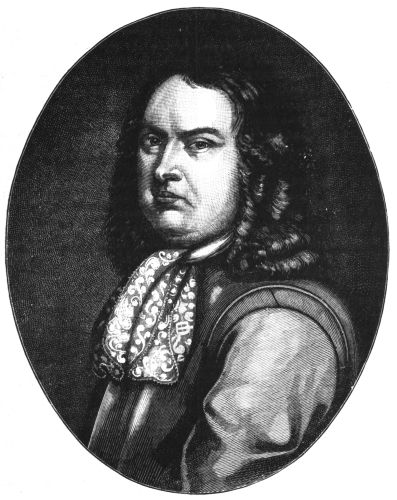
ADMIRAL BLAKE.
[See larger version]
All this was perfectly true. Sexby, the Leveller, had gone over to Charles, and thence to Spain, to solicit aid towards a Popish invasion, offering first to kill Cromwell himself. He obtained forty thousand crowns for the use of his party, and a promise of six thousand men when they were ready to land in England, who should wait in Flanders. Some of this money, when remitted to the accomplices in England, Cromwell intercepted, as he assured the Parliament. Sexby followed to accomplish his design of assassinating the Protector, as we shall find anon. Cromwell proceeded to remind Parliament of the insurrections excited by Charles's emissaries, Wagstaff and Rochester, and the conspiracy of Gerard and Vowel, the outbreaks at Salisbury, Rufford Abbey, and a score of other places; of Wildman taken in the act of penning his call to rebellion, of the design to destroy Monk in Scotland, and of similar instigations in the army in Ireland; of the plottings of the Lord Taaffe with Hyde at Antwerp; and, finally, that there had been an attempt to blow him up with gunpowder in his own house, and an officer of the Guard had been engaged to seize him in his bed. These last he characterised as "little fiddling attempts not worth naming," and which he regarded no more than he did "a mouse nibbling at his heel." But he told them that the animus altogether was of that un-English and un-Christian character, that it became them to fight manfully against it, and though they were low in funds, they should still put forth all their energies to crush this malignant power of Spain, whence the other enemies drew their strength. He informed them that France was well disposed to them, and that all the rest of the world was at peace with them.
He then assured them that the major-generals had done good service in every quarter, that the improvement of the ministry had become manifest through the exertions of the Commissioners, and that the Presbyterians had themselves expressed their approbation of what had been done in that respect. He strongly recommended to them further equalisation and improvement of the laws, so that every one should have cheap and easy justice, and that the purification of the public morals should be carefully attended to—"the Cavalier interest, the badge and character of continuing profaneness, disorder, and wickedness in all places," having worked such deplorable effects. "Nobility and gentry of this nation!" he exclaimed; "in my conscience it was a shame to be a Christian, within these fifteen, sixteen, or seventeen years in this nation; whether 'in Cæsar's house' or elsewhere! It was a shame, it was a reproach to a man, and the badge of 'Puritan' was put on it." As they would maintain nobility and gentry, he told them they must not suffer these classes "to be patronisers or countenancers of debauchery and disorders! And therefore," he concluded, "I pray and beseech you, in the name of Christ, show yourselves to be men; quit yourselves like men! It doth not infer any reproach if you do show yourselves men—Christian men, which alone will make you quit yourselves."
In the early days of the sitting of this Parliament—that is, in the beginning of October—came the news of Stayner's victory over the Spanish Plate fleet, and the capture of the treasure; and in the beginning of November the money arrived, and thirty-eight waggon-loads of silver were sent up from Portsmouth to the Mint to be coined, amid universal rejoicings. Before the year closed, also, Cromwell, by the help of Mazarin, effected a temporary separation of interests between Charles Stuart and the Duke of York; but it did not last long. But by this time Colonel Sexby was in England, watching his opportunity to murder Cromwell. He was daring enough to introduce himself amongst the Protector's escort in Hyde Park, and he and his accomplices had filed nearly through the hinges of the gates through which the Protector was accustomed to pass, so that they might create a sudden obstruction and confusion, during which Sexby might shoot Cromwell. But not being able to succeed to his mind, Sexby returned to Flanders to consult with the royal party, and left sixteen hundred pounds in the hands of one Miles Sindercomb, a cashiered quartermaster, who was to carry out the bloody design. Sindercomb took a house in Hammersmith, where the road by which the Protector passed to and from Hampton Court was very narrow, and there he prepared an "infernal machine," consisting of a battery of seven blunderbusses, which was to blow Cromwell's coach to atoms as it passed; but the machine did not answer, or could not be used from the crowd of Guards; and then Sindercomb resolved to set fire to Whitehall by night, and kill Cromwell as he came out in the confusion. He had bribed a great number of accomplices, many of them in the palace itself, and had probably a considerable number of fellow conspirators, for he had a hundred swift horses in stables in the neighbourhood, on which he and his confederates might escape, the deed being done. All this was with the privity and approbation of Charles, Clarendon, and the rest of that Court, and shows the state of moral principle in it, and which, after the Restoration, broke over England like a pestilence. They were constantly dabbling in attempts at assassination, and in the Clarendon papers themselves we have Clarendon's own repeated avowals of his satisfaction in them. He styles these base assassins "brave fellows and honest gentlemen," and thinks it a pity that any agent of the Protectorate abroad should not have his throat cut.
But Sindercomb's wholesale bribery led to the detection of the plot. Amongst those tampered with was Henry Toope, a Life Guardsman, who revealed the scheme. On the 8th of January, 1657, Sindercomb attended public worship in the evening at Whitehall Chapel. Toope, Cecil—who had been engaged in the construction of the infernal machine—and Sindercomb were arrested, and having been seen about General Lambert's seat, it was examined, and there was found a basketful of the most inflammable materials—strong enough, it was said, to burn through stones—and a lighted slow-burning match, calculated to reach the combustibles about midnight. There were found also holes bored in the wainscot, to facilitate the communication of the fire, and of draughts to encourage it. Toope and Cecil gave all the information that they could, but Sindercomb was obstinately silent, and being found guilty by a jury of high treason, was condemned to die on Saturday, the 13th. But the evening before, his sister taking leave of him, contrived to carry some poison to him, and the next morning he was found dead in his bed.
Parliament adjourned a week for the trial and examination of the plot, and appointed a day of thanksgiving on Friday, the 23rd. But though Sindercomb was dead, Sexby was alive, and as murderously inclined as ever, and to prevent interrupting other affairs, we may now follow him also to his exit. Though neither fleet nor money was ready to follow up the blow if successful, the gloomy Anabaptist once more set out for England with a tract in his possession, called "Killing no Murder," which was no doubt his own composition, though Colonel Titus, after the Restoration, claimed the merit of it. This tract, taking it as a settled fact that it was a noble piece of patriotism and virtue to kill a tyrant, pronounced Cromwell a tyrant, and therefore declared that it was a noble deed to kill him. It eulogised Sindercomb as the Brutus or Cato of the time. Sexby, disguised like a countryman, and with a large beard, travelled about distributing this pamphlet, but he was tracked, discovered, and lodged in the Tower. There he either went mad or pretended it, made a voluntary confession, found to be intended only to mislead, and, falling ill, died in the following January.
One of the first things which this second Parliament of the Protectorate did was to abolish the authority of the major-generals. Cromwell had assured them that they were doing good service in suppressing disturbances, and he told them so again; but there were many complaints of their rigour, especially of levying heavy fines on the Royalists; and Parliament, on the 29th of January, voted their withdrawal. The next matter, which occupied them for above three months, was the case of James Naylor, the mad Quaker, whom they sentenced to a punishment that was simply diabolical in its inhumanity. Before this was settled, Parliament entered on a far more momentous question—no less than whether they should not make Cromwell king.
Those who take an unfavourable view of the character of Cromwell, who regard him as a base mixture of hypocrisy and ambition, accuse him of having planned and manœuvred for this object; but there appears no evidence of this, but rather that the continual uneasiness created by the Royalist and Anabaptist assassins led many seriously to consider the peculiar position of the nation, and the great dangers to which it was exposed. There was nothing between the nation and all its old confusions but the life of one clear-headed, and strong-hearted, and strong-handed man, a life which was environed with perils. They deemed these dangers would be diminished by altering the form of government, and returning to a House of Lords and a Monarchy—but not to the corrupt and murder-seeking Stuarts. Had they their honest and earnest Protector converted into a king, and the succession settled on his family, the nation would jealously guard his life, and the hopes of the exiled family be diminished by the prospect of a successor of his own blood, even if he fell.
On the 23rd of February, 1657, suddenly Sir Christopher Pack, late Lord Mayor of London, craved leave to read a paper, which turned out to be drawn up in the form of a Remonstrance from Parliament to the Protector on the state of the country, and proposing a new form of government, including a House of Lords and himself as king. No sooner did the officers of the army, who had just lost their pro-consular dignity, and the other Republicans hear the proposition, than they rose, seized Pack, and hurried him from his seat to the bar of the House as a traitor. But those who were friendly to the proposition rose also in his defence, and after much commotion, the paper was not only read but debated. From this moment this subject occupied the House, with little intermission, till the 9th of May, or between two and three months. The title of the paper was changed from "A humble Address and Remonstrance," to "The humble Petition and Advice of the Parliament of England, Scotland, and Ireland." Its clauses were debated and carried one by one by a majority of a hundred to forty-four, and on the last day of the debate, March 26th, the blank left for the word king was filled in by a majority of one hundred and twenty-three to sixty-two. On the 31st of March an address was carried to the Protector at Whitehall by the Speaker and the House, praying that his Highness would be pleased to adopt their resolutions, and take upon him the state and title of king.
Unquestionably, this was the greatest temptation which had ever been thrown in the way of Cromwell. To have made his way by his energy and talent from the simple condition of a gentleman-farmer to the Dictatorship of the nation, and now to have the crown and succession of these great kingdoms offered to him and his family by Parliament, was a matter which would not have been much opposed by an ordinary man. But Cromwell was not of a character lightly to accept even a crown. He showed clearly that he had a strong inclination to place himself and his posterity in that august position, but he knew too well that the honour had also its dangers and its black side. His acceptance would at once darken his fair fame by settling it in the conviction of three-fourths of the kingdom that he had only fought and put down the Stuarts to set up himself. There was, moreover, a formidable party opposed to kingship, and especially decided against it were his generals and the army. A deputation of a hundred of them had waited on him on the 27th, with an address on the subject, in which they assured him that such a thing would be "a scandal to the people, would prove more than hazardous to his person, and would pave the way for the return of Charles Stuart." Let the nation but become once more accustomed to the name of king, and it would recall the ancient race on the first opportunity.
Cromwell felt too well the truth of these representations, and therefore he required of the House time to reflect on their important offer, though he had watched carefully the progress of the debate. He desired that a committee might be appointed to confer with him on all the articles of the new Instrument of Government proposed to him. A committee of ninety-nine persons was accordingly appointed, amongst them Whitelock, Glynn, the Lord Chief Justice, Lord Broghill, Nathaniel Fiennes, one of the Keepers of the Great Seal, etc. They had many meetings, but Cromwell, instead of giving his opinion upon the subject, desired to know their reasons for recommending this change. The chief reasons advanced were, the ancient habits of the nation; that the people were proud of the honour of their monarchs; that that form of government had prevailed from the most ancient period, and what no doubt weighed greatly with them was that, by the 9th of Edward IV. and the 3rd of Henry VII., it was enacted that all who took up arms for or obeyed the king de facto, were held guiltless; but not so they who served a protector de facto.
Cromwell admitted that this was a matter of precaution which demanded serious consideration, and that he regarded the proposal to him as "a very singular honour and favour," and would return such an answer as God should give him, or as he should arrive at through discussion with them; but that his conscience yet was not clear upon the subject, and they must examine the grounds for it further. Whitelock says the Protector often advised about this matter of the kingship, and other great businesses, with a select number of the committee—Lord Broghill, Mr. Pierpoint, brother of the Earl of Kingston, Thurloe, Whitelock, and Sir Charles Wolseley,—and would be shut up three or four hours together, and none else were admitted to him. He sometimes would be very cheerful with them, and, laying aside his greatness, would be exceedingly familiar; and, by way of diversion, would make verses and play at crambo with them, when every one had to try his fancy. He commonly called for tobacco, pipes, and a caudle, and would now and then take tobacco himself. Then he would fall again to his serious and great business of the kingship.
They were interrupted, however, in their colloquies, by a fresh outbreak of the Fifth-Monarchy men. These religionists, who admitted the idea of no king but Christ, were especially exasperated at this attempt to set up an earthly king, and determined to rise and prevent it. They fixed Thursday, the 9th of April, for the rising. They issued a proclamation called "A Standard set up," ordered Mile End as the place of rendezvous, and, headed by one Venner, a wine merchant, and other persons of the City, calculated on introducing the reign of the Millennium. They encouraged each other, says Thurloe, with the exhortation that though they were but worms, yet they should be made instrumental to thresh mountains. They spoke, he says, great words of the reign of the saints, and the beautiful kingdom of holies which they were to erect, and talked of taking away all taxes, excise, custom, and tithes. They had banners painted with the device of the lion of the tribe of Judah, and the motto, "Who shall raise him up?"
But the wide-awake Thurloe had watched all their motions. That morning at daybreak he marched a troop of horse down upon the meeting at Mile End, seized Venner and twenty other ringleaders, with chests of arms, many copies of the proclamation, and the famous war-flag of the lion-couchant of Judah. Major-General Harrison, Admiral Lawson, Colonel Rich, and others of the leaders of the Fifth-Monarchy men were also seized, and with these men shut up in the Tower, but no further punished. Venner ended his days for a similar attempt in the reign of Charles II.
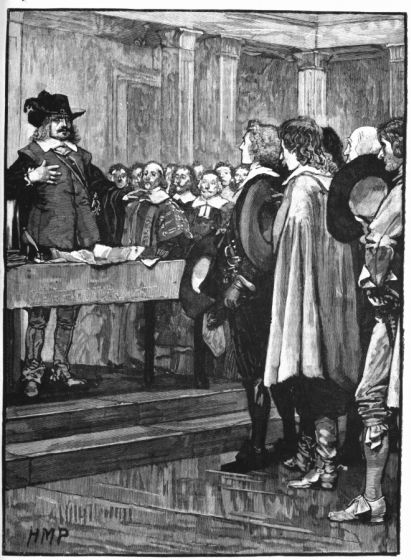
CROMWELL REFUSING THE CROWN. (See p. 142.)
[See larger version]
The discussions of Cromwell and the committee were resumed, and, without coming to any conclusion, on Tuesday, the 21st of April, the Protector suddenly left the consideration of the kingship, and examined the other articles of the Instrument. The chief of these were, that men of all classes should be capable of electing and being elected to Parliament or to offices of State, excepting Papists and Royalists, styled Malignants, at least such Royalists as had been in arms against the Parliament since 1642, unless they had since given signal proof of repentance by bearing arms for the Parliament; all who had been concerned in the Irish rebellion since 1650, or in any plot in England or Wales since December, 1653; all in Scotland who had been in arms against the Parliament of England or Parliament of Scotland, except such as had lived peaceably since the 1st of March, 1652. Besides those thus excluded, all freeholders of counties, and all burgesses and citizens of towns—constituting in fact a household suffrage—could vote for members of Parliament.
All who were atheistical, blasphemous, married to Popish wives, or who trained children, or suffered their children to be trained in Popery, or consented that their children should marry Papists, who scoffed at religion or at religious people, who denied the Scriptures to be God's Word, who denied the Sacraments, ministers, or magistracy to be divine ordinances (like the Fifth-Monarchy men), who were Sabbath-breakers, swearers, haunters of taverns and alehouses—in short, all who were unchristian men—were excluded from electing or being elected. All public preachers were excluded, as better employed in their own vocation, but at the recommendation of Cromwell this was restricted to such preachers as had fixed livings, and did not affect mere voluntary occasional preachers, like himself and many other officers.
A second House of Parliament was to be organised, to consist of not less than forty members, nor more than seventy, who were to be nominated by the Protector, and approved by the Commons. It was not to be called the House of Lords, nor the Upper, but the Other House. The same qualifications and disqualifications applied to it as to the Commons. All judges and public officers, as well as those of the army and navy, were to be approved of by the two Houses; or if Parliament were not sitting, by the Council. Another article settled the revenue, and all relating to it and—the most important one to the Protector—he was authorised to name his successor before his death. These matters being settled, and the Instrument revised by Parliament, on the 8th of May Cromwell summoned the House to meet him in the Banqueting-house, Whitehall, where he ratified the rest of the Instrument, but gave them this answer as to the kingship—that having taken all the circumstances into consideration, both public and private, he did not feel at liberty in his conscience to accept the government with the title of king; that whatever was not of faith was sin; and that not being satisfied that he could accept it in that form to the real advantage of the nation, he should not be an honest man if he did not firmly—but with every acknowledgment of the infinite obligations they had laid him under—decline it. This was his answer to that great and weighty business.
Whitelock assures us that Cromwell at one time had been satisfied in his private judgment that he might accept the royal title, but that the formidable opposition of the officers of the army had shown him that it might lead to dangerous and deplorable results, and that therefore he believed it better to waive it. Whatever the motives, whether those of conscience or prudence, or both, inciting the Protector, he surmounted his temptation, and decided with the firmness characteristic of him. Major-Generals Whalley, Goffe, and Berry are said to have been for his acceptance of the crown; Desborough and Fleetwood were strenuous against it, but Lambert, temporising, appearing to approve whilst he was secretly opposing, and at length coming out strong against it, was the only one whom Cromwell visited with his displeasure. He dismissed him, but with a pension of two thousand pounds a year, and Lambert retired to Wimbledon, where it had been happy for him had he remained in quiet.
On the 26th of June, 1657, the grand ceremony of the inauguration of the Protector as the head of this new Government took place in Westminster Hall. The Protector went thither from Whitehall by water, and entered the hall in the following manner:—First went his gentlemen, then a herald, next the aldermen, another herald, then Norroy, the Lords Commissioners of the Treasury, and the Great Seal carried by Commissioner Fiennes, then Garter, and after him the Earl of Warwick, with the sword borne before the Protector, bareheaded, the Lord Mayor carrying the City sword at his left hand. Being seated in his chair, on the left hand of it stood the Lord Mayor and the Dutch ambassador; on the right the French ambassador and the Earl of Warwick; next behind him stood his son Richard and his sons-in-law Claypole and Fleetwood, and the Privy Council. Upon a lower platform stood the Lord Viscount Lisle, Lord Montague, and Whitelock, with drawn swords. As the Protector stood under the cloth of State, the Speaker presented him with a robe of purple velvet, lined with ermine, which the Speaker and Whitelock put upon him. Then the Speaker presented him with a Bible richly gilt and bossed, girt the sword about his Highness, and delivered into his hand the sceptre of massy gold. Having done this, he made the Protector an address, and finally administered the oath. Then Mr. Manton, one of the chaplains, in prayer recommended his Highness, the Parliament, the Council, the forces by land and sea, and the whole Government and the people of the three nations to the blessing and protection of God. On that the trumpets sounded, the heralds proclaimed his Highness Protector of England, Scotland, and Ireland; and again the trumpets sounded, and the people shouted, "God save the Protector!" This closed the ceremony, and the Protector and his train returned to Whitehall as they came.
The ceremony, it is clear, fell little short of a royal ceremony, with the exception of the crown and the anointing. Charles Stuart might have used the words of James of Scotland to Johnny Armstrong—"What lacks this knave that a king should have?" With the exception of the name of king, Cromwell, the farmer, was become the monarch of Great Britain and Ireland. He had all the power, and inhabited the palaces of kings. He had the right to place his son in the supreme seat after him; and one whole House of Parliament was of his own creation, while the other was purged to his express satisfaction.
Cromwell had not enjoyed his new dignity more than about six weeks, when he received the news of the death of his great Admiral Blake. His health had been for some time decaying. Scurvy and dropsy were fast destroying him, yet to the last he kept his command at sea, and finished his career with one of the most brilliant victories which had ever been achieved. During the winter and spring he maintained the blockade of Cadiz, but learning that the Plate fleet had taken refuge in the harbour of Santa Cruz, in the Island of Teneriffe, he made sail thither. He found the fleet drawn up under the guns of seven batteries in the harbour, which was shaped like a horseshoe. The merchantmen, ten in number, were ranged close inshore, and the galleons, in number and of greater force than any of his own ships, placed in front of them. It was a sight—seven forts, a castle, and sixteen ships—to have daunted any man but Blake. Don Diego Darques, the Spanish admiral, was so confident of the impregnable nature of his position, that he sent Blake word to come and take his vessels. "But," says Clarendon, "the illustrious genius of Blake was admired even by the hostile faction of his countrymen. He was the first man that declined the old track, and made it manifest that the science might be obtained in less time than was imagined; and despised those rules which had been long in practice, to keep his ship and men out of danger, which had been held in former times a point of great ability and circumspection, as if the principal art requisite in the captain of a ship had been to be sure to come safe home again; the first man who brought the ships to contemn castles on shore, which had been thought ever very formidable; the first that infused that portion of courage into the seamen, by making them see what mighty things they could do if they were resolved, and taught them to fight in fire as well as upon water."
Blake did not hesitate. The wind was blowing into the harbour on the 20th of April, 1657; and trusting to the omnipotent instincts of courage, he dashed into the harbour at eight o'clock in the morning. Stayner, who had so lately defeated the Spanish Plate fleet, and destroyed in it the viceroy of Peru, now led the way in a frigate, and Blake followed with the larger ships. His fleet altogether amounted to twenty-five sail. It was received with a hurricane of fire from the batteries on both sides the harbour and the fleet in front; but discharging his artillery right and left, he advanced, silencing the forts, and soon driving the seamen from the front line of galleons into the merchant ships. For four hours the terrible encounter continued, the British exposed to a deadly hail of ball from the shore as well as the ships, but still pressing on till the Spanish ships were all in flames, and reduced to ashes, the troops in them having escaped to land. The question, then, was how to escape out of the harbour, and from the fury of the exasperated Spaniards on the land around. But Blake drew his ships out of reach of the forts and, as if Providence had wrought in his favour—as Blake firmly believed He did—the wind about sunset veered suddenly round, and the fleet sailed securely out to sea.
The fame of this unparalleled exploit rang throughout Europe, and raised the reputation of England for naval prowess to the greatest pitch. Unhappily, death was fast claiming the undaunted admiral. He was suffering at the moment that he won this brilliant triumph, and, sailing homewards, he expired (August 17, 1657) on board his ship, the St. George, just as it entered the harbour of Plymouth. Besides the high encomium of Clarendon, he received that of a writer of his own party and time, in the narrative of the "Perfect Politician"—"He was a man most wholly devoted to his country's service, resolute in his undertakings, and most faithful in his performances of them. With him valour seldom missed its reward, nor cowardice its punishment. When news was brought him of a metamorphosis in the State at home, he would then encourage the seamen to be most vigilant abroad; for, said he, it was not our duty to mind State affairs, but to keep foreigners from fooling us. In all his expeditions the wind seldom deceived him, but mostly in the end stood his friend, especially in his last undertaking in the Canary Islands. To the last he lived a single life, never being espoused to any but his country's quarrels. As he lived bravely, he died gloriously, and was buried in Henry VII.'s Chapel, yet enjoying at this time no other monument but what is raised by his valour, which time itself can hardly deface."
During this summer, Oliver had not only been gloriously engaged at sea, but he had been busy on land. He was in league with Louis XIV. of France to drive the Spaniards from the Netherlands. The French forces were conducted by the celebrated Marshal Turenne, and the Spanish by Don John of Austria, and the French insurgent chief, the Prince of Condé. Cromwell sent over six thousand men under Sir John Reynolds, who landed near Boulogne on the 13th and 14th of May. They were supported by a strong fleet under Admiral Montague, the late colleague of Blake, which cruised on the coast. The first united operations were to be the reduction of Gravelines, Mardyke, and Dunkirk, the first of which places, when taken, was to belong to France, the two latter to England. If Gravelines were taken first, it was to be put into possession of England, as a pledge for the conveyance of the two latter. This bold demand on the part of Cromwell astonished his French allies, and was violently opposed by the French cabinets, who told Louis that Dunkirk once in the hands of the English, would prove another Calais to France. But without Dunkirk, which Cromwell deemed necessary as a check to the Royalist invasions from the Netherlands, with which he was continually threatened, no aid was to be had from the Protector, and it was conceded, whence came the angry declaration from the French, that "Mazarin feared Cromwell more than the Devil."
The French Court endeavoured to employ the English forces on other work than the reduction of these stipulated places. The young French king went down to the coast to see the British army, and having expressed much admiration of them recommended them to lay siege to Montmédy, Cambray, and other towns in the interior. Cromwell was, however, too much of a man of business and a general to suffer this. He ordered his ambassador, Sir William Lockhart (who had married the Protector's niece, Miss Rosina Sewster) to remonstrate, and insist on the attack of Gravelines, Mardyke, and Dunkirk. He told the ambassador that to talk of Cambray and interior towns as guarantees was "parcels of words for children. If they will give us garrisons, let them give us Calais, Dieppe, and Boulogne." He bade him tell the Cardinal that if he meant any good from the treaty with him, he must keep it, and go to work on Dunkirk, when, if necessary, he would send over two thousand more of his veterans. This had the necessary effect: Mardyke was taken after a siege of three days only, and put into the hands of the English on the 23rd of September. The attack was then turned on Gravelines; but the enemy opened their sluices, and laid all the country round under water. On this Turenne, probably glad of the delay, put his troops at that early period into winter quarters. During this time attempts were made to corrupt the English officers by the Stuart party. The Duke of York was in the Spanish army with the English Royalist exiles, and communications were opened as of mere civility with the English at Mardyke. As the English officers took their rides between Mardyke and Dunkirk they were frequently met by the duke's officers, and conversation took place. Sir John Reynolds was imprudent enough to pay his respects to the duke on these occasions, and he was soon ordered to London to answer for his conduct; but both he and a Colonel White, who was evidence against him, were lost on the 5th of December on the Goodwin Sands. The Duke of York now made a treacherous attack on Mardyke, but was repulsed, and the affairs of Charles II. appeared so hopeless, that Burnet asserts, and the same thing is asserted also in the "Orrery Letters," that he was now mean enough to offer to marry one of Cromwell's daughters, and thus settle all differences, but that Cromwell told Lord Orrery that Charles was so debauched that he would undo them all. Cromwell, indeed, just now married his two remaining single daughters, Frances and Mary, to the Lords Rich and Falconberg. Frances married Lord Rich, the son of the Earl of Warwick, and Mary Lord Falconberg, of the Yorkshire family of Bellasis, formerly so zealous for the royal party.
By permission of the Corporation of Liverpool.
CROMWELL REFUSING THE CROWN, 1657.
From the Picture by J. SCHEX in the Walker Art Gallery, Liverpool.
[See larger version]
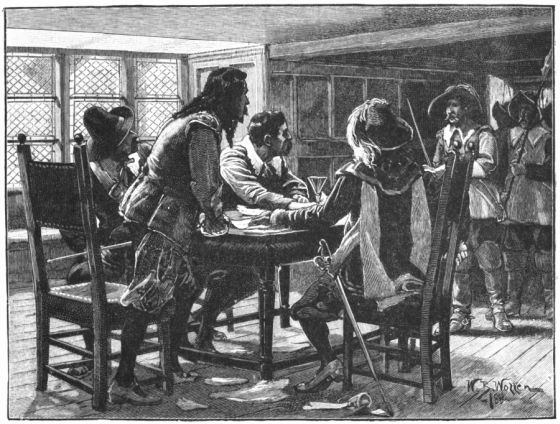
ARREST OF CONSPIRATORS AT THE "MERMAID." (See p. 147.)
[See larger version]
The year 1658 opened by the meeting of the new Parliament. It was a critical venture, and not destined to succeed better than the former ones. To constitute the new House, called the Other House, Cromwell had been obliged to remove to it most of the best-affected members of the Commons. To comply with the "Petition and Advice," he had been forced to admit into the Commons many who had been expelled from former Parliaments for their violent Republicanism. The consequences at once appeared. The Other House consisted of sixty-three members. It included six of the ancient Peers—the Earls of Manchester, Warwick, Mulgrave, Falconberg, Saye and Sele, and Lord Eure. But none but Eure and Falconberg took their seats, not even the Earl of Warwick, whose son and heir, Lord Rich, had just married the Protector's daughter. He and the others objected to sit in the same House with General Hewson, who had once been a shoemaker, and Pride, who had been a drayman. Amongst the members appeared a considerable number of the officers of the army, and the chief Ministers of State. These included the Protector's two sons, Richard and Henry Cromwell, Fiennes, Keeper of the Great Seal, Lisle, Fleetwood, Monk, Whalley, Whitelock, Barkstead, Pride, Hewson, Goffe, Sir Christopher Pack, alderman of London, General Claypole, St. John, and other old friends of the Protector, besides the lords already mentioned. As they had been called by writs, which were copies of the royal writs used on such occasions, the members immediately assumed that it made them peers, and gave them a title to hereditary rank. They were addressed by Cromwell in his opening speech as "My Lords, and Gentlemen of the House of Commons." His speech was very short, for he complained of indisposition, the truth being, that the life of excitement, struggle, and incessant care for twenty years had undermined his iron frame, and he was breaking down; but he congratulated them on the internal peace attained, warned them of danger from without, and exhorted them to unity and earnestness for the public good. Fiennes, after the Protector's retirement, addressed them in a much longer speech on the condition of the nation.
But all hopes of this nondescript Parliament were vain. The Other House no sooner met apart than they began inquiring into their privileges, and, assuming that they were not merely the Other House, but the Upper House, sent a message, after the fashion of the ancient peers by the judges, to desire a conference with the Commons on the subject of a fast. The Commons, however, who were by the new Instrument made judges of the Other House, being authorised to approve or disapprove of it, showed that they meant the Other House to be not an Upper House, but a lower House than themselves. They claimed to be the representatives of the people; but who, they asked, had made the Other House a House of Peers, who had given them an authority and a negative voice over them? The first thing which the Commons did was to claim the powers of the new Instrument, and admit the most violent of the excluded members, for none were to be shut out except rebels or Papists. Haselrig, who had been appointed one of the Other House, refused to sit in it; but having been elected to the Commons, he appeared there, and demanded his oath. Francis Bacon, the Clerk of the House, replied that he dared not give it him; but Haselrig insisted, and being supported by his party, he at length obtained his oath, and took his seat. It was then soon seen that the efficient Government members were gone to the Other House, and Haselrig, Scott, Robinson, and the most fiery members of the Republican section now carried things their own way, and commenced a course of vehement opposition. Scott ripped up the whole history of the House of Lords during the struggle of the Commonwealth. He said—"The Lords would not join in the trial of the king. We called the king to our bar, and arraigned him. He was for his obstinacy and guilt condemned and executed, and so let all the enemies of God perish! The House of Commons had a good conscience in it. Upon this the Lords' House adjourned, and never met again; and it was hoped the people of England should never again have a negative upon them." But the hostility of this party was not to the Other House merely, it was to the Protectorate itself, which it declaimed against, and not only in the House, but out of it, setting on foot petitions for the abolition of the Protectorate by the Commons. Whitelock remarks that this course boded the speedy dissolution of the House. Cromwell summoned both Houses to Whitehall January 25th, only five days after their meeting, and in a long and powerful speech remonstrated with the Commons on their frantic proceedings. He took a wide view of the condition of Europe, of the peace and Protestantism of England, and asked them what were their hopes, if, by their decision, they brought back the dissolute and bigoted Court which they had dismissed. He declared that the man who could contemplate the restoration of such a state of things must have the heart of a Cain; that he would make England the scene of a bloodier civil war than they had had before. He prayed, therefore, that whoever should seek to break the peace, God Almighty might root that man out of the nation; and he believed that the wrath of God would prosecute such a man to his grave, if not to hell.