Chapter XVII
Reading edition
THE REIGN OF QUEEN ANNE (continued).
Negotiations for Peace—The Ministry becomes Whig—Harley—Marlborough and Charles of Sweden—The Allies in Spain—Battle of Almanza—The French Triumphant in Spain—Attack on Toulon—Destruction of Shovel's Fleet—Jacobitism in Scotland—First Parliament of Great Britain—Abigail Hill—The Gregg Affair—Retirement of Harley and St. John from the Ministry—Attempted Invasion of Scotland—Campaign of 1708—Battle of Oudenarde—Capture of Lille—Leake takes Sardinia and Minorca—Death of Prince George of Denmark—The Junto—Terrible Plight of France—Marlborough's Plans for 1709—Louis Negotiates with Holland—Torcy's Terms—Ultimatum of the Allies—Rejection of the Terms—Patriotism of the French Nation—Fall of Tournay—Battle of Malplaquet—Meeting of Parliament—Dr. Sacheverell's Sermons—His Impeachment resolved upon—Attitude of the Court—The Trial and Sacheverell's Defence—The Riots—Dispersal of the Rabble—The Sentence—Bias of the Queen—The Tories in Power—Renewed Overtures for Peace—Their Failure—The Campaigns in the Netherlands and in Spain—Brihuega and its Consequence—Marlborough's Reign at an End—Unpopularity of Marlborough—Dismissal of the Duchess—Triumph of the Tories—Guiscard's Attack on Harley—Popularity of Harley—Marlborough's Last Campaign—Failure of the Attack on Quebec—The Ministry determine to make Peace—Overtures to the Pretender—He refuses to Change his Religion—Gualtier's Mission to Versailles—Indignation of the Dutch—The Basis of Negotiations—Signing of the Preliminaries—Excitement Abroad and at Home—Prorogation of Parliament—Strengthening of the Ministry—Debates in the two Houses—The Whigs adopt the Occasional Conformity Bill—Creation of Peers—Dismissal of Marlborough from his Employments—Walpole expelled the House.
The great event of the Union of the kingdoms has carried us somewhat past the course of general events. After the last disastrous campaign Louis XIV., humbled to a degree that he was hitherto unacquainted with, employed the Elector of Bavaria to propose a congress to the Duke of Marlborough and the States-General. He had already presented a memorial to the Dutch Government through the Marquis D'Alègre, and he besought the Pope to use his influence to this end. The terms which Louis offered in the moment of his alarm were such as well merited the attention of the Allies. He proposed to cede either Spain and the West Indies to King Charles, or Milan, Naples, and Sicily; to grant to the Dutch a barrier of fortified towns on the frontiers of the Spanish Netherlands; and to indemnify the Duke of Savoy for the ravages committed on his territories. Never since the commencement of the war had the Allies such an opportunity of closing the war triumphantly. They could thus balance the powers of France and Austria by dividing the Spanish monarchy, and give to the Dutch all they asked—a secure frontier. But the great doubt was whether Louis was in earnest, or only seeking to gain time during which he might continue to divide the Allies. And the Allies were by no means eager to accept Louis's offers. The Dutch were greatly elated by Marlborough's astonishing victories, and Marlborough himself was in no humour to stop in the mid-career of his glory. He is said to have induced the Grand Pensionary Heinsius—who was now as much devoted to him as he had formerly been to King William—to keep the Dutch high in their demands, whilst Marlborough induced the English Court to demand indemnity for the immense sums which England had expended in these wars. In these circumstances the offers of France were declined on the plea that England could not enter into any negotiations except in concert with the Allies. Had the English people known of the offers, there would have probably been a loud demand for peace; but they were kept secret, and the attention of the nation being then engrossed by the question of the Union, the matter was passed over,—not, however, without exciting fresh resentment against Marlborough amongst the Tory leaders.
During the Session of 1706-1707 the Ministry grew more completely Whig. Through the influence of Lady Marlborough rather than of the Duke, who was much averse from the free principles and free language of his son-in-law the Earl of Sunderland, that nobleman was made one of the Secretaries of State in the place of Sir Charles Hedges. This change was equally repugnant to Harley, the other Secretary, who was now the only Tory Minister left in the Cabinet. The three Tory Commissioners of the Board of Trade—Prior the poet being one—were removed, and three Whigs were introduced. Sir James Montague, the brother of the Earl of Halifax, was made Solicitor-General; and Sir George Rooke and the few remaining Tory Privy Councillors had their names erased. Harley was thus left, apparently without support, a Tory in a Cabinet all except himself Whig. But Harley was that kind of man that he not only managed to maintain his place, but eventually ruined and scattered the whole Whig party. He was by no means a man of genius, though he affected the company of such men. Pope, Swift, Bolingbroke, Arbuthnot, and Prior, were his friends and associates. His intellect was narrow and commonplace, but it was persevering; and though he was a wretched and confused speaker, yet he continually acquired more and more influence in the House of Commons, and ultimately raised himself to the peerage, and for many years to the chief direction of the national affairs. The secret of this was that he had made himself master of the laws and practices of Parliament, and on all disputed questions could clear up the point past dispute, so that he came to be regarded as far more profound than he was.
The Duke of Marlborough, relying on the support of the Whig Cabinet, which the influence of his contriving wife had created, set out in the month of April for the Continent. The condition to which his successes had reduced France was such that the Allies were in the highest spirits. The French Treasury was exhausted; and, in the absence of real money, Louis endeavoured to supply the deficiency by mint bills, in imitation of the Bank of England bills; but they were already at a discount of fifty-three per cent. The lands lay uncultivated, manufacturers were at a pause for want of capital, the people were perishing with famine, and nothing could be more deplorable than the state of France. Nothing could have saved Louis at this crisis but want of unity amongst the Allies, and already the artful Louis had contrived to get in the wedge of disunion. The Emperor, allured by the prospect of the evacuation of Italy, and of seizing Naples for himself, had come to a secret understanding with the French king, which was equally treacherous and suicidal; for the direct result, as any man but the stolid Emperor would have foreseen, was to liberate the French forces from the North of Italy to reinforce those in the Netherlands and those endeavouring to drive his brother Charles from Spain.
Marlborough, on his part, did everything that he could to keep the Allies together, and to combine them into a victorious strength; but it had always been his misfortune, as it had been that of William, to have to suffer from their regard to their own petty jealousies rather than to the grand object in view. He set out directly from the Hague to visit Hanover, and stimulate the young Elector to active assistance. He then set out to pay a visit to Charles XII. of Sweden, who was encamped at Alt Ranstadt, only a few marches from the Court of Hanover. The Swedish military madman, neglecting the Czar Peter, who was making continual inroads on his Finnish and Esthonian territories, and was now actually laying the foundations of a new capital and seaport on the shores of the Baltic, had pursued, with blind and inveterate hatred, Augustus, the Elector of Saxony, who had presumed to allow himself, in spite of the Swedish king, to be elected King of Poland. Marlborough's flattery appeared to produce the intended effect. The rough Swede assured him that he had a great regard for the Queen of England, and for the objects of the Grand Alliance, and should do nothing contrary to it; that he detested the domineering spirit of the French, and that no good need be expected till they were reduced to the condition they were in at the peace of Westphalia; that he had come into Saxony to demand certain satisfaction, and that when he had obtained it he should go away, and not sooner. But notwithstanding Charles's profession, he continued to harass and alarm the Emperor until he had obtained from him all that he chose to demand, when he marched away into Poland to encounter the Czar. Marlborough himself returned by way of the Courts of Prussia and Hanover to the Hague, giving everywhere the utmost satisfaction by his arrangements with Charles XII., who had made every neighbouring Court uneasy lest he might turn his erratic arms against them.
But the campaign in the Netherlands this year bore no relation to the great expectations formed of it. No grand action was fought there; and in Spain the adroit manœuvre of Louis, by which, through his treaty with the selfish and short-sighted Emperor, he had liberated his troops from Italy to throw them upon that country, and the want of unity between Charles and his auxiliaries, quite changed the face of affairs. The Whigs had studiously left the reinforcements in Spain insufficient, from the idea that it was better to continue to distract the attention of Louis in that direction than by a bold and vigorous effort to drive him from the country. They had a vain idea of conquering France, and thought this more easy to achieve while the French arms were demanded in various quarters. But the astute Louis was not so readily dealt with. He contrived, as we have seen, to amuse the Allies in Flanders without coming to blows. He coped without difficulty with the Germans on the Rhine; and, though fiercely attacked at Toulon by the Savoyards, he defeated the Allies in Spain, to the great astonishment of Europe.
By this time the opinion formed of King Charles when he was in England by those who had opportunity of observing him, was now become that of all who had come near him in Spain—that he was a very poor creature. The Earl of Peterborough, who had been travelling about with little success to borrow money for such a contest, and had returned to Spain, but without any command, did not hesitate to say that people were great fools to fight for such a couple of simpletons as Charles and Philip. Charles was surrounded by a set of Austrians who were utterly incapable of commanding, and who made it equally impossible for any one else to command. The great plan of the campaign was to march boldly on Madrid; but Charles was, as before, too timid to venture on such a step. He remained in Catalonia, and ordered the Earl of Galway with the Dutch and English forces, and Das Minas, with the Portuguese, to defend the frontiers of Aragon and Valencia; and thus he contrived to wait for fresh troops from England, or from Italy, where they were no longer wanted. Whilst Das Minas and Galway, who was only second in command, were laying siege to Velina, in Valencia, and were in want of almost everything—food, clothes, and ammunition—they heard that the Duke of Berwick was hastening, by forced marches, to attack them. They therefore drew off towards the town of Almanza, and there fell in with the enemy, who proved to be considerably stronger than themselves. They came to an engagement, however, on the 14th of April. The battle began about two in the afternoon, and the whole force of each army was engaged. The centre of the Allies, consisting of Dutch and English, fought most valiantly, and repeatedly threw back the forces of the Duke of Berwick. For six long and bloody hours they maintained the fight; but the two wings were beaten and dispersed; the Portuguese horse on the right at the first charge, but the Dutch and English on the left, only after a brave but unequal resistance. When the gallant centre was thus exposed on both flanks, they formed themselves into a square, and retired from the field, fighting doggedly as they went. But at length their ammunition was spent, they were worn out with fatigue, and they surrendered, to the extent of thirteen battalions. The Portuguese, part of the English horse, and the infantry who guarded the baggage, retreated to Alcira, where the Earl of Galway joined them with about two thousand five hundred horse, and they escaped. It was a complete triumph for the French and Spaniards. The Allies lost five thousand men, besides the wounded and the large force which surrendered.
Nothing now could stop Berwick, who won great reputation by this decisive action. He marched into Valencia, taking town after town, whilst Saragossa at the same time surrendered, without a shot, to the Duke of Orleans. Berwick marched for the Ebro, which he crossed on the 4th of June, and at length pursued and shut up the flying confederates in Lerida. Charles was too inert or too dastardly to lead his troops thither, though they lay at no great distance; and the place was taken by storm, and given up to all the licence of the soldiery. After this Manilla surrendered so late as the 17th of December, and with that the campaign closed. The Duke of Orleans returned to Paris, and the Duke of Berwick remained with the army till towards spring, when Louis sent for him in haste into France, ordering him to quit Spain unknown to Philip, lest he should endeavour to detain him. The Earl of Galway and Das Minas embarked at Barcelona for Lisbon, leaving General Carpenter with the English forces remaining in Catalonia, the only portion of Spain now left to the pusillanimous Charles.
The operation, however, which most alarmed the French Court was that of the Duke of Savoy against Provence. This had been planned by Marlborough and Prince Eugene, and would undoubtedly have had a brilliant success had not the Emperor been secretly planning his attempt on Naples, instead of sending all his forces into Italy to the support of this enterprise. The Duke of Savoy and Prince Eugene, though abandoned by this selfish and small-souled Emperor, on whose account the great Powers of Europe were expending so much life and wealth, crossed the Alps by the Col de Tende with twenty thousand men, whilst Sir Cloudesley Shovel appeared on the coast of Provence with the united fleet of England and Holland to support them. Eugene crossed the Var on the 10th of July, Sir John Norris and his English sailors clearing the way for him in their gunboats. But the French were fast marching towards Toulon from various quarters, Villars having been despatched with a large force, as we have stated, from the army of Flanders. The Duke of Savoy, on the other hand, instead of pushing on to Toulon with all speed, halted his army to rest, and then marched leisurely forward. By this means, not only had the French been able to collect a very powerful army, but had had time to strengthen greatly the fortifications of Toulon. When the practised eye of Prince Eugene took a survey of the formidable heights of Toulon, and of the great force on the outworks, with the power of the batteries, he advised the duke not to attempt the siege of the place with the forces at his command. The duke, however, would persist, and an assault was made on the outworks on the hill of St. Catherine, and on two small forts near the harbour. These were carried, but at a great cost of life, including that of the gallant Prince of Saxe-Gotha. But fresh French troops kept pouring in; it was impossible to maintain even this advantage. On the 15th of August the hill of St. Catherine was recovered by the French, and the Savoyards were even attacked in their own camp. On this an order was given to bombard the place, both from sea and land, in retaliation for the ravages committed by the French on Turin; the bombardment, especially from the sea, was made with terrible effect. A great part of the city was demolished, and the English and Dutch sailors destroyed eight ships of the line in the harbours, and utterly ruined two batteries. In the night of the 25th of August the army of Savoy retired; on the 31st it crossed the Var without any pursuit of the French, and then laid siege to Susa, an old and strong town at the foot of the Alps, which surrendered after a fortnight's investment.
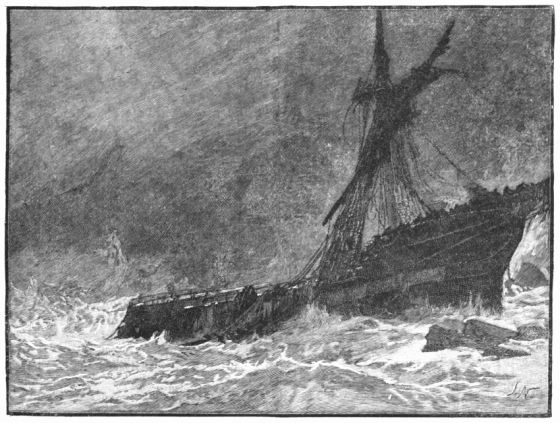
WRECK OF SIR CLOUDESLEY SHOVEL'S FLEET. (See p. 577.)
[See larger version]
Sir Cloudesley Shovel, leaving a squadron with Sir Thomas Dilkes in the Mediterranean, sailed for England, and on the night of the 22nd of October, 1707, closed his career in a sudden and melancholy manner. By some miscalculation his vessels got amongst the rocks of Scilly. His own ship struck on a rock about eight o'clock at night, and went down, drowning him and every soul on board. Three other vessels shared the same fate, only the captain and twenty-four men of one of them escaping. Sir Cloudesley Shovel had risen from a humble origin in Suffolk, had raised himself to the head of the maritime service of his country by his bravery, skill, and integrity. His body, when cast ashore, was stripped by the wreckers and buried in the sand, but was afterwards discovered and interred in Westminster Abbey.
Meanwhile disaffection was rife in Scotland, where there had been for some time a very zealous emissary of the Court of St. Germains, one Colonel Hooke. Colonel Hooke transmitted to Chamillard, the Minister of Louis XIV., flaming accounts of this state of things in Scotland, and represented that never was there so auspicious an opportunity of introducing the king of England (the Pretender) again to his ancient throne of Scotland—a circumstance than which nothing could be more advantageous to France. A civil war created in Great Britain must completely prevent the English from longer impeding the affairs of Louis on the Continent. All the power of England would be needed at home; and on the Elder Pretender succeeding in establishing himself on the throne of the United Kingdom, France would be for ever relieved from the harassing antagonism of England—the only real obstacle to the amplest completion of all France's plans for Continental dominion. These accounts were very highly coloured, as from most quarters, particularly from the Duke of Hamilton, Hooke only met with discouragement. From others, however, Hooke received more encouragement. He obtained a memorial to Louis XIV., signed by the Lord High Constable the Earl of Errol, by the Lords Stormont, Panmure, Kinnaird, and Drummond, and by some men of smaller note. The leading men did not sign. They were not willing to endanger their necks without some nearer prospect of invasion. Hooke, indeed, pretended that the lords who did sign, signed as proxies for many others, such as the Earls of Caithness, Eglintoun, Aberdeen, and Buchan, Lord Saltoun, and others. With this memorial Hooke went back to St. Germains, and what the document wanted in weight he made up by verbal assurances of the impatience of all Scotland for the arrival of the king. But the truth appears to be that France expected a stronger demonstration on the part of Scotland, and Scotland on the part of France, and so the adventure hung fire. It was not till the following year that sufficient spirit could be aroused to send out an armament, and not till upwards of twenty of the Jacobite lords and gentlemen, including the Duke of Hamilton, in spite of all his caution, had been arrested.
The first Parliament of Great Britain met on the 23rd of October, 1707. The queen, in her speech, endeavoured to make the best of the last unfortunate summer's military operations. The retreat of the Imperialist troops on the Rhine was freely admitted, but it was considered an encouraging circumstance that the command there was now in the hands of the Elector of Hanover, and it was announced that measures were taken for strengthening the forces in that quarter. Little could be said of the proceedings in the Netherlands, and less of those in Spain, including the fatal battle of Almanza; but the most was made of the attack upon, and the bombardment of, Toulon. But the speech promised renewed vigour in every quarter, and called for augmented supplies. The deficiencies of military and naval action—for we had also suffered a considerable defeat at sea from the celebrated French Admiral, Du Guai Trouin, off the Lizard Point, in which two ships of the line were taken and a third was blown up—an endeavour was made to cover by allusions to the happy event of the Union. The Commons, in their Address, seized on this point of congratulation, and declared it a "mark of the Divine goodness that her Majesty had been made the glorious instrument of this happy Union, which would so strengthen the kingdom as to make it a terror to all its enemies." The Lords joined with the Commons in an affectionate Address to her Majesty, declaring that the only means of obtaining an honourable peace was the entire recovery of Spain. To support these assurances by deeds the Commons voted the enormous sum of six millions for the supplies.
Meanwhile the influence of the Marlboroughs at Court was on the wane, and that partly through their own shortsightedness. The Duchess of Marlborough had introduced into the palace, when she was Groom of the Stole, Mistress of the Robes, and more queen than the queen herself, a poor relation of her own, one Abigail Hill. Abigail, from whose position as a bedchamber woman, and from whose singular rise and fortunes all women of low degree and intriguing character have derived the name of Abigails, being placed so near the queen, soon caught her eye, took her fancy, and speedily became prime favourite. Harley, the Tory Minister, being also her cousin, as was the Duchess of Marlborough, with equal tact discovered her to be a useful tool for him. The Duchess of Marlborough, trusting to her long absolute sway over the mind of Queen Anne, begun when she was a princess; to the firm establishment of the Whig faction in power, her own work, because the Tories had opposed the five thousand pounds a year which the queen, at the instigation of the duchess, demanded for Marlborough before he had even won the battle of Blenheim; and finally, relying on the great services which Marlborough had now rendered, had become intolerable in her tyranny over the queen. The Marlboroughs all this time were making use, not only of their position to enjoy power, but to scrape up money with an insatiable and unblushing avarice. The time was now approaching, however, for the queen's liberation from the heavy yoke of Sarah Marlborough. The duchess, in the midst of power and pride, had still for some time felt the ground mysteriously gliding from under her feet.
She found that Abigail Hill was, in reality, no longer Abigail Hill; that she had for a whole year been privately married to Mr. Masham, Groom of the Bedchamber to the Prince of Denmark; and that the queen herself had honoured this secret marriage by her presence at Dr. Arbuthnot's lodgings, at which time Anne, the duchess now remembered, had called for a round sum from the privy purse. In short, the duchess herself tells us that in less than a week after the inquiries she discovered that her cousin "was become an absolute favourite."
At this crisis an unlucky incident for the cunning Harley occurred. He had in his office one William Gregg, a clerk, who was detected in a treasonable correspondence with Chamillard the French Minister. He was arrested and thrown into the Old Bailey. The Whigs hoped to be able to implicate Harley himself in this secret correspondence. There had just been an attempt to get Lord Godolphin dismissed from his office, and he, the Duke of Marlborough, Sunderland, and their party, now seized eagerly on this chance to expel Harley and his acute coadjutor, St. John, from the Cabinet. Seven lords, including these, and all Whigs, were deputed to examine Gregg in prison, and are said to have laboured hard to induce Gregg to accuse Harley; but they were disappointed. Gregg remained firm, was tried, condemned, and hanged. Alexander Valiere, John Bara, and Claude Baude, the secretary of the ambassador to the Duke of Savoy, with that Minister's consent, were also imprisoned on the charge of carrying Gregg's correspondence to the governor and commissioners of Calais and Boulogne. On the scaffold Gregg was said to have delivered a paper to the ordinary, clearing Harley altogether; but this was not produced till Harley was once more in the ascendant. The lords deputed to examine Gregg and the smugglers Bara and Valiere, declared that Gregg had informed them that Harley had employed these men to carry correspondence, and that all the papers in the office of Harley lay about so openly that any one might read them. Both these assertions, and the paper said to have been left by Gregg, had much that is doubtful about them. The one statement proceeded from the Whigs, evidently to destroy Harley; the Gregg paper, on the other hand, not being produced till Harley was out of danger, was quite as evidently the work of Harley to clear his character. The charges, however, were sufficient to drive Harley and St. John from office for the time. When the Council next met, the Duke of Somerset rose, and pointing to Harley said rudely to the queen that if she suffered that fellow to treat of affairs in the absence of Marlborough and Godolphin, he could not serve her. Marlborough and Godolphin continued to absent themselves from the Council, and the queen was compelled to dismiss Harley. With him went out St. John, the Secretary of War; and Mr. Robert Walpole, a young man whose name was destined to fill a large space of history under the Georges, was put into his place.
Whilst things were on this footing, the nation was alarmed by an attempt at invasion. Louis XIV. had at length been persuaded that a diversion in Scotland would have a very advantageous effect by preventing England from sending so many troops and supplies against him to the Continent. Early in February, therefore, an emissary was sent over to Scotland in the person of Charles Fleming, brother of the Earl of Wigtown. He was to see the leading Jacobites, and assure them that their king was coming; and that as soon as the French fleet appeared in sight they were to proclaim the king everywhere, raise the country, seize arms, and open up again their previous communications with persons within the different forts and garrisons—thus proving that they had tampered with the troops and garrisons of Scotland, and that, as asserted by different historians, the regular troops in that country, about two thousand five hundred, were not to be trusted by the English. They were also to seize the equivalent money, which was still lying in the Castle of Edinburgh. On the earliest intimation of these designs, the suspected Scottish nobles, including the Duke of Hamilton and twenty-one others, lords or gentlemen, were secured. The Habeas Corpus Act was suspended; the Pretender and his abettors were declared traitors; and all Popish recusants were ordered to remove ten miles from the cities of London and Westminster. The alarm was not an empty one. The Pretender, who had now assumed the name of the Chevalier de St. George, was furnished with a fleet and army, which assembled at Dunkirk. The fleet, under the command of Admiral Forbin, consisted of five ships of the line and twenty frigates. It was to carry over five thousand troops, under the command of General de Gace, afterwards known as Marshal de Matignon. Before the expedition, however, could sail, the Chevalier was taken ill of the measles, and the postponement of the expedition ruined its chances. A powerful fleet under the command of Admiral Sir George Byng, with squadrons under Sir John Leake and Lord Dursley, was sent to blockade the port of Dunkirk, and prevent the sailing of the French expedition. The French were astonished at the appearance of so large a fleet, imagining that Leake had gone to Lisbon with his squadron; and Count de Forbin represented to the French Court the improbability of their being able to sail. A storm, however, drove the English ships from their station. The French fleet then ventured out on the 17th of March, but was soon driven back by the same tempest. On the 19th, however, it again put out, and made for the coast of Scotland. But Sir George Byng had stretched his ships along the whole coast, to the very Firth of Forth; and on the French squadron approaching the Forth, it perceived the English ships there before it, and stood off again. Byng gave chase and took the Salisbury, a ship of the line, having on board old Lord Griffin, two sons of Lord Middleton, a French lieutenant-general, various other French and Irish officers, and five companies of French soldiers. In the night Forbin altered his course, and thus in the morning was out of the reach of the English. The Chevalier was impatient that Forbin should proceed to Inverness, and there land him and the troops; but the wind was so violent and dead against them that Forbin contended that they would all be lost if they continued the attempt, and the Chevalier, having entered the Firth of Forth, reluctantly returned to Dunkirk.
Such was the alarm in London owing to these circumstances that there was a heavy run on the Bank, increased to the utmost by all who were disaffected to the Government. The Commons also suspended the Habeas Corpus Act, and the country was alive with military preparations.
The Allies and France prepared for a vigorous campaign in the Netherlands. Notwithstanding the low state of Louis XIV.'s funds and a series of severe disasters which had attended his arms, he put forth wonderful energies for the maintenance of his designs. He assembled at least one hundred thousand men in the Netherlands, under the command of the Duke of Burgundy, the Duke of Vendôme, the Duke of Berwick—who had been so suddenly called from Spain—Marshal Boufflers, and the Old Pretender, who sought here to learn martial skill, which he might employ in attempting to regain his crown. On the other hand, Marlborough went to the Hague towards the end of March, where he was met by Prince Eugene, and the plan of the campaign was concerted between them, the Pensionary Heinsius, and the States-General. Eugene then returned to Vienna to bring up reinforcements, and Marlborough proceeded to Flanders to assemble the army, and be in readiness for the junction of Eugene. Before Eugene and Marlborough parted, however, they had gone together to Hanover, and persuaded the Elector to be contented with merely acting on the defensive, so that he might spare a part of his forces for the projected operations in Flanders. His son, the Electoral Prince—afterwards George II. of England—took a command of cavalry in the Imperial army under Marlborough.
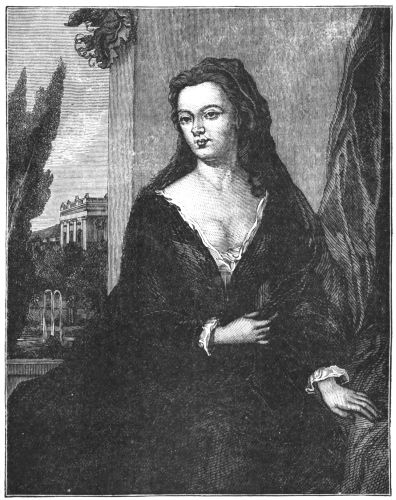
SARAH DUCHESS OF MARLBOROUGH. (After the Portrait by Sir Peter Lely.)
[See larger version]
The Duke of Vendôme, on the 25th of May, posted his army at Soignies, whilst Marlborough was encamped at Billinghen and Halle, only three leagues distant. The French then moved towards Braine-la-Leuvre, and Marlborough, supposing that they meant to occupy the banks of the Dyle and cut him off from Louvain, made a rapid night march, and on the 3rd of June was at Terbank, Overkirk occupying the suburbs of Louvain. There, as the Allies were yet far inferior in numbers, they imagined the French would give them battle; but such were not the French plans. They had advanced only to Genappe and Braine-la-Leuvre, and now sought by stratagem to regain the towns they had lost in Flanders. They knew that the Allies had drawn out all their forces, and that few of these towns had any competent garrisons. The inhabitants of many of these places had a leaning to France, from the heavy exactions of the Dutch, and the popularity of the Elector of Bavaria and the Count de Bergeyck, who was a warm adherent of the Bourbons. The French, therefore, resolving to profit by these circumstances, despatched troops to Ghent, Bruges, and Ypres, and were soon admitted to these places. They next invested Oudenarde; but Marlborough, being now joined by Eugene, made a rapid march to that town, and took up a strong position before it. The French, however, unwilling to come to an engagement, passed the Scheldt, and attempted to defeat the Allies by attacking them whilst they were in the act of passing it after them. The Allies, however, effected their transit, and came to an engagement with the enemy between the Scheldt and the Lys on the 11th of July. The French amounted to one hundred thousand, the Allies to little more than eighty thousand. The latter, however, had this great advantage—that the commanders of the Allies were united, those of the French were of contrary views. The Duke of Vendôme was prevented from attacking the Allies during their passage of the river by the remissness of the Duke of Burgundy. When it was already three o'clock in the afternoon, and the Allies were safe over, then Burgundy was eager for an attack, and the Duke of Vendôme as averse from it, the proper opportunity having been lost. The wiser general was eventually overruled, and Major-General Grimaldi was ordered to attack Count Rantzau, who was posted on a marshy plain near the village of Eyne, with a muddy rivulet in front of him, with the king's Household Troops. But these troops, when they saw the nature of the rivulet, would not charge, and filed off to the right. Rantzau then crossed the rivulet himself, and, whilst General Cadogan assaulted the village of Eyne, attacked and drove before him several squadrons of the enemy. In this attack the Electoral Prince of Hanover greatly distinguished himself by his gallant charge at the head of Bülow's dragoons. He had his horse killed under him, and Colonel Laschky killed at his side. Several French regiments were completely broken, and many officers and standards were taken by the Hanoverians. The general engagement, however, did not take place till about five o'clock, when the Duke of Argyll came up with the infantry. Overkirk and Tilly, who led on the left of the Allies, were the first to make the French give way, when they were attacked in flank by the Dutch infantry under the Prince of Orange and Count Oxenstjerna, and completely routed their right. After that the whole line gave way. In vain Vendôme exerted himself to check their flight and reform them; they fled in wild confusion along the road from Oudenarde towards Ghent, and Vendôme could do nothing but protect their rear. Their greatest protector, however, was the night, which stopped the pursuit of the Allies. As soon as it was light the pursuit was resumed; but this was checked by the French grenadiers, who were posted behind the hedges that skirted the road, and the French army reached Ghent at eight in the morning, and encamped on the canal on the other side of the city at Lovendegen, after one of the most thorough defeats that they had ever sustained. They lost three thousand men, were deserted by two thousand more, and had seven thousand taken, besides ten pieces of cannon, more than a hundred colours and standards, and four thousand horses. The loss of the Allies was not inconsiderable, amounting to nearly two thousand men.
After resting a couple of days on the field of battle, a detachment was sent to level the French lines between Ypres and the Lys; another to lay the country under contributions as far as Arras, which ravaged the country and greatly alarmed Paris itself by carrying the war into France. This alarm was heightened by the Allies next advancing upon the city of Lille, which was considered the key to Paris and to half of France. Lille was very strongly defended by batteries and entrenchments, and by a garrison of twenty-one battalions of the best troops in France, commanded by Boufflers. This daring act combined all the skill and chief leaders on each side for the attack or the defence. The Dukes of Burgundy, Vendôme, and Berwick hastened to the relief of the place. Marlborough, Eugene, the Prince of Orange, Augustus, King of Poland, and the Landgrave of Hesse, were engaged in the siege. All the art and valour on both sides were put forth. The French endeavoured to cut off the supplies of the Allies coming from Ostend; but Major-General Webbe, who guarded these supplies with a body of six thousand men, defeated an attacking party of twenty-two thousand French under the Count de la Motte, near Wynendale, killing six thousand of them, and accomplishing one of the most brilliant exploits of the whole war. After a stubborn and destructive defence Boufflers capitulated for the town on the 22nd of October, but contrived to hold the citadel till the 9th of December.
Lille, important as it was, was not won, it is said, without a loss of at least twelve thousand of the Allies, whilst Boufflers was reckoned to have lost half his garrison. During the siege Eugene had to hasten to the rescue of Brussels. After the fall of Lille the Allies reduced Ghent, Bruges, and all the towns they had lost; and the French, greatly humiliated, abandoned Flanders, and retired into their own territories, the French Court being filled with consternation at these terrible reverses. The Duke of Berwick was highly incensed at the management of the campaign by Vendôme and Burgundy. He states that during the siege of Lille Marlborough, through him, made propositions for peace, which were, however, haughtily rejected by the not yet sufficiently humbled Louis. Marlborough would probably have been glad to have procured peace now, that he might watch the critical state of affairs at home, where Harley and Mrs. Masham were steadily driving their mines beneath the feet of the Whigs, and where the whole body of Tories were constantly endeavouring to misrepresent his proceedings in the war, continually prognosticating defeats from alleged blunders, which, nevertheless, were as regularly refuted by the most brilliant successes.
The campaign in Catalonia had begun in favour of the French, but there, too, had ended decidedly in favour of the Allies. There the Earl of Galway was superseded by General Stanhope, an able and active officer; and Count Stahremberg, the Imperial general, was a man of like stamp. But before the Imperial troops had arrived in the English fleet commanded by Sir John Leake, the Duke of Orleans had besieged and taken Tortosa and Denia, the garrison of the latter place being detained prisoners, contrary to the articles of capitulation. No sooner, however, did Generals Stanhope and Stahremberg get into the scene of action than they put a stop to the progress of the French, and maintained the rest of the province intact. They soon, moreover, planned a striking enterprise. Sir John Leake carried over to Sardinia a small body of troops under the command of the Marquis D'Alconzel, assaulted and took Cagliari, and received the submission of the whole island, which acknowledged King Charles, and sent a very timely supply of thirty thousand sacks of corn to the army in Catalonia, where it was extremely needed. General Stanhope then, with the consent of Count Stahremberg, set sail for Minorca with a few battalions of Spaniards, Italians, and Portuguese, accompanied by a fine train of British artillery directed by Brigadier Wade and Colonel Petit. They landed on the 26th of August at Port Mahon, and invested St. Philip, its chief fortress. They so disposed their forces that the garrison, which consisted only of one thousand Spaniards and six hundred French marines, under Colonel Jonquiere, imagined that there were at least twenty thousand invaders, and, in consequence, surrendered after some sharp fighting, in which Brigadier Wade, at the head of a party of grenadiers, stormed a redoubt with such fury as amazed the garrison. On the 30th of September not only Port Mahon but the whole island was in the hands of the English, the garrison of Port Fornelles having also submitted to the attack of Admirals Leake and Whitaker. The inhabitants were delighted with the change, King Philip having so heavily oppressed them and deprived them of their privileges.
On the 28th of October the Prince of Denmark, the husband of the queen, died at Kensington Palace, in his fifty-fifth year. George of Denmark was a man not destitute of sense, but of no distinguished ability. He was a good-natured bon-vivant, who was, however, fond of the queen, who was very much attached to him. They lived together in great harmony and affection, having no jars or jealousies. They had several children, who all died early, their son, the Duke of Gloucester, arriving at the greatest age. Anne was supposed to have a strong conviction that the death of all her children was a judgment on her for her desertion of her father and the repudiation of her brother the Prince of Wales, whom, though she was the first to brand as a supposititious child, she came to recognise as her own brother.
On the death of the prince his offices were quickly divided amongst the expectant Whigs. The Earl of Pembroke took his office of Lord High Admiral, resigning the Lord-Lieutenancy of Ireland and the Presidency of the Council. But he soon found the business of the Admiralty too arduous for him, and it was put into commission, the Chief Commissioner being Lord Orford, that mercenary Russell whom the Whigs had so long been endeavouring to restore to that post. The post of Warden of the Cinque Ports and Constable of Dover Castle was separated from that of Admiral to accommodate Lord Dorset. Lord Somers was again brought into the Cabinet as President of the Council. Even the witty and wicked Lord Wharton was promoted to the Lord-Lieutenancy of Ireland. As Marlborough and Godolphin had a great fear and distrust of Wharton, this astonished many, but was accounted for by those more in the secrets of Court by Wharton being in possession of an autograph letter of Godolphin's to the Court of St. Germains, by which that Minister, and probably Marlborough, too, was greatly in his power.
But though the Whig Junto, as it was called, were now apparently omnipotent in the Government, that was far from being the case. Harley and Mrs. Masham had the ear of the queen as much or more than ever. They were continually closeted with her, and laboured hard to disconcert all the measures of the Whigs; the fierce and implacable Duchess of Marlborough, raging with jealousy of the influence of Mrs. Masham, who had supplanted her, did perhaps still more than Harley himself, by her impolitic anger and insolence, to render the queen only the more desirous to be rid of the Marlborough pest. Nothing but the duke's continued victories made the countenance of the duchess at Court possible.
Dreadful as was the condition to which the fiendish ambition of Louis XIV. had reduced Flanders, Spain, the North of Italy, and many parts of Germany, that of his own country and subjects was still more deplorable. Trade, agriculture, everything had been shrivelled up by the perpetual demands of these incessant wars. The wealthy classes were become as poor as the rest; the middle classes were ruined; the common people were drained off to the army if men, and sank into beggary if women, children, or old people. All credit was at an end; the Treasury of the king was empty; and his chief banker, Bernard, was bankrupt, as were hundreds of the same class of men. The most violent and spasmodic exertions had been made to raise the supplies for the armies in the different fields, and still of late nothing had come but tidings after tidings of disastrous and murderous defeats. The farmers of the taxes were out in all parts of France endeavouring to extort those levies which the ordinary tax-gatherers had demanded and distrained for in vain. The people of France were under a perpetual visitation of these officers; and though they were ill prepared to pay once, had frequently to pay more than once, the same taxes being demanded by different officers, the regular tax-collector, or the agents of those to whom they were farmed out. The Ministers themselves, Chamillard, Pontchartrain, and others of the proud servants of the Grand Monarque, were compelled to make journeys through the provinces to raise money for the necessities of the State in any way that could be devised. Such was the terrible condition of France: the people starving, ruined, and hopeless, and yet the daily victims of an incessant visitation of tax-gatherers, who, whilst they failed to procure the necessary sums for the war, were actively plundering and embezzling on their own account. Nothing but the immeasurable pride of the haughty but now defeated king could cause him to hold out; and even this chance seemed scarcely left him, for the enemy was on the frontiers of France—had, in fact, already crossed them, and laid the country under contribution in Picardy, and another campaign might see them in full march on Paris.
The Duke of Marlborough had not, as usual, visited England at the end of the campaign in 1708, which did not terminate till actual winter. He continued at the Hague, his enemies said, merely to look after his own interests; for, by various modes which we have already mentioned, he was making immense sums by his command. But although we may be quite satisfied that Marlborough would never neglect his own interests, these interests equally, or perhaps more pressingly, demanded his presence in England. Harley and the Tories, he knew, were actively though secretly engaged in ruining his credit with the queen, and the conduct of his wife was not of a kind to counteract these efforts. But Marlborough's interests were inseparably linked to his reputation, and that reputation now demanded his most vigilant attention at the Hague. He saw the triumphant position of the Allies, and the miserable condition of France. It is asserted, therefore, that he and Prince Eugene had planned boldly to march, on the opening of the next campaign, into France, and carry the war to the gates of Paris. There is no more doubt that they could have done this than that the Allies did it in 1814, and again in 1815. The whole of the wars against France had been too timidly carried on. With the forces which were at William's command, the war might have been made offensive instead of defensive, and Louis have found his own territories subjected to the ravages which he had committed on those of the States and the German Empire. Now there was nothing to prevent the victorious arms of Marlborough from penetrating to the French capital and humbling the troubler of Europe, or to prevent the Allies from there dictating their own terms of peace. Nothing, indeed, but the subtle acts of Louis, and the timid policy of the Dutch.
And already Marlborough was aware that Louis, compelled to open his eyes to his critical situation, was beginning to tamper with the Dutch for a separate peace. Some of his own nearest kinsmen, and especially his grandson the Duke of Burgundy, had spoken very plainly to Louis. They had asked him whether he meant irretrievably to ruin France in order to establish his grandson on the throne of Spain. They had laid fully before him the wasted condition of France, and the rapidly-growing ascendency of the Allies. The pride of the old king was forced to stoop, and he consented to sue for peace. He could not, however, bring himself to seek this of the Allies all together, but from Holland, whom he hoped by his arts to detach from the Confederation. He despatched Bouillé, the President of the Council, to Holland, who met Buys and Vanderdussen, the Pensionaries of Amsterdam and Gouda, at Woerden, between Leyden and Utrecht, and Bouillé offered to make terms with the Dutch very advantageous to them. Vanderdussen and Buys replied that he must first of all put into their hands certain fortified towns necessary for the security of their frontier. To this Bouillé would not listen. The Dutch communicated the French proposals to their Allies, and told the French Minister that they could enter into no negotiations without them. Prince Eugene hastened from Vienna to the Hague, and he and Marlborough consulted on the propositions with Heinsius, Buys, and Vanderdussen; and it was unanimously decided that they could not be accepted.
It was now near the end of April, and the Allies saw that it would not do to allow Louis to amuse them with offers which came to nothing, when they should be marching towards his capital. Whilst, therefore, Bouillé despatched the news of the rejection of his offers to Versailles, Marlborough made a hasty journey to England, to take the opinion of his Government as to the terms of the treaty. The receipt of Bouillé's despatch at the French Court produced the utmost consternation. The king was fixed in his proud determination to offer no ampler terms; his Minister represented that it was impossible to carry on the war. There was no alternative, and at length Bouillé was instructed to amuse the Allies with the proposal to repurchase Lille and to yield up Tournay, till the Marquis de Torcy could arrive to his assistance. De Torcy, the Minister for Foreign Affairs, set off for the Hague, not openly as the French Plenipotentiary, but merely furnished with a courier's passport, and ran many risks of being seized on the way. At Brussels he had a narrow escape, but he reached the Hague late at night on the 6th of May. De Torcy now offered much more enlarged terms. Louis was willing to destroy the fortifications of Dunkirk at the instance of the Allies; to engage to send the Pretender out of France, and also not to aid him in any attempt on the throne of Great Britain, provided that provision was made for his security and maintenance. He would give up Sicily, but would retain Naples—a country entirely gone out of his power for more than two years, and in possession of Austria. He even proposed that Philip should resign Spain and the Indies; but his allies, the Electors of Bavaria and Cologne, must be provided for, as they had sacrificed their own territories in his alliance. The main difficulties appeared to be the frontier towns of Lille, New Brisac, and Hermingen, in Flanders, De Torcy contending that the surrender of Ypres, Menin, Condé, and a few inferior fortresses, would be sufficient for frontier defences. As they would give up Spain, the only obstacle in the south appeared the demand on Naples. These terms would have been received with exultation by the Allies some time ago, but they were now in a different position, and their demands were proportionate.
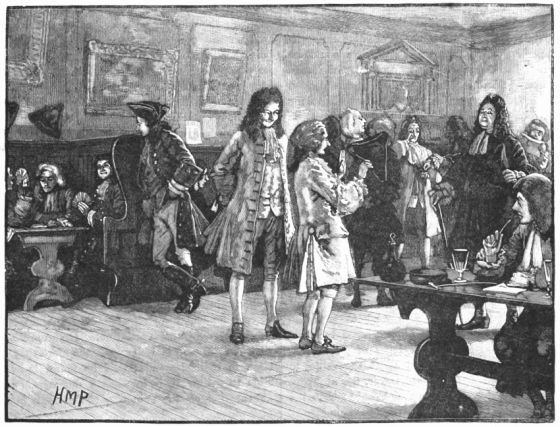
LONDON COFFEE-HOUSE IN THE REIGN OF ANNE.
[See larger version]
As De Torcy could not bring the Dutch Ministers to concede anything, he consented to meet Prince Eugene and Marlborough, who had now returned from England with Lord Townshend. To these was added Count Zinzendorf, as Minister for the Emperor. The French Minister, assisted by Bouillé, though he was treating in a condition of the deepest anxiety, yet maintained all the high pretensions which his Court had so long assumed. He offered the surrender of Spain, but he would give no guarantee for its evacuation. He contended that the word of his king was enough—-as if the word of any king could be accepted in such a case, and especially of Louis, who had broken his a thousand times. He pleaded that the king's great age, his earnest desire for peace and repose in his declining years, and the situation of his affairs, were of themselves ample guarantees for the fulfilment of that Article of the treaty; and he even melted into tears in his earnestness to bring the ambassadors to accept the word of the Grand Monarque. This was all mere child's play in a treaty which was to be the result of such a war, and to establish the future peace of Europe. As time was going on, the representatives of the Allies, at the end of May, presented their ultimatum, in forty Articles, the chief of which were these:—That Philip should within two months totally evacuate Spain and Sicily, which with the Indies were to be made over to Charles; that if Philip refused to evacuate Spain and Sicily, the King of France, so far from helping him, should assist the Allies to expel him; that Spain should never, nor any part of it, be united to the crown of France; that the Dutch should receive, as a barrier to their States, Furnes, Fort Kenoq, Menin, Saverge, Ypres, Warneton, Comines, Vervick, Lille, Condé, Tournay, and Maubeuge; that the French should deliver up all the towns, cities, and fortresses which they had taken in the Netherlands; that the fortifications of Dunkirk should be destroyed and never again be restored; that the Pretender should quit France; that the Queen of England's title and that of the Protestant succession should be acknowledged; that the interests of the Electors of Bavaria and Cologne should be settled by the congress which should settle this peace; and that the Duke of Savoy should receive back everything taken from him, and should also retain Exilles, Feneshelles, Chaumont, and the valley of Pragelas. Strasburg and Kehl were to be given up by Louis, but Alsace itself retained. The new King of Prussia and the new Elector of Hanover should both be acknowledged, and all these preliminaries should be adopted and the treaty completed within two months.
De Torcy, who could not expect for a moment that Louis would consent to any such terms, to gain time, however, engaged to send them to Versailles. He set off for Paris, but at Douay he saw Marshal Villars, showed him the conditions of peace, and told him to put his army in order, for they would never be accepted. Villars replied that he should be prepared, but that the army was on the point of utter starvation, and such was the destitution of the country that he had no conception how the troops were to exist. No sooner did De Torcy reach Paris than it was announced to the Allies that Louis would never accept such terms. Bouillé was recalled, and was commissioned by the Allies to assure the king that no others would be offered; and that, if they were not accepted by the 15th of June, they should take the field. But the French king had gained one great object by the negotiation—it enabled him to represent to his subjects his earnest efforts for peace, and the arrogant obstinacy of the Allies. He had letters circulated all over France representing the anxious endeavours he had made to put an end to bloodshed and to the miseries of Europe; that he had offered to make unheard-of sacrifices, but to no purpose; everything had been rejected by the Allies but a fresh carnage and spoliation. He represented that the more he had conceded, the more they had risen in their demands; that he found it impossible to satisfy their inordinate demands, except at the cost of the ruin and the eternal infamy of France.
The effect of this representation was wonderful. The whole of France was so roused by indignation at the supposed treatment of their king, the insolent rejection of his peaceful desires, that they execrated the selfish arrogance of the Allies, for Louis had insinuated that they were carrying on the war only for their own personal interests. The kingdom, impoverished and reduced as it was, determined to support the ill-used monarch with the last remnant of its substance; and such exertions were made for the continued struggle as astonished the world. Nor was the effect of Louis's representations lost on Marlborough's enemies in England. They declaimed on the unreasonableness of the Allies almost as loudly as the French, and they particularly denounced the demand that Louis should help to dethrone and expatriate his own grandson, as the most astounding piece of assumption that had ever been heard of.
On the 21st of June Marlborough and Prince Eugene crossed the frontiers of France, and with a force of one hundred and ten thousand men drew up in a plain near Lille. Marshal Villars, considered now the ablest general of France, encamped his army on the plain of Sens, between two impassable morasses, and began to entrench himself. The Allies reconnoitred his position, but found it too strong to attack him in it; and as they could not advance towards Paris, leaving such an enemy behind them, they made a feint of attacking Ypres; and then, suddenly marching on Tournay in the night of the 27th of June, they presented themselves before it on the 7th of July. The place was strong, but the garrison was weak. It consisted of only twelve battalions of infantry and four squadrons of horse, in very inefficient condition. Villars endeavoured to throw into the place seven thousand fresh troops, but he could not effect it. The governor, Lieutenant de Surville, was a man of great military skill and determination, and he maintained the siege with such vigour that the Allies were not only detained before the place for a long and invaluable time, but lost many men. The town capitulated on the 28th of July, when the Allies were about to carry it by storm, but the citadel held out till the 3rd of September. The same day, leaving a detachment under the Earl of Albemarle to level the defences, the Allies crossed the Scheldt and determined to besiege Mons. They sent forward a detachment under the Prince of Hesse to attack the French lines from the Haine to the Sambre, which were abandoned at his approach. At this juncture Marshal Boufflers arrived to support Villars, and, though his superior in command, agreed to serve under him. Marlborough, hearing that Villars had quitted his camp, and that the French were on the march to attack the Prince of Hesse and cut off the approaches to Mons, made a rapid movement, which brought him face to face with the French army, which consisted of one hundred and twenty thousand men—ten thousand more than the army of the Allies. Villars and Boufflers were encamped behind the woods of Lanière and Tasnière, in the neighbourhood of Malplaquet. The Allies encamped with their right near Sart and Bleron, and the left on the edge of the wood of Lanière, the headquarters being at Blaregines. On the 9th of September the outposts of the two armies began to skirmish; but the French fell back on an encampment near Malplaquet, and spent the night in fortifying their position. Had the Allies immediately attacked them the battle would have been less obstinate; but Marlborough was waiting for the coming up of eighteen battalions, left to rase the fortifications of Tournay. For the two days that he thus continued to wait, the French, with unremitting activity, proceeded to cast up triple entrenchments; and were, in fact, so completely covered with lines, hedges, entrenchments, cannon, and trees laid across, that the Dutch field-deputies declared that it would be madness to attack them in such a situation. But on the 10th, when the expected battalions had arrived, Marlborough and Eugene determined to give battle.
Early on the morning of the 11th of September they availed themselves of a thick fog to erect batteries on each wing, and, the day clearing about eight o'clock, the engagement began. The battle began on the right by eighty-six battalions, commanded by General Schuylemberg and the Duke of Argyll, supported by two-and-twenty battalions under Count Lottum, who broke through the French lines, and fought with such fury that, notwithstanding their strong barricades, the French in less than an hour were forced from their entrenchments, and compelled to seek refuge in the woods of Sart and Tasnière. The contest was far more desperate on the left, where the Prince of Orange and Baron Fagel, with six-and-thirty battalions, attacked the right of the enemy, posted in the woods of Lanière, and covered with three entrenchments. The Prince of Orange led on the charge with wonderful bravery, having two horses killed under him, and the greater part of his officers killed around him. The engagement was now general, and the French continued to fight with the fury of despair from eight in the morning till three in the afternoon, when, seeing all their lines forced, their left being utterly routed, and the centre under Villars giving way, Villars himself being dangerously wounded, they began to retreat towards Bavay, under the direction of Boufflers, and retired to a position between Quesnoy and Valenciennes. The forest of Ardennes served to protect the French from the pursuit of their enemies, and enabled them to carry off most of their cannon and standards. About forty colours and standards, and sixteen pieces of cannon, were taken by the Allies, with a considerable number of prisoners. But on surveying the field of battle they found that this was the dearest victory which they had ever purchased. About twenty thousand of their soldiers lay slain, and about ten thousand of the enemy. Thirty thousand lives sacrificed in one battle! Neither Blenheim nor Ramillies could compare with Malplaquet in monstrosity of carnage. Nor was the impression produced equal to the destruction. The French, under the able command of Villars, notwithstanding their defeat, felt rather reassured than depressed. They had inflicted far more damage than they had received; and Villars declared that, had he not been so severely wounded, he would not have left the field without the victory. The French having retired into Valenciennes, the Allies continued the siege of Mons, which capitulated on the 23rd of October, and the armies then retired into winter quarters, after which some resultless negotiations ensued.
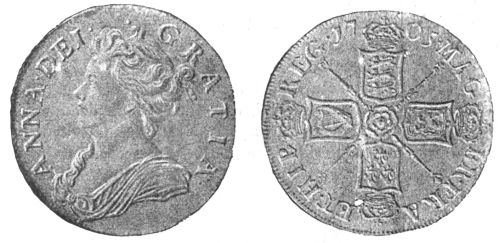
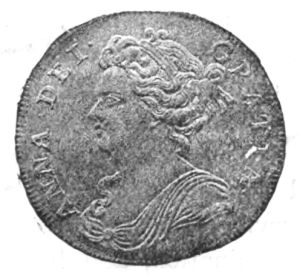
FIVE-GUINEA PIECE OF ANNE.
The Parliament of Great Britain met on the 15th of November, and the queen, opening it in person, announced in her speech that France had been endeavouring, by false and hollow artifices, to amuse the Allies with a prospect of peace, but with the real intent to sow jealousies amongst them; that the Allies had wisely rejected the insidious overtures; that our arms had been as successful as in any former campaign, and had now laid France open to the advance of the confederate troops; and that if they granted her, as she trusted they would, liberal supplies, she believed that she would now soon reduce that exorbitant and oppressive power which had so long threatened the liberties of Europe. Both Lords and Commons presented addresses fully approving of the rejection of the king of France's delusive overtures. They thanked the Duke of Marlborough for his splendid victory at Malplaquet. The Commons voted six million two hundred thousand pounds for the services of the year, and established the lottery and other schemes for raising this heavy sum.
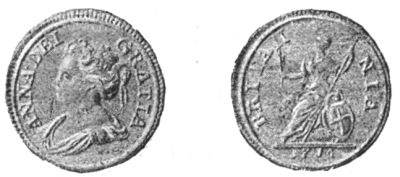
FARTHING OF ANNE.
The great topic, however, which engrossed almost the whole attention this Session, not only of Parliament, but of the whole nation, was not foreign affairs, not the general war, but a party war at home, which was carried on with the most extraordinary furor, and put the whole public into a flame. The ostensible cause of this vehement conflict was the publication of a couple of sermons by a clergyman, hitherto of no mark; the real cause was the determination of Harley and the Tories to damage the Whigs irremediably, and to drive them at once from the service of the State and the support of the people. They therefore seized with consummate tact on these sermons, which were, as printed, stupid though rabid performances; and which, had they not been adroitly steeped in party spirit—the most inflammable of all spirits—and set fire to, might soon have slept forgotten in the linings of trunks, or as wrappers of butter and cheese.
TWO-GUINEA PIECE OF ANNE.
On the 13th of December, 1709, Mr. Dolben, the son of the Archbishop of York, denounced, in the House of Commons, two sermons preached and published by Dr. Henry Sacheverell, Rector of St. Saviour's, in Southwark. The first of these sermons had been preached, on the 15th of August, at the assizes at Derby, before the Judge and Sheriff. The second had been preached, on the 5th of November, before the Lord Mayor and Corporation in St. Paul's Cathedral. In both these sermons he had made an attack, if not avowedly on the Government, on the principles on which the Throne and the whole Government were established. He professed the most entire doctrines of non-resistance and passive obedience, which, at the same time that they made him appear incapable, if he had the power, of over-turning any Government, led him to entirely sap and undermine the Government and title of the queen, by representing the resistance which had been made to the encroachments of the Stuarts, and especially to James II., as perfectly impious and treasonable, contrary to the laws of God and the political institutions of men. He reprobated the Revolution and all that flowed from it; and thus, pretending to passive obedience, he was, in the fullest sense, preaching resistance and a counter-revolution. Whilst crying non-resistance, he was, as far as in him lay, arming all those who were hostilely inclined to overturn the throne of Anne, as built only on rebellion and on maxims subversive of the divine right of kings. In his second sermon, which he called "Perils of False Brethren," he preached flamingly against the danger to the Church; danger from the false and democratic bishops who had been put in by the usurper William of Orange; danger from the Dissenters, whom he had by law tolerated, and made powerful in the State and against the true Church. With such a jubilant avidity was this war-note responded to by High Church clergy, High Church zealots of all sorts, and the Tories ready to rush to the assault on any promising occasion, that no less than forty thousand copies of these sermons are said to have been sold. "Nothing," says Dr. Johnson, "ever sold like it, except 'The Whole Duty of Man.'"
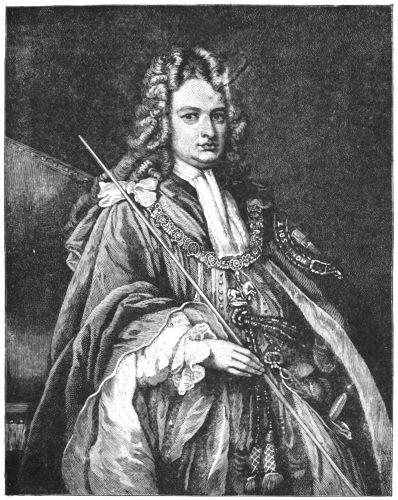
ROBERT HARLEY, EARL OF OXFORD. (After the Portrait by Sir Godfrey Kneller.)
[See larger version]
The motion made by Mr. Dolben in regard to Sacheverell in the House of Commons was seconded by Sir Peter King, one of the Aldermen of London, who had listened to the sermon in St. Paul's with astonishment and indignation. He denounced it as abounding with matter false, injurious, impious, and tending to sedition and schism in the Church. This had not been the case with all the City dignitaries on that occasion. Sir Gilbert Heathcote had indeed been equally astonished at it, and declared that the preacher ought to be called to account for it; but the Lord Mayor, Sir Samuel Garrard, had applauded it, and had allowed it to be published with his sanction. Neither was it the first of the kind which had been preached in London. One Francis Higgins had been haranguing on the same topics in the pulpits all over the metropolis, with the most outrageous declamations on the dangers of the Church. Sacheverell, however, had brought the fever to a crisis. The most violent paragraphs were read in the House of Commons, and voted scandalous and seditious libels. The doctor was summoned to the bar of the House, and, having acknowledged the authorship of the sermons, pleaded the encouragement which he had received from the Lord Mayor to print the one on "The Perils of False Brethren." Sir Samuel Garrard, who was a member of the House, now repudiated his encouragement, and the doctor being ordered to withdraw, it was resolved that he should be impeached of high crimes and misdemeanours at the bar of the Lords, and Mr. Dolben was ordered to conduct his impeachment. A committee was appointed to prepare the Articles, and Sacheverell was taken into custody.
When the impeachment was carried up to the Lords, Sacheverell petitioned to be admitted to bail, but this was refused. The Commons committed him to the custody of the Deputy-Usher of the Black Rod, but the Lords afterwards admitted him to bail. The Articles were carried up to the Lords on the 13th of January, 1710, and Sacheverell drew up an answer, in which he wholly denied some of the Articles, and endeavoured to justify himself in respect to the rest. The Commons made a reply, and declared themselves ready to prove the charge. A long delay, however, took place before the day of trial could be fixed. The queen was more than suspected of being favourable to Sacheverell, as influenced by Harley, Mrs. Masham, and the Tories. When the doctor appeared before the Commons, he was attended by Dr. Lancaster, the Vice-Chancellor of Oxford, and above a hundred of the most distinguished clergymen of London and other towns, conspicuous amongst them being several of the queen's own chaplains. From the moment that Sacheverell was taken into custody by the Commons, the Church and Tory party had set all their engines to work to raise the populace. These agents were everywhere, distributing money, treating the mob to ale, and spreading the most alarming rumours—that the Puritans, the Presbyterians, and the Dissenters were all combined to pull down the Church and restore the old republican practices, and that the prosecution of Sacheverell was a trial of their strength. The pulpits resounded in all quarters with these alarms, with the intention of working up the people to a pitch of desperation, and they succeeded. The mob became furious, and paraded the streets and round the palace, crying, "God save the Queen and Dr. Sacheverell! Queen and High Church!"
Marlborough took his departure for Holland, and the trial of Sacheverell was fixed for the 27th of February in Westminster Hall. The managers for the Commons were the Lords William Paulet and Coningsby, Sir Thomas Parker, Sir Joseph Jekyl, Sir John Hollis, Sir John Holland, Sir James Montague, Sir Peter King (Recorder of London), Mr. Robert Eyre (Solicitor-General), Mr. James Stanhope, Mr. Robert Walpole, Mr. Spencer Cowper, Mr. John Smith, Mr. John Dolben, and Mr. William Thompson. The prisoner was defended by Sir Simon Harcourt and Mr. Constantine Phipps, and was attended by Drs. Smallridge and Atterbury. The Lord Chancellor Cowper demanded of the Lords whether it was their pleasure that Dr. Sacheverell should be called before them; and the answer being in the affirmative, he was placed at the bar, his friends Atterbury and Smallridge standing at his side. Silence being ordered, the doctor was asked whether he was ready to take his trial; to which he answered with great confidence that he was, and should always be ready to obey the laws of the land. The Articles of Impeachment were then read. They accused him of having publicly reflected on the late Revolution; of having suggested that it was brought about by odious and unjustifiable means; of having defamed the Act of Toleration, and cast scurrilous reflections on those who advocated religious toleration; of asserting that the Church was in great peril from her Majesty's Administration; of maintaining that the civil Constitution of the country was also in danger; of stigmatising many of the dignitaries of the Church—some of whom the queen herself had placed in their posts—as false brethren; and of libelling her Majesty's Ministers, and especially of branding the Lord High Treasurer with the name of "Volpone;" and, finally, with having, in discharge of his sacred office, wickedly wrested and perverted the Holy Scriptures.
These charges were well supported by various members of the Commons, and amongst them Robert Walpole particularly distinguished himself. The counsel for the doctor then pleaded in his behalf, and endeavoured to answer the arguments adduced against him. Sacheverell, however, was not contented with this; he delivered a defence himself which has been generally considered to be the work of the high Tory divine Atterbury, and probably with good reason. In this he dwelt much on his responsibility as a clergyman, and represented the interests of all his brethren and of the Church as involved in this attack made upon them through his person. He expressed the utmost loyalty towards the queen and the Constitution; denied having called in question the Revolution, though he had certainly condemned in the strongest terms the resistance by which it was achieved. He declared himself in favour of the Protestant succession, and asserted that, as his principle was that of non-resistance in all cases, he could not by any word or act of his own endanger the Government as by law established; as if his very declaration of the principle of non-resistance and passive obedience did not condemn in toto the Revolution, the means by which the queen came to the throne, and encourage all those who were seeking to restore Popery and the Stuarts as the rightful religion and rightful possessors of the throne, both of which had been, according to his doctrines, forced from their legitimate place by ungodly and un-Christian violence; and he concluded by calling on God and His holy angels to witness that he had never been guilty of the wicked, seditious, or malicious acts imputed to him in the impeachment.
As the doctor went to and from the Hall, his chair was thronged round by dense crowds, which attended him to his lodgings in the Temple, or thence to Westminster Hall. Numbers pressed forward to kiss his hand; they lifted their hats to him with the utmost reverence. The windows were crowded by ladies and gentlemen, who cheered him vociferously, and many flung down presents to him. The doctor returned the salutations by continual bows and smiles, and seemed wonderfully elated by his sudden consequence. His chairmen seemed to partake of his glory, and stepped on as proudly as if they had been carrying the queen. "This huzzaing," says Defoe, "made the doctor so popular that the ladies began to talk of falling in love with him; but this was only a prelude to the High Church affair. An essay was to be made on the mob, and the huzzaing of the rabble was to be artfully improved." Accordingly after the trial the next day, February 28th, the mob assembled in dense masses—sweeps, link-boys, butchers, by a sturdy guard of whom the doctor was always escorted to and from the Hall—collected in the City and began to cry "Down with the Dissenters! High Church for ever!" And they soon put their cries in practice by assaulting the Dissenting chapels, and sacking their interiors. The Tory writers of the time pretend that the rioters did this of their own accord, as the mobs had destroyed the Catholic chapels in 1688; but this was not the case. The proceedings of the mob were stimulated and directed by gentlemen, who followed them in hackney coaches, according to Cunningham, who is the only writer who has furnished us with full details of these outrages. They then directed their rage against the house of Bishop Burnet, which stood on the other side of St. John's Square, and attempted to demolish it. This they must have done under instructions from their disguised instigators, for Burnet was hated by the High Church and Tory party for the distinguished part which he had borne in the Revolution, for his constant attachment to King William and his measures, and especially for his advocacy of toleration. They vowed they would put the Low Church Bishop to death if they could catch him; but the respectable inhabitants vigorously interposed in defence of the Bishop's house and life, and the mob were compelled to desist.
So long as the rioters were only burning and ruining the Dissenting chapels, the Court remained most calmly quiescent; but when the news came that they were beginning to attack "Low Church as by law established," there was a bustle and a fright at St. James's. This fright was wonderfully increased when Sunderland rushed into the presence of the queen and announced that the mob was on the march to pull down and rifle the Bank of England in honour of "High Church and Dr. Sacheverell." At this news the queen turned deadly pale, and trembled. She bade Sunderland send instantly the Horse and Foot Guards and disperse the rioters. Captain Horsey, the officer on duty at St. James's, was at once summoned into the royal presence, and Sunderland delivered to him the queen's order to disperse the mob, but to use discretion, and not to proceed to extremities. Horsey was one of the anti-Marlborough faction, and received the command in evident dudgeon. "Am I to preach to the mob, or am I to fight them?" he asked. "If you want preaching, please to send some one with me who is a better hand at holding forth than I am; if you want fighting, it is my trade, and I will do my best." Sunderland could only repeat the order. Horsey easily dispersed the rabble, who were more valiant against peaceable Dissenters than against soldiers. In one or two places they seemed as though they would make a stand; but on any attempt of the Guards to charge them they flew like leaves before the wind.
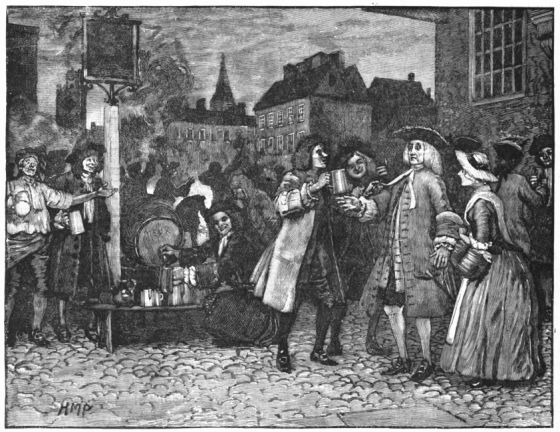
DRINKING TO THE HEALTH OF DR. SACHEVERELL. (See p. 593.)
[See larger version]
The trial lasted for three weeks, and every day the same crowds assembled, the same hurraing of Sacheverell, the same appeals to the queen on behalf of the Church and Dr. Sacheverell were shouted by the enthusiastic mob. No one scarcely dared to appear abroad without an artificial oak-leaf in his hat, which was considered the badge of restored monarchy, and all the time the doctor carried the air of a conqueror. At length, on the 10th of March, the Lords adjourned to their own House to consider this point, raised by the counsel for Sacheverell—whether in prosecutions by impeachments the particular words supposed to be criminal should be expressly specified in such impeachments. The question was referred to the judges, who decided that the particular words ought to be so specified. It was objected that the judges had decided according to the rules of Westminster Hall, and not according to the usages of Parliament, and it was resolved to adhere to the usages of Parliament, lest it should become a practice for the judges to decide on questions of Parliamentary right and privilege. On the 16th of March the Lords came to the consideration of their judgment, and the queen attended incognita to hear the debate, which was long and earnest. In the end Sacheverell was pronounced guilty by a majority of seventeen; but four-and-thirty peers entered a protest against the judgment, and his sentence bore no proportion to the usual ones in such cases. He was merely suspended from preaching for three years, and his sermons were condemned to be burnt by the common hangman.
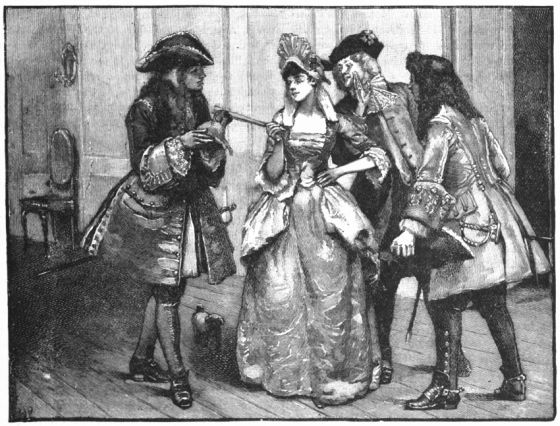
MAKING FRIENDS WITH MRS. MASHAM. (See p. 594.)
[See larger version]
This gentle sentence was regarded by the people and the Tories as a real triumph. It was proof of the decline of the Whig party, and of the fear of offending the public. The event was celebrated by Sacheverell's mob-friends by bonfires, and by the inhabitants of London and Westminster by illuminations. There was plenty of beer supplied to the populace from some quarter, and every one passing along was compelled to drink the health of Dr. Sacheverell, the "champion of the Church." Sacheverell himself went from house to house in a state of triumph to thank the lords and gentlemen who had taken his side. From some of these, as the Duke of Argyll, he met with a rebuff; but the great doctor, with a roaring mob at his heels, was generally flatteringly received, and he took care to boast that after his sentence it was clear that the Whigs were down and the Church was saved. The University of Oxford, which had received a snub from the Lords by their ordering its famous decree asserting the absolute authority and indefeasible right of princes, to be burnt with Sacheverell's sermons, was loud in professed triumph and sympathy with the doctor. The House of Commons was indignant at the lenity of his treatment, and declared that his sentence was an actual benefit to him, by exempting him from the duties of his living, and enabling him to go about fomenting sedition.
The queen prorogued Parliament on the 5th of April, expressing her concern for the occasion which had occupied so much of the Session. She declared that no prince could have a more zealous desire for the welfare of the Church than she had, and that it was mischievous in wicked and malicious libels to pretend that the Church was in danger; and she trusted that men would now study to be quiet, and mind their own business, instead of busying themselves to revive questions of a very high nature, and which could only be with an ill intention. But every one knew all the while that Anne was only too pleased at the demonstrations which had been made through Sacheverell; that they had damaged the Whigs essentially, and brought the day near when she could safely send them adrift, and liberate herself for ever from them and the Marlboroughs. Mrs. Masham now ruled triumphantly, and disposed of commissions and offices as royally as ever the duchess had done. It was openly said in the army that fighting was not the road to promotion, but carrying Mrs. Masham's lapdogs, or putting a heavy purse into the hand of Mrs. Abigail Earwig. The Duchess of Marlborough did not abate her exertions to recover favour, but they were in vain; and the great Marlborough complained in a letter to the queen that all his victories for her Majesty's honour could not shield him from the malice of a bedchamber-woman.
Indeed, the display of the queen's bias now became rapid and open. The Duke of Shrewsbury, who had now joined the Tories, returned from his long residence at Rome, where he had married an Italian lady, and had taken the part of Sacheverell in the trial. The queen immediately dismissed the Marquis of Kent, a staunch Whig, from the office of Lord Chamberlain, and, much to the grief and consternation of the Lord Treasurer, Godolphin, bestowed it on Shrewsbury. There was great alarm among the Whigs, and Walpole recommended the instant and entire resignation of the whole Cabinet as the only means to intimidate the queen and her secret advisers; but Harley is said to have persuaded the rest of the Ministers that the only object was to get rid of Godolphin, Marlborough, and his son-in-law Sunderland. The rumour of Sunderland's dismissal became general, and not without foundation. The queen had an extreme dislike to him, not only because of his belonging to Marlborough's clique, but on account of his blunt and outspoken manners. He was perfectly undisguised in his expressions of dislike for Mrs. Masham, and of his resolve, if possible, to turn her out of the palace; but, with the queen's devotion to that lady, he could have taken no surer way of getting himself out. The Duchess of Marlborough, who could not now obtain access to the queen, yet wrote to her, imploring her to defer any intention of removing Lord Sunderland till the duke's return; but the queen forthwith gave Sunderland his dismissal, and appointed Lord Dartmouth, an actual Jacobite, in his place. Anne endeavoured to qualify Lord Sunderland's dismissal by offering him a retiring pension, but he rejected it with disdain; and such was the fear that the Duke of Marlborough, on this act of disrespect to him, would throw up the command of the army, that all the leading Ministers—including Cowper, Somers, Halifax, Devonshire, Godolphin, and Orford—wrote to him, imploring him to retain his command, as well for the security of the Whig Government as for his own glory and the good of the country. The Allies on the Continent were equally alarmed at this indication of the declining favour of Marlborough, and France was just as elated at it. But nothing could now stay the fall of the Whigs. Anne, indeed, ordered Mr. Secretary Boyle to write to the Allied sovereigns and to the States-General to assure them that nothing was farther from her thoughts than the removal of the Duke of Marlborough from his command, and that she still proposed to conduct her government by the same party. The hollowness of these assurances was immediately shown by her also dismissing Godolphin from the Treasury, and appointing Harley Chancellor of the Exchequer. Harley thereupon proposed to Lord Chancellor Cowper and Walpole to make a coalition, but they rejected the overture; and as a Tory Cabinet could not expect to carry on with a Whig House of Commons, a dissolution was determined upon, and Parliament was dissolved accordingly, and writs were issued for a new election.
The nomination of the Tory Cabinet immediately followed. Lord Rochester, the queen's High Church and deep-drinking uncle, was made President of the Council in place of Somers; the Duke of Buckingham succeeded the Duke of Devonshire as Lord Steward; St. John succeeded Mr. Secretary Boyle; Sir Simon Harcourt, as Lord Chancellor, superseded Lord Cowper; the Duke of Ormonde took the Lord-Lieutenancy of Ireland from Lord Wharton; the Duke of Somerset had anticipated these changes by throwing up his post of Master of the Horse, and the Earl of Orford was removed from the Admiralty, and that office was put in commission. In the room of Walpole, George Granville was made Secretary at War. Here was a clean sweep of all the Whigs, except some subordinate officials, who clung to office as long as it was permitted. Dr. Sacheverell had done a mighty work for the Tories, and, having a living in Wales conferred on him, he made quite a triumphant progress thither in May, during all the heat and violence of the elections, still labouring in his vocation of self-glorification, and of damaging the Whig cause as much as he could, in which he was energetically supported by his patrons.
On the Continent war and negotiation were going on at the same time whilst the Sacheverell fever had been raging at home. Early in the spring Louis XIV., sensible of the miserable condition of his kingdom, had again made overtures for peace. The Ministers of the two parties met at first on board a yacht at Maardyk, but the French preferred the wretched little town of Gertruydenberg for their sojourn, where they complained of the miserable accommodations they obtained. The Dutch States-General had sent a pressing request that Marlborough might be allowed to go to Holland in time to give his advice in these negotiations, and the two Houses of Parliament seconded this request. The queen readily consented, though it was suspected the whole was done at the suggestion of Marlborough himself, to show how essential his services were deemed by the Allies. Though Marlborough hastened to the Hague in consequence, he did not in any way appear openly in the matter, but appeared busy with Prince Eugene in setting early on foot the campaign. The French ambassadors represented themselves as being not only most meanly entertained, but as meanly and narrowly watched—their letters being opened, and their propositions met by haughty discourtesy. Certainly, if we were to regard the concessions made by Louis XIV. on this occasion as honestly offered, the Allies had never a fairer opportunity of closing the war triumphantly, and were most culpable in refusing them. Louis offered to give up all Spain, and the Indies, East and West; to acknowledge Charles king of undivided Spain; to give no support to Philip, but to claim for him only Sicily and Naples. When it was objected that Naples was already in the possession of Austria, and could not be given up, the ambassadors waived the claim of Naples, and contented themselves with Sicily and Sardinia for Philip. As a security for Philip evacuating Spain, they offered to give up four cautionary towns in Flanders; to restore Strasburg and Brisac; to destroy all their fortifications on the Rhine from Basle to Philippsburg; to level all the fortifications of Dunkirk; and to surrender to the Dutch Maubeuge, Condé, Furnes, Menin, Ypres, Tournai, and Lille.
Surely nothing could be more complete. By gaining all these advantages the Allies gained everything they had been fighting for. They wanted not only an agreement for the surrender of Spain, but a sufficient guarantee for it; and this guarantee they demanded in the shape of an engagement that Louis should help them with actual money and arms to expel Philip from Spain if he refused to evacuate it, and really to place Austria in possession of it. This was certainly putting the sincerity of Louis to sufficient test, and Louis failed under it. He contended that it would be monstrous and unnatural to take arms against his own grandson, but that he would contribute money for this purpose—which, to ordinary intellects, looks quite as monstrous. He offered, according to his able Prime Minister De Torcy, to pay five hundred thousand livres a month towards this object, or even to raise it to a million of money if the Allies would not be satisfied with less. But as the Allies, in the first place, knew that Louis had not money to meet the demands of his own Government, and, in the second place, that Philip had sent an express declaration to the Allies, when this question was mooted before, that he stood on his rightful claim through the will of Charles II., the late King of Spain, and would recognise no pretensions of any party to deal with his patrimony—they declined the offer, and declared they would be contented with nothing less than the actual possession of the country. They knew that at the very time that these negotiations were going on, Philip was making fresh and strenuous exertions to drive Charles from Spain; that he had appealed to Louis to send him the Duc de Vendôme to take the command in that country, with which request Louis promptly complied. They knew that France had only to close the passes of the Pyrenees, and, under the pretence of protecting her own frontiers from the armies in Spain, shut out all attack on Philip, except by sea.
On this rock, therefore, the whole negotiation was wrecked. Louis had flattered himself that Marlborough, distracted by the state of affairs in England, would be anxious to make peace, in order that he might be on the spot to resist the fall of the Whig party at home, and with it of his influence. But the wiser De Torcy reasoned very differently. He saw that the party of Marlborough was already ruined, and for him to return home would be to return to insignificance, mortification, and insult. His only safety and strength lay in the continuance of the war; on the chance of reaping new victories, and, therefore, new humiliation to his enemies. And in this De Torcy was correct. Marlborough did not appear in the matter. Lord Townshend for England, and Count Zinzendorff for the Emperor, were consulted by the States-General on all the points of the treaty; but the Pensionary Heinsius, the devoted friend of Marlborough and Eugene, kept them au fait on the whole subject, and influenced the States-General as they dictated. The result was that, after the negotiations had continued from the 19th of March to the 21st of July, during which there was a rapid and frequent interchange of messages with Versailles, the conference broke up.
The campaign had not paused for the issue of the conference. Eugene and Marlborough left the Hague on the 15th of March, and assembled their troops, which quartered on the Meuse, at Tournai. The confederate army amounted to sixty thousand men, with which they invested Douay, and, Eugene remaining to carry on the siege, Marlborough advanced to Vitry, where he encamped. Marshal Villars—at the head of an army numerous and well appointed, considering the distresses of France, and all the more numerous because men, destitute of the means of livelihood, flocked to the royal banners—passed the Scheldt and encamped at Bouchain, declaring that he would engage the Allies; but he thought better of it. His aim was to embarrass the siege of Douay, in which there was a strong French garrison, commanded by General Albergotti. The defence was vigorous, Albergotti making frequent sallies, and altogether the Allies suffered severely before the town. It was compelled, however, to capitulate on the 26th of June. Eugene and Marlborough, being again united, contemplated forcing the lines of the enemy between Arras and Miramont, but finding them too strong, they resolved to besiege Béthune, which in spite of the menacing attitude of Marshal Villars, who marched out of his entrenchments as if going to attack them, surrendered on the 29th of August. They afterwards took also the inconsiderable towns of Aire and Verrant, and there the campaign ended. The armies broke up and retired to winter quarters.
This was a poor result after the grand schemes of storming Boulogne and marching upon Paris. The fact was, that the anxious condition of affairs at home completely paralysed Marlborough. He was no longer the man he had been. His mind was dragged different ways, and was harassed with anxieties. He could no longer concentrate his attention on one great plan of warfare, and the consequence was, that his action was spiritless and indecisive. He seemed to have lost the secret of success, and met with annoyances which his vigilance and promptitude had hitherto prevented. On one occasion a great supply of powder and other stores was intercepted by the enemy, though under the guard of twelve hundred foot and four hundred and eighty horse. In a word he was discouraged, divided in his own mind, and the spell of victory, or rather of high enterprise, was broken.
In other quarters the scene was not more encouraging. Nothing of consequence was effected on the Rhine, and in Piedmont the Duke of Savoy, still out of humour with the Emperor, did nothing. The Imperial forces were commanded by Count Daun, who endeavoured to cross the Alps and penetrate into Dauphiné, but was effectually kept back by the Duke of Berwick, who held the mountain passes. In Spain, after a brilliant commencement of the campaign, everything went to ruin. General Stanhope, having passed in his Parliamentary character through the Sacheverell campaign, joined the Imperial general, Count Stahremberg, in Catalonia, in May. On the 10th of July they encountered the army of King Philip at Almenara. Stanhope had the charge of the cavalry, killed with his own hand the commander of Philip's guards, General Amessaga, and routed the whole body of horse, upon which the infantry retired precipitately on Lerida. General Stahremberg pursued the flying army to Saragossa, where King Philip made a stand, but was again defeated, with a loss of five thousand men, seven thousand taken prisoners, with all his artillery, and a great number of colours and standards. Charles and his confederates entered Saragossa in triumph, and Philip continued his flight to Madrid. Whilst victory was with them, General Stanhope urged King Charles to push on to Madrid, drive Philip into the Pyrenees, and secure the pass of Pampeluna, the only one by which Louis could send reinforcements. But the inert Austrian loitered away a whole month at Saragossa, and it was not till the middle of September that Stanhope could induce him to advance. On the 21st of that month Stanhope, still leading the way, entered Madrid without opposition, Philip and all the grandees having retreated to Valladolid. On the 28th Charles himself made his entry into Madrid, but General Stanhope soon perceived that he had no welcome. The Castilians to a man were for Philip, and did the army of Charles all the mischief they could, cutting off his supplies, attacking his outposts, and destroying all the stragglers and foragers that they could meet with. Stanhope still urged Charles to send on a detachment to secure Toledo, and to keep open the passage of the Tagus to facilitate an expected advance of Portuguese troops in his favour. The Portuguese, however, did not make their appearance; provisions failed in Madrid, for the peasantry held back the supply, and the whole army marched to Toledo, where it found itself still worse off. Philip, meanwhile, had sent in haste to request reinforcements from Louis under the command of the Duc de Vendôme, and these approaching, the timid Charles hastened back into Catalonia as the only place of security.