Chapter XIII · (continued 2)
Reading edition
Having expressed their feelings on the mismanagement and treachery of the past year, the Commons proceeded to vote the supplies for the next, and in this they showed no want of confidence in the king. They did not, indeed, vote him his hundred and ten thousand troops, but they voted eighty-three thousand one hundred and twenty-one, but not till they had called for the treaties existing between William and his Allies, and the quota which every one was to furnish. To defray the charge, they voted five millions and a half, in nearly equal proportions between the army and the navy, including four hundred thousand pounds to pay the arrears of the Session; and this they ordered to be raised by a land tax of four shillings in the pound, and a further excise on beer, a duty on salt, and a lottery. This was a profusion which would have made the country stand aghast under the abhorrent rule of James, and the force was nearly double that with which Cromwell had made himself the dread of Europe.
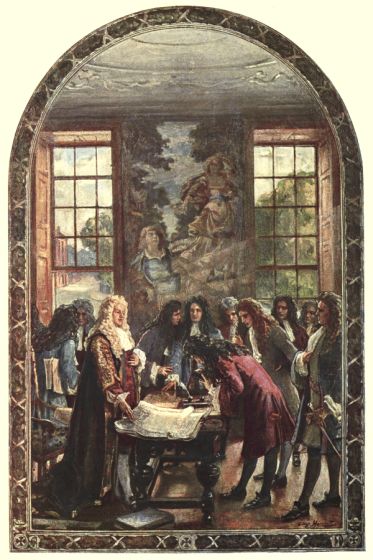
THE FOUNDING OF THE BANK OF ENGLAND, 1694.
From the Original Design by GEORGE HARCOURT for the Wall Panel in the Royal Exchange.
[See larger version]
These matters being settled, the Commons considered the popular questions of the Bill for Regulating the Trials for High Treason, the Triennial Bill, and the Place Bill. None of these Bills were made law. The Triennial Bill and the Bill for Regulating the Trials for High Treason were lost; the Place Bill was carried, but William refused to ratify it, under the idea that it was intended to abridge his prerogative. The excitement in the Commons was intense. It was resolved to address his Majesty, and such an address was drawn up and presented by the whole House. William received them very graciously, but conceded nothing, and Harley declared, on returning to the House, that the king's answer was no answer at all. Menaces of showing their power on the next occasion by stopping the supplies were thrown out, and it was proposed to go up to his Majesty again to demand a more explicit answer; but the Whigs represented the danger of thus encouraging the hopes of the Jacobites by the prospect of a breach between King and Parliament, and the matter dropped.
The question of the charter of the East India Company was again warmly debated. The feud between the old and the new Company had grown so violent that the old Company, fearing Government might be induced to grant a charter to the new Company, had put forth all its powers of bribery, and had succeeded. But the former had somehow neglected the payment of the tax on joint-stock companies, by which, according to the terms of the Act, their charter was forfeited. The new Company eagerly seized on this circumstance to prevent a renewal of the charter; but the old Company put nearly one hundred thousand pounds at the disposal of Sir Thomas Cook, one of their members, and also member of Parliament, and by a skilful distribution of this sum amongst the king's Ministers, Caermarthen and Seymour coming in for a large share, they succeeded in getting their charter renewed.
The new Company and the merchants of London were exasperated at this proceeding. They published an account of the whole transaction; they represented that the old Company was guilty of the grossest oppression and the most scandalous acts of violence and injustice in India and its seas; they asserted that two of their own ships had exported in one year more cloths than the old Company had exported in three years; and they offered to send more the next year of both cloths and other merchandise than the Company had sent in five; but the bribes prevailed, and the old Company obtained its charter—not very definite in its terms, however, as regarded its monopoly, and subject to such alterations and restrictions within a given time as the king should see fit. At this juncture the old Company were imprudent enough to obtain an order from the Admiralty to restrain a valuable ship called the Redbridge, lying in the Thames, from sailing. Her papers were made out for Alicante, but it was well known that she was bound for the Indies. The owners appealed to Parliament, and Parliament declared the detention of the vessel illegal, and, moreover, that all subjects of England had a right to trade to the Indies, unless prohibited by Act of Parliament. Encouraged by this decision, the new Company prayed the Commons to grant them a direct sanction to trade thither, and the old Company, on their part, prayed for a Parliamentary sanction to their charter; but no decision in either case was come to, and for some years scenes of strange contention continued to be enacted between the rival Companies and free traders in the seas and ports of those distant regions.
The last Act of this Parliamentary session proved the most important of all; it was the establishment of the Bank of England. Banking, now so universal, was but of very recent introduction to England. The Lombard Jews had a bank in Italy as early as 808; Venice had its bank in 1157; Geneva in 1345; Barcelona in 1401. In Genoa, Stockholm, Amsterdam, Hamburg, and Rotterdam there had long been banks, but in England men had continued, till within a very short time previous to this period, to hoard and pay out their own money from their own strong boxes. The goldsmiths of Lombard Street had of late become bankers, and people began to pay by orders on them, and travellers to take orders from them on foreign banks. It was now beginning to be strongly agitated to establish joint-stock banks, and there were various speculative heads at work with plans for them. One Hugh Chamberlayne and his coadjutor, John Briscoe, published a scheme of a land bank, by which gentlemen were to give security for their notes on their land; on the principle that land was as real and substantial property as gold. But the extravagant and unsound views as to the actual value of land which they promulgated ruined their credit. Because an estate was worth twenty thousand pounds at twenty years' purchase, they argued that it was worth that every twenty years, and, therefore, could be immediately convertible at the same rate for any number of years—as if they could put a hundred years' purchase in the first twenty, and raise the hundred years' value, or one hundred thousand pounds, on it at once.
There was, however, a more sober and shrewd projector, William Paterson, a calculating Scotsman, who in 1691 had laid before Government a plan for a national bank on sound and feasible principles. His scheme had received little attention, but now, though a million of money was raised by the lottery, another million was needed, and Paterson secured the attention of Charles Montague, a rising statesman, to his scheme. Paterson represented that the Government might easily relieve itself of the difficulty of raising this money, and of all future similar difficulties, by establishing a national bank, at the same time that it conferred the most important advantages on the public at large. He had already firmly impressed Michael Godfrey, an eminent London merchant, and the brother of the unfortunate Sir Edmundsbury Godfrey, with the immense merits of his scheme. They now submitted these merits, and the particularly attractive one to a young politician of raising himself by a happy mode of serving the Government, and acquiring immediate distinction for practical sagacity. Montague was a young man of high family, but a younger brother's younger son—poor, clever, accomplished, and intensely ambitious. At Cambridge he had distinguished himself as a wit and a versifier; but he was now in the Commons, and had made a rapid reputation as an orator and statesman by his management of the Bill for Regulating the Trials for High Treason. This man—vain, ostentatious, not too nice in his means of climbing, but with talents equal to the most daring enterprise, and who afterwards became better known as the Earl of Halifax—saw the substantial character of Paterson's scheme, and took it up. Whilst he worked the affair in Parliament, Godfrey was to prepare the City for it.
Montague submitted the scheme to the Committee of Ways and Means, and as they were at their wits' end to raise the required million, they caught at it eagerly. The proposed plan was to grant a charter to a company of capitalists, under the name of the Governor and Company of the Bank of England. This company was to have authority to issue promissory notes, discount bills of Exchange, and to deal in bullion and foreign securities. Their first act was to be to lend the Government twelve hundred thousand pounds, at eight per cent., and to receive, as means of repayment, the proceeds of a new duty on tonnage, whence the bank at first received the name of the Tonnage Bank. The Bill for establishing this bank was introduced ostensibly to Parliament as a Bill for imposing this new duty on tonnage; the charter of the proposed bank being granted in consideration of its making an immediate advance on the tonnage duty. In the Commons it underwent many sallies of wit and sarcasm, as one of the thousand speculations of the time; but in the City, where its real character was at once perceived by the Lombard Street money-dealers, it was instantly assailed by a perfect storm of execration. It was declared to be a scheme for enabling the Government to raise money at any moment and to any extent, independently of Parliament, and thus to accomplish all that the Charleses and Jameses had ever aimed at. To silence this suspicion, Montague introduced a clause making it illegal, and amounting to forfeiture of its charter, for the bank to lend any money to Government without the consent of the Parliament. This, however, did not lay the tempest. It was now denounced as a Republican institution borrowed from Holland and Genoa, and meant to undermine the monarchy; it was a great fact, the objectors urged, that banks and kings had never existed together.
Notwithstanding all opposition, however, the Bill passed the Commons; and though it met with fresh and determined opposition in the Lords, where it was declared to be a scheme of the usurers to enrich themselves at the expense of the aristocracy, on Caermarthen coolly asking them, if they threw out this Bill, how they meant to pay the Channel fleet, they passed it; and such was its success in the City, that in less than ten days the whole sum required by Government was subscribed. Such was the origin of that wonderful institution, the Bank of England. One other measure of importance was carried by this Parliament, namely, the Triennial Act, limiting Parliament to three years.
Immediately that the Bank of England Bill had received the royal assent, William prorogued Parliament, and rewarded Montague for his introduction of the scheme of the bank, by making him Chancellor of the Exchequer. Shrewsbury was now induced to accept the Seals. William having shown him that he was aware of his being tampered with by the agents of James, demanded his acceptance of them as a pledge of his fidelity. To secure him effectually—for William knew well that nothing but interest would secure Whigs—he conferred on him the vacant Garter and a dukedom. Seymour was dismissed, and his place as a Lord of the Treasury was given to John Smith, a zealous Whig, so that excepting Caermarthen, Lord President, and Godolphin, First Lord of the Treasury, the Cabinet was purely Whig. The old plan of mixed Ministries was being rapidly abandoned.
William had closed the session of Parliament on the 25th of April, 1694, and in a few days he was sailing for Rotterdam. Before going, however, he had ventured to refuse offers of peace from Louis. This ambitious monarch, by his enormous efforts to vanquish the Allies, had greatly exhausted his kingdom. Scarcely ever had France, in the worst times of her history, been reduced so low, and a succession of bad seasons and consequent famine had completed the misery of his people. He therefore employed the King of Denmark to make advances for a peace. He offered to surrender all pretensions to the Netherlands, and to agree to the Duke of Bavaria succeeding to Flanders on the death of the King of Spain; but he made no offer of acknowledging William and Mary as rightful sovereigns of England. Many thought that William ought, on such conditions, to have made peace, and thus saved the money and men annually consumed in Flanders. But Parliament and the English people both knew Louis far too well to suppose that the moment that he had recruited his finances he would not break through all his engagements and renew the war with redoubled energy. His people were now reduced in many places to feed on nettles, and his enemies deemed it the surest policy to press him whilst in his extremity.
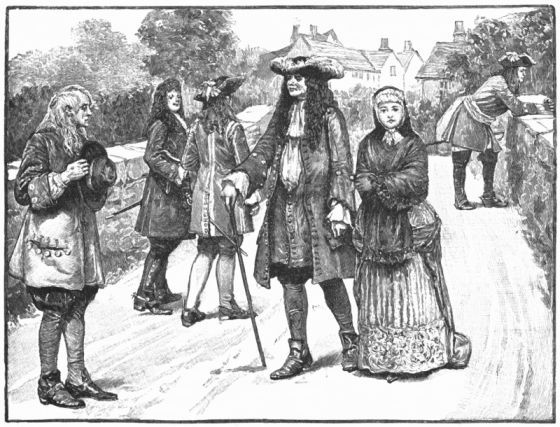
COSTUMES OF THE TIME OF WILLIAM AND MARY.
[See larger version]
Finding that he did not succeed in obtaining peace, Louis resolved to act on the defensive in the coming campaign in every quarter except in Catalonia, where his whole fleet could co-operate with the Count de Noailles, the commander of his land forces. William, who had received intelligence of this plan of the campaign, before his departure, ordered the British fleet under Russell to prevent the union of the French squadrons from Brest and Toulon. Russell was then to proceed to the Mediterranean to drive the French from the coast of Catalonia, and co-operate with the Spaniards on land. Meanwhile, the Earl of Berkeley, with another detachment of the fleet, was to take on board a strong force under the command of General Talmash, and bombard Brest in the absence of Tourville. All this was ably planned, but the whole scheme was defeated by the treachery of his courtiers: by Godolphin, his own First Lord of the Treasury, and by Marlborough, against whom the most damning evidence exists. Macpherson and Dalrymple, in the State papers discovered by them at Versailles, have shown that the whole of William's plans on this occasion were communicated to James by Godolphin, Marlborough, and Colonel Sackville, and have given us the strongest reasons for believing that the preparations of the fleet were purposely delayed by Caermarthen, the new Duke of Leeds, Shrewsbury, Godolphin, and others, letters for that purpose being discovered addressed to them by James through the Countess of Shrewsbury.
But of all the infamous persons thus plotting against the sovereign they had sworn to serve, and from whom they had many of them just received the highest honours that the Government could bestow, none equalled in infamy the detestable Marlborough. This man, who was professing allegiance at the same time to both William and James, and who would have betrayed either of them for his own purposes, was indefatigable in hunting out the king's secrets, and dispatching them with all haste, enforcing the disgrace of his own country and the massacre of his own countrymen with all his eloquence—the sole object being his own aggrandisement. Talmash was the only general who could be compared with him in military talent. Talmash betrayed and disgraced, Marlborough, who was suspected and rejected by William for his treason, felt sure he himself must be employed. Accordingly, he importuned Russell for a knowledge of the destination of the fleet; but Russell, who probably by this time had found it his interest to be true to his sovereign, refused to enlighten him. But Marlborough was not to be thus defeated in his traitorous designs. He was on most intimate terms with Godolphin, and most likely obtained the real facts from him. Godolphin, indeed, had already warned the French through James of the intended blow, and Marlborough followed up the intelligence by a letter dated the 2nd of May, in which he informed James that twelve regiments of infantry and two regiments of marines were about to embark under command of Talmash, in order to destroy Brest.
This diabolical treason had its full effect. Tourville had already sailed. He left Brest on the 25th of April, and was at this moment in the Straits of Gibraltar, which he passed on the 4th of May. Brest was defenceless; but Louis, thus apprised of his danger, instantly sent the great engineer of the age, Vauban, to put the port into the best possible state of defence, and dispatched after him a powerful body of troops. The weather favoured the traitors and the French. The English fleet was detained by contrary winds; it did not quit St. Helens till the 29th of May. On the 5th of June the fleet was off Cape Finisterre, where a council of war was held, and the next day Russell sailed for the Mediterranean with the greater part of the fleet. Lord Berkeley with the remainder, having on board General Talmash and his six thousand troops, turned his prows towards Brest. But by this time the town was in full occupation by a great body of soldiers, and Vauban had planted batteries commanding the port in every direction, in addition to eight large rafts in the harbour well supplied with mortars. In fact, there were no less than ninety mortars and three hundred cannons; all the passages under the castle were made bomb-proof, and there were at least five thousand infantry and a regiment of dragoons in the place. The English had no friendly traitors amongst the French to act the Marlborough and apprise them of all these preparations; and they rushed blindly on the destruction which their own perfidious countrymen had organised for them. The greater part of the unhappy men were slaughtered, and Talmash was shot through the thigh, and borne off to the ships. Talmash died in a few days, exclaiming that he had been betrayed by his own countrymen. He was so, more absolutely than he or even most of his contemporaries were aware of. The object of Marlborough was accomplished more completely than he could have anticipated. His rival was not disgraced, but destroyed—taken out of his way; and the hypocritical monster went to Whitehall to condole with the queen over this national dishonour and calamity, and to offer what he truly called "his own unworthy sword." When the offer was forwarded to William in Holland, he bluntly rejected it; but Marlborough ultimately achieved his end, and we ought never to forget, when we remember Ramillies, Blenheim, and Malplaquet, that amongst the acts by which he rose to a dukedom was the massacre of Camaret Bay.
On the 9th of November William landed at Margate, where the queen met him, and their journey to the capital was like an ovation. On the 12th the king met his Parliament, and congratulated it on having decidedly given a check to the arms of the French. This was true, though it had not been done by any battle during the campaign. Russell by relieving Barcelona, which had been blockaded by two French fleets, had effaced the defeat of Camaret Bay, and in the Netherlands, if there had been no battle, there had been no repulse, as in every former campaign. He had now no Mons, no Fleurus, no Namur, no Landen to deplore; on the contrary, he had driven the French to their own frontiers without the loss of a man. But he still deemed it necessary to continue their exertions, and completely to reduce the French arrogance, and he called for supplies as liberal as in the preceding year. The Customs Act was about to expire, and he desired its renewal.
The Commons adjourned for a week, and before they met again Archbishop Tillotson was taken suddenly ill whilst performing service in the chapel at Whitehall, and died on the 22nd of November. With the exception of the most violent Jacobites, who could not forgive him taking the primacy whilst Sancroft was living, the archbishop was universally and justly beloved and venerated. In the City especially, where he had preached at St. Lawrence in the Jewry for nearly thirty years, and where, as we have seen, his friend Firmin took care to have his pulpit supplied with the most distinguished preachers during his absence at Canterbury, he was enthusiastically admired as a preacher and beloved as a man. The king and queen were greatly attached to him, and William pronounced him, at his death, the best friend he ever had, and the best man he ever knew.
Tillotson was succeeded by Dr. Tenison, Bishop of Lincoln. Mary was very earnest for Stillingfleet; but even Stillingfleet was too High Church for William. Could he, however, have foreseen that it was the last request that the queen would ever make, he would, no doubt, have complied with it. In a few weeks Mary herself was seized with illness. She had been worn down by the anxieties of governing amid the feuds of parties and the plottings of traitors during the King's absence, and had now not strength to combat with a strong disease. The disease was, moreover, the most fatal which then attacked the human frame—the small-pox. No means had yet been discovered to arrest its ravages, and in her case the physicians were for a time divided in opinion as to its real character. One thought it measles, one scarlet fever, another spotted fever, a fourth erysipelas. The famous Radcliffe at once pronounced it small-pox. It was soon perceived that it would prove fatal, and Dr. Tenison was selected to break the intelligence to her. She received the solemn announcement with great fortitude and composure. She instantly issued orders that no person, not even the ladies of her bedchamber, should approach her if they had not already had the complaint. She shut herself up for several hours in her closet, during which she was busy burning papers and arranging others. Her sister Anne, on being apprised of her danger, sent a message, offering to come and see her; but she thanked her, and replied that she thought she had better not. But Mary sent her a friendly message, expressing her forgiveness of whatever she might have thought unkindness in Anne.
In everything else the very enemies of Mary were compelled to praise her. She was tall, handsome, and dignified in person, yet of the most mild and amiable manners; strong in her judgment, quick in perceiving the right, anxious to do it, warm in her attachment to her friends, and most lenient towards her enemies. To her husband she was devotedly attached; had the most profound confidence in his abilities, and was more happy in regarding herself as his faithful wife than as joint sovereign of the realm. William, on his part, had not avoided giving her the mortification of seeing a mistress in his Court in the person of Mrs. Villiers, yet she had borne it with a quiet dignity which did her much credit; and now William showed that, cold as he was outwardly, he was passionately attached to her. His grief was so excessive that, when he knew that he must lose her, he fainted many times in succession, and his own life even began to be despaired of. He would not quit her bedside for a moment day or night till he was borne away in a sinking state a short time before she expired. After her death he shut himself up for some weeks, and scarcely saw any one, and attended to no business, till it was feared that he would lose his reason. During his illness he had called Burnet into his closet, and, bursting into a passion of tears, he said, "he had been the happiest, and now he was going to be the most miserable of men; that during the whole course of their marriage he had never known a single fault in her. There was a worth in her that no one knew beside himself."
Mary died on the 28th of December in the utmost peace after taking the Sacrament, and William, deprived of his unselfish wife's support, was left to carry on his great work alone. But apart from the loss of popularity entailed by the death of so able and beloved a consort, it cannot be said that William's position was altered by the death of his wife; so completely was he the master-spirit.