Chapter III · (continued 2)
Reading edition
The king, greatly agitated, demanded to see the order for his removal, and to know whither they designed to convey him. Cobbet told him they should take him out of the island, but would not show his order. His nobles, bishops, and officers of his household crowded round in alarm and confusion, but there was no alternative; the king was obliged to take his leave of them, with much sorrow, and was conducted to Hurst Castle, on the opposite coast of Hampshire. "The place," says Warwick, "stood in the sea, for every tide the water surrounded it, and it contained only a few dog-lodgings for soldiers, being chiefly designed for a platform to command the ships." The sight of this dreary place struck a serious terror of assassination into his heart, for he never would believe that, though the Levellers talked of it, they would ever dare to bring an anointed king to public trial. Unfortunately, his own officers had lately been rendering assassination familiar to the public mind, for besides the gallant Colonel Rainsborough, they had murdered several other officers of less note, and there was a rumour that they had made a compact to get rid of the king's enemies in this manner. Charles, however, was to learn that the officers of the Parliamentary army disdained murder, and dared arraign a king.
The same day that Charles was transferred to Hurst Castle, the Parliament negatived the motion that the Parliamentary remonstrance should be taken into consideration, and it voted a letter of Fairfax's, demanding pay for the army, or threatening to take it where it could be found, a high and unbeseeming letter. The same day, too, the council of officers addressed a declaration to Parliament, assuring it that, seeing that their remonstrance was rejected, they were come to the conclusion that the Parliament had betrayed its trust to the people, and that the army would, therefore, appeal from their authority "to the extraordinary judgment of God, and all good people." They called on all faithful members to put their confidence in the army, and protest with them against the conduct of their colleagues. Parliament, on its part, sent to Fairfax an order that the army should not advance any nearer to the capital. But the army was advancing—several regiments from the neighbourhood of York—with the avowal that they were following the directions of Providence.
On the 1st of December the Commons met, and as if indifferent to the advance of the army, voted thanks to Holles, Pierpoint, and Lord Wenman, for their care and pains in the good treaty at Newport, and proceeded to read twice the report of the Commissioners. Holles, who, with his accused colleagues, was again in the House, moved that the king's answer should be voted satisfactory; but that question was postponed till the next day, when the House adjourned again till the 4th of December—Fairfax, in defiance of their prohibition, having that day marched into the City, and quartered his troops around Whitehall, York House, St. James's, the Mews, and other places. On the 4th they went into the question of the treaty again, having debated all Friday and Saturday; and on Monday they continued the debate all day until five o'clock the next morning, Tuesday. Such a debate of three days and a night had not hitherto been known, for no subject of such supreme importance had ever yet come before Parliament. Oliver Cromwell arrived in the midst of this memorable debate.
Sir Harry Vane the younger said that the treaty had been carried on for months, and that although the king had appeared to concede much at the last moment, yet they had his own declaration that he did not hold himself bound by promises which he might make, and that it was the conviction of himself, and thousands of others, that the king was not to be trusted; that he, therefore, moved that the House should return at once to its vote of non-addresses, which it ought never to have violated, should cease all negotiations, and settle the commonwealth on another model. Sir Henry Mildmay said the king was no more to be trusted than a caged lion set at liberty. This was the conviction of the whole body of the Independents, and no doubt a solid and rational conviction. But the king did not lack defenders: Fiennes, to the astonishment of his party, advocated the adoption of the report, and even Prynne, who had suffered so severely under it, became a pleader for royalty, that he might chastise Independency and the army. On a division it was found that a majority of thirty-six, being one hundred and forty against one hundred and four, had voted the concessions of Charles at Newport satisfactory, and offering sufficient grounds for settling the peace of the kingdom. But the army—or, in other words, the Independent and Republican cause—was not going thus to be defeated.
On the morning of the 6th of December, Major-general Skippon discharged the train-bands which had guarded the two Houses of Parliament, and Colonel Rich's cavalry and Colonel Pride's regiment of foot took their places. Colonel Pride took the lead in the proceeding, which has thence acquired the name of Pride's Purge. The army determined to purge the Parliament of all those who were weak enough or mischievous enough to consent to the return of the king on his own promises, which had long ceased to mean anything but deceit. Fairfax was engaged in conversation with some of the members, and Colonel Pride, placing some of his soldiers in the Court of Requests, and others in the lobby of the Commons, stood in the latter place with a list of its members in his hand, and as they approached—Lord Grey of Groby, who stood by him as one of the doorkeepers, informing him who the members were—he stopped such as were on his list, and sent them to the Queen's Court, the Court of Wards, and other places appointed for their detention by the general and council of the army. Fifty-two of the leading Presbyterians were thus secured, and the next day, others who had passed the first ordeal were also removed, so that Pride's Purge had left only about fifty members for a House, who were Independents, for others had fled into the country, or hidden themselves in the City to escape arrest. On the whole, forty-seven members were imprisoned, and ninety-six excluded. The purged remainder acquired the well-known name of the Rump.
The Independents were now uncontrolled; the royal party in Scotland, weakened by the defeat of Hamilton's army, were opposed by the Covenanters, who again denounced the curse of Meroz from the pulpit against all who did not rise in defence of the Solemn League and Covenant. Loudon and Eglinton were appointed commanders, and the Earl of Argyll, with his Highlanders, joining them, they, with the forces of Cassilis from Carrick and Galloway, marched to Edinburgh. This wild army advancing from the west were called the "Whiggamores," either from whiggam, a phrase used in driving their horses, or whig (whey), a beverage of sour milk, which was one of their articles of food. Whichever it was, the term was soon used to designate an enemy of the king, and in the next reign was adopted as a nickname for the opponents of the Court, whence the political term "Whig." Lord Lanark and Monroe were glad to treat with the Whiggamores, and disbanded their troops, so that Argyll being a great partisan of Cromwell's, nothing more was to be feared in the North. On Cromwell's visit Berwick and Carlisle had been surrendered to him.
On the sitting of the purged Parliament on the 6th, the first day of Pride's weeding out the suspected members, Cromwell appeared in his place, and was received with acclamations for his services in the North. The 8th was kept as a solemn fast, and a collection was made for the wives and widows of the poor soldiers. They then adjourned to the 11th, and on Sunday, Hugh Peters, the great enthusiast of Republicanism, preached a sermon in St. Margaret's, Westminster, from the text, "Bind your king with chains, and your nobles with fetters of iron;" and he did not hesitate in the sermon to characterise the king as Barabbas, the great murderer, tyrant, and traitor. It was remarkable that not only four earls and twenty commoners of note sat out this sermon, but the Prince Palatine himself, Charles's nephew. The king's own family, whatever their pretences, had clearly given him up to his fate, or the prince, with his powerful fleet, would never have scoured the coasts of the south of England for several weeks without a single attempt to save his father, the impetuous Prince Rupert being on board, and one of his chief counsellors.
Instead of the House of Commons sitting according to adjournment, on the 11th, the Military Councils, the Select Committee, and the General sat, and framed a new scheme of government. It was called "A new Representative, or an Agreement of the People." The composition was said to be Ireton's, but had probably been framed by Cromwell, Ireton, Peters, Vane, Pride, and the leading Republicans. It was but an amplification of the late remonstrance; it proposed that the present Parliament, which had now sat eight years, should be finally dissolved in April next, and a new one elected according to this formula. It declared that officers and malignants should be incapable of electing or being elected; that the House of Commons should consist of three hundred members, and the representation of the country should be more equal. These propositions, having been sanctioned by the general council of soldiers and inferior officers, were carried to Parliament. The Commons the next day readily voted these measures, as well as that both the Commons and Lords, by violating the vote of non-addresses, had committed an act most unparliamentary and detrimental to the kingdom, and that the treaty at Newport was a monstrous error, disgrace, and peril to the country. They again restored the order expelling the eleven Presbyterian members from the House.
On the 16th a strong party of horse was despatched under Colonel Harrison to remove the king to Windsor Castle. On the very day that he reached Windsor, the House of Commons, or the Rump fragment of it, appointed a committee of thirty-eight "to consider of drawing up a charge against the king, and all other delinquents that may be thought fit to bring to condign punishment." On the 1st of January, 1649, the committee made the following report:—"That the said Charles Stuart, being admitted King of England, and therein trusted with a limited power to govern by and according to the laws of the land, and not otherwise; and by his trust, oath, and office, being obliged to use the power committed to him for the good and benefit of the people, and for the preservation of their rights and liberties; yet, nevertheless, out of a wicked design to erect and uphold in himself an unlimited and tyrannical power, to rule according to his will, and to overthrow the rights and liberties of the people; yea, to take away and make void the foundations thereof, and of all redress and remedy of misgovernment, which by the fundamental constitutions of this kingdom were reserved on the people's behalf, in the right and power of frequent and successive Parliaments, or national meetings in council; he, the said Charles Stuart, for accomplishing of such his designs, and for the protecting of himself and his adherents in his and their wicked practices, to the same ends hath traitorously and maliciously levied war against the present Parliament, and the people therein represented." The report, therefore, declared that he should be brought to judgment for his treason to the nation.
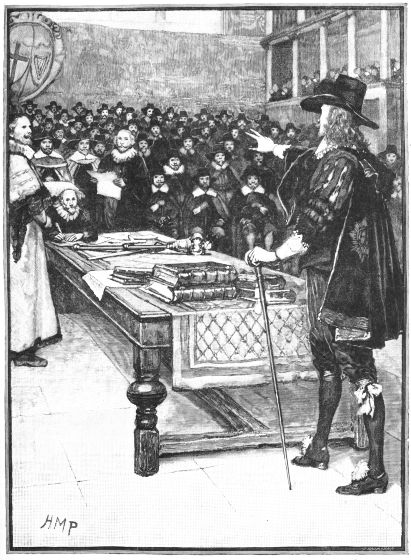
TRIAL OF CHARLES I. (See p. 86.)
[See larger version]
The next day the ordinance of the Commons confirming the report was sent up to the Lords, or at least to the few of them remaining, only amounting to about a dozen, who rejected it without a dissenting voice, and then adjourned. The Commons immediately closed their doors, and passed a resolution that the Commons of England in Parliament assembled were, under God, the origin of all just power as the representatives of the people; that whatsoever they decreed was law, and did not require any concurrence from the Lords.
On the 6th of January the Commons passed the ordinance for the trial of the king. By it they erected a High Court of Justice for trying him, and proceeding to judgment against him. It consisted of no less than a hundred and thirty-five Commissioners, of whom twenty were to form a quorum. Of these Commissioners no more than eighty assembled. On the 8th, fifty assembled in the Painted Chamber, Fairfax at their head, and ordered that on the morrow the herald should proclaim the approaching trial, and invite all people to bring in what matters of fact they had against Charles Stuart. Accordingly that was done both at Westminster and in the City the same day, the 9th. The Commons ordered the Great Seal in use to be broken up, and a new seal introduced, bearing the inscription, "The Great Seal of England," and on the reverse, "In the first year of Freedom, by God's blessing restored, 1648" (i.e., 1649, new style). The Commissioners then appointed John Bradshaw, a native of Cheshire, and a barrister of Gray's Inn, who had practised much in Guildhall, and had lately been made a serjeant, Lord President of the High Court; Mr. Steel, Attorney-General; Mr. Coke, Solicitor-General; Mr. Dorislaus and Mr. Aske, as Counsel for the Commonwealth; and, appointing the old Courts of Chancery and King's Bench, at the upper end of Westminster Hall, as the place of trial, they fixed the day for the 19th of January. On the 20th of January the Commissioners assembled in the Painted Chamber to the number of sixty-six, and proceeded in state to Westminster Hall.
It may be imagined that such a spectacle drew immense throngs. Every avenue to the hall was guarded by soldiers, and others stood armed within it. The open space below the bar was densely crowded, and equally packed throngs of nobles, gentlemen, and ladies, looked down from the galleries right and left. A chair of crimson velvet for the President stood elevated on three steps towards the upper end of the hall, and behind and in a line with him right and left the Commissioners took the seats placed for them, which were covered with scarlet. Before the President stood a long table on which lay the mace and sword, and just below him, at its head, sat two clerks. At the bottom of the table, directly opposite to the President, was placed a chair for the king.
After the commission had been read, Bradshaw ordered the prisoner to be brought to the bar. He had been brought from Whitehall, to which he had been removed from St. James's, in a sedan chair, and the serjeant-at-arms conducted him to the bar. His step was firm, and his countenance, though serious, unmoved. He seated himself covered, according to the wont, not of a prisoner, but of a king; then rose and surveyed the court and crowds around him. The Commissioners all sat with their hats on, and Charles eyed them sternly. He then glanced round on the people in the galleries and those around him with an air of superiority, and reseated himself. Bradshaw then addressed him to this effect:—"Charles Stuart, King of England,—The Commons of England, being deeply sensible of the calamities that have been brought upon this nation, which are fixed upon you as the principal author of them, have resolved to make inquisition for blood; and, according to that debt and due they owe to justice, to God, the kingdom, and themselves, they have resolved to bring you to trial and judgment, and for that purpose have constituted this High Court of Justice before which you are brought." Coke, the Solicitor-General, then rose to make the charge against him, but Charles, rising and crying, "Hold! hold!" tapped him on the shoulder with his cane. In doing this the gold head dropped from his cane, and though he took it up with an air of indifference, it was an incident that made a deep impression both on him and the spectators. He mentioned the circumstance to the Bishop of London, who attended him in private, with much concern, and those who saw it regarded it as an especial omen.
Coke, however, went on, and desired the clerk to read the charge, and whilst it was reading, Charles again cried, "Hold!" but as the clerk continued, he sat down, looking very stern; but when the words of the charge declaring him to be a tyrant and a traitor were read, he is said to have laughed outright. When the charge was finished, Bradshaw demanded what he had to say in reply to it; but he in his turn demanded by what authority he had been brought there? And he asserted very forcibly that he was king; acknowledged no authority superior to his own, and would not by any act of his diminish or yield up that authority, but leave it to his posterity as he had derived it from his ancestors. He reminded them that he had lately, in the Isle of Wight, treated with a number of lords and gentlemen; that they were upon the conclusion of that treaty, and he wanted to know by what authority he had, under such circumstances, been brought thence.
This was very true, and would have been unanswerable, had he, as he asserted, treated with them honestly and uprightly; but we know that at the very time that he was carrying on that treaty, and to the very last, he was also carrying on a secret correspondence with Ormond in Ireland, his wife in France, and with other parties, informing them that he was only doing this because there was no help for it; but that he had games to play which would still defeat the whole affair. He was meaning nothing less, and privately declaring nothing less, than that he would, on the first opportunity, be as despotic as ever. He continued, however, to demand, "By what authority am I here? I mean lawful authority, for there are many unlawful authorities in the world—thieves and robbers by the highways. Remember, I am your lawful king: let me know by what lawful authority I am seated here; resolve me that, and you shall hear more from me." Bradshaw told him that he might have observed that he was there by the authority of the people of England, whose elected king he was. That afforded Charles another answer. "England," he said, "never was an elective but an hereditary kingdom for nearly these thousand years. I stand more for the liberty of my people than any here that are come to be my pretended judges." Bradshaw might have told him that the people thought it time to put an end to the hereditary form, and adopt a new one; but he replied, "Sir, how well you have managed your trust is known. If you do not acknowledge the authority of the court I must proceed." Charles, however, turned to another weak place in his adversary's answer, and exclaimed, "I see no House of Lords that may constitute a Parliament, and the king, too, must be in and part of a Parliament." It was unquestionable that Charles could not be answered on the constitutional ground, but only on the revolutionary one, on that principle of the power and right of the people to revolutionise, and shape anew their constitution (which in 1688 was acknowledged and established as a great fact of the rights of nations), and Bradshaw brought forward that plea—"If you are not satisfied with our authority, we are satisfied with it, which we have from God and the people." He informed Charles that he would be expected to answer, and adjourned the court till Monday.
The two following days were spent in receiving evidence of the king's having not only commenced the war on his subjects, but of his having commanded personally in it, and in settling the form of judgment to be pronounced. On the third day, when Charles was again brought forward, the same painful scene was renewed of the king's denying the court, refusing to plead, and yet insisting on being heard. Bradshaw told him in vain that if he pleaded, admitting the authority of the court, he would be at liberty to make any observation in his defence that he pleased; but that in no court could it be otherwise. He then demanded a hearing before a committee of both Houses, but he was reminded that the authority of the Lords was no longer admitted. He assured him that though he contended that he had no superior in the State, the law was his superior, and that there was a power superior to the law—the people, the parent or author of the law—which was not of yesterday, but the law of old; that there were such things as parliaments, which the people had constructed for their protection, and these Parliaments he had endeavoured to put down and destroy; and that what his endeavours had been all along for the crushing of Parliament, had been notorious to the whole kingdom. "And truly, sir," he continued, "in that you did strike at all, for the great bulwark of the liberties of the people is the Parliament of England. Could you but have confounded that, you had at one blow cut off the neck of England. But God hath been pleased to confound your design, to break your forces, to bring your person into custody, that you might be responsible to justice."
He then combated Charles's argument, that there was no law or example of people deposing or destroying their kings. He quoted many instances from foreign nations, in which they had resisted, fought against, and destroyed their kings. Charles's own country of Scotland, before all others, abounded with instances of the deposition and putting to death of their sovereigns. His grandmother had been so set aside, and his own father, a mere infant, put in her place. The Lord President then referred to the depositions of Edward II. and Richard II., which he contended were effected by Parliament, and said that their crimes were not a tenth part so capital against the nation as those in this charge. As Charles again continued to reply and argue without submitting to plead, Bradshaw told him the court had given him too much liberty already, and ordered the sentence to be read. But here John Downes, one of the Commissioners, a citizen of London, said to those near him, "Have we hearts of stone? Are we men?" and then rising and trembling violently, exclaimed, "My lord, I am not satisfied to give my consent to the sentence. I desire the court may adjourn to hear me." They therefore adjourned, but in half an hour returned with a unanimous verdict of guilty.
Bradshaw then proceeded to pronounce the sentence. When the names of the Commissioners were read that morning, on that of Fairfax being called, a female voice from one of the galleries cried out, "He has more wit than be here." When the name of Cromwell was read, the same voice exclaimed, "A rogue and a traitor." As Bradshaw now went on to say, the king had been called to answer by the people, before the Commons of England assembled in Parliament, the same female voice shouted, "It is false! not one half-quarter of them!" There was a great excitement; all turned towards the gallery whence the voice came, from amid a group of masked ladies. Axtell, the officer commanding the soldiers, brutally ordered them to fire into the group; but the soldiers hesitated, and a lady rose and walked out of the gallery. It was seen to be Lady Fairfax, the wife of the commander-in-chief, a woman of very ancient and noble family, the Veres of Tilbury, who had come to object most decidedly to the extreme measures of the army, and had prevailed on her husband to keep away from the court.
After order had been restored, Bradshaw ordered the charge to be read, the king still interfering; and then Bradshaw passed the sentence, "That the court being satisfied in conscience that he, Charles Stuart, was guilty of the crimes of which he had been accused, did adjudge him as a tyrant, traitor, murderer, and public enemy to the good people of the nation, to be put to death by severing his head from his body."
After the sentence was pronounced, Charles again requested to be heard; but Bradshaw told him that after the sentence it could not be allowed, and ordered the guards to take him away. The Royalist writers state that during the trial the people had cried, "Justice! justice!" whilst others cried, "God save the king!" but that after the king was condemned, the soldiers, as he passed, insulted him in the grossest manner, spitting on him, blowing their tobacco in his face, throwing their pipes at him, and yelling in his ears, "Justice! justice! execution! execution!" But the popular party utterly denied the truth of these assertions; declaring that they were got up to make the case of Charles resemble that of the Saviour, to render his judges odious, and himself a sacred martyr. One soldier, Herbert says, as the king was proceeding to his sedan chair, said, "God help and save your majesty!" and that Axtell struck him down with his cane, on which the king said, "Poor fellow! it is a heavy blow for a small offence." To the hired hootings of the military, Herbert says that he merely remarked, "Poor souls! they would say the same to their generals for sixpence."
Charles went back to St. James's Palace, where he spent the remainder of the day, Sunday, the 28th of January, and Monday, the 29th, the execution being fixed for Tuesday, the 30th. He had the attendance of Juxon, the late Bishop of London, and the next morning he received the last visit of his only two remaining children in England, the Duke of Gloucester and the Princess Elizabeth. The princess was not twelve, and the king, setting her on his knee, began speaking to her—"But, sweetheart," he said, "thou wilt forget what I tell thee." The little girl, bursting into tears, promised to write down all that passed, and she did so. In her account, preserved in the "Reliquiæ Sacræ," she says, amongst other things, that he commanded her to tell her mother that his thoughts had never strayed from her, that his love would be the same for her to the last; and that he died a glorious death for the laws and religion of the land. To the Duke of Gloucester he said, "Sweetheart, now they will cut off thy father's head. Heed what I say, they will cut off my head, and perhaps make thee a king. But mark what I say; you must not be a king as long as your brothers Charles and James live; therefore, I charge you, do not be made a king by them." At which the child, sighing deeply, replied, "I will be torn in pieces first." "And these words coming unexpectedly from so young a child," says the princess, "rejoiced my father exceedingly." The whole interview was extremely affecting.
Charles slept well, but woke early, and bade his man Herbert rise and dress him with care, for it was his second marriage day, and he would be as trim as possible. Whilst Herbert dressed him, he told him he had dreamt of Archbishop Laud, who, on the king speaking seriously to him, had sighed and fallen prostrate. Charles said, had he not been dead, he might possibly have said something to Laud to cause him to sigh; so that it is possible he felt that Laud's proceedings and advice had brought things to this pass. He desired to have two shirts on, as the weather was very cold; for if he shook, the rogues would think it was through fear. He observed that he was glad he had slept at St. James's, as the walk through the park would warm him. At ten o'clock the summons came—Colonel Hacker knocked at the door to say they were ready. Hacker turned pale on seeing the king come out, and was much affected. Ten companies of infantry formed a double line on each side of his path, and a detachment preceded him with banners flying and drums beating.
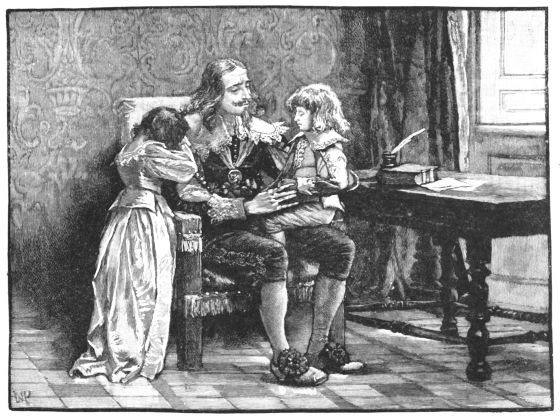
CHARLES'S FAREWELL INTERVIEW WITH THE DUKE OF GLOUCESTER AND THE PRINCESS ELIZABETH. (See p. 88.)
[See larger version]
On the king's right walked Juxon, on his left the Parliamentary Colonel Tomlinson, bareheaded. The king walked through the park at a brisk rate, and said to the guard, "Come, my good fellows, step on apace." He pointed out a tree planted by his brother Henry, and on arriving at Whitehall, he ascended the stairs with a light step, passed through the long gallery, and went to his chamber, where he remained with Juxon in religious exercise. It was past one o'clock before he was summoned to the scaffold, where the executioner, Brandon, and Hulet, a sergeant appointed to assist him, disguised in black masks, awaited him. The scaffold was raised in the street, in front of the Banqueting House at Whitehall, and he passed through a window which had been taken out, upon it. All was hung with black cloth, and in the middle of the scaffold stood the block, with the axe enveloped in black crape lying on it.
Charles made a speech, in which he denied making war on the Parliament, but the Parliament on him, by claiming the militia. Church, Lords, and Commons had, he said, been subverted with the sovereign power; if he would have consented to reign by the mere despotism of the sword, he asserted that he might have lived and remained king. He declared that he forgave all his enemies; and yet when the executioner knelt and begged his forgiveness, he said, "No, I forgive no subject of mine, who comes deliberately to shed my blood." He said that the nation would never prosper till they placed his son on the throne; and to the last moment, rooted in his theory of divine right, he denied that the people ought to have any share in the government—that being a thing "nothing pertaining to them"—and yet that "he died the martyr of the people."
Whilst he spoke some one disturbed the axe, on which he turned and said, "Have a care of the axe; if the edge be spoiled, it will be the worse for me." After concluding his speech, he put up his hair under a cap, and the bishop observed, "There is but one stage more, which, though turbulent and troublesome, is yet a very short one. Consider it will carry you a great way—even from earth to heaven." "I go," said the king, "from a corruptible crown to an incorruptible, where no disturbance can take place." "You are exchanged from a temporal to an eternal crown—a good exchange," replied the bishop. The king then took off his cloak, and gave his George to Juxon, saying impressively, "Remember!" The warning is supposed, as the medallion of the George concealed a portrait of Henrietta, to have regarded a message to his wife. Having laid his head on the block, the executioner severed it at a single stroke, and Hulet, the sergeant, holding it up, cried, "Here is the head of a traitor." At that sight a universal groan seemed to go through the crowd.
The body lay at Whitehall, to be embalmed, till the 7th of February, when it was conveyed to Windsor, and laid in the vault of St. George's Chapel, near the coffins of Henry VIII. and Jane Seymour. The day was very snowy, and the coffin being deposited without any service, was left without any inscription except the words, "Carolus Rex, 1648," the letters of which were cut out of a band of lead by the gentlemen present, with their penknives, and the lead folded round the coffin. In this condition it was discovered in 1813, when George IV., attended by Sir Henry Halford, had it opened, and found proof that the head had been separated from the body.