Chapter X
Reading edition
REIGN OF JAMES II.
James's Speech to the Council—Rochester supersedes Halifax—Other Changes in the Ministry—James Collects the Customs without Parliament—French Pension continued—Scottish Parliament—Oates and Dangerfield—Meeting of Parliament—It grants Revenue for Life—Monmouth and Argyll—Argyll's Expedition—His Capture and Execution—Monmouth's Expedition—He enters Taunton—Failure of his Hopes—Battle of Sedgemoor—Execution of Monmouth—Cruelties of Kirke and Jeffreys—The Bloody Assize—The Case of Lady Alice Lisle—Decline of James's Power—He Breaks the Test Act—Revocation of the Edict of Nantes—Prorogation of Parliament—Acquittal of Delamere—Alienation of the Church—Parties at Court—The Dispensing Power Asserted—Livings granted to Catholics—Court of High Commission Revived—Army on Hounslow Heath—Trial of "Julian" Johnson—James's Lawlessness in Scotland and Ireland—Declaration of Indulgence—The Party of the Prince of Orange and the Princess Mary—Expulsion of the Fellows of Magdalen College—New Declaration of Indulgence—Protest of the Seven Bishops—Birth of the Prince of Wales—Trial and Acquittal of the Bishops—Invitation to William of Orange—Folly of James—William's Preparations—Blindness of James and Treachery of his Ministers—William's Declaration—James convinced, makes Concessions—William lands at Torbay—His Advance to Exeter—Churchill's Treason—Flight of the Princess Anne and her Husband—James sends Commissioners to Treat with William—Flight of James—Riots in London—Return of James—His Final Flight to France—The Convention—The Succession Question—Declaration of Rights—William and Mary joint Sovereigns.
To the reign of merry cruelty now succeeded the reign of gloomy, ascetic, undisguised ferocity. Charles could laugh and sport with his ladies, whilst his subjects were imprisoned and tortured. James, who never laughed, pursued his cruel bent with a settled butcher-like mood, and would have extirpated nations, were it in his power, to restore Catholicism, and establish the political absolutism adored by the Stuarts. Yet he began the reign of the Inquisition with the hypocrisy of the Jesuit. When the breath had left the body of Charles, James retired for a quarter of an hour to his chamber, and then met the Privy Council with a speech which promised everything that he was most resolved not to perform. He began by eulogising the deceased "as a good and gracious king." If he really thought his late merry, debauched, and despotic brother good and gracious, it was an evil omen for the nation, whose ruler had such conceptions of what was good and gracious. He then added, "I have been reported to be a man fond of arbitrary power; but that is not the only falsehood which has been reported of me; and I shall make it my endeavour to preserve this Government, both in Church and State, as it is by law now established. I know the principles of the Church of England are favourable to monarchy, and the members of it have shown themselves good and loyal subjects; therefore I shall take care to defend and support it. I know, too, that the laws of England are sufficient to make the king as great a monarch as I can wish; and as I shall never depart from the just rights and prerogatives of the Crown, so I shall never invade any man's property. I have often before ventured my life in defence of this nation, and shall go as far as any man in preserving it in all its just rights and liberties."
The first thing which scandalised the people was the miserable economy of the late king's funeral. It was said to be scarcely befitting a private gentleman, and the Scottish Covenanters asserted that the dead tyrant had been treated, as the Scriptures declared tyrants should be, to the "burial of an ass." The first thing which James set about was the rearrangement of the Cabinet. There was but one man in the Cabinet of the late king who had his entire confidence—this was Rochester, the second son of the late Lord Clarendon. To him he gave the office of Lord High Treasurer, thus constituting him Prime Minister; to Godolphin, who had held this office, he gave that of Chamberlain to the Queen. Halifax was deprived of the Privy Seal, and was made President of the Council, a post both less lucrative and less influential, a circumstance which highly delighted Rochester, who now saw the wit who said he had been kicked upstairs, served in precisely the same way. Sunderland, the late Secretary of State, was suffered to retain his office. He had intrigued and acted against James; both he and Godolphin had supported the Exclusion Bill, but Sunderland now with his usual supple artifice, represented that he could have no hope of the king's favour but from the merit of his future services; and as he possessed some dangerous secrets, he was permitted to keep his place. He did not, however, content himself with this, but cherished the ambition of superseding Rochester as Lord Treasurer, and therefore represented himself to the Catholics as their staunch friend, whilst they knew that Rochester was the champion of the Church of England. For the present, nevertheless, from having been at high feud with both Rochester and Clarendon, he cultivated a strong friendship with them to make his position firm with the king. Halifax had opposed the Exclusion Bill, but he had become too well known as a decided enemy of Popery and of the French ascendency. James, therefore, tolerated him for the present, and whilst he assured him that all the past was forgotten, except the service he had rendered by his opposition to the Exclusion Bill, he told Barillon, the French ambassador, that he knew him too well to trust him, and only gave him the post of President of the Council to show how little influence he had.
The Great Seal was retained also by Lord Guildford, who, though he was by no means a friend of liberty, was too much a stickler for the law to be a useful tool of arbitrary power. James secretly hated him, and determined to associate a more unscrupulous man with him in the functions of his office. This was his most obedient and most unflinching creature, the Lord Chief Justice Jeffreys, of whose unexampled villainies we shall soon hear too much. Guildford was by the overbearing Jeffreys at once thrust back into the mere routine of a judge in equity, and all his State functions and patronage were usurped by this daring man. At the Council board Jeffreys treated him with the most marked contempt, and even insult, and poor Guildford soon saw all influence and profit of the Chancellorship, as well as the Chief Justiceship, in the hands of Jeffreys, and himself reduced to a cipher.
But the most ungenerous proceeding was that of depriving the old and faithful Lord Ormond of the Lord-Lieutenancy of Ireland. Ormond had not only stood firmly by Charles I., but had suffered unrepiningly the evil fortunes of Charles II. He had shared his exile, and had done all in his power for his restoration. He had opposed all the endeavours by the Popish Plot and the Exclusion Bill to get rid of James, and was highly respected in his office in Ireland. He had lately lost his eldest son, Lord Ossory, and, though aged, was still vigorous and zealous in discharge of his duties. But he had the unpardonable faults of being a firm Protestant and as firm an advocate for the constitutional restrictions of the Crown. James recalled him from his Lord-Lieutenancy on the plea that he was wanted at Court in his other office of Lord Steward of the Household. But the ancient chief felt the ungrateful act, and, at a farewell dinner at Dublin to the officers of the garrison, in toasting the health of the king, he filled a cup of wine to the brim, and, holding it aloft without spilling a drop, declared that whatever the courtiers might say, neither hand, heart, nor reason yet failed him—that he knew no approach of dotage.
Having made these changes in the ministry, James lost no time in letting his subjects see that he meant to enjoy his religion without the restraints to which he had been accustomed. He had been used to attend Mass with the queen in her oratory, with the doors carefully closed; but the second Sunday after his accession he ordered the chapel doors to be thrown wide open, and went thither in procession. The Duke of Somerset, who bore the sword of State, stopped at the threshold. James bade him advance, saying, "Your father would have gone farther." But Somerset replied, "Your Majesty's father would not have gone so far." At the moment of the elevation of the Host, the courtiers were thrown into a strange agitation. The Catholics fell on their knees, and the Protestants hurried away. On Easter Sunday Mass was attended with still greater ceremony. Somerset stopped at the door, according to custom, but the Dukes of Norfolk, Northumberland, Grafton, Richmond, and many other noblemen, accompanied the king as far as the gallery. Godolphin and Sunderland also complied, but Rochester absolutely refused to attend. Not satisfied with proclaiming his Catholicism, James produced two papers, which he said he had found in the strong box of the late king, wherein Charles was made to avow his persuasion that there could be no true Church but the Roman, and that all who dissented from that Church, whether communities or individuals, became heretic. James declared the arguments to be perfectly unanswerable, and challenged Sancroft, Archbishop of Canterbury, to attempt it. This was not very consistent with his speech as regarded the Church of England, and his next step was as great a violation of his assurance that he would not invade any man's property. Funds for carrying on the Government were necessary, and James declared that as the customs and part of the excise had only been granted to Charles for his life, they had now lapsed, and that it would produce great inconvenience to wait for the meeting of Parliament for their re-enactment. Nothing prevented him from calling Parliament at once, but James undoubtedly had a fancy for trying his father's favourite measure of levying taxes without Parliament. It was contended that as no law for customs or excise now existed, all goods newly imported would come in duty free, and ruin the merchants who had to sell goods which had paid the duty. North, Lord Guildford, recommended that the duties should be levied as usual, but the proceeds kept in the Exchequer till Parliament met and authorised their appropriation; but Jeffreys was a councillor much more after the king's heart. He recommended that an edict should at once be issued, ordering the duties to be paid as usual to his Majesty, and this advice was carried, every one being afraid of being declared disloyal, or a trimmer, who voted against it. The proclamation was issued, but, to render it more palatable, it announced that a Parliament would be very soon called, and as many addresses as possible from public bodies, sanctioning the measure, were procured. The barristers and students of the Middle Temple, in their address, thanked the king for preserving the customs, and both they and the two universities expressed the most boundless obedience to the king's sovereign and unlimited power. But the public at large looked on with silent foreboding. "The compliments of these bodies," says Dalrymple, "only served to remind the nation that the laws had been broken."
Before venturing to assemble Parliament James endeavoured to render Louis of France acquiescent in this step. He knew from the history of the late reign how averse Louis was from English Parliaments, which were hostile to his designs against the Continental nations. He therefore had a private interview with Barillon, in which he apologised most humbly for the necessity of calling a Parliament. He begged him to assure his master of his grateful attachment, and that he was determined to do nothing without his consent. If the Parliament attempted to meddle in any foreign affairs, he would send them about their business. Again he begged him to explain this, and that he desired to consult his brother of France in everything, but then he must have money by some means. This hint of money was followed up the next day by Rochester, and Barillon hastened to convey the royal wishes. But Louis had lost no time in applying the effectual remedy for a Parliament, the moment the assembling of one became menaced. He sent over five hundred thousand crowns, which Barillon carried in triumph to Whitehall, and James wept tears of joy and gratitude over the accursed bribe. But he and his ministers soon hinted that the money, though most acceptable, would not render him independent of Parliament, and Barillon pressed his sovereign to send more with an urgency which rather offended Louis, and rendered it possible that the ambassador had a pretty good commission out of what he obtained. James sent over to Versailles Captain Churchill, already become Lord Churchill, and in time to become known to us and all the world as the Duke of Marlborough. He was to express James's gratitude and his assurances of keeping in view the interests of France, and so well did the proceedings of Churchill in Paris and of Barillon in England, prosper, that successive remittances, amounting to two millions of livres, were sent over. But of this, except four hundred and seventy thousand livres, the arrears of the late king's pension, and about thirty thousand pounds for the corruption of the House of Commons, Louis strictly forbade Barillon paying over more at present to James without his orders. In fact, he was no more assured of the good faith of James than he had been of that of Charles; and he had ample reason for his distrust, for at the very same time James was negotiating a fresh treaty with his son-in-law, the Prince of Orange.
It is impossible to comprehend the full turpitude of this conduct of James without keeping steadily in view the aims of both James and Louis. James's, like that of all the Stuarts, was simply to destroy the British constitution and reign absolutely. To do this the money of France was needed to render them independent of Parliaments, and a prospect of French troops should the English at length rebel against these attempts at their enslavement. The object of Louis was to keep England from affording any aid to any power on the Continent, whilst he was endeavouring to overrun it with his armies.
On the day of the coronation in England (April 23rd), St. George's Day, the Parliament in Scotland met. James called on the Scots to set a good example to the approaching Parliament of England in a liberal provision for the Crown; and the Scottish Estates, as if complimented by this appeal, not only responded to it by annexing the excise to the Crown for ever, and offering him besides two hundred and sixty thousand pounds a year for his own life, but declared their abhorrence of "all principles derogatory to the king's sacred, supreme, sovereign, and absolute power and authority." They did more, they passed an Act making it death for any one to preach in a conventicle, whether under a roof or in the open air. In England the elections were going on most favourably, and therefore James seized on the opportunity, whilst all appeared smiling and secure, to indulge his appetite for a little vengeance.
On the 7th of May, Titus Oates, the enemy of James and of Popery, the arch-instrument of the Whig agitators, was brought up to the bar of the King's Bench, before the terrible Jeffreys. When he was now brought up, the Court was crowded with people, a large proportion of them being Catholics, glad to see the punishment of their ruthless enemy. But if they expected to see him depressed or humbled, they were much disappointed. He came up bold and impudent as ever. Jeffreys flung his fiercest Billingsgate at him, but Oates returned him word for word unabashed. On his last trial he had sworn he had attended a council of Jesuits on the 24th of April, 1671, in London, but it was now proved beyond doubt that on that very day Oates was at St. Omer. He had sworn also to being present at the commission of treasonable acts by Ireland, the Jesuit, in London, on the 8th and 12th of August, and on the 2nd of September of the same year. It was now also clearly proved that Ireland left London that year on the 2nd of August, and did not return till the 14th of September. Oates was convicted of perjury on both indictments, and was sentenced to pay a thousand marks on each indictment; to be stripped of his clerical habit; to be pilloried in Palace Yard, and led round Westminster Hall, with an inscription over his head describing his crime. He was again to be pilloried in front of the Royal Exchange, and after that to be whipped from Aldgate to Newgate, and after two days' interval whipped again from Newgate to Tyburn. If he survived this, which was not expected, he was to be confined for life, but five times every year he was to stand again in the pillory.
If the crimes of this wretch were monstrous, his punishment was equally so. He had the assurance on his trial to call many persons of distinction, including members of Parliament, to give evidence in his favour, but he was answered only by bitter reproaches, for having led them into the spilling of much innocent blood. The lash was applied the first day so unmercifully, that though he endured it for some time, it compelled him to utter the most horrible yells. Several times he fainted, but the flagellations never stopped, and when the flogging ceased, it was doubted whether he was alive. The most earnest entreaties were made to the king and queen to have the second flogging omitted, but they were both inexorable. Yet the guilty wretch survived through all, though he was said to have received seventeen hundred stripes the second day on his already lacerated body. So long as James reigned, he was subjected to the pillory five times a year, but he lived to be pardoned at the Revolution, and receive a pension of five pounds a week in lieu of that granted him by Charles II. He died in 1705.
Dangerfield, who had not only succeeded in destroying so many innocent victims, but had displayed villainy and ingratitude of the blackest dye, was also convicted, and sentenced to pay five hundred pounds, and to be pilloried twice and whipped twice over the same ground as Oates. He was extremely insolent on his trial, but on hearing his sentence he was struck with horror, flew into the wildest exclamations, declared himself a dead man, and chose a text for his funeral sermon. Singularly enough, his end was really at hand. On returning from his whipping a gentleman named Robert Francis, of Gray's Inn, stepped up to the coach and asked him how his back was. Dangerfield replied by a curse, and Francis thrusting at him with his cane, wounded him in the eye; the wound was declared to occasion his death, though the unmerciful flogging was probably the real cause, and Francis was tried for the murder, and hanged.
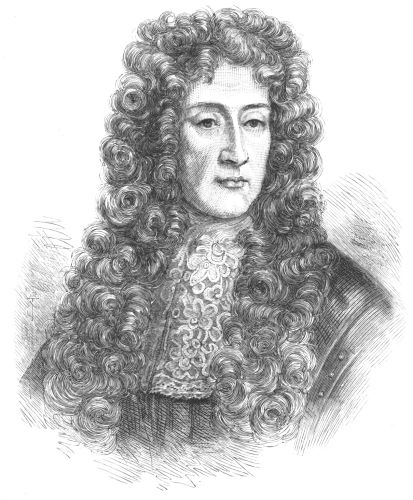
JAMES II.
[See larger version]
The meeting of Parliament on the 19th of May drew the public attention from these barbarities. Every means had been exerted to influence the elections. In the counties the reaction of Toryism, and the effects of the Rye House Plot in defeating and intimidating the Whigs, gave the Court every advantage. In the corporations the deprivation of their ancient charters made them the slaves of Government. But even with these advantages James was not satisfied. Wherever there appeared likely to be any independent spirit shown, agents were sent down to overawe the people, and to force a choice of the Government candidate. On the 22nd of May James went to the House of Lords in great state to open Parliament. He took his seat on the throne with the crown on his head, and his queen, and Anne, his daughter, Princess of Denmark, standing on the right hand of the throne. The Spanish and other Catholic ambassadors were present, and heard the Pope, the Mass, the worship of the Virgin Mary, and the saints all renounced, as the Lords took their oaths. James then produced a written speech and read it. He repeated in it what he had before declared to the Council, that he would maintain the Constitution and the Church as by law established, and added that, "Having given this assurance concerning their religion and property, they might rely on his word." Although it had been the custom to listen to the royal speech in respectful silence, at this declaration the members of both Houses broke into loud acclamations. He then informed them that he expected a revenue for life, such as they had voted his late brother. Again the expression of accord was loud and satisfactory, but what followed was not so palatable. "The inclination men have for frequent Parliaments, some may think, would be the best secured by feeding me from time to time by such proportions as they shall think convenient, and this argument, it being the first time I speak to you from the throne, I will answer once for all, that this would be a very improper method to take with me; and that the best way to engage me to meet you often is always to use me well. I expect, therefore, that you will comply with me in what I have desired, and that you will do it speedily." This agreeable assurance he followed up by announcing a rebellion to have broken out in Scotland under Argyll and other refugees from Holland.
When the Commons returned to their own House, Lord Preston entered into a high eulogium of the king, telling the House that his name spread terror over all Europe, and that the reputation of England was already beginning to rise under his rule; they had only to have full confidence in him as a prince who had never broken his word, and thus enable him to assert the dignity of England. The House went into a Committee of Supply, and voted his Majesty the same revenue that Charles had enjoyed, namely, one million two hundred thousand pounds a year for life. But when several petitions against some of the late elections were presented, a serious opposition asserted itself in a most unexpected quarter. This was from Sir Edward Seymour, of Berry Pomeroy Castle, the member for Exeter. Seymour was both a Tory and a High Churchman, proud of his descent from the Lord Protector Seymour, and who had great influence in the western counties. He was a man of indifferent moral character, but able and accomplished, and a forcible debater. He was now irritated by the Government proceedings in the elections which had interfered with his interests, and made a fierce attack on the Government pressure on the electors; denounced the removal of the charters and the conduct of the returning officers; declared that there was a design to repeal the Test and Habeas Corpus Acts, and moved that no one whose right to sit was disputed should vote till that right had been ascertained by a searching inquiry. There was no seconder to the motion, and it fell to the ground; for the whole House, including the Whigs, sat, as it were, thunderstruck. But the effect was deep and lasting, and in time did not fail of its end.
For the present, however, things went smoothly enough. The king informed the House—through Sir Dudley North, the brother of the Lord Keeper Guildford, and the person who had been elected Sheriff of London by the influence of Charles for his ready and ingenious modes of serving the royal will—that his late brother had left considerable debts, and that the naval and ordnance stores were getting low. The House promptly agreed to lay on new taxes and North induced them to tax sugar and tobacco, so that the king now had a revenue of one million nine hundred thousand pounds from England, besides his pension from France, and was strong in revenue.
The Lords were employed in doing an act of justice in calling before them Lord Danby, and rescinding the impeachment still hanging over his head, and also summoning to their bar Lords Powis, Arundel, and Bellasis, the victims of the Popish plot, and fully discharging them as well as the Earl of Tyrone. They also introduced a Bill reversing the attainder of Lord Stafford, who had been executed for treason and concern in the Popish plot, now admitting that he had been unjustly sacrificed through the perjury of Oates. The Commons were proceeding to the third reading of this Bill, when the rebellion of Monmouth was announced, and the question remained unsettled till the trial of Warren Hastings more than a century afterwards, when men of all parties declared that Oates's Popish plot was a fiction, and the attainder of Stafford was then formally reversed.
The political refugees who had fled to Holland and sought protection from Prince William were numerous, and some of them of considerable distinction. Monmouth and the Earl of Argyll were severally looked up to as the heads of the English and Scottish exiles. The furious persecution against the Covenanters in Scotland and the Whigs in England had not only swelled these bands of refugees, but rendered them at once ardent for revenge and restoration. Amongst them Ford; Lord Grey of Wark; Ferguson, who had been conspicuous among the Whig plotters; Wildman and Danvers, of the same party; Ayloffe and Wade, Whig lawyers and plotters; Goodenough, formerly Sheriff of London, who gave evidence against the Papists; Rumbold, the Rye House maltster, and others, were incessantly endeavouring to excite Monmouth to avail himself of his popularity, and the hatred of Popery which existed, to rebel against his uncle and strike for the crown. Monmouth, however, for some time betrayed no desire for so hazardous an undertaking. On the death of Charles he had returned from the Hague, to avoid giving cause of jealousy to James, and led the life of an English gentleman at Brussels. William of Orange strongly advised him to take a command in the war of Austria against the Turks, where he might win honour and a rank worthy of his birth; but Monmouth would not listen to it. He had left his wife, the great heiress of Buccleuch, to whom he had been married almost as a boy from royal policy, and had attached himself to Lady Henrietta Wentworth, Baroness Wentworth of Nettlestede. The attachment, though illicit, appeared to be mutual and ardent. Monmouth confessed that Lady Henrietta, who was beautiful, amiable, and accomplished, had weaned him from a vicious life, and had their connection been lawful, nothing could have been more fortunate for Monmouth. In her society he seemed to have grown indifferent to ambition and the life of courts. But he was beset by both Grey and Ferguson, and, unfortunately for him, they won over Lady Wentworth to their views. She encouraged Monmouth, and offered him her income and her jewels to furnish him with immediate funds. With such an advocate, Grey and Ferguson at length succeeded. Grey was a man of blemished character. He had run off with his wife's sister, a daughter of the Earl of Berkeley, and was a poor and desperate adventurer, notoriously cowardly on the field of battle. Ferguson was a fiery demagogue and zealot of insurrection. He had been a preacher and schoolmaster amongst the Dissenters, then a clergyman of the Church, and finally had become a most untiring intriguer, and was deep in the Rye House Plot. Under all this fire of rebellion, however, there was more than a suspected foul smoke of espionage. He was shrewdly believed, though not by his dupes, to be in the pay of Government, and employed to betray its enemies to ruin.
Monmouth having consented to take the lead in an invasion, though with much reluctance and many misgivings, a communication was opened with Argyll and the Scottish malcontents. We have seen that Argyll, after his father had been inveigled from his mountains and beheaded, had himself nearly suffered the same fate from James when in Scotland. He had been imprisoned and condemned to death on the most arbitrary grounds, and had only managed to escape in disguise. He had purchased an estate at Leeuwarden, in Friesland, where the great Mac Cailean More, as he was called by the Highlanders, lived in much seclusion. He was now drawn from it once more to revisit his native country at the head of an invading force. But the views of the refugees were so different, and their means so small, that it was some time before they could agree upon a common plan of action. It was at length arranged that a descent should be made simultaneously on Scotland and England—the Scottish expedition headed by Argyll, that on England by Monmouth. But to maintain a correspondence and a sort of unison, two Englishmen, Ayloffe and Rumbold the maltster, were to accompany the Scots, and two Scotsmen, Fletcher of Saltoun and Ferguson, the English force. Monmouth was sworn not to claim any rank or reward on the success of the enterprise, except such as should be awarded him by a free Parliament; and Argyll was compelled, although he had the nominal command of the army, to submit to hold it only as one of a committee of twelve, of whom Sir Patrick Hume of Polwarth was to be president.
In fact, Argyll at the outset displayed a fatal want of knowledge of human nature or firmness of resolution, in consenting to accept a command on so impossible a basis. To expect success as a military leader when hampered with the conflicting opinions of a dozen men of ultra views in religion and politics, and of domineering wills, was the height of folly. Hume, who took the lead in the committee, was a man of enormous conceit, a great talker, and a very dilatory actor. Next to him was Sir John Cochrane, the second son of Lord Dundonald, who was almost equally self-willed and jealous of the power of Argyll. With their Republican notions, they endeavoured to impose such restrictions on the power of the earl as were certain to insure the ruin of the attempt, in which everything must depend on the independent action of a single mind.
We have already noticed the character of Ferguson, one of the twain selected to accompany Monmouth. Fletcher of Saltoun, the other, was a far different man—a man of high talent, fine taste, and finished education. At the head of a popular senate he would have shone as an orator and statesman; but he had those qualities of lofty pride and headstrong will which made him by no means a desirable officer in an army of adventurers, although his military skill was undoubted. What was worse, from the very first he foreboded no good result from the expedition, and accompanied it only because he would not seem to desert his more sanguine countrymen. When Wildman and Danvers sent from London flaming accounts of the ripeness of England for revolt, and said that just two hundred years before the Earl of Richmond landed in England with a mere handful of men, and wrested the Crown from Richard, Fletcher coolly replied that there was all the difference between the fifteenth century and the seventeenth.
These men, Wildman and Danvers, represented the country as so prepared to receive Monmouth, that he had only to show his standard for whole counties to flock to it. They promised also six thousand pounds in aid of the preparations. But the fact was that little or no money came, and James and his ministers were duly informed of the measures of the insurgents, and were at once using every means with the Dutch Government to prevent the sailing of the armaments, and taking steps for the defence of the Scottish and English coasts. We may first follow the fortunes of Argyll and his associates, who sailed first. He put out from the coast of Holland on the 2nd of May, and after a prosperous voyage, sighted Kirkwall, in Orkney, on the 6th. There he very unwisely anchored, and suffered two followers to go on shore to collect intelligence. The object of his armament then became known, and was sure to reach the English Government in a little time. The Bishop of Orkney boldly ordered the two insurgents to be secured, and refused to give them up. After three days lost in endeavouring to obtain their release, they seized some gentlemen living on the coast, and offered them in exchange. The bishop paid no regard to their proposal or their menaces, and they were compelled to pursue their voyage.
The consequence of this ill-advised measure was that news of the armament was sent to Edinburgh with all speed, and whilst the invading force was beating round the northern capes and headlands, active preparations were made for defence. The whole of the militia, amounting to twenty thousand men, were called out; a third of these, accompanied by three thousand regulars, were marched into the western counties. At Dunstaffnage, Argyll sent his son Charles ashore to summon the Campbells to arms, but he returned with the report that many of the chiefs had fled or were in prison, and the rest afraid to move. At Campbelltown, in Kintyre, Argyll published a proclamation, setting forth that he came to suppress Popery, prelacy, and Erastianism, and to take the crown from James, whom he accused of persecution of the Covenanters, and the poisoning of his brother. He sent across the hills the fiery cross to summon all true men to his standard, and appointed Tarbert as the place of rendezvous. About eighteen hundred men mustered at the call, but any advantage to be derived from this handful of men was far more than counterbalanced by the pertinacious interference of Cochrane and Hume. They insisted on arranging everything, even the appointment of the officers over Argyll's own clan. They insisted also that the attack should be directed against the Lowlands, though Argyll wisely saw that they had no chance whatever in the open country with their present force. He contended that having first cleared the Western Highlands of the national soldiery, they should soon have five or six thousand Highlanders at their command, and might then descend on the Lowlands with effect. Rumbold advocated this prudential course, but all reasoning was lost on Hume and Cochrane, who insolently accused Argyll of wanting only to secure his own territories, and sailed away with part of the troops to the Lowlands. They found the coast, however, well guarded by the English ships, and escaped up the Clyde to Greenock. There they again quarrelled between themselves, and finding the people not at all disposed to join them, they returned to Argyll. But they had learned no wisdom: the earl again proposed to endeavour to secure Inverary—they as firmly opposed it. They, therefore, fixed on the castle of Ealan Ghierig as their present headquarters, landed their arms and stores, and made an officer named Elphinstone commander of the fort. Argyll and Rumbold now drove back the troops of Athol, and prepared to march on Inverary; but from this they were diverted by a call from Hume and Cochrane at the ships, who were about to be attacked by the English fleet. Argyll hastened to them, and proposed to give fight to the English, but was again prevented by these infatuated men. The earl, therefore, in utter despair, passed into Dumbartonshire, and was the very next day followed by the news of the capture of all his ships, and the flight of Elphinstone from Ealan Ghierig, without striking a blow. As a last desperate attempt, Argyll proposed to make a rush on Glasgow and secure a strong footing there; but the very men who had so strongly urged the attempt on the Lowlands now deserted him in numbers, and on the march nothing but disasters from the insubordination of the little army ensued. They were attacked on all sides by the militia, and when the earl and Ayloffe advised a bold attack on the enemy, Hume and his partisans protested against it. The end of all was that, becoming involved amongst morasses, the army was seized with panic, and rapidly melted away. The wrong-headed Hume escaped, and reached the Continent; Cochrane was taken, and soon after Rumbold, Major Fullerton, and Argyll himself were seized.
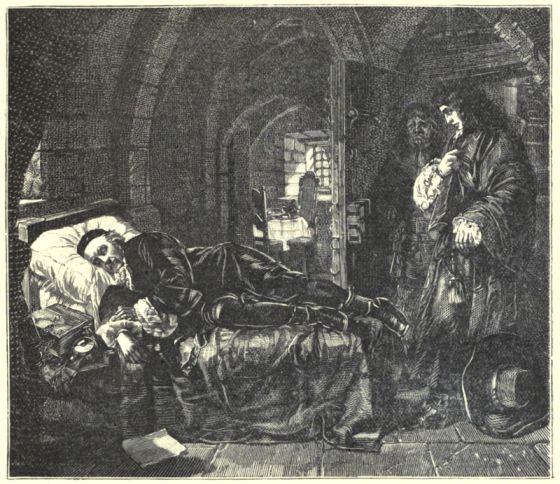
THE LAST SLEEP OF ARGYLL. (See p. 297.)
(From the Fresco by E. M. Ward, R.A., in the House of Commons.)
[See larger version]
The conduct of Argyll after his capture was distinguished by a calm dignity which showed how superior he was to the factious, pugnacious men who had baffled all his plans. With his arms pinioned behind him, he was led bareheaded through the streets of Edinburgh, from Holyrood to the castle. The Royalists thus revelled in revenging on the son the act of his father thirty-five years before, when he caused Montrose to be conducted over the very same ground. The headsman marched before him with his axe, and on reaching his cell in the castle Argyll was put into irons, and informed that his execution would quickly follow. This was the 20th of June; his execution did not take place till the 30th. During the ten days the orders of James were that he should be tried all ways to compel him to confess the full particulars of the invasion, its originators, supporters, and participators. It was understood that James meant that his favourite application of the boots and thumbscrews should be used, but this was not attempted. Argyll was menaced, but his firm refusal to reveal anything that would incriminate others, convinced his enemies that it was useless, and could only cover them with odium. The last day of his life he lay down to rest, ere the hour of his execution should arrive. During his sleep, a renegade Privy Councillor insisted on entering his cell. The door was gently opened, and there lay the great Argyll in heavy chains and sleeping the happy sleep of infancy. The beholder turned and fled, sick at heart. His former sentence of death was deemed sufficient to supersede any fresh trial, and being brought out to the scaffold, and saying that he died in peace with all men, one of the Episcopalian clergymen stepped to the edge of the scaffold and exclaimed to the people, "My lord dies a Protestant." "Yes," said the earl, also going forward, "a Protestant, and cordial hater of Popery, prelacy, and all superstition." His head was fixed on the top of the Tolbooth, where that of Montrose had formerly stood.
On the 30th of May, nearly a month after the sailing of Argyll, Monmouth left the Texel. His squadron consisted of a frigate of thirty-two guns, called the Helderenbergh, and three small tenders, a fourth tender having been refused by the Dutch. He was attended by about eighty officers, and a hundred and fifty men of different degrees, fugitives from England and Scotland. With such a force he proposed to conquer the crown of England! All the fine promises of money by Wildman and Danvers had ended in smoke, and he had only been able, chiefly through the revenues of Lady Henrietta Wentworth, to supply himself with arms and stores for a small body of cavalry and infantry. The voyage was long and tedious, the weather was stormy, and the Channel abounded with the royal cruisers. On the morning of the 11th of June his little fleet appeared off the port of Lyme, in Dorsetshire.
Monmouth was extremely popular with the people, and on discovering that it was their favourite hero come to put down the Popish tyrant, he was received with loud acclamations. "Monmouth and the Protestant religion!" was the cry. There was a rush to enlist beneath his banners, and within four-and-twenty hours he was at the head of fifteen hundred men. Dare, one of the adventurers, had been put ashore as they came along the coast to ride across the country and rouse the people of Taunton, and he now came in at the head of about forty horsemen, with the news that the people of Somersetshire were in favour of his cause. But with this arrival came the tidings that the Dorsetshire and Somersetshire folk were mustering at Bridport to attack them, and Monmouth ordered Lord Grey, who was the commander of the cavalry, to march there at once, and disperse them before they had collected in strength. But here an incident occurred which showed the unruly materials that he had to work with. Dare had mounted himself on a fine horse in his expedition to Taunton, and Fletcher of Saltoun, who was second in command of the cavalry under Grey, without asking leave of Dare, as superior officer, and being himself badly mounted, took possession of his horse. Dare refused to let him have it, they came to high words, Dare shook his whip at Fletcher, and the proud Scot drew his pistol and shot Dare dead on the spot. This summary proceeding, which might have passed in the ruder country of Scotland, created a violent outburst amongst the soldiers of Monmouth. They demanded of the duke instant execution of the murderer, and it was only by getting on board the Helderenbergh that Fletcher escaped with his life. He returned to Holland, and thus was lost to the expedition almost its only man of any talent and experience.
The next morning Grey, accompanied by Wade, led forth his untrained cavalry to attack the militia at Bridport. There was a smart brush with the militia, in which Monmouth's raw soldiers fought bravely, and would have driven the enemy from the place, but Grey, who was an arrant coward in the field, turned his horse and fled, never drawing bit till he reached Lyme. The men were indignant, and Monmouth was confounded with this conduct of his chief officer; but nevertheless he had not moral firmness to put some more trusty officer in his place. Four days after his landing, the 15th of June, Monmouth marched forward to Axminster, where he encountered Christopher Monk, Duke of Albemarle, the son of the first General Monk, at the head of four thousand men of the trained bands. Though daunted at first, Monmouth accepted the situation, and disposed his men admirably for a fight. He drew up the main body in battle array on advantageous ground, sent out his skirmishers to the front, and, as a last precaution, lined the hedges of a narrow lane, through which Albemarle must pass to come at him, with musketeers. Monk, however, was too cautious to risk a pitched battle on these terms—the more especially as his own forces were untrustworthy. There appeared so much enthusiasm for Monmouth amongst his troops that, fearing their desertion, he drew back. The result was that the whole body was speedily thrown into disorder, that panic seized them, and that they fled pell-mell towards Exeter, flinging away their arms and uniforms to expedite their escape. Monmouth, however, probably not aware of the extent of the rout, steadily pursued his march to Chard, and thence to Taunton, where he arrived on the 18th of June, just a week after his landing, and was received by the whole place with the warmest demonstrations of joy.
All this seemed auspicious and encouraging, but it did not satisfy Monmouth. He knew that, without the adhesion of the army and the leading gentry, he should never make his way to the crown. Their adhesion had been promised him, but where were they? Not a regiment had given a sign of being ready to join him. Lords Macclesfield, Brandon, Delamere, and other Whig noblemen—who, he had been assured, would instantly fly to his standard—lay all still. Trenchard of Taunton, who had promised to join him, unlike his townsmen, fled at his approach, and made his way into Holland, to the Prince of Orange. Wildman, who had promised such wonders of county support and of money, did not appear. On the contrary, the nobility and gentry from all parts of the country, with the clergy, were pouring in addresses of attachment and support to James. Parliament, both Lords and Commons, displayed the same spirit.
The common people might believe that the son of Lucy Walters was legitimate, but the educated classes knew better, and that Monmouth could never be king. Parliament, therefore, at once voted James four hundred thousand pounds for present necessities, and laid new taxes for five years on foreign silks, linen, and spirits. They ordered Monmouth's declaration to be burnt by the hangman, and rapidly passed against him a Bill of Attainder, setting a reward of five thousand pounds on his head. They were ready to go farther, and the Commons actually passed a Bill for the preservation of the king's person and government, making it high treason to say that Monmouth was legitimate, or to make any motion in Parliament to alter the succession. But James, knowing the uselessness of any such Act, adjourned Parliament without waiting for the Act passing the Lords, and dismissed the nobles and gentry to defend his interests in their different localities. He took care, however, to revive the censorship of the press, which had expired in 1679.
When Monmouth, with consternation, noted these adverse circumstances, Ferguson was ready with a reason. It was that Monmouth had committed a capital error in not taking the title of king. The style and title of king, he asserted, carried a wonderful weight with the English. But of this right he had deprived himself by abjuring this title and leaving it entirely to James. The majority would fight for the man who was in possession of the royal name, but for whom were they to fight who fought for Monmouth? Nobody could tell, and the result must be discouragement. Grey seconded Ferguson: Wade and the Republicans opposed the scheme. But probably Monmouth was only too willing to be persuaded, and, accordingly, on the 20th of June, he was proclaimed in the market-place of Taunton. As the names of both rivals were James, and James II. would continue to mean James who now had that title, Monmouth was styled King Monmouth. Immediately on taking this step, Monmouth issued four proclamations. Following the example of James, he set a price on the head of James, late Duke of York; declared the Parliament sitting at Westminster an unlawful assembly, and ordered it to disperse; forbade the people to pay taxes to the usurper; and proclaimed Albemarle a traitor, unless he forthwith repaired to the standard of King Monmouth, where he would be cordially received.
Almost every part of this proceeding was a gross political blunder. By assuming the royal title he lost nearly everything, and gained nothing. He offended the Republican party, and divided the allegiance of his little army, some of the most energetic of whose officers, as Wade and others, were of that political faith. He offended that great Protestant party which was looking forward to the Protestant succession of William of Orange and the Princess Mary, and in case of their want of issue to the Princess Anne. He cut off all retreat to Holland in case of failure, and all hope of mercy from James if he fell into his hands. By pledging himself on landing not to aspire to the crown, and thus immediately breaking his pledge, he inspired the thinking portion of the people with deep distrust, as inducing the same disregard of his word as had been so long conspicuous in the Stuarts. With all the influential Protestants who might have joined him, so soon as events gave hope of success, considering him the champion of a Protestant succession, he had placed himself in a hopeless position, because that succession could only come through a legitimate issue. By denouncing the Parliament that body became his mortal foes. The only party from which he could now expect any support was the people, and without means, without leaders, without military training, the result could only be failure, utter and fearful.
And despite the persuasions of Ferguson, the melancholy truth seemed already to stare the unhappy Monmouth in the face. He received a secret answer from Albemarle, addressed to James Scott, late Duke of Monmouth, telling him that he knew who was his lawful king, and that he had better have let rebellion alone. As he rode out of Taunton on the 22nd of June towards Bridgewater, it was remarked that he looked gloomy and dejected; the very people who crowded in the road to greet him with huzzas, could not help remarking how different was the expression of his countenance to what it had been in his gay procession there five years before. The only man who seemed elated with anticipation of triumph was Ferguson, and if, as is suspected to have been the case, he were playing the traitor to the unfortunate Monmouth, he might now well grow confident of his diabolical success.
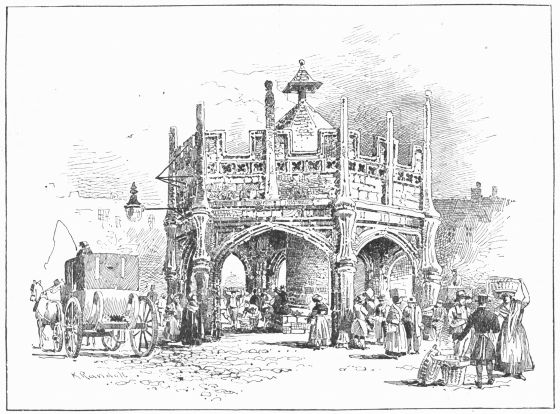
THE CROSS, BRIDGEWATER, WHERE MONMOUTH WAS PROCLAIMED KING.
[See larger version]
On reaching Bridgewater, where there existed a strong Whig body, Monmouth was again well received. The mayor and aldermen in their robes welcomed him, and preceded him in procession to the Cross, where they proclaimed him king. He took up his abode in the castle, encamped his army on the castle field, and crowds rushed to enlist in his service. His army already amounted to six thousand men, and might soon have been doubled or trebled; but his scanty supply of arms and equipments was already exhausted. He had no money, and men without weapons were useless. Numbers of them endeavoured to arm themselves, mob-fashion, with scythes, pitchforks, and other implements of husbandry and of mining.
Meanwhile, troops were drawing from all quarters, and preparing to overwhelm the invaders. Lord Feversham and Churchill, afterwards Marlborough, were ordered to march with strong bodies of troops to the West. Churchill was already arrived, and Feversham rapidly approaching. The militias of Sussex and Oxfordshire were drawing that way, followed by bodies of volunteer gownsmen from Oxford. To prevent any of the Whig party from affording Monmouth aid, they and the Nonconformists were closely watched, and many seized and imprisoned.
From Bridgewater Monmouth advanced to Glastonbury, and thence to Wells and Shepton Mallet. He appeared to have no precise object, but to seek reinforcements; from Shepton Mallet he directed his march on Bristol, which was only defended by the Duke of Beaufort and the muster of his tenantry. Bristol, once gained, would give them a strong position, and afford large supplies of money, stores, and arms. But Churchill harassed his rear on the march, and to reach the Gloucestershire side of the town, which was easiest of assault it was necessary to march round by Keynsham Bridge, which was partly destroyed. Men were despatched to repair it, and Monmouth following, on the 24th of June was at Ponsford, within five miles of the city. On reaching Keynsham Bridge, it was found to be repaired, but they were there encountered by a body of Life Guards under Colonel Oglethorpe, and Bristol having received reinforcements, the attack on it was abandoned. It was then proposed to get across the Severn and march for Shropshire and Cheshire, where he had been enthusiastically received in his progress; but the plan was not deemed practicable, and he advanced to Bath, which was too strongly garrisoned to make any impression upon. On the 26th they halted at Philip's Norton.
Feversham was now at their heels, and attacked them, the charge being led by the Duke of Grafton—the son of Charles and the Duchess of Cleveland—who fought bravely, but was repulsed. Monmouth, however, took advantage of the night to steal away to Frome, which was well affected to his cause, but had been just visited and disarmed by the Earl of Pembroke with the Wiltshire militia. The night march thither had been through torrents of rain and muddy roads; Frome could afford neither assistance nor protection; and, to add to his disappointment, here news reached him of the total failure of Argyll's expedition into Scotland, and that Feversham was now joined by his artillery and was in pursuit of him. Under these disastrous circumstances, and not a man of note, not a regiment of regulars or militia (as had been so liberally promised him by Wildman and Danvers) having come over to him, Monmouth bitterly cursed his folly in having listened to them, and resolved to ride off with his chief adherents, and get back to the Continent and his beloved Lady Wentworth. But from this ignominious idea he was dissuaded by Lord Grey, and they retreated again towards Bridgewater, where a report represented fresh assembling of armed peasantry. They reached that town on the 2nd of July, and, whilst throwing up trenches for defence, on the 5th Feversham arrived with about five thousand men, and pitched his tents on Sedgemoor, about three miles from the town. Feversham himself, with the cavalry at Weston Zoyland, and the Earl of Pembroke with the Wiltshire militia, about fifteen hundred in number, camped at the village of Middlezoy. Monmouth and his officers ascended the tower of the church and beheld the disposition of the enemy. Sedgemoor had formerly been a vast marsh, where Alfred, in his time, had sought a retreat from the triumphant Danes, and it was now intersected by several deep ditches, as most fen lands are, behind which the royal army lay. Near Chedzoy were some regiments of infantry which Monmouth had formerly commanded at Bothwell Bridge.
It was reported that the soldiers were left, by the reckless incapacity of the general, to drink cider and preserve little watch; and Monmouth, who saw that they lay in a very unconnected condition, conceived that by a skilful night attack he could easily surprise them. The gormandising incapacity of Louis Duras, now Lord Feversham, a foreigner who had been advanced by Charles II., was notorious, and the transcendent military talents of Churchill, who was in subordinate command, were yet little known. Preparations were therefore instantly made for the surprise. Scouts were sent out to reconnoitre the ground, who reported that two deep ditches full of mud and water lay between them and the hostile camp, which would have to be passed. At eleven o'clock at night the troops, with "Soho" for their watchword, marched out of Bridgewater in profound silence, taking a circuitous route, which would make the march about six miles. It was a moonlight night, but the moor lay enveloped in a thick fog, and about one in the morning the troops of Monmouth approached the royal camp. Their guides conducted the soldiers by a causeway over each of the two ditches, and Monmouth drew up his men for the attack, but by accident a pistol went off; the sentinels of the division of the army—the Foot Guards—which lay in front of them, were alarmed, and, listening, became aware of the trampling of the rebels as they were forming in rank. They fired their carbines and flew to rouse the camp. There was an instant galloping and running in all directions. Feversham and the chief officers were aroused, and drums beat to arms, and the men ran to get into rank. No time was to be lost, and Monmouth ordered Grey to dash forward with the cavalry, but he was suddenly brought to a halt by a third dyke, of which they had no information. The Foot Guards on the other side of the dyke demanded who was there, and on the cry of "King Monmouth!" they discharged a volley of musketry with such effect, that the untrained horses of Grey's cavalry became at once unmanageable; the men, thrown into confusion, were seized with panic and fled wherever they could find a way or their horses chose to carry them. Grey, as usual, was in the van of the fugitives. But, on the other hand, Monmouth came now rushing forward with his infantry, and, in his turn, finding himself stopped by the muddy dyke, he fired across it at the enemy, and a fierce fight took place, which was maintained for three-quarters of an hour. Nothing could be more brave and determined than Monmouth and his peasant soldiers. But day was now breaking, the cavalry of Feversham, and the infantry of Churchill, were bearing down on their flanks from different quarters, and Monmouth, then seeing that his defeat was inevitable, forgot the hero and rode off to save his life, leaving his brave, misguided followers to their fate. If anything could have added to the base ignominy of Monmouth's desertion of his adherents, it was the undaunted courage which they showed even when abandoned. They stood boldly to their charge; they cut down the horsemen with their scythes, or knocked them from their saddles with the butt end of their guns; they repulsed the vigorous attack of Oglethorpe, and left Sarsfield for dead on the field. But, unfortunately, their powder failed, and they cried out for fresh supplies in vain. The men with the ammunition waggons had followed the flight of the cavalry, and driven far away from the field. Still the brave peasantry and soldiers fought desperately with their scythes and gunstocks, till the cannon was brought to bear on them, and mowed them down in heaps. As they began to give way the royal cavalry charged upon them from the flank, the infantry poured across the ditch, the stout men, worthy of a better fate and leader, were overwhelmed and broke, but not before a thousand of them lay dead on the moor, or before they had killed or wounded more than three hundred of the king's troops.
The unfortunate rebels were pursued with fury, and hunted through the day out of the neighbouring villages, whither they had flown for concealment. The road towards Bridgewater was crowded with flying men and infuriated troopers following and cutting them down. Many of those who rushed frantically into the streets of Bridgewater fell and died there of their wounds, for the soldiers, who were treated by the farmers to hogsheads of cider, were drunk with drinking, with blood and fury. A vast number of prisoners were secured, for they were a profitable article of merchandise in the Plantations; five hundred were crowded into the single church of Weston Zoyland, and the battle and pursuit being over, the conqueror commenced that exhibition of vengeance which was always so dear to James. Gibbets were erected by the wayside, leading from the battle-field to Bridgewater, and no less than twenty of the prisoners were hanging on them. The peasantry were compelled to bury the slain, and those most suspected of favouring the rebels were set to quarter the victims who were to be suspended in chains. Meanwhile Monmouth, Grey, and Buyse, the Brandenburger, were flying for their lives. They took the north road, hoping to escape into Wales. At Chedzoy Monmouth drew up a moment to hide his George and procure a fresh horse. From the summit of a hill they turned and saw the final defeat and slaughter of their deluded followers. They pushed forward for the Mendip Hills, and then directed their course towards the New Forest, hoping to obtain some vessel on that coast to convey them to the Continent. On Cranborne Chase their horses were completely exhausted; they therefore turned them loose, hid their saddles and bridles, and proceeded on foot. But the news of the defeat of the rebels had travelled as fast as they, and in the neighbourhood of Ringwood and Poole parties of cavalry were out scouring the country, in hopes of the reward of five thousand pounds for Monmouth. Lord Lumley and Sir William Portman, the commanders, agreed to divide the sum among their parties if successful, and early on the morning of the 7th, Grey and the guide were taken at the junction of the two cross roads. This gave proof that the more important prize was not far off. The officers enclosed a wide circle of land, within which they imagined Monmouth and Buyse must yet be concealed; and at five the next morning the Brandenburger was discovered. He confessed that he had parted from Monmouth only four hours before, and the search was renewed with redoubled eagerness. The place was a network of small enclosures, partly cultivated and covered with growing crops of pease, beans, and corn, partly overrun with fern and brambles. The crops and thickets were trodden and beaten down systematically in the search, and at seven o'clock Monmouth himself was discovered in a ditch covered with fern.
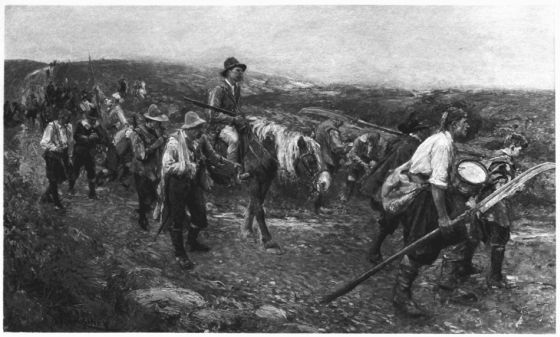
"AFTER SEDGEMOOR."
From the Painting by W. Rainey, R.I.
[See larger version]
Monmouth, though mild and agreeable in his manners, had never displayed any high moral qualities. Indeed, if we bear in mind the frivolous and debauched character of the Court in which he had grown up, whether it were the Court of the exile or of the restored king, it would have been wonderful if he had. He was handsome, gay, good-natured, but dissolute and unprincipled. He was ready to conspire against his father or his uncle, to profess the utmost contrition when defeated, and to forget it as soon as forgiven. He has been properly described as the Absalom of modern times. If he merely deserted his miserable followers on the battle-field, he now more meanly deserted his own dignity. He continued, from the moment of his capture to that when he ascended the scaffold, prostrating himself in the dust of abasement, and begging for his life in the most unmanly terms. He wrote to James instantly from Ringwood, so that his humble and agonised entreaties for forgiveness would arrive with the news of his arrest. James admitted the crawling supplicant to the desired interview, but it was in the hope of the promised word of wondrous revelation, not with any intention of pardoning him. He got him to sign a declaration that his father had assured him that he was never married to his mother, and then coolly told him that his crime was of too grave a dye to be forgiven. The queen, who was the only person present besides James and the two Secretaries of State, Sunderland and Middleton, is said to have insulted him in a most merciless and unwomanly manner. When, therefore, Monmouth saw that nothing but his death would satisfy the king and queen, he appeared to resume his courage and fortitude, and rising with an air of dignity, he was taken away. But his apparent firmness lasted only till he was out of their presence. On his way to the Tower he entreated Lord Dartmouth to intercede for him—"I know, my lord," he said, "that you loved my father; for his sake, for God's sake, endeavour to obtain mercy for me." But Dartmouth replied that there could be no pardon for one who had assumed the royal title. Grey displayed a much more manly behaviour. In the presence of the king he admitted his guilt, but did not even ask forgiveness. As Monmouth was under attainder, no trial was deemed necessary, and it was determined that he should be executed on Wednesday morning, the next day but one. On the fatal morning of the 15th he was visited by Dr. Tenison, afterwards archbishop, who discoursed with him, but not very profitably, on the errors of his ways. Before setting out for the scaffold, his wife and children came to take leave of him. Lady Monmouth was deeply moved; Monmouth himself spoke kindly to her, but was cold and passionless. When the hour arrived, he went to execution with the same courage that he had always gone into battle. He was no more the cringing, weeping supplicant, but a man who had made up his mind to die. A disgusting scene of butchery followed, owing to the nervousness of the executioner. The populace were so enraged at the man's clumsiness, that they would have torn him to pieces if they could have got at him. Many rushed forward to dip their handkerchiefs in Monmouth's blood, and the barbarous circumstances of his execution and the unfeeling persecution of the prelates, did not a little to restore his fame as a martyr to liberty and Protestantism.
Whilst these things were going on in London, the unfortunate people in the West were suffering a dreadful penalty for their adherence to Monmouth. Feversham was called to town, and covered with honours and rewards, though it was notorious that he had done nothing towards the victory. Buckingham even declared that he had won the battle of Sedgemoor in bed. In his place was left one of the most ferocious and unprincipled monsters that ever disgraced the name of soldier. This was Colonel Kirke, who had been governor of Tangier until it was abandoned, and now practised the cruelties that he had learned in his unrestrained command there. In that Settlement, left to do his licentious will on those in his power, he acquired a name for arbitrary, oppressive, and dissolute conduct, which in ordinary times would have insured his death. He now commanded the demoralised soldiers that he had brought back with him, and who, whilst they were capable of every atrocity, were called "Kirke's lambs," because, as a Christian regiment sent against the heathen, they bore on their banner the desecrated sign of the Lamb. His debauched myrmidons were let loose on the inhabitants of Somersetshire, and such as they could not extort money from, they accused on the evidence of the most abandoned miscreants, and hanged and quartered, boiling the quarters in pitch, to make them longer endure the weather on their gibbets. The most horrible traditions still remain of Kirke and his lambs. He and his officers are said to have caused the unhappy wretches brought in, who were not able to pay a heavy ransom, to be hanged on the sign-post of the inn where they messed, and to have caused the drums to beat as they were in the agonies of death, saying they would give them music to their dancing. To prolong their sufferings, Kirke would occasionally have them cut down alive, and then hung up again; and such numbers were quartered, that the miserable peasants compelled to do that revolting work, were said to stand ankle deep in blood. All this was duly reported to the king in London, who directed Lord Sunderland to assure Kirke that "he was very well satisfied with his proceedings." It was asserted in London that in the single week following the battle, Kirke butchered a hundred of his victims, besides pocketing large sums for the ransom of others, yet he declared that he had not gone to the lengths to which he was ordered. On the 10th of August he was sent for to Court, to state personally the condition of the West, James being apprehensive that he had let the rich delinquents escape for money, and the system of butchery was left to Colonel Trelawny, who continued it without intermission, soldiers pillaging the wretched inhabitants, or dragging them away to execution under the forms of martial law. But a still more sweeping and systematic slaughter was speedily initiated under a different class of exterminators—butchers in ermine.
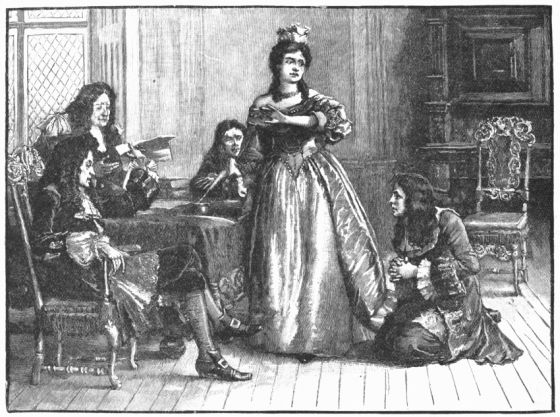
MONMOUTH'S INTERVIEW WITH THE KING. (See p. 303.)
[See larger version]
Lord Chief Justice Jeffreys, the most diabolical judge that ever sat on the bench—now rendered furious by nightly debauch and daily commission of cruelties; in his revels hugging in mawkish and disgusting fondness his brutal companions; in his discharge of his judicial duties passing the most barbarous sentences in the most blackguard and vituperative language; in whose blazing eye, distorted visage, and bellowing voice raged the unmitigated fiend,—was sent forth by his delighted master to consummate his vengeance on the unhappy people whom the soldiers had left alive and cooped up in prison. He was already created Baron of Wem, dubbed by the people Earl of Flint, and, the Lord Keeper just now dying, he was promised the Great Seal if he shed blood enough to satisfy his ruthless king. Four other judges were associated with him, rather for form than for anything else, for Jeffreys was the hardened, daring, and unscrupulous instrument on whom James confidently relied.
Jeffreys' Bloody Assize, as it was then and always has been termed, both from its wholesale slaughter and from the troops which accompanied him throughout the circuit—a name constantly used by the unfeeling king himself—was opened at Winchester on the 27th of August, and commenced with a case of hitherto unexampled ruthlessness. Mrs. Alice Lisle—or, as she was generally called, Lady Alice, her husband, one of the judges of Charles I., having been created a lord by Cromwell—was now an infirm and aged woman, deaf and lethargic. Her husband had been murdered, as we have related, by the Royalists, as he was entering the church at Lausanne. Lady Alice was known far and wide for her benevolence. Though her husband was on the other side, she had always shown active kindness to the followers of the king during the Civil War, and on this account, after her husband's death, his estate had been granted to her. During the rebellion of Monmouth her son had served in the king's army against the invader; yet this poor old lady was now accused of having given a night's shelter to Hicks, a Nonconformist minister, and Nelthorpe, a lawyer, outlawed for his concern in the Rye House Plot. They were fugitives from Sedgemoor, and the law of treason was that he who harbours a traitor is liable to death, the punishment of a traitor. Mrs. Lisle had no counsel, and pleaded that though she knew that Hicks was a Presbyterian minister, she did not know that he and Nelthorpe were concerned in the rebellion, and there was no direct proof of the fact.
Jeffreys terrified the witnesses, and then came the turn of the jury. They retired to consult, but not coming to a speedy conclusion, for they were afraid of the judge, and yet loth to condemn the prisoner, Jeffreys sent them word that if they did not agree he would lock them up all night. They then came into court and expressed their doubts of Mrs. Lisle knowing that Hicks had been with Monmouth. Jeffreys told them that their doubt was altogether groundless, and sent them back to agree. Again they returned, unable to get rid of their doubt. Then Jeffreys thundered against them in his fiercest style, and declared that were he on the jury, he would have found her guilty had she been his own mother. At length the jury gave way and brought in a verdict of guilty. The next morning Jeffreys pronounced sentence upon her amid a storm of vituperation against the Presbyterians, to whom he supposed Mrs. Lisle belonged. He ordered her, according to the rigour of the old law of treason, to be burned alive that very afternoon.
This monstrous sentence thoroughly roused the inhabitants of the place; and the clergy of the cathedral, the staunchest supporters of the king's beloved arbitrary power, remonstrated with Jeffreys in such a manner, that he consented to a respite of five days, in order that application might be made to the king. The clergy sent a deputation to James, earnestly interceding for the life of the aged woman, on the ground of her generous conduct on all occasions to the king's friends. Ladies of high rank, amongst them the Ladies St. John and Abergavenny, pleaded tenderly for her life. Feversham, moved by a bribe of a thousand pounds, joined in the entreaty, but nothing could move that obdurate heart, and all the favour that James would grant her was that she should be beheaded instead of burnt. Her execution, accordingly, took place at Winchester on the 2nd of September, and James II. won the unenviable notoriety of being the only tyrant in England, however implacable, who had ever dyed his hands in woman's blood for the merciful deed of attempting to save the lives of the unfortunate. What made this case worse was, that neither Hicks nor Nelthorpe had yet been tried, so that the trial of Mrs. Lisle was altogether illegal, and the forcing of the jury completed one of the most diabolical instances of judicial murder on record.
From Winchester Jeffreys proceeded to Dorchester. He came surrounded by still more troops, and, in fact, rather like a general to take bloody vengeance, than as a judge to make a just example of the guilty, mingled with mercy, on account of the ignorance of the offenders. The ferocious tyrant was rendered more ferocious, from his temper being exasperated by the agonies of the stone which his drunken habits had inflicted on him. He had the court hung with scarlet, as if to announce his sanguinary determination. When the clergyman who preached before him recommended mercy in his sermon, he was seen to make a horrible grimace, expressive of his savage disdain of such a sentiment. It was whilst preparing to judge the three hundred prisoners collected there, that he received the news of his elevation to the woolsack. He had received orders from James to make effectual work with the rebels, and he now adopted a mode of despatching the unhappy wretches in wholesale style. As it would be a very tedious work to try all that number one by one, he devised a more expeditious plan. He sent two officers to them into the prison, offering them mercy or certain death. All who chose to make confession of their guilt should be treated with clemency, all who refused should be led to immediate execution. His clemency amounted to a respite of a day or two—he hanged them all the same. Writing to Sunderland, Jeffreys said on the 16th of September:—"This day I began with the rebels, and have despatched ninety-eight." Of the three hundred, two hundred and ninety-two received sentence of death. Eighty only were hanged, the rest were, for the most part, sent to the Plantations as slaves.
From Dorchester he went to Exeter, where two hundred and forty-three prisoners awaited their doom. He proceeded in the same way, and condemned the whole body in a batch, and as they saved him much trouble, he did not hang so many of them. Taunton, the capital of Somersetshire, the county where the rebellion was the strongest, presented him with no fewer than a thousand prisoners. Here he perfectly revelled in his bloody task. The work seemed to have the effect of brandy or champagne upon him. He grew every day more exuberant and riotous. He was in such a state of excitement from morning to night, that many thought him drunk the whole time. He laughed like a maniac, bellowed, scolded, cut his filthy jokes on the astounded prisoners, and was more like an exulting demon than a man. There were two hundred and thirty-three prisoners hanged, drawn, and quartered in a few days. The whole number hanged in this bloody campaign has been variously stated at from three to seven hundred. Probably the medium is the most correct. But so many were hung in chains, or their jointed quarters and limbs displayed on the highways, village greens, and in the market-places, that the whole country was infected with the intolerable stench. Some of their heads were nailed on the porches of parish churches; the whole district was a perfect Golgotha. It was in vain that the most distinguished people endeavoured to check the infuriated judge's rage; he only turned his evil diatribes on them, and gave them what he called "a lick with the rough side of his tongue." Because Lord Stowell, a Royalist, complained of the remorseless butchery of the poor people of his neighbourhood, he gibbeted a corpse at his park gate.
The fate of the transported prisoners was worse than death itself. They were eight hundred and forty in number, and were granted as favours to the courtiers. Jeffreys estimated that they were, on an average, worth from ten pounds to fifteen pounds apiece to the grantee. They were not to be shipped to New England or New Jersey, because the Puritan inhabitants might have a sympathy with them on account of their religion, and mitigate the hardship of their lot. They were to go to the West Indies, where they were to be slaves, and not acquire their freedom for ten years. They were transported in small vessels with all the horrors of the slave trade. They were crowded so that they had not room for lying down all at once; were never allowed to go on deck; and in darkness, starvation, and pestiferous stench, they died daily in such quantities that the loss of one-fifth of them was calculated on. The rest reached the Plantations, ghastly, emaciated, and all but lifeless. Even the innocent school girls, many under ten years of age, at Taunton, who had gone in procession to present a banner to Monmouth, at the command of their mistress, were not excused. The queen, who had never preferred a single prayer to her husband for mercy to the victims of this unprecedented proscription, was eager to participate in the profit, and had a hundred sentenced men awarded to her, the profit on which was calculated at one thousand pounds. Her maids of honour solicited a share of this blood-money, and had a fine of seven thousand pounds on these poor girls assigned to them.
The only persons who escaped from this sea of blood were Grey, Sir John Cochrane, who had been in Argyll's expedition, Storey, who had been commissary to Monmouth's army, Wade, Goodenough, and Ferguson. All these owed their escape to money or their secret services in giving information against their old friends, except Ferguson, who by some means escaped to the Continent. On the other hand, Bateman, the surgeon who had bled Oates in Newgate after his scourging, and by his attentions saved his life, was, for a mere duty of his profession, arrested, tried, hanged, and quartered.
James now seemed at the summit of his ambition. He had established an actual reign of terror. The dreadful massacre of the West struck dumb the most courageous, and this gloomy tyrant gave full play to his love of cruelty. The Nonconformists were everywhere beset by informers, who imprisoned, robbed, and abused them at pleasure. They could only meet for worship in the most obscure places and in the most secret manner. Their houses were broken into and searched on pretence of discovering conventicles. Their ministers were seized and thrust into prison. Baxter was there; Howe was obliged to escape abroad. Never, even in the time of Laud, had the oppression been so universal and crushing. All spirit of resistance appeared to be quenched in terror. The close of the year 1685 was long remembered as one of indescribable and unexampled depression and speechless misery.
James, on the contrary, never was so triumphant. He believed that he had now struck effectual terror into the country, and might rule at will. He had increased the army, and openly declared the necessity of increasing it further. He had in many instances dispensed with the Test Act in giving many commissions in the army to Catholics, and he resolved to abolish both that Act and the Habeas Corpus Act. His great design was to restore the Roman religion to full liberty in England; he believed that he was able now to accomplish that daring deed. Parliament was to meet in the beginning of November, and he announced to his Cabinet his intention to have the Test Act repealed by it, or, if it refused, to dispense with it by his own authority. This declaration produced the utmost consternation. Halifax, however, was the only member who dared to warn him of the consequences, and avowed that he would be compelled to oppose the measure. James endeavoured to win him over to his views, but finding it vain, determined to dismiss him from office. His more prudent Councillors cautioned him against such an act on the eve of the meeting of Parliament, on the ground that Halifax possessed great influence, and might head a dangerous opposition. But James was the last man to see danger ahead, and Halifax ceased to be President of the Council. The news was received with astonishment in England, with exultation in Paris, and with discontent at the Hague.
The dismissal of Halifax produced a great sensation out of doors. The Opposition gathered new courage. Danby and his party showed themselves early to coalesce with the adherents of Halifax. The whispered assurance that Halifax was dismissed for refusing to betray the Test and Habeas Corpus Acts created general alarm, and even the leading officers of the army did not hesitate to express their disapprobation. Just at this crisis, only a week before Parliament would assemble, came the news of the revocation of the Edict of Nantes by Louis XIV. This Edict had been issued under the ministry of Richelieu, and had closed the long and bloody war between Catholic France and its Protestant subjects. Under certain restrictions the Huguenots were tolerated, and were contented. But Louis, urged by the Jesuits, had long been infringing on the conditions of the treaty. He had dismissed all Huguenots from his service, had forbade them to be admitted to the profession of the law, and compelled Protestant children to be educated by Catholics. Now at length he abolished the Edict altogether, by which the Huguenots were once more at the mercy of dragoons and ruffian informers and constables. Their ministers were banished, their children torn from them, and sent to be educated in convents. The unhappy people seeing nothing but destruction before them, fled out of the kingdom on all sides. No less than fifty thousand families were said to have quitted France, some of them of high rank and name, the bulk of them weavers in silk and stuffs, hatters, and artificers of various kinds. Many settled in London, where they introduced silk weaving, and where their descendants yet remain, still bearing their French names, in Bethnal Green and Spitalfields. Others carried their manufacturing industry to Saxony, and others emigrated to the Cape as vine growers. France, by this blind act of bigotry, lost a host of her best citizens, and had her arts carried to her rivals.
This was a terrible blow to the scheme of James for restoring Romanism to power in England. The people justly said, if a politic monarch like Louis could not refrain at such a serious cost from persecuting Protestants, what was England to expect should Romanism gain the ascendency here, under a bigoted and narrow-minded king like James? James himself saw the full extent of the, to him, inopportune occurrence, and professed to join heartily in the universal outcry of Europe, not excepting the very Pope himself, and Spain, the land of Jesuits and inquisitions; for those parties who were suffering from the aggressions of Louis found it, like James, convenient to make an outcry. What more irritated James was an address which the French clergy in a body had presented to Louis, applauding the deed and declaring that the pious king of England was looking to Louis for his aid in reducing his heretical subjects. This address was read with astonishment and terror by the English people, and James hastened to condemn the revocation of the Edict, and to promote and contribute to the relief of the refugees who had sought shelter here. This affected sympathy did not last long.
On the 9th of November James met his Parliament. He congratulated them on the suppression of the rebellion in the West, but observed that it had shown how little dependence could be placed on the militia. It would be necessary to maintain a strong regular force, and that would, of course, require proportionate funds. He had, he observed, admitted some officers to commissions who had not taken the test, but they were such as he could rely on, and he was resolved to continue them there. On their return to their House the Lords tamely voted him an address of thanks, but with the Commons a demur on this head arose, and a delay of three days was voted before considering an address. This was ominous, and during the interval the ambassadors of Austria and the Pope advised James not to quarrel with the Parliament. Barillon, on the contrary, urged him towards the fatality, for which he required little stimulus. If he quarrelled with his Parliament, he must become Louis's slave, and leave Austria, Spain, and Italy at his mercy. When the Parliament resumed the question, the members, both Whigs and Tories, who were alike opposed to James's projected aggressions, carefully avoided any irritating topic except that of the army. They took no notice of the atrocities committed in the west; they did not revert to the illegal practices by which members in the interest of Government had been returned, but they skilfully proposed improvements in the militia, so as to supersede the necessity of a standing army. When the vote for Supply was proposed, the House carried a motion for bringing in a Bill for rendering the militia more effective, and on this motion Seymour of Exeter, a Tory, as well as Sir William Temple, and Sir John Maynard, who had taken a leading part in the Parliamentary struggle against Charles I., and was now upwards of eighty years of age, took part: several officers of the army, including Charles Fox, Paymaster of the Forces, voted on the popular side of the question. Of course they were dismissed. But the House now having broken the ice, voted an address to the king on the subject of maintaining inviolate the Test Act. When they went into Committee for the Supply, the king demanded one million two hundred thousand pounds, the House proposed four hundred thousand pounds. They were afterwards willing to advance the sum to seven hundred thousand pounds, but the Ministers put the motion for the original sum to the vote, and were defeated. The next day the Commons went in procession to Whitehall, with their address regarding the test. James received them sullenly, and told them that whatever they pleased to do, he would abide by all his promises. This was saying that he would violate the Test Act as he had done. On returning to their House, John Coke of Derby said he hoped they were all Englishmen, and were not to be frightened from their duty by a few high words. As the House had been careful to avoid any expressions disrespectful to the king, they resented this manly but incautious speech, and committed Coke to the Tower. The Court took courage at this proceeding, but though the Commons had not all at once recovered their independent tone, the discontent was strongly fermenting, and though Seymour had at first in vain called on them to examine the abuses of the franchise during the last election, they now took up the question, and Sir John Lowther of Cumberland, another Tory member, headed this movement. The same spirit in the same day broke out in the Lords. Though they had voted thanks for the address, Halifax now contended that that was merely formal, and the Earl of Devonshire, William Cavendish, the bosom friend of Lord William Russell, and Viscount Mordaunt, afterwards the celebrated Earl of Peterborough, proposed to consider the king's speech, and vehemently denounced a standing army. What was still more significant was, that Compton, the Bishop of London, a Royalist, and the son of a Royalist—that Earl of Northampton who had fought for Charles I.,—and who had, moreover, been the educator of the two princesses, not only spoke for himself, but for the whole bench and Church, and declared that the constitution, civil and ecclesiastic, was in danger. Here was a quick end of the doctrine of Non-resistance. Jeffreys endeavoured to reply to these ominous harangues, but the bully of the bench, where he had it all his own way, here cut a very different figure. He was scarified in a style of refined sarcasm, against which his coarse Billingsgate was worse than harmless; it recoiled upon his own head, and this brutal monster, cowardly as he was insolent, sank prostrate before the whole House, and even gave way to a dastardly flood of tears of shame. James, astonished and enraged, but not warned by this first breath of the rising tempest, the next morning hurried to the House of Lords and prorogued Parliament till the 10th of February; but it never met again, being repeatedly prorogued, till the national spirit arose which drove him from the throne.
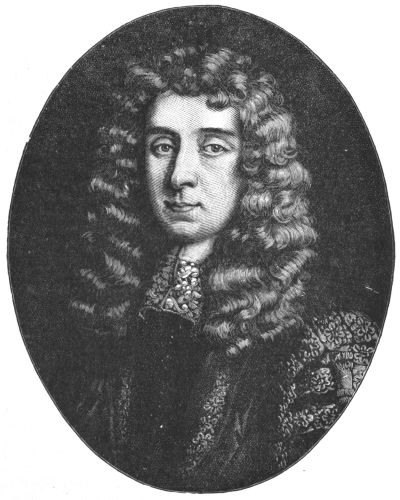
JUDGE JEFFREYS. (After a Painting by Sir Godfrey Kneller.)
[See larger version]
The prorogation of Parliament was followed by the trial of three Whig leaders of eminence. These were Gerard, Lord Brandon, the eldest son of the Earl of Macclesfield, Hampden, the grandson of the patriot, and Henry Booth, Lord Delamere. Hampden and Gerard were accused afresh of having been concerned in the Rye House Plot, Delamere of having been in league with Monmouth. Grey, Earl of Stamford, had been on the eve of being tried by the Peers on a similar charge of concern in the Rye House Plot, but the prorogation defeated that, and he was soon after liberated. These were the men against whom Grey had been induced to give information, and who, with Wade and Goodenough, were witnesses. Hampden and Gerard were tried at the Old Bailey and condemned. But Grey had stipulated that their lives should be safe, and they were redeemed by their relatives at a heavy price. Delamere, as a peer of the realm, was tried by a High Court of Peers, and as he was accused of having been engaged with Monmouth, his life was in danger. Jeffreys was appointed Lord High Steward, and he selected thirty peers as triers, all of whom in politics were opposed to Delamere, and half of them ministers and members of the royal household. He did not stop there, but as he had a personal spite against Delamere for having complained of him to Parliament when Chief Justice of Chester, and called him a "drunken jackpudding," he did his best personally to condemn him. But in spite of the murderous bias with which the villainous judge had contrived the prisoner's death, the Lords Triers unanimously acquitted him. This was a fact that equally electrified James and the country. Both saw that there was a spirit abroad that was no longer to be trifled with. The people openly rejoiced; the infatuated tyrant raged, but took no warning. The very Tories who had carried the Crown hitherto through every attempt, the Established Church which had preached Non-resistance, saw the gulf, to the edge of which their principles had brought them. Their loyalty paused at the threshold of Romanism, and the destruction of the safeguards of the liberty of the subject. The deadly artifices which an abandoned judge and a lawless monarch had employed against the life of Delamere, might soon be practised against every one of them. The spell of despotism, therefore, was broken. The spirit of an unconquerable suspicion had reached the very cabinet and the household of the Romish king, and his power was at an end.
But the greater the danger the more recklessly the bigotry-blinded monarch rushed upon it. His father had been bent on destroying the Constitution, but stood firm to the Anglican Church; James was resolved to root out both Church and Constitution together; but to his narrow intellect it never occurred that if his father lost his head in attempting half of this impossible enterprise, his danger was double in aiming at the whole. At the very beginning of the year 1686 he took a sudden stride in the direction of avowed Romanism, and during the whole year he marched forward with an insane hardihood that struck the boldest and most adventurous of his friends with consternation. The fact as to whether Charles II. had died a Catholic or a Protestant was still a matter of dispute. A few knew the truth, more surmised, but the bulk of the people still believed him to have been a Protestant. James determined to sweep away the remaining delusion. He therefore brought forth the two papers from Charles's strong box, and challenged the whole bench of bishops to refute them. He especially called on Sancroft, the Archbishop of Canterbury, to do it; but as the Primate from policy declined it, James took it for granted that they were secretly admitted to be unanswerable. He therefore had them printed in magnificent style, and appended to them his own signature, asserting that they were his late brother's own composition, and left in his own handwriting. He had this proof of Charles's Romanism distributed liberally to his courtiers, to the prelates and dignitaries of the Church, and amongst the people, even delivering them out of his coach window to the crowds as he drove about. He thus at once made known that his late brother had been secretly a Romanist, and that he was himself an open and uncompromising one.
His next step was to throw all the power of the Government into the hands of the most unscrupulous Catholics. His brother-in-law, Rochester, the Lord Treasurer, was nominally his Prime Minister, but Sunderland and a knot of Catholics were the really ruling junto. Sunderland, one of the basest men that ever crawled in the dust of a Court's corruption, was the head of this secret cabal. Sunderland, in the last reign, had been a violent Exclusionist. He had intrigued with the Duchess of Portsmouth, through her, if possible, to bring Charles to consent to this measure; but so soon as James was on the throne, he became his most servile tool, declaring that as he had nothing to hope but from the king's clemency and his own efforts to make compensation for the past, James could have no more efficient servant. James, who was a mean soul himself, did not spurn this meanness, but made use of it, and truly Sunderland earned his dirty bread. Avarice was his master vice, and he would have sold two souls for money if he had them. He retained the post of President of the Council, and held with it his old one of Secretary of State; whilst observing the course which James was taking, he did not despair to wrest from the staunch Protestant Rochester his still more lucrative office of Lord Treasurer. He had not the foresight to perceive that the project which James entertained to restore Romanism must bring speedy destruction on them all. This sordid minister was, at the same time, in the pay of Louis, at the rate of six thousand pounds a year, to betray all his master's most secret counsels to him.
With Sunderland were associated in the secret Romish junto—Sunderland himself not being an avowed Catholic, but a private professor—some of those Catholic lords who had been imprisoned on account of the Popish plots—Arundel, Bellasis, and William Herbert, Earl of Powis. To these were added Castlemaine, the man who for a title and revenue had sold his wife to Charles II. He had been imprisoned, too, on account of the Popish plot, and was ready to take vengeance by assisting to destroy his Protestant enemies and their Church together. With him were associated two of the most profligate and characterless men of that profligate age—Jermyn, celebrated for his duels and his licentious intrigues, and lately created by James Lord Dover, and a man familiarly named Dick Talbot—whom James had also for these crimes, which were merits in James's eyes, made Earl of Tyrconnel. These merits were, that Talbot was ready for any service of unmanly villainy that his master could desire. Like another prime favourite and associate of James, Lord Chancellor Jeffreys, Tyrconnel was notorious for his drinking, gambling, lying, swearing, bullying, and debauchery. He was equally ready to lie away a woman's character or to assassinate a better man than himself. In the last reign, when it was desired by the Court to ruin the character of James's wife, Anne Hyde, that she might be got rid of, he joined with Colonel Berkeley in the infamous assertion that they had had the most familiar intrigues with her. When they did not succeed with James, they as readily confessed that the whole was a lie. A man with the least spark of honour in him would have remembered this unpardonable villainy to his now deceased wife, and have banished the wretch from Court. James promoted him, and made him one of his most intimate companions. Tyrconnel offered to murder the Duke of Ormond, and was rewarded for his readiness by being made commander of the forces in Ireland; but his services were chiefly at present demanded at Court.