Chapter IV · (continued 2)
Reading edition
De Ruyter was advanced into his post, and put to sea in charge of a merchant fleet, and in return fell in with Ayscough off Plymouth, who broke through his line, but was not followed up vigorously by the captains of the other vessels, and the Dutch ships escaped. Ayscough was superseded, the Parliament suspecting him of a royal tendency.
De Ruyter joined De Witt, and attacked Blake, who had under him Admirals Bourne and Penn, and a fierce engagement took place, which lasted the whole of the 28th of September. The next morning the Dutch were seen bearing away for their own coasts, several of their vessels having gone down, and one of them being taken. Blake gave chase as far as Goree, but could not pursue them amongst the shoals and sandbanks, where the small vessels of the Dutch had taken refuge. Wherever English and Dutch ships now met, there was battle. There was an affray between them in the Mediterranean, where Van Galen, with a greatly superior force, attacked and defeated Captain Baily, but was himself slain; the King of Denmark also joined the Dutch with five ships, laid an embargo on English merchandise in the Baltic, and closed the Sound against them. There were, moreover, numerous vessels under the French flag cruising about in quest of merchantmen.
As winter, however, approached, Blake, supposing the campaign would cease till spring, dispersed a number of his vessels to different ports, and was lying in the Downs with only thirty-seven sail, when he was surprised by a fleet of eighty men-of-war, and ten fire-ships. It was Van Tromp, whom the States had again prevailed on to take the command, and who came vehement for the recovery of his tarnished reputation. Blake's stout heart refused to shrink from even so unequal a contest; and he fought the whole Dutch fleet with true English bulldogism, from ten in the morning till six in the evening, when the increasing darkness led to a cessation of hostilities on both sides. Blake took advantage of the night to get up the Thames as far as the quaint fishing village of Leigh. He had managed to blow up a Dutch ship, disable two others, and to do much damage generally to the Dutch fleet; but he had lost five ships himself. Van Tromp and De Ruyter sailed to and fro at the mouth of the river, and along the coast from the North Foreland to the Isle of Wight, in triumph, and then convoyed home the Dutch and French fleets. There was huge rejoicing in Holland over the great English admiral, which, considering the immense inequality of the fleets, was really an honour to Blake, for it showed how they esteemed his genius and courage. The whole of Holland was full of bravado at blocking up the Thames, and forcing the English to an ignominious peace. Van Tromp was so elated, that he stuck a besom at his masthead, intimating that he would sweep the English from off the seas.
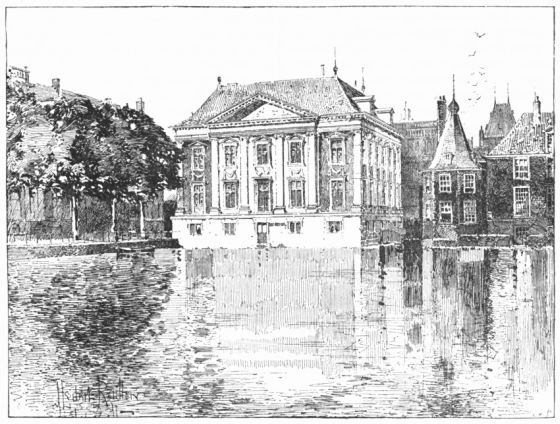
ROYAL MUSEUM AND PICTURE GALLERY, THE HAGUE.
[See larger version]
The English Parliament, during the winter, made strenuous efforts to wipe out this reverse. They refitted and put in order all their ships, ordered two regiments of infantry to be ready to embark as marines, raised the wages of the seamen, ordered their families to be maintained during their absence on service, and increased the rate of prize money. They sent for Monk from Scotland, and joined him and Dean in command with Blake.
The Dutch navy was estimated at this period at a hundred and fifty sail, and was flushed with success; but Blake was resolved to take down their pride, and lay ready for the first opportunity. This occurred on the 18th of February, 1653. Van Tromp appeared sailing up the Channel with seventy-two ships of war and thirty armed traders, convoying a homeward-bound merchant fleet of three hundred sail. His orders were, having seen the merchantmen safe home, to return and blockade the Thames. Blake saved him the trouble, by issuing from port with eighty men-of-war, and posting himself across the Channel. Van Tromp signalled the merchant fleet under his convoy to take care of themselves, and the battle between him and Blake commenced with fury. The action took place not far from Cape La Hogue, on the coast of France. Blake and Dean, who were both on board the Triumph, led the way, and their ship received seven hundred shots in her hull. The battle lasted the whole day, in which the Dutch had six ships taken or sunk, the English losing none, but Blake was severely wounded.
The next day the fight was renewed off Weymouth as fiercely as before, and was continued all day, and at intervals through the night; and on the third day the conflict still raged till four o'clock in the afternoon, when the wind carrying the contending fleets towards the shallow waters between Boulogne and Calais, Van Tromp, with his lesser ships, escaped from the English, and pursued his course homewards, carrying the merchant fleet safely there. In the three days' fight the Dutch, according to their own account, had lost nine men-of-war and twenty-four merchantmen; according to the English account, eleven men-of-war and thirty merchantmen. They had two thousand men killed, and fifteen hundred taken prisoners. The English had only one ship sunk, though many of their vessels were greatly damaged, and their loss of killed and wounded was very severe. But they had decidedly beaten the enemy, and the excitement in Holland, on the return of the crest-fallen though valiant boaster Van Tromp, was universal. It was now the turn of the English sailors to boast, who declared that they had paid off the Dutch for Amboyna. But the defeat of their navy was nothing in comparison to the general mischief done to their trade and merchant shipping. Their fisheries employed one hundred thousand persons: these were entirely stopped; the Channel was now closed to their fleet, and in the Baltic the English committed continual ravages on their traders. Altogether, they had now lost sixteen hundred ships, and they once more condescended to seek for accommodation with the English Parliament, which, however, treated them with haughty indifference; and it was, therefore, with great satisfaction that they now beheld the change which took place in England.
The Reformers of various shades and creeds had at first been combined by the one great feeling of rescuing the country from the absolute principles of the Stuarts. They had fought bravely side by side for this great object; but in proportion as they succeeded, the differences between themselves became more apparent. The Presbyterians, Scots and English, were bent on fixing their religious opinions on the country as despotically as the Catholics and Episcopalians had done before them. But here they found themselves opposed by the Independents, who had notions of religious freedom far beyond the Presbyterians, and were not inclined to yield their freedom to any other party whatever. Their religious notions naturally disposed them towards the same equalising system in the State, and as the chiefs of the army were of this denomination, they soon found themselves in a condition to dictate to the parliament. Pride's Purge left Parliament almost purely independent, and it and the army worked harmoniously till the sweeping victories of Cromwell created a jealousy of his power. This power was the more supreme because circumstances had dispersed the other leading generals into distant scenes of action. Monk and Lambert were in Scotland till Monk was called to the fleet, Fleetwood was in Ireland, Ireton was dead. The Long Parliament, or the remnant of it, called the Rump, ably as it had conducted affairs, was daily decreasing in numbers, and dreaded to renew itself by election, because it felt certain that anything like a free election would return an overwhelming number of Presbyterians, and that they would thus commit an act of felo de se.
At no period did what is called the Commonwealth of England present any of the elements of what we conceive by a republic, that is, by a government of the free representatives of the people. Had the people been allowed to send their representatives, there would have been a considerable number of Catholics, a much greater number of Episcopalians, and both of these sections Royalists. There would have been an overwhelming number of Presbyterians, and a very moderate one of Independents. The Government was, therefore, speedily converted into an oligarchy, at the head of which were the generals of the army, and some few of the leaders of Parliament. The army, by Pride's Purge, reduced the Parliament to a junto, by turning out forcibly the majority of the representatives of the people, and the time was now fast approaching when it must resolve itself into a military dictatorship.
Cromwell had long been accused by his own party of aiming at the possession of the supreme power. At what time such ideas began to dawn in his mind is uncertain; but as he felt himself rising above all his contemporaries by the energy and the comprehensive character of his mind, there is no doubt that he secretly indulged them. Ludlow, Whitelock, Hutchinson, and others, felt that such was the spirit growing in him; and many of those who had most admired his genius fell away from him, and openly denounced his ambitious intentions as they became more obvious. The excellent Colonel Hutchinson and Sir Henry Vane charged him with the ruin of the Commonwealth. But Cromwell must have long felt that nothing but a military power could maintain the ascendency of those principles which he and his fellow Independents entertained and held sacred. The world was not prepared for them. The roots of royalty were too deeply struck into the heart of the nation by centuries of its existence, to be torn out by the follies and tyrannies of one family. But if a free Parliament, which it had been the proud boast of the Reformers to be the sole seat of the national power, could not exist; if the sitting body calling itself a Parliament could not even add to its members without endangering its own existence either from itself or from the jealousy of the army—what could exist? Clearly nothing but a dictatorship, and the strongest man must come uppermost. That strongest man was without a question Cromwell.
As early as 1649 two Bills had been brought in to settle questions urgently demanded by the people, an act for a general amnesty, and for the termination of the present Parliament. On his return from the battle of Worcester, Cromwell reminded Parliament that these essential measures had not been completed. He carried the amnesty, so that all acts of hostility against the present Government previous to the battle of Worcester were pardoned, and the Royalists relieved from the fear of fresh forfeitures. The termination of Parliament was fixed for the 3rd of November, 1654, and the interval of three years was to be zealously employed in framing a scheme for the election of a new Parliament on the safest principles. At the same time Cromwell was living at Whitehall, in the house of the beheaded king, and with almost the state and power of a sovereign. He summoned, therefore, the council of the army, and discussed amongst them what they deemed necessary to be done.
In this council it was agitated as to the best form of government for England, whether a pure republic, or a government with something of monarchy in it. The officers were for a republic, the lawyers for a limited monarchy. Cromwell agreed that the government must have something of monarchy in it, and asked who they would choose if that were decided? The lawyers said Charles Stuart, or if they found him too much bent on power, his brother the Duke of Gloucester. There can be little doubt but that this was a feeler on the part of Cromwell, and as he was never likely to acquiesce in the restoration of a family which they had put down at so much cost, it would have the effect of causing him to proceed with caution. He had ascertained that the army was opposed to a king; the lawyers thought of no king but one from the old royal line. These were facts to be pondered.
Meanwhile the Parliament, without proceeding to lay a platform for its successor, evidenced a jealousy of the ascendency of the army; it voted a reduction of one-fourth of the army, and of the monthly assessment for its support from one hundred and twenty thousand pounds to ninety thousand pounds. In June, 1652, it proposed a fresh reduction, but this was opposed by the military council, and in August the officers appeared at the bar of the House with a petition, calling the attention of the Parliament to the great question of the qualifications of future parliaments, to reform of the law and religious abuses, to the dismissal of disaffected and scandalous persons from office, to the arrears due to the army, and to reform of malpractices in the Excise and the Treasury.
The contest between the army and the Parliament was evidently growing every day more active. The Commons had no desire to lay down their authority and, to retain their existence, even showed a leaning towards introducing a number of Presbyterians under the name of "Neuters." To such a project the army was never likely to assent, and Cromwell proposed, in the council at Whitehall, that Parliament should be at once dissolved, and a national council of forty persons, with himself at their head, should conduct affairs till a new Parliament could be called on established principles. The opinion, however, was that such a proceeding would be dangerous, and the authority of the council be looked upon as unwarrantable.
Whilst these matters were in agitation, Whitelock says that Cromwell, on the 8th of November, 1652, desired a private interview with him, and in this urged the necessity of taking prompt and efficient measures for securing the great objects for which they had fought, and which he termed the mercies and successes which God had conferred on the nation. He inveighed warmly against the Parliament, and declared that the army began to entertain a strange distaste to it; adding that he wished there were not too much reason for it. "And really," he continued, "their pride, their self-seeking, their engrossing all places of honour and profit to themselves and their friends; their daily breaking forth into new and violent parties and factions; their delays of business, and designs to perpetuate themselves, and to continue the power in their own hands; their meddling in private matters between party and party, contrary to the institution of Parliament; their injustice and partiality in these matters, and the scandalous lives of some of the chief of them, do give much ground for people to open their mouths against them, and to dislike them." He concluded by insisting on the necessity of some controlling power over them to check these extravagances, or else nothing could prevent the ruin of the Commonwealth.
Whitelock admitted the truth of most of this, but defended the Parliament generally, and reminded Cromwell that it was the Parliament which had granted them their authority, and to Cromwell even his commission, and that it would be hard for them, under those circumstances, to curb their power.
But Cromwell broke out—"We all forget God, and God will forget us. God will give us up to confusion, and these men will help it on if they be suffered to proceed in their ways." And then, after some further talk, he suddenly observed, "What if a man should take upon him to be king?" Whitelock saw plainly enough what Oliver was thinking of, and replied as if he had directly asked whether he should assume that office himself. He told him that it would not do, and that he was much better off, and more influential as he was. "As to your person," he observed, "the title of king would be of no advantage, because you have the full kingly power already concerning the militia." He reminded him that in the appointment of civil offices, though he had no formal veto, his will was as much consulted as if he had, and so in all other departments, domestic and foreign. Moreover, he now had the power without the envy and danger which the pomp and circumstance of a king would bring.
Cromwell still argued the point; contending that though a man usurped the title without royal descent, yet the possession of the crown was declared by an Act of Henry VII. to make a good title, and to indemnify the reigning king and all his ministers for their acts. Whitelock replied that, let their enemies once get the better of them, all such bills and indemnifications would be little regarded; and that to assume the crown would at once convert the quarrel into one not between the king and the nation, but between Charles Stuart and Oliver Cromwell. Cromwell admitted this, but asked what other course he could propose. Whitelock said that of making a good bargain with Charles, who was now down, and might be treated with just on what terms they pleased; or if they thought him too confirmed in his opinions, there was the Duke of York or the Duke of Gloucester. Cromwell did not appear pleased with this suggestion; in fact, he had resolved to seize the chief power in some shape himself—and even had he not, he had too much common sense to agree to admit any one of the deposed family again to the throne, which would be to put their necks in the certain noose of royal vengeance. The death of Charles I. could never be forgiven. From this time, Whitelock says, though he made no accusation against Cromwell, yet "his carriage towards me from that time was altered, and his advising with me not so frequent and intimate as before."
Cromwell again, however, broached the subject amongst the officers and members of the Council—St. John, Lenthall the Speaker, Desborough, Harrison, Fleetwood, and Whalley, not in so direct a manner, but as that "a settlement, with something of the monarchical in it, would be very effectual." It does not appear that the project was very unanimously received by them, but they were agreed that a new representation must take place, and no "Neuters" should be admitted. Cromwell said emphatically, "Never shall any of that judgment who have deserted the cause be admitted to power." On the 19th of April the debate on this subject was continued very warmly till midnight, and they separated, to continue the discussion on the next day. Most of the officers had argued that the Parliament must be dissolved "one way or another;" but the Parliament men and lawyers, amongst them Whitelock and Widdrington, contended that a hasty dissolution would be dangerous, and Cromwell appeared to lean towards the moderate view. But scarcely had they met the next morning, and found a strange absence of the members of Parliament, and an almost equal absence of officers, when Colonel Ingoldsby hastened in and informed them that the Commons were hard at work pushing forward their Bill for increasing their own numbers by the introduction of Neuters; and that it was evident that they meant to hurry it through the House before the Council could be informed of their attempt. Vane and others, well aware of Cromwell's design, were thus exerting themselves to defeat it.
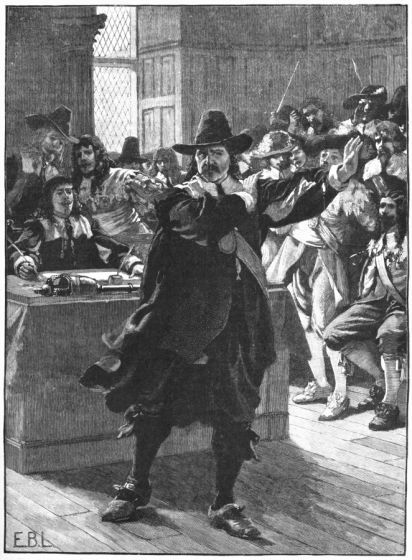
CROMWELL ADDRESSING THE LONG PARLIAMENT FOR THE LAST TIME. (See p. 118.)
[See larger version]
At this news Cromwell instantly ordered a file of musketeers to attend him, and hastened to the House of Commons, attended by Lambert, Harrison, and some other officers. He left the soldiers in the lobby of the House, and entering, went straight to his seat, where he sat for some time listening to the debate. He first spoke to St. John, telling him that he was come for a purpose which grieved him to the very soul, and that he had sought the Lord with tears not to impose it upon him; but there was a necessity, and that the glory of God and the good of the nation required it. He then beckoned Harrison to him, and said that he judged that the Parliament was ripe for dissolution. Harrison, who was a Fifth-Monarchy man, and had been only with much persuasion brought over to this design, replied, "Sir, the work is very great and dangerous; I desire you seriously to consider before you engage in it." "You say well," answered the general, and sat yet about a quarter of an hour longer. But when the question was about to be put, he said to Harrison, "This is the time; I must do it;" and starting up, he took off his hat, and began speaking. At first he spoke of the question before the House, and commended the Parliament for much that it had done, and well he might; for whatever its present corruption, it had nobly supported him and the fleet and army in putting down all their enemies, and raising the nation in the eyes of foreigners far beyond its reputation for the last century. But soon he came round to the corruption and self-seeking of the members, accusing them of being at that moment engaged in the very work of bringing in the Presbyterians to destroy all that they had suffered so much to accomplish. Sir Harry Vane and Peter Wentworth ventured to call him to order, declaring that that was strange and unparliamentary language from a servant of the House, and one that they had so much honoured. "I know it," replied Cromwell; then stepping forward into the middle of the floor, and putting on his hat, and walking to and fro, casting angry glances at different members, he exclaimed, "I tell you, you are no Parliament. I will put an end to your prating. For shame! get you gone! Give place to honest men; to men who will more faithfully discharge their trust. You are no longer a Parliament. The Lord has done with you. He has chosen other instruments for carrying on His work."
With that he stamped upon the floor, and the soldiers appearing at the door, he bade Harrison bring them in. The musketeers instantly surrounded him, and laying his hand on the mace, he said, "What shall we do with this bauble? Take it away," and he handed it to a soldier. Then looking at Lenthall the Speaker, he said to Harrison, "Fetch him down!" Lenthall declared that he would not move from his proper post unless he was forced out of it. "Sir," said Harrison, "I will lend you a hand," and taking hold of him, he brought him down, and he walked out of the House. Algernon Sydney, then but a young member, happened to sit next to the Speaker, and Cromwell said, "Put him out!" Sydney, like the Speaker, refused to move, but Cromwell reiterated the command, "Put him out!" and Harrison and Worsley, the lieutenant-colonel of Cromwell's regiment of Ironsides, laying each a hand on his shoulder, the young patriot did not wait for the ignominy of being dragged from his seat, but rose and followed the Speaker. Cromwell then went on weeding out the members, with epithets of high reproach to each of them. Alderman Allen bade him pause and send out the soldiers, and that all might yet be well; but Cromwell only replied, "It is you that have forced me upon this. I have sought the Lord day and night that He would rather slay me than put me upon this work." He then charged the alderman with embezzlement, as treasurer to the army; and taking first one and then another by the cloak, he said to Challoner, "Thou art a drunkard!" To Wentworth, "Thou art an adulterer!" To Martin, "Thou art a still more lewd character!" Vane, as he was forced past him, exclaimed, "This is not honest; yea, it is against morality and common honesty." "O, Sir Harry Vane, Sir Harry Vane!" exclaimed Cromwell, "the Lord deliver me from Sir Harry Vane!" Thus he saw the House cleared, no one daring to raise a hand against him, though, says Whitelock, "many wore swords, and would sometimes brag high." When all were gone, Cromwell locked the door, and put the key in his pocket. He then returned to Whitehall, and told the Council of officers, who yet remained sitting, what he had done. "When I went to the House," he said, "I did not think to do this, but perceiving the spirit of the Lord strong upon me, I resolved no longer to consult flesh and blood."
Such was the manner in which the last vestige of representative government was swept away by Cromwell. Charles I. roused the fiery indignation of Parliament, and of all England, as a violater of the privileges of Parliament, by entering the House to seize five members who had offended him. Cromwell, who had been one of the first to resist and to avenge this deed, now marched in his soldiers and turned out the whole Parliament, about fifty members, with impunity. "They went away so quietly," said Cromwell, "that not a dog barked at their going." Such is the difference between a private man with a victorious army at his back, and one who, though with the name of a king, has lost a nation's confidence by his want of moral honesty. The act of Cromwell was the death of all constitutional life whatever, it was in opposition to all parties but the army; yet no man dared assume the attitude of a patriot; the military Dictatorship was accomplished (April 20, 1653).
Cromwell's whole excuse was necessity; that without his seizure of the supreme power, the Commonwealth could not exist. It ceased to exist by his very deed, and if he saved the faint form of a republic, it was only for five years. As we have seen the great example to the nations of the responsibility of kings, we have now to see an equally significant one of the impossibility of maintaining long any form of government that is not based on the mature opinion and attachment of the people. Republicanism was not the faith of England in the seventeenth century, and therefore neither the despotism of Charles could create a republic with any permanence in it, nor the strenuous grasp of Cromwell maintain it beyond the term of his own existence.
On the afternoon of this celebrated coup d'état, Cromwell proceeded to Derby House, accompanied by Harrison and Lambert, where the Council was still sitting, and thus addressed the members:—"Gentlemen, if you are here met as private persons, you shall not be disturbed; but if as a Council of State, this is no place for you; and since you cannot but know what was done at the House this morning, so take notice that the Parliament is dissolved." Bradshaw, who was presiding, said that they knew, and that all England would soon know; but that if he thought that the Parliament was dissolved, he was mistaken, "for that no power under Heaven could dissolve them, except themselves. Therefore take you notice of that." Sir Arthur Haselrig and others supported this protest, and then the Council withdrew.
Cromwell and his party immediately held a council as to what steps were to be taken, and on the 22nd they issued a declaration in the name of the Lord-General and his council of officers, ordering all authorities to continue their functions as before; and in return, addresses of confidence arrived from generals and admirals. On the 6th of June Oliver, in his own name as Captain-General and Commander-in-Chief of all the armies and forces, issued a summons to one hundred and forty persons to meet and constitute a Parliament. Six were also summoned from Wales, six from Ireland, and five from Scotland. On the 4th of July about one hundred and twenty of these persons, of Cromwell's own selection—persons, according to his summons, "fearing God, and of approved fidelity and honesty"—met in the Council-chamber at Whitehall. Many of these were gentlemen of good repute and abilities—some of them were nobles, others of noble families—as Colonel Montague, Colonel Howard, and Anthony Ashley Cooper. Others, however, were of little worldly standing, but had been selected on account of their religious zeal and character. Amongst them was one Barbon, a leatherseller in Fleet Street, who had acquired the cognomen of Praise-God, and whose name being purposely misspelled became Praise-God Barebone, and the Royalist wits of the time, therefore, dubbed the Parliament Barebone's Parliament.
The more common appellation of this singular Parliament was "The Little Parliament." Cromwell opened their session with a very long and extraordinary speech, in which he gave a history of the past contest with the monarchy, and the mercies with which they had been crowned at Naseby, Dunbar, Worcester, and other places; of the backslidings of the Long Parliament, and the "necessity" to remove it and call this assembly. He quoted a vast quantity of Scripture, and told them that they were called of God to introduce practical religion into State affairs; and he then delivered into their hands an instrument, consigning to them the supreme power in the State till the 3rd of September, 1654, three months previous to which date they were to elect their successors, who were to sit only for a year, and in turn elect their successors.
This resignation of the supreme power once in his hands, has been described by historians as a gross piece of hypocrisy, used to avoid the odium of seizing for himself the power of the Parliament, which he had forcibly dissolved. Whether that were the case or not, it certainly was a prudent policy, and a safe one, for he knew very well that he possessed supreme power as head of the army, and could, if necessary, dismiss this Parliament as he had done the former one. In their character of pietists or saints, as they were called, this Parliament opened its session by electing Francis Rouse their Speaker, and by exercises of devotion, which continued from eight in the morning till six at night. Thirteen of the most gifted members preached and prayed in succession, and they adjourned, declaring that they had never enjoyed so much of the spirit and presence of Christ in any meetings for worship as they had done that day. It was moved the next morning that they "should go on seeking the Lord" that day too, but this was overruled, and Monday, the 11th, was fixed for that purpose. They then voted themselves the Parliament of the Commonwealth of England, invited Cromwell and four of his staff to sit as members amongst them, and on the 9th of July re-appointed the Council of State, amongst whom we find the names of Colonel Montague, afterwards Earl of Sandwich, the uncle of the poet Dryden, Sir Gilbert Pickering, Lord Viscount Lisle, brother of Algernon Sydney, Sir Ashley Cooper, and other names of equal note; and however they might be ridiculed on account of their religion, they soon showed that they were conscientious and independent men. The strongest proof of this was that they did not shrink from opposing the power and interests of Cromwell, who had selected them. Scarcely were they met, when they were appealed to to decide upon the case of John Lilburne, who, on the dissolution of the Long Parliament, petitioned Cromwell to allow him to return from his banishment. Cromwell gave no reply, but independent John took the liberty of appearing in London. He was at once seized and committed to Newgate. Lilburne, supported by his friends, petitioned the House to hear and decide the case, though it was the proper business of a jury. They might now have gratified their patron, whom Lilburne had continually assailed as a "robber," a "usurper," and a "murderer;" but they declined to interfere, and left him to the ordinary criminal court. There Lilburne so ably defended himself that he was acquitted; but he was again seized on the plea of libellous and seditious language used on his trial, and the House could then no longer refuse, at the instigation of the Council, to imprison him. Being removed from the Tower to Elizabeth Castle, in Jersey, and thence to Dover Castle, he there became a convert to the principles of George Fox, a remarkable end for so fiery and democratic a character. The Parliament lost no time in proceeding to assert that divine commission, which Cromwell, in his opening speech, had attributed to their call through him. They declared that they were appointed by the Lord, and would have greatly alarmed Cromwell had he not taken care to include amongst them a sufficient number of his staunch adherents. But they excited the same alarm in a variety of other classes. They set to work resolutely in cutting down the expenditure of the Government; they abolished all unnecessary offices; they revised the regulations of the Excise; reformed the constitution of the Treasury; reduced exorbitant salaries, and examined thoroughly the public accounts; they adopted measures for the sale of the confiscated lands, and enacted rules for the better registration of births, deaths, and marriages. They went further; they made marriage by a civil magistrate valid, and, indeed, necessary for the enjoyment of the civil effects of marriage. Marriage by a clergyman was left optional still.
They next attacked the unequal and oppressive modes of raising the one hundred and twenty thousand pounds a month for the maintenance of the army; the assessments in some cases amounting to two, in others, to ten shillings in the pound. From taxation they proceeded to law, and prepared a Bill to abolish the Court of Chancery, in which the abuses and delays had been a constant source of complaint in petitions to Parliament for years. But they were not content with destroying the Court of Chancery, they set about a general reform of the laws. They contended that every Englishman should understand the laws of his country, and that by a proper digest they might be reduced to the compass of a pocket volume. They, in fact, anticipated Napoleon in his Code, and appointed a committee to make the necessary revision, and to weed the real and useful statutes out of the chaotic mass of contradictory, obsolete, and unjust laws which overlaid them; the dicta of judges in many cases superseded and prevented the original enactments, so that men's lives and properties were at the mercy, not of the decrees of Parliament, but the opinions of individuals. It may be imagined what a consternation this daring innovation excited throughout Westminster Hall, and all the dusky, cobwebby cells of the lawyers. A terrible cry was raised that a set of ignorant men were about to destroy the whole noble system of British jurisprudence, and to introduce instead the law of Moses!
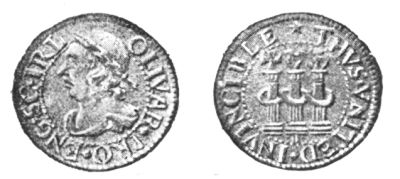
TOKEN OF THE COMMONWEALTH (COPPER).
But the projects of these radical Reformers were cut short by the universal outcry from lawyers, churchmen, officials, and a host of interested classes. They were represented as a set of mad fanatics, who in Parliament were endeavouring to carry out the wild doctrines which the Anabaptists and Fifth-Monarchy men were preaching out of doors. Borne down by public opinion, Cromwell was compelled to dissolve them, in fact to resume the supreme power which he had committed to them. Accordingly, on the 12th of December, Cromwell's friends mustered in full strength, and Colonel Sydenham moved that, as the proceedings of Parliament were regarded as calculated to overturn almost every interest in the country, they could not proceed, and that they should restore their authority to the hands whence they had received it. The motion was vehemently opposed, but the Independents had adopted their plan. The mover declared that he would no longer sit in an assembly which must be rendered abortive by general opposition. He therefore rose: the Speaker, who was one of the party, rose too, and the Independents, forming a procession, proceeded to Whitehall, and resigned their commission into the hands of Cromwell. The staunch dissentients remained and engaged in prayer, in which act two officers, Goffe and White, sent to close the House, found them. White asked them what they did there. They replied, "We are seeking the Lord." "Then," said he, rudely, "you may go somewhere else, for to my certain knowledge, the Lord has not been here these many years."
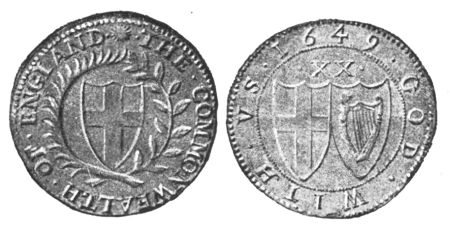
BROAD OF THE COMMONWEALTH (GOLD).
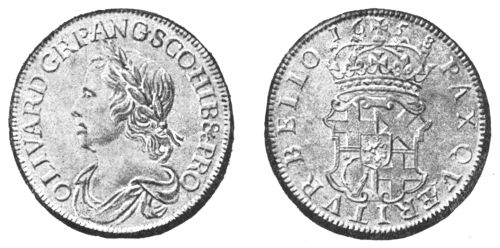
CROWN OF THE COMMONWEALTH (SILVER).
Cromwell affected to receive with reluctance the onerous charge of the supreme power and responsibility; but the officers urged its necessity, and the document being soon signed by eighty members, he acceded to it. The council of officers and ministers decided that it was necessary to have "a commonwealth in a single person;" and a new constitution was drawn up; and on the 16th of December Cromwell, dressed in a suit and cloak of black velvet, with long boots and a broad gold band round his hat, proceeded in his carriage from Whitehall to the Court of Chancery. The way was lined by files of soldiers, consisting of five regiments of foot and three of horse. A long procession followed, including the Lord Mayor, aldermen, and City officers, the two Commissioners of the Great Seal, the judges, the councillors of State and of the army. On reaching the Court of Chancery, Cromwell took his place before a chair of State, which had been placed on a rich carpet, the Commissioners of the Great Seal standing on his right and left, the judges ranging themselves behind, and the civil and military officers disposing of themselves on each hand. Lambert then stepped forward and addressed the Lord-General. He spoke of the dissolution of Parliament, and of the necessity of a strong Government, not liable to be paralysed by contending opinions; and he prayed the Lord-General, in the name of the army and of the official authorities of the three kingdoms, to accept the office of Lord-Protector of the Commonwealth, and to govern it for the public good by a constitution already drawn up. Cromwell assented, and thereupon Jessop, a clerk of the council, read what was called "The Instrument of Government," consisting of forty-two articles. The chief of these were, that the legislative power should be invested in the Lord-Protector and the Parliament; but chiefly in the Parliament, for every Act passed by them was to become law at the end of twenty days, though the Protector should refuse it his consent. Parliament should not be adjourned, prorogued, or dissolved without its own consent, for five months; and there was to be a new Parliament called within three years of the dissolution of the last. The members of the Parliament were adopted from a plan by Vane, brought forward during the Long Parliament—namely, three hundred and forty members for England and Wales, thirty for Scotland, and thirty for Ireland. The members were to be chosen chiefly from the counties, and no papist, Malignant, or any one who had borne arms against the Parliament, was admissible. In the Protector resided the power of making war or peace with the consent of the Council; he held the disposal of the militia, and of the regular forces and the navy, the appointment of all public offices with the approbation of Parliament, or during the recess of Parliament with that of the Council, subject to the after-approval of Parliament; but he could make no law, nor impose taxes without consent of Parliament. The civil list was fixed at two hundred thousand pounds, and a revenue for the army capable of maintaining thirty thousand men, with such a navy as the Lord-Protector should deem necessary. The elective franchise extended to persons possessed of property worth two hundred pounds, and sixty members of Parliament should constitute a quorum. All persons professing faith in Jesus Christ were to enjoy the exercise of their religion except papists, prelatists, or such as taught doctrines subversive of morality. Cromwell was named Lord-Protector for life, and his successor was to be elected by the Council, and no member of the family of the late king, or any of his line, should be capable of election. A Council was specially named by the Instrument, to consist of Philip, Lord Viscount Lisle, brother of Algernon Sydney; Fleetwood; Lambert; Sir Gilbert Pickering; Sir Charles Wolseley; Sir Anthony Ashley Cooper; Edward Montague; John Desborough, brother-in-law of Cromwell; Walter Strickland; Henry Lawrence; William Sydenham; Philip Jones; Richard Mayor, father-in-law of Richard Cromwell; Francis Rouse; Philip Skipton, or any seven of them, with power in the Protector, and a majority of the Council, to add to their number. Thurloe, the historian, was secretary of the Council, and Milton Latin secretary.
This Instrument being ready, Cromwell swore solemnly to observe it, and to cause it to be observed; and then Lambert, kneeling, offered the Protector a civic sword in the scabbard, which he took, laying aside his own, as indicating that he thenceforward would govern by the new constitution, and not by military authority. He then seated himself, covered, in the chair of State, all besides standing uncovered; he then received from the Commissioners the Great Seal, and from the Lord Mayor the sword and cap of maintenance, which he immediately returned to them. On this the court rose, and the Lord-Protector returned in state to Whitehall, the Lord Mayor bearing the sword before him, amid the shouting of the soldiers and the firing of cannon. The next day, the 17th of December, the Lord-Protector was proclaimed by sound of trumpet in Westminster and in the City, and thus had the successful general, the quondam farmer of Huntingdon, arrived at the seat of supreme power, at the seat of a long line of famous kings, though not with the name of king, to which many suspected him of aspiring. Yet even without the royal dignity, he soon found the position anything but an enviable one, for he was surrounded by hosts of men still vowed to his destruction and the restoration of the monarchy; and amongst those who had fought side by side with him towards this august eminence, were many who regarded his assumption of it as a crime, to be expiated only by his death. Though there is no reason to believe that the bulk of the nation was otherwise than satisfied with the change, his supporters were lukewarm while his enemies were ardent. There was no disguising the fact that until Parliament met his government was one of naked absolutism. The Protector forthwith established a body of "Triers" who proceeded to examine the religious beliefs of candidates for vacant benefices, and promptly presented them if the result of the examination was satisfactory. Before we proceed, however, to notice his struggles with his secret or avowed enemies, and with his new Parliament, we must notice what had been doing meanwhile in the war with Holland, which had still been raging.