PART I. (continued 2)
Reading edition
To Dom Perignon the abbey’s well-stocked cellar was a far cheerfuller place than the cell. Nothing delighted him more than
‘To come down among this brotherhood Dwelling for ever underground, Silent, contemplative, round, and sound; Each one old and brown with mould, But filled to the lips with the ardour of youth, With the latent power and love of truth, And with virtues fervent and manifold.’
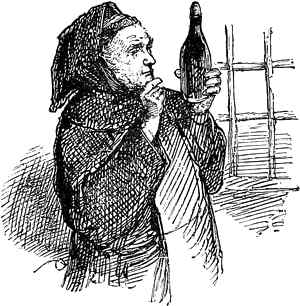
Ever busy among his vats and presses, barrels and bottles, Perignon found out a method of clearing wine, so as to preserve it perfectly limpid and free from all deposit, without being obliged, like all who sought to rival him in its production, to dépoter the bottles—that is, to decant their contents into fresh ones.[103] This secret, which helped to maintain the high reputation of the wine of Hautvillers when the manufacture of sparkling Champagne had extended throughout the district, he guarded even better than he was able to guard the apple of his eye. At his death, in 1715, he revealed it only to his successor, Frère Philippe, who, after holding sway over vat and vineyard for fifty years, died in 1765, imparting it with his latest breath to Frère André Lemaire. Revoked perforce from his functions by the French Revolution, he in turn, before his death about 1795, communicated it to Dom Grossart, who exults over the fact that whilst the greatest Champagne merchants were obliged to dépoter, the monks of Hautvillers had never done so.[104] Dom Grossart, who had counted the Moëts amongst his customers, died in his turn without making any sign, so that the secret of Perignon perished with him. Prior to that event, however, the present system of dégorgeage was discovered, and eventually dépotage was no longer practised.[105]
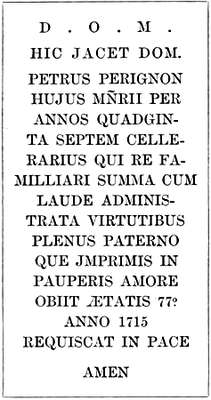
The material result of Dom Perignon’s labours was such that one of the presses of the abbey bore this inscription: ‘M. de Fourville, abbot of this abbey, had me constructed in the year 1694, and that same year sold his wine at a thousand livres the queue.’[106] Their moral effect was so complete that his name became identified with the wine of the abbey. People asked for the wine of Perignon, till they forgot that he was a man and not a vineyard,[107] and within a year of his death his name figures amongst a list of the wine-producing slopes of the Champagne.[108] His reputation has outlasted the walls within which he carried on his labours, and his merits are thus recorded, in conventual Latin of the period, on a black-marble slab still to be seen within the altar-steps of the abbey-church of Hautvillers.[109]
The anonymous Mémoire of 1718 gives, with an amount of preliminary flourish which would imply a doubt as to the accuracy of the statement made, the secret mode said to have been employed by Dom Perignon to improve his wine, and to have been confided by him a few days before his death to ‘a person worthy enough of belief,’ by whom it was in turn communicated to the writer. According to this, a pound of sugar-candy was dissolved in a chopine of wine, to which was then added five or six stoned peaches, four sous’ worth of powdered cinnamon, a grated nutmeg, and a demi septier of burnt brandy; and the whole, after being well mixed, was strained through fine linen into a pièce of wine immediately after fermentation had ceased, with the result of imparting to it a dainty and delicate flavour. Dom Grossart, however, in his letter to M. Dherbès, distinctly declares that ‘we never did put sugar into our wine.’[110] This collature, in which peaches play a part, was probably made use of by some wine-growers; and the peach-like flavour extolled by St. Evremond in the wine of Ay may have been due to it, or to the practice then and long afterwards followed of putting peach-leaves in the hot water with which the barrels were washed out, under the idea that this improved the flavour of the wine.[111]
Opinions were widely divided as to the cause of the effervescence in the wines of Hautvillers, for the connection between sugar and fermentation was then undreamt of, although Van Helmont had recognised the existence of carbonic acid gas in fermenting wine as early as 1624. Some thought it due to the addition of drugs, and sought to obtain it by putting not only alum and spirits of wine, but positive nastinesses, into their wine.[112] Others ascribed it to the greenness of the wine, because most of that which effervesced was extremely raw; and others again believed that it was influenced by the age of the moon at the epoch of bottling. Experience undoubtedly showed that wine bottled between the vintage and the month of May was certain to effervesce, and that no time was more favourable for this operation than the end of the second quarter of the moon of March. Nevertheless, as the wines, especially those of the Mountain of Reims, were not usually matured at this epoch, it was recommended, in order to secure a ripe and exquisite sparkling wine, to defer the bottling until the ascent of the sap in the vine between the tenth and fourteenth day of the moon of August; whereas, to insure a non mousseux wine, the bottling ought to take place in October or November.[113]
The fame of the new wine, known indifferently as vin de Perignon, flacon pétillant, flacon mousseux, vin sautant, vin mousseux, saute bouchon, &c., and even anathematised as vin du diable—for the present term, vin de Champagne, was confined as yet to the still or quasi-still growths—quickly spread. Never, indeed, was a discovery more opportune. At the moment of its introduction the glory of France was on the wane; Colbert, Louvois, and Luxembourg were dead; the Treaty of Ryswick had been signed; famine and deficit reared their threatening heads, and lo, Providence offered this new consolation for all outward and inward ills. With the King it could only find scant favour. The once brilliant Louis was now a bigoted and almost isolated invalid. His debilitated stomach, ruined by long indulgence, could scarcely even support the old Burgundy—so old that it was almost tasteless—which Fagon had prescribed as his sole beverage some years before;[114] and the popping of sparkling Champagne corks would have scandalised the quiet tête-à-tête repasts which he was wont to partake of with the pious Madame de Maintenon.[115]
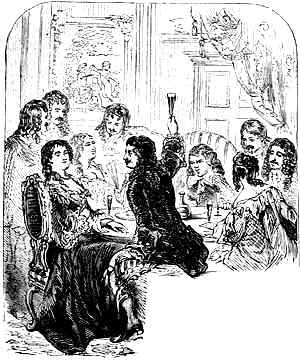
But the men who were to be the future roués of the Regency were in the flower of youthful manhood in 1698, and the recommendation of Comus had with them more weight than the warnings of Æsculapius. At the joyous suppers of Anet, where the Duc de Vendôme laid aside the laurels of Mars to wreathe his brows with the ivy of Bacchus; at the Temple, where his brother, the Grand Prior, nightly revived the most scandalous features of the orgies of ancient Rome; at the Palais Royal, where the future Regent was inaugurating that long series of petits soupers which were ultimately to cost the lives of himself and his favourite daughter; and at Chantilly, where the Prince de Conti sought successfully to reproduce a younger and brighter Versailles, the pear-shaped flasks, ‘ten inches high, including the four or five of the neck,’[116] stamped with the arms of the noble hosts, and secured with Spanish wax,[117] were an indispensable adjunct to the festivities of the table. A story is told of the Marquis de Sillery, who had turned his sword into a pruning-knife, and applied himself to the cultivation of the paternal vineyards, having first introduced the sparkling wine bearing his name at one of the Anet suppers, when, at a given signal, a dozen of blooming young damsels, scantily draped in the guise of Bacchanals, entered the room, bearing apparently baskets of flowers in their hands, but which, on being placed before the guests, proved to be flower-enwreathed bottles of the new sparkling wine.[118] If ever a beverage was intended for the pleasures of society, it was certainly this one, which it was said Nature had made especially for the French,[119] who found in its discovery a compensation for the victories of Marlborough.
Chaulieu, the poetic abbé, and the favourite of both the Vendômes, hailed this new product of his native province in rapturous strophes. In an invitation to supper addressed to his friend, the Marquis de la Fare, in 1701, he describes how
‘Of fivescore clear glasses the number and brightness Make up for of dishes the absence and lightness, And the foam, sparkling pure, Of fresh delicate wine For Fortune’s frail lure Blots out all regret in this memory of mine.’[120]
In a letter to St. Evremond, he mentions sundry wonderful things that should happen ‘if the Muses were as fond of the wine of Champagne as the poet who writes this to you;’ and, in one to the Marquis de Dangeau, jestingly remarks that
‘St. Maur’s harsher muse All flight will refuse, Unless you sustain Her wings with Champagne.’[121]
Replying to an invitation to Sonning’s house at Neuilly on July 20, 1707, he says that when he comes it will be wonderful to see how the Champagne will be drained from the tall glasses known as flutes.[122] That the Champagne he extols was a sparkling wine is established in a poetical epistle to Madame D., in answer to her complaint that the wine he had sent her did not froth as when they supped together, and in this he also speaks of its newness.
His brother-rhymster, Jean Baptiste Rousseau, who must not be confounded with the philosophic Jean Jacques, invited Chaulieu to join him at Neuilly, in mingling the water of Hippocrene with the wine of Hautvillers,[123] and announced to the Champagne-loving Marquis d’Ussé, apropos of the latter’s favourite source of inspiration, that even
‘Phœbus will no more go climbing For water up Helicon’s mount, But admit, as a source of good rhyming, Champagne excels Hippocrene’s fount.’[124]
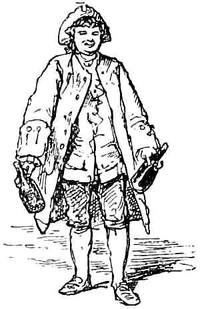
Such general attention did the subject attract that Frederick William II. of Prussia actually proposed to the Academy of Arts and Sciences at Berlin the question, ‘Why does Champagne foam?’ for solution. The Academicians, with unexpected sharpness, petitioned the King for a supply of the beverage in question on which to experiment. But the parsimonious monarch was equal to the occasion, and a solitary dozen of the wine was all he would consent to furnish them with. His ally, Augustus the Strong of Saxony, was the hero of a ludicrous adventure connected with sparkling Champagne. At a banquet given to him at Dresden, a page, who had surreptitiously appropriated a bottle of this costly beverage, and hidden it in the breast of his coat, had to approach the King. The heat and motion combined had imparted briskness to the wine, out popped the cork, and the embroidered garments and flowing periwig of Mr. Carlyle’s ‘Man of Sin’ were drenched with the foaming liquid. The page fell on his knees and roared for mercy, and the King, as soon as he recovered from his bursts of laughter, freely forgave him his offence.
The success of Dom Perignon’s wine caused a revolution in the wine-production of the province, and gave rise to numerous imitations, despite the outcry raised against sparkling wine by many gourmets, and even by the wine-merchants themselves, who complained that they had to pander to what they regarded as a depraved taste. The elder Bertin du Rocheret, father of the lieutenant criminel and a notable dealer in wine, was much opposed to it.[125] Marshal de Montesquiou d’Artagnan, the gallant assailant of Denain, had ordered some wine of him, and he writes in reply, on November 11, 1711: ‘I have chosen three poinçons of the best wine of Pierry at 400 francs the queue, not to be drawn off as mousseux—that would be too great a pity. Also a poinçon to be drawn off as mousseux at 250 francs the queue; or, if you will only go as far as 180 francs, it will froth just as well, or better. Also a poinçon of tocane of Ay to be drunk this winter—that is to say, it should be drunk by Shrovetide—at 300 francs the queue: this wine is very fine.’[126]
On the 27th December 1712 the Marshal writes: ‘With regard to my wine being made mousseux, many prefer that it should be so; and I should not be vexed, provided it does not in any way depreciate its quality.’ On the 18th October of the following year the stern laudator temporis acti describes how the bottling has been carried out, ‘in order that your wines might be mousseux, without which I should not have done it, and perhaps you would have found it better, but it would not have had the merit of being mousseux, which in my opinion is the merit of a poor wine, and only proper to beer, chocolate, and whipped cream. Good Champagne should be clear and fine, should sparkle in the glass, and should flatter the palate, as it never does when it is mousseux, but has a smack of fermentation; hence it is only mousseux because it is working.’
The converted Marshal replies on October 25th: ‘I was in the wrong to ask you to bottle my wine so that it might be mousseux; it is a fashion that prevails everywhere, especially amongst young people. For my own part, I care very little about it; but I wish the wine to be clear and fine, and to have a strong Champagne bouquet.’ In the following December Bertin, in answer to the Marshal’s request for three quartaux of wine, says: ‘Will you kindly let me know at what date you propose to drink this wine? If it is to be drunk as mousseux, I shall not agree with you.’
The allusion to the time of year at which the wine was to be drunk throws a light upon a practice of the day, confirmed by other passages in this correspondence. Much of the wine made was drunk as vin bourru fined, but not racked off, at the beginning of the year, or as tocane, which was apt to go off if kept beyond Shrovetide. This speedy consumption and the careful choice made of the grapes intended for vin mousseux militated against the formation in the bottles of that deposit, which, up to the commencement of the present century, when the system of dégorgeage was introduced, could only be remedied by dépotage,[127] though, as we have seen, the Abbey of Hautvillers had a secret method, carefully guarded, of checking its formation.[128]
It is singular that the presence of a natural liqueur—the consequence of a complete but not excessive ripeness of the grape, and at present considered one of the highest qualities of the wine—was, at the commencement of the eighteenth century, regarded as a disease. The Mémoire of 1718 states that when the wine has any liqueur, however good it may otherwise be, it is not esteemed, and recommends the owner to get rid of this ‘bad quality’ forthwith by putting a pint of new milk warm from the cow into each pièce, stirring it well, letting it rest three days, and then racking the wine off. At this epoch the wine of the Champagne seems to have been preferred perfectly dry.[129] In June 1716 the Marshal d’Artagnan reproached Bertin du Rocheret for sending him Hautvillers wine of the preceding vintage which had turned out liquoreuse. However, in August he felt forced to write that it had become excellent, and similar experiences seem to have soon removed all prejudices against this liqueur character. Bertin, in 1725, speaks of it as one of the qualities of wine, and charges for it in proportion; and six years later remarks that the English are as mad for liqueur and colour in their wines as the French.[130]
IV. THE BATTLE OF THE WINES.
Temporary check to the popularity of Sparkling Champagne—Doctors disagree—The champions of Champagne and Burgundy—Péna and his patient—A young Burgundian student attacks the Wine of Reims—The Faculty of Reims in arms—A local Old Parr cited as an example in favour of the Wines of the Champagne—Salins of Beaune and Le Pescheur of Reims engage warmly in the dispute—A pelting with pamphlets—Burgundy sounds a war-note—The Sapphics of Benigné Grenan—An asp beneath the flowers—The gauntlet picked up—Carols from a Coffin—Champagne extolled as superior to all other wines—It inspires the heart and stirs the brain—The apotheosis of Champagne foam—Burgundy, an invalid, seeks a prescription—Impartially appreciative drinkers of both wines—Bold Burgundian and stout Rémois, each a jolly tippling fellow—Canon Maucroix’s parallel between Burgundy and Demosthenes and Champagne and Cicero—Champagne a panacea for gout and stone—Final decision in favour of Champagne by the medical faculty of Paris—Pluche’s opinion on the controversy—Champagne a lively wit and Burgundy a solid understanding—Champagne commands double the price of the best Burgundy—Zealots reconciled at table.
BY a strange fatality the popularity of the sparkling wine of the Champagne, which had helped to dissipate the gloom hanging over court and capital during the last twenty years of the reign of Louis Quatorze,[131] began to wane the year preceding that monarch’s death.[132] Dom Perignon too, as though stricken to the heart by this, forthwith drooped and died. The inhabitants of the province once more turned their attention to their red wines, which continued to enjoy a high reputation during the first half of the century,[133] despite the sweeping assertion that they were somewhat dry, rather flat, and possessed a strong flinty flavour,[134] the goût de terroir alluded to by St. Evremond.
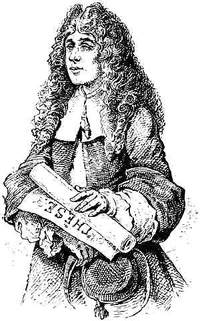
These red wines were not only sent to Paris in large quantities by way of the Marne,[135] but commanded an important export trade, those of the Mountain, which were better able to bear the journey than the growths of the River, gracing the best-appointed tables of London, Amsterdam, Copenhagen, and the North,[136] and especially of Flanders, where they were usually sold as Burgundy.[137] It must not be lost sight of that the yield of white sparkling wine from the crûs d’élite was for a long time comparatively small, especially when contrasted with that of to-day.[138] At a later period the manufacture of vin mousseux increased, notably in the districts south of the Marne,[139] and drove out almost entirely the still red wine; the place of the latter being supplied, as regards Holland, Belgium, and Northern France, by the growths of Bordeaux, which were found to keep better in damp climates.[140]
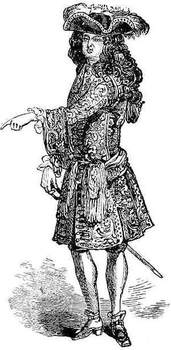
LOUIS XIV. (From a portrait of the time).
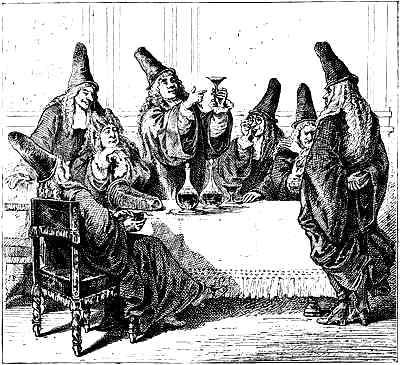
One cause of this falling off in the popularity of the sparkling wine arose from the great battle which raged for many years respecting the relative merits of Champagne and Burgundy. It was waged in the schools, and not in the field; for the combatants were neither dashing soldiers, brilliant courtiers, nor even gay young students, but potent, grave, and reverend physicians—the wigged, capped, and gowned pedants of the Diaphorus type whom Molière so piteously pilloried. The only blood shed was that of the grape, excepting when some enthusiastic Sangrado was impelled by a too conscientious practical examination into the qualities of the vintage he championed to a more than ordinary reckless use of the lancet. The contending armies couched pens instead of lances, and marshalled arguments in array in place of squadrons. They hurled pamphlets and theses at each others’ heads in lieu of bombshells, and kept up withal a running fire of versification, so that the rumble of hexameters replaced that of artillery.
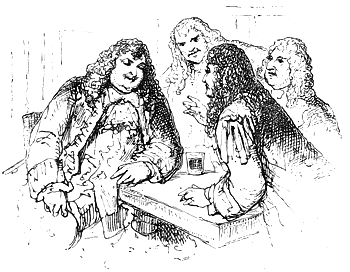
National pride, and perhaps a smack of envy at the growing popularity of the still red wines of the Champagne, had, as far back as 1652, led a hot-headed young Burgundian, one Daniel Arbinet, to select as the subject of a thesis, maintained by him before the schools of Paris, the proposition that the wine of Beaune was more delicious and more wholesome than any other wine,[141] the remaining vintages of the universe being pretty roughly handled in the thesis in question. The Champenois contented themselves for the time being with cultivating their vineyards and improving their wines, till in 1677, when these latter had acquired yet more renown, M. de Révélois of Reims boldly rushed into print with the assertion that the wine of Reims was the most wholesome of all.[142] Though the first to write in its favour, he was not the first doctor of eminence who had expressed an opinion favourable to the wine of Champagne. Péna, a leading Parisian physician of the seventeenth century, was once consulted by a stranger. ‘Where do you come from?’ he inquired. ‘I am a native of Saumur.’ ‘A native of Saumur. What bread do you eat?’ ‘Bread from the Belle Cave.’ ‘A native of Saumur, and you eat bread from the Belle Cave. What meat do you get?’ ‘Mutton fed at Chardonnet.’ ‘A native of Saumur, eating bread from the Belle Cave and mutton fed at Chardonnet. What wine do you drink?’ ‘Wine from the Côteaux.’[143] ‘What! You are a native of Saumur; you eat bread from the Belle Cave, and mutton fed at Chardonnet, and drink the wine of the Côteaux, and you come here to consult me! Go along; there can be nothing the matter with you!’[144]
Burgundy remained silent in turn for nearly twenty years, when, lo, in 1696—probably just about the time when the popping of Dom Perignon’s corks began to make some noise in the world—a yet more opinionated young champion of the Côte d’Or, Mathieu Fournier, a medical student, hard pressed for the subject of his inaugural thesis, and in the firm faith that
‘None but a clever dialectician Can hope to become a good physician, And that logic plays an important part In the mystery of the healing art,’
propounded the theory that the wines of Reims irritated the nerves, and caused a predisposition to catarrh, gout, and other disorders, owing to which Fagon, the King’s physician, had forbidden them to his royal master.[145]
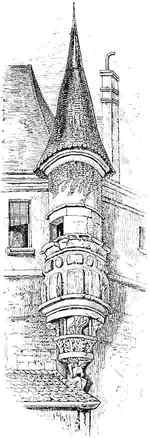
ANCIENT TOWER OF REIMS UNIVERSITY.
Shocked at these scandalous assertions, the entire Faculty of Medicine at the Reims University rose in arms in defence of their native vintage. Its periwigged professors put their learned heads together to discuss the all-important question, ‘Is the wine of Reims more agreeable and more wholesome than the wine of Burgundy?’ and in 1700 Giles Culotteau embodied their combined opinions in a pamphlet published under that title.[146] After extolling the liquid purity, the excellent brightness, the divine flavour, the paradisiacal perfume, and the great durability of the wines of Ay, Pierry, Verzy, Sillery, Hautvillers, &c., as superior to those of any growth of Burgundy, he instanced the case of a local Old Parr named Pierre Pieton, a vigneron of Hautvillers, who had married at the age of 110, and reached that of 118 without infirmity, as a convincing proof of the material advantages reaped from their consumption.
Salins, the doyen of the Faculty of Medicine of Beaune, was intrusted with the task of replying, and in 1704 bitterly assailed Culotteau’s thesis in a ‘Defence of the Wine of Burgundy against the Wine of Champagne,’ which ran to five editions in four years. M. le Pescheur, a doctor of Reims, vigorously attacked each of these editions in succession, maintaining amongst other things that the wine of Reims owed its renown to the many virtues discovered in it by the great lords who had accompanied Louis XIV. to his coronation; and that if the King, on the advice of his doctors, had renounced its use, his courtiers had certainly not. He also asserted that England, Germany, and the North of Europe consumed far more Champagne than they did Burgundy, and that it would be transported without risk to the end of the world, Tavernier having taken it to Persia, and another traveller to Siam and Surinam.
The partisanship quickly spread throughout the country, and the respective admirers of Burgundy and Champagne pitilessly pelted each other in prose and verse; for the two camps had their troubadours, who, like those of old, excited the courage and ardour of the combatants. The first to sound the warlike trumpet was Benigné Grenan, professor at the college of Harcourt, who, with the rich vintage of his native province bubbling at fever-heat through his veins, sought in 1711 to crush Champagne by means of Latin sapphics, a sample of which has been thus translated:
‘Lift to the skies thy foaming wine, That cheers the heart, that charms the eye; Exalt its fragrance, gift divine, Champagne, from thee the wise must fly! A poison lurks those charms below, An asp beneath the flowers is hid; In vain thy sparkling fountains flow When wisdom has their lymph forbid. ’Tis, but when cloyed with purer fair We can with such a traitress flirt; So following Beaune with reverent air, Let Reims appear but at dessert.’[147]
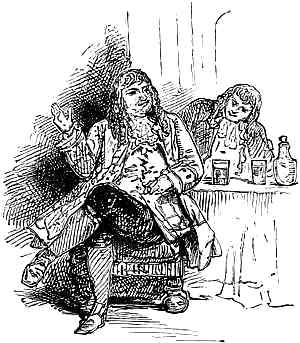
The gauntlet thus contemptuously thrown down was promptly and indignantly picked up by the Rector of the University of Beauvais, the learned Dr. Charles Coffin, a native of Buzancy, near Reims, who in the quiet retirement of the Picardian Alma Mater had evidently not forgotten to keep up his acquaintance with the vintage of his native province. The Latin poem he produced in reply, under the title of Campania vindicata,[148] had nothing in common with his lugubriously sepulchral name, as may be seen by the following somewhat freely translated extracts from it. After invoking the aid of a bottle of the enlivening liquor whose praises he is about to sing, he exclaims:
‘As the vine, although lowly in aspect, outshines The stateliest trees by the produce it bears, So midst all earth’s list of rich generous wines, Our Reims the bright crown of preëminence wears. The Massica, erst sang by Horace of old, To Sillery now must abandon the field; Falernian, nor Chian, could ne’er be so bold To rival the nectar Ay’s sunny slopes yield. As bright as the goblet it sparklingly fills With diamonds in fusion, it foaming exhales An odour ambrosial, the nostril that thrills, Foretelling the flavour delicious it veils. At first with false fury the foam-bells arise, And creamily bubbling spread over the brim, Till equally swiftly their petulance dies In a purity that makes e’en crystal seem dim.’[149]
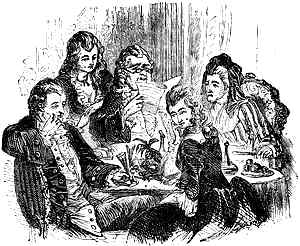
Praising the flavour of this nectar, which he declares is in every way worthy of its appearance, he stoutly defends the wine from the charge of unwholesomeness adduced against it by Grenan:
‘Despite the tongue of malice, No poison in thy chalice Was ever found, Champagne! Simplicity most loyal Was e’er thy boast right royal, And this thy wines retain. No harm lurks in the fire That helps thee to inspire The heart and spur the brain.’[150]
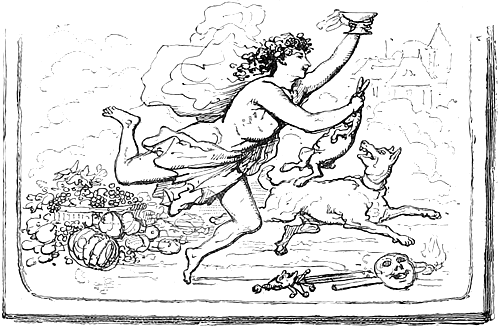
So far from causing inconvenience, he claims for Champagne the property of keeping off both gout and gravel, neither of which, he says, is known in Reims and its neighbourhood, and continues:
‘When on the fruit-piled board, Thy cups, with nectar stored, Commence their genial reign, The wisest, sternest faces Of mirth display the traces, And to rejoice are fain. As laughter’s silv’ry ripple Greets every glass we tipple. Away fly grief and pain.’[151]
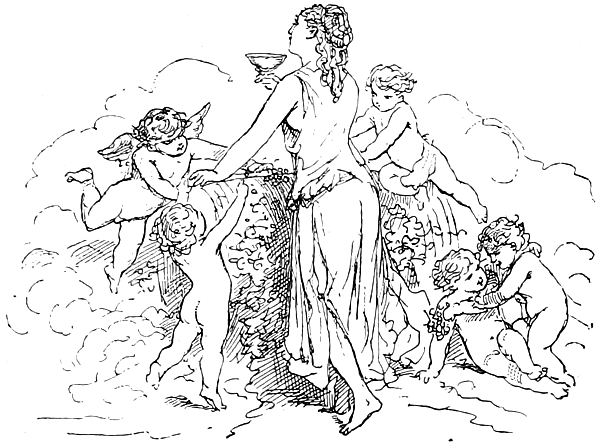
The jovial old rector with the sepulchral appellation then proceeds, according to the most approved method of warfare, to carry the campaign into the enemy’s territory. He admits the nutritive and strengthening properties of Burgundy, but demands what it possesses beyond these, which are shared in common with it by many other vintages. He then prophesies, with the return of peace,[152] the advent of the English to buy the wine of Reims; and concludes by wishing that all who dispute the merits of Champagne may find nothing to drink but the sour cider of Normandy or the acrid vintage of Ivri. The citizens of Reims, thoroughly alive to the importance of the controversy, were enchanted with this production; they did not, however, crown the poet with laurel, but more wisely and appropriately despatched to him four dozen of their best red and gray wines, by the aid of which he continued to tipple and to sing.
Grenan, resuming the offensive in turn, at once addressed an epistle in Latin verse, in favour of Burgundy against Champagne, to Fagon, the King’s physician.[153] Complaining that the latter wine lays claim unjustly to the first rank, he allows it certain qualities—brilliancy, purity, limpidity, a subtle savour that touches the most blunted palate, and an aroma so delicious that it is impossible to resist its attractions. But he objects to its pretensions.
‘Its vinous flood, with swelling pride In foaming wavelets welling up, Pours forth its bright and sparkling tide, Bubbling and glittering in the cup.’[154]
He goes on to accuse the Champenois poet of being unduly inspired by this wine, the effects of which he finds apparent in his inflated style and his attempts to place Champagne in the first rank, and make all other vintages its subjects; and he reiterates his allegations that, unlike Burgundy, it affects both the head and the stomach, and is bound to produce gout and gravel in its systematic imbibers. He concludes by begging Fagon to pronounce in his favour, as having proved the virtues of Burgundy on the King himself, whose strength had been sustained by it. The retort was sharp and to the point, taking the form of a twofold epigram from an anonymous hand:
‘To the doctor to go On behalf of your wine Is, as far as I know, Of its sickness a sign. Your cause and your wine Must be equally weak, Since to check their decline A prescription you seek.’[155]
Nor was the poet of the funereal cognomen backward in stepping into the field; for he published a metrical decree, supposed to be issued by the faculty of the island of Cos in the fourth year of the ninety-first Olympiad,[156] in which, though a verdict is nominally given in favour of Burgundy, Grenan’s pleas on behalf of this wine are treated with withering sarcasm.
But whilst these enthusiastic partisans thus belaboured one another, there were not wanting impartial spirits who could recognise that there were merits on both sides. Bellechaume, in an ode jointly addressed to the two combatants,[157] adjures them to live at peace on Parnassus, and, remembering that Horace praised both Falernian and Massica, to jointly animate their muse with Champagne and Burgundy:
‘To learn the difference between The wine of Reims and that of Beaune, The fairest plan would be, I ween, To drink them both, not one alone.’[158]
Another equally judicious versifier called also on the Burgundian champion[159] to cease the futile contest, since
‘Bold Burgundian ever glories With stout Remois to get mellow; Each well filled with vinous lore is Each a jolly tippling fellow.’[160]
And the learned Canon Maucroix of Reims exhibited a similar conciliatory spirit in the ingenious parallel which he drew between the two greatest orators of antiquity and the wines of the Marne and the Côte d’Or. ‘In the wine of Burgundy,’ he observes, ‘there is more strength and vigour; it does not play with its man so much, it overthrows him more suddenly,—that is Demosthenes. The wine of Champagne is subtler and more delicate; it amuses more and for a longer time, but in the end it does not produce less effect,—that is Cicero.’[161]
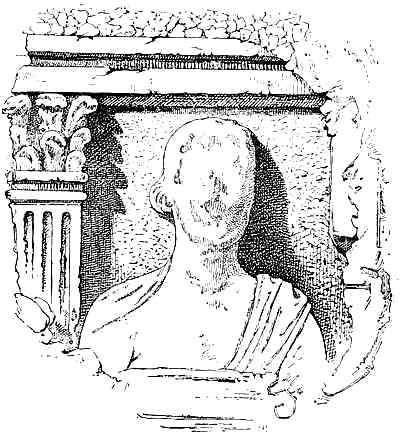
REMAINS OF THE GATE OF BACCHUS, NEAR REIMS UNIVERSITY.
The national disasters which marked the close of the reign of Louis XIV. diverted public attention in some degree from the nugatory contest;[162] and though Fontenelle sought to prove that a glass of Champagne was better than a bottle of Burgundy,[163] the impartially appreciative agreed with Panard that
‘Old Burgundy and young Champagne At table boast an equal reign.’[164]
But the doctors continued to disagree, and new generations of them still went on wrangling over the vexed questions of supremacy and salubrity. In 1739 Jean François carried the war into the enemy’s camp by maintaining at Paris that Burgundy caused gout; and a little later Robert Linguet declared the wine of Reims to be as healthy as it was agreeable. In 1777 Xavier, Regent of the Faculty of Medicine at the Reims University, affirmed that not only did the once vilified vin mousseux share with the other wines of the Champagne the absence of the tartarous particles which in many red wines are productive of gout and gravel, but that the gas it contained caused it to act as a dissolvent upon stone in the human body, and was also invaluable, from its antiseptic qualities, in treating putrid fevers.[165] Further, the appropriately named Champagne Dufresnay established, to his own satisfaction and that of his colleagues, that the wine was superior to any other growth, native or foreign.[166] At length, in 1778, when the bones of the original disputants were dust, and their lancets rust, on the occasion of a thesis being defended before the Faculty of Medicine of Paris, a verdict was formally pronounced by this body in favour of the wine of the Champagne.[167]
V. PROGRESS AND POPULARITY OF SPARKLING CHAMPAGNE.
Sparkling Champagne intoxicates the Regent d’Orléans and the roués of the Palais Royal—It is drunk by Peter the Great at Reims—A horse trained on Champagne and biscuits—Decree of Louis XV. regarding the transport of Champagne—Wine for the petits cabinets du Roi—The petits soupers and Champagne orgies of the royal household—A bibulous royal mistress—The Well-Beloved at Reims—Frederick the Great, George II., Stanislas Leczinski, and Marshal Saxe all drink Champagne—Voltaire sings the praises of the effervescing wine of Ay—The Commander Descartes and Lebatteux extol the charms of sparkling Champagne—Bertin du Rocheret and his balsamic molecules—The Bacchanalian poet Panard chants the inspiring effects of the vintages of the Marne—Marmontel is jointly inspired by Mademoiselle de Navarre and the wine of Avenay—The Abbé de l’Attaignant and his fair hostesses—Breakages of bottles in the manufacturers’ cellars—Attempts to obviate them—The early sparkling wines merely crémant—Saute bouchon and demi-mousseux—Prices of Champagne in the eighteenth century—Preference given to light acid wines for sparkling Champagne—Lingering relics of prejudice against vin mousseux—The secret addition of sugar—Originally the wine not cleared in bottle—Its transfer to other bottles necessary—Adoption of the present method of ridding the wine of its deposit—The vine-cultivators the last to profit by the popularity of sparkling Champagne—Marie Antoinette welcomed to Reims—Reception and coronation of Louis XVI. at Reims—‘The crown, it hurts me!’—Oppressive dues and tithes of the ancien régime—The Fermiers Généraux and their hôtel at Reims—Champagne under the Revolution—Napoleon at Epernay—Champagne included in the equipment of his satraps—The Allies in the Champagne—Drunkenness and pillaging—Appreciation of Champagne by the invading troops—The beneficial results which followed—Universal popularity of Champagne—The wine a favourite with kings and potentates—Its traces to be met with everywhere.
WHILST doctors went on shaking their periwigged heads, and debating whether sparkling Champagne did or did not injure the nerves and produce gout, the timid might hearken to their counsels, but there were plenty of spirits bold enough to let the corks pop gaily, regardless of all consequences. The wine continued in high favour with the viveurs of the capital, and especially with the brilliant band of titled scoundrels who formed the Court of Philippe le Débonnaire. ‘When my son gets drunk,’ wrote, on the 13th August 1716, the Princess Charlotte Elizabeth of Bavaria, the Regent’s mother, ‘it is not with strong drinks or spirituous liquors, but pure wine of Champagne;’[168] and as the pupil of the Abbé Dubois very seldom went to bed sober,[169] he must have consumed a fair amount of the fluid in question in the course of his career. Even his boon companion, the Duke de Richelieu, is forced to admit that there was a great deal more drunkenness about him than was becoming in a Regent of France; and that, as he could not support wine so well as his guests, he often rose from the table drunk, or with his wits wool-gathering. ‘Two bottles of Champagne,’ remarks the duke in his Chronique, ‘had this effect upon him.’
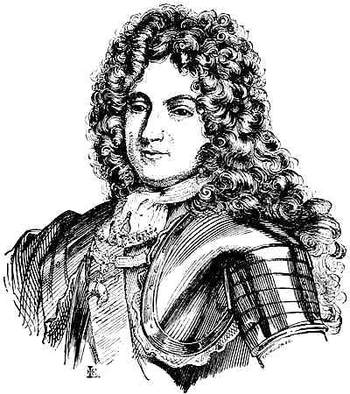
THE REGENT D’ORLÉANS (From the picture by Santerre).
Desirous, seemingly, that such enjoyments should not be confined to himself alone, he abolished in 1719 sundry dues on wine in general, whilst his famous, or rather infamous, suppers conduced to the vogue of that sparkling Champagne which was an indispensable accompaniment of those décolleté repasts. It unloosed the tongues and waistcoats of the roués of the Palais Royal, the Nocés, Broglios, Birons, Brancas, and Canillacs; it lent an additional sparkle to the bright eyes of Mesdames de Parabère and de Sabran, and inspired the scathing remark from the lips of one of those fair frail ones, that ‘God, after having made man, took up a little mud, and used it to form the souls of princes and lackeys.’ It played its part, too, at the memorable repast at which the Regent and his favourite daughter so scandalised their hostess, the Duchess of Burgundy, and at the fatal orgie shared by the same pair on the terrace of Meudon.
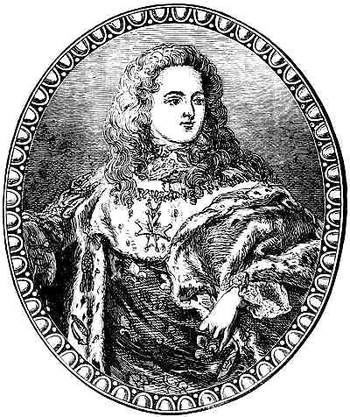
LOUIS XV. WHEN YOUNG (From a picture of the epoch).
The example set in such high quarters could not fail to be followed. Champagne fired the sallies of the wits and versifiers whom the Duchess of Maine gathered around her at Sceaux, and stimulated the madness which seized upon the whole of Paris at the bidding of the financier Law. It frothed, too, in the goblets which Bertin du Rocheret had the honour of filling with his own hand for Peter the Great, on the passage of the Northern Colossus through Reims in June 1717; and its consumption was increased by a decree of 1728, which especially provided that people proceeding to their country seats might take with them for their own use a certain quantity of this wine free of duty.
A curious purpose to which the wine was applied appeared from a wager laid by the Count de Saillans—one of the most famous horsemen of his day, and already distinguished by similar feats—to the effect that he would ride a single horse from the gate of Versailles to the Hôtel des Invalides within an hour. His wife, fearing the dangerous descent from Sèvres towards Paris, prevailed on the King to prohibit him from riding in person; but a valet, whose neck was of course of no moment, was allowed to act as his deputy in essaying the feat. The horse selected was carefully fed for some days beforehand on biscuits and Champagne. Crowds assembled to witness the attempt, which was made on May 9, 1725, and resulted in the valet’s coming in two and a half minutes behind time. Whether this was due to the badness of the roads, as was alleged, or to the singular régime adopted for the animal selected, remains a moot question.[170]
Champagne won equal favour in the eyes of Louis XV., as in those of the curious compound of embodied vices who had watched over the welfare of the kingdom during his minority, though it is true that at a comparatively early age—in the year 1731—he had, on representations that over-production of wine was lowering its value, prohibited the planting of fresh vineyards without his permission under a penalty of 3000 francs, and had renewed this prohibition the year following.[171]
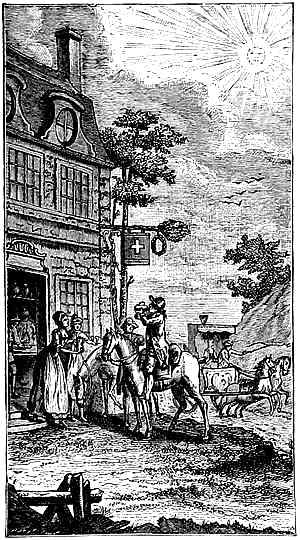
A FRENCH COUNTRY INN OF THE EIGHTEENTH CENTURY (From the ‘Routes de France’).
The royal repasts at La Muette, Marly, and Choissy were, however, enlivened with wine from the Champagne; for we find Bertin du Rocheret in 1738 despatching thirty pieces of the still wine to M. de Castagnet for the petits cabinets du Roi,[172] and the eldest of the fair sisters La Nesle, Madame de Mailly, the ‘Queen of Choissy’ and maîtresse en titre, in 1740 reforming the cellar management, and suppressing the petits soupers and Champagne orgies of the royal household.[173] Her conduct in this respect seems, however, not to have been dictated by motives of virtue, but rather by the conviction that the wine was too precious to be consumed by inferiors. We are assured that the countess loved wine, and above all that of Champagne, and that she could hold her own against the stoutest toper. ‘She has been reproached with having imparted this taste to the King, but it is probable that his Majesty was naturally inclined that way.’[174]
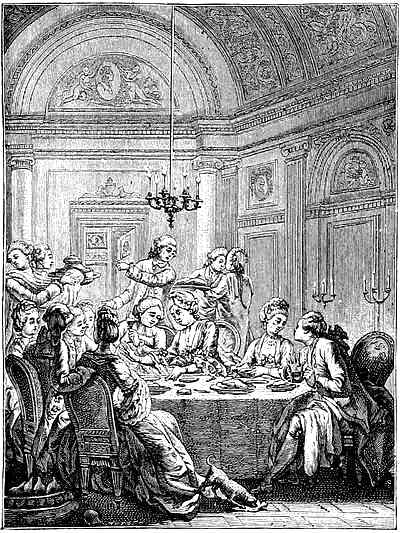
UN PETIT SOUPER OF THE EIGHTEENTH CENTURY (From the collection of the ‘Chansons de Laborde’).
When, in 1741, the ‘Well-Beloved’ passed through Reims, Dom Chatelain, after rejoicing over the year’s vintage having been a very fine one, adds that it was drunk to a considerable extent and with the greatest joy in the world during the ten days that the King remained in the city. ‘It was no longer a question,’ he exclaims exultingly, ‘of sending for Burgundy or Laon wine.’ Three years later, when traversing the Champagne, on his way to Metz, he again halted at Reims; and after hearing mass, ‘retired to the Archevêché, where the Corps de la Ville presented his Majesty with the wines of the town, which he ordered to be taken to his apartments.’[175] Wine was also presented to the Prince de Soubise, Governor of the Champagne; the Duke de Villeroy, M. d’Argenson, and the Count de Joyeuse; whilst, for the benefit of the populace, four fountains of the same fluid flowed at the corners of the Place de l’Hôtel de Ville.[176] In like manner, at the inauguration of that ‘brazen lie,’ the statue of this same Louis XV., in 1767, wine flowed in rivers from the different fountains of the city.[177]
The satyr-like sovereign of France was by no means the only monarch of his time who appreciated sparkling Champagne. Frederick the Great has praised its consoling powers in the doggerel which Voltaire was engaged to turn into poetry; and George II. of England at St. James’s, and Stanislas Leczinski of Poland at Nancy, both quaffed of the same vintage of Ay despatched in 1754 from the cellars of Bertin du Rocheret. Marshal Saxe, during his sojourn in 1745 at Brussels, where he held a quasi-royal court, of which Mademoiselle de Navarre was the bright particular star, drew an ample supply of Champagne from the cellars of that lady’s father, Claude Hevin de Navarre of Avenay, who had established himself as a wine merchant in the Belgian capital.[178] Despite, too, the continued outcry of some connoisseurs,[179] the vin mousseux became the universal source of inspiration for the cabaret-haunting poets of that graceless witty epoch.[180] Voltaire, all unmoved by the excellent still Champagne with which he and the Duke de Richelieu had been regaled at Epernay by Bertin du Rocheret in May 1735, persisted in singing the praises of the effervescing wine of Ay, in the sparkling foam of which he professed to find the type of the French nation:[181]
‘Chloris and Eglé, with their snowy hands, Pour out a wine of Ay, whose prisoned foam, Tightly compressed within its crystal home, Drives out the cork; ’midst laughter’s joyous sound It flies, against the ceiling to rebound. The sparkling foam of this refreshing wine The brilliant image of us French does shine.’
The Commander Descartes seems not to have been afraid to extol the charms of the sparkling wine to the younger Bertin du Rocheret, as stern a decrier of its merits as his father had previously been. In a letter dated December 1735, asking for ‘one or two dozen bottles of sparkling white wine, neither vert nor liquoreux, “I should like,” he says, “some
Of that delectable white wine Which foams and sparkles in the glass, And seldom mortal lips does pass; But cheers, at festivals divine, The gods to whom it owes its birth, Or else the great, our gods on earth.”’[182]
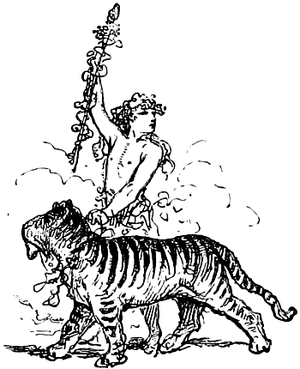
Amongst other versifiers of this epoch enamoured with the merits of the wine may be cited Charles Lebatteux, professor of rhetoric at Reims University, who in 1739 composed an ode, ‘In Civitatem Remensam,’ containing the following invocation to Bacchus:
‘’Tis not on the icy-topped mountains of Thrace, Or those of Rhodope, thy favours I trace— Not there to invoke thee I’d roam. No! Reims sees thee reign sovereign lord o’er her hills; There I offer my vows, and the nectar that thrills To my soul I will seek close at home. Whether Venus-like rising midst foam sparkling white, Or wrapped in a mantle of rose rich and bright, Thou seekest my senses to fire, Come aid me to sing, for my Muse is full fain To owe on this day each melodious strain To the fervour ’tis thine to inspire.’[183]
Bertin du Rocheret, who by no means shared his friend Voltaire’s admiration for the sparkling vintage of Ay, sang the praises of the still wine of the Champagne after the following fashion in 1741:
‘No, such blockheads do not sip Of that most delicious wine; Soul of love and fellowship, Sweet as truly ’tis benign. No, their palate, spoilt and worn, Craves adult’rate juice to drain; Poison raw which we should scorn, Beverage fit for frantic brain. Let us, therefore, hold as fools Such as now feign to despise Those balsamic molecules Horace used to sing and prize. No, such blockheads do not sip Of that most delicious wine; Soul of joy and fellowship, Sweet as truly ’tis benign. Of that wine, so purely white, Which the sternest mood makes pass, And which sparkles yet more bright In your eyes than in my glass. Drink, then, drink; I pledge you, dear, In the nectar old we prize; Sparkling in our glasses clear, But more brightly in your eyes.’[184]
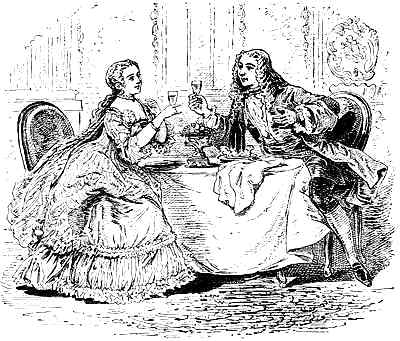
Marmontel, the author of Bélisaire and editor of the Mercure de France, found inspiration in his youthful days in the sparkling wine of Champagne. He describes, in somewhat fatuous style, the results of an invitation he received from Mademoiselle de Navarre to pass some months with her in 1746 at Avenay, where her father owned several vineyards, and where, she added, ‘It will be very unfortunate if with me and some excellent vin de Champagne you do not produce good verses.’ He tells how, in stormy weather, she insisted, on account of her fear of lightning, on dining in the cellars, where, ‘in the midst of fifty thousand bottles of Champagne, it was difficult not to lose one’s head;’ and how he was accustomed to read to her the verses thus jointly inspired when seated together on a wooded hillock, rising amidst the vineyards of Avenay.[185]
The foregoing in some degree recalls the circumstances under which Gluck, whose fame began to be established about this epoch, was accustomed to seek his musical inspirations. The celebrated composer of Orpheus and Iphegenia in Aulis was wont, when desirous of a visit from the ‘divine afflatus,’ to seat himself in the midst of a flowery meadow with a couple of bottles of Champagne by his side. By the time these were emptied, the air he was in search of was discovered and written down.
The lively and good-humoured Abbé de l’Attaignant, whose occupations as a canon of Reims Cathedral seem to have allowed him an infinite quantity of spare time to devote to versifying, addressed some rather indifferent rhymes to Madame de Blagny on the cork of a bottle of Champagne exploding in her hand;[186] and in some lines to Madame de Boulogne, on her pouring out Champagne for him at table, he maintains that the nectar poured out by Ganymede to Jupiter at his repasts must yield to this vintage.[187]
That boon convivialist Panard—who flourished at the same epoch, and was one of the chief songsters of the original Caveau, and a man of whom it was said that, ‘when set running, the tide of song flowed on till the cask was empty’—has not neglected sparkling Champagne in his Bacchanalian compositions. The ‘La Fontaine of Vaudeville,’ as Marmontel dubbed him, does not hesitate to admit that he preferred the popping of Champagne corks to the martial strains of drum and trumpet.[188] The wine, moreover, furnishes him with frequent illustrations for his code of careless philosophy.
‘Doctor for vintner vials fills Most carefully, with lymph of wells. Champagne, that grew on Nanterre’s hills, Vintner in turn to doctor sells. So still we find, as on we jog Throughout the world, ’tis dog bite dog.’[189]
Elsewhere Panard gives expression to the Bacchanalian sentiment, which he seems to have made his rule of life, in the following terms:
‘Let’s quit this vain world, with its pleasures that cloy, A destiny tranquil and sweet to enjoy: Descend to my cellar, and there taste the charms Of Champagne and Beaune; Our pleasure will there be without the alarms Of any joy queller; For the ennui that often mounts up to the throne Will never descend to the cellar.’[190]
The poet appears to have rivalled one of the characters in his piece, Les Festes Sincères (represented on the 5th October 1744 on the occasion of the King’s convalescence), who, after describing how wine was freely proffered to all comers, said that he had contented himself with thirty glasses, ‘half Burgundy and half Champagne.’
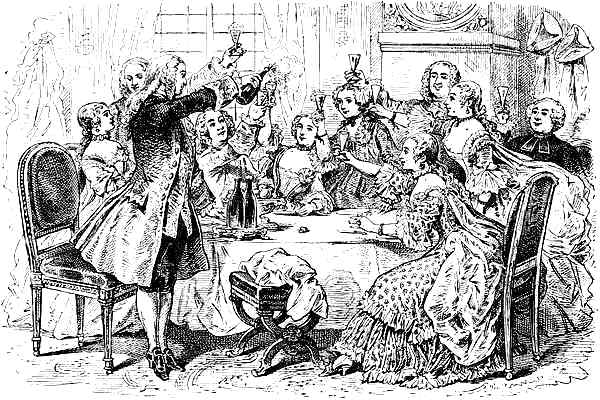
In a piece of verse entitled ‘La Charme du Vaudeville à Table,’ Panard sketches in glowing colours the inspiriting effect of sparkling Champagne upon such a joyous company of periwigged beaux and patched and powdered beauties as we may imagine to be assembled at the hospitable board of some rich financier of the epoch.
‘’Tis then some joyous guest A flask, filled with the best Of Reims or Ay, securely sealed, holds up; He deftly cuts the string, Aloft the cork takes wing; The rest with eager eyes Thrust glasses t’wards the prize, And watch the nectar foaming o’er the cup. They sip, they drink, they laugh, And then anew they quaff Their bumpers, crowned above the brim with foam That gives to laughter birth, And makes fresh bursts of mirth. Its spirit and its fire Unto the brain aspire, And rouse the wit of which this is the home.’[191]
To its praise he also devotes a poetic tour de force, the concluding verses of which may thus be rendered:
‘Thanks to the bowl That cheers my soul, No care can make me shrink. The foam divine Of this gray wine,[192] I think, When it I drain, Gives to each vein A link. Source of pure joy, Without alloy, Come, dear one, fain I’d drink! Divine Champagne, All grief and pain In thee I gladly sink. All ills agree Away from thee To slink. Sweet to the nose As new-blown rose Or pink. With gifts that ease And charms that please, Come, dear one, fain I’d drink!’[193]
Despite the success achieved by the vin mousseux, merchants, owing to the excessive breakage of the bottles—of the cause of which and of the means of stopping it they were equally ignorant—often saw their hopes of fortune fly away with the splintered fragments of the shattered glass.[194] The following passages from the MS. notes of the founder of one of the first houses of Reims, written in 1770, would imply some knowledge of the fact that a liquoreux wine was likely to lead to a destructive casse, and also that the importance of the trade in sparkling Champagne was far greater during the first half of the eighteenth century than is usually supposed.[195] The MS. in question says: ‘In 1746 I bottled 6000 bottles of a very liquoreux wine; I had only 120 bottles of it left. In 1747 there was less liqueur; the breakage amounted to one-third of the whole. In 1748 it was more vinous and less liquoreux; the breakage was only a sixth. In 1759 it was more rond, and the breakage was only a tenth. In 1766 the wine of Jacquelet was very rond; the breakage was only a twentieth.’[196]
The writer then proceeds to recommend, as a means of preventing breakage, that the wine should not be bottled till the liqueur had almost disappeared, and that, if necessary, fermentation should be checked by well beating the wine. But as at that epoch there was really no means of effectually testing this disappearance, and as the beating theory was an utterly fallacious one, the followers of his precepts remained with the sad alternative of producing in too many instances either mousses folles and their inevitable accompaniment of disastrous breakage, or wine so mature as to be incapable of continuing its fermentation in bottle, and producing mousse at all.[197]
It is therefore evident that much of the sparkling wine drunk at the commencement of the last century was what we should call crémant, or, as it was then styled, sablant,[198] as otherwise the breakage would have been something frightful. Bertin du Rocheret plainly indicates after 1730 a difference between the fiercely frothing kinds, to which the term saute bouchon or pop-cork was applied, and wine that was merely mousseux.[199] The price of the former is the highest, ranging up to 3 livres 6 sols, whilst that of the bon mousseux does not exceed 50 sols, the difference in the two being no doubt based to a certain extent on the loss by breakage.[200]
Hence, too, a partiality for weak sour growths for making vin mousseux, as, although science could give no reason, experience showed that with these the breakage would be less than with those of a saccharine nature.[201] Thus Bertin writes in 1744 that the vineyards of Avize, planted for the most part in 1715, and almost entirely with white grapes, only produced a thin wine, with a tartness that caused it to be one of the least esteemed in the district; but that ‘since the mania for the saute bouchon, that abominable beverage, which has become yet more loathsome from an insupportable acidity,’ the Avize wines had increased in value eightfold.[202] To this acidity the Abbé Bignon refers in a poem of 1741, in which, protesting against the partiality for violently effervescing wines, he says:
‘Your palate is a cripple Worn out by fiery tipple, Or else it would prefer juice Of grapes to fizzing verjuice.’[203]
This serves to explain the preference so long accorded by gourmets to the finer non mousseux wines, full of aroma and flavour, and often sugary and liquoreux, but looked upon by the general public up to the close of the eighteenth century as inferior to those which were sharp, strong, and even sourish, but which effervesced well.[204] Lingering relics of prejudice against sparkling wine existed as late as 1782, when that conscientious observer, Legrand d’Aussy, remarked that since it had been known that sparkling wines were green wines bottled in spring, when the universal revolution of Nature causes them to enter into fermentation, they had not been so much esteemed, the gourmets of that day preferring those which did not sparkle.[205]
It was not till the close of the eighteenth century that any attempt was openly made to improve sparkling Champagne by the addition of sugar.[206] Science then came forward to prove that such an addition was not contrary to the nature of wine, and that fermentation converted the saccharine particles of the must into alcohol, and increased the vinosity.[207] Several growers began to profit by this discovery of Chaptal, though, as a rule, those who followed his recommendations in secret were loudest in asserting that Providence alone had rendered their wine better than that of their neighbours.[208] M. Nicolas Perrier of Epernay, an ex-monk of Prémontré, pointed out, at the beginning of the present century, that up to that period sugar was only regarded as a means of rendering the wine more pleasant to drink, and had always been added after fermentation, and as late as possible. This practice was favoured by the tyrannical routine reigning among the peasants of not tasting the wine till December or January, when in 1800 a decisive experience confirmed the value of the new discoveries. Numerous demands for wine during the vintage led to anticipations of a brisk and speedy sale, and sugar was thereupon added at the time of the first fermentation, merely with the view, however, of bringing the wine more forward for the buyer to taste. The result went beyond the expectations entertained; and at Ay wines of the second class, commonly called vins de vignerons, rose to a price previously unheard of.[209]
The present system of clearing the wine in bottles was not practised formerly. People were then not so particular about its perfect limpidity; besides which the wine consumed at the beginning of the year[210] had not time to deposit, and that bottled as mousseux, owing to its being originally made from carefully-selected grapes, formed very little sediment in the flask.[211] The method of collage employed at the Abbey of Hautvillers is said to have preserved the wines from this evil. Whether this method transpired, or other people discovered it, is unknown; but certainly Bertin du Rocheret transmitted it, or something very similar, in July 1752 to his correspondent in London, who bottled Champagne wines regularly every year.[212]
The necessity of ridding the wine of the deposit which deprived it of its limpidity was, however, recognised later on. At first no other method suggested itself, excepting to dépoter it—that is, to decant it into another bottle; a plan fraught, in the case of sparkling wines, with several disadvantages. At the commencement of the present century, however, the system of dégorgeage was substituted.[213] As at first practised, each bottle was held neck downwards, and either shaken or tapped at the bottom to detach the sediment, the operation being constantly repeated until the deposit had settled in the neck, when it was driven out by the force of the explosion which followed upon the removal of the cork. Somewhat later the plan now followed of placing the bottles in sloping racks and turning them every day was adopted, to the great saving of time and labour. Its discovery has been popularly attributed to Madame Clicquot; but the fact is the suggestion emanated from a person in her employ named Müller. The idea is said to have simultaneously occurred to a workman in Marizet’s house of the name of Thommassin.
Although the advent of such a delectable beverage as sparkling Champagne proved of much benefit to the world in general, and the wine-merchants of Reims and Epernay in particular, those most immediately concerned in its production had little or no reason to rejoice over its renown. The hapless peasants, from whose patches of vineyard it was to a great extent derived, were the last to profit by its popularity. Bidet, writing in 1759, foreshadows the misery which marked the last thirty years of the ancien régime.[214] Speaking of the important trade in wine carried on by the city of Reims, he urges that this would in reality be benefited by the old decrees, prohibiting the planting of new vineyards in the Champagne, being enforced to the letter. Extensive plantations of vines in land suitable for the growth of corn had doubled and even tripled the value of arable land, and caused a rise in the price of wheat. Manure, so necessary to bring these new plantations into bearing, and wood, owing to the demand for vine-stakes, barrel-staves, &c., had risen to thrice their former value. Recent epidemics had cost the lives of a large number of vine-dressers, and public corvées occupied the survivors a great part of the year, and hence a considerable increase in the cost of cultivation, landowners having to pay high wages to labourers from a distance. ‘Putting together all these excessive charges, with the crushing dues levied in addition upon vine-land as well as upon the sale and transport of wine, the result will infallibly be that the more profitable the wine-trade formerly was to Reims and to the vineyards of the environs, the more it will languish in the end, till it becomes a burden to all the vineyard owners.’ Happily these gloomy forebodings have since been completely falsified.
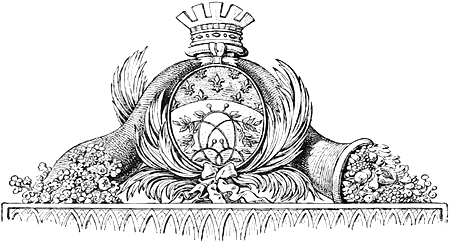
THE ARMS OF REIMS ON THE PORTE DE PARIS.
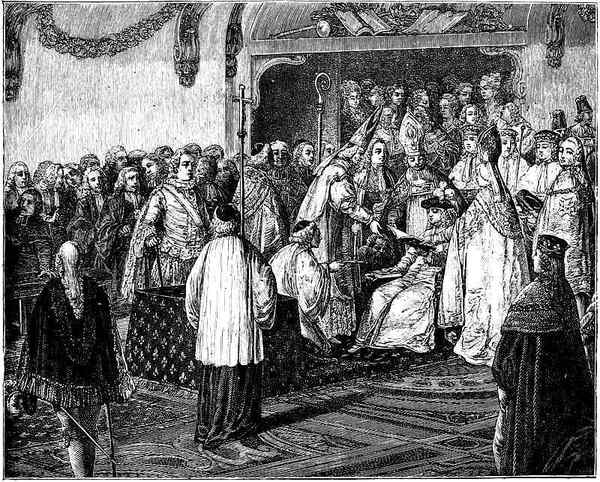
LOUIS XVI. TAKING THE CORONATION OATH AT REIMS (From a painting by Moreau).
Reims accorded an enthusiastic welcome to the youthful and ill-fated Marie Antoinette, on her passage through the city on May 12, 1770, shortly after her arrival in France;[215] and five years subsequently the Rémois were regaled with the splendours of a coronation, when the young King, Louis XVI., and his radiant Queen passed beneath the elaborately wrought escutcheon surmounting the Porte de Paris, expressly forged by a blacksmith of Reims in honour of the occasion,[216] and received from the hands of the Lieutenant des Habitans the three silver keys of the city.[217] The King was crowned on the 11th June by the Cardinal Archbishop of Reims, Charles Antoine de la Roche Aymon, a prelate who had previously baptised, confirmed, and married him, when the six lay peers were represented by Monsieur (the Count of Provence), the Count d’Artois, the Dukes of Orleans, Chartres, and Bourbon, and the Prince de Condé. The royal train was borne by the Prince de Lambesq; the Marshal de Clermont Tonnerre officiated as Constable; and the sceptre, crown, and hand of justice were carried respectively by the Marshals de Contades, de Broglie, and de Nicolai.[218] How the ill-fated King exclaimed, as the crown of Charlemagne was placed upon his brow, ‘It hurts me,’ even as Henri III. had cried, under the same circumstances, ‘It pricks me,’ and how his natural benevolence led him to slur over that portion of the coronation oath in which he ought to have bound himself to exterminate all heretics, are matters of history. An innovation to be noted is, that at the banquet at the archiepiscopal palace, after the ceremony, the youthful sovereign did not sit alone in solitary state beneath a canopy of purple velvet, ornamented with golden fleurs de lis, with his table encumbered by the great gold nef, the crown and the sceptres, the Constable, sword in hand, close by him, and the Grand Echanson and Ecuyer Tranchant tasting his wine and cutting his food,[219] circumstances under which ‘the roast must be without savour and the Ai without bouquet.’[220] The King on this occasion admitted his brothers to his board; and the ecclesiastical peers, the lay peers, the ambassadors, and the great officers of the crown formed, as usual, four groups at the remaining tables, whilst the Queen and her ladies witnessed the gustatory exploits from a gallery.
The frightful oppression of tailles, aides, corvées, gabelles, and other dues that crushed the hapless peasant in the pre-Revolutionary era, weighed with especial severity upon the vigneron. In virtue of the droit de gros, the officers could at any hour make an inventory of his wine, decree how much he might consume himself, and tax him for the remainder.[221] The fermiers généraux, who farmed the taxes of the province, became his sleeping partners, and had their share in his crop.[222] In a vineyard at Epernay, upon four pieces of wine, the average produce of an arpent, and valued at 600 francs, the ferme levied first 30 francs, and then when the pieces were sold 75 francs more.[223] The ecclesiastical tithe was also a heavy burden, at Hautvillers the eleventh of the wine being taken as dismes, at Dizy the twelfth, and at Pierry the twentieth.[224] The result was one continuous struggle of trickery on the part of the grower, and cunning on that of the officers.[225] The visits of the latter were paid almost daily, and their registers recorded every drop of wine in the cellars of the inhabitants.[226]
But the wine had by no means acquitted all its dues. The merchant buying it had to pay another 75 francs to the ferme before despatching it to the consumer. When he did despatch it, the ferme strictly prescribed the route it was to take, any deviation from this being punished by confiscation; and it had to pay at almost every step. Transport by water was excessively onerous from constantly recurring tolls, and by land whole days were lost in undergoing examinations and verifications and making payments.[227] The commissionnaire charged with the conveyance of Bertin du Rocheret’s wine to Calais from Epernay had from 70 to 75 francs per poinçon. Despite all these drawbacks, the export trade must have been considerable, for we are told that prior to the Revolution the profits on supplying two or three abbeys of Flanders were sufficient to enable a wine-merchant of Reims to live in good style.[228]
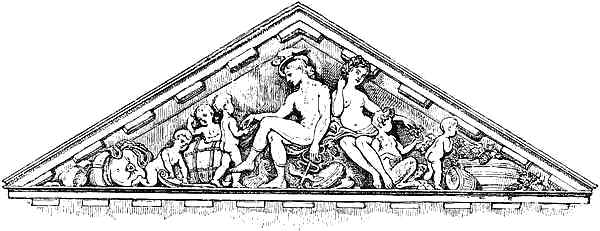
BAS-RELIEF ON THE ANCIENT HÔTEL DES FERMES AT REIMS.
On arriving at the town where it was to be drunk, the wine was subject to a fresh series of charges—octroi, droit de détail, le billot, le cinquième en sus l’impôt, jaugeage, courtage, gourmettage, &c.—frequently ranging up to 60 or 70 francs.[229] All this really affected the grower; for if the retail consumer, inhibited by high prices, could not buy, the former was unable to sell. At this epoch vine-grower and pauper were synonymous terms.[230] In certain districts of the Champagne the inhabitants actually threw their wine into the river to avoid paying the duties, and the Provincial Assembly declared that ‘in the greater part of the province the slightest increase in duty would cause all the husbandmen to abandon the soil.’[231] It is scarcely to be wondered at that under such a system of excessive taxation the fermiers généraux, who all made good bargains with the State, should have amassed immense fortunes, whilst denying themselves no kind of luxury and enjoyment. They built themselves princely hotels, rivalled the nobility and even the Court in the splendour of their entertainments, grasped at money for the sensual gratification it would purchase, and loved pleasure for its own sake, and women for their beauty and complaisance. The fermiers généraux of the province of Champagne had their bureaux, known as the Hôtel des Fermes, at Reims, and, after the town-hall, this was the handsomest civil edifice in the city. Erected in 1756 from designs by Legendre, it occupies to-day the principal side of the Place Royale. On the pediment of the façade is a bas-relief of Mercury, the god of commerce, in company with Penelope and the youthful Pan, surrounding whom are children engaged with the vintage and with bales of wool, typical of the staple trades of the capital of the Champagne.
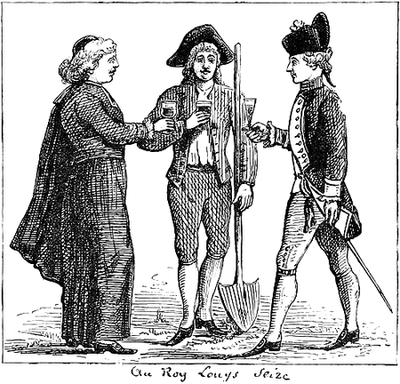
L’ACCORD FRATERNEL (From a print published at the commencement of the Revolution).
The revolutionary epoch presents a wide gap in the written history of sparkling Champagne which no one seems to have taken the trouble of filling, though this hiatus can be to some extent bridged over by a glance at the caricatures of the period. It is evident from these that Champagne continued to be the fashionable wine par excellence. We can comprehend it was de rigueur to ‘fouetter le Champagne’[232] at the epicurean repasts held at the petits maisons of the rich fermiers généraux, and that the talons rouges of the Court of Louis Seize were not averse to the payment of 3 livres 10 sols for a bottle of this delightful beverage[233] when regaling some fair émule of Sophie Arnould or Mademoiselle Guimard in the coulisses. One evening Mademoiselle Laguerre appeared on the stage as Iphigenia unmistakably intoxicated. ‘Ah,’ interjected the lively Sophie, ‘this is not Iphigenia in Tauris, but Iphigenia in Champagne.’ A proof of the aristocratic status of the wine is furnished by a print entitled L’Accord Fraternel, published at the very outset of the revolutionary movement, when it was fondly hoped that the Three Orders of the States General would unite in bringing about a harmonious solution to the evils by which France was sorely beset. In this the burly well-fed representative of the clergy holds out a bumper of Burgundy; the peasant—not one of the lean scraggy labourers, with neither shirt nor sabots,[234] prowling about half naked and hunger-stricken in quest of roots and nettle-tops, but a regular stage peasant in white stockings and pumps—grips a tumbler well filled with vin du pays; while the nobleman, elaborately arrayed in full military costume, with sword, cockade, and tie-wig all complete, delicately poises between his finger and thumb a tall flute charged with sparkling Champagne. Moreover, we can plainly trace the exhilarating influence of the wine upon the ‘feather-headed young ensigns’ at the memorable banquet given to the officers of the Régiment de Flandre by the Gardes du Corps at Versailles, on the 2d Oct. 1789.[235]
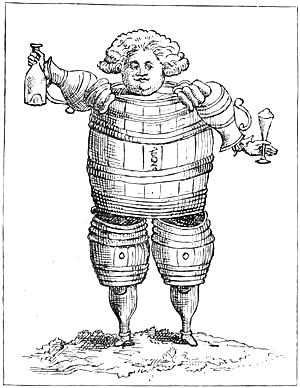
MIRABEAU TONNEAU (From a sketch by Camille Desmoulins).
Conspicuous amongst the titled topers of this period was the Viscount de Mirabeau—the younger brother of the celebrated orator and a fervent Royalist—nicknamed Mirabeau Tonneau, or Barrel Mirabeau, ‘on account of his rotundity, and the quantity of strong liquor he contains.’[236] In a caricature dated ‘An 1er de la liberté,’ and ascribed to Camille Desmoulins,[237] with whom the viscount long waged a paper war, his physical and bibacious attributes are very happily hit off. His body is a barrel; his arms, pitchers; his thighs, rundlets; and his legs inverted Champagne flasks; whilst in his left hand he holds a foam-crowned flute, and in his right another of those flasks, two of which he was credited with emptying at each repast.[238]
We have seen that the origin of many of the most famous crûs of France was due to monkish labours, and that at Reims, as elsewhere, a large proportion of the ecclesiastical revenue was derived, either directly or indirectly, from the vineyards of the district. This was happily hit off in Le Nouveau Pressoir du Clergé, or New Wine-Press for the Clergy, published in 1789. A man of the people and a representative of the Third Estate, the latter in the famous slouched hat and short cloak, are working the levers of a press, under the influence of which a full-faced abbé is rapidly disgorging a shower of gold. A yet more portly ecclesiastic, worthy to be the Archbishop of Reims himself, is being led forward, in fear and trembling, to undergo a like operation; whilst in the background a couple of his compeers, reduced to the leanness of church-rats, are making off with gesticulations of despair.
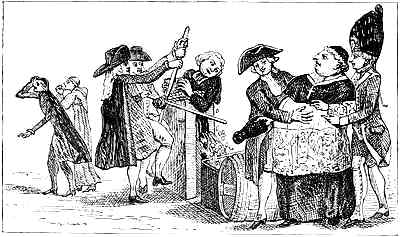
LE NOUVEAU PRESSOIR DU CLERGÉ, 1789 (From a caricature of the epoch).
The chief personal traits of Louis Seize, as depicted in numerous contemporary memoirs, seem to have been a passion for making locks and a gross and inordinate appetite. High feeding usually implies deep drinking, and one may suppose that a wine so highly esteemed at Court as Champagne was not neglected by the royal gourmand. Still there seems to have been nothing in the unfortunate monarch’s career to justify the cruel caricature wherein he is shown with the ears and hoofs of a swine wallowing in a wine-vat, with bottles, flasks, pitchers, cups, goblets, glasses, and flûtes of every variety scattered around him; whilst Henri Quatre, who has just crossed the Styx on a visit to earth, exclaims in amazement, ‘Ventre St. Gris! is this my grandson Louis?’ In another caricature, entitled ‘Le Gourmand,’ and said to represent an incident in the flight of the royal family from Paris, Louis XVI. is shown seated at table—surrounded by stringed flasks of Champagne, with the customary tall glasses—engaged in devouring a plump capon. His Majesty is evidently annoyed at being interrupted in the middle of his repast, but it is difficult to divine who the intruder is intended for. He can scarcely be one of the commissioners despatched by the National Assembly to secure the king’s return to Paris, as the German hussars drawn up in the doorway are inconsistent with this supposition. The female figure before the looking-glass is of course intended for Marie Antoinette, whilst the ungainly young cub in the background is meant for the Dauphin in an evident tantrum with his nurse.[239]
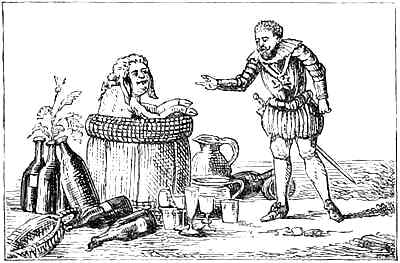
HENRI QUATRE AND LOUIS SEIZE. ‘Ventre St. Gris! Is this my grandson Louis?’ (Facsimile of a woodcut of the time.)
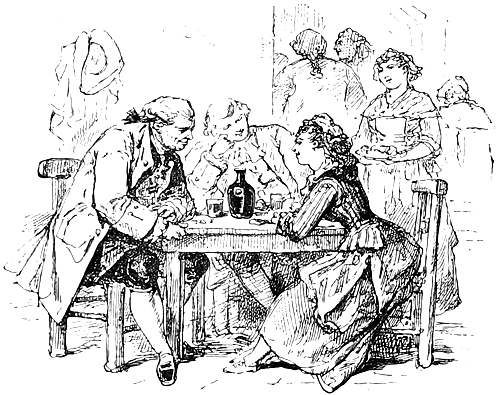
As to the pamphleteers, who advocated the Rights of Man and aspersed Marie Antoinette; the poets, who addressed their countless airy trifles to Phyllis and Chloe; the penniless disciples of Boucher and Greuze; and the incipient demagogues, briefless advocates, unbeneficed abbés, discontented bourgeois, whose eloquence was to shatter the throne of the Bourbons, they were fain for the time being to content themselves with the petit bleu of Argenteuil or Suresnes, consumed in company with Manon or Margot, in one of the dingy smoky cabarets which the café was so soon in a great measure to replace. When, however, their day did come, we may be sure they denied themselves no luxury, and sparkling Champagne would certainly have graced Danton’s luxurious repasts, and may possibly have played its part at the last repast of the condemned Girondins. In ’93, we find Champagne of 1779—the still wine, of course—announced for sale at Lemoine’s shop in the Palais Royal; while a delectable compound, styled crême de fleur d’orange grillée au vin de Champagne, was obtainable at Théron’s in the Rue St. Martin.[240] The sparkling wine can scarcely have failed to figure on the carte of the sumptuous repasts furnished by the restaurateurs, Méot and Beauvillers, to the de facto rulers of France,[241] although in 1795 the price of wine generally in Paris had increased tenfold.[242] Ex-procureurs of the defunct Parliament carefully hoarded all that remained of the Champagne formerly lavished upon them by their ex-clients;[243] whilst the latter had to content themselves with tea at London and beer at Coblenz.[244]
Although details respecting the progress of the Champagne wine-trade at home and abroad at the outset of the present century are somewhat scanty, we readily gather that the great popularity of the sparkling wine throughout Europe dates from an event which, at the time of its occurrence, the short-sighted Champenois looked upon as most disastrous. This was the Allied invasion of 1814–15. Consumption, so far as the foreign market was concerned, had been grievously interrupted by the great upset in all commercial matters consequent upon the wars of the Revolution and the Empire. It appears that the white wines of Champagne were sent to Paris, Normandy, Italy, and, ‘when circumstances permitted of it,’ to England, Holland, Sweden, Denmark, Russia, Spain, Portugal, and ‘beyond the seas.’ But the trade had suffered greatly during the wars with Austria and Russia in 1806 and 1807; and in the following years the consumption of white wine had fallen considerably, and a large number of wine-merchants had found themselves unable to meet their engagements.[245]
The wine which Napoleon I. preferred is said to have been Chambertin; still, his intimacy with the Moëts of Epernay could scarcely fail to have led to a supply of the best sparkling Champagne from the cellars he had deigned to visit in person. His satraps, who travelled with the retinue of sovereign princes, included the wine in their equipment wherever they went, and the popping of its mimic artillery echoed in their tents the thunder of their victorious cannon. But comparatively few foreign guests met at their tables; and as their foes had on their side few victories to celebrate in a similar style, the knowledge of sparkling Champagne outside France was confined to the comparatively small number of persons of wealth and position able to pay an extravagant price for it.
At length the fatal year, 1814, arrived, and the Allies swarmed across the frontier after the ‘nations’ fight’ at Leipzig. The Champagne lying directly on the way to Paris saw some hard fighting and pitiless plundering. The Prussians of Baron von Tromberg got most consumedly drunk at Epernay. The Cossacks ravaged Rilly, Taissy, and the other villages of the Mountain; and not being able to carry off all the wine they found at Sillery, ‘added to their atrocities,’ in the words of an anonymous local chronicler,[246] by staving in the barrels and flooding the cellars. The Russians, under the renegade St. Priest, seized on Reims, whetted their thirst with salt herrings till the retail price of these dainties rose from 5 liards a pair to 3 sous apiece, and then set to work to quench it with Champagne to such an extent that when Napoleon suddenly swooped down upon the city like his own emblematic eagle, a large number of them, especially among the officers, were neither in a condition to fight nor fly.[247]
The immense body of foreign troops who remained quartered in the east of France after the downfall of the Empire continued to pay unabated devotion to the dive bouteille. Tradition has especially distinguished the Russians, and relates how the Cossacks used to pour Champagne into buckets, and share it with their horses. But the walking sand-beds of North Germany, the swag-bellied warriors of Baden and Bavaria, and the stanch topers of Saxony and Swabia must of a surety have distinguished themselves. The votaries of Gambrinus, the beer king, strove whether they could empty as many bottles of Champagne at a sitting as they could flagons filled with the amber-hued beverage of their native province; while the inhabitants of those districts where the grape ripens sought to institute exhaustive comparisons between the vintages they gathered at home and the growths of the favoured region in which they now found themselves.
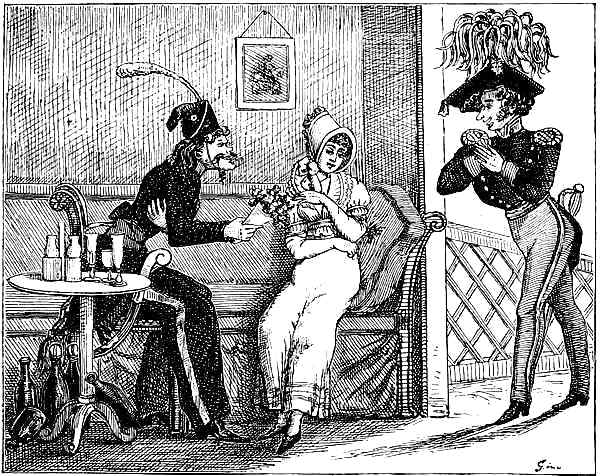
LES RUSSES À PARIS (From a coloured print of the time).
The Berliner was fain to acknowledge the superiority of the foam engendered by Champagne over that crowning his favourite weissbier, his own beloved kuhle blonde, and the beer-topers of Munich and Dresden to give the preference to the exhilaration produced by quaffing the wine of Reims and Epernay over that due to the consumption of bockbier. The Nassauer and the Rhinelander had to admit certain intrinsic merits in the vintages produced on the slopes of the Marne, and found to be lacking in those grown on the banks of the Rhine, the Ahr, the Main, and the Moselle. The Austrian recognised the superiority of the wines of the Mountain over those of Voslau or the Luttenberg; and the Magyar had to allow that the crûs of the River possessed a special charm which Nature had denied to his imperial Tokay. Even the red-coated officers who followed ‘Milord Vilainton’ to the great review at Mont Aimé, near Epernay, proved faithless to that palladium of the British mess-table, their beloved ‘black strop.’ Claret might in their eyes be only fit for boys and Frenchmen, and Port the sole drink for men; but they were forced to hail Champagne as being, as old Baudius had already phrased it, ‘a wine for gods.’
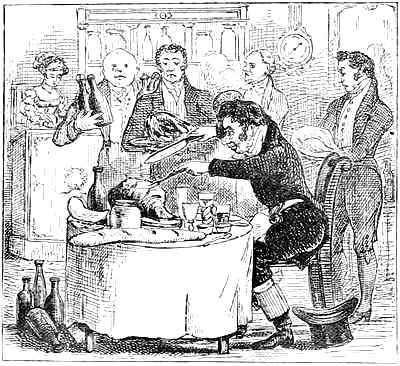
LE DÎNER DE MILORD GOGO, 1816 (After a coloured print of the time).
The officers of the Allied armies quartered in Paris after the Hundred Days supplemented the charms of the Palais Royal—then in the very apogee of its vogue as the true centre of Parisian life, with its cafés, restaurants, theatres, gambling-houses, and Galeries de Bois—with an abundance of sparkling Champagne. Royalty itself set the example by indicating a marked preference for the wine, Louis Dixhuit, according to a statement made by Wellington to Rogers, drinking nothing else at dinner. To celebrate the victories of Leipsic and Waterloo or a successful assault on the bank at Frascati’s, to console for the loss of a grosse mise at No. 113 or of a comrade transfixed beneath a lamp in the Rue Montpensier by a Bonapartist sword-blade, to win the smiles of some fickle Aspasia of the Palais Royal Camp des Tartares or to blot out the recollection of her infidelity, to wash down one of the Homeric repasts in which the English prototypes of the ‘Fudge Family Abroad’ indulged, the wine was indispensable; until, as a modern writer has put it, ‘Waterloo was avenged at last by the gros bataillons of the bankers at roulette and trente et quarante, and by the sale to the invaders of many thousand bottles of rubbishing Champagne at twelve francs the flask.’[248] The rancorous enmity prevailing between the officers of Bonapartist proclivities placed on half-pay and the returned émigrés who had accepted commissions from Louis XVIII., resulted, as is well known, in numerous hostile meetings. Captain Gronow has dwelt upon the bellicose exploits of a gigantic Irish officer in the gardes du corps, named Warren, who, when ‘excited by Champagne and brandy,’[249] was prepared to defy an army; and he tells us that at Tortoni’s there was a room set apart for such quarrelsome gentlemen, where, after these meetings, they indulged in riotous Champagne breakfasts.[250] At home, the British Government were being twitted on their parsimony in limiting the supply of Champagne for the table of the exiled Emperor at St. Helena to a single bottle per diem, a circumstance which led Sir Walter Scott to protest against the conduct of Lord Bathurst and Sir Hudson Lowe in denying the captive ‘even the solace of intoxication.’
As is not unfrequently the case, out of evil came good. The assembled nations had drunk of a charmed fountain, and it had excited a thirst which could not be quenched. The Russians had become acquainted with Champagne, which Talleyrand had styled ‘le vin civilisateur par excellence,’ and to love this wine was with them a very decided step towards a liberal education. Millions of bottles, specially fortified to the pitch of strength and sweetness suited for a hyperborean climate, were annually despatched to the great northern empire from the house of Clicquot; and later on the travellers of rival firms, eager to secure a portion of this patronage, traversed the dominions of the autocrat throughout their length and breadth, and poured their wines in wanton profusion down the throats of one and all of those from whom there appeared a prospect of securing custom.
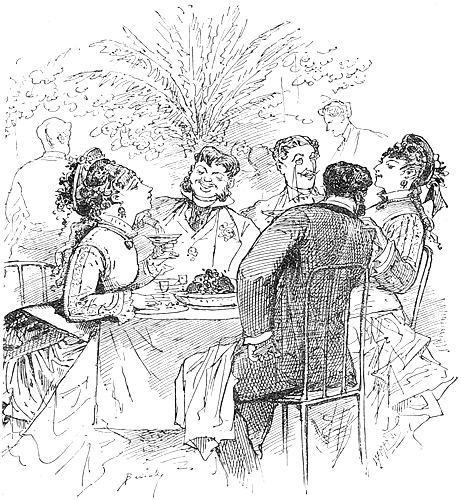
From this influx of sparkling wine into the frozen empire of the Czar the acceptance of civilisation—of rather a superficial character, it is true—may be said to date. Had Peter the Great only preferred Champagne to corn-brandy, the country would have been Europeanised long ago. As it is, the wine has to-day become a recognised necessity in higher class Russian society, and scandal even asserts that whenever it is given at a dinner-party, the host is careful to throw the windows open, in order that the popping of the corks may announce the fact to his neighbours. Abroad the Russians are more reserved in their manners; and though ranking amongst the best customers of the Parisian restaurateurs for high-class wines, it is only now and then that some excited Calmuck is to be seen flooding the glasses of his companions with Champagne in a public dining-room. The Russians, it should be noted, have sought, and not unsuccessfully, to produce sparkling wines of their own, more especially in the country of the Don Cossacks and near the Axis.
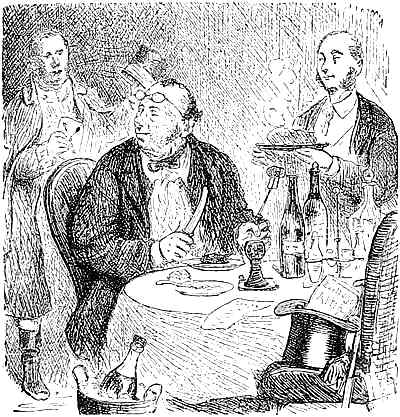
Béranger might exclaim, with a poet’s license, that he preferred a Turkish invasion to seeing the wines of the Champagne profaned by the descendants of the Alemanni;[251] but the merchants of Reims and Epernay were of a different opinion. Les militaires have always affected Champagne; and a military aristocracy like that of the Fatherland, in the cruel days when peace forbade any more free quarters and requisitions, became as large purchasers of the wine as their somewhat scanty revenues allowed of. Their example was followed to a considerable extent by the self-made members of that plutocratic class which modern speculation has caused to spring into life in Germany. Advantage was speedily taken of this taste by their own countrymen, who aimed at supplanting Champagne by sparkling wines grown on native slopes. Nay more, the Germans, as a military nation, felt bound to carry the war into the enemy’s territory, and hence it is that many important houses at Reims and Epernay are of German origin. Across the Rhine patriotism has had to yield to popularity, and the stanchest native topers have been forced to acknowledge, after due comparison in smoky wein stuben and gloomy keller, that, though the sparkling wines of the Rhine and the Moselle are in their own way most excellent, there is but one Champagner-wein, with Reims for its Mecca and Epernay for its Medina.
Of England we shall elsewhere speak at length; but the speculative trade of her colonies, with its sharp bargains, dead smashes, and large profits could hardly be carried on without the wheels of the car of Commerce and the tongues of her votaries being oiled with Champagne. The Swiss have only proved the truth of the proverb that imitation is the sincerest form of flattery by producing tolerable replicas of Champagne at Neufchâtel, Vevay, and Sion. Northern, or, to speak by the map, Scandinavian, Europe takes its fair share of the genuine article; and although the economic Belgian is apt to accept sparkling Saumur and Vouvray as a substitute, both he and his neighbour, the Dutchman, can to the full appreciate the superiority of the produce of the Marne over that of the Loire.
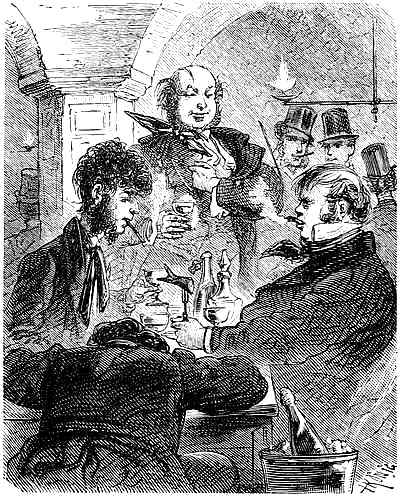
The Italian and the Spaniard may affect to outwardly despise a liquor which they profess not to be able to recognise as wine at all; but the former has to allow, per Bacco, that it excels in its particular way his extolled Lacryma Christi, while the latter does not carry his proverbial sobriety so far as to exclude the wine from repasts in the upper circles of Peninsular society. Moreover, of recent years they have both commenced making sparkling wines of their own. The Austrian also produces sparkling wines from native vintages, notably at Voslau, Graz, and Marburg; still this has not in any way lessened his admiration for, or his consumption of, Champagne. The Greek is ready enough to ‘dash down yon cup of Samian wine,’ provided there be a goblet of Champagne close at hand to replace it with; and boyards and magnates of the debateable ground of Eastern Europe not only imbibe the sparkling wines of the Marne ostentatiously and approvingly, but several of them have essayed the manufacture of vin mousseux on their own estates.
The East, the early home of the vine, and the first region to impart civilisation, is perhaps the last to receive its reflux in the shape of sparkling wine. But, the prohibition of the Prophet notwithstanding, Champagne is to be purchased on the banks of the Golden Horn, and has been imported extensively into Egypt in company with opéra-bouffe, French figurantes, stock-jobbing, and sundry other matters of foreign extraction under the régime of the late Khedive. The land of Iran has beheld with wonderment its sovereign freely quaffing the fizzing beverage of the Franks in place of the wine of Shiraz. The East Indies consume Champagne in abundance; for it figures not only on the proverbially hospitable tables of the merchants and officials of Calcutta, Bombay, and Madras, but at the symposia of most of the rajahs, princes, nawabs, and other native rulers. The almond-eyed inhabitant of ‘far Cathay,’ reluctant to abandon that strange civilisation so diametrically opposed in all its details to our own, continues to drink his native vintages, warm and out of porcelain cups, and to regard the sparkling drink of the Fanquis as a veritable ‘devils’ elixir.’ But his utterly differing neighbour, the Japanese, so eager to welcome everything European, has gladly greeted the advent of Champagne, and freely yielded to its fascination.
Turning to the undiscovered continent, we find sable sovereigns ruling at the mouths of the unexplored rivers of Equatorial Africa fully acquainted with Champagne, though disposed, from the native coarseness of their taste, to rank it as inferior to rum; whilst the Arab, filled with wonderment at the marvels of European civilisation which meet his eye at Algiers, bears back with him to the douar, wrapped up in the folds of his burnous, a couple of bottles of the wondrous effervescing drink of the Feringhees as a testimony, even as Othere brought the walrus-tooth to Alfred. One enthusiastic Algerian colonist has gone so far as to prophesy the advent of the day when the products of the native vineyards shall eclipse Champagne.[252] Let us hope, however, in the interest of Algerian digestions, that this day is as yet far distant.
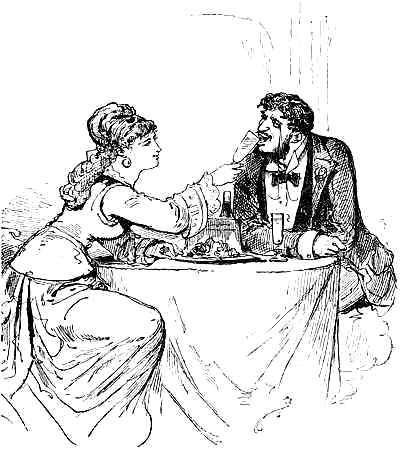
With respect to the consumption of Champagne in the Western world, the United States’ exceeds that of any European country, England and France alone excepted, despite the competition of sparkling Catawba and of a certain diabolical imitation, the raw material of which, it is asserted, is furnished not by the grapes of the Carolinas, the peaches of New Jersey, or the apples of Vermont, but by the oil-wells of Pennsylvania—in fact, petroleum Champagne. The cabinet particulier seems to be an institution as firmly established in the leading cities of the States as in Paris; and rumour says that drinking from a Champagne-glass touched by a fair one’s lips has replaced the New England pastime of eating the same piece of maple-candy till mouths meet. As regards the South American Republics, the popping of musketry at each fresh pronunciamento is certain to be succeeded by that of Champagne-corks in honour of the success of one or the other of the contending parties.
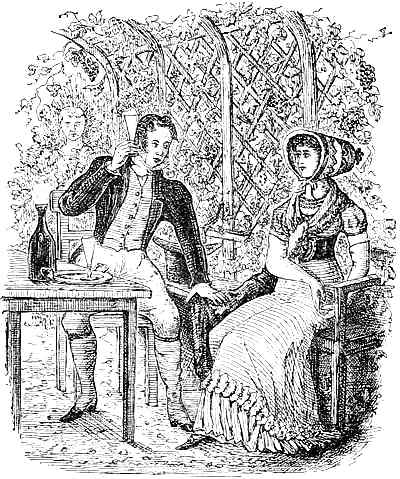
‘SOUS LA TONNELLE’ (From a print of the time of the Restoration).
In Europe Champagne has continued to be, from the days of Paulmier and Venner downwards, the drink of kings, princes, and great lords as they described it. Take a list of the potentates of the present century, and the majority of them will be found to have evinced at some time or other a partiality for the wine. Louis XVIII. drank nothing else at table. The late ruler of Prussia, Frederick William IV., had such a penchant for Champagne of a particular manufacture, that he obtained the cognomen of King Clicquot. The predecessor of Pio Nono, Gregory XVI., rivalled him in this appreciation, and, terrible to relate, so did the Commander of the Faithful, Abdul Medjid. The latter might, however, have pleaded the excuse put forward by Abd-el-Kader, that although the Prophet had forbidden wine, yet Champagne came into the category of aerated waters, concerning which he had said nothing, a remark justifying the title given to this wit-inspiring beverage of being ‘the father of bons mots.’ Prince Bismarck, in the stormy period of his youth, was in the barbarous habit of imbibing Champagne mixed with porter; but at present he judiciously alternates it with old Port. Marshal MacMahon and the King of the Belgians are said to drink the pink variety of the vin mousseux by preference.
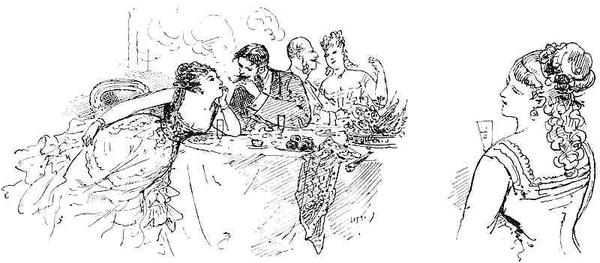
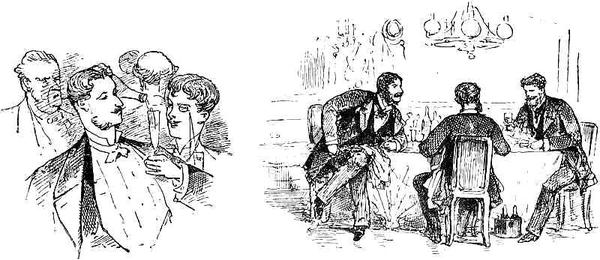
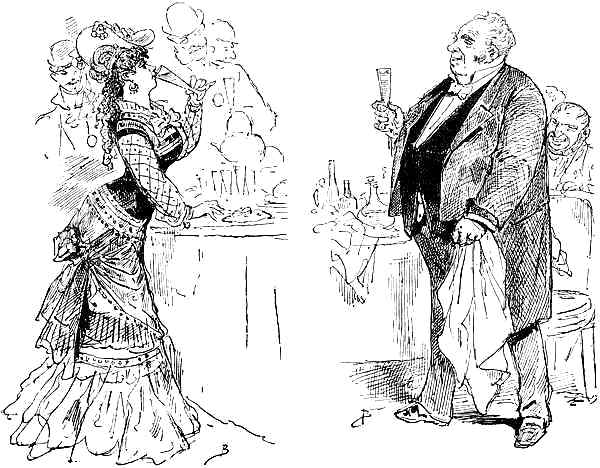
‘AU BEAU SEXE!’
Naturally, in France as elsewhere, the sparkling vintage of the Marne maintains its claims to be reckoned the wine of beauty and fashion, and more especially in beauty’s gayer hours. A glass of Champagne and a biscuit de Reims has been a refection which, though often verbally declined, was in the end pretty sure to be accepted from the days of the merveilleuses and incroyables, through those of the lionnes, down to the present epoch of the cocodettes de la haute gomme. Neither at ceremonial banquets nor at ordinary dinner-parties among our neighbours does Champagne hold, however, so prominent a place as amongst ourselves, owing to the great variety of other wines—all capable of appreciation by trained palates—entering into the composition of these festive repasts. In fact, a repas de noces is the only occasion on which Champagne flows in France with anything like the freedom to which we are accustomed; and then it is that its exhilarating effect is marked, as some portly old boy rises with twinkling eye to propose the health of the bride, or of that beau sexe to which he feels bound to profess himself deeply devoted. At such open-air gatherings as the races at Longchamps and Chantilly, the buffet will be besieged by a succession of frail fair ones in the most elaborate toilettes de courses, seeking to nerve themselves to witness a coming struggle, or to console themselves for the defeat of the horse backed by their favoured admirer. And, when writing of this wine, it is altogether impossible to omit a reference to those tête-à-tête repasts en cabinet particulier, of which it is the indispensable adjunct. Its mollifying influence on the feminine heart on occasions such as these has been happily hit off by Charles Monselet in his Polichinelle au Restaurant:
‘POLICHINELLE AU RESTAURANT.
I.
In a cabinet of Vachette, Pomponnette Listens to the pressing lover; Who, before they’ve done their soup, Cock-a-hoop, Dares his passion to discover.
II.
Elbows resting on the cloth, Partly wrath— So much do his words astound— Resolute she to resist Being kissed, Draws her mantle closer round.
III.
Whilst in vain his cause he pressed, A third guest, Who in ice-pail by them slumbered, Rears above his wat’ry bed Silver head And long neck with ice encumbered.
IV.
’Tis Champagne, who murmurs low, “Don’t you know That when once you set me flowing, This fair rebel to Love’s dart In her heart Soon will find soft passion glowing?
V.
This, if you will list to me, You shall see; Cease to swear by flames and fire, Cast aside each angry thought, As you ought, And at once cut through my wire,
VI.
For I am the King Champagne, And I reign Over e’en the sternest lasses, When midst maddening song and shout I gush out, Flooding goblets, bumpers, glasses.
VII.
As thus spoke the generous wine, Its benign Influence her heart ’gan soften. Who seeks such a cause to gain, To Champagne His success finds owing often.’[253]
VI. CHAMPAGNE IN ENGLAND.
The strong and foaming wine of the Champagne forbidden his troops by Henry V.—The English carrying off wine when evacuating Reims on the approach of Jeanne Darc—A legend of the siege of Epernay—Henry VIII. and his vineyard at Ay—Louis XIV.’s present of Champagne to Charles II.—The courtiers of the Merry Monarch retain the taste for French wine acquired in exile—St. Evremond makes the Champagne flute the glass of fashion—Still Champagne quaffed by the beaux of the Mall and the rakes of the Mulberry Gardens—It inspires the poets and dramatists of the Restoration—Is drank by James II. and William III.—The advent of sparkling Champagne in England—Farquhar’s Love and a Bottle—Mockmode the Country Squire and the witty liquor—Champagne the source of wit—Port-wine and war combine against it, but it helps Marlborough’s downfall—Coffin’s poetical invitation to the English on the return of peace—A fraternity of chemical operators who draw Champagne from an apple—The influence of Champagne in the Augustan age of English literature—Extolled by Gay and Prior—Shenstone’s verses at an inn—Renders Vanbrugh’s comedies lighter than his edifices—Swift preaches temperance in Champagne to Bolingbroke—Champagne the most fashionable wine of the eighteenth century—Bertin du Rocheret sends it in cask and bottle to the King’s wine-merchant—Champagne at Vauxhall in Horace Walpole’s day—Old Q. gets Champagne from M. de Puissieux—Lady Mary’s Champagne and chicken—Champagne plays its part at masquerades and bacchanalian suppers—Becomes the beverage of the ultra-fashionables above and below stairs—Figures in the comedies of Foote, Garrick, Coleman, and Holcroft—Champagne and real pain—Sir Edward Barry’s learned remarks on Champagne—Pitt and Dundas drunk on Jenkinson’s Champagne—Fox and the Champagne from Brooks’s—Champagne smuggled from Jersey—Grown in England—Experiences of a traveller in the Champagne trade in England at the close of the century—Sillery the favourite wine—Nelson and the ‘fair Emma’ under the influence of Champagne—The Prince Regent’s partiality for Champagne punch—Brummell’s Champagne blacking—The Duke of Clarence overcome by Champagne—Curran and Canning on the wine—Henderson’s praise of Sillery—Tom Moore’s summer fête inspired by Pink Champagne—Scott’s Muse dips her wing in Champagne—Byron’s sparkling metaphors—A joint-stock poem in praise of Pink Champagne—The wheels of social life in England oiled by Champagne—It flows at public banquets and inaugurations—Plays its part in the City, on the Turf, and in the theatrical world—Imparts a charm to the dinners of Belgravia and the suppers of Bohemia—Champagne the ladies’ wine par excellence—Its influence as a matrimonial agent—‘O the wildfire wine of France!’