PART II. (continued 2)
Reading edition
In the vast celliers of the manufacturers’ establishments, where a temperature of about 60 to 70 degrees Fahrenheit usually prevails, the wine undergoes its first fermentation, entailing a loss of about 7 ½ per cent, and lasting from a fortnight to a month, according as to whether the wine be mou—that is, rich in sugar—or the reverse. In the former case fermentation naturally lasts much longer than when the wine is vert or green. This active fermentation is converted into latent fermentation by transferring the wine to a cooler cellar, as it is essential it should retain a certain proportion of its natural saccharine to insure its future effervescence. The casks have previously been completely filled, and their bungholes tightly stopped, a necessary precaution to guard the wine from absorbing oxygen, the effect of which would be to turn it yellow, and cause it to lose some of its lightness and perfume. After being racked and fined—an operation generally performed about the third week in December—the produce of the different vineyards is ready for mixing together in accordance with the traditional theories of the various manufacturers; and should the vintage have been an indifferent one, a certain proportion of old reserved wine of a good year enters into the blend.
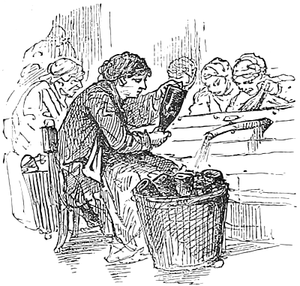
The mixing is usually effected in gigantic vats holding at times as many as 12,000 gallons each, and having fan-shaped appliances inside, which, on being worked by handles, insure a complete amalgamation of the wine. This process of marrying wine on a gigantic scale is technically known as making the cuvée. Usually four-fifths of wine obtained from black grapes, and now of a pale-pink hue, are tempered by one-fifth of the juice of white ones. It is necessary that the first should comprise a more or less powerful dash of the finer growths both of the Mountain of Reims and of the River; while, as regards the latter, one or other of the delicate vintages of the Côte d’Avize is essential to the perfect cuvée. The aim is to combine and develop the special qualities of the respective crus, body and vinosity being secured by the red vintages of Bouzy and Verzenay, softness and roundness by those of Ay and Dizy, and lightness, delicacy, and effervescence by the white growths of Avize and Cramant. The proportions are never absolute, but vary according to the manufacturer’s style of wine and the taste of the countries which form his principal markets. In the opinion of some clever amalgamators, a blend comprising one-third of the vintages of Sillery, Verzenay, and Bouzy, one-third of those of Mareuil, Ay, and Dizy, and the remaining third composed of the produce of Pierry, Cramant, and Avize, constitutes the wine of Champagne par excellence. Others not less expert declare that a simple mixture of the Ay, Pierry, and Cramant vintages furnishes a perfect wine. As when this blending takes place the wine is only imperfectly fermented and exceedingly crude, the reader may imagine the delicacy and discrimination of palate requisite to judge of the flavour, finesse, and bouquet which the cuvée is likely eventually to develop.
These, however, are not the only matters to be considered. There is, above everything, the effervescence, which depends upon the quantity of carbonic acid gas the wine already contains, and the further quantity it is likely to develop, which depends upon the amount of its natural saccharine. After the bottling, if the gas be present in excess, there will be a shattering of bottles and a flooding of cellars; while, on the other hand, if there be a paucity, the corks will refuse to pop, and the wine to sparkle aright in the glass. The amount of saccharine in the cuvée has therefore to be accurately ascertained by means of a glucometer; and should it fail to reach the required standard, as is the case at times when the season has been wet and cold and the vintage a poor one, the deficiency is made up by the addition of the purest sugar-candy. If, on the other hand, there be an excess of saccharine, the only thing to be done is to defer the final blending and bottling of the wine until the superfluous saccharine matter has been absorbed by fermentation in the cask.
The cuvée completed, the blended wine, which in its present condition gives to the uninitiated palate no promise of the exquisite delicacy and aroma it is destined to develop, is drawn off again into casks for further treatment. This comprises fining with some gelatinous substance, usually isinglass, made into a jelly and strained through a ‘tammy;’ while, as a precaution against ropiness and other maladies, liquid tannin, derived from nut-galls, catechu, or grape husks and pips, is at the same time frequently added to supply the place of the natural tannin, which has departed from the wine with its reddish hue at the epoch of its first fermentation. If at the expiration of a month the wine has not become perfectly clear and limpid, it is racked off the lees, and the operation of fining is repeated.
The operation of bottling the wine next ensues, when the scriptural advice not to put new wine into old bottles is rigorously followed. For the tremendous pressure of the gas engendered during the subsequent fermentation of the wine is such that the bottle becomes weakened, and can never be safely trusted again.[410] It is because of this pressure that the Champagne bottle is one of the strongest made, as indicated by its weight, which is almost a couple of pounds. To insure this unusual strength, it is necessary that the sides should be of equal thickness and the bottom of a uniform solidity throughout, in order that no particular expansion may ensue from sudden changes of temperature. The neck must, moreover, be perfectly round and widen gradually towards the shoulder. In addition—and this is of the utmost consequence—the inside ought to be perfectly smooth, as a rough interior causes the gas to make efforts to escape, and thus renders an explosion imminent. The composition of the glass, too, is not without its importance, as on one occasion a manufactory established for the production of glass by a new process turned out Champagne bottles charged with alkaline sulphurets, and the consequence was that an entire cuvée was ruined by their use, through the reciprocal action of the wine and these sulphurets. The acids of the former disengaged hydrosulphuric acid, and instead of Champagne the result was a new species of mineral water.
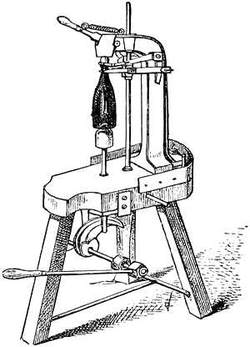
MACHINE FOR FIXING THE AGRAFES.
Most of the bottles used for Champagne come from the factories of Loivre (which supplies the largest quantity), Folembray, Vauxrot, and Quiquengrogne, and they cost on the average from 28 to 33 francs the hundred.[411] They are generally tested by a practised hand, who, by knocking them sharply together, professes to be able to tell, from the sound that they give, the substance of the glass and its temper, though occasionally a special machine, subjecting them to hydraulic pressure, is had recourse to.
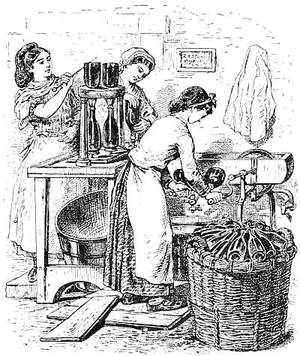
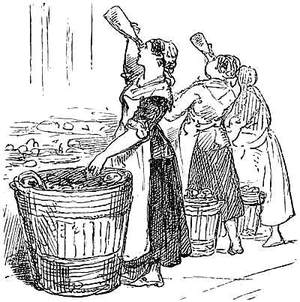
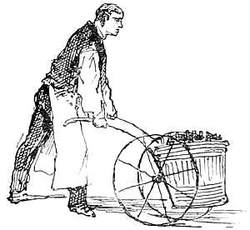
The operation of washing, which takes place immediately preceding the bottling of the wine, is invariably performed by women, who at the larger establishments accomplish it with the aid of machines, provided at times with a revolving brush, although small glass beads are generally used by preference. Each bottle after being washed is minutely examined, to make certain of its perfect purity, and is then placed neck downwards in a tall basket to drain.
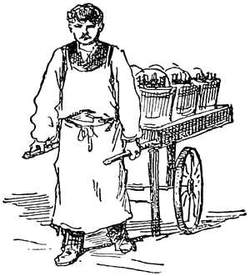
With the different Champagne houses the mode of bottling the wine, which may take place any time between April and August, varies in some measure, still the tirage, as this operation is called, is ordinarily effected as follows: The wine, after a preliminary test as to its fitness for bottling, is emptied from the casks into vats or tuns of varying capacity in the salle du tirage. From these it flows through pipes into oblong reservoirs, each provided with a row of syphon-taps, on to which the bottles are slipped, and from which the wine ceases to flow directly the bottles become filled. Men or lads remove the full bottles, replacing them by empty ones, while other hands convey them to the corkers, whose guillotine machines are incessantly in motion. Speed in the process is of much importance, as during a single day the wine may undergo a notable change. From the corkers the bottles are passed on to the agrafeurs, who secure the corks by means of an iron clip termed an agrafe; and they are afterwards conveyed either to a spacious room above-ground known as a cellier or to a cool vault underground, according to the number of atmospheres which the wine may indicate.
With reference to these atmospheres, it should be explained that air compressed to half its volume acquires twice its ordinary force, and to a quarter of its volume quadruple this force—hence the phrase of two, four, or more atmospheres. The exact degree of pressure is readily ascertained by means of a manometer, an instrument resembling a pressure-gauge, with a hollow screw at the base, which is driven through the cork of the bottle. A pressure of 5 ¾ atmospheres constitutes what is styled a ‘grand mousseux,’ and the wine exhibiting it may be safely conveyed to the coolest subterranean depths, for no doubt need be entertained as to its future effervescent properties. Should the pressure, however, scarcely exceed four atmospheres, it is advisable to keep the wine in a cellier above-ground, that it may more rapidly acquire the requisite sparkling qualities. If fewer than four atmospheres are indicated, it would be necessary to pour the wine back into the casks again, and add a certain amount of cane-sugar to it; but such an eventuality very rarely happens, thanks to the scientific formulas and apparatus, which enable the degree of pressure the wine will show to be determined beforehand to a nicety. Still mistakes are sometimes made, and there are instances where charcoal fires have had to be lighted in the cellars to encourage the latent effervescence to develop itself.[412]
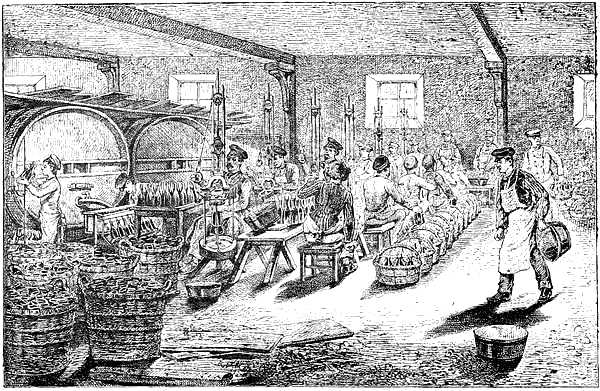
THE TIRAGE OR BOTTLING OF CHAMPAGNE.
The bottles are first placed in a horizontal position, the side to be kept uppermost being indicated by a daub of whitewash, and are stacked in rows of varying length and depth, one above the other, to about the height of a man, with narrow laths between them. Thus they will spend the summer, providing all goes well; but in about three weeks’ time the process of gas-making inside the bottles is at its height, and a period of considerable anxiety to the Champagne manufacturer ensues, through his dread lest an undue number of them should burst from the expansion of the carbonic acid gas generated in the wine. The glucometer notwithstanding, it is impossible to check a certain amount of breakage, especially when a hot season has caused the grapes, and consequently the raw wine, to be sweeter than usual. Moreover, when once casse or breakage sets in on a large scale, the temperature of the cellar is raised by the volume of carbonic acid gas let loose, which is not without its effect on the remaining bottles. Not only does the increased temperature unduly accelerate fermentation, but the mere shock of one bottle exploding often starts such of its neighbours as are predisposed that way, in addition to the direct havoc wrought by the heavier fragments of flying glass. The only remedy is the instant removal of the wine to a lower temperature whenever this is practicable.
A manufacturer of the pre-scientific days of the last century relates how one year, when the wine was rich and strong, he only preserved 120 out of 6000 bottles; and it is not long since that 120,000 out of 200,000 were destroyed in the cellars of a well-known Champagne firm. M. Mauméné, moreover, relates that in 1850 he was called in to consult about the checking of a casse, which had already reached 96 per cent.[413] Over-knowing purchasers affect to select a wine which has exploded in the largest proportion in the cellars, as being well up to the mark as regards its effervescence, and are in the habit of making inquiries as to its performances in this direction.
It is evident that, in spite of the teachings of science, the bursting of Champagne bottles has not yet been reduced to a minimum, for whereas in some cellars it averages 7 and 8 per cent, and rises to 15 when the pressure is unusually strong, in others it rarely exceeds 2 ½ or 3. The period between May and September is that in which the greatest destruction takes place. In the month of October, the first and severest breakage being over, the newly-bottled wine is definitively stacked in the cellars in piles from two to half a dozen bottles deep, from six to seven feet high, and frequently a hundred feet or upwards in length. Usually the bottles remain in their horizontal position, in which they gradually develop two essential qualities, that of effervescing well and that of travelling satisfactorily, for about eighteen or twenty months, though some firms, who pride themselves upon shipping perfectly matured wines, leave them thus for double this space of time. During this period the temperature to which the wine is exposed is, as far as practicable, carefully regulated; for the risk of breakage, though greatly diminished, is never entirely at an end.
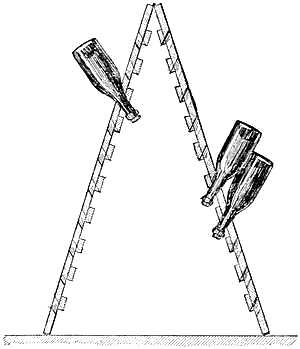
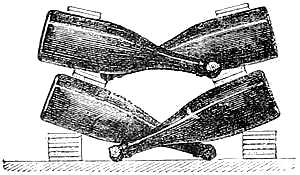
By this time the fermentation is over; but in the interval, commencing from a few days after the bottling of the wine, a loose dark-brown sediment has been forming, which has now settled on the lower side of the bottle, and to get rid of which is a delicate and tedious task. As the time approaches for preparing the wine for shipment, the bottles are placed sur pointe, as it is termed—that is to say, slantingly in racks with their necks downwards, the inclination being increased from time to time to one more abrupt.[414] The object of this change in their position is to cause the sediment to leave the side of the bottle where it has gathered. Afterwards it becomes necessary to twist and turn it and coagulate it, as it were, until it forms a kind of muddy ball, and eventually to get it well down into the neck of the bottle, so that it may be finally expelled with a bang when the temporary cork is removed and the proper one adjusted. To accomplish this the bottles are sharply turned in one direction every day for at least a month or six weeks, the time being indefinitely extended until the sediment shows a disposition to settle near the cork. The younger the wine the longer the period necessary for the bottles to be shaken, new wine often requiring as much as three months. Only a thoroughly practised hand can give the right amount of revolution and the requisite degree of slope; and in some of the cellars men were pointed out to us who had acquired such dexterity as to be able at a pinch to shake with their two hands as many as 50,000 bottles in a single day, whilst 30,000 to 40,000 is by no means an uncommon performance.
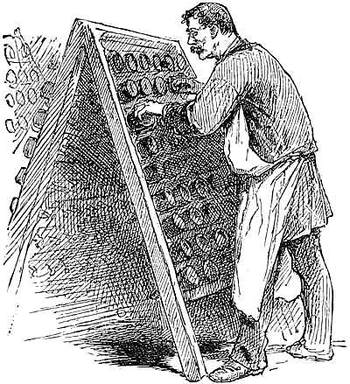
Some of these men have spent thirty or forty years of their lives engaged in this perpetual task. Fancy being entombed all alone day after day in vaults which are invariably dark and gloomy, and often cold and dank, and being obliged to twist sixty to seventy of these bottles every minute throughout the day of ten hours! Why, the treadmill and the crank, with their periodical respites, must be pastime compared to this maddeningly monotonous occupation, which combines hard labour, with the wrist, at any rate, with next to solitary confinement. One can understand these men becoming gloomy and taciturn, and affirming that they sometimes see devils hovering over the bottle-racks and frantically shaking the bottles beside them, or else grinning at them as they pursue their humdrum task. Still it may be taken for granted that the men who reach this stage are accustomed to drink freely of raw spirits, as an antidote to the damp to which they are exposed, and merely pay the penalty of their over-indulgence.
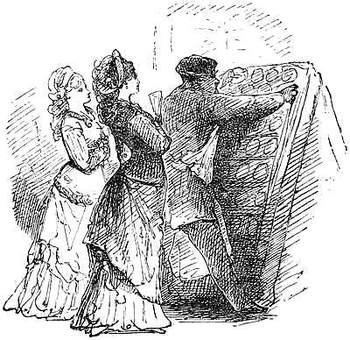
In former times the bottles used to be placed with their heads downwards on tables pierced with holes, from which they had to be removed and agitated. At a still earlier date the process was more or less successfully accomplished by holding the bottles upside down by the neck, tapping them at the bottom to detach the sediment, and then, after shaking them well up, laying them on their sides until the operation was repeated. In 1818, however, a man named Müller, in the employment of Madame Clicquot, suggested that the bottles should remain in the tables whilst being shaken, and further that the holes should be cut obliquely, so that they might recline at varying angles. His suggestions were privately adopted by Madame Clicquot; but eventually the improved plan got wind, and the system which he initiated now prevails throughout the Champagne.[415]
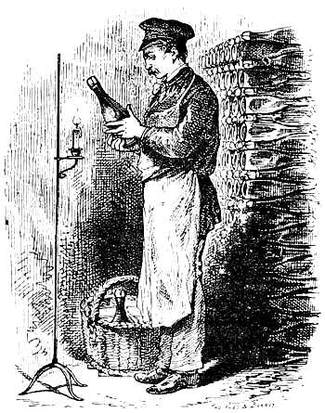
When the bottles have gone through their regular course of shaking, they are examined before a lighted candle to ascertain whether the deposit has all fallen on to the cork, and the wine has become perfectly clear. Sometimes it happens that, twist these men never so wisely, the deposit, instead of becoming flaky or granular, refuses to stir, and takes the shape of a bunch of threads technically called a ‘claw,’ or an adherent membrane styled a ‘mask.’ When this is the case an attempt is made to start it by tapping the part to which it adheres with a piece of iron, the result being frequently the sudden explosion of the bottle in the workman’s hands. By way of precaution, therefore, the operator protects his face with a wire mask, or by gigantic wire spectacles, which give to him a ghoul-like aspect. Frequently it is found impossible to detach the ‘mask’ from the side of the bottle, and in this case the only thing that remains is to pour the wine back again into the cask, with the view of mixing it in some future cuvée.[416]
The cellars of the Champagne manufacturers are very varied in character. The wine that has been grown on the chalky hills is left to develop itself in vaults burrowed out of the calcareous strata which underlie the entire district. In excavating these cellars the sides and roofs are frequently worked smooth and regular as finished masonry. The larger ones are composed of a number of spacious and lofty galleries, sometimes parallel with each other, but often ramifying in various directions, and evidently constructed on no definite plan. They are of one, two, and, in rare instances, of three stories, and now and then consist of a series of parallel galleries communicating with each other, lined with masonry, and with their stone walls and vaulted roofs resembling the crypt of some conventual building. Others of ancient date are less regular in their form, being merely so many narrow, low, winding corridors, varied, perhaps, by recesses hewn roughly out of the chalk, and resembling the brigands’ cave of melodrama; while a certain number of the larger cellars at Reims are simply abandoned quarries, the broad and lofty arches of which are suggestive of the nave and aisles of some Gothic church. In these varied vaults, lighted by solitary lamps in front of metal reflectors, or by the flickering tallow candles which we carry in our hands, we pass rows of casks filled with last year’s vintage or reserved wine of former years, and piles after piles of bottles of vin brut in seemingly endless sequence—squares, so to speak, of raw recruits for the historically famous ‘Regiment de Champagne’[417]—awaiting their turn to be thoroughly drilled and disciplined. These are varied by bottles reposing neck downwards in racks at different degrees of inclination, according to the progress their education has attained. Reports caused by exploding bottles now and then assail the ear, and as the echo dies away it becomes mingled with the rush of the escaping wine, cascading down the pile, and finding its way across the sloping sides of the floor to the narrow gutter in the centre. The dampness of the floor and the shattered fragments of glass strewn about show the frequency of this kind of accident.
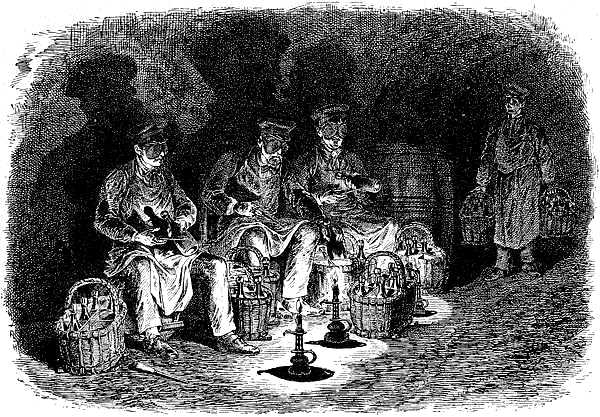
DETACHING THE ‘MASK’ FROM THE SIDES OF THE BOTTLES.
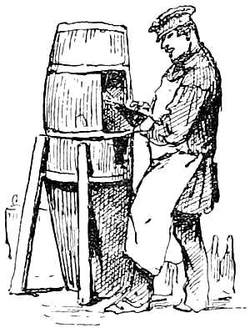
In these subterranean galleries we frequently come upon parties of workmen engaged in transforming the perfected vin brut into Champagne. Viewed at a distance while occupied in their monotonous task, they present in the semi-obscurity a series of picturesque Rembrandt-like studies. One of the end figures in each group is engaged in the important process of dégorgement, which is performed when the deposit, of which we have already spoken, has satisfactorily settled in the neck of the bottle. Baskets full of bottles with their necks downwards are placed beside the operator, who stands before a cask set on end, and having a large oval opening in front. This nimble-fingered manipulator seizes a bottle, raises it for a moment before the light to test the clearness of the wine and the subsidence of the deposit; holds it horizontally in his left hand, with the neck directed towards the opening already mentioned; and with a jerk of the steel hook which he holds in his right hand loosens the agrafe securing the cork. Bang goes the latter, and with it flies out the sediment and a small glassful or so of wine, further flow being checked by the workman’s finger, which also serves to remove any sediment yet remaining in the bottle’s neck. Like many other clever tricks, this looks very easy when adroitly performed, though a novice would probably allow the bottle to empty itself by the time he discovered that the cork was out. Yet such is the dexterity acquired by practice that the average amount of wine, foam, and deposit ejected by this operation does not exceed one-fourteenth of the contents of the bottle. Occasionally a bottle bursts in the dégorgeur’s hand, and his face is sometimes scarred from such explosions. The sediment removed, the dégorgeur slips a temporary cork into the bottle, or places the latter in a machine provided with fixed gutta-percha corks and springs for securing the bottles firmly in their places. The wine is now ready for the important operation of the dosage, upon the nature and amount of which the character of perfected Champagne, whether it be dry or sweet, light or strong, very much depends.[418]
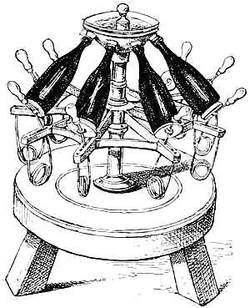
Different manufacturers have different recipes for the composition of this syrup, all more or less complex in character, and varying with the quality of the wine and the country for which it is intended; but the genuine liqueur consists of nothing but old wine of the best quality, to which a certain amount of sugar-candy and perhaps a dash of the finest cognac spirit has been added.[419] The saccharine addition varies according to the market for which the wine is destined: thus the high-class English buyer demands a dry Champagne, the Russian a wine sweet and strong as ‘ladies’ grog,’ and the Frenchman and German a sweet light wine. To the extra-dry Champagnes a modicum dose is added, while the so-called ‘brut’ wines receive no more than from one to three per cent of liqueur.[420]
In establishments wedded to old-fashioned usages the dose is administered with a tin can or ladle; but more generally an ingenious machine which regulates the percentage of liqueur to a nicety is employed. The bottle being usually nearly full when passed to the doseur, he, when a heavy percentage of liqueur has to be administered, is constrained, under the old system, to pour out some of the wine to make room for it, and this surplus in many cases is afterwards transformed into the well-known tisane de Champagne. As soon as the dosage is accomplished, the bottle is passed to another workman known as the égaliseur, who fills it up with pure wine, frequently with a part of that which has been poured out by the doseur, to the requisite level for corking. In the event of a pink Champagne being required, the wine thus added will be red, although manufacturers of questionable reputation sometimes employ the solution of elderberries, known as teinte de Fismes, to impart that once-favourite roseate hue which has been compared to the glow of fading sunlight on a crystal stream.
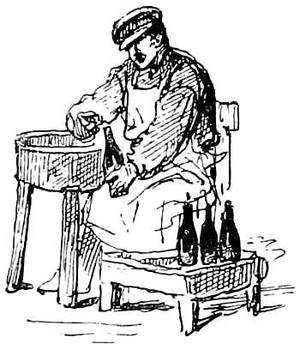
THE DOSEUR.
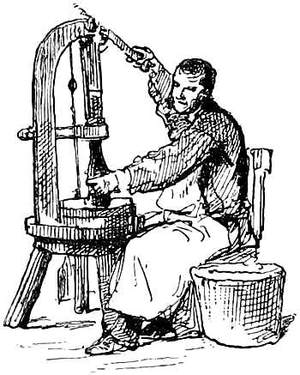
THE CORKER.
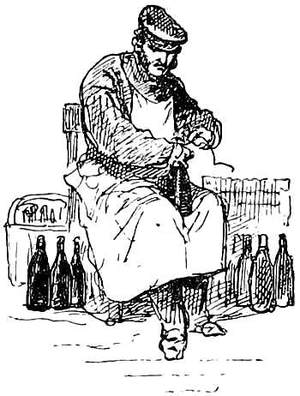
THE METTEUR DE FIL.
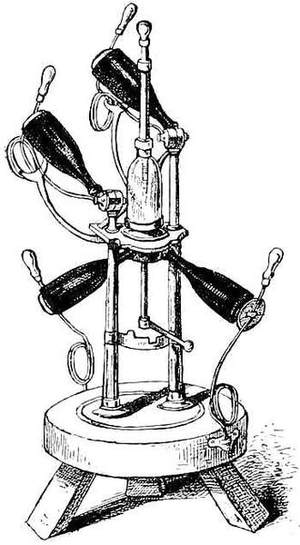
DOSING MACHINE.
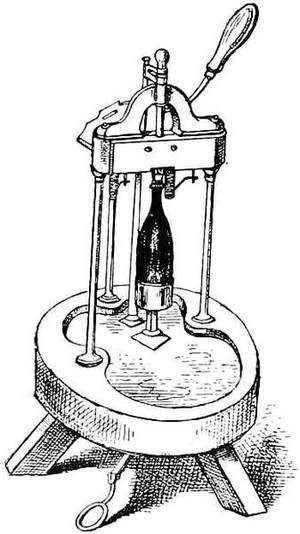
CORKING MACHINE.
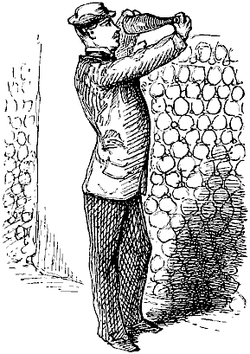
The égaliseur in his turn hands the bottle to the corker, who places it under a machine furnished with a pair of claws (so as to compress the cork to a size sufficiently small to allow it to enter the neck of the bottle) and a suspended weight, which in falling drives it home. These corks, principally obtained from Catalonia and Andalucia, are bound to possess a close and regular fibre and perfect elasticity. They form no unimportant item in the Champagne manufacturer’s budget, costing upwards of twopence each, and are delivered in huge sacks resembling hop-pockets. Previous to being used they are either boiled in wine or soaked in a solution of tartar, or else they have been steamed by the cork merchants, in order to prevent their imparting a bad flavour to the wine, and to hinder any leakage. They are commonly handed warm to the corker, who dips them into a small vessel of wine before making use of them. Some firms, however, prepare their corks by subjecting them to cold-water douches a day or two beforehand. The ficeleur receives the bottle from the corker, and with a twist of the fingers secures the cork with string, at the same time rounding its hitherto flat top, at a rate which allows from a thousand to twelve hundred bottles to pass through his hands in course of the day. The metteur de fil next affixes the wire with like celerity;[421] and then the final operation is performed by a workman seizing a couple of bottles by the neck and whirling them round his head, as though engaged in the Indian-club exercise, in order to secure a perfect amalgamation of the wine and the liqueur.
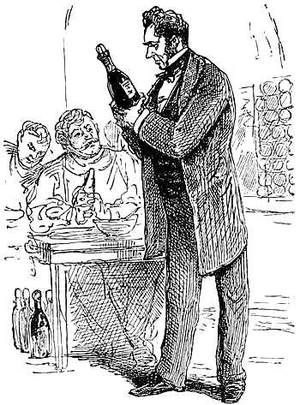
The final manipulation accomplished, the agitated course of existence through which the wine has been passing at last comes to an end, and the bottles are conveyed to another part of the establishment, where they repose for several days, or even weeks, in order that the mutual action of the wine and the liqueur upon each other may be complete. When the time arrives for despatching them, they are confided to feminine hands to have their dainty toilettes made, and are tastefully labelled, and are either capsuled, or else have their corks and necks imbedded in sealing-wax or swathed in gold or silver foil, whereby they are rendered presentable at the best-appointed tables. All that now remains is to wrap them up in coloured tissue-paper, to slip them into straw envelopes, or encircle them with wisps of straw, and pack them either in cases or baskets for despatch to all quarters of the civilised globe.
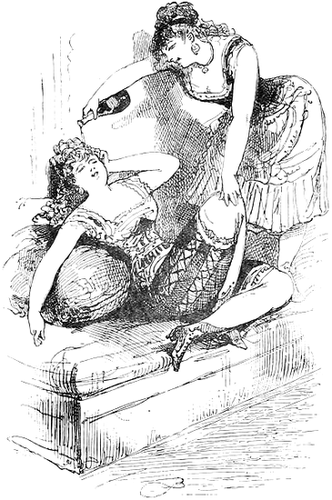
It is thus that Champagne sets out on its beneficial pilgrimage to promote the spread of mirth and light-heartedness, to drive away dull care and foment good-fellowship, to comfort the sick and cheer the sound. Wherever civilisation penetrates, Champagne sooner or later is sure to follow; and if Queen Victoria’s morning drum beats round the world, its beat is certain to be echoed before the day is over by the popping of Champagne corks. Nowadays the exhilarating wine graces not merely princely but middle-class dinner-tables, and is the needful adjunct at every petit souper, as well as the stimulant to the wildest revels in all the gayer capitals of the world. It gives a flush to beauty at garden-parties and picnics, sustains the energies of the votaries of Terpsichore until the hour of dawn, and imparts to many a young gallant the necessary courage to declare his passion. It enlivens the dullest of réunions, brings smiles to the lips of the sternest cynics, softens the most irascible tempers, and loosens the most taciturn tongues.
The grim Berliner and the gay Viennese both acknowledge the exhilarating influence of the wine. Champagne sparkles in crystal goblets in the great capital of the North, and the Moslem wipes its creamy foam from his beard beneath the very shadow of the mosque of St. Sophia; for the Prophet has only forbidden the use of wine, and of a surety—Allah be praised!—this strangely-sparkling delicious liquor, which gives to the true believer a foretaste of the joys of Paradise, cannot be wine. At the diamond-fields of South Africa and the diggings of Australia the brawny miner who has hit upon a big bit of crystallised carbon, or a nugget of virgin ore, strolls to the ‘saloon’ and shouts for Champagne. The mild Hindoo imbibes it quietly, but approvingly, as he watches the evolutions of the Nautch girls, and his partiality for the wine has already enriched the Anglo-Bengalee vocabulary and London slang with the word ‘simkin.’ It is transported on camel-backs across the deserts of Central Asia, and in frail canoes up the mighty Amazon. The two-sworded Daimio calls for it in the tea-gardens of Yokohama, and the New Yorker, when not rinsing his stomach by libations of iced water, imbibes it freely at Delmonico’s.
Wherever the Romans died they left traces behind them in their quaint funeral urns; wherever the civilised man of the nineteenth century has set his foot—at the base of the Pyramids and at the summit of the Cordilleras, in the mangrove swamps of Ashantee and the gulches of the Great Lone Land, in the wilds of the Amoor and on the desert isles of the Pacific—he has left traces of his presence in the shape of the empty bottles that were once full of the sparkling vintage of the Marne. They are strewn broadcast over the face of the globe, literally from Indus to the Pole. The crews of the Alert and the Discovery left them on the ice-bound verge of the paleocrystic sea; the French expeditionary columns have scattered them within the limits of the Great Sahara. In the lodges of the red man they are found playing the part of a great medicine, and in the huts of the negro they assume all the importance due to a big fetish. Stanley, arriving fainting and exhausted at the mouth of the Congo, hailed with joy the foil-tipped flask that the hospitable merchants who answered his appeal for succour had despatched; and as he quaffed its contents, recalled how he and Livingstone, when thousands of miles from any other European, had emptied a bottle of sparkling Champagne together on the night of their memorable meeting at Ujiji. And when, after the battle of Ulundi, the victorious British troops occupied Cetewayo’s kraal, they found within the sable potentate’s private chamber several empty Champagne bottles, the contents of which, it is to be presumed, he had quaffed the night before to the success of his followers. In the Transvaal too, during the negotiations for an armistice, Sir Evelyn Wood regaled the Boer delegates with Champagne. On a subsequent occasion, the latter were unable to return the compliment, excusing themselves by suggestively remarking, ‘We don’t take such things with us when we go to fight.’
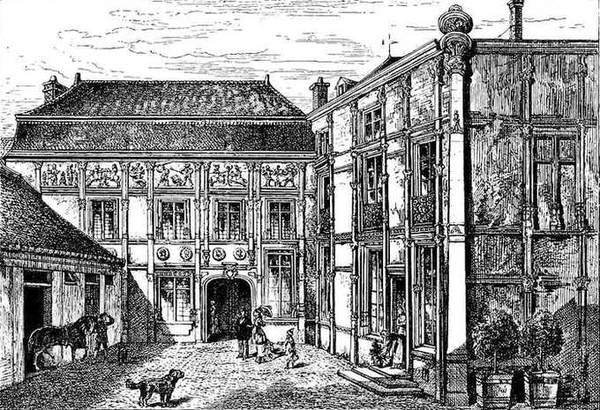
RENAISSANCE HOUSE AT REIMS, IN WHICH MADAME CLICQUOT RESIDED.
VI. REIMS AND ITS CHAMPAGNE ESTABLISHMENTS.
The city of Reims—Its historical associations—The Cathedral—Its western front one of the most splendid conceptions of the thirteenth century—The sovereigns crowned within its walls—Present aspect of the ancient archiepiscopal city—The woollen manufactures and other industries of Reims—The city undermined with the cellars of the great Champagne firms—Reims hotels—Gothic house in the Rue du Bourg St. Denis—Renaissance house in the Rue de Vesle—Church of St. Jacques: its gateway and quaint weathercock—The Rue des Tapissiers and the Chapter Court—The long tapers used at religious processions—The Place des Marchés and its ancient houses—The Hôtel de Ville—Statue of Louis XIII.—The Rues de la Prison and du Temple—Messrs. Werlé & Co., successors to the Veuve Clicquot-Ponsardin—Their offices and cellars on the site of a former Commanderie of the Templars—Origin of the celebrity of Madame Clicquot’s wines—M. Werlé and his son—Remains of the Commanderie—The forty-five cellars of the Clicquot-Werlé establishment—Our tour of inspection through them—Ingenious dosing machine—An explosion and its consequences—M. Werlé’s gallery of paintings—Madame Clicquot’s Renaissance house and its picturesque bas-reliefs—The Werlé vineyards and vendangeoirs.
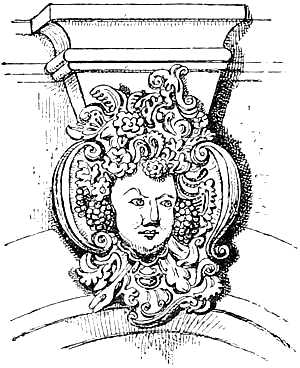
HEAD OF BACCHUS IN THE COURTYARD OF THE HÔTEL DU LION D’OR.
THE ancient city of Reims is pleasantly situate in a spacious natural basin, surrounded by calcareous hills, for the most part planted with vines. It is fertile in historical associations, rich in archæological treasures, and at the same time able to claim the respect more readily accorded in the nineteenth century to a busy and prosperous commercial centre. Indeed, its historical, archæological, and commercial importance is in advance of its actual political situation, for administratively it only ranks as a simple subprefecture in the department of the Marne. The student of history can hardly afford to neglect a city so intimately associated with the story of monarchy in France, and one which has witnessed the coronations of a long series of sovereigns, beginning with Clovis and ending with Charles X. From the day when the ‘proud Sicamber’ bent his neck at the adjuration of St. Remi, and vowed to adore that which he had burnt and to burn that which he had adored, down to the time when the future exile of Holyrood had his forehead touched by Jean Baptiste Antoine de Latil with the remnant of the ‘sacred pomatum’ so miraculously saved from revolutionary hands, few of the titular rulers of the country have failed to honour it with their presence. As the Durocortorum of Cæsar, the residence of Charlemagne, the seat of the great Ecclesiastical Councils of the twelfth century, the stronghold of the League, and the scene of one of the first Napoleon’s most brilliant feats of arms during the campaign of 1813–14, it has also earned for itself a conspicuous place in history. To Englishmen it is, perhaps, most noteworthy as having successfully checked the victorious advance of the third Edward after Cressy, and witnessed the apogee of that meteoric career, which began in the inn-yard at Domremi and ended in the market-place at Rouen, the career of Jeanne la Pucelle. Nor must it be forgotten that Reims sheltered the childhood of Mary Stuart, and saw the heralds of England hurl solemn defiance at Henri II. in the Abbey of St. Remi, at the command of Mary Tudor.
To the archæologist as to the ordinary sightseer, the chief attractions presented by Reims consist in its numerous ecclesiastical edifices, some still serving the purpose for which they were originally erected, others long since converted to secular usages. Most conspicuous among them is the cathedral church of Notre Dame, the stately basilica in which the sovereigns of France were wont to be crowned. This superb monument of Gothic architecture was commenced in 1210, upon the plans of Robert de Coucy, by Archbishop Alberic de Humbert. It was completed at the commencement of the fourteenth century, and though the original design was somewhat modified—owing, it is said, to the contributions of the faithful not coming in with sufficient rapidity—it remains a marvel of strength, admirably combined with grace. The exterior is extremely fine; and the western face, with its elaborately ornate portal, has been described as ‘one of the most splendid conceptions of the thirteenth century.’[422] Amidst the almost bewildering multiplicity of ornament, the triple porch, surmounted by a group representing the Coronation of the Virgin, the great rose window, flanked by colossal effigies of David and Goliath, and the range of statues known as the Gallery of the Kings, running across the façade near its summit, are conspicuous. The interior, although fine, and containing many objects of interest, is less impressive, while the plundered treasury can still boast of many quaint and curious relics of bygone times. But the chief interest centres in the fact of the surrounding walls having witnessed so many scenes of stately pomp and pageantry. St. Louis, Philip the Fair, Philip of Valois, the unfortunate John the Good, Charles the Simple, and Charles the Victorious, with Joan of Arc, standard in hand, by his side; the wily Louis XI., Louis the Father of his People, the magnificent Francis I., and his scarcely less magnificent son, the young husband of Mary Queen of Scots; the savage Charles IX., Henri III., with his protest that the crown hurt him, Louis the Just, the Roi Soleil himself, Louis the Well-Beloved, the hapless Louis Seize, and Charles X., have all knelt here in turns whilst the crown was placed on their heads, the sword girded to their sides, and the oriflamme waved above them.
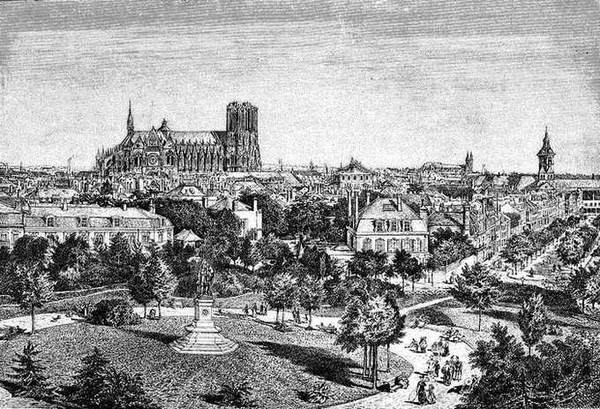
GENERAL VIEW OF REIMS, 1880.
Many of the most famous cities of the Middle Ages are mere fossilised representatives of former grandeur, but with Reims the case is otherwise. If somewhat fallen from its former high estate, politically speaking—though it should be remembered that Troyes was the titular capital of the Champagne when the province was ruled by independent Counts—its material prosperity has augmented. Round the nucleus of narrow and often tortuous streets, representing the old archiepiscopal city—the ‘Little Rome’ of the twelfth century—a network of spacious thoroughfares and broad boulevards has spread itself, and the life and movement of a busy manufacturing population are not lacking. In addition to the wine trade, which of course employs, both directly and indirectly, a large number of hands, Reims is one of the most important seats of the woollen manufacture in France, and the industrial element forms a very important factor amongst its inhabitants. In addition to the flannels, merinoes, blankets, trouserings, shawls, &c., that are annually produced, to the value of from thirty to forty million of francs, there is also a considerable production of gingerbread, biscuits, and dried pears, enjoying a wide-spread reputation.
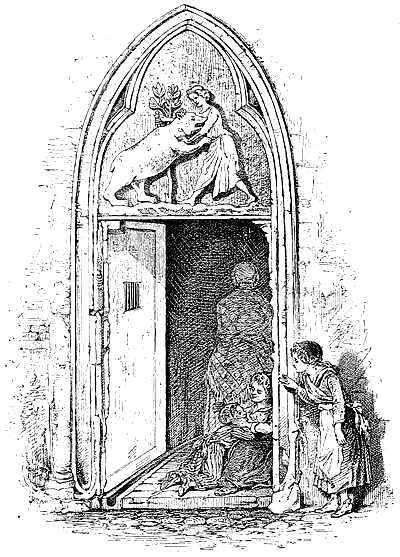
GOTHIC DOORWAY IN THE RUE DU BOURG ST. DENIS, REIMS.
The cellars of the great Champagne manufacturers of Reims are scattered in all directions over the historical old city. They undermine its narrowest and most insignificant streets, its broad and handsome boulevards, and on the eastern side extend beyond its more distant outskirts. In whichever direction we may elect to proceed when visiting the principal Champagne establishments, our starting-point will necessarily be the vicinity of the Cathedral, for it is here that all the hotels are situated. Facing the great western doorway of the ancient Gothic edifice is the Hôtel Lion d’Or, formerly the Hôtel Petit Moulinet, where the allied sovereigns sojourned on their way to Paris in 1814, and Napoleon rested on his flight after the battle of Waterloo. Close by is the Hôtel Maison Rouge, with the commemorative tablet on its renovated façade setting forth that in the year 1429, at the coronation of Charles VII. in this hostelry, then named the Striped Ass, the father and mother of Jeanne Darc were lodged at the expense of the city council. Almost facing is the newly-erected Grand Hôtel, and on the north-western side of the Cathedral is the Hôtel de Commerce, the resort, as its name implies, of most of the commercial travellers frequenting the capital of the Champagne. The visitor to Reims, be his object business or pleasure, is bound to put up at one or other of these four hostelries, and hence the starting-point of his peregrinations is necessarily the same.
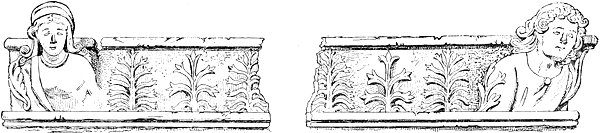
FRIEZE OF OLD HOUSE IN THE RUE DE VESLE, REIMS.
Proceeding along the Rue Tronçon Ducoudray, we reached the Rue de Vesle, where the Palais de Justice and the new theatre are situated. In the adjacent Rue du Bourg St. Denis is an old house—the ground-floor of which is a wine-shop styled Buvette du Théâtre—notable for its antique Gothic doorway, containing, within the upper portion of the arch, the bas-relief of a man fighting with a bear. There is a tradition that on this spot formerly stood a hospital dedicated to St. Hubert, and intended for the reception of persons wounded when hunting, or who might have chanced to be bitten by mad dogs. In the Rue de Vesle is another old house with an ornamental frieze surmounting its façade, which looks on to one of the entrances of the Church of St. Jacques. This edifice, originally erected at the close of the twelfth century, is hemmed in on all sides by venerable-looking buildings, while above them rises its tapering steeple, surmounted by a mediæval weathercock in the form of an angel. The interior of the church presents a curious jumble of architectural styles from early Gothic to late Renaissance. One noteworthy object of art which it contains is a life-size crucifix carved by Pierre Jacques, a Remois sculptor of the days of the Good King Henri, and from an anatomical point of view a perfect chef-d’œuvre.
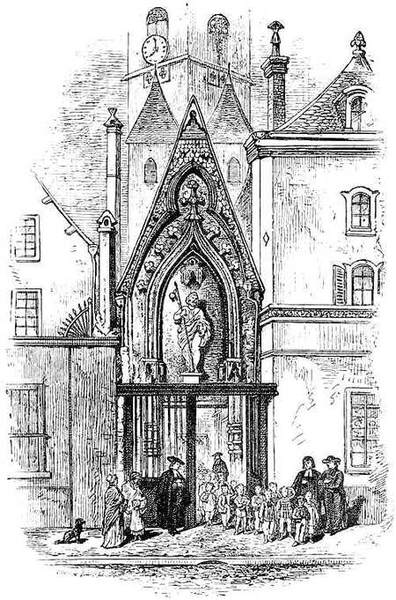
GATEWAY OF THE CHURCH OF ST. JACQUES, REIMS.
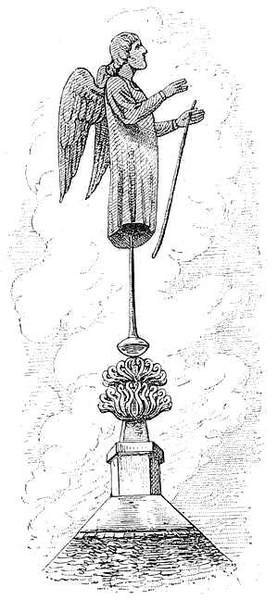
WEATHERCOCK OF THE CHURCH OF ST. JACQUES.
The Rue de Vesle merges into the Rue des Tapissiers, where in former times the carpet manufacturers of Reims had their warehouses. In the fourteenth and fifteenth centuries the carpets of Reims were as famous in France as those of Aubusson are to-day, but subsequently they began to decline. Half-way up this street—where, by the way, in 1694 the first numbers of the Gazette de France, the oldest existing French newspaper, were printed, the news being duly forwarded from Paris—we pass the ancient gateway leading to the chapter-court of the Cathedral. Within the court a weekly market of small wares is now held; but in the days when the archbishops, dukes, and peers of Reims wielded sovereign sway in the capital of the Champagne, this open space was a champ clos, where trials by battle took place. The surrounding buildings comprised residences for various ecclesiastics connected with the Cathedral, together with a small farm whence these epicurean priests derived their supply of fresh milk and fatted capons. According to ancient custom, the inhabitants of the houses facing the chapter-gateway were required to keep their doors and windows open on days of religious processions, the tapers carried by the clergy on these occasions being of such immoderate length that it was necessary to incline them, and run them into the doors and windows of the houses opposite when the bearers passed under the archway.
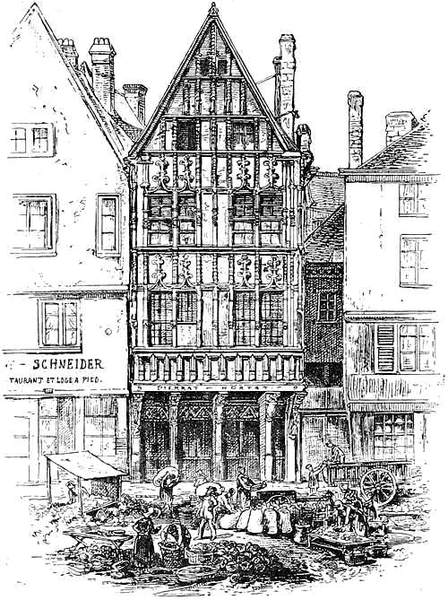
GOTHIC HOUSE IN THE MARKET-PLACE, REIMS.
At the end of the Rue des Tapissiers is the handsome Place Royale, connected with the Place des Marchés by a broad rectangular street lined with lofty edifices in the modern Parisian style of architecture. A break ensues in this range of massive-looking buildings as we enter the ancient Place des Marchés, the forum of Roman Reims, and to-day bordered more or less by houses of a mediæval character, remarkably well preserved. Principal among these is a Gothic timber-house of the fifteenth century, with its projecting upper stories supported by elaborately-carved corbels, and its entire façade enriched with mouldings and finials, and with columns and capitals overlaid with sculptured ornaments.
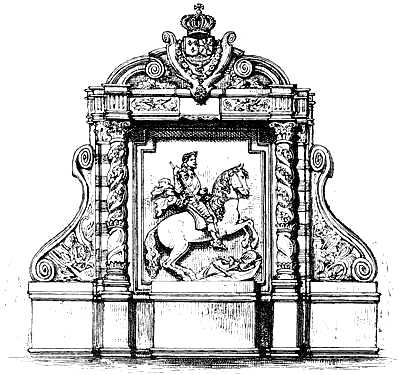
STATUE OF LOUIS XIII. ON THE HÔTEL DE VILLE, REIMS.
Some little distance beyond the Place des Marchés is the Place de l’Hôtel de Ville, which derives all its interest from the handsome-looking edifice in the florid Italian style of the early part of the seventeenth century which gives it its name. The façade of this building is profusely decorated with Ionic, Doric, and Corinthian columns, and on the pediment above the principal entrance is a bas-relief equestrian statue of Louis XIII., whom the Latin inscription beneath fulsomely characterises as ‘the just, the pious, the victorious, the clement, the beloved of his people, the terror of his enemies, and the delight of the world,’ and to whom ‘the senate and inhabitants of Reims have raised this imperishable trophy.’ Some century and a half later, however, the imperishable trophy got hurled down and shattered into fragments by the populace, and its vacant place was only filled by the present statue in the year 1818.
To the right of the Place is the Chambre des Notaires of Reims, raised on the site of the ancient présidial, or court of justice, where the city magistrates used to be elected during the Middle Ages, and to which a chapel and a prison were attached. The latter building evidently gave its name to the adjoining Rue de la Prison, the gloomy-looking houses of which—of a more massive character than the gabled structures of the market-place and the Rue de l’Etape—with their formidably-barred windows, possible relics of the religious wars, seem to frown, as it were, upon the passer-by. In a narrow tortuous street leading from this thoroughfare Messrs. Werlé & Co., the successors of the famous Veuve Clicquot-Ponsardin, have their offices and cellars, on the site of a former Commanderie of the Templars; and strangers passing by this quiet spot would scarcely imagine that under their feet hundreds of busy hands are incessantly at work, disgorging, dosing, shaking, corking, storing, wiring, labelling, capsuling, waxing, tinfoiling, and packing hundreds of thousands of bottles of Champagne destined for all parts of the civilised world.
The house of Clicquot, established in the year 1798 by the husband of La Veuve Clicquot-Ponsardin, who died in 1866, in her 89th year, was indebted for much of the celebrity of its wine to the lucky accident of the Russians occupying Reims in 1814 and 1815, and freely requisitioning the sweet Champagne stored in the widow’s capacious cellars. Madame Clicquot’s wines were slightly known in Russia prior to this date; but the officers of the invading army, on their return home, proclaimed their merits throughout the length and breadth of the Muscovite Empire, and the fortune of the house was made. Madame Clicquot, as every one knows, amassed enormous wealth, and succeeded in marrying both her daughter and granddaughter to counts of the ancien régime.

HEADS OF PHŒBUS AND BACCHUS.
The present head of the firm is M. Werlé, who comes of an old Lorraine family although born in the ancient free imperial town of Wetzlar on the Lahn, where Goethe lays the scene of his ‘Sorrows of Werther,’ the leading incidents of which really occurred there. M. Werlé entered the establishment which he has done so much to raise to its existing position so far back as the year 1821. His care and skill, exercised for nearly two-thirds of a century, have largely contributed to obtain for the Clicquot brand that high repute which it enjoys to-day all over the world. M. Werlé, who has long been naturalised in France, was for many years Mayor of Reims and President of its Chamber of Commerce, as well as one of the deputies of the Marne to the Corps Législatif. He enjoys the reputation of being the richest man in Reims, and, like his late partner, Madame Clicquot, he has also secured brilliant alliances for his children, his son, M. Alfred Werlé, having married the daughter of the Duc de Montebello, while his daughter espoused the son of M. Magne, Minister of Finance under the Second Empire.
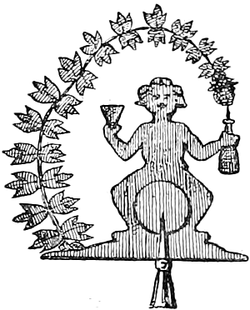
Half-way down the narrow Rue du Temple is an ancient gateway, on which may be traced the half-effaced sculptured heads of Phœbus and Bacchus. Immediately in front is a green porte-cochère forming the entrance to the Clicquot-Werlé establishment, and conducting to a spacious trim-kept courtyard, set off with a few trees, with some extensive stabling and cart-sheds on the left, and on the right hand the entrance to the cellars. Facing us is an unpretending-looking edifice, where the firm has its counting-houses, with a little corner tower surmounted by a characteristic weathercock consisting of a figure of Bacchus seated astride a cask beneath a vine-branch, and holding up a bottle in one hand and a goblet in the other. The old Remois Commanderie of the Knights Templars existed until the epoch of the Great Revolution, and today a few fragments of the ancient buildings remain adjacent to the ‘celliers’ of the establishment, which are reached through a pair of folding-doors and down a flight of stone steps. The date of the foundation of this Commanderie is uncertain, but it is known that a Templar’s church occupied a portion of the site in 1170. In 1311 both the church and the Commanderie passed into possession of the Order of St. John of Jerusalem, which held them until the epoch of the Revolution. Formerly the échevins of Reims used to be elected in the ancient hall of the Commanderie, which at one period was a sanctuary for debtors, and also for criminals. Early in the present century the buildings were sold and demolished.
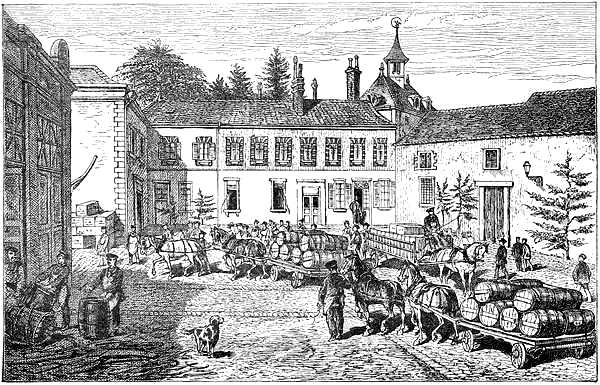
THE CLICQUOT-WERLÉ ESTABLISHMENT AT REIMS.
After being furnished with lighted candles, we set out on our tour of inspection of the Clicquot-Werlé establishment, entering first of all the vast cellar of St. Paul, where the thousands of bottles requiring to be daily shaken are reposing necks downward on the large perforated tables which crowd the apartment. It is a peculiarity that each of the Clicquot-Werlé cellars—forty-five in number, and the smallest among them a vast apartment—has its special name. In the adjoining cellar of St. Matthew other bottles are similarly arranged, and here wine in cask is likewise stored. We pass rows of huge tuns, each holding its twelve or thirteen hundred gallons of fine reserved wine designed for blending with more youthful growths; next, are threading our way between seemingly endless piles of hogsheads filled with later vintages, and anon are passing smaller casks containing the syrup with which the vin préparé is dosed. At intervals we come upon some square opening in the floor through which bottles of wine are being hauled up from the cellars beneath in readiness to receive their requisite adornment before being packed in baskets or cases, according to the country to which they are destined to be despatched. To Russia the Clicquot Champagne is sent in cases containing sixty bottles, while the cases for China contain as many as double that number.
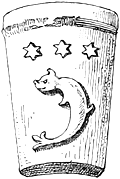
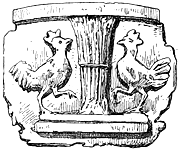
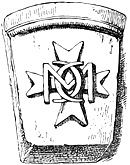
Arms of the Dauphins of France. Arms of the Knights of Malta.
DEVICES FROM THE COMMANDERIE AT REIMS.
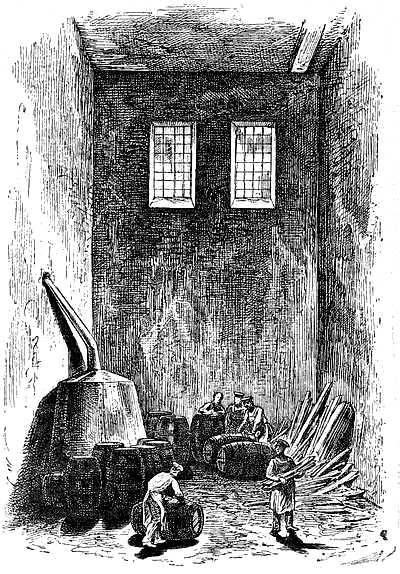
REMAINS OF THE COMMANDERIE AT REIMS.
The ample cellarage which the house possesses has enabled M. Werlé to make many experiments which firms with less space at their command would find it difficult to carry out on the same satisfactory scale. Such, for instance, is the system of racks in which the bottles repose while the wine undergoes its diurnal shaking. Instead of these racks being, as is commonly the case, at almost upright angles, they are perfectly horizontal, which, in M. Werlé’s opinion, offers a material advantage, inasmuch as the bottles are all in readiness for disgorging at the same time, instead of the lower ones being ready before those above, as is the case when the ancient system is followed, owing to the uppermost bottles getting less shaken than the others.
After performing the round of the celliers we descend into the caves, a complete labyrinth of gloomy underground corridors excavated in the bed of chalk which underlies the city, and roofed and walled with solid masonry, more or less blackened by age. In one of these cellars we catch sight of rows of workpeople engaged in the operation of dosing, corking, securing, and shaking the bottles of wine which have just left the hands of the dégorgeur by the dim light of half-a-dozen tallow-candles. The latest invention for liqueuring the wine is being employed. Formerly, to prevent the carbonic acid gas escaping from the bottles while the process of liqueuring was going on, it was necessary to press a gutta-percha ball connected with the machine, in order to force the escaping gas back. The new machine, however, renders this unnecessary, the gas, by its own power and composition, forcing itself back into the wine.
In the adjoining cellar of St. Charles are stacks of bottles awaiting the manipulation of the dégorgeur; while in that of St. Ferdinand men are engaged in examining other bottles before lighted candles, to make certain that the sediment is thoroughly dislodged, and the wine perfectly clear before the disgorgement is effected. Here, too, the corking, wiring, and stringing of the newly-disgorged wine are going on. Another flight of steps leads to the second tier of cellars, where the moisture trickles down the dank dingy walls, and save the dim light thrown out by the candles we carried, and by some other far-off flickering taper, stuck in a cleft stick, to direct the workmen, who with dexterous turns of their wrists, give a twist to the bottles, all is darkness. On every side bottles are reposing in various attitudes, the majority in huge square piles on their sides, others in racks slightly tilted; others, again, almost standing on their heads, while some, which through overinflation have come to grief, litter the floor and crunch beneath our feet. Tablets are hung against each stack of wine indicating its age, and from time to time a bottle is held up before the light to show us how the sediment commences to form, or to explain how it eventually works its way down the neck of the bottle, and finally settles on the cork. Suddenly we are startled by a loud report, resembling a pistol-shot, which reverberates through the vaulted chamber, as a bottle close at hand explodes, dashing out its heavy bottom as neatly as though it had been cut by a diamond, and dislocating the necks and pounding-in the sides of its immediate neighbours. The wine trickles down, and eventually finds its way along the sloping sides of the slippery floor to the narrow gutter in the centre.
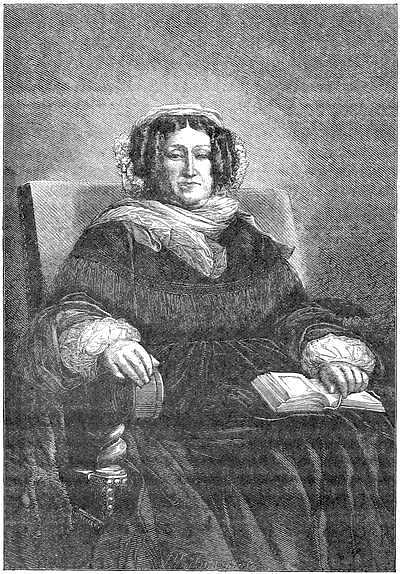
MADAME VEUVE CLICQUOT AT EIGHTY YEARS OF AGE (From the painting by Léon Coignet).
Ventilating shafts pass from one tier of cellars to the other, enabling the temperature in a certain measure to be regulated, and thereby obviate an excess of breakage. M. Werlé estimates that the loss in this respect during the first eighteen months of a cuvée amounts to 7 per cent, but subsequently is considerably less. In 1862 one Champagne manufacturer lost as much as 45 per cent of his wine by breakages. The Clicquot cuvée is made in the cave of St. William, where 120 hogsheads of wine are hauled up by means of a crane, and discharged into the vat daily as long as the operation lasts. The tirage, or bottling of the wine, ordinarily commences in the middle of May, and occupies fully a month.
M. Werlé’s private residence is close to the establishment in the Rue du Temple, and here he has collected a small gallery of high-class modern paintings by French and other artists, including Meissonier’s ‘Card-players,’ Delaroche’s ‘Beatrice Cenci on her way to Execution,’ Fleury’s ‘Charles V. picking up the brush of Titian,’ various works by the brothers Scheffer, Knaus’s highly-characteristic genre picture, ‘His Highness on a Journey,’ and several fine portraits, among which is one of Madame Clicquot, painted by Léon Coignet, when she was eighty years of age, and another of M. Werlé by the same artist, regarded as a chef-d’œuvre. Before her father’s death Madame Clicquot used to reside in the Rue de Marc, some short distance from the cellars in which her whole existence centred, in a handsome Renaissance house, said to have had some connection with the row of palaces that at one time lined the neighbouring and then fashionable Rue du Tambour. This, however, is extremely doubtful. A number of interesting and well-preserved bas-reliefs decorate one of the façades of the house looking on to the court. The figures are of the period of François Premier and his son Henri II., who inaugurated his reign with a comforting edict for the Protestants, ordaining that blasphemers were to have their tongues pierced with red-hot irons, and heretics to be burnt alive, and who had the ill-luck to lose his eye and life through a lance-thrust of the Comte de Montgomerie, captain of his Scotch guards, whilst jousting with him at a tournament held in honour of the marriage of his daughter Isabelle with the gloomy widower of Queen Mary of England, of sanguinary fame.
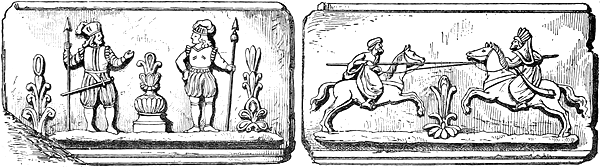
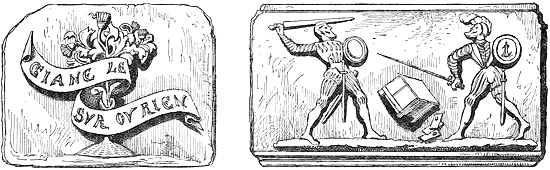
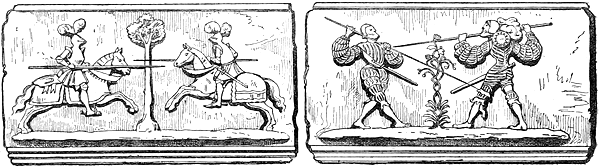
The first of these bas-reliefs represents two soldiers of the Swiss guard, the next a Turk and Slav tilting at each other, and then comes a scroll entwined round a thistle, and inscribed with this enigmatical motto: ‘Giane le sur ou rien.’ In the third bas-relief a couple of passionate Italians are winding up a gambling dispute with a hand-to-hand combat, in the course of which table and cards have got canted over; the fourth presents us with two French knights, armed cap-à-pie, engaged in a tourney; while in the fifth and last a couple of German lansquenets essay their gladiatorial skill with their long and dangerous weapons. Several years back a tablet was discovered in one of the cellars of the house, inscribed ‘Ci-gist vénérable religieux maistre Pierre Derclé, docteur en théologie, jadis prieur de céans. Priez Dieu pour luy. 1486,’ which would almost indicate that the house had originally a religious character, although the warlike spirit of the bas-reliefs decorating it renders any such supposition with regard to the existing building untenable. We should mention that the spaces above the porte cochère, and the window by its side, are occupied by four medallions, which present that curious mingling of classic and contemporary styles for which the epoch of the Renaissance was remarkable.
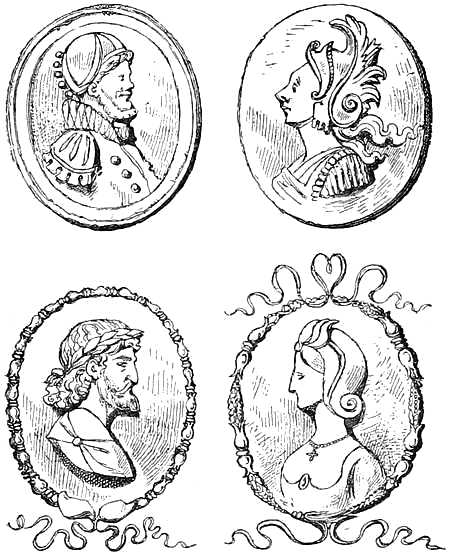
MEDALLIONS FROM MADAME CLICQUOT’S HOUSE.
The Messrs. Werlé own numerous acres of vineyards, comprising the very finest situations in the well-known districts of Verzenay, Bouzy, Le Mesnil, and Oger, at all of which places they have vendangeoirs or pressing-houses of their own. Their establishment at Verzenay contains seven presses, that at Bouzy eight, at Le Mesnil six, and at Oger two, in addition to which grapes are pressed under their own supervision at Ay, Avize, and Cramant, in vendangeoirs belonging to their friends.
Since the death of Madame Clicquot the legal style of the firm has been ‘Werlé & Co., successors to Veuve Clicquot-Ponsardin,’ the mark, of which M. Werlé and his son are the sole proprietors, still remaining ‘Veuve Clicquot-Ponsardin,’ while the corks of the bottles are branded with the words ‘V. Clicquot-P. Werlé,’ encircling the figure of a comet. The style of the wine—light, delicate, elegant, and fragrant—is familiar to all connoisseurs of Champagne. What, however, is not equally well known is that within the last few years the firm, in obedience to the prevailing taste, have introduced a perfectly dry wine of corresponding quality to the richer wine which made the fortune of the house, and gave enduring fame to the Clicquot brand.
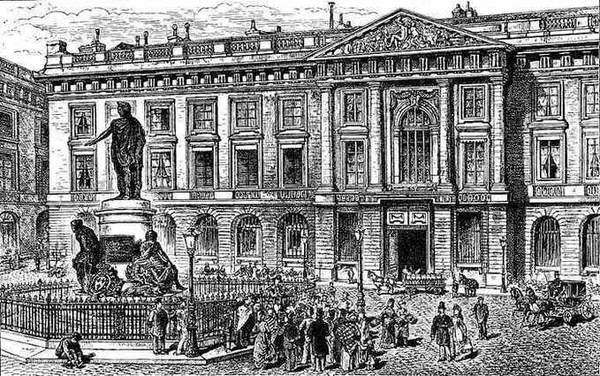
THE PLACE ROYALE AT REIMS.
VII. REIMS AND ITS CHAMPAGNE ESTABLISHMENTS (continued).
The house of Louis Roederer founded by a plodding German named Schreider—The central and other establishments of the firm—Ancient house in the Rue des Elus—The gloomy-looking Rue des Deux Anges and prison-like aspect of its houses—Inside their courts the scene changes—Handsome Renaissance house and garden, a former abode of the canons of the Cathedral—The Place Royale—The Hôtel des Fermes and the statue of the ‘wise, virtuous, and magnanimous Louis XV.’—Birthplace of Colbert in the Rue de Cérès—Quaint Adam and Eve gateway in the Rue de l’Arbalète—Heidsieck & Co.’s central establishment in the Rue de Sedan—Their famous ‘Monopole’ brand—The firm founded in the last century—Their extensive cellars inside and outside Reims—The matured wines shipped by them—The Boulevard du Temple—M. Ernest Irroy’s cellars, vineyards, and vendangeoirs—Recognition by the Reims Agricultural Association of his plantations of vines—His wines and their popularity at the best London clubs—Various Champagne firms located in this quarter of Reims—The Rue du Tambour and the famous House of the Musicians—The Counts de la Marck assumed former occupants of the latter—The Brotherhood of Minstrels of Reims—Périnet & Fils’ establishment in the Rue St. Hilaire—Their cellars of three stories in solid masonry—Their soft, light, and delicate wines—A rare still Verzenay—The firm’s high-class Extra Sec.
THE house of Louis Roederer, originally founded by a plodding German named Schreider, was content to pursue the sleepy tenor of its way for some years—until indeed it suddenly felt prompted to lay siege to the Muscovite connection of La Veuve Clicquot-Ponsardin, and secure a market for its wine at Moscow and St. Petersburg. It next opened up the United States, and finally introduced its brand into England. The house possesses cellars in various parts of Reims, and has its offices in one of the oldest quarters of the city—namely, the Rue des Elus, or ancient Rue des Juifs, where the old synagogue formerly stood, and the records of which date as far back as 1103.
At the corner of this street, and abutting on the Place des Marchés, is a curious old house, the overhanging upper stories of which are supported by huge massive carved brackets, decorated with figures more or less quaint in design. M. Louis Roederer’s offices in the Rue des Elus are at the farther end of a courtyard, beyond which is found a second court, where carts laden with cases of Champagne seem to indicate that some portion of the shipping business of the house is here carried on. Several requests made by us for permission to visit M. Louis Roederer’s establishments having been refused, it is only of their external appearance that we are competent to speak. One of them, in the Boulevard du Temple, is distinguished by a rather imposing façade, and has a carved head of Bacchus surmounting its porte-cochère; while the principal establishment, a picturesque range of buildings of considerable extent, is situated in the neighbouring Rue de la Justice.
Leading from the Rue des Elus into the Rue de Vesle is a gloomy-looking ancient street known as the Rue des Deux Anges, all the houses of which have their windows secured by iron gratings, and their massive doors thickly studded with huge nails. These prison-like façades, which in all probability refer to the epoch of the religious wars, succeed each other in lugubrious monotony along either side of the way; but gain admittance to their inner courts, and quite a different scene presents itself. In one notable instance, looking on to a pleasant little flower-garden, we found a small but charming Renaissance house, with its windows ornamented with elaborate mouldings, and surmounted by graceful sculptured heads, while at one corner there rose up a tower with a sun-dial displayed on its front. In this and in an adjoining house the canons of the cathedral were accustomed to reside in the days when something like four-fifths of the city were the property of the Church.
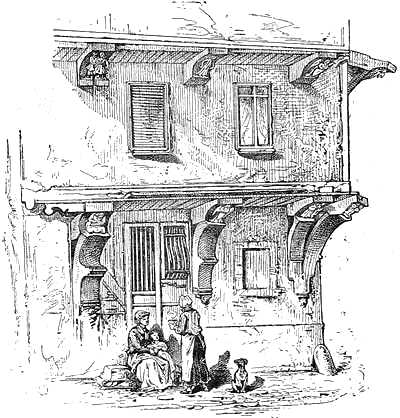
OLD HOUSE AT THE CORNER OF THE RUE DES ÉLUS AND THE PLACE DES MARCHÉS, REIMS.
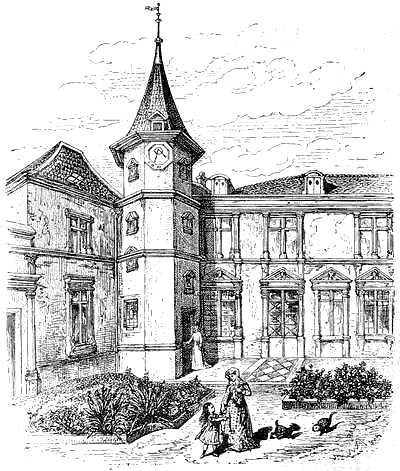
RENAISSANCE HOUSE IN THE RUE DES DEUX ANGES, REIMS.
Proceeding along the Rue de Vesle and the neighbouring Rue des Tapissiers, we find ourselves once more in the Place Royale, the principal side of which is occupied by the once notable Hôtel des Fermes, where, in the days of the ancien régime, the farmers-general of the Champagne were accustomed to receive the revenues of the province. A bronze statue rises in the centre of the Place, which from its Roman costume and martial bearing might be taken for some hero of antiquity, did not the inscription on the pedestal apprise us that it is intended for the ‘wise, virtuous, and magnanimous Louis XV.,’ a misuse of terms which has caused a Transatlantic Republican to characterise the monument as a brazen lie. Leading out of the Place Royale is the Rue de Cérès, in which there is a modernised sixteenth-century house claiming to be the birthplace, on the 29th August 1619, of Jean Baptiste Colbert, son of a Reims wool-merchant, and the famous minister who did so much to consolidate the finances of the State which the royal voluptuary, masquerading at Reims in Roman garb, afterwards made such dreadful havoc of.

HEADS SURMOUNTING THE PRINCIPAL WINDOWS OF THE RENAISSANCE HOUSE IN THE RUE DES DEUX ANGES.
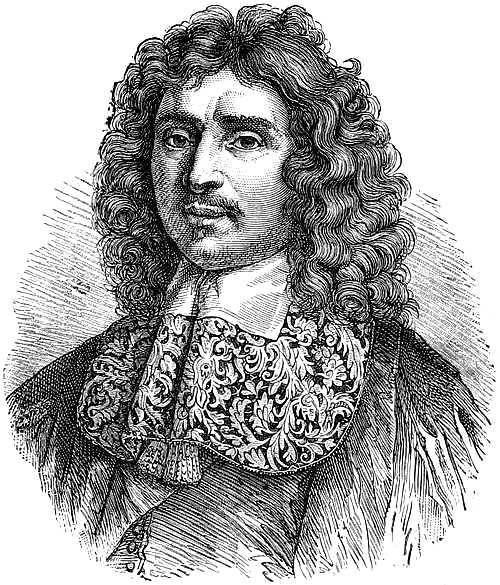
JEAN BAPTISTE COLBERT (From a portrait of the time).
We again cross the Place des Marchés, at the farther end of which, on the left-hand side, is the Rue de l’Arbalète, notable for a curious Renaissance gateway, with its pediment supported by two life-size figures, which the Rémois, for no very sufficient reason, have popularly christened Adam and Eve. Beyond the Place des Marchés and the Place de l’Hôtel de Ville, and at no great distance from the Clicquot-Werlé establishment, is the narrow winding Rue de Sedan, where the old-established firm of Heidsieck & Co., which has secured a high-class reputation in both eastern and western hemispheres for its famous Monopole and Dry Monopole brands, has its central offices. The original firm dates back to 1785, when France was struggling with those financial difficulties that a few years later culminated in that great social upheaving which kept Europe in a state of turmoil for more than a quarter of a century. Among the archives of the firm is a patent, bearing the signature of the Minister of the Prussian Royal Household, appointing Heidsieck & Co. purveyors of Champagne to Frederick William III. The Champagne-drinking Hohenzollern par excellence, however, was the son and successor of the preceding, who, from habitual over-indulgence in the exhilarating sparkling beverage during the last few years of his reign, acquired the sobriquet of King Clicquot.
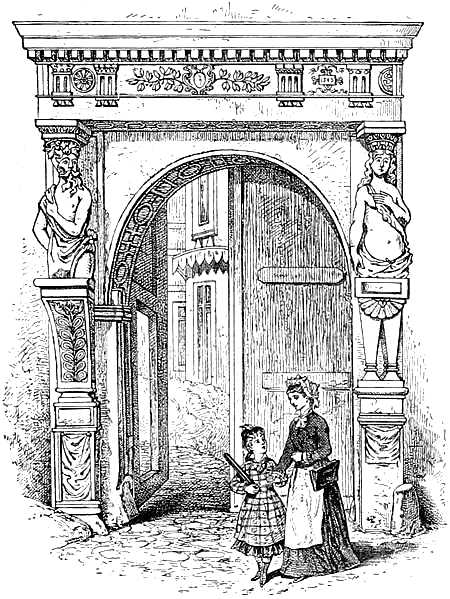
ADAM AND EVE GATEWAY, RUE DE L’ARBALÈTE, REIMS.
On passing through the large porte-cochère giving entrance to Messrs. Heidsieck’s principal establishment, one finds oneself in a small courtyard, with the surrounding buildings overgrown with ivy and venerable vines. On the left is a dwelling-house enriched with elaborate mouldings and cornices, and at the farther end of the court is the entrance to the cellars, surmounted by a sun-dial bearing the date 1829. The latter, however, is no criterion of the age of the buildings themselves, as these were occupied by the firm at its foundation, towards the close of the last century. We are first conducted into an antiquated-looking low cellier, the roof of which is sustained with rude timber supports, and here bottles of wine are being labelled and packed, although this is but a mere adjunct to the adjacent spacious packing-room, provided with its loading platform and communicating directly with the public road. At the time of our visit this hall was gaily decorated with flags and inscriptions, the day before having been the fête of St. Jean, when the firm entertain the people in their employ with a banquet and a ball, at which the choicest wine of the house liberally flows. From the packing-room we descend into the cellars, which, like all the more ancient vaults in Reims, have been constructed on no regular plan. Here we thread our way between piles after piles of bottles, many of which, having passed through the hands of the disgorger, are awaiting their customary adornment. The lower tier of cellars is mostly stored with vin sur pointe, and bottles with their necks downward are encountered in endless monotony along a score or more of long galleries. The only variation in our lengthened promenade is when we come upon some solitary workman engaged in his monotonous task of shaking his 30,000 or 40,000 bottles per diem.
The disgorging at Messrs. Heidsieck’s takes place, in accordance with the good old rule, in the cellars underground, where we noticed large stocks of wine three and five years old, the former in the first stage of sur pointe, and the latter awaiting shipment. It is a specialty of the house to ship only matured wine, which is necessarily of a higher character than the ordinary youthful growths, for a few years have a wonderful influence in developing the finer qualities of Champagne. At the time of our visit, in the spring of 1877, when the English market was being glutted with the crude full-bodied wine of 1874, Messrs. Heidsieck were continuing to ship wines of 1870 and 1872, beautifully rounded by keeping, and of fine flavour and great delicacy of perfume. Of these thoroughly matured wines the firm had fully a year’s consumption on hand.
Messrs. Heidsieck & Co. have a handsome modern establishment in the Rue Coquebert—a comparatively new quarter of the city, where Champagne establishments are the rule—the courtyard of which, alive with workmen at the time of our visit, is broad and spacious, while the surrounding buildings are light and airy, and the cellars lofty, regular, and well ventilated. In a large cellier here, where the tuns are ranged side by side between the rows of iron columns supporting the roof, the firm make their cuvée. Here, too, the bottling of their wine takes place, and considerable stocks of high-class reserve wines and more youthful growths are stored ready for removal when required by the central establishment. The bulk of Messrs. Heidsieck’s reserve wines, however, repose in the outskirts of Reims, near the Porte Dieu-Lumière, in one of the numerous abandoned chalk quarries, which of late years the Champagne manufacturers have discovered are capable of being transformed into admirable cellars.
In addition to shipping a rich and a dry variety of the Monopole brand, of which they are sole proprietors, Messrs. Heidsieck export to this country a rich and a dry Grand Vin Royal. It is, however, to their famous Monopole wine, and especially to the dry variety, which must necessarily comprise the finest growths, that the firm owe their principal celebrity.
Few large manufacturing towns like Reims—which is one of the most important of those engaged in the woollen manufacture in France—can boast of such fine promenades and such handsome boulevards as the capital of the Champagne. As the ancient fortifications of the city were from time to time razed, their site was levelled and generally planted with trees, so that the older quarters of Reims are almost encircled by broad and handsome thoroughfares, separating the city, as it were, from its outlying suburbs. In or close to the broad Boulevard du Temple, which takes its name from its proximity to the site of the ancient Commanderie of the Templars, various Champagne manufacturers, including M. Louis Roederer, M. Ernest Irroy, and M. Charles Heidsieck, have their establishments; while but a few paces off, in the neighbouring Rue Coquebert, are the large and handsome premises of Messrs. Krug & Co.
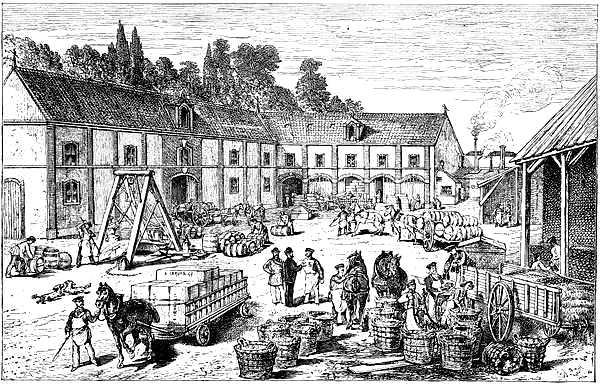
M. ERNEST IRROY’S ESTABLISHMENT AT REIMS.
The offices of M. Ernest Irroy, who is known in Reims not merely as a large Champagne grower and shipper, but also as a distinguished amateur of the fine arts, taking a leading part in originating local exhibitions and the like, are attached to his private residence, a handsome mansion flanked by a large and charming garden in the Boulevard du Temple. The laying out of this sylvan oasis is due to M. Varé, the head gardener of the city of Paris, who contributed so largely to the picturesque embellishment of the Bois de Boulogne. M. Irroy’s establishment, which comprises a considerable range of buildings grouped around two courtyards, is immediately adjacent, although its principal entrance is in the Rue de la Justice. The vast celliers, covering an area of upwards of 3000 square yards, and either stocked with wine in cask or used for packing and similar purposes, afford the requisite space for carrying on a most extensive business. The cellars beneath comprise three stories, two of which are solidly roofed and lined with masonry, while the lowermost one is excavated in the chalk. They are admirably constructed on a symmetrical plan, and their total surface is very little short of 7000 square yards. Spite of the great depth to which these cellars descend, they are perfectly dry, the ventilation is good, and their temperature moreover is remarkably cool, one result of which is that M. Irroy’s loss from breakage never exceeds four per cent per annum. M. Irroy holds a high position as a vineyard proprietor in the Champagne, his vines covering an area of nearly ninety acres. At Mareuil and Avenay he owns some twenty-five acres, at Verzenay and Verzy about fifteen, and at Ambonnay and Bouzy close upon fifty acres. His father and his uncle, whose properties he inherited or purchased, commenced some thirty years ago to plant vines on certain slopes of Bouzy possessing a southern aspect, and he has followed their example with such success both at Bouzy and Ambonnay, that the Reims Agricultural Association in 1873 conferred upon him a silver-gilt medal for his plantations of vines, and in 1880 presented him with a coupe d’honneur. M. Irroy owns vendangeoirs at Verzenay, Avenay, and Ambonnay; and at Bouzy, where his largest vineyards are, he has built some excellent cottages for his labourers. He has also constructed a substantial bridge over the ravine which, formed by winter torrents from the hills, intersects the principal vineyard slopes of Bouzy.
M. Ernest Irroy’s wines, prepared with scrupulous care and rare intelligence, have been known in England for some years past, and are steadily increasing in popularity. They are emphatically connoisseurs’ wines. The best West-end clubs, such as White’s, Arthur’s, the old Carlton, and the like, lay down the cuvées of this house in good years as they lay down their vintage ports and finer clarets, and drink them, not in a crude state, but when they are in perfection—that is, in five to ten years’ time. M. Irroy exports to the British colonies and to the United States the same fine wines which he ships to England.
Several well-known Champagne firms have their establishments in this quarter of Reims. In addition to those already mentioned, we may instance G. H. Mumm & Co., who are located in the Rue Andrieux, only a short distance from the grand triumphal arch known as the Gate of Mars, by far the most important Roman remain of which the Champagne can boast. Within a stone’s throw of this arch there formerly stood the ancient château of the Archbishops of Reims, demolished close upon three centuries ago. In the Rue de Mars, a winding ill-paved thoroughfare leading from the Gate of Mars to the Place de l’Hôtel de Ville, Jules Mumm & Co., an offshoot from the once famous firm of P. A. Mumm & Co., are installed; while in a massive and somewhat pretentious-looking house, dating back to the time of Louis Quatorze, in a corner of the Place de l’Hôtel de Ville, Ruinart Père et Fils, who claim to rank as the oldest existing Champagne establishment, have their offices. The late Vicomte de Brimont, the recent head of the firm, was a collateral descendant of the Dom Ruinart, whose remains repose nigh to those of the illustrious Dom Perignon in the abbey church of Hautvillers. From the Place de l’Hôtel de Ville we proceed through the narrow Rue du Tambour, originally a Roman thoroughfare, and during the Middle Ages the locality where the nobility of Reims principally had their abodes. Half-way up this street stands the famous House of the Musicians, one of the most interesting architectural relics of which the capital of the Champagne can boast. It evidently dates from the early part of the fourteenth century, but by whom it was erected is unknown. Some ascribe it to the Knights Templars, others to the Counts of Champagne, while others suppose it to have been the residence of the famous Counts de la Marck, who in later times diverged into three separate branches, the first furnishing Dukes of Cleves and Jülich to Germany, and Dukes of Nevers and Counts of Eu to France; while the second became Dukes of Bouillon and Princes of Sedan, titles which passed to the Turennes when Henri de la Tour d’Auvergne, Vicomte de Turenne, married the surviving heiress of the house. The third branch comprised the Barons of Lumain, allied to the Hohenzollerns. Their most famous member slew Louis de Bourbon, Archbishop of Liège, and flung his body into the Meuse; and subsequently became celebrated as the Wild Boar of the Ardennes, of whom all readers of Quentin Durward will retain a lively recollection.
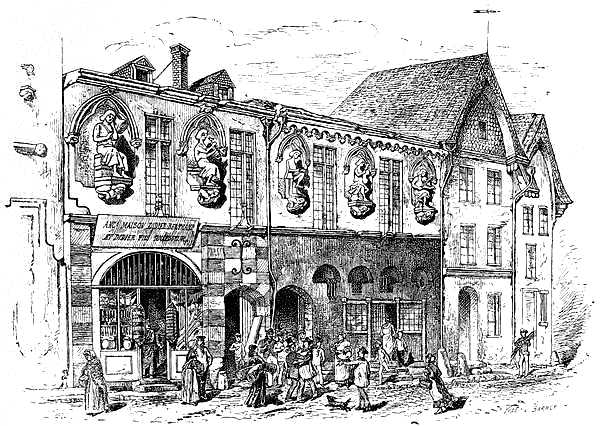
THE HOUSE OF THE MUSICIANS IN THE RUE DU TAMBOUR, REIMS.
To return, however, to the House of the Musicians. A probable conjecture ascribes the origin of the quaint mediæval structure to the Brotherhood of Minstrels of Reims, who in the thirteenth century enjoyed a considerable reputation, not merely in the Champagne, but throughout the North of France. The house takes its present name from five seated statues of musicians, larger than life-size, occupying the Gothic niches between the first-floor windows, and resting upon brackets ornamented with grotesque heads. It is thought that the partially-damaged figure on the left-hand side was originally playing a drum and a species of clarionet. The next one evidently has the remnants of a harp in his raised hands. The third or central figure is supposed merely to have held a hawk upon his wrist; whilst the fourth seeks to extract harmony from a dilapidated bagpipe; and the fifth, with crossed legs, strums complacently away upon the fiddle. The ground-floor of the quaint old tenement is to-day an oil and colour shop, the front of which is covered with chequers in all the tints of the rainbow.
Leading from the Rue du Tambour is the Rue de la Belle Image, thus named from a handsome statuette of the Virgin, which formerly decorated a corner niche; and beyond is the Rue St. Hilaire, where Messrs. Barnett et Fils, trading under the designation of Périnet et Fils, and the only English house engaged in the manufacture of Champagne, have an establishment which is certainly as perfect as any to be found in Reims. Above-ground are several large store-rooms, where vintage-casks and the various utensils common to a Champagne establishment are kept; and a capacious cellier, upwards of one hundred and fifty feet in length, with its roof resting on massive timber supports. Here new wine is stored preparatory to being blended and bottled; and in the huge tun, holding nearly three thousand gallons, standing at the further end, the firm make their cuvée; while adjacent is a room where stocks of corks and labels, metal foil, and the like are kept.
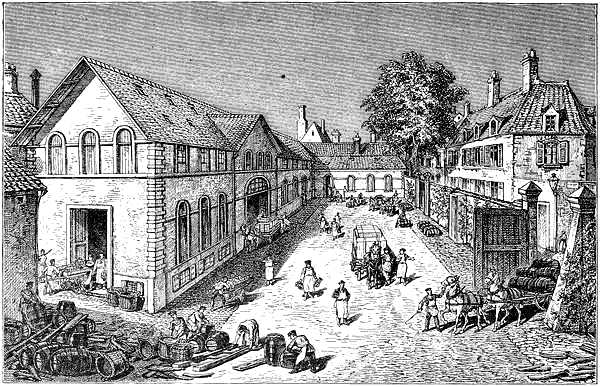
MESSRS. PÉRINET ET FILS’ ESTABLISHMENT IN THE RUE ST. HILAIRE, REIMS.
Underneath this building there are three stories of cellars—an exceedingly rare thing anywhere in the Champagne—all constructed in solid masonry on a uniform plan, each story comprising two wide galleries, running parallel with each other and connected by means of transverse passages. Spite of the great depth to which these cellars descend, they are perfectly dry; the ventilation, too, is excellent; and their different temperatures render them especially suitable for the storage of Champagne, the temperature of the lowest cellar being 6° Centigrade (43° Fahrenheit), or one degree Centigrade below the cellar immediately above, which in its turn is two degrees below the uppermost of all. The advantage of this is that, when the wine develops an excess of effervescence, any undue proportion of breakages can be checked by removing the bottles to a lower cellar, and consequently into a lower temperature.
The first cellars we enter are closely stacked with wine in bottle, which is gradually clearing itself by the formation of a deposit; while in an adjoining cellar on the same level the operations of disgorging, liqueuring, and corking are going on. At the end of this gallery is a spacious compartment, where a large stock of pure Champagne cognac of grand vintages is stored for cask and liqueur use. In the cellars immediately beneath, bottles of wine repose in solid stacks ready for the dégorgeur; while others rest in racks, in order that they may undergo their daily shaking. In the lowest cellars reserved wine in cask is stored, as it best retains its natural freshness and purity in a very cool place. All air is carefully excluded from the casks; any ullage is immediately replaced; and, as evaporation is continually going on, the casks are examined every fortnight, when any deficiency is at once replenished. At Messrs. Périnet et Fils’, as at all the first-class establishments, the vin brut is a mélange comprising the produce of some of the best vineyards, and has every possible attention paid to it during its progressive stages of development.
From the second tier of cellars at Messrs. Périnet et Fils’ a gallery extends, under the Rue St. Hilaire, to some extensive vaults excavated beneath an adjacent building, in which the Reims Military Club is installed. These vaults, arranged in two separate stories, are eight in number, and in them we found a quarter of a million bottles of vin brut, reposing either in solid stacks or sur pointe, the latter going through their daily shaking in order to fit them for the operation of dégorgement. On the whole the cellars of Périnet et Fils, including the six long galleries already described, suffice for the storage of a million bottles of Champagne.
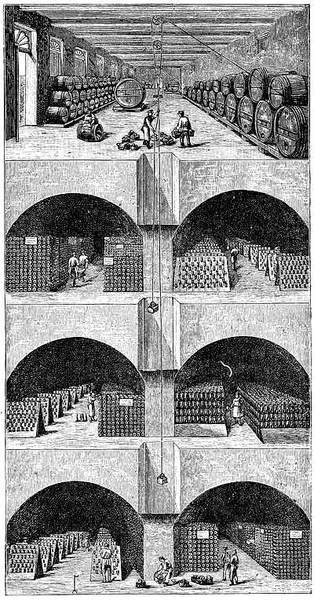
THE CELLIER AND CELLARS OF MESSRS. PÉRINET ET FILS.
Before leaving the establishment Champagnes of different years were shown to us, all of them soft, light, and delicate, and with that fine flavour and full perfume which the best growths of the Marne alone exhibit. Among several curiosities submitted to us was a still Verzenay of the year 1857, one of the most delicate wines it was ever our fortune to taste. Light in body, rich in colour, of a singularly novel and refined flavour, and with a magnificent yet indefinable bouquet, the wine was in every respect perfect. Not only was the year of the vintage a grand one, but the wine must have been made with the greatest possible care, and from the most perfect grapes, for so delicate a growth to have retained its flavour in such perfection, and preserved its brilliant ruby colour for such a length of time.
From the samples shown to us of Périnet et Fils’ Champagne, we were prepared to find that at some recent tastings in London, the particulars of which have been made public, their Extra Sec took the first place at each of the three severe competitions to which it was subjected.
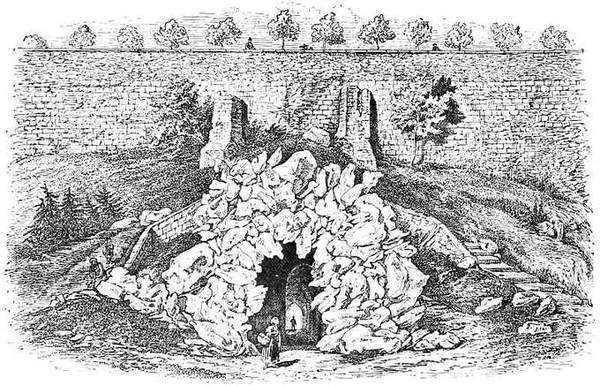
GROTTO BENEATH THE OLD FORTIFICATIONS OF REIMS.
VIII. REIMS AND ITS CHAMPAGNE ESTABLISHMENTS (continued).
La Prison de Bonne Semaine—Mary Queen of Scots at Reims—Messrs. Pommery & Greno’s offices—A fine collection of faïence—The Rue des Anglais a former refuge of English Catholics—Remains of the old University of Reims—Ancient tower and grotto—The handsome castellated Pommery establishment—The spacious cellier and huge carved cuvée tuns—The descent to the cellars—Their great extent—These lofty subterranean chambers originally quarries, and subsequently places of refuge of the early Christians and the Protestants—Madame Pommery’s splendid cuvées of 1868 and 1874—Messrs. de St. Marceaux & Co.’s new establishment in the Avenue de Sillery—Its garden-court and circular shaft—Animated scene in the large packing hall—Lowering bottled wine to the cellars—Great depth and extent of these cellars—Messrs. de St. Marceaux & Co.’s various wines—The establishment of Veuve Morelle & Co., successors to Max Sutaine—The latter’s ‘Essai sur le Vin de Champagne’—The Sutaine family formerly of some note at Reims—Morelle & Co.’s cellars well adapted to the development of sparkling wines—The various brands of the house—The Porte Dieu-Lumière.
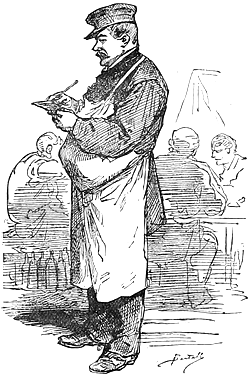
HEAD OVERSEER AT POMMERY AND GRENO’S.
NIGH the cathedral of Reims, and in the rear of the archiepiscopal palace, there runs a short narrow street known as the Rue Vauthier le Noir, and frequently mentioned in old works relating to the present capital of the Champagne. The discovery of various pillars and statues, together with a handsome Gallo-Roman altar, whilst digging some foundations in 1837, points to the fact that a Pagan temple formerly occupied the site. The street is supposed to have taken its name, however, from some celebrated gaoler, for in mediæval times here stood ‘la prison de bonne semaine.’ On the site of this prison a château was subsequently built, which tradition has erroneously fixed upon as the residence of the beautiful and luckless Mary Queen of Scots, in the days when her uncle, Cardinal Charles de Lorraine, was Lord Archbishop of Reims. Temple, prison, and palace have alike disappeared, and where they stood there now rises midway between court and garden a handsome mansion, the residence of Madame Pommery, head of the well-known firm of Pommery & Greno. To the left of the courtyard, which is entered through a monumental gateway, are some old buildings, let into the walls of which are a couple of sculptured escutcheons, the one comprising the arms of France, and the other those of the Cardinal de Lorraine. On the right-hand side of the courtyard are the Pommery offices, together with the manager’s sanctum, replete with artistic curiosities, the walls being completely covered with remarkable specimens of faïence, including Rouen, Gien, Palissy, Delft, and majolica, collected in the majority of instances by Madame Pommery in the villages around Reims. Here we were received by M. Vasnier, who at once volunteered to accompany us to the cellars of the firm outside the city. Messrs. Pommery & Greno originally carried on business in the Rue Vauthier le Noir, where there are extensive cellars, but their rapidly-increasing connection long since compelled them to emigrate beyond the walls of Reims.
In close proximity to the Rue Vauthier le Noir is the Rue des Anglais, so named from the English Catholic refugees, who, flying from the persecutions of our so-called Good Queen Bess, here took up their abode and established a college and a seminary. They rapidly acquired great influence in Reims, and one of their number, William Gifford, was even elected archbishop. At the end of this street, nigh to Madame Pommery’s, there stands an old house erected late in the fifteenth century, with a corner tower and rather handsome Renaissance window, which formerly belonged to some of the clergy of the cathedral, and subsequently became the ‘Bureau Général de la Loterie de France,’ an institution abolished by the National Convention in 1793.
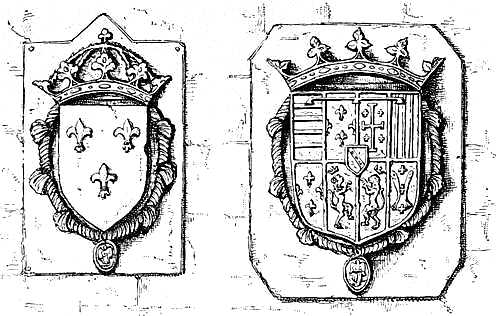
OLD COATS OF ARMS IN THE COURTYARD OF MADAME POMMERY’S RESIDENCE.
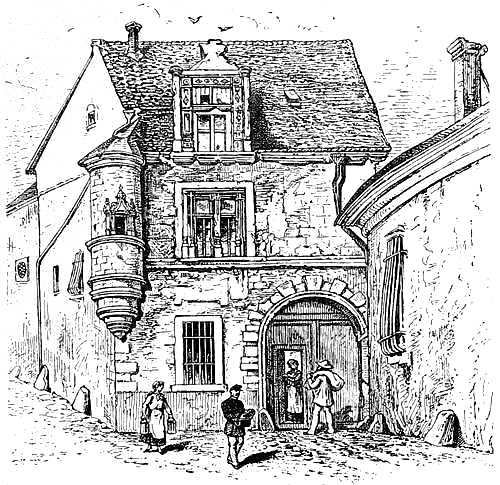
OLD HOUSE IN THE RUE DES ANGLAIS, REIMS.
The Rue des Anglais conducts into the Rue de l’Université, where a few remnants of the old University, founded by Cardinal Charles de Lorraine (1538–74), formerly attracted attention, notably a conical-capped corner tower, the sculptured ornaments at the base of which had crumbled into dust beneath the corroding tooth of Time.[423] From the Rue de l’Université our way lies along the Boulevard du Temple to the Porte Gerbert, about a mile beyond which there rises up the curious castellated structure in which the Pommery establishment is installed, with its tall towers commanding a view of the whole of Reims and its environs. As we drive up the Avenue Gerbert we espy on the right an isolated crumbling tower, a remnant of the ancient fortifications of Reims,[424] while close at hand, and under the old city-walls, is a grotto, to which an ancient origin is likewise ascribed. In another minute we reach the open iron gates of Messrs. Pommery’s establishment, flanked by a picturesque porter’s lodge; and proceeding up a broad drive, we alight under a Gothic portico at the entrance to the spacious and lofty cellier. Iron girders support the roof of this vast hall, 180 feet in length and 90 feet in width, without the aid of a single column. At one end is the office and tasting-room, provided with a telegraphic apparatus and telephone, by means of which communication is carried on with the Reims bureaux. Stacked up on every side of the cellier, and often in eight tiers when empty, are rows upon rows of casks, 6000 of which contain wine of the costly vintage of 1880 sufficient for a million and a half bottles of Champagne. The temperature of this hall is carefully regulated; the windows are high up near the roof, and the sun’s rays are rigidly excluded, so that a pleasant coolness pervades the building. On the left-hand side stand two huge tuns, with the monogram P. and G., surmounting the arms of Reims, carved on their heads. These are capable of containing 5500 gallons of wine, and in them the firm make their cuvée. A platform, access to which is gained by a staircase in a side aisle, runs round one of these foudres; and when the wine, which has been hoisted up in casks and poured through a metal trough into the foudre, is being blended, boys stand on this platform and, by means of a handle protruding above the cask, work the paddle-wheels placed inside, thereby securing the complete amalgamation of the wine. Adjoining are the chains and lifts worked by steam, by means of which wine is raised and lowered from and to the cellars beneath, one lift raising or lowering eight casks, whether full or empty, in the space of a minute.
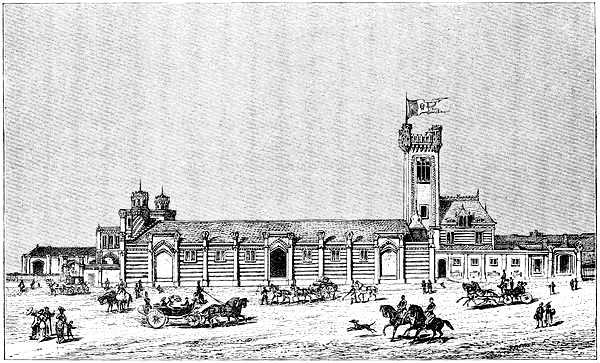
THE POMMERY AND GRENO ESTABLISHMENT IN THE OUTSKIRTS OF REIMS.
At the farther end of the hall a Gothic door, decorated with ornamental ironwork, leads to the long broad flight of steps, 116 in number, and nearly twelve feet in width, conducting to the suite of lofty subterranean chambers, where bottles of vin brut repose in their hundreds of thousands in slanting racks or solid piles, passing leisurely through those stages of development necessary to fit them for the dégorgeur. Altogether there are 130 large shafts, 90 feet in depth and 60 feet square at their base, which were originally quarries, and are now connected by spacious galleries. This side of Reims abounds with similar chalk quarries, commonly believed to have served as places of refuge for the Protestants at the time of the League and after the revocation of the Edict of Nantes; and it is even conjectured that the early Christians—the followers of St. Sixtus and St. Sinicus—here hid themselves from their persecutors. Since the cellars within the city have no longer sufficed for the storage of the immense stocks required through the development of the Champagne trade, these vast subterranean galleries have been successfully utilised by various firms. Messrs. Pommery, after filling up the chambers above the water level, proceeded to excavate the connecting tunnels, shore up the cracking arches, and repair the flaws in the chalk with masonry, finally converting these abandoned quarries into magnificent cellars for the storage of Champagne. No less than 60,000 l. was spent upon them and the castellated structure aboveground. Several millions of bottles of Champagne can be stored in these capacious vaults, the area of which is nearly 450,000 square feet.
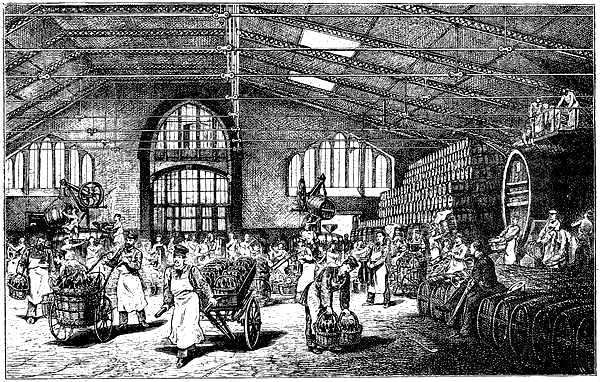
INTERIOR OF MESSRS. POMMERY AND GRENO’S CELLIER.
Madame Pommery made a great mark with her splendid cuvées of 1868 and 1874, the result being that her brand has become widely popular, and that it invariably realises exceptionally high prices.
On leaving Messrs. Pommery’s we retrace our steps down the Avenue Gerbert, bordered on either side with rows of plane-trees, until we reach the treeless Avenue de Sillery, where Messrs. de St. Marceaux & Co.’s new and capacious establishment is installed. Simple and without pretension, the establishment, which covers an area of upwards of 18,000 feet, is distinguished for its perfect appropriateness to the industry for which it was designed. The principal block of building is flanked by two advanced wings enclosing a garden-court, set off with flowers and shrubs, and from the centre of which rises a circular shaft, covered in with glass, and admitting light and air to the cellars below. In the building to the left the wine is received on its arrival from the vineyard, and here are ranged large quantities of casks replete with the choice crus of Verzenay, Ay, Cramant, and Bouzy, while thousands of bottles ready for labelling are stacked in massive piles at the end of the packing-hall in the corresponding wing of the establishment. Here, too, a tribe of workpeople are arraying the bottles with gold and silver headdresses, and robing them in pink paper, while others are filling, securing, marking, and addressing the cases or baskets destined to Hong-Kong, San Francisco, Yokohama, Bombay, London, New York, St. Petersburg, Berlin, or Paris.
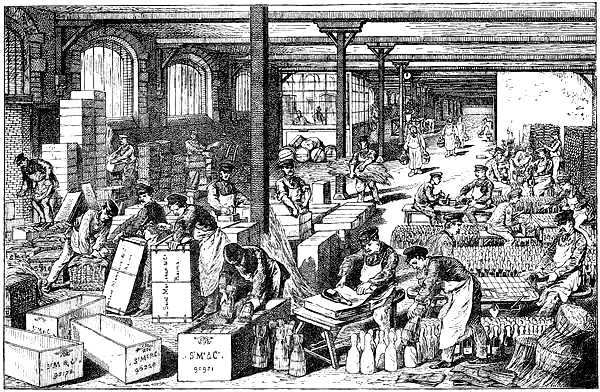
THE PACKING-HALL OF MESSRS. DE ST. MARCEAUX AT REIMS.
The wine in cask, stored in the left-hand wing, after having been duly blended in an enormous vat, is drawn off into bottles, which are then lowered down a shaft to the second tier of cellars by means of an endless chain, on to which the baskets of bottles are swiftly hooked. The workman engaged in this duty, in order to guard against his falling down the shaft, has a leather belt strapped round his waist, by means of which he is secured to an adjoining iron column. We descended into the lower cellars down a flight of ninety-three broad steps—a depth equal to the height of an ordinary six-storied house—and found no less than four-and-twenty galleries excavated in the chalk, devoid of masonry supports, and containing upwards of a million bottles of Champagne. These galleries vary in length, but are of uniform breadth, and allow either for a couple of racks with wine sur pointe, or stacks of bottles, in four row’s on either side, with ample passage-room down the centre.
The upper range of cellars comprises two large arched galleries of considerable breadth, one of which contains wine in wood and wine sur pointe, while the other is stocked with bottles of wine heads downward, ready to be delivered into the hands of the dégorgeur.
MM. de St. Marceaux & Co. have the honour of supplying the King of the Belgians, the President of the French Republic, and several German potentates with an exceedingly delicate Champagne known as the Royal St. Marceaux. The same wine is popular in Russia and other parts of Europe, just as the Dry Royal of the firm is much esteemed in the United States. The brand of the house most appreciated in this country is its Carte d’Or, a very dry wine, the extra superior quality of the firm, which secured the first place at a recent Champagne competition in England.
Some little distance beyond the remnants of the ancient fortifications of Reims, skirting the Butte de St. Nicaise, is the establishment of Veuve Morelle & Co., successors to Veuve Max Sutaine & Co. This house was founded in 1823 by the late M. Maxime Sutaine, who, like several other notabilities in the Reims wine trade, was as familiar with art and science as with the special industry to which he had devoted himself. An amateur painter of no mean skill, he showed himself thoroughly at home in the biographical and critical notices on artists and art in his native province which he produced. His name, however, is chiefly identified in literature with his Essai sur le Vin de Champagne.[425] This work may be regarded as the first attempt to collect the scattered materials relating to the history of Champagne wine, and to deal with them in a critical spirit. Though necessarily imperfect, its value is undoubtedly great, and it has been frequently quoted from in the present volume. The family of Sutaine long held an honourable position at Reims, the name of one of M. Max Sutaine’s immediate ancestors, who filled the position of lieutenant of the city in 1765, appearing on the bronze slab at the base of the statue of Louis XV. in the Place Royale, erected during that year.