PART I.
Reading edition
I. EARLY RENOWN OF THE CHAMPAGNE WINES.
The vine in Gaul—Domitian’s edict to uproot it—Plantation of vineyards under Probus—Early vineyards of the Champagne—Ravages by the Northern tribes repulsed for a time by the Consul Jovinus—St. Remi and the baptism of Clovis—St. Remi’s vineyards—Simultaneous progress of Christianity and the cultivation of the vine—The vine a favourite subject of ornament in the churches of the Champagne—The culture of the vine interrupted, only to be renewed with increased ardour—Early distinction between ‘Vins de la Rivière’ and ‘Vins de la Montagne’—A prelate’s counsel respecting the proper wine to drink—The Champagne desolated by war—Pope Urban II., a former Canon of Reims Cathedral—His partiality for the wine of Ay—Bequests of vineyards to religious establishments—Critical ecclesiastical topers—The wine of the Champagne causes poets to sing and rejoice—‘La Bataille des Vins’—Wines of Auviller and Espernai le Bacheler.
ALTHOUGH the date of the introduction of the vine into France is lost in the mists of antiquity, and though the wines of Marseilles, Narbonne, and Vienne were celebrated by Roman writers prior to the Christian era, many centuries elapsed before a vintage was gathered within the limits of the ancient province of Champagne. Whilst the vine and olive throve in the sunny soil of the Narbonnese Gaul, the frigid climate of the as yet uncultivated North forbade the production of either wine or oil.[1] The ‘forest of the Marne,’ now renowned for the vintage it yields, was then indeed a dark and gloomy wood, the haunt of the wolf and wild boar, the stag and the auroch; and the tall barbarians of Gallia Comata, who manned the walls of Reims on the approach of Cæsar, were fain to quaff defiance to the Roman power in mead and ale.[2] Though Reims became under the Roman dominion one of the capitals of Belgic Gaul, and acquired an importance to which numerous relics in the shape of temples, triumphal arches, baths, arenas, military roads, &c., amply testify; and though the Gauls were especially distinguished by their quick adoption of Roman customs, it appears certain that during the sway of the twelve Cæsars the inhabitants of the present Champagne district were forced to draw the wine, with which their amphoræ were filled and their pateræ replenished, from extraneous sources. The vintages of which Pliny and Columella have written were confined to Gallia Narboniensis, though the culture of the vine had doubtless made some progress in Aquitaine and on the banks of the Saône, when the stern edict of the fly-catching madman Domitian, issued on the plea that the plant of Bacchus usurped space which would be better filled by that of Ceres, led (A.D. 92) to its total uprooting throughout the Gallic territory.
For nearly two hundred years this strange edict remained in force, during which period all the wine consumed in the Gallo-Roman dominions was imported from abroad. Six generations of men, to whom the cheerful toil of the vine-dresser was but an hereditary tale, and the joys of the vintage a half-forgotten tradition, had passed away when, in 282, the Emperor Probus, a gardener’s son, once more granted permission to cultivate the vine, and even exercised his legions in the laying-out and planting of vineyards in Gaul.[3] The culture was eagerly resumed, and, as with the advancement of agriculture and the clearance of forests the climate had gradually improved, the inhabitants of the more northern regions sought to emulate their southern neighbours in the production of wine. This concession of Probus was hailed with rejoicing; and some antiquaries maintain that the triumphal arch at Reims, known as the Gate of Mars, was erected during his reign as a token of gratitude for this permission to replant the vine.[4]
By the fourth century the banks of the Marne and the Moselle were clothed with vineyards, which became objects of envy and desire to the yellow-haired tribes of Germany,[5] and led in no small degree to the predatory incursions into the territory of Reims so severely repulsed by Julian the Apostate and the Consul Jovinus, who had aided Julian to ascend the throne of the Cæsars, and had combatted for him against the Persians. Julian assembled his forces at Reims in 356, before advancing against the Alemanni, who had established themselves in Alsace and Lorraine; and ten years later the Consul Jovinus, after surprising some of the same nation bathing their large limbs, combing their long and flaxen hair, and ‘swallowing huge draughts of rich and delicious wine,’[6] on the banks of the Moselle, fought a desperate and successful battle, lasting an entire summer’s day, on the Catalaunian plains near Châlons, with their comrades, whom the prospect of similar indulgence had tempted to enter the Champagne. Valerian came to Reims in 367 to congratulate Jovinus; and the Emperor and the Consul (whose tomb is to-day preserved in Reims Cathedral) fought their battles o’er again over their cups in the palace reared by the latter on the spot occupied in later years by the church of St. Nicaise.
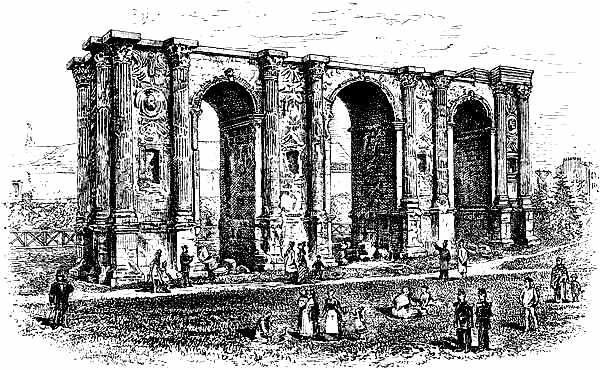
THE GATE OF MARS AT REIMS.
The check administered by Jovinus was but temporary, while the attraction continued permanent. For nearly half a century, it is true, the vineyards of the Champagne throve amidst an era of quiet and prosperity such as had seldom blessed the frontier provinces of Gaul.[7] But when, in 406, the Vandals spread the flame of war from the banks of the Rhine to the Alps, the Pyrenees, and the ocean, Reims was sacked, its fields ravaged, its bishop cut down at the altar, and its inhabitants slain or made captive; and the same scene of desolation was repeated when the hostile myriads of Attila swept across north-western France in 451.
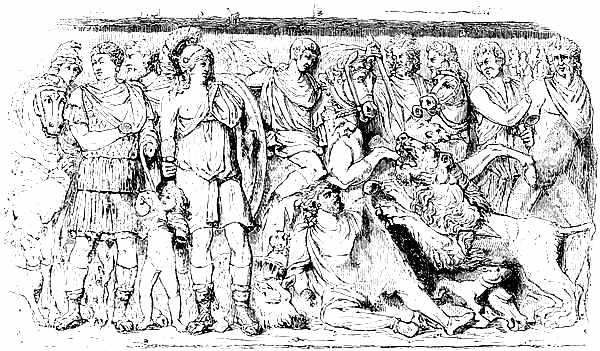
TOMB OF THE CONSUL JOVINUS, PRESERVED IN REIMS CATHEDRAL.
Happier times were, however, in store for Reims and its bishops and its vineyards, the connection between the two last being far more intimate than might be supposed. When Clovis and his Frankish host passed through Reims by the road still known as the Grande Barberie, on his way to attack Syagrius in 486, there was no doubt a little pillaging, and the famous golden vase which one of the monarch’s followers carried off from the episcopal residence was not left unfilled by its new owner. But after Syagrius had been crushed at Soissons, and the theft avenged by a blow from the king’s battle-axe, Clovis not only restored the stolen vase, and made a treaty with the bishop St. Remi or Remigius, son of Emilius, Count of Laon, but eventually became a convert to Christianity, and accepted baptism at his hands. Secular history has celebrated the fight of Tolbiac—the invocation addressed by the despairing Frank to the God of the Christians; the sudden rallying of his fainting troops, and the last desperate charge which swept away for ever the power of the Alemanni as a nation. Saintly legends have enlarged upon the piety of Queen Clotilda; the ability of St. Remi; the pomp and ceremony which marked the baptism of Clovis at Reims in December 496; the memorable injunction of the bishop to his royal convert to adore the cross he had burnt, and burn the idols he had hitherto adored; and the miracle of the Sainte Ampoule, a vial of holy oil said to have been brought direct from heaven by a snow-white dove in honour of the occasion. A pigeon, however, has always been a favourite item in the conjuror’s paraphernalia from the days of Apolonius of Tyana and Mahomet down to those of Houdin and Dr. Lynn; and modern scepticism has suggested that the celestial regions were none other than the episcopal dovecot. Whether or not the oil was holy, we may be certain that the wine which flowed freely in honour of the Frankish monarch’s conversion was ambrosial; that the fierce warriors who had conquered at Soissons and Tolbiac wetted their long moustaches in the choicest growths that had ripened on the surrounding hills; and that the Counts and Leudes, and, judging from national habits, the King himself, got royally drunk upon a cuvée réservée from the vineyard which St. Remi had planted with his own hands on his hereditary estate near Laon, or the one which the slave Melanius cultivated for him just without the walls of Reims.
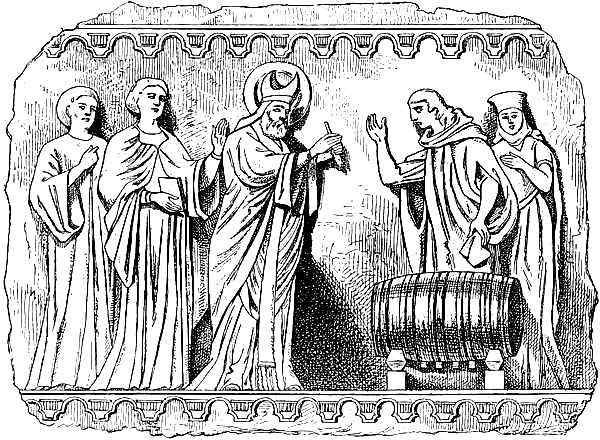
For the saint was not only a converter of kings, but, what is of more moment to us, a cultivator of vineyards and an appreciator of their produce. Amongst the many miracles which monkish chroniclers have ascribed to him is one commemorated by a bas-relief on the north doorway of Reims Cathedral, representing him in the house of one of his relatives, named Celia, making the sign of the cross over an empty cask, which, as a matter of course, immediately became filled with wine. That St. Remi possessed such an ample stock of wine of his own as to have been under no necessity to repeat this miracle in the episcopal palace is evident from the will penned by him during his last illness in 530, as this shows his viticultural and other possessions to have been sufficiently extensive to have contented a bishop even of the most pluralistic proclivities.[8]
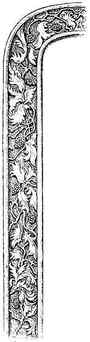
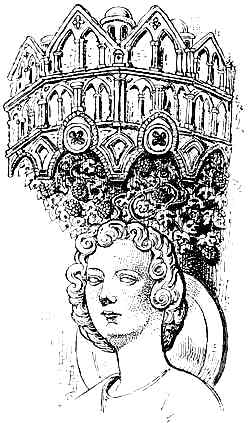
It is curious to note the connection between the spread of viticulture and that of Christianity—a connection apparently incongruous, and yet evident enough, when it is remembered that wine is necessary for the celebration of the most solemn sacrament of the Church. Christianity became the established religion of the Roman Empire about the first decade of the fourth century, and Paganism was prohibited by Theodosius at its close; and it is during this period that we find the culture of the grape spreading throughout Gaul, and St. Martin of Tours preaching the Gospel and planting a vineyard coevally. Chapters and religious houses especially applied themselves to the cultivation of the vine, and hence the origin of many famous vineyards, not only of the Champagne but of France. The old monkish architects, too, showed their appreciation of the vine by continually introducing sculptured festoons of vine-leaves, intermingled with massy clusters of grapes, into the decorations of the churches built by them. The church of St. Remi, for instance, commenced in the middle of the seventh century, and touched up by succeeding builders till it has been compared to a school of progressive architecture, furnishes an example of this in the mouldings of its principal doorway; and Reims Cathedral offers several instances of a similar character.
FROM THE NORTH DOORWAY OF REIMS CATHEDRAL.
Amidst the anarchy and confusion which marked the feeble sway of the long-haired Merovingian kings, whom the warlike Franks were wont to hoist upon their bucklers when investing them with the sovereign power, we find France relapsing into a state of barbarism; and though the Salic law enacted severe penalties for pulling up a vine-stock, the prospect of being liable at any moment to a writ of ejectment, enforced by the aid of a battle-axe, must have gone far to damp spontaneous ardour as regards experimental viticulture. The tenants of the Church, in which category the bulk of the vine-growers of Reims and Epernay were to be classed, were best off; but neither the threats of bishops nor the vengeance of saints could restrain acts of sacrilege and pillage. During the latter half of the sixth century Reims, Epernay, and the surrounding district were ravaged several times by the contending armies of Austrasia and Neustria; and Chilperic of Soissons, on capturing the latter town in 562, put such heavy taxes on the vines and the serfs that in three years the inhabitants had deserted the country. Matters improved, however, during the more peaceful days of the ensuing century, which witnessed the foundation of numerous abbeys, including those of Epernay, Hautvillers, and Avenay; and the planting of fresh vineyards in the ecclesiastical domains by Bishop Romulfe and his successor St. Sonnace, the latter, who died in 637, bequeathing to the church of St. Remi a vineyard at Villers, and to the monastery of St. Pierre les Dames one situate at Germaine, in the Mountain of Reims.[9] The sculptured saint on the exterior of Reims Cathedral, with his feet resting upon a pedestal wreathed with vine-leaves and bunches of grapes, may possibly have been intended for one of these numerous wine-growing prelates.
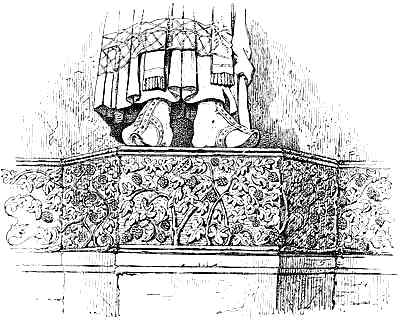
FROM THE NORTH DOORWAY OF REIMS CATHEDRAL.
The mighty figure of Charlemagne, overshadowing the whole of Europe at the commencement of the ninth century, appears in connection with Reims, where, begirt with paladins and peers, he entertained the ill-used Pope Leo III. right royally during the ‘festes de Noel’ of 805. The monarch who is said to have clothed the steep heights of Rudesheim with vines was not indifferent to good wine; and the vintages of the Champagne doubtless mantled in the magic goblet of Huon de Bordeaux, and brimmed the horns which Roland, Oliver, Doolin de Mayence, Renaud of Montauban, and Ogier the Dane, drained before girding on their swords and starting on their deeds of high emprise—the slaughter of Saracens, the rescue of captive damsels, and the discomfiture of felon knights—told in the fables of Turpin and the ‘chansons de geste.’ That the cultivation of the grape, and above all the making of wine, had been steadily progressing, is clear from the fact that the distinction between the ‘Vins de la Rivière de Marne’ and the ‘Vins de la Montagne de Reims’ dates from the ninth century.[10]
This era is, moreover, marked by the inauguration of that long series of coronations which helped to spread the popularity of the Champagne wines throughout France by the agency of the nobles and prelates taking part in the ceremony. Sumptuous festivities marked the coronation of Charlemagne’s son Louis in 816; and the officiating Archbishop Ebbon may have helped to furnish the feast with some of the produce from the vineyard he had planted at Mont Ebbon, generally identified with the existing Montebon, near Mardeuil. It is of this vineyard that Pardulus, Bishop of Laon, speaks in a letter addressed by him to Ebbon’s successor, the virtuous Hincmar, who assumed the crozier in 845, proffering him counsels as to the best method of sustaining his failing health. After telling him to avoid eating fish on the same day that it is caught, insisting that salted meat is more wholesome than fresh, and recommending bacon and beans cooked in fat as an excellent digestive, he proceeds: ‘You must make use of a wine which is neither too strong nor too weak—prefer, to those produced on the summit of the mountain or the bottom of the valley, one that is grown on the slopes of the hills, as towards Epernay, at Mont Ebbon; towards Chaumuzy, at Rouvesy; towards Reims, at Mersy and Chaumery.’ The Champagne vineyards suffered grievously from the internal convulsions which marked the period when the sceptre of France was swayed by the feeble hands of the dregs of the Carlovingian race. The Normans, who threatened Reims and sacked Epernay in 882, swept over them like devouring locusts; and their annals during the following century are written in letters of blood and flame.
Times were indeed bad for the peaceful vine-dressers in the tenth century, when castles were springing up in every direction; when might made right, and the rule of the strong hand alone prevailed; and when the firm belief that the end of the world was to come in the year 1000 led men to live only for the present, and seek to get as much out of their fellow-creatures as they possibly could. Such natural calamities as that of 919, when the wine-crop entirely failed in the neighbourhood of Reims, were bad enough; but the continual incursions of the Hungarians, whose arrows struck down the peasant at the plough and the priest at the altar, and the memory of whose pitiless deeds yet survives in the term ‘ogre;’ the desperate contest waged for ten years by Heribert of Vermandois to secure the bishopric of Reims for his infant son, during which hardly a foot of the disputed territory remained unstained by blood; the repeated invasions of Otho of Germany; and the struggle between Hugh Capet and Charles of Lorraine for the titular crown of France,—left traces harder to be effaced. Reims underwent four sieges in about sixty years; and Epernay, that most hapless of towns, was sacked at least half a score of times, and twice burnt, one of the most conscientiously executed pillagings being that performed in 947 by Hugh the Great, who, as it was vintage-time, completely ravaged the whole country, and carried off all the wine.[11]
Under the rule of the Capetian race matters improved as regarded foreign foes, though the archbishops had in the early part of the eleventh century to abandon Epernay, Vertus, Fismes, and their dependencies to the family of Robert of Vermandois, who had assumed the title of Counts of Champagne, to be held by them as fiefs. The fame of the schools of Reims, where future popes and embryo emperors met as class-mates; the festive gatherings which marked the coronation of Henry I. and Philip I.; the great ecclesiastical council held by Leo IX., which procured for the city the nickname of ‘little Rome;’ and the growing importance of the Champagne fairs, the great meeting-places throughout the Middle Ages of the merchants of Spain, Italy, and the Low Countries,—favoured the prosperity of the district and the production of its wine. Urban II., a native of Châtillon, who wore the triple crown from 1088 to the close of the century, was, prior to his elevation to the chair of St. Peter, a canon of Reims, under the name of Eudes or Odo, and, tippling there in company with his fellow-clerics, acquired a taste for the wine of Ay, which he preferred to all others in the world.[12] Pilgrims to Rome found penance light and pardon easily obtained when they bore with them across the Alps, in addition to staff and scrip, a huge ‘leathern bottel’ of that beloved vintage which warmed the pontiff’s heart and whetted his wit for the delivery of those soul-stirring orations at Placentia and Clermont, wherein he appealed to the chivalry of Western Europe to hasten to the rescue of the Holy Sepulchre from the hands of the infidel.
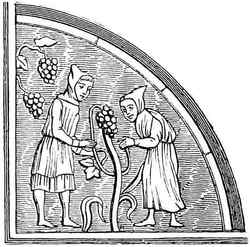
VINE-DRESSERS—THIRTEENTH CENTURY (From a window of Chartres Cathedral).
The result of these appeals was felt by the vine-cultivators of the Champagne in more ways than one, and their case recalls that of the petard-hoisted engineer. The virtuous, the speculative, and the enthusiastic who followed Peter the Hermit and Walter the Penniless to the plains of Asia Minor suffered at the hands of the vicious, the prudent, and the practical, who remained at home and passed their time in pillaging the estates of their absent neighbours. The abbatial vineyards suffered like the others; and the monks of St. Thierry, in making peace with Gerard de la Roche and Alberic Malet in 1138, complained bitterly of wine violently extorted during two years from growers on the ecclesiastical estate and of a levy made upon their vineyard.[13]
The efforts of Henry of France, a warlike prelate, who built fortresses and attacked those of the robber-nobles, and of Louis VII., who avenged the wrongs of the church of Reims on the Counts of Roucy, served to improve matters; and we may be sure that whenever the monks did get hold of a repentant or dying sinner, they made him pay pretty dearly for peace with them and Heaven. Colin Musset, the early Champenois poet, thought that the best use to which money could be put was to spend it in good wine.[14] Churchmen, however, managed to secure the desired commodity without any such outlay, for numerous charters of the twelfth and thirteenth centuries show lords, sick or about starting for the crusades, making large gifts to abbeys and monasteries; and many a strip of fair and fertile vineland was thus added, thanks to a judicious pressure on the conscience, to the already extensive possessions of the two great monasteries of Reims, St. Remi and St. Nicaise, and also to that of St. Thierry. The Templars, too, whose reputation as wine-bibbers was only inferior to that of the monks, if we may credit the adage which runs,
‘Boire en templier, c’est boire à plein gosier; Boire en cordelier, c’est vuider le cellier,’
and who, prior to the catastrophe of 1313, had a commandery at Reims, possessed either vineyards, or droits de vinage, at numerous spots, including Epernay, Hermonville, Ludes, and Verzy; while the separate community of these ‘Red Monks’ installed at Orilly had estates at Ay, Damery, and Mareuil. The hospital of St. Mary at Reims also reckoned amongst its possessions vineyards at Moussy, bequeathed by Canon Pontius and Tebaldus Papelenticus. The wine, which in 1215 the treasurer of the chapter of Reims Cathedral obtained from that body an acknowledgment of his right to on the anniversaries of the deaths of Bishops Ebalus and Radulf, and that to which the sub-treasurer and carpenter were severally entitled, was no doubt in part derived from the vineyard planted in 1206 by Canon Giles at the Porte Mars and bequeathed by him to the chapter, and the one which Canon John de Brie had purchased at Mareuil and had similarly bequeathed.[15] Although papal bulls and archiepiscopal warrants had forbidden the levying of the droit de vinage on wine vintaged by religious communities, in 1252 Pope Innocent IV. had to reprove the barons for interfering with the monastic vintages in the neighbourhood of Reims, and to threaten them with excommunication if they repeated their offence.[16]
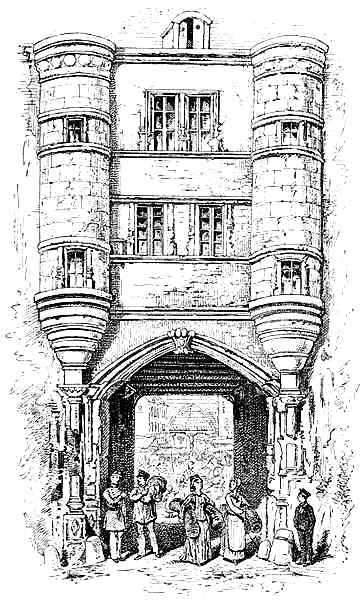
GATEWAY OF THE CHAPTER COURT AT REIMS.
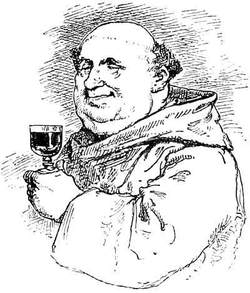
These ecclesiastical topers, as a rule, were sufficiently critical of the quality of the liquor meted out to them, and an agreement respecting the dietary of the Abbey of St. Remi, at Reims, drawn up in 1218 between the Abbot Peter and a deputation of six monks representing the rest of the brethren, provides that the wine procured for the latter should be improved by two-thirds of the produce of the Clos de Marigny being set apart for their exclusive use. Ten years later, to put a stop to further complaints on the part of these worthy rivals of Rabelais’ Frère Jean des Entonnoirs, Abbot Peter was fain to agree that two hundred hogsheads of wine should be annually brought from Marigny to the abbey to quench the thirst of his droughty flock, and that if the spot in question failed to yield the required amount the deficiency should be made up from his own private and particular vineyards at Sacy, Villers-Aleran, Chigny, and Hermonville.[17]
We can readily picture these
‘jolly fat friars Sitting round the great roaring fires With their strong wines;’
or the cellarer quietly chuckling to himself as he loosened the spiggot of the choicest casks—
‘Between this cask and the abbot’s lips Many have been the sips and slips; Many have been the draughts of wine, On their way to his, that have stopped at mine.’
The monks were in the habit of throwing open their monasteries to all comers, under pretext of letting them taste the wine they had for sale, until, in 1233, an ecclesiastical council at Beziers prohibited this practice on account of the scandal it created. Petrarch has accused the popes of his day of persisting in staying at Avignon when they could have returned to Rome, simply on account of the goodness of the wines they found there. Some similar reasons may have led to the selection of Reims, during the twelfth century, as a place for holding great ecclesiastical councils presided over by the sovereign pontiff in person; and no doubt ‘Bibimus papaliter’ was the motto of Calixtus, Innocent, and Eugenius when the labours of the day were done, and they and their cardinals could chorus, apropos of those of the morrow,
‘Bonum vinum acuit ingenium Venite potemus.’
The kings of France may have preferred the wines of the Orleanais and the Isle of France, and the monarchs of England have been content to vary the vintages of their patrimony of Guienne with an occasional draught of Rhenish; but the wines of the river Marne certainly found favour at Troyes, where the Counts of Champagne, to whom Epernay had been ceded as a fief, held a court little inferior in state to that of a sovereign prince. The native vintage mantled in the goblets and beakers that graced the board where they sat at meat amidst their knights and barons, whilst minstrels sang and jongleurs tumbled and glee-maidens danced at the lower end of the hall. It fired the fancy of the poet Count Thibault, to whom tradition has ascribed the introduction of the Cyprus grape into France on his return from the Crusades,[18] and helped the flow of the amorous strains which he addressed to Blanche of Castille. Nor was he the only versifier of the time who could exclaim, with his compatriot Colin Musset, that ‘good wine caused him to sing and rejoice.’[19] Other local songsters, such as Doete de Troyes, Eustache le Noble, and Guillaume de Machault, sought inspiration at their native Helicon, and were equally ready with Colin Musset to appreciate a gift of
‘barrelled wine, Cold, strong, and fine, To drink in hot weather,’ [20]
in return for their rhymes. It was this wine that the gigantic John Lord of Joinville, Seneschal of Champagne under Thibault, and chronicler of the Seventh Crusade, was in the habit of consuming warm and undiluted, by the advice of his physicians, on account, as he himself mentions, of his ‘large head and cold stomach;’ a practice which seems to have scandalised that pious and ascetic monarch St. Louis, who was careful to temper his own potations with water. The king was most likely not unacquainted with the wine, as a roll of the expenses incurred at his coronation at Reims, in 1226, shows that 991 livres were spent in wine on that occasion, when, in consequence of the vacancy of the archiepiscopal see, the crown was placed upon his head by Jacques de Bazoche, Bishop of Soissons.
Henry of Andelys, a compatriot of the engineer Brunel, who flourished, if a poet can be said to flourish, in the latter half of the thirteenth century, has extolled the wines of Epernay and Hautvillers, and mentioned that of Reims, in his poem entitled the ‘Bataille des Vins.’ He informs us at the outset that ‘the great King Philip Augustus,’ whom state records prove to have had a score of vineyards in different parts of France,[21] was very fond of ‘good white wine.’ Anxious to make a choice of the best, he issued invitations to all the most renowned crûs, French and foreign, and forty-six different vintages responded to this appeal; amongst them Hautvillers and Epernay, described as ‘vin d’Auviler’ and ‘vin d’Espernai le Bacheler.’ The king’s chaplain, an English priest, makes a preliminary examination, resulting in the summary rejection of many competitors, till at length, as Argenteuil—‘clear as oil’—and Pierrefitte are disputing as to their respective merits, Epernay and Hautvillers simultaneously exclaim, ‘Argenteuil, thou wishest to degrade all the wines at this table. By God, thou playest too much the part of constable. We excel Châlons and Reims, remove gout from the loins, and support all kings.’[22] But lo, up jumps the ‘vin d’Ausois,’ the ‘Osey’ of so many of our English mediæval poets, with the reproach, ‘Epernay, thou art too disloyal; thou hast not the right of speaking in court;’[23] and enumerates the blessings which he and his demoiselle ‘la Mosele’ confer upon the Germans.[24] La Rochelle in turn reproves Ausois, and extols the strength of his own wines, and those of Angoulême, Bordeaux, Saintes, and Poitou, and boasts of the welcome accorded to them in the northern states of Europe, including England, to which the districts he mentions then belonged.[25]
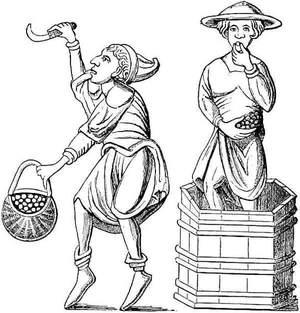
VINTAGERS OF THE THIRTEENTH CENTURY (From a MS. of the Dialogues de St. Grégoire).
The vintages of the then little kingdom of France put in a counter-claim for finesse and flavour as opposed to strength, and maintain that they do not harm those who drink them. The dispute becomes general, and the wines, heated with argument, exhale a perfume of ‘balsam and amber,’ till the hall where they are met resembles a terrestial paradise. The chaplain, after conscientiously tasting the whole of them, formally excommunicated with bell, book, and candle all the beer brewed in England and Flanders, and then went incontinently to bed, and slept for three days and three nights without intermission. The king thereupon made an examination himself, and named the wine of Cyprus pope, and that of Aquilat[26] cardinal, and created of the remainder three kings, five counts, and twelve peers, the names of which, unfortunately, have not been preserved.
II. THE WINES OF THE CHAMPAGNE FROM THE FOURTEENTH TO THE SEVENTEENTH CENTURY.
Coronations at Reims and their attendant banquets—Wine flows profusely at these entertainments—The wine-trade of Reims—Presents of wine from the Reims municipality—Cultivation of the vineyards abandoned after the battle of Poitiers—Octroi levied on wine at Reims—Coronation of Charles V.—Extension of the Champagne vineyards—Abundance of wine—Visit to Reims of the royal sot Wenceslaus of Bohemia—The Etape aux Vins at Reims—Increased consumption of beer during the English occupation of the city—The Maid of Orleans at Reims—The vineyards and wine-trade alike suffer—Louis XI. is crowned at Reims—Fresh taxes upon wine followed by the Mique-Maque revolt—The Rémois the victims of pillaging foes and extortionate defenders—The Champagne vineyards attacked by noxious insects—Coronation of Louis XII.—François Premier, the Emperor Charles V., Bluff King Hal, and Leo the Magnificent all partial to the wine of Ay—Mary Queen of Scots at Reims—State kept by the opulent and libertine Cardinal of Lorraine—Brusquet, the Court Fool—Decrease in the production of wine around Reims—Gifts of wine to newly-crowned monarchs—New restrictions on vine cultivation—The wine of the Champagne crowned at the same time as Louis XIII.—Regulation price for wine established at Reims—Imposts levied on the vineyards by the Frondeurs—The country ravaged around Reims—Sufferings of the peasantry—Presents of wine to Marshal Turenne and Charles II. of England—Perfection of the Champagne wines during the reign of Louis XIV.—St. Evremond’s high opinion of them—Other contemporary testimony in their favour—The Archbishop of Reims’s niggardly gift to James II. of England—A poet killed by Champagne—Offerings by the Rémois to Louis XIV. on his visit to their city.
THE coronations at Reims served, as already remarked, to attract within the walls of the old episcopal city all that was great, magnificent, and noble in France. The newly-crowned king, with that extensive retinue which marked the monarch of the Middle Ages; the great vassals of the crown scarcely less profusely attended; the constable, the secular and ecclesiastical peers, and the host of knights and nobles who assisted on the occasion, were wont at the conclusion of the ceremony to hold high revelry in the spacious temporary banqueting-hall reared near the cathedral. It is to be regretted that the menus of these banquets have not been handed down to us in their entirety; but a few fragmentary excerpts show that from a comparatively early period there was no lack of wine, at any rate. A remonstrance addressed to Philip the Fair, after his coronation in 1286, by the archbishop and burghers, asks that they may be relieved of a certain proportion of the sum levied on them for the cost of the ceremony, on the ground that there still remained over for the king’s use no less than seven score tuns of wine from the banquet. Some idea may be formed of the quantity of wine brought regularly into the city from the circumstance of the king having Reims surrounded by walls in 1294, and levying a duty on the wine imported to pay for them, and by the value attached to the ‘rouage’[27] of the Mairie St. Martin, claimed by the chapter of Reims Cathedral in 1300.
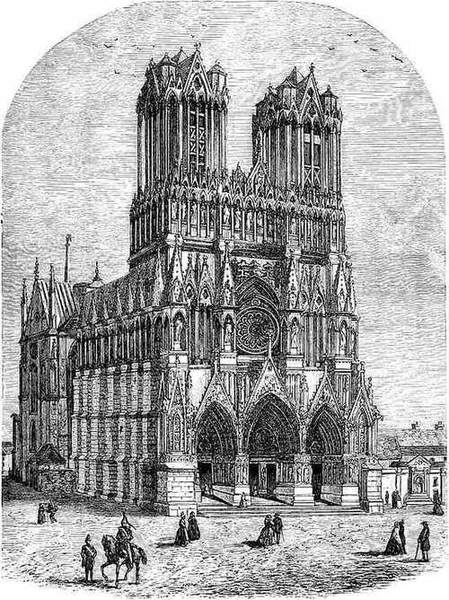
REIMS CATHEDRAL, WEST FRONT.
At the coronation of Charles IV., in 1322, wine flowed in rivers. Amongst the unconsumed provisions returned by the king’s pantler, Pelvau dou Val, to the burghers, ‘vin de Biaune et de Rivière’—that is, of Beaune and of the Marne—figures for a value of 384 livres 5 sols 2 deniers.[28] The arrangements of the coronation had been intrusted to the minister of finances, Pierre Remi, who certainly played the part of the unjust steward. In the first place, he made the cost of the ceremony amount to 21,000 livres, whereas none of his predecessors had spent more than 7,000 livres. His opening move had been to seize upon the greater part of the corn and all the ovens in Reims ‘for the king’s use,’ and to sell bread to the townsfolk and visitors at his own price for a fortnight prior to the coronation. After the ceremony he appropriated in like manner all the plate and napery, and all the cooking utensils and kitchen furniture, together with whatever had been left over, in the shape of wine, wax, fish, bullocks, pigs, and similar trifles. The wine thus taken was estimated at 1500 livres, part of which he sold to two bourgeois of Reims, and kept the rest, together with forty-four out of the fifty muids, or hogsheads, of salt provided.[29] Retributive justice overtook him, for the chronicler of his ill-doings chuckles over the fact that he was hanged as high as Haman on a gibbet he had himself erected at Paris. Things went off better at the coronation of King Philip, in 1328, when the total amount expended in the three hundred poinçons of the wine of Beaune, St. Pourçain, and the Marne consumed was 1675 livres 2 sols 3 deniers.[30] Part of this flowed through the mouth of the great bronze stag before which criminals condemned by the archiepiscopal court used to be exposed, but which at coronation times was placed in the Parvis Notre Dame, and spouted forth the ‘claré dou cerf,’ for the preparation of which the town records show that the grocer O. la Lale received 16 livres.[31]
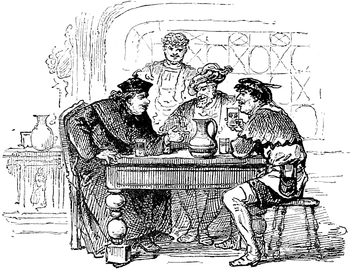
The importance of the wine-trade of Reims at the commencement of the fourteenth century is evidenced by the fact of there being at this epoch courtiers de vin, or wine-brokers, the right of appointing whom rested with the eschevins—a right which, vainly assailed by the archbishop in 1323, was confirmed to the municipal power by several royal decrees.[32] The burghers of Reims were fully cognisant of the merits of their wine, and certainly spared no trouble to make others acquainted with them. When the eschevins dined with the archbishop in August 1340 they contributed thirty-two pots of wine as their share of the repast, in addition to sundry partridges, capons, and rabbits. All visitors to the town on business, and all persons of distinction passing through it, were regaled with an offering of from two to four gallons from the cellars of Jehan de la Lobe, or Petit Jehannin, or Raulin d’Escry, or Baudouin le Boutellier, or Remi Cauchois, the principal tavern-keepers. The provost of Laon, the bailli and the receveur of Vermandois, the eschevins of Châlons, the Bishop of Coustances, Monseigneur Thibaut de Bar, Monseigneur Jacques la Vache (the queen’s physician), the Archdeacon of Reims, and the ‘two lords of the parliament deputed by the king to examine the walls,’ were a few of the recipients of this hospitality, which was also extended to such inferior personages as a varlet of Verdun and the varlet of the eschevins of Abbeville.
Two ‘flasks,’ purchased for threepence-halfpenny from Petit Jehannin, served to warm the eloquence of Maistre Baudouin de Loingnis when he pleaded for the town on the subject of the fortifications in 1345; and when, in 1340, the Archbishop of Narbonne, the Bishop of Poitiers, and sundry other dignitaries passed through Reims with heavy hearts on their way to St. Omer, to negotiate a truce with Edward of England after the fatal battle of Sluys, the municipality expended five shillings and threepence in a poinçon of wine to cheer them on their way. There was probably plenty to spare, since on the outbreak of hostilities with England the town-crier had received one penny for making proclamation that no one should remove any wine from the town during the continuance of the contest. The advent of a messenger of Monseigneur Guillaume Pinson, who brought ‘closed letters’ to the eschevins informing them of the invasion of King Edward, does not seem to have spoilt the digestion of those worthy gentlemen, since they partook of their annual gift of wine and their presentation lamb at Easter 1346; but there were sore hearts in the old city when one Jenvier returned from Amiens with the tidings that their best and bravest had fallen under the banner of John de Vienne, their warlike prelate, on the field of Crécy. Perhaps to the state of depression that followed is due the fact that there are no records of festivities at the coronation of King John the Good in 1350, though we find the citizens seeking two years later to propitiate the evil genius of France, Charles the Bad of Navarre, by the gift of a queue of wine costing five crowns.
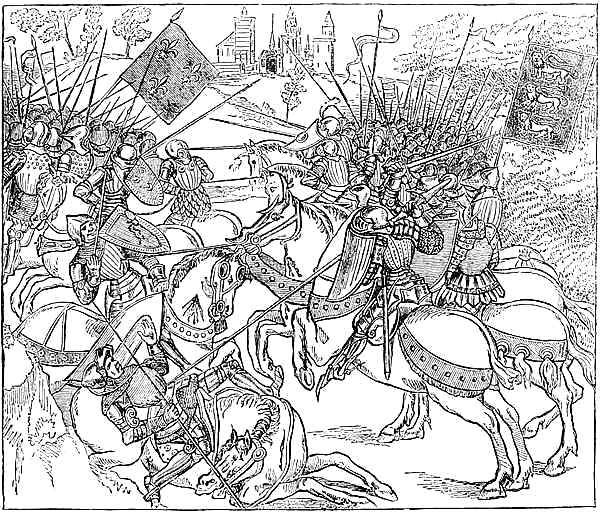
THE BATTLE OF CRÉCY (From a MS. of Froissart’s Chronicles).
During the frightful anarchy prevailing after the battle of Poitiers, when the victorious English and the disbanded forces of France made common cause against the hapless peasants, the fields and vineyards of Reims remained uncultivated for three years,[33] and the people of the archbishopric would have perished of hunger had they not been able to get food and wine from Hainault. Despite the prohibitions of the regent, the nobles pillaged the country around Reims and ravaged the vineyards from June to August 1358, and the havoc they wrought exceeded even that accomplished during the Jacquerie. Nor were matters improved by the advent of the English king, Edward III., when, on the wet St. Andrew’s-day of 1359, he sat down before the town with his host, which starved and shivered throughout the bitter and tempestuous winter, despite the comfort derived from the ‘three thousand vessels of wine’ captured by Eustace Dabreticourt in ‘the town of Achery, on the river of Esne.’[34] But the Rémois stood firm behind the fortifications reared by Gaucher de Châtillon till the following spring, when the victor of Crécy drew off his baffled forces, consoling them with the promise of bringing them back during the ensuing vintage, and made a reluctant peace at Bretigny.[35]
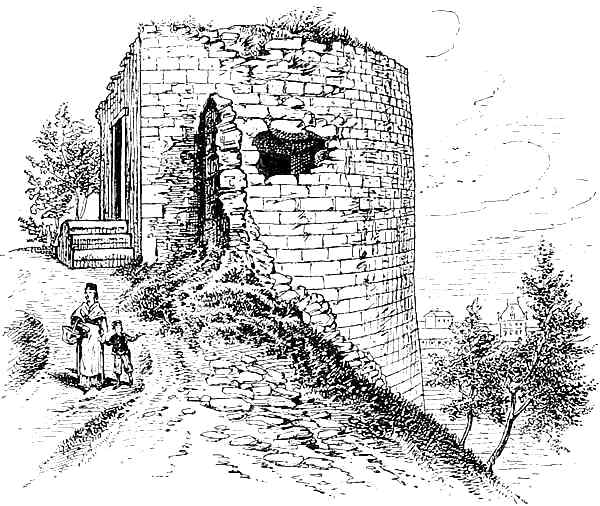
ANCIENT TOWER BELONGING TO THE FORTIFICATIONS OF REIMS.
Yet, though plague and famine in turn almost depopulated the city, the importance of its vineyards augmented from this time forward. In 1361 the citizens, who had already been in the habit of granting ‘aides’ to the king out of the dues levied on the wine sold in the town, obtained leave to impose an octroi on wine, in order to maintain their fortifications. Henceforward the connection between the wines and the walls of Reims became permanent. The octroi was from time to time renewed or modified in various ways by different monarchs; but their decrees always commenced with a preliminary flourish concerning the necessity of keeping the walls of so important a city in good order, and the admirable opportunity afforded of so doing by the ever-increasing prosperity of the trade in wine. Conspicuous amongst the few existing fragments of the circuit of walls and towers with which Reims was formerly begirt is the tower of which a view is here given.[36]
The Rémois, although willing enough to tax themselves for the defence of their city, submitted the reverse of cheerfully to the preliminary levies of provisions, wines, meats, and other things necessary, made by the king’s ‘maistres d’hôtel’ for the coronation of Charles V., which took place on the 19th May 1364, at a cost to the town of 7712 livres 15 sols 5 deniers parisis.[37] The citizens had, however, something to gaze at for their money, if that were any consolation. The king and his queen (Jeanne de Bourbon) were accompanied by King Peter of Cyprus; Wenceslaus, King of Bohemia and Duke of Brabant; the Dukes of Burgundy and Anjou; the Counts of Eu, Dampmartin, Tancarville, and Vaudemont, and many other prelates and lords, who did full justice to the good cheer provided for the great feasts and solemnities taking place during the five days of the royal sojourn.[38] The crown, borne by Philip of Burgundy, the king’s youngest brother, having been placed upon Charles’s head by the Archbishop Jean de Craon, that prelate proceeded to smear the royal breast and brow with what the irreverent Republicans of the eighteenth century designated ‘sacred pomatum,’ from the Sainte Ampoule presented to him by the Bishop of Laon, amidst the enthusiastic applause of nobles and prelates.[39]
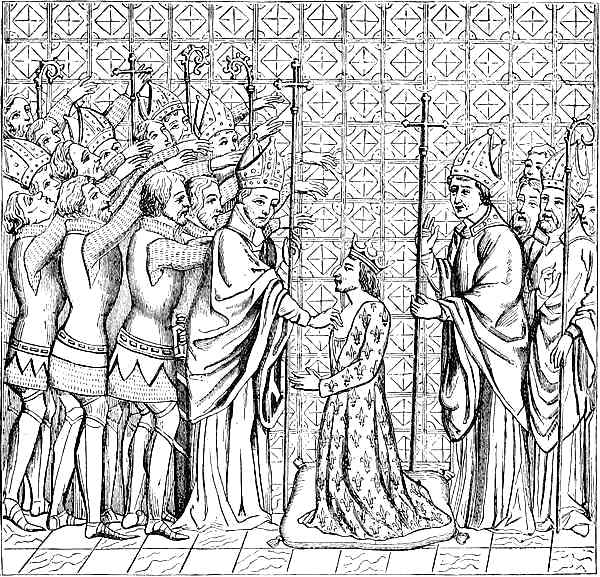
CORONATION OF CHARLES V. AT REIMS (From a MS. Histoire de Charles V.).
The great planting of vines in the Champagne district plainly dates from the last quarter of the fourteenth century, at which epoch large exports of wine to the provinces of Hainault and Flanders, and especially to the ports of Sluys, are noted. In a list of the revenues of the archbishopric of Reims, drawn up by Richard Pique towards 1375, are included patches of vineland and annual payments of wine from almost every village and hamlet within twenty miles of Reims; though it is only fair to mention that many of the places enumerated produce to-day wines of very ordinary character, which, although they have a local habitation, have certainly failed to secure themselves a name.[40] A general return of church property made to the Bailli of Vermandois, the king’s representative in 1384, at a time when Charles VI. was busily engaged in confiscating whatever he could lay hands on, shows that the religious establishments of Reims were equally well endowed with vineyards. These were mostly situate to the north-east and south-west of Reims, or in the immediate vicinity of the city; and according to their owners, whose object was of course to offer as few temptations as possible to the monarch, they frequently cost more to dress than they brought in.[41] In the return furnished by the archbishop in the following year, he complains that, owing to the great plantation of vines throughout the district, the right of licensing the brewing of ale and beer had failed to bring him in any revenue for the past three years. This prelate, by the way, seems to have loved his liquor like many of his predecessors, judging from the inventory made after his death, in 1389, of the contents of his cellars.[42] All this abundance of wine was not without its fruits; and we find the clerk of Troyes asserting that liars swarm in Picardy as drunkards do in Champagne, where a man not worth a rap will drink wine every day;[43] and a boast in the chanson of the Comte de Brie to the effect that the province abounded in wheat, wine, fodder, and litter.[44]
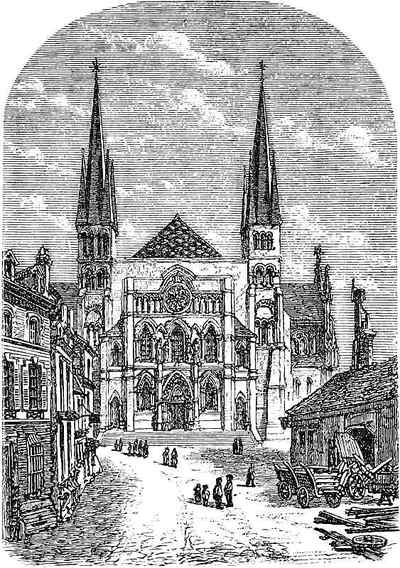
CHURCH OF ST. REMI, REIMS.
Under these circumstances it is not at all surprising that that renowned vinous soaker, King Wenceslaus (surnamed the Drunkard) of Bohemia, found ample opportunities for self-indulgence when he visited Reims to confer with Charles VI. on the subject of the schism of the popes of Avignon, then desolating the Church—certainly a very fit subject for a drunkard and a madman to put their heads together about. No sooner had the illustrious visitor alighted at the Abbey of St. Remi—to-day the Hôtel Dieu—where quarters had been assigned him, than he expressed a wish to taste the wine of the district, with the quality of which he had long been acquainted. The wine was brought, and tasted again and again in such conscientious style that when the Dukes of Bourbon and Berri came to escort him to dinner with the king they found him dead-drunk and utterly unfit to treat of affairs of State, still less those of the Church. The same kind of thing went on daily—the ‘same old drunk,’ as the nigger expressed it, lasting week after week; and the French monarch, who must have surely had a lucid interval, resolved to profit by his guest’s weakness. Accordingly he gave special orders to the cup-bearers, at a grand banquet at which matters were to be finally settled, to be particularly attentive in filling the Bohemian king’s goblet. This they did so frequently that the royal sot, overcome by wine, yielded during the discussion following the repast whatever was asked of him; whilst his host probably returned special thanks to St. Archideclin, the supposed bridegroom of the marriage of Cana, whom the piety of the Middle Ages had transformed into a saint and created the especial patron of all appertaining to the cellar. This triumph of wine over diplomacy occurred in 1397.[45]
A charter of Charles VI., dated July 1412, which gave the municipal authorities of Reims the sole right of appointing sworn wine-brokers, expressly mentions that the trade of the town was chiefly based upon the wine grown in the environs.[46] The wine, the charter states, when stored in the cellars of the town, was customarily sold by brokers, who of their own authority were in the habit of levying a commission of twopence, and even more, per piece, selling it to the person who offered them most, and taking money from both buyer and seller. To remedy this state of things, from which it was asserted the trade had begun to suffer, it was decreed that every broker should take an oath, before the Captain of Reims and the eschevins, to act honestly and without favour, and not to receive more than one penny commission. In the case of his receiving more, both he and the seller of the wine were to forfeit two-pence-halfpenny to the town.
The sales of wine mainly took place at the Etape aux Vins, where most of the wine-merchants were established, the busiest time being during the three great annual fairs, when no duties were levied. The old Etape aux Vins is now the Rue de l’Etape, jocularly styled the Rue de Rivoli of Reims, on account of the arcades formed by the projecting upper floors of its fifteenth-and sixteenth-century houses, which rest upon wooden and stone pillars. To-day the casino and the principal restaurants of the city are installed here; still the locality retains much the same aspect as it presented in the days when Remi Cauchois and Huet Hurtaut stood here and chaffered with the peasants who had brought their casks of wine on creaking wains into the city; when S. de Laval glided in search of a customer among the long-gowned fur-capped merchants of the Low Countries; when bargains were closed by a God’s-penny and wetted with a stoup of Petit Jehannin’s best; and when files of wine-laden wagons rolled forth from the northern gates of the city to gladden the thirsty souls of Hainault and Flanders.
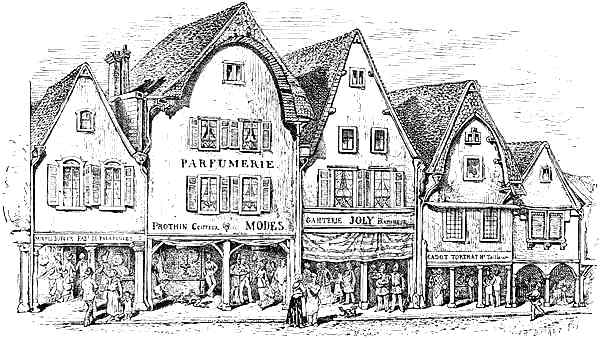
RUE DE L’ETAPE, REIMS.
Some of the wine had, however, a nobler destination. An order of payment addressed by the town council to the receiver, and dated March 23, 1419, commands him to pay Jacques le Vigneron the sum of 78 livres 12 sols for six queues of ‘vin blanc et clairet,’ presented to the fierce Duke of Burgundy, Jean sans Peur, at the high price of about 11 s. each.[47] Nor did his son Philip, the self-styled ‘Prince of the best wines in Christendom,’ disdain to draw bridle in order to receive eleven poinçons of ‘vin claret’ when hastening,
‘Bloody with spurring, fiery red with speed,’
through Reims to avenge his father’s murder at the Bridge of Montereau.[48] The devastating results of the terrible struggle for supremacy waged between the Armagnacs and Burgundians, and of the invasion of Henry V. of England, are evidenced in the facts that when, in fear and trembling, the Reims council resolved to allow Duke Philip to enter the town in 1425, at the head of four thousand horse, they could only offer him one queue of Beaune, one queue of red, and one queue of white wine; and to the duchess the following year one queue of Beaune and one of French wine; and that wine sent to l’Isle Adam, at the siege of Nesle, cost as much as 19 livres, or nearly 16 s., the queue.
Reims had passed under the sway of England by the Treaty of Troyes in 1420, the Earl of Salisbury becoming governor of the Champagne. The scarcity of wine, and the liking of the new possessors for their national beverage, is shown by a prohibition issued by the town council in 1427 against using wheat for making beer; and a statement of Gobin Persin, that he had sold more treacle—a famous medicinal remedy in the Middle Ages—during the past half year than in the four years previous, owing to people complaining that they were swollen up from drinking malt liquor. The English, however, at their abrupt departure from the city on the arrival of Charles and the Maid of Orleans, proved their partiality for the wine of Reims by carrying off as many wagonloads of it as they could manage to lay their hands on.
The gallant knights and patriot nobles who followed the Maid of Orleans to Reims, and witnessed the coronation of Charles VII. in 1429, despised, of course, the drink of their island foes, and moistened throats grown hoarse with shouting ‘Vive le roi’ with the choice vintage of the neighbouring slopes, freely drawn forth from the most secret recesses of the cellars of the town in honour of the glorious day. And no doubt Dame Alice, widow of Raulin Marieu, and hostess of the Asne royé (the Striped Ass), put a pot of the very best before the father of ‘Jehane la Pucelle,’ and did not forget, either, to score it down in the little bill of twenty-four livres which she was paid out of the deniers communs for the old fellow’s entertainment.[49] For the next ten years, however, the note of war resounded through the country, the hill-sides bristled with lances in lieu of vine-stakes, and instead of money spent for wine for presentation to guests of a pacific disposition, the archives of the town display a long list of sums expended in the purchase of arms, artillery, and ammunition, for the especial accommodation of less pleasant visitors, in repairing fortifications, and in payments to men charged with watching day and night for the coming of the foe.
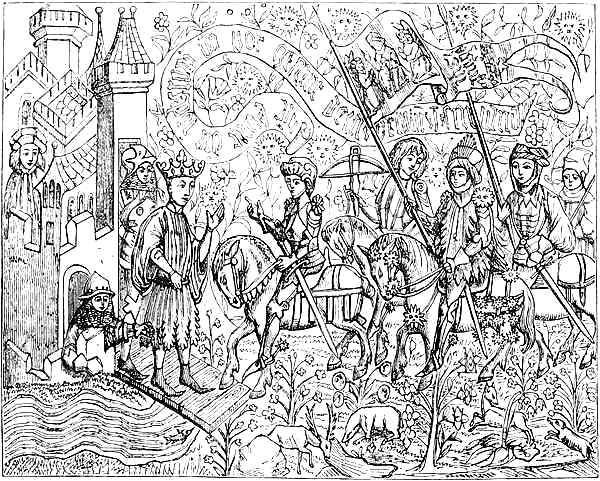
JEANNE DARC’S FIRST INTERVIEW WITH CHARLES VII. (From a tapestry of the fifteenth century).
The excesses of the licentious followers of Potton de Xaintrailles and Lahire were worse than those of the English and Burgundians, spite of the four hundred and five livres which had been paid to men-at-arms and archers from the neighbouring garrisons, ‘engaged by the city of Reims to guard the surrounding country, in order that the wine might be vintaged and brought into the said city and the vineyards dressed,’[50] and bitter were the complaints addressed in 1433 to the king on the falling off of the wine trade which had resulted therefrom. The ravages of the terrible ‘Escorcheurs’ led, in 1436, to fresh complaints and to an additional duty on each queue of ‘wine of Beaune, of the Marne, and of other foreign districts’ sold wholesale at Reims, the receipts to be spent in warlike preparations and on the fortifications. Some of this went to Lahire as a recompense for defending the district from ‘the great routs and companies’ that sought to invade it, he having, presumably on the principle of setting a thief to catch a thief, been made Bailli of Vermandois. In troublous times like these it was necessary to secure the good will of men in power and authority, and hence the town records comprise numerous offerings of money, fine linen cloths, and wine given to various nobles ‘out of grace and courtesy’ for their good will and ‘good and agreeable services, pleasures, and love.’ Madame Katherine de France (the widow of Henry V.), the Chancellor of France, the Constable Richemont, Lahire (Bailli of Vermandois), the bastard Dunois, the Archbishop of Narbonne, the Count de Vendôme, and many other nobles and dignitaries, were in turn recipients of such gifts; and the visit of King Charles the Victorious, in 1440, was celebrated by their profuse distribution.[51]
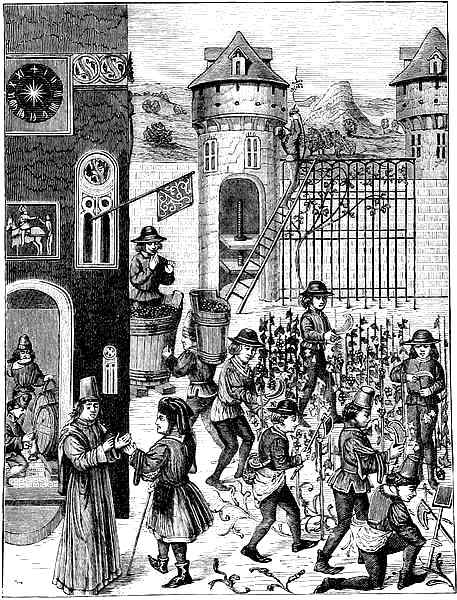
CULTIVATION OF THE VINE AND VINTAGING IN THE FIFTEENTH CENTURY (From a MS. of the Propriétaire des Choses).
Despite the complete expulsion of the English from France, a depression in trade still continued; and in 1451 the lieutenant of the town was sent to court to complain that, owing to the exactions of the farmers of the revenue, merchants would no longer come to Reims to buy wine. Louis XI., who was crowned at Reims on 15th August 1461, entered the city in great pomp, accompanied by Philip, Duke of Burgundy, and his son the Count of Charolais, afterwards Charles the Bold; the Duke of Bourbon, the Duke of Cleves, and his brother the Lord of Ravenstein, all three nephews of Duke Philip; the Counts of St. Pol, Angoulême, Eu, Vendôme, Nassau, and Grandpré; Messire Philip of Savoy, and many others,—‘all so richly dressed that it was a noble sight to see,’ remarks Enguerrand de Monstrelet. Prior to being crowned, the king handed his sword to Duke Philip, and requested the latter to bestow upon him the honour of knighthood, which the duke did, and afterwards gave the accolade to several other persons of distinction. The coronation, with its accompaniment of ‘many beautiful mysteries and ceremonies,’ was performed by Archbishop Jean Juvénal des Ursins, assisted by the Cardinal of Constance, the Patriarch of Antioch, a papal legate, four archbishops, seventeen bishops, and six abbots. At its close the twelve peers of France[52] dined at the king’s table; and after the table was cleared the Duke of Burgundy knelt and did homage for Burgundy, Flanders, and Artois, other lords following his example.
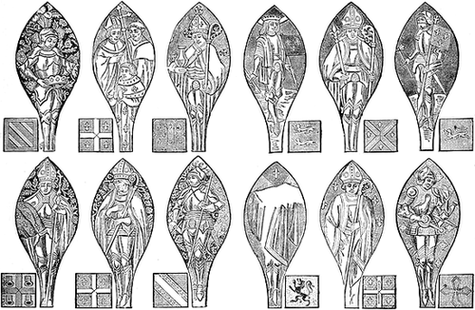
THE PEERS OF FRANCE PRESENT AT THE CORONATION OF LOUIS XI. AT REIMS (From painted-glass windows in Evreux Cathedral).
Louis XI., on his accession, found himself in presence of an exhausted treasury, and cast about for an expedient to fill it. The wine he drunk at his coronation at Reims may have suggested the dues which, only a month afterwards, he decreed should be levied on this commodity, in conjunction with an impost on salt. The inhabitants of the archiepiscopal city found it impossible to believe in such a return for their wonted hospitality, and the vine-growers assailed the collectors furiously. The affair resulted in a general outbreak, known as the Mique-Maque, and in the final hanging, branding, mutilating, and banishing of a number of individuals, half of whom, it may fairly be presumed, were innocent. The wars between France and Burgundy were also severely felt by the Rémois, whose territory was ravaged by the followers of Charles the Bold after Montlhery, and who suffered almost as much at the hands of their friends as at those of their foes. The garrison put into the town shared amongst themselves the country for a circuit of eight leagues, the meanest archer having a couple of villages, whence he exacted, at pleasure, corn, wood, provisions, and wine, the latter in such profusion that the surplus was sold in the streets, the smallest allowance for each lance being a queue, valued at ten livres, monthly. In 1470 and the following years large subsidies of wine were, moreover, despatched from time to time to the king’s army in the field; a cartload being judiciously sent to General Gaillard, ‘as he is well disposed towards us, and it is necessary to cultivate such people.’ Complaints made in 1489 set forth that in consequence of the octroi of the river Aisne, which had been established six years previously, the merchants of Liège, Mezières, and Rethel, instead of coming to Reims to buy wine, were obtaining their supplies from Orleans. The landing of Henry VII. of England, in 1495, spread new alarms throughout the Champagne, and orders were given for all the vine-stakes within a radius of two leagues of Reims to be pulled up, so that the enemy might be prevented from cooking provisions or filling up the moats of the fortifications with them.
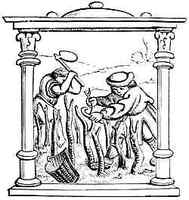
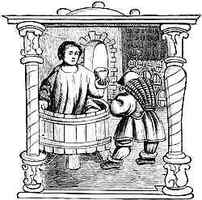
CULTURE OF THE VINE—SIXTEENTH CENTURY (From a MS. Calendar). TREADING GRAPES—SIXTEENTH CENTURY (From a MS. Calendar).
Pillaging foes and extortionate defenders were bad enough, but the vine-growers had yet other enemies, to wit, certain noxious little insects, which were in the habit of feeding on the young buds, though there is no record that they were ever so troublesome at Reims as they were in other parts of the Champagne, notably at Troyes, where on the Friday after Pentecost 1516 they were formally and solemnly enjoined by Maître Jean Milon to depart within six days from the vineyards of Villenauxe, under pain of anathema and malediction.[53] A century and a half later these insects renewed their ravages, and were exorcised anew by the rural dean of Sézanne, on the order of the Bishop of Troyes.
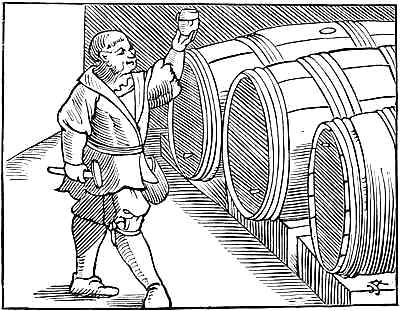
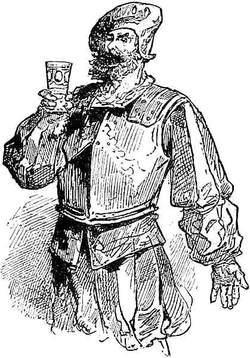
BUTLER OF THE SIXTEENTH CENTURY (Facsimile of a woodcut in the Cosmographie Universelle, 1549).
The close of the fifteenth century witnessed another coronation, that of the so-styled ‘Father of his People,’ Louis XII., celebrated with all due splendour in May 1498. The six ecclesiastical peers—principal among whom was the Cardinal Archbishop of Reims, Guillaume Briconnet, in rochet and stole, mitre and crozier; and the six representatives of the secular peerages, Burgundy, Normandy, Aquitaine, Flanders, Toulouse, and Champagne—solemnly invested their sovereign with sword, spurs, ring, orb, sceptre, crown, and all the other outward symbols of royalty; whilst the vaulted roof rang with the acclamations of the people assembled in the nave, and the triumphant peals from the heralds’ silver trumpets, on the banneroles of which was emblazoned the monarch’s favourite badge, the hedgehog. Trumpet-blowing and shouting being both provocative of thirst, peers and people did ample justice to the wine freely provided for all comers on this occasion.
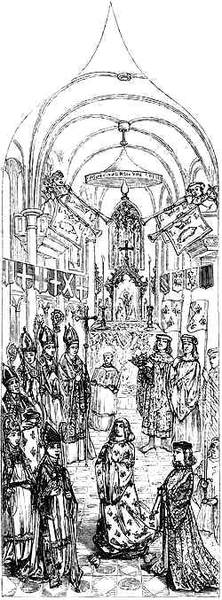
CORONATION OF LOUIS XII. AT REIMS (From a painting on wood of the fifteenth century).
Francis I. was crowned at Reims in January 1515; and on the occasion of his visiting the city sixteen years afterwards, twenty poinçons of wine were offered to him and sixty to his suite, so that this bibulous monarch had a good opportunity of comparing various growths of the Mountain and the River with the wine from his own vineyards at Ay; and possibly the Emperor Charles V. did his best to institute similar comparisons on his self-invited incursion into the district in 1544. For not only did these two great rivals, but also our own Bluff King Harry and the magnificent Leo X., have each their special commissioner stationed at Ay to secure for them the finest vintages of that favoured spot, the renown of which thenceforward has never paled. The wine despatched for their consumption was most likely sent direct from the vineyards in carefully-sealed casks; but the bulk of the river growths came to Reims for sale, and helped to swell the importance of the town as an emporium of the wine-trade. When Mary Queen of Scots came to Reims, a mere child, in 1550, four poinçons of good wine, with a dozen peacocks and as many turkeys, were presented to her. There are no records, however, of any further offerings to her when, as the widowed queen of Francis II., she visited Reims at Eastertide in 1561, and again during the summer of the same year, shortly before her final departure from France. On these occasions she was the guest, by turns, of her aunt Renée de Lorraine, at the convent of St. Pierre les Dames,—to-day a woollen factory,—and of her uncle, the ‘opulent and libertine’ Charles de Lorraine, Cardinal and Archbishop of Reims, at the handsome archiepiscopal palace, where this powerful prelate resided in unwonted state. As the rhyme goes—
‘Bishop and abbot and prior were there, Many a monk and many a friar, Many a knight and many a squire, With a great many more of lesser degree Who served the Lord Primate on bended knee. Never, I ween, Was a prouder seen, Read of in books, or dreamt of in dreams, Than the Cardinal Lord Archbishop of Reims.’
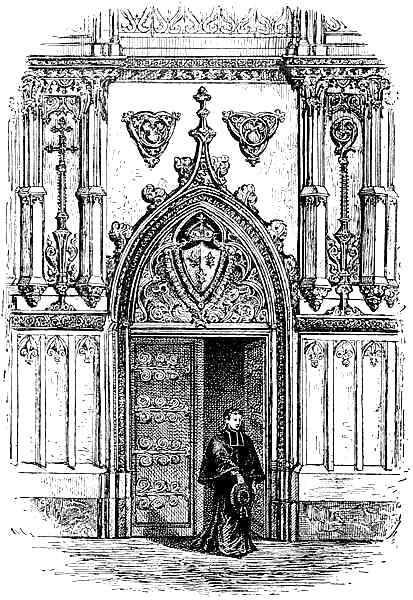
DOORWAY IN THE ARCHIEPISCOPAL PALACE AT REIMS.
Brusquet, the court fool of Henry II., Francis II., and Charles IX., was a great favourite with this princely prelate, and accompanied him several times on his embassies to foreign states. Brusquet’s wit was much appreciated by the cardinal, and has been highly extolled by Brantome; but most of the specimens handed down to us will not bear repetition, much less translation, from their coarseness. When the cardinal was at Brussels in 1559, negotiating the peace of Cateau Cambresis with Philip II., Brusquet one day at dessert jumped on to the table, and rolled along the whole length, wrapping himself up like a mummy in the cloth, with all the knives, forks, and spoons, as he went, and rolling over at the further end. The emperor, Charles V., who was the host, was so delighted that he told him to keep the plate himself. Brusquet had great dread of being drowned, and objected one day to go in a boat with the cardinal. ‘Do you think any harm can happen to you with me, the pope’s best friend?’ said the latter. ‘I know that the pope has power over earth, heaven, and purgatory,’ said Brusquet; ‘but I never heard that his dominion extended over water.’ It is not unlikely that the effigy forming one of the corbels beneath the chapter court gateway, and representing a fool in the puffed and slashed shoes and bombasted hose of the Renaissance, with his bauble in his hand, may be intended for Brusquet; for in the Middle Ages the ecclesiastical councils had forbidden dignitaries of the Church to have fools of their own.[54]
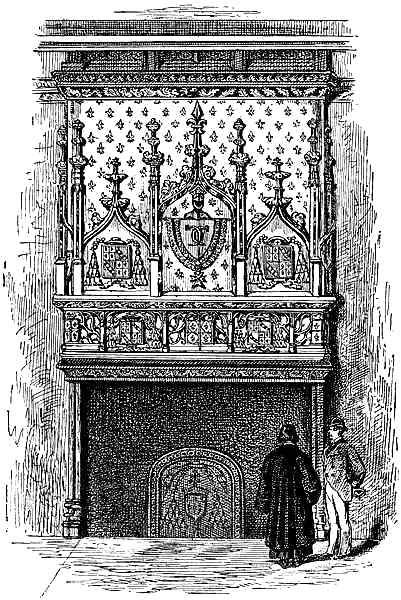
CHIMNEYPIECE IN THE BANQUETING HALL OF THE ARCHIEPISCOPAL PALACE AT REIMS.
It was in the grand hall of the archiepiscopal palace of Reims—an apartment which is very little changed from the days when Charles Cardinal de Lorraine entertained Henry II., Francis II., and Charles IX. in succession—that the coronation banquets at this epoch used to take place. Of the richness and beauty of the internal decorations of this interesting edifice some idea may be gained from the accompanying illustrations.
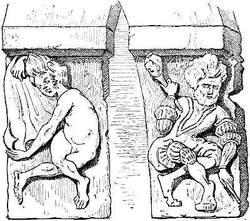
CORBELS, FROM THE CHAPTER COURT GATEWAY, REIMS.
The stock of wine at Reims at the period of Mary’s first visit must have been very low, owing to the continued requisitions of it for armies in the field, for ‘German reiters at Attigny,’ and ‘Italian lansquenets at Voulzy;’ and no doubt its production subsequently decreased to some extent from the orders issued to the surrounding villagers to destroy all their ladders and vats lest they should fall into the hands of the enemy, at the epoch of the threatened approach of the German Emperor in 1552.
At the coronation of Francis II. in 1559, and at that of Charles IX. (the future instigator of the massacre of St. Bartholomew) two years later, the citizens of Reims presented the newly-crowned monarchs with the customary gifts of Burgundy and Champagne wines.[55] In the latter instance, however, the gift met with an unexpected return, inasmuch as the king, after the fashion of Domitian, issued an edict in 1566, ordering that vines should only occupy one-third of the area of a canton, and that the remaining two-thirds should be arable and pasture land. When the forehead of Henry III., the last of the treacherous race of Valois, was touched with the holy oil by the Cardinal de Guise, the wine of Reims for the first time was alone used to furnish forth the attendant banquet, and the appreciative king modified his brother’s edict to a simple recommendation to the governors of provinces to see that the planting of vines did not lead to a neglect of other labours. During this reign the wine of Ay reached the acme of renown, and came to be described as ‘the ordinary drink of kings and princes.’[56]
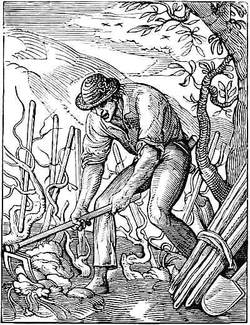
VIGNERON OF THE SIXTEENTH CENTURY (Facsimile of a woodcut of the period).
In the troubles which followed the death of Henry III., when the east of France was laid desolate in turn by Huguenots and Leaguers, Germans and Spaniards; when Reims became a chief stronghold of the Catholics, who formed a kind of Republic there, and the remaining towns and villages of the district changed masters almost daily, the foragers of the party of Henry of Navarre and that of the League caused great tribulation amongst the vine-dressers and husbandmen of the Montagne and of the Marne. In 1589 very little wine could be vintaged around Reims ‘through the affluence of enemies,’ dolefully remarks a local analist.[57] After the battle of Ivry, Reims submitted to the king, but many of the surrounding districts, Epernay among the number, still sided with his opponents. Epernay fell, however, in 1592, after a cruel siege; and in the autumn of the same year the leaders of the respective parties met at the church of St. Tresain, at Avenay, and agreed to a truce during the ensuing harvest, in order that the crops of corn and wine might be gathered in—a truce known as the Trève des Moissons. The yield turned out to be of very good quality, the new wine fetching from 40 to 70 livres the queue.[58]
The system of cultivation prevailing in the French vineyards at this epoch must have been peculiar, since the staple agricultural authority of the day states that, to have an abundant crop and good wine, all that was necessary was for the vine-dresser to wear a garland of ivy, and for crushed acorns and ground vetches to be put in the hole at the time of planting the vine-shoots; that, moreover, grapes without stones could be obtained by taking out the pith of the young plant, and wrapping the end in wet paper, or sticking it in an onion when planting; that to get grapes in spring a vine-shoot should be grafted on a cherry-tree; and that wine could be made purgative by watering the roots of the vine with a laxative, or inserting some in a cleft branch.[59]
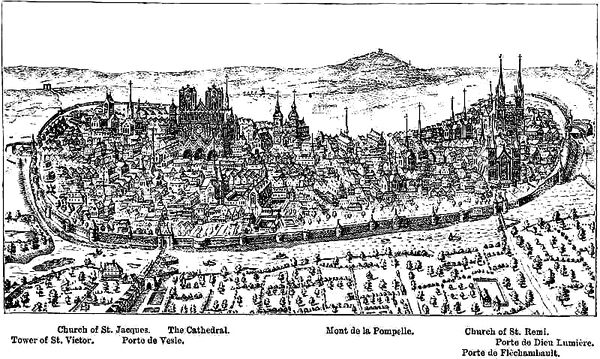
THE CITY OF REIMS IN 1635 (From an engraving of the period).
In the seventeenth century the still wine of the province of Champagne was destined, like the setting sun, to gleam with well-nigh unparalleled radiance up to the moment of its almost total eclipse. Continual care and untiring industry had resulted in the production of a wine which seems to have been renowned beyond all others for a delicate yet well-developed flavour peculiarly its own, but of which the wonderful revolution effected by the invention of sparkling wine has left but few traces. In 1604 the yield was so abundant that the vintagers were at their wits’ end for vessels to contain their wine; but three years later so poor a vintage took place as had not been known within the memory of man. During the winter the cold was so intense that wine froze not only in the cellars, but at table close to the fire, and by the ensuing spring it had grown so scarce that the veriest rubbish fetched 80 livres the queue at Reims.[60] In 1610, at the banquet following the coronation of Louis XIII., the only wine served was that of Reims, at 175 livres, or about 7 l., the queue; and the future raffinés of the Place Royale who assisted at that ceremony were by no means the men to forget or neglect an approved vintage after once tasting it. Champagne, it has been said, was crowned at the same time with the king, and of the two made a better monarch. Five years later a complaint, addressed to the king on the subject of the fermiers des aides trying to levy duties on goods sold at the fairs, asserted it was notorious that the chief commerce of Reims consisted of wines. According to the police ordinances of 1627, the price of these was fixed three times a year, namely, at Martinmas, Mid-Lent, and Midsummer; and tavern-keepers were bound to have a tablet inscribed with the regulation price fixed outside their houses, and were not allowed to sell at a higher rate, under a penalty of 12 livres for the first, and 24 livres for the second offence. Moreover, to encourage the production of the locality, they were strictly forbidden to sell in their taverns any other wine than that of the ‘cru du pays et de huit lieues es environs,’ under pain of confiscation and a fine, the amount of which was arbitrary. The vine-dressers too, in the same ordinances, were enjoined to kill and burn all vine-slugs and other vermin, which during 1621 and the two succeeding years had caused much damage.[61]
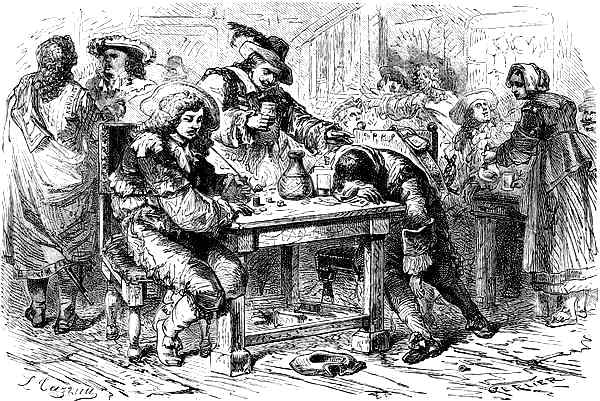
This rule must have been perforce relaxed during the troubles of the Fronde, when for two years the troops of the Marshal du Plessis Praslin lived as in a conquered country, indulging in drinking carousals in the wine-shops of the towns, or marching in detachments from village to village throughout the district, in order to prevent all those who neglected to pay the contributions imposed from working in their vineyards; when their leader, on the refusal of the Rémois to supply him with money, ravaged the vineyards of the plains of les Moineaux and Sacy; and when Erlach’s foreigners at Verzy sacked the whole of the Montagne from March until July 1650. As a consequence, people in the following year were existing on herbs, roots, snails, blood, bread made of bran, cats, dogs, &c., or dying by hundreds through eating bread made of unripe wheat harvested in June; the ruin of the citizens being completed, according to an eyewitness, at the epoch of dressing the vines, owing to the lack of men to do the work.[62] A contemporary writer, however, asserts that the vineyards still continued ‘to cover the mountains and to encircle the town of Reims like a crown of verdure;’ and that their produce not only supplied all local wants, but, transported beyond the frontier, caused the gold of the Indies to flow in return into the town, and spread its reputation afar.[63]
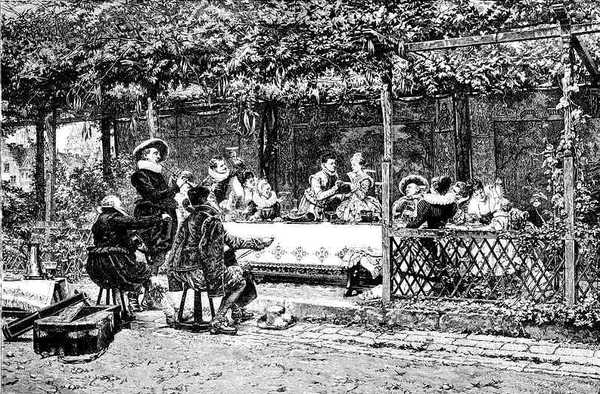
A BETROTHAL BANQUET IN THE SEVENTEENTH CENTURY.
Such was the repute of the Champagne wines when Louis XIV. was crowned at Reims in 1654, that all the great lords present on the occasion were exceedingly anxious to partake of them, and no doubt regarded with envious eyes the huge basket containing a hundred bottles of the best which the deputies from Epernay had brought with them as a present to the gallant Turenne. He at least was no stranger to the merits of the wine, for the records of Epernay show that many a caque had found its way to his tent during the two preceding years, when he was defending the Champagne against Condé and his Spanish allies. In the same year (1654), the Procureur de l’Echevinage speaks of the chief trade of Reims as consisting in the sale of wine, of which the inhabitants collect large quantities, both from the Montagne de Reims and the Rivière de Marne, through the merchants who make this their special trade—a trade sorely interrupted by the incursions of Montal and his Spaniards in 1657 and 1658. Guy Patin too, writing in 1666, mentions the fact of Louis XIV. making a present to Charles II. of England of two hundred pièces of excellent wine—Champagne, Burgundy, and Hermitage; and three years later is fain himself to exclaim, ‘Vive le pain de Gonesse, vive le bon vin de Paris, de Bourgogne, de Champagne!’ whilst Tavernier the traveller did his best to spread the fame of the Champagne wine by presenting specimens to all the sovereigns whom he had the honour of saluting during his journeyings abroad.[64]
It was about the eighth decade of this century, when the renown of the Grand Monarque was yet at its apogee, and when for many years the soil of the province had not been profaned by the foot of an invader, that the still wine of the Champagne attained its final point of perfection. The Roi Soleil himself, we are assured by St. Simon, never drank any other wine in his life till about 1692, when his physician, the austere Fagon, condemned his debilitated stomach to well-watered Burgundy, so old that it was almost tasteless, and the king consoled himself with laughing at the wry faces pulled by foreign nobles who sought and obtained the honour of tasting his especial tipple.[65] An anonymous Mémoire[66] written early in the ensuing century (1718) states that, although their red wine had long before been made with greater care and cleanliness than any other wine in the kingdom, the Champenois had only studied to produce a gray, and indeed almost white, wine, within the preceding fifty years. This would place about 1670 the first introduction of the new colourless wine, obtained by gathering grapes of the black variety with the utmost care at early dawn, and ceasing the vintage at nine or ten in the morning, unless the day were cloudy. Despite these precautions a rosy tinge—compared to that lent by a dying sunset to the waters of a clear stream—was often communicated to the wine, and led to the term ‘partridge’s eye’ being applied to it. St. Evremond, the epicurean Frenchman—who emigrated to the gay court of Charles II. at Whitehall to escape the gloomy cell designed for him in the Bastille—and the mentor of the Count de Grammont, writing from London about 1674, to his brother ‘profès dans l’ordre des coteaux,’[67] the Count d’Olonne, then undergoing on his part a species of exile at Orleans for having suffered his tongue to wag a little too freely at court, says: ‘Do not spare any expense to get Champagne wines, even if you are at two hundred leagues from Paris. Those of Burgundy have lost their credit amongst men of taste, and barely retain a remnant of their former reputation amongst dealers. There is no province which furnishes excellent wines for all seasons but Champagne. It supplies us with the wines of Ay, Avenay, and Hautvillers, up to the spring; Taissy, Sillery, Verzenai, for the rest of the year.’[68] ‘The wines of the Champagne,’ elsewhere remarks this renowned gourmet, ‘are the best. Do not keep those of Ay too long; do not begin those of Reims too soon. Cold weather preserves the spirit of the River wines, hot removes the goût de terroir from those of the Mountain.’ Writing also in 1701, he alludes to the care with which the Sillery wines were made forty years before.
Such a distinction of seasons would imply that wine, instead of being kept, was drunk within a few months of its manufacture; though this, except in the case of wine made as ‘tocane,’ which could not be kept, would appear to be a matter rather of taste than necessity. This custom of drinking it before fermentation was achieved, and also the natural tendency of the wine of this particular region to effervesce—a tendency since taken such signal advantage of by the manufacturers of sparkling Champagne—are treated of in a work of the period,[69] the author of which, after noting the excellence of certain growths of Burgundy, goes on to say that, ‘If the vintage in the Champagne is a successful one, it is thither that the shrewd and dainty hasten. There is not,’ continues he, ‘in the world a drink more noble and more delicious; and it is now become so highly fashionable that, with the exception of those growths drawn from that fertile and agreeable district which we call in general parlance that of Reims, and particularly from St. Thierry, Verzenay, Ay, and different spots of the Mountain, all others are looked upon by the dainty as little better than poor stuff and trash, which they will not even hear spoken of.’ He extols the admirable sève of the Reims wine, its delicious flavour, and its perfume, which with ludicrous hyperbole he pronounces capable of bringing the dead to life. Burgundy and Champagne, he says, are both good, but the first rank belongs to the latter, ‘when it has not that tartness which some debauchees esteem so highly, when it clears itself promptly, and only works as much as the natural strength of the wine allows; for it does not do to trust so much to that kind of wine which is always in a fury, and boils without intermission in its vessel.’
Such wine, he maintains, is quite done for by the time Easter is over, and only retains of its former fire a crude tartness very unpleasant and very indigestible, which is apt to affect the chest of those who drink it. He recommends that Champagne should be drunk at least six months after the end of the year, and that the grayest wines should always be chosen as going down more smoothly and clogging the stomach less, since, however good the red wine may be as regards body, from its longer cuvaison, it is never so delicate, nor does it digest so promptly, as the others. He concludes, therefore, that it is better to drink old wine, or at any rate what then passed as old wine, as long as one can, in order not to have to turn too soon to the new ones, ‘which are veritable head-splitters, and from their potency capable of deranging the strongest constitutions.’ Above all, he urges abstinence from such ‘artificial mummeries’ as the use of ice, ‘the most pernicious of all inventions’ and the enemy of wine, though at that time, he admits, very fashionable, especially amongst certain ‘obstreperous voluptuaries,’ ‘who maintain that the wine of Reims is never more delicious than when it is drunk with ice, and that this admirable beverage derives especial charms from this fatal novelty.’ Ice, he holds, not only dispels the spirit and diminishes the flavour, sève, and colour of the wine, but is most pernicious and deadly to the drinker, causing ‘colics, shiverings, horrible convulsions, and sudden weakness, so that frequently death has crowned the most magnificent debauches, and turned a place of joy and mirth into a sepulchre.’ Wherefore let all drinkers of Champagne frappé beware.
Here we have ample proof of the popularity of the wines of the Champagne, a popularity erroneously said to be due in some measure to the fact that both the Chancellor le Tellier, father of Louvois, and Colbert, the energetic comptroller-general of the state finances, and son of a wool-merchant of Reims, possessed large vineyards in the province.[70] Lafontaine, who was born in the neighbourhood, declared his preference for Reims above all cities, on account of the Sainte Ampoule, its good wine, and the abundance of other charming objects;[71] and Boileau, writing in 1674, depicts an ignorant churchman, whose library consisted of a score of well-filled hogsheads, as being fully aware of the particular vineyard at Reims over which the community he belonged to held a mortgage.[72] James II. of England was particularly partial to the wine of the Champagne. When the quinquennial assembly of the clergy was held in 1700, at the Château of St. Germain-en-Laye, where he was residing, Charles Maurice le Tellier, brother to Louvois and Archbishop of Reims, who presided, ‘kept a grand table, and had some Champagne wine that was highly praised. The King of England, who rarely drank any other, heard of it, and sent to ask some of the archbishop, who sent him six bottles. Some time afterwards the king, who found the wine very good, sent to beg him to send some more. The archbishop, more avaricious of his wine than of his money, answered curtly that his wine was not mad, and therefore did not run about the streets, and did not send him any.’[73] Du Chesne, who, when Fagon became medical attendant to Louis XIV., succeeded him as physician to the ‘fils de France,’ and who died at Versailles in 1707, aged ninety-one, in perfect health, ascribed his longevity to his habit of eating a salad every night at supper, and drinking only Champagne, a régime which he recommended to all.[74]
The wine was nevertheless the indirect cause of the death of the poet Santeuil, who, although a canon of St. Victor, was very much fonder of Champagne and of sundry other good things than he ought to have been. A wit and a bon vivant, he was a great favourite of the Duc de Bourbon, son of the Prince de Condé, whom he accompanied in the summer of 1697 to Dijon. ‘One evening at supper the duke amused himself with plying Santeuil with Champagne, and going on from joke to joke, he thought it funny to empty his snuff-box into a goblet of wine, and make Santeuil drink it, in order to see what would happen. He was pretty soon enlightened. Vomiting and fever ensued, and within forty-eight hours the unhappy wretch died in the torments of the damned, but filled with the sentiments of great penitence, with which he received the sacraments and edified the company, who, though little given to be edified, disapproved of such a cruel experiment.’[75] Of course nothing was done, or even said, to the duke.
‘Sire,’ said the president of a deputation bringing specimens of the various productions of Reims to the Grand Monarque when he visited the city in 1666, ‘we offer you our wine, our pears, our gingerbread, our biscuits, and our hearts;’ and Louis, who was a noted lover of the good things of this life, answered, turning to his suite, ‘There, gentlemen, that is just the kind of speech I like.’ To this day Reims manufactures by the myriad the crisp finger-shaped sponge-cakes called ‘biscuits de Reims,’ which the French delight to dip in their wine; juvenile France still eagerly devours its pain d’épice, and the city sends forth far and wide the baked pears which have obtained so enviable a reputation. But the production of such wine as that offered to the king has long since almost ceased, while its fame has been eclipsed tenfold by wine of a far more delicious kind, the origin and rise of which has now to be recounted. This is the sparkling wine of Champagne, which has been fitly compared to one of those younger sons of good family, who, after a brilliant and rapid career, achieve a position far eclipsing that of their elder brethren, whose fame becomes merged in theirs.[76]
III. INVENTION AND DEVELOPMENT OF SPARKLING CHAMPAGNE.
The ancients acquainted with sparkling wines—Tendency of Champagne wines to effervesce noted at an early period—Obscurity enveloping the discovery of what we now know as sparkling Champagne—The Royal Abbey of Hautvillers—Legend of its foundation by St. Nivard and St. Berchier—Its territorial possessions and vineyards—The monks the great viticulturists of the Middle Ages—Dom Perignon—He marries wines differing in character—His discovery of sparkling white wine—He is the first to use corks to bottles—His secret for clearing the wine revealed only to his successors Frère Philippe and Dom Grossart—Result of Dom Perignon’s discoveries—The wine of Hautvillers sold at 1000 livres the queue—Dom Perignon’s memorial in the Abbey-Church—Wine flavoured with peaches—The effervescence ascribed to drugs, to the period of the moon, and to the action of the sap in the vine—The fame of sparkling wine rapidly spreads—The Vin de Perignon makes its appearance at the Court of the Grand Monarque—Is welcomed by the young courtiers—It figures at the suppers of Anet and Chantilly, and at the orgies of the Temple and the Palais Royal—The rapturous strophes of Chaulieu and Rousseau—Frederick William I. and the Berlin Academicians—Augustus the Strong and the page who pilfered his Champagne—Horror of the old-fashioned gourmets at the innovation—Bertin du Rocheret and the Marshal d’Artagnan—System of wine-making in the Champagne early in the eighteenth century—Bottling of the wine in flasks—Icing Champagne with the corks loosened.
A SYBARITE of our day has remarked that the life of the ancient Greeks would have approached the perfection of earthly existence had they only been acquainted with sparkling Champagne. As, however, amongst the nations of antiquity the newly-made wine was sometimes allowed to continue its fermentation in close vessels, it may be conceived that when freshly drawn it occasionally possessed a certain degree of briskness from the retained carbonic acid gas. [77] Virgil’s expression,
‘Ille impiger hausit Spumantem pateram,’[78]
demonstrates that the Romans—whose patera, by the way, closely resembled the modern champagne-glass—were familiar with frothy and sparkling wines, although they do not seem to have intentionally sought the means of preserving them in this condition.[79]
The early vintagers of the Champagne can hardly have helped noting the natural tendency of their wine to effervesce, the difficulty of entirely overcoming which is exemplified in the precautions invariably taken for the production of Sillery sec; indeed tradition claims for certain growths of the Marne, from a period of remote antiquity, a disposition to froth and sparkle.[80] Local writers profess to recognise in the property ascribed by Henry of Andelys to the wine of Chalons, of causing both the stomach and the heels to swell,[81] a reference to this peculiarity.[82] The learned Baccius, physician to Pope Sixtus V., writing at the close of the sixteenth century of the wines of France, mentions those ‘which bubble out of the glass, and which flatter the smell as much as the taste,’[83] though he does not refer to any wine of the Champagne by name. An anonymous author, some eighty years later,[84] condemns the growing partiality for the ‘great vert which certain debauchees esteem so highly’ in Champagne wines, and denounces ‘that kind of wine which is always in a fury, and which boils without ceasing in its vessel.’ Still he seems to refer to wine in casks, which lost these tumultuous properties after Easter. Necessity being the mother of invention, the inhabitants of the province had in the sixteenth century already devised and put in practice a method of allaying fermentation, and obtaining a settled wine within four-and-twenty hours, by filling a vessel with ‘small chips of the wood called in French sayette,’ and pouring the wine over them.[85]
With all this, a conscientious writer candidly acknowledges that, despite minute and painstaking researches, he cannot tell when what is now known as sparkling Champagne first made its appearance. The most ancient references to it of a positive character that he could discover are contained in the poems of Grenan and Coffin, printed in 1711 and 1712; yet its invention certainly dates prior to that epoch,[86] and earlier poets have also praised it. It seems most probable that the tendency to effervescence already noted became even more marked in the strong-bodied gray and ‘partridge-eye’ wines, first made from red grapes about 1670, than in the yellowish wine previously produced, like that of Ay, from white grapes,[87] and recommended, from its deficiency in body, to be drunk off within the year.[88] These new wines, when in a quasi-effervescent state prior to the month of March, offered a novel attraction to palates dulled by the potent vintages of Burgundy and Southern France;[89] and their reputation quickly spread, though some old gourmets might have complained, with St. Evremond, of the taste introduced by faux delicats.[90] They must have been merely cremant wines—for glass-bottle making was in its infancy, and corks as yet unknown[91]—and doubtless resembled the present wines of Condrieu, which sparkle in the glass on being poured out, during their first and second years, but with age acquire the characteristics of a full-bodied still wine. The difficulty of regulating their effervescence in those pre-scientific days must have led to frequent and serious disappointments. The hour, however, came, and with it the man.
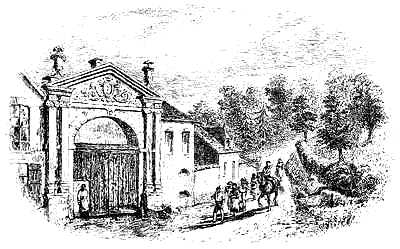
GATEWAY OF THE ABBEY OF HAUTVILLERS.
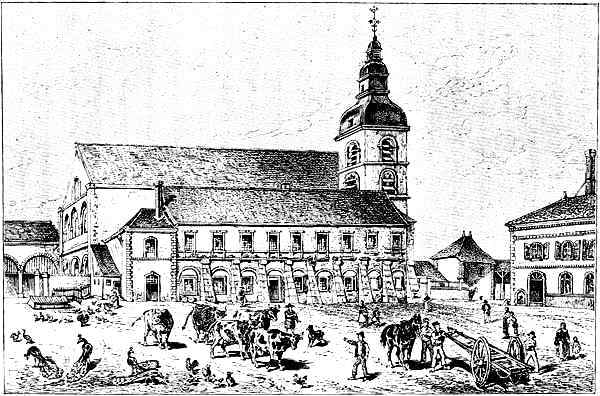
THE CHURCH OF HAUTVILLERS, WITH THE REMAINS OF THE ABBEY.
In the year 1670, among the sunny vineyard slopes rising from the poplar-fringed Marne, there stood in all its pride the famous royal Abbey of St. Peter at Hautvillers. Its foundation, of remote antiquity, was hallowed by saintly legend. Tradition said that about the middle of the seventh century St. Nivard, Bishop of Reims, and his godson, St. Berchier, were seeking a suitable spot for the erection of a monastery on the banks of the river. The way was long, the day was warm, and the saints but mortal. Weary and faint, they sat down to rest at a spot identified by tradition with a vineyard at Dizy, to-day belonging to Messrs. Bollinger, but at that time forming part of the forest of the Marne. St. Nivard fell asleep, with his head in St. Berchier’s lap, when the one in a dream, and the other with waking eyes, saw a snow-white dove—the same, firm believers in miracles suggested, which had brought down the holy oil for the anointment of Clovis at his coronation at Reims—flutter through the wood, and finally alight afar off on the stump of a tree. Such an omen could no more be neglected by a seventh-century saint than a slate full of scribble by a nineteenth-century spiritualist, and accordingly the site thus miraculously indicated was forthwith decided upon. Plans for the edifice were duly drawn out and approved of, and the abbey rose in stately majesty, the high altar at which St. Berchier was solemnly invested with the symbols of abbatial dignity being erected upon the precise spot occupied by the tree on which the snow-white dove had alighted.[92] As time rolled on and pious donations poured in, the abbey waxed in importance, although it was sacked by the Normans when they ravaged the Champagne, and was twice destroyed by fire—once in 1098, and again in 1440—when each time it rose phœnix-like from its ashes.
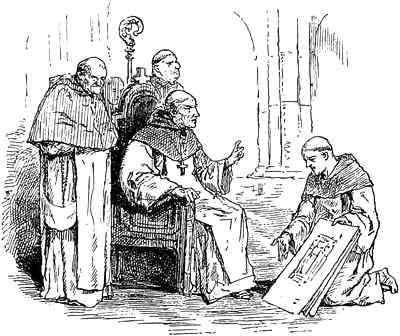
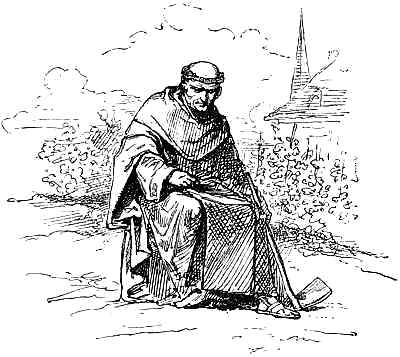
In 1670 the abbey was, as we have said, in all its glory. True, it had been somewhat damaged a century previously by the Huguenots, who had fired the church, driven out the monks, sacked the wine-cellars, burnt the archives, and committed sundry other depredations inherent to civil and religious warfare; but the liberal contributions of the faithful, including Queen Marie de Medicis, had helped to efface all traces of their visit. The abbey boasted many precious relics rescued from the Reformers’ fury, the most important being the body of St. Helena, the mother of Constantine the Great, which had been in its possession since 844, and attracted numerous pilgrims. The hierarchical status of the abbey was high; for no less than nine archbishops had passed forth through its stately portal to the see of Reims, and twenty-two abbots, including the venerable Peter of Cluny, to various distinguished monasteries. Its territorial possessions were extensive; for its abbot was lord of Hautvillers, Cumières, Cormoyeux, Bomery, and Dizy la Rivière, and had all manner of rights of fourmage, and huchage, vinage, and pressoir banal, and the like,[93] to the benefit of the monks and the misfortune of their numerous dependents. Its revenues were ample, and no small portion was derived from the tithes of fair and fertile vinelands extending for miles around, and from the vineyards which the monks themselves cultivated in the immediate neighbourhood of the abbey.
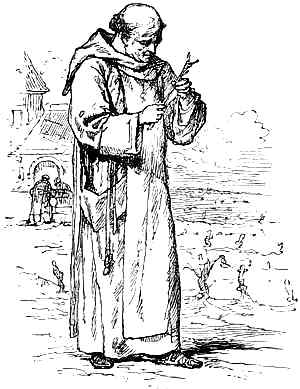
It should be remembered that for a lengthy period—not only in France, but in other countries—the choicest wines were those produced in vineyards belonging to the Church, and that the vinum theologium was justly held superior to all others. The rich chapters and monasteries were more studious of the quality than of the quantity of their vintages; their land was tilled with particular care, and the learning, of which in the Middle Ages they were almost the sole depositaries, combined with opportunities of observation enjoyed by the members of these fraternities by reason of their retired pursuits, made them acquainted at a very early period with the best methods of controlling the fermentation of the grape and ameliorating its produce.[94] To the monks of Bèze we owe Chambertin, the favourite wine of the first Napoleon; to the Cistercians of Citaulx the perfection of that Clos Vougeot which passing regiments saluted tambour battant; and the Benedictines of Hautvillers were equally regardful of the renown of their wines and vineyards. In 1636 they cultivated one hundred arpents themselves,[95] their possessions including the vineyards now known as Les Quartiers and Les Prières at Hautvillers, and Les Barillets, Sainte Hélène, and Cotes-à-bras at Cumières, the last named of which still retains a high reputation.
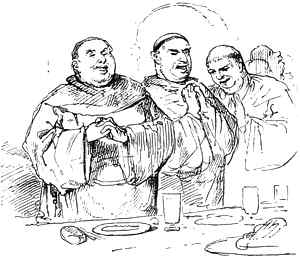
Over these vineyards there presided in 1670 a worthy Benedictine named Dom Perignon, who was destined to gain for the abbey a more world-wide fame than the devoutest of its monks or the proudest of its abbots. His position was an onerous one, for the reputation of the wine was considerable, and it was necessary to maintain it. Henry of Andelys had sung its praises as early as the thirteenth century; and St. Evremond, though absent from France for nearly half a score years, wrote of it in terms proving that he had preserved a lively recollection of its merits. Dom Perignon was born at Sainte Ménehould in 1638, and had been elected to the post of procureur of the abbey about 1668, on account of the purity of his taste and the soundness of his head. He proved himself fully equal to the momentous task, devotion to which does not seem to have shortened his days, since he died at the ripe old age of seventy-seven. It was Dom Perignon’s duty to superintend the abbey vineyards, supervise the making of the wine, and see after the tithes, paid either in wine or grapes[96] by the neighbouring cultivators to their seignorial lord the abbot. The wine which thus came into his charge was naturally of various qualities; and having noted that one kind of soil imparted fragrance and another generosity, while the produce of others was deficient in both of these attributes, Dom Perignon, in the spirit of a true Benedictine, hit upon the happy idea of ‘marrying,’ or blending, the produce of different vineyards together,[97] a practice which is to-day very generally followed by the manufacturers of Champagne. Such was the perfection of Dom Perignon’s skill and the delicacy of his palate, that in his later years, when blind from age, he used to have the grapes of the different districts brought to him, and, recognising each kind by its flavour, would say, ‘You must marry the wine of this vineyard with that of such another.’[98]
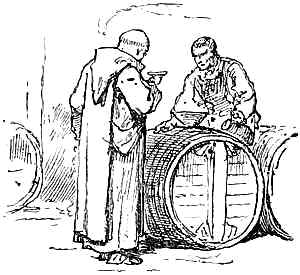
But the crowning glory of the Benedictine’s long and useful life remains to be told. He succeeded in obtaining for the first time in the Champagne a perfectly white wine from black grapes, that hitherto made having been gray, or of a pale-straw colour.[99] Moreover, by some happy accident, or by a series of experimental researches—for the exact facts of the discovery are lost for ever—he hit upon a method of regulating the tendency of the wines of this region to effervesce, and by paying regard to the epoch of bottling, finally succeeded in producing a perfectly sparkling wine, that burst forth from the bottle and overflowed the glass, and was twice as dainty to the palate, and twice as exhilarating in its effects, as the ordinary wine of the Champagne. A correlative result of his investigations was the present system of corking bottles, a wisp of tow dipped in oil being the sole stopper in use prior to his time.[100] To him, too, we owe not only sparkling Champagne itself, but the proper kind of glass to drink it out of. The tall, thin, tapering flute was adopted, if not invented, by him, in order, as he said, that he might watch the dance of the sparkling atoms.[101] The exact date of Dom Perignon’s discovery of sparkling wine seems to be wrapped in much the same obscurity as are the various attendant circumstances. It was certainly prior to the close of the seventeenth century; as the author of an anonymous treatise, printed at Reims in 1718, remarked that for more than twenty years past the taste of the French had inclined towards sparkling wines, which they had ‘frantically adored,’ though during the last three years they had grown a little out of conceit with them.[102] This would place it at 1697, at the latest.