PART II. (continued 3)
Reading edition
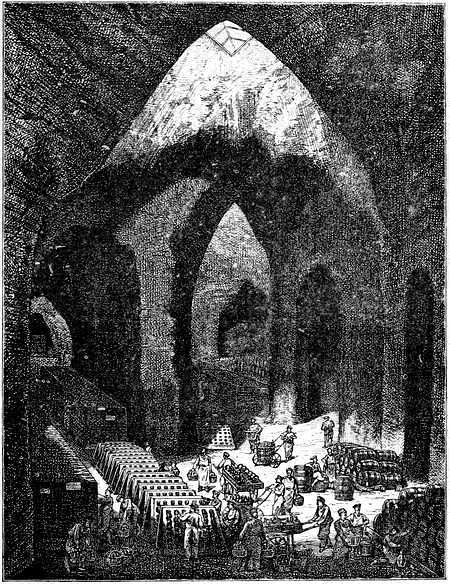
THE CELLARS OF MAX SUTAINE AND CO. IN THE CHEMIN DE LA PROCESSION, REIMS.
The cellars of the firm of Veuve Morelle & Co., successors to Max Sutaine & Co., are very extensive; and while more than usually picturesque in appearance, are in every respect admirably adapted for the rearing and development of the delicate wines of the Champagne. These cellars, hewn out of the chalk, are of great depth. The firm has been careful to adhere to the good traditions of its predecessors in the composition of its cuvées, and at the same time to avoid those errors which experience and the resources of modern science have made manifest. Its rule is only to send out wines of a good cru, and never before they are thoroughly matured, thereby avoiding the shipment of young wines. The chief kinds bearing the brand of Max Sutaine & Co. are Vin Brut (of great years), Extra Dry, Creaming Sillery, and Bouzy for England, Sillery Sec for Russia, and Verzenay and Cabinet for Germany and Belgium.
It should be mentioned that of late years the abandoned quarries, so numerous on this side of the city, have been largely utilised by the Reims Champagne manufacturers as cellars for the storage of their wines. Beyond the firms that have been already alluded to as possessing cellars in this direction, there remain to be enumerated Messrs. Kunkelmann & Co., Ruinart Père et Fils, the Goulets, Jules Champion, Théophile Roederer, &c. The cellars of several of the last named are immediately outside the Porte Dieu-Lumière, near which is a seventeenth-century house having let into its face a curious bas-relief, of evidently much earlier date, the subject of which has been a source of considerable perplexity to local antiquaries.
A like cloud enshrouds the origin of the name of Dieu-Lumière, bestowed upon the fortified gate formerly standing here, and originally erected during the fourteenth century, when, the circle of the ramparts having been carried round the Bourg de St. Remi so as to unite it to the old city, the Porte St. Nicaise was walled up.[426] Like the other portals of Reims, it has no lack of historical associations. Its vaulted roof resounded with the trampling of barbed war-steeds when, on the 16th July 1429, Charles the Victorious swept beneath it into the city, with Joan of Arc by his side and the steel-clad chivalry of France at his back.[427] The year 1583 saw its keys handed to the Duc de Guise, and the green flag of the League, with its device ‘Auspice Christo,’ hoisted above it; and twenty-three years later, as Henri Quatre rode through it amidst shouts of welcome, the jesting remark, ‘I had no idea I was so well beloved at Reims,’ was the only attempt at revenge made by the easy-going Béarnais on the population who had so long flouted his authority. Rebuilt in 1620, it witnessed the triumphant return of Grandpré’s cavalry and the Rémois militia, after their victory over Montal and his Spaniards at La Pompelle in 1657, and the successful assault of the renegade Saint Priest, whose Cossacks entered the walls at this point in 1814, and gave way to the most brutal excesses. Nor must it be forgotten that Marie Louise passed through this gate en route for Paris, on which occasion its summit was crowned with elaborate allegorical devices supported by cupids weaving garlands of flowers; or that for several centuries the relics of St. Timotheus and his companions were annually carried through it on Whit-Monday by the clergy of Reims, escorted by a procession of pilgrims, to the scene of the martyrdom of these early Christians at La Pompelle.
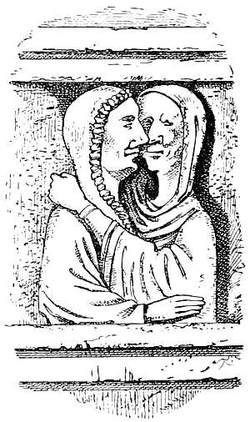
BAS-RELIEF NEAR THE PORTE DIEU-LUMIÈRE.
IX. EPERNAY.
The connection of Epernay with the production of wine of remote date—The town repeatedly burnt and plundered—Hugh the Great carries off all the wine of the neighbourhood—Vineyards belonging to the Abbey of St. Martin in the eleventh, twelfth, and thirteenth centuries—Abbot Gilles orders the demolition of a wine-press which infringes the abbey’s feudal rights—Bequests of vineyards in the fifteenth century—Francis I. bestows Epernay on Claude Duke of Guise in 1544—The Eschevins send a present of wine to their new seigneur—Wine levied for the king’s camp at Rethel and the strongholds of the province by the Duc de Longueville—Epernay sacked and fired on the approach of Charles V.—The Charles-Fontaine vendangeoir at Avenay—Destruction of the immense pressoirs of the Abbey of St. Martin—The handsome Renaissance entrance to the church of Epernay—Plantation of the ‘terre de siége’ with vines in 1550—Money and wine levied on Epernay by Condé and the Duke of Guise—Henri Quatre lays siege to Epernay—Death of Maréchal Biron—Desperate battle amongst the vineyards—Triple talent of the ‘bon Roy Henri’ for drinking, fighting, and love-making—Verses addressed by him to his ‘belle hôtesse’ Anne du Puy—The Epernay Town Council make gifts of wine to various functionaries to secure their good-will—Presents of wine to Turenne at the coronation of Louis XIV.—Petition to Louvois to withdraw the Epernay garrison that the vintage may be gathered in—The Duke and Duchess of Orleans at Epernay—Louis XIV. partakes of the local vintage at the maison abbatiale on his way to the army of the Rhine—Increased reputation of the wine of Epernay at the end of the seventeenth century—Numerous offerings of it to the Marquis de Puisieux, Governor of the town—The Old Pretender presented at Epernay with twenty-four bottles of the best—Sparkling wine sent to the Marquis de Puisieux at Sillery, and also to his nephew—Further gifts to the Prince de Turenne—The vintage destroyed by frost in 1740—The Epernay slopes at this epoch said to produce the most delicious wine in Europe—Vines planted where houses had formerly stood—The development of the trade in sparkling wine—A ‘tirage’ of fifty thousand bottles in 1787—Arthur Young drinks Champagne at Epernay at forty sous the bottle—It is surmised that Louis XVI., on his return from Varennes, is inspired by Champagne at Epernay—Napoleon and his family enjoy the hospitality of Jean Remi Moët—King Jerome of Westphalia’s true prophecy with regard to the Russians and Champagne—Disgraceful conduct of the Prussians and Russians at Epernay in 1814—The Mayor offers them the free run of his cellars—Charles X., Louis Philippe, and Napoleon III. accept the ‘vin d’honneur’ at Epernay—The town occupied by German troops during the war of 1870–1.
IF Reims be the titular capital of the Champagne wine-trade, Epernay can boast of containing the establishments of some of the most eminent firms engaged therein. Its connection with the production of the wines of Champagne is of the remotest. The vineyards stretching for miles around the ancient Sparnacum claim indeed an antiquity far exceeding that of any existing portion of the town itself, which, despite the remote date of its foundation, and the fact that it was a place of considerable importance as early as 445, presents a thoroughly modern aspect. Unlike Reims—so rich in the remains of antiquity—it possesses no mementoes of the days when its lord Eulogius gave it to St. Remi,[428] and he in turn bequeathed it to the Church.
The reason is simple, for the history of Epernay may be briefly summed up in the words—fire, pestilence, and pillage. From the days when misfortune first overtook it, after the division of the Frankish monarchy on the death of Clovis, it has been burnt down on half a dozen occasions, repeatedly depopulated by the plague, and captured and sacked times out of number. The contending sovereigns of Austrasia and Neustria alternately obtained forcible possession of it, and the rival counts of Paris and Vermandois snatched it repeatedly from each other’s hold, like hungry dogs contending for a bone; whilst the Normans, the Hungarians, the vassals of Charles of Lorraine, and the followers of Otho of Germany added their quota to the work of destruction during the long period of anarchy preceding the establishment of the Capetian race upon the throne of France. The founder of the said race, Hugh the Great, distinguished himself in 947 by plundering the town of Epernay, ravaging the surrounding country, and profiting by the fact that it was vintage-time to carry off all the wine of the neighbourhood.[429]
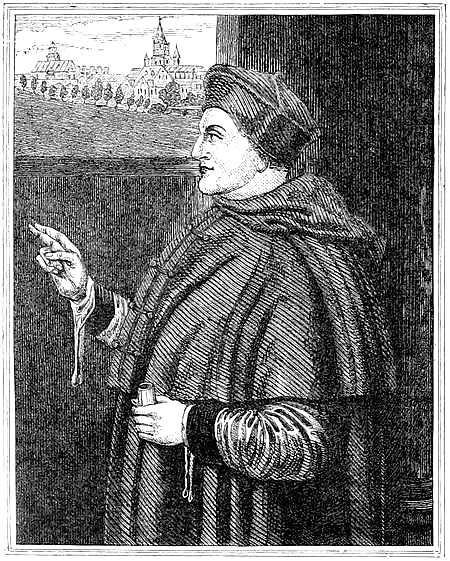
Even during the epoch of comparative tranquillity which prevailed up to the English invasion, Epernay became from time to time the prey of robber knights like Thomas de Marlé and rebellious nobles like Count John of Soissons; and at the commencement of the thirteenth century Count Thibault of Champagne was fain to burn it, in order to prevent it from serving as a rallying-place for the lords who had risen against Queen Blanche and her infant son Louis IX. After the battle of Poitiers it was pillaged by the partisans of Charles the Bad of Navarre; Edward the Black Prince entered it twice as a conqueror; and John of Gaunt exacted a heavy tribute from it. In the struggles which followed the death of Henry V. of England it was again taken and re-taken, partially burnt and utterly ruined, remaining for three years absolutely depopulated after the unwelcome visit paid it by the Duke of Burgundy in 1432.
Yet during all these ravages the vineyards clothing the slopes around the town were gradually developed, chiefly by the fostering care of the good fathers of the Abbey of St. Martin. The charter of foundation of this abbey, which was endowed in 1032, makes mention of vineyards amongst its possessions, and they are also spoken of in the confirmation of donations and privileges granted by Pope Eugenius III. in 1145. Count Henry of Champagne in 1179 gave the canons of the abbey the hospital of Epernay, with the fields and vineyards belonging to it; and twenty years later, Abbot Guy purchased from Abbot Noah, of the monastery of the Chapelle aux Planches, near Troyes, the fields, vineyards, house, barn, and garden adjoining the ‘ruisseau du Cotheau’ at Epernay for 110 livres. In 1203, Parchasius, a canon of Laon, left by will to the abbey the ‘vigne du Clozet,’ which is still celebrated for the excellence of its products, at Epernay; and in 1217, Abbot Theodoric gave the ‘terres de la Croix Boson’ at Mardeuil to sundry of the inhabitants of that village, on the condition of planting them with vines and paying a yearly rent of fourteen hogsheads of wine obtained therefrom as vinage. Tithes of wine at Oger, Cuis, Cramant, Monthelon, &c., and the vineyards of Genselin, Beaumont, and Montfelix also figure amongst the possessions of the abbey in the thirteenth century.[430]
A certain proportion of the tithes of the ‘fields, meadows, and vineyards’ owned by the abbey at Epernay was assigned to the dependent priory in the faubourg of Igny-le-Jard by Abbot Richard de Cuys in 1365. The cultivation of the grape seems to have been carried on in even the most distant of the numerous possessions of the abbey, which drew ‘rentes de vin’ from Chatillon and Dormans; and in 1373 we find Abbot Gilles de Baronne compelling an unfortunate inhabitant of Romains, near Fismes, to demolish forthwith a wine-press he had dared to erect to the prejudice of the ‘droits seigneuriaux et bannaux’ which the abbey had over that village. The military orders had their share, too; for the Commandery of the Temple at Reims owned at Epernay at the commencement of the fourteenth century a house and some vineyards, still bearing the name of ‘Les Tempières.’ In 1419, Philippe le Maître and his wife left to the curé of Epernay a little vineyard at Montebon to pay for a yearly mass; and at a somewhat later date, Isabelle la Linotte bequeathed to the abbey the vineyard De la Ronce at Mardeuil.[431]
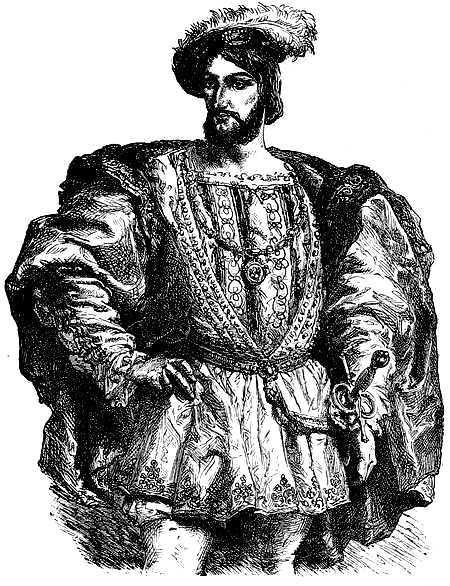
FRANCIS I. (From a portrait of the time).
Indeed, the history of Epernay is most intimately connected with that of its wine, which figures throughout its records as a constant attraction to friends and foes. After the final expulsion of the English, the town gradually recovered its prosperity, and became an appanage of the Dukes of Orleans. At the commencement of the sixteenth century we find Francis I.—to whom it had reverted on the death of Louise of Savoy—presenting it to Claude, Duke of Guise, and the eschevins resolving in 1544 that their new seigneur should be offered ‘twenty poinçons of the best wine that can be found in the cellars of the district, and that after the vintage twenty more of the new crop shall be sent to him.’[432] A levy of one hundred poinçons had already been demanded of them for the camp formed by the King at Rethel two years before; and the various strongholds of the province had been freely supplied with wine exacted from Epernay by the Duke de Longueville, lieutenant-governor of the Champagne.
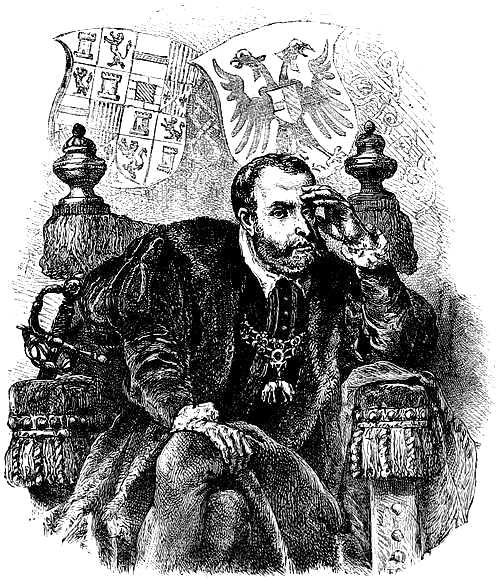
THE EMPEROR CHARLES V. (From a portrait of the time).
On the advance of Charles V. in 1544, the Dauphin, afterwards Henri II., following the example successfully set by Anne de Montmorency in Provence, pitilessly sacked the entire district of the Marne, in order that the enemy might find nothing to live on, and stored the product, which included an enormous quantity of wine, in Epernay. The Emperor advanced, meeting with but little opposition, and having taken up his quarters in the Abbey of Avenay, amused himself with building the vendangeoir known as Charles-Fontaine on the adjacent slope, as a testimony of his intention to make, if possible, a permanent sojourn in a province, the vinous products of which he so highly esteemed.[433] But whilst the illustrious patron of Titian and his ‘swarthy grave commanders’ were snugly tippling the choicest vintages contained in the abbey cellars, and his followers camped outside Epernay were waiting for the hour when they should revel at pleasure on the wine stored in the town, their hopes vanished literally in smoke. For Francis, fearing the town would be unable to hold out, had sent word to Captain Sery to burn it, and destroy the accumulated store of provisions, in order to prevent them falling into the hands of the enemy. This was accordingly done on the 3d September, and amongst the property consumed were the immense pressoirs of the Abbey of St. Martin. In this conflagration the church of Epernay was no doubt also destroyed, as the handsome Renaissance doorway—the sole ancient portion of the existing edifice—was evidently erected in the latter half of the sixteenth century. The misfortunes of the town did not cease with this calamity, for a great pestilence seems to have marked the return of the inhabitants to their ruined dwellings at the epoch of the following vintage.[434] Five years later, six arpents of the ‘terre de siege’ where the Spaniards had encamped were planted with vines by the Count de Nanteuil-le-Haudouin, and received the name of the Vineyard de la Plante.[435]
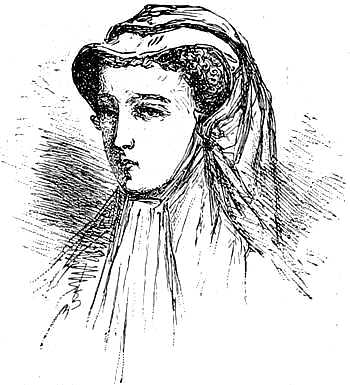
MARIE STUART, QUEEN OF SCOTS.
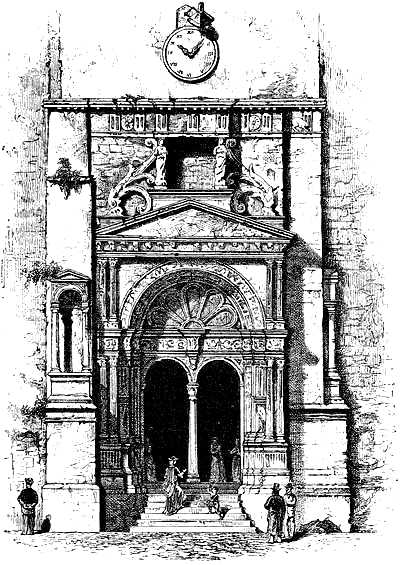
RENAISSANCE DOORWAY TO THE CHURCH OF EPERNAY.
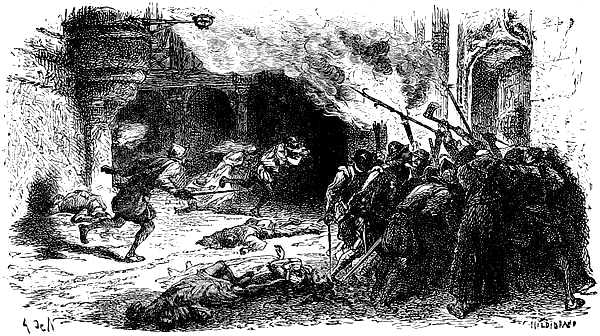
ATTACK ON THE HUGUENOTS AT EPERNAY.
As a matter of course, the hapless fate of the town pursued it during the religious wars of the sixteenth century. In 1567 the Huguenots, under Condé, seized on Epernay—then a portion of the appanage of the unfortunate Marie Stuart of Scotland—and exacted a ransom of 10,500 livres, towards which the Abbey of St. Martin contributed 3451 livres, partly in money and partly in wine, calculated at no more than eleven livres the queue. A higher price appears to have ruled on the recapture of the town by the Duke of Guise the same year, when the levy made consisted of 500 pièces of wine, estimated at twenty-four livres the queue.[436] Guise was driven out by the inhabitants in 1588; but after one fruitless assault, the Leaguers under Rosné succeeded in obtaining forcible possession of Epernay four years later.
On Henri Quatre laying siege in turn to Epernay in 1592, the vineyards around the town were again literally watered with blood. One notable episode of this siege was the death of Maréchal Biron, the most devoted of Henri’s adherents. On the 27th July the King and Biron were returning on horseback from Damery to the camp. As they advanced up the road leading from Mardeuil to the faubourg of Igny, the wind blew off Henri’s hat, adorned with the famous white plume, and Biron, picking it up, jestingly placed it upon his own head. At this moment the white plume unluckily caught the eye of Petit, the master gunner of Epernay, and he at once pointed a cannon at it from the Tour Saint Antoine. ‘For the Béarnais!’ he exclaimed, as he fired; and the ball carried away the head of the Maréchal, to whom Henri was speaking, and upon whose shoulder the King’s hand was actually resting. ‘Ah, mordieu, the dog has bitten the Béarnais!’ cried the exulting gunner, believing it was the King who had fallen, and alluding to the name of the cannon, which was known as the ‘Dog of Orleans,’ from its having been captured from the English at the siege of that city, and bearing on its breech the figure of a dog.[437]
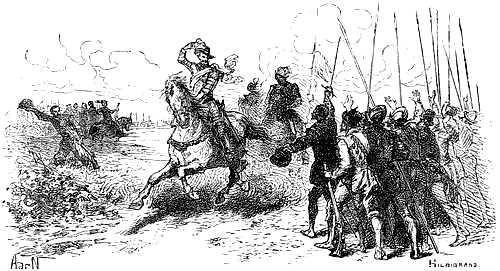
HENRI QUATRE BEFORE EPERNAY.
The death of Maréchal Biron, and the fact that Henri was devoting quite as much attention to his ‘belle hôtesse’ at Damery, the fair Présidente Anne du Puy, as he was to the siege, encouraged St. Paul, who commanded at Reims for the League, to despatch a strong body of Walloon pikemen and musketeers to the relief of the beleaguered town. They approached by the hollow road leading from the Faubourg des Ponts Neufs to the slope of the Vignes des Capinets, and passing between the vineyards Dure Epine and Gouttes d’Or. Attacked by the Royalists, they drew up in good order in the latter spot, and prepared to defend themselves with all the stubborn valour of their race, their dense array of pikes bristling amongst the bright green leaves—for it was the close of summer, and the vines were in all the glory of their luxuriant foliage. Vainly for a long time the Royalists assailed them. Attack after attack was repulsed, till the ‘golden drops’ were turned to drops of gore; and it was not until the white plume of King Henri came dashing on in the forefront of his choicest cavalry that the Walloons were finally broken and routed, after inflicting upon their assailants a far greater loss than they themselves sustained. The vineyard thus baptised in blood was thenceforward known as the Vigne des Sièges.[438]
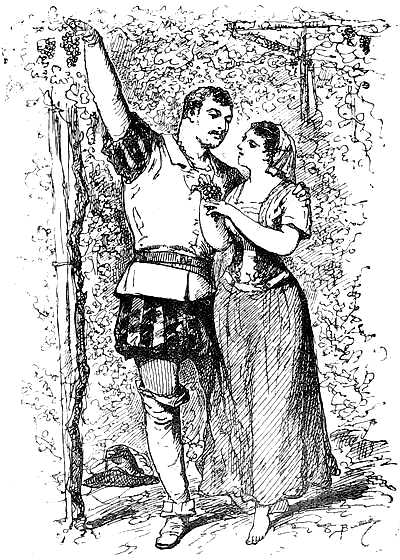
Though data may be lacking to connect the ‘bon Roi Henri’ directly with the wine of Epernay, there can be no doubt that the sovereign whose triple talent for drinking, fighting, and love-making has been handed down to us in song[439] found a fair opportunity of exercising all three of these attributes during the siege. Of fighting, as we have seen, he had plenty, and, Anacreon-like, he seems to have blended love and wine together.[440] He who, when a new-born babe, had his lips wetted in the old castle of Pau by stout Antoine de Bourbon with a cup of the generous wine of the South, and who gloried in the title of the Sieur d’Ay, was not likely to neglect the nectar vintaged on the slopes around Epernay. And probably the recollection of the raven-haired, black-eyed, bronze-skinned Bernais peasant-girls, whom tradition vows he used to woo when in the first flush of youthful manhood beneath the trellised vines of Jurançon and Gan, served by contrast to heighten the fairer charms of the blonde Anne du Puy, in whose honour he is reported to have sung:
‘Morning bright, Thy pure light I rejoice when I see; The fair dove Whom I love So, is rosy like thee. She is fair, None so rare, With a waist matched by none; By my hand It is spanned, And eyes bright as the sun. Wet with new Fallen dew, The rose sparkles less bright; Freer from spot Ermine’s not, Nor is lily more white. Fair Dupuis, All agree, On ambrosia is fed; From her lip When I sip Nectar’s perfume is shed.’[441]
At the outset of the seventeenth century Epernay had its full share in the troubles that marked the early part of the reign of Louis XIII., being taken in turn by Condé, by the Count de Soissons, acting for the malcontent nobles leagued against Richelieu in 1634, and by the King’s forces the year following. The peaceful records are, however, plentiful and interesting. In 1631 we find the town council deciding to present ‘six caques of white wine, the best that can be found,’ to M. de Vignolles, and the same to M. d’Elbenne; and two years later protesting to the ‘treasurers of France’ their inability to pay 70,000 livres, demanded towards the maintenance of the army, owing to the all but total failure of the wine crop. The council were fully aware of the merits of their vintage, and of the advantages of appealing to the heart by way of the stomach. Six ‘feuillettes’ of the best wine were ordered to be sent in September 1636 to M. de Vaubecourt, and one to his secretary, ‘to retain their good-will towards the town,’ and induce the former to use his influence with a committee appointed by the King for repaying loans and advances, and also towards getting rid of the garrison. A little later the Marquis de Senneterre received a queue of wine to withdraw his troops from the town. The Maréchal de Chatillon, M. de Vaubecourt, M. de Belfonds, and the Count d’Estaing were in frequent receipt of such gifts; and it is noteworthy that amongst them figure ‘two caques of wine in bottles,’ sent to each of the two first at Sainte Ménéhoulde in 1639.[442]
The successful efforts of Turenne against his great rival Condé during the wars of the Fronde were encouraged by frequent presents of the wine of Epernay. As the brother of the Duc de Bouillon, to whom the town of Epernay had been given in 1643 in exchange for Sedan, and as the protector of the district against the Spaniards, he received numerous tokens of the citizens’ good-will. In September 1652 twelve caques of wine were sent to him, with the result that he at once ordered his soldiers to repair the broken bridge across the Marne. In the following January a chevreuil and two caques, and in June wine, fowls, and game, were presented to him. In June 1654 it was resolved that a deputation should be sent to the coronation of Louis XIV. at Reims, ‘to render the homage due to the King,’ and to present ‘a caque of wine in bottles’ to M. de Turenne, which helped no doubt to spread the fame of the Epernay wine amongst the nobility present on that occasion.
The same social lever was applied in 1660 to the ‘traitant général’ of the so-called ‘don gratuit’ exacted on the occasion of the King’s marriage, two feuillettes being proffered in order to get him to reduce the assessment. Representations made to an eschevin of Paris, despatched to Epernay in 1662 to see if there was any store of grain in the town that could be sold to benefit the starving poor of the capital, to the effect that the district was a wine-growing and not a corn country; and the despatch of a deputation in August 1666 to Louvois, to request that the garrison might be withdrawn to allow of the vintage being gathered in—the inhabitants of the surrounding country having fled to avoid sheltering soldiers,—serve to show the importance of the Epernay wine-trade. In 1671, on the passage of the Duke and Duchess of Orleans from Châlons, fruit and sweetmeats were presented to them, and wine to the lords of their suite, at a cost of 211 livres 7 sols; and two years later, Louis XIV. partook of the local vintage during his sojourn at the ‘maison abbatiale,’ when on his way to the army of the Rhine.
Towards the close of this century the wine grew in repute, and was eagerly sought after. In November 1677 two caques were sent to ‘a person who enjoys some credit,’ and who was willing to accord his protection to the town in the matter of quartering troops upon it; and the following January twelve more caques were despatched to this ‘unknown,’ who may have been Louvois himself. As to Roger Brulart, Marquis de Puisieux et de Sillery and Governor of Epernay, a joyous companion, if we may credit St. Simon, his appreciation of the local vintage is borne ample testimony to. In 1677 six caques of ‘the best’ were sent to him by the town council; but by 1691 he must have become used to larger offerings, as in September a letter was addressed to him begging him to be satisfied with the like amount, as ‘the inhabitants could not manage more,’ and could only promise, with regard to three caques still due, that they would ‘make an effort’ to supply them the following year. Wise in their generation, they sent at the same time ‘twelve bottles of the best wine’ to his intendant, and a similar gift to his secretary; but the following year they were forced to write again that it would be impossible to supply the wine promised unless he obtained a permission to levy it.[443]
The Old Pretender, or, as he is styled in the local records, ‘Jacques Stuart III., roy d’Angleterre,’ arrived at Epernay in September 1712, and was presented with ‘twenty-four bottles of the best;’ whilst the Marquis de Puisieux, who accompanied him, was satisfied with nothing less than a ‘carteau,’ or quarter-cask. And when the latter announced his intention of paying a visit in the autumn of 1719 to Maître Adam Bertin du Rocheret, conseiller du roy and ex-president of the Grenier-à-sel at Epernay, a resolution was passed to offer him wine on his arrival, and to send ‘a hundred flasks of the best’ to his château of Sillery. The use of the word ‘flaçons’ clearly implies that the discoveries of Dom Perignon were being acted upon at Epernay, and that the gift in question was one of sparkling wine.
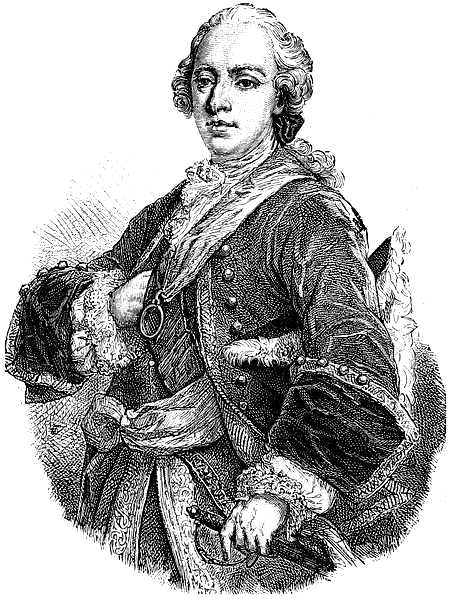
JAMES EDWARD FRANCIS STUART, THE OLD PRETENDER.
In June 1722 the Sieurs Quatresous and Chertemps, despatched to congratulate the marquis’s nephew and successor, Louis Philogène Brulart, on his appointment to the governorship of the town and his marriage with Mademoiselle de Souvré, granddaughter of Louvois, took with them a similar offering. At the coronation of Louis XV., in October, deputies were sent to compliment the Prince de Turenne, representative of his father the Duc de Bouillon, seigneur d’Epernay, and to present him with ‘game, trout, and other fish,’ and ‘a basket of a hundred flasks of the best.’ In August 1725 the bourgeois were drawn up under arms, and four dozen bottles were got ready, on the passage through the town of the Duke of Orleans, son of the late Regent, on his way to espouse, as the King’s proxy, Marie Leczinska. This was, however, a sad year for the wine-growers, for ten months of incessant rain, beginning in April, not only ruined the at first promising crop entirely, but caused floods which wrought some havoc. The terrible hail-storm of 1730, which devastated the vineyards of Reims, fortunately spared those of Epernay; but a frost in October 1740 destroyed the vintage, and led to a dearness of provisions which pressed even on the most well-to-do.[444]
For the next three-quarters of a century Epernay continued quietly to profit by the yield of ‘the slopes laden with vines producing the most delicious wines in Europe,’ to quote the expression of Stapart, who in 1749 notes the importance of the trade in wine carried on, not only with Paris, but with foreign countries; though at the same time complaining of the decreasing size of the town, and the fact of vineyards being planted where houses had formerly stood.[445] The only events of importance were from time to time an unusually good or an uncommonly bad crop, or—as the manufacture of vin mousseux gradually swallowed up that of still wine—a disastrous casse, like the memorable one of 1776, varied by an occasional royal visit or so. By 1780, Max Sutaine notes that a single manufacturer would turn out from five to six thousand bottles of sparkling Champagne, and exults over the fact that seven years later an enterprising firm risked a tirage of fifty thousand, though people at the time regarded this as something prodigious, and wondered where an outlet would be found.[446] Very likely a bottle of this identical tirage was ‘the excellent vin mousseux’ with which Arthur Young regaled himself, at a cost of forty sous, on the 7th July of the same year, at that ‘very good inn’ the Hôtel de Rohan, at Epernay.[447] At this same inn the hapless Louis XVI. stopped to dine on his return from the intercepted flight to Varennes; and when we recall his timid nature, we may fairly surmise that it was Champagne which inspired him, amidst the insults of the mob, to remind the authorities that his ancestor, Henri Quatre, had entered the town in a very different fashion, and by implication to assert that he might yet do the same.[448]
The Emperor Napoleon, the Empress Josephine, the King of Westphalia, and the other members of the Bonaparte dynasty, who from time to time visited Epernay and partook of the hospitality of Jean Remi Moët, showed a healthy appreciation of its vintage. Indeed King Jerome, in giving an order for six thousand bottles premier cru, remarked with a strange foresight that he would have taken more, only he was afraid that it would be the Russians after all who would come and drink it. Sure enough the eventful year 1814 witnessed the arrival at Epernay of a host of self-invited guests, all equally appreciative of the merits of Champagne, and gifted with an almost unlimited power of consumption, but entertaining insuperable objections to pay for what they consumed. The Prussians and Russians who came hither in February and March misconducted themselves in a very sad manner, burning and pillaging houses, insulting and maltreating the inhabitants, requisitioning all the wine they could lay hands on, and drinking in a manner recalling the Bacchic exploits of Gargantua and Pantagruel. The mayor, Jean Remi Moët, moved by the state of affairs, offered the invaders the free run of his cellars rather than that they should pillage those of others, doubtless under the idea that the reputation his house would thus acquire abroad would soon enable him to retrieve the temporary loss—a proviso happily and amply realised. Beyond the facts that Epernay has profited, and continues to profit, by the ever-increasing development of the taste for sparkling wine; that Charles X., Louis Philippe, and Napoleon III. have successively favoured it with their presence, and accepted the vin d’honneur offered on such occasions; and that during the war of 1870–1 the town, in common with the rest of the province of Champagne, was occupied by the German invading army, there is nothing more to be said respecting its history.
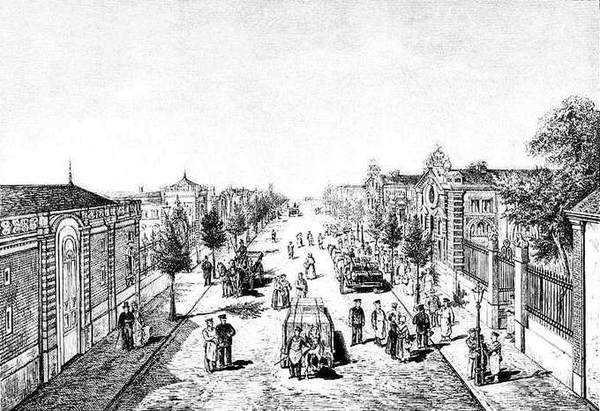
THE RUE DU COMMERCE (FAUBOURG DE LA FOLIE), EPERNAY.
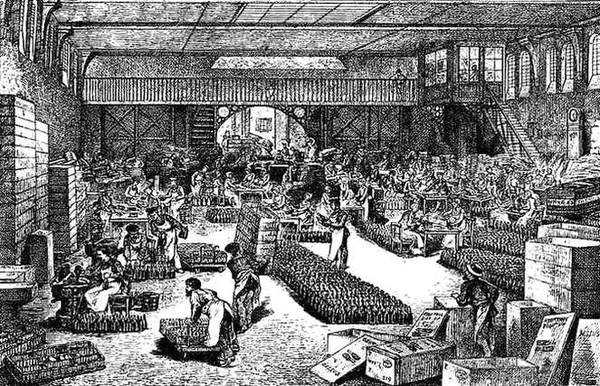
THE PACKING-HALL AT MESSRS. MOËT AND CHANDON’S, EPERNAY.
X. THE CHAMPAGNE ESTABLISHMENTS OF EPERNAY AND PIERRY.
Early records of the Moët family at Reims and Epernay—Jean Remi Moët, the founder of the commerce in Champagne wines—Extracts from old account-books of the Moëts—Jean Remi Moët receives the Emperor Napoleon, the Empress Josephine, and the King of Westphalia—The firm of Moët & Chandon constituted—Their establishment in the Rue du Commerce—The delivery and washing of new bottles—The numerous vineyards and vendangeoirs of the firm—Their cuvée made in vats of 12,000 gallons—The bottling of the wine—A subterranean city, with miles of streets, cross-roads, open spaces, tramways, and stations—The ancient entrance to these vaults—Tablet commemorative of the visit of Napoleon I.—The original vaults known as Siberia—Scene in the packing-hall—Messrs. Moët & Chandon’s large and complete staff—The famous ‘Star’ brand of the firm—Perrier-Jouët’s château, offices, and cellars—Classification of the wine of the house—The establishment of Messrs. Pol Roger & Co.—Their large stock of the fine 1874 vintage—The preparations for the tirage—Their vast fireproof cellier and its temperature—Their lofty and capacious cellars—Pierry becomes a wine-growing district consequent upon Dom Perignon’s discovery—Esteem in which the growths of the Clos St. Pierre were held—Cazotte, author of Le Diable Amoureux, and guillotined for planning the escape of Louis XVI. from France, a resident at Pierry—His contest with the Abbot of Hautvillers with reference to the abbey tithes of wine—The Château of Pierry—Its owner demands to have it searched to prove that he is not a forestaller of corn—The vineyards and Champagne establishment of Gé-Dufaut & Co.—The reserves of old wines in the cellars of this firm—Honours secured by them at Vienna and Paris.
THOSE magnates of the Champagne trade, Messrs. Moët & Chandon, whose famous ‘Star’ brand is familiar in every part of the civilised globe, and whose half-score miles of cellars contain as many million bottles of Champagne as there are millions of inhabitants in most of the secondary European States, have their head-quarters at Epernay in a spacious château—in that street of châteaux named the Rue du Commerce, but commonly known as the Faubourg de la Folie—which is approached through handsome iron gates, and has beautiful gardens in the rear extending in the direction of the River Marne. The existing firm dates from the year 1833, but the family of Moët—conjectured to have originally come from the Low Countries—had already been associated with the Champagne wine trade for well-nigh a century previously. If the Moëts came from Holland they must have established themselves in the Champagne at a very early date, for the annals of Reims record that in the fourteenth century Jehan Moët de Mennemont, escuier, held a fief at Attigny from the Archbishop Richard Pique, and that in the following century Jean and Nicolas Moët were échevins of the city. A Moët was present in that capacity at the coronation of Charles VII. in 1429, when Joan of Arc stood erect by the principal altar of the cathedral with her sacred banner in her hand; and for having contributed to repulse an attempt on the part of the English to prevent the entrance of the Royal party into the city, the Moëts were subsequently ennobled by the same monarch. A mural tablet in the church of St. Remi records the death of D. G. Moët, Grand Prior, in 1554; and nine years later we find Nicol Moët claiming exemption at Epernay for the payment of tailles on the ground of his being a noble.
An old commercial book preserved in the family archives shows that in the year 1743—at the epoch when the rashness of the Duc de Grammont saved the English army under George II. from being cut to pieces at Dettingen—a descendant of the foregoing, one Claude Louis Nicolas Moët, who owned considerable vineyard property in the vicinity of Epernay, decided upon embarking in the wine trade. It is his son, however, Jean Remi Moët, born in 1758, who may be looked upon as the veritable founder of the present commerce in Champagne wines, which, thanks to his efforts, received a wonderful impulse, so that instead of the consumption of the vintages of the Marne being limited as heretofore to the privileged few, it spread all over the civilised world.
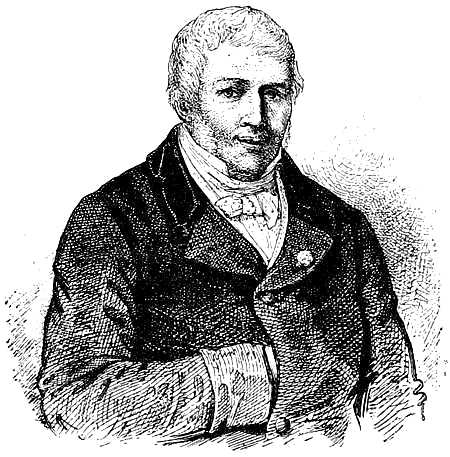
JEAN REMI MOËT.
At Messrs. Moët & Chandon’s we had the opportunity of inspecting some of the old account-books of the firm, and more particularly those recording the transactions of Jean Remi Moët and his father. The first sales of sparkling wine, on May 23d, 1743, comprised 301 bottles of the vintage of 1741 to Pierre Joly, wine-merchant, bon des douze chez le Roi, whatever that may mean, at Paris; 120 bottles to Pierre Gabriel Baudoin, also bon des douze, at Paris; and a similar quantity to the Sieur Compoin, keeping the ‘hotellerie ditte la pestitte Escurie,’ Rue du Port-Maillart, at Nantes in Brittany. The entry specifies that the wine for Nantes is to be left at Choisy-le-Roi, and taken by land to Orleans by the carters of that town, who are to be found at the Ecu d’Orléans, Porte St. Michel, Paris, the carriage as far as Choisy being 4 livres 10 deniers (about 4 francs) for the two half-baskets, and to Paris 3 livres 15 deniers the basket.
Between 1750 and ’60 parcels of wine were despatched to Warsaw, Vienna, Berlin, Königsberg, Dantzig, Stettin, Brussels, and Amsterdam; but one found no mention of any sales to England till the year 1788, when the customers of the firm included ‘Milord’ Farnham, of London, and Messrs. Felix Calvert & Sylvin, who had a couple of sample-bottles sent to them, for which they were charged five shillings. In the same year Messrs. Carbonnell, Moody, & Walker (predecessors of the well-known existing firm of Carbonnell & Co.) wrote in French for two baskets, of ten dozens each, of vin de Champagne ‘of good body, not too charged with liqueur, but of excellent taste, and not at all sparkling.’ The Chevalier Colebrook, writing from Bath, also requests that 72 bottles of Champagne may be sent to his friend the Hon. John Butler, Molesworth-street, Dublin, ‘who, if contented with the wine, will become a good customer, he being rich, keeping a good house, and receiving many amateurs of vin de Champagne.’ Shortly afterwards the Chevalier himself receives 50 bottles of still wine, vintage 1783. In 1789 120 bottles of Champagne, vintage 1788, are supplied to ‘Milord’ Findlater, of London; and in 1790 the customers of the house include Power & Michel, of 44 Lamb-street, London, and Manning, of the St. Alban Tavern, the latter of whom is supplied on March 30th with 130 bottles of Champagne at three livres, or two ‘schillings,’ per bottle; while a month later Mr. Lockart, banker, of 36 Pall Mall, is debited with 360 bottles, vintage 1788, at three shillings.
In this same year M. Moët despatches a traveller to England named Jeanson, and his letters, some two hundred in number, are all preserved in the archives of the house. On the 17th May 1790 he writes from London as follows: ‘As yet I have only gone on preparatory and often useless errands. I have distributed samples of which I have no news. Patience is necessary, and I endeavour to provide myself with it. How the taste of this country has changed since ten years ago! Almost everywhere they ask for dry wine, but at the same time require it so vinous and so strong that there is scarcely any other than the wine of Sillery which can satisfy them.... To-morrow I dine five miles from here, at M. Macnamara’s. We shall uncork four bottles of our wine, which will probably be all right.’ In May 1792 Jean Remi Moët is married, and thenceforward assumes the full management of the house. On December 20 of the year following, when the Reign of Terror was fairly inaugurated, we find the accounts in the ledger opened to this or the other ‘citoyen.’ The orthodox Republican formula, however, did not long continue, and ‘sieur’ and ‘monsieur’ resumed their accustomed places, showing that Jean Remi Moët had no sympathy with the Jacobin faction of the day. In 1805 he became Mayor of Epernay, and between this time and the fall of the Empire received Napoleon several times at his residence, as well as the Empress Josephine and the King of Westphalia. The Emperor, after recapturing Reims from the Allies, came on to Epernay, on which occasion he presented M. Moët with the Cross of the Legion of Honour. In 1830 the latter was arbitrarily dismissed from his mayoralty by Charles X., but was speedily reinstated by Louis Philippe, though he did not retain his office for long, his advanced age compelling him to retire from active life in the course of 1833. At this epoch the firm, which since 1807 had been known as Moët & Co., was remodelled under the style of Moët & Chandon, the two partners being M. Victor Moët, son of the outgoing partner, and M. P. G. Chandon, the descendant of an old ennobled family of the Mâconnais, who had married M. Jean Remi Moët’s eldest daughter. The descendants of these gentlemen are to-day (1880) at the head of the business, the partners being, on the one hand, M. Victor Moët-Romont and M. C. J. V. Auban Moët-Romont; and on the other, MM. Paul and Raoul Chandon de Briailles.
Facing Messrs. Moët & Chandon’s offices at Epernay is a range of comparatively new buildings, with its white façade ornamented with the well-known monogram M. & C., surmounted by the familiar star. It is here that the business of blending and bottling the wine is carried on. Passing through the arched gateway, access is obtained to a spacious courtyard, where carts laden with bottles are being expeditiously lightened of their fragile contents by the busy hands of numerous workmen. Another gateway on the left leads into the spacious bottle-washing room, which from the middle of May until the middle of July presents a scene of extraordinary animation. Bottle-washing apparatus, supplied by a steam-engine with 20,000 gallons of water per diem, are ranged in fifteen rows down the entire length of this hall, and nearly 200 women strive to excel each other in diligence and celerity in their management, a practised hand washing from 900 to 1000 bottles in the course of the day. To the right of this salle de rinçage, as it is styled, bottles are stacked in their tens of thousands, and lads furnished with barrows, known as diables, hurry to and fro, conveying these to the washers, or removing the clean bottles to the adjacent courtyard, where they are allowed to drain prior to being taken to the salle de tirage or bottling-room.
Before, however, the washing of bottles on this gigantic scale commences, the ‘marrying’ or blending of the wine is accomplished in a vast apartment, 250 feet in length and 100 feet broad, during the early spring. The casks of newly-vintaged wine, which have been stowed away during the winter months in the extensive range of cellars hewn out of the chalk underlying Epernay, where they have slowly fermented, are mixed together in due proportion in huge vats, each holding upwards of 12,000 gallons. Some of this wine is the growth of Messrs. Moët & Chandon’s own vineyards, of which they possess as many as 900 acres (giving constant employment to 800 labourers and vinedressers) at Ay, Avenay, Bouzy, Cramant, Champillon, Chouilly, Dizy, Epernay, Grauves, Hautvillers, Le Mesnil, Moussy, Pierry, Saran, St. Martin, Verzy, and Verzenay, and the average annual cost of cultivating which is about £40 per acre. At Ay the firm own 210 acres of vineyards; at Cramant and Chouilly, nearly 180 acres; at Verzy and Verzenay, 120 acres; at Pierry and Grauves, upwards of 100 acres; at Hautvillers, 90 acres; at Le Mesnil, 80 acres; at Epernay, nearly 60 acres; and at Bouzy, 55 acres. Messrs. Moët & Chandon, moreover, possess vendangeoirs, or pressing-houses, at Ay, Bouzy, Cramant, Epernay, Hautvillers, Le Mesnil, Pierry, Saran, and Verzenay, in which the large number of 40 presses are installed. At these vendangeoirs no less than 5450 pièces of fine white wine, sufficient for 1,360,000 bottles of Champagne, are annually made—that is, 1200 pièces at Ay, 1100 at Cramant and Saran, 800 at Verzy and Verzenay, and smaller quantities at the remaining establishments. All these establishments have their celliers and their cellars, together with cottages for the accommodation of the numerous vinedressers in the employment of the firm.
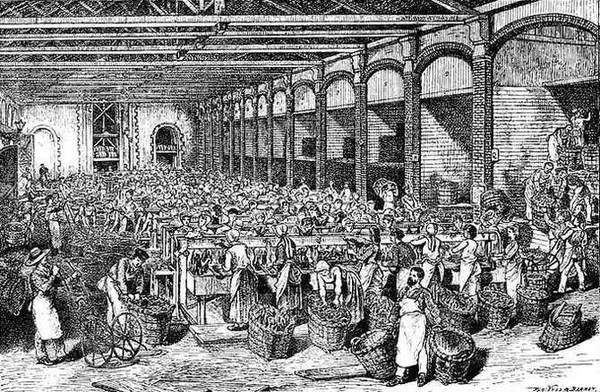
WASHING BOTTLES AT MESSRS. MOËT AND CHANDON’S, EPERNAY.
Extensive as are the vineyards owned by Messrs. Moët & Chandon, the yield from them is utterly inadequate to the enormous demand which the great Epernay firm are annually called upon to supply, and large purchases have to be made by their agents from the growers throughout the Champagne. The wine thus secured, as well as that grown by the firm, is duly mixed together in such proportions as will insure lightness with the requisite vinosity, and fragrance combined with effervescence, a thorough amalgamation being effected by stirring up the wine with long poles provided with fan-shaped ends. If the vintage be indifferent in quality, the firm have scores of huge tuns filled with the yield of more favoured seasons to fall back upon to insure any deficiencies of character and flavour being supplied.
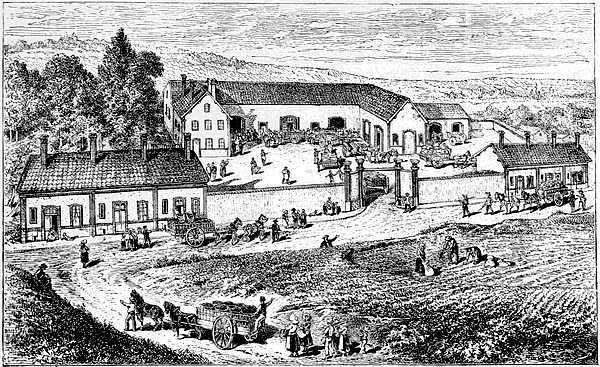
MESSRS. MOËT AND CHANDON’S VENDANGEOIR AT BOUZY.
The casks of wine to be blended are raised from the cellars, half a dozen at a time, by means of a lift provided with an endless chain, and worked by the steam-engine of which we have already spoken. They are emptied, through traps in the floor of the room above, into the huge vats which, standing upon a raised platform, reach almost to the ceiling. From these vats the fluid is allowed to flow through hose into rows of casks stationed below. Before being bottled the wine reposes for a certain time; is next duly racked and again blended; and is eventually conveyed through silver-plated pipes into oblong reservoirs, each fitted with a dozen syphon-taps, so arranged that directly the bottle slipped on to one of them becomes full the wine ceases to flow.
Upwards of 200 workpeople are employed in the salle de tirage at Messrs. Moët & Chandon’s, which, while the operation of bottling is going on, presents a scene of bewildering activity. Men and lads are gathered round the syphon-taps, briskly removing the bottles as they become filled, and supplanting them by empty ones. Other lads hasten to transport the filled bottles on trucks to the corkers, whose so-called ‘guillotine’ machines send the corks home with a sudden thud. The corks being secured with agrafes, the bottles are placed in large flat baskets called manettes, and wheeled away on trucks, the quarts being deposited in the cellars by means of lifts, while the pints slide down an inclined plane by the aid of an endless chain, which raises the trucks with the empty baskets at the same time the full ones make their descent into the cellars. What with the incessant thud of the corking-machines, the continual rolling of iron-wheeled trucks over the concrete floor, the rattling and creaking of the machinery working the lifts, the occasional sharp report of a bursting bottle, and the loudly-shouted orders of the foremen, who display the national partiality for making a noise to perfection, the din becomes at times all but unbearable. The number of bottles filled in the course of the day naturally varies, still Messrs. Moët & Chandon reckon that during the month of June a daily average of 100,000 are taken in the morning from the stacks in the salle de rinçage, washed, dried, filled, corked, wired, lowered into the cellars, and carefully arranged in symmetrical order. This represents a total of two and a half million bottles during that month alone.
The bottles on being lowered into the cellars, either by means of the incline or the lifts, are placed in a horizontal position, and, with their uppermost side daubed with white chalk, are stacked in layers from two to half a dozen bottles deep, with narrow oak laths between. The stacks are usually about 6 or 7 feet high, and 100 feet and upwards in length. Whilst the wine is thus reposing in a temperature of about 55° Fahrenheit, fermentation sets in, and the ensuing month is one of much anxiety. Thanks, however, to the care bestowed, Messrs. Moët & Chandon’s annual loss from bottles bursting rarely exceeds three per cent, though fifteen was once regarded as a respectable and satisfactory average. The broken glass is a perquisite of the workmen, the money arising from its sale, which at the last distribution amounted to no less than 20,000 francs, being divided amongst them every couple of years.
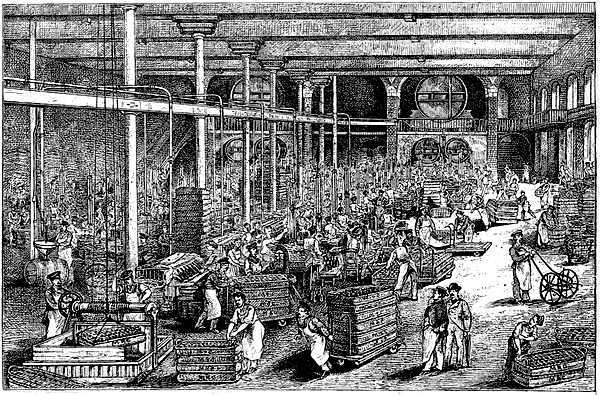
BOTTLING CHAMPAGNE AT MESSRS. MOËT AND CHANDON’S, EPERNAY.
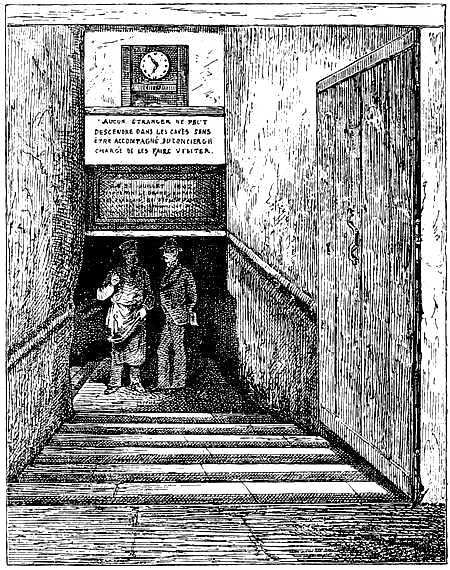
The usual entrance to Messrs. Moët & Chandon’s Epernay cellars—which, burrowed out in all directions, are of the aggregate length of nearly seven miles, and have usually between 10,000,000 and 12,000,000 bottles and 20,000 casks of wine stored therein—is through a wide and imposing portal, and down a long and broad flight of steps. It is, however, by the ancient and less imposing entrance, through which more than one crowned head has condescended to pass, that we set forth on our lengthened tour through these intricate underground galleries—this subterranean city, with its miles of streets, cross-roads, open spaces, tramways, and stations devoted solely to Champagne. A gilt inscription on a black-marble tablet testifies that ‘on the 26th July 1807, Napoleon the Great, Emperor of the French, King of Italy, and Protector of the Confederation of the Rhine, honoured commerce by visiting the cellars of Jean Remi Moët, Mayor of Epernay, President of the Canton, and Member of the General Council of the Department,’ within three weeks of the signature of the treaty of Tilsit. Passing down the flight of steep slippery steps traversed by the victor of Eylau and Jena, access is gained to the upper range of vaults, brilliantly illuminated by the glare of gas, or dimly lighted by the flickering flame of tallow-candles, upwards of 60,000 lb. of which are annually consumed. Here group after group of the small army of 350 workmen employed in these subterranean galleries are encountered, engaged in the process of transforming the vin brut into Champagne. At Messrs. Moët & Chandon’s, the all-important operation of liqueuring the wine is effected by aid of machines of the latest construction, which regulate the quantity administered to the utmost nicety. The corks are branded by being pressed against steel dies heated by gas by women, who can turn out 3000 per day apiece, the quantity of string used to secure them amounting to nearly ten tons in the course of the year.
TABLET COMMEMORATIVE OF THE VISIT OF NAPOLEON I.
There is another and a lower depth of cellars to be explored, to which access is gained by trap-holes in the floor—through which the barrels and baskets of wine are raised and lowered—and by flights of steps. From the foot of the latter there extends an endless vista of lofty and spacious passages hewn out of the chalk, the walls of which, smooth as finished masonry, are lined with thousands of casks of raw wine, varied at intervals by gigantic vats. Miles of long, dark-brown, dampish-looking galleries stretch away to the right and left, devoid of the picturesque festoons of fungi which decorate the London Dock vaults, yet exhibiting a sufficient degree of mouldiness to give them an air of respectable antiquity. These multitudinous galleries, lit up by petroleum-lamps, are mostly lined with wine in bottles stacked in compact masses to a height of six or seven feet, only room enough for a single person to pass being left. Millions of bottles are thus arranged, the majority on their side, in huge piles, with tablets hung up against each stack to note its age and quality; and the rest, which are undergoing daily evolutions at the hands of the twister, in racks at various angles of inclination. These cellars contain nearly 11,000 racks, and as many as 600,000 bottles are commonly twisted here daily.
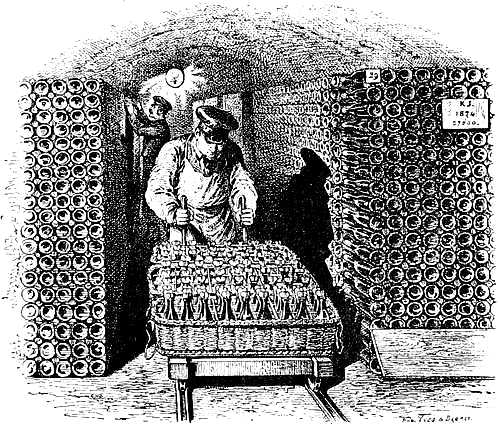
The way runs on between regiments of bottles of the same size and shape, save where at intervals pints take the place of quarts; and the visitor, gazing into the black depths of the transverse passages to the right and left, becomes conscious of a feeling that if his guide were suddenly to desert him, he would feel as hopelessly lost as in the catacombs of Rome. There are two galleries, each 650 feet in length, containing about 650,000 bottles, and connected by 32 transverse galleries, with an aggregate length of 4000 feet, in which nearly 1,500,000 bottles are stored. There are, further, eight galleries, each 500 feet in length, and proportionably stocked; also the extensive new vaults, excavated some five or six years back, in the rear of the then existing cellarage, and a considerable number of smaller vaults. The different depths and varying degrees of moisture afford a choice of temperature of which the experienced owners know how to take advantage. The original vaults, wherein more than a century ago the first bottles of Champagne made by the infant firm were stowed away, bear the name of Siberia, on account of their exceeding coldness. This section consists of several roughly-excavated low winding galleries, resembling natural caverns, and affording a striking contrast to the broad, lofty, and regular-shaped corridors of more recent date.
When the proper period arrives for the bottles to emerge once more into the upper air, they are conveyed to the packing-room, a spacious hall 180 feet long and 60 feet broad. In front of its three large double doors wagons are drawn up ready to receive their loads. The 70 men and women employed here easily foil, label, wrap, and pack up some 10,000 bottles a day. Cases and baskets are stacked in different parts of this vast hall, at one end of which numerous trusses of straw used in the packing are piled. Seated at tables ranged along one side of the apartment women are busily occupied in pasting on labels or encasing the necks of bottles in gold or silver foil, whilst elsewhere men, seated on three-legged stools in front of smoking caldrons of molten sealing-wax of a deep green hue, are coating the necks of other bottles by plunging them into the boiling fluid. When labelled and decorated with either wax or foil, the bottles pass on to other women, who swathe them in pink tissue-paper and set them aside for the packers, by whom, after being deftly wrapped round with straw, they are consigned to baskets or cases, to secure which last no less than 10,000 lb. of nails are annually used. England and Russia are partial to gold foil, pink paper, and wooden cases holding a dozen or a couple of dozen bottles of the exhilarating fluid, whereas other nations prefer waxed necks, disdain pink paper, and insist on being supplied in wicker baskets containing fifty bottles each.
Some idea of the complex character of so vast an establishment as that of Messrs. Moët & Chandon may be gathered from a mere enumeration of their staff, which, in addition to twenty clerks and 350 cellarmen proper, includes numerous agrafe-makers and corkcutters, packers and carters, wheelwrights and saddlers, carpenters, masons, slaters and tilers, tinmen, firemen, needlewomen, &c., while the inventory of objects used by this formidable array of workpeople comprises no fewer than 1500 distinct heads. A medical man attached to the establishment gives gratuitous advice to all those employed, and a chemist dispenses drugs and medicines without charge. While suffering from illness the men receive half-pay, but should they be laid up by an accident met with in the course of their work full salary is invariably awarded to them. As may be supposed, so vast an establishment as this is not without a provision for those past work, and all the old hands receive liberal pensions from the firm upon retiring.
It is needless to particularise Messrs. Moët & Chandon’s wines, which are familiar to all drinkers of Champagne. Still it may be mentioned that the great Epernay firm, with the view of meeting the requirements of the time, have lately commenced shipping a high-class vin brut, or natural Champagne, possessing great vinosity, combined with remarkable delicacy of flavour. To this fine dry wine the name of ‘Brut Impérial’ has been given by the house. Moët & Chandon’s famous ‘Star’ brand is known in all societies, figures equally at clubs and mess-tables, at garden-parties and picnics, dinners and soirées, and has its place in hotel cartes all over the world. One of the best proofs of the wine’s universal popularity is found in the circumstance that as many as a thousand visitors from all parts of the world come annually to Epernay and make the tour of Messrs. Moët & Chandon’s spacious cellars.
A little beyond Messrs. Moët & Chandon’s, in the broad Rue du Commerce, we encounter a heavy, ornate, pretentious-looking château, the residence of the late M. Perrier-Jouët, presenting a striking contrast to the almost mean-looking premises opposite, where the business of the firm is carried on. On the left-hand side of a courtyard surrounded by low buildings, which serve as celliers, store-houses, packing-rooms, and the like, are the offices; and from an inner courtyard, where piles of bottles are stacked under open sheds, the cellars themselves are reached. Previous to descending into these we passed through the various buildings, in one of which a party of men were engaged in disgorging and preparing wine for shipment. In another we noticed one of those heavy beam presses for pressing the grapes which the more intelligent manufacturers regard as obsolete, while in a third was the cuvée vat, holding no more than 2200 gallons. In making their cuvée the firm commonly mix one part of old wine to three parts of new. An indifferent vintage, however, necessitates the admixture of a larger proportion of the older growth. The cellars, like all the more ancient ones at Epernay, are somewhat straggling and irregular; still they are remarkably cool, and on the lower floor remarkably damp as well. This, however, would appear to be no disadvantage, as the breakage in them is calculated never to exceed 2 ½ per cent.
The firm have no less than five qualities of wine, and at one of the recent Champagne competitions at London, where the experts engaged had no means of identifying the brands submitted to their judgment, Messrs. Perrier-Jouët’s First Quality got classed below a cheaper wine of their neighbours, Messrs. Pol Roger & Co., and very considerably below the Extra Sec of Messrs. Périnet et fils, and inferior even to a wine of De Venoge’s, the great Epernay manufacturer of common-class Champagne.
Champagne establishments, combined with the handsome residences of the manufacturers, line both sides of the long imposing Rue du Commerce at Epernay. On the left hand is a succession of fine châteaux, commencing with one belonging to M. Auban Moët, whose terraced gardens overlook the valley of the Marne, and command views of the vine-clad heights of Cumières, Hautvillers, Ay, and Mareuil, and the more distant slopes of Ambonnay and Bouzy; while on the other side of the famous Epernay thoroughfare we encounter beyond the establishments of Messrs. Moët & Chandon and Perrier-Jouët the ornate monumental façade which the firm of Piper & Co.—of whom Messrs. Kunkelmann & Co. are to-day the successors—raised some years since above their extensive cellars. In a side street at the farther end of the Rue du Commerce stands a château of red brick, overlooking on the one side an extensive pleasure-garden, and on the other a spacious courtyard, bounded by celliers, stables, and bottle-sheds, all of modern construction and on a most extensive scale. These form the establishment of Messrs. Pol Roger & Co., settled for many years at Epernay, and known throughout the Champagne for their large purchases at the epoch of the vintage. From the knowledge they possess of the best crus, and their relations with the leading vineyard proprietors, they are enabled whenever the wine is good to acquire large stocks of it. Having bottled a considerable quantity of the fine wine of 1874, they resolved to profit by the exceptional quality of this vintage to commence shipping Champagne to England, where their agents, Messrs. Reuss, Lauteren, & Co., have successfully introduced the new brand.
Passing through a large open gateway, we enter the vast courtyard of the establishment, which, with arriving and departing carts—the first loaded with wine in cask or with new bottles, and the others with cases of Champagne—presents rather an animated scene. Under a roof projecting from the wall of the vast cellier on the right hand a tribe of ‘Sparnaciennes’—as the feminine inhabitants of Epernay are termed—are occupied in washing bottles in readiness for the coming tirage. The surrounding buildings, most substantially constructed, are not destitute of architectural pretensions.
The extensive cellier, the area of which is 23,589 square feet, is understood to be the largest single construction of the kind in the Champagne district. Built entirely of iron, stone, and brick, its framework is a perfect marvel of lightness. The roof, consisting of rows of brick arches, is covered above with a layer of Portland cement, in order to keep it cool in summer and protect it against the winter cold, two most desirable objects in connection with the manipulation of Champagne. Here an endless chain of a new pattern enables wine in bottle to be lowered and raised with great rapidity to or from the cellars beneath—lofty and capacious excavations of two stories, the lower one of which is reached by a flight of no less than 170 steps.
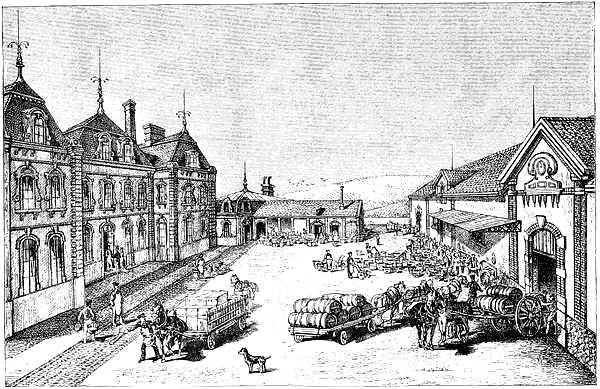
COURTYARD OF MESSRS. POL ROGER AND CO.’S ESTABLISHMENT AT EPERNAY.
Less than a couple of miles southward of Epernay, on the high-road to Troyes, is the village of Pierry, which, unlike most of the Champagne villages, is one of those happy spots with little or no history. Up to the close of the seventeenth century it was an insignificant hamlet; but at that epoch—when Dom Perignon’s discovery gave such an impetus to the viticultural industry of the Marne—the waste land lying around it was broken up and planted with vines, and a number of rich strangers, chiefly from Epernay, built themselves houses and vendangeoirs here, and contributed to the erection of the church. The Benedictines of St.-Pierre-aux-Monts at Châlons, who continued to be the titular seigneurs of Pierry up to the period of the Revolution, were not behindhand in attention to their vines, and during the early part of the eighteenth century the wine vintaged in their Clos St. Pierre, under the fostering care of Brother Jean Oudart—whose renown almost equalled that of Perignon himself—was very highly esteemed.[449]
During the eighteenth century Pierry continued to be a favourite residence of well-to-do landowners,[450] and was further embellished by the construction of numerous handsome châteaux, the most interesting, from a historic point of view, being that formerly belonging to Cazotte.[451] It was here that the ex-Commissary General of the navy composed the greater part of his works, and elaborated that futile scheme for the escape of Louis XVI. after Varennes, which was to conduct its author to the scaffold.[452]
The visionary dreamer, to whom we owe the Diable Amoureux, appears at Pierry in the triple character of a practical viticulturist, a village Hampden withstanding with dauntless breast that little tyrant of the surrounding vineyards—the Abbot of Hautvillers,[453] and a local legislator put forward in the proprietarial interest at the outbreak of that Revolution[454] which he appears to have foreseen, if not to have directly prophesied, as he has been credited with doing.[455]
Amongst the most imposing of the remaining Pierry châteaux is the one situate in that part of the village known as Corrigot, and now in the occupation of Messrs. Gé-Dufaut & Co. Its grandiose aspect, various courts, charming garden, fine trees, and clear lake justify this firm in adopting, in combination with an anchor, the title Château de Pierry as the brand of their wine. Prior to the Revolution the château belonged to M. de Papillon de Sannois, a fermier-général of that period. The municipal records of Pierry contain a petition addressed by him to the authorities in 1791, at a time when a panic prevailed respecting the forestallers of corn, begging them to institute a formal search throughout his residence, in order to give the lie to the rumours accusing him of having bought up and stored away a considerable quantity of wheat. The municipality accepted his invitation, and the result was a certificate to the effect that the total amount of wheat and oats stored there only represented three months’ consumption for the household.
Messrs. Gé-Dufaut & Co. are the owners of vineyards both in Pierry and the neighbouring parts, and for upwards of thirty years the firm have been engaged in preparing and shipping Champagnes. Their cellars, excavated in the mingled stone, chalk, and earth which form the prevailing soil of the district, extend beneath the vineyards belonging to the firm, and are walled and vaulted throughout. The circumstance of their being on one level, slightly below the celliers of the establishment, is a great convenience as regards the various manipulations which the wine has to undergo. Considerable reserves of old wines of the best years are stored in these vaults. The cultivation of the vineyards owned by the firm, and the pressing, maturing, and general cellar management of their wines are under the personal superintendence of the various partners, with a highly satisfactory result, as is proved by the first-class medal secured by the firm at the Vienna Exhibition of 1873, and the gold medal awarded to them at the Paris Exhibition of 1878. Messrs. Gé-Dufaut & Co. ship their wines to Europe, America, and India, and more especially to England, where their dry, natural, and unalcoholised Champagne has acquired a deserved reputation. The firm, moreover, are the officially appointed furnishers of Champagne to the Courts of Italy and Spain.
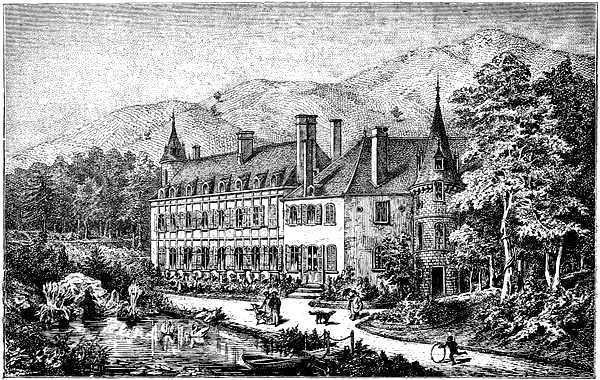
CHÂTEAU OF PIERRY, THE PROPERTY OF MESSRS. GÉ-DUFAUT AND CO.
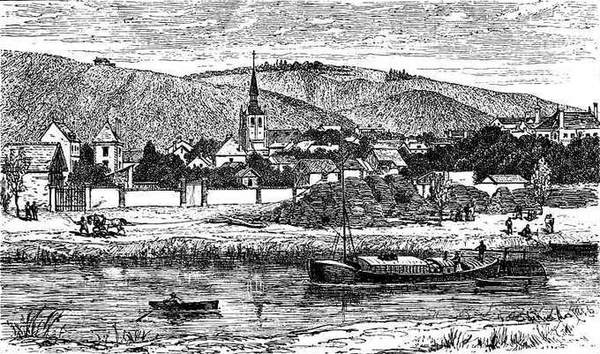
VIEW OF AY FROM THE BANKS OF THE MARNE CANAL.
XI. SOME CHAMPAGNE ESTABLISHMENTS AT AY AND MAREUIL.
The bourgade of Ay and its eighteenth-century château—Gambling propensities of a former owner, Balthazar Constance Dangé-Dorçay—Appreciation of the Ay vintage by Sigismund of Bohemia, Leo X., Charles V., Francis I., and Henry VIII.—Bertin du Rocheret celebrates this partiality in triolets—Estimation of the Ay wine in the reigns of Charles IX. and Henri III.—Is a favoured drink with the leaders of the League, and with Henri IV., Catherine de Medicis, and the courtiers of that epoch—The ‘Vendangeoir d’Henri Quatre’ at Ay—The King’s pride in his title of Seigneur d’Ay and Gonesse—Dominicus Baudius punningly suggests that the ‘Vin d’Ay’ should be called ‘Vinum Dei’—The merits of the wine sung by poets and extolled by wits—The Ay wine in its palmy days evidently not sparkling—Arthur Young’s visit to Ay in 1787—The establishment of Deutz & Geldermann—Drawing off the cuvée there—Mode of excavating cellars in the Champagne—The firm’s new cellars, vineyards, and vendangeoir—M. Duminy’s cellars and wines—The house founded in 1814—The new model Duminy establishment—Picturesque old house at Ay—Messrs. Pfungst Frères & Co.’s cellars—Their finely-matured dry Champagnes—The old church of Ay and its numerous decorations of grapes and vine-leaves—The sculptured figure above the Renaissance doorway—The Montebello establishment at Mareuil—The château formerly the property of the Dukes of Orleans—A titled Champagne firm—The brilliant career of Marshal Lannes—A promenade through the Montebello establishment—The press-house, the cuvée-vat, the packing-room, the offices, and the cellars—Portraits and relics at the château—The establishment of Bruch-Foucher & Co.—The handsome carved gigantic cuvée-tun—The cellars and their lofty shafts—The wines of the firm.
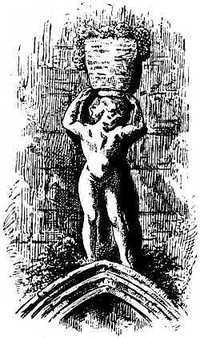
FIGURE ABOVE THE DOORWAY OF AY CHURCH.
THE historic bourgade of Ay is within a short walk of the station on the line of railway connecting Epernay with Reims. The road lies across the light bridge spanning the Marne canal, the tall trees fringing which hide for a time the clustering houses; still we catch sight of the steeple of the antique church, relieved by a background of vine-covered slopes, and of an eighteenth-century château rising above a mass of foliage. Perched half-way up the slope, covered with ‘golden plants,’ which rises in the rear of the village, the château, with its long façade of windows, commands the valley of the Marne for miles; and from the stately-terraced walk, planted with ancient lime-trees, geometrically clipped in the fashion of the last century, a splendid view of the distant vineyards of Avize, Cramant, Epernay, and Chouilly is obtained. The château formed one of a quartette of seignorial residences which, at the commencement of the present century, belonged to Balthazar Constance Dangé-Dorçay, whose ancestors had been lords of Chouilly under the ancien régime. Dorçay had inherited from an aunt the châteaux of Ay, Mareuil, Boursault, and Chouilly, together with a large patrimony in land and money; but a mania for gambling brought him to utter ruin, and he dispossessed himself of money, lands, and châteaux in succession, and was reduced, in his old age, to earn a meagre pittance as a violin-player at the Paris Opera-house. The old château of Boursault, which still exists contiguous to the stately edifice raised by Madame Clicquot on the summit of the hill, was risked and lost on a single game at cards by this pertinacious gamester, whose pressing pecuniary difficulties compelled him to sell the remaining châteaux one by one. That of Ay was purchased by M. Froc de la Boulaye, and by him bequeathed to his cousin the Count de Mareuil, whose son is to-day a partner in the Champagne house of Ayala & Co.
The wine of Ay, from an early date, has found equal favour in the eyes of poets and princes. Eustache Deschamps sang its praises in the fourteenth century, and was echoed a hundred years later by the anonymous author of the Eglogue sur le Retour de Bacchus.[456] Sigismund of Bohemia, the betrayer of John Huss, on visiting France in 1410, desired to pass through Ay in order to taste the wine at the place of its production.[457] Leo X., Charles V., Francis III., and our own Henry VIII., each had a house in or near Ay; ‘for amongst all the great affairs of state which these princes had to unravel, supplying themselves with this vintage was not the least of their cares.’[458] Malicious tongues have asserted that they were somewhat suspicious of the honesty of the wine-growers of the district, and, in order to secure a genuine article, deemed it needful to have a commissioner or agent resident on the spot, to superintend the making of the wine set apart for their own consumption.[459] Tradition still points out, on the right of the road from Dizy to Ay, a vineyard called Le Léon, as the one whence the Pope derived his wine, though no traces remain of the vendangeoir built by the Emperor in a coppice above Ay during the siege of Epernay in 1544, and still standing in 1727.[460] The president Bertin du Rocheret has celebrated the partiality of a couple of these potentates for the wine of Ay in some triolets addressed to M. de Senécé, and published in the Mercure in 1728:
‘Ay produces the best wine— I call the world to witness this; Though you may for Reims opine, Ay produces the best wine. It ranks the first, and the most fine St. Evremond has said it is. Ay produces the best wine— I call the world to witness this. Charles the Fifth was well aware Of this—far better than his friend Adrian in the papal chair; Charles the Fifth was well aware Of this, and so, to get his share, Sought in France his days to end. Charles the Fifth was well aware Of this—far better than his friend. Lest some fraud the juice should mix, And his table thus disgrace, He would his own vintage fix, Lest some fraud the juice should mix. Leo, fearing the like tricks, Bought in Ay a pressing-place, Lest some fraud the juice should mix, And his table thus disgrace.’[461]
The wine of Ay ranked at the court of Charles IX. as ‘a very pleasant and noble wine;’[462] and even that bigoted uprooter of vines and heresy had a vendangeoir in this stronghold of Protestantism,[463] which the Catholics of the Champagne marched against, singing—
‘Parpaillot d’Ay, T’es bien misérable, T’as quitté ton Di Pour servir le diable; Tu n’auras ni chien, ni chat, Pour te chanter Libera, Et tu mourras mau-chrétien, Toi qu’a maudit Saint Trézain.’[464]
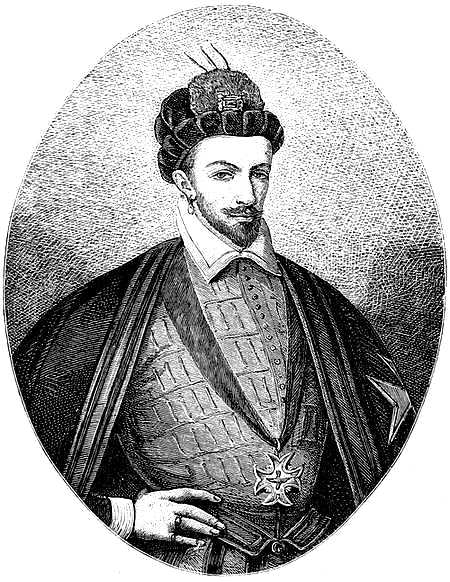
HENRI III. (From a painting of the period).
In the reign of Henri III. the wines of Ay—‘claret and yellowish, subtile, fine, and in taste very pleasing to the palate, ... yet therewithal such wines as the Greeks call Oligophora, and as will not admit the mixture of much water’[465]—were ‘eagerly sought after for the use of kings, princes, and great lords.’[466] At a time when the bulk of the vintage of Burgundy was denounced as rough, sour, and harsh; and that of Bordeaux stigmatised as thick and black; and when good and bad years were allowed to have a considerable influence upon the growths of the Isle of France, the Orleannais, and Anjou, it was admitted that ‘the wines of Ay do, for the most part, hold the first and principal place, ... and are, in all good and evil years, found better than any others.’[467] The kings and princes of the day made the wines of Ay their ordinary drink.[468] They flowed freely in the scandalous orgies with which the French Heliogabalus and his mignons alternated their pious flagellations and solemn processions, and mantled in the beakers over which the chiefs of the League sat in dark and solemn conclave; they were quaffed by the Béarnais to the bright eyes of the fair De Saulve, and cheered the nightly vigils of Catherine de Medicis and Ruggieri; they sharpened the biting wit of Chicot, and spurred the plotting spirit of Francis of Anjou. Guise and Crillon, Joyeuse and D’Epernon, Mayenne and D’Aubigné made common cause in recognising their merits; Quelus and Maugiron may have quaffed a goblet before setting forth on their fatal journey to the Barrière Saint Antoine; and a cup, filled by the fair hands of the Duchess de Montpensier, may have fired the brain and nerved the arm of the regicide Jacques Clément.
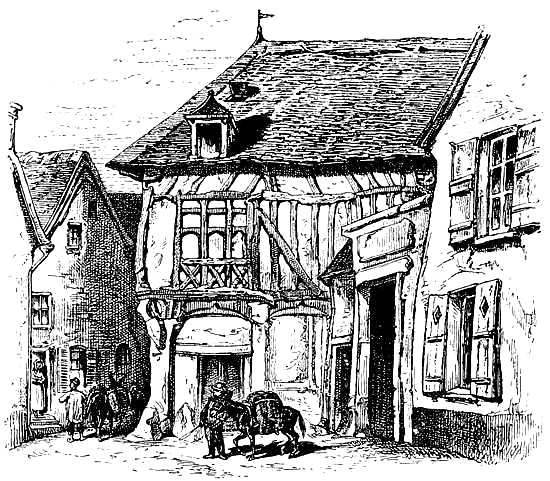
OLD HOUSE AT AY, KNOWN AS THE VENDANGEOIR OF HENRI QUATRE.
Henri Quatre boasted the merits of his vineyard at Prepaton, near Vendôme, when he was only King of Navarre,[469] and delighted in the wine of Arbois.[470] At Ay, within a few yards of the church, there is a quaint old timber house traditionally known as the ‘vendangeoir d’Henri Quatre,’ with obliterated carved escutcheons on the pillars of its doorway. In this dilapidated yet interesting structure we have a mute but certain testimony to the King’s appreciation of the wine of Ay, if not a confirmation of the truth of the assertion that Henri was as proud of his title of Seigneur d’Ay as of that of King of France.[471] Giving an audience to the Spanish ambassador, and irritated at the long list of titles appended by the punctilious hidalgo to his royal master’s name, he exclaimed: ‘You will say to his Highness Philip, King of Spain and the Indies, Castille, Leon, Arragon, Murcia, and the Balearic Isles, that Henri, Sieur of Ay and of Gonesse ...,’ being the places producing the best wine and the whitest bread in France.[472] When encamped at Damery, during the siege of Epernay, this favourite beverage, and the smiles of the fair Anne Dudey, Présidente du Puy, helped to relieve the tedium of campaigning; for, as Bertin du Rocheret has sung,
‘Our great Henry, king benign, With it cheered his “belle hôtesse.” When at Damery he’d dine, Our great Henry, king benign, Chose it for his favourite wine; And for bread, that of Gonesse Our great Henry, king benign, With it cheered his “belle hôtesse.”’[473]
With the vintage of Ay in such universal esteem, it is scarcely to be wondered at that Dominicus Baudius, professor of eloquence at the University of Leyden and historiographer to the States of the Netherlands, should, in the fulness of his admiration, have declared to his friend the Président du Thou that instead of vin d’Ay it ought to be called vinum Dei.[474]
Olivier de Serres, the French Tusser, praises this divine liquor.[475] The anonymous author of the Hercule Guepin, a poem penned at the commencement of the seventeenth century in honour of the wine of Orleans, is forced to acknowledge the merits of that of Ay;[476] and that indefatigable commentator, the Abbé de Marolles, in a note to his edition of Martial, classes the growths of Ay, Avenay, and Epernay amongst the best that France produced. ‘Vive le bon vin d’Ay!’ exclaims Guy Patin enthusiastically; and that strange compound of the wit and the philosopher, St. Evremond, has extolled its qualities in prose and verse.[477] ‘If you ask me which wine of all others I prefer,’ he writes from London to the Count d’Olonne, about 1671, ‘without yielding to tastes introduced by people of sham daintiness, I will answer that good wine of Ay is the most natural of all wines, the most healthy, the best purified from all earth smack; of a most exquisite charm, through the peach flavour which is peculiar to it; and is, in my opinion, the finest of all flavours.’[478]
It is improbable that the wine of Ay of Francis I., or of Henri Quatre, was mousseux, for had it been so history would have mentioned it. In good years the still wine of Ay has a bouquet and perfume sufficient to account for its ancient reputation. Neither was the wine St. Evremond preferred sparkling, though his reference to the taste introduced by sham gourmets points probably to the custom of drinking the wine before its fermentation was completed, or else to the practice of icing it. When once, however, the introduction of vin mousseux added a new charm to the pleasures of the table, the poets who sang the praises of the foaming nectar seem one and all to have celebrated it as the ‘pétillant Ay,’ and to have chosen, perhaps for euphonistic reasons, that spot as its birthplace.[479] The material results were equally satisfactory; for Arthur Young mentions that when, on July 8, 1787, he visited ‘Ay, a village not far out on the road to Reims very famous for its wines,’ he was provided with a letter for M. Lasnier, who had 60,000 bottles in his cellar, whilst M. Dorsé had from 30,000 to 40,000.[480]
A century ago the foregoing were no doubt considered large stocks, but to-day the very smallest of the Ay firms would think itself poorly provided if its cellars contained under quadruple this quantity. The largest Champagne establishment at Ay is that of Messrs. Deutz & Geldermann, whose extra dry ‘Gold Lack’ and ‘Cabinet’ Champagnes have long been favourably known in England, through the energetic exertions of their agents, Messrs. J. R. Parkington & Co., of Crutched Friars. The Ay firm have their offices in a massive-looking corner-house at the further extremity of the town, in the direction of the steep hills sheltering it on the north. This forms their central establishment, and here are spacious celliers for disgorging and finishing off the wine, a large packing-hall, and rooms where bales of corks and other accessories of the trade are stored, the operations of making the cuvées and bottling being accomplished in an establishment some little distance off.
On proceeding thither, we find an elegant château with a charming terraced garden, lying at the very foot of the vine-clad slopes, and on the opposite side of the road some large celliers where wine in wood is stored, and where the cuvées of the firm, consisting usually of upwards of 50,000 gallons each, are made in a vat of gigantic proportions, furnished with a raised platform at one end for the accommodation of the workman who agitates the customary paddles. When the wine is completely blended it is drawn off into casks disposed for the purpose in the cellar below, as shown in the accompanying engraving, and after being fined it rests for about a month to clear itself. To each of these casks of newly-blended wine a portion of old wine is added separately, and at the moment of bottling the whole is newly amalgamated.
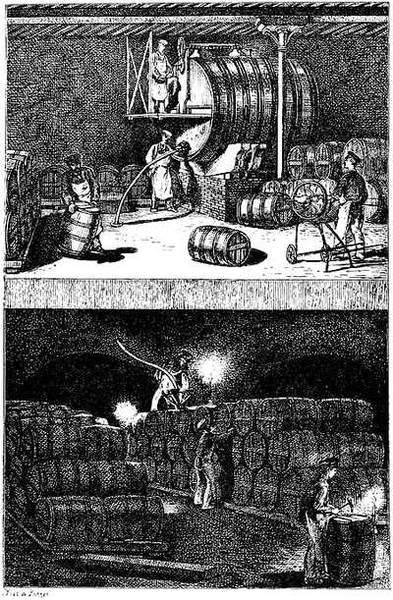
DRAWING OFF THE CUVÉE AT DEUTZ AND GELDERMANN’S, AY.
Adjoining M. Deutz’s château is the principal entrance to the extensive cellars of the firm, to which, at our visit in 1877, considerable additions were being made. In excavating these cellars in the chalk a uniform system is pursued. The workmen commence by rounding off the roof of the gallery, and then proceed to work gradually downwards, extracting the chalk, whenever practicable, in blocks suitable for building purposes, which, being worth from three to four shillings the square yard, help to reduce the cost of the excavation. When any serious flaws present themselves in the sides or roof of the galleries, they are invariably made good with masonry.
This splendid range of cellars now comprises eight long and lofty galleries no less than seventeen feet wide, and the same number of feet in height, and of the aggregate length of 2200 yards. These spacious vaults, which run parallel with each other, and communicate by means of cross passages, underlie the street, the château, the garden, and the vineyard slopes beyond, and possess the great advantage of being always dry. They are capable, we were informed, of containing several million bottles of Champagne, in addition to a large quantity of wine in cask.
Messrs. Deutz & Geldermann possess vineyards at Ay, and own a large vendangeoir at Verzenay, where in good years they usually press 500 pièces of wine. They, moreover, make large purchases of grapes at Bouzy, Cramant, Le Mesnil, Pierry, &c., and invariably have these pressed under their own superintendence. Beyond large shipments to England, where their wine is deservedly held in high estimation, Messrs. Deutz & Geldermann transact a considerable business with other countries, and more especially with Germany, in which country their brand has been for years one of the most popular, while to-day it is the favourite at numerous regimental messes and the principal hotels.
Within a hundred yards of the open space, surrounded by houses of different epochs and considerable diversity of design, where the Ay market-hall stands, and in one of those narrow winding streets common to the town, an escutcheon, with a bunch of grapes for device, surmounting a lofty gateway, attracts attention. Beyond, a trim courtyard, girt round with orange-trees in bright green boxes, and clipped in orthodox fashion, affords access to the handsome residence and offices of M. Duminy, well known in England and America as a shipper of high-class Champagnes, and whose Parisian connection is extensive. On the right-hand side of the courtyard is the packing-room; and through the cellars, which have an entrance here, one can reach the celliers in an adjoining street, where the cuvée is made and the bottling of the wine accomplished.
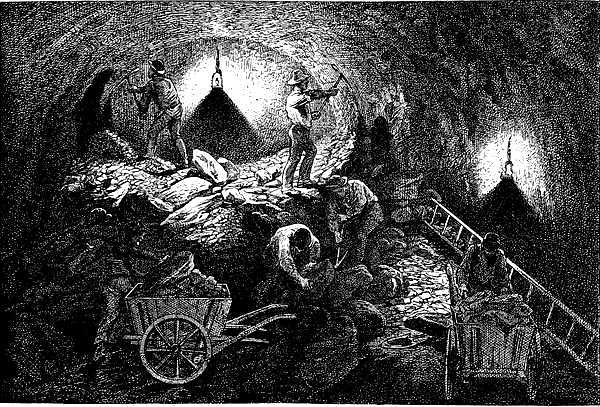
THE EXCAVATION OF DEUTZ AND GELDERMANN’S NEW CELLARS AT AY.
M. Duminy’s cellars are remarkably old, and consequently of somewhat irregular construction, being at times rather low and narrow, as well as on different levels. In addition, however, to these venerable vaults, packed with wines of 1874 and ’78, M. Duminy has a new and extensive establishment on the outskirts of Ay, as well as various subterranean adjuncts in the town itself. This new establishment, which stands under the vineclad slope, and merely a stone’s throw from the railway line to Reims, consists of a large ornamental building looking on to a spacious courtyard ordinarily alive with busy workpeople. In addition to the pavilion already erected, it is intended to construct one of similar design, and to connect the two with a monumental tower. The requisite land has already been purchased, the architectural plans are prepared, and the work is now in active progress.
Entering the courtyard of which we have spoken, we notice the new offices of the firm on the left hand, and extending along the wall beyond is a long zinc-roofed shed, crowded with baskets filled with newly-purchased Champagne bottles. On the opposite side of the courtyard is a building in which the operation of bottle-washing is carried on. The pavilion in the rear of the courtyard is of somewhat monumental proportions, and is ornamented with dressings of white stone and red brick. Entering through the principal doorway, we find ourselves in a vast cellier, where the packing operations are carried on, and where are a couple of huge tuns in which the cuvées of the house are made. A stone staircase conducts to an upper cellier, where several hundred casks of vin brut are stored, and for the raising or lowering of which lifts are provided at stated distances. In an apartment above this second cellier straw envelopes for bottles and other accessories employed in the trade are kept.
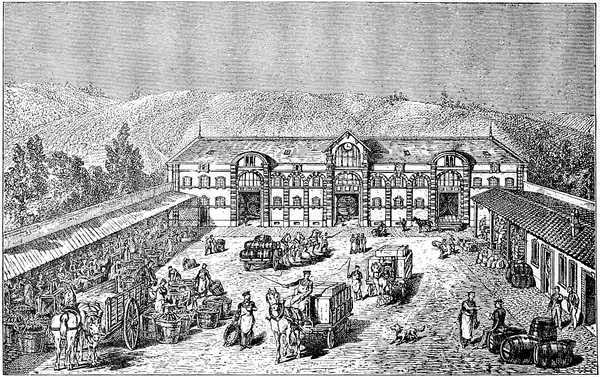
M. DUMINY’S NEW ESTABLISHMENT AT AY.
The cellars extend, not merely beneath this large building and the courtyard in front, but run under the adjacent mountain-slope. They comprise four galleries on the same level, vaulted and faced with brick or stone, each gallery being about 500 feet in length and upwards of twelve feet in width and height. Eight transverse passages connect these galleries with each other, and numerous lifts communicate with the cellier and the courtyard above. The galleries that run under the vineyard slope are ventilated by shafts no less than 120 feet in height. M. Duminy has already provided room here for a million bottles of sparkling wine; and it is estimated that, when the establishment is completed, two and a half millions of bottles can be stored here in addition to the stock contained in the old cellars possessed by M. Duminy in the town. During its two-thirds of a century of existence the house has invariably confined itself to first-class wines, taking particular pride in shipping fully-matured growths. Besides its own large reserve of these, it holds considerable stocks long since disposed of, and now merely awaiting the purchasers’ orders to be shipped.
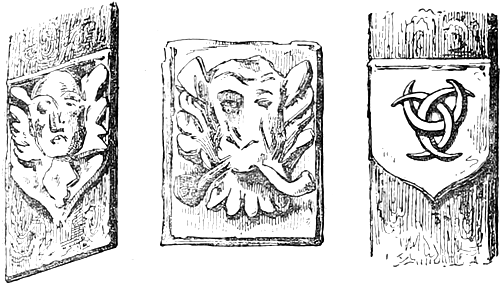
A few paces beyond M. Duminy’s we come upon an antiquated, decrepit-looking timber house, with its ancient gable bulging over as though the tough oak brackets on which it rests were at last grown weary of supporting their unwieldy burden. Judging from the quaint carved devices on the timbers at the lower portions of this building, one may imagine it to have been the residence of an individual of some importance in the days when the principal European potentates had their commissioners installed at Ay to secure them the finest vintages. The house evidently dates back to this or to an earlier epoch.
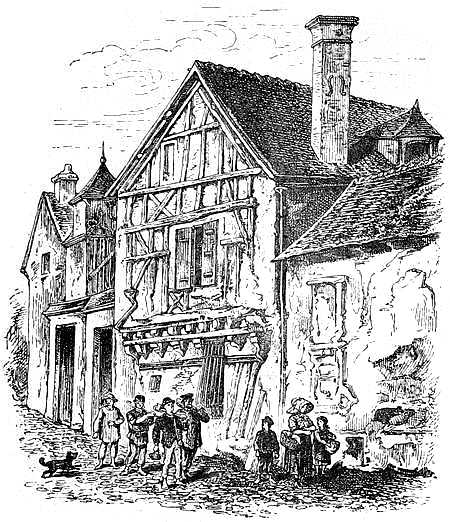
ANCIENT TIMBER HOUSE AT AY.
The cellars of Messrs. Pfungst Frères et Cie. are situated some little distance from the vineyard owned by them at Ay. The firm lay themselves out exclusively for the shipment of high-class Champagne, and the excellent growths of this district necessarily form an important element in their carefully-composed cuvées. A considerable portion of their stock consists of reserves of old wine of grand years; and a variety of samples of finely-matured Champagnes were submitted to our judgment. All of these wines were of superior quality, combining delicacy and fragrance with dryness, the latter being their especial feature. In addition to their business with England, where the brand of the firm is rapidly increasing in popularity among connoisseurs of matured wines, Messrs. Pfungst Frères ship largely to India and the United States.
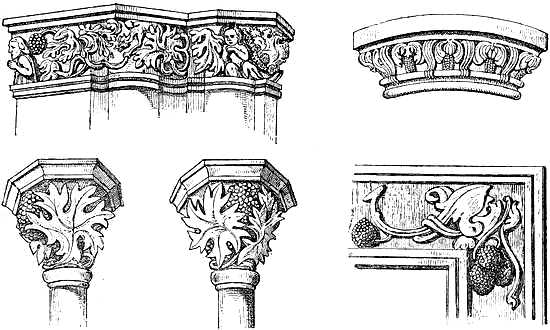
CAPITALS AND MOULDINGS IN AY CHURCH.
On the northern side of the town stands the handsome Gothic church of Ay, dating from about the middle of the fifteenth century. The existing building replaced the edifice erected some two hundred years previously, and traces of which are still to be seen in the present transept. The stone tower, which is in striking contrast with the other portions of the structure, bears the date 1541 on its western face. This tower and the interior of the church were greatly damaged by the fire—traditionally ascribed to lightning—which occurred at the close of the sixteenth century, and the former had to be strengthened by filling up the arched windows and by the addition of buttresses. The bell, whose terrible tocsin used to warn good citizens that the patrie was in danger in the days of the Revolution, when the church was converted into a Temple of Reason, had previously swung in the abbey of Hautvillers, and may have summoned the vintagers to labour as well as the faithful to prayer. From 1867 to 1877 extensive interior repairs and restorations, costing upwards of 6000 l., greatly transformed the interior of the church. Care was, however, taken to preserve the numerous bits of mediæval and Renaissance sculpture with which both the interior and exterior of the edifice were studded. In many of the ornamental mouldings, as well as the capitals of the columns, grape-laden vine-branches had been freely introduced, as if to indicate the honour in which the vine, the material source of all the prosperity enjoyed by the little town, was held both by mediæval and later architects; and these appear all to have been scrupulously restored. One of the most characteristic decorations of this character is the sculptured figure of a boy bearing a basket of grapes upon his head, which surmounts the handsome Renaissance doorway.
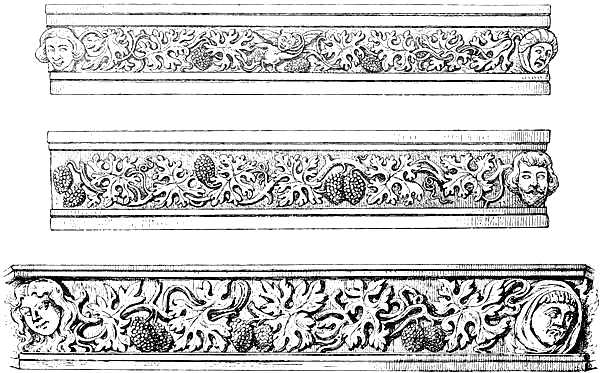
MOULDINGS FROM AY CHURCH.
Within half an hour’s walk of Ay, in an easterly direction, is the village of Mareuil, a long straight street of straggling houses, bounded by trees and garden-plots, with vine-clad hills rising abruptly behind on the one side, and the Marne canal flowing placidly by on the other. The archaic church, a mixture of the Romanesque and Early Gothic, stands at the farther end of the village, and some little distance on this side of it is a massive-looking eighteenth-century building, spacious enough to accommodate a regiment of horse, but conventual rather than barrack-like in aspect, from the paucity of windows looking on to the road. A broad gateway leads into a spacious courtyard, to the left of which stands a grand château; while on the right there rises an ornate round tower of three stories, from the gallery on the summit of which a fine view over the valley of the Marne is obtained. The buildings, enclosing the court on three sides, comprise press-houses, celliers, and packing-rooms, an antiquated sun-dial marking the hour on the blank space above the vines that climb beside the entrance gateway. The more ancient of these tenements formed the vendangeoir of the Dukes of Orleans at the time they owned the château of Mareuil, purchased in 1830 by the Duke de Montebello, son of the famous Marshal Lannes, and minister and ambassador of Louis Philippe and Napoleon III.
The acquisition of this property, to which were attached some important vineyards, led, several years later, to the duke’s founding, in conjunction with his brothers, the Marquis and General Count de Montebello, a Champagne firm, whose brand speedily acquired a notable popularity. To-day the business is carried on by their sons and heirs, for all the original partners in the house have followed their valiant father to the grave. Struck down by an Austrian cannon-ball in the zenith of his fame, the career of Marshal Lannes, brief as it was, furnishes one of the most brilliant pages in French military annals. Joining the army of Italy as a volunteer in 1796, he was made a colonel on the battle-field in the gorges of Millesimo, when Augereau’s bold advance opened Piedmont to the French. He fought at Bassano and Lodi, took part in the assault of Pavia and the siege of Mantua, and at Arcola, when Napoleon dashed flag in hand upon the bridge, Lannes was seriously wounded whilst shielding his general from danger. He afterwards distinguished himself in Egypt, and led the van of the French army across the Alps, displaying his accustomed bravery both at Montebello and Marengo. At Austerlitz, where he commanded the right wing of the army, he greatly contributed to the victory; and at Jena, Friedland, and Eylau his valour was again conspicuous. Sent to Spain, he defeated the Spaniards at Tudela, and took part in the operations against Saragossa. Wounded at the battle of Essling, when the Archduke Charles inflicted upon Napoleon I. the first serious repulse he had met with on the field of battle, the valiant Lannes expired a few days afterwards in the Emperor’s arms.
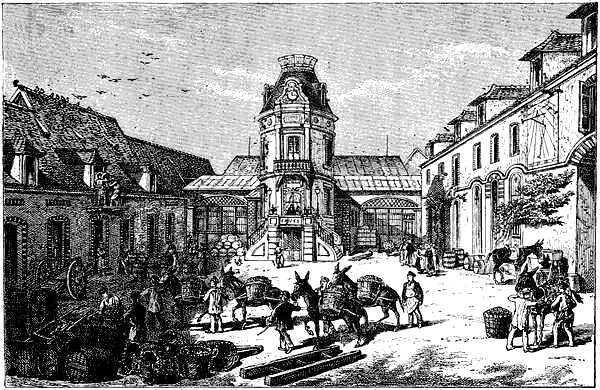
THE MONTEBELLO ESTABLISHMENT AT MAREUIL.
We were met at Mareuil, on the occasion of our visit, by Count Alfred Ferdinand de Montebello, the present manager of the house, and conducted by him over the establishment. In the press-house, to the left of the courtyard, were two of the ponderous presses used in the Champagne, for, like all other large firms, the house makes its own wine. Grapes grown in the Mareuil vineyards arrive here in baskets slung over the backs of mules, muzzled, so that while awaiting their loads they may not devour the fruit within reach. In a cellier adjoining the press-house stands a large vat, capable of holding fifty pièces of wine, with a crane beside it for hauling up the casks when the cuvée is made. Here the tirage likewise takes place; and in the range of buildings roofed with glass, in the rear of the tower, the bottled wine is labelled, capped with foil, and packed in cases for transmission to Paris, England, and other places abroad.
A double flight of steps, decorated with lamps and vases, leads to the handsome offices of the firm, situated on the first-floor of the tower; while above is an apartment with a panelled ceiling, gracefully decorated with groups of Cupids engaged in the vintage and the various operations which the famous wines of the Mountain and the River undergo during their conversion into Champagne. On the ground-floor of the tower a low doorway conducts to the spacious cellars, which, owing to the proximity of the Marne, are all on the same level as well as constructed in masonry. The older vaults, where the Marquis de Pange, a former owner of the château, stored the wine which he used to sell to the Champagne manufacturers, are somewhat low and tortuous compared with the broad and lofty galleries of more recent date, which have been constructed as the growing connection of the firm obliged them to increase their stocks. Spite, however, of numerous additions, portions of their reserves have to be stored in other cellars in Mareuil. Considerable stocks of each of the four qualities of wine supplied by the firm are being got ready for disgorgement, including Cartes Noires and Bleues, with the refined Carte Blanche and the delicate Crêmant, which challenge comparison with brands of the highest repute.
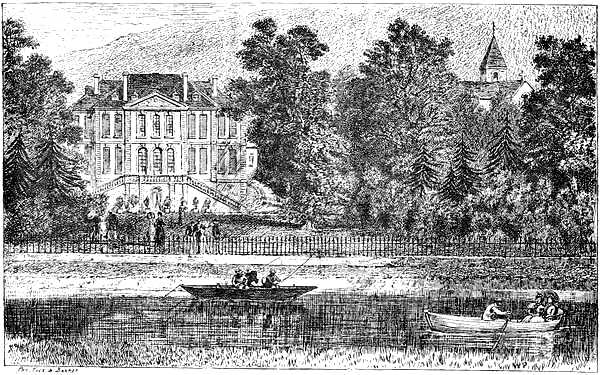
CHÂTEAU OF MAREUIL, BELONGING TO THE DUKE OF MONTEBELLO.
In the adjacent château, the gardens of which slope down to the Marne canal, there are various interesting portraits, with one or two relics of the distinguished founder of the Montebello family, notably Marshal Lannes’s gold-embroidered velvet saddle trappings, his portrait and that of Marshal Gerard, as well as one of Napoleon I., by David, with a handsome clock and candelabra of Egyptian design, a bust of Augustus Cæsar, and a portrait of the Regent d’Orleans.
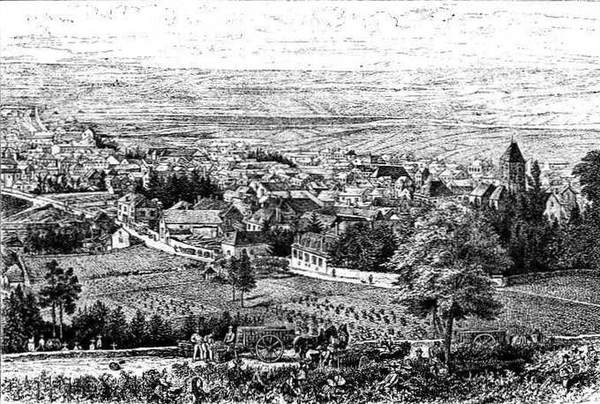
GENERAL VIEW OF AVIZE.
XII. CHAMPAGNE ESTABLISHMENTS AT AVIZE AND RILLY.
Avize the centre of the white grape district—Its situation and aspect—The establishment of Giesler & Co.—The tirage and the cuvée—Vin Brut in racks and on tables—The packing-hall, the extensive cellars, and the disgorging cellier—Bottle stores and bottle-washing machines—Messrs. Giesler’s wine-presses at Avize and vendangeoir at Bouzy—Their vineyards and their purchases of grapes—Reputation of the Giesler brand—The establishment of M. Charles de Cazanove—A tame young boar—Boar-hunting in the Champagne—M. de Cazanove’s commodious cellars and carefully-selected wines—Vineyards owned by him and his family—Reputation of his wines in Paris and their growing popularity in England—Interesting view of the Avize and Cramant vineyards from M. de Cazanove’s terraced garden—The vintaging of the white grapes in the Champagne—Roper Frères’ establishment at Rilly-la-Montagne—Their cellars penetrated by roots of trees—Some samples of fine old Champagnes—The principal Châlons establishments—Poem on Champagne by M. Amaury de Cazanove.