PART II.
Reading edition
I. THE CHAMPAGNE VINELANDS—THE VINEYARDS OF THE RIVER.
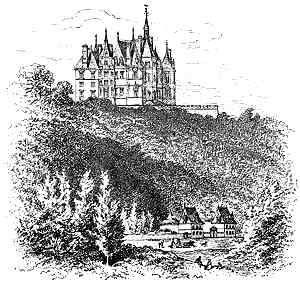
CHÂTEAU DE BOURSAULT.
The vinelands in the neighbourhood of Epernay—Viticultural area of the Champagne—A visit to the vineyards of ‘golden plants’—The Dizy vineyards—Antiquity of the Ay vineyards—St. Tresain and the wine-growers of Ay—The Ay vintage of 1871—The Mareuil vineyards and their produce—Avernay; its vineyards, wines, and ancient abbey—The vineyards of Mutigny and Cumières—Damery and ‘la belle hôtesse’ of Henri Quatre—Adrienne Lecouvreur and the Maréchal de Saxe’s matrimonial schemes—Pilgrimage to Hautvillers—Remains of the Royal Abbey of St. Peter—The ancient church—Its quaint decorations and monuments—The view from the heights of Hautvillers—The abbey vineyards and wine-cellars in the days of Dom Perignon—The vinelands of the Côte d’Epernay—Pierry and its vineyard cellars—The Moussy, Vinay, and Ablois St. Martin vineyards—The Côte d’Avize—Chavot, Monthelon, Grauves, and Cuis—The vineyards of Cramant and Avize, and their light delicate white wines—The Oger and Le Mesnil vineyards—Vertus and its picturesque ancient remains—Its vineyards planted with Burgundy grapes from Beaune—The red wine of Vertus a favourite beverage of William III. of England.
WITH the exception of certain famous vineyards of the Rhône, the vinelands of the Champagne may, perhaps, be classed among the most picturesque of the more notable vine-districts of France. Between Paris and Epernay, even, the banks of the Marne present a series of scenes of quiet beauty. The undulating ground is everywhere cultivated like a garden. Handsome châteaux and charming country houses peep out from amid luxuriant foliage. Picturesque antiquated villages line the river’s bank or climb the hill-sides, and after leaving La Ferté-sous-Jouarre, the cradle of the Condés, all the more favoured situations commence to be covered with vines.
This is especially the case in the vicinity of Château-Thierry—the birthplace of La Fontaine—where the view is shut in on all sides by vine-clad slopes, which the spring frosts seldom spare. Hence merely one good vintage out of four gladdens the hearts of the peasant proprietors, who find eager purchasers for their produce among the lower-class manufacturers of Champagne. In the same way the petit vin de Chierry, dexterously prepared and judiciously mingled with other growths, often figures as ‘Fleur de Sillery’ or ‘Ay Mousseux.’ In reality it is not until we have passed the ornate modern Gothic château of Boursault, erected in her declining years by the wealthy Veuve Clicquot, by far the shrewdest manipulator of the sparkling products of Ay and Bouzy of her day, and the many towers and turrets of which, rising above umbrageous trees, crown the loftiest height within eyeshot of Epernay, that we find ourselves in that charmed circle of vineyards whence Champagne—the wine, not merely of princes, as it has been somewhat obsequiously termed, but essentially the vin de société—is derived.
The vinelands in the vicinity of Epernay, and consequently near the Marne, are commonly known as the ‘Vineyards of the River,’ whilst those covering the slopes in the neighbourhood of Reims are termed the ‘Vineyards of the Mountain.’ The Vineyards of the River comprise three distinct divisions—first, those lining the right bank of the Marne and enjoying a southern and south-eastern aspect, among which are Ay, Hautvillers, Cumières, Dizy, and Mareuil; secondly, the Côte d’Epernay on the left bank of the river, of which Pierry, Moussy, and Vinay form part; and thirdly, the Côte d’Avize (the region par excellence of white grapes), which stretches towards the south-east, and includes the vinelands of Cramant, Avize, Oger, Le Mesnil, and Vertus. The entire vineyard area is upwards of 40,000 acres.[378]
The Champagne vineyards most widely celebrated abroad are those of Ay and Sillery, although the last named are really the smallest in the Champagne district. Ay, distant only a few minutes by rail from Epernay, is in the immediate centre of the Vinelands of the River, having Mareuil and Avenay on the east, and Dizy, Hautvillers, and Cumières on the west; while Sillery lies at the foot of the so-called Mountain of Reims, and within an hour’s drive of the old cathedral city.
It was on one of those occasional sunshiny days in the early part of October[379] when we first visited Ay—the vineyard of ‘golden plants,’ the unique premier cru of the Wines of the River—and the various adjacent vinelands. The road lay between two rows of closely-planted poplar-trees reaching almost to the village of Dizy, whose quaint gray church-tower, with its gabled roof, is dominated by the neighbouring vine-clad slopes, which extend from Avenay to Venteuil, some few miles beyond Hautvillers, the cradle, so to speak, of the vin mousseux of the Champagne. The vineyards of Dizy, the upper soil of which is largely mixed with loose stones, have chiefly a southern or western aspect, and, excepting in the case of the precipitous height suggestively styled ‘Grimpe Chat,’ their incline is generally a gentle one. In these vineyards, which rank among the premiers crus of the Champagne, a quantity of wine from white grapes is regularly made.
From Dizy the road runs immediately at the base of vine-clad slopes, broken up occasionally by a conical peak detaching itself from the mass, and tinted from base to summit with richly-variegated hues, among which deep purple, yellow, green, gray, and crimson by turns predominate. On our right hand we pass a vineyard called Le Léon, which tradition asserts to be the one whence Pope Leo the Magnificent, the patron of Michael Angelo, Raffaelle, and Da Vinci, drew his supply of Ay wine. The village of Ay lies immediately before us at the foot of the slopes of vines, with the tapering spire of its ancient church rising above the neighbouring hills and cutting sharply against the bright blue sky. The vineyards, which spread themselves over a calcareous declivity, have mostly a full southern aspect, and the predominating vines are those known as golden plants, the fruit of which is of a deep purple colour. After these comes the plant vert doré, and then a moderate proportion of the plant gris, white varieties of grapes being no longer cultivated as formerly.[380]
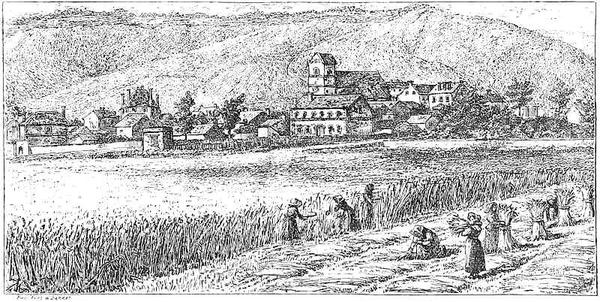
DIZY AND ITS VINEYARD SLOPES.
The Ay vineyards are mentioned in a charter of Edmund of Lancaster, son of our Henry II. and guardian of Jehanne, heiress of Henri le Gros, Count of Champagne, dated 1276, and confirming the right of the Abbey of Avenay to four hogsheads of wine from the terroir of Ay.[381] If faith, however, may be placed in monkish legends, their existence dates back to the sixth century, at which epoch St. Tresain, the patron saint of Avenay and a contemporary of St. Remi, emigrated to the Champagne from Scotland. Having given away all he possessed in charity, he became perforce a swineherd at Mutigny, a village on the summit of the hill overlooking Ay, Mareuil, and Avenay. One day the vine-growers of Ay, hearing that St. Remi was at Ville-en-Selve, sought him out, and clamorously accused St. Tresain of neglecting to look after his pigs, which had devastated the vineyards on the slopes, and so caused great loss to the community. When called upon for his defence, St. Tresain acknowledged that he was wont to listen in the church-porch to the celebration of mass, and to forget on these occasions all such sublunary matters as swine. St. Remi, finding him so deeply religious, not only forgave him his negligence and relieved him from his porcine charge for the future, but appointed him parish priest of Mareuil and Mutigny, the inhabitants of which, it is to be hoped, received more attention from him than his pigs had done. St. Tresain, although his promotion was brought about by the complaint of the men of Ay, retorted on the latter in a vindictive and unsaintly spirit, for he ill-naturedly cursed them, and declared that after thirty years of age not one of them or their posterity should prosper temporally or spiritually—a prophecy which, if it affected the vine-growers of that epoch, has proved harmless enough in the case of their descendants.[382]
At Ay we visited the pressoir of the principal producer of vin brut, who, although the owner of merely five hectares, or about twelve and a half acres of vines, expected to make as many as 1500 pièces of wine that year, mainly of course from grapes purchased from other growers.[383] On our way from Ay to Mareuil, along the lengthy Rue de Châlons, we looked in at the little auberge at the corner of the Boulevard du Sud, and found a crowd of coopers and others connected in some way with the vintage, taking their cheerful glasses round. The walls of the room were appropriately enough decorated with capering bacchanals squeezing bunches of purple grapes and flourishing their thyrsi about in a very tipsy fashion. All the talk—and there was an abundance of it—had reference to the yield of this particular vintage and the high rate the Ay wine had realised. Eight hundred francs the pièce of 200 litres, equal to 44 gallons, appeared to be the price fixed by the agents of the great Champagne houses, and at this figure the bulk of the vintage was disposed of before a single grape passed through the winepress.[384]
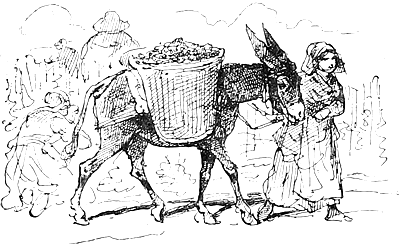
The Mareuil vinelands, which include the vineyard bequeathed some six hundred years ago by Canon John de Brie to the chapter of Reims cathedral, and possibly those vineyards bestowed in 1208 on the Abbey of Avenay by Alain de Jouvincourt, cover the slopes of two coteaux, the first a continuation of the Côte d’Ay, and the second a detached spur, known as the Mont de Fourche, overlooking the Marne canal. Owing to the steepness of the slopes and to the roads through the vineyards being impracticable for carts, the grapes were being conveyed to the press-houses in baskets slung across the backs of mules and donkeys, most of which, on account of their known partiality for the ripe fruit, were muzzled while thus employed. The wine yielded by the Mareuil vineyards possesses body and vinosity, and while of course regarded as inferior to that of Ay, found a ready market the year of our visit at from five to six hundred francs the pièce. Prior to the French Revolution, the produce of the winepresses of the Seigneurs of Mareuil and the Abbess of Avenay were almost as renowned as the best growths of Ay. The reputation of the wine was then shared by the inhabitants of the village; the popular local diction, ‘Les gens d’Ay, les messieurs de Mareuil, et les crottés d’Avenay,’ referring to the days when the first was inhabited by enriched wine-growers, the second by people of some position, and the third merely by peasants, simply from its being cut off, in a great measure, from outside intercourse through the badness of its approaches. It was not until after 1776, when the seigneurie of Louvois was purchased from the Marquis de Souvré by Madame Adelaïde, aunt of Louis XVI., that the road from Epernay to Louvois, which passes through Mareuil and Avenay, was, if not constructed, at any rate rendered practicable, in order to facilitate the visits of the princess to her new acquisition. These roads exist, though no traces remain of the ancient fort of Mareuil on the bank of the Marne, taken from the English in 1359 by Gaucher de Chatillon, captain of Reims, and alternately occupied by Leaguers and Royalists during the War of Religion in the sixteenth century. Nor does there seem any chance of identifying either the ‘vineyard called la Gibaudelle, lying next the vineyard of Oudet, surnamed Leclerc,’ in the territory of Mareuil, which Guillaume de Lafors and Marguerite his wife bestowed upon the Abbey of Avenay in 1273, or those from which, in the fourteenth century, Archbishop Richard Pique of Reims used to draw ten muids or hogsheads of wine annually for ‘droits de vinage.’
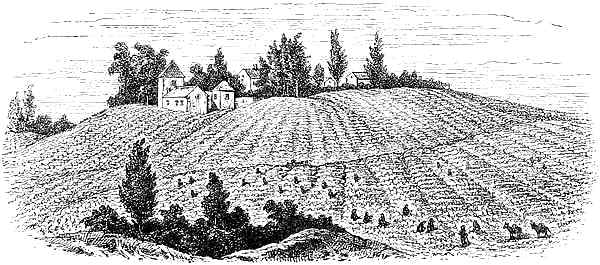
AVENAY AS SEEN FROM THE RAILWAY.
The vineyards of Avenay also date prior to the thirteenth century, mention being frequently made of them in the charters of that epoch.[385] Their best wine, which Saint Evremond extolled so highly, is vintaged to-day up the slopes of Mont Hurlé. Avenay itself is a tumbledown little village situated in the direction of Reims, and the year of our visit we found the yield from its vineyards had been scarcely more than the third of an average one, and that the wine produced at the first pressure of the grapes had been sold for 500 francs the pièce. We tasted there some very fair still red wine, made from the same grapes as Champagne, remarkably deep in colour, full of body, and possessing that slight sweet bitterish flavour which characterises certain of the better-class growths of the South of France.
Although at Avenay vineyards cover the slopes as of yore, when Marmontel used to wander amongst them in company with his inamorata Mademoiselle Hévin de Navarre, no traces remain of the ancient royal abbey—founded by St. Bertha in 660, on the martyrdom of her husband, St. Gombert, one of the early Christian missionaries to Scotland—where Charles V. took up his quarters when invading Champagne in 1544, and where the deputies of the Leaguers of Reims and of the Royalists of Châlons met in October 1592 to settle the terms of the ‘Traité des Vendanges,’ securing to both parties liberty to gather in the vintage unmolested.[386] The villagers still point out the house where Henri Quatre slept, and the window from which he harangued the populace during the visit paid by him to Madame Françoise de la Marck, the Abbess of Avenay,[387] in August of the same year. This, by the way, does not seem to have been the only occasion when the spot was honoured by the presence of Royalty; for a tradition, which, although unsupported by any documentary evidence, appears to be worthy of credence, is current to the effect that Marie Antoinette paid a visit to the Abbey of Avenay during her sojourn at Louvois as the guest of Madame Adelaïde in 1786. The spring which, according to the legend, gushed forth when St. Bertha, in imitation of Moses, struck the rock with her distaff, is still shown to travellers; and scandal has gone so far as to say that recourse is sometimes had to it to eke out the native vintage.
On leaving Avenay we ascended the hills to Mutigny, and wound round thence to Cumières, on the banks of the Marne, finding the vintage in full operation all throughout the route. The vineyards of Cumières—classed as a second cru—yield a wine which, though celebrated in the verses of Eustache Deschamps, a famous and prolific Champenois poet of the fourteenth century, varies to-day considerably in quality, the best coming from the ‘Côtes-à-bras,’ the property of the Abbey of Hautvillers in Dom Perignon’s day. The Cumières vineyards join those of Hautvillers on the one side and Damery on the other, the latter a cosy little river-side village, where the bon Roi Henri sought relaxation from the turmoils of war in the society of the fair Anne du Pay, sa belle hôtesse, as the gallant Béarnais was wont to style her. Damery also claims to be the birthplace of Adrienne Lecouvreur, the celebrated actress of the Regency, and mistress of the Maréchal de Saxe, who coaxed her out of her 30,000 l. of savings to enable him to prosecute his suit with the obese Anna Iwanowna, niece of Peter the Great, which, had he only been successful, would have secured the future hero of Fontenoy the coveted dukedom of Courland. From Cumières can be distinguished far away on the horizon the ruined tower of the bourg of Châtillon, the birthplace of Pope Urban II., preacher of the first Crusade, and a devotee of the wine of Ay.[388]
It was during the budding spring-time when we made our formal pilgrimage to Hautvillers across the swollen waters of the Marne at Epernay. Our way lay for a time along a straight level poplar-bordered road, with verdant meadows on either hand; then diverged sharply to the left, and we commenced ascending the vine-clad hills, on a narrow plateau of which the church and abbey remains are picturesquely perched. The closely-planted vines extend along the undulating slopes to the summit of the plateau, and wooded heights rise up beyond, affording shelter from the bleak winds that sweep over here from the north. Spite of the reputation which the wine of Hautvillers enjoyed a couple of centuries ago, and its association with the origin of vin mousseux, the vineyards to-day appear to have been relegated to the rank of a second cru, their produce ordinarily commanding less than two-thirds of the price obtained for the Ay and Verzenay growths.[389]
The church of Hautvillers and the remains of the abbey are situated at the farther extremity of the village, at the end of its one long street, named, pertinently enough, the Rue de Bacchus. Time, the iconoclasts of the great Revolution, and the quieter, yet far more destructive, labours of the Bande Noire, have spared but little of the royal abbey of St. Peter, where Dom Perignon lighted upon his happy discovery of the effervescent quality of Champagne. The quaint old church, scraps of which date back to the twelfth century, the remnants of the cloisters, and one of the abbey’s ancient gateways, are all that remain to testify to the grandeur of its past, when it was the proud boast of the brotherhood that it had given nine archbishops to the see of Reims, and two-and-twenty abbots to various celebrated monasteries.
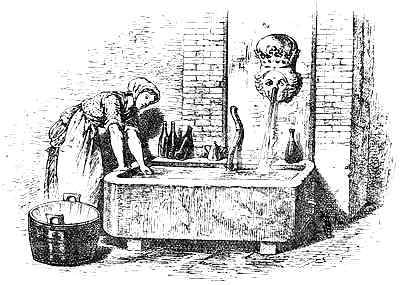
FOUNTAIN AT A CAFÉ IN THE RUE DE BACCHUS, HAUTVILLERS.
Passing through an unpretentious gateway, we find ourselves in a spacious courtyard, bounded by buildings somewhat complex in character. On our right rises the tower of the church with the remains of the old cloisters, now walled-in and lighted by small square windows, and propped up by heavy buttresses. To the left stands the residence of the bailiff, and beyond it an eighteenth-century château on the site of the abbot’s house. Formerly the abbey precincts were bounded on this side by a picturesque gateway-tower leading to the vineyards, and known as the ‘Porte des Pressoirs,’ from its contiguity to the winepresses. The court is enclosed on its remaining sides by huge barn-like buildings, stables, and cart-sheds; while roaming about are numerous live stock, indicating that what remains of the once-famous royal abbey of St. Peter has degenerated into an ordinary farm. To-day the abbey buildings and certain of its lands are the property of M. Paul Chandon de Brialles, of the firm of Moët & Chandon, the great Champagne manufacturers of Epernay, who maintains them as a farm, keeping some six-and-thirty cows there, with the object of securing the necessary manure for the numerous vineyards which the firm own hereabouts.
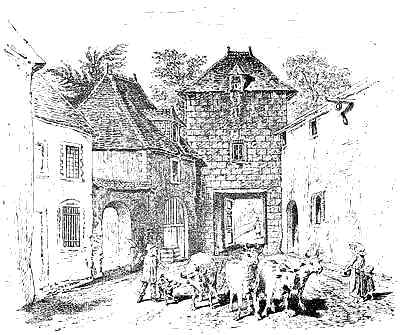
THE PORTE DES PRESSOIRS, ABBEY OF HAUTVILLERS (Destroyed by fire in 1879).
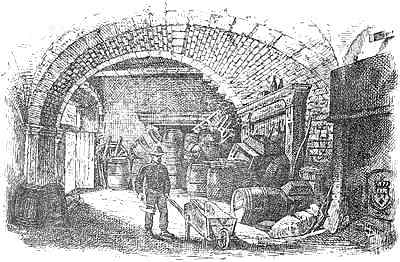
REMAINS OF CLOISTERS, ABBEY OF HAUTVILLERS.
The dilapidated cloisters, littered with old casks, farm implements, and the like, preserve ample traces of their former architectural character, changed as they are since the days when the sandalled feet of the worthy cellarer resounded through the echoing arches as he paced to and fro, meditating upon coming vintages and future marryings of wines. Vine-leaves and bunches of grapes decorate some of the more ancient columns inside the church, and grotesque mediæval monsters, such as monkish architects habitually delighted in, entwine themselves around the capitals of others. The stalls of the choir are elaborately carved with cherubs’ heads, medallions and figures of saints, cupids supporting shields, and free and graceful arabesques of the epoch of the Renaissance. In the chancel, close by the altar-steps, are a couple of black-marble slabs, with Latin inscriptions of dubious orthography, the one to Johannes Royer, who died in 1527, and the other, which has been already cited in detail, setting forth the virtues and merits of Dom Petrus Perignon, the discoverer of the effervescing qualities of Champagne. In the central aisle a similar slab marks the resting-place of Dom Thedoricus Ruynart—obit 1709—an ancestor of the Reims Ruinarts; and little square stones interspersed among the tiles with which the side aisles of the church are paved record the deaths of other members of the Benedictine brotherhood during the seventeenth and eighteenth centuries. Several large pictures grace the walls of the church, the most interesting one representing St. Nivard, Bishop of Reims, and his friend, St. Berchier, designating to some mediæval architect the site which the contemplated Abbey of St. Peter is to occupy, as set forth in the legend already related.
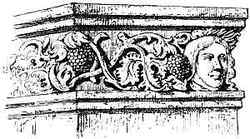
FROM THE ABBEY CHURCH, HAUTVILLERS.
At a short distance from the abbey farm, Messrs. Moët & Chandon have erected a tower, whence a splendid view, extending over the vineyards of Cumières, Hautvillers, Dizy, and Ay, with those lying on the opposite bank of the river, is to be obtained. Gazing from here, it is easy to imagine the scene presented in the days when the Abbey of St. Peter still reared its stately walls, when Louis Chaumejan de Tourille wore the abbatial insignia, and Dom Perignon displayed with equal pride as the badge of his office the key of the abbey cellars. Over these slopes on a dewy autumn morning the latter’s eyes, ere sealed in blindness, must have often wandered, and an unctuous chuckle must have welled up from between his lips as he marked the grapes steadily advancing towards maturity. We can fancy him pausing from time to time
‘To breathe an ejaculatory prayer And a benediction on the vines,’
although in those halcyon days there was neither oïdium nor phylloxera to be dreaded, and an extra taper or so to St. Vincent, the patron of vine-dressers, sufficed to secure the crop from ordinary accidents of flood and field.
When the epoch of the vintage arrived, and the slopes were all alive with bands of vintagers engaged in stripping the ripened purple bunches from the vines, and carefully transporting them to the winepress, one can picture Dom Perignon smiling contentedly at the report of the gray-haired bailiff that no such crop had been garnered for years before. And when the must began to gush forth as the stalwart bare-armed peasants tugged at the levers of the huge press on which M. de Tourille had placed the glorifying inscription elsewhere cited, with what satisfaction must Perignon have recognised a foreshadowing of that divine aroma which lends so exquisite a charm to the choice vintages of the Champagne! Later on we can imagine him entering the abbey cellar, stored with the results of his careful labours, as a
‘sacred place, With a thoughtful, solemn, and reverent pace,’
and softly chanting to himself, as he draws off a flagon of the best and choicest vintage which the gloomy vaults contain:
‘Ah, how the streamlet laughs and sings! What a delicious fragrance springs From the deep flagon as it fills, As of hyacinths and daffodils!’
The vineyards of the Côte d’Epernay, on the southern bank of the Marne, extend eastward from beyond Boursault, on whose wooded height stands the fine château built by Madame Clicquot, and in which her granddaughter, the Comtesse de Mortemart, to-day resides. They then follow the course of the river, and, after winding round behind Epernay, diverge towards the south-west. Amongst them are the slopes of Pierry, Mardeuil, Moussy, Vinay, Ablois, and Chouilly, the last named situate somewhat apart from the rest to the east of Epernay, and yielding a light wine, qualified as slightly purgative. The vines of the Côte d’Epernay produce only black grapes, and many of the vineyards are of great antiquity, the one known as the Closet, near Epernay, having been bequeathed under that name by a canon of Laon named Parchasius to the neighbouring Abbey of St. Martin six and a half centuries ago.
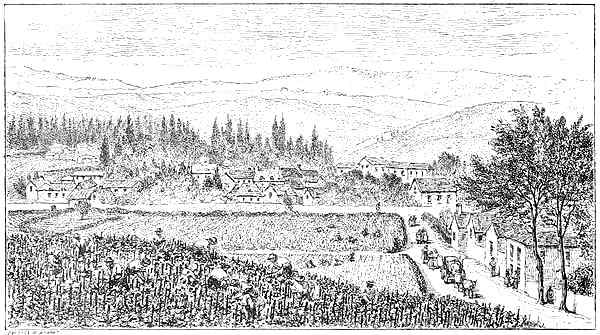
THE VILLAGE OF PIERRY.
A short drive along the high-road leading from Epernay to Orleans brings us to the village of Pierry, cosily nestling amongst groves of poplars in the valley of the Cubry, with some half-score of châteaux of the last century, belonging to well-to-do wine-growers of the neighbourhood, screened from the road by umbrageous gardens. Vines mount the slopes that rise around, the higher summits being crowned with forest, while here and there some pleasant village shelters itself under the brow of a lofty hill. Near Pierry many cellars have been excavated in the chalky soil, to the flints so prevalent in which the village is said to owe its name. The entrances to these cellars are closed by iron gateways, and on the skirts of the vineyards we come upon whole rows of them picturesquely overgrown with ivy, and suggestive in appearance of catacombs. Early in the last century the wine vintaged here in the Clos St. Pierre, belonging to an abbey of this name at Châlons, acquired a high reputation through the care bestowed upon it by Brother Jean Oudart, whose renown almost rivalled that of Dom Perignon himself; and to-day the Pierry vineyards, producing exclusively black grapes, hold a high rank among the second-class crus of the Marne.[390]
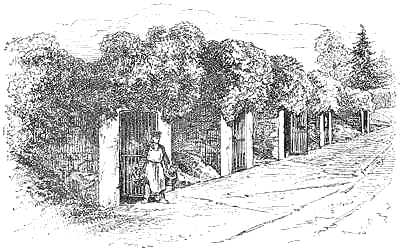
VINEYARD WINE-CELLARS AT PIERRY.
Crossing the Sourdon, a little stream which, after bubbling up in the midst of huge rocks in the forest of Epernay, rushes down the hills, and then changes its name to the Cubry, we soon reach Moussy, where vineyards have been in existence for something like eight centuries; for we find enumerated in the list of bequests made to the hospital of St. Mary at Reims in the eleventh and twelfth centuries sundry ‘vineas in Moiseio’ devised by such long-forgotten notabilities as Pontius, priest and canon, Tebaldus Papilenticus, Johannes de Germania, and Macela, wife of Pepinus. Spite, however, of their long pedigree and advantageous southern aspect, the Moussy vineyards rank to-day merely as a second cru. Continuing to skirt the vine-clad slopes we come to Vinay, noted for an ancient grotto[391]—the former comfortless abode of some rheumatic anchorite—and a pretended miraculous spring to which fever-stricken pilgrims to-day credulously resort. The water may possibly merit its renown; but the wine here produced is very inferior, due no doubt to the class of vines, the meunier being the leading variety cultivated. At Ablois St. Martin, once a fief of Mary Queen of Scots, and picturesquely perched partway up a slope in the midst of hills covered with vines and crowned with forest trees, the Côte d’Epernay ends, and the produce becomes of a choicer character.
As the Côte d’Avize lies to the south-east, to reach it we have to retrace our steps to Pierry, and follow the road which there branches off, leaving on our right hand the vineyards of Chavot, Monthelon, and Grauves, now of no particular note, although of undoubted antiquity, Blanche of Castille, Countess of Champagne, having endowed the Abbey of Argensolles, on its foundation in 1224, with sundry strips of vineland, including one at Grauves, possibly the vineyard of Les Roualles, which yields a wine not unlike certain growths of the Mountain of Reims. After passing through Cuis, where the slopes, planted with both black and white varieties of vines, are extremely abrupt, and where Simon la Bole, man-at-arms of Epernay, and his wife Basile gave, in 1210, ‘four hogsheads of vinage to be taken annually’ to Hugo, Abbot of St. Martin at Epernay, we eventually reach Cramant, one of the grand premiers crus of the Champagne. From the vineyards around this picturesque little village, and extending along the somewhat precipitous Côte de Saran—a prominent object, on which is M. Moët’s handsome château—there is vintaged a wine from white grapes, especially remarkable for lightness and delicacy and the richness of its bouquet, and an admixture of which is essential to every first-class Champagne cuvée.
From Cramant the road runs direct to Avize, a large thriving village, lying at the foot of vineyard slopes, where numerous Champagne firms have established themselves. Its prosperity dates from the commencement of the last century (1715), when the Count de Lhery, its feudal lord, cleared away the remains of its ancient ramparts, filled up the moat, and planted the ground with vines, the produce of which proved admirably suited for the sparkling wines then coming into vogue. Prior to this the Avize wine, made almost entirely from white grapes, fetched only from 25 to 30 francs the queue; but being found well adapted for the manufacture of the strongly-effervescent wine known as saute-bouchon, it soon commanded as much as 300 francs, and the arpent of vineyard rose in value from 250 to 2000 francs.[392] To-day the light delicate wine of Avize is classed, like that of Cramant, as a premier cru, and it is the same with the wine of Oger,[393] lying a little to the south, while the neighbouring growths of Le Mesnil hold a slightly inferior rank. The latter village and its gray Gothic church lie under the hill in the midst of vines that almost climb the forest-crowned summit. The stony soil hereabouts is said to be better adapted to the cultivation of white than of black grapes; besides which, the wines of Le Mesnil are remarkable for their effervescent properties.
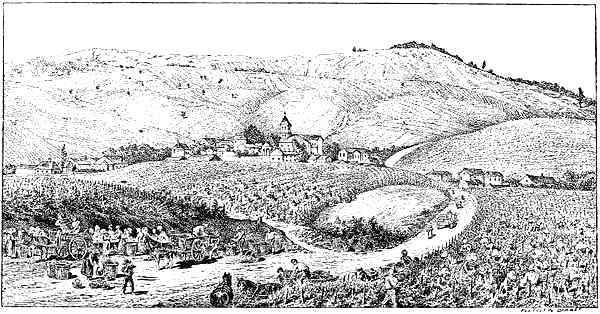
LE MESNIL AND ITS VINEYARDS.
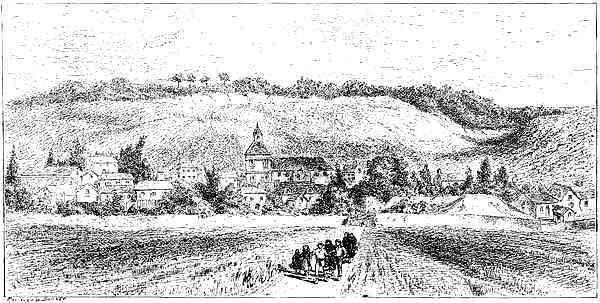
VIEW OF VERTUS.
Vertus forms the southern limit of the Côte d’Avize, and the vineyard slopes subsiding at their base into a broad expanse of fertile fields, and crested as usual with dense forest, rise up behind the picturesque old town, which is mentioned in a letter of the Emperor Louis and a charter of Charles the Bald in the ninth century. It was once strongly fortified, though a dilapidated gateway is all that to-day remains of the ancient ramparts, which failed to secure it in 1380, when the English, under the ‘Comte de Bouquingouan,’ presumably Buckingham, burnt the whole of the town except the Abbey of St. Martin, and elicited from the native poet, Eustache Deschamps, dit Morel, ‘huissier d’armes’ to Charles VI. and castellan of Fismes, a lamentation, wherein he fails not to mention the high renown of the local vintage.[394]
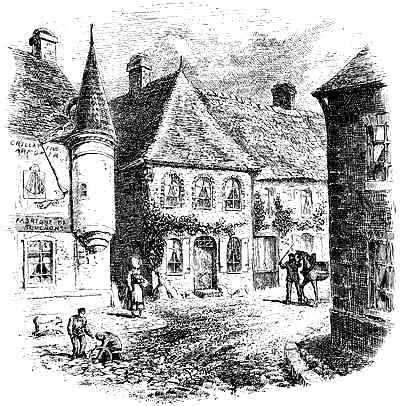
OLD HOUSES AT VERTUS.
Vertus can still boast a curious old church of the eleventh century, with solid Romanesque towers, elaborate mouldings, and richly ornamented capitals; also a picturesque promenade, shaded with centenarian trees, together with several quaint old houses, including one with a florid Gothic window surrounded by a border of grapes and vine-leaves, and another with a quaintly projecting corner turret, dominated by a conical roof. The Vertus vineyards are mentioned in a charter of the Abbey of Ste. Marie, dated 1151. They were originally planted with vines from Beaune in Burgundy, and in the fourteenth century yielded a red wine held in high repute, of pleasant flavour, and rich in perfume,[395] but which would appear to have been imbued with those purgative properties[396] traceable in other growths of the Champagne. The red wine of Vertus formed the favourite beverage of William III. of England, and was long in high repute. To-day, however, the growers find it more profitable to make white instead of red wine from their crops of black grapes, the former commanding a good price for conversion into vin mousseux, from being in the opinion of some manufacturers especially valuable for binding a cuvée together. The Vertus growths rank among the second-class Champagne crus.[397]
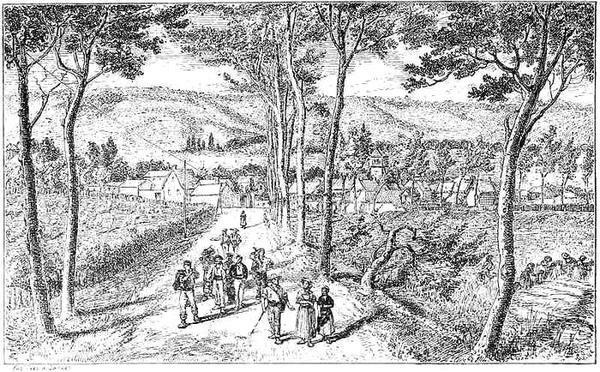
SILLERY AND ITS VINEYARDS.
II. THE CHAMPAGNE VINELANDS—THE VINEYARDS OF THE MOUNTAIN.
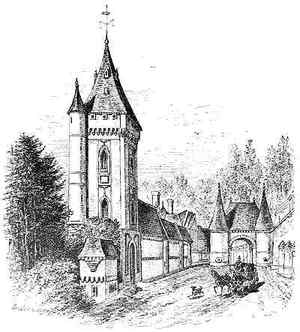
TOWER AND GATEWAY OF THE CHÂTEAU DE SILLERY.
The wine of Sillery—Origin of its renown—The Maréchale d’Estrées a successful Marchande de Vin—The Marquis de Sillery the greatest wine-farmer in the Champagne—Cossack appreciation of the Sillery produce—The route from Reims to Sillery—Henri Quatre and the Taissy wines—Failure of the Jacquesson system of vine cultivation—Château of Sillery—Wine-making at M. Fortel’s—Sillery sec—The vintage at Verzenay and the vendangeoirs—Renown of the Verzenay wine—The Verzy vineyards—Edward III. at the Abbey of St. Basle—Excursion from Reims to Bouzy—The herring procession at St. Remi—Rilly, Chigny, and Ludes—The Knights Templars’ ‘pot’ of wine—Mailly and the view over the Champagne plains—Wine-making at Mailly—The village in the wood—Château and park of Louvois, Louis le Grand’s War Minister—The vineyards of Bouzy—Its church-steeple, and the lottery of the great gold ingot—Pressing grapes at the Werlé vendangeoir—Still red Bouzy—Ambonnay—A pattern peasant vine-proprietor—The Ambonnay vintage—The vineyards of Ville-Dommange and Sacy, Hermonville and St. Thierry—The still red wine of the latter.
THE vineyards of the Mountain of Reims may be divided into two zones, one of which, known as the Basse Montagne, is situate north-west of Reims, and comprises the vineyards of St. Thierry, Marsilly, Hermonville, and others; whilst the more important zone lies to the south of the old cathedral city, and includes the better-known crus of Sillery, Verzy, Verzenay, Mailly, Ludes, Chigny, and Rilly. The vinelands of Bouzy and Ambonnay are also reckoned within it, though situate somewhat apart on a southern slope of the Mountain some few miles from the Marne.
The smallest of the Champagne vineyards are those of Sillery, and yet no wine of the Marne enjoys a greater renown, due originally to the intelligence and energy of the family of the Brularts, Marquises of Sillery and Puisieux, to whom the estate originally belonged, and who seem to have devoted great attention to viticulture from certainly the middle of the seventeenth century. The reputation of the still wine of Sillery, ‘the highest manifestation of the divinity of Bacchus in all France,’ was firmly established at this epoch. ‘As to M. de Puyzieux,’ writes St. Evremond to his friend Lord Galloway in August 1701, ‘he acts wisely to fall in with the bad taste now in fashion concerning Champagne in order to sell his own the better;’ but at the same time he counsels his correspondent to get the marquis to make him ‘a little barrel after the fashion in which it was made forty years before, prior to the existing depravation of taste.’[398] The marquis here referred to was Roger Brulart, Governor of Epernay, who was himself a joyous bon vivant, and died from over-indulgence in the good things provided at a dinner given by the Chartreux in 1719.[399] He was succeeded by his nephew, Louis Philogène Brulart, Marquis de Sillery et de Puisieux, to whom, in 1727, on the occasion of his marriage with Mademoiselle de Souvré, granddaughter of Louvois, the Sieurs Quatresous and Chertemps presented at his château of Sillery, on behalf of the town of Epernay, a basket of one hundred flasks of wine.[400] He died in 1771, leaving an only daughter, Adelaïde Félicité Brulart de Sillery, married, in 1744, to Louis César le Tellier, Maréchal Duc d’Estrées.
The wine attained its apogee under the fostering care of the Maréchale d’Estrées, to whom not only this cru, but those of Mailly, Verzy, and Verzenay belonged, and who concentrated their joint produce in the capacious cellars of her château, afterwards sending it forth with her own guarantee, under the general name of Sillery, which, like Aaron’s serpent, thus swallowed up the others. The Maréchale’s social position enabled her to secure for her wines the recognition they really merited, being made with the utmost care and a rare intelligence, shown by the removal of every unripe, rotten, or imperfect grape from the bunches before pressing, so that the Vin de la Maréchale, as it was styled, became famous throughout Europe.[401] This lady is not to be confounded with that other Maréchale d’Estrées mentioned by St. Simon, noted for her exquisite and magnificent although rare entertainments, and so sordid that when her daughter, who was covered with jewels, fell down at a ball, her first cry was, not like Shylock’s, ‘My daughter!’ but ‘My diamonds!’ as, rushing forward, she strove to pick up, not the fallen dancer, but her scattered gems.
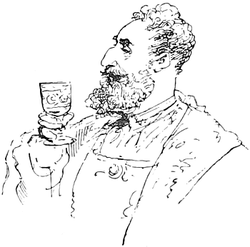
HENRI QUATRE.
Later owners of the famous Sillery cru did their best to sustain its reputation, and Arthur Young, who stopped here in 1787, speaks of the Marquis de Sillery as ‘the greatest wine-farmer in the Champagne,’ having on his own hands 180 arpents of vines, and cellar-room for a couple of hundred pièces of wine.[402] Among more recent appreciation of the merits of Sillery sec may be mentioned the Cossacks, who pillaged the district in 1814, and who, not being able to carry off all the wine from the cellar of the Count de Valence at Sillery, stove in some thirty pièces of the best, and set the place afloat.[403]
The drive from Reims to Sillery has nothing attractive about it. A long, straight, level road bordered by trees intersects a broad tract of open country, skirted on the right by the Petite Montagne of Reims, with antiquated villages nestled among the dense woodland. After crossing the Châlons line of railway—near where one of the new forts constructed for the defence of Reims rises up behind the villages and vineyards of Cernay and Nogent l’Abbesse—the country becomes more undulating. Poplars border the broad Marne canal, and a low fringe of foliage marks the course of the languid river Vesle, on the banks of which is Taissy, famous in the old days for its wines, great favourites with Sully, and which almost lured Henri Quatre from his allegiance to the vintages of Ay and Arbois that he loved so well.[404]
To the left rises Mont de la Pompelle, where the first Christians of Reims suffered martyrdom, and where, in 1658, the Spaniards under Montal, when attempting to ravage the vineyards of the district, were repulsed with terrible slaughter by the Rémois militia, led on by Grandpré. A quarter of a century ago the low ground on our right near Sillery was planted with vines by the late M. Jacquesson, the then owner of the Sillery estate, and a large Champagne manufacturer at Châlons, who was anxious to resuscitate the ancient reputation of the domain. Under the advice of Dr. Guyot, the well-known writer on viticulture, he planted the vines in deep trenches, which led to the vineyards being punningly termed Jacquesson’s celery beds. To shield the vines from hailstorms prevalent in the district, and the more dangerous spring frosts, so fatal to vines planted in low-lying situations, long rolls of straw-matting were stored close at hand with which to roof them over when needful. These precautions were scarcely needed, however; the vines languished through moisture at the roots, and eventually were mostly rooted up.
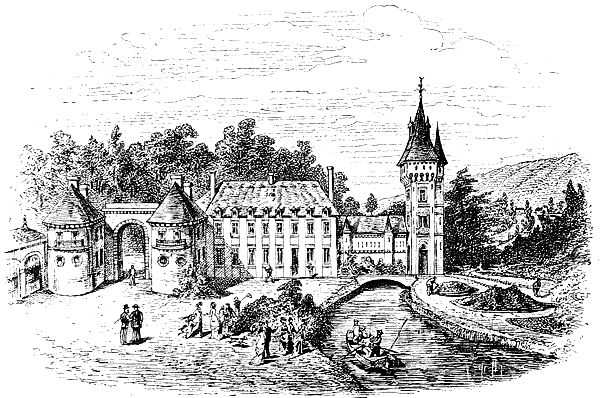
CHÂTEAU DE SILLERY.
After again crossing the railway we pass the trim restored turrets of the famous château of Sillery, with its gateways, moats, and drawbridges, flanked by trees and floral parterres. It was here that the stout squire Laurent Pichiet kept watch and ward over the ‘forte maison de Sillery’ on behalf of the Archbishop of Reims at the close of the fourteenth century, that the Maréchale d’Estrées carried on her successful business as a marchande de vins, and that the pragmatic and pedantic Comtesse de Genlis, governess of the Orleans princes, spent, as she tells us, the happiest days of her life. The few thriving vineyards of Sillery cover a gentle eminence which rises out of the plain, and present on the one side an eastern and on the other a western aspect. They have fallen somewhat from their high estate since the days when old Coffin of Beauvais University sang their praises in Latin:
‘Let Horace the charms of old Massica own, And the praise of Falernian sound; Such wines, although famous, must bow to that grown On Sillery’s fortunate ground.’[405]
To-day the Vicomte de Brimont and M. Fortel of Reims, the latter of whom cultivates some forty acres of vines, yielding ordinarily about 300 hogsheads, are the only wine-growers at Sillery. Before pressing his grapes—of course for sparkling wine—M. Fortel has them thrown into a trough, at the bottom of which are a couple of grooved cylinders, each about eight inches in diameter, and revolving in contrary directions, the effect of which, when set in motion, is to disengage the grapes partially from their stalks. Grapes and stalks are then placed under the press, which is on the old cider-press principle, and the must runs into a reservoir beneath, whence it is pumped into large vats, each holding from 250 to 500 gallons. Here it remains from six to eight hours, and is then run off into casks, the spigots of which are merely laid lightly over the holes, and in the course of twelve days the wine begins to ferment. It now rests until the end of the year, when it is drawn off into new casks and delivered to the buyer, invariably one or other of the great Champagne houses, who willingly pay an exceptionally high price for it. The second and third pressures of the grapes yield an inferior wine, and from the husks and stalks eau-de-vie, worth about five shillings a gallon, is distilled.
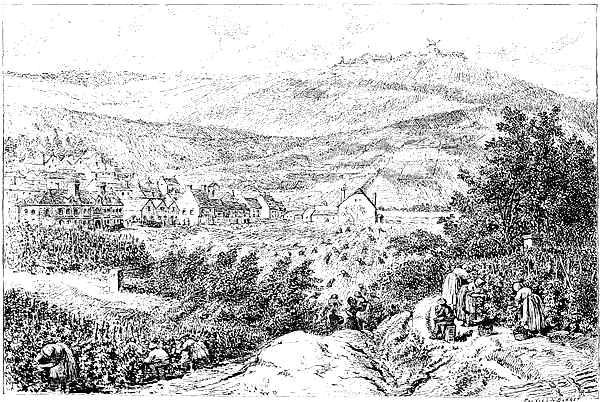
THE VINEYARDS OF VERZENAY.
The wine known as Sillery sec is a full, dry, pleasant-flavoured, and somewhat spirituous amber-coloured wine. Very little of it is made nowadays, and most that is comes from the adjacent vineyards of Verzenay and Mailly, and is principally reserved by the growers for their own consumption. One of these candidly admitted that the old reputation of the wine had exploded, and that better white Bordeaux and Burgundy wines were to be obtained for less money. In making dry Sillery, which locally is esteemed as a valuable tonic, it is essential that the grapes should be subjected to only slight pressure; while to have it in perfection it is equally essential that the wine should be kept for ten years in the wood according to some, and eight years in bottle according to others, to which circumstance its high price is in all probability to be attributed. In course of time it forms a deposit, and has the disadvantage common to all the finer still wines of the Champagne district of not travelling well.
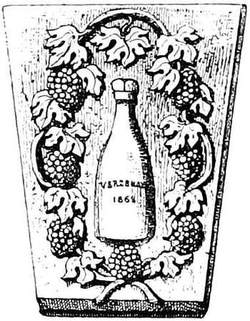
DEVICE ABOVE ENTRANCE TO VENDANGEOIR AT VERZENAY.
Beyond Sillery the vineyards of Verzenay unfold themselves, spreading over the extensive slopes and stretching to the summit of the steep height to the right, where a windmill or two are perched. Everywhere the vintagers are busy detaching the grapes with their little hook-shaped serpettes, the women all wearing projecting close-fitting bonnets, as though needlessly careful of their anything but blonde complexions. Long carts laden with baskets of grapes block the narrow roads, and donkeys, duly muzzled, with panniers slung across their backs, toil up and down the steeper slopes. Half-way up the principal hill, backed by a dense wood and furrowed with deep trenches, whence soil has been removed for manuring the vineyards, is the village of Verzenay—where in the Middle Ages the Archbishop of Reims had a fief—overlooking a veritable sea of vines. Rising up in front of the old gray cottages, encompassed by orchards or gardens, are the white walls and long red roofs of the vendangeoirs belonging to the great Champagne houses—Moët & Chandon, Clicquot, G. H. Mumm, Roederer, Deutz & Geldermann, and others—all teeming with bustle and excitement, and with the vines almost reaching to their very doors. Messrs. Moët & Chandon have as many as eight presses in full work, and own no less than 120 acres of vines on the neighbouring slopes, besides the Clos de Romont—in the direction of Sillery, and yielding a wine of the Sillery type—belonging to M. Raoul Chandon. Verzenay ranks as a premier cru, and for three years in succession—1872, 3, and 4—its wines fetched a higher price than either those of Ay or Bouzy. In 1873 the vin brut commanded the exceptionally large sum of 1050 francs the hogshead of 44 gallons. All the inhabitants of Verzenay are vine-proprietors, and several million francs are annually received by them for the produce of their vineyards from the manufacturers of Champagne. The wine of Verzenay, remarkable for its body and vinosity, has always been held in high repute,[406] which is apparently more than can be said of the probity of the inhabitants, for, according to an old Champagne saying, ‘Whenever at Verzenay “Stop thief” is cried every one takes to his heels.’
Just over the Mountain of Reims is the village of Verzy, the vine-growers of which distinguished themselves in the fifteenth century by their resistance to the officials sent to levy the ‘aide en gros’ of two sols per queue, imposed by Louis XI. on all wine made within a radius of four miles of Reims. The Verzy vineyards—ranked to-day as a second cru—date at least from the days of the Knights Templars, when the Commanderie of Reims had ‘two vineyards near the abbey’ here. They adjoin those of Verzenay, and are almost exclusively planted with white grapes, the only instance of the kind to be met with in the district. In the Clos St. Basse, however—taking its name from the Abbey of St. Basle, of which the village was a dependency, and where Edward III. of England had his head-quarters during the siege of Reims—black grapes alone are grown, and its produce is almost on a par with the wines of Verzenay.
Immediately prior to the Revolution, one-fourth of the inhabitants of Verzy were landholders, each cultivating about five arpents of vines, and obtaining therefrom, on an average, twenty poinçons, out of which the abbey exacted one and three-quarters for ‘droits de dimes et de banalité de pressoir.’ Southwards of Verzy are the third-class crus of Villers-Marmery and Trépail, the former of which was of some repute in the Middle Ages.
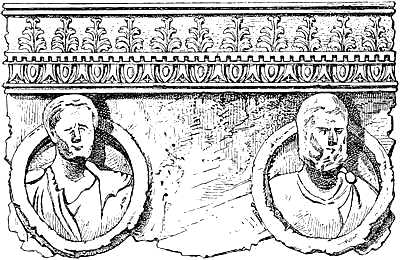
PORTION OF FRIEZE OF OLD HOUSE, RUE DU BARBATRE, REIMS.
We made several excursions to the vineyards of Bouzy, driving out of Reims along the ancient Rue du Barbâtre and past the quaint old church of St. Remi, one of the sights of the Champagne capital, and notable, among other things, for its magnificent ancient stained-glass windows, and the handsome modern tomb of the popular Rémois saint. It was here in the Middle Ages that that piece of priestly mummery, the procession of the herrings, used to take place at dusk on the Wednesday before Easter. Preceded by a cross, the canons of the church marched in double file up the aisles, each trailing a cord after him, with a herring attached. Every one’s object was to tread on the herring in front of him, and prevent his own herring from being trodden upon by the canon who followed behind—a difficult enough proceeding, which, if it did not edify, certainly afforded much amusement to the lookers-on.
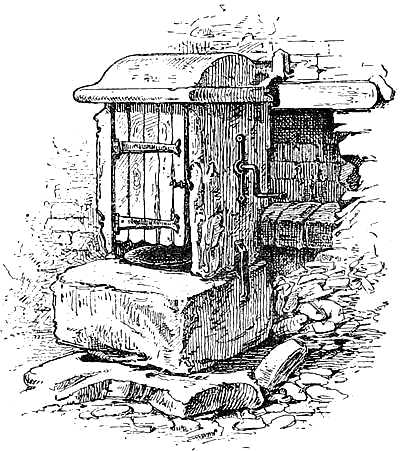
ANCIENT WELL, RUE DU BARBATRE, REIMS.
After crossing the canal and the river Vesle, and leaving the gray antiquated-looking village of Cormontreuil on our left, we traversed a wide stretch of cultivated country streaked with patches of woodland, with occasional windmills dotting the distant heights, and villages nestling among the trees up the mountain-sides and in the quiet hollows. Soon a few vineyards occupying the lower slopes, and thronged by bands of vintagers, came in sight, and the country too grew more picturesque. We passed successively on our right hand Rilly, a former fief of the Archbishop of Reims, and noted for its capital red wine; then Chigny, where the Abbot of St. Remi had a vineyard as early as the commencement of the thirteenth century; and afterwards Ludes,—all three of them situated more or less up the mountain, with vines in every direction, relieved by a dark background of forest-trees. In the old days, the Knights Templars of the Commanderie of Reims had the right of vinage at Ludes, and exacted their modest ‘pot’ (about half a gallon) per pièce on all the wine the village produced. On our left hand is Mailly, the vineyards of which join those of Verzenay, and, though classed only as a second cru, yielding a wine noted for finesse and bouquet, identified by some as the vintage which was recommended in the ninth century to Bishop Hincmar of Reims by his confrère, Pardulus of Laon. From the wooded knolls hereabouts a view is gained of the broad plains of the Champagne, dotted with white villages and scattered homesteads among the poplars and the limes, the winding Vesle glittering in the sunlight, and the dark towers of Notre Dame de Reims, with all their rich Gothic fretwork, rising majestically above the distant city.
At one vendangeoir we visited, at Mailly, between 350 and 400 pièces of wine were being made at the rate of some thirty pièces during the long day of twenty hours, five men being engaged in working the old-fashioned press, closely resembling a cider-press, and applying its pressure longitudinally. This ancient press doubtless differs but little from the one which the chapter of Reims Cathedral possessed at Mailly in 1384. As soon as the must was expressed it was emptied into large vats, holding about 450 gallons, and in these it remained for several days before being drawn off into casks. Of the above thirty pièces, twenty resulting from the first pressure were of the finest quality, while four produced by the second pressure were partly reserved to replace what the first might lose during fermentation, the residue serving for second-class Champagne. The six pièces which came from the final pressure, after being mixed with common wine of the district, were converted into Champagne of an inferior quality.
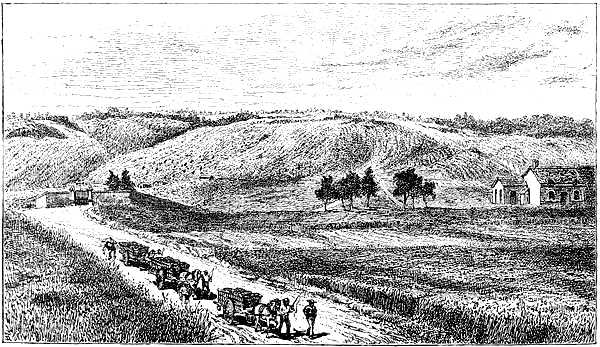
THE VINEYARDS OF BOUZY.
We now crossed the mountain, sighting Ville-en-Selve—the village in the wood—among the distant trees, and eventually reached Louvois, whence the Grand Monarque’s domineering war minister derived his marquisate, and where his château, a plain but capacious edifice, may still be seen nestled in a picturesque and fertile valley, and surrounded by lordly pleasure-grounds. Château and park are to-day the property of M. Frédéric Chandon, who has bestowed much care on the restoration of the former. Soon after we left Louvois the vineyards of Bouzy appeared in sight, with the prosperous-looking little village rising out of the plain at the foot of the vine-clad slopes stretching to Ambonnay, and the glittering Marne streaking the hazy distance. The commodious new church is said to have been indebted for its spire to the lucky gainer—who chanced to be a native of Bouzy—of the great gold ingot lottery prize, value 16,000 l., drawn in Paris some years ago. The Bouzy vineyards occupy a series of gentle inclines, and have the advantage of a full southern aspect. The soil, which is of the customary calcareous formation, has a marked ruddy tinge, indicative of the presence of iron, to which the wine is in some degree indebted for its distinguishing characteristics—its delicacy, spirituousness, and pleasant bouquet. Vintagers were passing slowly in between the vines, and carts laden with grapes came rolling over the dusty roads. The mountain which rises behind the vineyards is scored up its sides and fringed with foliage at its summit, and a small stone bridge crosses the deep ravine formed by the swift-descending winter torrents.
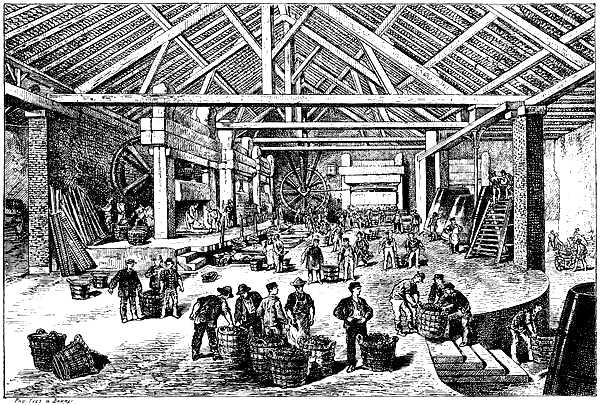
THE VENDANGEOIR OF M. WERLÉ AT BOUZY.
The principal vineyard proprietors at Bouzy, which ranks, of course, as a premier cru, are M. Werlé, M. Irroy, and Messrs. Moët & Chandon, the first and last of whom have capacious vendangeoirs here, M. Irroy’s pressing-house being in the neighbouring village of Ambonnay. M. Werlé possesses at Bouzy from forty to fifty acres of the finest vines, forming a considerable proportion of the entire vineyard area. At the Clicquot-Werlé vendangeoir, containing as many as eight presses, about 1000 pièces of wine are made annually. At the time of our visit, grapes gathered that morning were in course of delivery, the big basketfuls being measured off in caques—wooden receptacles holding two-and-twenty gallons—while the florid-faced foreman ticked them off with a piece of chalk on the head of an adjacent cask.
As soon as the contents of some half-hundred or so of these baskets had been emptied on to the floor of the press, the grapes undetached from their stalks were smoothed compactly down, and a moderate pressure was applied to them by turning a huge wheel, which caused the screw of the press to act—a gradual squeeze rather than a powerful one, and given all at once, coaxing out, it was said, the finer qualities of the fruit. The operation was repeated as many as six times; the yield from the three first pressures being reserved for conversion into Champagne, while the result of the fourth squeeze would be applied to replenishing the loss, averaging 7 ½ per cent, sustained by the must during fermentation. Whatever comes from the fifth pressure is sold to make an inferior Champagne. The grapes are subsequently well raked about, and then subjected to a couple of final squeezes, known as the rébêche, and yielding a sort of piquette, given to the workmen employed at the pressoir to drink.
The small quantity of still red Bouzy wine made by M. Werlé at the same vendangeoir only claims to be regarded as a wine of especial mark in good years. The grapes, before being placed beneath the press, are allowed to remain in a vat for as many as eight days. The must undergoes a long fermentation, and after being drawn off into casks is left undisturbed for a couple of years. In bottle—where, by the way, it invariably deposits a sediment, which is indeed the case with all the wines of the Champagne, still or sparkling—it will outlive, we were told, any Burgundy.
Still red Bouzy has a marked and agreeable bouquet and a most delicate flavour, is deliciously smooth to the palate, and to all appearances is as light as a wine of Bordeaux, while in reality it is quite as strong as Burgundy, to the finer crus of which it bears a slight resemblance. It was, we learnt, very susceptible to travelling, a mere journey to Paris being, it was said, sufficient to sicken it, and impart such a shock to its delicate constitution that it was unlikely to recover from it. To attain perfection, this wine, which is what the French term a vin vif, penetrating into the remotest corners of the organ of taste, requires to be kept a couple of years in wood and half a dozen or more years in bottle.
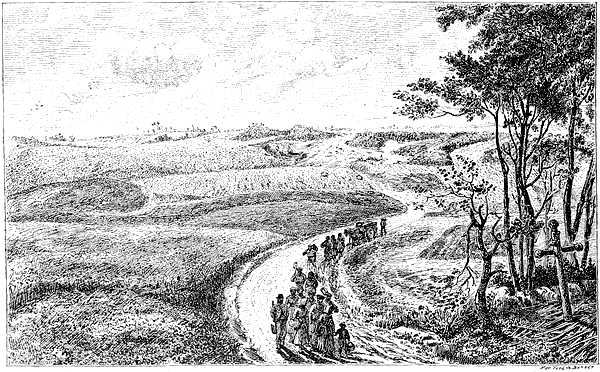
THE AMBONNAY VINEYARDS.
From Bouzy it was only a short distance along the base of the vine-slopes to Ambonnay, where there are merely two or three hundred acres of vines, and where we found the vintage almost over. The village is girt with fir-trees, and surrounded with rising ground fringed either with solid belts or slender strips of foliage. An occasional windmill cuts against the horizon, which is bounded here and there by scattered trees. Inquiring for the largest vine-proprietor, we were directed to an open porte-cochère, and on entering the large court encountered half a dozen labouring men engaged in various farming occupations. Addressing one whom we took to be the foreman, he referred us to a wiry little old man, in shirt-sleeves and sabots, absorbed in the refreshing pursuit of turning over a big heap of rich manure with a fork. He proved to be M. Oury, the owner of we forget how many acres of vines, and a remarkably intelligent peasant, considering what dunderheads the French peasants as a rule are, who had raised himself to the position of a large vine-proprietor. Doffing his sabots and donning a clean blouse, he conducted us into his little salon, a freshly-painted apartment about eight feet square, of which the huge fireplace occupied fully one-third, and submitted patiently to our catechising.
At Ambonnay, as at Bouzy, they had that year, M. Oury said, only half an average crop; the caque of grapes had, moreover, sold for exactly the same price at both places, and the wine had realised about 800 francs the pièce. Each hectare (2 ½ acres) of vines had yielded 45 caques of grapes, weighing some 2 ¾ tons, which produced 6 ½ pièces, equal to 286 gallons of wine, or at the rate of 110 gallons per acre. Here the grapes were pressed four times, the yield from the second pressure being used principally to make good the loss which the first sustained during its fermentation. As the squeezes given were powerful ones, all the best qualities of the grapes were by this time extracted, and the yield from the third and fourth pressures would not command more than eighty francs the pièce. The vintagers who came from a distance received either a franc and a half per day and their food, consisting of three meals, or two francs and a half without food, the children being paid thirty sous. M. Oury further informed us that every year vineyards came into the market, and found ready purchasers at from fifteen to twenty thousand francs the hectare, equal to an average price of 300 l. the acre, which, although Ambonnay is classed merely as a second cru, has since risen in particular instances to upwards of 600 l. per acre. Owing to the properties being divided into such infinitesimal portions, they were not always bought up by the large Champagne houses, who objected to be embarrassed with the cultivation of such tiny plots, preferring rather to buy the produce from their owners.
There are other vineyards of lesser note in the neighbourhood of Reims producing very fair wines, which enter more or less into the composition of Champagne, and almost all of which can boast of a pedigree extending back at least to the Middle Ages. Noticeable among these are Ville-Dommange and Sacy, south-west of Reims. At Sacy the Abbey of St. Remi had a vineyard in 1218; and in the return of church property made in 1384, the doyen of the Cathedral is credited with ‘rentes de vin’ and about six jours of vineland here, the Convent of Clermares at Reims owning a piece of ‘vigne gonesse.’ North-west of the city the best-known vineyards are those of Hermonville—mentioned likewise at the beginning of the thirteenth century, and in the return which we have just quoted—and St. Thierry, where the Black Prince took up his quarters during the siege of Reims, and where Gerard de la Roche wrought such havoc amongst the vines in the twelfth century, to the great indignation of their monkish owners. The still red wine of St. Thierry, which recalls the growths of the Médoc by its tannin, and those of the Côte d’Or by its vinosity, is to-day almost a thing of the past, it being found here, as elsewhere, more profitable to press the grapes for sparkling in preference to still wine.
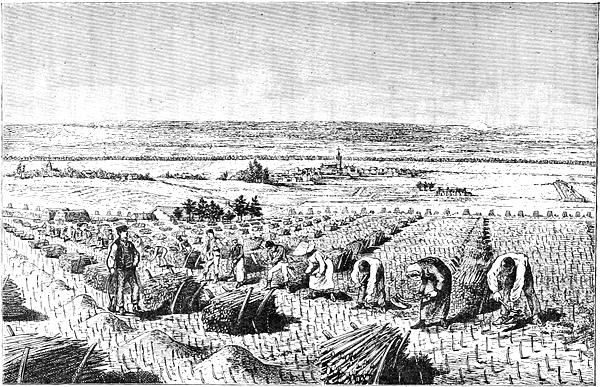
LABOURERS AT WORK IN THE EARLY SPRING IN M. ERNEST IRROY’S BOUZY VINEYARDS.
III. THE VINES OF THE CHAMPAGNE AND THE SYSTEM OF CULTIVATION.
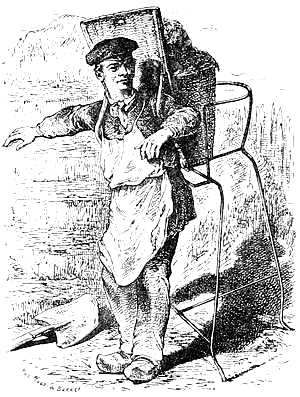
CARRYING MANURE TO THE VINEYARDS.
A combination of circumstances essential to the production of good Champagne—Varieties of vines cultivated in the Champagne vineyards—Different classes of vine-proprietors—Cost of cultivation—The soil of the vineyards—Period and system of planting the vines—The operation of ‘provenage’—The ‘taille’ or pruning, the ‘bêchage’ or digging—Fixing the vine-stakes—Great cost of the latter—Manuring and shortening back the vines—The summer hoeing around the plants—Removal of the stakes after the vintage—Precautions adopted against spring frosts—The Guyot system of roofing the vines with matting—Forms a shelter from rain, hail, and frost, and aids the ripening of the grapes—Various pests that prey upon the Champagne vines—Destruction caused by the Eumolpe, the Chabot, the Bêche, the Cochylus, and the Pyrale—Attempts made to check the ravages of the latter with the electric light.
GOOD Champagne does not rain down from the clouds, or gush out from the rocks, but is the result of incessant labour, patient skill, minute precaution, and careful observation. In the first place, the soil imparts to the natural wine a special quality which it has been found impossible to imitate in any other quarter of the globe. To the wine of Ay it lends a flavour of peaches, and to that of Avenay the savour of strawberries; the vintage of Hautvillers, though somewhat fallen from its former high estate, is yet marked by an unmistakably nutty taste; while that of Pierry smacks of the locally-abounding flint, the well-known pierre à fusil flavour. So, on the principle that a little leaven leavens the whole lump, the produce of grapes grown in the more favoured vineyards is added in definite proportions, in order to secure certain special characteristics, as well as to maintain a fixed standard of excellence.
While it is admitted that climate is not without its influence in imparting a delicate sweetness and aroma, combined with finesse and lightness, to the wine, some authorities maintain that to the careful selection of the vines best suited to the soil and temperature of the district the excellence of genuine Champagne is mainly to be ascribed.
Four descriptions of vines are chiefly cultivated in the Champagne, three of them yielding black grapes, and all belonging to the pineau variety, from which the grand Burgundy wines are produced, and so styled from the clusters taking the conical form of the pine. The first is the franc pineau, the plant doré of Ay, with its closely-jointed shoots and small leaves, producing squat bunches of small round grapes, with thickish skins of a bluish-black tint, and sweet and refined in flavour. The next is the plant vert doré, with its leaves of vivid green, more robust and more productive than the former, but yielding a less generous wine, and the berries of which, growing in compact pyramidal bunches, are dark and oval, very thin-skinned, and remarkably sweet and juicy. The third variety, extensively planted in the vineyards of Verzy and Verzenay, is the plant gris, or burot, as it is styled in the Côte d’Or, a somewhat delicate vine, whose fruit has a brownish tinge, and yields a light and perfumed wine. The remaining species is a white grape known as the épinette, a variety of the pineau blanc, and supposed by some to be identical with the chardonnet of Burgundy, which yields the famous wine of Montrachet. It is met with all along the Côte d’Avize, notably at Cramant, the delicate and elegant wine of which ranks immediately after that of Ay and Verzenay. The épinette is a prolific bearer, and its round transparent golden berries, which hang in somewhat straggling clusters amongst its dark-green leaves, are both juicy and sweet. It ripens, however, much later than either of the black varieties.
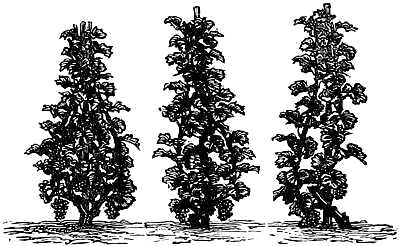
TYPES OF THE CHAMPAGNE VINES IN BEARING.
There are several other species of vines cultivated in the Champagne vineyards, notably the common meunier, or miller, prevalent in the valley of Epernay, which bears black grapes, and takes its name from the young leaves appearing to have been sprinkled with flour. This variety being more hardy than the franc pineau is replacing the latter on the lower parts of the slopes, which are the most exposed to frosts—a regrettable circumstance, as it impairs the quality of the wine. There are also the black and white gouais; the meslier, a prolific white variety yielding a wine of fair quality; the black and white gamais, the leading grape in the Mâconnais, and chiefly found in some of the Vertus vineyards; together with the tourlon, the marmot, the cohéras, the plant doux, and half a score of others.
The land in the Champagne, as in other parts of France, is minutely subdivided, and it has been estimated that the 40,000 acres of vines are divided amongst no less than 16,000 proprietors. A few of the principal Champagne firms are large owners of vineyards; and as the value of the soil has more than quadrupled within the last thirty years, even the smallest peasant proprietors have cause for congratulation.[407] These latter cultivate their vineyards themselves; while the larger landowners employ labourers, termed forains when coming from a distance and working by the week for their lodging, food, and from 20 to 30 francs wages, or tâcherons when paid by the job. The last-mentioned class usually contract to cultivate and dress an arpent of vines, exclusive of the vintage, at from 8 l. to 12 l. per annum.
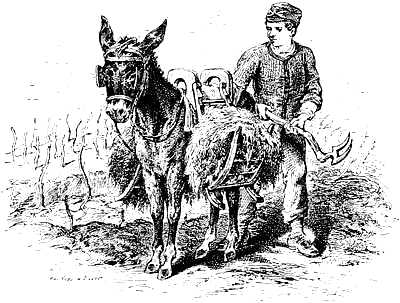
MANURING THE NEWLY-PLANTED YOUNG VINES.
In the Champagne the old rule holds good—poor soil, rich product, grand wine in moderate quantity. The soil of the vineyards is chalk, with a mixture of silica and light clay, combined with a varying proportion of oxide of iron. Many of the best have a substratum of stones and sand, and a thin superstratum of vegetable earth. The ruddier the soil, and consequently the more impregnated with ferruginous earth, the better suited it is found to the cultivation of black grapes; whilst the gray or yellowish soils, such as abound in the Côte d’Avize, are preferable for the white varieties.
The vines are almost invariably planted on rising ground, the lower slopes, which seldom escape the spring frosts, producing the best wines. The vines are placed very close together, there often being as many as six within a square yard, and the result is that they reciprocally impoverish each other. Planting takes place between November and April, the vine-growers of the River being usually in advance of those of the Mountain in this operation. Plants two or three years old and raised in nurseries are usually made use of. These are placed either in holes or trenches. The roots have a little earth sprinkled over them, to which a liberal supply of manure or compost is added, and the holes having been filled up and trodden, the vines are pruned down to a couple of buds above the ground.
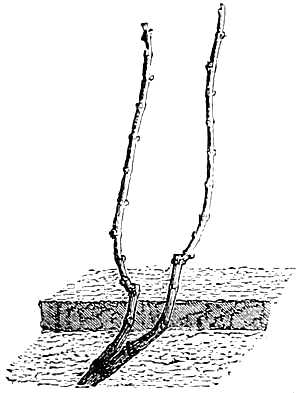
VINE PREPARED FOR ‘PROVINAGE.’
In the course of two or three years they are ready for the operation of ‘provinage,’ or layering, a method of multiplication universally practised in the Champagne. This consists in burying in a trench, from six to eight inches deep dug on one side of the plant, two or more of the principal shoots, left when the vine was pruned for this especial purpose. The whole of the two-years’-old wood is thus buried, and the ends of the shoots of one-year-old, which are left above ground, are cut down to the second bud. The shoots thus laid underground are dressed with a light manure, and in course of time take root and form new vines, which bear during their second year. This operation is performed simultaneously with the ‘bêchage’ in the early spring, and is annually repeated until the vine is five years old, the plants thus being in a state of continual progression; a system which accounts for the juvenescent aspect of the Champagne vineyards, where none of the wood of the vines showing above ground is more than three years old.
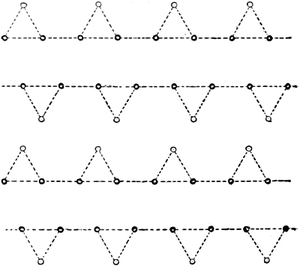
PLAN OF ‘PROVINAGE À L’ÉCART’ IN A NEWLY-PLANTED VINEYARD.
The two principal plans adopted in provining are styled the ‘écart’ and the ‘avance.’ In the first, which is usually followed in newly-planted vineyards, the two shoots are carried forward to the right and left—so as to form the two base points of an equilateral triangle, of which the point of departure is the summit—and are maintained in this position by the aid of wooden or iron pegs. In the ‘provinage à l’avance’ both shoots are carried forward in the same direction, and sometimes a variation embodying the two systems is employed.
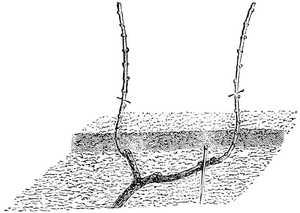
PROVINAGE À L’ÉCART.
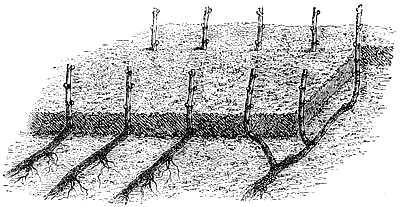
PROVINAGE À L’AVANCE.
When the vine has attained its fifth year it is allowed to rest for a couple of years, and then the provining is resumed, the shoots being dispersed in any direction throughout the vineyard, so as to fill up vacancies. The plants remain in this condition henceforward, merely requiring to be renewed from time to time by judicious provining. For instance, it is sometimes found necessary to bend one of the shoots round into a circle, so that its end may issue from the ground at the point occupied by the parent stock. The system of provinage is sometimes carried to excess in the Champagne, with a view of increasing the yield of wine, which suffers, however, in quality. The network of roots, too, renders the various operations of cultivation difficult and dangerous, as they are liable to be injured by the short-handled hoe in universal use among the Champenois vine-dressers.
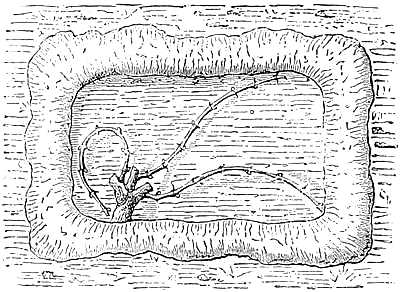
TRIPLE ‘PROVINAGE’ TO REPLACE THE PARENT STOCK.
Viticulturists inclined to make experiments have tried the system of arranging the vines in transverse and longitudinal lines, quincunxes, &c., or have replaced their vine-stakes with iron wires supported by wooden pickets. Some of these experiments have proved successful, although none of them are as yet in general use.
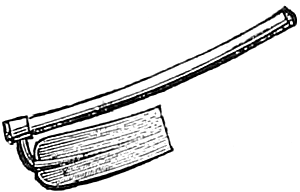
VINE DRESSER’S HOE.
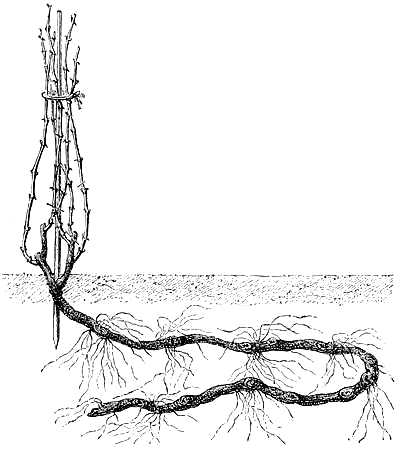
VINE PRIOR TO THE FEBRUARY PRUNING, SHOWING THE EXTENT OF ROOT.
The first operation of importance carried out during the year in the vineyards is the ‘taille,’ or pruning, which takes place in February, and consists in cutting away the superfluous shoots, simply leaving one—or, if it is intended to multiply by provinage, two—on each stock. This is followed about March or April by the ‘bêchage,’ or ‘hoyerie’—that is, the digging round the roots of the vine—with which is combined the provinage. A trench being opened, as already noted, and the vine laid bare to the roots, it is bent down so that, on filling up the trench with earth and manure, the stock is entirely covered and only the new wood appears above ground. This new wood is then shortened back, and the stakes intended for the support of the vines are fixed in the ground. These stakes are set up in the spring of the year by men or women, the former of whom force them into the ground by pressing against them with their chest, which is protected with a shield of wood. The women use a mallet, or have recourse to a special appliance, in working which the foot plays the principal part. The latter method is the least fatiguing, and in some localities is practised by the men. An expert labourer will set up as many as 5000 stakes in the course of the day. When of oak these stakes cost sixty francs the thousand; and as the close system of plantation followed in the Champagne renders the employment of no less than 24,000 stakes necessary on every acre of land, the cost per acre of propping up the vines amounts to upwards of 57 l., or more than treble what it is in the Médoc and quadruple what it is in Burgundy. The stakes last only some fifteen years, and their renewal forms a serious item in the vine-grower’s budget.
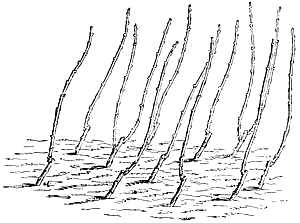
VINES IN FEBRUARY AFTER THE ‘TAILLE.’
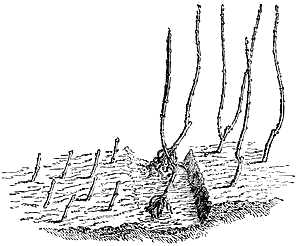
THE ‘BÊCHAGE’ OF THE VINES.
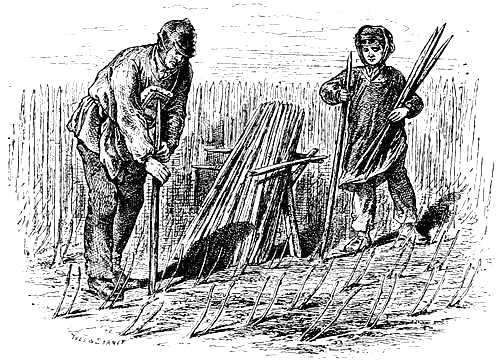
PUTTING STAKES TO THE VINES IN THE SPRING.
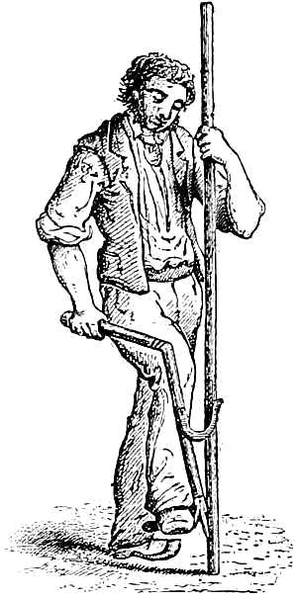
APPARATUS FOR FIXING VINE-STAKES.
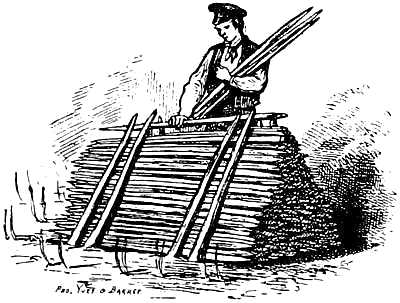
UNSTACKING THE VINE-STAKES.
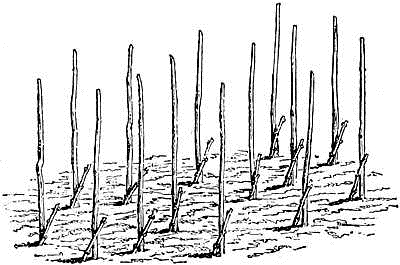
NEWLY-STAKED VINES AFTER THE ‘BÊCHAGE.’
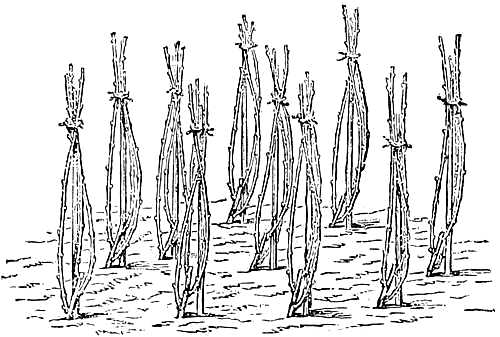
VINES IN AUTUMN AFTER THE VINTAGE.
In May or June, after the vines have been hoed around their roots, they are secured to the stakes, and their tops are broken off at a shoot to prevent them from growing above the regulation height, which is ordinarily from 30 to 33 inches. They are liberally manured with a kind of compost formed of the loose friable soil termed ‘cendre’—dug out from the sides of the hills, and of supposed volcanic origin—mixed with animal and vegetable refuse. The vines are shortened back while in flower, and in the course of the summer the ground is hoed a second and a third time, the object being, first, to destroy the superficial roots of the vines and force the plants to live solely on their deep roots; and secondly, to remove all pernicious weeds from round about them. After the third hoeing, which takes place in the middle of August, the vines are left to themselves until the period of the vintage, excepting that some growers remove a portion of the leaves in order that the grapes may receive the full benefit of the sun, and raise up those bunches that rest upon the ground. The vintage over, the stakes supporting the vines are pulled up later in the autumn and stacked in compact masses, styled ‘moyères,’ with their ends out of the ground, or else ‘en chevalet,’ the vine, which is left curled up in a heap, remaining undisturbed until the winter, when the earth around it is loosened. In the month of February following the vine is pruned and subsequently sunk into the earth, as already described, so as to leave only the new wood above ground. Owing to the vines being planted so closely together they naturally starve one another, and numbers of them perish. Whenever this is the case, or the stems chance to get broken during the vintage, their places are filled up by provining.
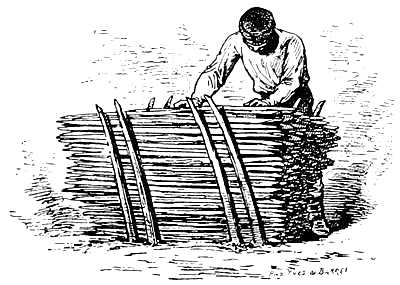
STACKING STAKES ‘EN CHEVALET.’
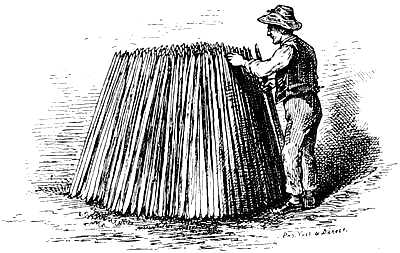
STACKING STAKES IN A ‘MOYÈRE.’
The vignerons of the Champagne regard the numerous stakes which support the vines as affording some protection against the white frosts of the spring. To guard against the dreaded effects of these frosts, which invariably occur between early dawn and sunrise, and the loss arising from which is estimated to amount annually to 25 per cent, some of the cultivators place heaps of hay, fagots, dead leaves, &c., about twenty yards apart, taking care to keep them moderately damp. When a frost is feared the heaps on the side of a vineyard whence the wind blows are set light to, whereupon the dense smoke which rises spreads horizontally over the vines, producing the same result as an actual cloud, intercepting the rays of the sun, warming the atmosphere, and converting the frost into dew. Among other methods adopted to shield the vines from frosts is the joining of branches of broom together in the form of a fan, and afterwards fastening them to the end of a pole, which is placed obliquely in the ground, so that the fan may incline over the vine and protect it from the sun’s rays. A single labourer can plant, it is said, as many as eight thousand of these fans in the ground during a long day.

UNROLLING MATTING FOR ROOFING THE VINES WITH.
Dr. Guyot’s system of roofing the vines with straw matting, to protect them alike against frosts and hailstorms, is very generally followed in low situations in the Champagne, the value of the wine admitting of so considerable an expense being incurred. This matting, which is made about a foot and a half in width, and in rolls of great length, is fastened either with twine or wire to the vine-stakes; and it is estimated that half a dozen men can fix nearly 11,000 yards of it, or sufficient to roof over 2 ½ acres of vines, during an ordinary day. To carry out the system properly, a double row of tall and short stakes connected with iron wires has to be provided. The matting can then be used as a shelter to the young vines in spring, as a south wall to aid the ripening of the grapes in summer, and as a protection against rain and autumn frosts.
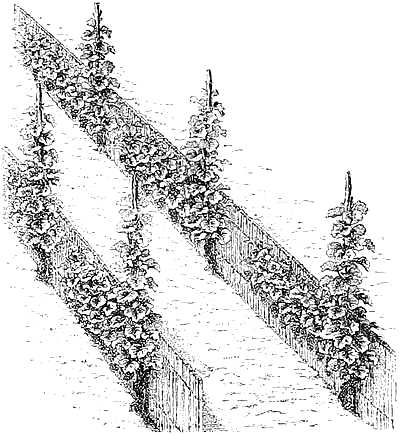
MATTING ARRANGED TO AID THE RIPENING OF THE GRAPES.
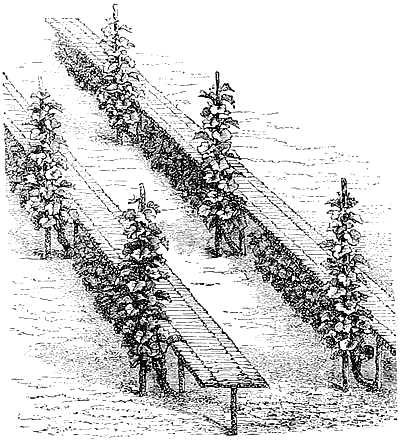
MATTING ARRANGED TO PROTECT THE VINES AGAINST AUTUMN FROSTS.
Owing to the system of cultivation by rejuvenescence, and the constant replenishing of the soil by well-compounded manures, the Champenois wine-growers entertain great hopes that their vineyards will escape the ravages of the phylloxera vastatrix. They certainly deserve such an immunity, for, according to Dr. Plonquet of Ay, they are already the prey of no less than fifteen varieties of insects, which feed upon the leaves, stalks, roots, or fruit of the vines. One of the most destructive of these is the eumolpe, gribouri, or écrivain as it is popularly styled, from the traces it leaves upon the vine-leaves bearing some resemblance to lines of writing. It is a species of beetle, the larvæ of which pass the winter amongst the roots of the vine, and in the spring attack the young leaves and buds, their ravages often proving fatal to the plant. Then there is the chabot, which has caused great destruction at Verzy and Verzenay; the attelabe, cunche, or bêche, which rolls up the leaves of the vine like cigars, and seems to be identical with the hurebet or urbec of the Middle Ages; and the cochylis, teigne, or vintage-worm, which develops into a white-and-black butterfly, producing in the course of the year two generations of larvæ, having the form of small red caterpillars, one of which attacks the blossoms of the vine, while the second pierces and destroys the grapes themselves. The list of foes further comprises the altise, a kind of beetle allied to the gribouri; the liset or coupe-bourgeon, a tiny worm assailing the first sprouting shoots; and the hanneton or cockchafer.
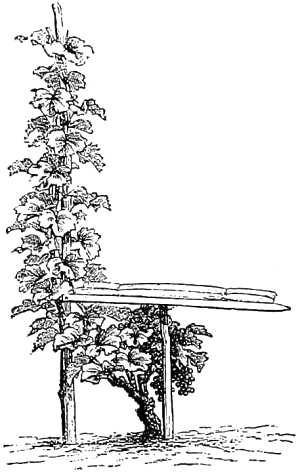
MATTING ARRANGED TO KEEP OFF RAIN OR HAIL.
The greatest havoc, however, appears to be wrought by the pyrale, a species of caterpillar, which feeds on the young leaves, flowers, and shoots until the vine is left completely bare. The larva of this insect, after passing the winter either in the crevices of the stakes or in the cracks in the bark of the vine, emerges in the spring, devours leaves, buds, and shoots indifferently, and eventually becomes transformed into a small yellow-and-brown butterfly, which deposits its eggs amongst the bunches of grapes in July. Between 1850 and 1860 the vineyards of Ay were devastated by the pyrale, which, like the locusts of Scripture, spared no green thing; and all the efforts made to rid them of this scourge proved ineffectual until the wet and cold weather of 1860 put a stop to the insect’s ravages.[408] More recently it was discovered that its attacks could be checked by sulphurous acid, or by scalding the stakes and the vine-stocks with boiling water during the winter. Nevertheless, it appeared impossible to check its destructiveness at Ay, where it made its reappearance in 1879, and caused an immense amount of damage. On this occasion an ingenious gentleman, M. Testulat Gaspar, was seized with the idea of combating the pyrale by means of the electric light. His theory was, that on a powerful light being exhibited in a central position at midnight amongst the vineyards, with a number of tin reflectors distributed in every direction around, the butterflies, roused from slumber, would wing their way in myriads towards the latter, when their flight could be arrested by sheets of muslin stretched between poles, smeared with honey and baited with a dash of Champagne liqueur. The theory was put to the test in August 1879, amongst the vineyards between Dizy and Ay, where the pyrale was committing the greatest ravages. The light was turned on, and the butterflies rose ‘in millions;’ but they failed to flock to the reflectors, and the honey-smeared muslin proved quite useless to secure the few which came in contact with it.
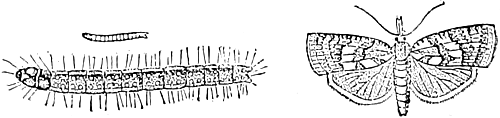
THE PYRALE.
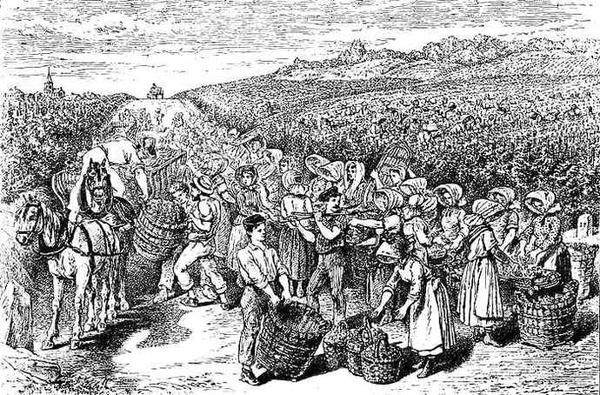
A VINTAGE SCENE IN THE CHAMPAGNE.
IV. THE VINTAGE IN THE CHAMPAGNE.
Period of the Champagne vintage—Vintagers summoned by beat of drum—Early morning the best time for plucking the grapes—Excitement in the neighbouring villages at vintage-time—Vintagers at work—Mules employed to convey the gathered grapes down the steeper slopes—The fruit carefully examined before being taken to the wine-press—Arrival of the grapes at the vendangeoir—They are subjected to three squeezes, and then to the ‘rébêche’—The must is pumped into casks and left to ferment—Only a few of the vine-proprietors in the Champagne press their own grapes—The prices the grapes command—Air of jollity throughout the district during the vintage—Every one is interested in it, and profits by it—Vintagers’ fête on St. Vincent’s-day—Endless philandering between the sturdy sons of toil and the sunburnt daughters of labour.
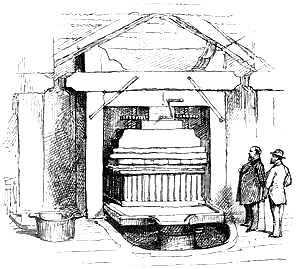
WINE-PRESS IN THE CHAMPAGNE.
WHEN the weather has been exceedingly propitious, the vintage in the Champagne commences as early as the third week in September, and in good average years the pickers set to work during the first week of October. If, however, the summer has been an indifferent one, and only an inferior vintage is looked forward to, it is scarcely before the latter half of October that the gathering of the grapes is proceeded with. There is no vintage-ban in the Champagne, as in Burgundy and other parts of France; but, as a rule, the growers of Ay and of the neighbouring slopes commence operations a week or more earlier than those of the Mountain of Reims, whilst around Cramant and Avize, the white-grape region, the vintagers usually set to work when in the other districts they have nearly finished.
The pleasantest season of the year to visit the Champagne is certainly during the vintage. When this is about to commence, the vintagers—some of whom come from Sainte Menehould, forty miles distant, while others hail from as far as Lorraine—are summoned at daybreak by beat of drum in the market-places of the villages adjacent to the vineyards, and then and there a price is made for the day’s labour. This, as we have already explained, is generally either a franc and a half, with food consisting of three meals, or two francs and a half, rising on exceptional occasions to three francs, without food, children being paid a franc and a half. The rate of wage satisfactorily arranged, the gangs start off to the vineyards, headed by their overseers.
The picking ordinarily commences with daylight, and the vintagers assert that the grapes gathered at sunrise always produce the lightest and most limpid wine. Moreover by plucking the grapes when the early morning sun is upon them, they are believed to yield a fourth more juice. Later on in the day, too, spite of all precautions, it is impossible to prevent some of the detached grapes from partially fermenting, which frequently suffices to give a slight excess of colour to the must, a thing especially to be avoided in a high-class Champagne. When the grapes have to be transported in open baskets for some distance to the press-house, jolting along the road either in carts or on the backs of mules, and exposed to the torrid rays of a bright autumnal sun, the juice expressed from the fruit, however dexterously the latter may be squeezed in the press, is occasionally of a positive purple tinge, and consequently useless for conversion into Champagne.
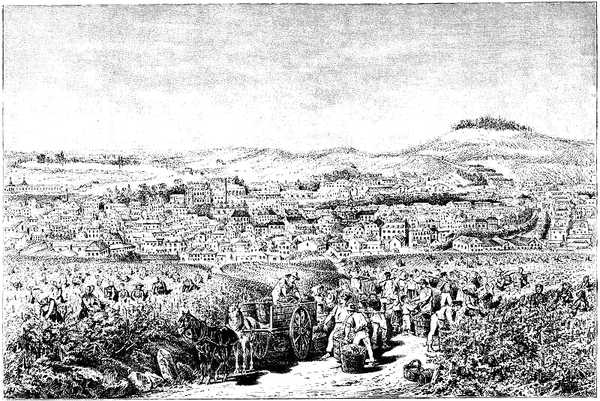
THE CHAMPAGNE VINTAGE IN THE NEIGHBOURHOOD OF EPERNAY.
At vintage-time everywhere is bustle and excitement; every one is big with the business in hand. In these ordinarily quiet little villages nestling amidst vine clad hollows, or perched half-way up a slope tinted from base to summit with richly-variegated hues, there is a perpetual pattering of sabots and a rattling and bumping of wheels over the roughly-paved streets. The majority of the inhabitants are afoot: the feeble feminine half, baskets on arm, thread their way with the juveniles through the rows of vines planted half-way up the mountain, and all aglow with their autumnal glories of green and purple, crimson and yellow; while the sturdy masculine portion are mostly passing to and fro between the press-houses and the wine-shops. Carts piled up with baskets, or crowded with peasants from a distance on their way to the vineyards, jostle the low railway-trucks laden with brand-new casks, and the somewhat rickety cabriolets of the agents of the big Champagne houses, who are reduced to clinch their final bargain for a hundred or more pièces of the peerless wine of Ay or Bouzy, Verzy or Verzenay, beside the reeking wine-press.
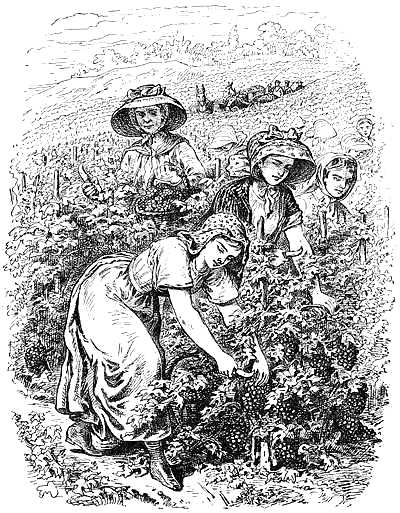
Dotting the steep slopes like a swarm of huge ants are a crowd of men, women, and children, the men, in blue blouses or stripped to their shirt-sleeves, being for the most part engaged in carrying the baskets to and fro and loading the carts; whilst the women, in closely-fitting neat white caps, or wearing old-fashioned unbleached straw-bonnets of the contemned coalscuttle type, resembling the ‘sun-bonnet’ of the Midland counties, together with the children, are intent on stripping the vines of their luscious-looking fruit. They detach the grapes with scissors or hooked knives, technically termed ‘serpettes,’ and in some vineyards proceed to remove all damaged, decayed, or unripe fruit from the bunches before placing them in the baskets which they carry on their arms, and the contents of which they empty from time to time into a larger basket resembling an ass’s pannier in shape, numbers of these being dispersed about the vineyard for the purpose, and invariably in the shade. When filled the baskets are carried by a couple of men to the roadside, along which dwarf stones carved with initials, and indicating the boundaries of the respective properties, are encountered every eight or ten yards, into such narrow strips are the vineyards divided. Large carts with railed open sides are continually passing backwards and forwards to pick these baskets up; and when one has secured its load it is driven slowly to the neighbouring pressoir, so that the grapes may not be in the least degree shaken, such is the care observed throughout every stage of the process of Champagne manufacture. When the vineyard slopes are very steep—as, for instance, at Mareuil—and the paths do not admit of the approach of carts, mules, equipped with panniers and duly muzzled, are employed to convey the gathered fruit to the press-house.
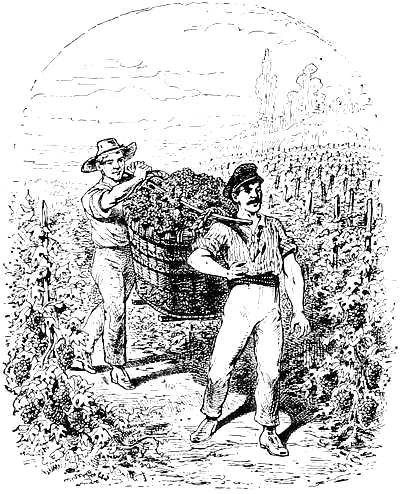
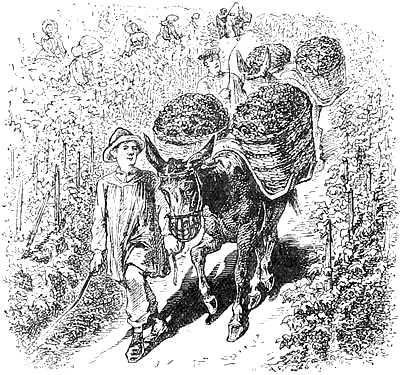
In many vineyards the grapes are inspected in bulk instead of in detail before being sent to the wine-press. The hand-baskets, when filled, are brought to a particular spot, where their contents are minutely examined by some half-dozen men and women, who pluck off the bruised, rotten, and unripe berries, and fling them aside into a separate basket. In other vineyards we came upon parties of girls, congregated round a wicker sieve perched on the top of a large tub by the roadside, engaged in sorting the grapes, pruning away the diseased stalks, and picking off all the doubtful berries. The latter were let fall through the interstices of the sieve, while the sound fruit was deposited in large baskets standing beside the sorters, and which, as soon as they were filled, were conveyed to the pressoir. When the proprietor is of an economic turn he usually has the refuse grapes pressed for wine for home consumption. Spite of the minute examination to which the grapes are subjected, a sharp eye will frequently discover in the heart of what looks like a regular and well-grown bunch a grape that is absolutely rotten, and capable of infecting its companions when the whole are heaped up together in the wine-press.
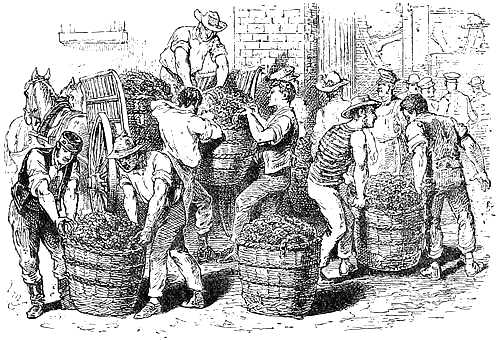
ARRIVAL OF THE GRAPES AT THE PRESS-HOUSE.
Carts laden with grapes are continually arriving at the pressoirs, discharging their loads and driving off for fresh ones. The piled-up baskets, marked with the names of the vineyard-owners whose grapes they contain, are temporarily stored under a shed in a cool place, and are brought into the pressoir from time to time as required. In the district of the River the grapes are weighed, while in that of the Mountain they are measured, before being emptied on to the floor of the press. In some places the latter is of the old-fashioned type, resembling the ordinary cider-press; but usually powerful presses of modern invention, worked by a large fly-wheel requiring four sturdy men to turn it, are employed. The grapes are spread over the floor of the press in a compact mass, and in some rare cases are lightly trodden by a couple of men with their naked feet before being subjected to mechanical pressure, which is again and again repeated, only the first squeeze giving a high-class wine, and the second and third a relatively inferior one. After three pressures the grapes are usually worked about with peels, and subjected to a final squeeze known as the ‘rébêche,’ which produces a sort of piquette, given to the workmen to drink, but in many instances forming the habitual, and indeed only, beverage of the economically-inclined peasant proprietor.
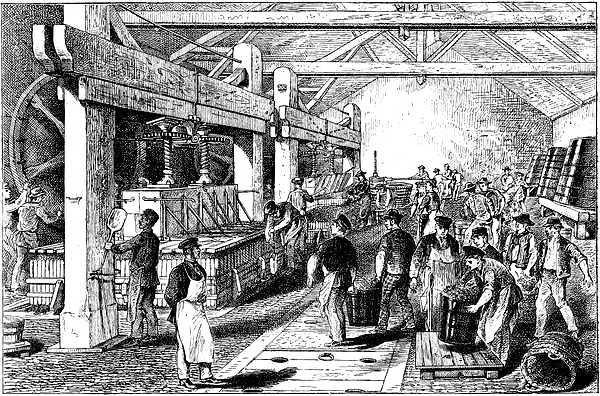
THE VINTAGE IN THE CHAMPAGNE: A WINE-PRESS AT WORK.
The must filters through a wicker basket into the reservoir beneath, whence, after remaining a certain time to allow of its ridding itself of the grosser lees, it is pumped through a gutta-percha tube into the casks. The wooden stoppers of the bungholes, instead of being fixed tightly in the apertures, are simply laid over them, and after the lapse of ten or twelve days fermentation usually commences, and during its progress the must, which is originally of a pale-pink tint, fades to a light-straw colour. The wine usually remains undisturbed until Christmas, when it is drawn off into fresh casks and delivered to the purchaser.
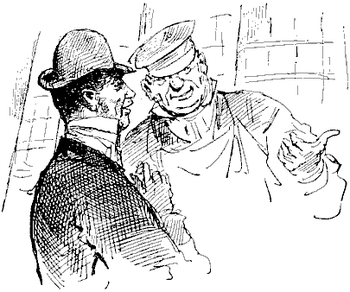
One peculiarity of the Champagne district is that, contrary to the prevailing practice in the other wine-producing regions of France, where the owner of even a single acre of vines will crush his grapes himself, only a limited number of vine-proprietors press their own grapes. The large Champagne houses, possessing vineyards, always have their pressoirs in the neighbourhood, and other large vine-proprietors press the grapes they grow; but the multitude of small cultivators invariably sell the produce of their vineyards to one or other of the former at a certain rate, either by weight or else by caque, a measure estimated to hold sixty kilogrammes (equal to 132 lb. avoirdupois) of grapes. The price which the fruit fetches varies of course according to the quality of the vintage and the requirements of the manufacturers; but the average may be taken at about 80 centimes per kilogramme, equivalent to rather more than 3 ½ d. per lb.[409]
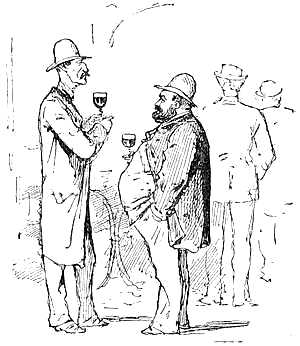
If in the Champagne the picturesque rejoicings immortalised in the Italian vintage scenes of Léopold Robert are lacking, and if the grapes, instead of being trodden to the blithe accompaniment of flute and fiddle, as in some parts of France, are pressed in more quiet fashion, a pleasant air of jollity nevertheless pervades the district at the season of the vintage. Every one participates in the interest which this excites. It influences the takings of all the artificers and all the tradespeople, and brings grist to the mill of the baker and the bootmaker, as well as to the café and cabaret. The contending interests of capital and labour are, moreover, singularly satisfied, the vintagers being content at getting their two francs and a half a day, and the men at the pressoirs their three francs and their food; the vineyard proprietor reaping the return of the time, care, and money expended upon his patch of vines, and the Champagne manufacturer acquiring raw material on sufficiently satisfactory terms, the which, when duly guaranteed by his name and brand, will bring to him both fame and fortune.
Should the vintage be a scanty one, the plethoric commissionnaires-en-vins will wipe their perspiring foreheads with satisfaction when they have at last secured the full number of hogsheads they had been instructed to buy—at a high figure maybe; still this is no disadvantage to them, as their commission mounts up the higher. And even the thickest-skulled among the small vine-proprietors, who make all their calculations on their fingers, see at a glance that, although the crop may be no more than half an average one, they are gainers, thanks to the ill-disguised anxiety of the agents to secure all the wine they require, which has the effect of sending prices up to nearly double those of ordinary years, and this with only half the work in the vineyard and at the winepress to be done.
The vintage in the Champagne comes to a close without any of those festivals which still linger in the department of the Gironde. On the 22d of January, the fête of St. Vincent, the patron saint of vine-growers, it is customary, however, for one of the proprietors in each village to pay for a mass and give a breakfast to his relatives and friends, at which he presents a bouquet to one of the guests, who, in his turn, is expected to pay for the mass and give the breakfast the year following. On the same day the proprietors entertain their workpeople, who, after having eaten and drunk their fill, wind up the day with song and dance, leading to no end of innocent philandering between the sturdy sons of toil and the sunburnt daughters of labour. On these occasions the famous vintage song is sometimes heard:
‘Vendangeons et vive la France, Le monde un jour avec nous trinquera.’
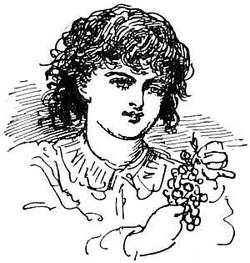
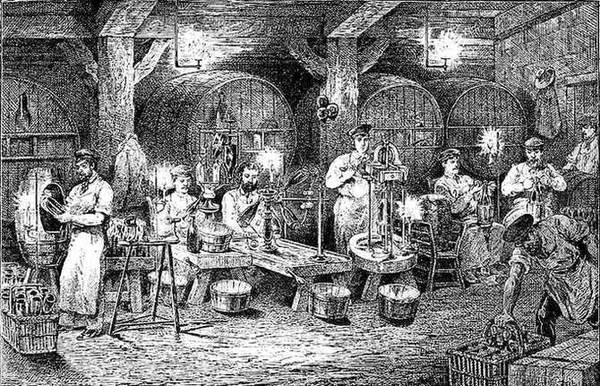
THE DISGORGING, LIQUEURING, CORKING, STRINGING, AND WIRING OF CHAMPAGNE.
V. THE PREPARATION OF CHAMPAGNE.
The treatment of Champagne after it comes from the wine-press—The racking and blending of the wine—The proportions of red and white vintages composing the ‘cuvée’—Deficiency and excess of effervescence—Strength and form of Champagne bottles—The ‘tirage’ or bottling of the wine—The process of gas-making commences—Details of the origin and development of the effervescent properties of Champagne—The inevitable breakage of bottles which ensues—This remedied by transferring the wine to a lower temperature—The wine stacked in piles—Formation of sediment—Bottles placed ‘sur pointe’ and daily shaken to detach the deposit—Effect of this occupation on those incessantly engaged in it—The present system originated by a workman of Madame Clicquot’s—‘Claws’ and ‘masks’—Champagne cellars—Their construction and aspect—Raw recruits for the ‘Regiment de Champagne’—Transforming the ‘vin brut’ into Champagne—Disgorging and liqueuring the wine—The composition of the liqueur—Variation in the quantity added to suit diverse national tastes—The corking, stringing, wiring, and amalgamating—The wine’s agitated existence comes to an end—The bottles have their toilettes made—Champagne sets out on its beneficial pilgrimage round the world.
THE special characteristic of Champagne is that its manufacture only commences where that of other wines ordinarily ends. No one would recognise in the still brut fluid—which, after being duly racked and fined, has somewhat the taste and colour of an acrid Rhine wine, with a more or less pronounced bitter flavour—that exhilarating essence which is capable of raising the most depressed spirits, and imparting gaiety to the dismallest gatherings. Much as Champagne may stand indebted to Nature, soil, climate, and species of vine, the sparkling fluid has contracted a far greater debt towards man, to whose incessant labour, patient skill, and minute precautions it owes that combination of qualities which causes it to be so highly prized.
In the preceding chapter we left the newly-expressed must flowing direct from the press into capacious reservoirs, whence it is drawn off into large vats, where it clears itself by depositing its mucous lees, usually within twenty-four hours. It is then transferred to new or perfectly clean casks, holding some forty gallons each, in which a sulphur match has been previously burnt. These casks are not filled quite up to the bunghole, which is generally covered with a vine-leaf kept in its place by a piece of tile. The bulk of the newly-made wine is left to repose at the vendangeoirs until the commencement of the following year; still, when the vintage is over, numbers of long narrow carts laden with casks of newly-expressed must may be seen rolling along the dusty highways, bound for those towns and villages in the department of the Marne where the manufacture of Champagne is carried on, and where the leading firms have their establishments. Chief amongst these is the cathedral city of Reims, after which comes the rising town of Epernay, stretching to the very verge of the river; then Ay, nestling between the vine-clad slopes and the Marne canal, with the neighbouring village of Mareuil; next Pierry; and finally Avize, in the centre of the white-grape district southwards of Epernay. Châlons, owing to its distance from the vineyards, does not usually draw its supply of wine until the new year.