VANDA ROXBURGHII. [Plate 59.] Native of India.
Reading edition
VANDA ROXBURGHII. [Plate 59.] Native of India.
Epiphytal. Stems dwarf, stout, erect, leafy, with aërial roots from the lower portion. Leaves two-ranked, evergreen, leathery, light green, ligulate, channelled, obliquely tridentate at the apex. Flowers six to twelve, in erect axillary racemes longer than the leaves, tessellated; sepals and petals oblong-obovate, obtuse, undulated, white on the exterior surface, the inner side pale green, marked with olive-brown in chequered lines; lip three-lobed, projected backwards near the middle to form a short pinkish spur; the lateral lobes lanceolate, sharp-pointed, about as long as the column, white; the middle lobe convex, with the sides inflected beneath, ovate, emarginate and very obtuse, channelled, violet-purple, deeper towards the apex. Column short, thick, obtuse, white.
Vanda Roxburghii, R. Brown, in Botanical Register, t. 506; Lindley, Genera and Species of Orchidaceous Plants, 215; Id. Folia Orchidacea, art. Vanda, No. 4; Id. Paxton’s Flower Garden, t. 42, fig. 2; Hooker, Botanical Magazine, t. 2245; Van Houtte, Flore des Serres, ii., t. 11; Wight, Icones Plantarum Indiæ Orientalis, iii., t. 916; Williams, Orchid Grower’s Manual, 5 ed., 307.
Vanda tessellata, Loddiges; Paxton’s Magazine of Botany, vii., 265 (var. with rosy lip).
Vanda tesselloides, Reichenbach fil., in Walpers’ Annales Botanices Systematicæ, vi., 864.
Cymbidium tesselloides, Roxburgh, Flora Indica, iii., 463.
We now bring before our readers a plant that few of the present generation of Orchid growers have seen, but one which we think they all should possess, as it requires but little space, and produces its flower-spikes on very small specimens. Our plate will give some idea of this, as it represents a full-sized plant, with a spike of very charmingly coloured flowers. There are several varieties of this species known, among which we consider the one which our plate pourtrays to be an excellent form. The plant represented is in the collection of W. Lee, Esq., Downside, Leatherhead. We are delighted to know that Mr. Lee is taking up the cultivation of the Vandas (of which he possesses a splendid collection), and intends devoting a centre table in one of his houses to their accommodation. There are no Orchids that flower so freely when they are well grown; indeed, Mr. Lee blooms many plants of Vanda tricolor while quite small. When the specimens attain a large size they flower two or three times a year, lasting each time some six weeks, or even more, in perfection. They are extremely fragrant, imparting a 23 grateful odour to the whole atmosphere of the house. Other growers also are paying more regard to these beautiful plants, which we are glad to observe, as, though they flower so often, they do not require so much heat as some East Indian kinds.
Vanda Roxburghii is a dwarf compact growing plant, with light green foliage. The flower-spikes proceed from the axils of the leaves, and are upright, bearing from six to twelve flowers. The sepals and petals are of a greenish yellow, netted with purplish brown, the lip being of a bright mauve colour. This plant usually blossoms in May, and lasts six weeks in full beauty; but it sometimes varies as to the time of flowering.
The treatment which we find to suit this plant is to grow it in a basket suspended from the roof, where it procures a good amount of light, being merely shaded in summer when the sun is hot. It does best at the coolest end of the East Indian house. We have also cultivated it in a pot with good drainage and sphagnum moss; it requires a moderate supply of water in summer, but in winter only just sufficient should be given to moisten the moss.
Watering Orchids.—There can be no doubt that Orchids, like other plants, are particular as to the fluids given to them to nourish their roots. We often hear growers say, that the water obtainable in the particular locality where they may reside is hard, and that their plants do not thrive as they should do. We can fully sympathise with these men, as we know that hard water is bad for Orchids as well as for other plants. Hardwooded plants especially will not thrive if the water they receive does not suit them; but it must be borne in mind that these plants have fine hair-like roots, and are much sooner killed than Orchids which have thick fleshy roots. When conversing the other day with an Orchid grower from the north of England, who said that his plants were not doing well, that he could not keep the sphagnum moss alive—which he attributed to the use of hard water—and that he consequently put up a cistern for rain-water, and employed that, we were not surprised to hear that the result had been to improve the health of the plants, and that the moss was now growing luxuriantly.
There is a great difference between different hard waters; some contain a quantity of iron, while others contain lime; these when used for syringing leave white marks upon the foliage. We believe water containing chalk and lime to be beneficial to some kinds of Orchids, especially Cypripediums; in fact, some growers use chalk or broken limestone mixed with charcoal and peat to grow them in, and they succeed very well in it. We have frequently seen distinct traces of lime on imported Cypripediums. An importation of Cypripedium Spicerianum, received some time ago, was literally covered with lime deposit, probably owing to the plants having been found growing in the fissures of limestone rocks, where the water trickled down upon them. We should think that water containing iron would be the most injurious to Orchids.
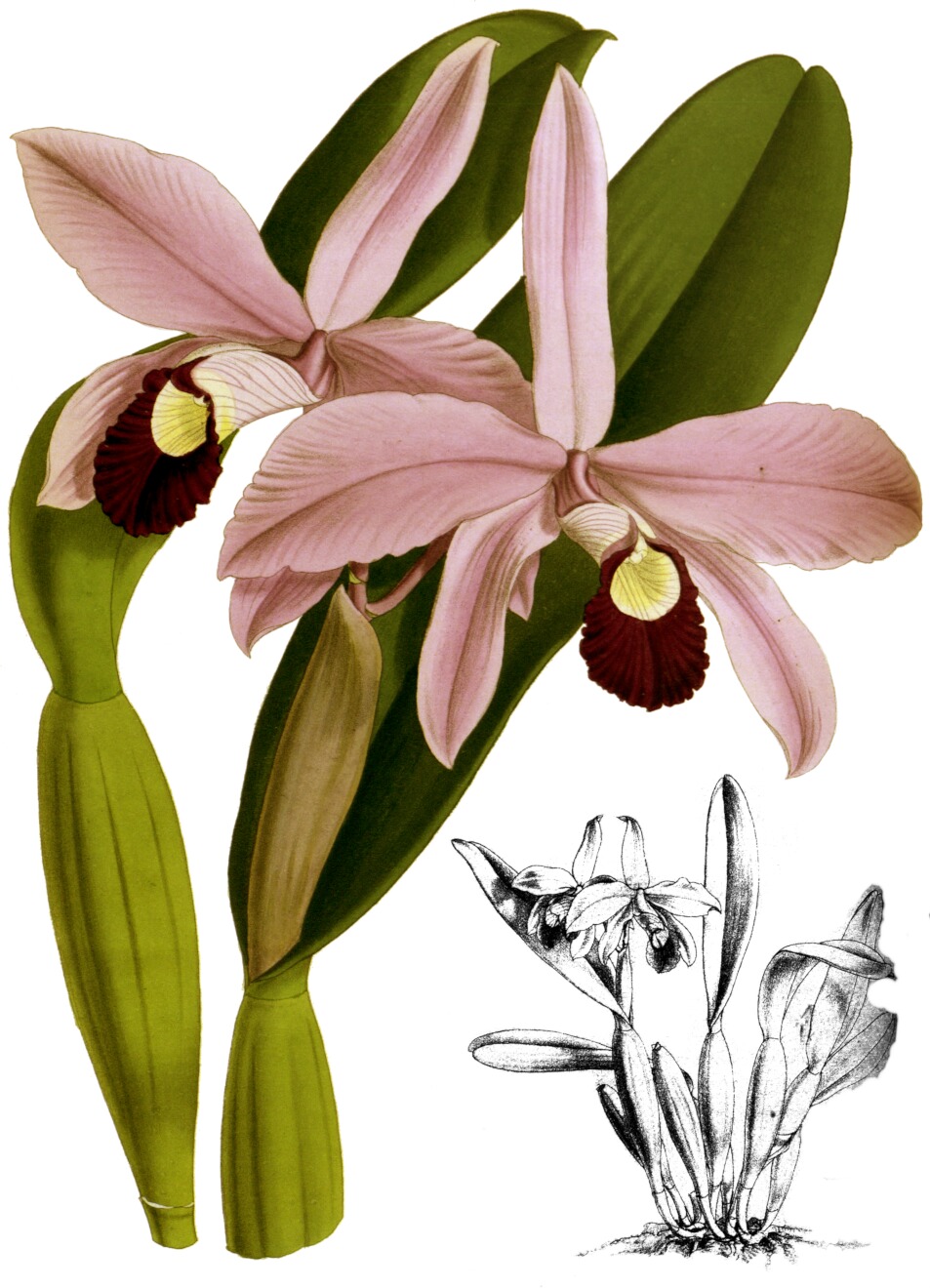
PL. 60. LÆLIA PERRINII.
24