CATTLEYA ACLANDIÆ. [Plate 69.] Native of Bahia.
Reading edition
CATTLEYA ACLANDIÆ. [Plate 69.] Native of Bahia.
Epiphytal. Stems (pseudobulbs) clavate, slightly furrowed, jointed, four to five inches long, sheathed at the joints with membranaceous spathes. Leaves terminal, two in number, elliptic, obtuse, thick and fleshy in texture, dark green. Scape terminal, bearing about two flowers and issuing from between the leaves. Flowers large, about three inches across, and strikingly beautiful from the boldly contrasted colours; sepals and petals nearly equal, somewhat fleshy, obovate-lanceolate, yellowish green heavily and transversely blotched and spotted with rich dark chocolate-purple, the markings more distinctly coloured on the inner surface, but apparent though less distinct on the back or exterior surface; lip large, fully two inches long, flat, panduriform, three-lobed, the lateral lobes pale rose marked with transverse veins, small and not enclosing the column, the front lobe one and a half inch across, broadly kidney-shaped, emarginate, of a bright magenta colour, the disk marked by a yellow line. Column dark magenta, parallel with the lip, obovate, with two wing-like margins.
Cattleya Aclandiæ, Lindley, Botanical Register, 1840, t. 48; Paxton’s Magazine of Botany ix, 1; Flore des Serres, t. 674; Illustration Horticole, t. 565; Hooker, Botanical Magazine, t. 5039; Bateman, Second Century of Orchidaceous Plants, t. 119; Williams, Orchid Grower’s Manual, 5 ed., 114.
The Cattleya Aclandiæ though a small-growing epiphyte, is one of the most beautiful of the Cattleyas, notwithstanding that there are several others which are of dwarf habit and produce richly coloured flowers. The specimen we now figure is growing in the fine collection of Baron J. H. Schröder, The Dell, Staines, to whom we are indebted for the opportunity of having our drawing made. It is a highly-coloured and finely marked form, quite as good as any we remember to have seen. This species does not, however, vary so much as many other kinds.
Cattleya Aclandiæ is an evergreen species of dwarf stature, growing about six inches in height, and blooming at different times of the year, previous to the completion of its new growths. It generally produces two or three flowers on a spike; the sepals and petals are greenish yellow, heavily blotched with chocolate-purple, while the lip is a bright magenta, distinctly veined, which gives it an unique appearance. When vigorous the plants frequently make a second growth, which also produces flowers, these lasting in perfection for several weeks.
We have found these plants do best grown in pans or baskets, in a compost of good fibrous peat and lumpy charcoal, and good drainage must be provided to ensure success. We have also seen them well cultivated on blocks of wood, but as they 43 then require more attention as regards watering than when in pans or baskets, we prefer them grown in the latter way. An abundance of moisture should be provided for them during the growing season, when the plants will be throwing out their new roots. At this period close attention should be given in order to prevent the injuries that may occur from the attacks of insects on the young and tender roots, since these are frequently produced above the soil; even if the plants recover from such a check they are apt to get into a sickly condition, or to shrivel and dwindle away. Cattleya Aclandiæ is not one of the easiest of Orchids to cultivate, and for this reason it requires extra attention to keep it in good condition. We have, however, seen many fine plants of this beautiful species where it has had the treatment suitable to it. We have found the Cattleya house to afford the best temperature in which to grow it. A position as near the glass as possible, with not too much shade, will be found to suit it best; though care should always be taken to prevent the burning sun from injuring the leaves, and to keep the bulbs in a plump state, for, if allowed to shrivel or get into bad condition, the plants might as well be thrown away, since they seldom recover. During the resting season, therefore, sufficient water should be given to keep the bulbs from shrinking.
Always bear in mind that cleanliness is one of the great secrets of successful Orchid-growing, and that this little gem, if allowed to become the prey of insects or to get dirty, will invariably fall into a bad state of health from which it will rarely emerge. These pests may be kept under if taken in time. Both thrips and scale will sometimes attack the young growth, but they should be thoroughly routed out and destroyed.
Oncidium Phalænopsis.—This lovely Orchid comes to us from E. Salt, Esq., of Ferniehurst, Shipley, near Leeds. It is now extremely rare, and is seldom seen in collections. Mr. Salt informs us that this same plant, last year, before it was divided, produced one spike with six flowers. It is a glorious Orchid, allied to O. nubigenum and O. cucullatum; the flowers are, however, much larger than in either of these, and more beautifully coloured. The sepals and petals are cream coloured, barred, and spotted with purple; the lip is large, reniform, creamy white, spotted about the base with violet-crimson, the crest being golden yellow, and forming a striking contrast with the violet spotting which surrounds it. The species is a native of Peru.—B. S. W.
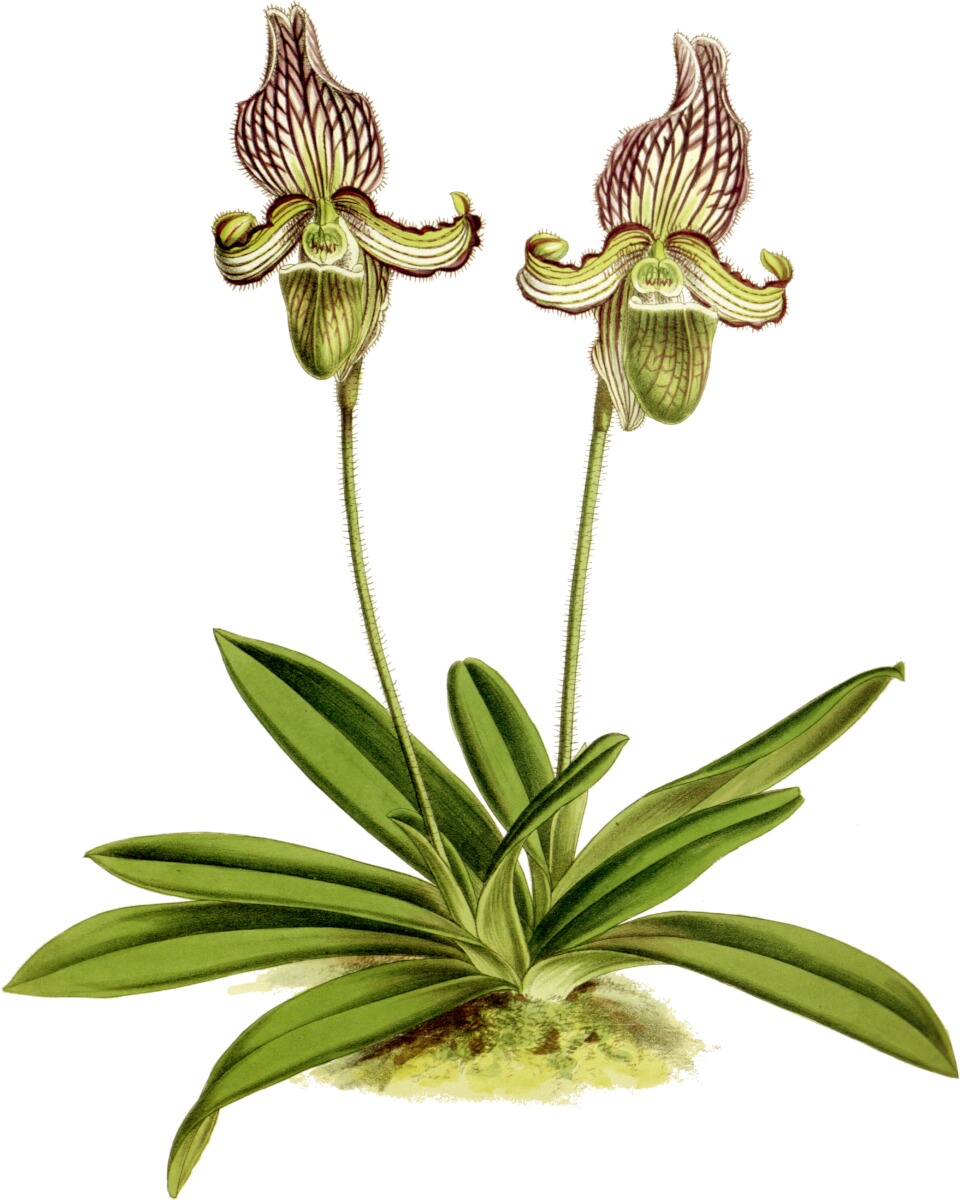
PL. 70. CYPRIPEDIUM FAIRRIEANUM.
44