ODONTOGLOSSUM CRISTATELLUM. [Plate 66.] Native of the United States of Columbia.
Reading edition
ODONTOGLOSSUM CRISTATELLUM. [Plate 66.] Native of the United States of Columbia.
Epiphytal. Pseudobulbs ovate, one and a half to two inches long, pale green. Leaves one or two from each pseudobulb, ligulate-oblong, acute, narrowed to the base, keeled. Peduncles radical, terminating in a showy raceme of flowers, and furnished below with lanceolate pale brown bracts, smaller triangular bracts being produced at the base of the pedicels. Flowers two and a half inches across, attractive in colour and marking; sepals and petals subhastate, broadish oblong-ovate above, acuminate, yellow, with a few large rich chestnut-brown blotches; lip short, narrow, the blade oblong-panduriform, apiculate, the margin much undulated and minutely denticulate, yellow at the base and chestnut-brown in front, bearing at the base of the disk subulate radiate calli, consisting of about six teeth on each side, and in front of these two rhomboid serrated lamellæ, all these parts yellowish, streaked (and the keels bordered) with chestnut-red. Column trigonous, arcuate, with violet spots in front of its base, and chestnut-red wings.
Odontoglossum cristatellum, Reichenbach fil., in Gardeners’ Chronicle, N.S., x., 716; Id. xvii., 143.
Odontoglossum Lehmanni, F. C. Lehmann in litteris—fide Reichenbach.
The Odontoglossum cristatellum is described by Prof. Reichenbach as a near relative of O. cristatum. It is, without doubt, a very rare plant, one that has flowered in but few collections, and is supposed to be a natural hybrid. It is not perhaps so showy as some other Odontoglots, but still it is one that is quite worth cultivating. Our sketch was taken from a well-grown plant in the collection of O. Schneider, Esq., Cromwell Range, Fallowfield, Manchester. This gentleman, who has an excellent collection of Orchids, has houses set apart for the various kinds, and we may say that our visit there gave us very great satisfaction, as we there saw many well-grown plants of species that are usually found difficult to cultivate.
Odontoglossum cristatellum is a compact evergreen plant, growing from ten inches to a foot in height. It is furnished with light green foliage and produces its flower-spikes at different periods of the year, according to the time of the completion of its growth; moreover, it lasts for several weeks in bloom. The plant requires to be grown in the cool Odontoglossum house, with the same treatment as O. Alexandræ, as regards soil, water, and temperature, fire-heat being always avoided if possible in summer. The less fire-heat the plants receive the more successful will be their growth, though, of course, in cold weather, some little fire 37 will be required to keep the house up to the correct temperature, at the same time giving a little air, but avoiding cold draughts.
The Odontoglots are among the most accommodating of Orchids, as they are free-growing, and most of them free-blooming subjects. By having a stock of plants, a succession of flowers may be kept up all the year round in the case of such kinds as Odontoglossum Alexandræ, O. Pescatorei, and others. There are some amateurs who are not satisfied unless they possess some thousands of plants of the two species just named, and they argue correctly, that by obtaining so many they have the opportunity of selecting the good kinds for permanent cultivation, and of doing away with the bad ones, or else of using them for ordinary decorative purposes. The good varieties take up no more room than the indifferent ones, and both are valuable and beautiful in their respective departments.
Orchids at The Kilns, Falkirk, N.B., the seat of John Gair, Esq.—A short time since we paid a visit to this place, and we were well repaid for our journey. We always maintain that there is something to be learnt in every place, and we found it so here. Thus we often hear it remarked that Orchids and stove plants cannot be grown together, but we found in this collection that many stove plants were grown in the centre bed, while Orchids were suspended from the roof, the side tables also being full of Orchids. In this case the house was a large span-roofed one, and contained many kinds of Orchids, coming from countries various and diverse. The plants, consisting of many hundreds, were all grown together, and there was not one in bad condition among them. We propose to mention the different genera which have been cultivated in this house for several successive years, since we have been fortunate enough to be able to bear testimony to the progress they have made. On entering the house one’s attention is at once arrested by some finely grown specimens of Bollea, Huntleya, and Batemannia, all in luxuriant health. Next came Lælia purpurata, L. elegans, L. elegans prasiata, and others, all in the best possible condition, and flowering freely. There was also standing on the same table a well-grown collection of Cypripediums, consisting of all the choicest and best kinds, which were growing splendidly. Mr. Fairbairn appears to use a great deal of water, more than we do, for we were informed by him that he syringed them every day in summer, and kept them moist in winter, though at that season he does not syringe them so much. By the side of these were many fine plants of Dendrobiums, and other good Orchids. At the end, and on the other side of the house, there was a good collection of East Indian Orchids—Aërides, Saccolabiums, Angræcums, Vandas, &c., all doing well. Then came a fine lot of Cattleyas, such as C. Trianæ, C. Mendelii, C. gigas, C. Warnerii, C. Mossiæ, and others, all in excellent health. The centre table was furnished with many fine Orchids mixed with foliage plants, and from the roof were suspended such genera as Phalænopsis and Dendrobium, making fine growths, and enjoying the moisture from the stove plants below.—B. S. W.
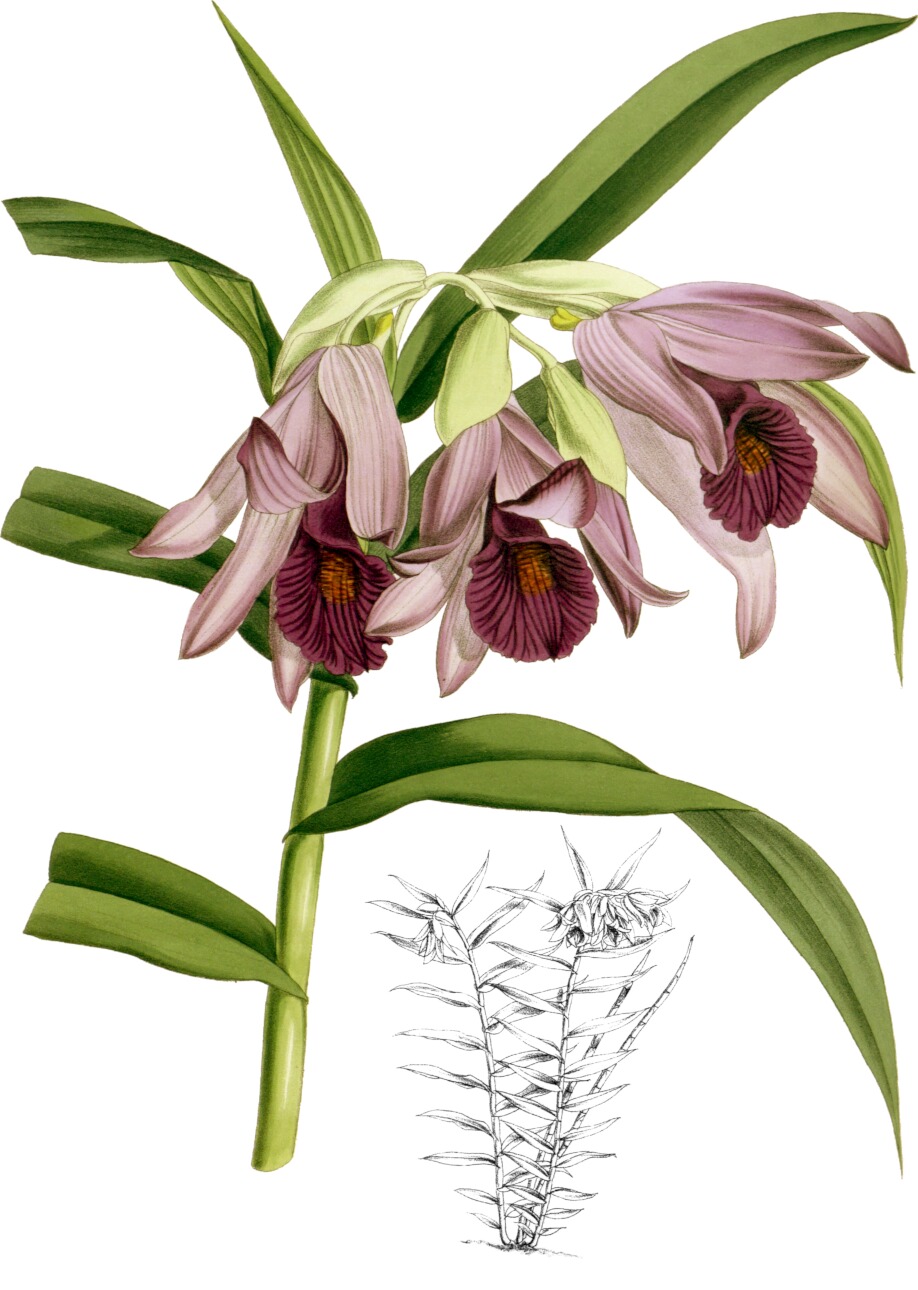
PL. 67. THUNIA BENSONIÆ.
38