CATTLEYA LABIATA. [Plate 88.] Native of Brazil.
Reading edition
CATTLEYA LABIATA. [Plate 88.] Native of Brazil.
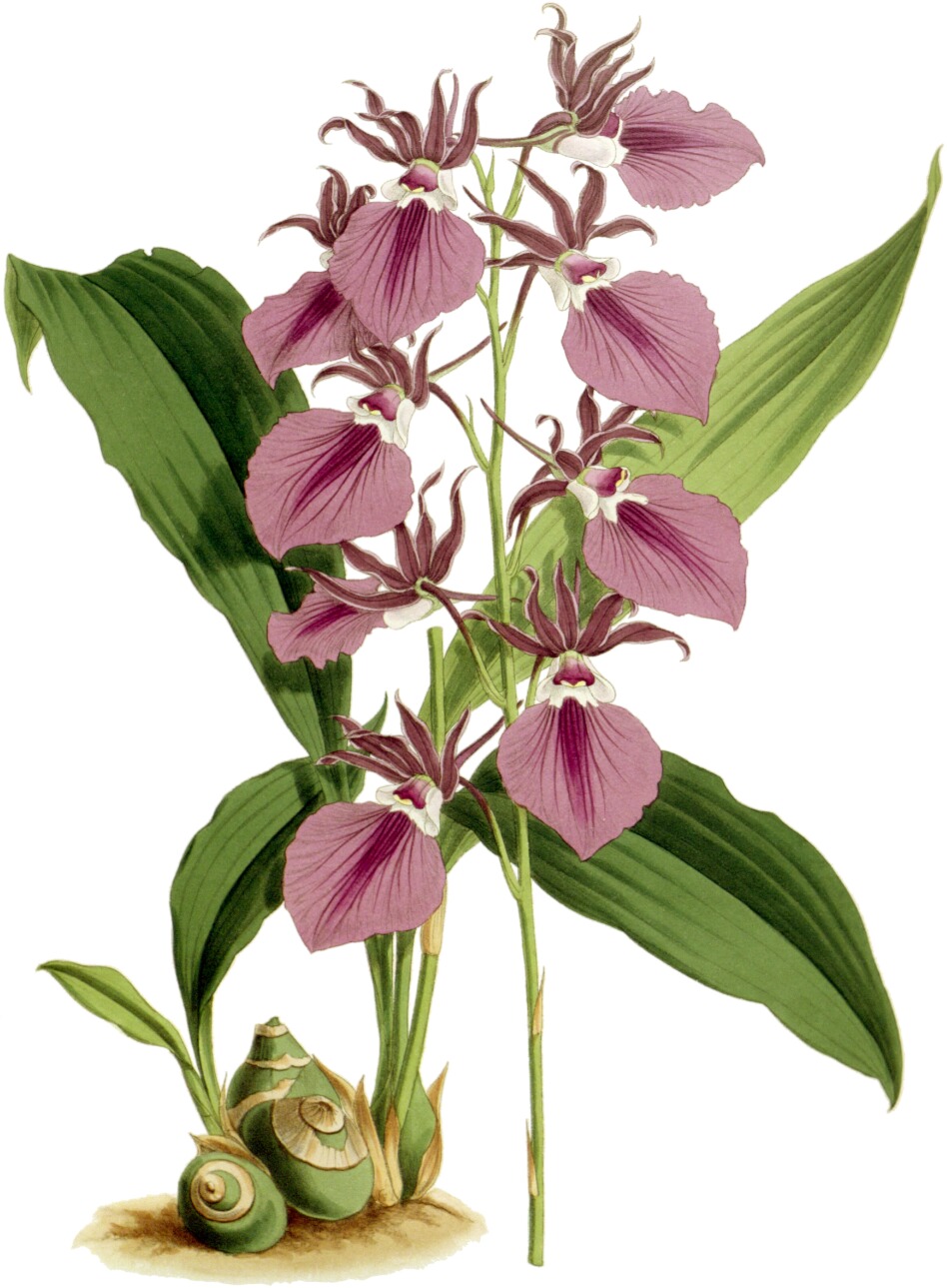
Epiphytal. Stems (pseudobulbs) short, club-shaped, furrowed when old, invested by greyish membraneous sheaths, one-leaved. Leaves coriaceous, oblong obtuse, of a dark green. Scape issuing from an elongate oblong compressed double sheath, of a paler green than the leaves. Flowers two to five—usually about three—on each spike, large though not equalling in size many of the forms of C. Mossiæ, the lip very richly coloured; sepals lanceolate, acute, plane and entire at the margin, recurved at the apex, of a very pale delicate tint of rosy blush; petals of the same colour, but three times as broad, ovate, bluntish at the apex, the margin undulated; lip obovate, with the two sides connivent over the column, of the same delicate blush tint as the sepals and petals, the front part beyond the tubulose portion expanded (about two inches broad and long), rounded, deeply emarginate, almost wholly of a very rich lustrous deep magenta-purple, a broad bar of which is continued towards the base down the centre of the tube, and on each side of this bar at the mouth of the tube is a roundish-oblong patch of creamy yellow, which becomes paler as it spreads towards the edge; the margin neatly and densely frilled, and having at the extreme edge a narrow border of pale rosy blush, which is continued around the whole of the richly-coloured front lobe. Column clavate, semi-terete, shorter than the tube.
Cattleya labiata, Lindley, Collectanea Botanica t. 33; Id., Genera and Species of Orchidaceous Plants, 116; Id., Botanical Register, t. 1859; Id., Paxton’s Flower Garden, t. 24 (varieties); Hooker, Exotic Flora, t. 157; Id., Botanical Magazine, t. 3998; Loddiges, Botanical Cabinet, t. 1956; Paxton’s Magazine of Botany, iv., 121; Van Houtte, Flore des Serres, tt. 1893-4; Jennings’ Orchids, t. 45; Williams, Orchid Grower’s Manual, ed. 5, 122.
Epidendrum labiatum, Reichenbach fil., in Walpers’ Annales Botanices Systematicæ, vi., 313 (var. a. genuinum).
This fine species has been known in England since 1818, and Cattleya Loddigesii excepted (originally grown as Epidendrum violaceum), was the first Cattleya introduced and the type of the genus, which was named in compliment to W. Cattley, Esq., of Barnet. There are two or three varieties of the autumn-flowering C. labiata, the one having foliage of a light green, and the other of a darker green with the under side of the leaf also darker-coloured than in the first. It is the same in the case of C. (labiata) Warnerii, the sub-species named in honour of Mr. R. Warner, the two forms of which may be easily distinguished from the typical C. labiata, since they generally bloom in May and June. There are many wonderful sub-varieties of C. Warnerii, both as regards the colour of lip and the size of the flowers, and some of these have been sold by collectors as the true autumn-flowering 81 C. labiata, though that is easily distinguished from C. Warnerii by those who really know the two plants.
We have been cultivating Orchids for nearly forty years, and have never known the original C. labiata to be imported during that period. It is this that makes it so scarce, and causes it to fetch the high prices that it does. Another reason is, that it blossoms when few Cattleyas are in flower, i.e., in October and November, and so every grower desires to possess it. We remember many years ago seeing plants of this species two feet in diameter in the collection of R. Hanbury, Esq., The Poles, near Ware. Mr. Hanbury had a wonderful specimen in his first collection, which went to Germany. Many other such plants were to be seen in those days; and it would appear that these plants have been divided, and distributed among growers. It is greatly to be regretted that our collectors do not again discover its habitat.
The specimen we now illustrate is from a well-grown plant in the fine collection of H. Gaskell, Esq., Woolton Wood, Woolton, Liverpool, where it bloomed with five very fine flowers on a spike. A most wonderful and lovely spike it was, and we regret not being able to depict it full size, in order to show off its beauty.
There is another variety of C. labiata that blooms in August, and is very distinct from the old variety referred to above both in the colour of its flowers and its foliage; it is called C. labiata pallida. There are two very fine plants of this variety in the collection of the Comte de Germany, Chateau de Gouville, near Rouen, in France; each plant has over a hundred bulbs—a grand sight when in bloom.
Cattleya labiata is an evergreen plant, and is also one of the most free-flowering Cattleyas we have in cultivation, since every good growth brings its blossoms, a strong one, producing a spike of five flowers from a double sheath. The individual flowers are of large size, the sepals and petals pale soft rosy-pink, the lip rich magenta, margined with light rosy-pink, and the sides of the throat orange-yellow; they last in their freshness and beauty for some three or four weeks. This species requires the same treatment as C. Mossiæ, that is, to be planted in good fibrous peat, and to have perfect drainage; it will grow either in a pot or in a basket, and requires a moderate supply of water during the growing season, which is in the spring and summer months. In winter, when the plants are at rest, they merely require sufficient moisture to keep the bulbs and leaves in a plump state; but it is very detrimental to Cattleyas to keep them too dry, as this often causes them to shrivel and turn yellow, and when this occurs it takes a long time to recover their healthy condition. We do not agree with over-watering or over-potting Cattleyas—both practices are extremely dangerous, especially the use of too much material about the roots, which becomes soddened by the necessary moisture, and causes the roots to decay. If the plants should fall into this misfortune, they should be completely shaken out of the material used, their roots well washed, and then be potted in crocks until they make fresh roots. They must be kept in a shady place during the continuance of this régime, and until they appear to have regained their vigour, after which they may be allowed all the light obtainable.
PL. 89. EULOPHIA GUINEENSIS PURPURATA.
82