LÆLIA PERRINII. [Plate 60.] Native of Brazil.
Reading edition
LÆLIA PERRINII. [Plate 60.] Native of Brazil.
Epiphytal. Pseudobulbs (stems) club-shaped, under a foot in height, becoming furrowed when old. Leaves solitary, oblong-obtuse, about as long as the stems, coriaceous, of a dark green colour. Spathes oblong, compressed, green, often tinged with purple. Scape two-flowered, purplish. Flowers large, about six inches in expansion, richly coloured; sepals linear-oblong, bluntish, the lateral ones falcate, of a diluted magenta-rose; petals broader, oblong-lanceolate, of the same colour as the sepals; lip oblong-lanceolate, three-lobed, unguiculate, the base forming an inflated fistular cavity, the lateral lobes erect, acute, convergent over the column, the middle lip elongate, oblong-obtuse, wavy at the margin, the basal portion white inside, washed externally with magenta, the front part of an intense velvety purple-crimson. Pollen-masses eight.
Lælia Perrinii, Lindley, Botanical Register, 1842, under t. 62; Paxton’s Magazine of Botany, xiii., 5; Williams, Orchid Grower’s Manual, 5 ed., 207.
Cattleya Perrinii, Lindley, Botanical Register, 1838, t. 2; Hastingen, Paradisus Vindobonensis, i., t. 10.
Bletia Perrinii, Reichenbach fil., in Walpers’ Annales Botanices Systematicæ, vi., 421.
The Lælia Perrinii is a very old species, and one that nearly all Orchid growers have seen or had in their possession, but we do not consider it too ancient to be introduced to the notice of our subscribers. It is a useful acquisition to the Orchid house, as it flowers when there are few Lælias, or any other Orchids in bloom. There are several varieties of this Lælia, which vary in colour, some being much paler than others. The form we here illustrate is part of an importation we received a few years ago, many of which bore blossoms of the same colour as that here represented. A pure white variety also came from the same locality at the same time, but the latter is very rare, there being only a few plants in this country. The white-flowered forms seem to be making their appearance in many of the species of Lælia and Cattleya. We are glad to notice this, as they make a very pretty contrast with the dark-coloured flowers, of which we have so many in these two genera—genera which resemble each other very closely, the only tangible difference being in the number of pollen-masses.
Lælia Perrinii is an evergreen plant, with dark green foliage and pseudobulbs, the leaves being about a foot high, and the pseudobulbs ten inches. The flower-spikes proceed from the top of the bulbs, and issue from a sheathing bract; they appear after the plants have completed their growth. The sepals and petals are 25 of a light tint of magenta colour, while the lip is of a dark purple-crimson, with a rich yellow throat. The species blooms in October and November, and continues for about two weeks in perfection.
It requires the same treatment as Cattleya Mossiæ, and is best grown in a pot with good drainage and fibrous peat. It must be kept moist at the roots during the growing season, but after it has completed its growth less water will do, that is, merely enough to keep the roots and leaves in a plump state. When it recommences to grow a little water may be applied to encourage it to make strong growths, which are the precursors of finer flowers. The plants must be always fully exposed to light by being kept near the glass.
Orchids at Bickley.—A recent visit to Oldfield, the residence of F. A. Philbrick, Esq., Q.C., reminds us of the grand collection of Orchids in Avenue Road, Regent’s Park, many of the best of which were sold on Mr. Philbrick changing his residence. It is surprising to find the rapid way in which a new collection is now being grown and brought together in the new place. Houses had to be built, and the plants removed from one garden to the other, which, of course, involves more or less of injury. It is now twelve months since we visited this place, and the change that has taken place in that interval in respect to the collection of Orchids is remarkable, and highly creditable to Mr. Heims, the gardener. The plants have real vigour about them, sending out their growths and making roots freely, which is a sure sign they are doing well. The Cattleya house is a well-built structure, having plenty of light, with provision for a good circulation of air, two things very essential to the successful cultivation of Orchids. Mr. Philbrick is doing the right thing in securing the very best species and varieties, for, as he remarked to us, “they take up no more room than the bad ones, which are dear at any price.” We noticed some grand specimens of Lælia purpurata in bloom, with many spikes of flowers, and there were some wonderful varieties among them; also some large specimens of Cattleya Mossiæ in bloom. Of Sobralia macrantha there were large specimens which had been very fine; and of Cattleya Mendelii some fine varieties. Near to these stood several good Lælias, such as L. elegans, L. anceps alba, and L. anceps Dawsoni, which were growing vigorously. Epidendrum ritellinum majus was at the time finely in bloom.—B. S. W.
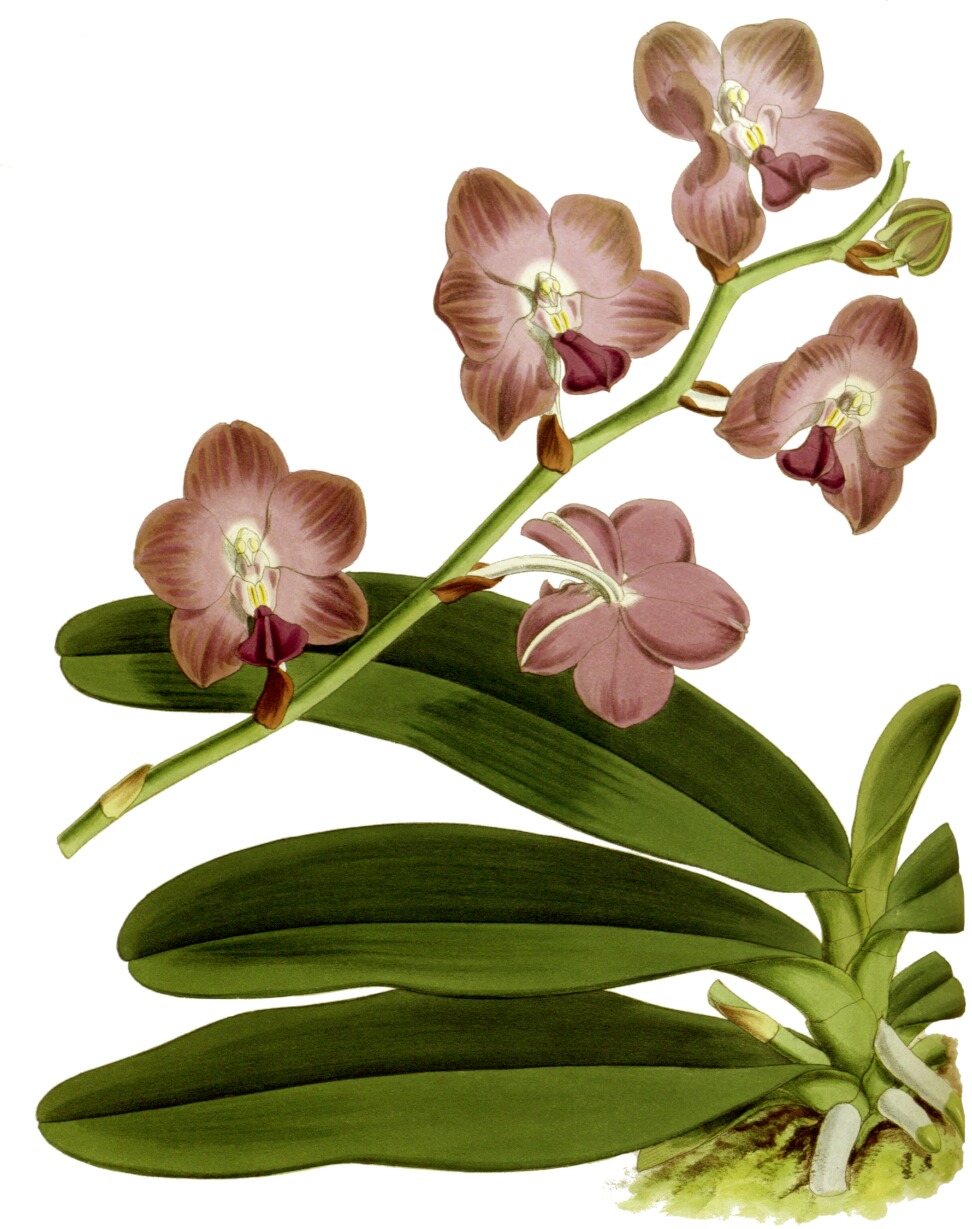
PL. 61. VANDA PARISHII MARRIOTTIANA.
26