PHAIUS TUBERCULOSUS. [Plate 91.] Native of Madagascar.
Reading edition
PHAIUS TUBERCULOSUS. [Plate 91.] Native of Madagascar.
Epiphytal. Stems (pseudobulbs) fusiform or sub-clavate jointed, dark green, annularly marked by the pallid bases of the leaf-sheaths. Leaves oblong-acuminate, about a foot long, plicate, narrowed below, the base again enlarged so as to clasp the stems. Scape produced with the young growth, green, below bearing lanceolate imbricated bracts, and terminating in an erect raceme of six or more flowers. Flowers spreading, two and a half inches across, of singular form; sepals ovate-acuminate, stoutish, pure white; petals of the same colour and texture as the sepals, but rather broader and more oblong; lip obliquely funnel-shaped at the base, with a blunt chin projecting upwards, three-lobed; the two basal lobes large, suborbicular, meeting the column, yellow, thickly blotched with irregular spots and dots of a dull crimson, producing a bronzy effect, furnished with scattered hairs on the surface, wavy at the edge; front lobe smaller, roundish-emarginate or subcordate, wavy, white, with rosy purple marginal spots, closely frilled; disk yellowish white, with three deep orange-yellow crests or ridges towards the front, the crests bluntly toothed and wavy along the upper edge, the central one forked about the middle; near the base, a short distance from the column, is a small tuft of pale sulphur capitate hairs. Column slender, incurved, club-shaped, white, tinted with purple in front.
Phaius tuberculosus, Blume, Museum Botanicum Lugduno-Batavum, ii., 181; Id., Orchidées de l’Archipel Indien et du Japon, 13, t. ii. B.; Gardeners’ Chronicle, N.S., xv., 341, fig. 67; Reichenbach fil., in Gardeners’ Chronicle, N.S., xv., 428.
Limodorum tuberculosum, Du Petit-Thouars, Orchidées recueillies sur les trois Iles Australe d’Afrique, t. 31.
Bletia tuberculosa, Sprengel, Systema Plantarum, iii., 744; Lindley, Genera and Species of Orchidaceous Plants, 123.
The plant we are now about to describe, and of which a figure accompanies these remarks, is one of the most beautiful and distinct yet known, one, moreover, which has only bloomed in few collections. It is a new introduction from Madagascar, and as yet is a very rare plant, being difficult to import and also to establish, which is much to be regretted on account of its beauty. Our plate was taken from a well-grown specimen in the fine collection of Baron Schröder, of The Dell, Staines, where, under the care of Mr. Ballantyne, the plant is very successfully managed. Sir Trevor Lawrence, Bart., M.P., has also been fortunate in flowering it, and, indeed, it was first exhibited by him.
87
Phaius tuberculosus produces short fusiform fleshy stems, from which proceed the new growths, consisting of a tuft of plicate leaves, of light green colour, and with them the flower spike, which is erect, and has as yet only borne about half-a-dozen flowers on each. It blooms during January and February, and is difficult to establish and cultivate. As the plant gets better understood it may be found more easy to import, and other growers may then be more successful. Many of the imported plants have been lost through want of knowledge as to packing and other requirements of travel; there is little doubt that our collectors will be more successful as to these matters, and then we may expect the plants to reach Europe in safety. We know of many Orchids that were once considered difficult to import which are now obtained safely in quantities through being sent at the proper season. If plant collectors would study this point they would be very much more successful than they have hitherto been. Of course it is difficult for one to be on the spot at the moment when the plants have matured their bulbs, and so as to get them to this country before they start into growth, but if this could be done there would be more chance of saving them.
There is another important point affecting cultivation, namely, that more complete information where and how the plants are found in their native habitats should be obtained and furnished. A great deal of the success in the development of all these and other plants depends on their proper treatment as regards the temperature and the supply of moisture. If they are found in low-lying districts they require quite a different treatment to that of those which occur in high and mountainous districts.
Whenever we find a plant, as this is, difficult to cultivate, we should endeavour to find out which house suits it best; this may easily be done if we have different houses situate in different aspects, and even if there is but one house a great deal can be done by placing the plant in different positions in that house. If it does not succeed in one part it may do so in another, and should it happen that a plant is found to thrive well in a particular part, an endeavour should be made to keep it there during its season of growth, and should it be removed during the resting period let it be put back again the following season to make its growth. There is more than many growers imagine in this matter of setting plants in the places which they are found to like best. Some cultivators, because they have succeeded for a few years, think they can do as they please with a particular plant, but this is an error. We often meet with cases in which persons have grown their plants well for a few years, after which they go back. The cause is generally not far to seek. It may often be attributed to over watering, or to keeping the plants dry when they should have been moist, or to changing the temperature, or allowing the plants to get dirty. There are various other causes of non-success, such as acting on the advice of different persons, rushing suddenly into different modes of treatment, using different materials, or some other such-like practices. We have in our time seen many new schemes tried, and have to record that many of them have utterly failed.
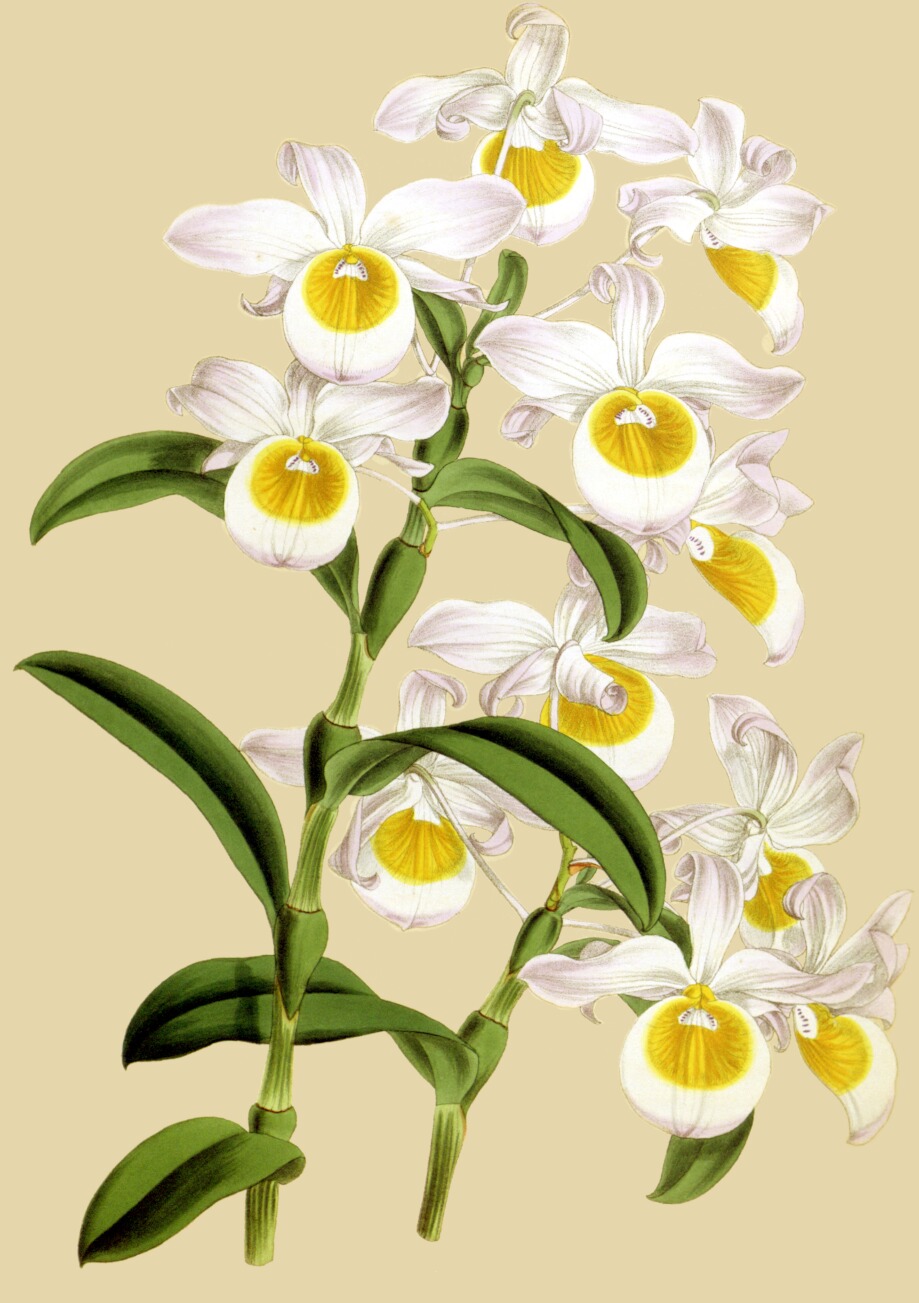
PL. 92. DENDROBIUM FINDLEYANUM.
88