LÆLIA AUTUMNALIS ATRORUBENS. [Plate 49.] Native of Mexico.
Reading edition
LÆLIA AUTUMNALIS ATRORUBENS. [Plate 49.] Native of Mexico.
Epiphytal. Pseudobulbs oblong-ovate, terete, furrowed, bearing two or three leaves at the attenuated apex, and sheathed at the base with large brown imbricated scales. Leaves oblong-linear, spreading, smooth, leathery in texture. Scape terete, issuing from between the leaves, and much longer than them, bearing five or six flowers at the apex, jointed, with sheathing scales at the joints. Flowers large and richly-coloured, much more so than in the typical form, sweet-scented; sepals lanceolate acuminate, spreading, of a brilliant purple-crimson, paler towards the base; petals ovate acuminate, subundulate, of the same colour as the sepals; lip three-lobed, the lateral lobes erect, truncately rounded, white, the middle lobe obovate-oblong, of an intensely brilliant purple-crimson colour, bilamellate on the disk, the apex recurved. Column semicylindrical, decurved, rosy purple.
Lælia autumnalis atrorubens, Backhouse, in Gardeners’ Chronicle, N.S., xii., 232.
Mr. Bateman has well observed that “the genus Lælia may be regarded as one of the most ornamental of its tribe, since pleasing colours, graceful habit, long duration, and delicious perfume—in short, all the essentials of floral beauty seem to be combined in its various species.” There is, indeed, no doubt that in this genus some of the most showy of our cultivated Orchids are to be found. There are, moreover, species presenting many different hues, varying from yellow to rich purple, and while some of them produce small flowers, in others they are gigantic in size. The subject of our plate, as will be seen from the figure, is a magnificent Orchid, our drawing of which was taken from a well-managed specimen grown by Mr. Stevens, Gardener to W. Thompson, Esq., The Grange, Walton, Stone, Staffordshire. This particular variety was imported in 1878 by Messrs. James Backhouse & Son, of York, who grow it to great perfection.
There are many known varieties of Lælia autumnalis, but the one before us is by far the most beautiful of them all, being superior both as regards the size and the colour of the flowers. The pseudobulbs of this form, too, are much stouter and stronger than those of the type form. This variety, as also does the original Lælia autumnalis, blooms during the autumn and winter months, when flowers are in great request.
Lælia autumnalis atrorubens is a compact-growing evergreen plant, the pseudobulbs of which, with the foliage, attain to about ten inches in height. The flower-spikes 3 are produced from the apex of the bulb just at the period when it has completed its growth; they each produce several flowers, which are of large size and stout substance, and of a rich crimson-magenta or purple-crimson colour, and last two to three weeks in perfection.
This plant grows naturally in exposed situations, and on this account, no doubt, we find that it likes plenty of sun and as much light as possible, just enough shade being given to prevent the foliage from burning. The conditions best suited to it are that it should be planted in a basket or pan, and suspended from the roof of the cool house; or if fastened to a block placed on a damp wall, this will suit it equally as well. It should receive a copious supply of water during the growing season; and in warm weather syringing will be found beneficial to it in the morning, and also when the house is shut up in the afternoon.
Orchids at the Manchester Exhibition, May, 1882.—The Orchids were a marvellous sight, and probably such a magnificent display of these glorious plants was never before seen. The plants, many of which bore grand masses of blossom of many rich shades of colour, were arranged along both sides of the large Exhibition house in the Gardens at Old Trafford, and had been brought together from different parts of the country, as well as from the vicinity of Manchester. Everyone who possesses a taste for horticulture—and especially for the wonderful productions of nature which have been brought from distant lands by our plant collectors, and are transmitted to our exhibitions both by amateur growers and nurserymen, so that the public may be able to see all these treasures at one view—should avail themselves of the opportunity of witnessing this exhibition. The entrance fee is only one shilling, and besides Orchids there is always provided a grand display of other plants, too numerous to mention. It is gratifying to learn that 51,000 persons availed themselves of the opportunity to visit this grand show of 1882. We may venture to add that the Council of the Manchester Botanical and Horticultural Society, and Mr. Findlay, the Curator of the Gardens, are doing a great benefit to the horticultural world, as well as to the general public, by bringing such multitudes of fine plants together, while at the same time they secure a good revenue for carrying on the gardens, and afford much gratification to the subscribers, who can thus at their ease feast their eyes upon nature’s beauties to an extent they could not do even if they travelled to the various native habitats of the plants—for even there no one could possibly witness such a diversified display at one point. The best advice we can give to those who are fond of flowers is to go next year and see for themselves, as the specimens are too numerous to be mentioned in our limited space. The show is held annually, and continued during Whit-week, the last being the sixteenth anniversary.—B. S. W.
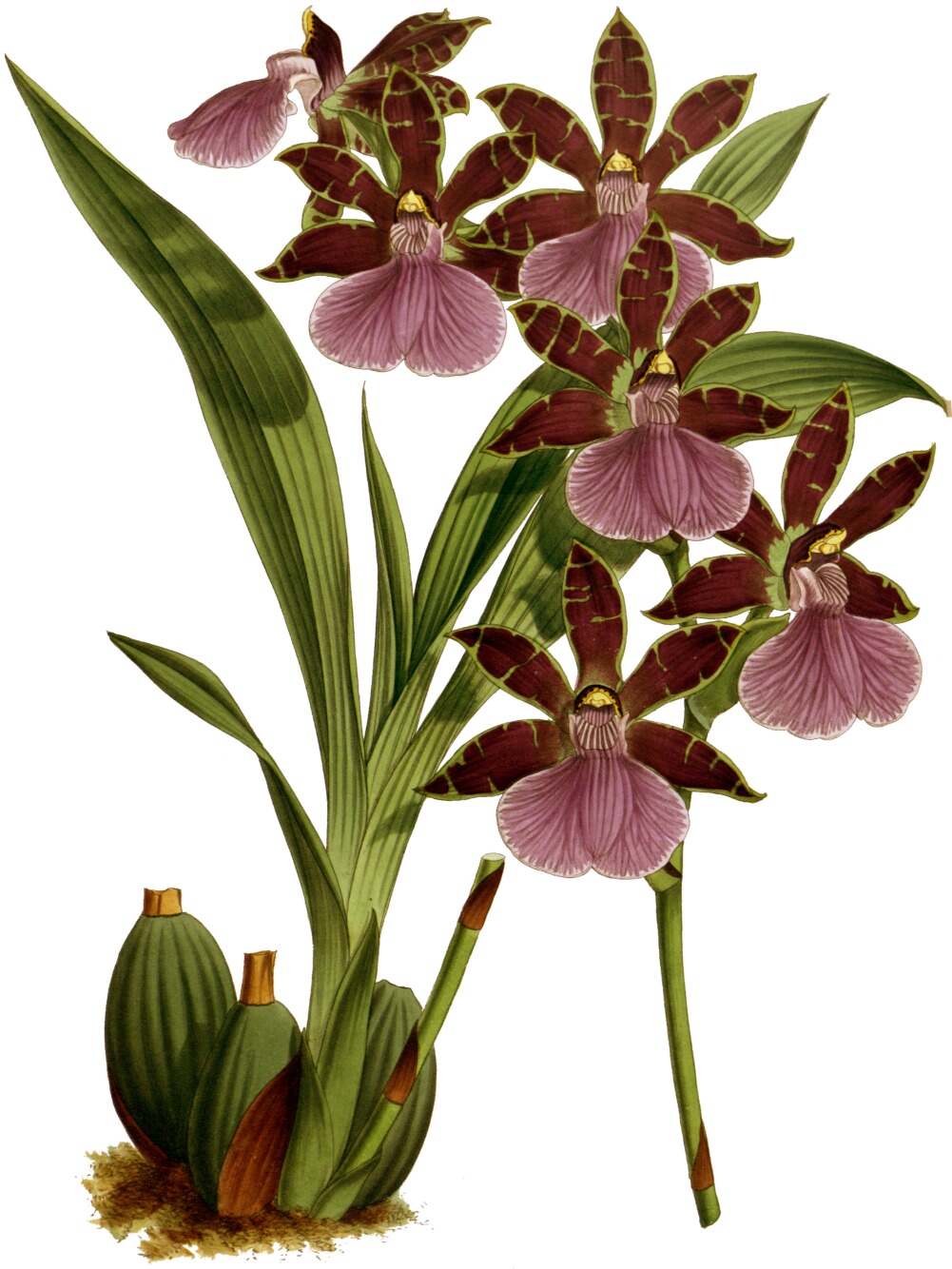
PL. 50. ZYGOPETALUM CLAYII.
4