DENDROBIUM FINDLEYANUM. [Plate 92.] Native of Moulmein.
Reading edition
DENDROBIUM FINDLEYANUM. [Plate 92.] Native of Moulmein.
Epiphytal, Stems jointed, the joints oblong-pyriform, complanate, two inches long or more, the lower part of each internode slender, stalk-like, and invested by the leaf sheath, the upper end much thickened, and at length becoming more or less furrowed. Leaves linear oblong acute, three inches long, soon falling. Peduncles lateral, two-flowered, with small appressed bracts. Flowers rather large, three inches across, showy, the colours being clear and attractive; sepals lanceolate, recurved, the lateral ones somewhat broader, of a light purplish mauve colour, whitish towards the base; petals larger and more oblong, white at the base, and heavily tipped with pale purplish mauve; lip stilted, roundish-cordate, concave, the sides meeting over the column, white, slightly tipped with purple, the disk velvety, marked with a large roundish orange-yellow blotch, paler at the edges, the basal callus obscure. Column with two deep purple hands in front.
Dendrobium Findleyanum, Parish and Reichenbach fil., in Transactions of the Linnæan Society, xxx., 149; Reichenbach fil., in Gardeners’ Chronicle, N.S., vii. 334; Hooker fil., Botanical Magazine, t. 6438.
The Dendrobes form a large and splendid group of Orchids, in which may be found some of the finest examples of the Orchid family. The species we have now the pleasure to bring before our readers is of recent introduction, and is one of the most beautiful and distinct of the whole family, not only as regards its flowers, which are very attractive, but also on account of its very peculiar jointed stems, of which a better idea will be obtained from our illustration than from any minute description. The figure was taken from a beautiful plant grown in the large collection of J. T. Peacock, Esq., Sudbury House, Hammersmith, who is an enthusiastic collector and cultivator of plants, and has many houses filled with Orchids, which are doing well under the care of Mr. Vicary, the gardener.
Dendrobium Findleyanum is a free-growing plant, and its curiously knotted stems have a singular appearance. The blossoms are produced very freely; the sepals and petals are white, tipped with pale magenta, while the lip is white, with the apex rosy purple, and the throat or disk yellow. It flowers during March and April, and lasts for two or three weeks in beauty.
We find it does well in a pan or basket, suspended from the roof, in the East India house, where it can receive all the light possible, and be shaded slightly from the sun in summer. The material used about its roots must be rough peat and sphagnum moss. It needs a liberal supply of water during the summer season, and must be kept moist until it has completed its growth, when less water may be given, just sufficient to insure the plumpness of the stems.
89
Orchids at Summer House, Hammersmith, the Residence of J. T. Peacock, Esq.—The collection of Orchids grown by Mr. Peacock is truly surprising, as was the show of flower when we paid a visit to it in March last. There were then many hundreds of blooming Orchids, especially of Phalænopsis, of which there were in one house hundreds of flowers of the different species and varieties, the drooping spikes overhanging and mingling with each other, and presenting a striking picture, some being snowy white, and others of different shades of mauve colour; there were, moreover, some very good forms among them. In an adjoining house were some very fine plants of Dendrobiums, such as D. Findleyanum, D. crassinode, and D. Wardianum; also hundreds of flowers of D. Freemanii. In the same range of houses we saw a fine lot of Odontoglossum vexillarium, showing well for bloom. O. Phalænopsis was doing well, which we do not often see. Of O. Roezlii there were many fine plants in good health, as there were also of O. Alexandræ (crispum), of which a great number were in bloom. Cattleya citrina was well grown—better than we have seen it before; the plants were suspended from the roof. Lycaste Skinneri, of which we found a huge lot in bloom, were producing very fine flowers. We were surprised to see such fine plants of L. Skinneri alba in blossom. Mr. Peacock has been very fortunate in flowering these from an importation, as it is a rare and chaste variety. In the next house were many hundreds of Odontoglossum Alexandræ and O. Pescatorei, and other kinds; many of them were in bloom, and among them were some good varieties.
We also noted some good East Indian Orchids, many plants of Angræcum sesquipedale, and other kinds. There was a fine collection of Cattleyas in a large span-roofed house, amongst which were some good forms of C. Trianæ in full bloom; also a grand lot of Cymbidium eburneum in flower, the white blossoms with the graceful green foliage having a good effect. There were several other houses filled with Orchids. If Mr. Peacock continues as he has begun, he will presently have the largest collection of these plants in the country. That this is likely to be the case we may presume, for we saw several other new houses intended for Orchids in the course of construction. Mr. Vicary, the excellent gardener, is one who takes great interest in the collection under his charge, and therefore we may expect that good results will be assured.—B. S. W.
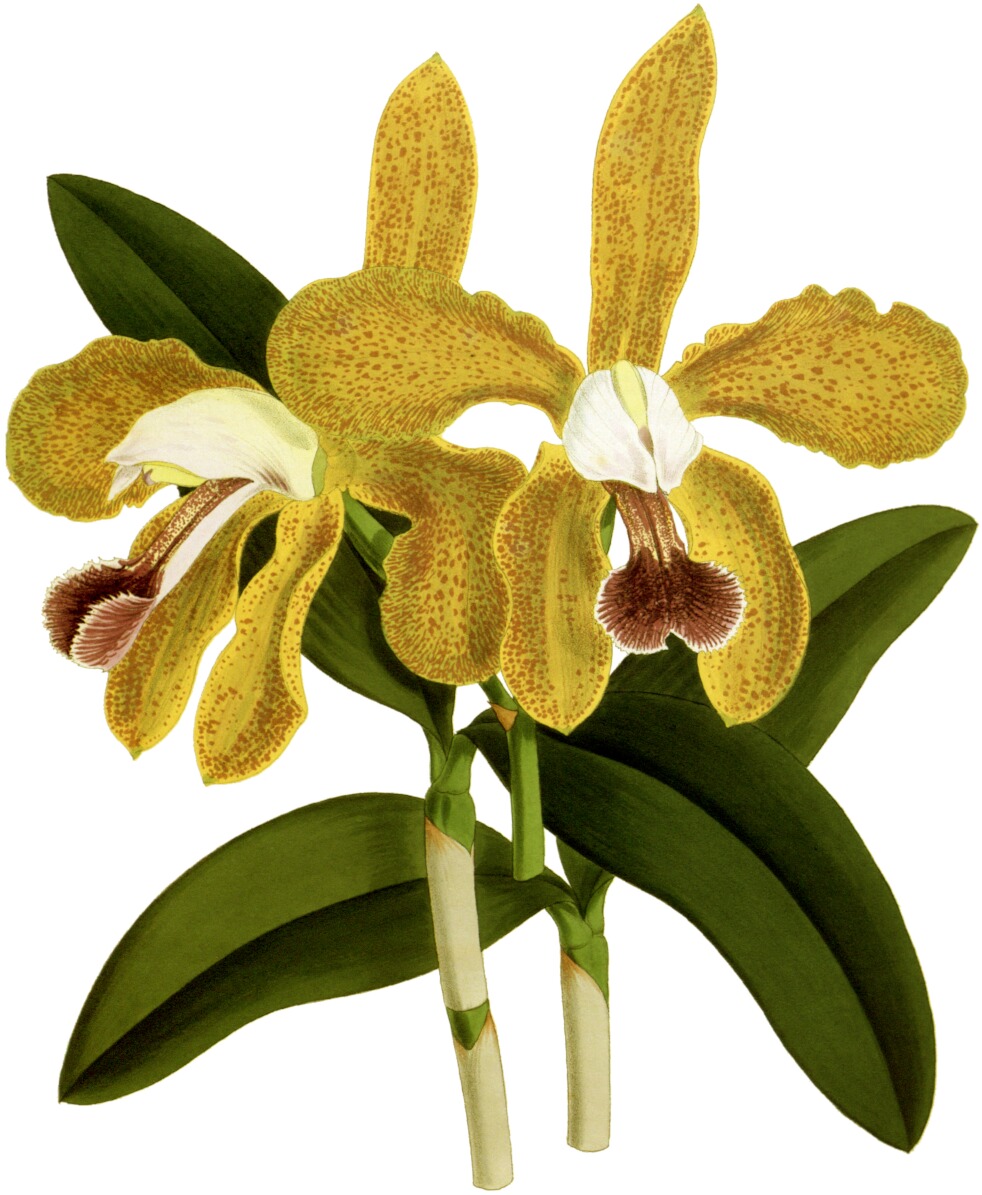
PL. 93. CATTLEYA SCHOFIELDIANA.
90