CATTLEYA SCHOFIELDIANA. [Plate 93.] Native of Brazil.
Reading edition
CATTLEYA SCHOFIELDIANA. [Plate 93.] Native of Brazil.
Epiphytal. Stems (pseudobulbs) from one to one and a half foot long, slender, terete, slightly thickened near the top, jointed, the internodes nearly covered by whitish membranous sheaths, diphyllous. Leaves oblong obtuse, about six inches long and two inches wide, of a deep glossy green, shortly stalked, the stalks spotted behind with dull dark red. Flowers about two, large, six inches broad, and about the same in depth, very handsome, in the way of those of Cattleya granulosa; sepals ligulate-oblong, bluntly acute, the dorsal one over, the lateral ones rather under three inches long, nearly one inch broad, of an Indian or pale tawny yellow, having a flush of purple and a tinge of green, the whole spotted thickly with crimson-purple, the spots most numerous on the outer half of each lateral sepal; petals obovate, rounded at the apex, narrowed towards the base, about three inches long and one and a half inch broad, of the same colour as the sepals, the spots towards the edges coalescing in divergent, sometimes forked, lines, which run out to the margin; lip two and a half inches long, three-lobed, the lateral lobes whitish, large, obliquely ovate, meeting over the column, the middle lobe with a long narrow claw, and a small transversely reniform fimbriated blade, which, except at the pallid edges, is entirely covered by lamellæ and papulæ of the most beautiful magenta-purple, the claw-like portion having a dash of yellow in its ground colour. Column whitish, curved, hidden by the lateral lobes of the lip.
Cattleya Schofieldiana, Reichenbach fil., in Gardeners’ Chronicle, N.S. xviii., 808.
We have in cultivation many handsome species of Cattleya, but that now before us is very distinct from any we have previously seen, and is quite new to us. The growers of Orchids are all on the lookout for new species, especially such as are distinct. We are, therefore, glad to be able to bring such a beautiful and charming species as this, under the notice of our readers. There are, indeed, numerous other fine Cattleyas in cultivation, but many of them are much alike in form and colour. The present type is, however, distinct, and embraces but few forms, especially with blossoms of an equal size. Our illustration was taken from a well-grown specimen in the select collection of G. W. Law-Schofield, Esq., New-Hall-Hey, Rawtenstall, near Manchester, in whose honour it was named by Professor Reichenbach. This is the only plant of which we have any knowledge as existing in the country, and Mr. Schofield has been truly fortunate in introducing it.
Cattleya Schofieldiana is an evergreen species, with slender terete stems, each bearing two leaves, about five inches in length and two in breadth, of a dark green colour; the stems grow some eighteen inches in height. In its growth this 91 plant resembles C. amethystoglossa and C. Leopoldii, but it is not so robust. Mr. Wise, the gardener, grows it in rough fibrous peat, giving good drainage. Pot culture suits this class of Cattleyas best. They must be well elevated above the rim of the pot, so that the roots may run over the surface, as, when buried in the peat, if they get over-watered, they are apt to go rotten. A little charcoal placed on the top of the peat is advantageous, as the roots lay hold of it freely; and it is also desirable to mix a portion with the peat, as it renders it more porous, and allows the water to pass off more freely, thereby helping to keep the compost sweet. This latter is a matter of great importance to the plants, for Cattleyas, like many other Orchids, do not like the soil in which they are planted to set too closely together to the exclusion of fresh air from their roots. There is no doubt the access of fresh air keeps them in a more vigorous condition. In support of this it may be noted that in their native country they are found on trees, where they get a free circulation of air, their roots being merely sheltered by the small quantity of moss or decayed leaves from the trees which may collect about them, while many of them luxuriate with their roots suspended in the air.
This Cattleya is one of those which should always be kept plump in the stems and leaves, for if allowed to shrivel it will be found difficult to get them again into a plump healthy condition. Give all the light possible, so that the stems may be well ripened. A great deal of success depends upon the thorough maturation of the successive growths, for if they are weak or immature they will produce but puny results. The plants require the same temperature as C. Trianæ.
Cattleya Mossiæ.—We have lately received from De Barry Crawshay, Esq., Sevenoaks, flowers of a fine series of varieties of Cattleya Mossiæ. The flowers were all large and very richly marked, some of the colours being exceedingly distinct, and the lips very large.—B. S. W.
Dendrobium Dearei.—We were agreeably surprised to see this novelty exhibited by Sir T. Lawrence, Bart., at the Summer Show of the Royal Horticultural Society. The flowering bulb was two feet six inches high, and was furnished with two spikes of flowers. This species seems to differ from the formosum section of the genus, by throwing out lateral as well as terminal spikes. The flowers were about thirty in number, pure white, with a slight tinge of green in the throat. In shape they resemble those of D. Jamesianum, but they are somewhat smaller.—H. W.
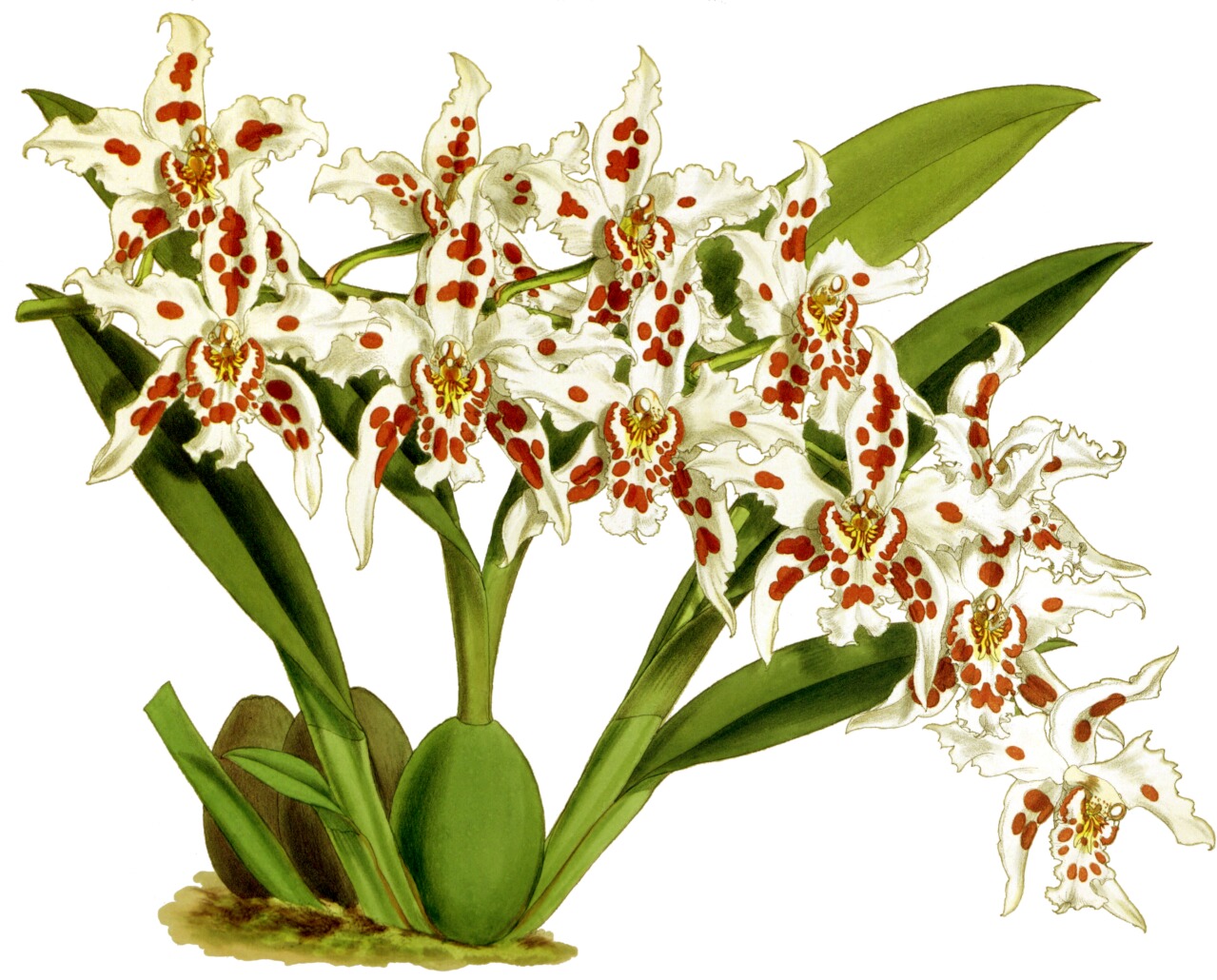
PL. 94. ODONTOGLOSSUM ALEXANDRÆ GUTTATUM.
92