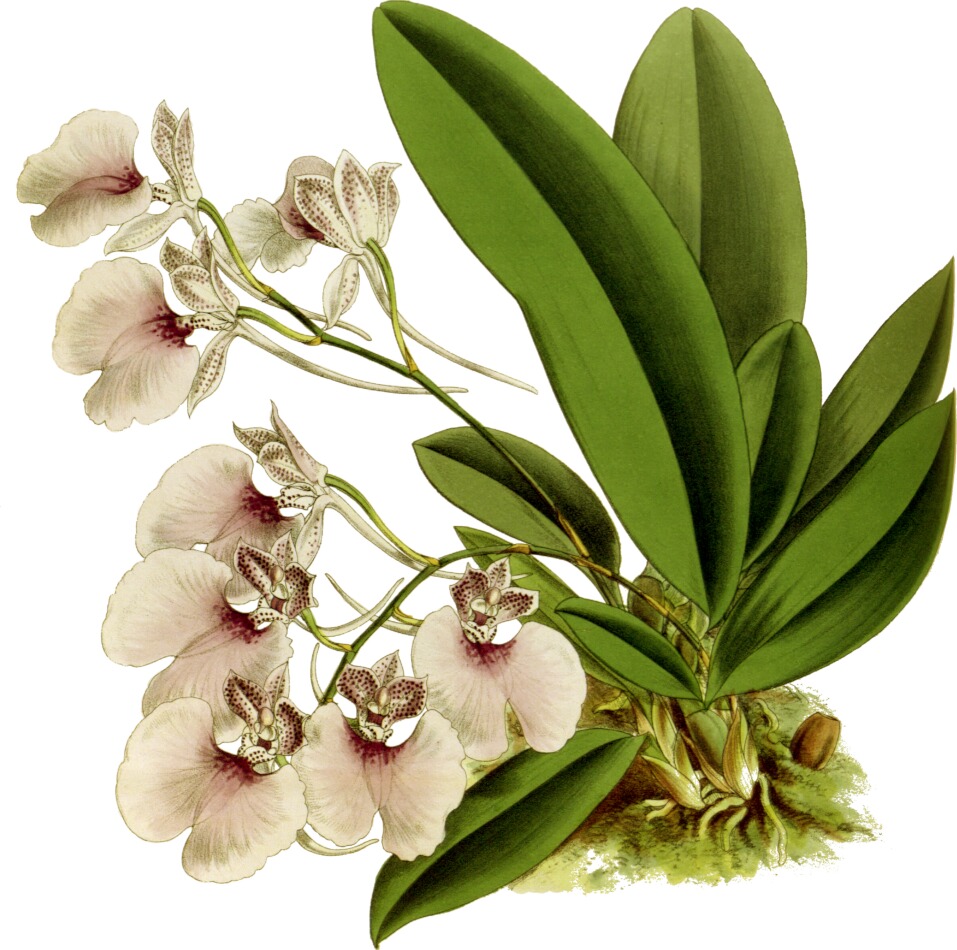
ODONTOGLOSSUM ROEZLII. [Plate 64.] Native of Colombia.
Reading edition
ODONTOGLOSSUM ROEZLII. [Plate 64.] Native of Colombia.
Epiphytal. Pseudobulbs narrowly ovate, two inches long, compressed, with acute margins. Leaves elongately linear-lanceolate, acuminate, nearly or quite a foot in length, keeled behind, and there marked with nine nervose striæ, the colour a clear pale green. Scapes short, slender, terete, three to six-flowered (according to Rchb.), erect, with subulate pale green bracts shorter than the pedicels, which pass gradually into the slender grooved ovary. Flowers three to four inches across, flat, exceedingly chaste and effective; sepals obovate-oblong acute, sub-equal, snow-white; petals similar to the lateral sepals in form, but rather broader, pure white, marked with a distinct transverse purplish-red band at their base; lip large, two and a half inches across, broadly obcordate, or cuneately flabellate, obtusely bilobed, with a mucro in the sinus, sagittate or bearing a spur-like horn directed upwards and backwards on each side at the base of the short claw, and having three short slender keels on the disk in front of the horns, and a pair of short calli interposed; the disk has a largish yellow blotch streaked with red, while the rest of the surface is snow-white. Column short, wingless.
Odontoglossum Roezlii, Reichenbach fil., in Gardeners’ Chronicle, 1873, 1302, fig. 269; Id. Xenia Orchidacea, t. 182, fig. 1; Hooker fil., Botanical Magazine, t. 6085; Bateman, Monograph of Odontoglossum, t. 30; Floral Magazine, ser. 2, t. 90.
This grand Odontoglot, which has been designated “a first-class beauty,” and which comes near to Odontoglossum vexillarium, was introduced in 1873 by Mr. B. Roezl, the very successful traveller and Orchid hunter, who has so well worked up the greater part of the Western hemisphere in the search after these plants, and to whose zeal and energy Orchid growers are so deeply indebted for the many rich gems he has introduced to cultivation. The species was most properly named by Professor Reichenbach after Mr. Roezl, and we are glad to be able to figure it, in order to remind Orchid growers how much they owe to the unflinching perseverance of one who has now retired from active life among his favourites. The best compost in which to cultivate this plant, is a mixture of peat and moss, with good drainage.
Odontoglossum Roezlii is one of the few Odontoglots that require to be grown in a warm temperature. The Cattleya house will be found to be the best position for it, and if the plants are suspended either in pots or in baskets from the roof of the house, where a copious supply of water can be given to them, they will be found to thrive well. This species is particularly liable to the attacks of the thrips, and great care should be exercised in searching for and destroying them. We have found flowers of sulphur mixed with water, and applied to the young growths with a 33 camel’s-hair pencil, very beneficial in preventing the attacks of this insect, while the application does not at all injure the young and tender parts. The thrips has a great aversion to sulphur—in fact will not go near it.
The drawing from which our plate is prepared was taken from the select collection of D. Tod, Esq., Eastwood Park, Thorliebank, near Glasgow, who is not only forming a nice collection of Orchids, but who flowers this species very freely, and cultivates it better than we have seen it grown in any other collection. We have had these plants under our notice for the past three years, and believe Mr. Tod’s gardener has hit upon the right method of treatment, the plants being very strong and vigorous, with clean healthy foliage. The specimens at Eastwood Park are grown in a warm house, near the glass, with plenty of moisture during the summer season, and even in winter they are kept moist at the roots.
Orchids at Bickley.—We are glad to see the East Indian Orchids well represented in the new collection being got together by F. A. Philbrick, Esq., Q.C., at Bickley. They are grown in a house where they are associated with stove plants. Here are seen some fine examples of Vanda, Saccolabium guttatum in bloom, also a wonderful specimen of Aërides affine, with many spikes just coming into flower. We, moreover, noticed some fine plants of Cypripedium in bloom in the same house. The cool house is well filled with fine examples of Odontoglossum and Masdevallia, which are promising to make fine plants. Many kinds of Masdevallia were in bloom when we saw them, amongst them an especially fine dark variety of M. ignea in full beauty, and some varieties of M. Harryana were very bright in colour. Odontoglossum Alexandræ was well represented by several varieties in bloom. A cool and airy house is set apart for Dendrobiums, and alongside this is a house devoted entirely to Phalænopsis containing a fine lot of healthy plants, all hanging in baskets near the light, but shaded from the sun, which bid fair to eclipse their predecessors in this collection.—B. S. W.
Cattleya superba.—We have received a very fine spike of blossom of this splendid Cattleya from the choice collection of O. Schneider, Esq., Cromwell Grange, Fallowfield, near Manchester. The inflorescence was cut from a remarkably well-grown specimen, and bore six flowers. We have never seen better managed plants of this species than are to be found at this place; they do great credit to Mr. Holmes.—B. S. W.
Cattleya virginalis.—A fine variety of this chaste Orchid comes to us from R. P. Percival, Esq., Birkdale, Southport. The sepals and petals are pure white, and the lip white, with an orange spot at the entrance to the throat. This species is very strongly scented.—B. S. W.
PL. 65. COMPARETTIA MACROPLECTRON.
34