THUNIA BENSONIÆ. [Plate 67.] Native of India—Rangoon.
Reading edition
THUNIA BENSONIÆ. [Plate 67.] Native of India—Rangoon.
Terrestrial. Stems deciduous, terete, one and a half to two feet high, swelling into tuberous knobs at the base, the lower part clothed with suborbicular green reflexed leafy sheaths, which, as they advance upwards, gradually pass into the leaves. Leaves sheathing, membranous, subdistichous, linear-lanceolate acuminate, glaucous beneath, six to eight or ten inches long. Flowers large and very showy, terminal, growing in short nodding racemes of ten to fifteen together, each emerging from a pale green sheathing bract, which encloses it while in bud; sepals and petals linear-lanceolate, partially spreading, two to three inches long, of a light magenta-purple striately distributed, and paler towards the centre; lip about three inches long, three-lobed, the lateral lobes short, obtuse, rolled round the column, toothed; middle lobe broadly oblong, flabellate, closely undulated and lobulate, of a very rich deep magenta-purple, the base produced into a short notched spur, the disk of a rich bronzy orange, bearing several ciliated keels. Column furnished with toothed wings at its apex.
Thunia Bensoniæ, Hooker fil., Botanical Magazine, t. 5694; Williams, Orchid Grower’s Manual, 5 ed., 298.
Phaius Bensoniæ, Hemsley, in Gardeners’ Chronicle, N.S., xviii., 565.
This is undoubtedly one of the most beautiful and free-flowering of the Thunias. The colour of its gorgeous flowers is very uncommon in the Orchid family, and is very charming. It is a plant that should find a place in every collection, especially when seen in such a form as that represented in our drawing, taken from a plant to which we alluded when referring to the Orchids in bloom in the collection of W. Leach, Esq., Oakleigh, Fallowfield, Manchester—a collection very ably managed by Mr. Swan. The Orchid houses at Oakleigh are well arranged, so that the different temperatures required by plants coming from different localities are readily obtainable, and the plants being grown near the glass they have plenty of light. This is a great advantage to Orchids generally, as by this means the growths get better ripened, and this enables the plants to flower more freely, and to produce flowers of a richer colour.
Thunia Bensoniæ is a deciduous plant, losing its stems and foliage after it has finished its growth. It attains to a height of from eighteen inches to two feet, or sometimes more when the growths are strong. We have seen blooming plants eighteen inches in height. The flowers proceed from the top of the new stems at the time they are making their growth, and they continue blooming for some 39 time. The sepals and petals are of a pale magenta colour, while the lip is much darker, of a rich purple, with a bronzy orange blotch. Sometimes the spikes produce as many as fifteen of these beautiful blossoms, which was the case with the plant from which our illustration was taken; they do not, however, all open at the same time, but follow in succession until the spike is exhausted.
The Thunias are all deciduous plants, and require different treatment from that given to evergreen Orchids. After their growth is completed, they require a season of rest, which must be given by putting them away in a dry part of the house. It is after they have finished their growth that their foliage begins to decay, and subsequently falls away. When in this dormant state they require just sufficient moisture to keep them from shrivelling. This treatment must be continued until March, when they will begin to show signs of growth; at that time they must be shaken out of the pots, the decayed roots cut off, and the plants re-potted, setting the bulbs one inch below the pot rim, and just into the soil, so that the young growths are not covered. We find rough fibrous peat and sphagnum moss suitable material for growing them in, and good drainage is indispensable, as the plants require a considerable amount of water when they are in a vigorous state, as their growth and flowering are both completed in about six months. Water should be sparingly applied until the stems are a few inches high, just sufficient being given to keep them moist until the roots are beginning to fill the pots; then a little manure water will benefit them, making them grow stronger and flower more freely.
They are of easy cultivation, and do not require deep pots, indeed pans from three to four inches deep will suit them, and they may be suspended from the roof, where they can get plenty of light. They will, however, thrive on tables if they receive all the light possible, and are shaded from the sun. We have also grown them on blocks, but grown in this way they require more frequent and copious supplies of water.
Thunias are readily propagated by taking off some of the old bulbs when the young growths are about ten inches in height, but only part of the old bulb should be removed or cut off, dividing it in pieces of about six inches in length, and placing these in sand. The growths proceed from the joints, and these make plants during the season; they must be potted in due course, and often bloom during their second year.
Odontoglossum coronarium miniatum.—We received in August last from the garden of Lord Rendlesham, M.P., Woodbridge, Suffolk, a fine inflorescence of this rare Odontoglot, which is seldom seen in flower. The spike bore twelve of its gay-looking yellow and brown flowers. In growth it resembles O. coronarium, only it is much smaller; the flowers also resemble those of that species, but they are, like the growth, considerably smaller. Many growers believe this to be the same as O. brevifolium, but the two plants are quite distinct, both in flower and in growth, besides which O. brevifolium is much the freer flowerer of the two.—B. S. W.
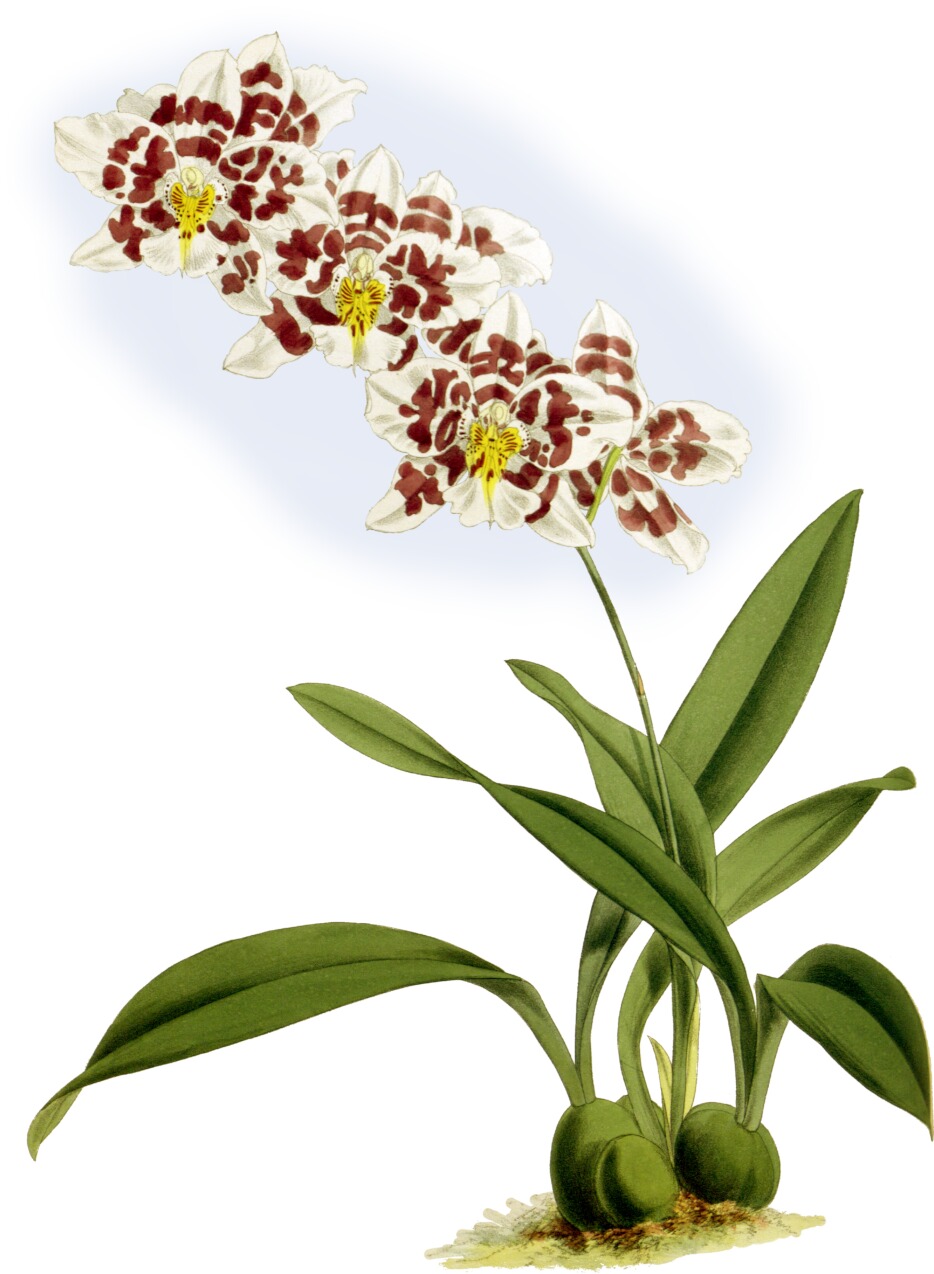
PL. 68. ODONTOGLOSSUM PESCATOREI VEITCHIANUM.
40