PHALÆNOPSIS MARIÆ. [Plate 80.] Native of the Eastern Archipelago.
Reading edition
PHALÆNOPSIS MARIÆ. [Plate 80.] Native of the Eastern Archipelago.
Epiphytal. Plant stemless, with flat aërial clinging roots. Leaves deflexed, distichous, oblong or ligulate, acute, somewhat channelled, two inches or more in width, stoutish in texture, dark green, glossy, obscurely striate. Scape radical, bearing a many-flowered drooping raceme, shorter than the leaves, and proceeding from their axils. Flowers of medium size, elegantly coloured; sepals narrowly-oblong, bluntish, about an inch long, the lateral ones slightly falcate, white, with about six bold transverse bars or blotches of a deep chocolate red, the basal spots magenta-coloured like the lip; petals shorter, broader and more obovate, marked in a similar manner, but with fewer blotches, the colour being the same as in the sepals; lip obovate oblong, apiculate, convex, somewhat constricted at the sides, of a rich deep magenta-rose, the middle lobe plane not pilose. Column short, white, without fringes at the apex.
Phalænopsis Mariæ, Reichenbach fil. M.S.
In this little Moth Orchid we have a very pretty novelty, for the opportunity of figuring, which we have to acknowledge our indebtedness to the Messrs. Veitch and Sons, of Chelsea, for whom the plant was collected by Mr. F. W. Burbidge, now the energetic Curator of the Trinity College Botanic Gardens, Dublin. Mr. Burbidge has been good enough to inform us that the plant was found in a totally new habitat, at an elevation of 2,000 feet above the sea level. Only four plants were originally found, although a large sum was offered for specimens of it to the natives, in whose language it is known as the Rain-flower, on account of its opening its first blossoms at the commencement of the wet monsoon. Mr. Burbidge adds that it was discovered by him “when travelling in the Eastern Archipelago for the Messrs. Veitch, and that it has been named by Professor Reichenbach in compliment to Mrs. Burbidge.
“At first sight the plant both in its habit of growth, and in its blossoms, is suggestive of Phalænopsis sumatrana, especially the beautiful variety of that species known as lilacina, but in P. Mariæ, there is no brush-like apical lobe to the lip, nor is the apex of the column fringed as in that species. The bold amethyst-coloured blotches on the snow-white sepals and petals are very lovely, and, although the flowers are not so large as those of some others of its congeners, it affords, nevertheless, another illustration of the pleasing beauty of mountain flowers. It has a singularly hardy constitution, and so bears the vicissitudes of transit better than many of its allies.”
65
Though this new species is not so showy as many other kinds, it is quite worthy of a place in the most select collection, the flowers being exceedingly pretty and very pleasingly coloured. It has bloomed with the Messrs. Veitch during the past year, and was exhibited by them, and greatly admired at one of the Royal Horticultural Society’s Meetings. It is of this plant, thanks to the importers, that our artist was allowed to avail himself in preparing the figure we now publish.
It produces drooping foliage of a light green colour, and bears several flowers in a pendent raceme. The sepals and petals are white, transversely barred with reddish brown and rosy purple, and the lip is of a deep rich magenta.
The plant requires the same kind of treatment as the other species of Phalænopsis, which has been already explained in connection with Plates 11 and 39 of our first volume.
Orchids at Woolton Wood, Liverpool, the Seat of H. Gaskell, Esq.—We have had great pleasure in visiting this place, and may state that we were greatly surprised to find such a fine collection of Orchids brought together in so short a space of time. Mr. Gaskell has commenced in the right way, in that he has built good houses for the various Orchids that come from different climates, and require a distinct mode of treatment. No doubt this collection will take rank amongst the finest in the country, especially as it is the good kinds only that are being added to it. This, indeed, is the only way in which a really select collection can be made; but when this is done, the plants are of real value, and every day become more and more interesting to the owner. In this case, Mr. Davis, who has the care of the plants, takes great interest in their welfare, the result being that they are thoroughly well attended to.
We noticed in the Woolton Wood collection some fine specimens of Cattleya labiata in full bloom, one plant having had several grand spikes of flowers upon it; there were also in bloom C. exoniensis, C. gigas, and a very fine C. maxima, which were extremely showy. In the same house, along with many other fine Orchids, were the lovely Vanda cœrulea, with fifteen finely-coloured blossoms; a superb variety of Cymbidium Mastersii in full beauty, and some grand Cattleyas and Lælias. We also noticed a wonderful specimen of C. Skinneri alba, such as we had no idea was to be found in the country.
In the next house was a fine lot of plants, many of them in bloom. Among the Calanthes, which make a grand show at the dull season of the year, we noticed many fine Odontoglossums, including some good varieties of O. Alexandræ in full bloom. The cool Orchids were thriving well in the different houses.
We were glad to see that Mr. Gaskell intends to have a good collection of East Indian Orchids. We noted some fine specimens of Phalænopsis, Saccolabium, Vanda, &c. These genera rank amongst the finest of their race. In addition to the Orchids there are here other valuable plants, and a nice fernery, which is always interesting, as the plants associate so well with the Orchids. We regret that our space is too limited to permit us to give further details of this charming collection.—B.S.W.
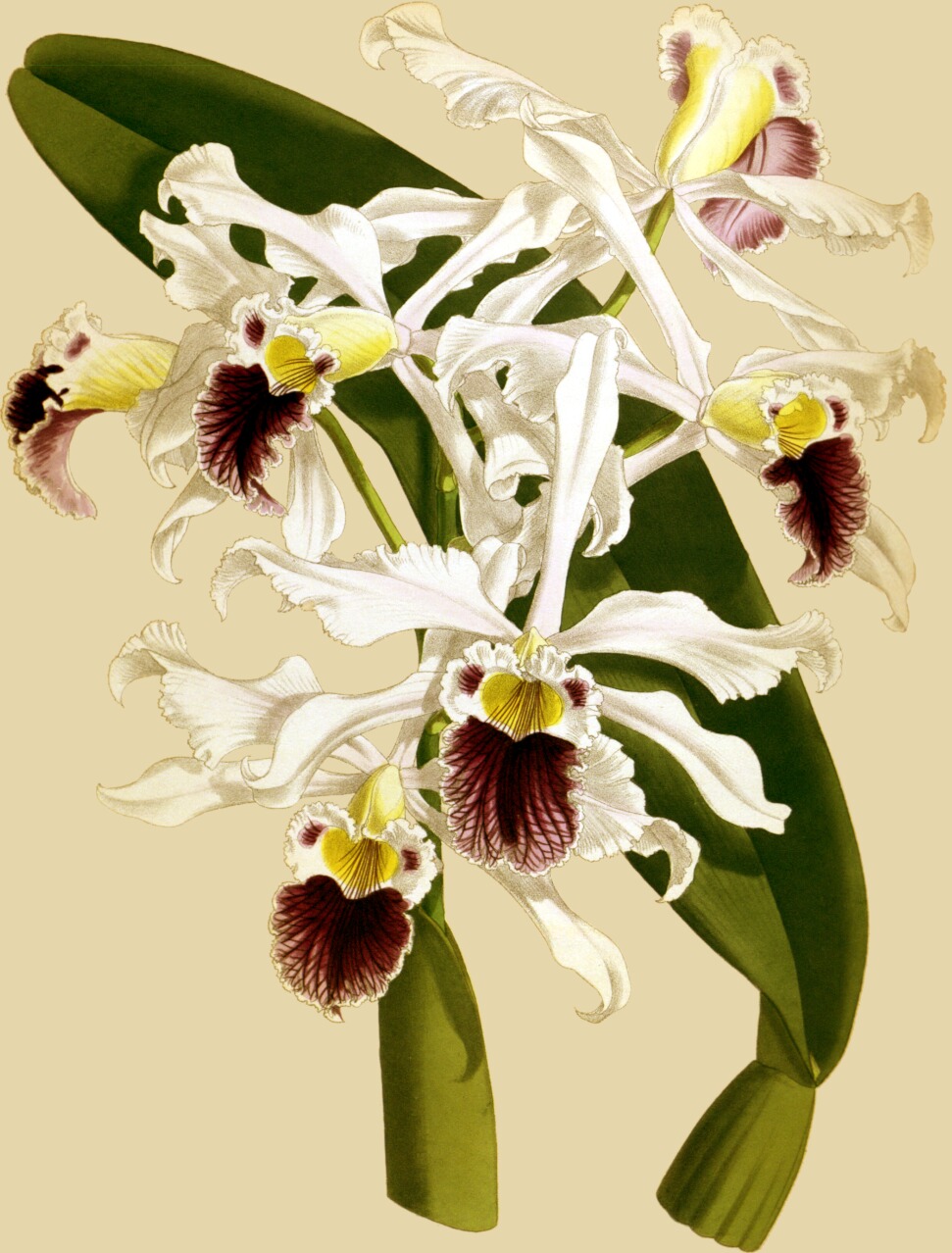
PL. 81. CATTLEYA CRISPA BUCHANANIANA.
66