CŒLOGYNE PANDURATA. [Plate 63.] Native of Borneo.
Reading edition
CŒLOGYNE PANDURATA. [Plate 63.] Native of Borneo.
Epiphytal, Pseudobulbs large, somewhat compressed, oblong ovate, bearing about two leaves at the summit. Leaves large, broadly-lanceolate, plaited, eighteen inches long, many-nerved. Scape radical, produced with the young growth, supporting a pendulous raceme somewhat longer than the leaves. Flowers numerous, rather distant, large, four inches across when fully expanded, fragrant, each one issuing from the axil of a brown cucullate deciduous bract as long as the pedicel; sepals and petals linear-oblong, acute, pale green; lip concave at the base, cordate-oblong, appearing to be panduriform from the inflection at the sides, retuse, setaceo-acuminate, the edges crisped, green marked with blackish veins and stains, the disk with three keels and two deep double-warted crests on each side, the crests converging towards the middle of the lip, where they are lost amongst a series of irregular rugged often two-lobed warts. Column green, with the edges thin and rounded.
Cœlogyne pandurata. Lindley, Gardeners’ Chronicle, 1853, 791; Id. Folia Orchidacea, art. Cœlogyne, No. 7; Hooker, Botanical Magazine, t. 5084; Bateman, Second Century of Orchidaceous Plants, t. 160; Van Houtte, Flore des Serres, t. 2139; Reichenbach fil., Xenia Orchidacea, t. 121; Id. Walpers’ Annales Botanices Systematicæ, vi., 224.
As a curiously beautiful plant this Orchid is perhaps unequalled. It is very rarely met with in a flowering state in collections, which is the more to be wondered at, as though the flowers are not bright in colour, yet on account of the peculiar association of tints—light green and black—and their large size, it makes a very attractive object. The flowers are produced upon drooping spikes from the young growths during the summer, and continue for some time in perfection.
Cœlogyne pandurata is a native of Borneo, where, according to Mr. Low, it is common on trees, in shady places overhanging water. It thrives best in the temperature of the Cattleya house, and during the period of growth requires a good supply of water. After the growth is complete, less water must be given, until it begins again to show signs of starting into fresh growth, when the supply should be gradually augmented.
The specimen here figured was flowered in the fine collection of Baron J. H. Schrœder, The Dell, Staines, under the care of Mr. Ballantyne, the gardener, who seems to be very successful in the cultivation of this interesting plant.
The root material in which we find it to succeed best, is a compost of peat, with a little moss and charcoal added. It does well either in a pot or in a basket, suspended from the roof, but should be well shaded from the sun, as too much 31 sunlight causes the leaves to become spotted and look sickly, and this is very detrimental to the plants. It will be found to be a very free-growing species, when it obtains the treatment it requires.
The plant is propagated by separating the pseudobulbs just before they start into growth.
Orchids in France.—The Chateau de Ferrières, the country seat of Baron Alphonse de Rothschild, in the department of Seine et Marne, is situated about 33 kilometres from Paris, and about two miles from the station Ozouer la Ferrière, on the Ligne de Mulhouse. Orchid growers, when in Paris, would do well to pay this wonderful place a visit, since it is unequalled both for size and beauty by any other place in France. Here Orchids are well cared for, Mr. Bergman, the gardener, being very successful in their cultivation, admirably seconded as he is by his son, who passed some years in this country, studying gardening in all its branches.
Commencing with the Vanda house we were pleased to find these noble plants so much at home, there being several remarkable specimens of V. suavis, V. tricolor, and V. tricolor insignis, marvels of cultivation. Vanda cœrulea is doing well and flowering profusely. V. Lowei is represented by a plant of enormous dimensions, having four strong growths, and is one of the finest plants we have ever seen. The species of Phalænopsis are also well grown here, in company with the Vandas, and right well do they seem to like their company, since there are some wonderful plants of nearly all the species, thriving well and making strong flowering spikes. In the Cattleya house are some fine healthy plants of all the best species and varieties thriving admirably. Mr. Bergman gives his plants plenty of light, which causes them to look somewhat yellow, but he gets his bulbs ripened off well, and flowers them in greater profusion. Passing from here to the new Odontoglossum house we find a grand collection of these favourite Orchids. These plants are grown very largely here, as cut Orchids are in great request.
In another house are some other fine Vandas, associated with ornamental Stove Plants. Doing well in the same house, near the door, are a quantity of plants of Vanda teres, planted out in a compost of moss and charcoal, which is kept together on the stage of the house by a wirework edging. Here the plants are allowed to grow freely until they touch the glass, when they are cut down and replanted. All the light possible is given them, together with a copious supply of water, and the plants flower luxuriantly every year. Mr. Bergman, Jun., informed us that last year 651 flowers were cut from these plants. We recommend cultivators to give this plant a trial in the way above described, as it is one of the richest gems of the Orchid world. Cœlogyne Massangeana was doing well; one plant, having ten spikes, was suspended from the roof, and was an object never to be forgotten.
H. Williams.
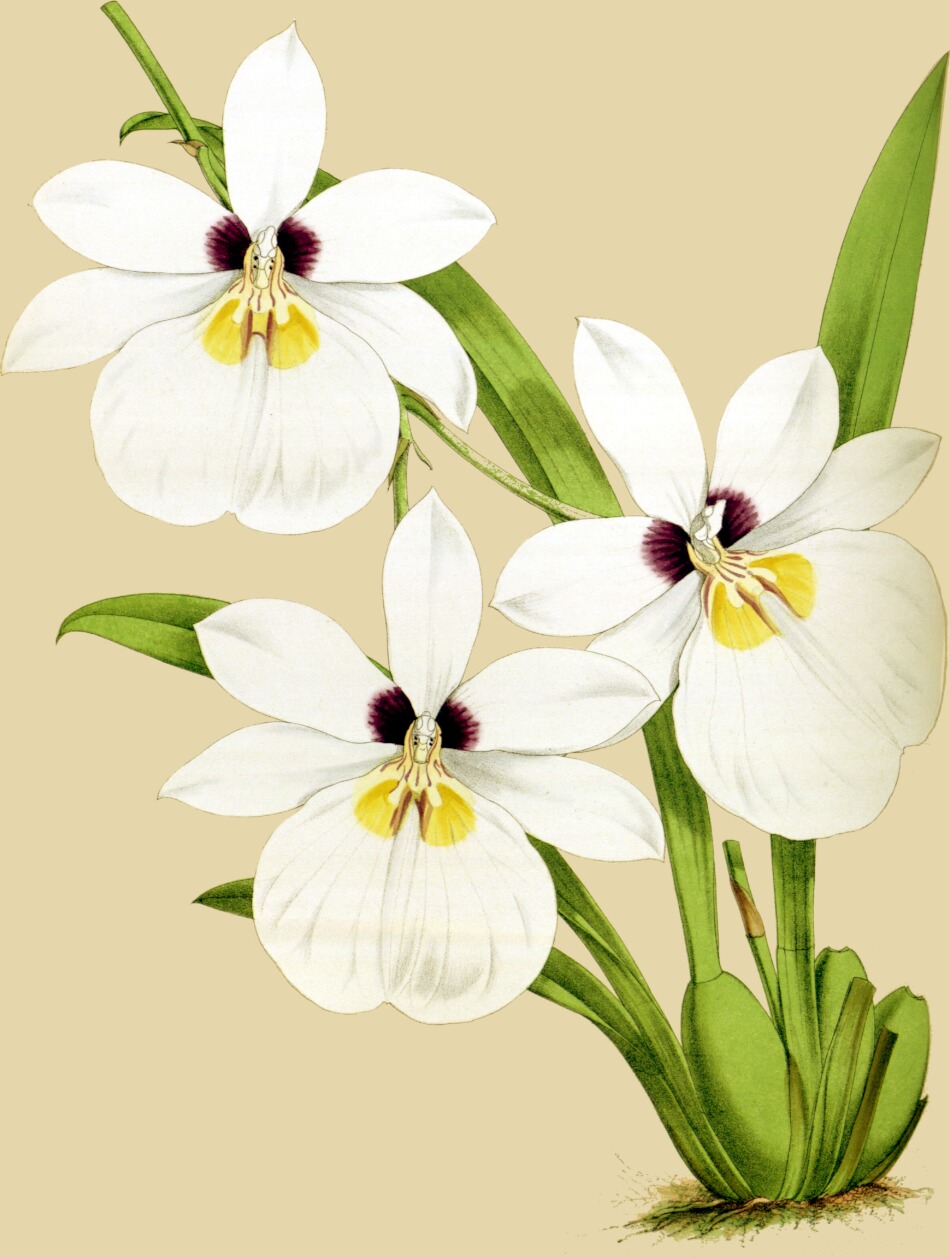
PL. 64. ODONTOGLOSSUM ROEZLII.
32