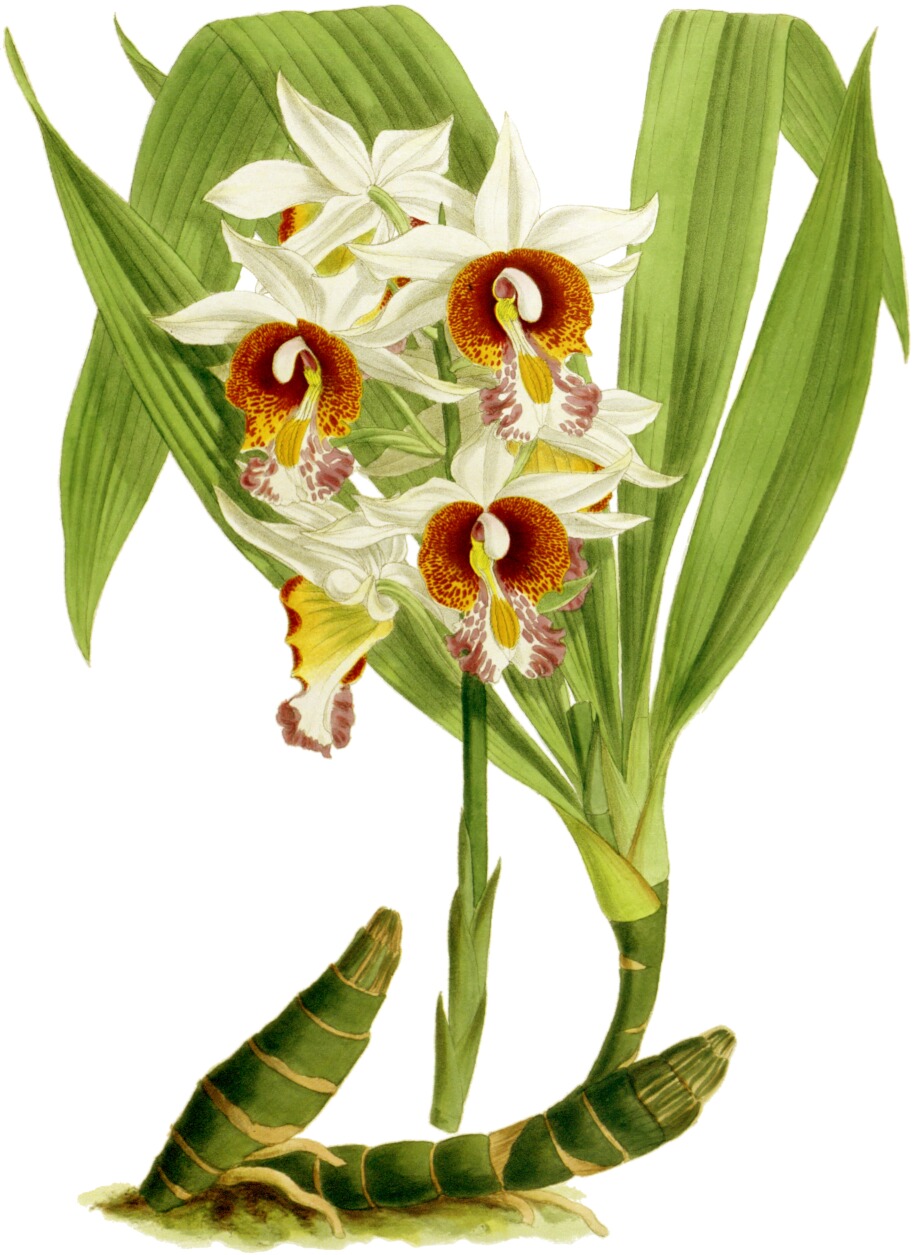
ODONTOGLOSSUM CORADINEI. [Plate 90.] Native of New Grenada.
Reading edition
ODONTOGLOSSUM CORADINEI. [Plate 90.] Native of New Grenada.
Epiphytal. Pseudobulbs elongate-ovate, compressed, somewhat ribbed, usually diphyllous. Leaves narrow, ligulate, or ligulate-oblong, acuminate, of a deep green colour, an extra one or more sometimes sheathing the base of the pseudobulbs. Scape radical, with small triangular bracts supporting a slender spreading raceme of nine to ten flowers, which forms a neat spike of about a foot in length. Flowers stellate, somewhat over three inches in breadth and length; sepals lanceolate, tapered to a long narrow point, pale yellow, with about two large irregular sometimes broken spots of chestnut-brown at some distance from the base; petals similar in form and colour, one inch and a half long, marked with a large often bipartite spot at a considerable distance from and one or two smaller spots nearer the base; lip shorter than the petals, obovate-oblong, apiculate, contracted in the middle, paler yellow, with a squarish spot of chestnut-brown on the middle or contracted portion, and a few spots or blotches near the base, where there is a crest of two upcurved horns. Column whitish, semiterete, with brown blotches in the sub-rhomboid wings, which are denticulate on the outer edge.
Odontoglossum Coradinei, Reichenbach fil., in Gardeners’ Chronicle, 1872, 1068, fig. 251; Id. Xenia Orchidacea, ii. 208, t. 192, figs. 1-4.
This is one of the numerous imported forms of Odontoglots which are supposed to be natural hybrids, many of which are so beautiful and so much sought after, becoming greater favourites as time passes. We are by no means surprised at the growing taste for this charming Orchidic genus, since the plants are of easy culture, require nothing but cool treatment, and their flowers, which are of long duration, are borne on graceful spikes.
The form we now represent is distinct in colour, and comes in as a good contrast with the varieties of Odontoglossum Alexandræ (crispum)—a contrast which it should always be sought to establish in making a collection, in order to produce a picturesque effect in the house, since the different varieties when associated show each other off to advantage.
The plant was found in New Grenada by the collectors Chesterton and Coradine, and was named by request of the former (who has lately died) in honour of his companion in travel. It appears to be a hybrid between Odontoglossum triumphans and some of the O. odoratum group, and would seem to be somewhat variable in character. The sketch we publish was taken from a plant in the collection of Robert Warner, Esq., Broomfield, near Chelmsford, who has the largest and finest collection of Odontoglots we have seen, extending to about twelve thousand plants. 85 In this collection we have seen many hundred spikes of O. Alexandræ (crispum)—and other kinds in bloom at the same time, and, arranged as they were in two long houses, the sight was a glorious one, never to be forgotten. A similar magnificent display is obtained every year.
Odontoglossum Coradinei, which is very rare, forms a compact-growing plant, furnished with lively green foliage, and producing its flowers, about nine in number, on a drooping spike; the sepals and petals are primrose colour, spotted with a warm brown, and the lip is primrose, with an oblong spot of brown in the centre. The plant blooms during winter, and lasts for several weeks in full beauty. It requires to be grown in the cool house, and should have the same temperature and treatment as O. Alexandræ.
Mr. Lee’s Vandas.—We were favoured recently with a box of Orchid flowers from W. Lee, Esq., Downside, Leatherhead. The box contained twenty-one grand spikes of varieties of Vanda suavis and V. tricolor, amongst which were some of the finest forms we have ever seen. It was, indeed, a feast of Vandas to have so many fine varieties side by side. Amongst the varieties of V. tricolor were many forms—from a pale variety with a whitish ground up to the most superbly marked one of the series, which Mr. Lee calls the “Downside” variety. The markings of this gem are very rich and distinct, the spots being well defined, of a bright chestnut-brown, and the lips a rich magenta. V. tricolor Patersoni and V. tricolor superba were quite in the shade by the side of this great beauty. V. tricolor Warnerii was also grand, but of a different type to the last-mentioned plant, having rosy margins around the sepals and petals; this plant is well figured in Warner’s Select Orchidaceous Plants.
Of Vanda suavis there were some magnificent forms, one, marked Lee’s variety, being especially fine; this had thirteen flowers on the spike; the sepals and petals were of fine form, with distinct pale brownish-crimson spots. In some cases the spotting of this variety is very peculiar, especially on the lower parts of the sepals and petals, where the spots or stripes are from half an inch to three-fourths of an inch long, rendering the markings very distinct.
Accompanying the Vandas was a fine variety of Cattleya Mendelii, called Jamesiana, with rose-coloured sepals and petals, and a broad well-fringed lip, two inches across, of a bright magenta, with the throat yellow, streaked with dull purple; the petals are distinctly blotched with bright magenta at the apex.—B. S. W.
PL. 91. PHAJUS TUBERCULOSUS.
86