EULOPHIA GUINEENSIS PURPURATA. [Plate 89.] Native of West Tropical Africa.
Reading edition
EULOPHIA GUINEENSIS PURPURATA. [Plate 89.] Native of West Tropical Africa.
Terrestrial. Pseudobulbs short, roundish-ovate, marked near the apex with one or two annulate scars, indicating the bases of former leaves. Leaves with an oblong-oblanceolate acuminate blade six inches long, narrowed below into a petiole of about half the length, somewhat plicate. Scape arising from the base of the pseudobulb, twelve to fifteen inches high, including the raceme of seven to ten flowers, furnished at intervals with pale brown sheathing bracts, which become smaller upwards. Flowers pedicellate, spurred, remarkable for their narrow dark sepals and petals and their broad highly-coloured lip; sepals about an inch long, linear acuminate, deep rosy purple, the lateral ones spreading horizontally; petals directed upwards between the erect dorsal and the spreading lateral sepals, and similar to them in size, form, and colour; lip three-lobed, the front lobe roundish-ovate pointed, about an inch and a quarter in length and in breadth, wavy at the margin, of a rich bright magenta, traversed by deep crimson flabellate veins, which become deep rosy purple as they converge towards the base when they suddenly stop, the extreme base being white; the side lobes are short and blunt, of a blush. Spur slender, deep purple, three-fourths of an inch long. Column bent forward, rosy purple, slightly keeled at the back.
Eulophia guineensis purpurata, Reichenbach fil., in Kotschy’s Plantæ Binderianæ Niloticæ Æthiopiceæ, 3; Kotschy, Plantæ Tinneanæ, 63.
Eulophia is a small genus of Orchids of which a few species are known in cultivation. The one we now describe is a most beautiful and distinct variety of a species which was cultivated many years since, and one that everyone may admire. Our drawing was taken from a specimen in the grand collection of Sir Trevor Lawrence, Bart., M.P., Burford Lodge, Dorking. It is a very rare plant, and is most difficult to import from its native habitats. It is also supposed to be difficult to establish, but it is so rare that few persons have had the opportunity to try it. Sir Trevor Lawrence manages to cultivate it very successfully, and we have also seen it well grown in the Collection of H. Shaw, Esq., of Buxton, who has also flowered it. We have heard of very few other plants, and, therefore, we should like to see a good importation of it, as many cultivators would, we are quite sure, be glad to possess such a gem.
Eulophia guineensis purpurata produces small oval-shaped pseudobulbs, and has light green plicate foliage, ten inches or a foot in height. The flower stem is produced from the base of the bulb with the young growths, and reaches to a 83 height of eighteen inches, terminating in a spike of ten or more flowers. The sepals and petals are brownish purple, veined with a darker brown, and the lip is magenta-rose, veined with a darker magenta, the throat being white. It blooms in September and October.
Being a terrestrial Orchid it is best grown in a pot, with good fibrous loam, leaf soil, and sharp river sand; a little charcoal should be mixed with the soil, and good drainage is essential, since a moderate supply of water during the growing season is needed. When at rest only just enough water should be given to keep the bulbs plump. We have found it do well in the Cattleya house, placed as near the light as possible, but shaded from the hot sun. The leaves being thin they are apt to scorch. It is propagated by dividing the pseudobulbs, leaving one old pseudobulb along with the new one.
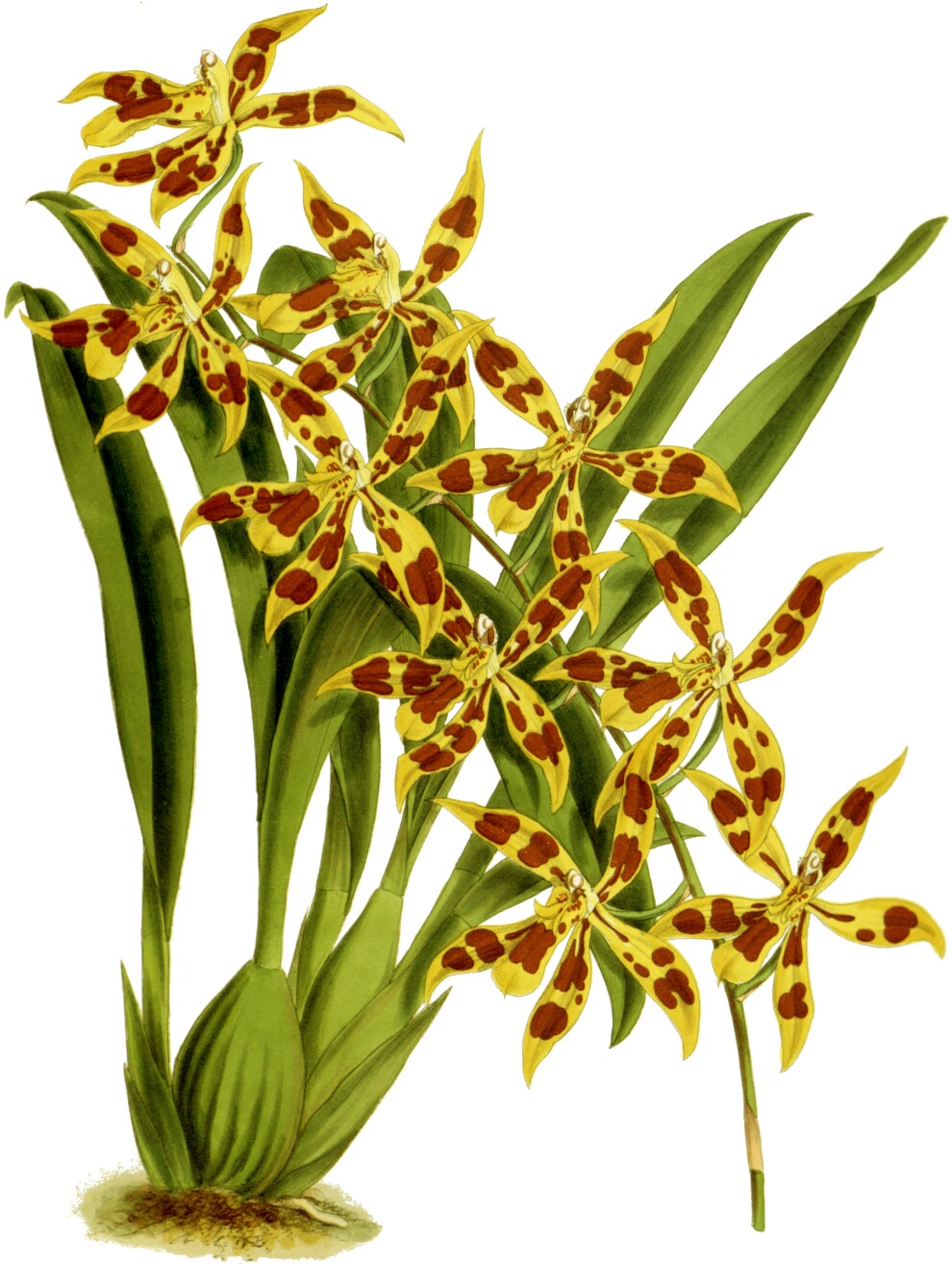
Odontoglossum triumphans.—We have received, through the post, from J. Gordon, Esq., Aikenhead, Cathcart, near Glasgow, flowers of two distinct varieties of this beautiful species, varying both in size and in hue. One variety was of large size, and very bright in colour, the sepals and petals being of a clear golden yellow, barred and spotted with brownish-crimson, and the lip white, with the throat yellow, and the apical portion brownish-crimson. The other variety was smaller, and as Mr. T. Hogg, the gardener, informs us, was from a pseudobulb with two spikes bearing twenty-nine expanded flowers; in this the sepals and petals were nearly all brownish-crimson, with very little golden yellow, the lip white, with a large irregular blotch of brownish-crimson on the antical portion—B. S. W.
PL. 90. ODONTOGLOSSUM CORADINEI.
84