CATASETUM CHRISTYANUM. [Plate 83.] Native of the Amazon Country.
Reading edition
CATASETUM CHRISTYANUM. [Plate 83.] Native of the Amazon Country.
Epiphytal. Stems stoutish, fusiform, jointed, six to eight inches long, and clothed with whitish membraneous sheaths. Leaves several from the apex of the younger stems, lanceolate-lorate, acuminate, plaited, the basal part channelled and sheathing the upper part of the stems. Scape radical, bearing an erect six to seven flowered raceme, with distinct sheathing scales below. Flowers remarkable in form, large, spreading, brown and green, each with a narrow bract at its base; sepals lanceolate-acuminate, the dorsal ones erect, the lateral ones spreading horizontally, dark reddish or chocolate brown; petals connivent, parallel with the dorsal sepal, of a lighter brown, obscured, spotted with still paler brown at the base; lip short, with a bluntly conical saccate pouch, and a three-lobed limb: the front lobe obovate apiculate, bent down on both sides, olive-green, ciliate with short brown fringe-like teeth, the lateral lobes squarish, bright green, with much longer purple fringes, the spur or pouch pale brown outside, darker brown within, and having a square oblong mouth with the front margin nearly straight, and the hinder margin with two upright emarginate lamellæ. Column green, with a long erect green subulate inflexed beak, on two deflexed setæ below the anther bed, green, curving outwards like tusks.
Catasetum Christyanum, Reichenbach fil., in Gardeners’ Chronicle, N.S., xvii, 588.
The subject of our present illustration belongs to a most peculiar family of Orchids, and one which is especially interesting to those who are fond of curiosities. “Take Cataseta into your stoves,” observes Professor Reichenbach, “and you are pretty sure to become more or less bewitched, earlier or later.” No doubt they are full of interest to the botanist, but they are not so useful for purposes of decoration, nor so attractive as objects of beauty as are many others of their race. Possibly, however, some of our readers may admire the peculiar forms and colours of this flower, more than the showy and bright shades we so often meet with among the infinitely varied genera of Orchidacæ. It has been pointed out that the close affinity of this plant is with Catasetum saccatum, a Demerara species introduced in 1840. It is certainly a very remarkable Orchid, and our artist has made a very faithful representation of it from a specimen growing in the collection of Thomas Christy, Esq., Malvern House, Sydenham, after whom it is named, and who not only possesses many new and rare species, but also takes great interest in their cultivation. Catasetum Christyanum is a deciduous species, with fusiform stem growing about eight inches in height. It produces its flower-spikes from the base of these stems, on erect scapes bearing in each spike about half a dozen flowers. The sepals 71 and paler petals are of a dull purplish red, which is relieved by the green of the lip. The plants usually bloom during the autumn months, but we believe the blossoms do not last very long after they have expanded.
Mr. Christy has bloomed another variety of the same plant, with smaller and greener flowers, which has been called C. Christyanum chlorops.
We find the different species of Catasetum to thrive very well in the Cattleya house, if provided with fibrous peat and good drainage at the roots, and suspended from the roof of the structure in baskets. They must not receive too much water at any time, and when their growth is completed they should only have just sufficient to keep them in a plump condition, as they have thick fleshy bulbs to be maintained fresh and healthy during their resting season.
Lælia superbiens.—We received from A. H. Smee, Esq., the Grange, Carshalton, a fine spike of flowers of this noble Orchid, forming in itself a most beautiful bouquet, the sepals and petals were of a rosy pink, the lip dark rose colour, with the throat of a primrose-yellow, veined with rosy purple, the upper part dark rose. It is altogether a charming winter-blooming species, but it is seldom seen. Mr. Smee is a great lover of Orchids, and is beginning to make a collection, in which already some rare species appear. He is trying experiments in their cultivation, and we are inclined to think that many plants will succeed under his treatment. The house is a very peculiar one; we have not seen one like it before. It is a long house, and in it there are different temperatures kept up, so that the different Orchids can be grown in the same house. Many plants were in bloom when we saw the collection in January last. The place is a very interesting one, and in the summer must be very charming on account of the great variety of Ferns and other plants that are grown there, almost all kinds of plants being cultivated. The garden must be a source of great enjoyment to the owners, as both Mr. and Mrs. Smee take much interest in their Orchids and other plants.—B. S. W.
Cattleya Trianæ Russelliana.—We were highly delighted to see this old favourite the other day at Baron Schröder’s, where it was flowering profusely. The plant was in a fourteen-inch pot, and had as many as eight spikes, bearing in all sixteen flowers. In the same house were several other fine varieties of C. Trianæ, including C. Trianæ Backhousiana, but C. Russelliana was a long way in advance of anything there represented, in fact there is no doubt it is the finest variety of the dark-lipped section of C. Trianæ at present known. The lip of this variety is two inches across, and the colour, which is well carried back into the throat, is a most intense crimson-magenta. There is no margin of a lighter tint as in many of the other varieties, but the rich colour is as dark at the margin as in the centre. In addition to this the flowers are of great substance.—H. W.
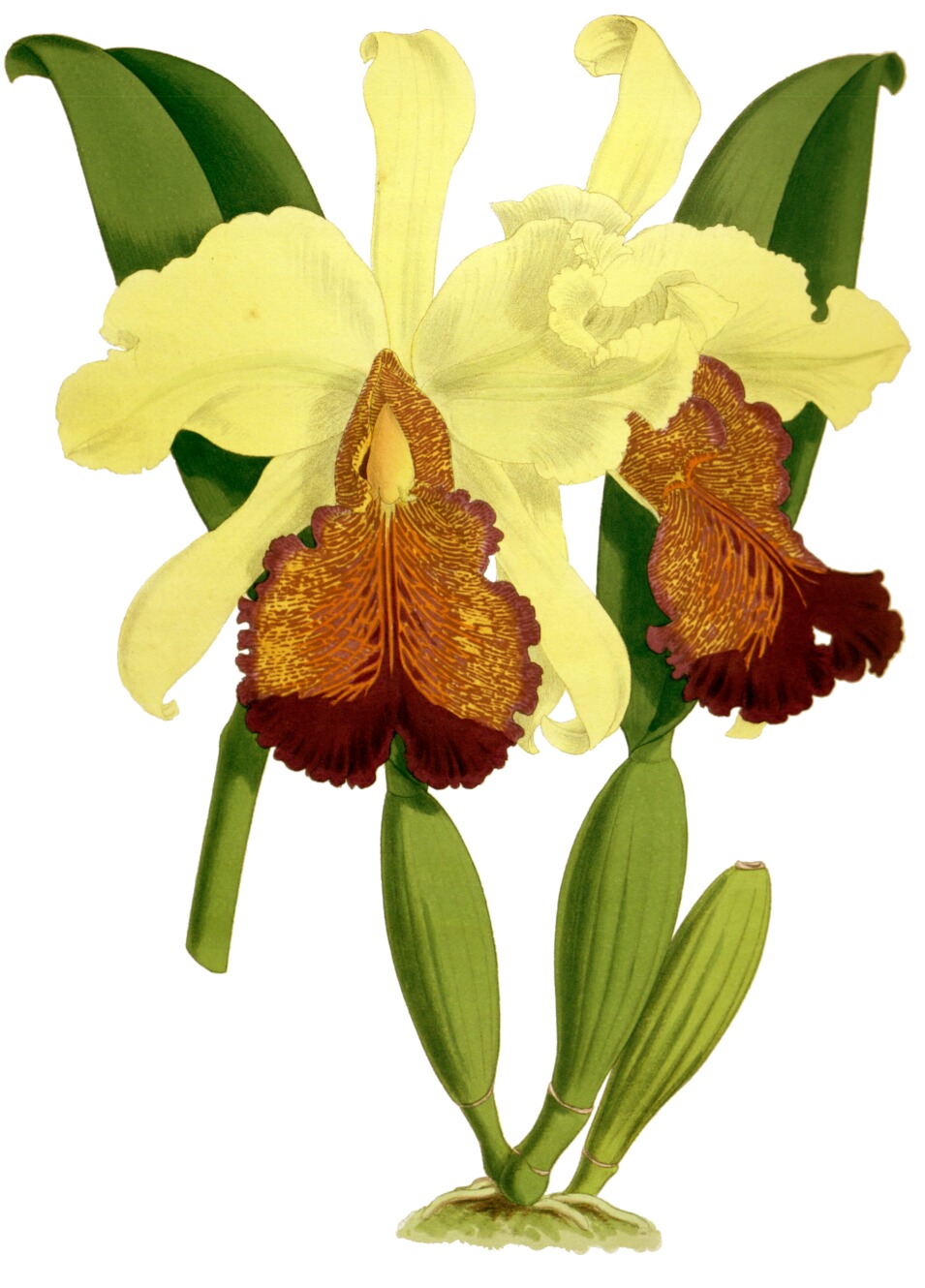
PL. 84. CATTLEYA DOWIANA AUREA.
72