ODONTOGLOSSUM HEBRAICUM LINEOLIGERUM. [Plate 85.] Native of New Grenada.
Reading edition
ODONTOGLOSSUM HEBRAICUM LINEOLIGERUM. [Plate 85.] Native of New Grenada.
Epiphytal. Pseudobulbs elongate-ovate, compressed, upwards of two inches in height, pale green, brownish in age. Leaves, one or two springing from the apex of the pseudobulb, and frequently with a smaller one from its base, ligulate-oblong acute, nine inches to a foot in length, bright green. Scape supporting a dense elongated raceme of elegant flowers, radical, that is springing from the base of the pseudobulb. Flowers large, upwards of three inches in breadth and depth, the ground colour at first yellow, afterwards changing to creamy white, and freely spotted with purplish crimson; sepals lanceolate, attenuately acuminated, pale yellow, marked thickly on the lower half with deep purplish crimson, in bars and elongated blotches, which are sometimes confluent, the edges slightly wavy; petals similar in size, form, colour, and marking; lip elongate-triangular, or narrowing from a broad base to the acuminate apex, toothed and undulated at the margin, pale yellow, deeper at the base, where there are placed a pair of prominent divergent crests, very sparingly spotted with the same colour as the sepals. Column arcuate, club-shaped, with the wings toothed.
Odontoglossum hebraicum lineoligerum, Reichenbach fil., in Gardeners’ Chronicle, N.S., xix., 44.
This beautiful plant was first flowered by Charles Winn, Esq., of the Uplands, Selly Hill, near Birmingham, and was by him submitted to Professor Reichenbach, who gave it the name here adopted. It has also been flowered by Mr. Cypher, of Cheltenham, who has kindly forwarded one of its pseudobulbs for description, and from whom we learn that while on the imported bulbs two leaves were developed, the bulbs formed in this country have as yet only borne a single leaf. It is a very distinct variety, and will make a charming companion to the already famous Odontoglossum hebraicum, of which but few specimens have yet been introduced into our Orchid-houses. They will form welcome associates of the better forms of O. Alexandræ, which are among the most useful of all Orchids for decorative purposes, and of the best of which we hope to submit to our subscribers at some future time a series of authenticated figures. Among them are to be found some plants bearing pure white flowers, while in others the blossoms are beautifully spotted with crimson and reddish brown, or have the sepals and petals suffused with a delicate rose colour. Mr. Winn, in whose fine collection the plant now illustrated was bloomed, has a very choice lot of these cool Odontoglots, which are well cultivated by his gardener, Mr. Shields.
75
There is no doubt that under good treatment the Odontoglots requiring what is called cool treatment are among the most accommodating of Orchids for the amateur, as they take but little room and require but a small amount of heat. Moreover, they thrive well in the suburbs of our smoky cities and towns, such as Birmingham and Manchester, or even in the cities themselves, if a small well-appointed house can be provided for their accommodation; for as they will do well without much sun, the back of a north wall will suit them well, provided they get plenty of light and air, while the fire-heat required in growing them forms but a small item of expense. There are besides many cool orchids of other genera that may be grown in the same way, many of which may be purchased at a very small cost.
This interesting Odontoglossum is a compost-growing plant, like the type, and appears to be a free bloomer. The flowers, as we learn from Mr. Winn, open of a pale yellow, and are richly spotted and barred with purple-crimson, the lip also being pale yellow, and spotted, though in a less degree, with purple-crimson, but after about two days the ground colour changes to creamy white. They remain for a long time in a fresh state if kept from the damp. The plant requires the same treatment as Odontoglossum hebraicum and O. Alexandræ. We find rough fibrous peat, with good drainage, to suit them all well; a little broken charcoal and crocks mixed with the peat being of great benefit to them. It must be borne in mind that they must not be potted too firmly, as their roots differ from those of hard-wooded plants, which require that kind of potting. With these, on the other hand, the more porous the soil is kept the better, since they require a good deal of water about their roots at most times of the year, and it then passes away more freely. Another important item in their treatment is to raise the plant one or two inches above the rim of the pot. A little sphagnum moss placed on the top of the peat is beneficial to them, if it can be kept in a growing condition, as it maintains a nice moisture about the plant. If the moss should become decayed it must be removed, and some fresh living sphagnum applied. The plants will grow without the moss, but we prefer to use it. Avoid overpotting, which is often detrimental to them, for they do not require too much of the potting material about them; the pot should, in fact, be just large enough to hold the plant, and to admit a small quantity of the material being placed around it. A temperature of 45° to 50° in winter, and from 50° to 65° in summer, suits the Odontoglots of the Alexandræ section. In summer, indeed, they can scarcely be kept too cool.
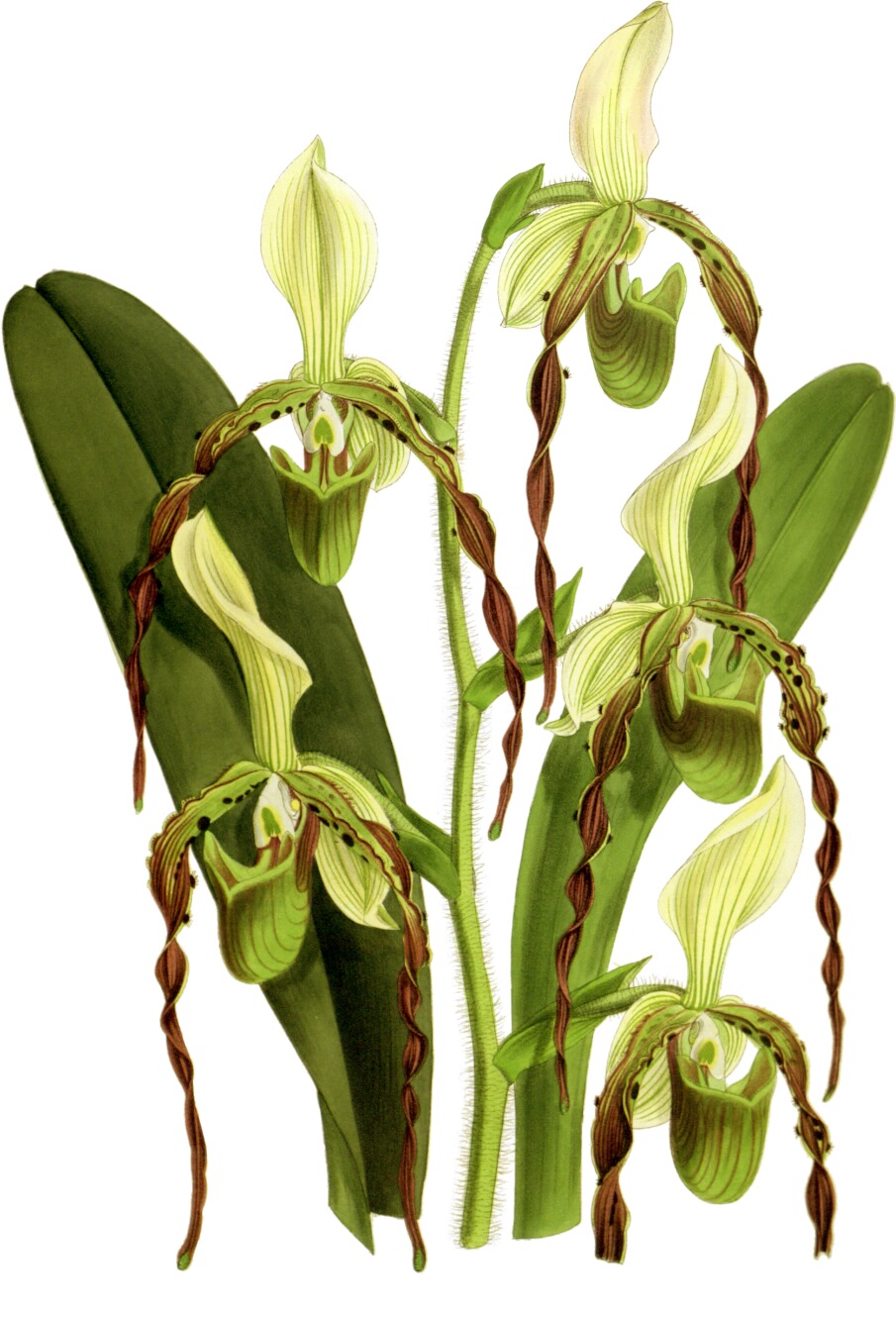
PL. 86. CYPRIPEDIUM PARISHII.
76