ODONTOGLOSSUM PESCATOREI VEITCHIANUM. [Plate 68.] Native of New Grenada.
Reading edition
ODONTOGLOSSUM PESCATOREI VEITCHIANUM. [Plate 68.] Native of New Grenada.
Epiphytal. Pseudobulbs roundish or bluntly ovate, slightly-ribbed, about an inch high, diphyllous. Leaves strap-shaped or lorate-oblong, narrowed both to the base and apex, six inches long, of a deep green colour. Peduncle springing from the base of the pseudobulb, a foot in height in the only specimen which has yet flowered, bearing a raceme of about half-a-dozen flowers rather closely placed back to back at its upper end, with minute bracts at the base of their pedicels. Flowers two and a half inches across, the most beautiful which have yet appeared amongst the forms of this species; sepals oblong acute, over an inch in length, pure white, marked with two or three transverse curved bars of the richest crimson-purple or wine-purple; petals broadly ovate apiculate, slightly wavy, white, more irregularly transversely blotched than the sepals with the same rich purple colour; lip undulated at the edge, heart-shaped at the base, contracted in the middle, dilated and cuspidate at the apex, white with a few purple spots round the basal lobes, the disk including the contracted parts bright yellow, furnished on each side with a flat lacerated appendage streaked with red, having a pair of parallel plates between, and bearing a few deep red spots. Column with short lacerated wings.
Odontoglossum Pescatorei Veitchianum, Reichenbach fil., in Gardeners’ Chronicle, N.S., xvii., 588; Moore, Florist and Pomologist, 1882, 76.
There is no doubt that Odontoglossum Pescatorei is one of the most beautiful species of this extensive and exceedingly beautiful genus of Orchids. Its flowers borne in fine branching panicles, are most pleasing in their form and character, and of a chaste and lovely whiteness, besides which the plant is one of the most free-growing of the Odontoglots. There are in our collections many forms of this species, and most of them are well worthy of cultivation, the flowers being for the most part good in shape and of a pure white, which is a colour generally sought after by those who have a keen taste for floral beauty. A hundred of these gems can be cultivated in a small space, and they can now be purchased at so cheap a rate that they are within reach of everyone who can afford to erect a small house; and being really cool Orchids they require but little fire heat at any time, and none whatever during the summer months.
The variety, Veitchianum, which we now introduce to our readers, bears most charmingly and wonderfully spotted flowers, as will be seen from the accompanying plate. It bloomed last spring for the first time in the fine collection of Orchids belonging to Messrs. J. Veitch & Sons, of Chelsea, who imported it with many thousands of plants referrible to this specific type, and amongst them many 41 hundreds of good kinds have been flowered, but none approaching in richness of hue or in beauty of marking, to the one now before us. We hope the Messrs. Veitch may be fortunate enough to bloom more of the same, as cultivators will be glad to procure it for their collections. The plant in question has, we understand, now passed out of their hands into Baron J. H. Schroeder’s collection at Staines.
Odontoglossum Pescatorei Veitchianum has the same habit of growth as the type. The flowers on the specimen which bloomed last year, and was certificated both by the Royal Horticultural and Royal Botanic Societies, formed a close raceme, and were large and showy, the sepals and petals being white, heavily transversely blotched at the base with a lovely shade of crimson-purple, the lip being also white, and spotted around the base with the same colour, while the bright yellow disk was striately marked with crimson. This specimen bore several flowers on the spike, and we have no doubt that as the plant increases in strength the spikes will branch into panicles, as those of most of the plants of O. Pescatorei are branching in habit. They are graceful in appearance, and of long duration, which renders them most useful for decorative purposes, the more so as even when cut and placed in water they keep fresh for a long time. The treatment these plants require is the same as that of O. Alexandræ and the other cool-house Orchids.
The greatest pest in the cultivation of cool Orchids, and one which is consequently a great annoyance to cultivators, is a small black slug that takes up its home in the moss and about the plants, and which often eats many of the young flower spikes when they first appear. These should be sought after night and morning as it is at these periods they do their mischief. They seem to enjoy the temperature of the cool Orchid house. The method we adopt for catching them is to look the moss carefully over at once, when the spikes first appear, and be sure there are no slugs allowed to remain among it; then we place a wire round the pot, and suspend it from the roof, and in this manner we secure the flower spikes. This is done when they are young, which is the favourite time for these marauders to attack them. The plants are well worth this trouble, as after watching them for a length of time it is most annoying to find the flowers destroyed.
Odontoglossum Alexandræ.—We have received from H. J. Buchan, Esq., Wilton House, Southampton, a grand spike of a fine variety of this most variable Orchid. The flowers are large, and of fine form and substance; the sepals and petals are pure white, beautifully serrated; the lip is broad and distinctly coloured on the upper part. This is one of the best forms of O. Alexandræ we have met with. Mr. Buchan has a good collection of cool Orchids, and has been growing them for many years.—B. S. W.
Odontoglossum Jenningsianum.—R. Smith, Esq., Brentham Park, Stirling, has sent us a splendid inflorescence of this novelty. The flowers are produced in a panicle, which is much branched, and bears numerous blossoms. This species somewhat resembles a spotted form of O. Alexandræ in the markings of the flowers, but the form is more like that of O. Andersonianum.—B. S. W.
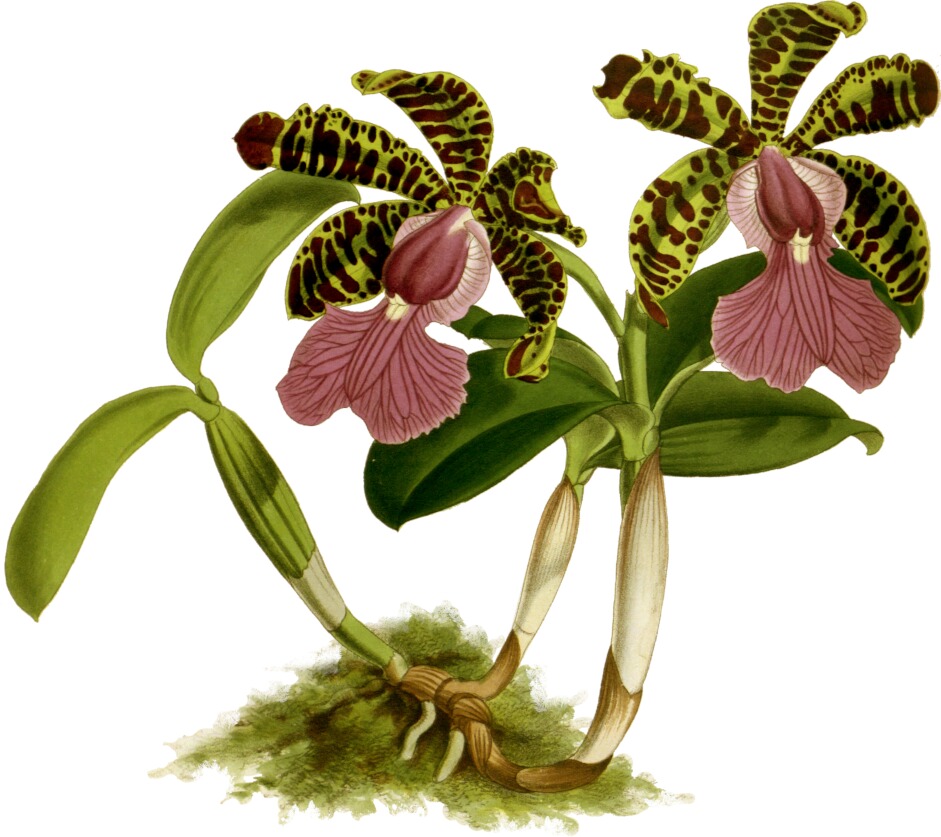
PL. 69. CATTLEYA ACLANDIÆ.
42